
Words: Trials Guru/John Moffat; Hartwig Kamarad
Photos: Trial Museum, Ohlsdorf; Eric Kitchen; Off Road Archive; Reiner Heise; Iain Lawrie & Trials Guru.

In August 2024, Trials Guru’s John Moffat was holidaying in Austria and had arranged to visit the 1. Europäisches Motorrad Trial Museum at Ohlsdorf 75kms North East from Salzburg in the Gmunden area of Upper Austria. This is very much KTM territory as the factory was situated at nearby Mattighofen and at Mondsee, this was the base of the famous gear specialist, Michael Schafleitner who made gear clusters for many racing machines in the 1960s and 70s and was a local supplier to KTM before he retired.

The museum was the brain-child of curator and trials super-fan, Hartwig Kamarad who rode trials from the 1960s until the 1980s before taking up car racing with a March, Porsche and BMW.

The museum is not easy to find without the benefit of a GPS system as it is tucked away up a small, narrow one-way street and from the outside looks like a house and garage, but behind it becomes clear that there is much more to this residential set-up.
Hartwig Kamarad is well known in the Austrian trial scene, having been a rider, promoter and organiser for many years. He is a good friend of Joe Wallmann whom he shared travel arrangements with when Joe rode Bultaco for Horst Leitner, the Bultaco importer for Austria and Germany.

In 1970, Hartwig Kamarad, was approached by Motor Sport Club Rutzenmoos, the most successful motorsport club in Austria at that time, with a package deal. The MSC Rutzenmoos tasked Kamarad with forming a trials team, with Castrol Austria providing start-up assistance and also financed the purchase of a Ford FK 1000 transport bus for Joe Wallmann and Hartwig. Autoladen Vöcklabruck paid for insurance and taxes and took care of tyres and spare parts. This enabled Wallmann and Kamarad finance the expensive trips to international trials in Italy, France, Finland, Sweden, the three remaining seats in the bus were made available to other Austrian competitors and could thus travel cheaply all over Europe. Castrol was to become a major sponsor in the Austrian trials scene for many years.

Austria has produced many fine trials riders, some rode on the International stage and included Franz Wolfgang Trummer; Joe Wallmann; Walther Luft; Walther Wolf; Gottfried Engstler; Huberl Erbler; Max Hengl to name but a few.

Luft was himself a multiple Austrial Trials Champion, as was Wallman, with Luft being factory supported by Steyr-Dailmer Puch, Graz from 1970 until 1975 when Luft made the decision to ride for KTM who were developing a trials machine. Luft was paired with former Montesa rider, Felix Krahnstover of Celle, Germany.
Museum:

We are greeted by our host, Hartwig Kamarad who is dressed in a black tee-shirt, chinos and sandals as this is mid-summer in Austria and the temperatures have been in the high twenties and although an over-cast day, it is still rather warm. We are made welcome and feel at ease with the relaxed meeting. He knew we were coming, as arrangements were made prior to the trip and he has not only arranged to show us the museum, but also to partake of some lunch, ‘mittagessen’ at a local inn just a mile or two up the road, when we can also visit the Trialgarten Ohlsdorf ‘Trial Garden’. More on this later.
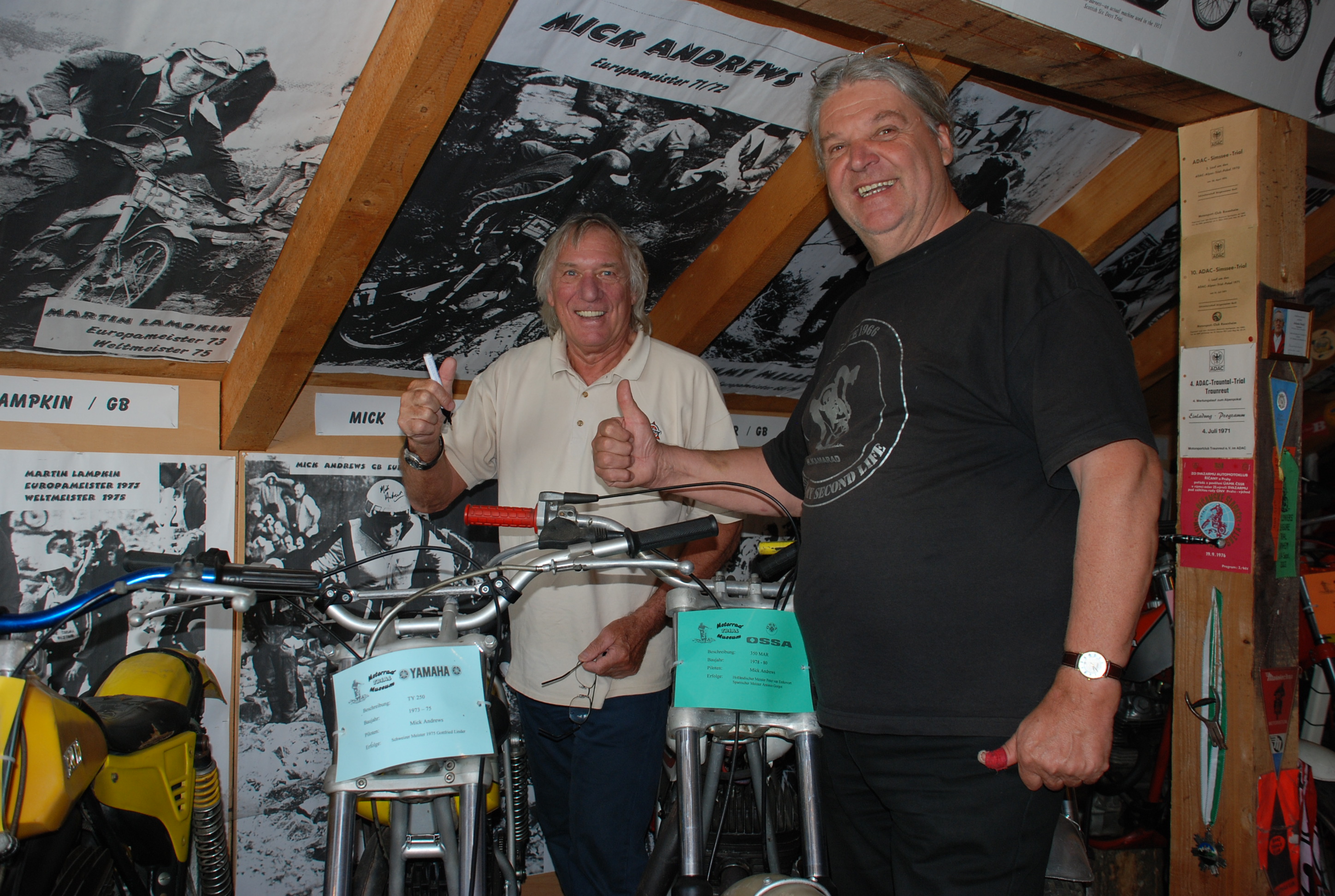
The museum is quite small in comparison to other motorcycle museums, but it is packed with interesting machines, memorabilia and exhibits from trials acros the globe. Dead centre is a Fantic 200 (Alpen Scooter) which is a trials machine converted to a tracked rear drive for use on ski-slopes. There were several of these made, some based on Bultaco Sherpa chassis with chain driven tracks.

As you approach the museum door, you spot a blue mark inscribed with a felt-tipped pen on the white entrance door with a date in 2015, this was a record of the height of the mud and water that swept down on the museum building from a maize field immediately behind, causing devastation within the museum itself. Fortunately the exhits were all saved but the dampness affected the paper based exhibits. There is now an earth embankment behind the museum, being an attempt to stem any further water and mud run off which could occur in the future.

The front window declares that you are at Europe’s first Motorcycle Trial Museum and there are some exhibits in the window. The interior is not lush, it is deliberately spartan so that the exhibits are totally visible and your eye is not drawn away by expensive decor. It’s all about the bikes and memorabilia of which there is plenty to look at and occupy your time all afternoon.
KTM:


The eye is drawn first to a very rare machine just inside the doorway. It is a 1978 KTM T325, one of four machines built at Mattighofen by the Trials Department. The trials program created 250 and 325cc versions and was with the blessing of Hans Trunkenpolz, whose father was the ‘T’ of KTM which stands for ‘Kronreif und Trunkenpolz Mattighofen’. In charge of the engineering for the trials project was Heinrich Weiditz at the KTM factory.
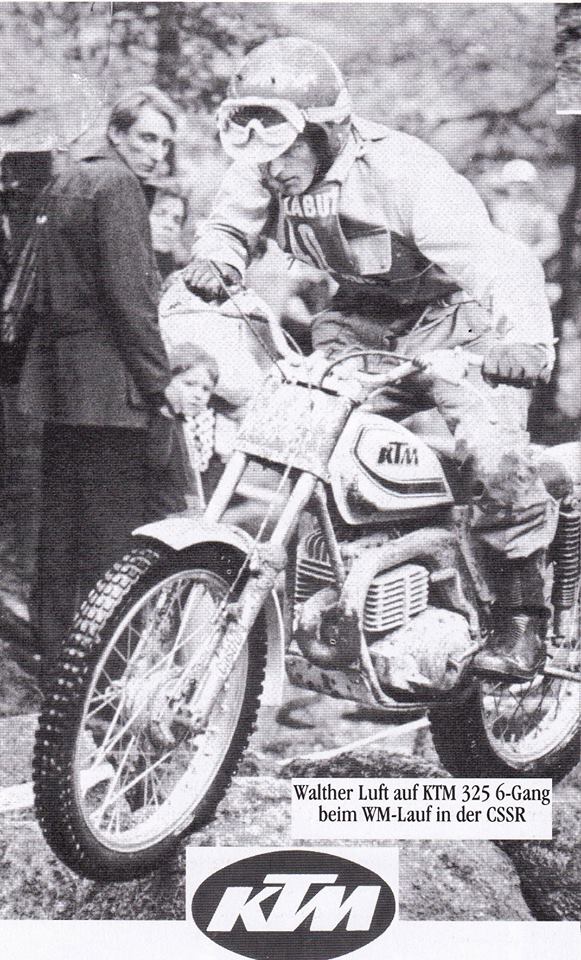
The bike on display is number 4 and was the personal machine of Trunkenpolz which has been gifted to the museum. The trials project was eventually abandoned in 1978, as KTM decided to concentrate on their enduro and motocross effort, the trials market already saturated by Spanish, Italian and Japanese built machines. After KTM pulled out of trials, Luft continued to ride and further develop his Puch and Krahnstover returned to Montesa and went on to edit the German magazine, Trialsport. Other examples of these KTM prototype machines exist in Italy. KTM T325 number 4 is probably the most prize exhibit of the museum, given it’s local connections and being an Austrian built machine.

Hartwig explains all the technical points of the KTM, it has magnesium crankcases, six-speed transmission, Bing carburettor, Marzocchi forks and has a unusual bolted-on weight on the offside front fork leg, just above the spindle housing!
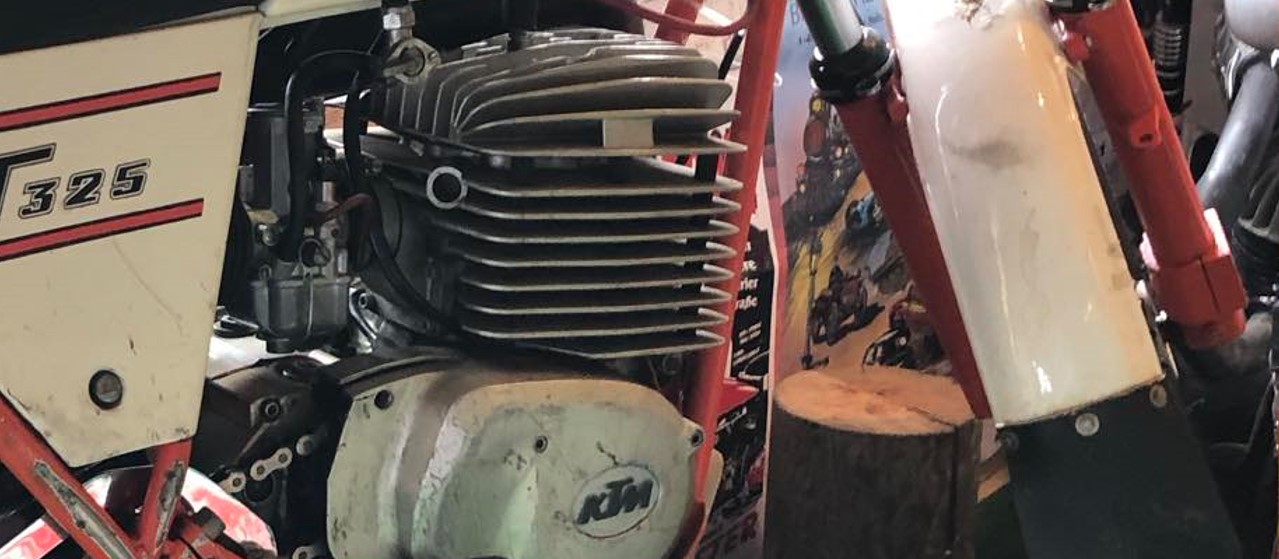
Wather Luft has looked at this feature and cannot imagine why it was fitted, however Yrjo Vesterinen had a similar attachment on his 1984 Bultaco to add a little weight to keep the front end down under accelaration up steep sections.

Presentation:
The machines in the museum have not been messed about with or restored to concours condition, they are exactly as purchased by or entrusted to the museum. This is true ‘patina’ and many prefer this state of presentation.
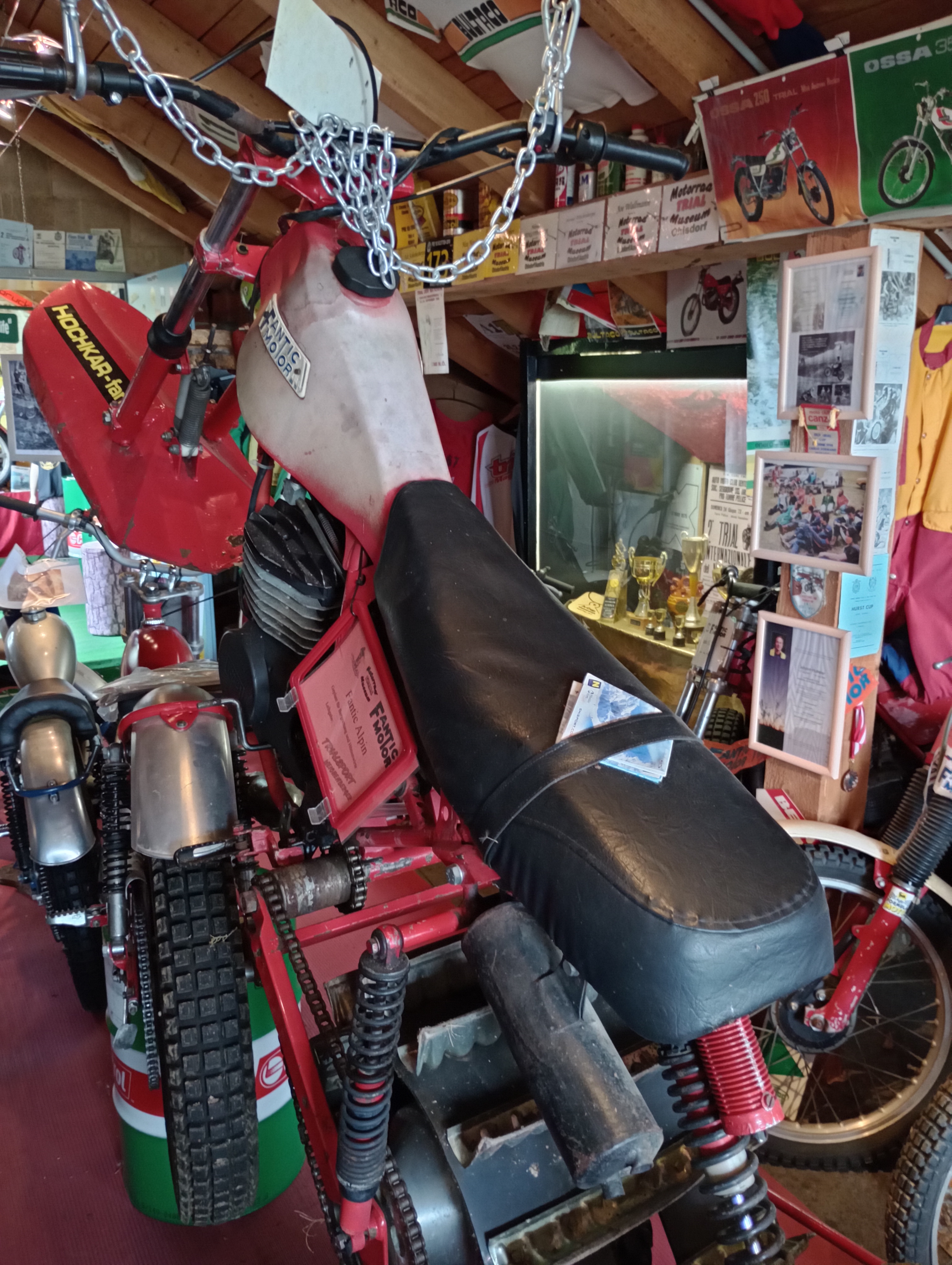
Probably the most unusual trial exhibit is the quirky trials-half-track, Fantic Alpen Scooter 200 as used in the Italian Tyrol on ski-slopes.
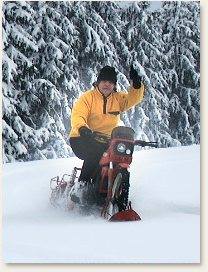
The front wheel is removed and fitted by a nose ski and the drive is modified to turn a set of tracks for the snow. These machines were popular in the 1970s and 1980s. There has been Fantic and Bultaco powered variants.

Still on the snow subject, sitting in a corner is a pair of skis, made by Austrian ski manufacturer, Atomic. But these don’t carry the usual Atomic logo but that of Spanish motorcycle manufacturer, Bultaco! This was done as a venture by Horst Leitner of Bruck an der Mur, the Bultaco importer and involved an association with Franz Klammer ‘The Kaiser’ the Austrian 1976 Olympic ski champion and Alpine ski racer. Not many of these Bultaco skis were made and very much a special order.
Exhibits:

The museum is dotted with interesting exhibits and artifacts and takes quite some time to take them all in. There are old trial posters from events gone by, the sort of thing that would usually adorn a ‘Man Cave’ if you could find them for sale. One such poster was from a National trial at St Koloman in Austria in August 1977, which was sponsored by Afri Cola which is a cola soft drink produced in Germany. The trademark Afri–Cola was registered in 1931 by the company F. Blumhoffer Nachfolger GmbH. The printer has used an image of the then World Champion Yrjo Vesterinen.

John Moffat takes up the story of this poster: “When my parents house was sold, there were two posters I had on the garage wall, these were obtained when on holiday in Austria in 1977. I contacted my friend Yrjo Vesterinen and he hadn’t seen these, so because I had two, I sent him one which is now in his own private collection”.
More artifacts emerge from a variety of sources, but up in the eaves is fixed a yellow tee-shirt.
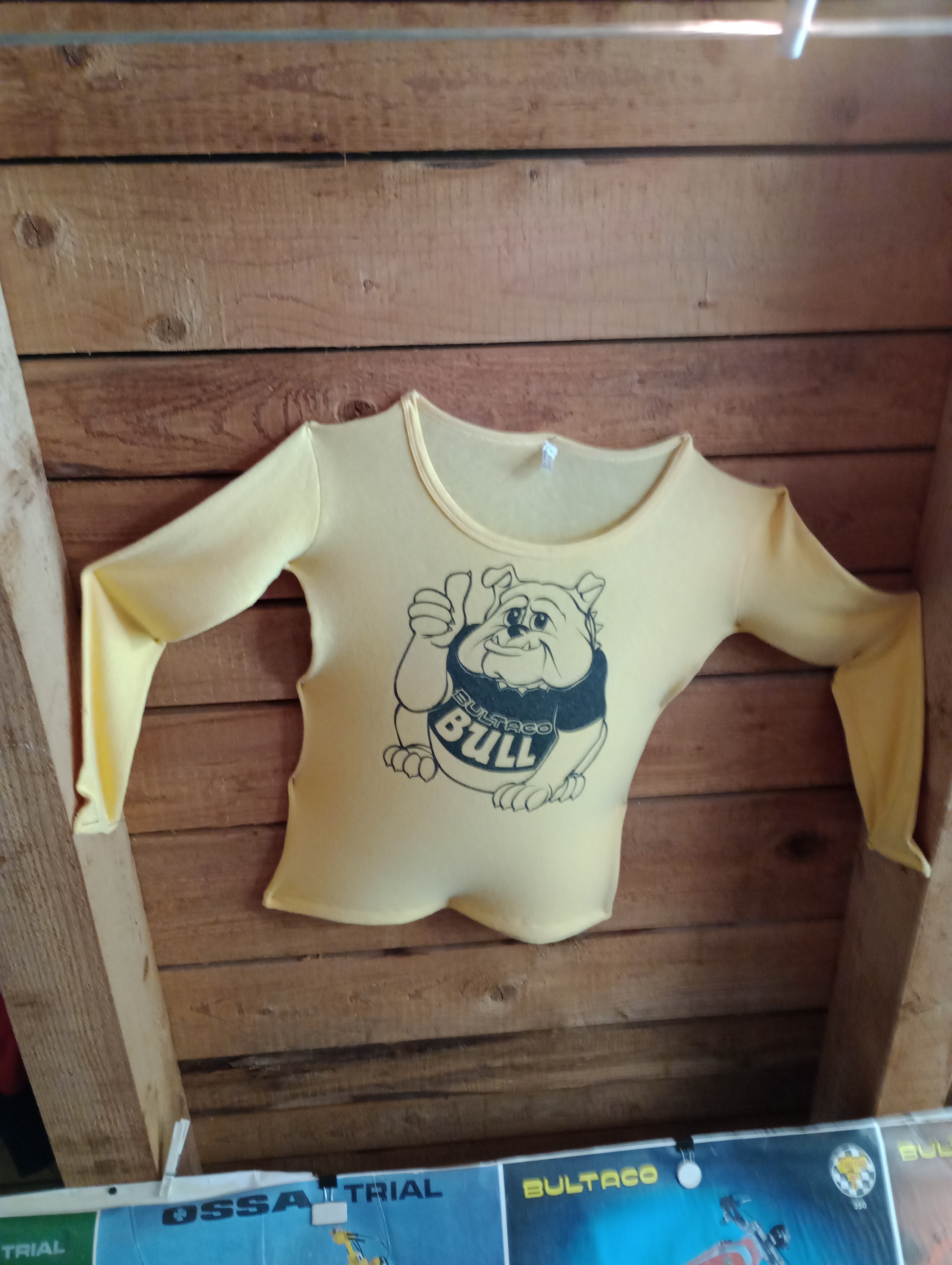
Moffat: “I recognised the logo straight away, it was the same as a large sticker that I had seen on the back door of Joe Wallmann’s van in 1976 when attending the ISDT at Zeltweg. It was a bulldog giving the thumbs up with the slogan ‘Bultaco Bull’. I haven’t seen this since in 48 years”.

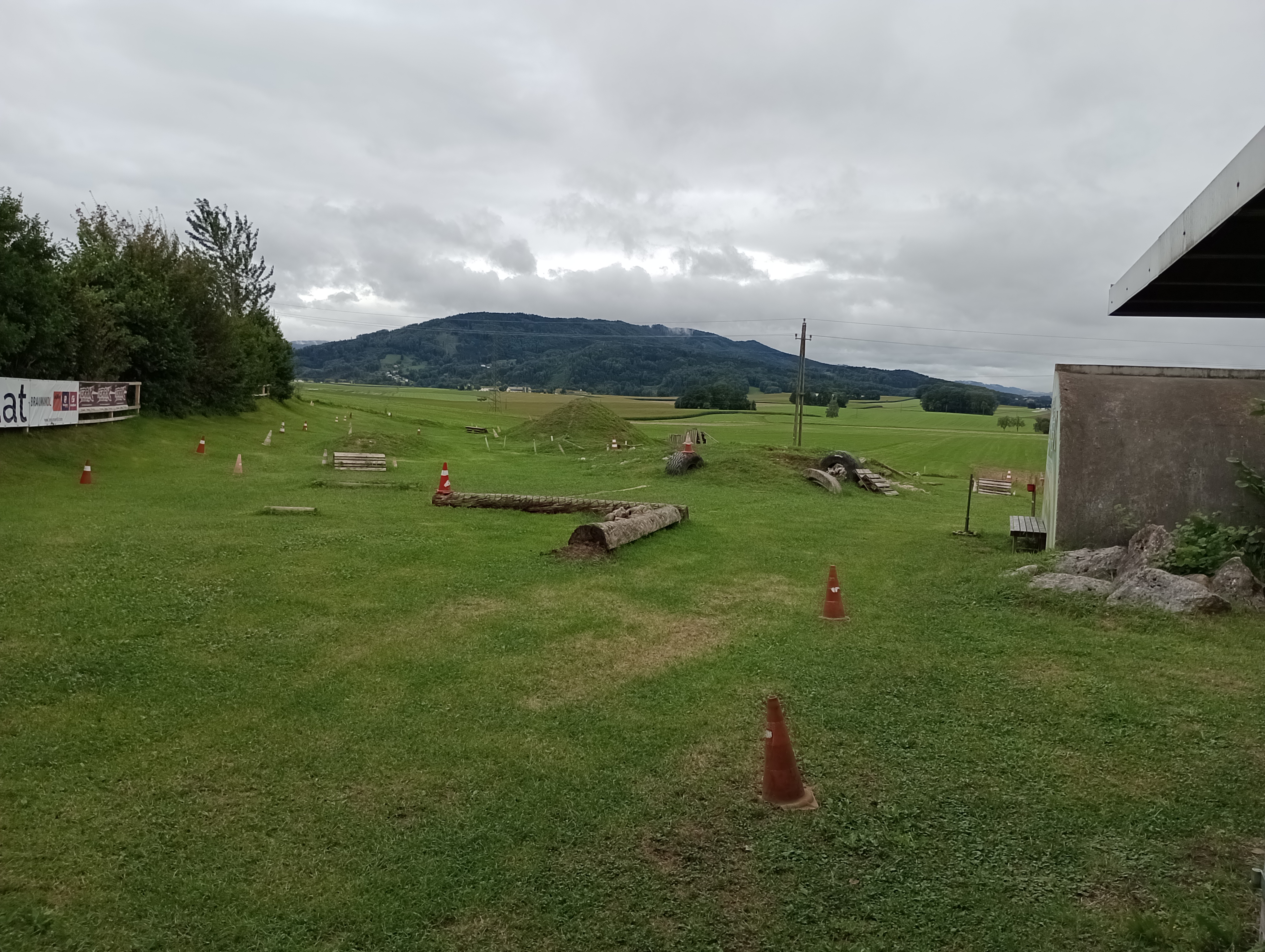
Having taken in only part of the exhibits, Hartwig says that it is time for lunch, so we drive to a local inn which is serving a special lunch only a few kilometers away in his VW T5 Kombi-van. We indulge in a nice lunch and then on the way back to the museum we call in at the Trialgarten Ohlsdorf, a training facility with man-made sections for local riders to practice and train for trials. The sections are varied and have a good following with a photo-montage on display with riders aged from 6 to 86! This again was developed by Hartwig and proves a popular attraction with small trials being held there regularly. The local council are 100% behind the venture and local firms sponsor events and prizes.



The bikes on display are many and varied, with some quite rare machines, which include: Kawasaki KT250 (the model developed by Don Smith); Honda TL250; Wassell Antelope; Zundapp 250; Greeves Pathfinder; Puch Yeti and probably the only 1962 Greeves 250 TES in Austria which was obtained from Peter Remington of Kendal, England. A machine that Hartwig travelled to collect in person some years ago.
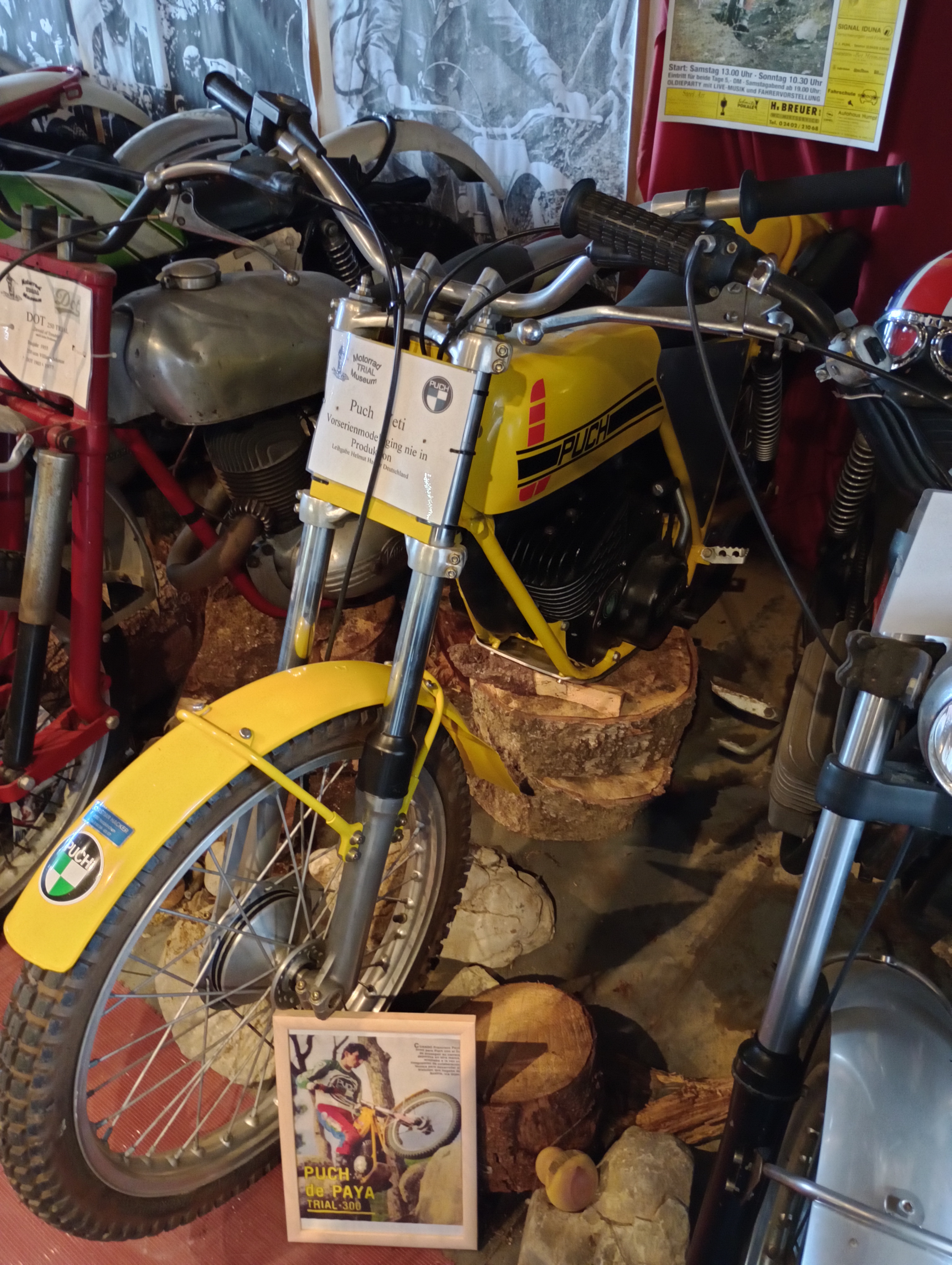
Puch Yeti:

On display is the bright yellow, Puch Yeti 300 (277cc) with the Austrian built Rotax engine and beside it, a photo of Spanish rider Francisco Paya on board. Paya helped develop the first 348 engined Montesa back in 1975. The Puch was discovered in a pretty poor state and had to be rebuilt. When complete it was finished in yellow with red detail, similar to the prototype used by Francisco Paya.

Photo-album:
Hartwig is keen to show us his own photograph album which has many unpublished photographs from Austrian and International trials and results. It is great to look back on such photographs which record the history of trials in Austria. Hartwig’s wife, Heidi comes in with some coffee and cake, made that morning which was very nice indeed.

If you are in the Salzburg area at any time, why not take a visit to the Trial Museum at Ohlsdorf? The admission fee is very reasonable and you get to meet Hartwig Kamarad, who is now the proud owner of a Trials Guru VIP cap! And remember to sign the ‘Gaste-buch’.


1st Europäisches Mottorrad – Trial Museum, Weinbergstraße 66, 4694 Weinberg, Ohlsdorf, Austria.
Follow the Europäisches Trial-Museum on facebook: HERE
European Trial Museum article is the copyright of Trials Guru.
Apart from ‘Fair Dealing’ for the purpose of private study, research, criticism or review as permitted under the Copyright, Design and Patents Act, 1988, no part of this article may be copied, reproduced, stored in any form of retrieval system, electronic or otherwise or transmitted in any form or by any means, electronic, electrical, mechanical, optical, chemical, photocopying, recording or otherwise without the prior written permission of the author as stated above. This article is not being published for any monetary reward or monetisation, be that online or in print.
Discover more from TRIALS GURU - DEDICATED TO TRIAL
Subscribe to get the latest posts sent to your email.
 TRIALS GURU - DEDICATED TO TRIAL
2 thoughts on “European Trial Museum”