
Words: Mike Naish and Doug Williams
Photos: Doug Williams Collection; Mike Naish
Mike Naish: I want to introduce you to a rider from the North East corner of the South Western Centre. A rider, who I believe is only one of two, that has gained expert status in the disciplines of trials, scrambling and grass track racing, Doug Williams.

Mike Naish: Have you always lived in Somerset Doug?
Doug Williams: “Yes I have, I was born in Tiverton but have always lived in the Taunton area. I joined the Taunton MCC when I was sixteen and have been a member most years since then.”
MN: How did you get started in sporting events?
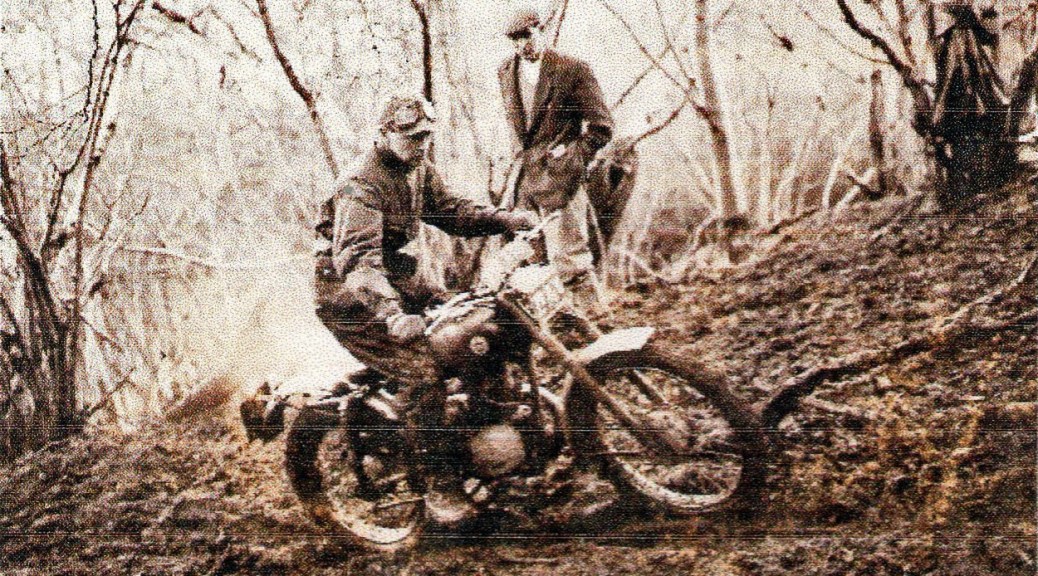
DW: “My parents took me to watch scrambling when I was a nipper and I suppose I caught the bug then, although I did not think that I would ever be able to ride as fast as those boys. I started work when I was fifteen at Edwards Motors of Taunton run by Frank Jarman, I did an apprenticeship and my first job on a Monday morning was washing down Paul and Neil’s scramble bikes from the previous day’s event. I went along to see a couple of trials and I thought ‘I can do this’ so in 1956 or 57 when I was sixteen I bought a 1956 DOT with the 6E Villiers three speed gearbox and the ‘five times a week forks’ thats to be greased, a very early version of Metal Profiles, from Pankhursts of Taunton. My first trial was an invitation event with Taunton MCC held at The Pines, Buncombe Hill. I won the novice award with no marks lost. I was very proud of the headline in the Western Morning News when I turned to the results; ‘Williams Stars in Taunton Trial’. I won another novice award a week later at an Exmoor Open Trial and was promptly upgraded to non-expert, and I was still a green rider so to speak with very little riding experience.”

MN: What other bikes did you have?
DW: “After the DOT which I had for about a year, I had a 10E James from Edwards. I used the bike to ride to work, then in the evenings for courting when I put a dual seat and footrests on, and then for trials at the weekend when a single seat went on and the lights came off. I used to take the lights to the trial to put them on and ride the bike home afterwards. In 1959 I moved up a class and had a 350 Royal Enfield Bullet. I rode trials for five years, four full seasons, getting up to expert status.”

MN: Was that when you moved on to Scrambling?
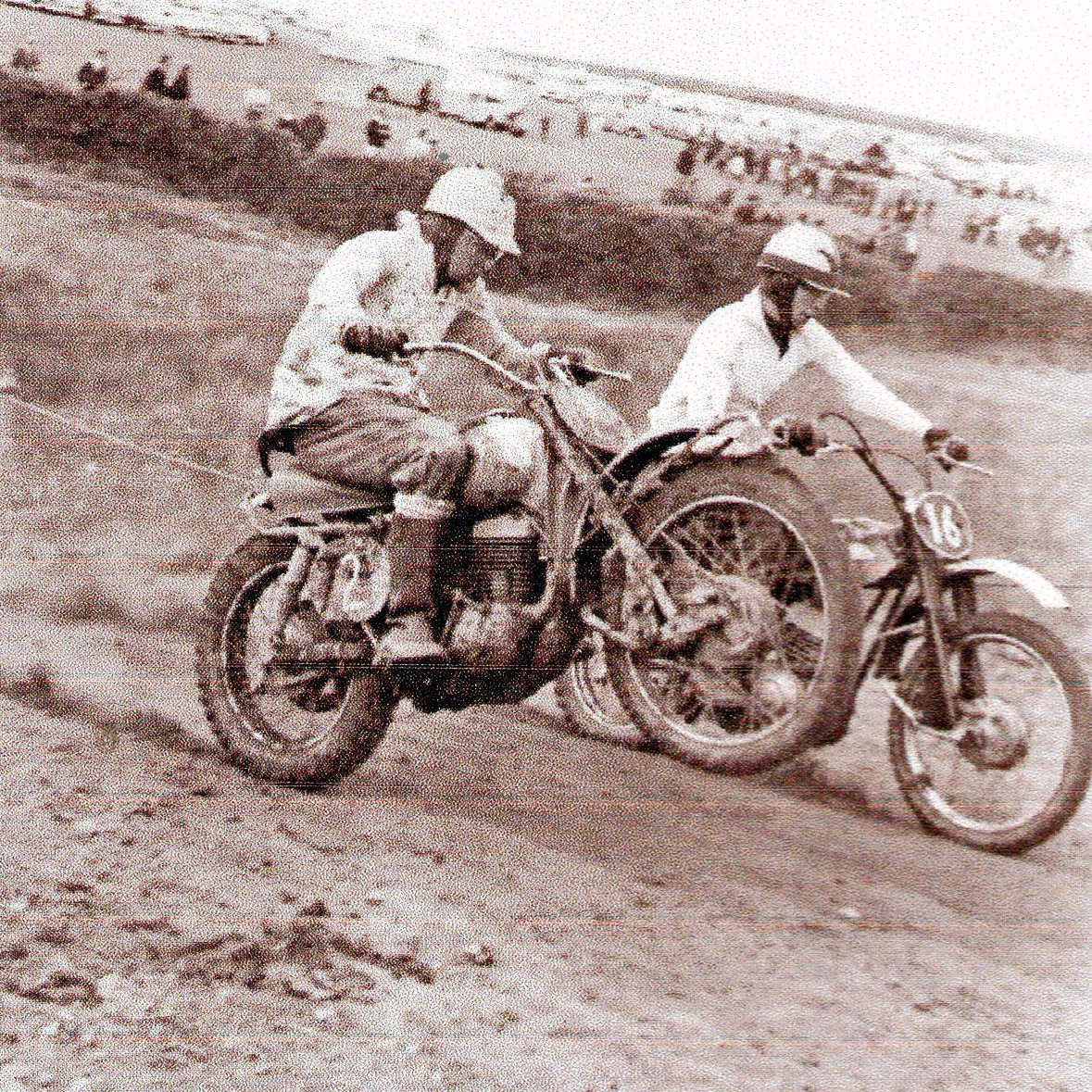
DW: “Yes, I bought an ex John Churchill Greeves Hawkstone in 1961 which I rode all over the Southwest, Wessex and Southern Centres. In those days riders were known as much by the colours on their jerseys and their helmets(mine was yellow) -as their riding numbers. It was riding on a shoestring with any prize money spent on tuning the bike and also in the pub afterwards event- socialising. Cliff Baker used to tune the bike and I set up a tab with him to pay him back at so much a week. I rode the Hawkstone until 1962 when I bought a brand new MDS Greeves. I was expert status by 1963 and I remember I rode at the Tor clubs Glastonbury circuit which I liked. In the experts supporting race at the International I finished eleventh, which I did not think was very good but others said that given the strong field I had done very well. I remember I got two pounds and ten shillings for that one race which was about half what I got for a complete weekend of riding. The Greeves MDS just couldn’t live with the Huskys and CZs that were just coming in and I could not afford to change so in 1970 I gave it up, and my mate John Long said I should take up an old mans sport, grass track. So I did as I also wanted to succeed in all three sports.”
MN: What did you think of Grass tracking?
DW: “It was without a doubt my favourite sport. I had a Hagon with Lightweight aircraft tubing frame and a big JAP engine which when you wound up the throttle and fed in the clutch would just take off. When I had built up the Grass bike the rear chain would not run too well along the sprocket line. John Long said “Why don’t I give you a tow with my car down the road to bed it in”. It was a quiet Sunday Morning down a B class road, nobody about, and he towed me about two miles down the road and then did a U turn to go back the other way. As he turned around the law came along on a motorcycle and stopped. John threw the rope in the boot of his car and took of leaving me to explain, and to convince him I lived in the cottages that we had just stooped outside. When the PC had gone John reappeared and connected up the rope and towed me the two miles home.”

“In racing there is nothing quite like the feeling of having gone into the bend applying a bit of opposite lock pressure on the handlebars with the throttle wide open, just sitting there on the slide sometimes with your left leg up on the casing. It seems as if you could ride all day in that position. I loved it. I won the junior ‘Wimbourne Whoppa and I can tell you that riding four laps of a Grasstrack is like twelve laps of scrambling. But then I had the accident which meant I had to give it up and it changed my life.”
MN: How did it happen?
DW: “It was in September 1973, I was riding near Salisbury and the track was very slick and it was hot and dusty. At the interval I had decided not to continue because of the conditions which at times were suicidal, and I said so. But then in the end I thought I would give it one more squirt. I went off the line and on the third lap I slid off going into a bend. It is thought that a small stone went under the tyre lifting it off the rim. Another rider ran straight over me, split my helmet in two and took my foot almost off as well. I was in agony, my leg was broken and my right foot was hanging by just the back tendon. I was rushed to Oldstock Hospital Salisbury and underwent a four hour operation. A specialist surgeon was called out from his home and worked a miracle putting the foot back together. Part of the bony sponge which supplies blood to the foot had died and they thought they might have to amputate. When I was moved back to Taunton Hospital they said I had been lucky with the specialist because if I had been in Taunton I would have been walking on a block of wood.”
“I had six operations and two skin grafts and spent the next eighteen months in plaster on crutches and could not work for five years because I was at the time driving heavy tipper trucks. It was a difficult time because I had two young children at eight months and eighteen months and Gloria my wife had to look after all of us.”
MN: Did you want to get back to riding or did you feel you had had enough?
DW: “It was very frustrating being home but it was the thought that one day I might be back in the saddle which kept me going. Lew Coffin and Sean Wilmont visited me in hospital and brought me in a collection they had arranged from the riders and public for a meeting I had organised for the Taunton Club but could not attend. I also had a bit of help from the ACU Benevolent Fund and was visited by Freddy Vigers who administered it. I always try and give a bit back to the Ben fund because they were good to me. As I got gradually better I helped Edgar Stangland, the International Norwegian speedway rider, who lived in Taunton. I travelled all over Europe with him visiting Czechoslovakia, Yugoslavia, Germany and all the Nordic countries doing long track and grass track events, something I would not have normally been able to do. I had to drive with a wooden block under my heel to give me more movement. In 1978 I felt confident enough to get back on a bike and bought a 250 Bultaco and then moved on to a Beamish Suzuki for trials and I started work for Gerry Wheeler, doing some driving for them.”
MN: Is there any other incident that sticks in your mind?
DW “There is a couple. One was a crash I had at Bridgwater Grasstrack with the late Gordon Hambridge over the start and Finish line. We had a coming together and whilst I was lying on the track I thought it was all over for me because I could not breathe, I expect I was winded. I ended up with just a broken thumb.”
MN: When did you start in Pre-65 Trials?
DW: “After the Suzuki which passed on to Dave Fisher, I had a 156 Fantic which I just couldn’t get on with and then a 200 Majesty which was a nice little bike. I think it must have been about 1981 or 1982 that Mike Palfrey, Vic Burgoyne and myself decided to ride pre-65 trials and I got myself a Bantam frame with a Tiger Cub Engine. By this time I had gone into a driving rig of my own and was an owner driver with ready-mix concrete.”
“My current bike is an ex John Trowbridge 250 Enfield I entered the Talmag on it in 1984 and won my class. I have been moderately successful in Pre65 trials winning the championship for two years in 1985 and 1986 and being runner up a couple of times.”
MN: What do you enjoy and how do you see your competition future?
DW: “As you have said Mike, motorcycling is a disease for which there is no known cure. I keep coming back to it. I said I would retire when I was 60 but now I am 66 and coming up to my 50th year since I started. I enjoyed our visits to Mons in Belgium, the Scarborough Two Day and the Northallerton Three Day and also my ride in the Scottish Pre65 the first year it became a two day event. I should really like to do the Scottish one more time. I still enjoy my trials and the comradeship that goes with it, and I guess I will carry on while I am still enjoying it for as long as I am able.”

Doug Williams by Mike Naish is the copyright of Trials Guru and Mike Naish.
More interviews with Mike Naish HERE
Apart from ‘Fair Dealing’ for the purpose of private study, research, criticism or review as permitted under the Copyright, Design and Patents Act, 1988, no part of this article may be copied, reproduced, stored in any form of retrieval system, electronic or otherwise or transmitted in any form or by any means, electronic, electrical, mechanical, optical, chemical, photocopying, recording or otherwise without the prior written permission of the author as stated above. This article is not being published for any monetary reward or monetisation, be that online or in print.
Discover more from TRIALS GURU - DEDICATED TO TRIAL
Subscribe to get the latest posts sent to your email.
 TRIALS GURU - DEDICATED TO TRIAL