Category Archives: Gloves Off – With Bernie Schreiber

GLOVES OFF – Celebrating 55 years

Celebrating 55 years of Trials Competition with Bernie Schreiber

Words: Bernie Schreiber, Zurich, Switzerland – September 1st, 2025

Photos: Bernie Schreiber personal collection; Eric Kitchen; Iain C. Clark; Trials Guru; Len Weed; Jean Claude Commeat.
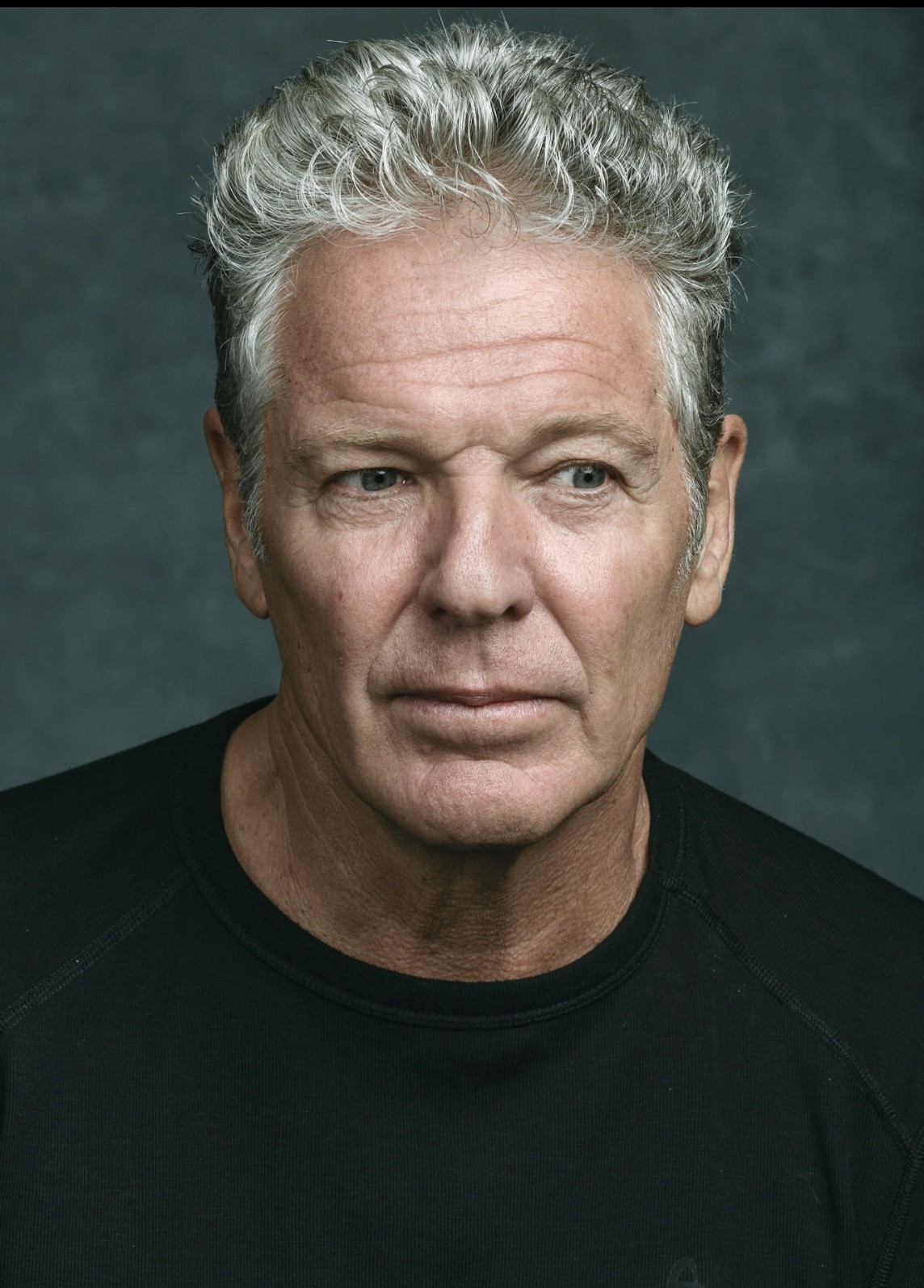
America’s only World Trials Champion and Scottish Six Days Trial winner, Bernie Schreiber is the most successful and iconic trials rider ever from the USA. To this day, he is the only American trials rider to reach the pinnacle of the sport. 2025 marks a special moment for Schreiber who started trials competition fifty-five years ago in California and still competes in vintage events today. 1970 was the beginning of what later became a successful adventure overseas in the late 1970s and 80s. Trials Guru shares Bernie’s journey.

Trials Guru: How did you discover the sport of Observed trials?

Bernie Schreiber: “A friend of my father introduced us to trials in 1970.

One day we all went riding in the Mojave Desert outside Los Angeles. We were climbing hills and riding trails all day on our bikes while the son of our friend spent most of the day in a sandy pit area, riding in circles standing up. We asked, what have you been doing all day on that strange bike called a Bultaco? In fact we thought the motorcycle was made in Mexico until they informed us it was a trials bike made in Spain. We had no idea what trials was and never heard of Bultaco. He said, that we should come out to watch a local trials event in a few weeks.

A few weeks later I found myself riding, not watching the event at a famous off-road venue called Saddleback Park in Southern California. I had a Kawasaki 90cc trail bike and my dad signed me up in the kid’s class. I started section one stood on my passenger foot-pegs to stay balanced going up and down hills. I really enjoyed the challenge and my parents found the sport friendly and safe.”

Mojave Desert with a young Bernie Schreiber on a 90cc Kawasaki trail bike. (Photo: Bernie Schreiber Collection)

“I rode a few more events in the kid’s class that year and eventually got a 125cc Bultaco Lobito and moved up a class. We joined the trials club VOTE ‘Valley Observed Trials Enthusiasts’ that year and the trials adventure began.”

TG: Who inspired you to focus on trials and to go as far as you did?

BS: “That would be hard to pinpoint exactly, there are so many names, but of course my parents were always the main pillar of inspiration and support.”

Bernie was inspired by the film ‘On Any Sunday’ early in his motorcycling career. (Photo: Bernie Schreiber Collection)

“The 1971 Bruce Brown movie ‘On Any Sunday’ with Malcolm Smith and Steve McQueen truly inspired me to be a motorcycle rider in some way, shape or form. That movie touched on every aspect of motorcycling from lifestyle to coolness and the risks of high-speed racing. Best motorcycle film ever for the industry.”

Lane and Debbie Evans-Leavitt. Debbie’s father appeared in the film, ‘On Any Sunday’ doing an endless wheelie on a Bultaco Sherpa. (Photo: Bernie Schreiber Collection)

“As a kid early on, it’s important to have heroes to look up to. Sammy Miller and Mick Andrews were two of mine on the world stage and Lane Leavitt in the USA. I did trials schools with both Sammy and Mick in the early 1970s and practiced with Lane whenever the opportunity presented itself.”
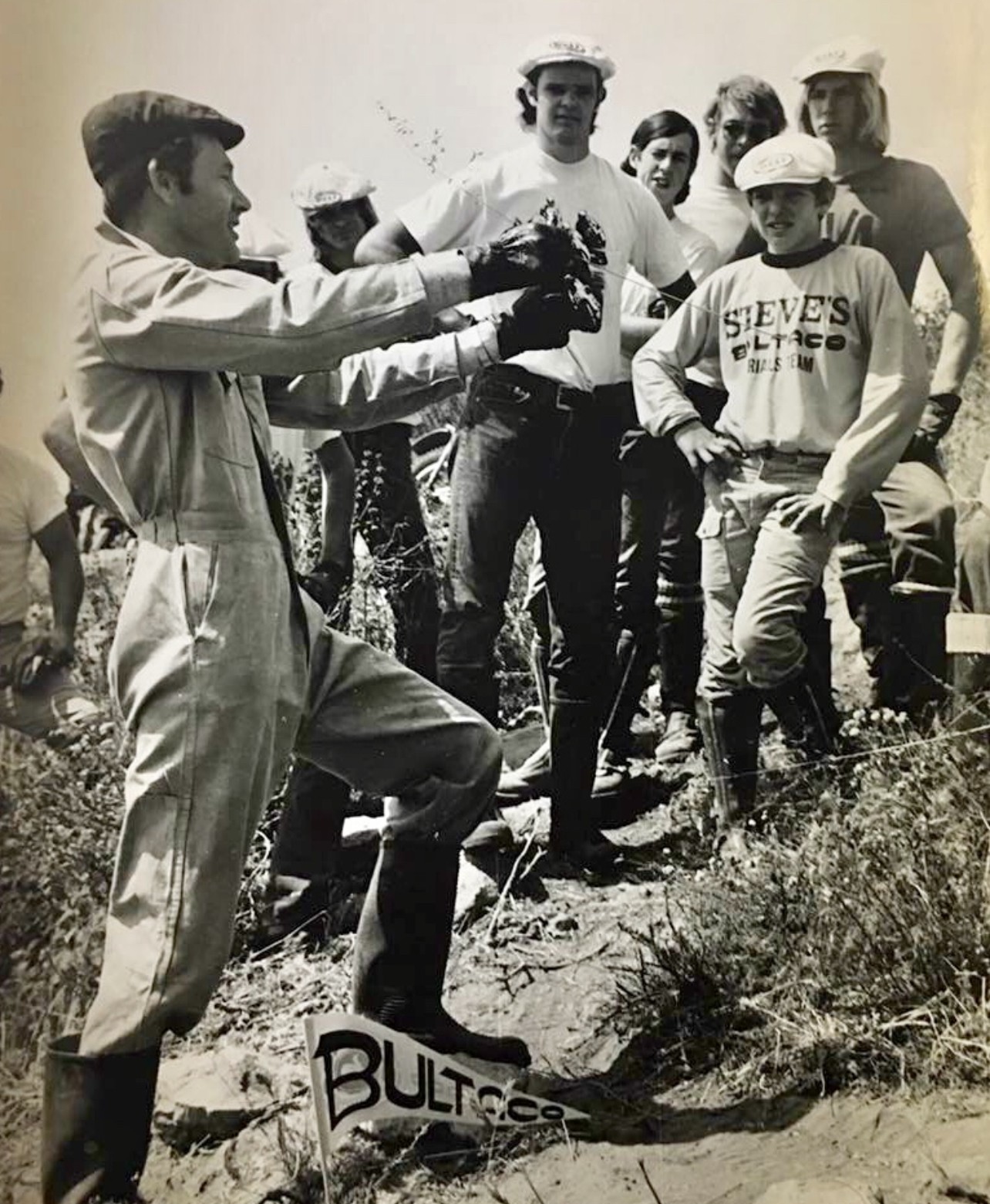
Sammy Miller MBE explains the finer points of trials to an attentive audience including a young Bernie Schreiber at Miller’s 1973 Trials School in the USA (Photo: Bernie Schreiber Collection)

“The local Los Angeles dealer, Steve’s Bultaco supported me at first, until Bultaco International USA stepped up support based on my national results. My local trials club VOTE and all their members were great motivators and supporters as well. Always organizing events and trials training weekends.”

Support from Steve’s Bultaco on the Sherpa in 1971. (Photo: Bernie Schreiber Collection)

TG: So how did a young kid from California end up riding trials in Europe?

BS: “Riding in Europe is one thing, winning is another. Most Americans fifty years ago said winning couldn’t be done in Europe and here we are forty-six years later still trying to figure out how it had been done.

Every life has a story and every story has a lesson. My personal lesson is things are not as easy as they may seem.  At every stage in life, everyone has a story to tell, a lesson to teach, wisdom to share, so learn from them.”
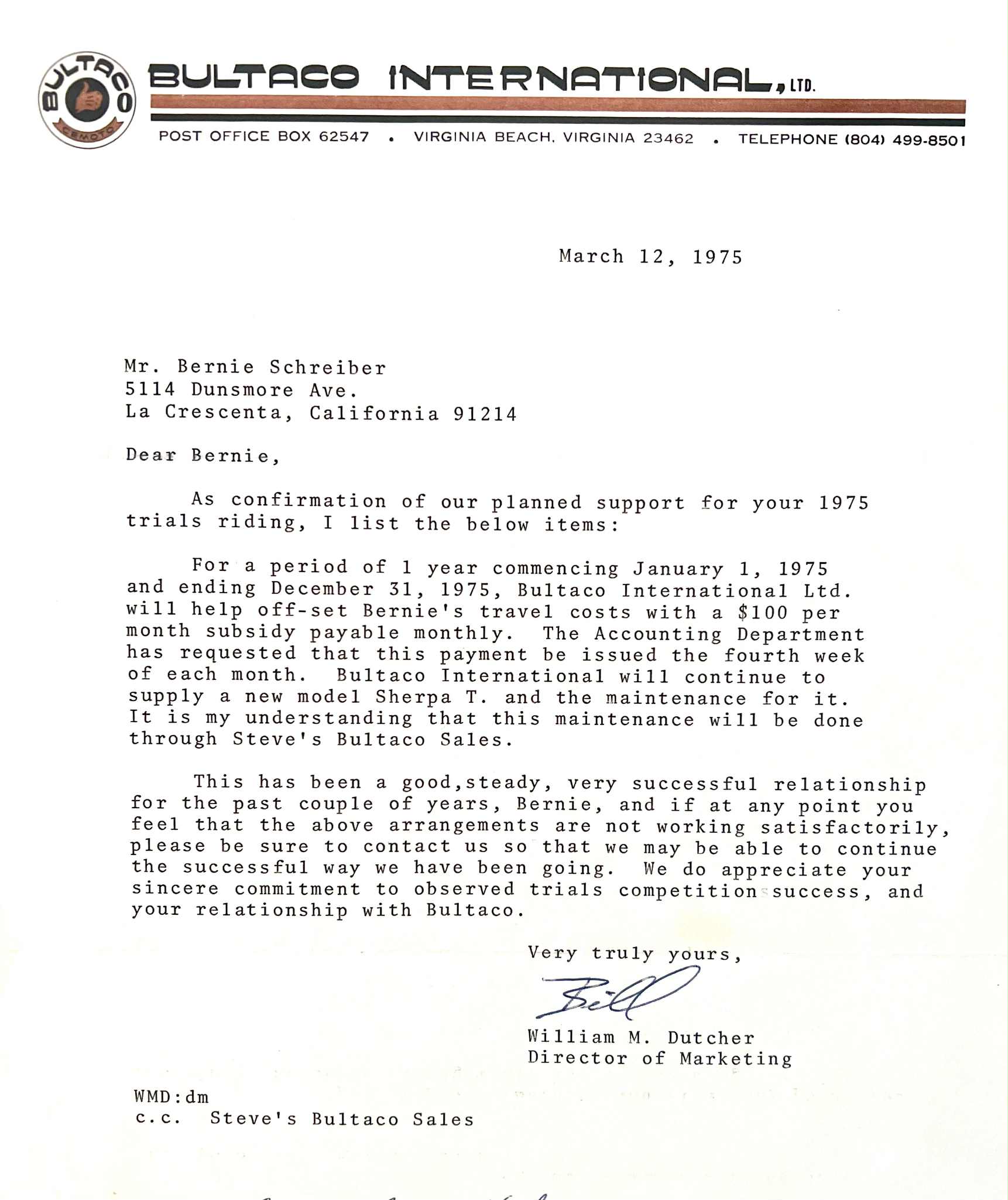
Letter from Bultaco International to Bernie in 1975. (Bernie Schreiber Collection)

“My first trip to Europe was funded by (ATA) American Trials Association, the governing body of all trials clubs in Southern California and managed the annual El Trial de Espana event and the prizes and donations. This event which started in 1970, had a huge fundraiser each year to send a team of talented local riders to Spain. This was mainly to expose local riders to the European Championship and Spanish manufacturers.”

Bernie was the 1974 Southern California Trials champion and Bultaco International sent this cheque for $1,000 to him in recognition of his success on the brand. (Photo: Bernie Schreiber Collection)

“I was part of that delegation in 1974 to visit the Bultaco factory, meet the world riders and observe the Spanish round of the European Championship, before it became a World Championship in 1975.”
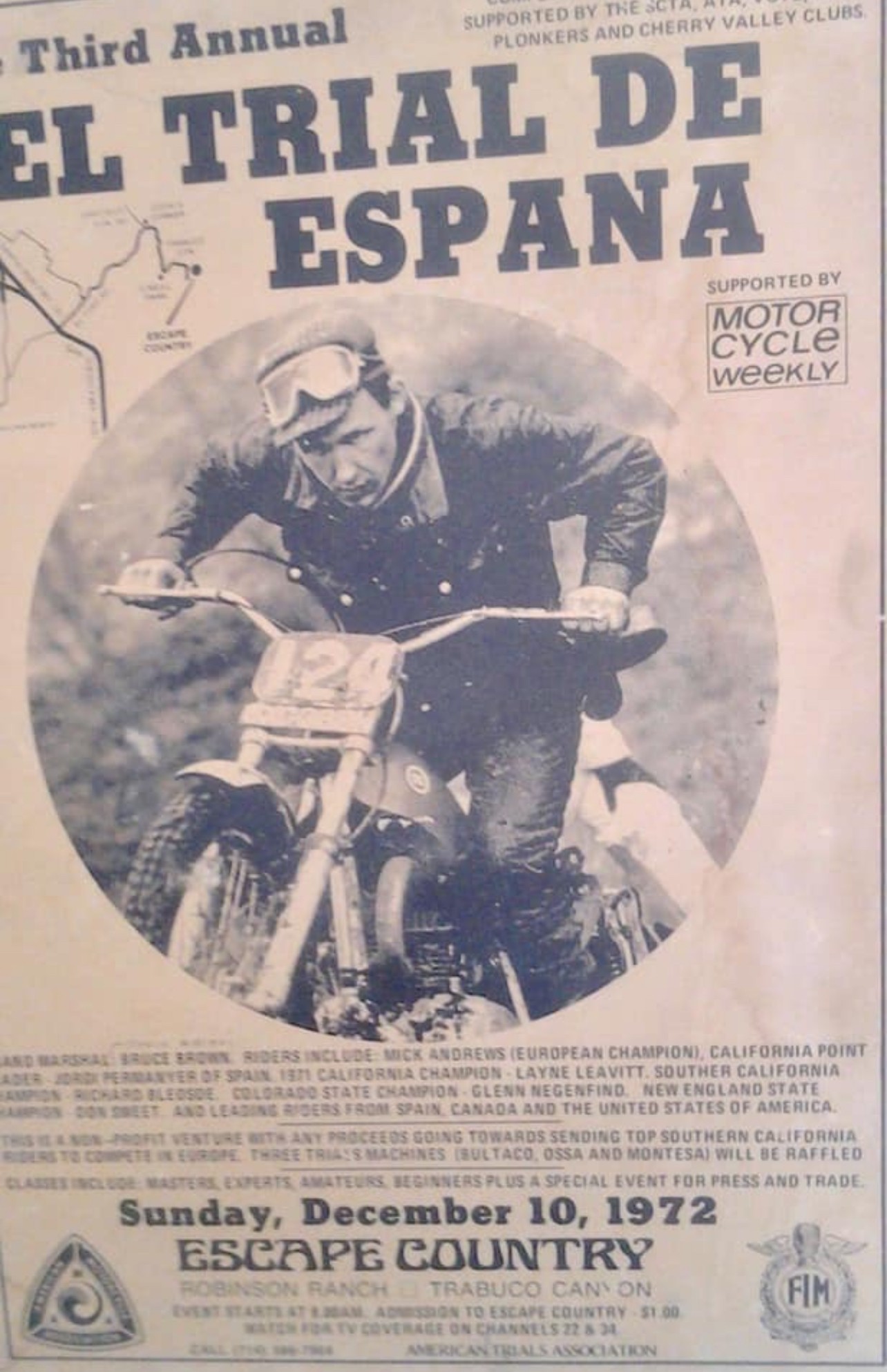
“In 1976, I joined the ETDE team again to Scotland to watch the Scottish Six Days Trial. I was still under eighteen years of age, so couldn’t ride both these events unfortunately.

I’d quickly seen that European sections in Spain were not the same as our American sections, so I immediately changed my practice at home to bigger steps, tighter turns, larger and longer sections with more speed. At the 1976 SSDT, I did learn a lot about the trials culture and history of a sport which was established in 1909.

El Trial de Espana trips were fruitful, and after hard work, winning events locally and nationally, the Bultaco factory and Bultaco International agreed in December 1976 to provide me an opportunity in Europe.

The main purpose was to obtain real trials competition exposure and learn from the world’s best Bultaco riders who were based in Europe. Therefore, I could improve my skills and become the best U.S. trials rider. That would inturn sell more Bultaco’s in a very crowed American market with more and more Japanese bikes entering each year. The Japanese brands were buying market share and acquiring the best talent in many American motorcycle disciplines.”

1977 – Practising hard in California on a stock Bultaco Sherpa M199 in 1977. (Photo: Len Weed)

“So, I departed to Belgium for my first three-month European tour in February 1977 to compete in the world championship and SSDT. I’d just turned eighteen in January and acquired my first FIM license. I landed in Brussels with rubber boots and a helmet, but no real riding gear for sub-zero temperatures, mud and snow.

To remind the younger readers, there was no internet, no fax, no iPhone, no GPS, limited English hard to understand and no money in my pocket. Thankfully, the Belgian Bultaco importer at the time, Marcel Wiertz took care of me on arrival. I had a test ride on a stock Bultaco Sherpa in the Belgium mud, and that was the real beginning of the European journey.”
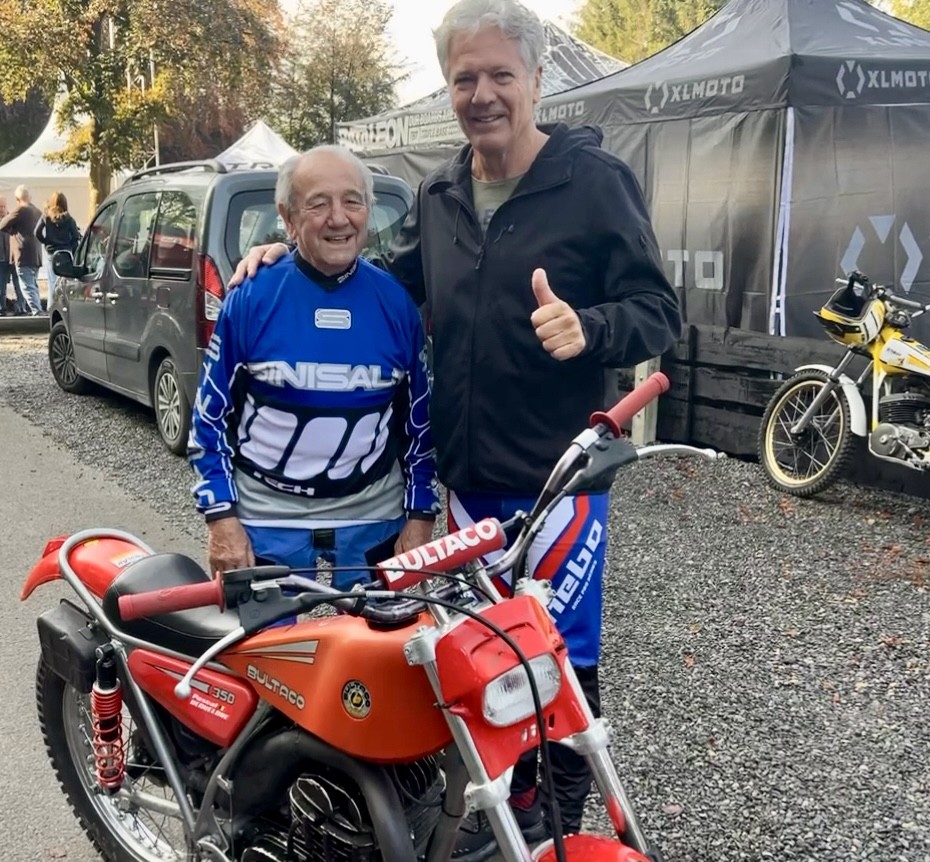
Marcel Weirtz was the official importer for Bultaco in Belgium (Photo: Bernie Schreiber Collection)

“My practice sections in California paid off and I finished in fifth place in Belgium with one hundred and thirty points, just two points behind Yrjo Vesterinen the current World Champion. The next event was dryer and warmer in Spain and clenched my first podium that impressed the Bultaco factory owners.”

The West German round of the 1977 World Championship featured this big drop off (Photo: Bernie Schreiber Collection)

“Then onwards to France for a fifth place finish and another second place podium in West Germany, beating nearly every factory rider once during the two-month tour.”
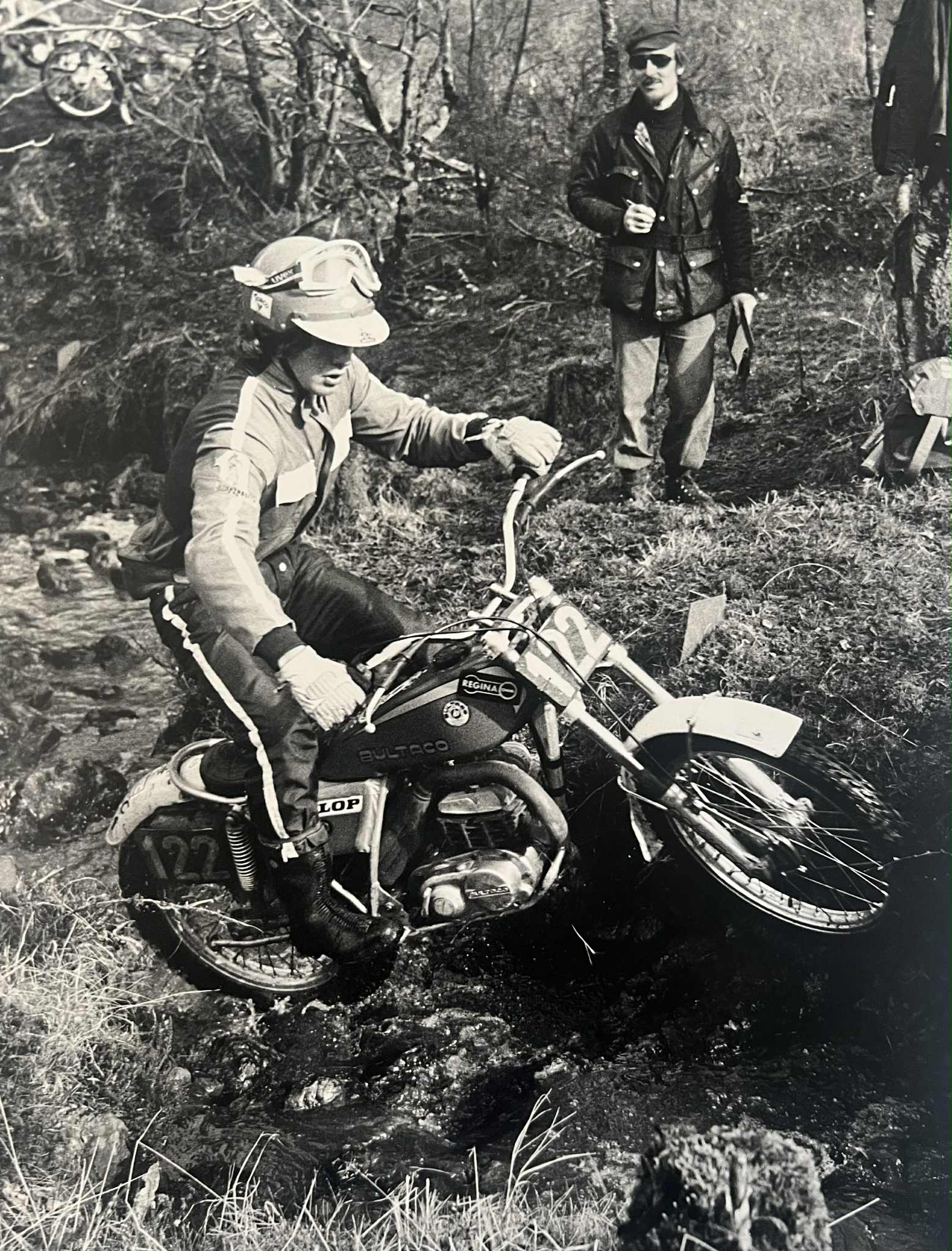
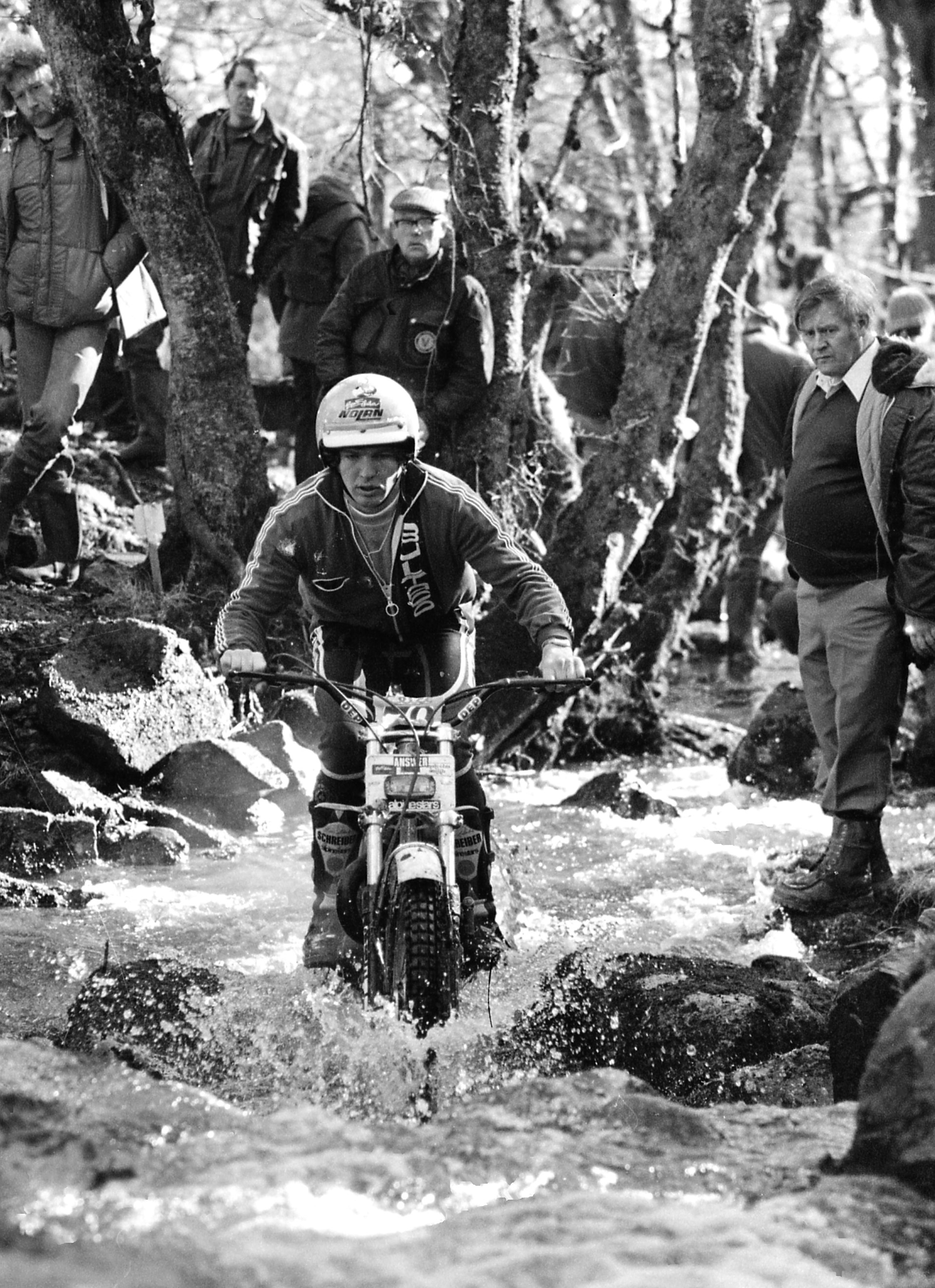
Bernie’s first Scottish Six Days was 1977 on a factory supplied Bultaco 325, where he was Best Newcomer, seen here on ‘Kilmonivaig’. (Photo: Iain C. Clark, Fort William)

“In the May, I competed in my first Scottish Six Days Trial and obtained the Best Newcomer Award with eleventh place out of several hundred riders. Overall, I finished the season seventh in the world and impressed some European media, spectators, sponsors and riders.”

Bernie Schreiber was Best Newcomer at the 1977 Scottish Six Days Trial (Photo: Bernie Schreiber)

“At the time, I wish there would have been other options besides Europe. Life was good at home, but sometimes opportunity only knocks once in life. You’ve got to be where the action is taking place at the highest level or you will most likely be left behind.”

TG: 1977 had been a year of experience for 1978, so how was the following year?

BS: “1978 was by far the toughest year and a turning point in my career. I asked myself many times, do I stay in Europe or stay at home. I learned a lot in 1978 and finally won my first world round in France, becoming the youngest rider ever at age nineteen.

Eventually, I went on to win four world rounds in 1978 – FRANCE, SPAIN, USA and ITALY. I became the first American to win a world round, so the impossible was achieved. The 1978 U.S. Wagner Cup round that year in Roaring Branch, Pennsylvania was a special win, as I hadn’t even won a U.S. American Championship until later that same year.

The biggest take away from 1978 was acknowledging that cleaning sections and winning world rounds from time to time was not enough to win a Championship.  The current world champion Yrjo Vesterinen was a great rider, like all the factory Bultaco team riders, Lampkin, Coutard, Soler and others. I learned a lot from each and every one of them.”

Yrjo Vesterinen was a close rival from the Bultaco days through to SWM (Photo: Bernie Schreiber Collection)

“Vesterinen was the man to beat and he was on his way to a third World championship title in a row. Vesterinen was a talented rider, smart and very consistent. His consistent effort, focus, preparation and mindset were unmatched. He had it all together and a well-planned strategy, and the most professional Championship rider without a doubt. Risk management drives Championship victories and Yrjo was a master with a plan to win Championship titles.”
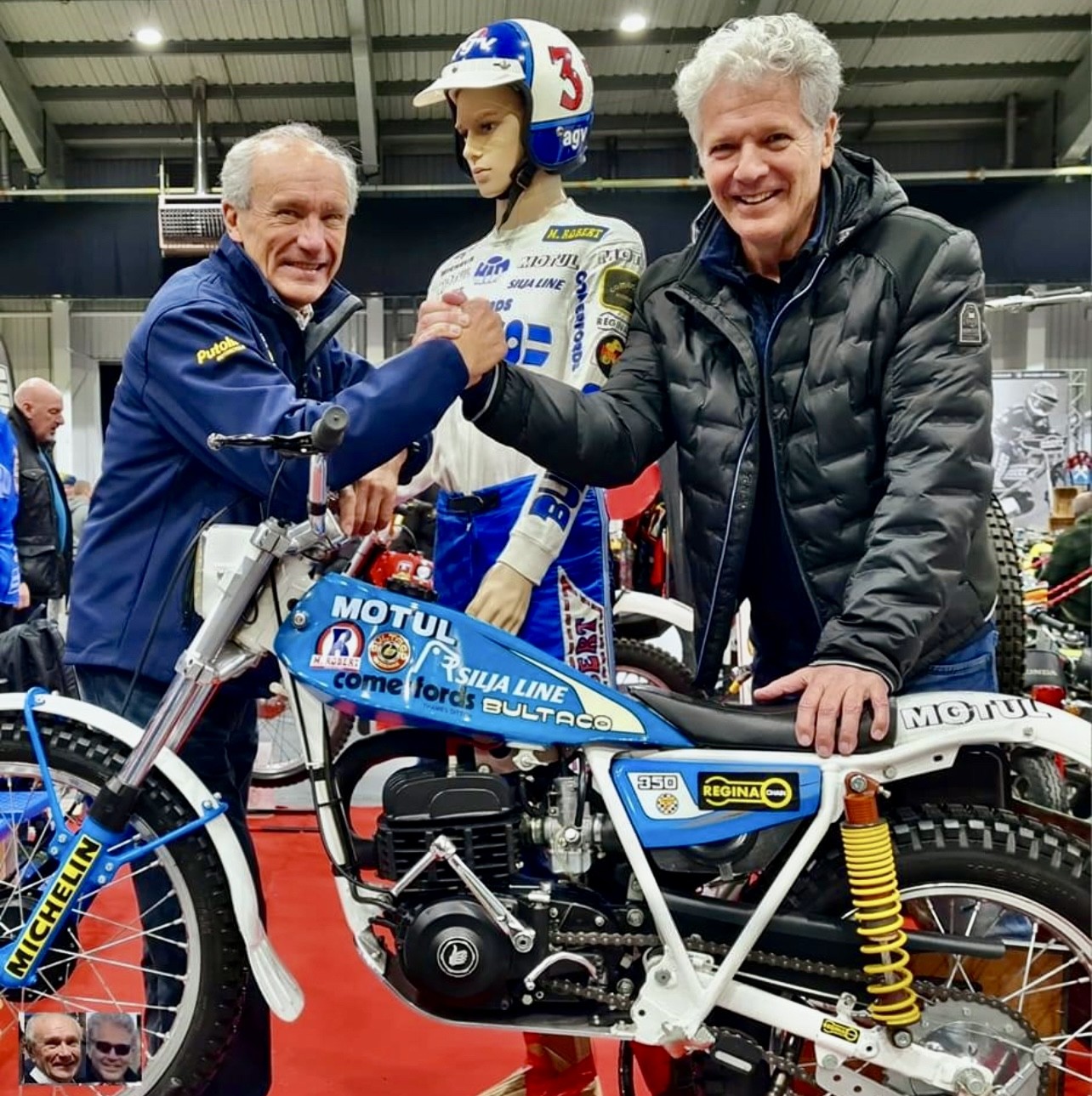
Bernie Schreiber has a high regard for rival and friend, Yrjo Vesterinen (Photo: Bernie Schreiber Collection)

“Consistency became my obvious plan for 1979 after finishing third overall in the 1978 Championship. Numbers matter at the end of the season.”
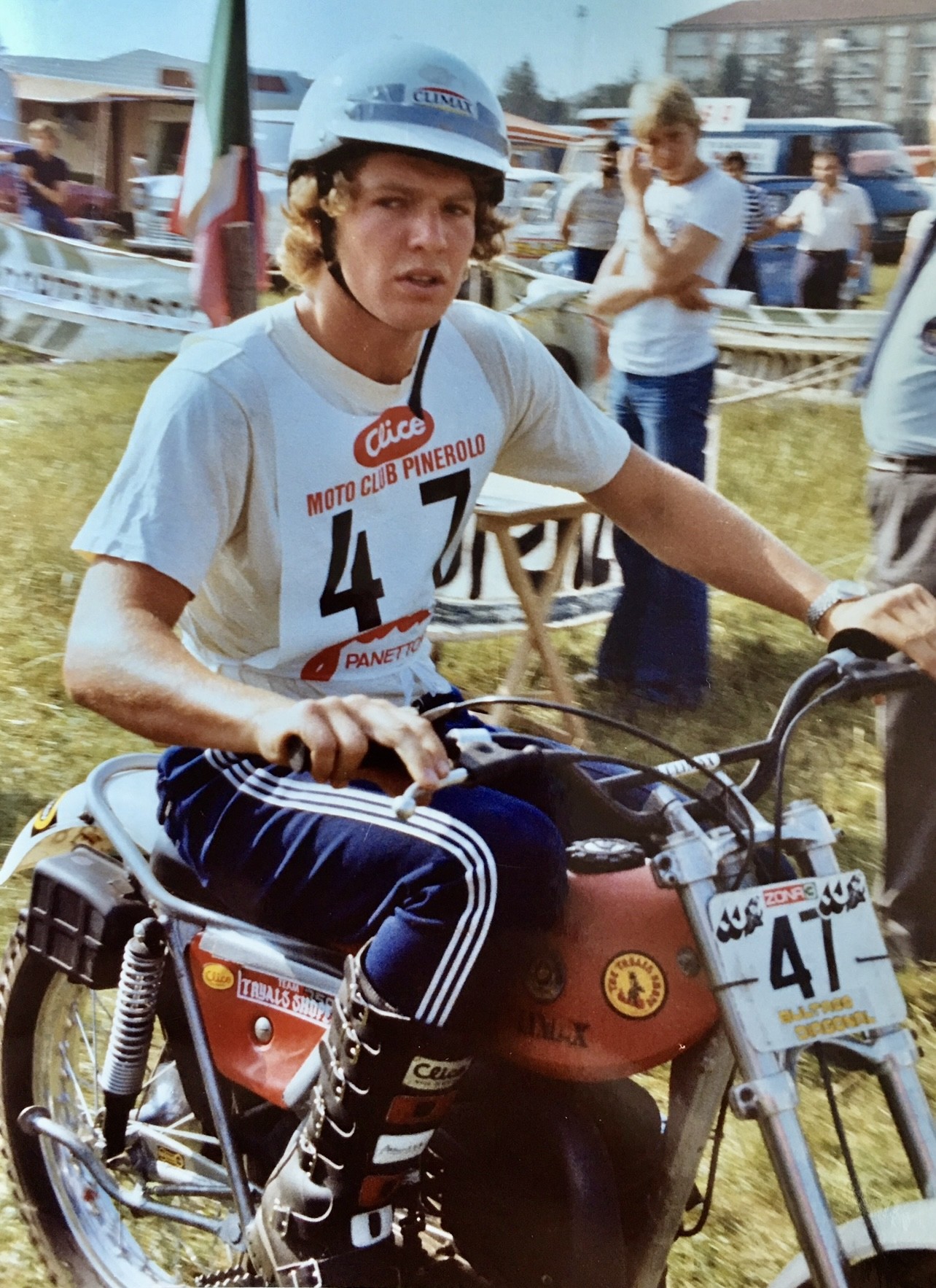
1978, Schreiber in thoughtful mood, eyeing up the FIM World Trials Championship. (Photo: Bernie Schreiber Collection)

TG: Then it all comes together in 1979 and you won the FIM World Trials Championship?

BS: “The start of the 1979 season was extremely difficult and not as planned. It was decided with Bultaco after the 1978 season that London would be my European Base. From there, I could practice more mud riding, communicate in English and stabilize a bit. I moved in with the Hudson family and worked out of Comerford’s at Thames Ditton, Surrey the UK Bultaco importer at that time.”

Deep in conversation, Yrjo Vesterinen, Colin Boniface and Bernie Schreiber at the SSDT – Photo: Eric Kitchen

“I received tremendous support from the entire team in the UK, especially Pete Hudson a trials rider who worked at Comerford’s as competitions manager, he looked after me during the entire season.”

Bernie with Pete Hudson who looked after Bernie when at Comerford’s in 1979. (Photo: Bernie Schreiber Collection)

“The 1979 plan didn’t come together as forecasted. I crashed, bent the fork in the first world round in Northern Ireland and scored zero points. Then seventh in the UK, sixth in Belgium and fourth in the Netherlands. Actually, the 1979 season started worse than 1978 and I was way behind the leader in overall points, not just wins.”

1979 – Schreiber in World Championship mode. (Photo: Bernie Schreiber Collection)

“1979 started as one of those mental moments. It was a Rocky Balboa moment. “It’s not about how hard you get hit, but how hard you can get hit, get up and keep moving forward”. I moved forward to the fifth round in Spain and won. After that, things turned sunny, positive, and more consistent from that point. I won more events and stayed on the podium to the end.”

1979, Schreiber was on top of the world and gave Bultaco their last World Trials Championship victory. (Photo: Bernie Schreiber Collection)

“I had a lot of support from Comerford’s in the UK, but the 1979 season was only decided at the last world round in Czechoslovakia. That’s when history was made and it still stands forty-six years later.”

TG: What do you feel were the main drivers of your success?

BS: “The heart to win is a must, and it often comes with more pain than pleasure. Most of us were riding from the heart, not for the money.  The winning experience provides confidence which adds to your performance, but the most important skill is learning how to transfer your skills to competition and then to winning. The hardest skill is mental and how to transfer winning into Championship titles under pressure all season. Innovations can make the difference between winning and losing. Perfecting bunny hops and floater turns in the 1970s was an innovative advantage. Some called it trick riding, but it was used within the traditional non-stop rules of the sport. A positive attitude, strong motivation and commitment, combined with believing in yourself is the main driver of success.”

Bultaco had a strong factory supported team in the mid to late seventies. Here is Charles Coutard (France); Manel Soler (Spain) and Bernie Schreiber (USA) Photo: Bernie Schreiber Collection.

TG: You finished second in the 1980, 82 and 83 World Championship. Were those frustrating years?

BS: “YES and NO!

It’s always frustrating not to win, especially when you are expected to win.  The best rider always wins regardless of all the excuses we wish to present. People aren’t interested in hearing all the excuses, challenges or reasons for not winning, but they do exist for most of us at the top.   

Here are some facts that don’t change my results.  In 1980 when the Bultaco factory closed, I changed from Bultaco to Italjet in mid-season. For the readers, Italjet was a mini-bike manufacture and the Bultaco importer in Italy in 1980 and well aware of the current situation.

Most Bultaco riders had moved on and changed bikes by the end of the 1979 season. Vesty to Montesa and Lampkin SWM. Only Manel Soler and myself had not changed bikes by year end.”

Bernie Schreiber and Manel Soler were good friends (Photo: Bernie Schreiber Collection)

“I continued with Comerford’s Bultaco until the June of 1980, while Soler was going to develop the Italjet bike. In the end, Manel moved to Montesa and I was pretty much solo on a Green Taco with Spanish engineer Manuel Marques.”

“My first event in 1980 on the new bike was round seven in Switzerland and due to technical issues, no points were scored. Round eight in Germany, I finished late on time and no points again, so only scored points in ten of the twelve rounds that year and finished second.

I set two new world records that year by winning six of twelve world rounds in one season and the last four victories in a row. Won a lot of battles in 1980, but lost the Championship to Ulf Karlson.

1982 was probably the best year of my career with SWM. I had a proven bike, strong factory support and a great team manager with Pietro Kuciukian. For me personally, Kuciukian was the greatest of all time team managers and still a dear friend after forty-five years.”

Pietro Kuciukian was a guiding light for Bernie when at SWM (Photo: Bernie Schreiber Collection)

“The year resulted in two wins and ten podiums out of twelve events. Managed a UK hat trick in 1982, winning the SSDT, British World round and the famous Kick Start TV trial, but still finished second to Eddy Lejeune. We both dominated the season, but he was the best rider and won his first World Championship title.

In 1983, I changed bikes again, not brands. The SWM Jumbo was introduced which was a totally new bike frame and engine.”

The 1983 SWM ‘Jumbo’ 350 was a big bore offering from the innovative Italian factory. (Photo: Bernie Schreiber Collection)

“After just a month of training, I won the opening world round in Spain and managed eight podium finishes during the season, so quite happy with my results after six full championship seasons, but Eddy won again on his factory Honda.”
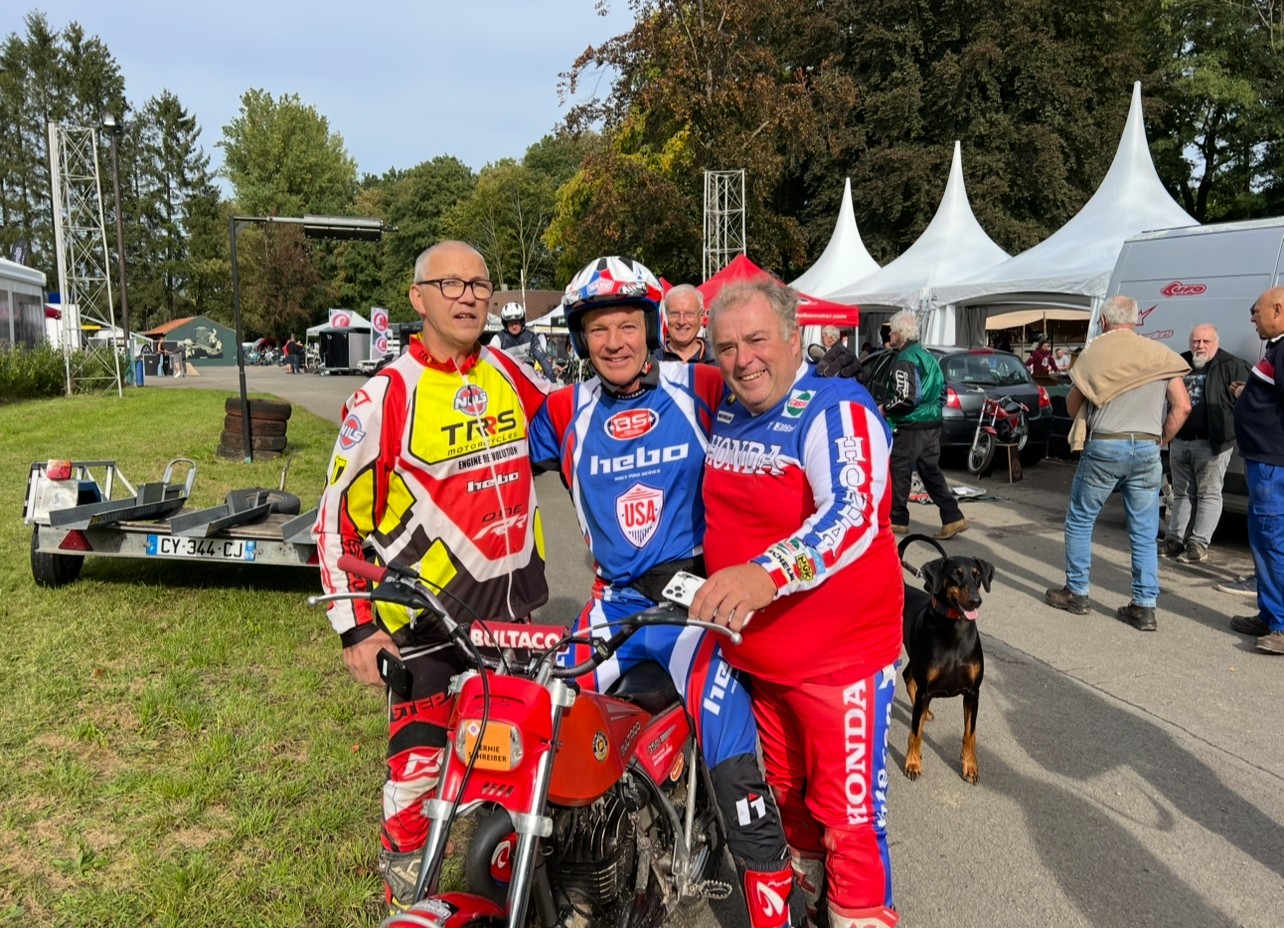
With Eddy and Eric Lejeune at Bilstain, Belgium (Photo: Bernie Schreiber Collection)

“Results and frustrations become less painful if you achieve most of your career goals. In sports, we are only the best during a certain moment in time.” 

The most desirable trials boot of all time. The Alpinestars ‘Schreiber’ (Photo: Bernie Schreiber Collection.

TG: How important was your 1982 historic Scottish Six Days Trial win?

BS: “It remains one of my greatest accomplishments in the sport of trials. I was not a huge fan of the SSDT in the beginning, because my knowledge of the events history and culture was blurred by the World Championships. It’s the only real trial remaining today in the sport.”
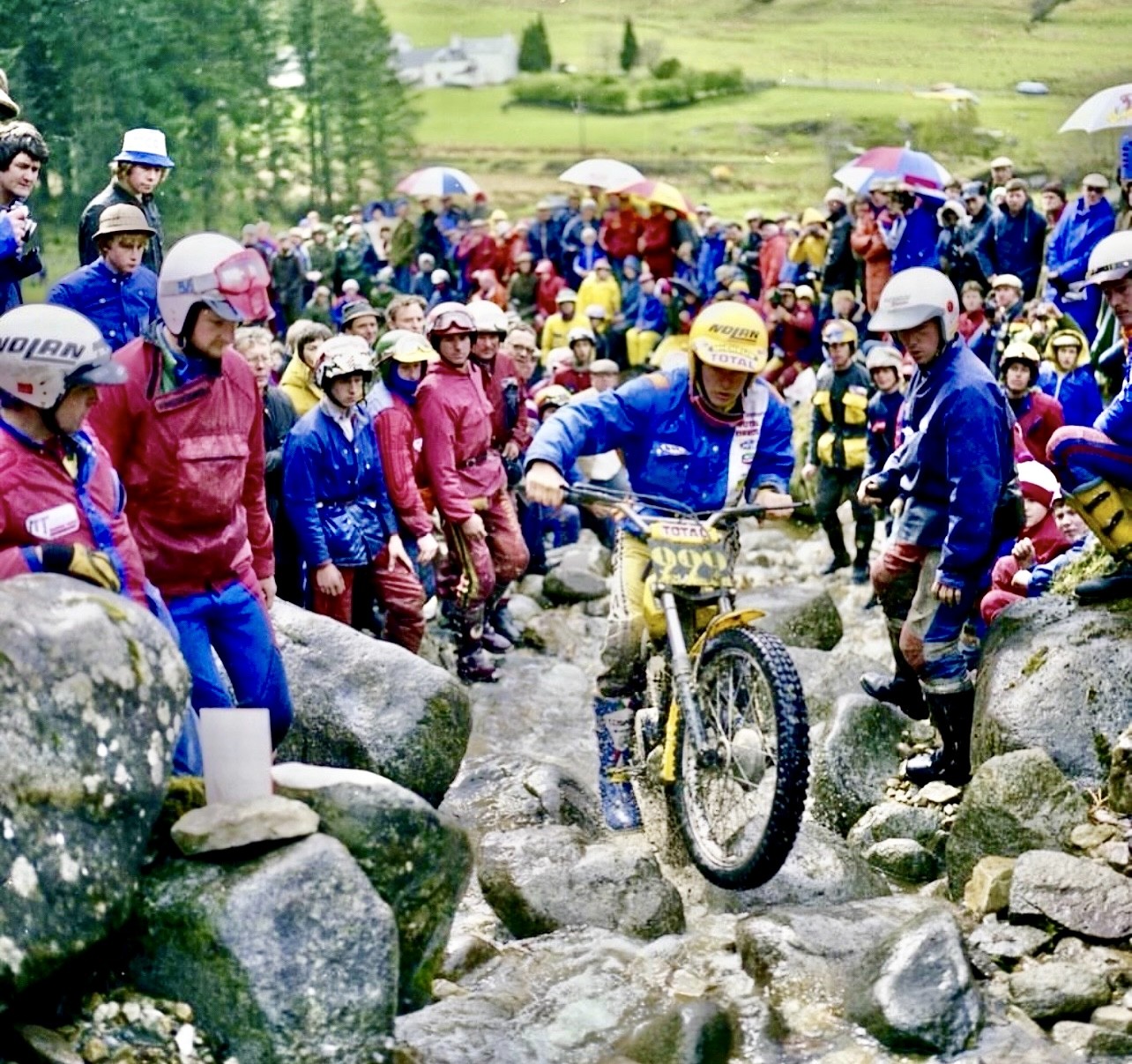
Schreiber’s 1982 Scottish Six Days victory, captured here by Eric Kitchen.

“The SSDT has long distances between sections, river style sections with many uphill rock beds, cold weather, time controls, non-stop rules, no score cards and six tough days over one hundred miles each day. It has always been an important event for manufactures, media and sponsors.

My second attempt was in 1980, I was the current world champion, but after two years of absence from the first attempt in 1977, I was not familiar with the event anymore. After three days, I realised that this event was really unique and one of a kind. I began to understand the true meaning of reliability trials, the history and traditions of the SSDT itself and where the sport all began.

1980 SSDT action on the famous ‘Pipeline’ section. (Photo: Jimmy Young)

If you try to clean every section each day, or try to win each day for six days, you were not going to win. The event is tough and had little margin for errors, not like a world championship, where you could drop more points in a day than the entire six days trial.

The SSDT is comparable to winning the Open Championship of golf at St Andrews in Scotland. It’s the most prestigious, most historic and most traditional event in the sport of Trials.”

TG: 1987 was your final appearance at the World Championships. When did you realize your time was up? Was that an easy decision?

BS: “Honestly, my time was up at the end of 1984, although I won two world rounds that year, including the British and German which were my last wins. Overall, finished third in the World Championship. I rode a few more years for fun and enjoyed it, especially with Gilles Burgat on the 1986 Yamaha team.”
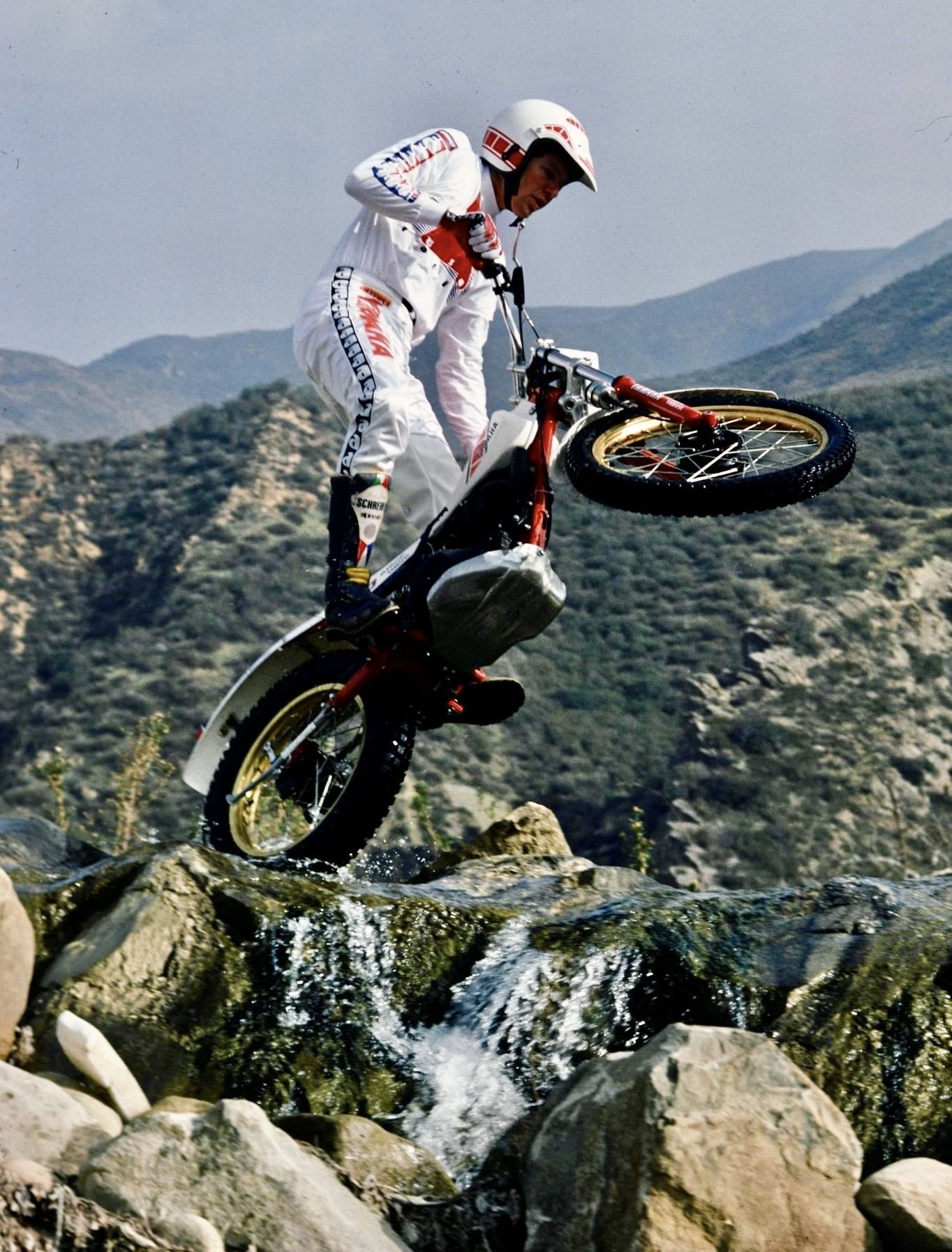
On the Yamaha TY250R, but the time to move on had arrived. (Bernie Schreiber Collection)

“My last year in 1987, had been focused on winning the U.S. National Championship for the fourth time and competed in the Spanish and American World rounds on a Fantic 303. It was nice to win the 1987 American Championship one more time after not competing since 1983.”

Bernie rode for Yamaha at the conclusion of his professional trials career. (Photo: Bernie Schreiber Collection)

“Good decisions are not easy to make, but mine was good for me. After ten years competing in over one hundred world rounds at high-level competitions, most major accomplishments in the sport had been reached except the Scott Trial of which I never competed.

Otherwise, six overall world podium finishes in 1978, 79, 80, 82, 83 and 84. Twenty individual world wins and forty-eight podiums over those six years.  It was time to explore and seek new challenges.”

TG: What happened after you retired in 1988 and stopped competing as a professional Trials rider?

BS: “In 1998, I’d been doing trials schools worldwide for a few years and continued doing them for another year. Many riders had bought my book ‘Observed Trials’ by Len Weed when it was published in 1983 and never seen the techniques in action, so it was an opportunity to share my time and skills with club riders and trials fans.”
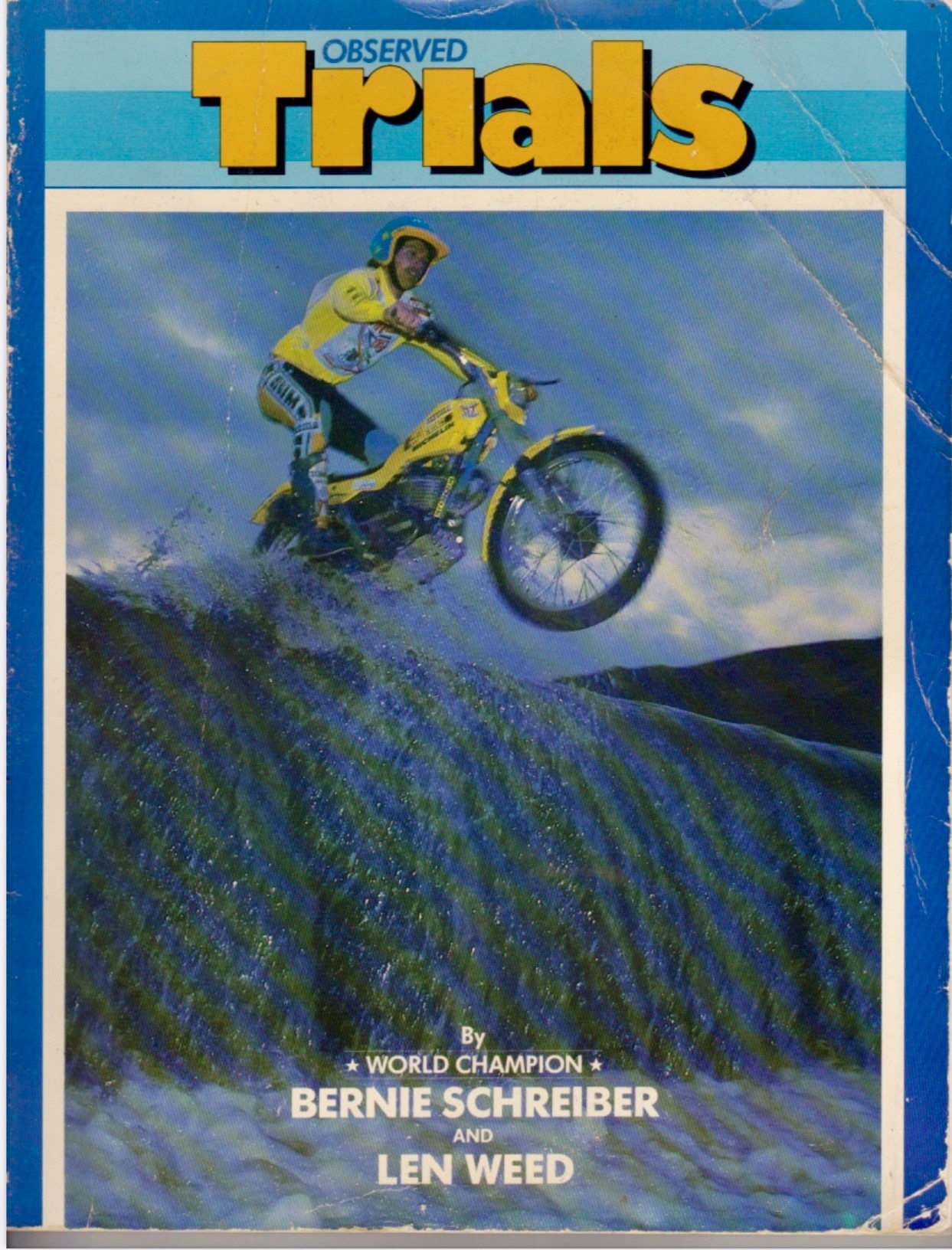
Bernie Schrieber’s 1983 book ‘Observed Trials’ which he wrote with Len Weed.

“In 1989, I started my first real job with the Malcolm Smith Products (MS Racing). The company was expanding to Europe in 1989 and needed boots on the ground to assist them with sales, marketing, and newly appointed European distributors. Great experience and Malcolm had always been one of my heros and a legend in the motorcycle industry.

After two years with MS Racing, I set up a consulting company in Europe and began advising additional clients Alpinestars and Answer Products overseas in the motorcycle and bicycle industry. I had a prior relationship with both, due to my trials boot and handlebar agreements in the early 80s. By the mid 1990s, I was mostly in the cycling industry with a strong focus on mountain bikes and accessories. I managed the consulting company for about six years.”

Bernie had contracts with Answer Products and Alpinestars with whom he developed for them the now famous and highly collectable ‘Schreiber’ trials boot. (Photo: Bernie Schreiber Collection)

“In 1996, the Company was approached by Tissot Watches of Switzerland who signed a long-term agreement as the official timekeeper for all UCI Cycling World Championship disciplines.

Tissot was searching for someone to manage on-site activations and promote their new precision and robust watches in the Mountain Bike space. That was my first big BRAND client. Tissot is one of twenty brands owned by the Swatch Group in Switzerland.  After a year or so of providing services, the Tissot President asked if I’d be interested to work internally at the headquarters in Switzerland and take responsibility of the Sports marketing department globally. The answer was YES just like with Bultaco in 1977. A multinational group with one hundred and fifty-year-old brands and 10,000s employees is when I took a deep dive into the corporate world.

Over the next ten years, Tissot had double digit growth year after year. We signed partnership agreements for timekeeping services and product licensing with several global properties in motorsports like MotoGP and NASCAR, but also the Asian Games, AFL, CBA in China to name a few. We had selective ambassadors like footballer Michael Owen, Danica Patrick in Indy Car and the late Nicky Hayden in MotoGP as well.
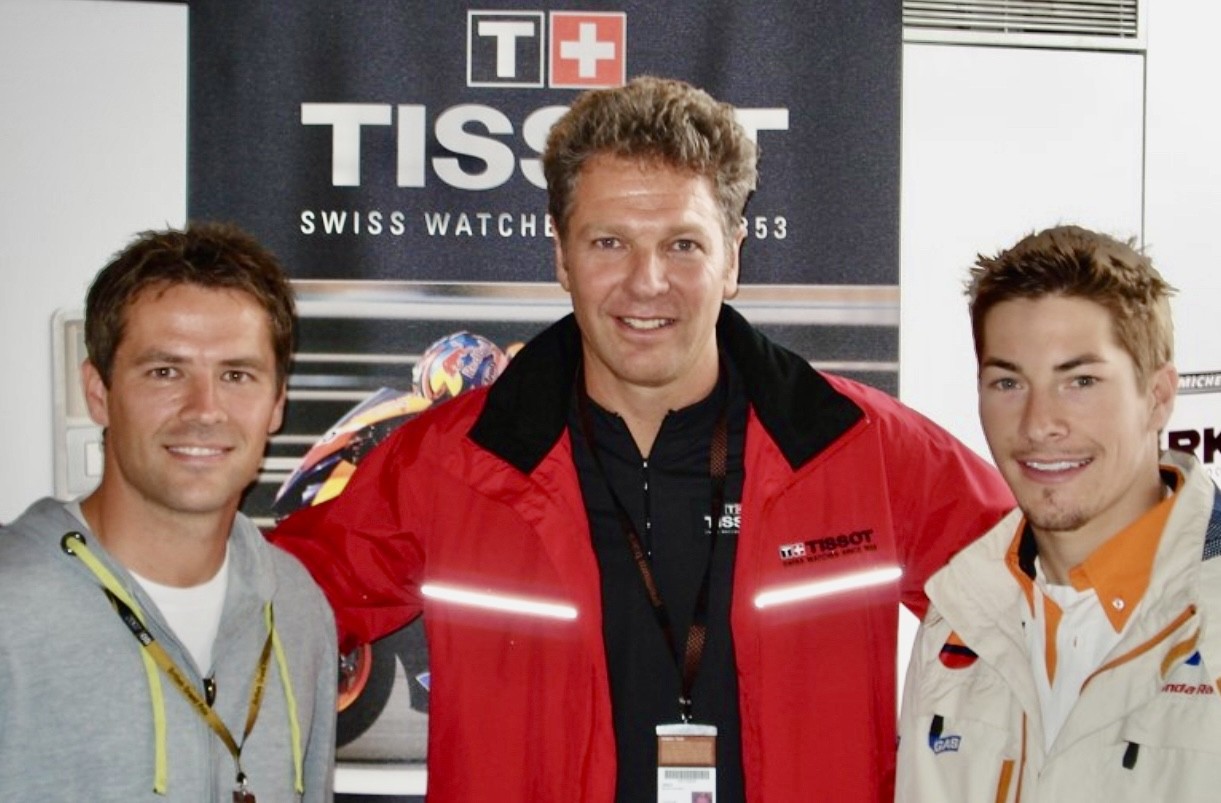
Michael Owen and the late Nicky Hayden were brand ambassadors (Photo: Bernie Schreiber Collection)

“In 2010, I decided to take a career break and stop travelling to events around the world for a while. Wonderful experience, but too much time on the road. It had been over twenty years on the road by now with trials travelling included.

Two years later in 2012, I was presented an opportunity by the Swatch Group CEO to lead the U.S. golf initiatives for the Swiss watch brand OMEGA in the USA. This position was based in Palm Beach Gardens, Florida.  

Omega had just signed a long-term partnership agreement with PGA of America, the governing body of 28,000 golf professionals across America. I spent three years traveling throughout the US, activating the brand in the golf space. My main focus was on golf tournaments, included the US Ryder Cup and other PGA of America Championship events. Omega has been the official timekeeper of the Olympic Games since 1932. They are very active in other sports like sailing, track & field and swimming. Prior to my arrival in the USA, Omega signed Greg Norman – the real Australian Great White Shark to be a brand ambassador, so I was based and worked out of his offices for the next three years before returning to Omega Switzerland.”
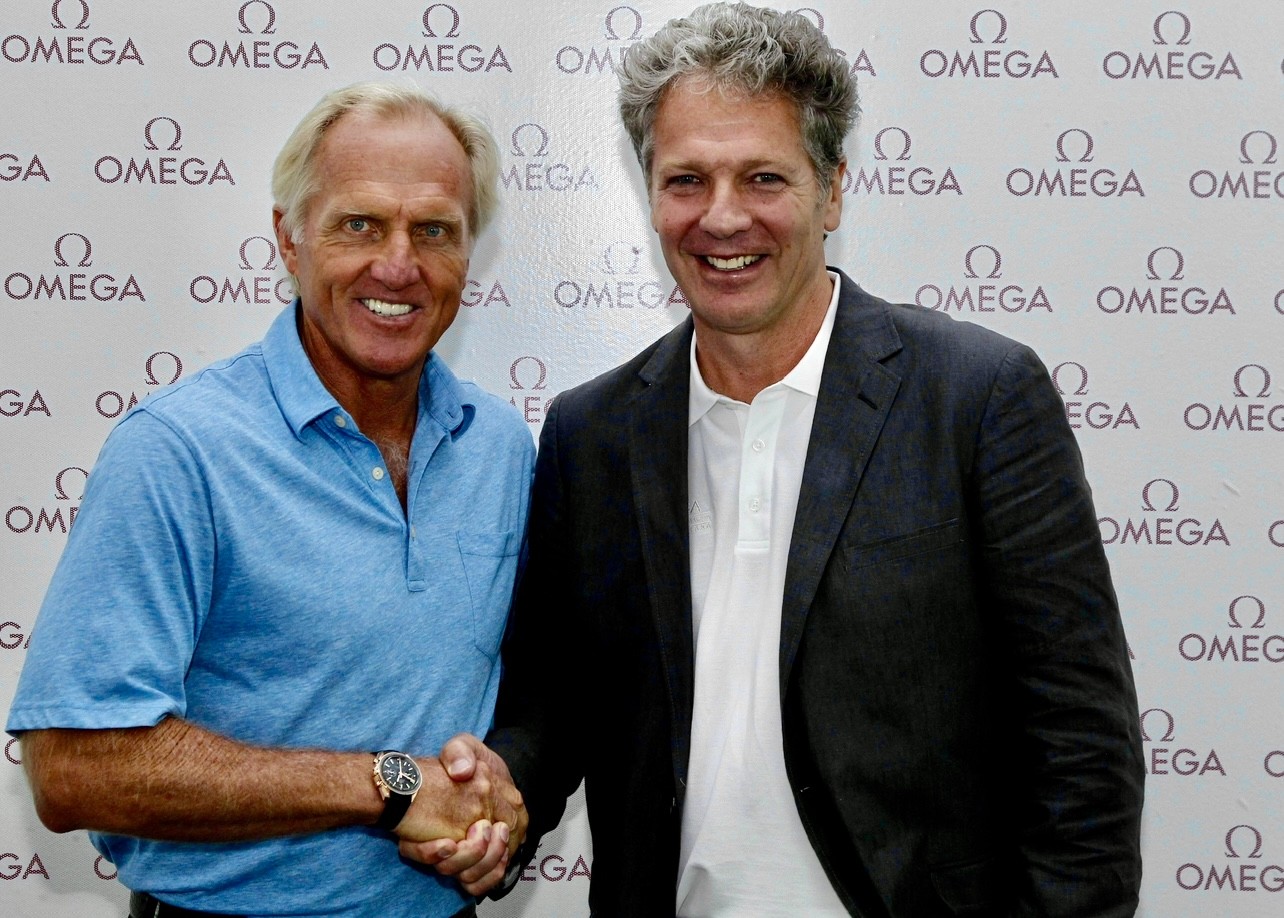
With Greg Norman and Omega. (Photo: Bernie Schreiber Collection)

TG: You remained in sports for a long time with professional athletes, can you tell us more about that?

BS: “Professional sports athletes are easy to work with, but often their agents are NOT. Sports ambassadors that have a Personal brand that fits a corporate brand can be a great association and added value for both parties. The activation plan of the association is key to the success of any co-branding partnerships.

Ambassadors are a product of the brand communication. Example: Michael Phelps the greatest Olympian of all time would talk about the importance of timing/touch pads during his swimming competitions at the Olympics, or golfer Rory McIIroy who would talk about precision and timing of a putt at the Masters. Time is what you make of those moments which can be in the past or present.

Timekeeping is an important tool for sports athletes or race teams. Nearly all sports Federations need a service provider for timekeeping. That’s how they measure performance, set official world records and handle results data for media and TV networks. You can host a major event without sponsors or spectators, but you must have a timekeeper. Try removing timekeeping from a downhill skiing event or many other sports. It would be like removing sound from a movie. All emotions are gone and nothing to measure performances.”

TG: Did you return to Switzerland after your U.S. Golf tour?

BS: “YES, returned to Omega Switzerland in 2015 to lead “Golf returning to Olympics” for the first time in 100 years and assist with other golf projects in Asia.

In 2017, we decided as a family to move permanently to Zurich for my son’s schooling and my partners work opportunities. A wonderful twenty years with Swatch Group. I’m thankful for the opportunity.”

TG: Have you still been doing any local club trials or did you walk away completely?

BS: “By 1989, I had lost interest in trials and found a passion in new adventures which was exciting times. I completely walked away from trials for about twenty years, or 1988 to 2008.  In 2008, I received an invitation to ride the Robregordo classic two-day trials in Madrid, Spain.”
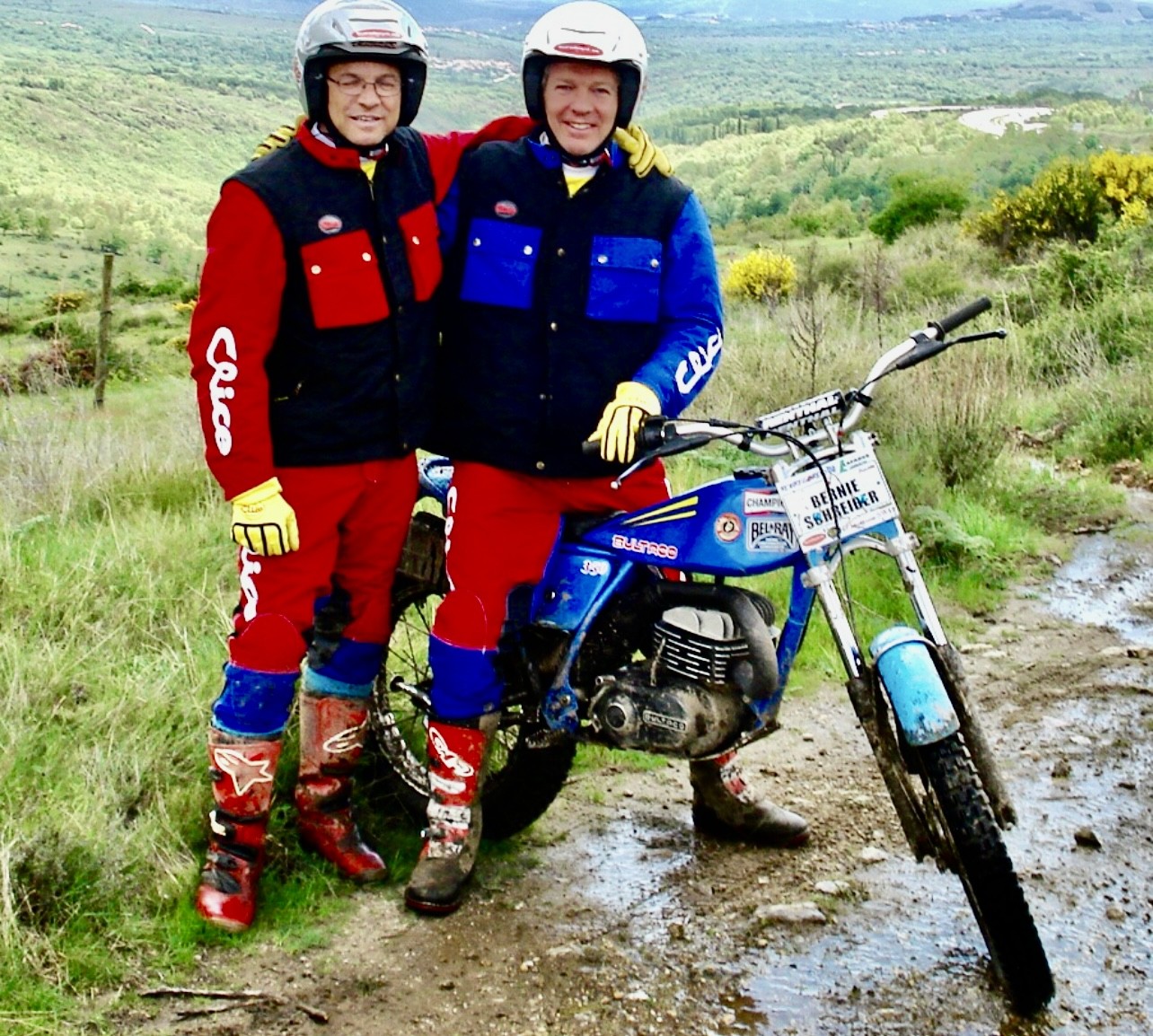
Manel Soler with Bernie Schreiber at Robregordo in 2008 (Photo: Bernie Schreiber Collection)

“A special event to celebrate my thirty years anniversary of my world championship victory. I had so much fun riding with old friends, Manel Soler, Mick Andrews, Andrea Codina, Jamie Subira and many others. At that time, I had no bike, boots, clothes or helmet. Everything was provided. Unfortunately, I was still working and had little time to ride trials.”

Bernie at Robregordo, Madrid in 2008 on a Bultaco supplied by Carlos Bosch. (Photo: Bernie Schreiber Collection)

“In 2011, Gilles Burgat invited me to celebrate his thirtieth anniversary at the Ventoux Classic Two-Day Trial in France. Another fabulous weekend with so many champions and friends. I was hooked to ride again, but soon after in 2012, I departed to the US for three years. During that time in the US, I attended the 2013 U.S. World round in Tennassee. Many old friends and fans attended the event. Great weekend and a lot of autographs.”

TG: When did you become involved in Trials again?

BS: “In 2018, I became more interested and available to ride trials and started receiving invitations to ride Classic events. The 2018 Bultaco Revival in the UK was my first real competition in many years. Riding with Vesty and Soler and staying at his home was the best weekend of trials for quite some time. Maybe because I competed on one of Vesty’s machines, but it was magical and memorable few days.”
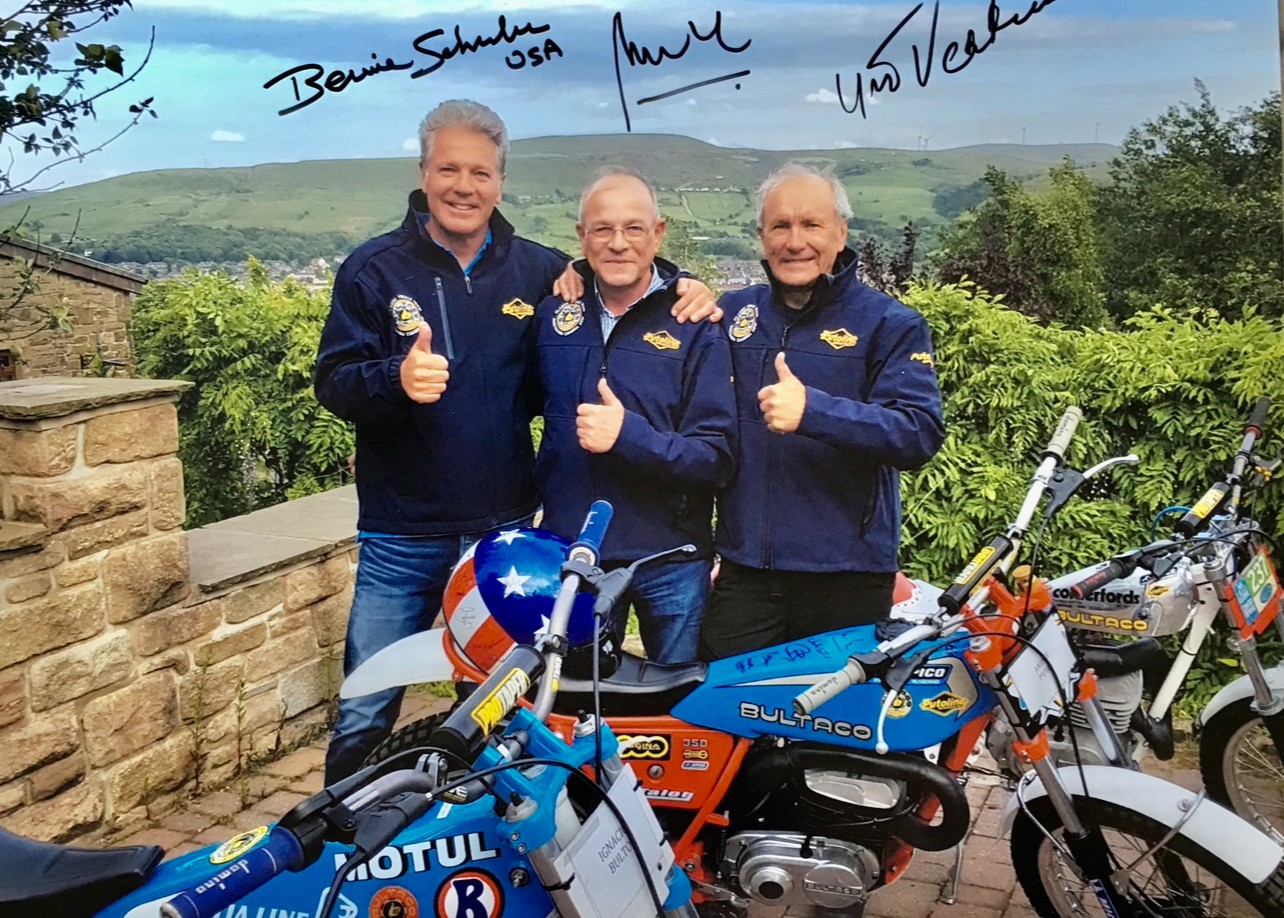
Together again as Team Bultaco at the Revival trial in Cumbria. Bernie, Manel Soler and Vesty (Photo: Bernie Schreiber Collection)

“A few months later there was the big gathering of trials riders in Barcelona, Spain called the ‘Trials Legends’ (1964-1985) that celebrated the golden years of the sport. Most of the past and present Trial Legends were present that day. Memorable moments with many champions.”
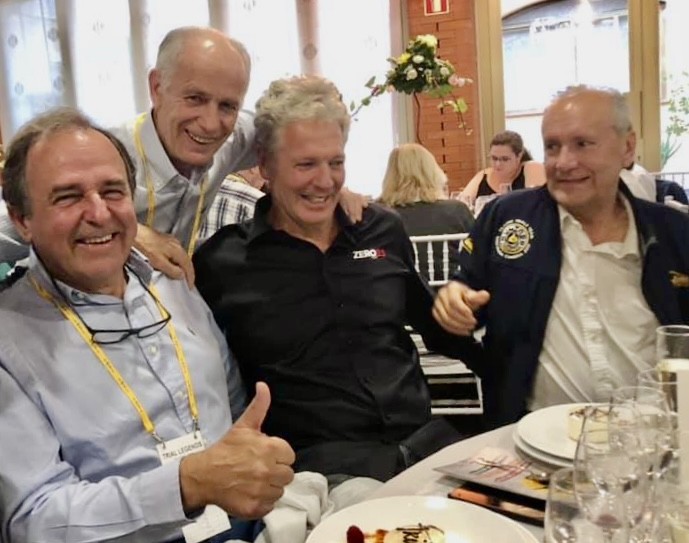
2018 Trial Legends, Barcelona, Spain, with Javier Cucurella; Charles Coutard, Bernie Schreiber and Yrjo Vesterinen. (Photo: Bernie Schreiber Collection)

“Later that year, I was invited to Italy for the Trial of Champions and Danilo Galeazzi’s 60th anniversary. The whole SWM team from the 1980’s was there and it was a celebration to remember with Moto Club Domo 70 in Domodossola.”
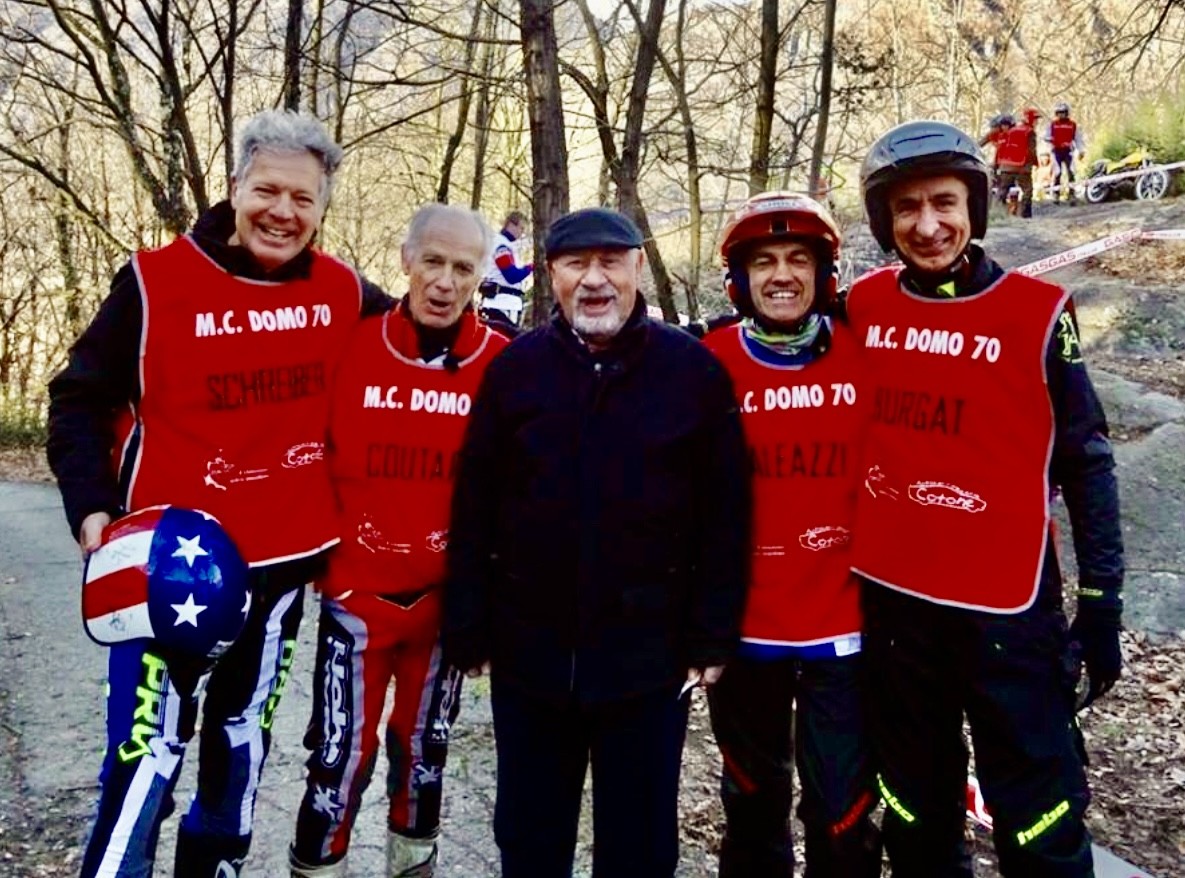
2018 and the SWM team are back together in Italy.

“2019 was the fortieth anniversary of my world championship title, and really the first year of full involvement again in the sport. It started with a lengthy phone call with John Moffat about participating at the Highland Classic Two-Day Trial as their guest of honor at Alvie Estate in Scotland. Its was the first time on the pegs in Scotland since my 1982 SSDT win. The Friendliest Trial in Scotland.”

“After watching riders on Facebook videos, it was clear that many of the classic riders lacked some fundamental skills, so it was decided with John Moffat to launch a Trials school in Scotland the day after the Highland Classic. Riding trials without learning the fundamentals is like building a house with no foundation. It will look good for a while and then it will fall apart.

I’d seen the need for a training plan with basics learning tools. A lot of basic instruction can be found in my book ‘Observed Trials’ with Len Weed, but I wanted to go deeper into the mental approach as well. You can be good at something, but not successful implementing it when needed. The approach and experience of learning has changed, but the basics are still the same.

That was my first school in decades and I repeated the experience in four other locations that year which included England, Canada, USA and Spain.”

TG: Did you compete in more competitions throughout 2019?

BS: “It was a fun year for sure with many invitations as Guest of Honor. Following the Highland Classic, I attended the Bultaco Revival in Yorkshire, then Andorra two-day trial followed by the Leven Valley in Scotland.”

Andorra in 2019 with Yrjo Vesterinen and Horacio San Martin of Todotrial website. (Photo: Bernie Schreiber Collection)

“The year ended with the traditional Robregordo Trial just outside of Madrid with a school organized by Javier Cruz. 2019 was busy with a lot of travel and experiences.”

With Spanish enthusiast, Javier Cruz in Madrid (Photo: Bernie Schreiber Collection)

TG: You stayed active in the sport between 2020 and 2024 considering Covid cancelled many competitions. Tell us about those years?

BS: “The 2020 Covid pandemic changed plans for many people in many sports. I still managed to attend a few events before Covid started and one being the Classic Dirt Bike show in Telford for the first time.”
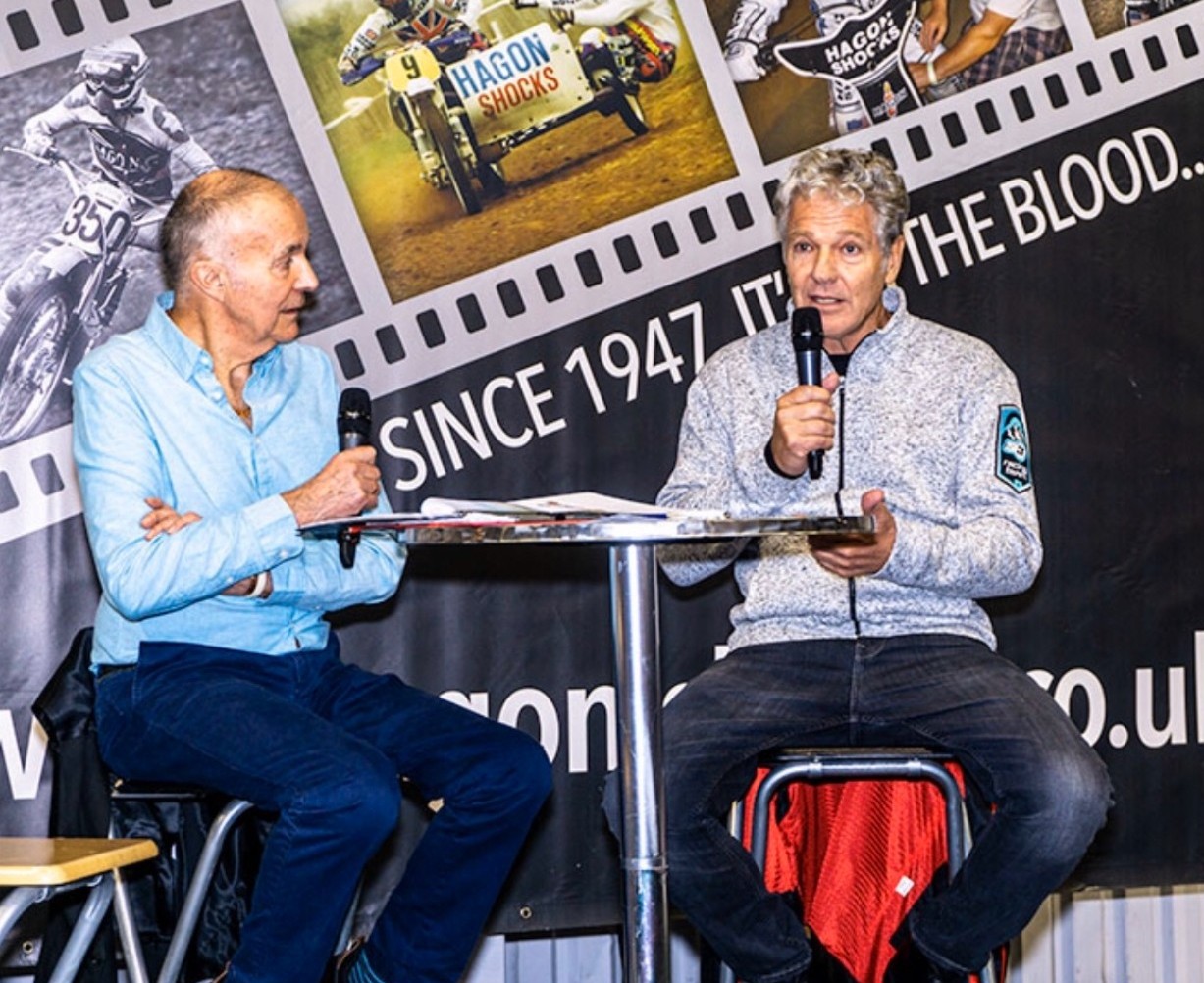
Jack Burnicle interviewed Bernie on stage at the Telford Off Road show in February 2020. (Photo: Bernie Schreiber Collection)

“I also participated at the Jersey Island Classic the day before the UK was closed and flew out on the last flight from London to Zurich.”

Jersey 2020, with Jersey Classic and Modern club President, Graham Du Feu. (Photo: Bernie Schreiber Collection)

“Later in August 2020 I competed at the A-Cup Trial in Austria, where they hosted their riders meeting in masks. It was good fun and nice venue. Overall, the year was good and was able to work on my first website with Heath Brindley who will soon be developing the new updated version soon.  www.bernieschreiber.com

2021 was a quiet year with fewer trials activities which included the Arbecey Invitational in France and the Due Giorni Trial Folgaria in Italy.”

“The one big event in 2021 was the FIM Awards Gala in Monaco and being a recipient of the FIM Trial Legend Award. A beautiful evening and very honored to receive this award by the FIM President, Jorge Viegas in front of the world’s motorcycle champions.

The FIM Congress with President Jorge Viegas in 2021 at Monaco. (Photo: Bernie Schreiber Collection)

2022 was a big year for the good and not so good. First was the loss of my father and best friend who had been the driving force of my trials career from the first day, so not so good.”

Richard and Bernie Schreiber. Richard was Bernie’s guiding light in the early years. (Photo: Bernie Schreiber Collection)

“It was a year of reflection and the fortieth Anniversary of my victory at the 1982 SSDT. I had planned activities, but reduced them due to other family activities.”

GLOVES OFF was launched in February 2022 with TRIALS GURU as a regular and exclusive column in the news feed, and is archived there for trials enthusiasts. https://trialsguru.net/gloves-off-bernie-schreiber/

“In the April, I made a trip to the UK to visit Heath Brindley for a few days to ride in Wales with a modern TRS and friends. That followed by a bucket list visit to the Sammy Miller Museum which is highly recommended. Seen some beautiful machines, motorsports history and luckily seen the man himself for a tour. Sammy was my first trials instructor in California back in 1973, so it was very nice to catch up with the champion and legend.”

Friendship and mutual respect, Sammy Miller MBE and Bernie Schreiber at Sammy’s workshop at New Milton. (Photo: Bernie Schreiber Collection)

“As the year advanced, Rich Hilbun organized a fortieth SSDT celebration in Montana with a trials school and annual event called ‘Whiskey Gulch’ with one hundred and twenty riders attending from the USA and Canada. A fabulous week of trials with American friends and my Spanish friend Yoyi San Martin from www.TodoTrial.com in Spain.”
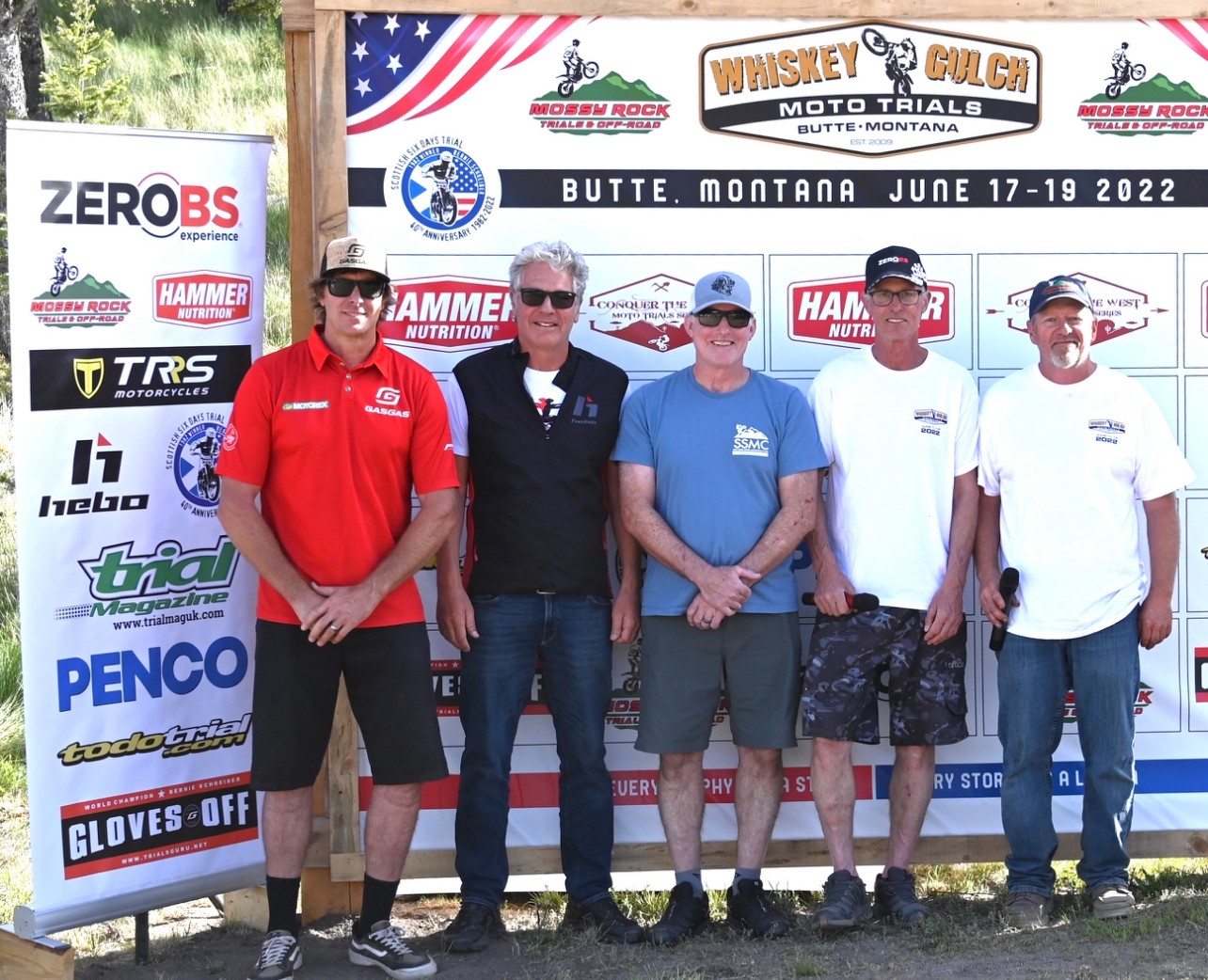
Left to right: Geoff Aaron, Bernie Schreiber, Scott Head, Rich Hilbun and Dan Larson in 2022 at Whiskey Gulch, Montana. 17 U.S. titles in one photo! (Photo: Bernie Schreiber Collection)

“In 2022, I decided that as I bought my first Bultaco in 1971, a 125 Lobito with money I received for my paper round, I would buy my second Bultaco. I only had bought one Bultaco, all the ones I rode were given to me under sponsorships or contracts. I struck out and bought a 325cc model 199A, the type I used to win the 1979 World championship. That was a gap of fifty-one years.”

Bernie’s personal 1979 M199A Bultaco Sherpa, only the second Bultaco he has ever bought. (Photo: Bernie Schreiber Collection)

“Another highlight of the year was the 2022 FIM Trial Vintage Trophy in Monza, Italy. This event was one day before the Trial des Nations. This was the first ever FIM Vintage Trophy event and my role was Ambassador, not competing. The winner was Philippe Berlatier from France.”

Philippe Berlatier was the winner of the 2022 FIM Trial Vintage event. (Photo: Bernie Schreiber Collection)

2023 highlight was a Trials school in Tulsa, Oklahoma, organized by Kirk Mayfield an old trials friend since the early 1970’s. The event was hosted by one of the oldest clubs in the USA, the North Eastern Oklahoma Trials Team, founded in 1969 by one of the legendary names in U.S. trials history Mike McCabe, who became the first American competitor of the Scottish Six Days Trial in 1972.”
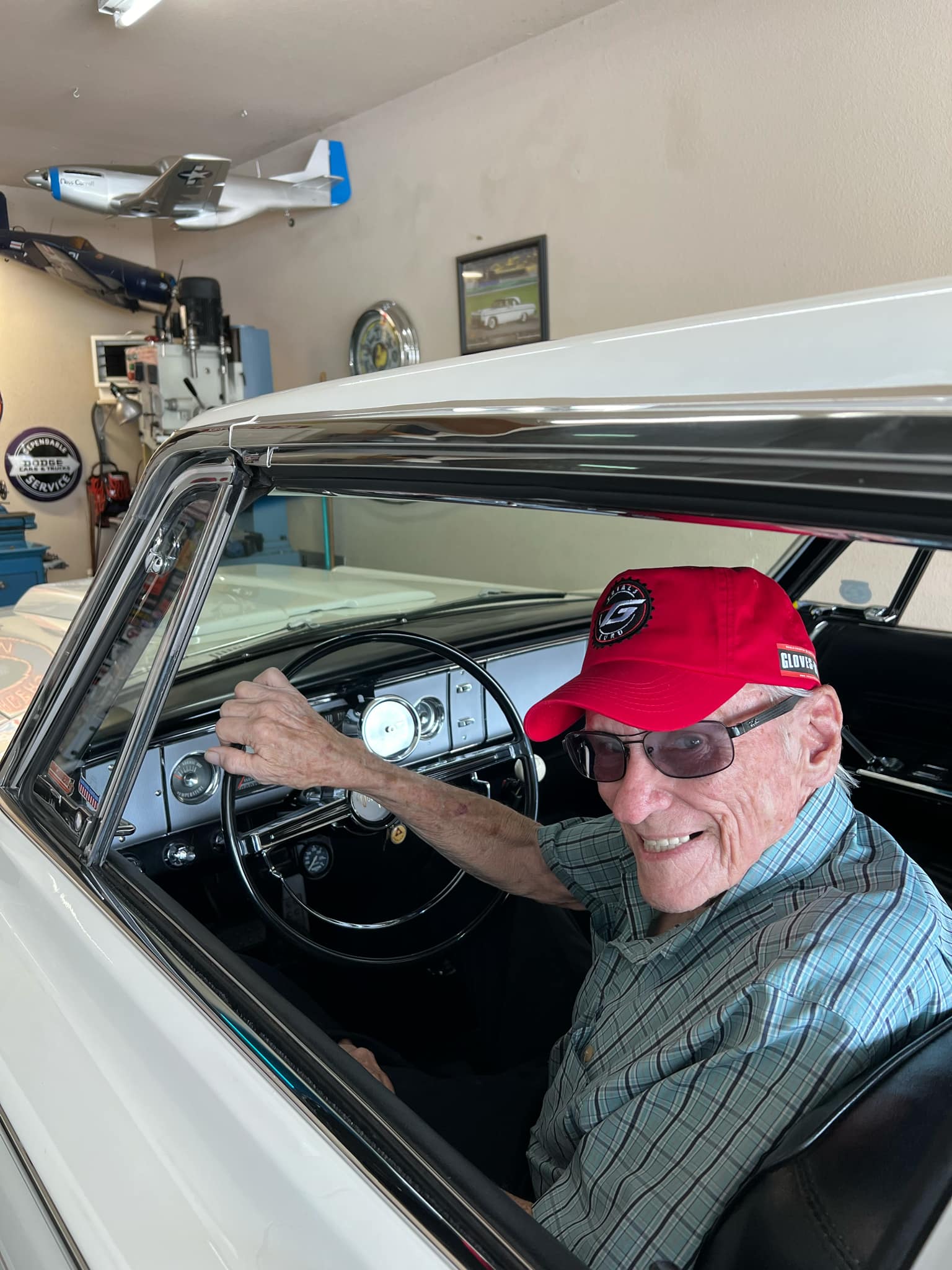
Mike McCabe from Broken Arrow, Oklahoma, the first American to ride the SSDT is a Trials Guru VIP.

“A few weeks after Oklahoma, I returned to the Highland Classic in Scotland for the second time and had a lot of fun riding a special Moffat Bultaco prepared by Vazquez Racing in Madrid.

The final event of 2023 was the fiftieth Anniversary of Domaine Bilstein in Belgium. Probably the best festival trial ever with many historic riders and in the venue where I rode my first World Championship event in 1977. Fantastic event organized by the Crosset family and team.  

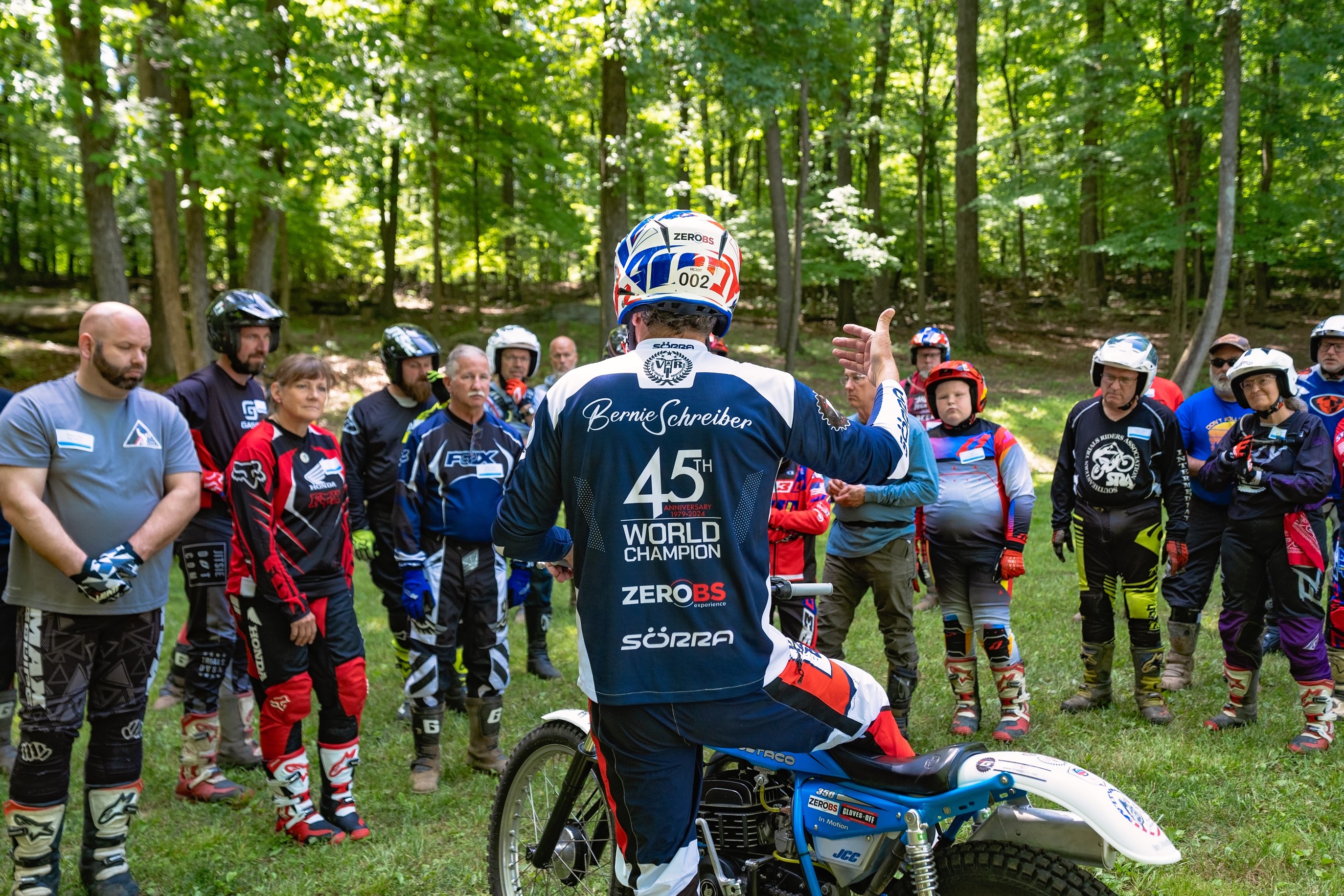
2024 started with the Classic Dirt Bike show in Telford, England. The idea to celebrate the 45th anniversary of my World Championship title was mentioned and off we went with a new Sorra limited edition jersey.”

The launch of the Sorra/Schreiber riding gear at Telford with Sandy Plenty, the UK concessionaire of Sorra. (Photo: J. Moffat/Trials Guru)

“The next adventure was in Ohio for my third American Trials school in three years.”

Bernie Schreiber was inducted into the AMA ‘Hall of Fame’ in 2000. (Photo: Bernie Schreiber Collection)

“This time was to visit the AMA Hall of Fame Museum and raise funds for NextGen Mototrial youth in America, which was very successful thanks to Duane Tope and Adam Blumhorst.”

Bernie with Alan ‘Sid’ Lampkin and Tony Davis at the Highland Classic ‘BSA/Triumph Edition’ in 2024. (Photo: Bernie Schreiber Collection)

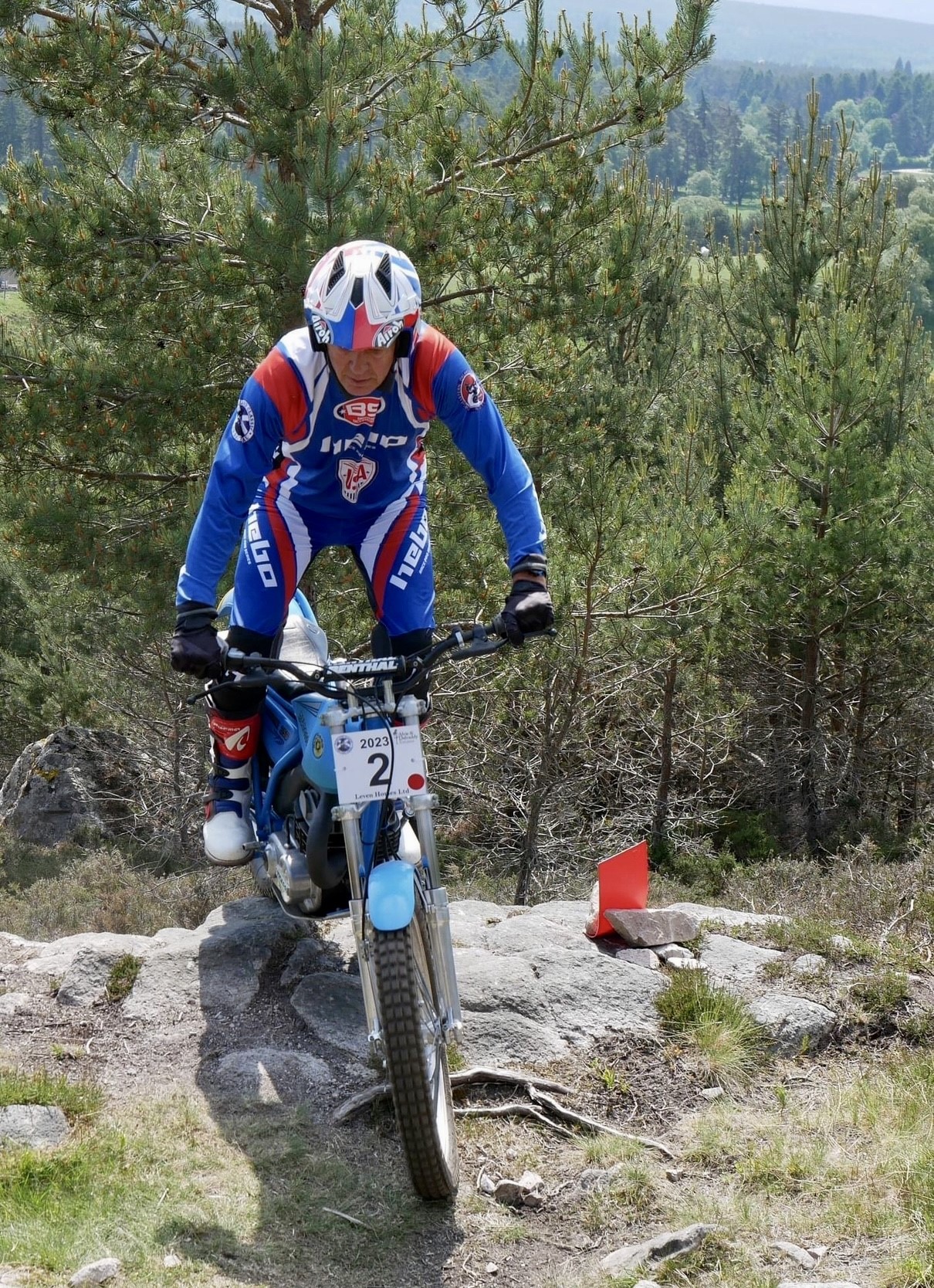
“Then returned back to the Highland Classic for the ‘BSA-Triumph Edition’. This year, I rode a 250 BSA supplied by John Moffat and truly had blast riding around on the thumper.”

Bernie sampled BSA four-stroke power at the 2024 Highland Classic at Alvie Estate, Aviemore, Scotland, borrowing the machine from friend, John Moffat (Photo: Bernie Schreiber Collection)

TG: That has been a busy schedule of events. How has 2025 been so far?

BS: “2025 has been a fabulous year to date. As always, the planning of events takes time and commitment, but well worth it all. Celebrating 55 years of riding and still on the pegs is a very fortunate person.”
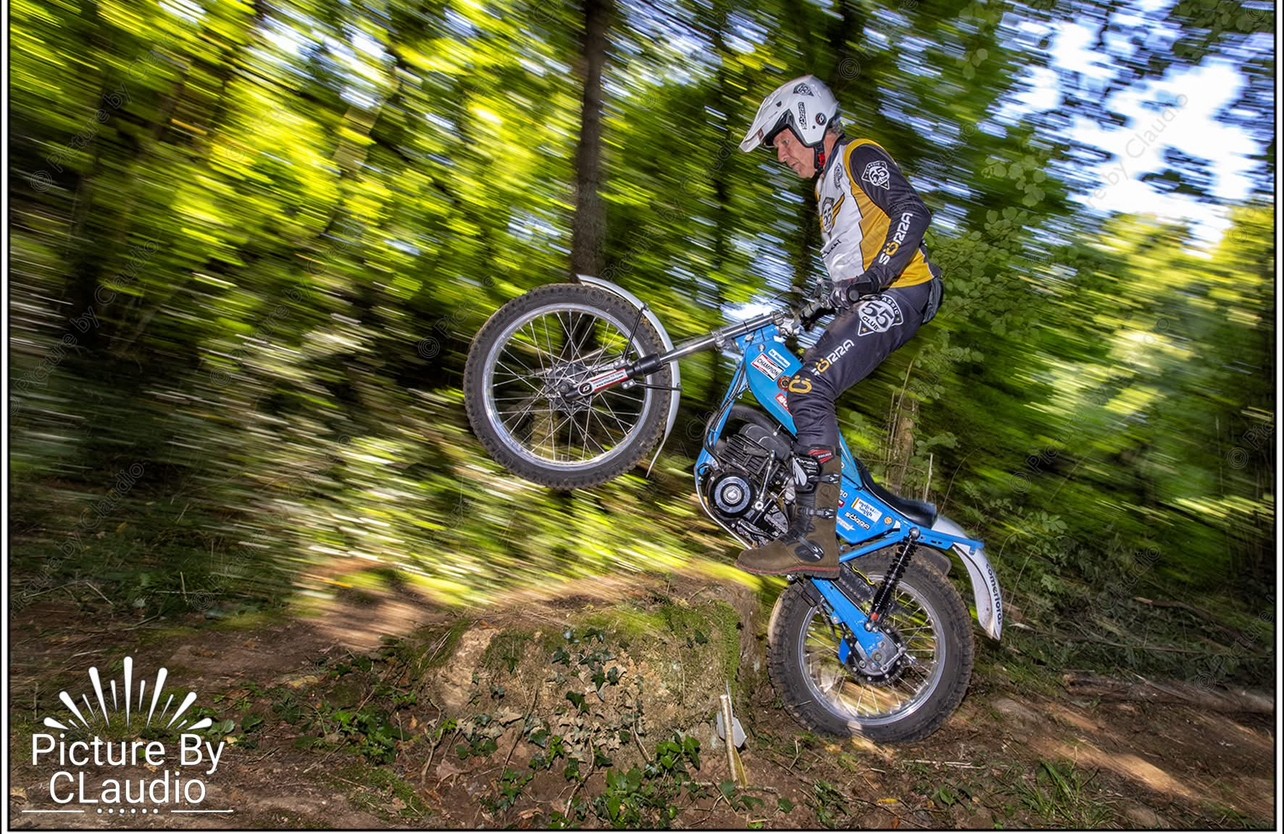
“This year has been celebrating 55 years of riding and it started in Telford again with some good people and laughs.”

Fun at Telford for the 2025 Off-Road Show. Left to right: John Moffat; Jill Andrews; Jean Caillou; Bernie Schreiber; Yrjo Vesterinen; Patrick Pissis; Olivier Barjon; Martin Matthews and seated, Mick Andrews (Photo: Bernie Schreiber Collection)

“The American `Ride Vintage’ weekend training in Indiana organized by Duane Tope and the local club has been a high point of the year for me.”

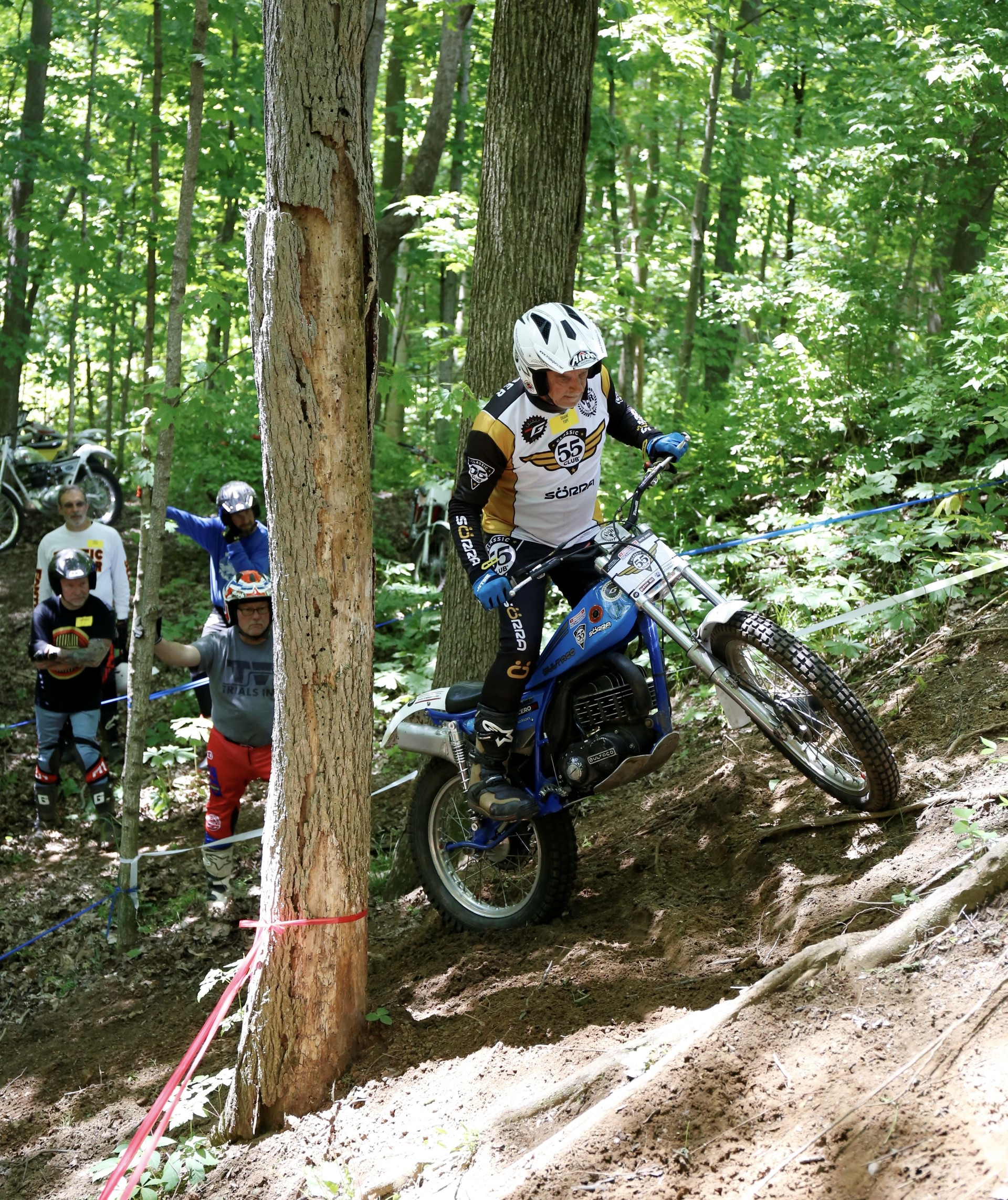
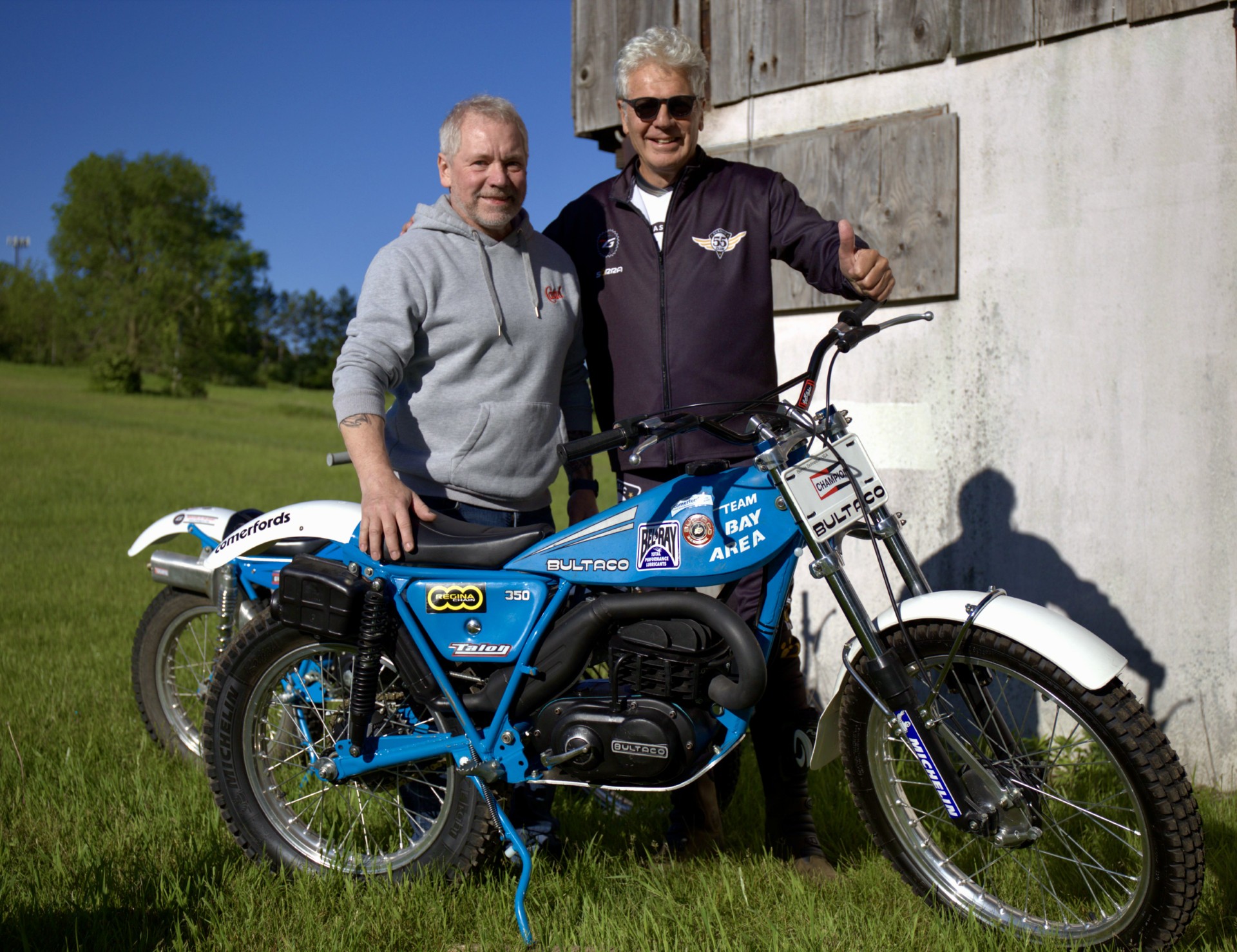
I was thrilled to ride my late fathers 1972 Bultaco which had been fully restored by Duane Tope for the occasion.”
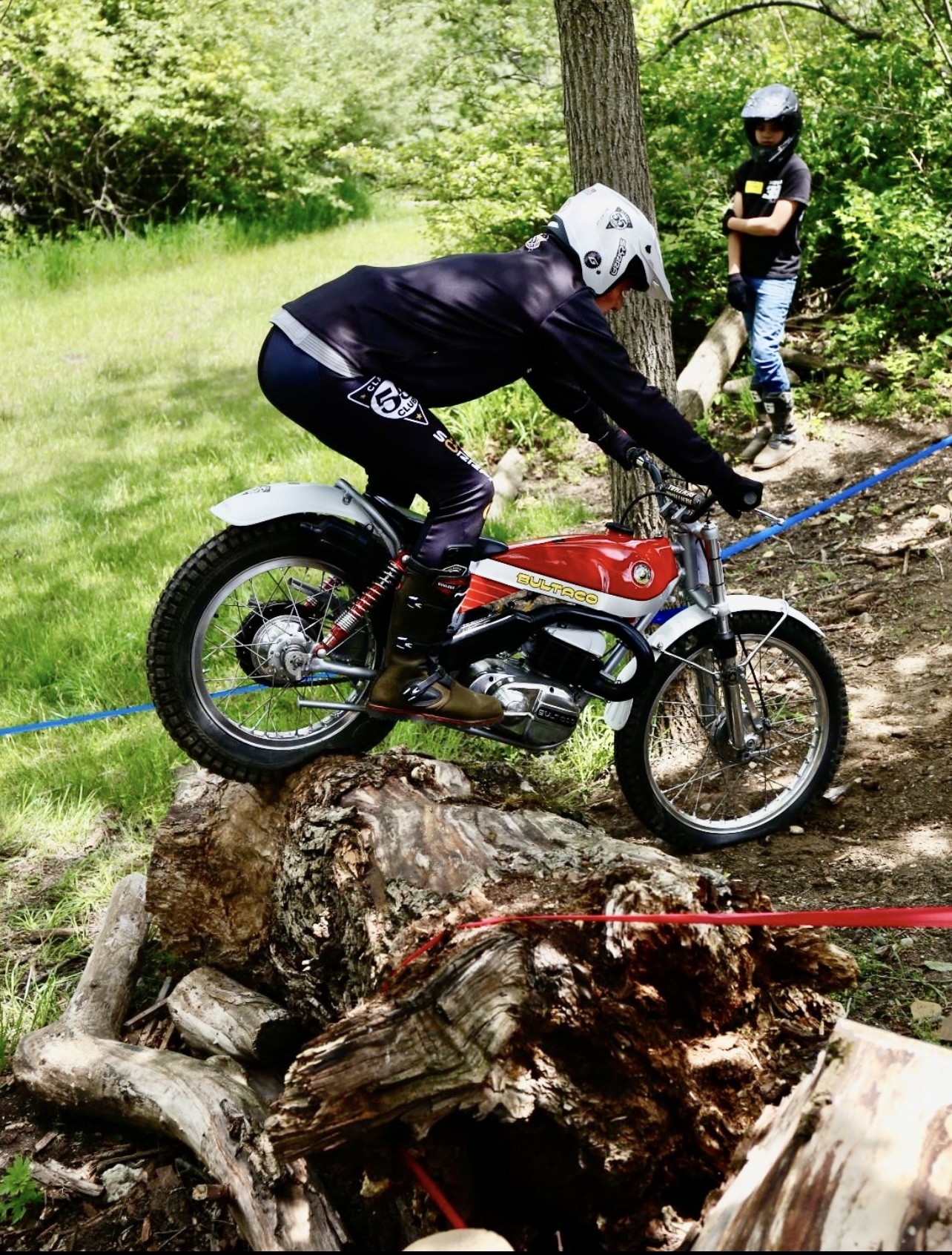
Riding his late father’s 1972 325cc Bultaco Sherpa in 2025.

“Duane Tope has a long history in Vintage Trials bikes restorations and competition, winning the AMA Twin-shock Trials Championship title in 2023.”

Duane Tope did the rebuilding of Bernie’s father’s Bultaco and also prepared this version. (Bernie Schreiber Collection)

“From Indiana, I returned to the friendliest trial in Scotland. The Highland Classic for my fourth experience at the event.”

2025 Highland Classic for the fourth time, riding the Vazquez Bultaco 325 from the John Moffat stable – Photo: Bernie Schreiber Collection

“This has become my favorite trial of the year and I’m already looking forward to June 2026.”
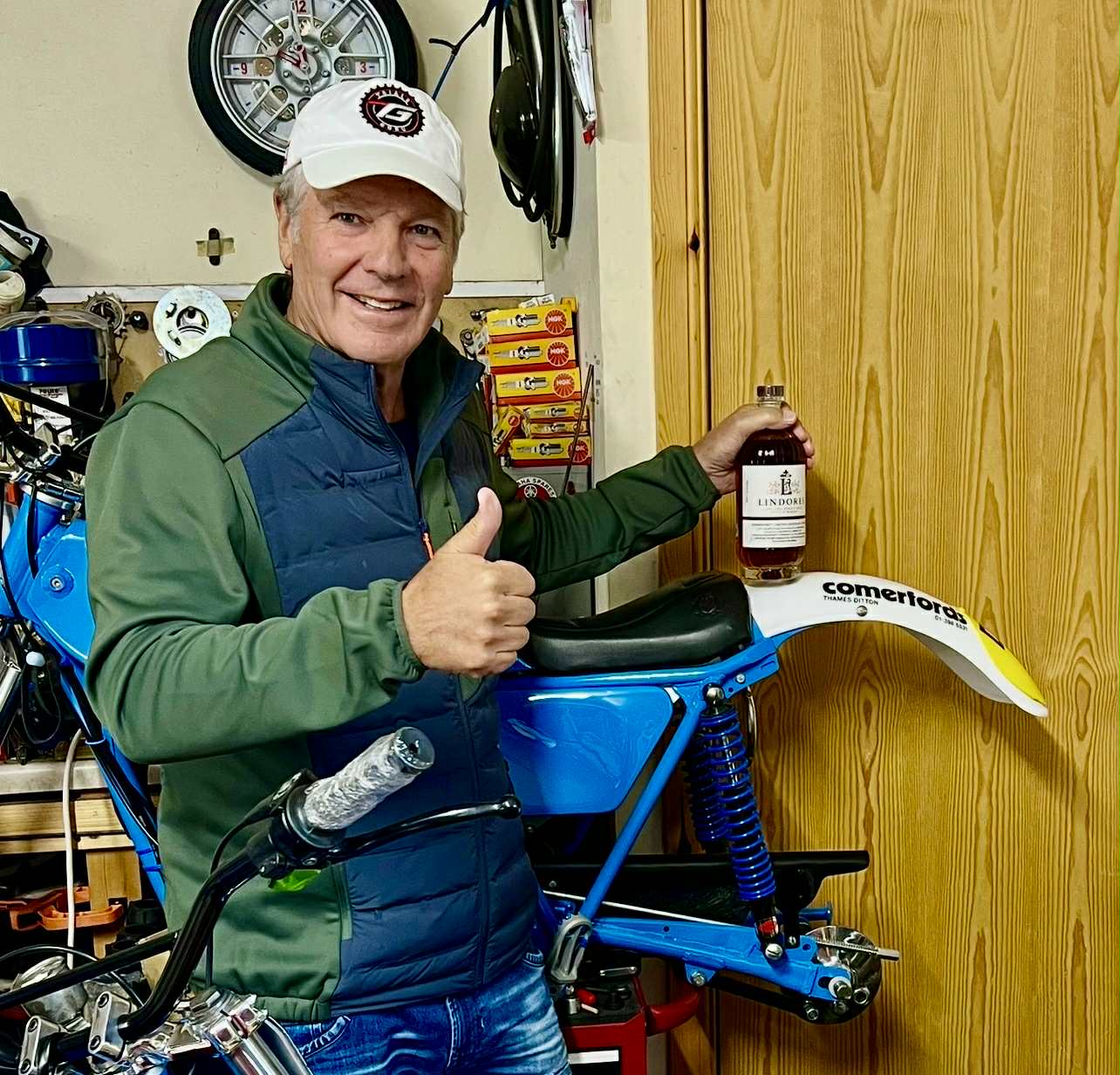
In Scotland for the 2025 Highland Classic, Bernie received his commemorative bottle of special Scotch whisky from Patrick Comerford, to celebrate 100 years of Comerford’s. (Photo: Trials Guru)

“My last competition of 2025 was the annual Arbecey two-day Invitational in France. I finished second overall at this traditional event organized by Joel Corroy and Trial 70 Club. This year ten times French Champion, Charles Coutard competed and we rode side by side for two days. The magic of trials is you can ride with friends who also started riding in the sport 55 years ago.”
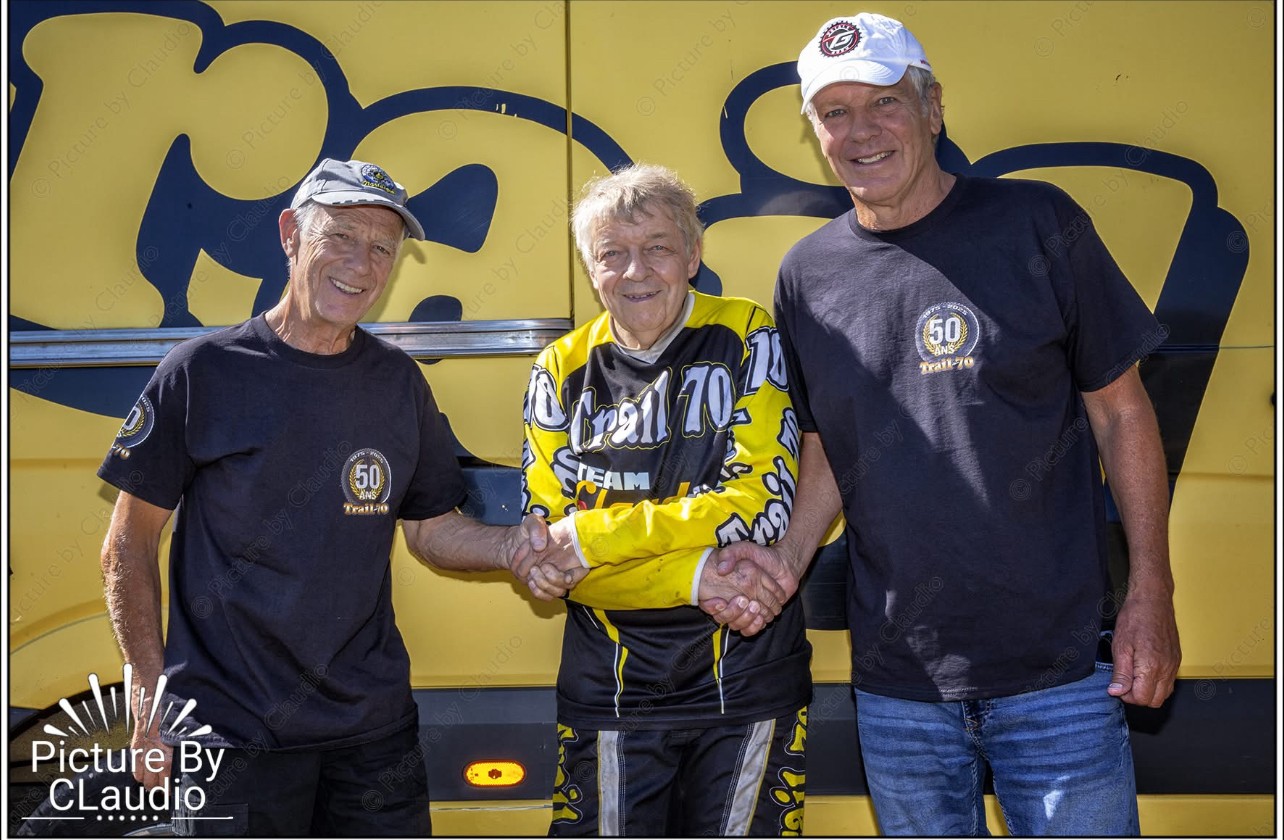
Friends at Abercy in 2025, Charles Coutard, Joel Corroy and Bernie. (Photo: Jean Claude Commeat)

TG: What is Classic 55 Club?

Classic 55 Club Logo

BS: “At Classic 55 Club, everything revolves around the love of off-road classic bikes and passionate motorcycle enthusiasts. Our mission is to continue creating the strong connection between the beautiful historic bikes and those stories riders have to share. Welcome to the club.

For me personally, it’s always the people that make the biggest difference in everything. With that said, I would like to thank all those who continue to support me at events, on social media and the media platforms. Thank you, Trials Guru, for your continued dedication to trials and our partnership.”

“Thank you to Racing Services Spain for all your graphic support, including special logos, number plates, catalogs and stickers. Thanks to all the trials school organizers who made it happen and hopefully learned something along the way. Thanks to everyone who loaned me a bike or worked on one and washed it after the event. Big thanks to Walter Frei in Zurich for taking care of my only Bultaco in Europe and his transportation services for practice and other events. Thanks to all the photographers who capture all the special moments, and observers who keep my score card clean. Thank you to all my sponsors and suppliers over these past years.”
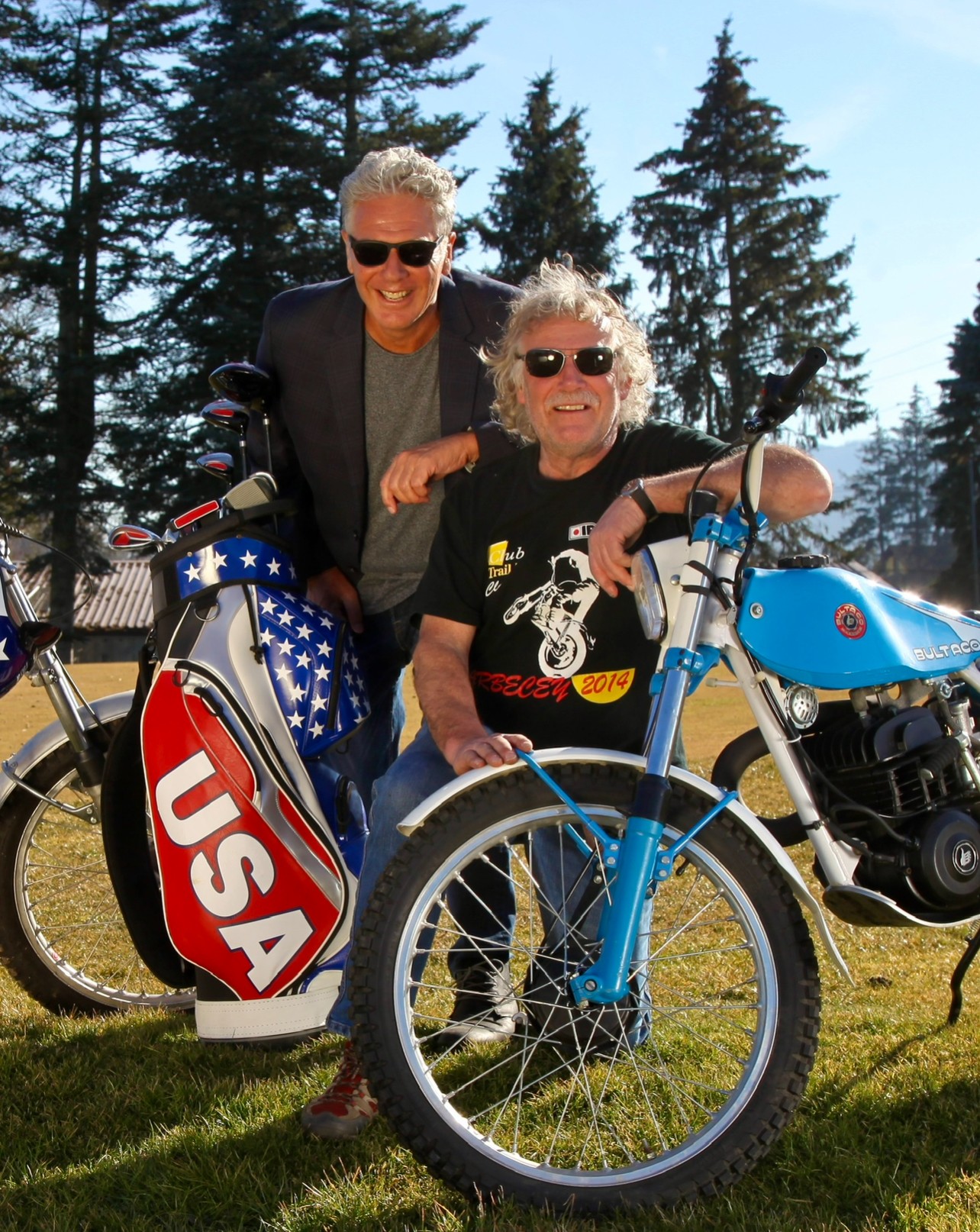
With friend Walther Frei in Switzerland. (Photo: Bernie Schreiber Collection)

“I am grateful for everyone who supported me over the last 55 years in Trials. In the meantime, Keep your feet up!” – Bernie Schreiber

1979 FIM World Trials Champion and 1982 SSDT winner, multiple US NATC National Champion – Bernie Schreiber

Article copyright: Bernard Schreiber/Trials Guru 2025

(The Classic 55 Club logo is the registered trade mark of Bernard Schreiber, Zurich, Switzerland.)

For more articles by Bernie Schreiber on Trials Guru: GLOVES OFF

Apart from ‘Fair Dealing’ for the purpose of private study, research, criticism or review as permitted under the Copyright, Design and Patents Act, 1988, no part of this article may be copied, reproduced, stored in any form of retrieval system, electronic or otherwise or transmitted in any form or by any means, electronic, electrical, mechanical, optical, chemical, photocopying, recording or otherwise without the prior written permission of the author as stated above. This article is not being published for any monetary reward or monetisation, be that online or in print.
Bernie in Indiana 2025

Vintage Weekend with World Champion Bernie Schreiber in Indiana, U.S.A.

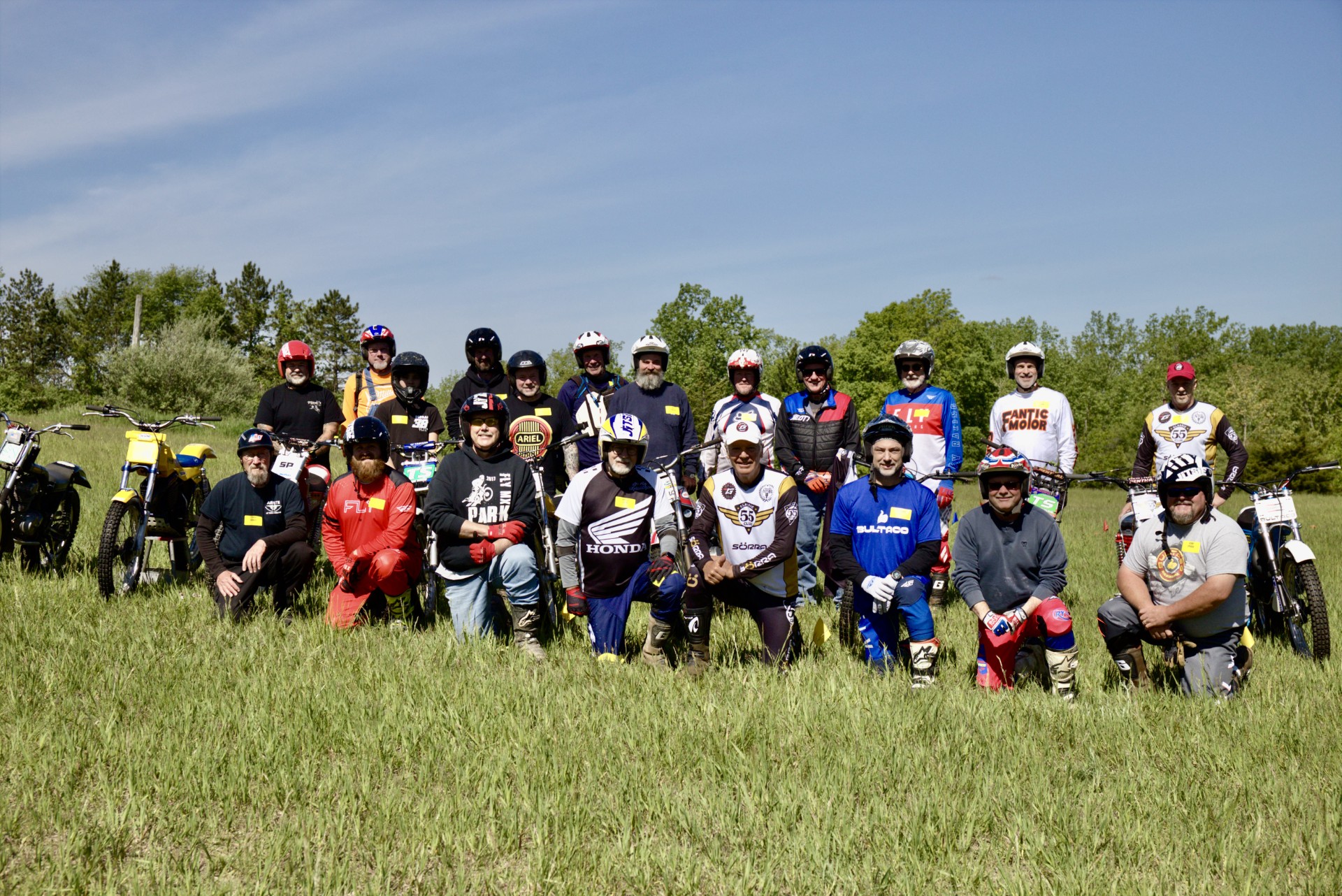
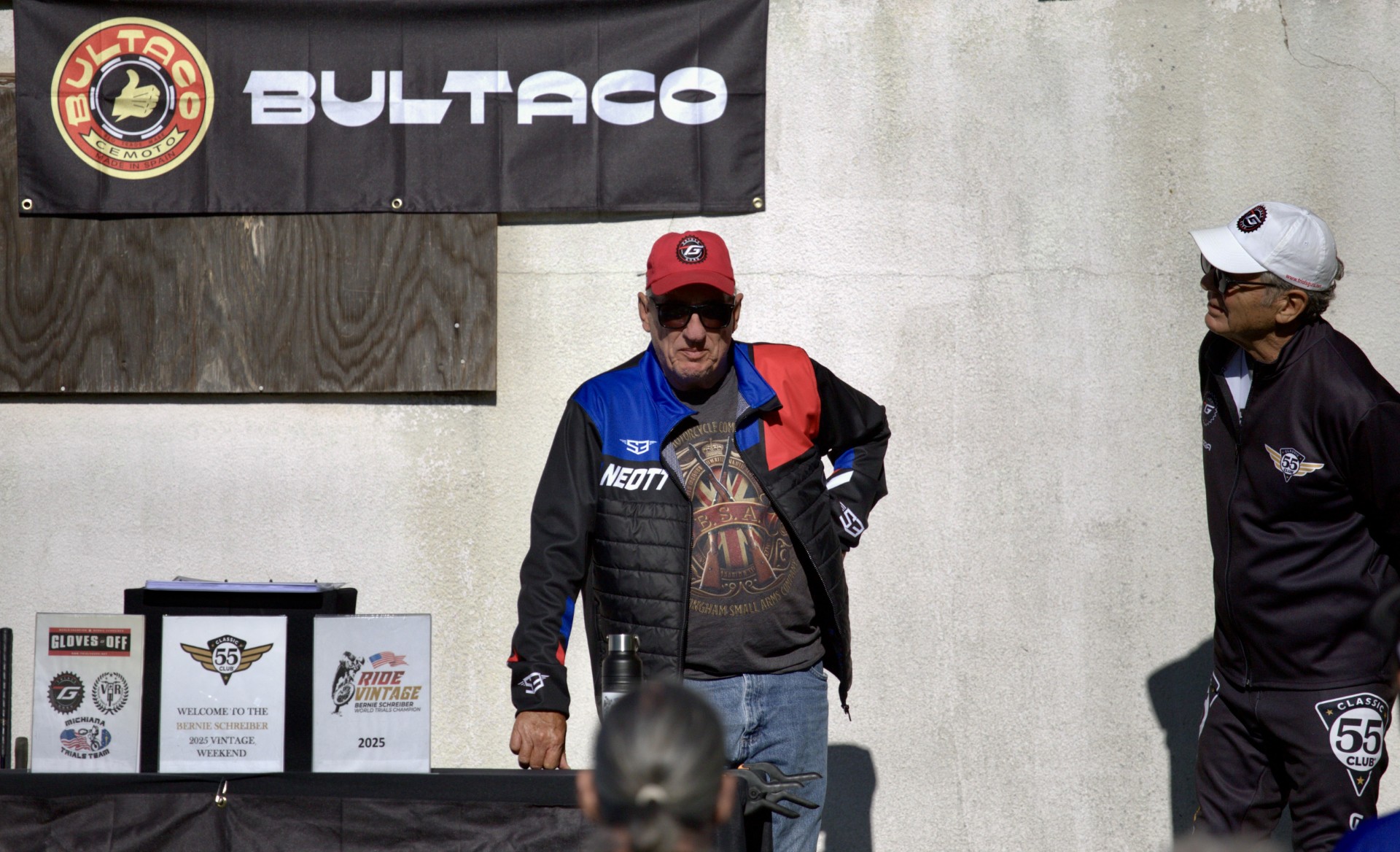
American’s only World Trials Champion and Scottish Six Days Trial winner Bernie Schreiber conducted his first RIDE VINTAGE two-day Training weekend on May, 24/25 at Mount Wawasee Lodge in Indiana. Schreiber, being the most successful Trials rider ever from the USA, shared his wealth of knowledge and overseas experience with twenty participants attending from five States. The weekend was exclusively reserved for twin-shock machines.

The Vintage weekend event was hosted by Michiana Trials Team in Indiana a member club of (MOTA) The Michigan Ontario Trials Association created on February 19, 1967, in Detroit, Michigan. MOTA has a long history in American Trials hosting American National Championships and a World Championship in 1977 of which Schreiber competed. Just two years later Schreiber competed at the AMA National Championship on May 26th, 1979 in Indiana, the same year he won the World Championship.

2025 marks a special moment for Schreiber who started Trials competition fifty-five years ago in California and still competes in Vintage events today. 1970 was the beginning of what later became a successful Trials career overseas in the late 1970’s and 80’s. This year is a celebration of 55 years of competing in a sport which originated in 1909 throughout parts of the United Kingdom.

Schreiber was thrilled to ride his late fathers 1972 Bultaco Sherpa which has been fully restored by Duane Tope for the occasion. Tope from Indiana has a long history in Vintage Trials bikes restorations and competition, winning the AMA Twin-shock Trials Champion title in 2023. 

Schreiber treated the 20 Vintage enthusiasts to his structured training format based on lessons learned in becoming a World, National, and Scottish Six Days Trials Champion, which included fundamental techniques from his book ‘Observed Trials’ by Len Weed. Schreiber said: “Its not just skills and hard work, everyone at the top level has great techniques, but your mindset is what makes you a winner. That’s the only difference. Learning to ride a Trials bike, is not the same as learning to ride Trials.” He continued to focus on competition successes and practicing with purpose by design. “The best way to practice is to prioritize on the things you need to practice, and knowing which tasks should get top priority, then act to get maximum returns.”

Kirk Mayfield (left) delivers a tribute in honour of Lane Leavitt who recently passed away.

Scotland is Schreiber’s next stop at the annual Highland Classic two-day trial on June 7/8 to compete with 200 twin-shock participants at Alvie Estate, near Aviemore.

Bernie demonstrates ‘body position’ on his 1972 Bultaco.
Event organiser and American twinshock champion, Duane Tope.
Englishman Francis Hall on his Ariel.
Bernie Schreiber’s 1979 Bultaco 199A now owned by Francis Hall.

All photos copyright: Cory Tope

Bernie goes Vintage!

Breaking News! 

Mount Wawasee Lodge, INDIANA U.S.A. – January 30th, 2025 

1979 FIM Trial World Champion, Bernie Schreiber is to host a VINTAGE training weekend in Indiana.

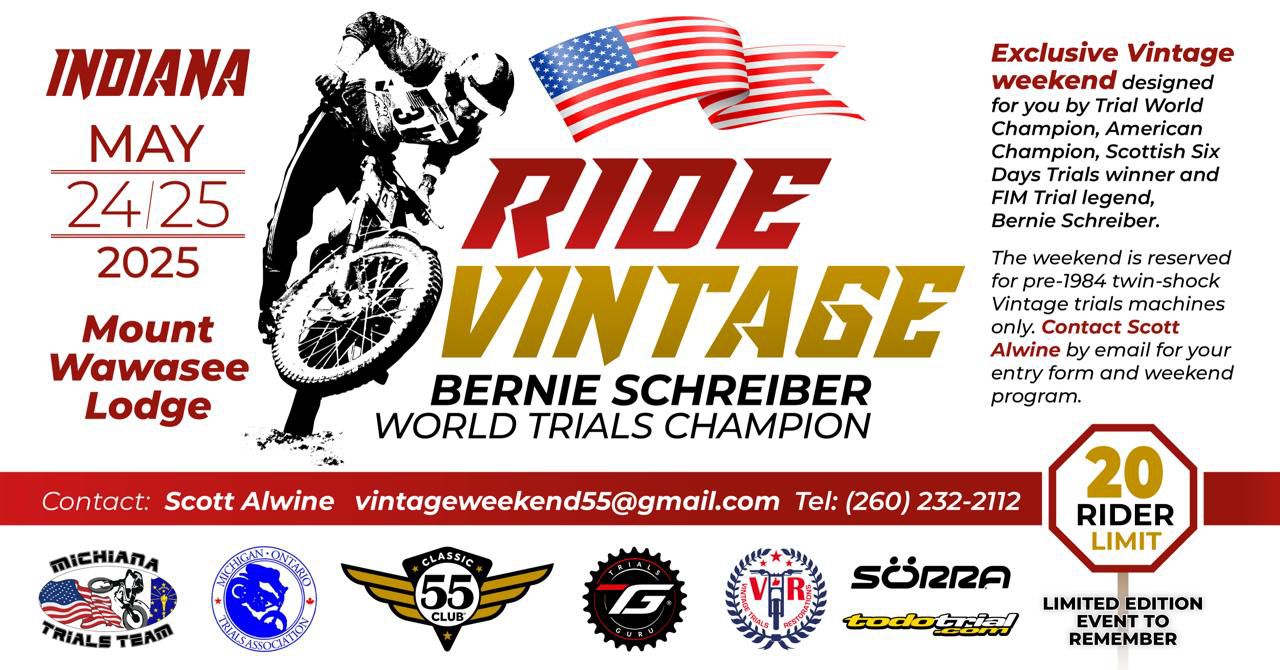
AMERICA’S only World Trials Champion and Scottish Six Days Trial winner Bernie Schreiber will return once again to the USA in 2025 to conduct a two-day Vintage training weekend, exclusively reserved for pre-1984 twin-shock Vintage machines on 24/25 May.   

The event will be hosted by Michiana Trials Team in Indiana, a member club of MOTA. The Michigan Ontario Trials Association was created on February 19, 1967 in Detroit, Michigan. MOTA has a long history in American Trials hosting American National Championships and a World Championship in 1977.

2025 marks a special moment for Schreiber who started trials competition fifty-five years ago in California and still competes in Vintage events today. 1970 was the beginning of what later became a successful adventure overseas in the late 70’s and 80’s. This year is a celebration of 55 years of competing in a sport which originated in 1909.

A young Bernie Schreiber in 1973 – Photo: Len Weed

The ‘Ride Vintage’ training weekend revolves around the love of off-road twin-shock trials bikes together as a group of enthusiastic Vintage Trials enthusiasts. Schreiber, a trials coach has always believed that every off-road motorcycle rider can improve, and that real enjoyment is the challenge to be the best that you can be!

Schreiber’s wealth of overseas knowledge and experiences are priceless for Vintage club riders and his trials accomplishments recognized him as a FIM Trial Legend in 2022. The Champion’s insights on how he became the only American World Champion is a mental instruction that all in the sport need to experience.

For more information contact: Scott Alwine at: vintageweekend55@gmail.com

www.motatrials.com

The Rules, Regulations and Benefits in Sport

Gloves Off with Bernie Schreiber

Former World Champion, SSDT winner and American Champion Bernie Schreiber shares his opinions with Trials Guru about sports rules and regulations in this ‘Gloves Off’ feature. Schreiber competed himself in local, national and international Trials during his professional career. He also worked with Swiss watch brands, Tissot and Omega for decades within their role as Official Timekeepers for many sports including MotoGP and the Olympic Games. Schreiber spent over a decade in World Championship Trials competition and he knows first hand that rules and regulations aren’t just part of sport, they are the sport. We had the opportunity to explore his opinions about sports regulations, Trials today and his observations going forward, as he looks back on the sport’s history and heritage.   

Trials Guru: When did you start competing in sports?

Bernie Schreiber: The beginning was a few American team sports back in Junior high school. My mother had me competing in local tennis competitions since the age of 10, so I had a good taste of getting beat up by bigger kids already. Took a liking to individual sports from a very young age. First motorcycle Trials competition was around 1971 at Saddleback Park in the kids’ class with Jeff Ward who turned to Motocross a few years later. A year later in 1972, I competed in America’s biggest trials event ‘El Trial de Espana’ and that same year Sammy Miller entered and won. There were about 300 participants at the event.

In 1974, I won a trip to Barcelona to watch the Spanish European Championship and visited the Bultaco factory. Two years later in 1976, a group of Americans went to the Scottish Six Days Trial. I was underage to ride, so spectated the entire event, starting in Edinburgh. The following year in 1977 at 18 years old, I entered the FIM Trial World Championship season sponsored by Bultaco and participated in the SSDT. Managed two podiums at the world rounds in Spain and West Germany that year and finished seventh in the world. That was the start of my career in sports.

1979 FIM World Trials Champion – Bernie Schreiber

TG: How important are rules and regulations in sports?

BS: Rules and regulations are very important in sports. Regulations are typically created by governing bodies at various levels such as; national or international and these rules are officially put into effect by a greater weight than standard rules and are legally binding. While some rules can be limited to specific groups, clubs or organizations, regulations apply to all individuals and entities within a jurisdiction. The main purpose of regulations is to ensure standardization, safety and fairness of the sport.

Rules are the invisible force that guides every sport, every athlete, judge and manufacturers, etc. Imagine a baseball game without strikes or a basketball match without fouls or motorsports with no weight or power capacity rules? It wouldn’t just be chaotic; it would be a completely different sport.

Rules create the boundaries that give a sport their identity. They dictate the pace, the intensity, the excitement and fairness. Rules and regulations ensure fair-play and apply to everyone equally, leveling the playing field so that talent and strategy win the day. There should not be special rules for a few, venues for a few, event calendars for a few, support for a few, overwhelming product advantage for a few, or total financial dominance.

Rules are the backbone that keeps the sport fair, safe, exciting, and, frankly, playable. Without fair rules, there would be no structure, no way to determine a real winner, no framework to build upon and eliminate a potential for unfair acts in order to gain an advantage.

TG: Why is fair-play essential in sports?

BS: Fair-play is an essential and central part of successful sport involvement, promotion and development. By adhering to the rules and regulations, athletes compete on a level playing field, where their skills and abilities determine the outcome.

The principles of fair-play include integrity, fairness, and respect for opponents, fellow players, referees, sponsors and fans. With these principles, the spirit of competition thrives, fuelled by honest rivalry, courteous relations and a graceful acceptance of results.

So, when you’re watching your favourite sport or playing the sport yourself, remember those rules are more than just guidelines, they’re what makes the sport great.

Each sport has a unique set of boundaries and rules which brings out the best in athletes and teams, fostering an atmosphere of competition that’s both challenging and rewarding. Remember, it’s within these well-defined lines and well-established rules that the true spirit of sportsmanship thrives. And every time you coach youth, you’re instilling that same respect for rules and boundaries in a new generation of athletes.

Photo: Eric Kitchen

TG: What are the benefits of rules and regulations?

BS: Rules set the stage for competition, defining how to score, what’s in bounds, and what’s a foul. They level the playing field so that talent shines over bad actors. The benefits of rules help sports accurately adapt to challenges and support growth. If the rules are good for all involved, it benefits all involved. Rules are meant to enhance, promote good and be optimized over time to match specific goals and best interests for all parties involved.

There are always concerns about modifying sport rules and it has been an increasing issue in the past few decades. Modifying the rules is a common way to change the game conditions. Rules provide the unique, differentiating character to the sport and especially in traditional sports.

There are many reports on the subject of rule changes and time after time the rule modifications are no real benefit, impact or a specific goal achieved. Rule modification involves processes that seek change in the game conditions with a certain goal in mind. 

This could be to improve performance, attract more spectators, media, sponsors or cost reductions etc. 

Quite a few times it has been identified that one of the primary sources of rule change was purely commercial pressures and personal interests. In some cases, the commercial benefits are related to an increase in TV spectatorship, which in turn affects the public’s interest in the sport and certain sponsors. 

Some cases could be demands of the media to change the game time, but these should be tested over time for short and long-term benefits. Media has always played a role in sports, but over the past decades they seem to play along with whatever brings in advertising revenue whether it’s good or bad for the sport.  

Sports law plays a pivotal role in shaping the framework within which athletes, teams, sponsors, manufactures and sporting organizations operate by focusing on the intersection of various legal practices with sports-related matters.  

TG: Which rules in Trials are you always confused as to why they exists in the first place and you believe the sport would be better without?

BS: Today we can witness two different sports in Trials. One is the traditional participant sport which most Trials riders practice successfully under traditional rules and the other sport is designed to stage a show that entertains crowds. What always confused me is why at the World Championship level they brought the Indoor stage a show rules and obstacle design to outdoor events.

Times have changed and the word reliability has been removed from the sport of outdoor Trials in both World championship and most National Championships. The sport has changed, but so have the rules. The success of participant trials will always take place with traditional rules like the Scottish Six Days or classic events, with non-stop and no assistance (minders) rules in my opinion.

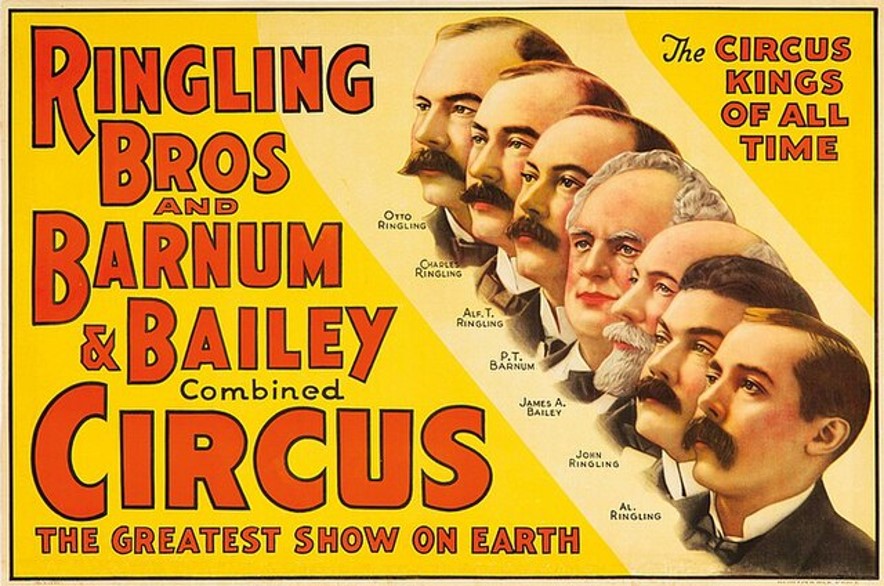
The word  ‘circus’ has been used to described these stage shows versus traditional trials, it has not been successful for outdoor trials under the current rules. Outdoor trials have always been a participant sport for riders and remains so today. Nothing has changed except the lack of interest and participation in World and National Championships. Many riders have been forced to depart the sport of trials over the past decade due to no support. The sport has left behind many top riders unable to adapt or get support for the professional entertainment business based on the show and money. The quantity of show riders becomes more and more limited each year as manufacturers’ budgets are reduced due to sales. 

This is an excerpt from the official press release earlier in 2024 about new outdoor trials rules “Stop Allowed” that stated:

“Global conditions have changed considerably and the FIM’s approach is different from that of the previous decade. During the previous seasons, the FIM carried out numerous expert appraisals and consultations with a view to improving these conditions and considering solutions for modernising the discipline. A majority of manufacturers and a number of riders expressed their desire for the greatest possible ‘freedom’ in expressing their enormous technical abilities in the sections with the main aim of putting on a show. To this end, the FIM has decided that its TrialGP organisations will focus primarily on visibility and the quality of the show put on. Other measures such as the acceleration of the race pace, the separation of certain classes and other decisions to come – leading to greater dynamism of the Events – will go in this direction.”

Whoever applied the rule “Stop Allowed” or “Rider Assistance” back in the 1990s, had the intent in my view, to make a show and turn the outdoor World Championship into a permanent circus style environment. In my opinion, these two regulations have been the single biggest mistakes over the last few decades for outdoor Trials. The sport would be better without them.  

TG: Why are these Two rules so important?

BS: Complicating simplicity is not always progress, but often chaos. Changing one rule can change the sport completely and benefit a group of riders with specific skills coming from other rules in another sport.

These specific rule changes allow for more extreme style sections and the permanent need for (minders) which only a few riders can afford. These rules just add costs in very difficult economic times at every level and provide no real benefits to the sport.

The few (X-Trial) invitational riders obtain a huge advantage over all other World Championship riders at outdoor events, due to nearly identical rules and section designs. Most other riders don’t have the financial means to acquire such advantages during practice or competition. This makes the sport for elitists who can dominate the podium for a longer period of time in such a regime.  

I believe that you just can’t transfer indoor (X-Trial) rules to outdoor with the same approach to section design. The Indoor (X-Trial) circus/stage show is an entirely different sport than the outdoor World Championship. The terrain, climate, skills, public perception, rules, access, sections and classes. Trials have always been the individual rider and machine against the natural terrain sport, not a team of acrobats assisted in artificial sections. 

Only about ten to fifteen riders actually receive an entry to these winter X-Trial shows and most never qualify for the final. The show must go on with lights, music, ticket sales, spectators, seats, beer and some money for the organisers and top teams.

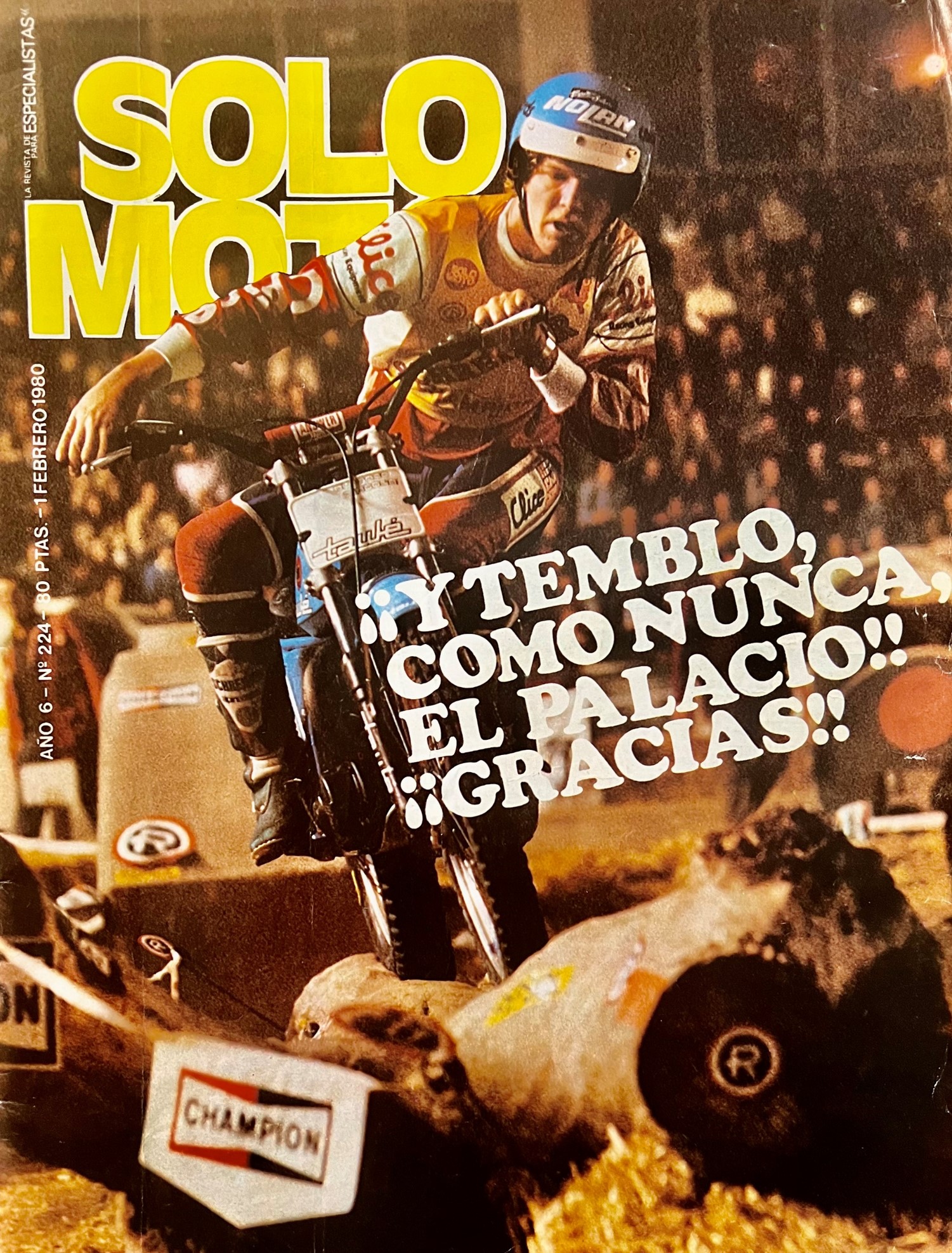
I’ve been there and done that forty-five years ago, I found myself pleasing the crowd in front of ten thousand Trials spectators at the 1979 SoloMoto Indoor Barcelona in the January. The next month in February, was the opening World round of the Hurst Cup in Northern Ireland riding in cold, mud and icy conditions. 

The rules, riding techniques, competitors were completely different and that’s what makes a World Championship and Champion in any discipline. My view remains, that two sports need two sets of rules for success.

Cover photo: Juan Garcia Luque

TG: What’s your thoughts on the modern Trials bikes of today?

BS: Trials bikes today have a massive number of modern technologies like most off-road machines. They are light and provide benefits for expert riders and upwards, but not really the best bike for your average club rider. The products available today are highly specialized and mostly designed for indoor acrobatic riders with the main purpose to hop, stop, pop and repeat on the back wheel which doesn’t really appeal to your average off-road rider or trial enthusiasts. These modern machines are not designed for about 80% of Trials riders skills. The youth struggle to purchase such technology, which offers no other usage than trials riding.

I’ve hosted a few hundred students at my Trial’s schools over the last five years and many students with modern bikes struggle to do a basic turn, as they find themselves unable to control or use the technology properly. Many club riders today seem to enjoy the sport most on a modern 125cc model. The advanced riders who actually use the bike technology and capabilities end up staging a show on a big obstacle, but then they struggle to clean a traditional trials section in competition conditions.

Bikes with no real flywheel, fender seats, quick action throttles, sensitive brakes and clutch are a nightmare for most novice and intermediate riders’ skills. Many just excel at bad habits as they progress and can’t focus on the section lines or truly enjoy sport competition fully without the risk of an accident. 

Some riders purchase the high-performance machine to do imaginary tasks. These tasks and skills become unrealistic illusions. Social media posts of top riders are much more than a skill, it’s a staged show of skills.

Whether you have a twin-shock bike or modern bike you still have to do the work to learn skills, then clean sections and win trials. We all have much respect and admiration for top trials riders, but we must be realistic that they represent less than 1% of trials riders. The Ringling Bros and ‘Barnum & Bailey’ effect is not beneficial for the growth of outdoor Trials. 

It’s like saying American stunt performer and entertainer, Evel Knievel’s jumps were good for the promotion of MotoGP.

Photo: Stepanie Vetterly

TG: What has been removed from the sport since the 1970s and 80s golden trials years?

BS: Trials has lost its character, beauty, elegance, culture and freedoms from the earlier golden years which included the 1960s as well. On top of that, the World Championship calendar is no longer a real World Championship. It has become a southern European Championship hosted throughout the dry summer months. This fits perfectly to the stage show riders and cost cutting program of most factory teams.  

The United Kingdom that invented the sport of trials and has the deepest traditions has not hosted a World Championship since 2018, leaving a six-year void in the sport.  That would be like the United Kingdom not hosting Tennis at Wimbledon for six-years. These are huge mistakes in my opinion and have effects on the sport. The U.S. World round is in the same situation. From 1975 to 1987 there was a USA world round every year except 1980. Young riders now migrate to Spain for practice and factory exposure hoping to learn indoor style conditions to get ready for the World Championship season. 

Of course, it’s easier and cheaper to migrate from European countries to Spain than from the USA, but many youth riders are isolated in their home country riding the local events without minders, sponsors, budgets or hope. Some local importers try to support and bridge the financial gap, but money is tight, and the gap is growing, while bike sales drop to their lowest levels in decades. The gap for youth riders keeps growing and the culture of the sport has nearly disappeared in some countries.  

The rules of the sport are like a puzzle and must be assembled correctly for a successful future.

Photo: Alain Sauquet

TG: What do you mean by a cost cutting calendar for riders and factory teams?

BS: Like a business, the easiest thing to do is cut costs before searching for additional revenues or growth. Trials have not been innovative at developing the sport for future generations. 

Back in 1979 we had 12 outdoor world rounds in 12 different countries. That same year there were five different winners in the first five rounds of the championship. In 1980 the first 4 world round winners were from 4 countries riding four different bike brands. We used to ride trials with three 18-mile laps of 15 to 20 sections without assistance or section viewing the day before. During my entire trials career, I never had a say in the rules or calendar of the World Championship.

The World Championship formula worked and still works with MXGP and MotoGP calendars. MXGP and MotoGP have long standing promoters who look after the sport and their interests, but always strive for innovative growth in a professional manner.   

Once you stop hosting prestigious events in countries, you begin to uproot the grass roots venues on the calendar and start the process to dismantle local organizers, sponsors, media, clubs, history and the development of the sport. The potential sales markets dry up and eventually everything around the sport as well. The youth gap to the top grows and becomes even more difficult and dreams vanish, or they turn to something else.

The manufacturers Teams save costs in the short term, but the long-term vision for growth slowly dies and limits markets to sell products and develop youth programs. Once grass roots are gone, the work is difficult to build back again, and a generation of riders are left behind. Evaluating your success over the years is never easy, but meetings without substance just remain empty seats.

TG: What do you see going forward?

BS: First you need to identify the challenges before solutions are found and changes made. Trials need some common sense back-to-basics rules for the Outdoor World Championship. Smart rules and regulations built from the bottom-up, not top-down approach used for decades with no real proven success or results for the sport. These 106 pages of regulations actually takes away our freedoms and has restricted growth of the sport over the years. 

2024_FIM_Trial_World_Championship_Regulations_En_10-05.pdf (fim- moto.com)

Media interest has nearly disappeared, and most publications today are classic magazines with stories from the past. Print coverage is delayed for major news and over 80% of advertisers are industry partners as the numbers are weak and reach is very limited. When a sport becomes very specialized most mainstream media and sponsors have little interest. The promotion of the sport cannot be limited to TrialGP or X-Trial on social media and expect growth and awareness.

The sport has overdosed on new classes in the World Championship, National Championships and local events. In the USA you will discover 20 classes in their National Championship with only 100 riders. This brings the risk of riders dropping down a class to pick up a trophy discouraging others in the process. It also dilutes the overall winner’s value as a National Champion. Organizers producing 60 trophies for 20 podium presentations or a podium with one rider. This doesn’t make sense in any sport.  

This might be a way to obtain additional entries in the short term, but that’s not substantial. I’m not convinced this approach provides benefits for outside sponsorship investment unless the company produces awards.

Land usage is becoming a challenge for everything related to two-wheel vehicles, not just trials bikes. Classic event organizers still run successful two-day trials at world class venues with 200 to 400 participants across Europe. Urban Trials and X-Trials attract local spectators and tourists, but don’t really promote bike sales or the traditional sport. Expanding the calendar and cutting the rider assistance with smarter section designs and other rule changes would be a huge benefit for the sport and most know that would level the playing field for growth.

My view is that sections should be non-stop and limited to around 45 seconds keeping the flow of the event for a larger quantity of riders and simple scoring. The sport of Trials has become difficult, complicated and expensive. Maybe the most challenging of all two-wheel off-road sports. Bikes are expensive and too specialized for the average rider. Travel and transport have become expensive, so downsizing on-site infrastructure and rider costs is important and beneficial for everyone. One other point is the need for standardization of rules across the world like most sports.

TG: This year marks your 45th anniversary since you became FIM Trial World Champion in 1979 and we wish to thank you for supporting Trials Guru with your ‘Gloves Off’ column.

BS: Yes, September 16th, 1979 marks that historic date when the first and only American won the Trial World Championship. Thank you to Trials Guru website for the dedication to the sport and its history. The sport of Trials will always be greater than its Heroes and Champions.

Copyright: Bernie Schreiber/Trials Guru 2024

More ‘Gloves Off’ articles here: ‘GLOVES OFF’ with Bernie Schreiber

Coming Soon! – Gloves Off

Former World Champion, SSDT winner and American Champion, Bernie Schreiber shares his opinions with Trials Guru about the sport’s rules and regulations in the next ‘Gloves Off’ feature. Schreiber competed himself in local, national and international Trials during his professional career. He also worked with Swiss watch brands Tissot and Omega for decades within their role as Official Timekeepers for many sports including MotoGP and the Olympic Games.

Schreiber spent over a decade in World Championship Trials competition and he knows first hand that rules and regulations aren’t just part of sport, they are the sport. We had the opportunity to explore his opinions about sports regulations, Trials today and his observations going forward, as he looks back on the sport’s history and heritage.

Exclusively on Trials Guru: ARTICLE HERE

World Champion Trials School in Newark, Ohio U.S.A.

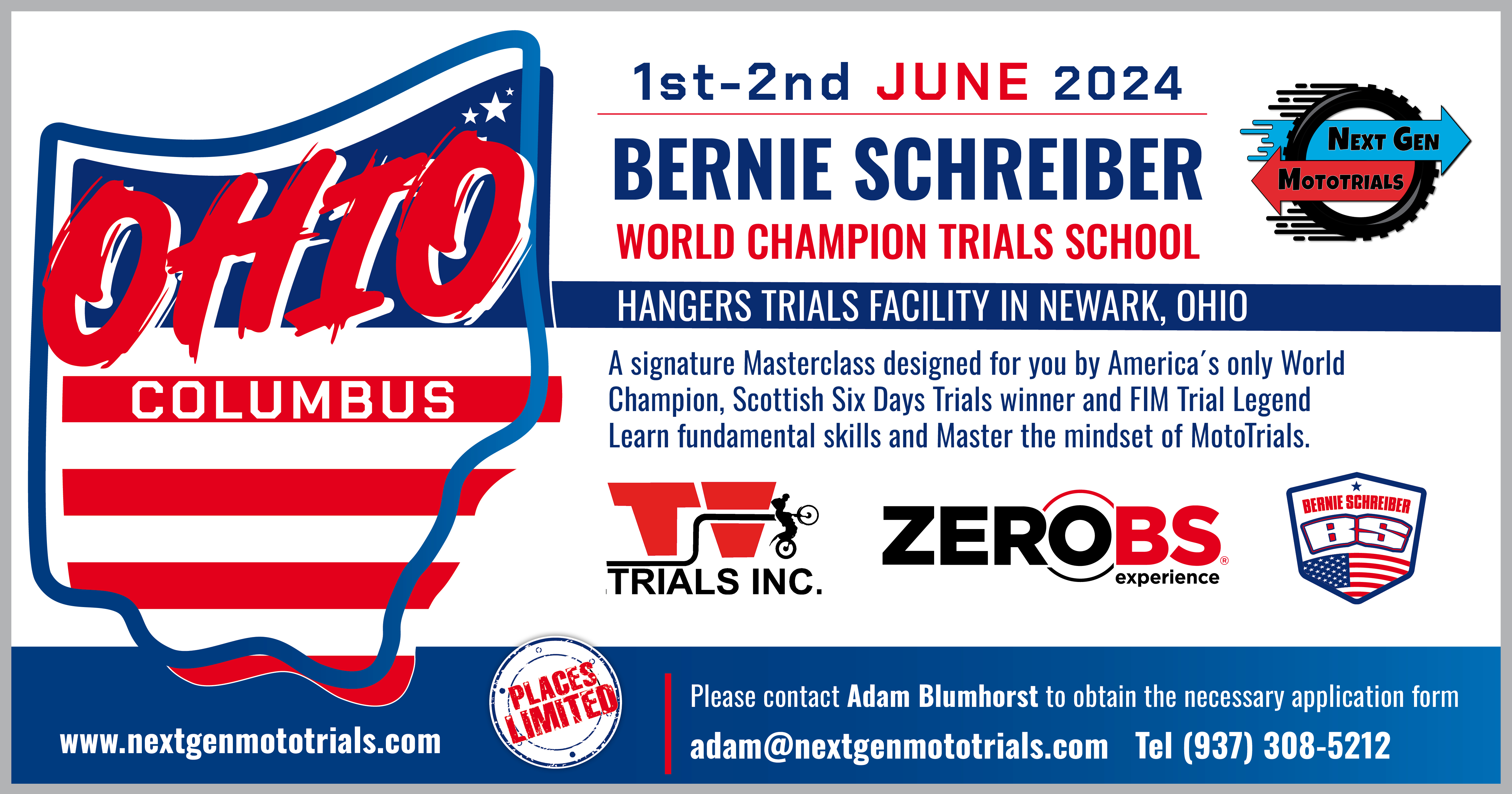
World Champion and Scottish Six Days Trial winner Bernie Schreiber conducted his ‘ZeroBS two-day Masterclass’ on June 1st & 2nd in Newark, Ohio at Hangers Trials Facility. 

Schreiber, being the most successful Trials rider ever from the USA, shared his wealth of knowledge and experiences overseas with 34 participants attending from five nearby States. The event was supported by Trials Inc, a 50-year-old Trials club founded in 1973 and well-known across the USA.

The Masterclass was open to all skill levels from novice to expert and vintage. The weekend was designed for adult riders, and supported next generation youth riders who received an exclusive session by Schreiber on Saturday afternoon. Schreiber said, “Teaching American youth riders from a young age to set goals and create a plan to reach those goals will pay off for many years to come.” 

The weekend event raised $4,200 and all proceeds will be donated to Next Gen MotoTrials Corporation managed by co-founder Adam Blumhorst.

Schreiber treated the 34 participants and 8 youth riders to his structured Masterclass based on lessons learned in becoming a World, National, and Scottish Six Days Trials Champion, but also basic techniques from his book “Observed Trials” by Len Weed. 

Sports such as golf were used to benchmark, where direct comparisons become involved. Mastering the sport, hands on riding and the all-important mindset were covered in great detail.

Schreiber said, it’s not just skills and hard work. Everyone at the top level has great techniques. Your mindset is what makes you the winner or the loser. That’s the only difference.

Learning to ride a Trials bike, is not the same as learning to ride Trials was repeated as he continued to focus on competition successes and practicing with purpose by design. 

The best way to practice is to prioritize on the things you need to practice, and knowing which tasks should get top priority, then act to get maximum returns.

The sit-down morning sessions began first before feet on the pegs riding, by covering the most important aspect of motorcycle trials and the proper stance. 

Motorcycle trials has always been a very unique form of off-road riding which requires certain techniques that do not always apply to riding a “normal” dirt bike, especially when it comes to the fundamentals. Many aspects were demonstrated during what Schreiber calls “Impact Zones” throughout two full days of instruction.

Schreiber also covered what gave him an advantage over his rivals, that being the technique which he introduced and perfected, the floating front wheel turn. Also known as the “Pivot turn”, Schreiber used this to great effect in winning the 1979 World Championship and showed exactly why this technique is just as effective today.

During each day of the school, each individual student was given one on one instruction on the techniques of this challenging sport and an insight into what actually makes a World Champion, with attention to detail, leaving no stone unturned.

For more information contact Adam Blumhorst at: adam@nextgenmototrials.com

Photo Copyright: Stephanie Vetterly

Schreiber in Ohio 2024

Breaking News! …
December 5th, 2023 Columbus, OHIO …
World Champion Bernie Schreiber to support Next Gen MotoTrials USA in 2024!

Photo credit: Chris Ostlin 1973


AMERICA’S only World Trials Champion and Scottish Six Days Trial winner Bernie Schreiber will return once again to the USA to conduct a two-day Masterclass on June 1st & 2nd, 2024 near Columbus, Ohio. The event will be hosted by Next Gen MotoTrials Corporation founded by Adam Blumhorst and Steph Vetterly to support, foster and secure the next generation of American youth riders.

The 2023 Masterclass was held in Tulsa, Oklahoma by Schreiber’s long-time friend, Kirk Mayfield who competed in the 1973 Scottish Six Days Trial. During the Tulsa weekend,
Duane Tope of Indiana who attended Schreiber’s 1988 school in Mantua, Ohio discussed returning to Ohio in 2024. Tope put Schreiber in contact with Adam Blumhorst and the idea of supporting next generation youth riders motivated the World Champion.
The Masterclass is open to all skill levels from novice to expert and vintage. The weekend is designed for adult riders, but youth riders will receive an exclusive session by Schreiber at the end of Saturday’s class. A large portion of the weekend proceeds will be donated to Next Gen MotoTrials Corporation a 501c3 Charity organization.

Blumhorst and Schreiber agreed on the Hangers Trials Facility in Newark, Ohio as the 2024 venue. The Masterclass will be supported by Trials Inc, a 50-year-old Trials club founded in 1973 and well-known across the USA.

Schreiber said, “I’m thrilled and honored to host a trials school in Ohio that supports and secures the next generation of American trials riders through training and competition. I still remember the impact that Sammy Miller and Mick Andrews schools had on me nearly 50 years ago. Teaching them from a young age to set goals and create a plan to reach those goals will pay off for many years to come. Colombus, Ohio is the home of the American Motorcycle Association and Motorcycle Hall of Fame Museum, so I’m also excited to make a first visit since my Hall of Fame induction in 2000.”

Photo Credit: Stephanie Vetterly


Blumhorst, co-founder of Next Gen MotoTrials Corporation and organizer of the AMA/Next Gen Youth and Women’s Regional Championship said, “We have hosted many prestigious events here and around the country, but it is such a privilege to host the USA’s only World
Trials Champion here in Ohio. Everyone in Ohio and nearby States are looking forward to this unique opportunity. Schreiber’s wealth of knowledge and experience overseas is priceless for our club members and youth riders. Schreiber’s accomplishments globally recognized him as a FIM Trial Legend and his insights on how he became the only American world champion is a mental instruction that all in the sport need to experience.”

Photo Credit: Stephanie Vetterly

For more information about the 2024 Schreiber Masterclass Experience on June 1st & 2nd, please contact: Adam Blumhorst at: adam@nextgenmototrials.com
Note: Limited Spaces Available

Celebration for the 50th anniversary of the Domaine Bilstain trial area

Hello Trials Guru reader!

This is a rather different ‘Gloves Off’ as I have been off on my travels again to Belgium for the 50 year celebration of Domaine Bilstain, which of course was the big talking point in the early 1980s with their famous huge step!

I have obtained permission from our good friend at the Spanish Trial premier website, ToDoTrial, Horacio San Martin to make use of his excellent report for your enjoyment.

Best regards, Bernie Schreiber

Photo Credits: Bernie Schreiber; Pierre Yves Soete; Hugo Jossart; Thomas Baarz; Pascal Degueldre.

The Bilstain Motor Area, in Belgium, celebrated its fifty years of existence in style during the weekend of September 30 and October 1, with great riders within the history of trials.

Text: Horacio St. Martin

Domaine Bilstain was founded in 1973 and then it has been a reference place for motor enthusiasts, from all over Europe, mainly in off-road disciplines, both on two and four wheels.

Although its area is not very large, the enthusiasm and work of those who founded it and keep it alive.

While the existence of trial areas or motocross circuits are the most normal and common facilities in the vast majority of advanced countries, unfortunately in Spain we are still in a state of “underdevelopment” in terms of trial areas or areas where it allows its practice, since few places have ideal areas to enjoy our sport in nature, mainly in Catalonia. The reason we have so few areas is none other than the excessive zeal and obstacles on the part of the environmental authorities of our country. That is why the Bilstain Area turning 50 years old is a reference, an example to follow and a demonstration that the environmental impact is minimal and completely sustainable.

The event was great and given the great trial history of this place, which hosted some of the most famous rounds of the trial world championship in the 80s, one of the main activities was the Trial of Legends.

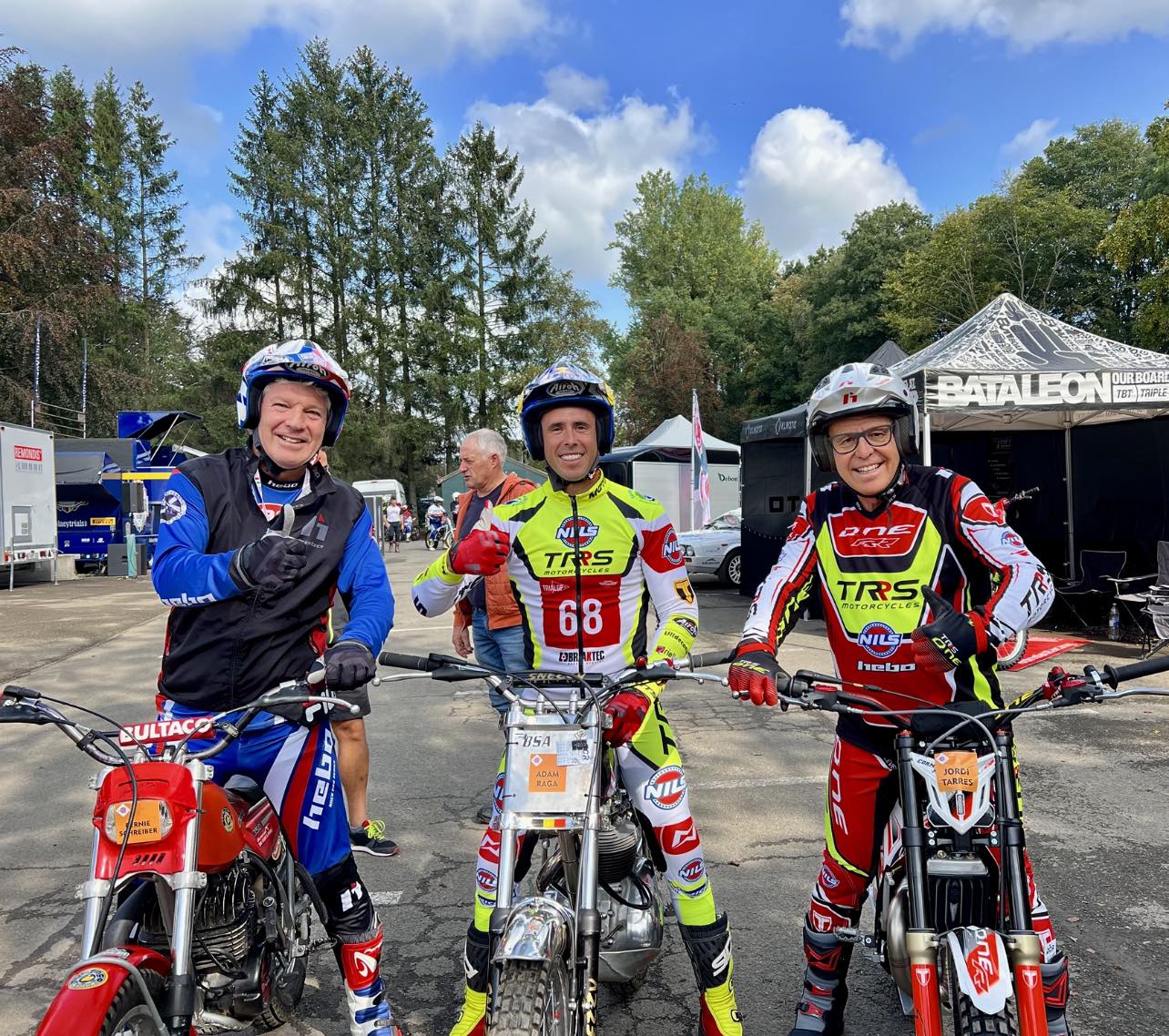
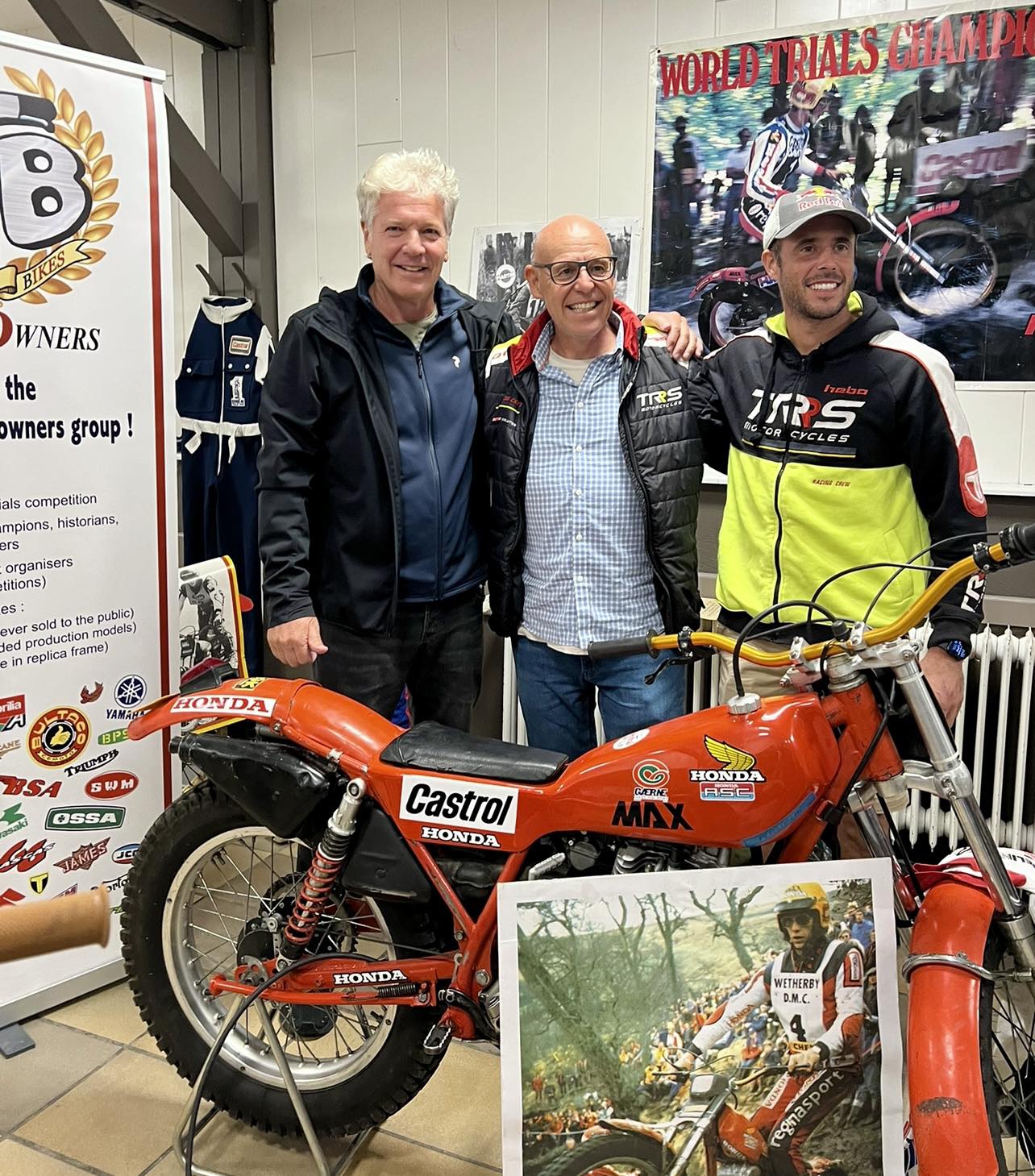
It featured some of the most renowned riders in the history of trials, as well as Mick Andrews, Bernie Schreiber, Steve Saunders, Charles Coutard and Adam Raga. Prominent local drivers such as Eric Lejeune and other fans.

There were also multiple world champions, Jordi Tarrés and Eddie Lejeune, who although they did ride on their motorcycles, they did not take part in the trial.

There were concerts, a gala dinner, a giant paella, autograph, an exhibition of classic trial motorcycles, and spectacular trial and trial bike exhibitions by Adam Raga and Kenny Belaey. Possibly the most anticipated moments of the weekend were those in which the aforementioned great trial myths could be seen in action in the areas.

Adam Raga was competing on a BSA Pre-65 4-stroke, thus giving a certain advantage to the rest and offering a nice spectacle, with Mick Andrews, at 79 years old, at the controls of a modern Vertigo!

It was especially nice to see the magnificent steps through the areas of Bernie and Charles on a Bultaco or Steve on a Honda Rothmans. Along with them, the fans shared areas, and one of the most beautiful things about our sport is the closeness between all the fans and with the great champions.

Sunny and pleasant weekend that the greatness of trial and its beautiful history could be enjoyed.

So here is to continued support for our sport for at least another 50 years!

The Art of Practice (Part 2)

Photos: Eric Kitchen; Jean Pierre Quemin; Scott Williams & Fin Yeaman.

“Our potential lies between what is and what could be.”

“Maximizing your potential essentially means getting more out of yourself in every situation. It means doing more in less time and achieving better results. However, to attain higher level results, you need to first upgrade yourself.”

TG1: How can trials riders achieve more of their potential?

BS1: Many instructors foresee great futures for some athletes if they are willing to work and focus on achieving their full potential. Unfortunately, most athletes do not share or see the same vision as their instructors. Further complicating matters, many athletes do not understand how to tap into those inner resources to achieve maximum results.

Some terms used to describe potential are: probable, within the realm of possibility, undeveloped or unrealized. I believe most trials riders regardless of age have growth potential.

To achieve more of your potential is to have a strong belief that you can do what is necessary to succeed. You must be willing to push your limits and know that your efforts will lead to improvement and success.

World Round GB – Photo: Eric Kitchen

TG2: Is there a step plan or process to tap into potential?

BS2: The first step to develop your potential is to define your goals or a vision for the future and execute. Reaching your potential requires that you create short-term plan. Accomplishing smaller goals allows you to make incremental steps towards your long-term destination and gives you evidence and confidence that you are progressing. It’s the accumulation of smaller steps that allows you to make bigger ones.

In order to realize your potential, you must develop the mental game plan that allows you to persist and conquer adversity through the ups and downs of training and competing over a period of time.

To grow as a rider, you have to learn how to adjust your training, tweak your techniques and improve your mental and physical skills to keep moving towards your potential.

You must record your progress and evaluate your actions on a day-to-day, week-to-week and section-to-section basis.  Change is hard for many riders and bad habits make it even harder to change.

In an attempt to improve, many riders make big changes in their techniques or strategy. This can hurt performance in the short term. Be patient with changes to take place, because often with changes, you take one step back to go two steps forward with your game plan. The potential for greatness lives within each of us, so don’t let others tell you that you can’t do something.

France – Photo: Jean Pierre Quemin

TG3: Don’t you feel that many trials riders are limited in perfection?

BS3: Don’t be crippled by perfection… EVERYONE HAS LIMITS. Nobody is perfect or we would only need score cards with the ZERO column.

Don’t aim for perfection! Yes, you did read that right, don’t aim for perfection! Many athletes do so whether that be to perfect the golf swing, perfect the serve in tennis or perfect a trials technique and so on.  They often hear, read and are told that working hard is the key to success. What some athletes then do is work hard, very hard, too hard even, repeating moves, and this leads them to chasing perfection – potentially causing frustration and failure.

Being perfect at trials suggests you’ll always be exactly where you want to be at the right speed, position and time you’d like to. How realistic is that!  Seeking perfection at a particular skill may seem achievable in the moment – however, if I were you, I’d consider the last time a trials competition was exactly the same.

Your goal should be to embrace imperfection as a rider.  Yes, work hard, work smart, but consider what being adaptable is in your sport. The point being, that most trials events are rarely ever the same conditions, so work from different starting positions and to a range of practice targets, never repeating the same skill twice.

It can be very difficult in sport because athletes are often told they must keep working to get better, which feeds into the perfectionist trap. If these words resonate with you – I’d encourage you to take the emotion out of those words and ask yourself another question instead: “What can I do better?” alongside, “What can I do differently?”. That way you may just avoid the perfectionist trap. 

Tulsa, Oklahoma – Photo: Scott Williams

TG4: Does the practice process matter more than competition?

BS4: Absolutely! By training yourself to achieve a present moment mindset, you will become an expert at focusing on the competition process during practice.

You need to identify process goals and direct your attention towards them.  Process goals are built around the execution of technical skills, tactical or strategic aspects. These types of goals you have complete control over.

Spend time reflecting on your most recent performance as the pace of life and the number of distractions that people have because of technology today means that the art of reflecting is dying.

Highland Classic, Alvie Estate, Scotland – Photo: Fin Yeaman

TG5: So, there is reason to practice with purpose goals?

BS5: We need to reflect and practice with two brains. The practice brain and competition brain. You are what you practice and winning is what you do before the season starts which is practice with a purpose to win.

Performing a basic skill is not difficult as it’s a matter of practicing it over and over again. Performing the same skill over six hours consistently under pressure is much more difficult. That’s MENTAL MUSCLES vs SKILLS.

When you practice consistently under competition conditions this becomes performance practice which leads to perfect performance.

The best skill you can ever learn in trials is to… perform well, under fatigue and under pressure consistently in competition conditions. Only a selective number of trials riders have conquered that winning skill over the years.

TG6: Are these skills taught in your trial’s schools?

BS6: My trials schools focus on the fundamentals which are so important to understand and practice for riders at all levels. The tools provided put priorities on where to invest your time to win or improve your results. Every rider needs a blueprint for progress and achieving new goals. You will discover stories about my approach to the World Championship or SSDT victory and what it took to achieve that goal, but many of the fundamentals are still the same.

Everything depends on execution, having just a vision is no solution. It’s important to help riders take action by removing obstacles that stand in their way. Mostly mental and bad habit obstacles. As a result, they are able to use their knowledge more effectively and efficiently.

Many riders buy an expensive new bike and think it will solve their issues and clean sections without doing the work. Unfortunately, all trials riders need to practice hard and smart regardless of the motorcycle.

Your mindset is how you reach your potential. Self confidence is what separates champions from the rest of the competition.

Performance Practice Makes for Perfect Performance.

Article 5 – The Artwork of Practice (Part 1)

“Practice doesn’t make you perfect. Only perfect practice does.”

“It’s not just skills and hard work. Everyone at the top level has great techniques. Your mindset is what makes you the winner or the loser. That’s the only difference.”

TG1: Why is it that some athletes progress much faster and succeed vs. the majority?

BS1: After practicing my own sport of Observed Trials for approximately 25,000 hours, and more than a decade of competition and experimentation at the highest level including coaching others, I discovered the process in which you practice will determine your success or failure.

The reason why some Trials riders progress so much faster at skills or results has a lot less to do with HOW HARD they train, but much more to do with HOWthey train.

It’s important to understand that behind every accomplishment, behind every success is a process. The majority of riders often even with hard practice, can’t get half as much done, not even in twice the time, or worse, with no progress at all or very little.

TG2: Understanding that process, you obviously could have more control over the outcome, right?

BS2: Yes, but most riders spend 95% of their energy and attention working on their outer game, their outer execution. Many often think about their movements: how high they should be, how low or how fast, etc, and though it’s true these things are very important, they are all merely just an effect of whatever system of practicing they use in order to progress.

If you practice anything a certain way, whether consciously or unconsciously it’s because you think that’s probably the best way and the way it should be done, but “you don’t know what you don’t know”.

Those without a practice strategy of what works, often ask themselves how to achieve twice as much progress or increase results, and the only plan they can think of is to do twice the amount of work. Coaching those who might have already put in some tremendous amount of hard work and have already seen how difficult it can be to continue to progress once they are past a certain point is challenging. Some riders learn a new routine in just a few days, others might have started a skill much later than you but caught up and even passed you by.

TG3: Is there a universal way to progress and achieve results faster?

BS3: Well, simply doubling your efforts doesn’t seem to be the key to effective progress for most riders or athletes, but having strategies and perfect practice plans does. Many riders feel overwhelmed by all of the next-level skills, drills, or moves they want to learn, but it’s impossible to practice everything, even if you had all the time in the world.

The best way is to prioritize on the things you need to practice, and knowing which tasks should get top priority, then act to get maximum returns.

Progressing consistently in a way that lets you maintain present skills, but also allows to move to the next level continually is a priority, while keeping yourself motivated and maintain focus so you can stay in the best possible state of mind for achieving results. We often put naturally talented athletes on a pedestal, and tell ourselves the story that they were destined to be great, and that they have some mysterious power. But in reality, that’s not the case at all. What often makes sense in the moment is not what usually leads to success.

Len Weed photo

Often, the things you wouldn’t think will work and go unnoticed are the things that will, but almost nobody does.

A process that gives you the best possible results that you’re capable of achieving, and knowing your current practice is the best possible way for achieving those results, regardless if your competition day is a “good” or “bad” one.

TG4: Is there a secret to “Perfect Practice”?

BS4: Not really, but there are multiple processes for improvement and the higher you go, probably the less you know, so probably more discovery than a secret. The reason I know the challenges so well is because of my personal experiences that I needed to deal with throughout the years.

The truth is, I was terrible at practice. And when I say terrible, I’m really talking about a whole other level of dysfunction compared to a rider like 3 x World Champion Yrjö Vesterinen at the time. I know how the struggle feels and tried everything that you could think of to become better at winning.

3 x World Champion – Yrjo Vesterinen – Photo: Giulio Mauri / Fontsere

I’d brute force my way through the slightest of progress, only to become burned out right after, without having much to show for it. Most of the stuff I tried didn’t work at all especially in the mud and the only reason I could think of for my lack of progress not working was “not hard enough”, while practicing many hours a week.

That’s why nobody would guess that the sudden change in my progress came from applying simple rules and processes that made me progress in a faster way than usual, that helped me to compete, share and break world records in the sport at 20 years old.

It’s because certain systems I had and certain mindset I had helped me get past those blocks that allowed me to dominate over my progress. Yet more than anything, it involved having to change how I believed practice works to what actually worked.

What I didn’t understand at the time is that if we’re practicing in a way that is against the fundamental laws of progress, we won’t get any better no matter how hard or how much we practice.

One lesson I learned early on was that practice won’t make you perfect, but “Perfect Practice” will and does pay off.

Winning the 1982 Scottish Six Days on Pipeline – Giulio Mauri / Fontsere

TG5: Should we practice with better riders?

BS5: Absolutely, and some riders are better at what they do than others, and it’s not simply by chance that they got better. I saw first-hand after observing and practicing with some of the best riders in the world, that it wasn’t the strength or physical powers that separated the good from the best.

The big or small differences are always present in the background, and often, one little shift, just one simple change, is all it takes. It was their mostly unconscious approach and mentality that looked dramatically different from the rest.

I found throughout the years, the basic rules of the “successful” are surprisingly uniform and predictable.

For me, one defining characteristic is an athlete who can perform under any circumstance. Most athletes can perform when conditions are perfect, but it is the rare athlete who can perform when conditions are terrible.

TG6: Don’t you find the technical practice gap is growing for many riders?

BS6: Yes, and this gap has spread worldwide to a point of no return for most. It’s really an obstacle point for the sport in my observation. Picture it as a ladder, and the horizontal steps become far apart midway up, for anybody to continue climbing. The top riders like it, because it gives them longer careers, but most riders coming up, cannot climb and surpass the big gap.

That’s why focus on perfect practice matters so much for future champions who want to improve results. Part of the reason top athletes burn-out or get frustrated early is that being famous is not the same as being a champion. Conviction is about being dedicated to becoming the best athlete your mind and body will allow you to be, not the conviction to becoming good enough to be a paid media star on social media.

The tough reality is that 95% of athletes really have no clue what it takes. They want the fame, glory, and money of a World Champion, but they are unwilling to endure the suffering, pain, and heartbreak of that dream. The journey is a long one that requires thousands of hours of boring, focused training, numerous failures, many heartbreaks, and super human resiliency. Today, it requires an army of family, friends, training partners, coaches, businessmen, companies, and fans to make it happen. The truth is that talent and hard work are simply prerequisites for this journey.

Lastly, it takes some luck to become a World Champion. The road to becoming a World Champion is littered with many, many talented and hard-working athletes who never got a lucky break. When you put all of these pieces together, it highlights why World Champions are few in millions.

It’s not all about talent or hard work or competence. It is 100% about what is in a person’s soul. It is the will to win, and the application of that will to find a way to win. It is a level of mental toughness and intelligence that very few people in the world truly understand. There are many gaps to be filled and variables to consider during your perfect practice sessions.

Schreiber Masterclass at Alvie Estate, Scottish Highlands – Photo: Jaxx Lawson

TG7: Many riders wonder how to improve during practice without a minder?

BS7: That’s a good question, considering most clubmen riders practice and compete without a minder, so in many ways, modern trials for the average person, are more like Classic Trials, not only techniques but also in the section difficulty.

Consider that 95% of riders in the sport, will never have a professional minder to practice or compete as World or National Championship riders do, so the vast majority of riders are really practicing and competing traditional clubman Trials their entire career in the sport.

This understanding is what is missed today in the sport. Not only will World or National Championship techniques not be best for the average clubman, but their machines will not be tuned the same for a Championship contender as it would be for the clubman.

Simply meaning, the bike that a top rider competes on, will not perform the best for the average clubman rider. Likewise, the techniques needed to successfully enjoy club level trials to the fullest, is not the same as what is needed to win a National or World Championship. That’s created false illusions for many and one reason traditional classic trials are so popular across Europe. Thinking and understanding what you practice for is so important. The challenge today is we have a lot of clubman level riders on modern bikes who think they can “one day” do BOU tricks and this perception is wrong, distracts from learning the sport and dangerous to be honest. There is a huge difference between learning BOU tricks and traditional trials skills. There is nothing wrong with practicing trick skills, but that’s a different and unique skill set for highly trained riders. You don’t just learn them at a trials school. It’s an act, which includes a variety of acrobatics, gymnastics, aerial acts and a variety of other routines, but not the traditional sport of Trials.

Photo: Solo Moto

The Artwork of Practice (Part 2) will focus on some practical solutions to help riders reach their potential, manage expectations, set goals and practice with purpose by design.