
Words: Trials Guru & Peter Jerred
Photos: Iain Lawrie; Alistair MacMillan Studio, Fort William; Jimmy Young; Peter Jerred; Anthony Hylton.
In late 1972, Honda Motor Company launched their trials effort in Japan, code-named quirkily as ‘Bials for Trials’ debuting their small capacity which later became the production TL125 for the UK and Europe and the TL250 specifically for the North American market in 1975. From that time, there were to become official Honda trials models, but mainly the giant Japanese manufacturer created some very good motorcycles for the sport of trials, but few reached series production. This encouraged smaller concerns to build their own, using Honda engines. Honda even adopted a model made in the UK, built by Colin Seeley International, the Seeley Honda TL200E. This was in collaboration with Honda’s Racing Service Centre (RSC). The Seeley frame featured top and down tubing of square section as did some of the factory special Hondas.
The original 124cc TL was to provide an entry level machine for trials sport and with ten times British Champion, Sammy Miller MBE effectively in charge of development, it came as no surprise that he would eventually provide upgrade parts through his New Milton trials emporium. He would later produce a ‘Hi-Boy’ frame kit, as Sammy had produced for the Bultaco Sherpa T which he also developed from 1964 until 1974.

Conversely, down in St. Ives, Cambridgeshire, Peter Jerred ran a motorcycle dealership in the mid 1970s, he had taken a shine to the little Honda.
Peter was educated at Ottershaw boarding school at Ottershaw in Surrey and had studied building and land surveying at Guildford College and went on to become a senior engineer on various road projects in the south of England. He was at that time a keen scrambles rider.

Jerred set about building his own version of the Honda TL125 and pulled a team together for the 1979 Scottish Six Days Trial, which attracted a good bit of interest in Fort William that year, during the weigh-in Sunday. The team comprised of Nick Holt, Nick Fossey and Jim Kelly.
The previous year, 1978, Nick Holt had ridden his Jerred Honda to 104th position losing 460 marks. He received a first class award and was third best 200 that year on the prototype.

Peter Jerred tells it in his own words:
“I had a TL125 which was rather short of power and lacked quite a lot more. Sammy Miller began selling piston kits which took them up to 150cc, which was actually a modified standard Honda 750/4 piston with some machining work done on the piston crown. So, using one of those the next thing to do was ‘stroke’ the engine. The obvious amount was six millimeters, as each link of the cam-chain was six millimeters.”

It all started with a Renault 4:
“Next on the list was the chassis department, Mike Mills of BSA fame had got involved, having ridden in my Renault 4 across a ploughed field, no real power but long travel soft suspension. This allowed the drive wheels to stay on the ground rather than hop across the ‘undulations’ with thanks to Murray Walker, losing grip every time it was in the air. Mike therefore designed that frame so that all standard TL parts would fit but massively increased rear travel built in to the design. Mike at that time was possibly the best engineer in the field of suspension in Europe if not the World having worked for Ohlins with international racing star, Kenny Roberts.”

“The TL125 frame was re-designed with only two slightly bent tubes and tig welded, very unusual at the time, by talented fabricator, Bill Wooldridge in his workshop at Weedon, Northamptonshire. The frame numbers begin with the year they were built, for example 1979 begins 79. The frames were finished in bright nickle, just like the Rickman Metisse frames were.”
“Nick Holt rode the prototype which had the rear mudguard loop made from a pair of bicycle front fork legs and it used a standard TL tank and aluminium side panels. The side stand was fitted to the offside, whereas later bikes had it fitted on the nearside.”

“The exhaust was also very different as it only had the front box with a short tail pipe. The kick start was reworked, which allows the bike to be started without lifting the footrest. I used to offer that modification on the basis that the customer sent me his old kick start that I would modify for the next customer. It was a good little mod.”
Angular Fuel Tank:
“The fuel tank was folded aluminium, in a similar style to a CCM tank which was another Mike Mills project. Fibre glass was used for the air filter and the side-panel and seat unit.”
“At the time, nothing was written down like professional race teams except the drawings for the frame. As mentioned, the first remit was that standard parts from the TL125 Honda should fit perfectly. Obviously, the tank and air filter and exhaust were special and supplied as part of the kit.”

Suspension:
“Forks were standard straight exchange including yokes. Rear suspension, now that where the biggest and most significant change was made, by the standards at the time, the late 1960s and early 1970s. As I said previously it was massively long and unbelievably soft, controlled by the blue Girling Gas shocks with the twin spring set up. Many people did not understand that the combination of a long soft spring and the inclusion of the short square section orange spring actually further reduced the rate of the long soft spring.”
“Let us say the soft spring was rated at 60lbs per inch, then for every inch the unit moved both springs would compress, therefore the soft spring had not moved an inch, the 60lb/inch rate is reduced. Still with me? The suspension movement was just a little over ten inches! In general, when a rider was sat/stood on the bicycle, approximately half of that was taken up, around five inches, so plenty remaining to absorb impact and the same amount to drop in a hole and still retain grip. The hubs were standard TL125 Honda but on the “works” versions the fins were turned off; rims were re- anodised gold.”
Front End:
“Back to the front forks, although standard forks were okay. We tried several options, Bultaco/Betor, Marzocchi, Honda XL, the ones with the leading axle and the XL forks ran without springs but with air. Mudguards were Bultaco/Gonelli standard on rear, but the front version turned round with the flap trimmed off, which is very popular nowadays.”
Engines:
“There were three variations. 220cc in the bored and stroked version and 175cc with just the over-size bore however that came in the Over Head Cam TL engine and also in the push-rod version based on the CG 125 motor with trials gears added. In a funny sort of way, I liked the CG based engine, it was unusual, quiet and a little lighter. Going back to the 220cc engines, there was a lot of work to produce one. A spacer was required to lift the barrel 6mm, the cam chain had to be two links longer, extra weight was added internally to the crankshaft which also needed the piston to have a little of the skirt removed for clearance.”
“The crank pin had to be moved to account for the barrel being lifted 6mm. We over-bored the flywheels, plugged the hole and bored the new position for the crank pin 6mm offset.”
“There was also additional weight added to the external ignition flywheel. To do this there was a skim taken the external diameter and a stepped sleeve pressed on. To allow for the extra width of the ignition flywheel the near side outer case was spaced out 15mm.”
Lubrication:
“As far as lubrication was concerned, Jim Kelly had a connection with ELF lubricants, hence the large sticker on the tank of his bike. All the others ran on a standard 10/40 oil. They never used a drop between oil changes.”
Carburation:
“Fuel continued to be delivered via the standard TL carburettor but attached to the cylinder head by a purposed made manifold. From memory, surprisingly little was changed in the jetting department.”
Exhaust:
“As far as the exhaust was concerned, the front pipe was retained but married to a large fabricated open chamber and one to a pipe with a quite simple muffler on the end exiting just behind the top of the offside rear unit. The exhaust was relatively quiet, and Mike Mills explained it like this. If you had a motorcycle exhaust pipe going in the front door of the Albert Hall and a pipe coming out of the rear door, there would be little sound to be heard. I know it’s more complicated, but the principle has some logic.”
“Although we made twenty-five Jerred Honda kits, records of who they were sold to are unfortunately long gone! I have two, one of which I have begun to restore, frame number 15 and I hope that perhaps Sammy Miller could find a space at Bashley Manor for it. The complete frame weights in at 14lbs (6.36 kg).”
“Nick Fossey was exceptionally good on one, Nick Holt enjoyed his time on one, Jim Kelly and Mike Butcher also had one. Finally, I think, the bicycle was ridden briefly by both a Honda and a Yamaha test rider at an SSDT and within six months, if my memory serves me correctly, they both had long travel soft suspension.”
“For the 1979 Scottish Six Days, Nick Holt’s bike had Marzocchi forks, Nick Fossey had Bultaco on his. I also used XL125 on one of them and they didn’t use springs, the fork caps were linked together with a valve on one and were pumped up from that valve. Air gives a progressive rate and it worked quite well. The issue for the rider of course is that what is going on in the head, often overrides what is going on with the bike!

“I’d like to think that in its own way the bicycle was a little special for its time which must be credited to Mike Mills who was just a talented motorcycle designer/engineer.”
The Jerred Hondas in the SSDT:

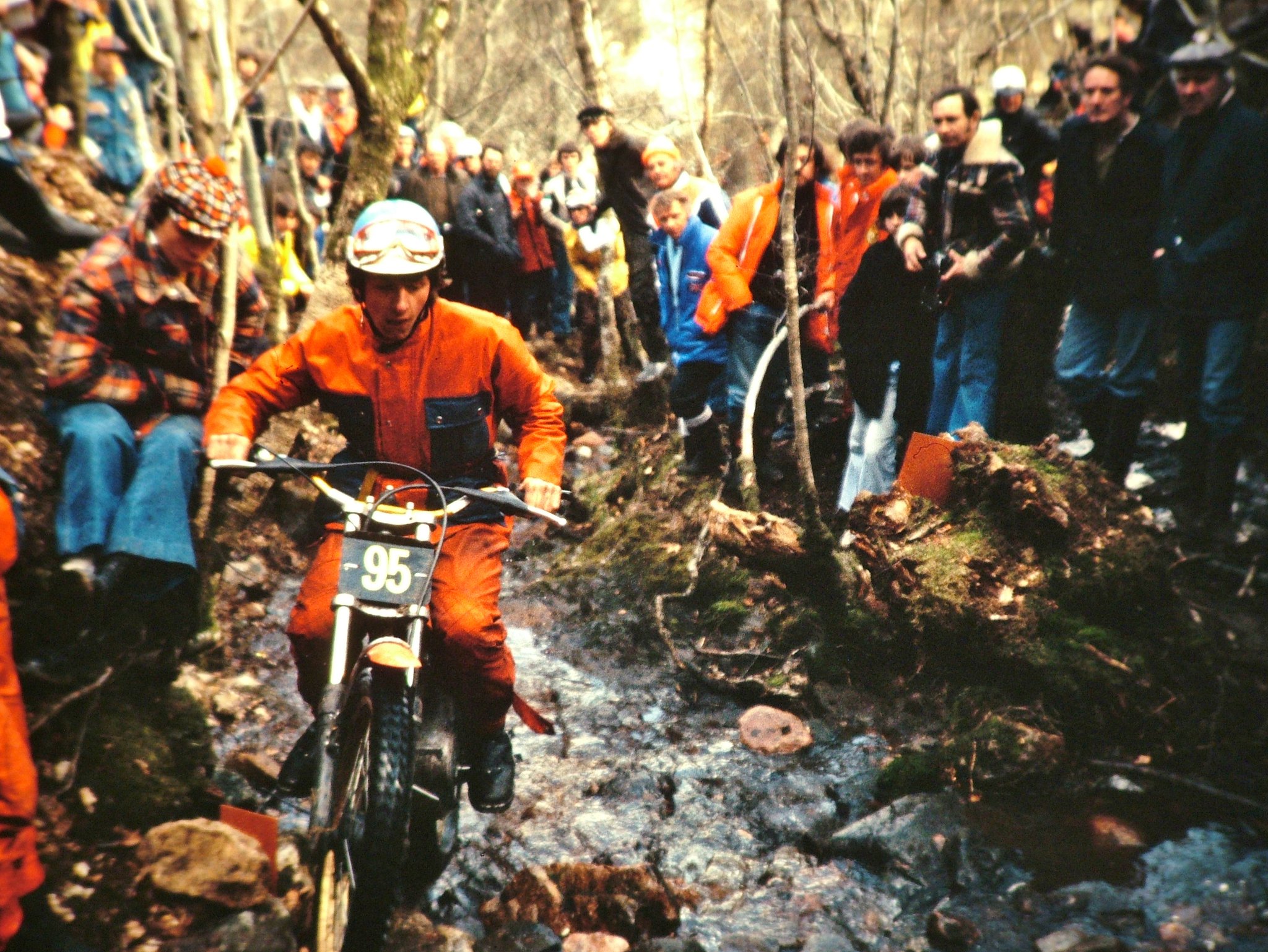
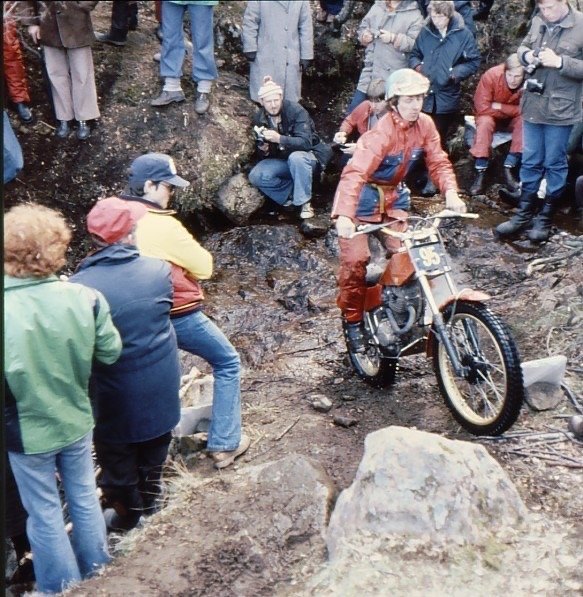
History records that all three of the Jerred Honda team riders competing in the 1979 Scottish Six Days, finished the event. Nick Fossey who was entered on a ‘Mills Honda 200’ riding number 95, was 87th losing 387 marks for the week. Nick Holt (Honda 200) riding number 59 came home in 130th position losing 478 marks.
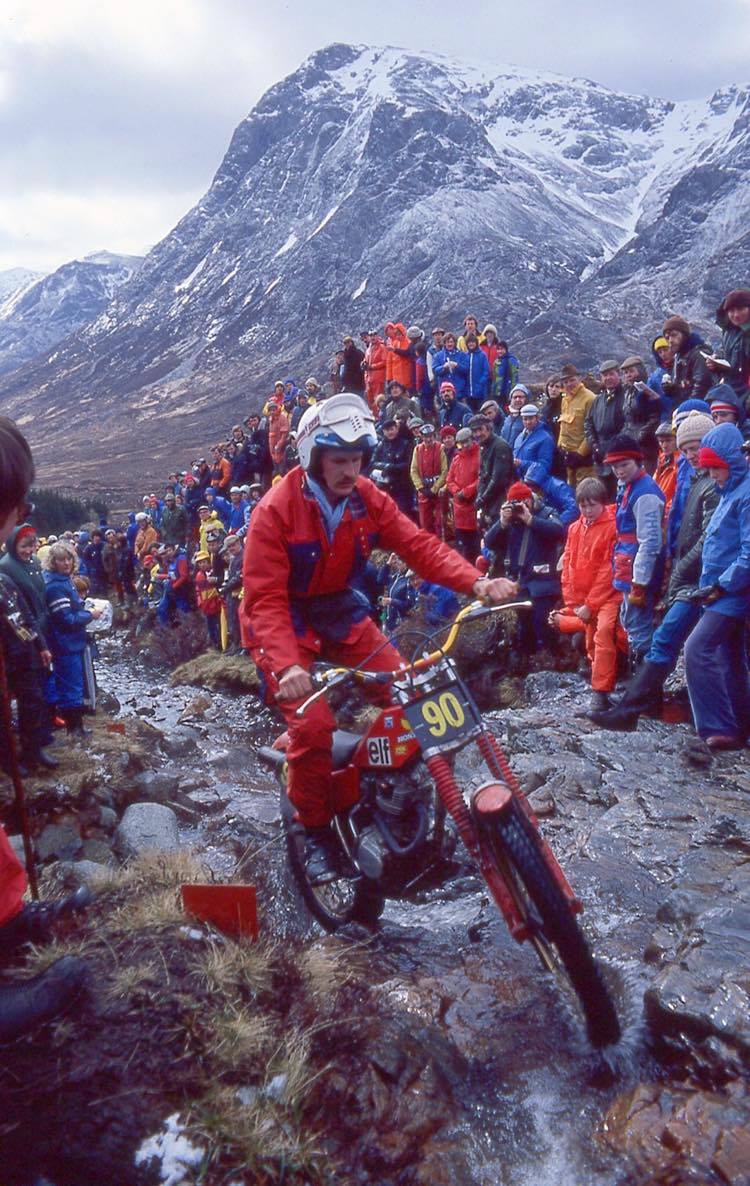
Third man in the Jerred team was Jim Kelly (Honda 190) whose riding number was 90 and came home in 164th position on 547 marks.

The following year, 1980, Nick Holt was entered under number 18 and finished in 123rd position on 464 marks.
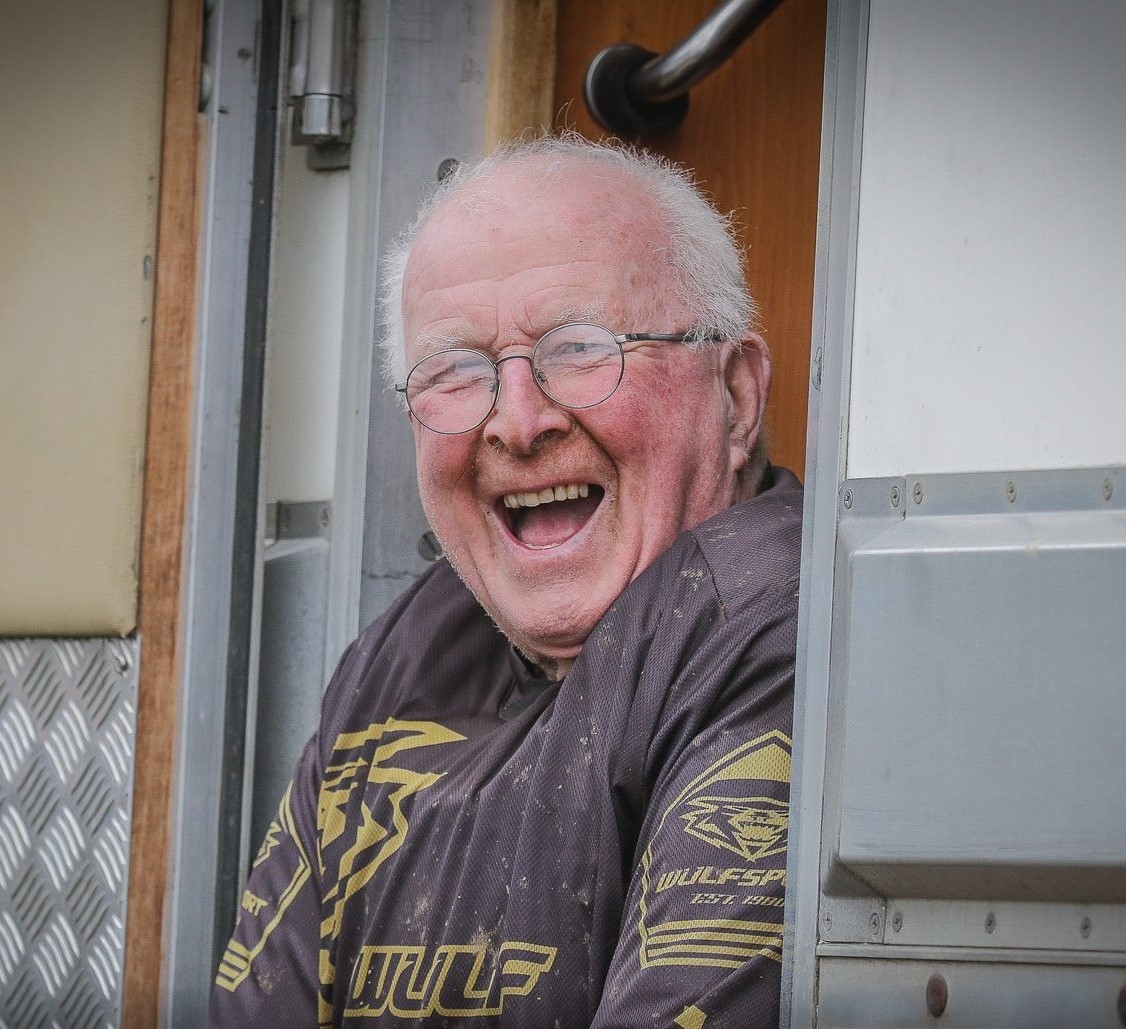
Peter Jerred: “Mike Mills was not only my brother in law, but also a great friend and talented design engineer who is sorely missed to this day. He really was the man behind this venture and I will always be truly thankful for his help. Mike had an affinity to the sport of motorcycling which we all love.”
Peter Jerred is still involved with motorcycle sport, having become immersed in classic scrambles in recent years, campaigning specially tuned and modified CZs. He also makes gear shift kits for the Czechoslovakian machines.
Trials Guru’s John Moffat got to know Peter Jerred when he purchased a jack-up stand from him in the early 1990s.
Moffat: “I bought one of Peter’s jack-up stands that he was selling at the Scottish Six Days one year. It was a very sturdy and well built item and was finished in red powder coating with a good quality bottle jack and securing bar. The jack has been in my workshop since then and has been used countless times when working on my motorcycles. I always ask Peter when I see him at scrambles if the warranty is still in date and we have a laugh about it. Peter is a great character, very knowledgeable and an enthusiast. He is always willing to help when required.“

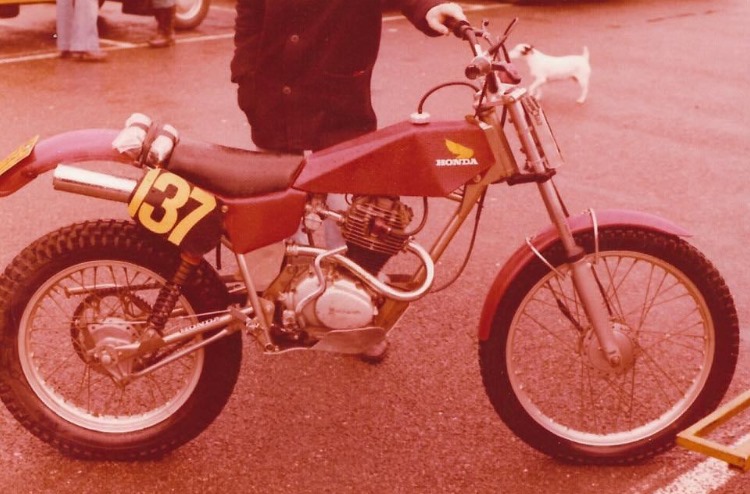
Following the publishing of this article, we discovered that the Jerred Honda bearing the number 137 was the machine owned by Colin Moyce from Rye, East Sussex.
Colin Moyce: “Honda number 137 was my bike, you could buy the kit from Peter and build the bike yourself. I loved that little Honda and never went back to a two-stroke trials bike after owning the Honda. The rear suspension was amazing, it found grip like no other bike at the time. This was based on the trials in South East centre, where our conditions consisted of mud, more mud and total mud. The little Honda was in a world of its own, my club mates were just in shock on how much grip it achieved. Currently I’m riding a Triumph Cub or BSA B40 in pre65 events.“
“I rode the Honda in the 1979 Scottish Six Days, I then won the Scottish raffle for a free entry the following year, Jim McColm was SSDT secretary at the time, unfortunately I did not manage to claim the free ride as I was working in the Middle East for five years. I understand the bike is in Scotland now, I’m trying to get a contact number as would love to have it back. I wonder if Brian Fowlers’ Rapid Araldite is still covering the hole in the casing after hitting a rock on the Tuesday? That Araldite rescued me from retiring.”
It all started with a Renault 4 – The story of the ‘Jerred Hondas’ article is the copyright of Trials Guru and Peter Jerred.
Tribute to Mike Mills
Words: John Dickinson

John Dickinson remembers time spent with Mick Mills, a man so far ahead in his field, then listens to tales of old at the Crooklands Hotel.
Sad news greeted me, and many other enthusiasts when they learnt the news I imagine, the other day as I arrived at work between Christmas and the New Year when I was told of the death of Mick Mills. Now, to our younger readers, this might not mean anything at all, but whether you have heard of Mick Mills or not, if you ride a modern off-road bike you unknowingly owe a lot to the man.
Mick was a remarkable engineer, whose forte was suspension. Now I am not going to rashly claim that he actually invented’ the modern linkage type of rear suspension, or Upside Down Forks, because as we all know there is nothing new under the sun, but he most definitely led the way in their development and thus to their almost universal adaptation.
Mick was the man behind the Swindon Swing-link, which was the first linkage type rear suspension system most of us had seen or heard of. It was so far ahead of its time in the days of twin-shock and linkless single shock systems that it enjoyed a tremendous run of success in British motocross with riders Paul Hunt and Gary Dunn. T+MX ran out of headlines as the duo relentlessly clocked-up success after success on the National circuit. The major MX manufacturers then ran riot with the idea and suddenly everyone was running a single-shock link system. Kawasaki ‘Uni-Trak’, Suzuki ‘Full-Floater’, Honda ‘Pro-Link’, all different but all basically a four-bar’ system as Mick described it to me one day.
I was fortunate to be invited down to Armstrong Motorcycles, formerly CCM, in the early 1980s by Alan Clews to meet and talk to both his talented designers who just happened to be Mick Mills and Mike Eatough and who were absolutely chalk and cheese in every aspect as I quickly learnt.
I met Mills first and in his drawing office found him to be a quiet, friendly, softly-spoken man who patiently talked myself and fellow T+MX staffman at the time, Mike Sweeney, through the theory of the four-bar rear suspension system, aided by the beautiful technical drawings on his draughtsman’s board, of his latest system due to be fitted to the next generation Armstrong. All the time, Mike Eatough was standing impatiently in the doorway, waiting for Mills to finish his explanations. As we thanked Mick and made our exit, Eatough grabbed us and whisked us off to his workshop saying something along the lines of, All that theory is all very well but THIS is how you really do it, in the workshop. Mike proceeded to show us how he converted his own ideas in hard metal with saws, tools and welders. Two totally different approaches yet each worked for the individual.
Mick Mills then went on to work for Ohlins, one of the most respected of suspension companies, becoming their chief designer where he did pioneering work with USD forks, working with the factory Yamaha MotoGP team and their famous rider, Kenny Roberts.
I occasionally met Mick down the years and he was unbelievably modest regarding his life’s work but was always willing to sit and chat with an interested amateur engineer such as myself and carefully explain why he did this or why such and such works and something else doesn’t. I always enjoyed our encounters and am sure I gained far more from them than Mick did but he was always happy to talk. The USD forks idea came from us looking for the stiffest possible triple-clamp structure… he told me one day when I encountered him in a Gloucestershire pub following one of Mark Kemp’s BVM trials test days.
I even once built a trials bike that Mick had designed, the Jerred Honda. Again, this was the early 1980s and again Mick was years ahead of his time, having come up with a long-travel twin-shock chassis for the TL 125 Honda engine. Out of the blue he rang me up just a couple of years ago and joked: “If you fancy building another I’ve just found my original drawings for the Jerred so we can knock one up if you like!”
I enjoyed an afternoon over the holiday period which was basically a get-together of old gits’ from the northern centre who gathered at the Crooklands Hotel, near Kendal, for a pint of Black Sheep, a plate of chips and a listen to well-known northern character Tony Bingley. ‘Bing’, who has enjoyed an enviably varied life in motorcycle sport, kept us amused for several hours, which just flew by. It wasn’t just entertaining, I learned a few things as well and eventually came away determined as Tony urged us to attend as many similar get-togethers and reunions as possible. There are a lot of characters out there with a tale to tell, so get them to tell it and make sure you listen.
‘Tribute to Mike Mills’ is the copyright of John Dickinson, Kendal.
Acknowlegement of source:
Article first appeared in TMX January 2010, R.I.M. Publishing Ltd.
More Honda Trials articles: HERE
Apart from ‘Fair Dealing’ for the purpose of private study, research, criticism or review as permitted under the Copyright, Design and Patents Act, 1988, no part of this article may be copied, reproduced, stored in any form of retrieval system, electronic or otherwise or transmitted in any form or by any means, electronic, electrical, mechanical, optical, chemical, photocopying, recording or otherwise without the prior written permission of the author as stated above. This article is not being published for any monetary reward or monetisation, be that online or in print.
 TRIALS GURU - DEDICATED TO TRIAL