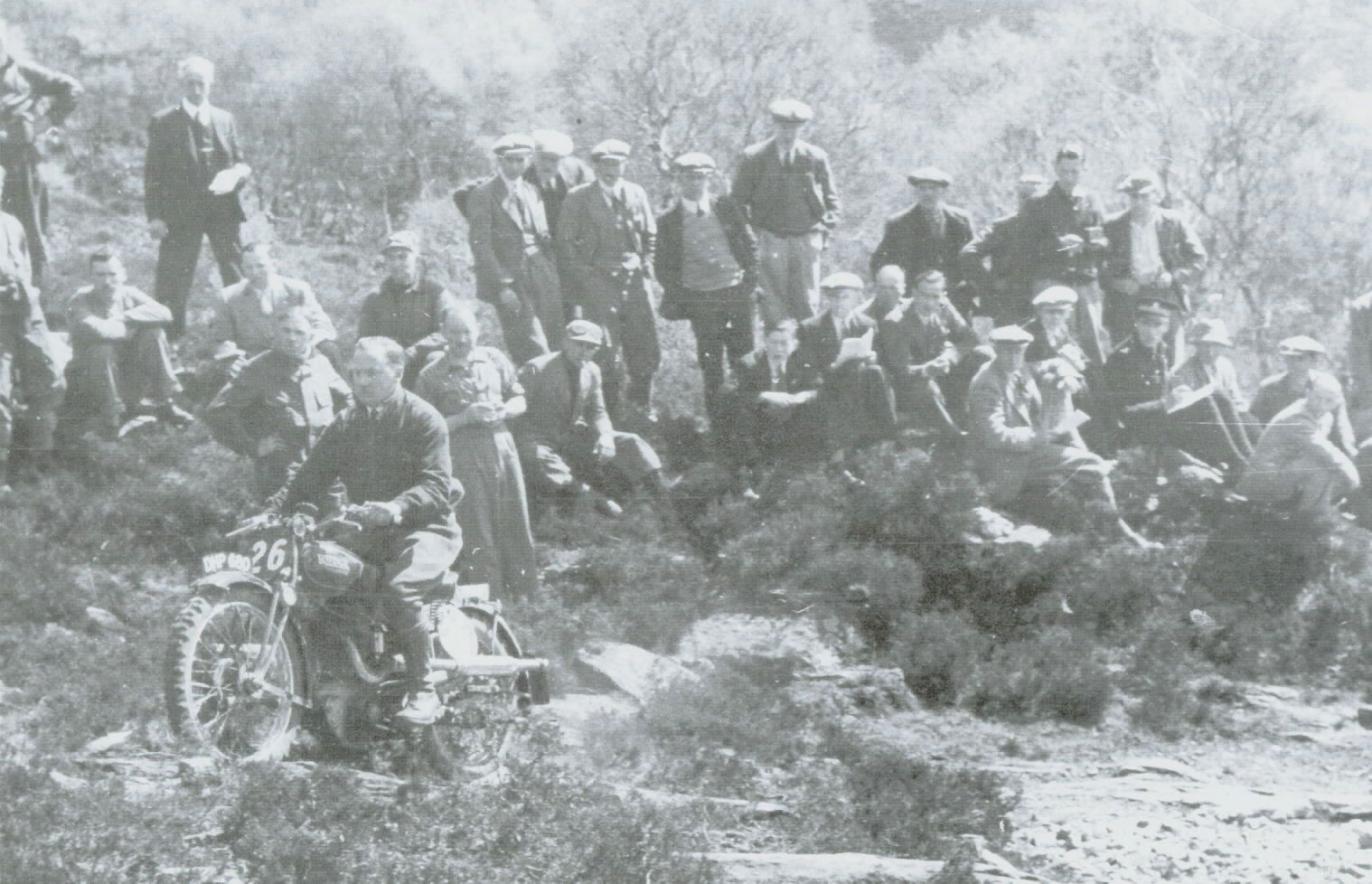
Bob MacGregor in the 1939 SSDT on his Rudge. Photo: Trials Guru Archive
In May 1935, 80 years ago now, Robert ‘Bob’ MacGregor rode his factory Rudge motorcycle to victory in the annual Scottish Six Days Trial, little did he know at the time, that he was to be the only Scotsman to have ever won the event and his ‘record’ would last well into the following century! MacGregor also won the same event three years previously when he became the first individual winner of the event. Bob was Rudge mounted for the 1932 event, although he did also ride for the Raleigh factory in reliability trials on previous occasions.
The 1935 results sheet, showing Bob Macgregor (Rudge) as the overall winner of the trial. Courtesy of Edinburgh & District Motor Club Ltd Archive.
Bob lived in Killin on the shores of Loch Tay and ran a successful greengrocers business in the centre of the Perthshire village. He was well-known locally and respected as a sporting personality of his time.
The Perthshire village of Killin is no stranger to the Scottish Six Days. This is the village in which Bob MacGregor ran his greengrocers business. Photo: Trials Guru Archive
MacGregor would regularly ride his machine from his home to the Coventry factory for refurbishment works and ride the machine home again, taking in a national event on the way. There were no works vans or motorhomes in those days so any travelling was done on the machine you competed on.
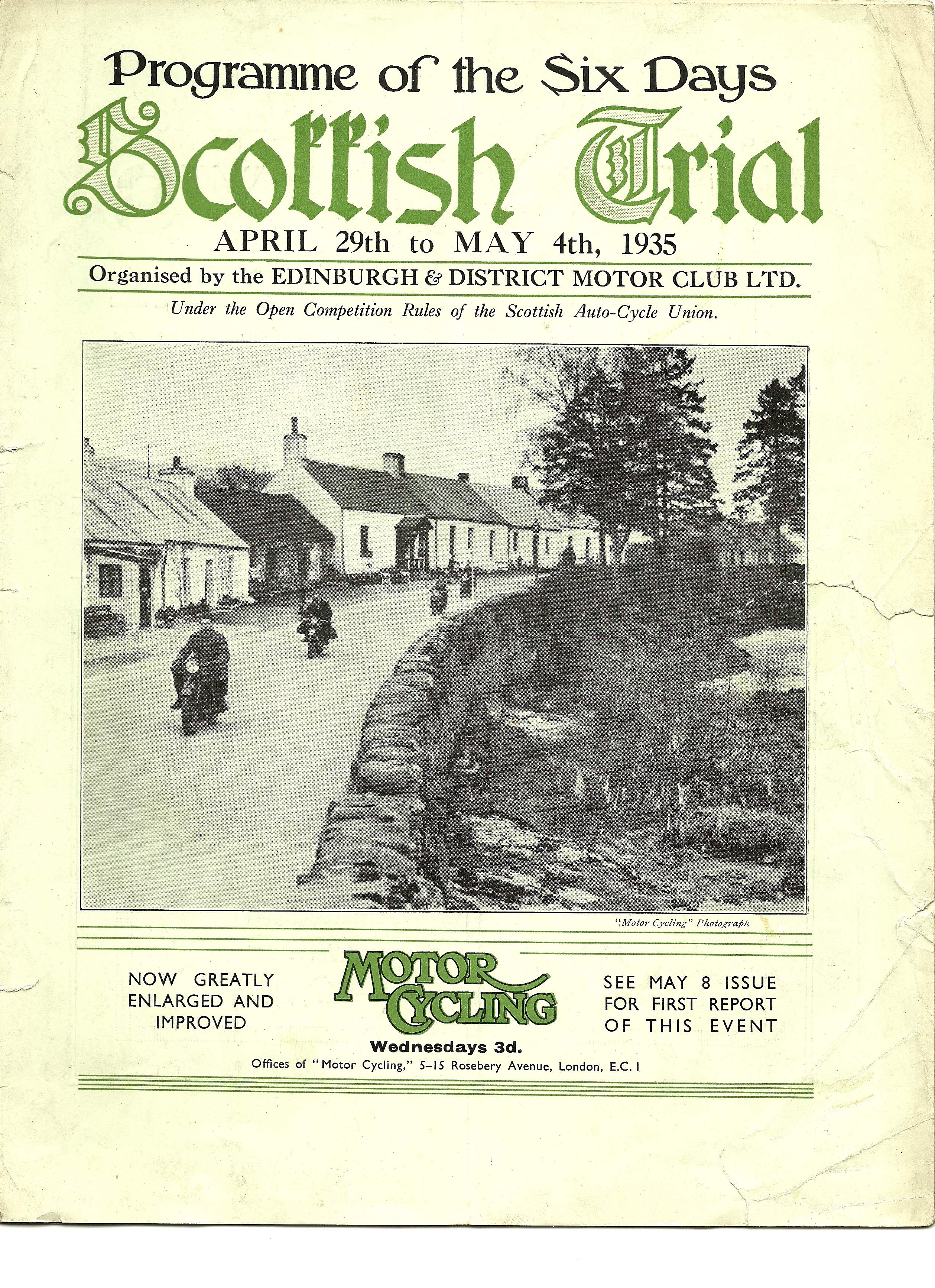
Front cover of the 1935 SSDT programme featuring Killin, which was won by Bob MacGregor – Photo Courtesy of Edinburgh & District Motor Club Ltd Archive.
After his SSDT victory, Bob continued to compete as a national rider until the outbreak of the second world-war in 1939 when he was enlisted into the British Army for a specific purpose, this venture was led by Graham Walker, the father of sports commentator Murray Walker. MacGregor became a motorcycle instructor and trained many hundreds of despatch riders or ‘Don-R’s’ as they were referred to by the military. Bob delivered training for off-road riding, using his trials riding skills to great effect. It was when he was in the army that he met and struck up a friendship with Hugh Viney who was a Sergeant and would become one of the post-war winners of the SSDT when he rode for AJS. MacGregor did ride a few more SSDT’s post-war but a new breed of younger men emerged in the sport such as Artie Ratcliffe, Johnny Brittain, Jeff Smith, John Draper and of course Hugh Viney, who had won the first post-war SSDT in 1947 at his first attempt. Since 1935, there have been only two Scotsmen to secure ‘podium’ positions, Bob MacGregor and Kinlochleven’s Gary Macdonald, who came third in 2003. Macdonald is the most successful Scottish trials rider of all time, having won ten Scottish titles and a British title.
Gary Macdonald – Scotlands’ most successful trials rider of all time! – Photo: Iain Lawrie, Kinlochleven.
MacGregor’s name lives on in Killin, firstly as the greengrocers business still bears his name although not now under family ownership. Secondly as an annual trial is held there, run by the enthusiastic Bob MacGregor Motorcycle Club, an event conceived by the local painter, decorator and trials rider, Bobby Lafferty. The event is always over-subscribed and supported by riders from far-afield. Thirdly, there is an annual road run around the area, organised by the Cumbria Classic Club headed up by trials and scrambles rider Peter Remington from Kendal. This year, former SSDT Clerk of Course Mark Whitham will be riding a 1935 Rudge ‘Special Competition’ model in the road run, an almost identical machine to that which MacGregor won the SSDT eighty years previously.
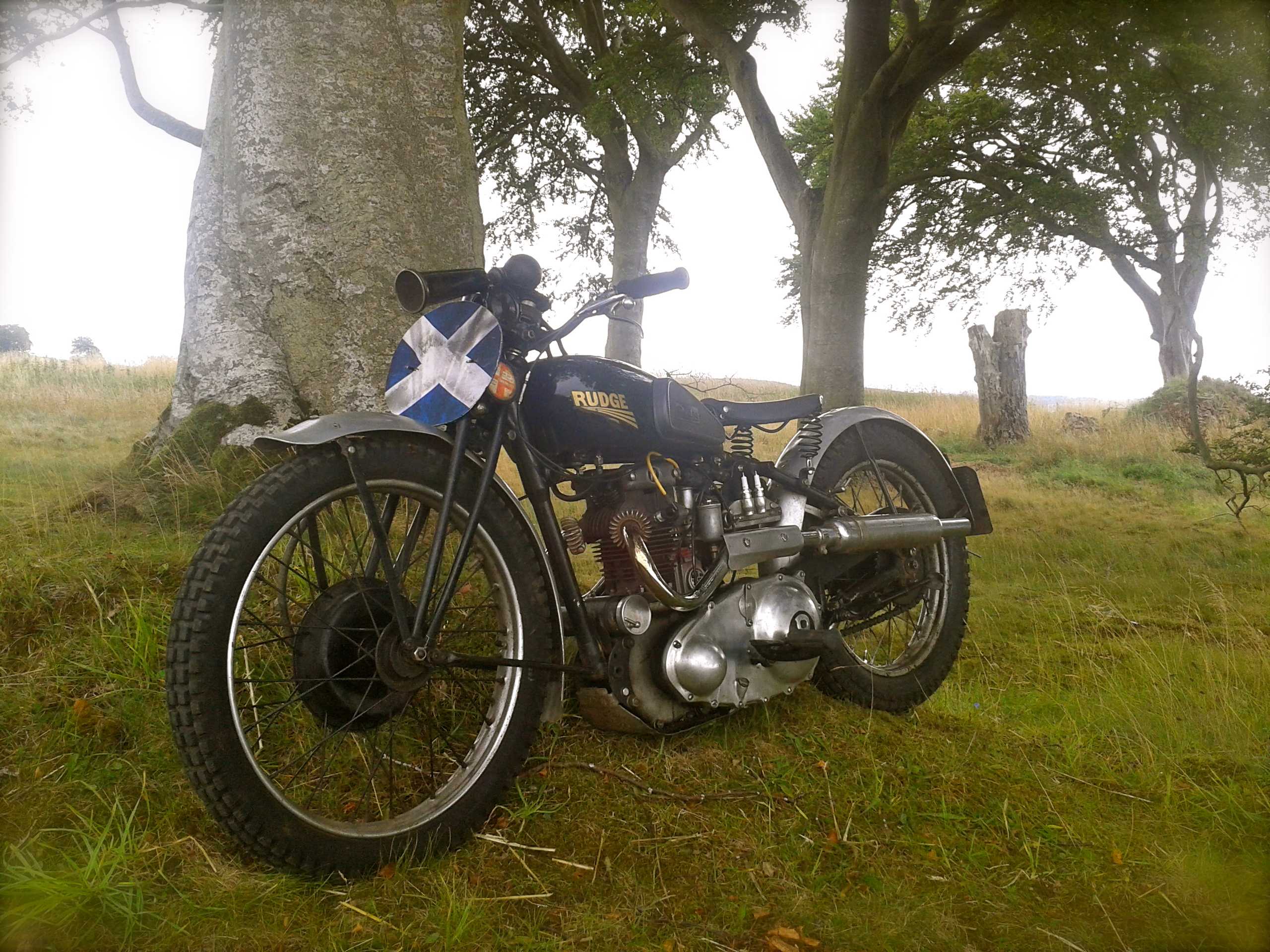
Mark Whitham’s 1935 Rudge Special Competition model.
MacGregor’s daughters regularly attend the main trial event to remember their childhood in the village and of course their father’s achievements in the sport of motorcycle trials. Gary Macdonald’s life-time ambition is to break Bob MacGregor’s SSDT record, now in its eightieth year – will he do it in 2015? We shall have to wait and see! Article Copyright: Trials Guru / Moffat Racing, John Moffat 2015 Photos by kind permission: – Iain Lawrie, Kinlochleven – Trials Guru Archive – Edinburgh & District Motor Club Ltd – Archive – Mark Whitham
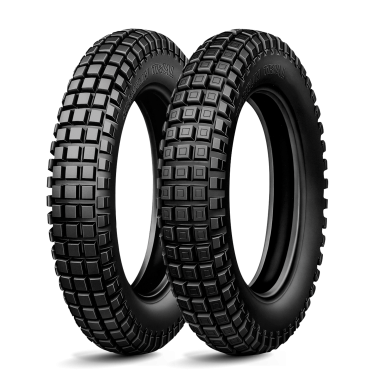
The 2015 Scottish Six Days Trial is nearly upon us and Michelin is pleased to announce its presence and support at this year’s event.
With a long and proud association that goes back to the first Michelin win with French rider, Gilles Burgat, on an SWM in 1981 through to the most recent win in 2014 with Dougie Lampkin – Michelin is pleased to support the 2015 event.
In 2014 Michelin tyres were used by seven of the top ten riders, including the winner Dougie Lampkin, who along with his friend James Dabill, start this year’s event as the favourites. Lampkin has won using Michelin tyres for the last three years and will be looking to add a fourth win in 2015. Ladies World trials champion and Michelin rider, Emma Bristow, will also once again be looking to win the Best Lady rider award.
This year Michelin will be providing a ‘Fill Up with Air’ unit in the start area. It will be situated under two Michelin gazebos to protect the riders from the Scottish weather with 4 compressors available. Michelin staff will be on-hand to offer pressure checks and expert tyre advice to the riders, teams and spectators. There will also be a Michelin tyre display where you can view the latest rubber.
Proud to be associated with this prestigious event you will be able to find the Michelin service area as the large inflatable Michelin man can be seen with the Michelin flags also flying proud.
Bringing you live information on the morning of each of the six days will be Nevis Radio Station. Hosted by David Ogg and John Moffat with rider interviews and general information is presented to you by Michelin in association with Trial Magazine positioned in the start area.
To see the full range of Michelin motorcycle tyres visit: Michelin
Article courtesy of Trials Media/ Trial Magazine UK
Sammy Miller developed the Sherpa N 200cc into the world beating 244cc Sherpa T in 1965, helped by his win at the Scottish Six Days Trial that year. (Photo: Rickman Brothers, New Milton, Hants.)
You may be forgiven if you haven’t realised that in May this year it will be fifty years since Samuel Hamilton Miller won the Scottish Six Days Open Reliability Trial on his 244cc Bultaco Sherpa registered as 669NHO.
Miller had left Ariels to ride for the Catalunian manufacturer based at San Adrien De Besos, part of Barcelona in late 1964 to develop the Bultaco Sherpa into a machine that was to change the face of motorcycle trials forever.
The defection to the lightweight Bultaco signalled the end of the big four-stroke single as the bike to win at trials.
There is a celebration of the marque in July this year at the Circuit De Barcelona.
Sammy went on to further develop the machine and many British born riders followed him to ride for the Spanish factory, riders such as Malcolm Rathmell and the first winner of the world championship, Martin Lampkin with Frenchman Charles Coutard and Finland’s Yrjo Vesterinen who was to win three world Championships for Bultaco.
The Bultaco Sherpa was a revelation as it weighed much less than its competitors with a 52 inch wheelbase it handled and steered much better than its rivals and pulled well from low revs. It turned novice riders into award winners.
Well restored examples of the four-speed Model 10 Sherpa still command high prices, if you can find one for sale as these are very much collector’s items.
Miller had written into his contract with Senor Bulto, that if he didn’t win more than 50% of all events he entered, then Bulto was not obliged to pay Miller’s salary! Of course, Sammy did win more than 50% of the events and was so confident of doing so.
Miller told Trials Guru: “If I didn’t win all those events on the Bultaco, it wasn’t worth my time competing in the first place”.
However, Sammy Miller wasn’t the first to compete in the famous Scottish Six Days Trial on a Barcelona-built Bultaco, it was a Lancastrian rider called Tommy Ollerton who rode a 200cc Bultaco Sherpa N in the 1962 event. Ollerton’s machine was registered in the UK as PDV700. Tommy Ollerton rode in company with Oriol Puig Bulto, nephew of Senor Bulto, having travelled all the way from the factory to Edinburgh in a Fiat 500 car with a two bike trailer attached, carrying two Sherpa N models, one for himself and the other for Ollerton, who was supported by Anellays of Blackburn, Lancashire.
Having said that, it was Miller who gave the factory it’s first Scottish Six Days win and that is a major part of both the event and motorcycle trial history.
The next character in our series of ‘Great Scots’ – The story of Ian Pollock, the man who discovered many of the Scottish Six Days hills in and around Kinlochleven.
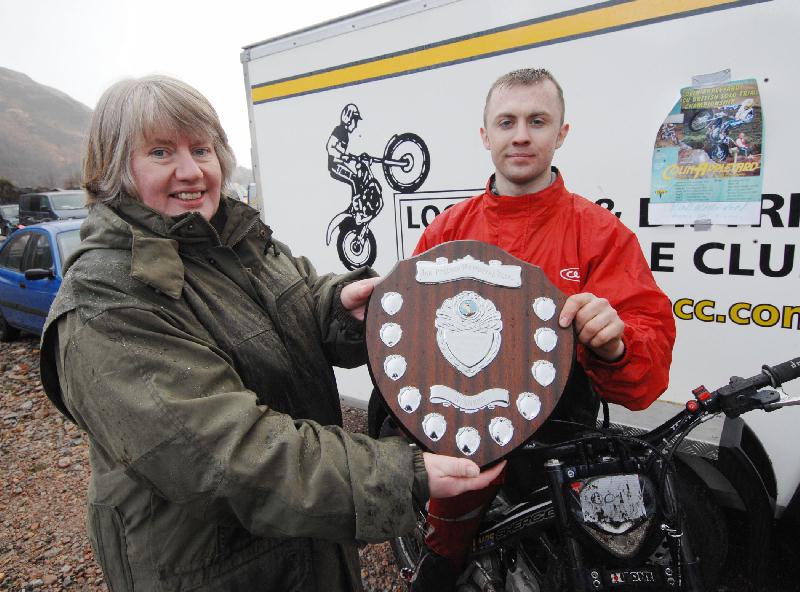
POLLOCK SHIELD 2008 – Pamela Pollock MacGregor presents Gary Macdonald with the Ian Pollock Memorial shield – Photo copyright and with permission: Iain Ferguson – The Write Image, Fort William.
ALL GAS GAS RIDERS MUST REGISTER WITH GGUK BEFORE THE EVENT. Please phone Andy Hipwell on 01298 766814 or email him .. andy@gasgasuk.com
Andy will need all your details…..name, address, riding number and credit card details.
1. Check spokes in both front & rear wheels for tightness as they may have worked loose since first being checked.
If you have the normal type rear wheel (pre 2011) with the sealing band make sure the sealing band is sealed properly BEFORE the event. Please don’t come to our mechanics on ‘way-in’ day with a leaking rim-tape. GET IT SORTED beforehand.
The latest type rear wheels fitted to 2010 RAGA, and all 2011-2015 bikes have the new band-less rear wheel which prevents the tyre leaking air. You must make sure that the spokes are also in good condition on these wheels.
2. Fit new MICHELIN tyres on the front and back. The heat generated on the road destroys tyres and only Michelins stand the abuse. It’s probably better to use the ‘normal’ X11 rear tyres because the new X-light is very thin on the carcass (crown) so there’s more risk of a puncture.
You can get the whole week out of one rear tyre but we recommend using two.
We also recommend using a thicker Enduro inner tube in the front.
We also recommend fitting new wheel bearings…..particularly the front.
3. Repack your silencer with some good quality packing wool. (We recommend SILENTSPORT). It’s a messy job but is well worth doing.
Even if your bike is relatively new we still recommend repacking it before the SSDT. Make sure you re-fit the plastic end can with silicone sealer. And use loctite on the 5mm screws.
Try and not sit on the rear mudguard / silencer because this can make the plastic end can come away from the silencer. You can strengthen this by adding rivets…see pic.
Also a GOOD idea is to add a rivet to the very end of the silencer to help strengthen the fixing of the small stainless outlet.
Fit both front pipe & silencer with new o-rings and silicone sealer.
Also check that the middle-box brackets have no cracks….re-weld / repair if necessary.
1. Check suspension linkage for excessive play & damaged seals, replace as necessary.
Check your ‘bump-stop’ rubber is intact.
2. Clean air filter box & make sure it is completely water tight, clean filter & refit after applying some (decent) filter oil.
On the Pros, it’s a good idea to split the two halves of the air box and seat and re-apply some decent silicone sealant before re-fixing the screws. We use WURTH RTV silicone.
3. Also a good idea (but not a must) is to drill a small 4mm drain hole in the bottom of the plastic flywheel cover & put PVC tape around where wires go into casing. Things can be very wet in Scotland and this will help drain any water that may enter your ignition/stator.Whilst the case is off check the flywheel nut.
4. Make sure all wiring connections are free from dirt & fitted together properly with silicone grease. If your thermostat switch is working fine then leave it alone. Its a good idea to make yourself a small link wire to bypass the switch and wire the fan direct if the switch fails. Only do this in an emergency because having the fan running all the time eventually destroys the small bearings in the fan motor.
5. It’s a good idea also to renew your head o-rings, especially on the two piece S3 cylinder heads. Its also a good idea to carry some head orings in case you cook your bike. If u empty the rad the next thing that fries are the head orings so because they weigh and cost very little, it’s a good idea to carry some.
6. Fit new front & rear brake pads.
Tighten ALL the brake banjo bolts especially the rear brake one because they tend to work loose sometimes. Also check the clutch banjo bolt on top of the cover.
9. Fit new chain & sprockets and the chain is correctly adjusted & it’s not too low-geared. The standard Pro gearing of 11×41/42 is ok but you may want to gear the bike up a little to help on the road sections. (check those sprocket bolts!)
DO NOT FIT A 12T front sprox on a GG PRO!
Remember —- one tooth on the front is the equivalent to four on the back.
When changing the front sprocket make sure the cir-clip is fitted properly.
10. The standard IRIS chains are no good for Scotland. Spend your money on a good quality heavy duty chain like Regina or Renthal for example. (there’s a lot of road work in Scotland). DO NOT USE AN O-RING CHAIN! Also renew the chain tensioner pad.
11. Check the coolant is topped up, condition of the hoses & clips are O.K.
12. Remove carburettor & the float bowl, blow all jets out with airline & refit. Usually, the standard jetting is fine for Scotland. A good idea is to change the ‘float jet’ from the std. 200 to say a 300 to allow more fuel when you’re abusing the bike on the road. Sometimes the bigger float jet can affect the performance in the sections running rich and sometimes a smaller pilot jet (33) is needed. Also keep your filter clean and try and stay away from deep water because you’re engine wont like it.
13. If you use a Keihin Carb (standard on Racing models) we recommend using the richer slide #3 to make the jetting richer mid range and safter on the road. The #3.5 makes the bike nice and clean in the sections but makes it very weak on the road.
14. If you want piece of mine regarding fuel tanks then we do the large capacity ones which all the Team use. http://www.trialendurodirect.com/products/BIG_TANKS_FOR_PROS_53.html This is not just so we can make money either! Its peace of mind for you. You may get stuck on the moors, get lost or your bike might fall over whilst viewing a section. If you use a Keihin carb then these use even more petrol on the road.
If you have a 2013 PRO RACING/REPLICA FACTORY/STD or RACING 2014 model then you must ask for the tank that fits that model because the coil is mounted in a different place and so needs a modified tank.
If you can’t afford a tank then Id advise carrying at least half a litre in your rucksack….which is not actually allowed….oops.
The petrol stops are perfectly situated nowadays thanks to the army and many GG riders manage on the standard tanks.
15. YOU MUST USE THE CHOKE ON THE ROAD. Keep easing off to the ‘rich’ spot is the best technique. Tip; vary your speed and throttle when you are on the road. Holding the throttle in a constant place on any 2 stroke is fatal. The engine will run very weak, detonate and easily seize up.
Always ride a long with a finger hovering the clutch lever. If you feel the engine tighten or if the piston ‘nips’, pull that clutch lever fast ! If you seize the piston, don’t panic. Let the engine cool down a little and try and push the kickstart down. If the kickstart is absolutely solid, you are in trouble ! The cylinder needs to be removed and renewed with a new piston. If the kickstart will push down, you’ve been lucky. Start the bike and carry on, steadily for a while. The engine will rattle but usually quietens down after a few miles.
16. Fit new handlebar grips with glue and also wire them on.
There are many grips on the market and we love both the Renthal and S3 Brands.
I would use either Renthal mediums or the new S3 ‘6 Days’ grips
From 2011 model onwards we fit a larger rubber ring around the rear shock absorber to help stop water entering the airbox, we have these in stock at GGUK.
DON’T forget a front mudguard flap and wider the mudguard with Duct-tape !
19. If you normally use a cylinder head spacer kit, then we recommend you remove it for the Scottish. Sometimes these can leak when the cylinder reaches high temperatures for along time (road/moors)
If you are used to riding with a head spacer and want that nice soft power for the Scottish we HIGHLY recommend the new S3 ‘low compression’ head inserts.
YOU MUST PREPARE YOUR BIKE FULLY BEFORE YOU GO UP TO THE TRIAL
EACH YEAR WE EXPERIENCE PROBLEMS FROM RIDERS WHO DO NOT BOTHER TO DO THE JOBS LISTED ABOVE.
SOME THINGS MAY SEEM UN-IMPORTANT BUT THEY ARE ALL THERE FOR A REASON.
The SSDT committee are quite strict in the paddock regards to anyone else working on your bike so make sure you are able to carry out the work yourself.
Our SSDT service that you register to enables you to use our facilities, buy spare parts and get advice. It does not get you your own personal mechanic for the week.
GGUK services / shop in the paddock open at 9am on Sunday May 3rd.
Our staff will not be there and no parts/service is available on Saturday May 2nd.
The GGUK squad March 2015 – here to look after you!
Many thanks to John Shirt Jnr and his team at GasGasUK for providing Trials Guru with this information.
Stu Thomson was and still is a trials rider. Son of a motorcycling Mum and Dad he was brought up in the trials faith.
Stu and his brother Peter, rode in the Lanarkshire Motorcycle Club as a youth before taking up Downhill Mountain Bike competitions in which he was managed by none other than Steve Peat (another son of a trials rider!).
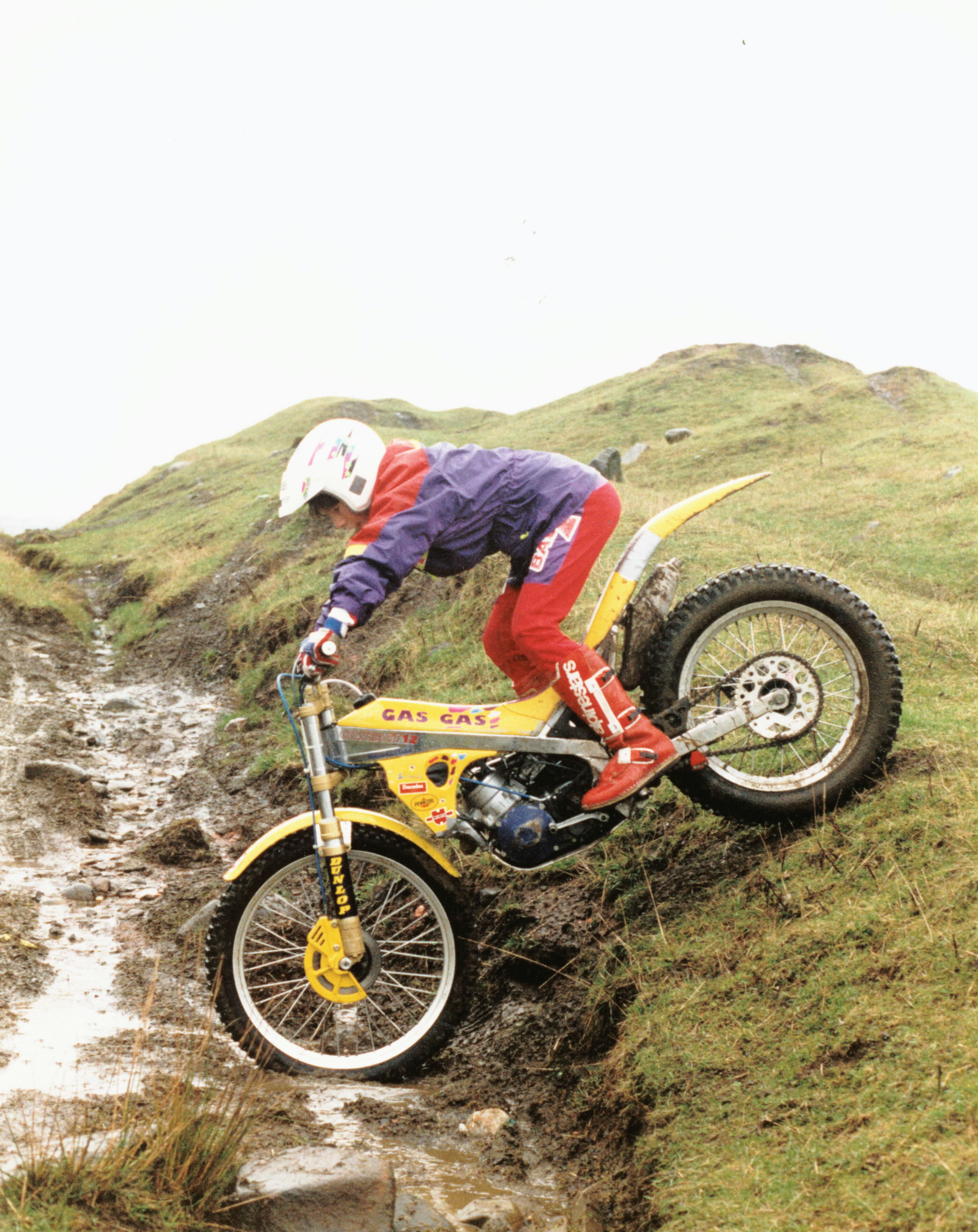
Stu on his 125 Gas Gas Contact in 1995 when a youth rider in Scotland.
Stu’s parents are Richard and Bobbie Thomson, who were stalwarts of the Avon Valley MCC. They were TT race fans and at one time owned a Norton Commando, which Bobbie rode as often as husband Richard.
Richard Thomson rode trials from around 1974 to 1980, riding the Scottish Six Days Trial four times between 1976 and 1979.
Stu’s Dad Richard was a keen trials rider. Photo: Jimmy Young, Armadale.
Stu is now married and lives near Stirling and is an accomplished film producer, running his own company CutMedia who have produced many films with Danny MacAkill (Imaginate), Guy Martin and Dougie Lampkin (Tundra Trial).
Here is a clip showcasing Stu’s most recent work…
Six Days in May – CUTMedia
Article copyright: Trials Guru / Mofffat Racing, John Moffat
Photos: Copyright – Jimmy Young, Armadale & Mrs. Bobbie Thomson
Peter ‘Jock’ Wilson … a great friend … a great man ~ By Renee Bennett.
Jock Wilson on ‘Cheeks’ at the Clayton Trial in 1962 on his specially built ultra-short-stroke AJS 350. (Photo supplied by Patricia Wilson)
When I think of Jock Wilson, it reminds me of the fantastic Thames Ditton motorcycle dealers, Comerfords, AJS trials machines, Bultaco, the Scottish Six Days and a top Home Counties based trials rider who went on to take charge of the British International Six Days Trial Trophy Team for nearly 20 years.
Peter Cameron ‘Jock’ Wilson was born in Scotland on 12th January 1934 at Oakbank, Bridge of Balgie, Glen Lyon, Perthshire. The Scottish Six Days was practically on his doorstep as the ‘Meall Glas’ section was only ¾ mile from his front door.
Jock on his short-stroke AJS in a Sidcup 60 Trial. Comerfords Sales manager Bert Thorn is following in the background.
There is the main reason he was such a good trials rider ~ with all that practice ground, he just had to be good!
‘Jock’ as I’ve always known him, started his working life as a lumberjack, then a spell in the British Army doing his national service at Aldershot, then marrying his wife Pat and moving to London to live permanently.
At Aldershot, Jock was in the Royal Army Service Corps or RASC for short, his commanding officer was Captain Eddie Dow, but he also met many of the factory trials and scrambles stars of the era who were also doing their national service. Riders such as Roy Peplow, John Giles and many more.
He took up employment at Arthur Cook Motors in Kingston-Upon-Thames and then the well-known motorcycle dealership, Comerfords based in Portsmouth Road, Thames Ditton, Surrey which he joined in 1957.
Jock started at Comerfords as a motorcycle mechanic in the workshops, soon progressing to workshop manager. When he became bored with that, he moved into sales under Sales Director, Bert Thorn.
1965 Scottish Six Days on Callert, riding the ex-Sammy Miller Ariel 786GON, which Wilson owned and rode for several years. The machine is now in Italy.
Jock’s specialty was modifying AJS trials bikes, cleverly making them lighter and more powerful. Gordon Jackson, Gordon Blakeway and Gordon McLaughlan rode AJS machines as a team in those days and Jock even named one of his sons after the trio.
Gordon Jackson of course won the 1961 SSDT on his factory AJS (187 BLF) with just one ‘dab’ ~ Amazing!
Jock went on to manage the British International Six Days Junior Trophy and Trophy teams. His knowledge gained by riding in the ISDT many times himself on AJS and Triumph machinery gave him a valuable insight into this part of off-road sport and was a very highly thought of manager by the riders and the ACU. He actually cut his teeth initially by managing the Scottish ACU squad in Sweden in 1978.
A Scottish ACU presentation of awards ceremony at Perth in 1980. From left: Margaret Allan (SACU Chairperson); Ron Wright (SACU Trials); Alex Phillip (Clubman TT winner 1948); Robbie Allan; Charlie Bruce (former Scottish racing champion); Tommy Milton (SACU official); Anne Allan (wife of Vic Allan) and Jock Wilson, ISDT Team Manager.
When Comerfords eventually took over the importership from Rickman Brothers of the Bultaco brand, Jock was soon in charge … supplying dealers and operating a first class spares service.
When Jock left Comerfords, some many years later, he started his own business importing the Italian SWM trials and enduro macinery in partnership with Mick ‘Bonkey’ Bowers, which became equally as good as the Bultaco brand and very popular.
Jock and Bonkey set up a countrywide dealer network which included former World Trials Champion, Martin Lampkin.
After SWM stopped producing motorcycles, Jock went self-employed working from his home in Tolworth, fixing and tuning bikes and repairing damaged wheels, as he is an ace wheel-builder.
Nowadays, Jock is retired but still works a little on classic bikes in his spare time. I speak to him regularly and it’s always a pleasure.
Jock has always been a friend to me, to my late father Wag Bennett, and to my children Charles (who runs a busy London motorcycle shop) and my daughter, Julie.
I owe Jock a debt of gratitude for the support and help he gave me over twenty five years of trials riding.
Thank you Jock Wilson … Renee Bennett, Plaistow, East London.
Trials Guru: Jock Wilson, so named because this was common place for a Scotsman living and working in Southern England at the time, became one of off-road motorcycle sports’ most respected characters. Jock was a very competent mechanic and a serious trials competitor. When he was with Bultaco UK, he was responsible for setting up the contracts with the Comerfords supported riders in both motocross and trials. Wilson was mentor to Greeves rider and fellow Scotsman, Vic Allan when he moved from Aberdeenshire to Thames Ditton to ride for Comerfords in 1967. Allan then went on to ride for BSA briefly, during which time he crashed heavily at the Italian GP on his factory BSA breaking his hip and was sidelined for several months, during which time BSA closed the Small Heath competitions department. Allan then reverted to race for Comerfords on the Spanish Bultaco and became British 250cc and 500 cc Motocross champion in 1974, riding the Pursang models in both classes.
Supported by Trial Mag & Classic Trial, the Highland Classic has proved popular with riders of both Pre’65 and twinshock machines.
After only five days promotion, the Inverness and District Motorcycle Club annual Highland Classic Two-Day Trial is now full up at the 130 rider maximum.
Held on the picturesque Alvie Estate, near Aviemore in the Scottish Highlands, the event celebrates ten years as a two-day affair. This year the guest of honour will be Bill Wilkinson, the last British rider to win the Scottish Six Days on a British built Greeves machine!
Now surely a victim of its own success, it was the ‘brain-child’ of club Chairman, Malcolm Smith who has been a long standing trials rider and regular observer at the SSDT, the event started as a one day trial back in 2004, elevated to a two-day event the following year to make it worth the stay for riders south of the border.
It is a Pre’65 and twin-shock event combined with two routes to choose from for all classes.
The event was publicised in Classic Trial Magazine as part of a sponsorship deal and the event has been building in stature over the past three years when the club decided to have a special guest annually.
Previous guests have been Yrjo Vesterinen in 2013 and Dave Thorpe in 2014.
The trial is held on the shooting estate and will be on Saturday 13th and Sunday 14th June 2015.
If you wish to help by observing, please contact IDMCC club secretary David MacKay by e-mail: secretary@idmcc.co.uk
For the lucky 130, here is a from the saddle view of Alvie:
The Premier Trial Website – Recording the History of the Sport 'Established 2014'









 TRIALS GURU - DEDICATED TO TRIAL