Abbreviated to ‘2DGT’ the Two-Day Group Trial is set for the 22/23rd of July 2017 at Dudwood Farm & Burycliffe Quarry, Matlock, Nr Derbyshire, with the valued support of Mr. Barry Burton (YMSA) Regulations will be posted on the facebook group (Hard To Find Twinshock Trials & Aircooled Monos) along with all relative information on the weekends activities within the next 10 days for all those interested in entering what is becoming a not to be missed annual event.
This will be a great weekend for all ,with the added bonus of a 50/50 route this time round.
Entries will be limited to the following classes :- Twinshock; Aircooled Mono; Pre’65 with Clubman; 50/50 and Expert Routes available.
As previously, Mick Andrews will be setting out the courses at both venues, and will be in attendance on both days to offer his invaluable support and experience to all.
Camping / Motorhome accommodation is available, and evening entertainment, along with Clay Oven Pizzas and Beers a plenty!!
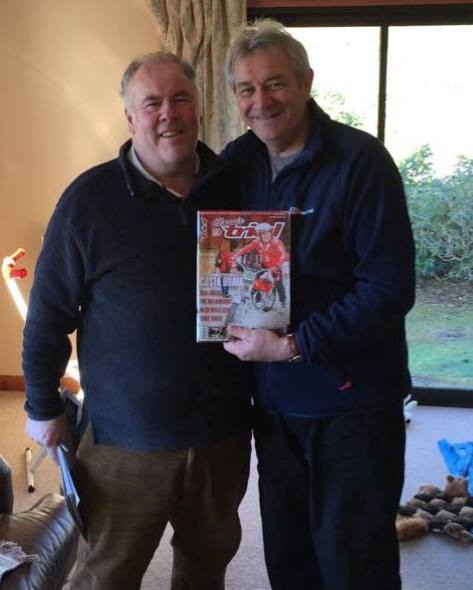
Trials Guru’s John Moffat (right) with John MacGregor of Glencoe with a copy of the magazine which has the ‘Full Circle BSA’ article. MacGregor is a subscriber to the excellent magazine.
For anyone that regularly reads ‘Classic Trial Magazine’, the finale to the story ‘Full Circle BSA’ was the delivery of the Trials Guru’s John Moffat BSA B40 to its ‘new’ owner, John F. MacGregor, the first man to lay out the course of the Pre’65 Scottish Trial in 1984 in company with the late Johnnie Graham.
Classic Trial Magazine Issue 20 carried the ‘Full Circle BSA’ article
The story started when Moffat was unsuccessful in obtaining an entry in the 2017 Pre’65 Scottish and this prompted him to review his collection of trials machines. The B40 was purchased from MacGregor by Moffat in 2004, MacGregor having bought it from Scarborough’s Gordon Jackson in 1999.
John MacGregor competed in Scottish trials from around 1971 to 1977 on Bultaco machinery and thereafter took an active role in course plotting for the Scottish Six Days Trial. He married Pamela, the only daughter of Ian Pollock the man who discovered many of the sections around Kinlochleven that are still used to this day.
John MacGregor and Pamela (formerly Pollock, daughter of Ian Pollock) – Photo: Sharon Smith, Fort William
Pollock was always referred to as ‘our man on the spot’ by the SSDT committee as he lived and worked in Kinlochleven in the Aluminium factory. MacGregor’s parents ran the small caravan site at ‘Narrach Bridge’ near Kinlochleven.
Ian Pollock is remembered by the renaming of the Lochaber club’s ‘Spring Trial’ as the ‘Ian Pollock Memorial Trial’ an event he used to organise and is still regarded as a ‘shake-down’ event in the March for those riding the SSDT in the following May.
Looking good! Gordon Jackson from Scarborough on 946ERH (The Full Circle BSA) back in 1984 on Pipeline when the Pre’65 Scottish was originally created for ‘pure’ machinery by John MacGregor and Johnnie Graham.
Moffat: “I was mildly disappointed at not gaining an entry in the Pre’65 Scottish, but as I had ridden the event 23 times previously I wasn’t really too concerned as there are plenty of other events that were not on my ‘radar’ during the year. I decided that I had too many pre’65 machines, the AJS & Matchless bikes that I own are far to original to use nowadays and I had already bought the ex-Gerry Minshall BSA C15, so the B40 would have to go to a new home. The result was a nice story about my machine that almost went back to it’s builder, Gordon Jackson, but it was thwarted when I telephoned John MacGregor who jumped in and bought the bike there and then! John Hulme asked me to write the story for Classic Trial Mag and it seems to have been well received by motorcycle enthusiasts”.
…
John MacGregor gives the 1962 BSA a quick test near his Glencoe home – Photo courtesy of Sharon Smith, Fort William
…
The ‘Full Circle BSA B40’ which was last used in the Pre’65 Scottish in 2015 has now been sold to previous owner, John F. MacGregor
Moffat continued: “To be quite honest I have to admit to becoming more interested in what we now call the ‘twinshock’ trials classes as that is what I started out on in 1974, a 250cc Bultaco. I took up Pre’65 riding at aged 34 and I had bought my very original Matchless G3C which was once owned by Cliff Clayton, the AJS works rider after he had stopped riding for the AMC factory and my late father had ridden AJS and Matchless in trials back in the day. My son David rode the very same Matchless in the 2016 Pre’65 Scottish, maybe that will be our last to ride together as father and son in the annual event. The Pre’65 Scottish has now become far removed from what it originally was designed for, as many of the machines that are now entering and being accepted by the organisers bear no resemblance to real Pre’65 bikes that I remember as a child. That is a pity really. Many enthusiasts keep asking why the Bultaco Sherpa T (Model 10) is acceptable when it wasn’t commercially available until 1965? The Pre’65 movement was created to allow old bikes to re-surface from sheds and garages, but many, like my own have gone back into museums and garages as they are no longer the tool for the job. It’s a bit like history repeating itself.”
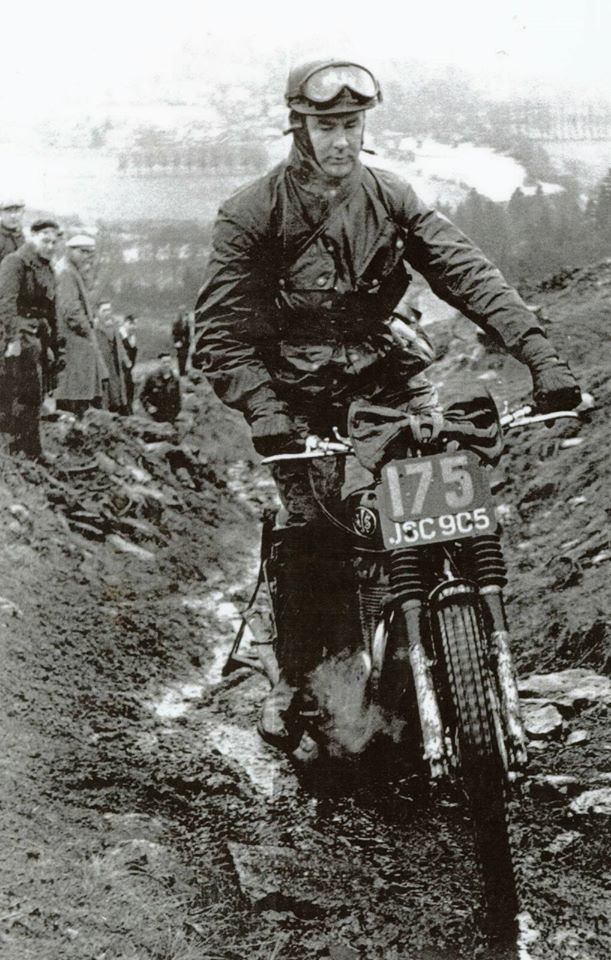
Moffat’s father, T.Arnott Moffat rode this AJS in the 1953 and 1954 Scottish Six Days Trial, seen here on ‘Weem’ in a wet 1954 SSDT. Moffat still owns this motorcycle, but few of these machines appear in Pre’65 events now.
The Inverness & District Motor Cycle Club of which Moffat is both company and general secretary created their Highland Classic 2 Day Trial initially for Scots riders who were unsuccessful in gaining a Pre’65 entry, that was 13 years ago.
Moffat: “The Highland Classic was the idea of our highly respected Club Chairman, Malcolm Smith. He felt that there should be more than one Pre’65 style event in Scotland. however because there are few Pre’65 riders in Scotland, we included twinshocks in the first two day event and the trial has now become very popular, because of its relaxed atmosphere and friendly welcome by Alvie Estate owner, Laird, Jamie Williamson. It just goes to show, if you build it properly, then people will come. I have taken up the challenge of becoming more involved in our local motor cycle club this year, so I actually have a lot less time on my hands now”.
Still riding when time allows, but preferring twinshock nowadays, Trials Guru’s John Moffat on one of his Bultaco 325 Sherpas in action at the very popular Highland Classic 2 Day Trial, June 2016 – Photo: Bill McGregor, Bon Accord.
This year, the 2017 Highland Classic is called the ‘Honda Edition’ and has attracted a bumper entry of 150 riders with six Guests including Guest of Honour, Rob Shepherd. The event takes place on June 11/12 followed on Monday 12th with a memorial road run around Loch Ness.
Moffat ended by saying: “I’m not completely leaving the Pre’65/Britshock scene behind, plans are already well advanced for the building of a Drayton framed BSA B40 as I had a spare engine and wheels left over in my store, maybe I’ll ride it or perhaps have a supported rider on it -so watch this space!”
Article made possible with the co-operation of Classic Trial Magazine – Available HERE
TRIALS GURU – the Premier Trial Sport Website for photos, articles, news and the history of motorcycle trials
Here at Trials Guru, we are always looking for something different and original and instead of featuring a rider, we obtained this article about the unsung heroes of our sport, the observers. Without observers, we would have no events. Trials Guru asked an observers’ daughter to pen us an article, this is the result.
Words and photos provided by Helen Graham:
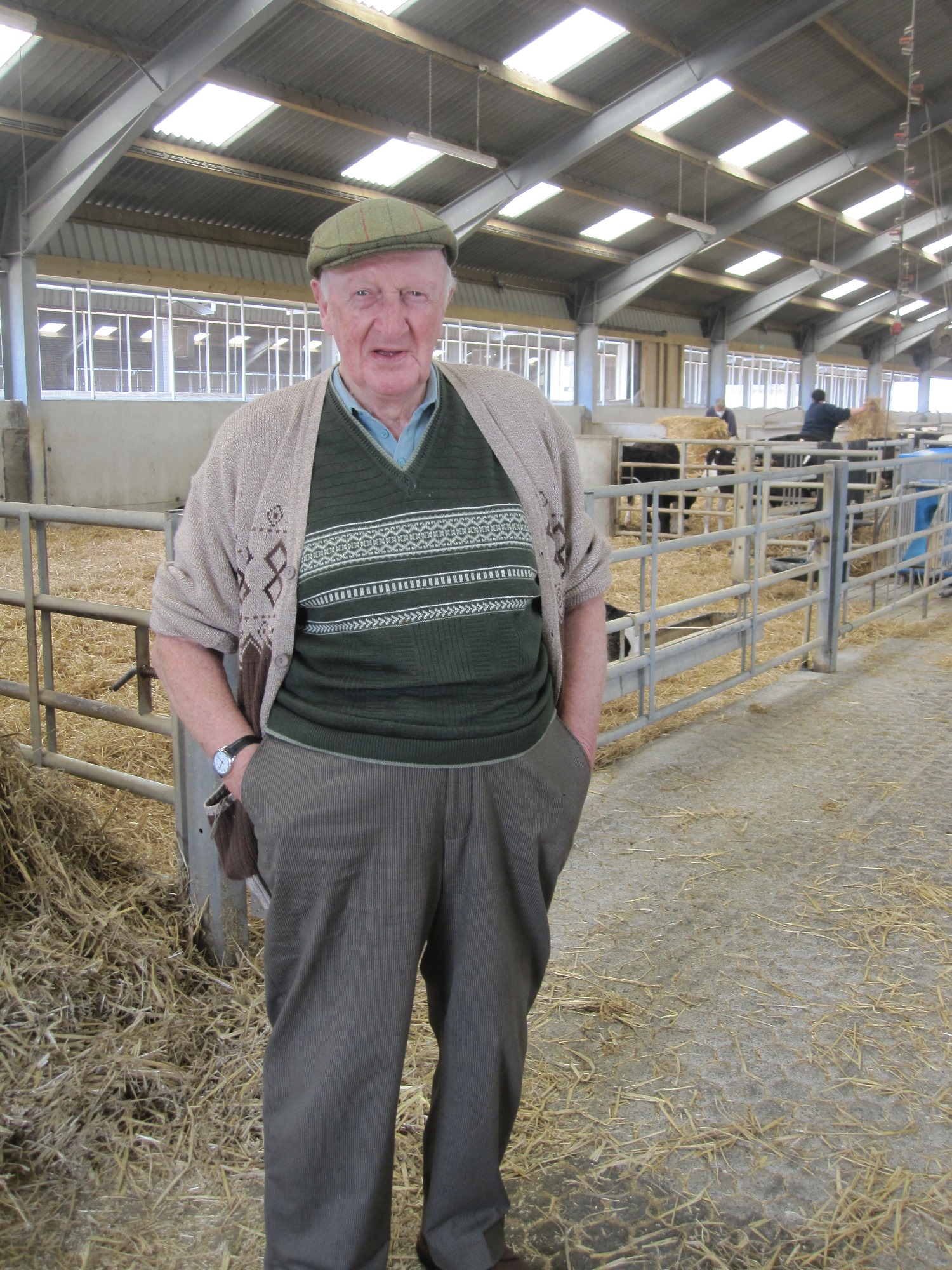
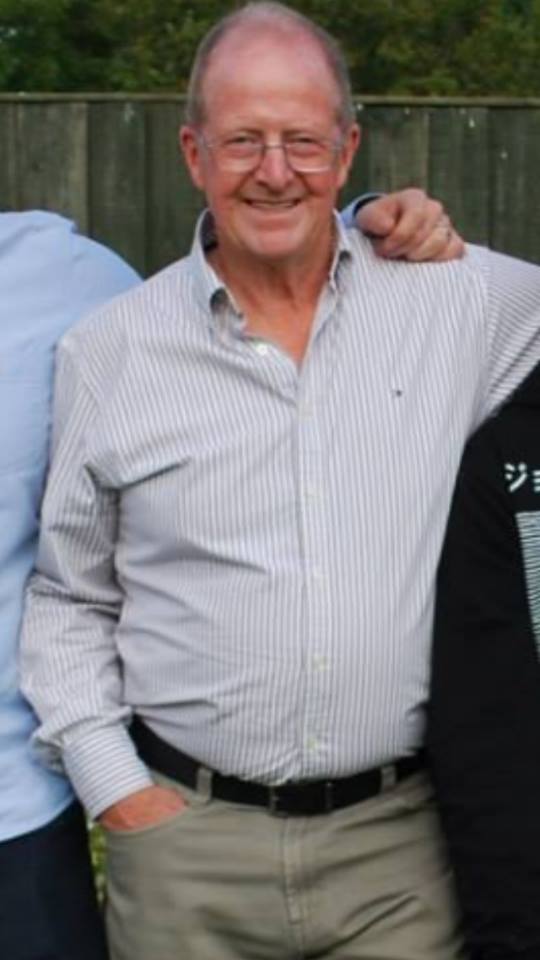
Following a photograph of a well-known and reliable observer ‘Farmer John’ being featured on social media, a flurry of praise ensued with comments such as: Legend; Respect; “Hope I can do that at his age”; “Dedicated to North East Trials”.
There were also questions raised about the life of this 87 year old man in a flat cap, who braves all weathers to observe at trials throughout the North East and beyond.
John Graham was born on 10th January 1930 in Blanchland, Northumberland and at an early age moved with his parents to a rented farm in Hexhamshire, where he lived until the age of twelve when the family moved to a different farm in Hexhamshire, known as High Raw Green, not far from Whitley Chapel.
John wanted to join the RAF as he wanted a trade, and particularly wished to be a mechanic on aeroplanes.
Sadly this was not to be, as being an only child it was expected that he would work for his father and then take over the tenancy of the farm, which was owned by Northumberland County Council.
Let us not forget that in those days there were few cars or tractors, and work on the farm was by means of four legged ‘horse-power’. John states his father got the first family car in 1947, and only after that did they get a tractor on the farm.
Farmer John has only ever possessed one motor cycle, a 1950 Ariel 500 with sidecar. He describes the sidecar as a “wooden box for carrying stuff in”.
John got married to his wife Nancy in 1958, and in 1962 they began farming for themselves at High Raw Green. Sadly the Ariel 500 and ‘box’ had to be swapped for a wagon chassis to make a trailer to be used on the farm. Money was scarce and any available was put into the farm. John is a self-taught engineer and this was not the only trailer that he has built throughout his life.
John and Nancy had a hard life on their dairy farm. They had a herd of over 40 friesian dairy cows to be milked every morning and evening. In summer there was hay and silage to harvest. In winter there were severe snowstorms and John was a well-recognised figure out on his tractor with snow plough fitted to the back, to clear the local roads of snow so that the milk tanker could get to the farms to take the daily production of milk from the farms to the dairy.
John and his younger daughter Anthea began going to motocross every Sunday afternoon. He described it as “an interest, at weekends”.
In 1991 when he and Nancy retired from farming John started to go to motorcycle trials, and says that Harry Norman “roped him in to observe”, and he has been doing so ever since, for 26 years in fact.
Let us not also forget that since John retired from farming in 1991 he has worked continuously at Hexham Auction Mart as a stock person, a manual job, and starts work there at 7am every Tuesday and Friday, and other days when sheep and cattle or other sales take place.
John has observed at all local trials, plus the Yorkshire and Cumberland main trials, and this year is his 20th year for observing at the Scottish Pre-65.
His elder daughter Helen questioned him closely: What do you enjoy about being an Observer?.
His immediate reply, with a wry smile, was “Authority”!
She asked – Do you want to elaborate on that?, and Farmer John replied “to make sure there’s no rock-shifting”.
She asked him what he thinks about observing in wind and rain and all types of weather and his matter-of-fact reply was “It doesn’t bother me because I’ve been used to it all my life”.
Has he a favourite venue?
FJ: “No, but the Scottish Pre-65 is one I enjoy very much. It was a one-day effort originally, and I observed at Pollock Hill for 12 years, The Pipeline, twice or thrice at the hotel up on the top. It was Brian Short who ran the Weardale Trial who got me to do it. They always wanted me to observe at the Scottish Six Days Trial but I declined, it was unfair on anyone that was with me because I would be out from 7am – 7pm. I’ve seen most of the sections at one time or another.”
Does he have any problems with any of the riders?
FJ: “Some of them didn’t like getting Fives but there’s no arguments nowadays because a Five is a Five! I know most of the riders well now“.
What do you think of the new/young riders who are taking part in trials now?
FJ: “They are progressing well“.
A lot of people are surprised you are so fit and healthy at your age of 87 years. What do you put that down to? – FJ: “Hard work“.
How long do you intend to continue? – FJ: “Till I Die“.
Well ‘Farmer John’, let’s hope that’s not for some time yet!!
His daughters just also want to say that behind every good man there is a good woman, and Farmer Johns’ wife Nancy still makes his bag of ‘bait’ every Sunday morning for him, before he heads off to the relevant Trial of the day, and has his cooked meal ready for him when he gets home.
Legend is probably quite fitting, don’t you think?
2017 Pre’65 Scottish Trial – Major Gaff!
When 87 year old Farmer John Graham was asked if he had a favourite venue to observe at he described the Pre’65 Scottish as being ‘The Trial’.
This year, 2017 was to be his twentieth year as an observer at the Pre’65 Scottish Trial.
His daughter Helen has always said that for as long as he wants to observe she will drive him the 225 miles to Kinlochleven from his home town of Hexham, Northumberland.
This duly happened this year, and she drove Farmer John and wife Nancy on a beautiful sunny day from Hexham to what had been a wet day in Kinlochleven.
Farmer John had been given a brand new section to observe at on Friday 28th April 2017, at Man na Gualain. He was most concerned that he had not checked it out. Helen took him to the meeting of all observers the evening beforehand and once having received his official programme he was keen to check out his section.
Farmer John Graham (right) gets into position to observe – Photo: Helen Graham, Consett
He was duly at Kinlochleven checking in the following morning and was duly at his section well before he needed to be, so keen is he!
Farmer John was glad to find that the section was harder than what he thought it would be and “riders lost quite a few marks”. He was as ever vigilant that there was no “rock-moving” and he thoroughly enjoyed his day, chatting with entrants and people who were watching the trial.
Saturday was a section he had been at previously, Camas na Muic, and the only blight in his day was the amount of riders who stood on a particular “rock” in the section in an attempt to move it. As ever he was on the ball and fair in his marking.
Unbeknown to him organisers of the Pre-65 Scottish wanted to acknowledge his 20 years of observing at the awards evening on Saturday 29th April. He is not a big social attender but Helen suggested it might be nice to go as he hadn’t been previously, so he obliged.
Farmer John was there presented with an engraved whisky glass and medal acknowledging his 20 years of observing. He was very grateful, albeit very confused when the organisers made a huge and very embarrassing blunder by having the presenter, Graham Archer mention that he was retiring.
Oops! Graham Archer (right) and Colin Dommett (Centre) received incorrect information that ‘Farmer John’ was retiring, whereas it was actually for recognition of twenty years service for observing! Farmer John accepts his award in his usual shy manner and certainly isn’t retiring – Photo: Helen Graham, Consett
Well, his daughter Helen was very quick to point out, that is the first she had heard of him retiring, and he has made no decision to do so!
As an interesting aside, after his two days observing Farmer John, Nancy and Helen travelled down the west coast to Portpatrick for an overnight stay there. Farmer John and Nancy had stayed there almost fifty-nine years previously on their honeymoon. Farmer John was again in his element with his other interest, seeing the countryside and cattle on the Mull of Galloway and visiting a farm near Whithorn, Dumfries and Galloway which belongs to a cattle dealer that is a client at Hexham Auction Mart where Farmer John works.
Roll on your 21st Pre’65 Scottish Trial Farmer John, and never lose your interests.
Article: Copyright – Trials Guru & Helen Graham 2017
Photos: Helen Graham, Consett
Farmer John (left) with North East riders, Darren Palmer (Centre) and Gavin Brown( Right)
Sadly John Graham passed away on 7th December 2020, aged 90 years.
John Graham was diagnosed with cancer on 19th November 2020. He had been out observing at a motorcycle trial as late as the 12th September. The nurses who treated John told his family they had never known anyone as strong, and they called him ‘individual’. The sum of £4000 has been raised in donations for Tynedale Hospice at Home. Trials riders followed the funeral cortege around Hexham Auction Mart where John had worked from his retirement from farming in 1991. Around 200 farmers, friends, family and about 30 trials riders on their bikes, in effect his worlds united with mutual respect.
Memorial to Farmer John Graham – Dedicated To Trial
Apart from ‘Fair Dealing’ for the purpose of private study, research, criticism or review as permitted under the Copyright, Design and Patents Act, 1988, no part of this article may be copied, reproduced, stored in any form of retrieval system, electronic or otherwise or transmitted in any form or by any means, electronic, electrical, mechanical, optical, chemical, photocopying, recording or otherwise without the prior written permission of the author as stated above. This article is not being published for any monetary reward or monetisation, be that online or in print.
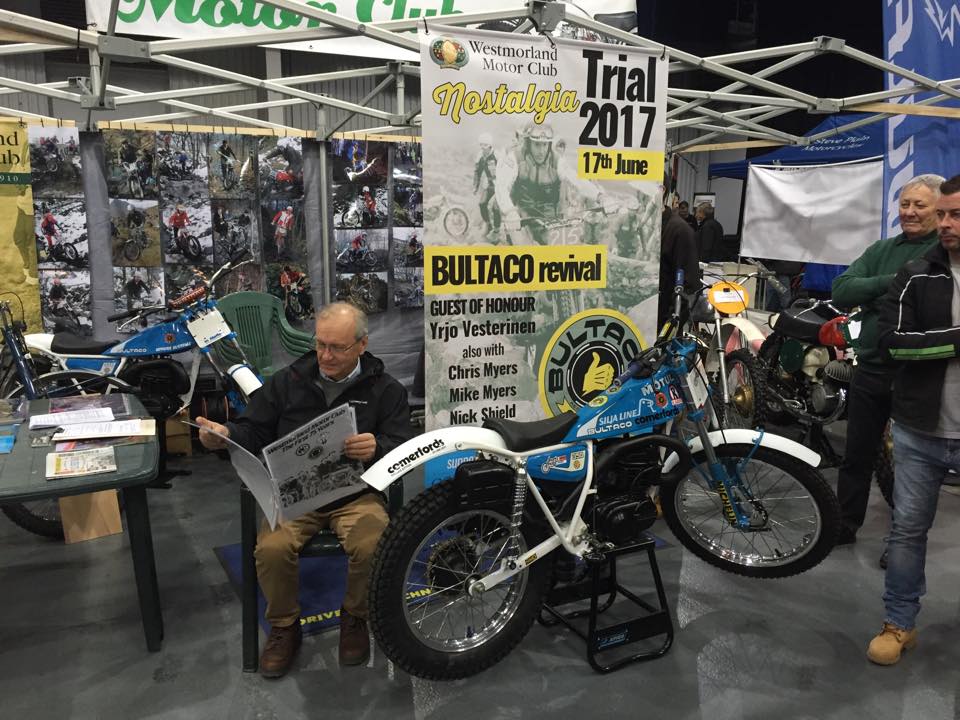
The incredibly popular Nostalgia Trial for Pre’65 and twin-shocks which has run in conjunction with the Nostalgia Scramble for the past couple of decades, has now split from the scramble date and from that organising club.
The trial will run this year under the banner of the Westmorland Club, originators of the Nostalgia Trial title and on a new date of SATURDAY JUNE 17th. The venue remains the same – Holme Farm, Middleton near Sedbergh, Cumbria – but there will be a totally new start area and three quarters of the course will be new due to changes in the land management.
To boost the popularity of this trial it has been renamed as the ‘Bultaco Revival Nostalgia’ Trial with Yrjo Vesterinen the guest of honour along with local Bultaco men Chris and Mike Myers and Nick Shield all featuring amongst the famous faces. In addition, Vesty is hoping that several of his French and Spanish former Bultaco rivals and very good friends will attend this mid-June event.
In all other respects the trial will remain the same, two laps of 20 sections off-road, sponsorship from Ian Bradley and his award winning Coniston Brewing Company, with the trial organising committee remaining the same.
The regulations and entry forms are available now from the attachments below with the trial classes the same as they have always been.
STOP PRESS! – Trials Guru, John Moffat will be there, with a suitable Bultaco machine of course!
Download the event regulations and entry forms below:
(Article reproduced with the kind permission of Trial Magazine UK)
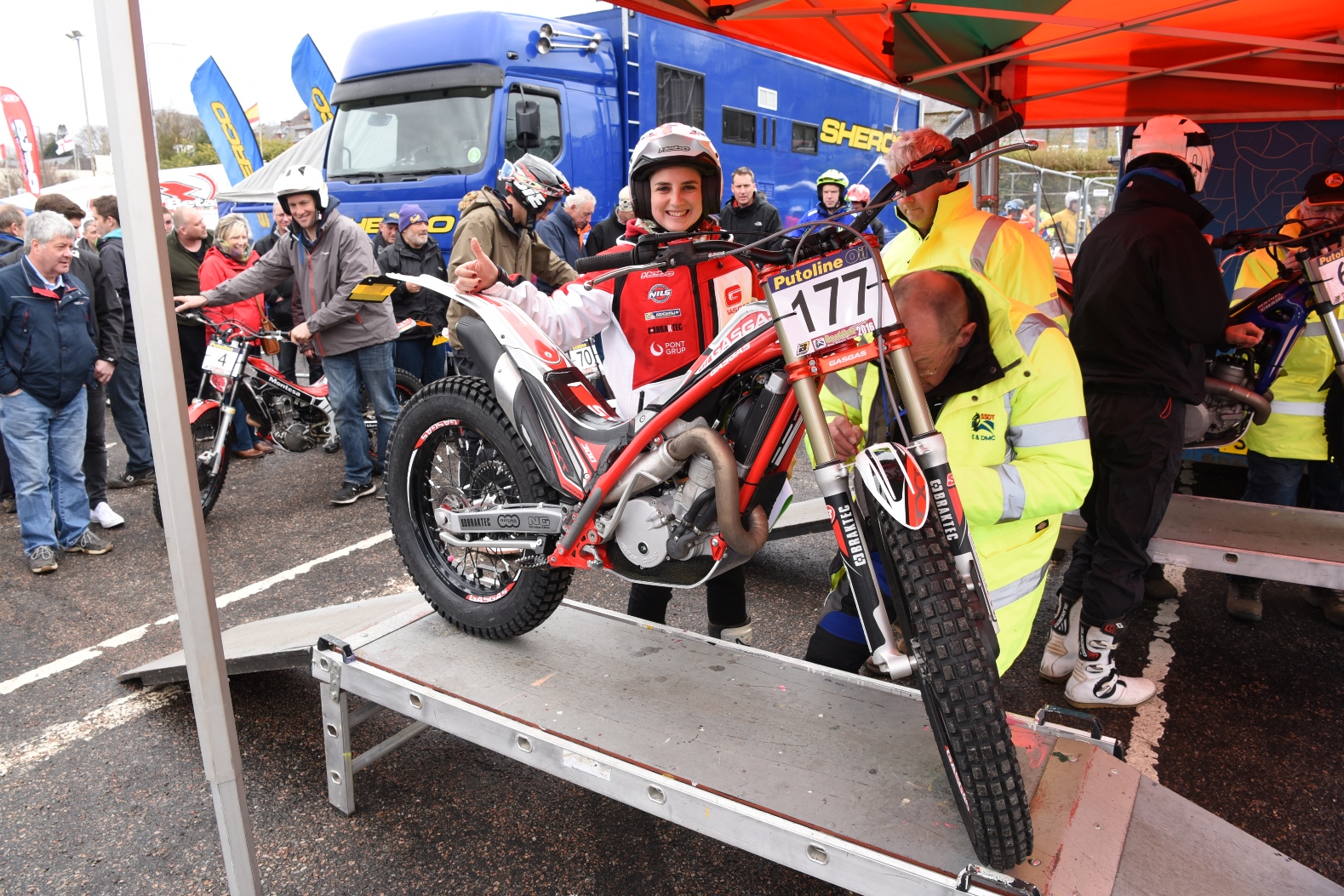
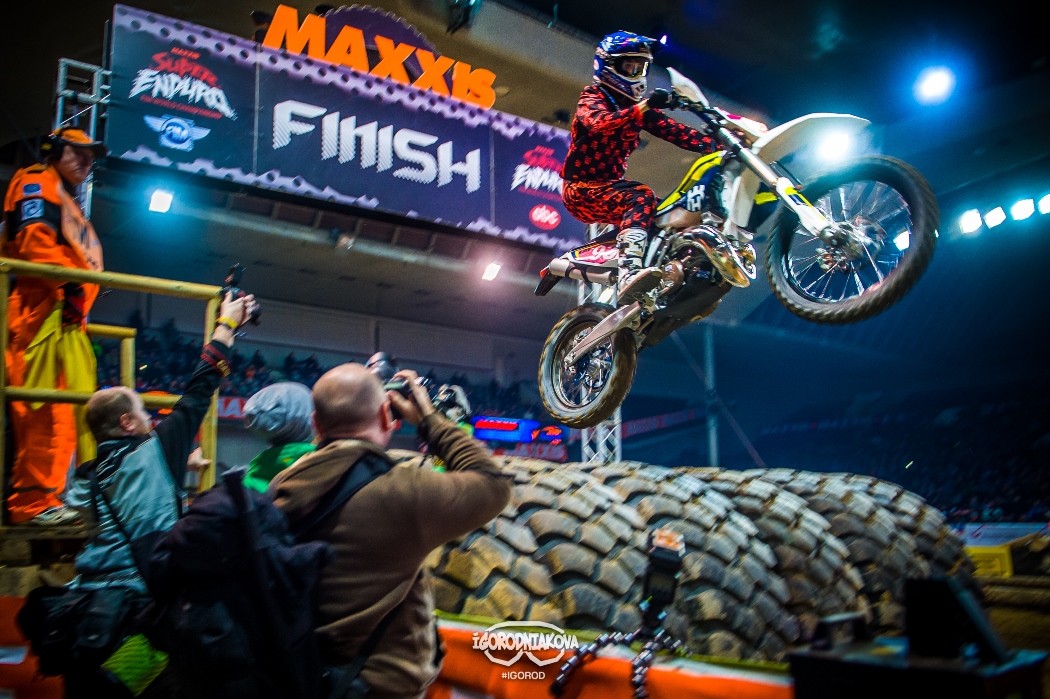
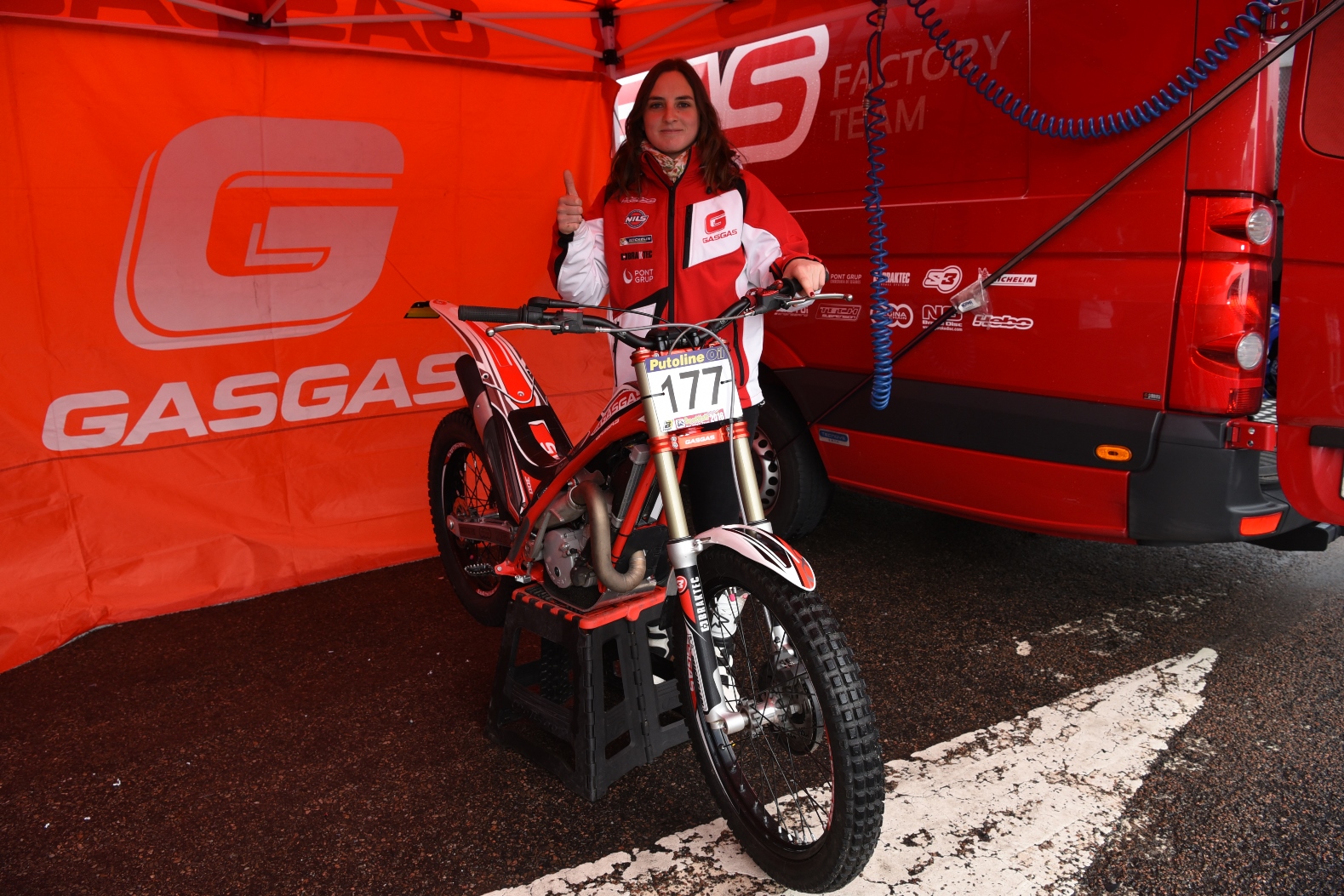
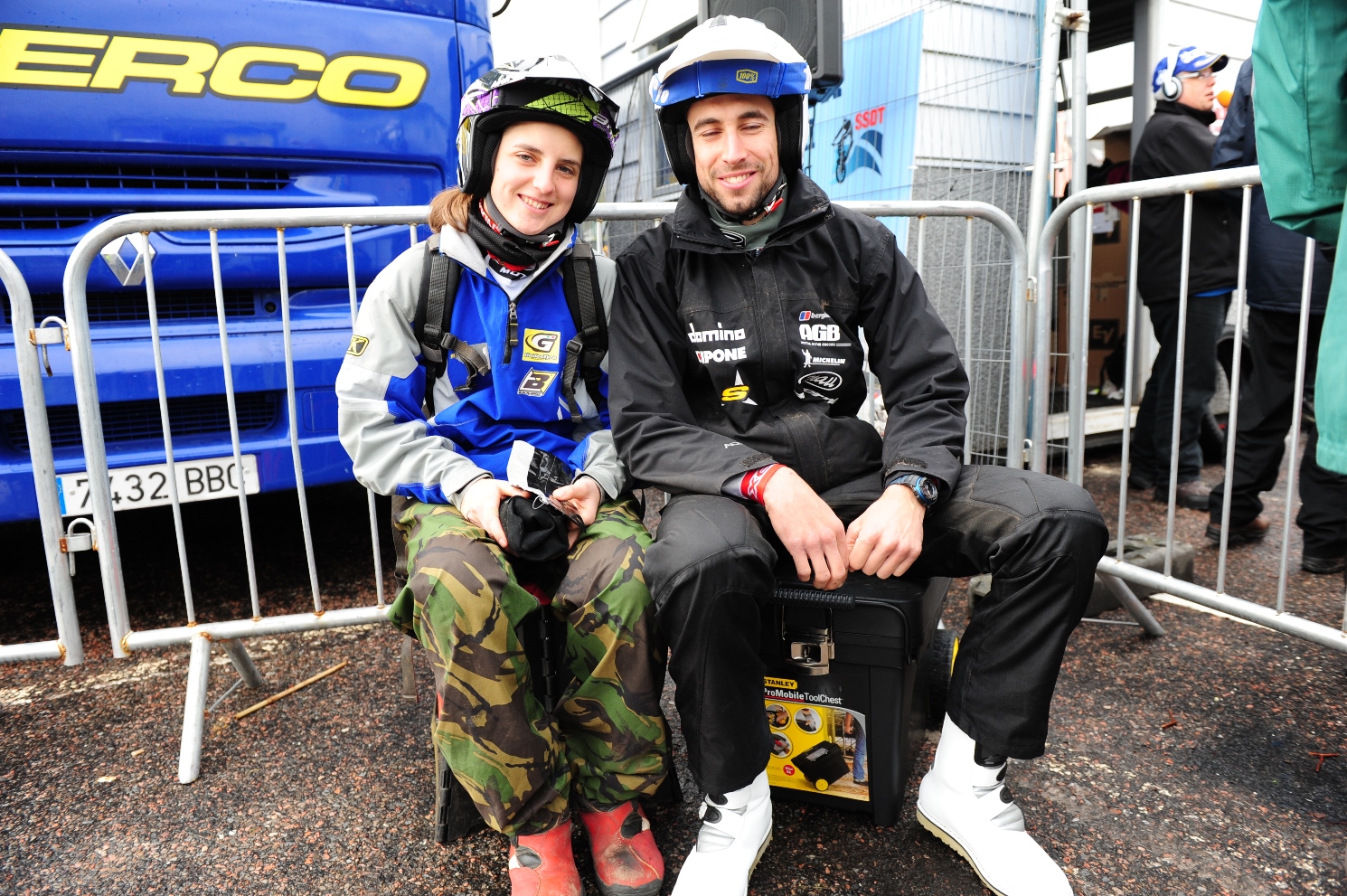
Until Spain’s off-road motorcycling world champion Laia Sanz started to draw the attention of the media, female riders in trials and enduro were not really high on the radar. We then had Great Britain’s Emma Bristow join the elite to become an off-road world champion in both trials and SuperEnduro, and global interest has since escalated with the exploits of Laia in the Paris Dakar race well documented, hitting the television screens, affording her superstar status. Step by step we have another rising star from the female quarters in Spain by the name of Sandra Gomez; is she the lady in waiting? Winning the 2016 World SuperEnduro title has certainly given her one foot in the door.
Words: John Hulme with Sandra Gomez
Pictures: Trials Media – Irina Gorodniakova
Congratulations on your first world crown!
Sandra: “Thank you, I am very happy to have in my hand one of my dreams! Last year I couldn’t give 100% because I injured my ankle in the first round in Germany but finally this year I can celebrate my title. It’s been a hard season with only one event and two races. In the first race I was leading all the way but in the last lap I crashed twice and Emma Bristow passed me. In the second race I had a crash in the first corner and I thought the title was for Emma once again, but I re-started my machine and didn’t give up, I kept pushing as hard as I could and finally I passed Emma just one lap from the end. It was a crazy race and I was under pressure; I was really tired after the first race, but now I’m very proud of the result and finally the ultimate reward for my team.”
You are from a motorcycling family?
Sandra: “Yes, and my family loves the sport. My father started with cycle trials and he came fourth in the European Championship. He started with the trials motorcycle and he won some Spanish Championship events in the C class. My uncle always rode Motocross, where sometimes my father also rode. But I think the craziest person in the family is my mother. She was a city girl, she didn’t ride motorcycles but when my brother Alfredo and I started to ride she also practised and now she can follow us at the events always riding a motorcycle, I am so proud of her.”
Your brother Alfredo was successful in trials before enduro.
Sandra: “He is an incredible rider, he won the World Cup and the Junior World Championship in trials. I think he could have been a top rider in trials but sometimes your life changes. I’m very proud of him because he started from zero in Enduro and now he’s one of the best riders in the world with support from KTM and Redbull. It’s all we dreamed of when we were children!”
How did you become involved with trials?
Sandra: “I don’t remember my first time on a motorcycle, I think I was about three years old but everybody said I liked it. My parents showed me all the sports they could and I have competed in skiing, gymnastics, mountain biking, football, basketball and trials, but I loved skiing and trials more than the others. My brother started to compete in trials and I loved what my big brother was doing so I started to compete in trials and left my first choice of skiing.”
When was your first competition?
Sandra: “I had an orange 50cc Merlin passed down from my brother. I think my first trial was in a little place close to Madrid. It had some indoor sections and some outdoor and I remember exactly one section with a lot of rocks. I didn’t like that one but I saw Alfredo ride it and it looked easy, I was about six years old.”
You first rode in the Ladies’ WTC in 2007 in the Czech Republic and finished 16th. Tell us about what you remember.
Sandra: “I was only fourteen years old but the year before I saw the girls competing in Andorra and so I asked my parents to speak with Super, who was the RFME manager of the trials team in Spain, to see if I could ride in the Ladies’ WTC. The round in the Czech Republic was on a closed private ground course which meant I did not require a driving license and so I could compete as it did not use any road work.”
Were you nervous?
Sandra: “I remember I was very nervous but I really enjoyed it. I had a machine problem before the start but the riders, minders from the RFME and Gas Gas mechanics helped me and the nerves then changed to excitement. I just missed scoring points by one mark!”
In 2008 you scored your first points in Spain.
Sandra: “Yes but it was one of the hardest years for me… I broke my knee at the start of the season and two operations were required to repair it. I couldn’t be ready for the first round in Belgium but I did two more rounds in Spain and Andorra. I was really excited after I recovered and I was able to compete again.”
By the time 2010 arrived you had moved into the top five in the WTC.
Sandra: “My training stayed the same and I moved from eighth to fifth in the World Championship. I continued training hard with my brother, competing in Spanish events in the ladies’ class, when there was one, or in the men’s classes. I always love competing against the men because the sections usually are more difficult. In 2010 I improved so much as I was travelling around Europe with the RFME team watching my brother and the other team riders. Laia Sanz was competing in the junior class and we spent some time training together in Italy where she lived, which certainly helped.”
You made your first podium visit in 2012, was it at this point you realised you wanted to push for the title?
Sandra: “Not really as I always I want to give my best in every competition. Obviously when you arrive in the top three you know you’re riding well. If you think you have arrived you will fail. You have to train even harder to achieve your goals!
If you work hard and continue pushing day by day and section by section you will know you have given your best.”
In 2013 you moved to ride the Ossa, was there a reason for this?
Sandra: “Ossa wanted a lady in the world championship and when Emma moved to Sherco I was offered the opportunity to be part of a factory team. I tested the Ossa and it was very good to ride, and so for the first time in my career I was an official ‘works’ rider.”
The Ladies’ WTC was now very competitive with Laia Sanz, Emma Bristow and Becky Cook your main rivals.
Sandra: “Laia was a very special rider but she also has a very strong mind and she beat us before the trial had started. In my opinion the level of the ladies’ world championship is changing year by year because we are all so much more competitive. Since Laia is not riding trials and moved to Enduro I think everybody is more excited because the opportunity to win is more open.”
After moving up to 3rd in 2015 you moved to Scorpa before you injured your leg and could not compete in the final rounds.
Sandra: “I was very motivated for the opening world rounds in Spain, and I was very happy how the summer training went and how the team was working but unfortunately I broke my foot. I was testing my machine on the Friday afternoon next to the paddock as always. I had a stupid crash in some rocks and the machine crushed my foot breaking two metatarsals. It was one of those moments when you feel like your dream is over.”
When did you start with SuperEnduro?
Sandra: “My brother won the 2011 Junior Trials World Championship on Montesa but at the end of the year he could not find a team to move into the ‘Pro’ class and he made the decision to move to Enduro. This was a very tough decision for the family as we were 100% trials. I continued in trials but obviously the family wasn’t as interested, but they knew I had a dream in the sport. Alfredo started competing in SuperEnduro taking in some world events and he won the Spanish Championship. He was riding very well and getting the results and Husqvarna Spain started to support him. It was a very steep learning curve but he trained all the time and never gave up. He now has a new ambition, and is very happy with his riding and enjoying life.
So it was case of following in your brother’s boots?
Sandra: “Yes he has always encouraged me and my first time in SuperEnduro was at the XGames in Barcelona. My brother received a phone call to ask if I was interested in taking part. I was but it was the same week as the Scottish Six Days Trial and so that was my choice. I did eventually compete in Barcelona and took the bronze medal. I enjoyed it so much and continued riding, going to Munich in Germany where I took bronze again before going to the USA and Los Angeles where I finished fourth.”
You have now moved to Gas Gas for the 2016 season.
Sandra: “It feels very much like I am back home again but this is the start of a new journey for Gas Gas. Everybody in the team is very motivated, focused and wants to win, but the most important part is that everybody knows we need to be a team and work hard to win. These are exciting times for Gas Gas and I am very proud to be part of the adventure.”
Before we close tell us about how you like the Scottish Six Days Trial.
Sandra: “I really love this trial. I spend six days in a motorcycling paradise riding my machine with and amongst friends. Year by year I feel much better in Fort William and how I ride my machine there. The trial is very different from the other ones but I learn so much, especially this year because I couldn’t practice much on the Gas Gas. I also love to go there because I am with my English family during the week, the Moffat Family, I feel like I am at home! Without them the week would be much harder. They are part of this event for me… My first year I enjoyed the Scottish riding with David Moffat and I remember that it was very cold weather and the sections were difficult for me. With David the most important part was to have fun and smile; that’s been my philosophy since my first year despite the tough conditions.”
The trials world in the UK were stunned on February 10th with the news of the death of Bristolian trials enthusiast Dave Norris.
Dave was the father of former Hamilton Yamaha teamster, Adam Norris who was a top UK rider in the 1990s.
In a personal tribute Trials Guru’s John Moffat said: ” I got to know Dave Norris in the 1990s as he was always around the SSDT, he chased after his rider and son Adam and we were always within speaking distance every day as Dave was a master at being in the right place at the right time, on time every time! Dave must have clocked hundreds of thousands of miles following Adam at events over the years.”
He continued: “I really got to know Dave in 2002 when I was SSDT Secretary and Adam was of course riding his umpteenth Scottish. I always enjoyed speaking with him and I just knew that he was like us all, a motorcycle sport enthusiast. He never passed me without speaking he was one of the good guys. I, along with many other friends will miss him greatly at Scottish Six Days time.”
Dave Norris’s funeral will take place on 9th March 2017 at Westerleigh Crematorium, Westerleigh Road, Bristol, BS37 8QP at 2 pm. Mourners can then attend and join the family at The Kendleshire Golf Club, Henfield Road, Near Coalpit Heath.
Our sincere condolences go to the Norris family, Delya, Lee, Jamie and Adam.
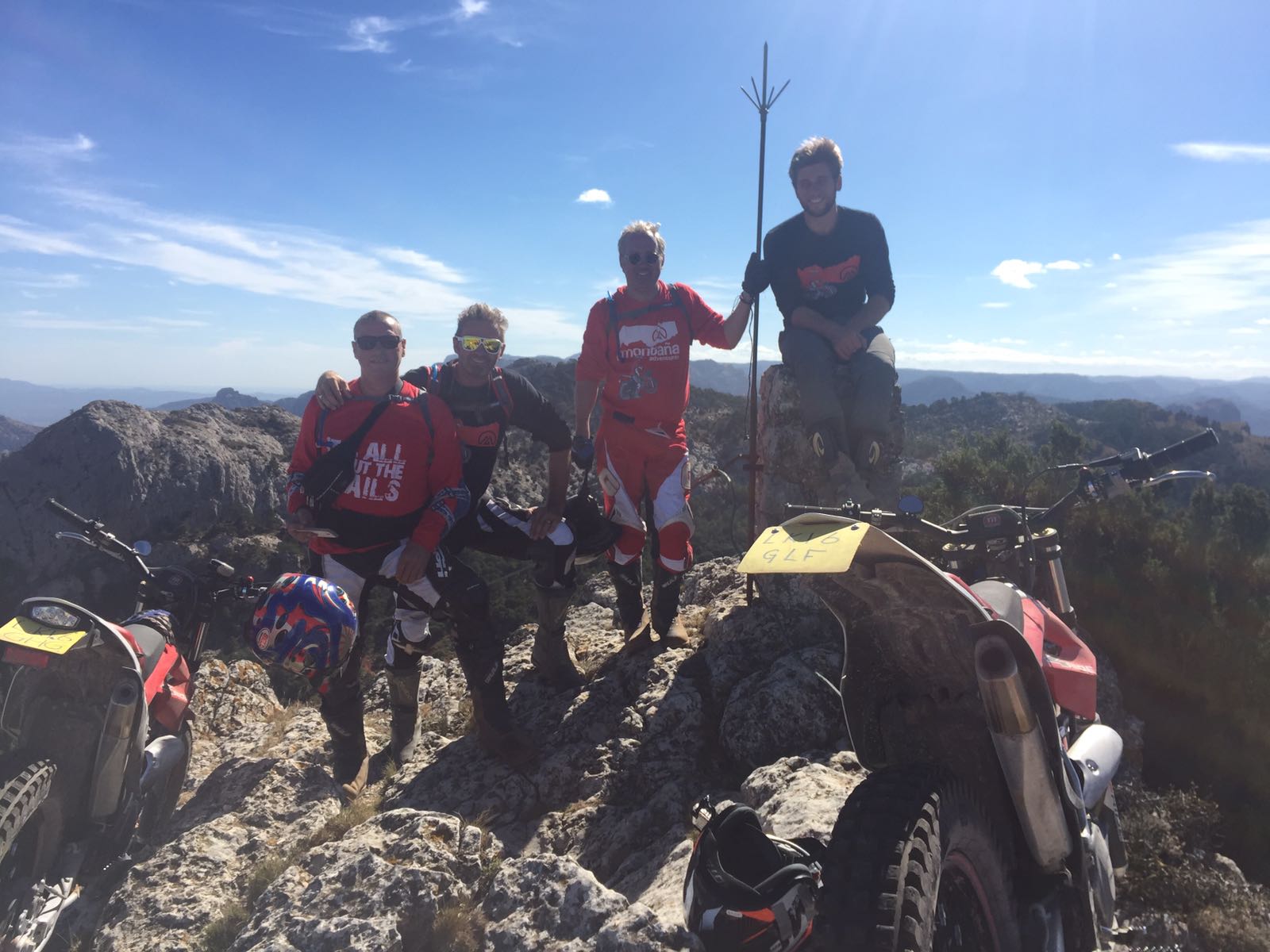
George Moore from Northampton has been a busy lad recently, setting up ‘Montana Adventures’ in Spain. Trials Guru took some time out to have a chat with him and what he was doing.
Words: George Moore & Trials Guru
George: “I have been riding motorcycles since a very young age, when my mother introduced me to off-road riding as she rode a KTM 250 and she thought that the perfect bike for me would be a BETA REV3 250 which the clutch didn’t work properly, so as you can imagine, a baptism of fire.
I aspired to steal the KTM off her and when I could, I left trials behind and started enduro and when I was old enough, trail riding, this was my love of an ‘adventure’.
My enduro bike got stolen some years later and with running my own business and thinking I could not risk getting injured, I decided to take up trials again and got hooked. But for me it was still all about the adventures, my favourite events were road trials because of the between section riding. I have never been a good trials rider but always been brave and up for a challenge and within the first year of riding trials again I have entered the Scottish Six Days, I will ride a Montesa 4-Ride.
I have ridden and owned every modern trials bike and there are many that I truly love to ride the bike that I have always come back to is the montesa because it allows me to have the most fun for the least amount of hassle in the trials that I really enjoy.”
George in England :
“I have started and built up a successful tree surgery business over the last 10 years which I thoroughly enjoyed in which we built many custom made machines which I have loved as I am fascinated with how things work and am of the opinion that you can build most things with a welder and a good brain, not that I have a good brain when it comes to welding but I am very good at seeing the project in my head and getting the right people involved to make it all happen.”
George in Spain:
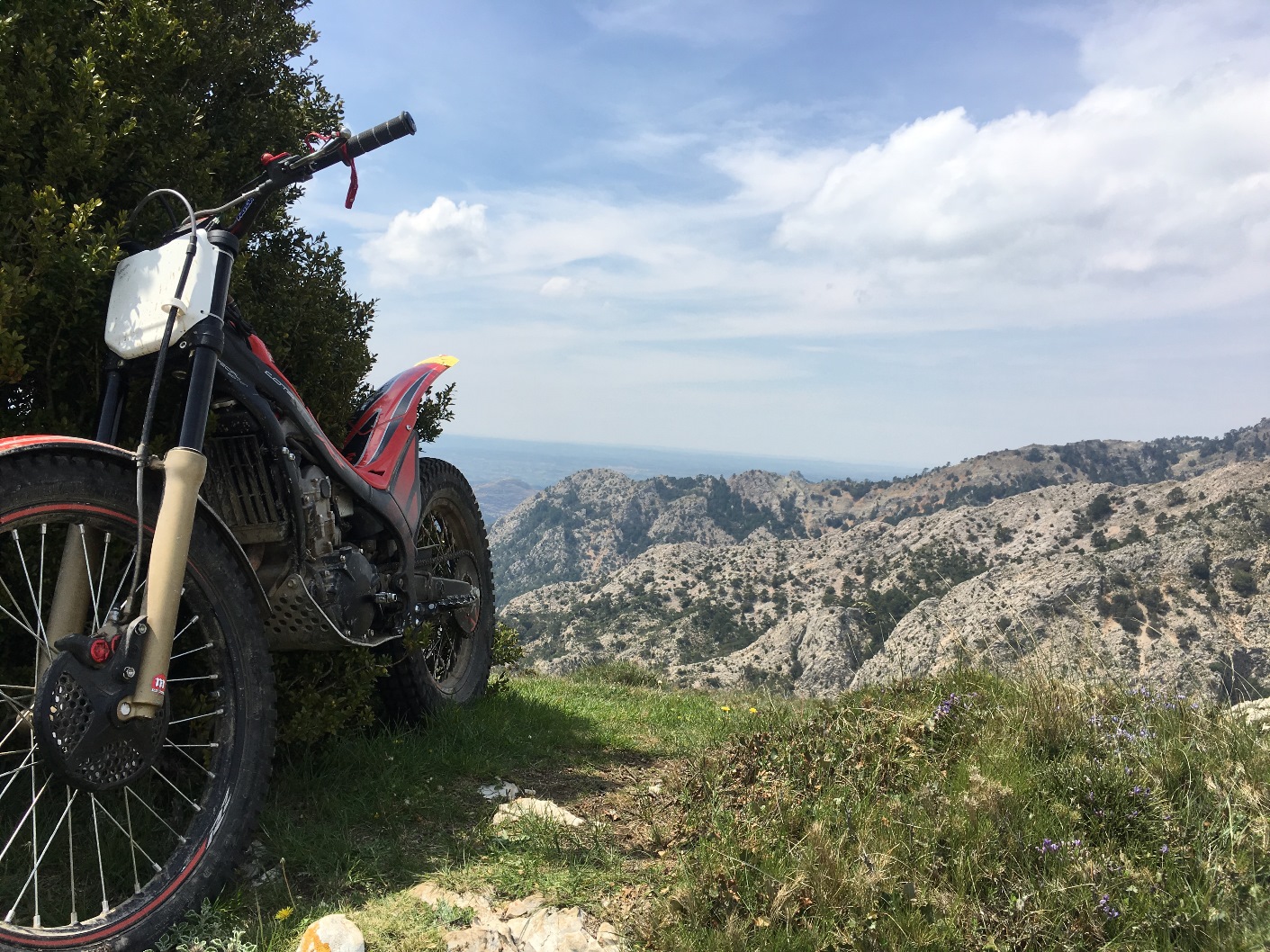
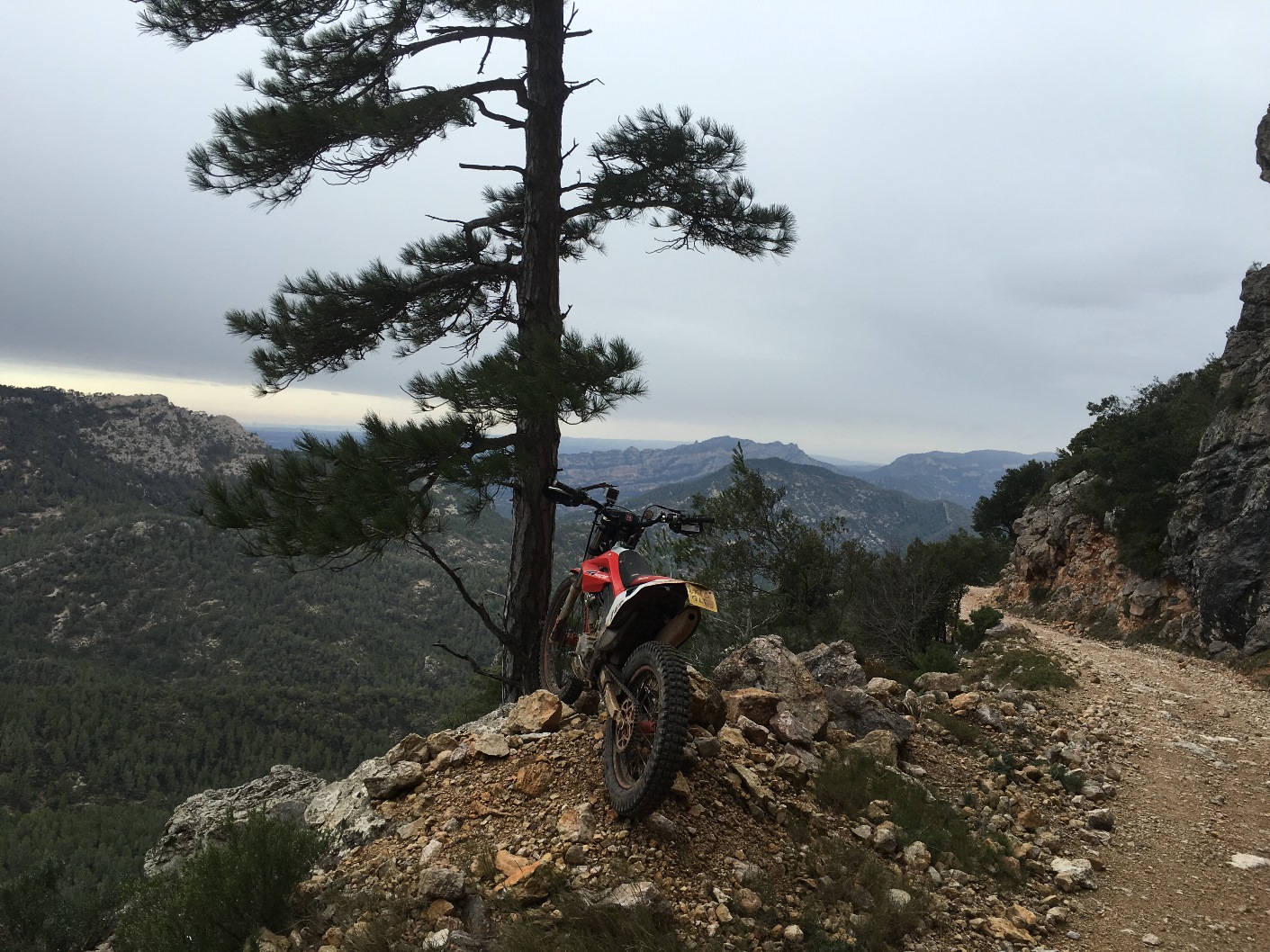
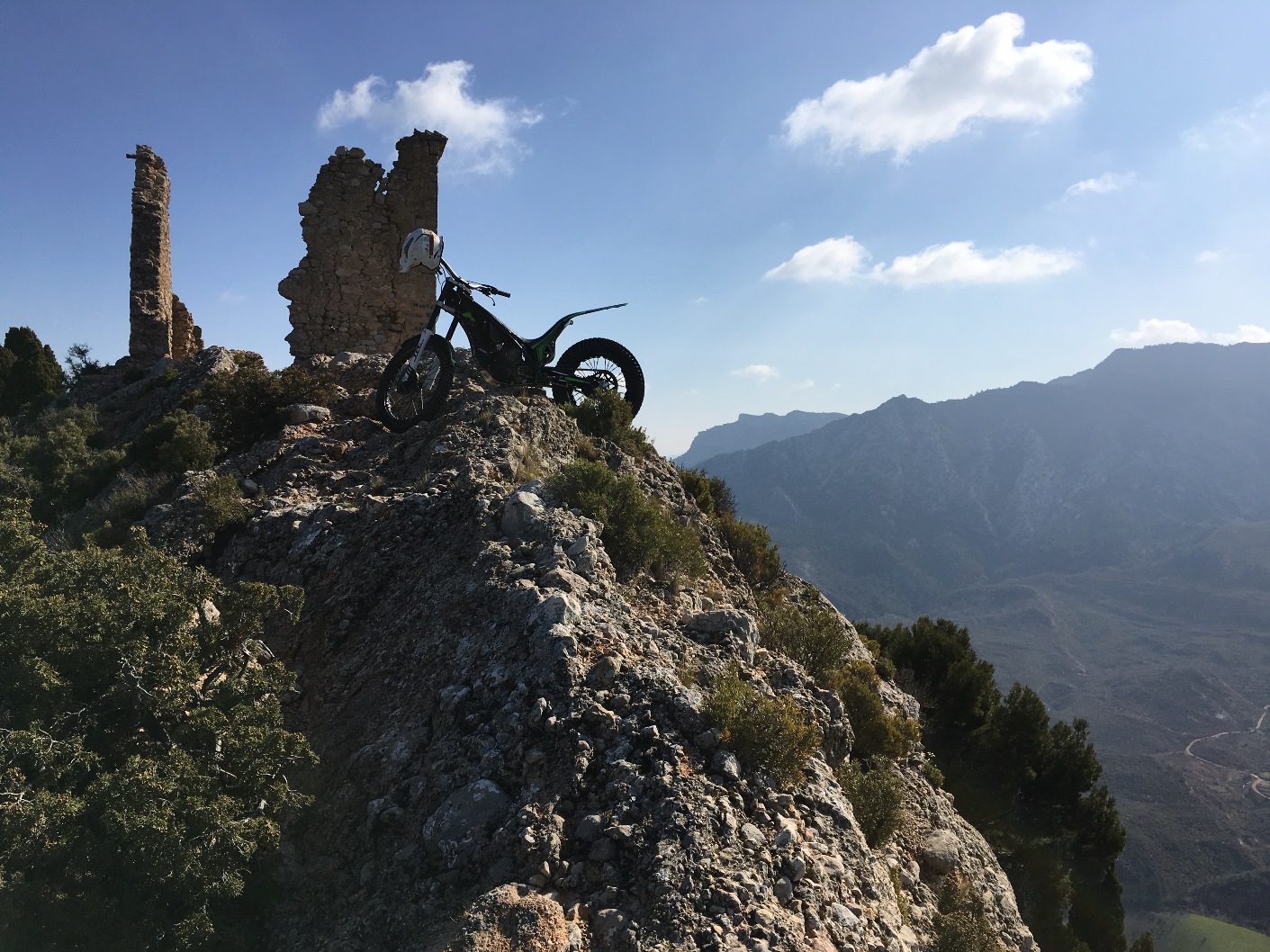
“I came to Spain at Christmas time in 2015 to go on an enduro riding trip with a company very close to where I am operating my own business now and was a little disappointed in the level of riding, it was too easy, and how it lacked many things that I think are necessary in a holiday. When in Spain I met my now girlfriend Raquel and this prompted many more visits to spain and to this magical area, one of my journeys to see her I decided to drive and bring my trials bike. With my bike being in Spain I decided to do some map reading and some exploring and see if I could find the trails I had been craving when I had come out at Christmas and would you believe it they were everywhere.
This got me thinking, things were going well with Raquel and if this other guy can do a bad holiday then why can’t I do a good one.
So I carried on exploring some routes and finding great resteraunts for lunch and finding great accommodation and basically putting the frame work of the business in place.
And then to the bikes and the equipment well it could only really be the brand new Montesa 4 Ride, it was as if the planets had aligned the perfect tool for the job. John Lee Motorcycles sorted me out with all of the riding kit and spares I was ever going to need.
I had already built a business from the ground up before, which is hard so was determined that with this one I was not going to have any customers until it was 100% prepared.
I bought my bikes, a van for collecting customers from the airport and all parts and kit I was ever going to need and set off for Spain.
I started putting some videos and photos of my route finding on ‘facebook’ and within a day or so I had a chance message from someone I had never come across saying he wanted to come with three friends in September, this was ‘D-day’ which was brilliant, I had a target.
The four English guys lived on Ibiza and also do a trip of this sort each year so I was apprehensive as to how my tour would live up to home but they couldn’t have been happier and immediately booked up for the following year at the end of the tour they described as being the same as home but better because the landscape is bigger and the wine is better. I was at this point I was quite sure that I was doing the right thing in life.
I decided I had had enough of England apart from my favourite trials, I put my business up for sale and moved out with Raquel.”
Montana Adventures:
“I decided when I had moved to spain that I wanted to buy some land and use it as a trials practice ground partly for my business and partly as a free and legal practice ground for brits practicing in the winter, I wanted to help trial sport as a whole but also bring some more people to my tiny village that I know call home.
I now do free trials practice lessons for the children in the village with two Osets I bought from John Lee Motorcycles.
And using this new goodwill from the locals I plan to run a three-day trial in this area in 2018 to bring even more people to this little village.
So far we have some professional German riders coming to practice, ‘Hippel Racing’ who fitted right in and had a lot of fun.”
George explains ‘Montana Adventures’ mission:
“It’s quite simple, to provide a top quality holiday.
It does not matter if you have never ridden offroad or ride the Six Days, I have stunning trails for you. This is not only for trials riders it is for motorcyclists who want to have a holiday on a bike in a beautiful place without being scared by an enduro bike or put off by not wanting to share a room with Fred or not wanting to be at the back of a ten man group.
We only provide small number tours with a max of six riders and we provide all your meals and take you to superb restaurants to eat good food.
We provide beautiful traditional accommodation with everyone having their own room.
We also provide the best bikes around, which unlike enduro bikes are suitable for absolute begginers to ride. We also provide all riding kit and safety kit as required and cover accidental damage with no charge. We collect and drop off to the airport.
The only thing you need to do is get to spain and bring some money for your beers!
I am based in the area known as Mataranna on the border of Aragon and Catalonia which is known for its beauty. The best airport is Barcelona.”
To find out more about Montana Adventures – click HERE
Article copyright: George Moore (Montana Adventures) & Trials Guru – 2017
All photos: Copyright and Courtesy of George Moore (Montana Adventures) – 2017
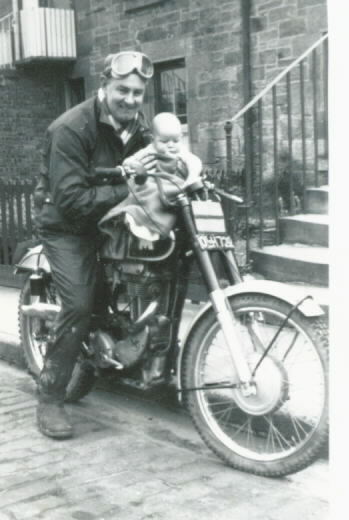
Long connections with the sport of trials – T. Arnott Moffat with John Moffat in early 1958 with Moffat’s ex-factory 350 Matchless (OLH722) in Edinburgh. Machines were ridden to events, competed with and ridden home again – Photo: Moffat Family Archive
When motorcycle enthusiasts, Peter Remington, John Holmes and John Moffat got together one sunny afternoon, the talk was predominately about one subject – motorcycling.
Former Trials and motocross competitor, Peter Remington from Kendal has for many years been the prime-mover of the annual Bob MacGregor road run at Killin, Perthshire in the April, just prior to the SSDT week.
He suggested to Moffat that it would be something different to have a road run up near Inverness to coincide with the now popular Highland Classic Two Day Trial (June 10/11). Remington made the suggestion that it be named after Moffat’s father who had been thirty-two years secretary of the Scottish ACU and was a keen motorcycle trials rider in his youth.
A suggested route would be Loch Ness based and initial soundings were taken from some local enthusiasts and the reports were favourable. There is an established annual Loch Ness run and checking the calendar it was feasible to run such an event the day after. This would allow some riders to make a two day affair out of the two independent events, one on the Sunday and the other on the Monday.
By a strange piece of good luck, Mairi Grant from Rogart discovered a copy of the 1957 Highland Two Day Trial programme and inside was the actual routes used sixty years ago.
And so the plans became a reality, with a permit approved by the Scottish ACU and the title: “Arnott Moffat Memorial Highland Road Run” was created.
The route will attempt to retrace as much of the 1957 Highland Trial as possible with a fuel and lunch stop on the way. The final route has yet to be confirmed, but entry forms are available and the cost is a modest £12. A donation will be made to the local Highland Classic Motor Cycle Club for their support of this event. All machines must be road registered and insured, with the preference being pre 1975 machinery, but all road-legal solo motorcycles are welcome. The only qualification being that you must be a ‘motorcycle enthusiast’.
Entry forms for the ‘Arnott Moffat’ on Monday, June 12th 2017 are available by contacting the event secretary, John Moffat by e-mail: highlandclassic@outlook.com
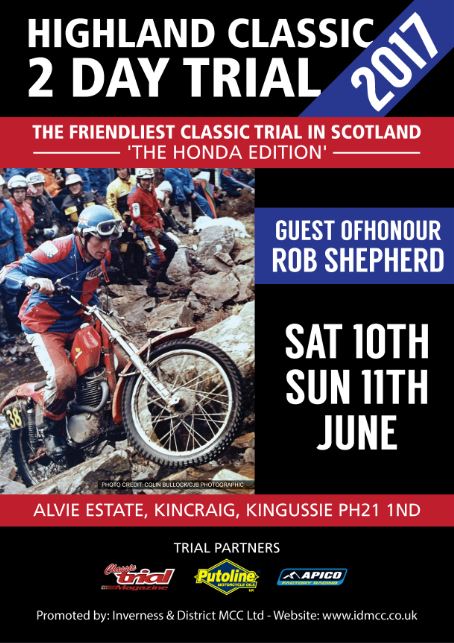
The Twelfth annual Highland Classic Two Day Trial is becoming a very popular event, with the maximum entry being surpassed in less than 48 hours of it’s opening just after midnight on Wednesday, 1st February.
The go-ahead organising committee of the Inverness & District club were surprised at the take-up of entries of which they changed the format after protestations last year that it favoured previous years riders.
Club and company secretary, John Moffat said: “In 2016 we were accused of nepotism where we sent out paper-based entries to every rider who competed in the 2015 event and the Royal Mail were very quick at their delivery for some reason. The official entries opened a day later although this wasn’t the overall intention. Quite a few prospective competitors felt that this was unfair. However, I’d like to point out that quite a few regular riders have supported our event since it’s inception in 2005 when it went from a one-day trial to a two-day affair.”
Moffat continued: ” We are quite overwhelmed at the response this year as we were full by the Thursday evening. We made a conscious decision to reserve some of our entry for special ‘Guest’ riders which has been kept to a minimum and are over and above the 150 rider maximum. These riders were chosen for their contribution they have made to our sport of off-road motorcycling or were nominated by our ‘Trial Partners’ – that is Apico Factory Racing; Putoline Oils UK and Classic Trial Magazine who have been very generous in their support of the 2017 event. As a contingency, we have a 15 place reserve list in opertion, just in case any competitor pulls out, pre-event”.
The ‘brainchild’ of Inverness Chairman, Malcolm Smith who thought up the original idea of the event which takes place on 10/11 June on the shooting estate, Alvie, near Aviemore which is run by the enthusiastic Laird, Jamie Williamson and managed by Estate Factor, David Kinnear.
This year the theme is ‘The Honda Edition’ and the Guest of Honour is 1977 British Trials Champion and Honda factory rider, Rob Shepherd. A special award will be made to the rider making the best performance on a Honda who has not won any other award. there is also a Best Female Rider award.
Shepherd will ride a specially prepared Honda TLR250, but it is very likely that his ex-works TL305 will be there and it is hoped that Rob will demonstrate ride it during the end of one of the days.
Jean Caillou from France will be there, having entered on the ex-Marland Whaley factory Honda.
The ‘Guest’ riders announced so far are: Rob Shepherd – Honda (Guest of Honour); Yrjo Vesterinen – BSA (3 times FIM World Trials Champion); Vic Allan – MV Agusta (1974 – British 250cc and 500cc Motocross Champion); Chris Milner – Triumph (former Comerford Bultaco rider); John Hayden – Yamaha (Putoline Oils UK); Nick Shield – Yamaha Majesty (Classic Trial Magazine tester). It is still a possibility that Nick Jefferies – Honda may appear if TT committments allow.
Other notable successful entrants are former TT winner, Iain Duffus (Fantic) and Yamaha Motor Company’s Rob McElnea.
The event is billed as the ‘Friendliest Classic Trial in Scotland’ and that is helped by a relaxed atmosphere, a great place to ride off-road, sensible flowing sections, a ‘Specials’ category in case some machines don’t fully comply with class boundaries, cheese and wine at the end of Day One and for this some sections lost to the event a few years ago which are very traditional to Scotland.
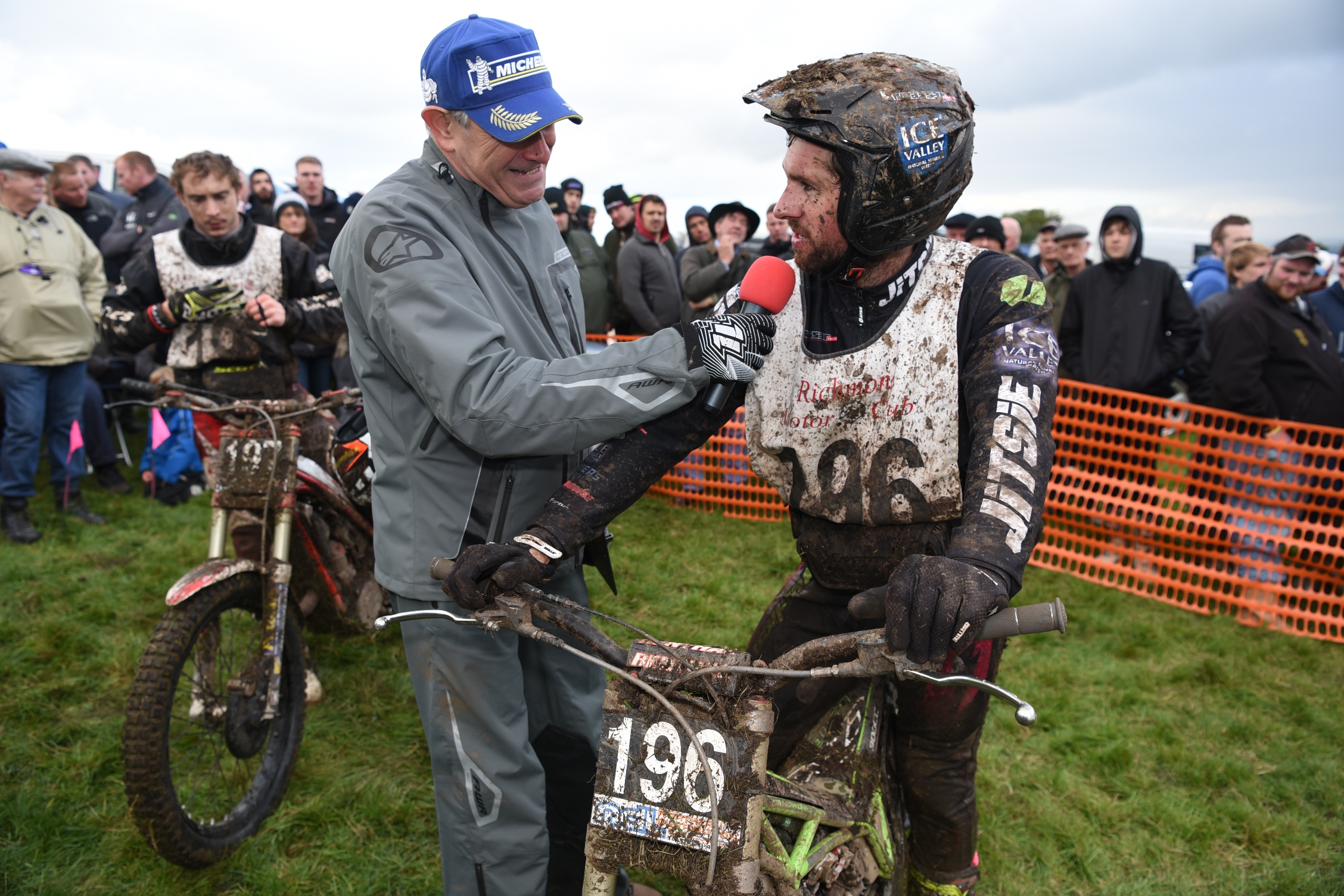
Trials Guru’s John Moffat interviews Scott Trial 2016 winner, James Dabill at the finish. Dabill values a win at both the SSDT and the Scott highly – Photo – John Hulme/Trial Magazine
The trials world was shocked with the announcement by the reigning and seven times British Trials Champion, James Dabill that he has withdrawn his entry from the 2017 Scottish Six Days Trial in May.
Dabill broke the news via his own social media account today, 1st February. He recently changed camps from Vertigo to Gas Gas and is contracted to compete in the Spanish National Trials Championship plus the World series.
James broke the news as follows: “So this was a very long and tough decision of mine and after speaking with some of my close friends, family and Team Manager, I have decided to withdraw from taking part in this years’ SSDT. It was not an easy decision as it’s one of my favourite events but I feel it’s the best way for me to really concentrate on having a good year at world championship. With the first TrialGP being only a week after the SSDT, I don’t want to lose precious time training and preparing myself and my bike at the highest level possible. I would like to thank everybody who respects my decision and I will see you up in Fort William for the first weekend and I would like to take this opportunity to wish all competitors a great and enjoyable week, Cheers Dibs”.
Dabill’s announcement once again brings into question the tactics of the manufacturers who were always keen to win the prestigeous Scottish Six Days Trial, seen by many to have an impact on sales, in the UK at least, of trials machines. However, the World Championship does carry an equally prestigeous tag, that of World Champion.
James Dabill does value highly a win at the SSDT, he has achieved this twice in his career, 2007 and 2011, so this was clearly not a decision he wanted to have to take. However, he is a professional rider and his job is to satify his contractual obligations first and foremost.
Trials Guru’s John Moffat commented: “This must have been a very tough decision for James to take. I have interviewed him up at Fort William on the local Nevis Radio and been on stage at the presentation of awards when he picked up his wins in 2007 and 2011. He is always quite relaxed in the mornings before the off and really enjoys riding the SSDT. While it’s a great shame for SSDT fans that James will not be riding in 2017, but we wish him well in his World series, TrialGP endeavours and hope that he will return to ride the SSDT in the very near future.”
James Dabill (Vertigo) – FIM TRIAL 2016 Cal Rosal, Spain – Photo: Mario Candellone
The Premier Trial Website – Recording the History of the Sport 'Established 2014'

 Mark Trueman photo
















 TRIALS GURU - DEDICATED TO TRIAL