Ted Heather was, I think, one of the quiet ones with his own brand of humour. When he was Clerk of the Course for the West Wilts Motor Club’s famous, or was it the infamous, Tanner Trudge Time & Observation Trial he would sometimes ring me up pretending to be perhaps Sammy Miller or another well known rider. I would usually be certain it wasn’t who Ted said it was and would be racking my brains to work out who it was on the phone, stalling for time so I could decide who it actually was on the line!
Ted was very independent and didn’t find it easy to ask for help marking out, and you had to twist his arm to get him to agree that you could come out & help him setting up before the day. Then he would say at Club Meetings that he didn’t get much help! He was quietly very proud of the many Trudges when he was Clerk of Course. I think it was 19 or 24 and it was only years later, after the Club had stopped running the Trudge because of dwindling entries that I realised Ted had wanted to make that milestone. Ted said nothing when we decided to stop running.
Ted drifted away from the Club after that, but kept involved every year in the SSDT where he would be in the parc ferme and would be out at ungodly hours putting up Route Markers. I guess those early mornings were no trouble to Ted after the many years of early starts that he had as Postman working out of Corsham. I recall him saying to me, with a chuckle, that David Hempleman-Adams, the explorer had given him a sponsored anorak which David had used on an expedition!
Ted was a keen gardener, and his own immaculate garden impressed sufficient people to ask him to look after theirs that he had more than he could really cope with. He did a lot of walking after he ‘retired’ and with the new hip that he had late last year he was planning a walking holiday in September when he would have turned 80. He liked dogs and had a succession of large dogs although I don’t think he had another after his dog, Sam, died.
Ted played his part in the Wessex Centre too, he had been President & had been awarded the Harry Croft Trophy, he had been a Centre Steward spanning the times before the days when Stewards didn’t need licences and when they did!
It’s rumoured Ted ‘helped’ riders who wanted to enter the SSDT by ‘putting in a word to the Committee’. It was rumoured that Ted paid the SSDT Entry Fee for one of the Centre’s best riders every year. Ted would just smile and be non committal if I gently tried to persuade him to let on. We know Ted was actually hurt that one or two of those he did help never actually thanked him for his intervention. The last time we saw Ted was at the in the Fort William parc ferme last year.
Ted leaves behind his widow, Rachel, they had no children.
Rachel was very involved with the Wiltshire St Johns Ambulance Service, joining in 1955 and has been the Divisional Superintendent for the Chippenham District.
I remember Ted telling me, with another little smile, that he had conducted Rachel’s driving test when they were in the RAF in Germany. She passed!
My wife Phyllis was Secretary of the Meeting for the Tanner Trudge while Ted was Clerk of Course for quite a number of years, and they always exchanged Christmas cards. Last year Phyllis’s said we weren’t going to Scotland this year, and Ted’s said he had a new hip.
We heard on Monday that Ted had passed away late last week from Wessex Centre Secretary, Theresa Talbot, who had been told while at Sundays Vic Brittain Trial.
It was maybe 20 years ago that Ted had had an intestinal cancer which he completely recovered from. Some time after his hip operation.Ted had a DVT and a fall., He was readmitted & had another fall. A scan showed that he had a left lung shadow & a brain tumour, and he rapidly deteriorated.
Our thoughts are with Rachel. Ted, RIP – you will be remembered.
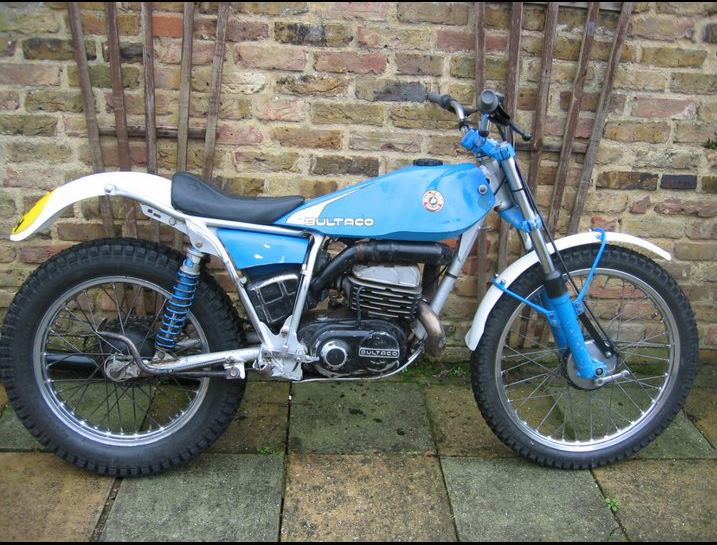
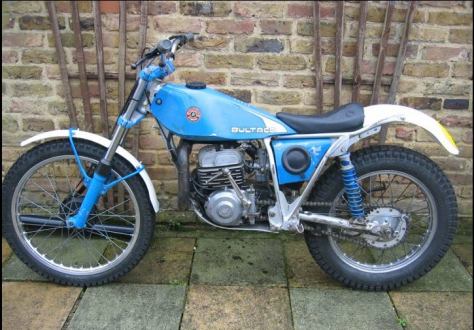
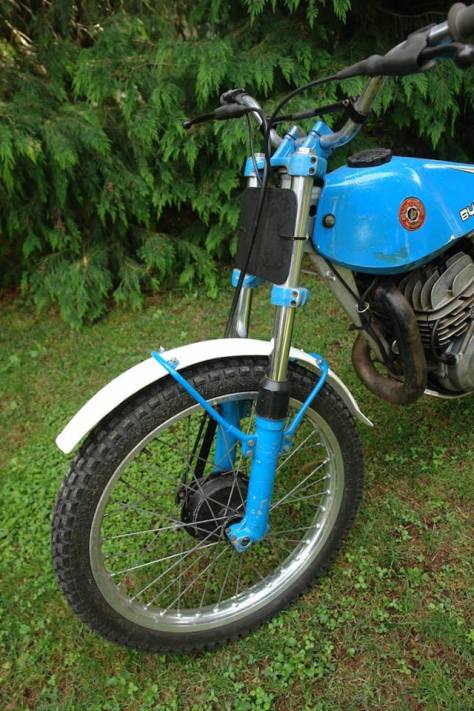
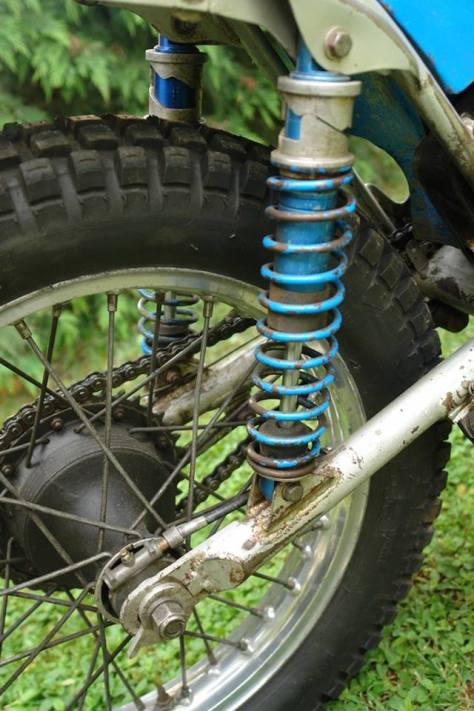
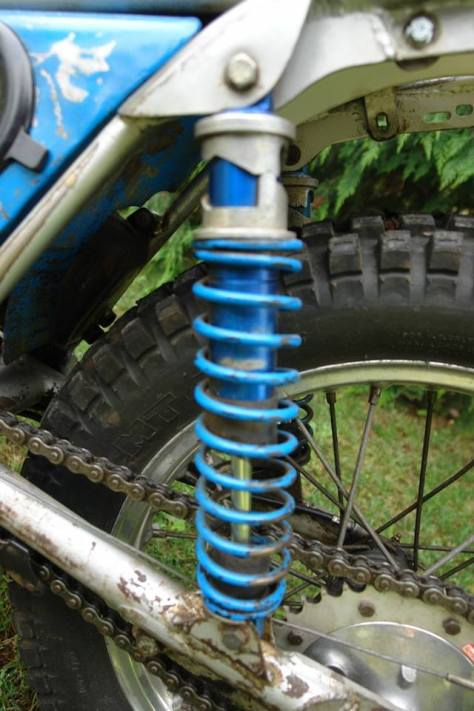
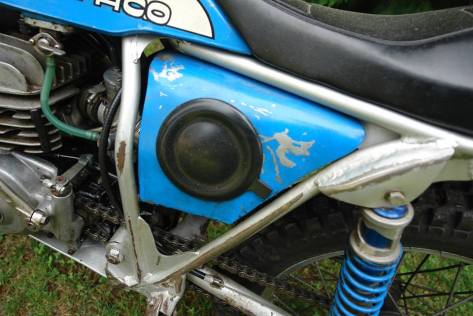
In an attempt to keep at the cutting edge of the sport but with a factory in serious financial trouble, Yorkshireman John Reynolds rode a special Comerfords Bultaco 340 in 1983 which had been built by Reg May on a freelance basis. It had some innovative features. Reg had managed to move the swinging arm pivot very close to the final drive sprocket. This was achieved by mounting the swinging arm pivots on two independent mounting ‘bobbins’ mounted on the frame. The swinging arm spindle was effectively dispensed with as was the rear engine mount assembly.
A special snakey exhaust system was used with the back box lowered to the footrest area on the off-side of the machine using modified Bultaco components. The swinging arm was a modified Bultaco Pursang item on the final version.
Enthusiast and journalist, Stefano Bianchi from Milan had the opportunity to buy this very special machine and has allowed Trials Guru to feature some photographs taken by Stefano.
…
…
…
…
…
…
…
…
…
…
…
…
…
…
…
With special thanks to Stefano Bianchi for allowing Trials Guru to feature this very unique Bultaco 340.
…
The Premier Trial Sport Website for photos, articles, news and the history of motorcycle trials
Gordon L. Jackson waits for the call to fire up 187BLF at the parade during the Centenary celebrations for the Scottish Six Days in 2011 – Photo: Tommy Sandham, Magor
Be sure to look in on our special section dedicated to the AJS & Matchless single cylinder trials machines of yesteryear, with four separate articles on the marque.
Trials Guru’s John Moffat has had a soft spot for AMC single cylinder trials motorcycles from an early age. Seen here in 1999 riding his 1959 Matchless G3C at the Pre’65 Scottish Trial on Loch Eild Burn – Photo: Iain Lawrie, Kinlochleven
Two great motorcycling enthusiasts from the North West, Peter Remington (left) and John Holmes
The enthusiastic Westmorland MCC headed up by super enthusiast Peter Remington have plans well advanced for the annual Bob MacGregor Memorial Road Run 2017, which takes place on Tuesday 25th April.
Again starting and finishing in MacGregor’s home town of Killin, Perthshire, the route takes in many of the old SSDT section locations from the 1960s and even earlier.
The route is around 180 road miles on a variety of A and B class rural roads and is still attracting some genuine trials machines of yesteryear.
The Guest of Honour this year is ever-green John Holmes a well known Cumbrian character who loves this run and the enjoyment it brings, especially if the weather is kind!
The start and finish is at the McLaren Hall, Main Street, Killin FK21 8UH and is open to Pre-1975 motorcycles (preferred). It is a circular route: Killin – Aberfeldy – Loch Rannoch area – Killin.
The first machines leave the start at 10.00 am and then groups of 5-10 leave at minute intervals. There is a lunch break on route.
Entries are to Peter Remington, Kenrig, Levens, Kendal, LA8 8DT or e-mail him on premington2@gmail.com
1969 – SSDT – ‘Edramucky’, a section that the road run usually passes. Rob Edwards negotiates the hazard on his Cotton Minarelli – Photo: Rob Edward Private Collection
Words: Trials Guru; Rob Farnham (Oz); Mick Andrews; Martyn Adams.
Additional comments by: Don Morley, Reigate, Surrey.
Photos: Rob Farnham; Rob Edwards’ personal collection; OffRoad Archive; Mike Rapley; Don Morley; James Holland, Bristol; Martyn Adams.
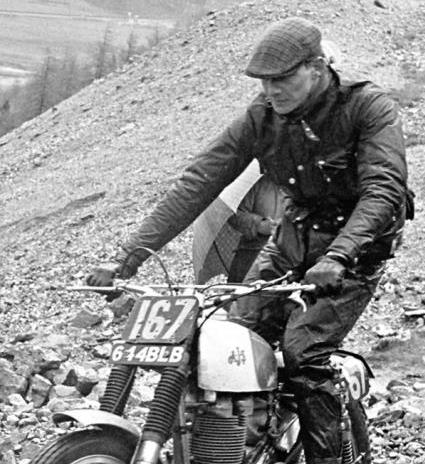
Mick Andrews on 644BLB at the Bemrose Trial
What is 644BLB?
It was the registration number allocated in January 1961 to a 350 Matchless, which was used exclusively as an AJS and owned by the Associated Motor Cycles Ltd competition Department at Plumstead, South East London.
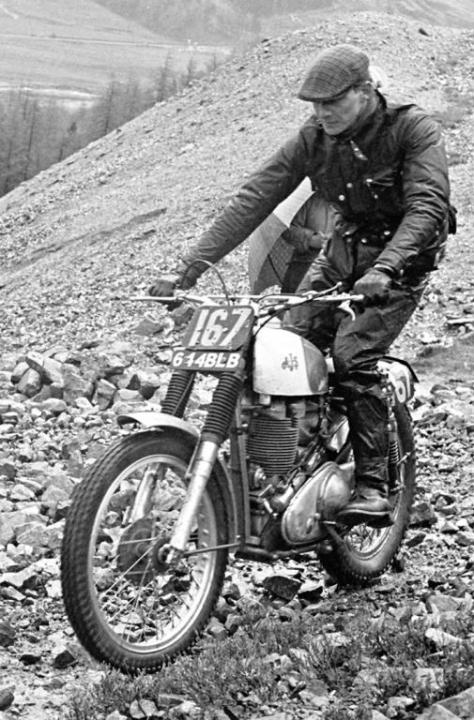
The 1961 AJS registered as 644BLB was at heart a Matchless used under the AJS name by Cliff Clayton and Mick Andrews 1961-1964 – Photo: Rob Farnham, Queensland
The motorcycle was to be used by factory supported riders and we know that AJS factory rider, Cliff Clayton used it in the 1961 Scottish Six Days Trial. Clayton was a member of the Barham MCC, and lived at Gillingham in Kent.
644BLB however, was to become better known in the trials world as Mick Andrews’ factory AJS, as he competed on it from 1962-1964 when factory supported. It was a machine that took Andrews on two consecutive occasions to the runner-up position in the Scottish Six Days Trial (winners Arthur Lampkin – BSA C15 – 1963 & Sammy Miller – Ariel – 1964).
Don Morley, the well-known photo journalist spent a great deal of time researching the works trials AMC machines when he was preparing his book, Classic British Trials Bikes which was published by Osprey. Don had photographed many, if not all, the factory models over the years.
Morley told Trials Guru when discussing some articles, that some AMC trials machines were registered as one marque but actually used as the badge engineered stablemate. 644BLB was one such machine, an AJS in use, but registered as a Matchless. The same method was employed for the machine registered 164BLL, issued to Gordon McLaughlan. There has never been a definitive reason for this other than perhaps the AJS 16C was a slightly more expensive model than the corresponding Matchless variant G3C and as the factories had to pay the then ‘Purchase Tax’ on a registered machine, perhaps they saw this as a way of saving some money?
Don told Trials Guru: “I should really have paid more attention to the finer details of the works bikes when I had the chance back in the days when they were used week in, week out by the factory supported riders. I have questioned many of the stars of yesteryear about the finer points of the machines they rode some time later, to find that most hardly touched the machines as they usually were repaired, modified and serviced by the relevant competition departments. No disrespect intended, but I take most of the so-called modifications by riders with a pinch of salt.“
Where is 644BLB?
Our article begins with a message sent through social media to Rob Edwards, the former factory Cotton, Montesa and, at one time, AJS teamster. Rob had ridden a factory supported but privately bought AJS in the 1964 and 1965 SSDT, it was registered ‘970PL’ and had bought it from Comerfords in 1963.
The enquiry came to Rob Edwards facebook page in December 2016 from Rob Farnham from Queensland, Australia (who we will refer to as ‘Oz’, his shortened internet name, for the rest of the story) who had seen Rob’s story on Trials Guru and a reference to his promotional trip with his employers, Montesa Motorcycles ‘down under’ in 1975. A photo was within Rob’s story sitting on a 350 AJS which Noel Shipp of Wollongong owned at the time and was reputedly Mick Andrews’ AJS factory machine.
Oz picks up the story: “I purchased the bike from Noel Shipp in December 2008, as being a bit of and AMC competition bike nut, it was an opportunity too good to miss. Sadly Noel was unwell then and died in the September of 2012.
Noel had shipped 644BLB out from the UK in 1970. I have a note of who he purchased it from, but he was actually after another trials machine, a Triumph I think, but took the AJS as his second choice.
Obvious changes have been made between 1964 and 1970, mainly the bottom frame rails and footrest hangers.”
The lower frame rials have been removed by a previous owner and replaced by strip aluminium, this was not a factory modification – Photo: Rob Farnham
Oz: “I have done very little to it as I have too many projects but was only spurred into motion following a request from John Cuff, a member of the bike club I’m a member of, the Historical Motorcycle Club of Queensland as he needed some bikes for club magazine articles for 2017. He had seen my Matchless G80CS but knew nothing of the 350 AJS, 644BLB. His main interest is trials and competition machines so he was very excited when he saw it.
Most of my previous research had drawn a blank so was quite excited myself on Rob Edwards response to my post on his facebook page.”
Oz had been doing a lot of digging in an attempt to catalogue the machine’s history, but over the years details of ownership had been lost and of course never rely on people’s memories.
Oz had heard that after Mick Andrews had handed the AJS back to Plumstead, Gordon Blakeway had ridden it. This was false as Blakeway had been issued with 187BLF, the ex-Gordon Jackson machine when Andrews was still riding 644BLB for the factory and was subsequently riding the 250 James (306AKV) for AMCs in 1965.
It was likely that after Andrews moved on, 644BLB would have been moved on also as the factory was in financial decline and several machines were sold off to dealers, the most noteable being Comerfords in Thames Ditton, Surrey and it was most likely that 644BLB would have found its way to this dealer given their connections with the factory.
Confusion reigns!
Oz clarifies how he undertood matters initially: “I was actually led to believe that Rob Edwards had made his debut in the Scottish Six Days on 644BLB in 1965. This was caused by the caption in ‘British Trials Motorcycles’ by Bruce Main-Smith on pages 12 and 13 which read: ‘Rob Edwards (opposite bottom) made his Scottish debut on Andrews’ ex-works 350 AJS, with unofficial factory support’. The photo does show Rob Edwards, but I now know through Trials Guru’s Rob Edwards Story and AJS & Matchless Trials articles that this was actually Rob’s own private but factory supported AJS (970PL). The photo in Main-Smith’s book was taken from a rear view and the machine had lost it’s rear registration number plate, making identification difficult. On top of this, Noel Shipp had told me Rob Edwards had been a privateer rider post 1964, which is one of the reasons I contacted Rob Edwards via his Facebook page.”
In reality, Rob Edwards had taken over the berth left in the AJS official team for the 1965 Scottish Six Days, riding his own AJS, suitably modified as Andrews’ mount 644BLB was not available, this occurred due to Andrews moving to ride the James. So why did the AJS competition manager not allocate 644BLB to Rob Edwards? That may remain a mystery, was it by then sold off or did they not have time to prepare it for the arduous SSDT?
The 1970 UK tax disc of 644BLB shows it clearly to be a Matchless, not an AJS – Photo: Rob Farnham, Queensland
Oz is keen to find out who purchased and rode 644BLB from around 1964 until it was exported to Australia in the 1970s. He still has the road fund licence tax disc from 1970 with the index ‘644BLB’ and ‘350 Matchless’. This would be the last time the machine was road registered in the UK.
Research indicated that as the machine had left the UK shores, the registration mark had become void due to the mid 1970s ‘amnesty’ that was afforded owners to have their vehicles applied to the DVLA computer at Swansea.
For many years it was thought that the ex-Gordon Jackson AJS (187BLF) had been exported to Australia, even Jackson himself believed it to be so, but it was actually the Clayton/Andrews machine 644BLB that had gone ‘down under’.
The AJS & Matchless Owners Club were contacted in January 2000, but their archivist, Mrs Pat Hughes confirmed that the later competition model records were missing, they had all the road going machine despatch details from 1946 onwards. So another blank was drawn, but the important thing is that the machine still exists half way around the world from where it was built and used. The only confirmation was that the motor number stamped on the crankcases was that of a 1961 model G3C Matchless.
The Mick Andrews connection:
Mick Andrews has been asked many times what he did for a living and simply answers that he commenced a motor mechanic apprenticeship with Kennings when he left school in his home town of Buxton in Derbyshire, but quickly earned a place in the AJS factory trials team riding their works prepared 350cc 16C model, registered as 644BLB at seventeen years of age in late 1961. His name had been put forward to AMC’s Hugh Viney by Ralph Venables. Viney had sent a letter to Andrews, which was the way it was done back then, offering him an AJS.
Mick Andrews told Trials Guru: “I had a Matchless which my Dad Tom bought for me and I had some good rides on that. I came home from work one day and my Dad said that I had better have a look in the garage and there stood a gleaming AJS sent up by Hugh Viney for me to ride. It was 644BLB with a blue tank and gold lining, it looked beautiful.“
Mick Andrews with his factory AJS at the 1963 SSDT, Gorgie Market, Edinburgh – Photo: DON MORLEY
Andrews first appearance on the factory AJS was at the national St. Davids Trial in Wales when he partnered Gordon Jackson and Gordon McLaughlan. That was in 1962, also Andrews’ first time in the Scottish Six Days Trial. In 1963, Mick was second in the SSDT to Arthur Lampkin. Andrews went on to not only win many national trials on 644BLB, but it also established him as a force to be reckoned with in the sport. His last SSDT on 644BLB was the 1964 event, again finishing runner up to Ariel’s Sammy Miller, riding in the factory team comprising of Gordon Blakeway (187BLF) and Gordon McLaughlan (164BLL) with the fuel tanks refinished in ivory white with simplified lining and gold monogram, the penultimate time an AJS team would compete in the annual classic.
Mick Andrews factory AJS 644BLB at the 1964 SSDT weigh-in (Photo: Mike Rapley)
In 1965, the final AJS team comprised of Gordon McLaughlan (164BLL); Gordon Blakeway (187BLF) and new recruit, Rob Edwards (970PL) who took the best 350cc cup.
Mick Andrews on ‘Tyndrum’ in the 1964 Scottish Six Days Trial aboard 644BLB sporting the ivory finished fuel tank. It was Andrews final SSDT using this machine on which he made a name for himself in the sport. Note the spigot fitted on the magneto engine plate with the prop stand pipe strapped to the front downtube. He finished runner up to Sammy Miller – Photo Courtesy of OffRoad Archive
Long-stroke fan!
Mick Andrews: “I did hear many years ago that my old works AJS had been sold to someone in Australia, but I never did see it again. It’s nice to hear that it is still around, OK maybe not exactly as I rode it, but still it’s good that it has survived this long. I was in New Zealand with my wife Jill in 2010 and a bloke came up to me and said, you’re Mick Andrews! I said how do you know me? The chap replied, ‘well I moved out here some years ago, but I did all the work on your AJS, I worked in the comp shop’. I couldn’t believe it, you see Hugh Viney told my Dad and I that we were not allowed to modify or change things on the motorcycle, so my dad sent the AJS back to the factory every Monday morning and they sent it back up to Buxton so I could ride it at the weekend, we never really touched it the whole time I rode for the factory. I never met the guy before, but he made sure the motorcycle was well prepared each week for me to ride.”
Andrews continued: “When I rode for AJS I always rode with the long-stroke motor, never the short-stroke, I didn’t like them. They seemed to suit Gordon Jackson, he liked the sharper power delivery, but it wasn’t my choice. In 1964 we were all offered 250 James to ride, the two Gordons were not happy and handed them back, but I said to the then AMC team manager Ernie Wiffen, that I’ll stick with the James (306AKV) and never looked back.“
The long stroke motor looks to have stayed with 644BLB and having examined the engine number it is that of a 1961 G3C Matchless and is in keeping with known serial numbers. The factory did not usually build special factory bikes from scratch, they normally chose one or two from the production line and used these to register them for road use. They were usually tested and them the dispatch clerks booked them out to the ‘Competition Department’.
So what happened to 644BLB after its time as a works machine expired? It is still a bit of a mystery, apart from the obvious, that it was exported from the UK to Australia. Motorcycles change hands and sometimes many hands at that. Without the old style ‘Registration Book’ or buff log book as they were universally referred, it makes it difficult to trace a machines’ history.
At the moment this period looking competition tank is fitted which has the makings of the late AJS tank lining – Photo: Rob Farnham
What is known is that this AJS, or Matchless as it was registered with the authorities is concerned, was sold off, through a main dealer is most likely as many ex-factory AMC machines were disposed of in this manner.
Magneto platform has been cutaway to allow for a prop-stand spigot mounting. Another factory machine detail – Photo: Rob Farnham
At one stage, the registration number re-appeared on a 350 AJS in the annual Pre’65 Scottish trial at Kinlochleven in the hands of Andrew Arden, whose father Maurice was the man behind Big John Products, a one time sponsor of Mick Andrews. However, it wasn’t the original machine, it had been in Australia for 15 years or more and the machine was a replica, the dummy registration number plates used purely as a ‘nod’ to Andrews achievements on his original Plumstead built machine.
It was discovered that Noel Shipp bought 644BLB from a UK sales agent, a Stan ‘Rodwell’ or ‘Phelps’ based in Ilford, Essex, so the motorcycle was shipped over.
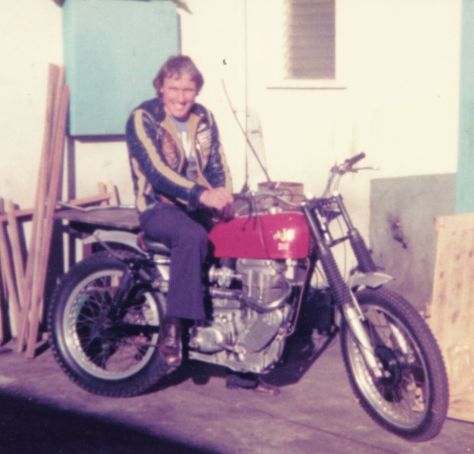
Rob Edwards tries Noel Shipp’s Ex-Mick Andrews 350 AJS 644BLB for size in Australia in 1975, which shows the G85 style tank in situ. – Photo courtesy: Rob Edwards personal collection
From photos taken in 1975 during Rob Edwards and Mick Andrews trip to Australia, one notices that the bottom frame rails had been removed and replaced by a plated assembly which gave a flush area to mount an alloy sump-shield in an attempt to loose some weight. This was not a factory modification as AMC believed in making the factory machines look exactly like the standard production competition models.
A non standard modification to the underside of the frame, this would not have been carried out at Plumstead’s comp shop but by a previous private owner attempting to modernise the machine – Photo: Rob Farnham, Queensland
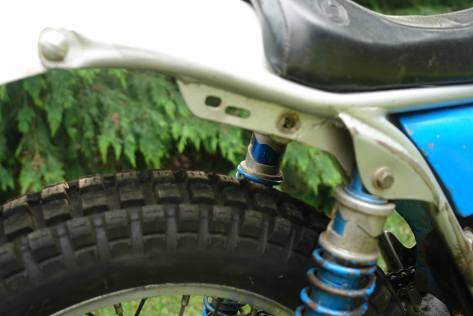
Having said that, the late model factory trials machines all sported the lowered rear subframe and short, but kicked up rear mudguard fixing loop. This allowed shorter rear suspension units to be deployed while maintaining the same rear wheel movement.
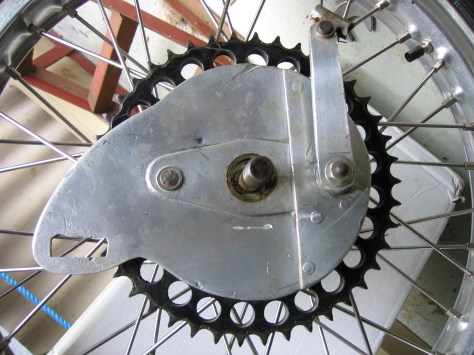
Detail photo of the rear subframe assembly of 644BLB and detachable rear mudguard loop, alloy rear brakeplate and Dunlop Racing 19 inch wheel – Photo: Rob Farnham, Queensland
The tank appears to have been changed over the years. Initially it had an alloy competition tank finished in blue and gold lining.
Oz: “As previously mentioned Noel Shipp fitted the black 2 gallon AJS competition tank at some point although when he got the bike it had the red fibreglass Matchless G85 style tank on it. This is actually an interesting tank as its shape and fitting is definitely for a G85 but there is a drip recess around the fuel cap and the bottom of the tank is finished off quite roughly. It has ‘R. E. G Mouldings’ inscribed on the bottom, maybe someone over in the UK knows of them?
I bought a polished alloy Lyta Gordon Jackson style tank from Rickmans for another project which requires a fully painted tank, it seems a shame to rough up such a nice tank and I eventually found the black and silver painted tank on eBay, so my current plan is to use the painted tank for the other project and the nice shiny one could be painted up similar to the one used by Gordon Jackson.”
Gordon Jackson style Lyta aluminium fuel tank was sourced from the UK – Photo: Rob Farnham, Queensland
History of course records that Andrews rode the 1964 Scottish with a Jackson style tank in off-white/ivory with the gold AJS monogram.
We have recently discovered through Dave Lewis, that all G85CS glassfibre parts were made for AMC by Reg Curley Mouldings, which ties in with what Oz discovered.
Oz confirms that the primary chaincase has an alloy inner case with an outer steel component. Production AMC trials machines were never supplied with alloy chaincases, only the factory ones had them.
Inner section of the primary drive chaincase is in alloy, a special factory modification – Photo: Rob Farnham
Oz who is a lover of originality added: “Of course there is always the matter of whether the bike should be conserved as it is or perhaps restored back to factory finish circa 1964. While 187BLF looks very nice, any traces of its history will have been wiped away during the extensive restoration, in my opinion it has been somewhat over done.”
The clutch pressure plate has been extensively drilled and a fair bit of thought has gone into this modification. Was it done in the AMC competition shop? – Photo: Rob Farnham
“At present 644 is neither ‘fish nor fowl’ as the wheels have been restored, the tank isn’t original to any period, I have the correct style of tank and muffler, and a very good frame repairer who is more than capable of making original pattern bottom rails, however I have several other projects before I even think about what should be done with it, so that may be an interesting area for discussion on your website?“
Alloy rear brake plate is a factory only item, the rear section has been repaired, rear hub is standard ‘five-stud’ competition issue – Photo: Rob Farnham
So there we have it. It would appear that the former AMC factory AJS, 644BLB has found a new home at the other side of the world, without the factory dispatch records it isn’t possible to identify 100% and without a shadow of a doubt this is the ex-Andrews machine, but the evidence certainly points firmly that it is.
It’s a nice end, because if this is truly 644BLB, then its good news that it survives and hasn’t gone to the AMC factory trials machine graveyard and it’s in a good home.
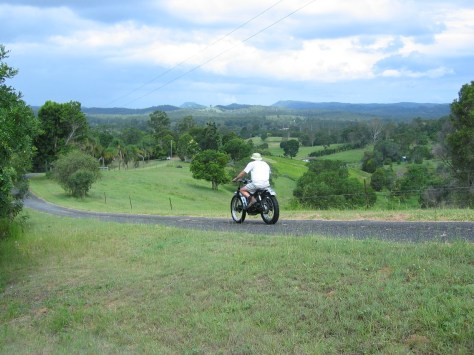
644BLB, is now in retirement in Australia, but enjoys a canter every now and then – Photo: Rob Farnham, Queensland
Or is this the end of the story? We will have to wait and see because researching old motorcycles history is something that never really stops.
Trials Guru … 644BLB Post Script!
James Holland founder of JHS Racing Ltd the motorcycle performance centre in Bristol, read this article and came in with additional information.
James Holland: “Back in 1998 I made contact with Noel Shipp in Australia as I was keen to establish the whereabouts of Mick Andrews’ ex-works AJS. Noel wrote to me and sent me some photographs of the bike he had bought from England some years previously. He wanted around £5,000 for it, which in 1998 was a lot of money for a machine that was many thousands of miles away. I was very tempted, but I had to be sure that it was the real deal. I spoke to Mick about it when the photos arrived, but it had been many years since he last saw the AJS and of course he didn’t do much work on it as the factory took care of all that.
There were some details that did point to it being a works AJS, but I had a lot of committment going on back then and I decided that I wouldn’t re-import the bike and left it at that.
Noel Shipp sent me a nice letter in the November of 1998 and also detailed separately the frame and engine numbers which I believe are still valid to this day having spoken with John Moffat who was given them in confidence by Rob Farnham.
It’s amazing that this article should be written many years after I walked away from a deal that could have re-united Mick with the first factory machine he ever rode in anger and on which he was propelled to stardom.” – James Holland, Bristol
The letter sent by Noel Shipp to James Holland in November 1998, when James had the idea of buying Mick Andrews AJS to bring it home to England
Photo taken by the late Noel Shipp in 1998 showing the engine of 644BLB with the December 1970 UK tax disc – Photo courtesy of James Holland, Bristol
Mick Andrews astride James Holland’s Matchless/BSA – Photo copyright: James Holland, Bristol.
Even more on 644BLB, the story continues:
The machine has now been sold by Rob Farnham to Yorkshire born enthusiast and engineer, Martyn Adams who now lives in South Australia and intends doing some light restoration back to original trim when Mick Andrews rode the bike for the AJS factory.
Martyn Adams with 644 BLB, the ex-Mick Andrews factory AJS at the Macclesfield show, Southern Australia, Martyn is also a Trials Guru VIP!
Far from being the end of this fascinating story, when Martyn has concluded his sympathetic upgrading, he will send us details and photographs of 644BLB.
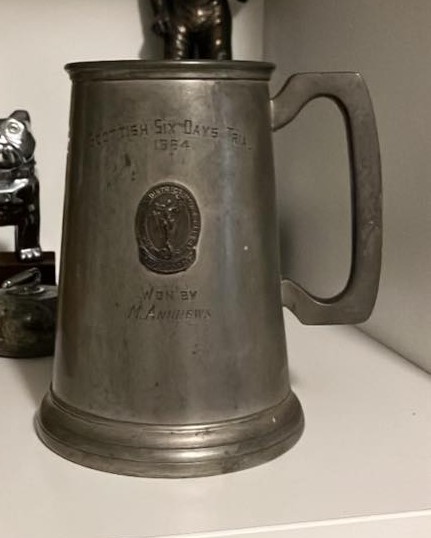
Mick Andrews and Martyn Adams at Mick’s home in June 2025. Mick is holding the award from 1964 from the Scottish Six Days Trial for Best 350 on 644BLB – Photo: Martyn Adams.The 1964 tankard for Best 350cc at the 1964 Scottish Six Days, won by Mick Andrews on 644BLB. (Photo: Martyn Adams)
Interactive Trials Guru – Do you have information about 644BLB that you would like to share and perhaps have added to this article? Get in touch using this online form:
‘644BLB – Rediscovered’ is the copyright: Trials Guru & Rob Farnham.
Photos: Rob Farnham, Queensland, Australia; James Holland, Bristol, UK; Martyn Adams.
Apart from ‘Fair Dealing’ for the purpose of private study, research, criticism or review as permitted under the Copyright, Design and Patents Act, 1988, no part of this article may be copied, reproduced, stored in any form of retrieval system, electronic or otherwise or transmitted in any form or by any means, electronic, electrical, mechanical, optical, chemical, photocopying, recording or otherwise without the prior written permission of the author as stated above. This article is not being published for any monetary reward or monetisation, be that online or in print.
An exclusive to Trials Guru, we discover that 644BLB, the Matchless that thinks it’s an AJS is alive and well in Australia! We bring you the article – HERE.
644BLB as it is today, living in exile – Photo: Rob Farnham
Photos: Jimmy Young – Iain Lawrie – Kimages/Kim Ferguson
Alastair Macgillivray in 1978 – Photo: Jimmy Young, Armadale
Two times a Scottish trials champion, 1974 & 1979, from Banavie, Fort William, Alastair Macgillivray is an electrician by trade and was brought up at ‘Muirshearlich’ near to where a group of sections for the Scottish Six Days were situated – ‘Trotter’s Burn’.
Alastair Macgillivray shares a joke with Mallaig man, Alan Mcdonald at Lagnaha in 2015 – Photo: Kimages/Kim Ferguson
Known to all the locals as simply, ‘Allie-Magill’, the quiet spoken Lochaber-man was a force to be reckoned with in the late 1970s and early 1980s in Scottish Trials.
Alastair Macgillivray (Bultaco) on Cnoc-a-Linnhe in the 1981 SSDT – Photo: Iain Lawrie, Kinlochleven
He is the cousin of Rodger Mount, himself a three-time Scottish Trials Champion (1971-1973).
Alastair Macgillivray on his Bultaco Sherpa 250 in 1972 at the Kinlochleven Spring Trial (Now Ian Pollock Memorial) captured by Iain Lawrie, Kinlochleven.
Always a member of Lochaber & District MCC and at one time a secretary of the club, Alastair rode mainly Bultaco Sherpas from 1971 until 1982 when he moved on to ride Fantics in Scottish nationals and in the Scottish Six Days.
Alastair MacGillivray (Bultaco 325) at Scottish Experts & National Trial, Achallader, Bridge of Orchy 1978 – Photo: Jimmy Young
He acted as a ‘back-marker’ official at the SSDT for many years after he ceased riding regularly in trials.
Former Scottish Trials Champion, Alastair MacGillivray from Fort William on a 325 Bultaco at a very wet Forfar trial around 1980. He has the benefit of having an earlier air-box fitted which helped these bikes, but they were bad for taking on water! – Photo: Jimmy Young
Macgillivray won the Scottish championship in 1979 after coming very close to winning in 1978, but lost out at the penultimate round at the Glentanner Estate in Kincardineshire run by Bon Accord MCC, leaving the championship spoils open to eventual joint winners, John Winthrop and Robin Cownie.
Alastair McGillivray Scottish Trials Champion in 1974 & 1979 (Fort William) seen here on a 200c Fantic at the Lanarkshire Valente Trial in 1981 – Photo: Jimmy Young, Armadale
Alastair is also an accomplished fly-fisherman, particularly trout fishing and has won many competitions, one of which the prize was the use of a Lexus car for a year being the Lexus Fly-Fishing Champion in 2012.
Taken around 1970 – From left: Allie ‘Beag’ Cameron; Kenny Fleming; Rodger Mount & Alastair Macgillivray
The Premier Trial Sport Website for photos, articles, news and the history of motorcycle trials
The Highland Classic 2 Day Trial, Scotland’s premier event of its type will pay homage to Honda Trials with their HONDA EDITION, when the event is once again promoted by the very active and go-ahead Inverness & District MCC on June 10/11 at Alvie Estate, near Aviemore.
The Guest of Honour will be ROB SHEPHERD, British Trials Champion on Honda in 1977.
Rob Shepherd (Honda) seen here on ‘Muirshearlich’ in the 1981 SSDT will be Guest of Honour at the 2017 Highland Classic Two-Day in June – Photo: Iain Lawrie, Kinlochleven
The decision was taken by the organising committee to continue to feature motorcycle trials brands as their headline theme and have announced the guest of honour, Rob Shepherd who is from the era when Honda was active in British and World trials with their twin-shock TL and RTL300/360 machines which were hand-built by their subsidiary company ‘Honda Racing Corporation’. Since 2013, there has been Bultaco; Greeves and Yamaha with The Thorpe Edition which paid homage to Dave Thorpe in 2014, a regular competitor at the Highland Classic.
Alvie’s Laird, Jamie Williamson (second right) welcomes the riders to his estate in 2016 – Photo: Lorna Brackenridge
The event now enters its twelfth year as a two day trial and permission has been granted by Alvie Estates CEO, Laird Jamie Williamson who is an enthusiastic supporter of the event which now attracts an entry of 150 competitors from a variety of regions of the UK and Europe.
Mick Andrews was guest at the Highland Classic in 2016 at the ‘Yamscot Edition’ – Photo: Lorna Brackenridge
The Highland Classic, sometimes referred to as ‘The Alvie’ or even ‘HC2DT’, has remained firm in that it accommodates Pre’65 and twin-shocks only. There are no classes for mono-shock machines and any motorcycles which have been heavily modified are put to the ‘specials’ category, although there have been very few times that the organisers have had to relegate entries to this class.
The entries will open on Wednesday 1st February and will only be available online as a pdf document from the club website, (www.idmcc.co.uk) and their facebook and event pages on social media. Previous entrants will not receive a hard copy by post. Return of the entry forms are to be made by post to the entry secretary on an ‘earliest receipt’ basis. It is expected that entries will fill rapidly as in 2016 they were full within 5 days! Entries will close when full, or Saturday, 15th April whichever is the sooner.
The first 150 entries received by the secretary will be informed of their receipt of entry and there will be a 15 strong ‘waiting list’ of reserve riders, which represent a 10% fall-back facility. E-mailed entries will not be accepted and all entry forms must be complete and accompanied by the appropriate entry fee, which will be £45.00 (50 Euros) for two days of fantastic trialling in the Scottish Highlands.
For 2017, there will be a ‘Best Female Rider’ award and ‘Best Honda’ cup.
The ‘trial partners’ for 2017 are Classic Trial Magazine; Putoline Oils and Apico Factory Racing.
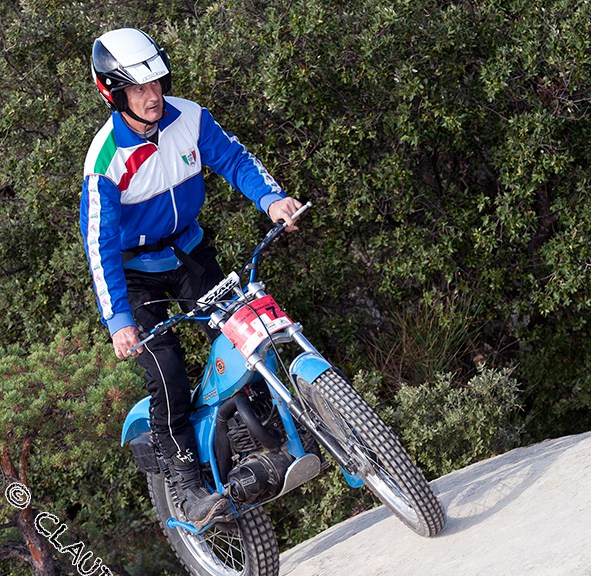
Ettore Baldini – 26 April 1956 – 10 January 2017 – Photo by Claudio Pictures
It is with deep regret that we have to report the passing of another trials friend, Italian Ettore Baldini, who has died as a result of a heart attack.
Ettore was a competitive rider who started his trials career on a Montesa Cota 247, taking second place in the Italian Trials Championship at the tender age of 19. In 1977 he won his first national title for Bultaco, repeating this again in 1979 again on the Spanish machine. Baldini left Bultaco in 1979 to join American, Bernie Schreiber at Italjet.
Ettore signed for Montesa, which he rode until the end of his career in 1985. He was many times in the top 15 in the world trials championship.
Realising his development skills, Ettore was employed by Aprilia to develop their model ‘TX 311’ and then the ‘Climber’ model which would become the world championship winning machine in 1992 in the hands of Tommy Ahvala.
Latterly Ettore worked for Ducati.
Trials Guru extends our sincere condolonces to the Baldini family.
Photo courtesy and copyright of Claudio Pictures/Jean-Claude Commeat
Jon Stoodley is a trials superenthusiast and more, who lives in Muskogee, Muskogee County, Oklahoma, United States of America.
He has been a reader/follower of Trials Guru from the very start and he has kindly written this article for us.
Jon Stoodley enjoys his trials riding, seen here on his Gas Gas
Photos provided by Jon Stoodley/JSE Trials
An observant man once said, to the effect, “You don’t choose your passions, your passions choose you.” Each of us came into the sport of Trials or ‘Mototrials’ as it is called in some areas, from different directions. Some of us were, in a way, born into the sport as a result of their father’s or even grandfather’s influence. Some, like me, were involved in other forms of motorsports and thought we would ‘give Trials a shot’ and took up the sport.
I had been involved in racing cars and motorcycles as a hobby since I was 15 years old and one fateful night, in 1971, while I was sitting on my TT bike, waiting for the flagman to start my race, I looked around and thought to myself, “Darn. These guys are trying to run me over all the time and I’m not having fun anymore!” So, that was it, I sold my bike and equipment and just took some time off to see what I wanted to do next. As I always loved motorcycles, I was pretty sure they would be involved somehow in my future, but to what extent, I didn’t know.
A short time later, I went to a big off-road motorcycle and equipment show in South San Francisco. There were lots of bikes and stuff on display as well as local motorcycle sports clubs being represented. Over in one corner, was a small booth with a group of riders who had some of their bikes on display. The bikes were weird looking little things with little seats and what looked like street tires on them. I had seen a few photos of them in magazines, so I had an idea they were what was called ‘Observed Trials’ bikes and a bunch of guys in the U.K. bounced around on them all over the countryside. They didn’t look loud, mean or terribly fast like other racing bikes but they were very compact and simple.
One of the riders at the booth came over to me and in a friendly way, asked me if I was interested in riding the, new to me, sport of Observed Trials. I told him I didn’t know much about the sport but was curious. He introduced himself, “I’m Whitey Webb and I’d be happy for you to meet some of the other riders here.” Whitey took me over to the group, which was friendly and welcoming and obviously really enjoyed the sport they were involved in. I hung around their booth for some time and Whitey turned out to be a good salesman as I decided to give this weird sport a try at their next event. There is a Zen saying that goes, ‘When the Student is ready, the Teacher will appear.’
I guess I was ready as a great teacher appeared. Whitey Webb is the father of Kip Webb, a top level U.S. National Trials rider as well as the grandfather of Cody Webb, past U.S. National Trials and EnduroCross Champion. I guess I got real lucky!
So, I converted a bike I had laying around the shop and showed up at my first Trials event, secure in the knowledge that an experienced and supremely talented racer such as myself would surely show this bunch of old ladies how to REALLY ride a motorcycle, well, we all know what happened next. I flopped, dabbed, crashed, dragged and moaned myself through the sections and loop and generally made a complete fool of myself. My shins were as bruised and bloody as my over-inflated ego at the end……but, you know what? …. I actually had fun. Looking back, I had lots of fun and everybody was helpful and encouraged me to keep going and, most of the time anyway, didn’t laugh when I made rookie mistakes and I made a LOT of them.
That was it, I was hooked. Something about this, in the U.S. anyway, relatively unknown sport spoke to me. It was challenging and rewarded personal effort, but most of all, it was enjoyable, if even in a sadomasochistic way at times. But there was something else….the people. This sport attracted a certain kind of person and I became aware that these were the kind of people I wanted to be around.
As far as motorsports is concerned, Trials is a weird sport. It’s a lot like golf in that I have friends who are as passionate about golf as I am about Trials. They are always buying the latest, high-tech equipment and a couple of them have even been to Golf’s Mecca, the famous St. Andrew’s Links in Scotland. Trials is also like Golf in that it looks so simple but in reality, is much more complex than a description would indicate. Don’t believe me? Try explaining Golf to a person who has never heard of it: “Well see, you got this little stick and this little ball. There are a bunch of holes in this huge lawn and you try to knock this little ball into the holes with as few whacks as possible. You win if your score is smaller than all the other people. It’s really exciting!”
Then there’s Trials: “Well you see, we got these spindly little motorcycles with no seats. We look for places that nobody would ever ride on (and some places you can’t even walk over) and thrash these little bikes through rushing water, boulders, and other nasty stuff while trying not to fall off.
Oh, yea, and we do it for hours on end in rain, snow, sleet and flood. It’s really exciting!” You can get an idea of what I mean, in that the physical description does not do justice to the reality of the experience.
In Psychology it’s called “having a mental equivalence”, in that the person you are describing the experience to, does not have the retrievable mental images necessary to accurately frame the physical descriptions you are giving them.
325 Bultaco Sherpa mounted, Jon Stoodley in the British-America Cup trial around 1974
What is it about this sport that I enjoy?
Well, you get to ride for hours in some of the most beautiful scenery around. It’s personally challenging and rewards practice and commitment.
The other participants are helpful and supportive, probably because we are all trying to solve the same problem of trying to ride the section successfully. We all have a common purpose.
The bikes, in comparison to other forms of motorcycle sports, are a lot less expensive and you can get a good entry level bike at a very reasonable price. The bikes, in most cases, are well under-stressed in use and seem to last forever. At least here in the U.S., trying to find a Trials bike in a motorcycle salvage yard is next to impossible. They are just passed on from one rider to a new owner.
I’ve rode events alongside first-time beginners and World Champions and in what other sport can you say that? You can ride just for fun or compete on a serious level, the sport allows for both types of riders at the same time.
Trials is a reasonably safe sport and injuries are rare. A Clubman rider can compete on Sunday and he or she can have a more than reasonable expectation that they can report for work on Monday, unscathed. The list of positive attributes of this sport goes on and on.
Riding a creek on the 325 Bultaco Sherpa
Another point is that Trials riders are, as a general rule, easily approachable and love to share. It’s fun for me to wander around the event pits and talk to riders. If I admire one of their bikes, inevitably the next thing I hear is “want to take it for a ride?”
The approachability factor applies not only to Clubman riders but also to World Champions. I’ve chatted with Martin Lampkin when he got to my sections early (even though I knew, in part, he was buttering me up so I’d go easy on Dougie if there was a close call on his scoring. Martin was as good a salesman and had as good a sense of humor as Whitey Webb), I’ve drank beer and talked about motorcycles with Mick Andrews for an afternoon, sat around camp with Tommi Ahvala and talked about everything and sat with Dani Oliveira, 125 World Champion, in the GasGas pits while he was putting on some small parts he had brought from Spain to make an otherwise stock bike work at the World Round level.
This reminds me that Trials is primarily a sport of talent, not machinery. At the World level, of course, the competition is so intense that any advantage, however slight, is important but for most of us mere mortals, the bikes anyone can buy are essentially race-ready and require little preparation. I don’t know of any other motorsport here in the U.S. that one can buy a stock bike, do reasonable maintenance and adjustment and enter it in a National event and have a good chance of doing well, it not winning. Trials is a ‘no excuses’ sport.
On the smooth but very powerful 370 model JTR (Jordi Tarres Replica) Gas Gas of 1997 at the Frank Raines Trial
The sport of Trials has, and continues, to mean a lot to me. I’ve got long time Trials friends all over the world because we share a common experience. The very nature of Trials competition promotes camaraderie and friendship and I would imagine this is because of the fact that we are alone in the section and essentially competing against ourselves. Like I say, Trials is a ‘no excuses’ sport, you can’t blame the other riders for cutting you off in the turn, running into you or jumping the flag at the start.
I love Trial’s rich history, it is one of the oldest and most enduring forms of motorsports there is and one only has to look to the Scottish Six Day Trial to get an idea of the sport’s remarkable lineage. Although I don’t compete anymore I really, really enjoy helping to set up an event, helping new riders and observing a section.
I sometimes think I enjoy checking a section more than I did riding in competition. Even after checking sections at three World Rounds, numerous Nationals and over a hundred plus clubman events, I still love standing in a section encouraging the riders. I always want the riders to do well in my section and I always get there early to make sure it is safe, there are no tree branches hanging down in their way, no unnecessary debris is at the entrance or exits, the boundaries are secure and whatever I need to do to make the section as trouble-free yet challenging as I can.
I enjoy seeing the riders analyze the section, picking unique lines through the obstacles and then using their talents to conquer the problems set before them. I take pride in the fact that Trials riders help each other and you only have to see the upper class riders take time to answer the questions of the lower class riders and watch as the spectators cheer on and encourage both beginners and World Champions.
I like the fact that people of all ages and genders can be involved in this equal opportunity sport and even old geezers like me can participate to whatever level they enjoy. I probably appreciate my time spent with other Trials people now more than I ever have. There are not many activities one can say that about.
When my friend, John Moffat, asked if I would write a piece for The Trials Guru, I first thought of a technical article. Through the years, I have written many technical articles for both Motocross and Trials publications but John suggested: “how about a letter from America?” This got me to thinking, “how about a love letter to Trials?” a passion that chose me and I’ve enjoyed for over 46 years and counting. I’ve tried to give back to Trials what my talents would allow. It’s been a really good investment as Trials has rewarded me tenfold. I love this sport.- Jon Stoodley
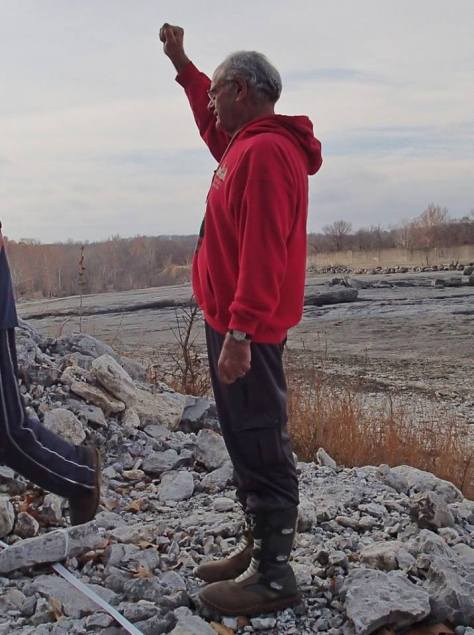
A true enthusiast puts back what he/she takes out, here is Jon observing (checking) riders at a trials event
The Premier Trial Sport Website for photos, articles, news and the history of motorcycle trials
The Premier Trial Website – Recording the History of the Sport 'Established 2014'




























 TRIALS GURU - DEDICATED TO TRIAL