
Words: Trials Guru; David Cordle and Doug Theobald.
Photos: Ben Chaplin Collection; Pat Cordle; Mike Rapley; nickhaskell at the motocrossarchives.com; Justyn Norek; Ian Berry; Theobald family collection.
At Trials Guru, we feel that the word ‘Legend’ has been overused in recent years and, as a result, has perhaps lost some of its meaning. For that reason, we prefer to use the word ‘Icon’ — a term we feel better reflects those who have made a lasting and significant contribution to the sport.
There are riders whose names become firmly woven into the fabric of motorcycle trials, and in the Eastern and South Midland Centres, Doug Theobald the popular rider from Risby, Bury St. Edmunds, Suffolk, is certainly in there.
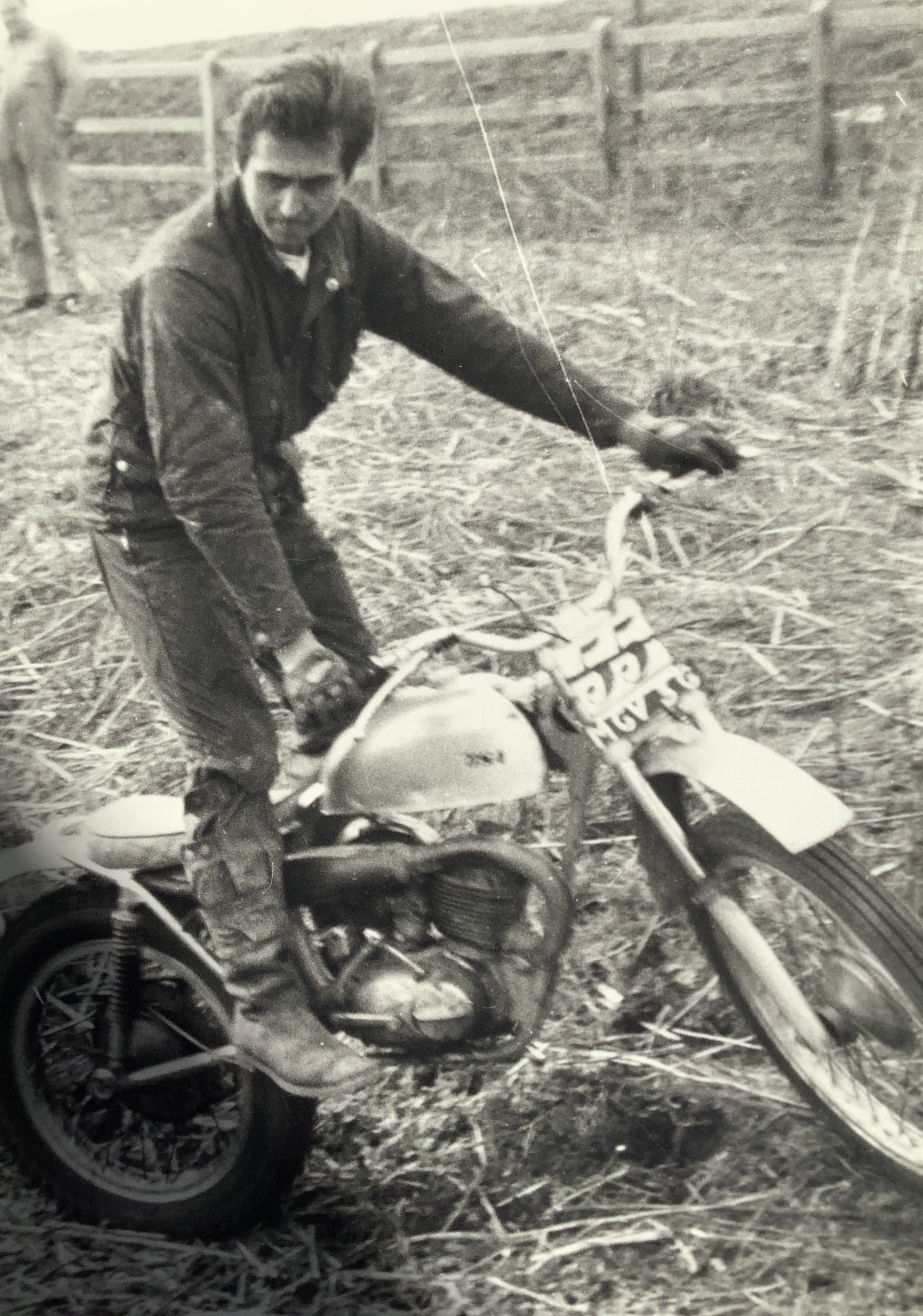
A very successful competitor during the late 1950s and early 1960s, Doug was a multiple Centre Champion and Norfolk and Suffolk Group Champion, establishing himself as one of the dominant riders of his generation.
Within the Auto-Cycle Union, the Eastern region is an affiliation of over thirty clubs and over 2,500 like-minded members in Norfolk, Suffolk and Essex.
In the period 1960 – 1975, notable Eastern Centre riders included Greeves factory rider, Don Smith, Allen Collier and Eddie Cordle. The dominant brand in the early 1960s was Greeves, which was manufactured in nearby Thundersley in Essex.
What makes Doug’s story all the more remarkable is that his association with motorcycle trials has stretched across more than seven decades. From the days of rigid-framed DOTs and the Ariel HT5 to the modern era of Fantic and GasGas machinery, Doug has remained a familiar and respected figure at trials events.

Born in May 1938, his competition career began in October 1954 as a sixteen-year-old, when he entered an Essex and Suffolk Border novice trial on a rigid-framed 197cc DOT which he bought from his farm wages. It was quite an introduction to competition, for the winner that day was another young DOT rider who would go on to become one of Britain’s most famous motocross riders, European Champion, Dave Bickers from Coddenham. Doug finished runner-up.

That early result proved to be a sign of things to come.

Doug quickly established himself as a force to be reckoned with in the Eastern and South Midland Centres. He collected Centre and Group Championship honours and became a regular winner, riding against many of the leading competitors of the period.
Football or Trials?:
There was, however, another road that Doug might easily have followed. A talented footballer, he had played for the local town team and for a short while, Wolverhampton Wanderers. At the age of just 18 he was also drafted into the Army for national service in March 1956 until March 1959, creating another potential diversion from his growing trials career.
His national military service produced one of the more remarkable stories in Doug’s long life.
His Royal Artillery regiment was destined for duties on Christmas Island in the Pacific ocean, where British nuclear weapons testing was taking place as part of ‘Operation Grapple’. Doug was fortunate to escape that posting, thanks in no small part to his motorcycle ability. His Sergeant decided to keep him back because of his talents on two wheels.
That officer was Sergeant Challinor; another of the sergeants was Bill Brooker, a name that would later become very familiar within the trials world as the Greeves Competitions Team Manager. It was an extraordinary twist of fate which perhaps helped shape Doug’s future in the sport. In 1959 Doug won an Army championship on a rigid 350cc Matchless, beating Jeff Smith, Pat Brittain, Peter Stirland and Don Smith who broke his collarbone in the process. Incidentally, Don Smith had great respect for Doug both as a competitor and person.
Doug was based at Kinmel Park Camp, Bodelwyddan, Rhyl, for a time, so he rode in Cheshire Centre events on the weekends, when not on duty.
Doug Theobald: “I was really chuffed when I won the championship in the Army as I came from a fairly flat area of the country with very little rocks and the others were all experienced trials riders, so I think I did really well to achieve that at the time.”
Doug began his working life in the school summer holidays on a farm, then started out as a coal merchant in 1953, then set up a follow on business after his National Service, Doug Theobald Aggregates in 1964.
In 1963, Greeves mounted Doug took the win at the Arthur French Trophy Trial, organised by the Sudbury and District MC & LCC, and again in 1968, with 1964-1967 won by none other than Don ‘D.R.’ Smith when riding for the Greeves factory. Other notable winners were John Kendall, Eddie Cordle and Laurie Bird.
Family man:

Doug met Maureen Price at the Bury St. Edmunds swimming baths and struck up a relationship. They married in 1965 and two years later, Nichola was born, followed by Lisa in 1968 and Melinda in 1970.

The Theobald’s now have seven grandchildren and three great-grandchildren.

Scotland:
Back on home soil, Doug’s trials career continued to flourish. He rode many National and International events, but among his greatest personal achievements were his performances in the Scottish Six Days Trial.
Doug tackled the SSDT on eight occasions and finished inside the top twenty three times and collected seven Special First Class awards and a first class at his first attempt in 1960. In an era when the Scottish was a truly formidable test of rider and machine, such consistency was a considerable achievement. Doug rode DOT six times, with two appearances on Greeves machines at the famous event.
Doug also became a regular competitor in the early days of the Pre65 Scottish Trial, riding seven times, where he collected a number of Special First Class awards. His knowledge of older machinery and his ability to get the best from it made him a natural competitor in the event.
Said Doug: “I didn’t reckon I did very well at the Pre65 Scottish as I was getting a bit older by then, but I enjoyed the event very much indeed“.

Over the years Doug rode a fascinating variety of trials machines. He competed on a 500cc Ariel of the late 1950s, but it is perhaps the DOT name that is most closely associated with him.

Having met Eric Adcock while competing in a Cheshire trial on his heavy 500cc Ariel, Eric convinced Doug that he should try a DOT. That was in 1960 when an offer came in letter form from Burnard Scott-Wade to ride a Manchester-built works machine.

Doug thus became a DOT-supported trials rider, spending many years representing the Lancashire manufacturer, with a short spell in 1962–63 riding a factory-supplied Greeves before returning to DOT. He was particularly at home on the lightweight DOT machines, but the arrival of the DOT Minarelli, replacing the familiar Villiers engine which had become unavailable following its acquisition by Norton Villiers, was not to Doug’s liking. This prompted him to look elsewhere.
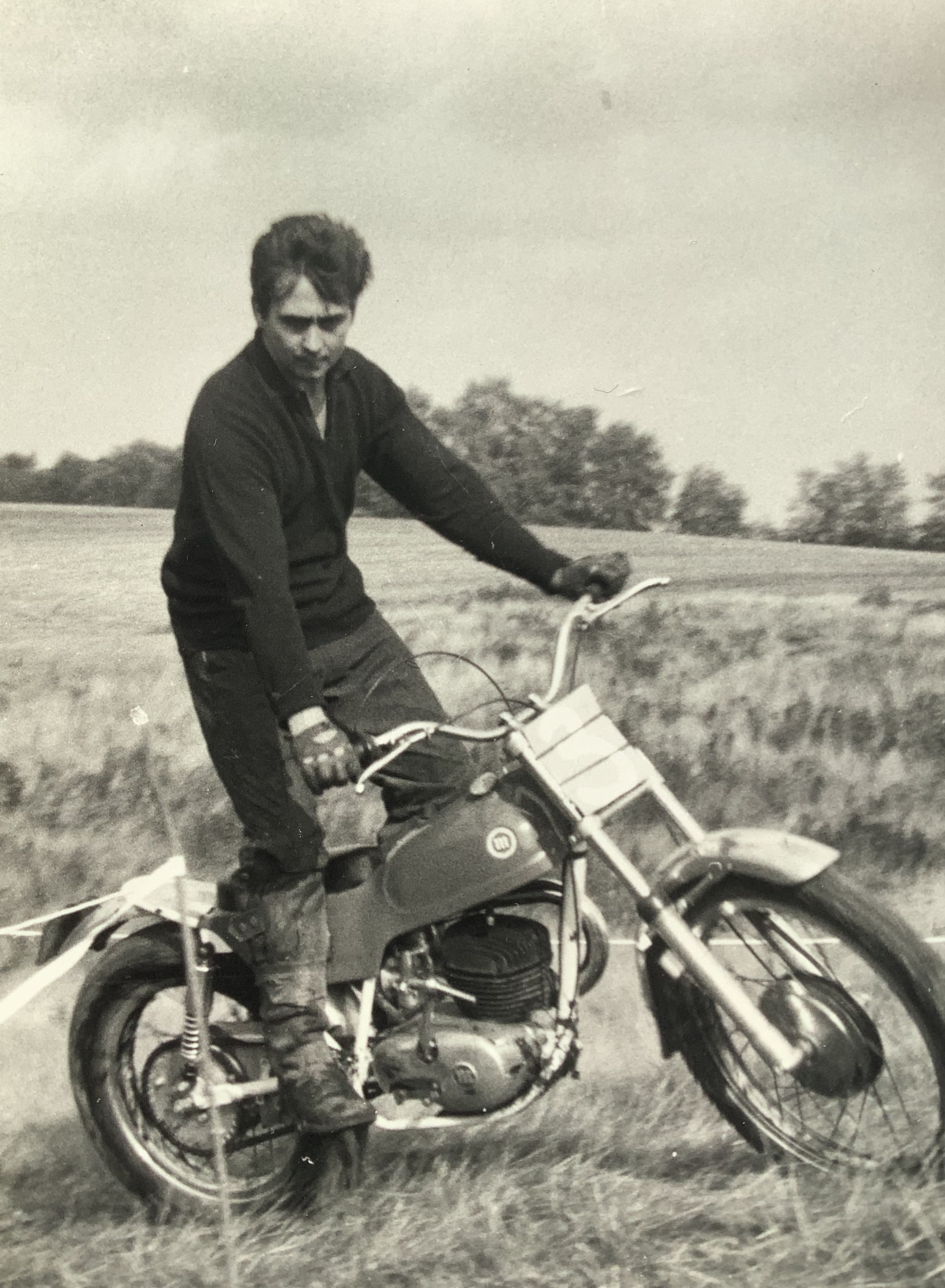
That led to another important chapter in his riding career and a friendship which remains part of trials folklore.
‘Burian’ – built in Bury St. Edmunds:

Doug also campaigned the ‘Burian’ machines produced by his good friend and motocross legend John Banks in 1965. The name is actually pronounced ‘Berry-un‘. Both Doug and Banks were members of the Bury St. Edmunds and District club, and the lightweight Burians, powered by both Villiers 36A and BSA Bantam engines, proved highly effective competition machines. The Villiers-engined machine utilised a type 36A bottom-end with a modified Greeves Challenger cylinder barrel and head. Later, John Banks built a Burian with a 441cc BSA Victor engine for his own use in trials, when he was concentrating on motocross, keeping fit over the winter months.
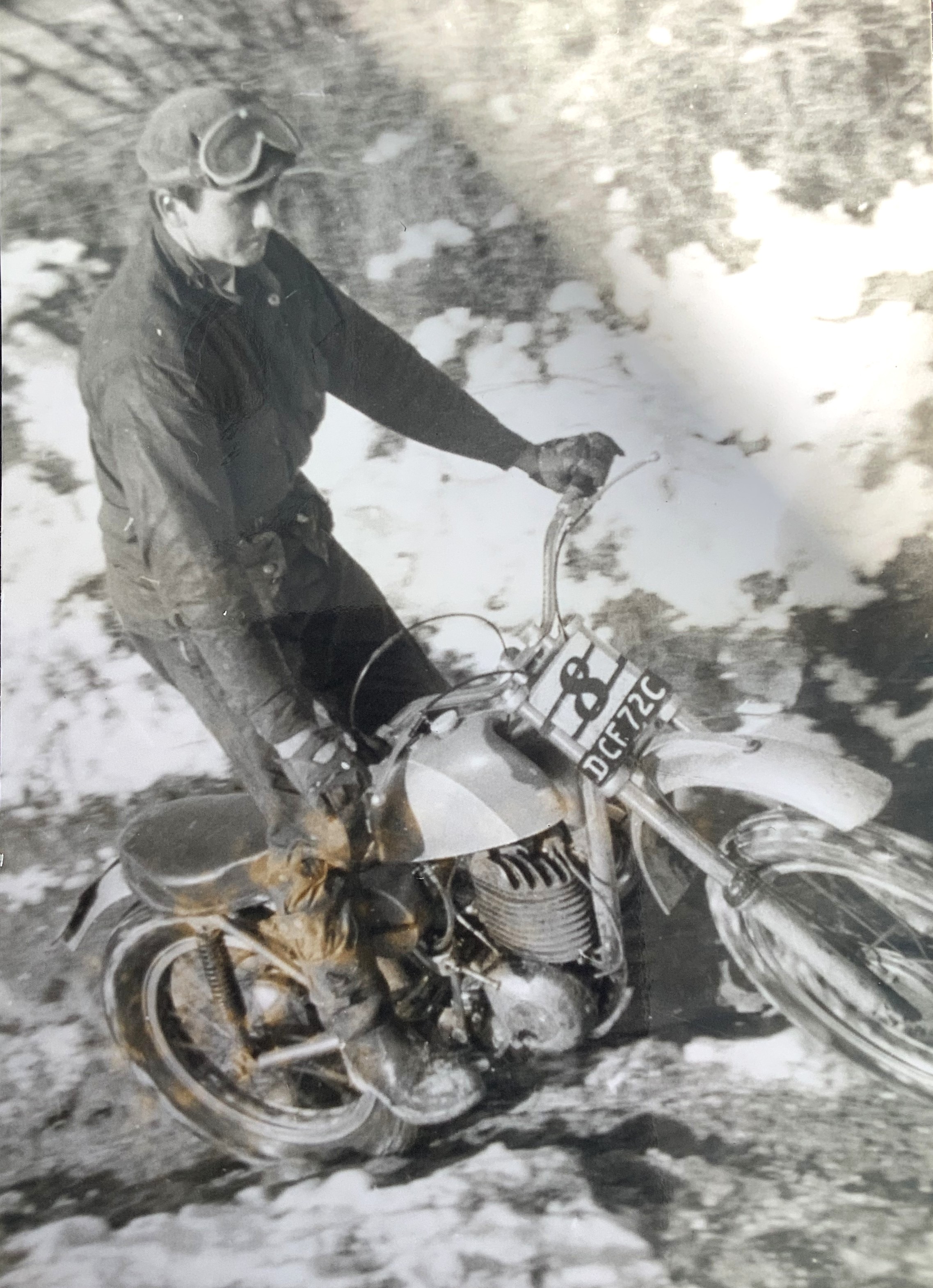
The name was coined from both the town, Bury St. Edmunds and to those who attended a local school, the King Edward VI – known as ‘Old Burians’.
In Doug’s hands the early Burian machines were certainly successful. He enjoyed numerous trial victories on these individual and highly distinctive machines, demonstrating that a good rider could make a relatively unconventional motorcycle a very competitive proposition.

Some time later, the Villiers Burian ended up with local Bury St. Edmunds rider, Alan Garrett who rated the machine highly.

The Banks connection:

Few realise that four times British Motocross champion, John Banks, also from Bury St. Edmunds began his sporting motorcycling as a trials rider.

“John Banks was born into an affluent family, his father was a highly successful building contractor, and as a youth he was fascinated with the efforts of Dave Bickers in the European Motocross championships. His first bike, a Greeves trials bike, was bought from the 1960-61 European champion and young Banks showed great promise.” [1] His nickname in the motorcycle press was ‘The Baron’ as he lived on Barons Road. His father, F.G. Banks was a local councellor, alderman of the borough and Mayor of the town in 1959.
Having ridden trials for a couple of seasons, John Banks was keen to try his hand at scrambling, an opportunity that came about through Doug Theobald. At the time, Doug was supported by DOT Motorcycles for his trials activities and suggested to the company’s owner, Burnard Scott-Wade, that John could prove to be an asset to the manufacturer.

The rest, as they say, is history, with Banks competing in the European 250cc championships in 1963 on DOTs. This was followed by signing for BSA as teammate to World Champion Jeff Smith in 1966, rising to BSA’s number one rider in 1969. John Banks became a household name in the latter part of the 1960s by competing in both the ITV and BBC televised scrambles which were extremely popular with Saturday audiences. He won the ITV series titles twice and the BBC series four times. After BSA’s demise in 1971, he switched to race a CZ and also Husqvarna before returning to four-stroke power, riding for Eric Cheney in 1973 and then CCM in 1975.

Doug Theobald: “I actually taught John Banks to ride a motorcycle and also drive a car, then I got him interested in riding trials, I see John regularly.“
Theobald and Banks forged a true and lasting friendship, their local connection and shared passion for motorcycling creating a bond that would endure throughout their lives.

Determination:
Sadly, around 1972, Doug was diagnosed with rheumatoid arthritis, a debilitating condition that causes pain, stiffness and swelling in the joints. Despite this setback, Doug Theobald refused to let his illness dictate his future in the sport and continued to compete in trials. His determination to carry on, despite the considerable physical challenges he faced, was a testament to the character and resilience of a man who was never easily beaten.
A serious competitor, Doug was nevertheless known for taking the time to chat with observers at events and to thank them personally for giving up their time to officiate at trials. His reputation for courtesy and good manners has long preceded him, and it is another quality that has earned him the respect and affection of those within the sport.
Keeping up to date:
As the sport developed, Doug developed with it. He embraced new machinery and continued competing successfully on Fantic through Roy Cary and later GasGas through John Shirt Senior, while never losing his enthusiasm for the machines of an earlier generation. The 125cc Gas Gas that Doug campaigned was set up by GasGas UK’s resident technician, ‘Factory’ Kev Hipwell.

That is perhaps the most remarkable aspect of Doug Theobald’s story. His trials career is not simply a chapter from the past. It has continued through generation after generation of riders, motorcycles and changing styles of competition.
From that first novice event in 1954, riding a rigid 197 DOT against the likes of Dave Bickers, through Centre Championship success, National events, multiple Scottish Six Days Trials and the early Pre65 Scottish competitions, Doug has remained a competitor in the truest sense.
Today, Doug can still regularly be found around the Eastern and South Midland Centres, enjoying the sport that has been such an important part of his life. He has been known to push a little towards the front of a queue of riders at sections, claiming that he has a wedding or a christening to go to!

More than seventy years after that first ride, the enthusiasm and love of the sport remains.
Doug Theobald is, quite simply, one of those characters who reminds us that motorcycle trials is not just about results, machines or championships. It is about the people who give the sport its history, its stories and its enduring character.
So, does Doug Theobald deserve to be described as an ‘Icon’? Here at Trials Guru, we certainly believe so – and the sporting community within the Eastern Centre would undoubtedly agree. Throughout a lifetime devoted to motorcycle sport, Doug has earned the admiration and respect of all who knew him, not only for his achievements in competition, but also for his character, determination and enduring contribution to trials.
Doug Theobald has certainly played his part.

‘Doug Theobald – Eastern Centre Trials Icon’ is the copyright of Trials Guru and David Cordle.
Bibliography:
Classic Dirt Bike Magazine (Mortons Media), 1st March 2017 – Ian Berry, ‘An Hour with the Banks’. [1]
With special thanks to David Cordle; Ian Berry; Nichola and Doug Theobald for their assistance in the production of this article.

Apart from ‘Fair Dealing’ for the purpose of private study, research, criticism or review as permitted under the Copyright, Design and Patents Act, 1988, no part of this article may be copied, reproduced, stored in any form of retrieval system, electronic or otherwise or transmitted in any form or by any means, electronic, electrical, mechanical, optical, chemical, photocopying, recording or otherwise without the prior written permission of the author as stated above. This article is not being published for any monetary reward or monetisation, be that online or in print.