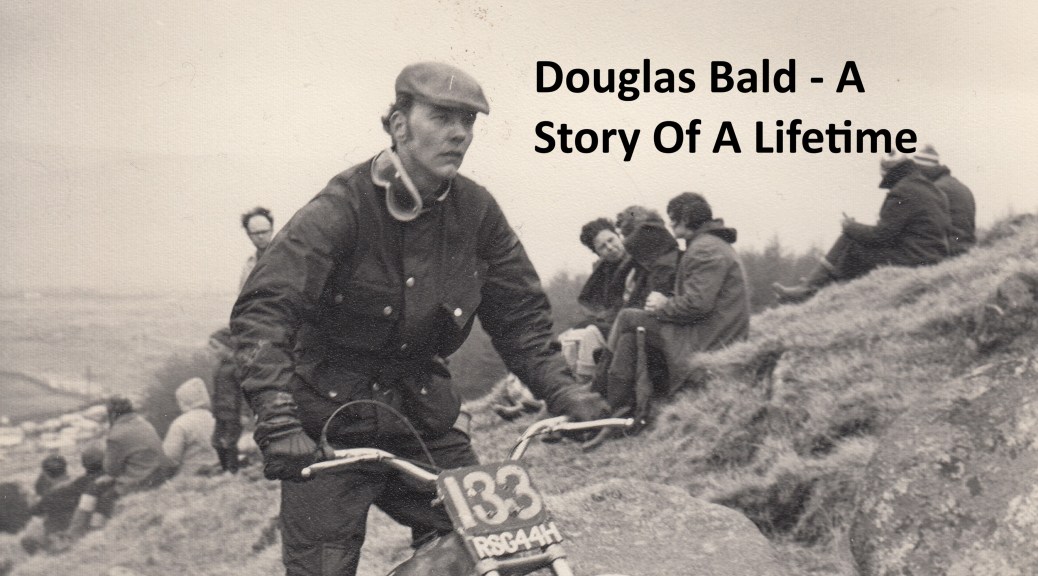
Tag Archives: SSDT

GLOVES OFF – Celebrating 55 years

Celebrating 55 years of Trials Competition with Bernie Schreiber

Words: Bernie Schreiber, Zurich, Switzerland – September 1st, 2025

Photos: Bernie Schreiber personal collection; Eric Kitchen; Iain C. Clark; Trials Guru; Len Weed; Jean Claude Commeat.

America’s only World Trials Champion and Scottish Six Days Trial winner, Bernie Schreiber is the most successful and iconic trials rider ever from the USA. To this day, he is the only American trials rider to reach the pinnacle of the sport. 2025 marks a special moment for Schreiber who started trials competition fifty-five years ago in California and still competes in vintage events today. 1970 was the beginning of what later became a successful adventure overseas in the late 1970s and 80s. Trials Guru shares Bernie’s journey.

Trials Guru: How did you discover the sport of Observed trials?

Bernie Schreiber: “A friend of my father introduced us to trials in 1970.

One day we all went riding in the Mojave Desert outside Los Angeles. We were climbing hills and riding trails all day on our bikes while the son of our friend spent most of the day in a sandy pit area, riding in circles standing up. We asked, what have you been doing all day on that strange bike called a Bultaco? In fact we thought the motorcycle was made in Mexico until they informed us it was a trials bike made in Spain. We had no idea what trials was and never heard of Bultaco. He said, that we should come out to watch a local trials event in a few weeks.

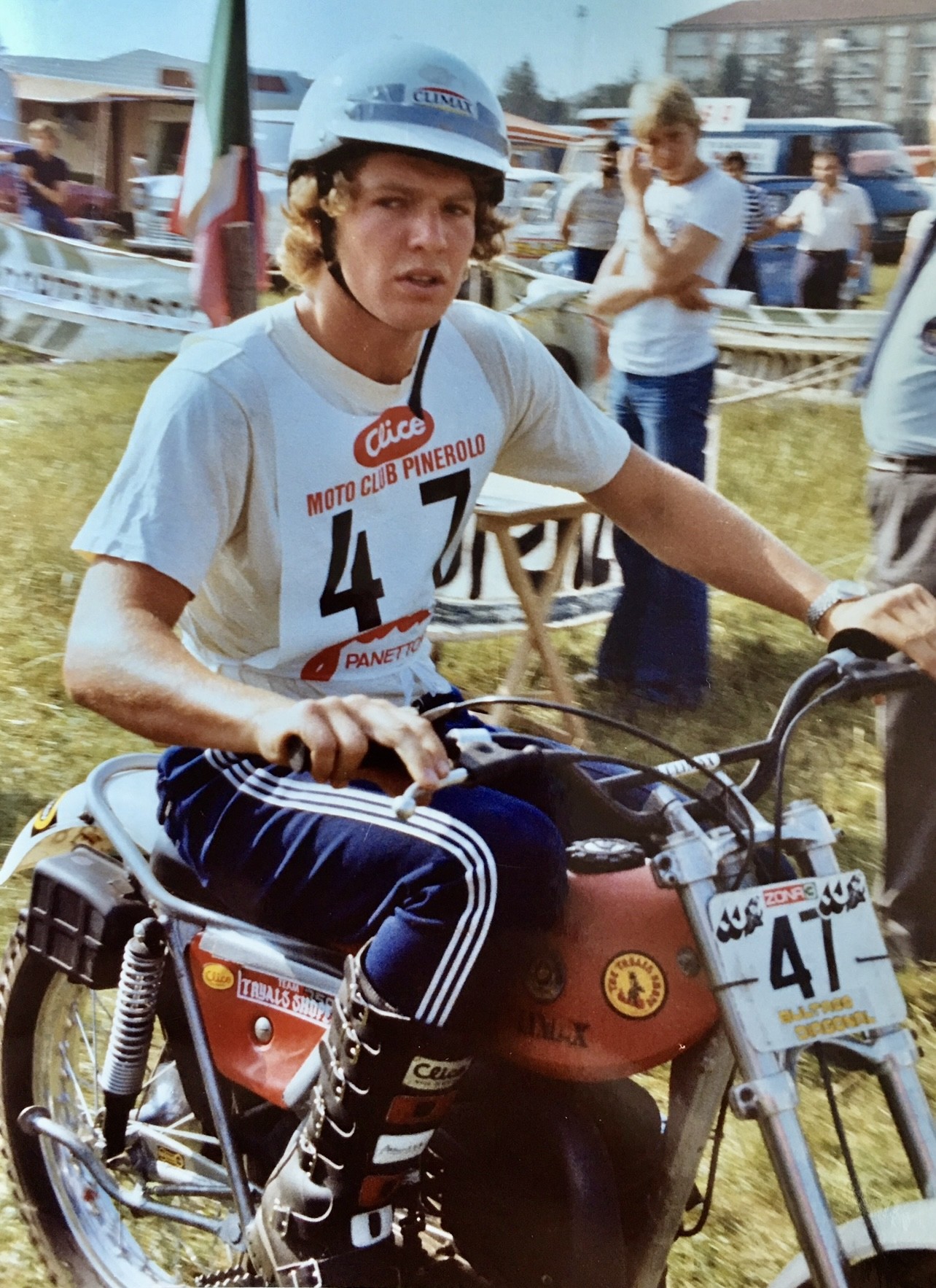
A few weeks later I found myself riding, not watching the event at a famous off-road venue called Saddleback Park in Southern California. I had a Kawasaki 90cc trail bike and my dad signed me up in the kid’s class. I started section one stood on my passenger foot-pegs to stay balanced going up and down hills. I really enjoyed the challenge and my parents found the sport friendly and safe.”

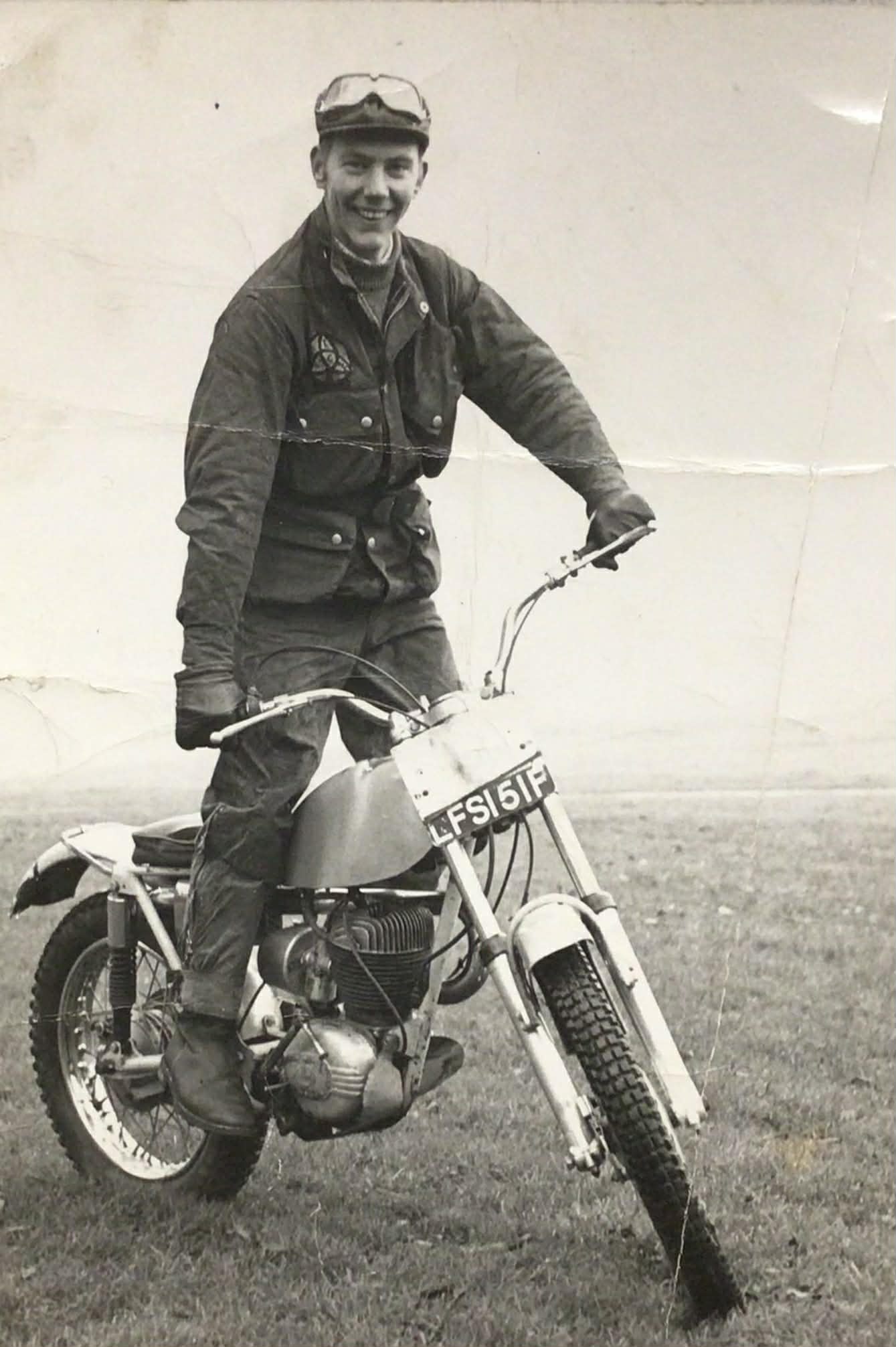
Mojave Desert with a young Bernie Schreiber on a 90cc Kawasaki trail bike. (Photo: Bernie Schreiber Collection)

“I rode a few more events in the kid’s class that year and eventually got a 125cc Bultaco Lobito and moved up a class. We joined the trials club VOTE ‘Valley Observed Trials Enthusiasts’ that year and the trials adventure began.”

TG: Who inspired you to focus on trials and to go as far as you did?

BS: “That would be hard to pinpoint exactly, there are so many names, but of course my parents were always the main pillar of inspiration and support.”

Bernie was inspired by the film ‘On Any Sunday’ early in his motorcycling career. (Photo: Bernie Schreiber Collection)

“The 1971 Bruce Brown movie ‘On Any Sunday’ with Malcolm Smith and Steve McQueen truly inspired me to be a motorcycle rider in some way, shape or form. That movie touched on every aspect of motorcycling from lifestyle to coolness and the risks of high-speed racing. Best motorcycle film ever for the industry.”

Lane and Debbie Evans-Leavitt. Debbie’s father appeared in the film, ‘On Any Sunday’ doing an endless wheelie on a Bultaco Sherpa. (Photo: Bernie Schreiber Collection)

“As a kid early on, it’s important to have heroes to look up to. Sammy Miller and Mick Andrews were two of mine on the world stage and Lane Leavitt in the USA. I did trials schools with both Sammy and Mick in the early 1970s and practiced with Lane whenever the opportunity presented itself.”

Sammy Miller MBE explains the finer points of trials to an attentive audience including a young Bernie Schreiber at Miller’s 1973 Trials School in the USA (Photo: Bernie Schreiber Collection)

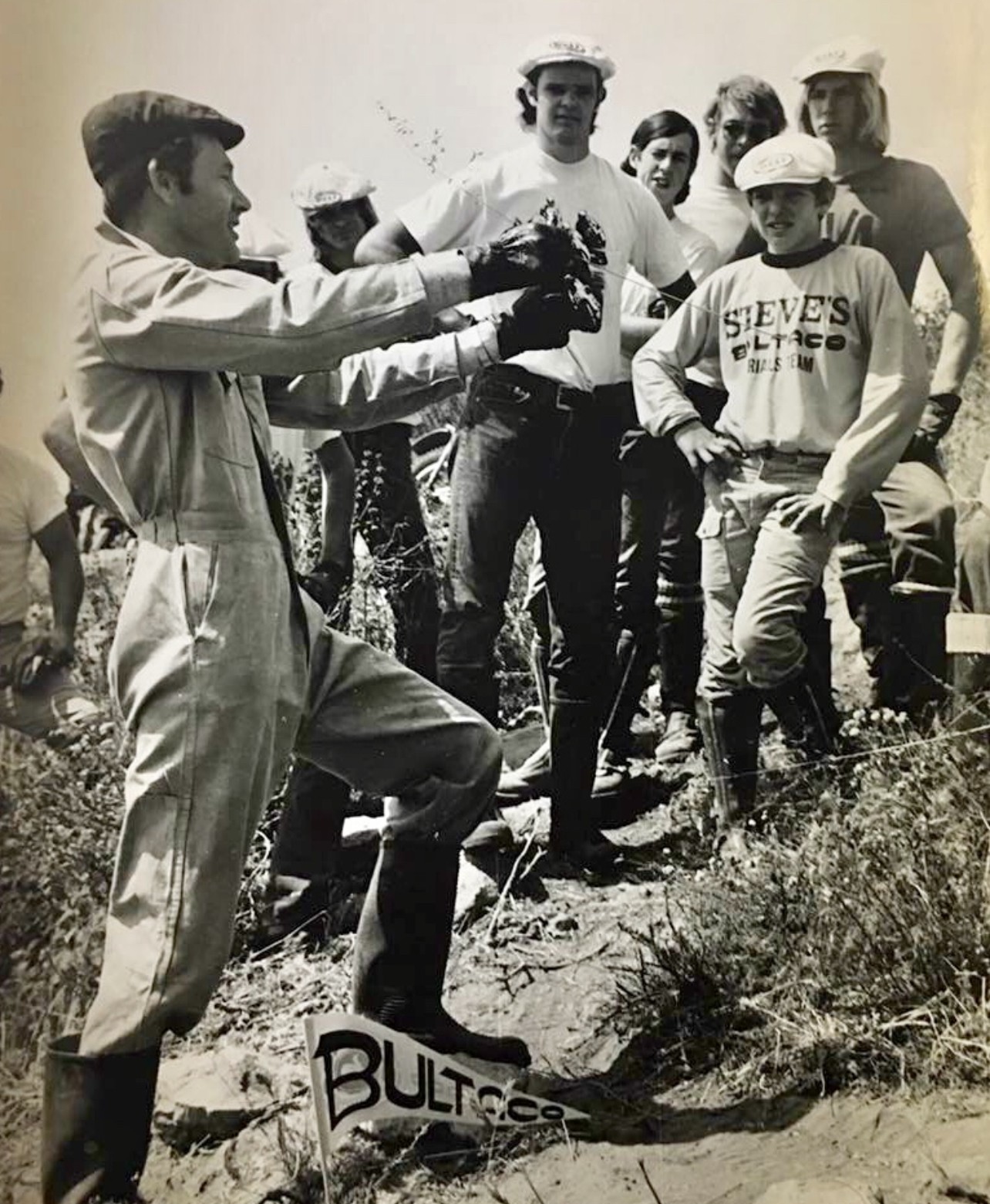
“The local Los Angeles dealer, Steve’s Bultaco supported me at first, until Bultaco International USA stepped up support based on my national results. My local trials club VOTE and all their members were great motivators and supporters as well. Always organizing events and trials training weekends.”

Support from Steve’s Bultaco on the Sherpa in 1971. (Photo: Bernie Schreiber Collection)

TG: So how did a young kid from California end up riding trials in Europe?

BS: “Riding in Europe is one thing, winning is another. Most Americans fifty years ago said winning couldn’t be done in Europe and here we are forty-six years later still trying to figure out how it had been done.

Every life has a story and every story has a lesson. My personal lesson is things are not as easy as they may seem.  At every stage in life, everyone has a story to tell, a lesson to teach, wisdom to share, so learn from them.”

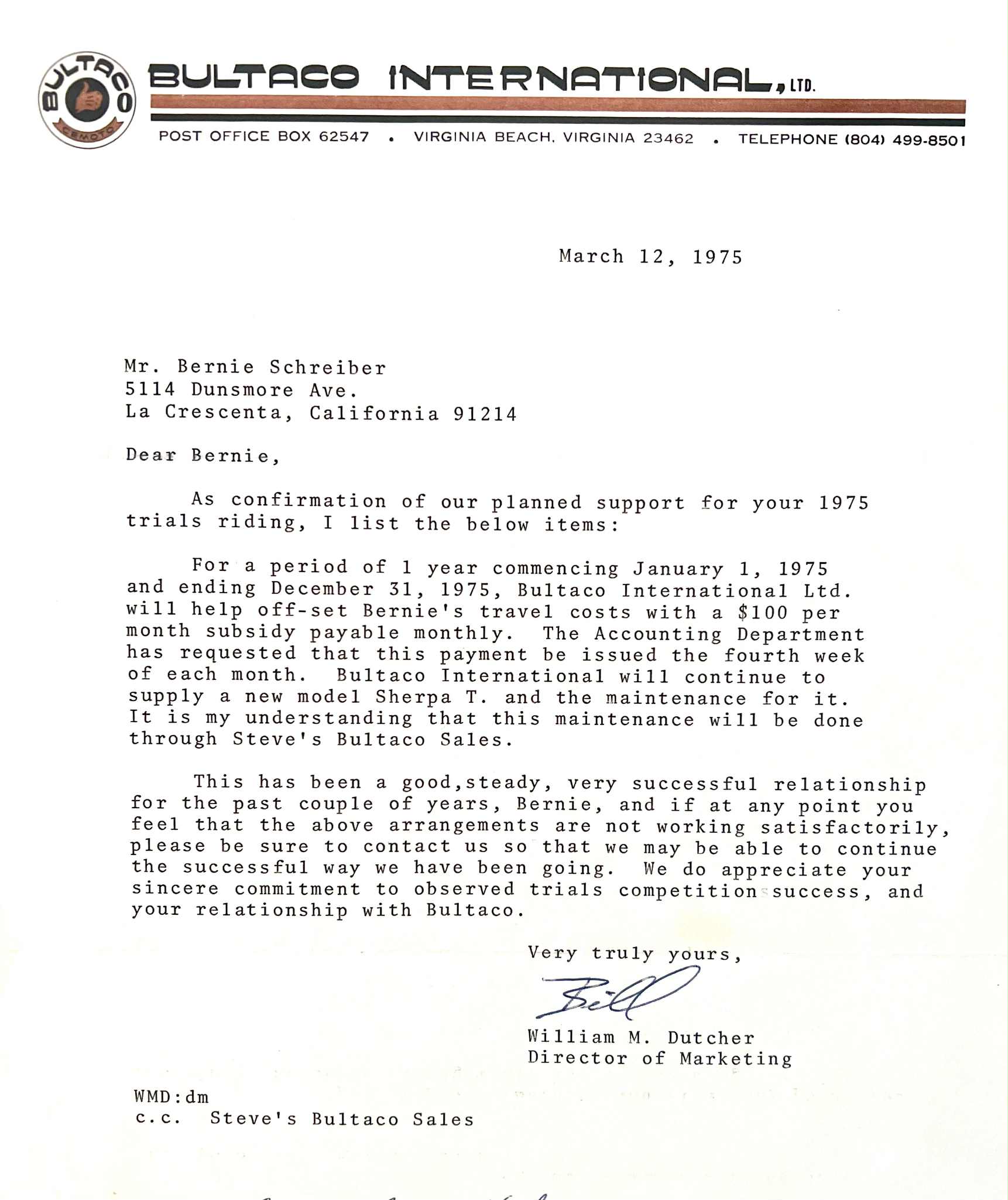
Letter from Bultaco International to Bernie in 1975. (Bernie Schreiber Collection)

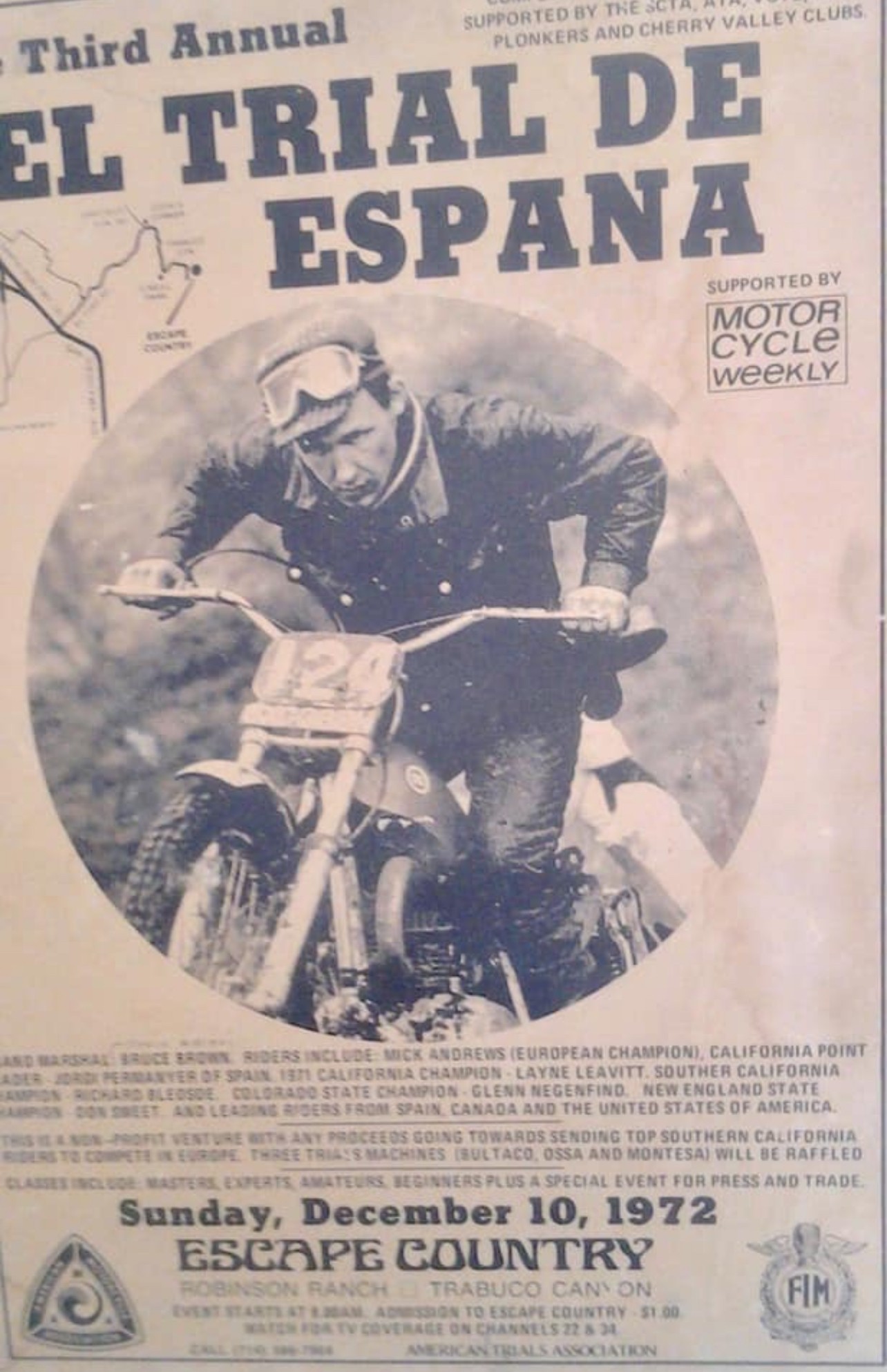
“My first trip to Europe was funded by (ATA) American Trials Association, the governing body of all trials clubs in Southern California and managed the annual El Trial de Espana event and the prizes and donations. This event which started in 1970, had a huge fundraiser each year to send a team of talented local riders to Spain. This was mainly to expose local riders to the European Championship and Spanish manufacturers.”

Bernie was the 1974 Southern California Trials champion and Bultaco International sent this cheque for $1,000 to him in recognition of his success on the brand. (Photo: Bernie Schreiber Collection)

“I was part of that delegation in 1974 to visit the Bultaco factory, meet the world riders and observe the Spanish round of the European Championship, before it became a World Championship in 1975.”

“In 1976, I joined the ETDE team again to Scotland to watch the Scottish Six Days Trial. I was still under eighteen years of age, so couldn’t ride both these events unfortunately.

I’d quickly seen that European sections in Spain were not the same as our American sections, so I immediately changed my practice at home to bigger steps, tighter turns, larger and longer sections with more speed. At the 1976 SSDT, I did learn a lot about the trials culture and history of a sport which was established in 1909.

El Trial de Espana trips were fruitful, and after hard work, winning events locally and nationally, the Bultaco factory and Bultaco International agreed in December 1976 to provide me an opportunity in Europe.

The main purpose was to obtain real trials competition exposure and learn from the world’s best Bultaco riders who were based in Europe. Therefore, I could improve my skills and become the best U.S. trials rider. That would inturn sell more Bultaco’s in a very crowed American market with more and more Japanese bikes entering each year. The Japanese brands were buying market share and acquiring the best talent in many American motorcycle disciplines.”

1977 – Practising hard in California on a stock Bultaco Sherpa M199 in 1977. (Photo: Len Weed)

“So, I departed to Belgium for my first three-month European tour in February 1977 to compete in the world championship and SSDT. I’d just turned eighteen in January and acquired my first FIM license. I landed in Brussels with rubber boots and a helmet, but no real riding gear for sub-zero temperatures, mud and snow.

To remind the younger readers, there was no internet, no fax, no iPhone, no GPS, limited English hard to understand and no money in my pocket. Thankfully, the Belgian Bultaco importer at the time, Marcel Wiertz took care of me on arrival. I had a test ride on a stock Bultaco Sherpa in the Belgium mud, and that was the real beginning of the European journey.”

Marcel Weirtz was the official importer for Bultaco in Belgium (Photo: Bernie Schreiber Collection)

“My practice sections in California paid off and I finished in fifth place in Belgium with one hundred and thirty points, just two points behind Yrjo Vesterinen the current World Champion. The next event was dryer and warmer in Spain and clenched my first podium that impressed the Bultaco factory owners.”

The West German round of the 1977 World Championship featured this big drop off (Photo: Bernie Schreiber Collection)

“Then onwards to France for a fifth place finish and another second place podium in West Germany, beating nearly every factory rider once during the two-month tour.”

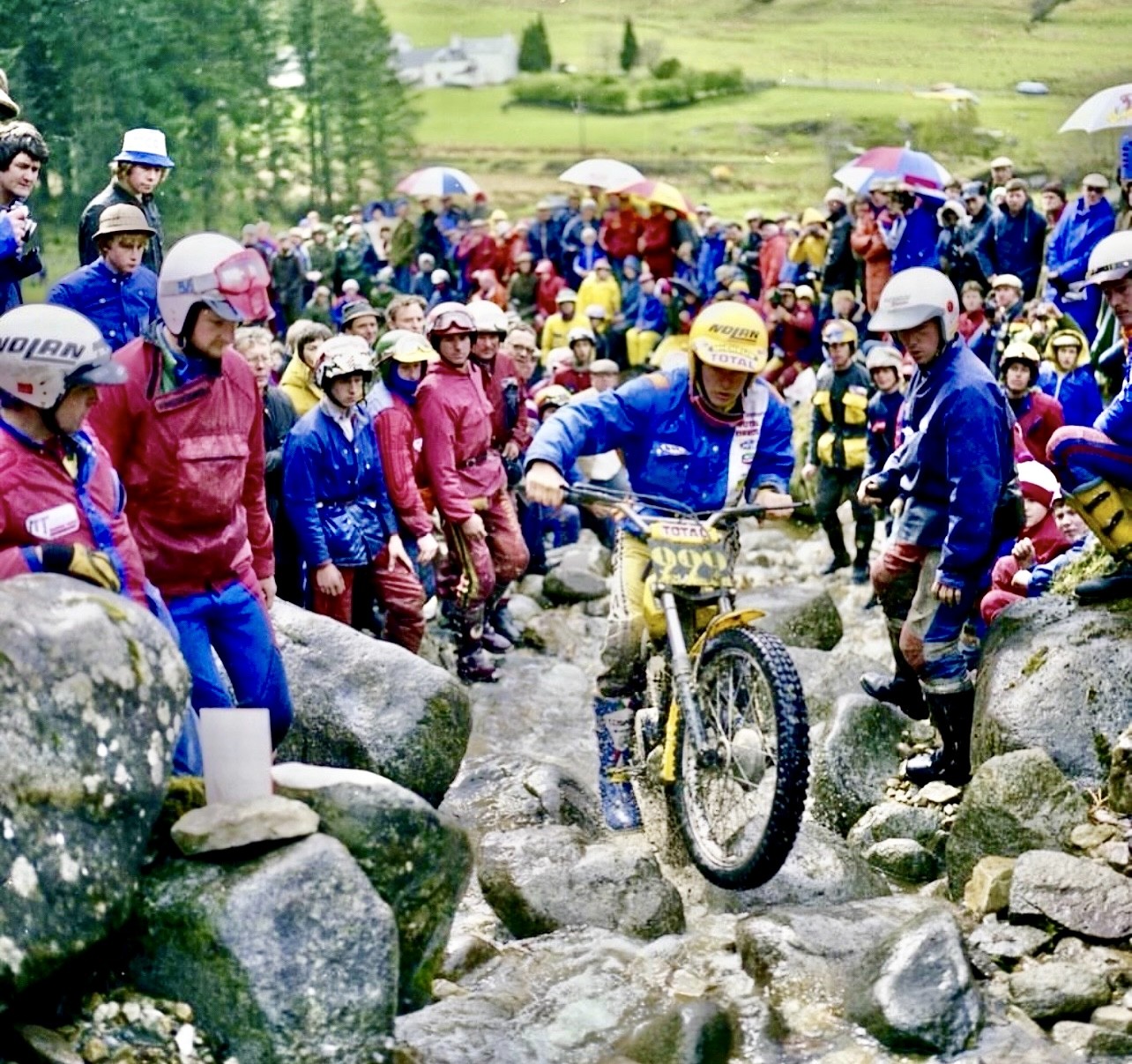
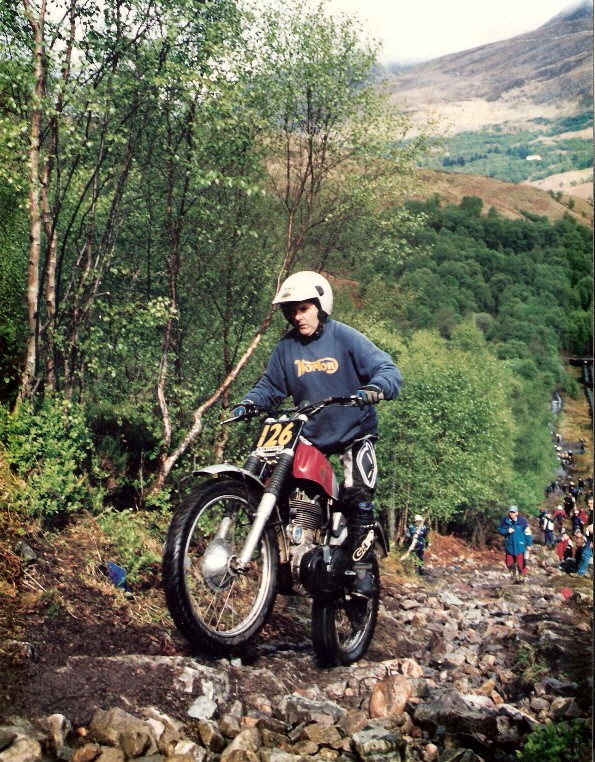
Bernie’s first Scottish Six Days was 1977 on a factory supplied Bultaco 325, where he was Best Newcomer, seen here on ‘Kilmonivaig’. (Photo: Iain C. Clark, Fort William)

“In the May, I competed in my first Scottish Six Days Trial and obtained the Best Newcomer Award with eleventh place out of several hundred riders. Overall, I finished the season seventh in the world and impressed some European media, spectators, sponsors and riders.”

Bernie Schreiber was Best Newcomer at the 1977 Scottish Six Days Trial (Photo: Bernie Schreiber)

“At the time, I wish there would have been other options besides Europe. Life was good at home, but sometimes opportunity only knocks once in life. You’ve got to be where the action is taking place at the highest level or you will most likely be left behind.”

TG: 1977 had been a year of experience for 1978, so how was the following year?

BS: “1978 was by far the toughest year and a turning point in my career. I asked myself many times, do I stay in Europe or stay at home. I learned a lot in 1978 and finally won my first world round in France, becoming the youngest rider ever at age nineteen.

Eventually, I went on to win four world rounds in 1978 – FRANCE, SPAIN, USA and ITALY. I became the first American to win a world round, so the impossible was achieved. The 1978 U.S. Wagner Cup round that year in Roaring Branch, Pennsylvania was a special win, as I hadn’t even won a U.S. American Championship until later that same year.

The biggest take away from 1978 was acknowledging that cleaning sections and winning world rounds from time to time was not enough to win a Championship.  The current world champion Yrjo Vesterinen was a great rider, like all the factory Bultaco team riders, Lampkin, Coutard, Soler and others. I learned a lot from each and every one of them.”

Yrjo Vesterinen was a close rival from the Bultaco days through to SWM (Photo: Bernie Schreiber Collection)

“Vesterinen was the man to beat and he was on his way to a third World championship title in a row. Vesterinen was a talented rider, smart and very consistent. His consistent effort, focus, preparation and mindset were unmatched. He had it all together and a well-planned strategy, and the most professional Championship rider without a doubt. Risk management drives Championship victories and Yrjo was a master with a plan to win Championship titles.”

Bernie Schreiber has a high regard for rival and friend, Yrjo Vesterinen (Photo: Bernie Schreiber Collection)

“Consistency became my obvious plan for 1979 after finishing third overall in the 1978 Championship. Numbers matter at the end of the season.”

1978, Schreiber in thoughtful mood, eyeing up the FIM World Trials Championship. (Photo: Bernie Schreiber Collection)

TG: Then it all comes together in 1979 and you won the FIM World Trials Championship?

BS: “The start of the 1979 season was extremely difficult and not as planned. It was decided with Bultaco after the 1978 season that London would be my European Base. From there, I could practice more mud riding, communicate in English and stabilize a bit. I moved in with the Hudson family and worked out of Comerford’s at Thames Ditton, Surrey the UK Bultaco importer at that time.”

Deep in conversation, Yrjo Vesterinen, Colin Boniface and Bernie Schreiber at the SSDT – Photo: Eric Kitchen

“I received tremendous support from the entire team in the UK, especially Pete Hudson a trials rider who worked at Comerford’s as competitions manager, he looked after me during the entire season.”

Bernie with Pete Hudson who looked after Bernie when at Comerford’s in 1979. (Photo: Bernie Schreiber Collection)

“The 1979 plan didn’t come together as forecasted. I crashed, bent the fork in the first world round in Northern Ireland and scored zero points. Then seventh in the UK, sixth in Belgium and fourth in the Netherlands. Actually, the 1979 season started worse than 1978 and I was way behind the leader in overall points, not just wins.”

1979 – Schreiber in World Championship mode. (Photo: Bernie Schreiber Collection)

“1979 started as one of those mental moments. It was a Rocky Balboa moment. “It’s not about how hard you get hit, but how hard you can get hit, get up and keep moving forward”. I moved forward to the fifth round in Spain and won. After that, things turned sunny, positive, and more consistent from that point. I won more events and stayed on the podium to the end.”

1979, Schreiber was on top of the world and gave Bultaco their last World Trials Championship victory. (Photo: Bernie Schreiber Collection)

“I had a lot of support from Comerford’s in the UK, but the 1979 season was only decided at the last world round in Czechoslovakia. That’s when history was made and it still stands forty-six years later.”

TG: What do you feel were the main drivers of your success?

BS: “The heart to win is a must, and it often comes with more pain than pleasure. Most of us were riding from the heart, not for the money.  The winning experience provides confidence which adds to your performance, but the most important skill is learning how to transfer your skills to competition and then to winning. The hardest skill is mental and how to transfer winning into Championship titles under pressure all season. Innovations can make the difference between winning and losing. Perfecting bunny hops and floater turns in the 1970s was an innovative advantage. Some called it trick riding, but it was used within the traditional non-stop rules of the sport. A positive attitude, strong motivation and commitment, combined with believing in yourself is the main driver of success.”

Bultaco had a strong factory supported team in the mid to late seventies. Here is Charles Coutard (France); Manel Soler (Spain) and Bernie Schreiber (USA) Photo: Bernie Schreiber Collection.

TG: You finished second in the 1980, 82 and 83 World Championship. Were those frustrating years?

BS: “YES and NO!

It’s always frustrating not to win, especially when you are expected to win.  The best rider always wins regardless of all the excuses we wish to present. People aren’t interested in hearing all the excuses, challenges or reasons for not winning, but they do exist for most of us at the top.   

Here are some facts that don’t change my results.  In 1980 when the Bultaco factory closed, I changed from Bultaco to Italjet in mid-season. For the readers, Italjet was a mini-bike manufacture and the Bultaco importer in Italy in 1980 and well aware of the current situation.

Most Bultaco riders had moved on and changed bikes by the end of the 1979 season. Vesty to Montesa and Lampkin SWM. Only Manel Soler and myself had not changed bikes by year end.”

Bernie Schreiber and Manel Soler were good friends (Photo: Bernie Schreiber Collection)

“I continued with Comerford’s Bultaco until the June of 1980, while Soler was going to develop the Italjet bike. In the end, Manel moved to Montesa and I was pretty much solo on a Green Taco with Spanish engineer Manuel Marques.”

“My first event in 1980 on the new bike was round seven in Switzerland and due to technical issues, no points were scored. Round eight in Germany, I finished late on time and no points again, so only scored points in ten of the twelve rounds that year and finished second.

I set two new world records that year by winning six of twelve world rounds in one season and the last four victories in a row. Won a lot of battles in 1980, but lost the Championship to Ulf Karlson.

1982 was probably the best year of my career with SWM. I had a proven bike, strong factory support and a great team manager with Pietro Kuciukian. For me personally, Kuciukian was the greatest of all time team managers and still a dear friend after forty-five years.”

Pietro Kuciukian was a guiding light for Bernie when at SWM (Photo: Bernie Schreiber Collection)

“The year resulted in two wins and ten podiums out of twelve events. Managed a UK hat trick in 1982, winning the SSDT, British World round and the famous Kick Start TV trial, but still finished second to Eddy Lejeune. We both dominated the season, but he was the best rider and won his first World Championship title.

In 1983, I changed bikes again, not brands. The SWM Jumbo was introduced which was a totally new bike frame and engine.”

The 1983 SWM ‘Jumbo’ 350 was a big bore offering from the innovative Italian factory. (Photo: Bernie Schreiber Collection)

“After just a month of training, I won the opening world round in Spain and managed eight podium finishes during the season, so quite happy with my results after six full championship seasons, but Eddy won again on his factory Honda.”

With Eddy and Eric Lejeune at Bilstain, Belgium (Photo: Bernie Schreiber Collection)

“Results and frustrations become less painful if you achieve most of your career goals. In sports, we are only the best during a certain moment in time.” 

The most desirable trials boot of all time. The Alpinestars ‘Schreiber’ (Photo: Bernie Schreiber Collection.

TG: How important was your 1982 historic Scottish Six Days Trial win?

BS: “It remains one of my greatest accomplishments in the sport of trials. I was not a huge fan of the SSDT in the beginning, because my knowledge of the events history and culture was blurred by the World Championships. It’s the only real trial remaining today in the sport.”

Schreiber’s 1982 Scottish Six Days victory, captured here by Eric Kitchen.

“The SSDT has long distances between sections, river style sections with many uphill rock beds, cold weather, time controls, non-stop rules, no score cards and six tough days over one hundred miles each day. It has always been an important event for manufactures, media and sponsors.

My second attempt was in 1980, I was the current world champion, but after two years of absence from the first attempt in 1977, I was not familiar with the event anymore. After three days, I realised that this event was really unique and one of a kind. I began to understand the true meaning of reliability trials, the history and traditions of the SSDT itself and where the sport all began.

1980 SSDT action on the famous ‘Pipeline’ section. (Photo: Jimmy Young)

If you try to clean every section each day, or try to win each day for six days, you were not going to win. The event is tough and had little margin for errors, not like a world championship, where you could drop more points in a day than the entire six days trial.

The SSDT is comparable to winning the Open Championship of golf at St Andrews in Scotland. It’s the most prestigious, most historic and most traditional event in the sport of Trials.”

TG: 1987 was your final appearance at the World Championships. When did you realize your time was up? Was that an easy decision?

BS: “Honestly, my time was up at the end of 1984, although I won two world rounds that year, including the British and German which were my last wins. Overall, finished third in the World Championship. I rode a few more years for fun and enjoyed it, especially with Gilles Burgat on the 1986 Yamaha team.”

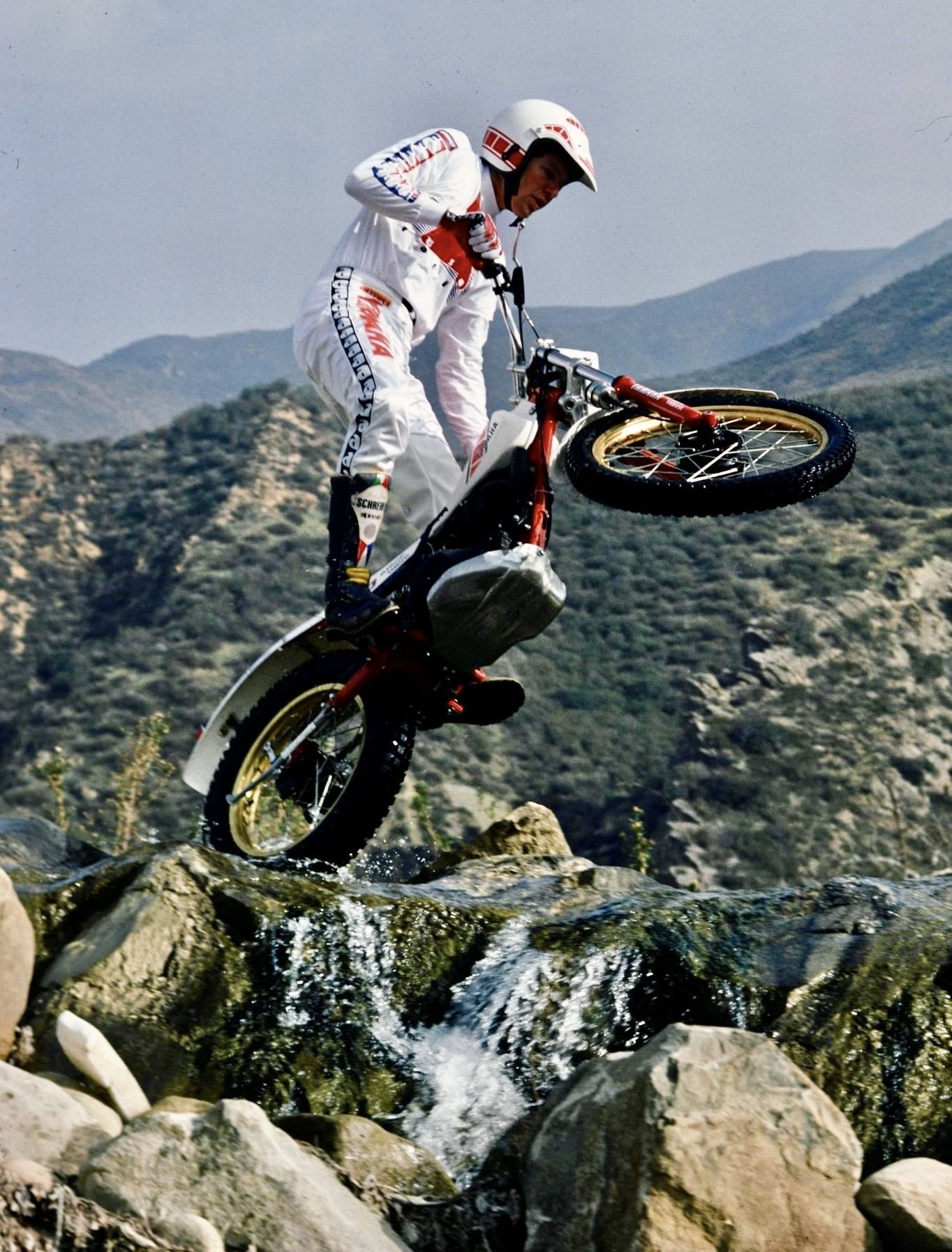
On the Yamaha TY250R, but the time to move on had arrived. (Bernie Schreiber Collection)

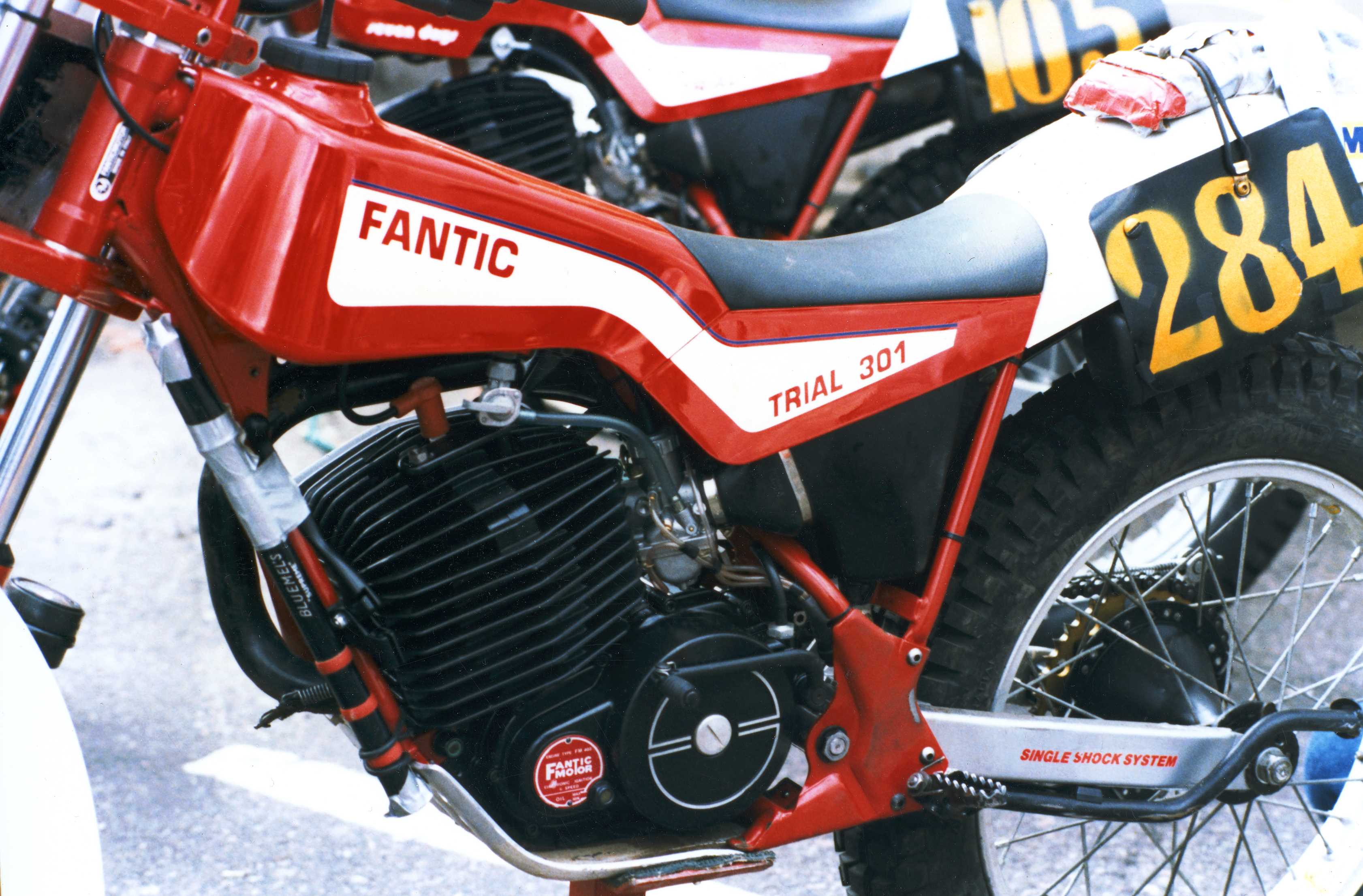
“My last year in 1987, had been focused on winning the U.S. National Championship for the fourth time and competed in the Spanish and American World rounds on a Fantic 303. It was nice to win the 1987 American Championship one more time after not competing since 1983.”

Bernie rode for Yamaha at the conclusion of his professional trials career. (Photo: Bernie Schreiber Collection)

“Good decisions are not easy to make, but mine was good for me. After ten years competing in over one hundred world rounds at high-level competitions, most major accomplishments in the sport had been reached except the Scott Trial of which I never competed.

Otherwise, six overall world podium finishes in 1978, 79, 80, 82, 83 and 84. Twenty individual world wins and forty-eight podiums over those six years.  It was time to explore and seek new challenges.”

TG: What happened after you retired in 1988 and stopped competing as a professional Trials rider?

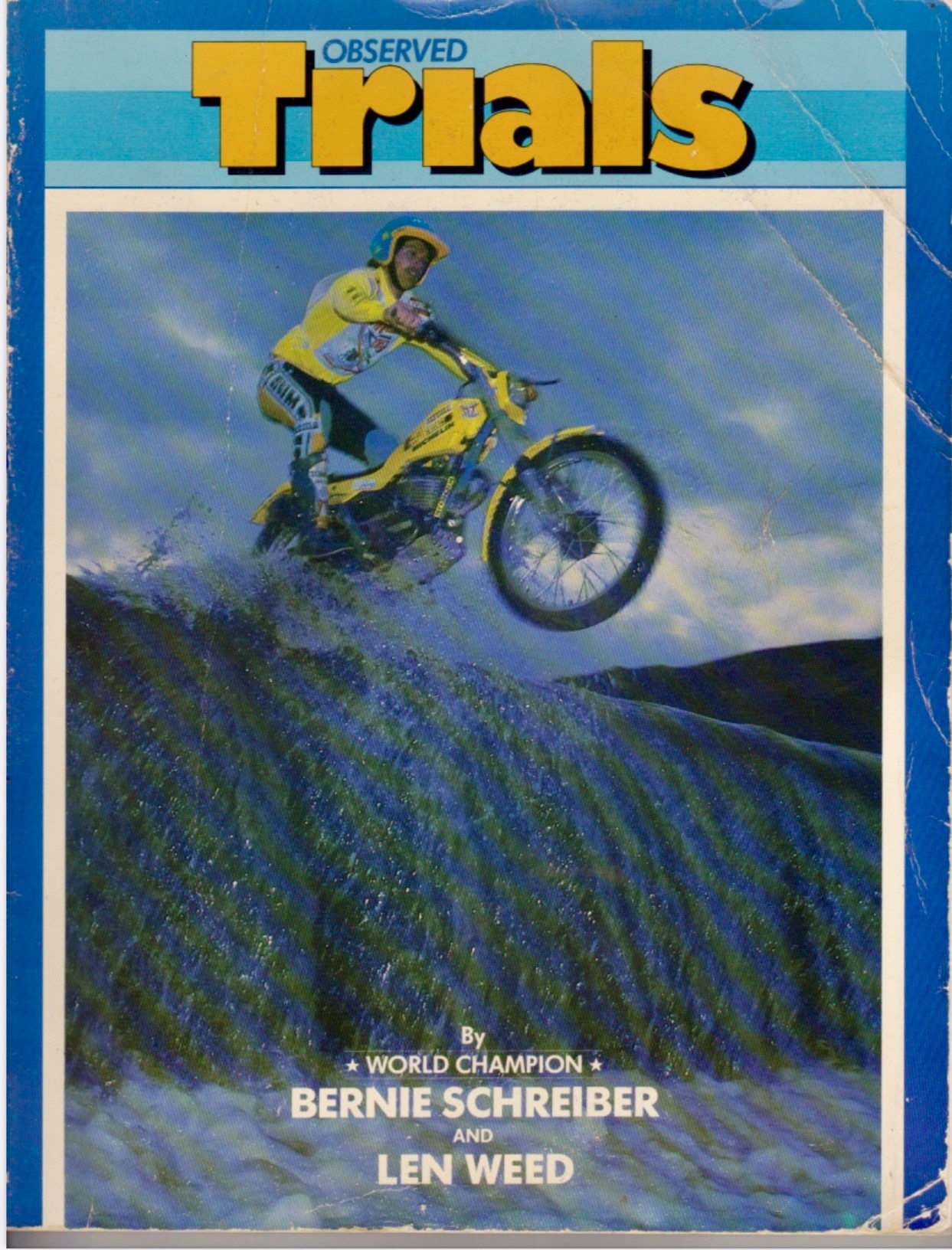
BS: “In 1998, I’d been doing trials schools worldwide for a few years and continued doing them for another year. Many riders had bought my book ‘Observed Trials’ by Len Weed when it was published in 1983 and never seen the techniques in action, so it was an opportunity to share my time and skills with club riders and trials fans.”

Bernie Schrieber’s 1983 book ‘Observed Trials’ which he wrote with Len Weed.

“In 1989, I started my first real job with the Malcolm Smith Products (MS Racing). The company was expanding to Europe in 1989 and needed boots on the ground to assist them with sales, marketing, and newly appointed European distributors. Great experience and Malcolm had always been one of my heros and a legend in the motorcycle industry.

After two years with MS Racing, I set up a consulting company in Europe and began advising additional clients Alpinestars and Answer Products overseas in the motorcycle and bicycle industry. I had a prior relationship with both, due to my trials boot and handlebar agreements in the early 80s. By the mid 1990s, I was mostly in the cycling industry with a strong focus on mountain bikes and accessories. I managed the consulting company for about six years.”

Bernie had contracts with Answer Products and Alpinestars with whom he developed for them the now famous and highly collectable ‘Schreiber’ trials boot. (Photo: Bernie Schreiber Collection)

“In 1996, the Company was approached by Tissot Watches of Switzerland who signed a long-term agreement as the official timekeeper for all UCI Cycling World Championship disciplines.

Tissot was searching for someone to manage on-site activations and promote their new precision and robust watches in the Mountain Bike space. That was my first big BRAND client. Tissot is one of twenty brands owned by the Swatch Group in Switzerland.  After a year or so of providing services, the Tissot President asked if I’d be interested to work internally at the headquarters in Switzerland and take responsibility of the Sports marketing department globally. The answer was YES just like with Bultaco in 1977. A multinational group with one hundred and fifty-year-old brands and 10,000s employees is when I took a deep dive into the corporate world.

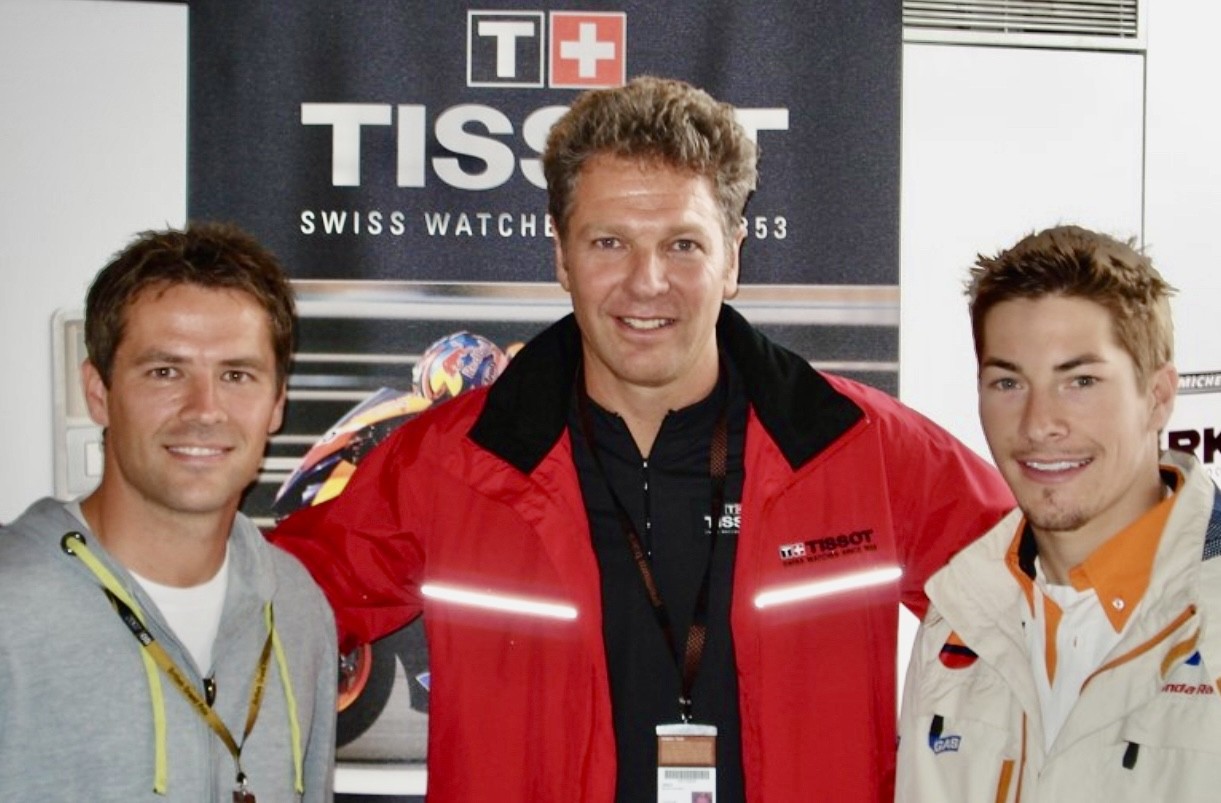
Over the next ten years, Tissot had double digit growth year after year. We signed partnership agreements for timekeeping services and product licensing with several global properties in motorsports like MotoGP and NASCAR, but also the Asian Games, AFL, CBA in China to name a few. We had selective ambassadors like footballer Michael Owen, Danica Patrick in Indy Car and the late Nicky Hayden in MotoGP as well.

Michael Owen and the late Nicky Hayden were brand ambassadors (Photo: Bernie Schreiber Collection)

“In 2010, I decided to take a career break and stop travelling to events around the world for a while. Wonderful experience, but too much time on the road. It had been over twenty years on the road by now with trials travelling included.

Two years later in 2012, I was presented an opportunity by the Swatch Group CEO to lead the U.S. golf initiatives for the Swiss watch brand OMEGA in the USA. This position was based in Palm Beach Gardens, Florida.  

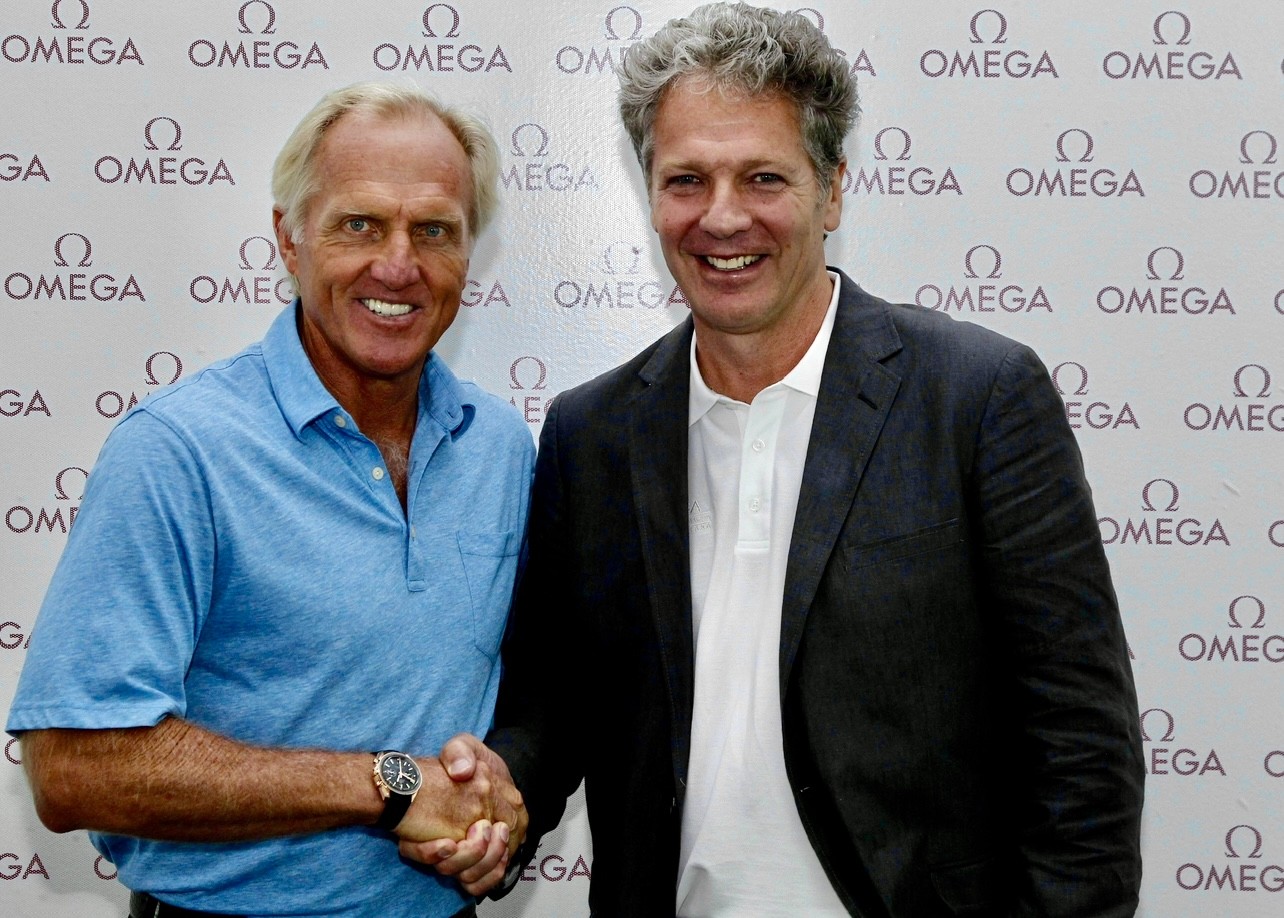
Omega had just signed a long-term partnership agreement with PGA of America, the governing body of 28,000 golf professionals across America. I spent three years traveling throughout the US, activating the brand in the golf space. My main focus was on golf tournaments, included the US Ryder Cup and other PGA of America Championship events. Omega has been the official timekeeper of the Olympic Games since 1932. They are very active in other sports like sailing, track & field and swimming. Prior to my arrival in the USA, Omega signed Greg Norman – the real Australian Great White Shark to be a brand ambassador, so I was based and worked out of his offices for the next three years before returning to Omega Switzerland.”

With Greg Norman and Omega. (Photo: Bernie Schreiber Collection)

TG: You remained in sports for a long time with professional athletes, can you tell us more about that?

BS: “Professional sports athletes are easy to work with, but often their agents are NOT. Sports ambassadors that have a Personal brand that fits a corporate brand can be a great association and added value for both parties. The activation plan of the association is key to the success of any co-branding partnerships.

Ambassadors are a product of the brand communication. Example: Michael Phelps the greatest Olympian of all time would talk about the importance of timing/touch pads during his swimming competitions at the Olympics, or golfer Rory McIIroy who would talk about precision and timing of a putt at the Masters. Time is what you make of those moments which can be in the past or present.

Timekeeping is an important tool for sports athletes or race teams. Nearly all sports Federations need a service provider for timekeeping. That’s how they measure performance, set official world records and handle results data for media and TV networks. You can host a major event without sponsors or spectators, but you must have a timekeeper. Try removing timekeeping from a downhill skiing event or many other sports. It would be like removing sound from a movie. All emotions are gone and nothing to measure performances.”

TG: Did you return to Switzerland after your U.S. Golf tour?

BS: “YES, returned to Omega Switzerland in 2015 to lead “Golf returning to Olympics” for the first time in 100 years and assist with other golf projects in Asia.

In 2017, we decided as a family to move permanently to Zurich for my son’s schooling and my partners work opportunities. A wonderful twenty years with Swatch Group. I’m thankful for the opportunity.”

TG: Have you still been doing any local club trials or did you walk away completely?

BS: “By 1989, I had lost interest in trials and found a passion in new adventures which was exciting times. I completely walked away from trials for about twenty years, or 1988 to 2008.  In 2008, I received an invitation to ride the Robregordo classic two-day trials in Madrid, Spain.”

Manel Soler with Bernie Schreiber at Robregordo in 2008 (Photo: Bernie Schreiber Collection)

“A special event to celebrate my thirty years anniversary of my world championship victory. I had so much fun riding with old friends, Manel Soler, Mick Andrews, Andrea Codina, Jamie Subira and many others. At that time, I had no bike, boots, clothes or helmet. Everything was provided. Unfortunately, I was still working and had little time to ride trials.”

Bernie at Robregordo, Madrid in 2008 on a Bultaco supplied by Carlos Bosch. (Photo: Bernie Schreiber Collection)

“In 2011, Gilles Burgat invited me to celebrate his thirtieth anniversary at the Ventoux Classic Two-Day Trial in France. Another fabulous weekend with so many champions and friends. I was hooked to ride again, but soon after in 2012, I departed to the US for three years. During that time in the US, I attended the 2013 U.S. World round in Tennassee. Many old friends and fans attended the event. Great weekend and a lot of autographs.”

TG: When did you become involved in Trials again?

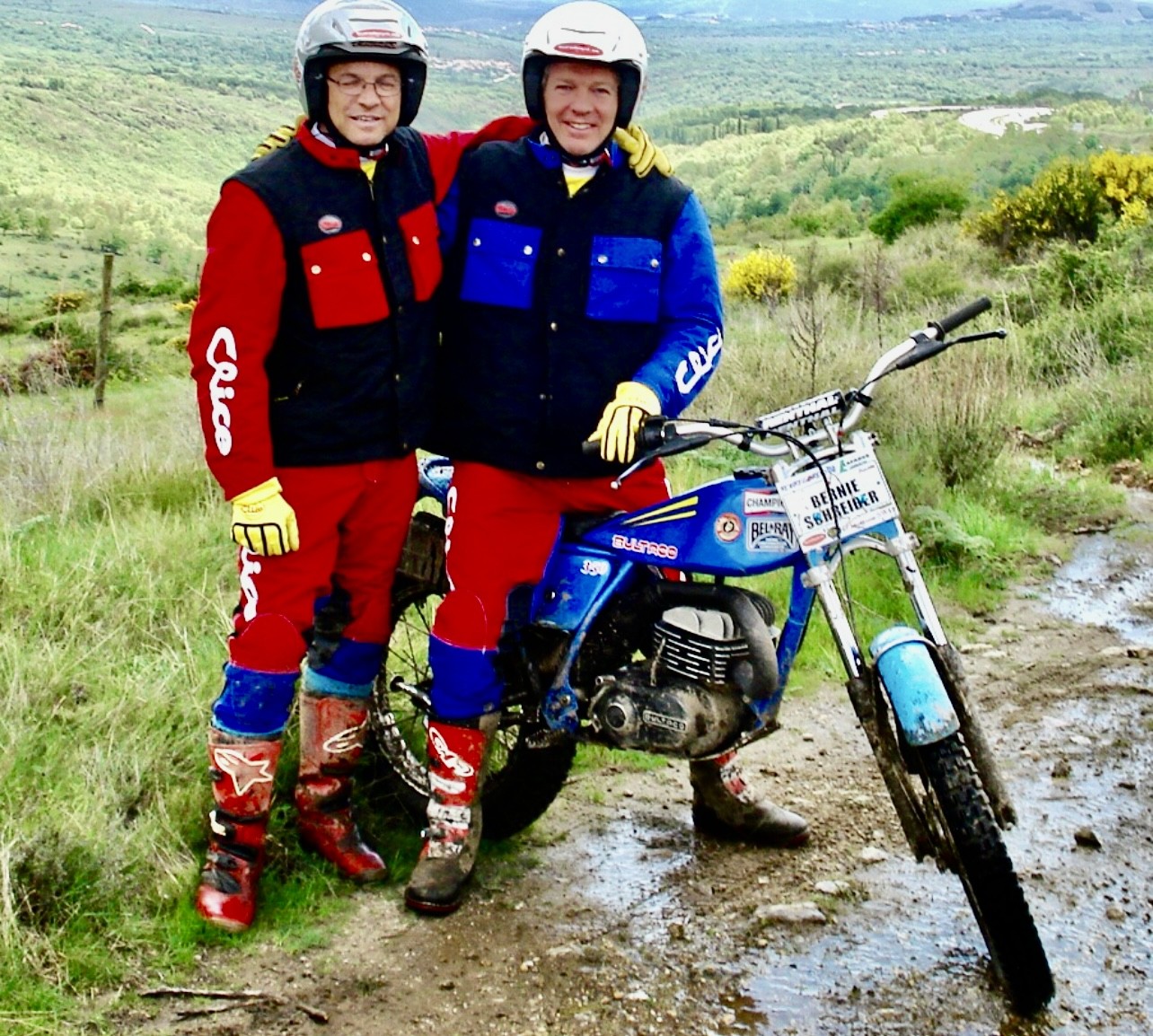
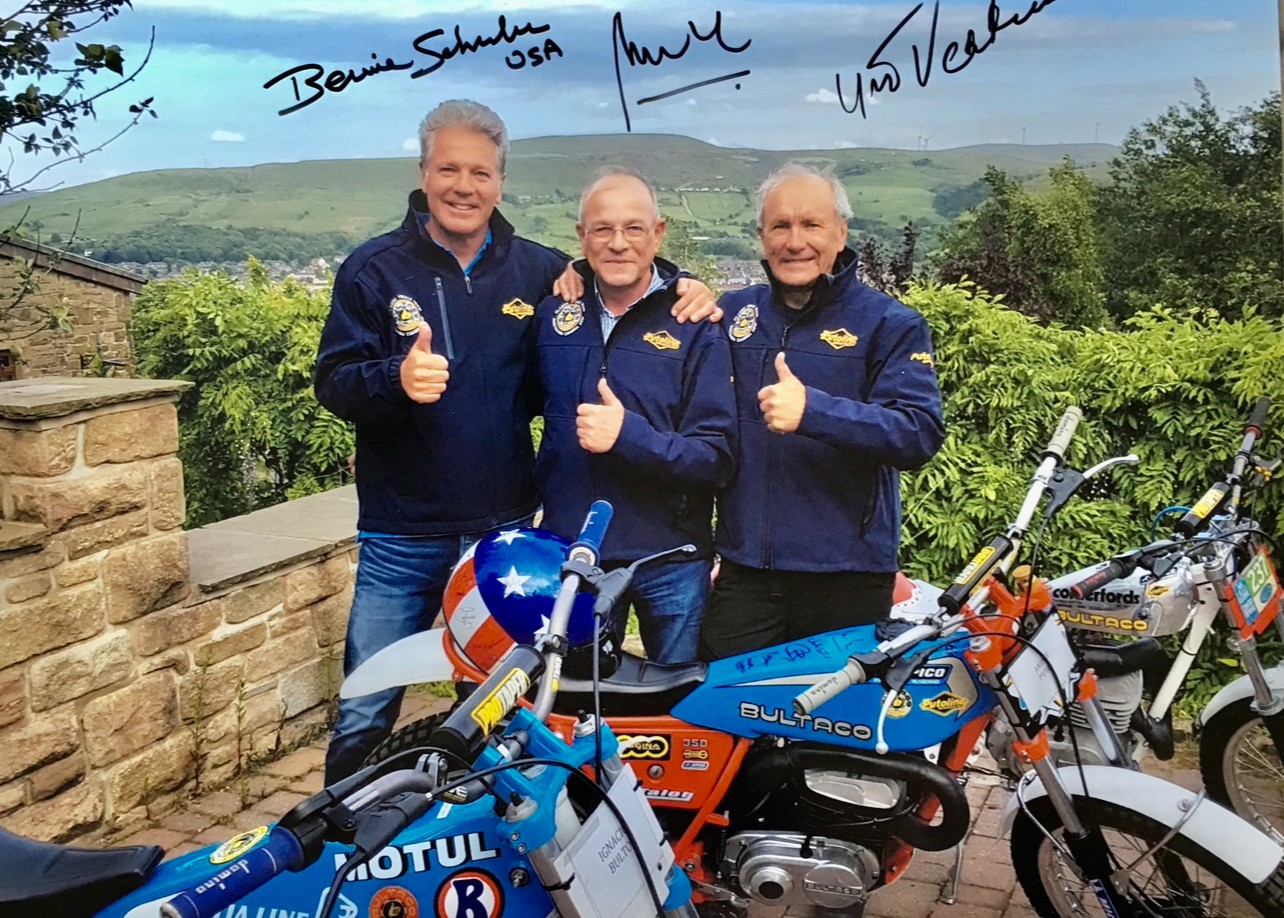
BS: “In 2018, I became more interested and available to ride trials and started receiving invitations to ride Classic events. The 2018 Bultaco Revival in the UK was my first real competition in many years. Riding with Vesty and Soler and staying at his home was the best weekend of trials for quite some time. Maybe because I competed on one of Vesty’s machines, but it was magical and memorable few days.”

Together again as Team Bultaco at the Revival trial in Cumbria. Bernie, Manel Soler and Vesty (Photo: Bernie Schreiber Collection)

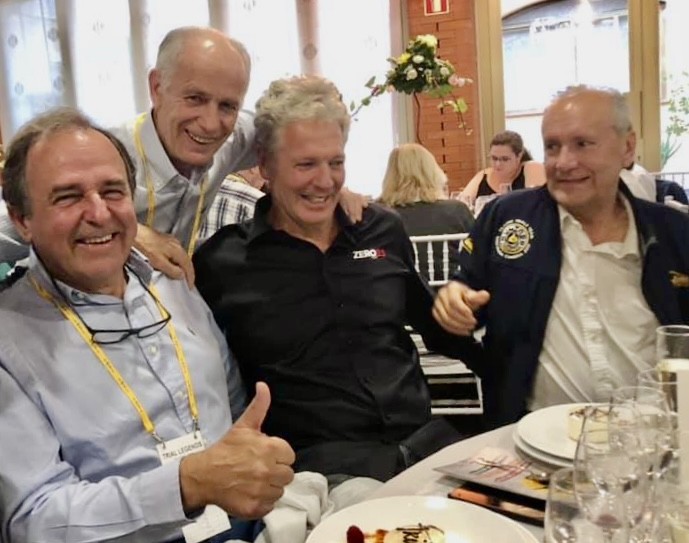
“A few months later there was the big gathering of trials riders in Barcelona, Spain called the ‘Trials Legends’ (1964-1985) that celebrated the golden years of the sport. Most of the past and present Trial Legends were present that day. Memorable moments with many champions.”

2018 Trial Legends, Barcelona, Spain, with Javier Cucurella; Charles Coutard, Bernie Schreiber and Yrjo Vesterinen. (Photo: Bernie Schreiber Collection)

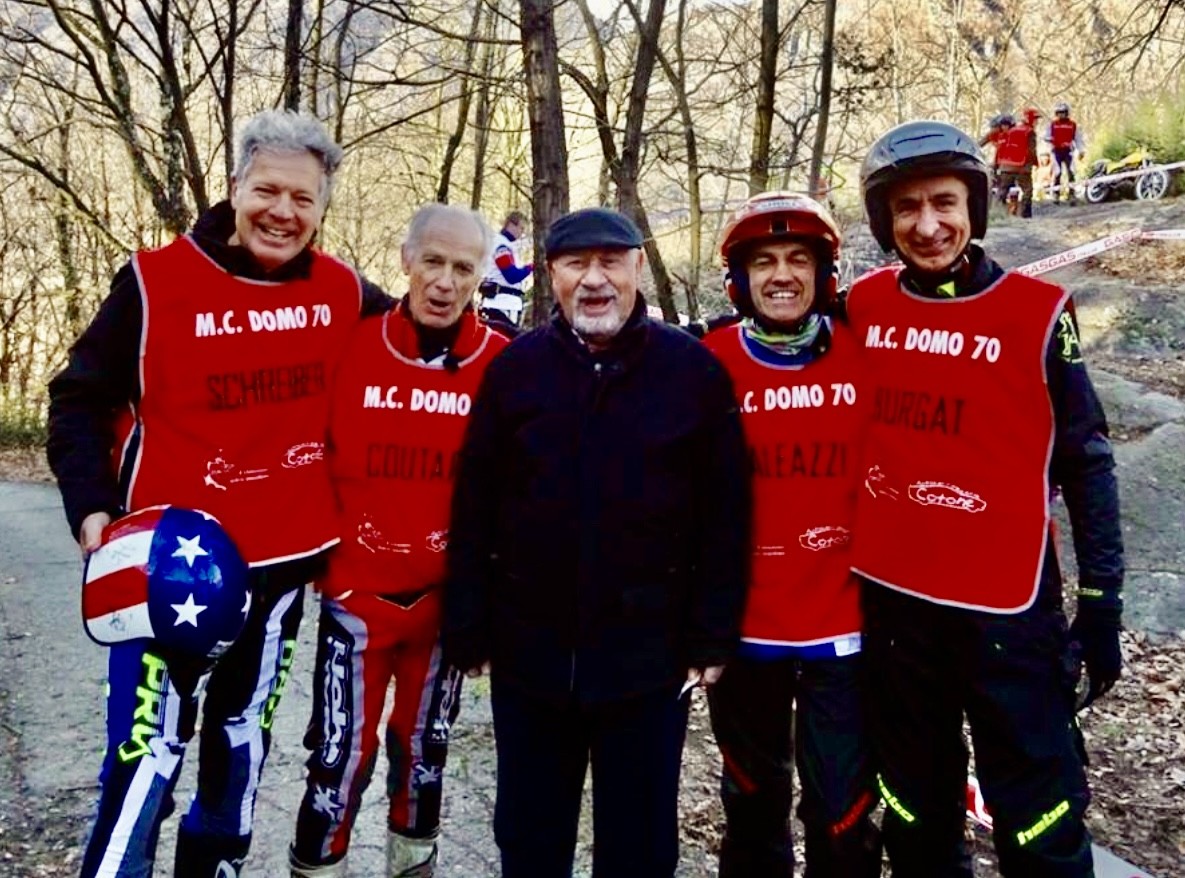
“Later that year, I was invited to Italy for the Trial of Champions and Danilo Galeazzi’s 60th anniversary. The whole SWM team from the 1980’s was there and it was a celebration to remember with Moto Club Domo 70 in Domodossola.”

2018 and the SWM team are back together in Italy.

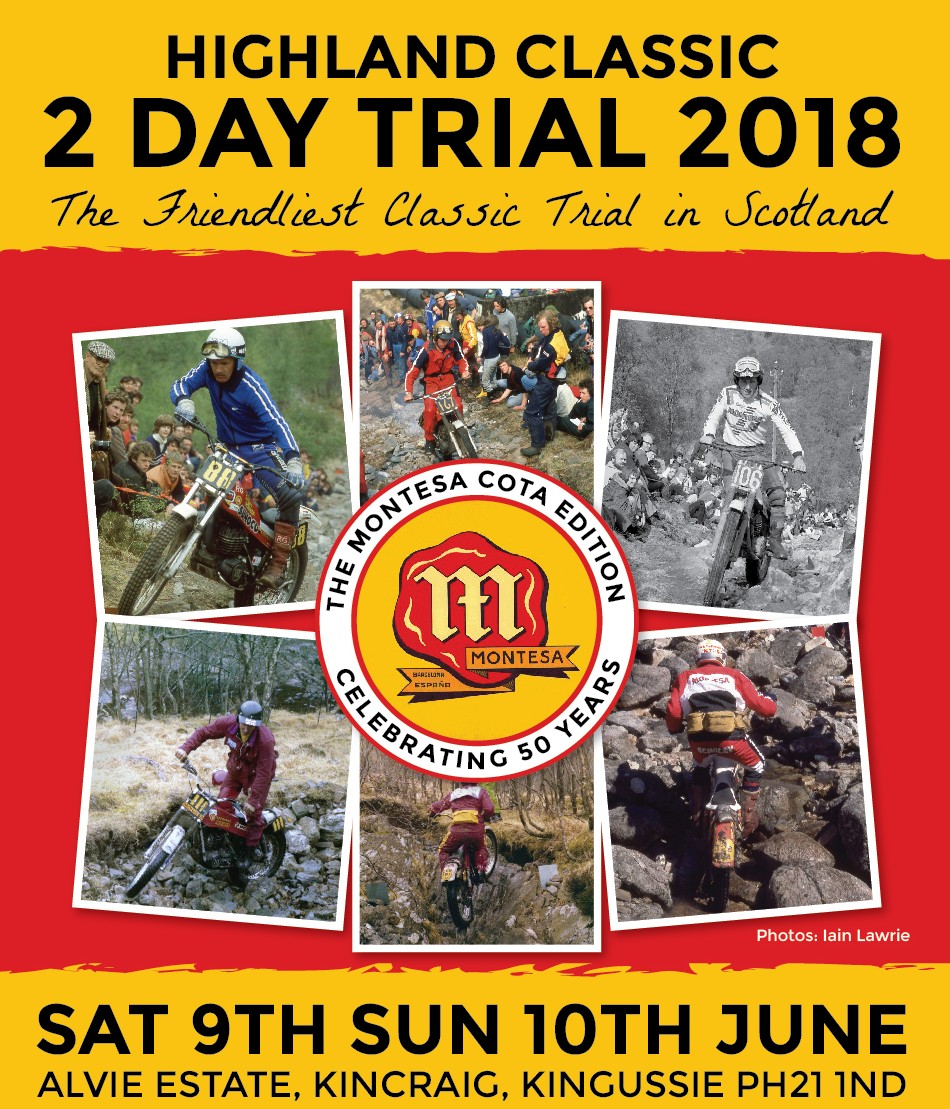
“2019 was the fortieth anniversary of my world championship title, and really the first year of full involvement again in the sport. It started with a lengthy phone call with John Moffat about participating at the Highland Classic Two-Day Trial as their guest of honor at Alvie Estate in Scotland. Its was the first time on the pegs in Scotland since my 1982 SSDT win. The Friendliest Trial in Scotland.”

“After watching riders on Facebook videos, it was clear that many of the classic riders lacked some fundamental skills, so it was decided with John Moffat to launch a Trials school in Scotland the day after the Highland Classic. Riding trials without learning the fundamentals is like building a house with no foundation. It will look good for a while and then it will fall apart.

I’d seen the need for a training plan with basics learning tools. A lot of basic instruction can be found in my book ‘Observed Trials’ with Len Weed, but I wanted to go deeper into the mental approach as well. You can be good at something, but not successful implementing it when needed. The approach and experience of learning has changed, but the basics are still the same.

That was my first school in decades and I repeated the experience in four other locations that year which included England, Canada, USA and Spain.”

TG: Did you compete in more competitions throughout 2019?

BS: “It was a fun year for sure with many invitations as Guest of Honor. Following the Highland Classic, I attended the Bultaco Revival in Yorkshire, then Andorra two-day trial followed by the Leven Valley in Scotland.”

Andorra in 2019 with Yrjo Vesterinen and Horacio San Martin of Todotrial website. (Photo: Bernie Schreiber Collection)

“The year ended with the traditional Robregordo Trial just outside of Madrid with a school organized by Javier Cruz. 2019 was busy with a lot of travel and experiences.”

With Spanish enthusiast, Javier Cruz in Madrid (Photo: Bernie Schreiber Collection)

TG: You stayed active in the sport between 2020 and 2024 considering Covid cancelled many competitions. Tell us about those years?

BS: “The 2020 Covid pandemic changed plans for many people in many sports. I still managed to attend a few events before Covid started and one being the Classic Dirt Bike show in Telford for the first time.”

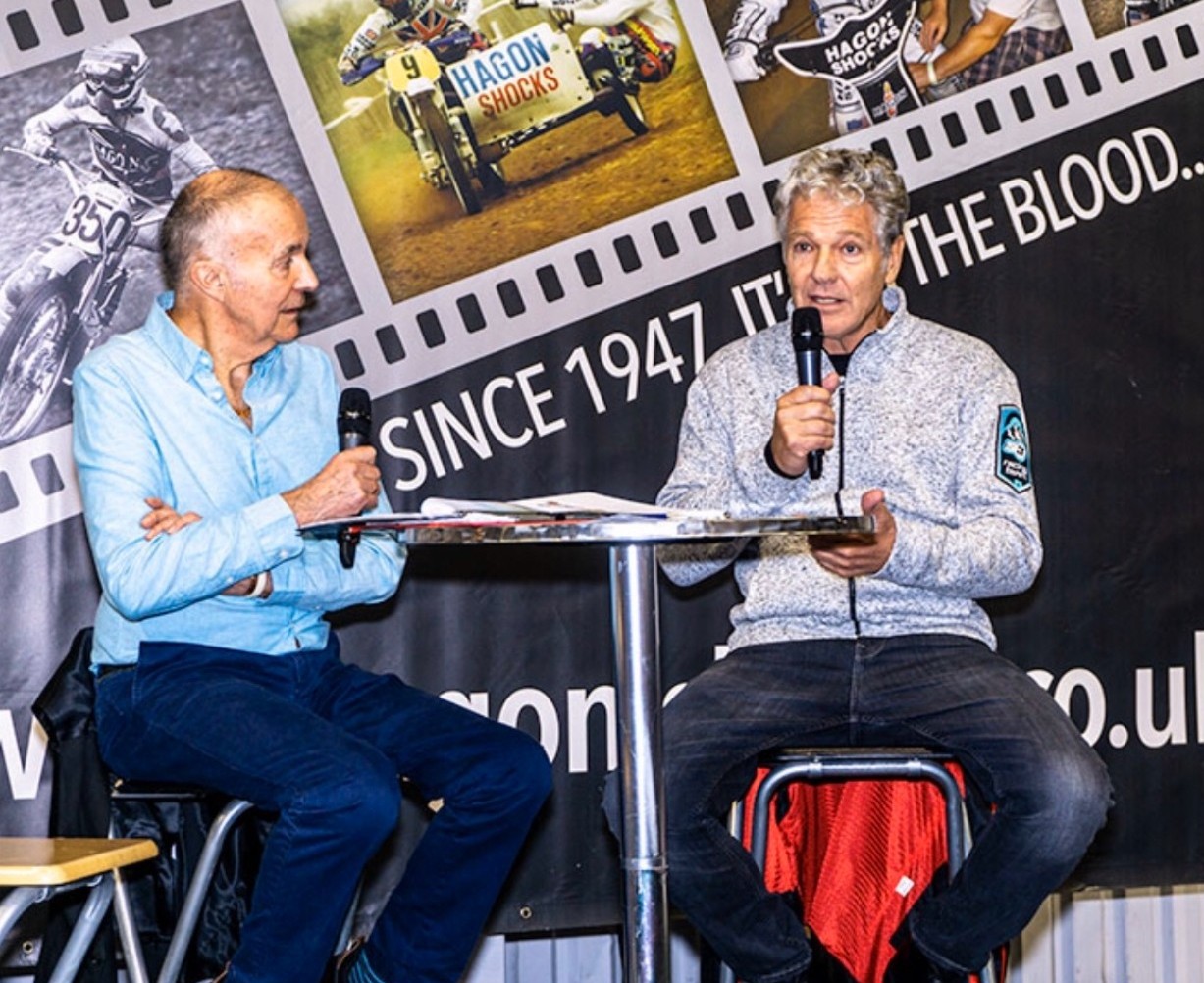
Jack Burnicle interviewed Bernie on stage at the Telford Off Road show in February 2020. (Photo: Bernie Schreiber Collection)

“I also participated at the Jersey Island Classic the day before the UK was closed and flew out on the last flight from London to Zurich.”

Jersey 2020, with Jersey Classic and Modern club President, Graham Du Feu. (Photo: Bernie Schreiber Collection)

“Later in August 2020 I competed at the A-Cup Trial in Austria, where they hosted their riders meeting in masks. It was good fun and nice venue. Overall, the year was good and was able to work on my first website with Heath Brindley who will soon be developing the new updated version soon.  www.bernieschreiber.com

2021 was a quiet year with fewer trials activities which included the Arbecey Invitational in France and the Due Giorni Trial Folgaria in Italy.”

“The one big event in 2021 was the FIM Awards Gala in Monaco and being a recipient of the FIM Trial Legend Award. A beautiful evening and very honored to receive this award by the FIM President, Jorge Viegas in front of the world’s motorcycle champions.

The FIM Congress with President Jorge Viegas in 2021 at Monaco. (Photo: Bernie Schreiber Collection)

2022 was a big year for the good and not so good. First was the loss of my father and best friend who had been the driving force of my trials career from the first day, so not so good.”

Richard and Bernie Schreiber. Richard was Bernie’s guiding light in the early years. (Photo: Bernie Schreiber Collection)

“It was a year of reflection and the fortieth Anniversary of my victory at the 1982 SSDT. I had planned activities, but reduced them due to other family activities.”

GLOVES OFF was launched in February 2022 with TRIALS GURU as a regular and exclusive column in the news feed, and is archived there for trials enthusiasts. https://trialsguru.net/gloves-off-bernie-schreiber/

“In the April, I made a trip to the UK to visit Heath Brindley for a few days to ride in Wales with a modern TRS and friends. That followed by a bucket list visit to the Sammy Miller Museum which is highly recommended. Seen some beautiful machines, motorsports history and luckily seen the man himself for a tour. Sammy was my first trials instructor in California back in 1973, so it was very nice to catch up with the champion and legend.”

Friendship and mutual respect, Sammy Miller MBE and Bernie Schreiber at Sammy’s workshop at New Milton. (Photo: Bernie Schreiber Collection)

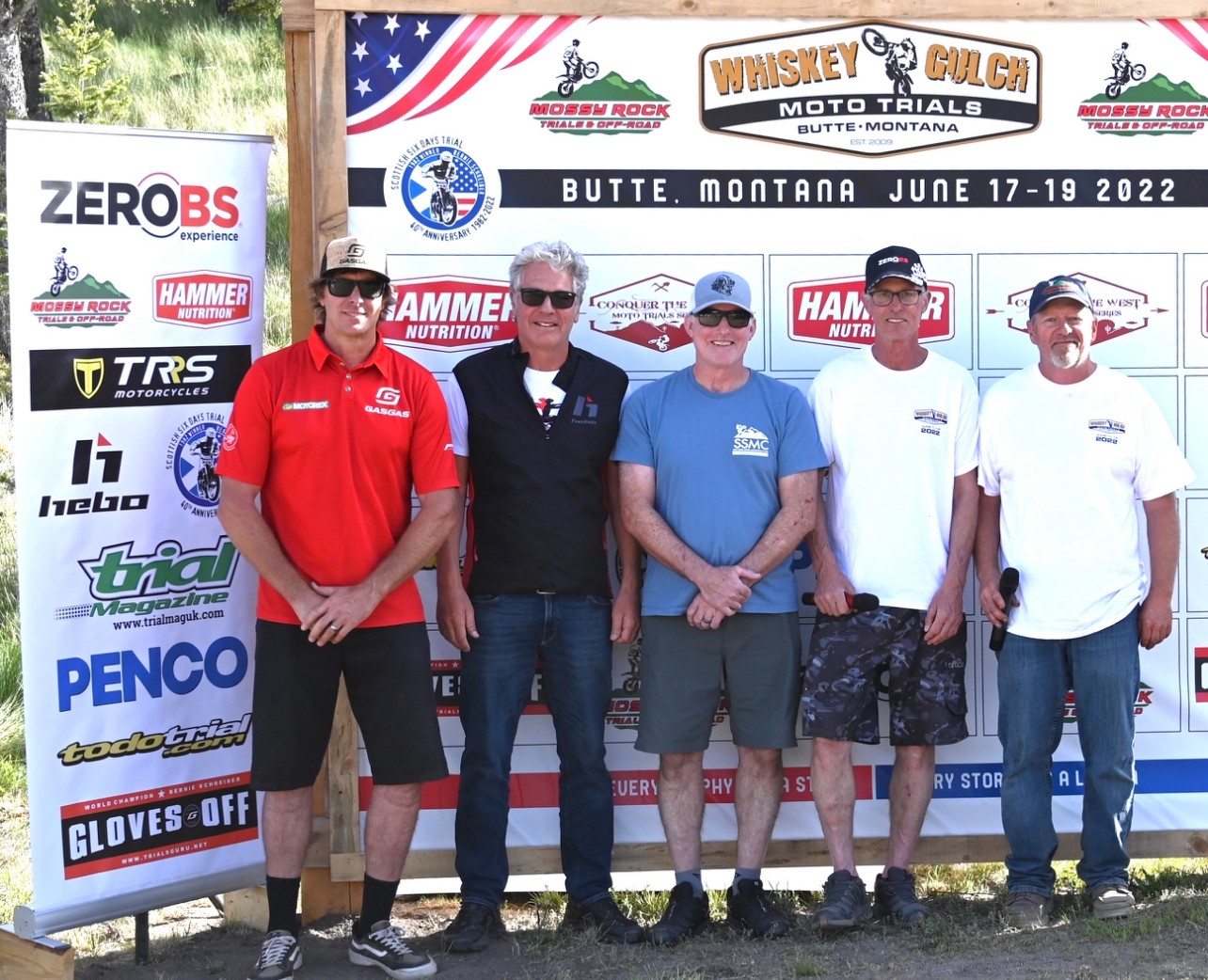
“As the year advanced, Rich Hilbun organized a fortieth SSDT celebration in Montana with a trials school and annual event called ‘Whiskey Gulch’ with one hundred and twenty riders attending from the USA and Canada. A fabulous week of trials with American friends and my Spanish friend Yoyi San Martin from www.TodoTrial.com in Spain.”

Left to right: Geoff Aaron, Bernie Schreiber, Scott Head, Rich Hilbun and Dan Larson in 2022 at Whiskey Gulch, Montana. 17 U.S. titles in one photo! (Photo: Bernie Schreiber Collection)

“In 2022, I decided that as I bought my first Bultaco in 1971, a 125 Lobito with money I received for my paper round, I would buy my second Bultaco. I only had bought one Bultaco, all the ones I rode were given to me under sponsorships or contracts. I struck out and bought a 325cc model 199A, the type I used to win the 1979 World championship. That was a gap of fifty-one years.”

Bernie’s personal 1979 M199A Bultaco Sherpa, only the second Bultaco he has ever bought. (Photo: Bernie Schreiber Collection)

“Another highlight of the year was the 2022 FIM Trial Vintage Trophy in Monza, Italy. This event was one day before the Trial des Nations. This was the first ever FIM Vintage Trophy event and my role was Ambassador, not competing. The winner was Philippe Berlatier from France.”

Philippe Berlatier was the winner of the 2022 FIM Trial Vintage event. (Photo: Bernie Schreiber Collection)

2023 highlight was a Trials school in Tulsa, Oklahoma, organized by Kirk Mayfield an old trials friend since the early 1970’s. The event was hosted by one of the oldest clubs in the USA, the North Eastern Oklahoma Trials Team, founded in 1969 by one of the legendary names in U.S. trials history Mike McCabe, who became the first American competitor of the Scottish Six Days Trial in 1972.”

Mike McCabe from Broken Arrow, Oklahoma, the first American to ride the SSDT is a Trials Guru VIP.

“A few weeks after Oklahoma, I returned to the Highland Classic in Scotland for the second time and had a lot of fun riding a special Moffat Bultaco prepared by Vazquez Racing in Madrid.

The final event of 2023 was the fiftieth Anniversary of Domaine Bilstein in Belgium. Probably the best festival trial ever with many historic riders and in the venue where I rode my first World Championship event in 1977. Fantastic event organized by the Crosset family and team.  

2024 started with the Classic Dirt Bike show in Telford, England. The idea to celebrate the 45th anniversary of my World Championship title was mentioned and off we went with a new Sorra limited edition jersey.”

The launch of the Sorra/Schreiber riding gear at Telford with Sandy Plenty, the UK concessionaire of Sorra. (Photo: J. Moffat/Trials Guru)

“The next adventure was in Ohio for my third American Trials school in three years.”

Bernie Schreiber was inducted into the AMA ‘Hall of Fame’ in 2000. (Photo: Bernie Schreiber Collection)

“This time was to visit the AMA Hall of Fame Museum and raise funds for NextGen Mototrial youth in America, which was very successful thanks to Duane Tope and Adam Blumhorst.”

Bernie with Alan ‘Sid’ Lampkin and Tony Davis at the Highland Classic ‘BSA/Triumph Edition’ in 2024. (Photo: Bernie Schreiber Collection)

“Then returned back to the Highland Classic for the ‘BSA-Triumph Edition’. This year, I rode a 250 BSA supplied by John Moffat and truly had blast riding around on the thumper.”

Bernie sampled BSA four-stroke power at the 2024 Highland Classic at Alvie Estate, Aviemore, Scotland, borrowing the machine from friend, John Moffat (Photo: Bernie Schreiber Collection)

TG: That has been a busy schedule of events. How has 2025 been so far?

BS: “2025 has been a fabulous year to date. As always, the planning of events takes time and commitment, but well worth it all. Celebrating 55 years of riding and still on the pegs is a very fortunate person.”

“This year has been celebrating 55 years of riding and it started in Telford again with some good people and laughs.”

Fun at Telford for the 2025 Off-Road Show. Left to right: John Moffat; Jill Andrews; Jean Caillou; Bernie Schreiber; Yrjo Vesterinen; Patrick Pissis; Olivier Barjon; Martin Matthews and seated, Mick Andrews (Photo: Bernie Schreiber Collection)

“The American `Ride Vintage’ weekend training in Indiana organized by Duane Tope and the local club has been a high point of the year for me.”

I was thrilled to ride my late fathers 1972 Bultaco which had been fully restored by Duane Tope for the occasion.”

Riding his late father’s 1972 325cc Bultaco Sherpa in 2025.

“Duane Tope has a long history in Vintage Trials bikes restorations and competition, winning the AMA Twin-shock Trials Championship title in 2023.”

Duane Tope did the rebuilding of Bernie’s father’s Bultaco and also prepared this version. (Bernie Schreiber Collection)

“From Indiana, I returned to the friendliest trial in Scotland. The Highland Classic for my fourth experience at the event.”

2025 Highland Classic for the fourth time, riding the Vazquez Bultaco 325 from the John Moffat stable – Photo: Bernie Schreiber Collection

“This has become my favorite trial of the year and I’m already looking forward to June 2026.”

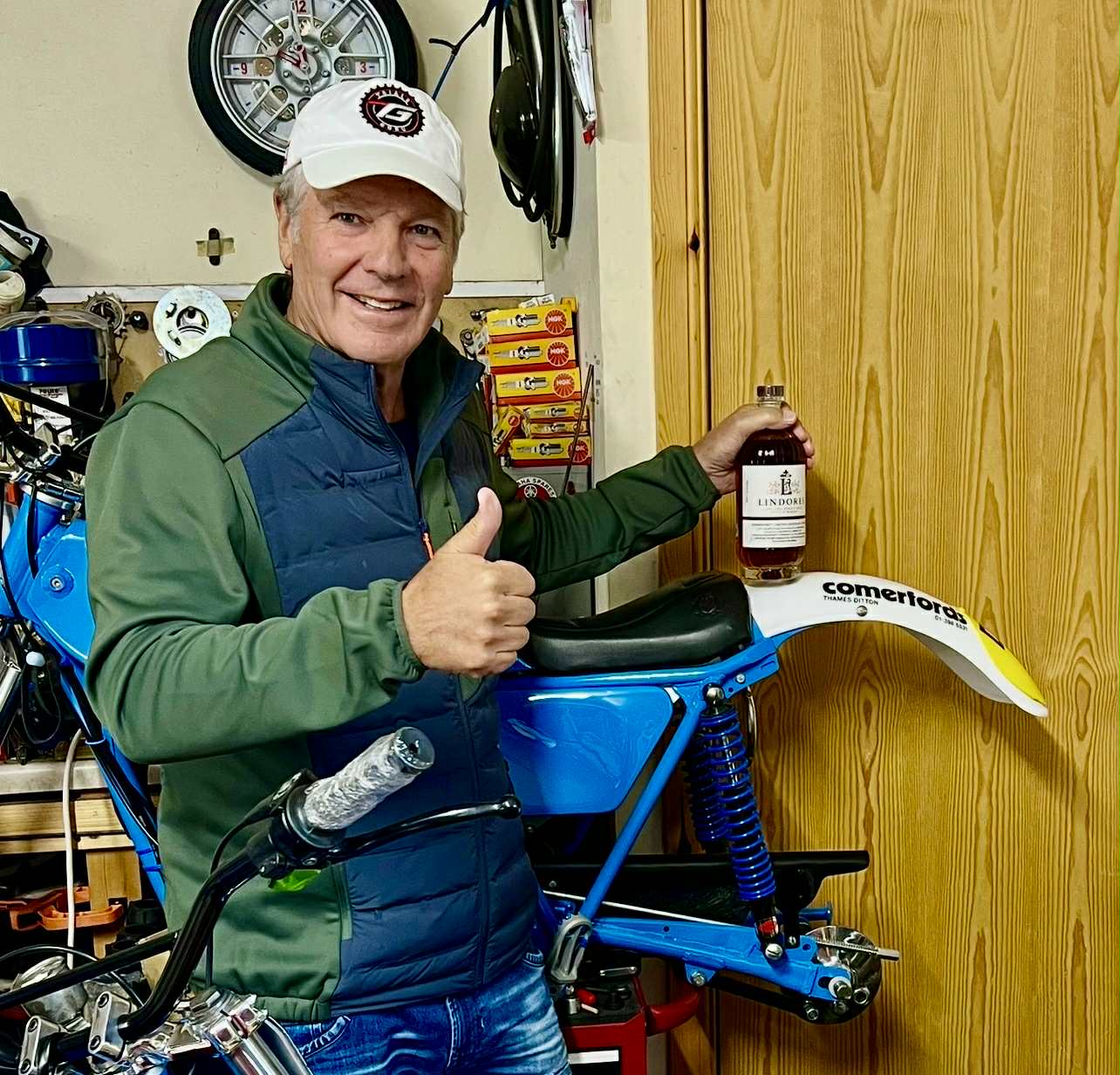
In Scotland for the 2025 Highland Classic, Bernie received his commemorative bottle of special Scotch whisky from Patrick Comerford, to celebrate 100 years of Comerford’s. (Photo: Trials Guru)

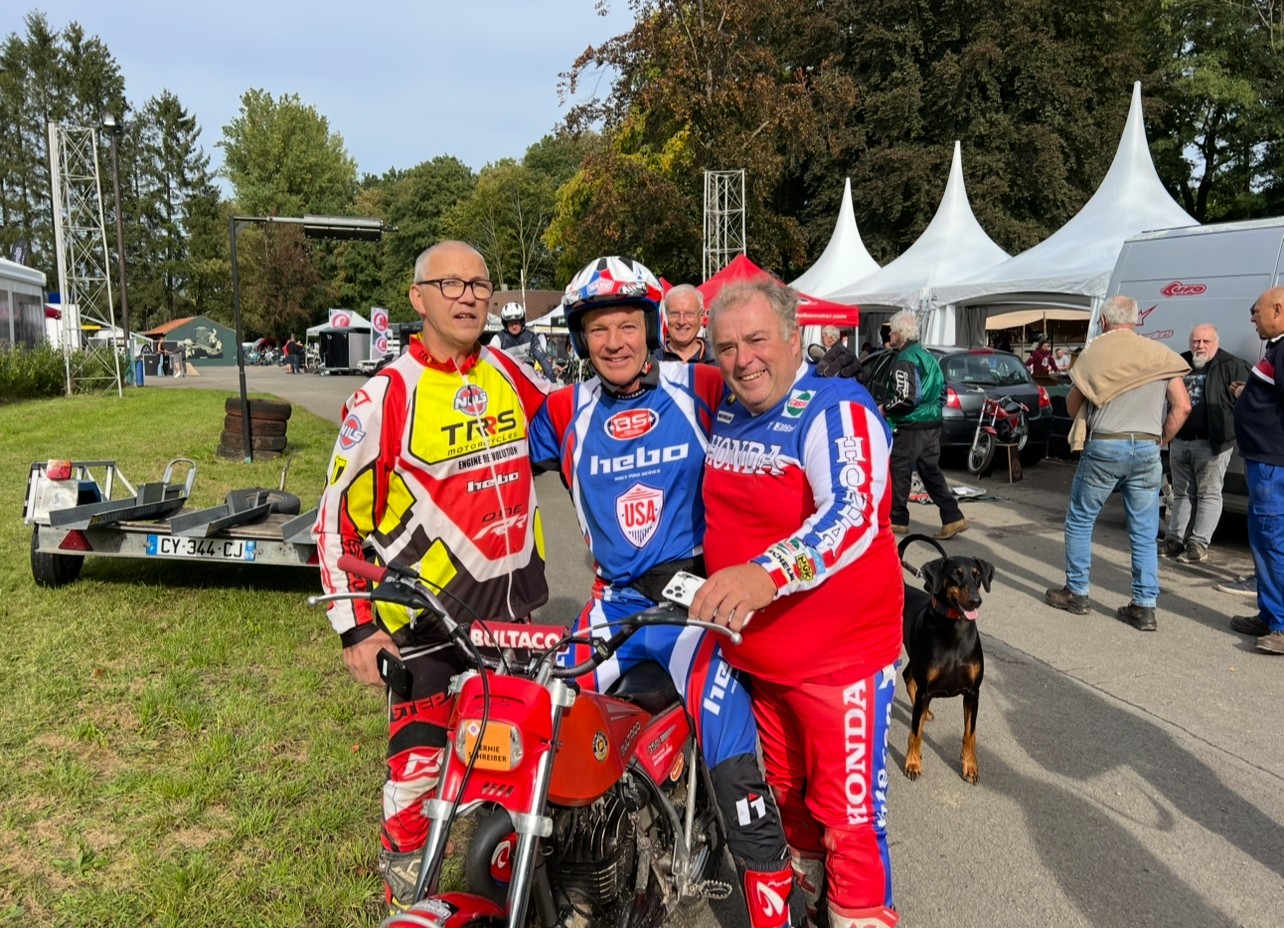
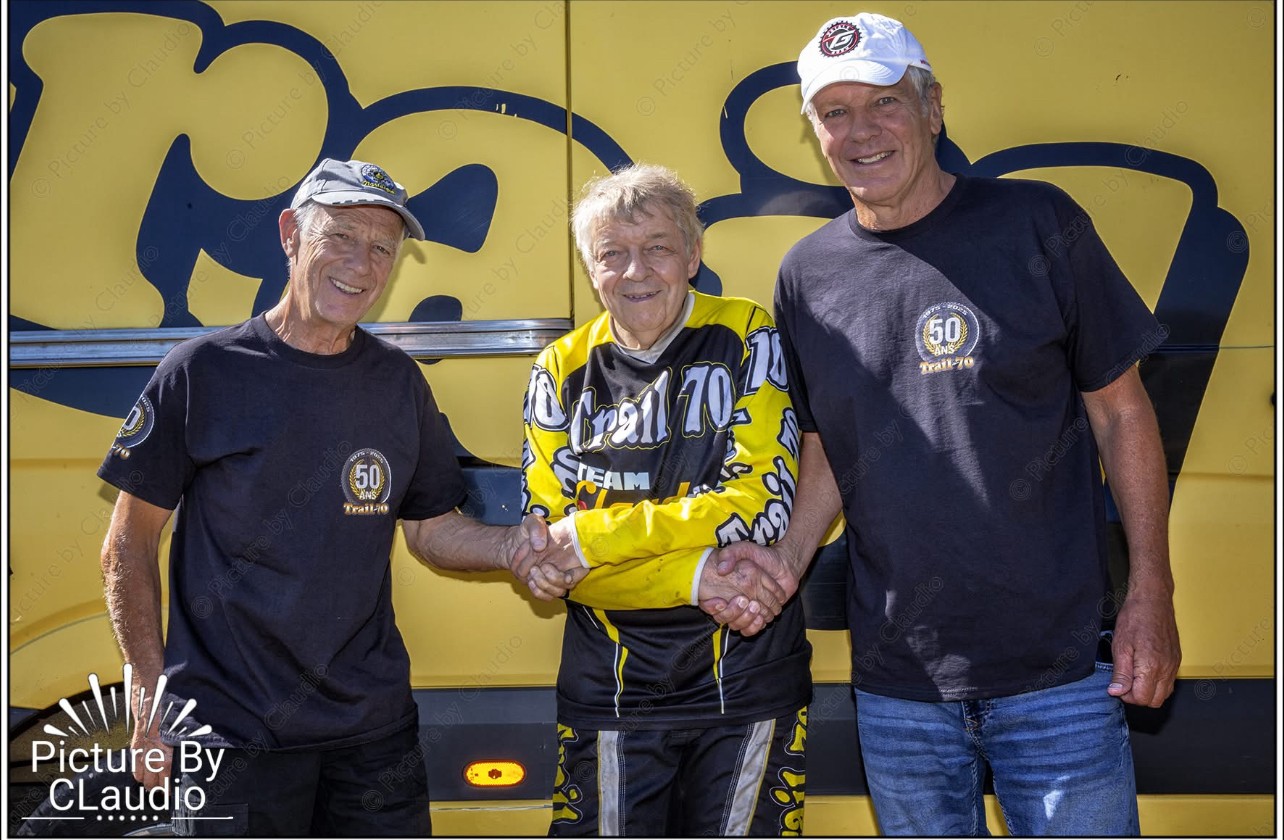
“My last competition of 2025 was the annual Arbecey two-day Invitational in France. I finished second overall at this traditional event organized by Joel Corroy and Trial 70 Club. This year ten times French Champion, Charles Coutard competed and we rode side by side for two days. The magic of trials is you can ride with friends who also started riding in the sport 55 years ago.”

Friends at Abercy in 2025, Charles Coutard, Joel Corroy and Bernie. (Photo: Jean Claude Commeat)

TG: What is Classic 55 Club?

Classic 55 Club Logo

BS: “At Classic 55 Club, everything revolves around the love of off-road classic bikes and passionate motorcycle enthusiasts. Our mission is to continue creating the strong connection between the beautiful historic bikes and those stories riders have to share. Welcome to the club.

For me personally, it’s always the people that make the biggest difference in everything. With that said, I would like to thank all those who continue to support me at events, on social media and the media platforms. Thank you, Trials Guru, for your continued dedication to trials and our partnership.”

“Thank you to Racing Services Spain for all your graphic support, including special logos, number plates, catalogs and stickers. Thanks to all the trials school organizers who made it happen and hopefully learned something along the way. Thanks to everyone who loaned me a bike or worked on one and washed it after the event. Big thanks to Walter Frei in Zurich for taking care of my only Bultaco in Europe and his transportation services for practice and other events. Thanks to all the photographers who capture all the special moments, and observers who keep my score card clean. Thank you to all my sponsors and suppliers over these past years.”

With friend Walther Frei in Switzerland. (Photo: Bernie Schreiber Collection)

“I am grateful for everyone who supported me over the last 55 years in Trials. In the meantime, Keep your feet up!” – Bernie Schreiber

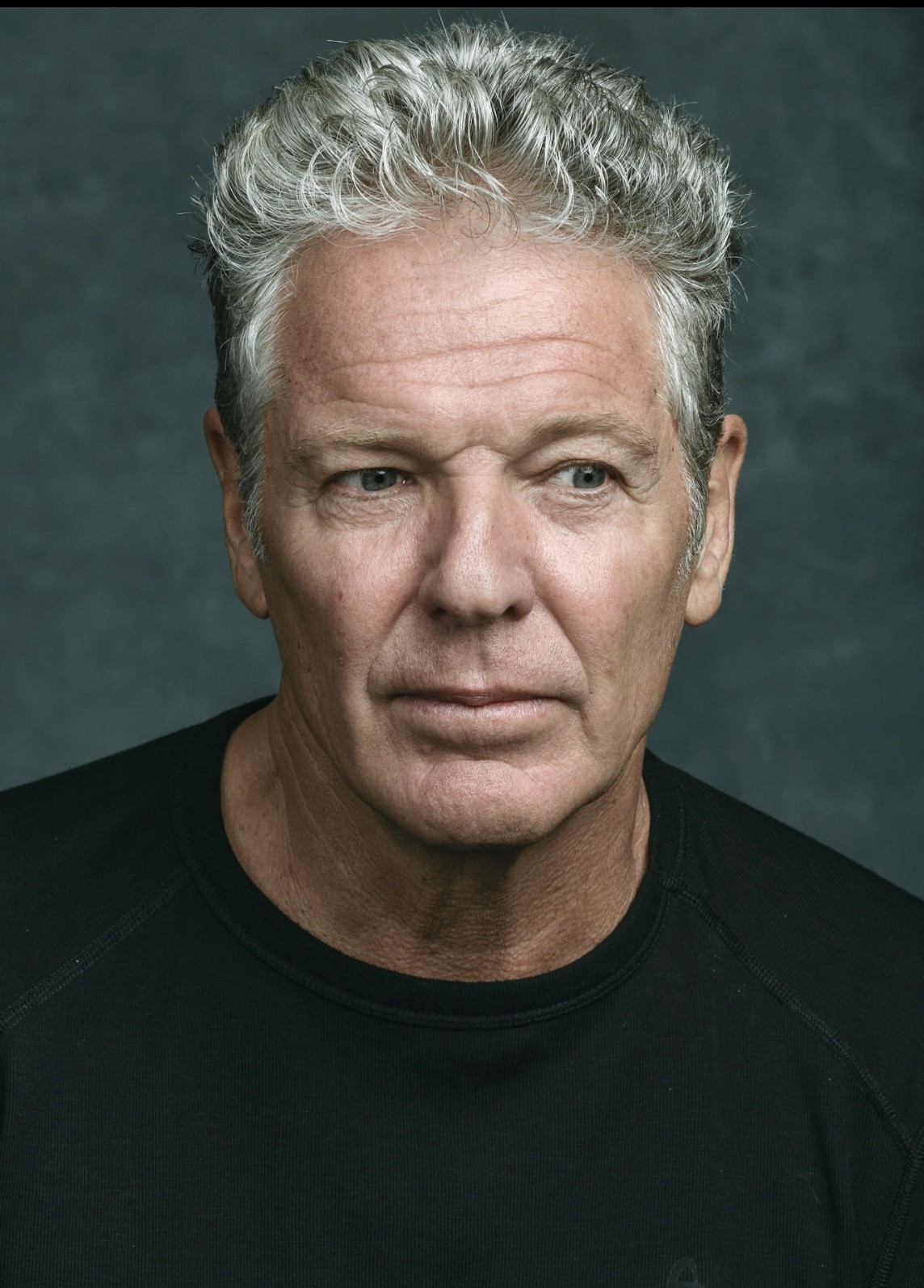
1979 FIM World Trials Champion and 1982 SSDT winner, multiple US NATC National Champion – Bernie Schreiber

Article copyright: Bernard Schreiber/Trials Guru 2025

(The Classic 55 Club logo is the registered trade mark of Bernard Schreiber, Zurich, Switzerland.)

For more articles by Bernie Schreiber on Trials Guru: GLOVES OFF

Apart from ‘Fair Dealing’ for the purpose of private study, research, criticism or review as permitted under the Copyright, Design and Patents Act, 1988, no part of this article may be copied, reproduced, stored in any form of retrieval system, electronic or otherwise or transmitted in any form or by any means, electronic, electrical, mechanical, optical, chemical, photocopying, recording or otherwise without the prior written permission of the author as stated above. This article is not being published for any monetary reward or monetisation, be that online or in print.
Army Man George

We are constantly on the lookout for something out of the ordinary at Trials Guru. We think we have found it with this interesting article, penned for us specially by the subject himself.

Words: George Webb; Trials Guru. (50 minutes read time)

Photos: Alistair MacMillan Studio, Fort William; National Motorcycle Museum, Birmingham; David Strickland; Rainer Heise, Germany; OffRoad Archive; Brian Catt; George Webb personal Archive.

Born on 7th April 1943, George Webb is a well-known and respected Army MCA rider from the 1960s through the 1970s and into the 1980s. He rode trials, long distance trials, Army trials, enduros, the Scottish Six Days and the International Six Days Trials, representing Great Britain and the British Army. George Webb wasn’t a ‘works rider’ as such, but he was paid to ride motorcycles by the British Army and occasionally he was issued with some very specialised kit! Now George has agreed to share details of his many adventures while serving in the British Army and beyond. We think you will enjoy this article.

Here is George Webb’s story, written specially for the Trials Guru website by the man himself:

“It was the 6th of April 1959 and I had just enlisted for nine years in the British Army. Tomorrow was my sixteenth birthday and my favourite subject at school had been Geography, which gave me the desire to travel and drive things, the services seemed the best option to me.”

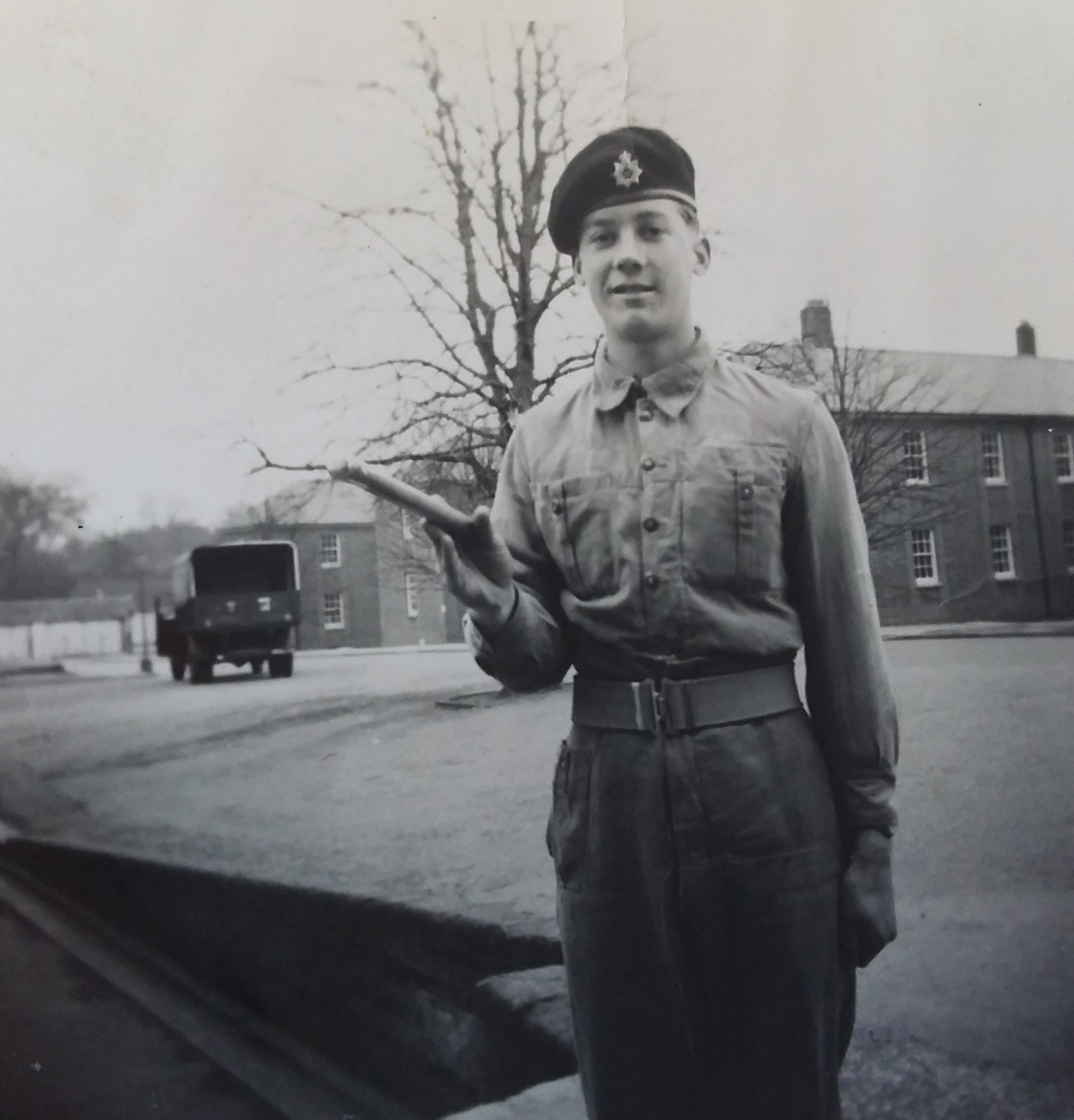
1959/60 at Borden, Hampshire. George Webb at sixteen years of age. ATTENTION!

“Growing up in West Suffolk in a small village between two airbases, most of my time was spent working on farms, trying to earn some pocket money. Times were hard in those days and rationing after the second World War lasted well into the fifties. My Mother had a hard upbringing with five other siblings, there were times when there was no food in the house and they had to rely on neighbours for bread. My Father’s history was not much different, he worked his whole life and, to the best of my knowledge, he ever had a holiday. All my immediate family have passed on.

During the war we missed being killed when a Short Stirling bomber, returning from a raid in Germany, missed our chimney by about six feet and crashed in a field at the bottom of our garden, sadly there were no survivors. Mother related later to us that this often happened and she would hear the screams of the crew when the aircraft burst into flames. There were no good wars.

My two brothers had motorcycles, but were not much into competition and like myself, bikes were seen as a mode of transport. My first bike was a 1960 250cc Francis Barnett fitted with an Avon fairing, which I could use to get about on, and travel to my Army base and home for leave.”

George Webb and his best mate, and pillion rider, the late Pete ‘Ossie’ Osbourne. He was always going to sleep on the back!  1960 250 Francis Barnet, 888VF.

“My first couple of years were training for junior leaders and we spent most of this time doing things like weapons training, drill, fitness and assault course, map reading and compass work and further education.

I also took my HGV training with the driving test on 1st November 1960 and was the only one of eight to pass. Later the same day, I passed my motorcycle test, both tests at the first attempt. I was truly chuffed to bits.”

George Webb, bottom right, Malta 1962, after a swim. Following Amphibious training.

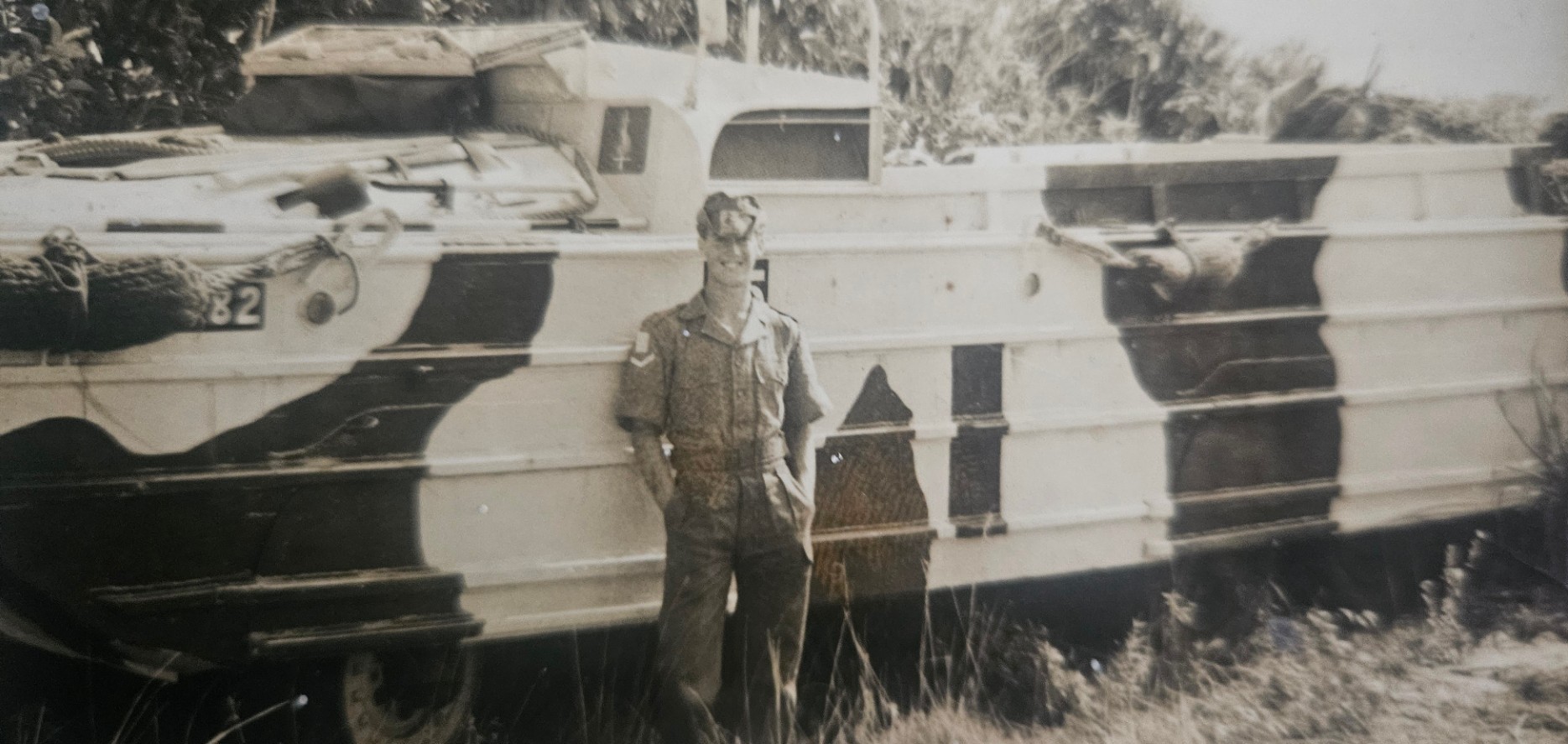
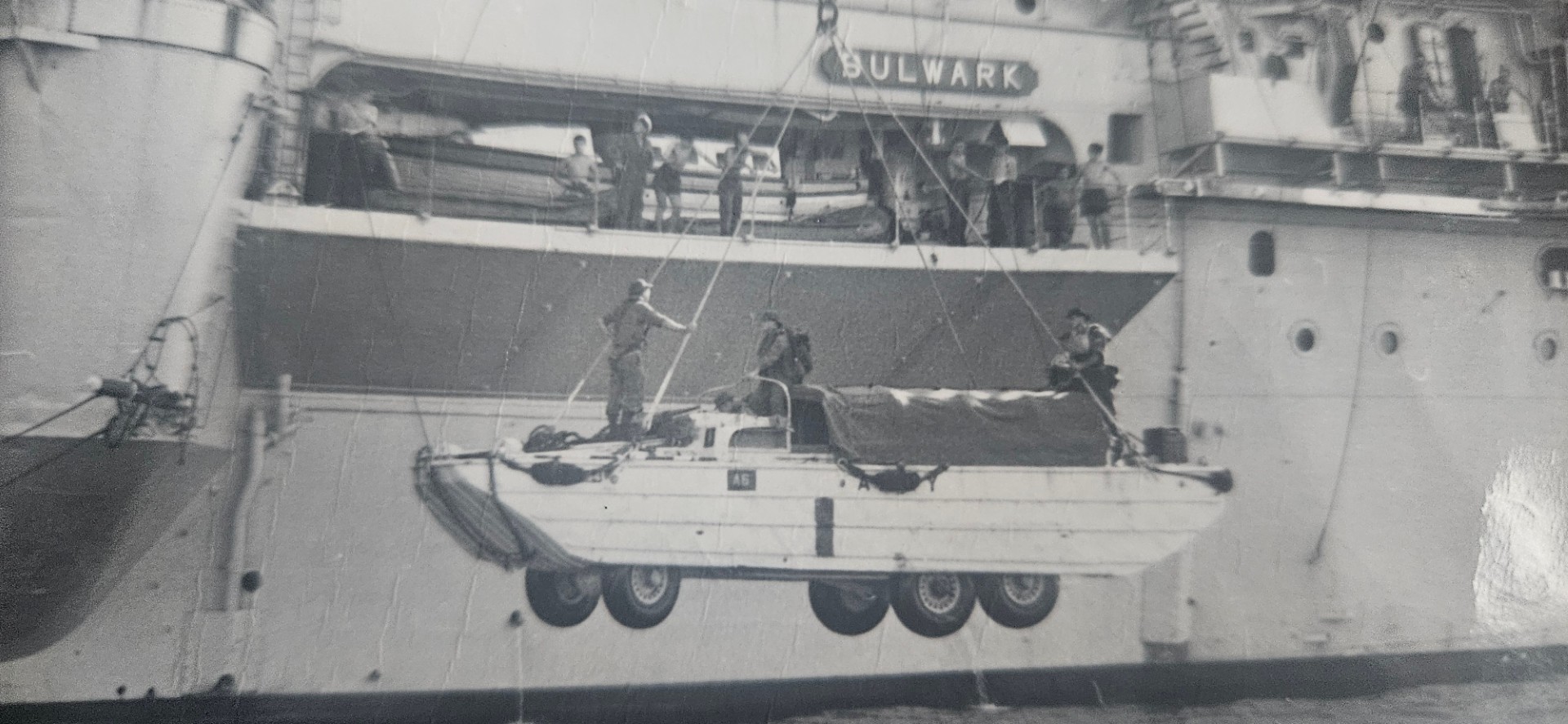
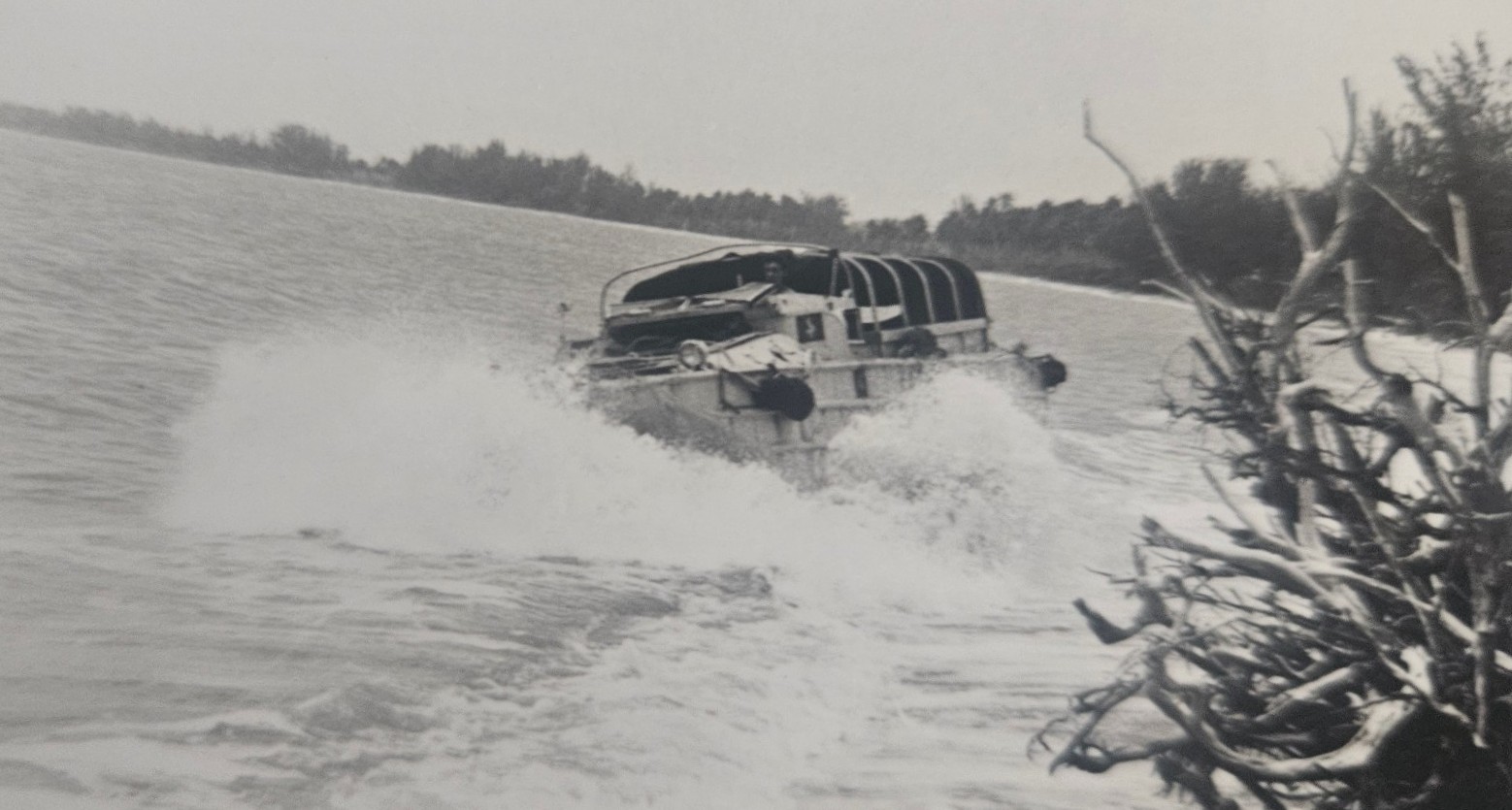
“Fast forward to 1963, I was now stationed in North Devon, having trained as an Amphibious Specialist, operating in rivers, estuaries and the open sea. Ours were the only such unit operating in the British Army and we were operating WW2 six wheeldrive D.U.K.W, referred to as a ‘Duck’ made in the USA.”

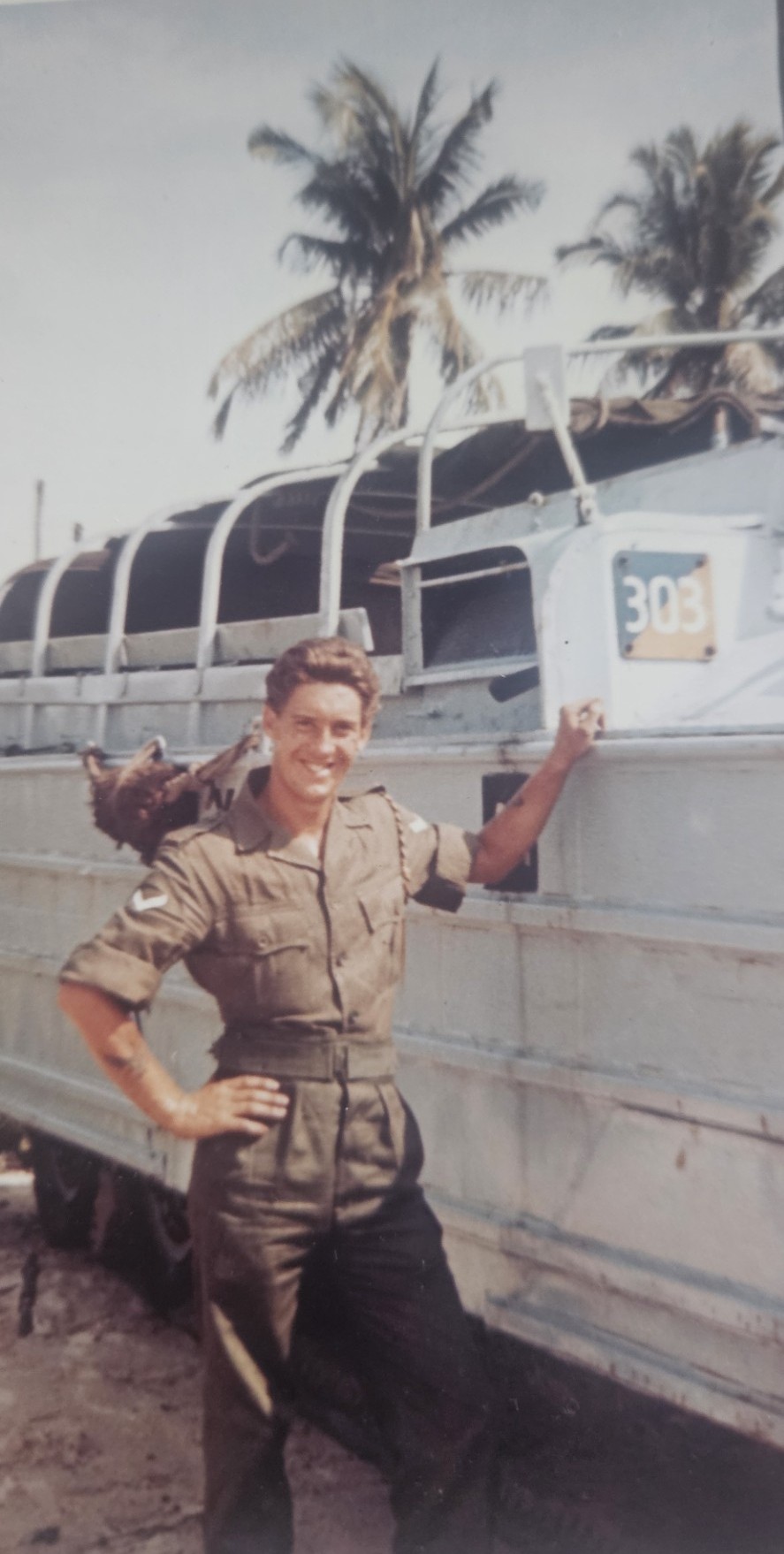
George Webb poses with a British Army amphibious DUKW.

“Our job was to deliver ship to shore, troops, supplies such as food, ammunition and fuel. We could deliver this up onto the beach or miles inland, and then return to the supply ship for more loads. There is of course much more I could tell you about, but Trials Guru is about trials, right?”

George Webb beside one of the amphibious DUKW vehicles it was his job to drive in the British Army.

“We had a new Sergeant Major arrive at our unit in 1963 who happened to be an Army motorcyclist. He wanted to enter a unit team in some upcoming Army event. After a bit of practice with his selected team, one didn’t make the grade, so he invited me in as I had now been riding for three years. However I had never ridden in a trial, so I had to quickly find out what was involved.

To explain, an Army trial is not quite the same as a civil trial, because it was classed as training. Generally speaking, all riders or entrants would ride the same service issue machines, which at that time was the WW2 issue M20 BSA, a 500cc side-valve, which had poor ground clearance, poor steering lock, no rear suspension and girder forks. We also had to wear standard issue riding gear and helmets.

First of all came a map reading exercise, we were handed an Ordnance Survey map and a route to plot and then ride, taking in a number of check points and within a set time limit. This was usually done on minor roads and green lanes.

Secondly, came a number of sections to be ridden within a time limit.

Third, was a cross country timed course.

Points could be lost on all three stages, but also the condition of the bike at the final inspection of rider and machine.

At this stage of my life, I now had a Triumph twin which was far and away better than the Army M20 BSA, but hey-ho this was still fun and I was getting paid to ride. Did this mean that I was a works supported rider? Hardly!”

The 1941 M20 BSA a machine similar to those ridden by George Webb in his early career with the British Army – Photo: National Motorcycle Museum, Birmingham.

“The map reading I could do, but reading a map and riding down bumpy lanes, steering with one hand and holding up the map board to follow the route was somewhat risky. I had an enormous tank-slapper when a puddle turned out to be deep! Desperately trying to grab the handlebars while my tin helmet was flip-flopping over my eyes. ‘Bugger that’, I thought to myself, and shortly after the Sergeant Major went passed, going the wrong way. When he stopped and I put him right, he said ‘OK, you can lead’.

So, off I went, I suppose I was trying to impress him, when I missed a turn by going too fast. He took off at some speed, trying to impress me I guess, which he did of course. As I entered a sharp bend with those West Country high banks and hedges, well of course there was a field entrance mid corner, so as I ride up the bank, which I am forced to do by the footrests digging into the tarmac. Back down the bank, heart rate up slightly, remembering that this isn’t the Triumph I am used to – slow down Boyo!

In no time at all I find the Sergeant Major sitting up a bank on his machine which had seized up. He said: “You carry on and finish and come and fetch me with the truck. Well the other team members didn’t finish either so it was just me and I never got any results, and to this day I do not know which position I finished up with.

There was one more episode with the M20 BSA, but that was up the Jungle three years later.

Singapore and Malaysia:

In 1964, it was time for my next posting.  I was not keen to go, as I had a steady girlfriend, and a BSA Super Rocket as my transport! This would mean two and a half years with no home leave. What would happen to my girl?  You guessed! – She found someone new!

It was a long flight to Singapore on the old Bristol Brittania nicknamed the ‘whispering giant’, with stops at Ankarra, and Bombay where we could get out of the plane for a bit of excercise and fresh air.  Wow, it was eight in the evening and 108 degrees! By next morning we arrived in Singapore.

We now had to get used to high heat and high humidity for the next thirty months, phew!

We were still operating our amphibious D.U.K.Ws there, as half of them were shipped out by sea in a LCT, a sea going Landing Craft, Tank.”

A British Army DUKW as driven by George Webb is hoisted aboard HMS Bulwark – Photo: George Webb personal Archive.

“Malaysia was having trouble with incursions by the Indonesians, mainly in Borneo, but also in Malaysia and Singapore. I guess somebody thought our unit would be of some use out there. As it happened, we did not get much involved as it required a lot of Jungle warfare, with specially trained troops such as the Gurhka Rifles, and real locally recruited Borneo Head Hunters. I kid you not!  My friend served there for a while and he took years to get over what he had seen. Anyway, the Indonesians got fed up of being killed, and after a few years, it all settled down.

We spent our time doing exercises, and training, and maintainence. I bought a bike and could now explore the Island and up into the Malay Peninsular. This was great, my new Triumph Tiger 100SS was a cracking bike, a 1962 model, had been in its shipping crate for 3 years, and I got a big discount. The locals stopped buying the bigger more expensive bikes, when the Japanese bike invasion began.

I joined the the Singapore Forces Driving Club, and took part in some light hearted trials and quite a few rallies, both as driver and also navigator.

Before I left England, I took part in the Army Driving Championship in 1963. Over five days and a two thousand mile course of navigation, special tests, cross country, and night map reading. Out of an entry of many hundreds, we came home in fifth place at our first attempt, but even more important, we had won a major trophy. The R.O.S.P.A. Cup, for road safety.

Our Boss was so chuffed, he gave us two weeks holidays – Bloody Brilliant! 

Terendak, Malaya:

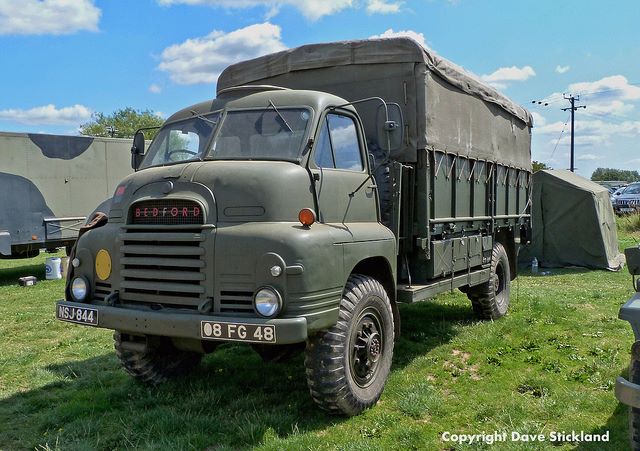
After eighteen months in Singapore, I was sent up north to a base near Malacca. This was a general transport unit equipped with Bedford RL trucks, nicknamed  the ‘Flying Tigers’.”

Bedford RL truck of the type used by the British Army – Photo: David Strickland.

“Perhaps something to do with the fact, they seemed to go flat out everywhere!

Very soon we were off on excercise, as I had a bike licence, I got to ride the motorcycle! A BSA M20 500cc side valve.  Well, that made things interesting, how to control a convoy on a bike that was slower than the trucks!  As usual on excercise, one had to carry a personal weapon which would normally be a 7.62 SLR Rifle. But that is a bit large to carry on a bike, so I had a Sterling sub machine gun, and magazine, but no live rounds! Now this is quite normal for army exercises, no point in taking unessary risks. Live firing exercises would be carefully planned and more in line with preperation for genuine Ops, or war.

One night I was sent on a job on my own to some jungle location, I can’t tell you what it was, because I have forgotten. What I can tell you is that after some time of riding there was a sudden tropical downpour of very heavy rain. Luckily my heavy DR Mac kept out the rain which was good. However, some of the rain flowed down the Mac and into the open carburrettor, and the bike conked out!

This was quite worrying to say the least, and especially because on an earlier excise in the central Malayan Highlands, I and two friends had a very close encounter with three tigers! I always thought tigers were solitary creatures, and right now in the pitch blackness I was thinking of tigers, and all manner of other stuff. This is when I really, really, wanted a magazine full of lovely bullets! I cursed the Army for not thinking about what might happen to one of theirs, who might end up in such a predicament! If there had been two of us on bikes, my fear level would have been less!

There was no doubt what the trouble was, the rain had entered the open carburettor and wet the spark plug. What happened next was one of the fastest fixes that you could imagine. The bike burst into life, and I was off in an instant. I never saw another human on that jungle track, not your average trail ride. That was my second experience on the BSA M20, and probably the most memorable.

Rally success in Singapore and Malaya around 1964/65. George Webb is second from right front row.

I will tell you another little story for the benefit of anybody that may not have ‘served’, and for those that have.

On this occasion I was still down in Singapore, and we had an exercise up on the east coast of Malaya with our D.U.K.W.s. One evening, we had a briefing, about what our next task would be…….. ‘OK lads, tonight the Marine Commandos are doing a landing on our beach. Your job will be to capture them’. – Your kidding right Sarge?  ‘No, I am not kidding’. Well, the imagination starts working overtime, how this might turn out.

I mean we are drivers and landing craft operators, not front line storm troopers! Anyway, we have been tasked, and me and my mate Ray were concealed just back in the jungle line waiting anxiously. It was a full moon night and we could see quite well, we have to get this right – Bayonets fixed!

We waited not more than thirty minutes, then we saw him coming towards us. we were well concealed and hoped he could not see us. The element of surprise being essential.

Then, as he went to pass, I rose up swiftly and put the bayonet at his throat, hoping he would come quietly. He did, and we were both pleased, and relieved.

My time in the Far East was very interesting, I had in my time there both a Tiger 100 and a Triumph Bonneville, which I used to travel around the country. I was fullfilling my love of travelling and motorcycling. The weather was warm and mostly dry in those days, and it was a pleasure to be out. The roads were better than ours are now, and traffic was light.”

A brace of Triumph Twins, George Webb is on the right of the photo. Photo was taken at the top of Gunung Brinchang mountain in the Cameron Highlands, near the village of Tana Rata.

“Singapore has changed tremendously, we thought it was great before, but now its amazing what they have achieved.  If only we had their politicians here!

In November 1966, I made my way to catch an RAF flight from Kuala Lumpur back to the UK, and to see my family.  VC10 jet power all the way.”

George Webb far left on his Triumph in Singapore enjoying the company of like minded motorcyclists, the Forces Driving group at Columbo Camp who did trials and scrambles.

“Although this is a very condensed version of my time in the Far East, I hope it will give a flavour of what life can be like in the Armed Forces. It was only a short time of my twenty odd years in uniform, but there is more to come, when I get to Germany.

Germany –  British Army of the Rhein

In the post war years many British Soldiers spent time serving in B.A.O.R. short for British Army of the Rhein. For myself, I had two different postings there, the first was to a town called Bielefeld, in Northern Germany, where most of the British were. In the south were the Americans and the French.  This was really the start of my Trial riding.

10 Regiment Royal Corp of Transport, equipped with AEC 10 tonners general transport. Very slow, very noisy, and no power steering! In addition a crash gearbox, and driving these beasts on the Autobahn was like being in a mobile chicane!

After a few days I met up with a John Wigham, who was in charge of the motorcycle bay. When he discovered I was a biker, he asked did I want to come out and do some cross country riding, and that’s how I got involved in Army Motorcycling.

We had some great places to ride and train, and John was heavily involved with the local German trials scene. Our bikes at that time were the Triumph TRW side valve 500 twin, as issued to the Army at that time. There were also some BSA M20 still on the books, but the Triumph was better, marginally! Soon we were off at weekends riding in events all over Northern Germany. Of course we were at a disadvantage riding against proper trials bikes, but invariable there would be a class for road orientated bikes. But hey, it was fun and it only cost us the entry fee, as army transport was provided for us.

After a while I decided to get a proper trials bike, and settled on a 250 Sprite from Frank Hipkin’s empire. In kit form it was relatively cheap, and as army wages never ammounted to very much, cost always entered into the equation.

Well, this didn’t turn out to be such a good decision, as it never handled very well, and I have never had a bike that needed so much maintainence! I named it the ‘Bendy Bike’.  When my mate asked to have a ride on it, he went over the handle bars in no time at all!  I was soon looking for something else!

I ordered a Bultaco from the factory in Spain, and soon it arrived at the local railway station, Whoopee! I couldn’t wait to pick it up, but when I arrived at the station to collect it they told me I could not have it today because it was 3.45pm and they stop work at 4.00pm. So much for German effiency! I stormed out, slamming the door behind me!

Of course I had to go back the next day and put my best friendly face on, and I got the Bultaco, things were looking up.

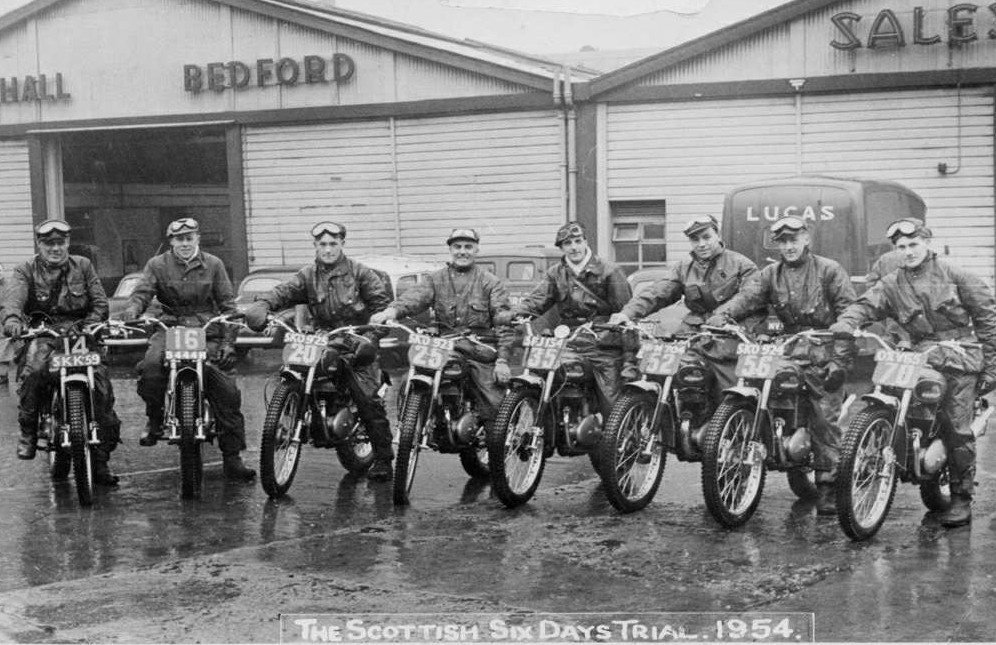
A big thank you to Mr. Sammy Miller, this Bulto was chalk and cheese against the Sprite. Next year I would get to ride this bike in the 1969 Scottish Six Days Trial as part of the Official Army Team.

The Army had now been issued with the new BSA B40 and this was a big leap forward from the M20, and the Triumph TRW. It had a couple of shortcomings but was a big improvement.

The Bi-annual Army Motorcycle Championships was coming up soon, and we were going to enter on the new machines.

The Army Championships:

My friend John Wigham had been posted to another unit, but there were a couple of other riders to make up our team of three. With myself as team leader, backed up by Tom Methven and Bill Hutley we set off with our three new BSA B40 bikes to Leek in Staffordshire. We were all novices, and all first timers at the championships. We made the journey over to England in a Bedford RL truck, with bikes in the back.”

George Webb, far right, with British Army issue 343cc BSA B40 machines that were used in Army trials.

“On arrival at Leek we found the conditions wet and the course very muddy, which often means a more difficult course. We began with the usual map-reading route on day one, and then part two the sections. I had lost no marks for map reading and only ten on the sections, it appeared I was in the lead. Bill and Tom were also well up, and we began to think we were in with a chance. Only the cross country to do now, and if we complete this with no loss of time, we were a strong position.

Day two and we were in high spirits, and trying our best. I caught up with my team mates at a particularly difficult part of the course, where many were stuck trying to cross a big ditch. We worked together, when I jumped the bike to the other bank and they pulled me up and sent me on ahead to try and get the win. I was really on the gas and sliding about on the slippery ground. If only I can stay upright, and not crash is what went through my mind.

The final time control came into sight, and I was ten minutes early which surprised me, as the set time is usually quite tight.

Anyway I awaited my allotted time and booked in, only to be told I was four minutes late! I was chatting to the time controller for most of my waiting time, how could I be late? Was it my mistake, had I worked out my due time incorrectly?

I was now in third place, behind two Army International riders, the late Mike Soames and Tom Fayers, but, we had won best Army Team, We were the Army Champions!

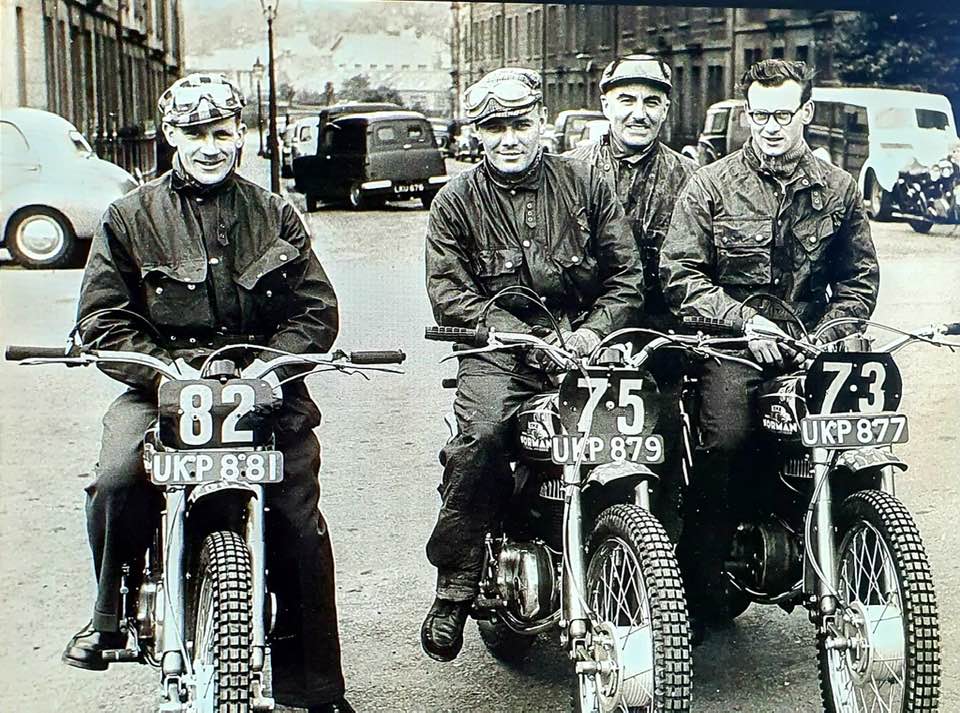
This result got me into the official Army Team, and next year I was selected to ride in the Scottish Six Days Trial, with John Wigham, (Greeves), Tom Fayers (Greeves), Jack Galloway, (Saracen), and myself on the Bultaco.

We travelled back to Germany with a fair haul of silverware, and I think it would be fare to say we were all pretty chuffed. Its very sad to lose the win, not on riding ability, but getting the timing wrong, should have worked harder at school!

We arrived at the Camp main gates and were told we had to remain at the Guard room! Whats going on we thought, had we been reported for some traffic infringement?

Were we in trouble, thats always the first thing that goes through your mind. After a few minutes were saw some Soldiers coming down the main entrance pulling a four wheel carriage. We were ordered into the carriage and pulled through camp, and everyone turned out to cheer us back.  Things were looking up!

Off to the Mess for Champagne with the C. O.  – Yes!

1969 the main events, still in Germany

This year I got promotion to Sergeant, but instead of moving to a new base, I was lucky and stayed in Bielefeld. We continued with our local events and Army Trials in Germany.

However, now that I was in the Army Team, the main focus would be the following events: The Scottish Six Days; The German Three Days Enduro in Isny; The Welsh Three Days Trial; The I.S.D.T. in Garmisch-Partenkirken, Bavaria, Germany.

In Brief: The Scottish went well and lived up to expectations. We started in Edinburgh back then, and there was considerably more mileage than there is today.

We all had good rides and and Jack Galloway on the Saracen had a top ten ride! We won the John Bull Tyre Trophy for best Services Team and I won a first class award, which I was happy with, especially as a First timer, then aged 26.”

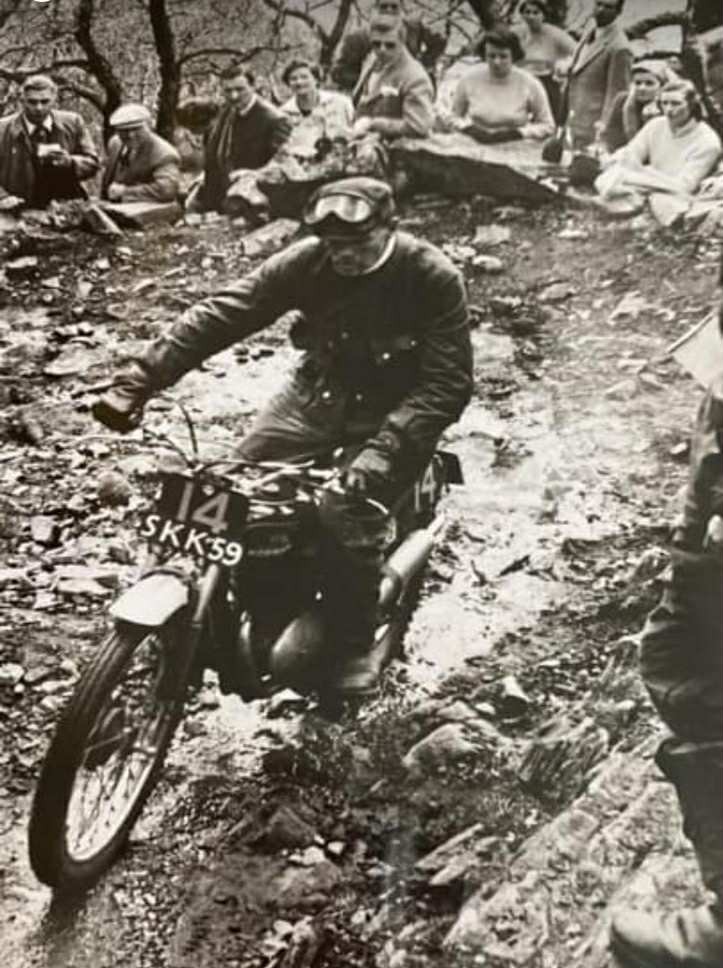
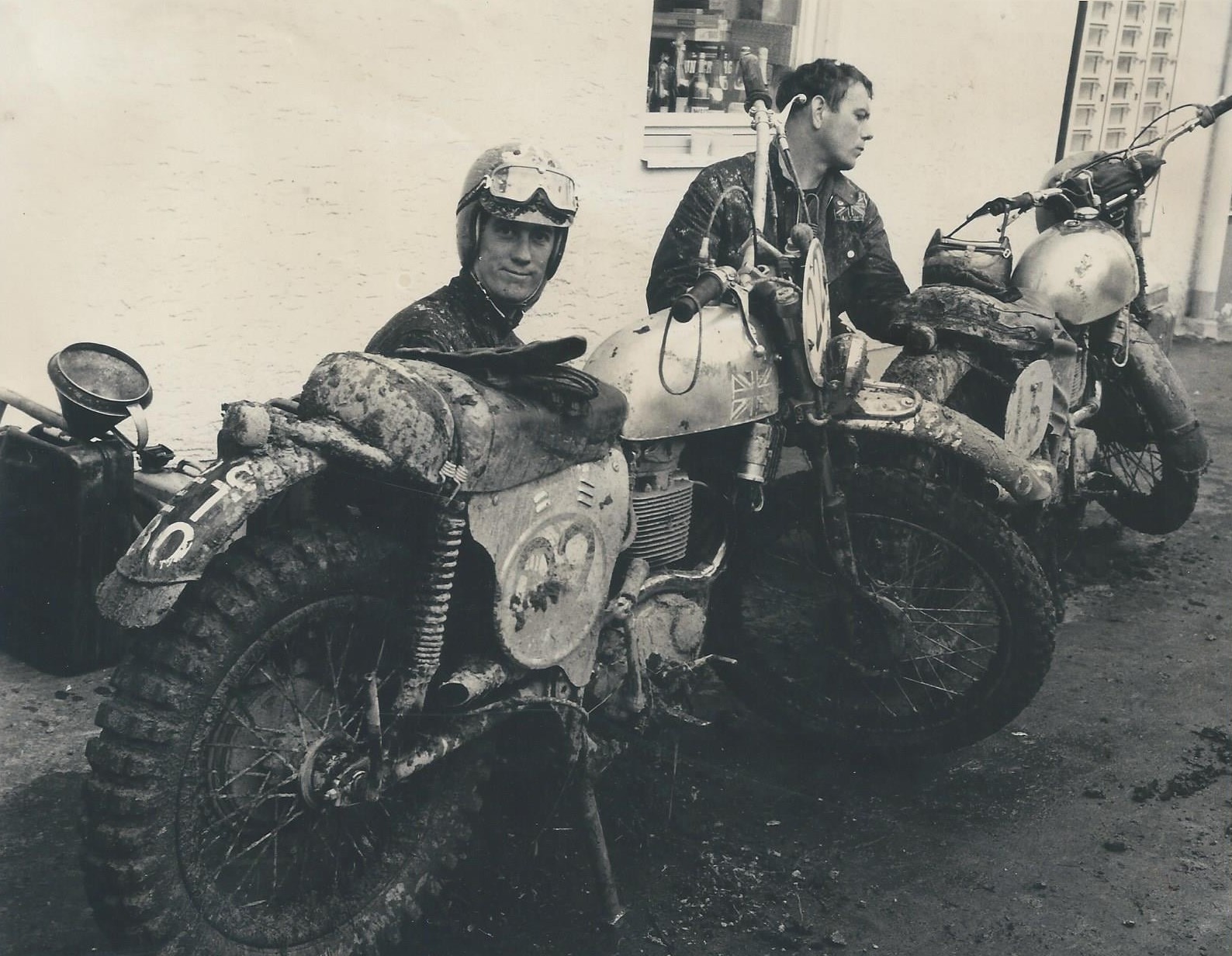
The 1969 Scottish Six Days, with George Webb on the 250cc Bultaco Sherpa running with British Army registration plates on the iconic ‘Pipeline’ section. Photo: Alistair MacMillan Studio, Fort William.

“Just a few weeks later, we were off to Isny, in Southern Germany, for my first International Enduro. This event became a European Championship round the following year.

The course was very wet with some big hills and thick forestry. Our BSA B40s had been uprated to 441 cc Victor motors and heavier chains, and the extra power was a benefit. However, our bikes were no match for some of the ‘works’ machines that were far lighter. This would become a patern in following years, where we would be running uncompetitive machinery, in World class events.

At this time we were officially in Training, nowadays this is recognised as Sport, within the Army. Now the Army can purchase the right bikes, as funds are provided.

As soon as we finished here, we had to drive a one thousand miles back to take part the in the Welsh Three Day Trial/enduro.

This is the big event of the year for enduro riders, although at this time it was still refered to as a trial, as was the I.S.D.T.

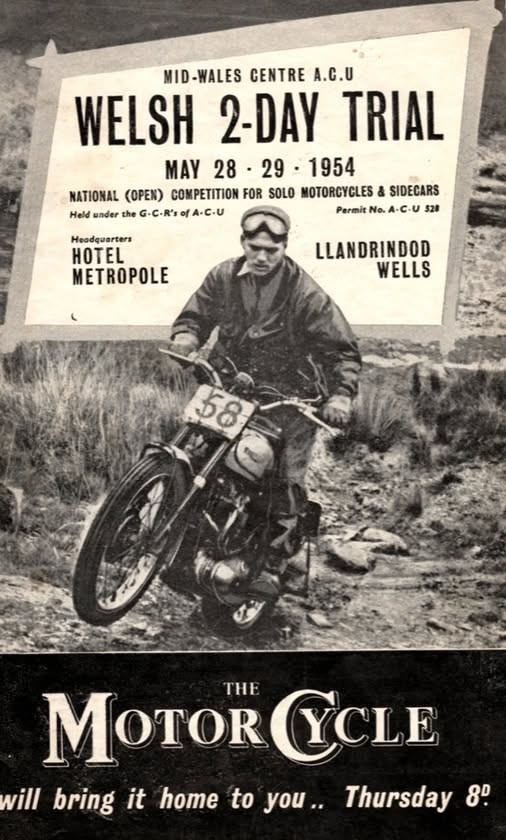
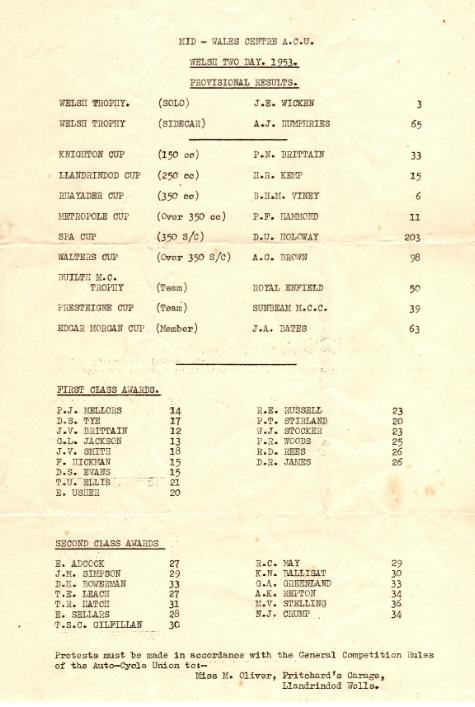
Starting in Llandindrod Wells, this event had been running I believe for some years and always attracted a big entry. Our B40s had been modified to run with the Capacitor Discharge ignition system to try and save some weight by taking off the heavy battery. However, it was giving problems with starting, and when it came to my turn to start it was playing up!

Well, you only have one minute to start, and ride over the line one hundred yards away, or you lose marks. The seconds were passing and nothing, and then when time was almost up it burst into life! I was into gear and the clutch was out in a fraction of a second and from start to way passed the one hundred yard line was on the back wheel only!

After a good first day, we went down to check the results at the Metropole Hotel, Llandrindod Wells. Well, I couldn’t believe it, I was in second place, behind Scott Ellis the eventual winner that year. If I could maintain this position tomorrow?

The second day started off well, no problems staying on time, until the Strate Florida part of the course, several water crossings. After coming across the stream for the last time the engine just died, no sparks! Catastrophe!  

I had been there trying to discover the problem for about an hour or slightly more, when suddenly it started. Could I reach the next time check before I was over my hour of lateness allowance?

Well, I really did fly to the next time control. and I skidded past the time clock as it ticked passed the hour. However, there was an ACU Steward there and he said I actually made it within my hour, and could continue.

Unfortunately, I was so dejected at the time I made the mistake of retiring from the event, forgetting that I was in a team, and that retirement would cost the team many more marks.

So, remember, if you are in a team, even if you have lost a lot of marks, try and keep going for your team mates.

I never found out what the fault had been with the bike but I suspected a faulty diode.

The  Welsh was one of my favorite events, due to the great variety of the course, with forestry, open moorland, and many dirt tracks. Over the next ten years, I won several Gold medals, and one class win. On the last occasion I rode there I had for the very first time a competitive machine, a 250cc Can-Am, and finished with another Gold medal.

The 1969 I.S.D.T. was in Southern Germany, in Garmisch-Partenkirken, and we were riding the Army modified B40. The ignition system was still giving us starting problems, mostly from the initial cold start in the mornings. It was a great course but I was soon running on Bronze medal time due to starting problems.”

The Army modified BSA B40 for ISDT use, with George Webb on board.
The Army modified BSA B40 for ISDT use, seen here ridden by George Webb.

“The event each day consisted of two laps of a hundred mile long course and on the Thursday things got worse!

As I had almost completed the first lap when the engine cut out.  I quickly diagnosed that the Alternator had stopped working, using my test kit.

This did not bode well, but I decided to investigate further, and after removing the side cover (many screws) I found the 3 wires badly damaged. The heat from the engine had shrunk the insulation, and there was only a couple of strands from each cable left! I seperated the strands and insulated each one and got a current and a spark. Whilst I was doing this I had got another of our riders to get a message to our support crew located at the start finish area. By the time I had finished the repair, they had got a new Stator to me and I packed it away in my tool bag, and set off. I was now forty minutes down.

Just before completing my first lap, aproaching a blind bend which went around a big black barn, three support riders came straight at me, going against the course!

I took out the middle one, and flew over the other two, to land incredibly uninjured in the long grass. I was out, taken out by three Russians, riding illegally.”

George Webb’s 1969 Army issue ISDT BSA 441cc B40 after its coming together with three Russian outriders going in the opposite direction to the course. The front Dunlop ‘Sports’ tyre completely ripped from the wheel rim.

“Bloody Russians, always causing trouble!”

The Army School of Transport:

George Webb cut his teeth on standard British Army motorcycles, like this a 343cc BSA B40, in fact this particular bike was a ‘good one’ and George’s favourite! With two Army Championships and many other awards to its credit, it was a sad day when this bike was damaged beyond repair. When George’s friend, Dave Le-cheminant asked to borrow it for an errand, he parked it behind a Scammel recovery vehicle, the driver of which reversed over it. One dead BSA B40.

After winning the 1970 Army Championship, I received my next posting to the Army M.T. School at Borden in Hampshire. Borden is where I started my Army career some years earlier, so it was familiar area.

This would turn out to be the best time that I had in the services, as I would be in charge of all the Motorcycle Training.”

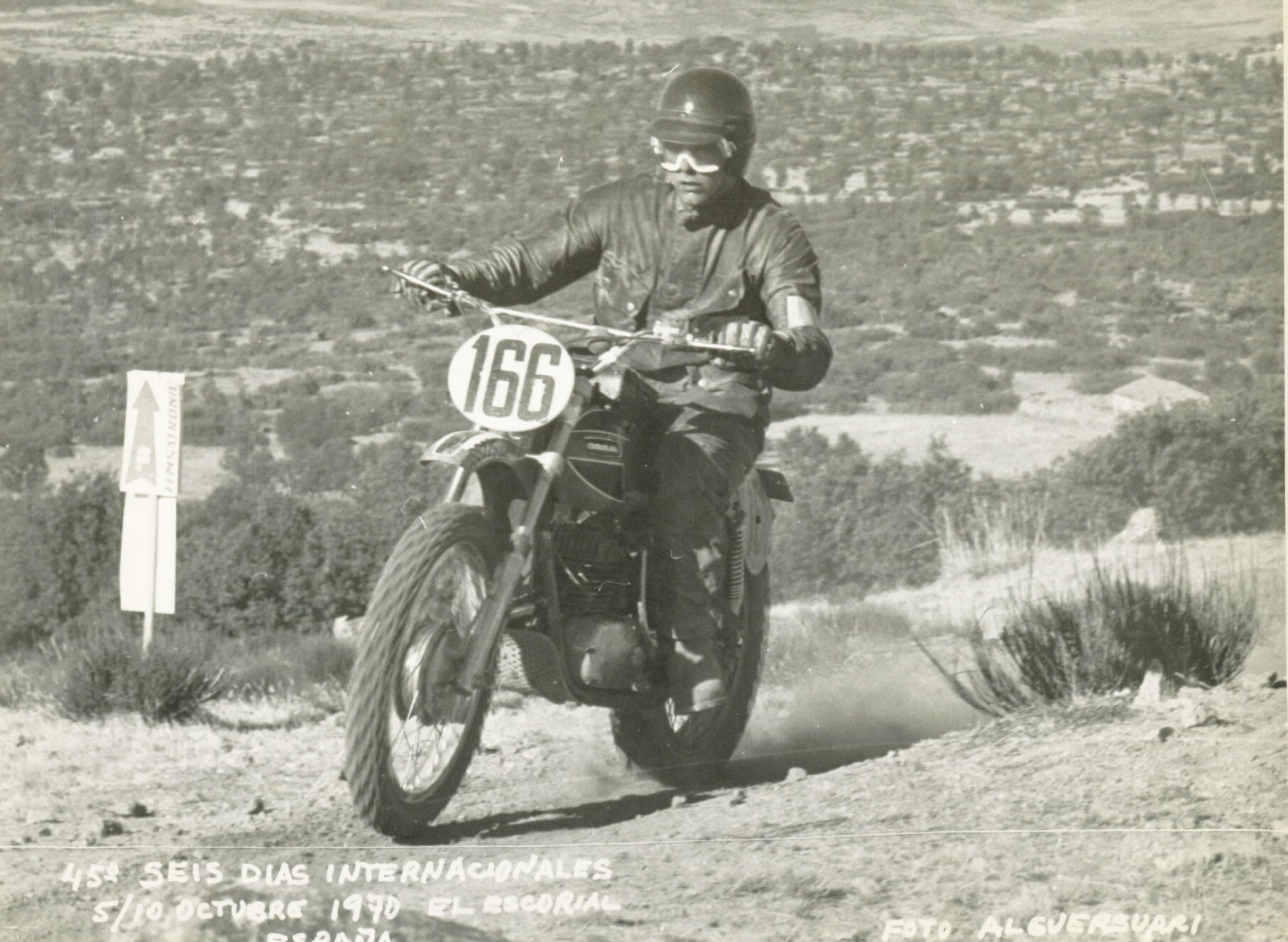
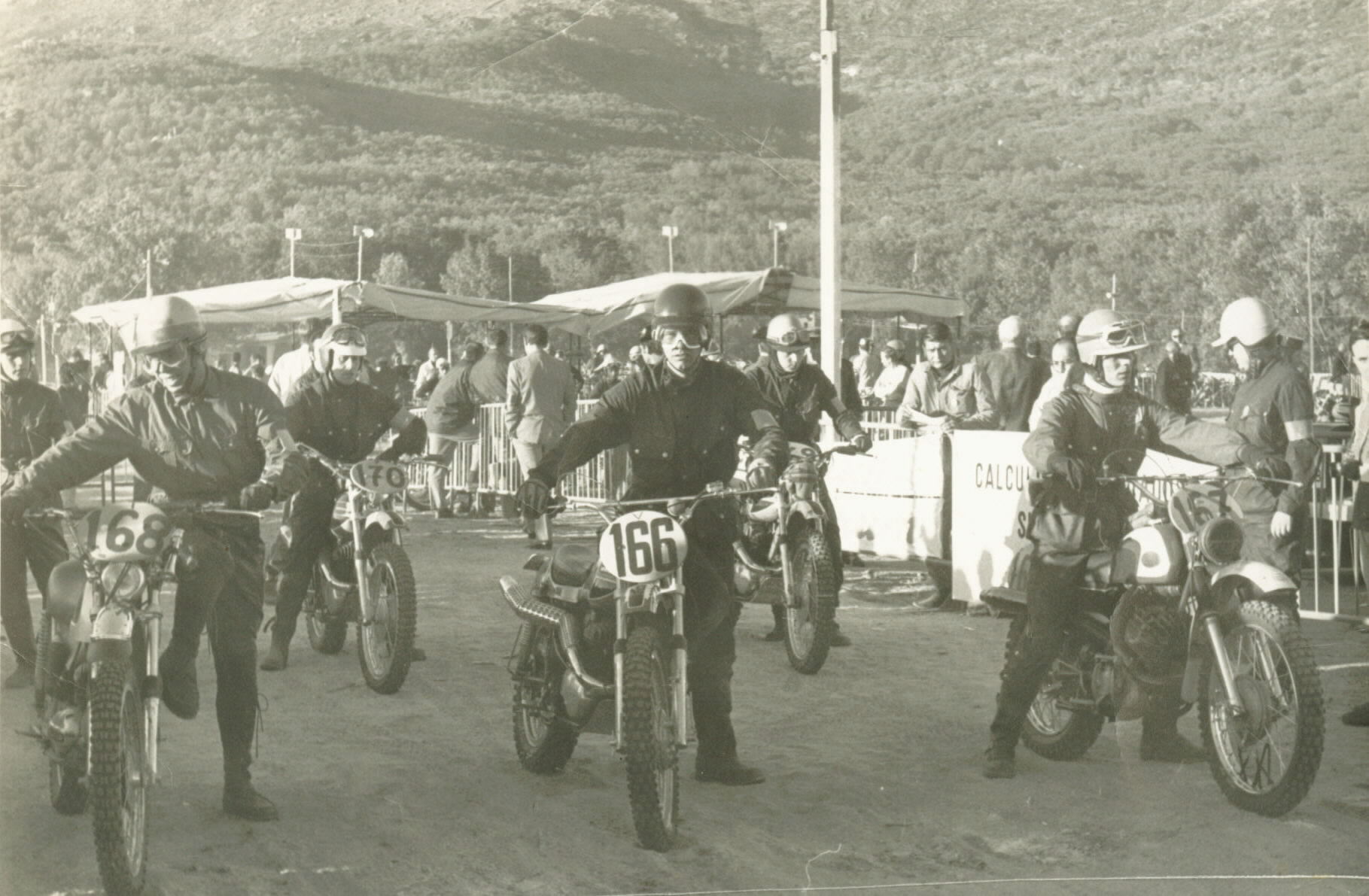
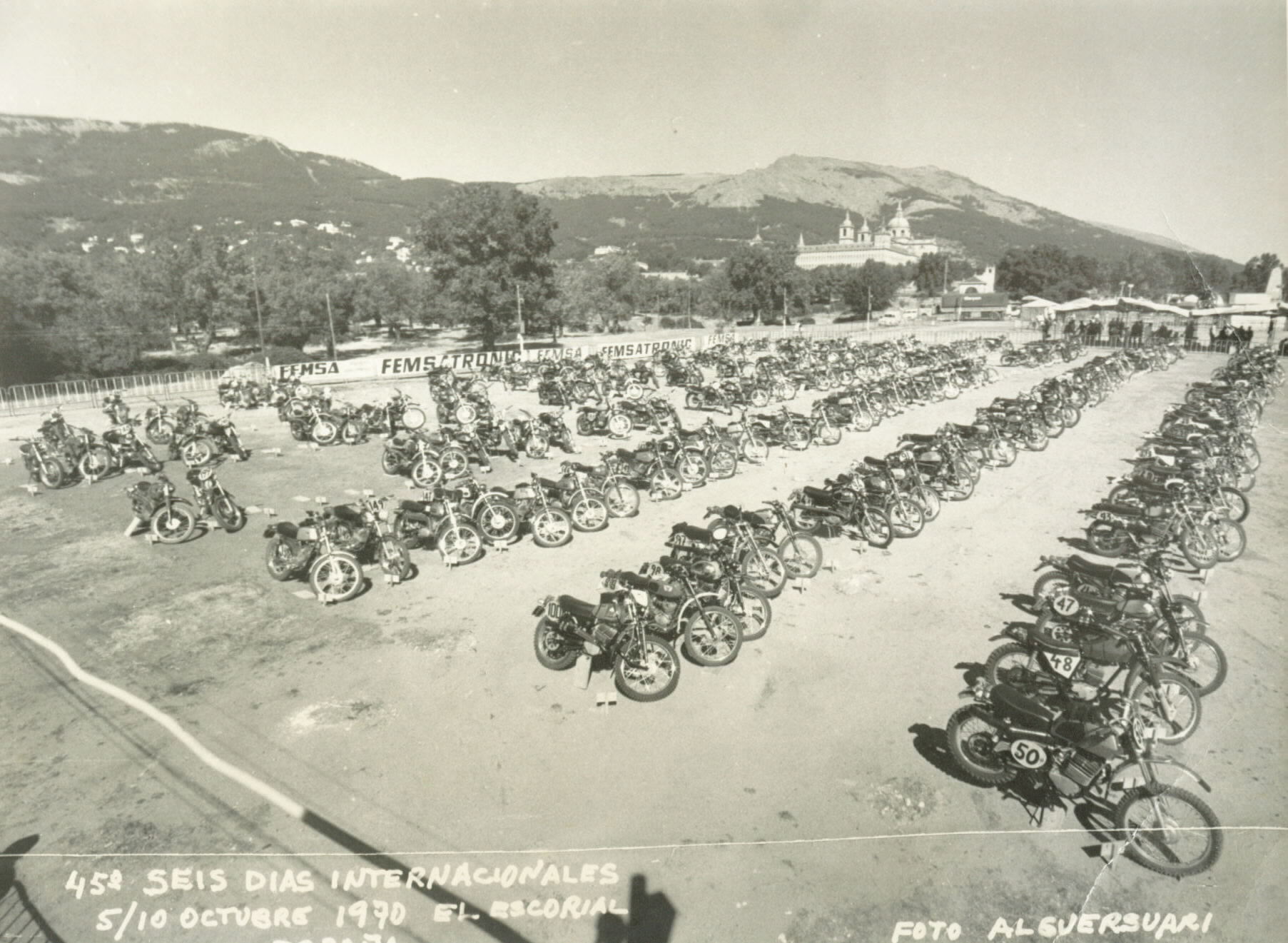
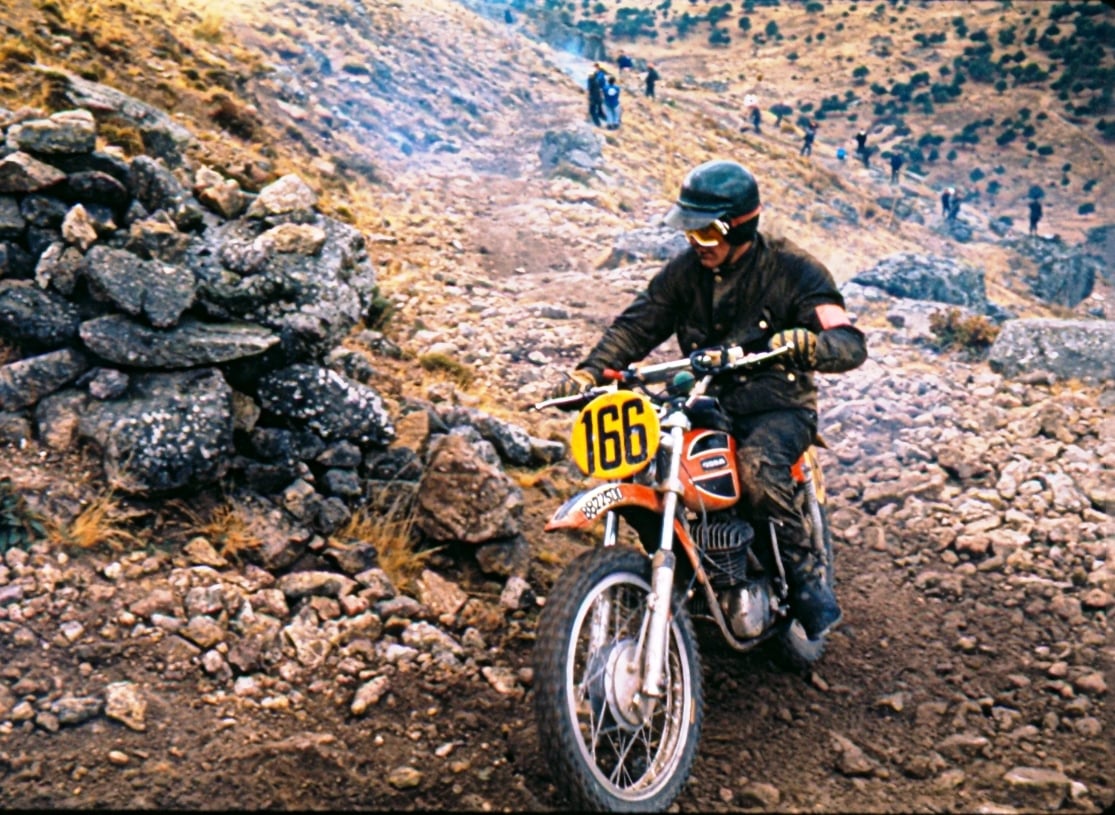
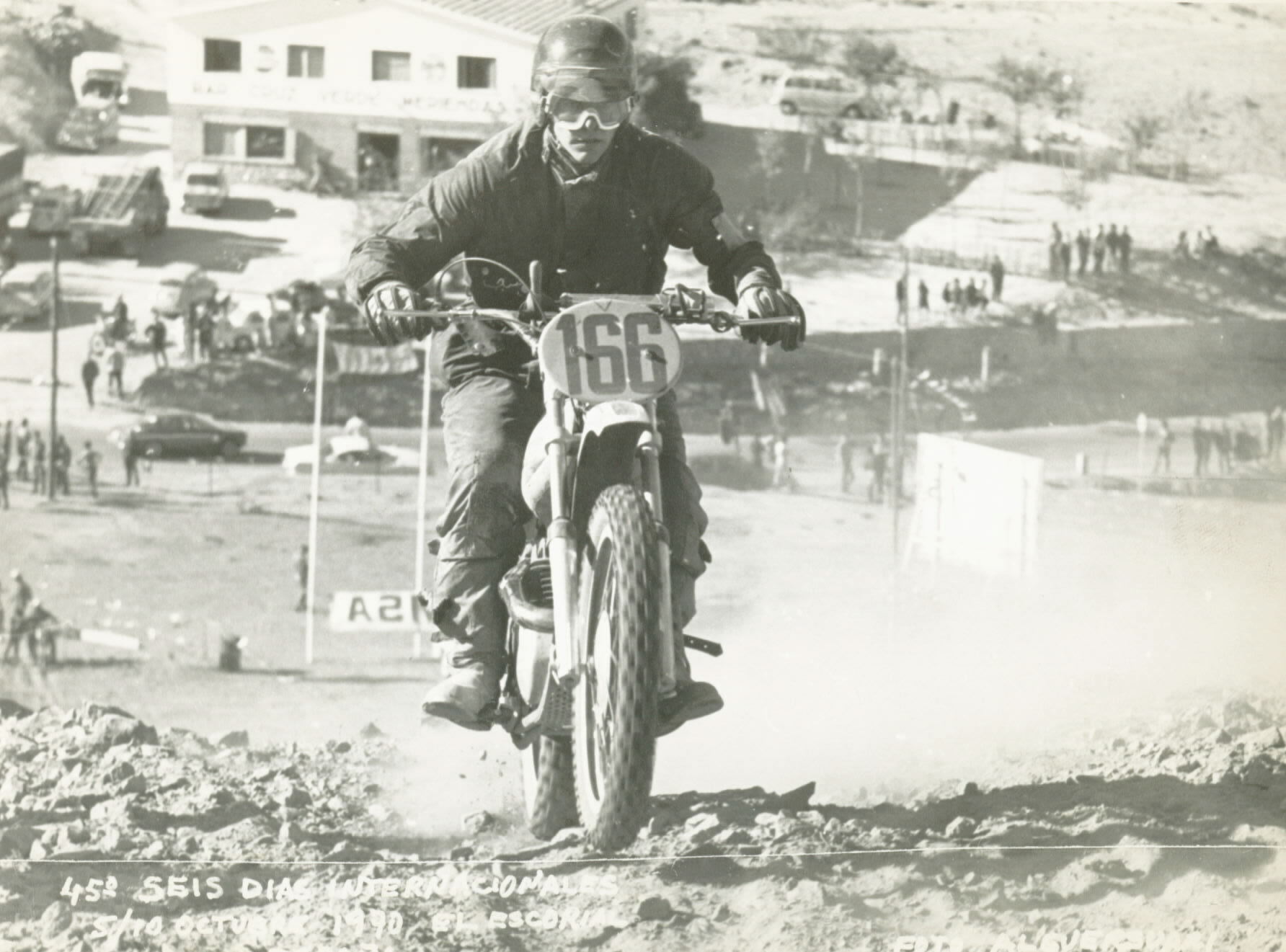
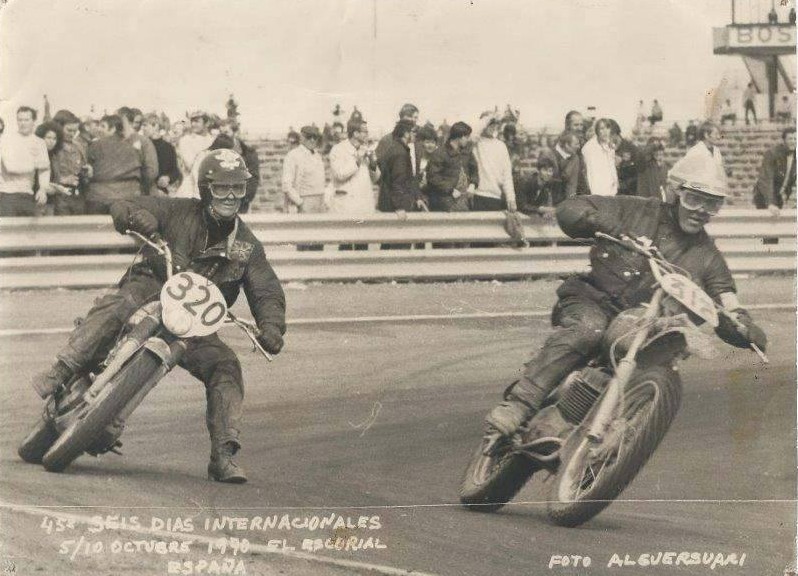
1970 saw George Webb ride in the British Vase A team on the 441cc BSA B40. The event was held around El Escorial north of Madrid, Spain.

“We had one week courses for Junior Officers to get their bike licences. Can you imagine what folk would think today, just a week, well five days actually!

Before all that I would be required to train as a driving test examiner to D.O.E. standards, in order to take students on their test. I always promised them half a days cross country riding if they had advanced enough with the road work, This was a great incentive, and improved their riding skills at the same time.”

Jarama racing circuit action on the final speed test in the 1970 ISDT at El Escorial with George Webb, left BSA chasing a Swede on a Husqvarna. Official photo as watermarked.

“There were three week instructors courses, for soldiers who already had a bike licence, so that they could go back to their units and teach more to ride. This would involve more advanced riding lessons and cross country, to a higher standard.  This would also include maintenance lessons and tyre changing practice.”

Press cutting from Motor Cycle News, penned by Ralph Venables.
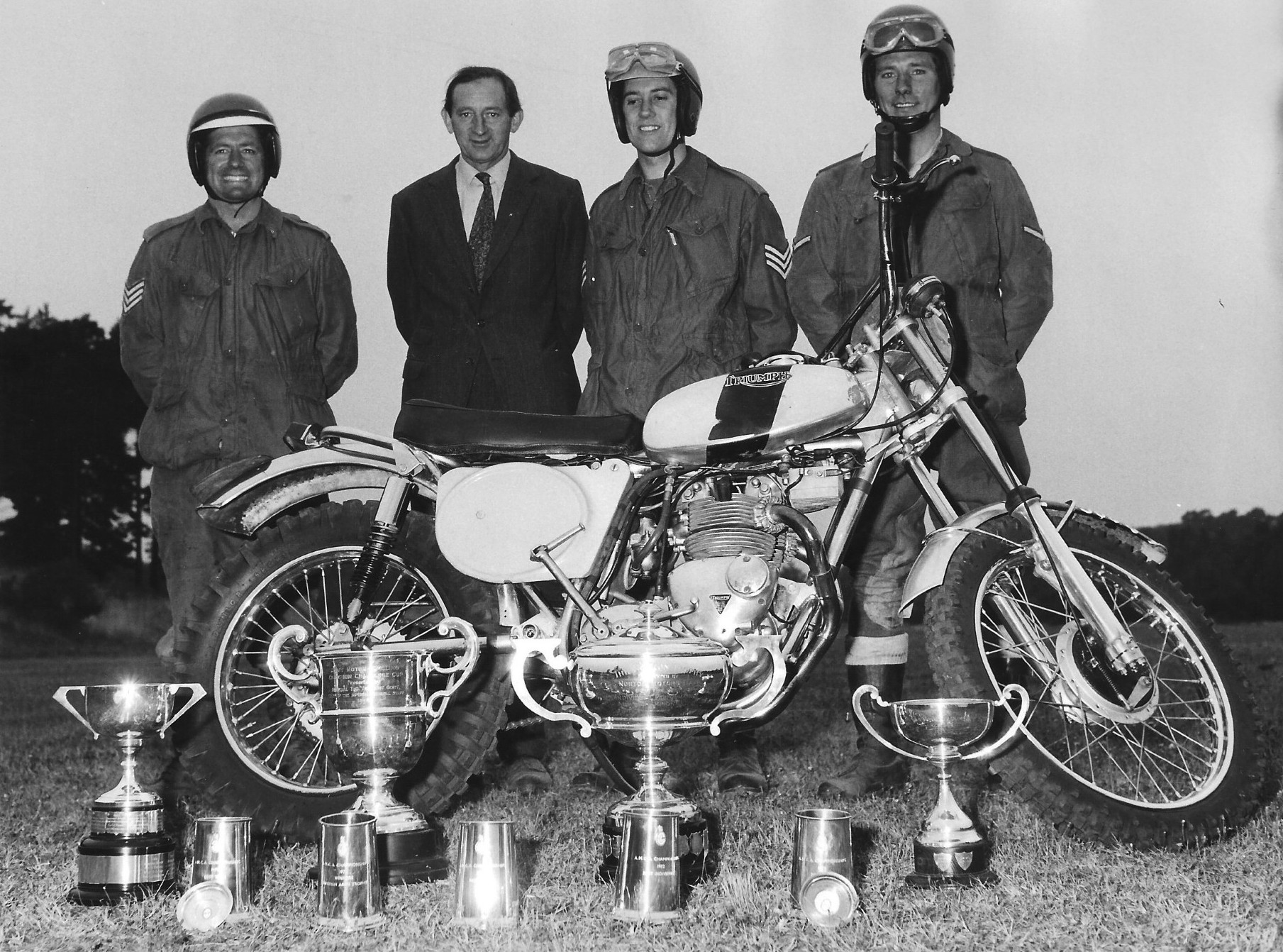
Left to Right: Sgt. John Nightingale, Col. Burnett Commandant  ASOT, George Webb, and Ken Ablewhite following our second Championship win.
Machine is the prototype Triumph ‘Adventurer’ that George rode in several events in 1972, including the I.S.D.T. in Czechoslovakia gaining a Silver Medal.

“On one of these courses, I had some Ghurkas soldiers from Hong Kong, and we were out on a cold winters day, doing some of Hampshires green lanes. We had come to a very steep down hill section which was frozen ice, with just a touch of water on the surface. There was a barbed wire fence each side. I talked them through the procedure for tackling this and then did a demonstration ride down. It was quite scary, and I said it was not necessary for them to do it, but they were up for it. Once again, keep the bike absolutely straight, first gear, and don’t touch the brakes! Well, they all came down like tobogans, but perfect, and no mishaps! That took some guts!

During my time at the School, I was always impressed by our Ghurka troops, but always ashamed that we payed them so little. On one occasion when I was taking a Ghurka on his class two HGV test in Aldershot, he finished up with the lowest score of anybody I have tested, just two minor faults. Brilliant, as this was a very heavy Leyland six wheeler Artillery Tractor.

Then we ran three week courses for Special Forces which involved lightweight 125cc bikes, instead of Army B40s. The purpose for this was to be able to Helicopter in for an Operation, then ride the bikes, to where ever?”

Another shot of British Vase A team member, George Webb on the Army supplied 441cc BSA B40 in the 1970 ISDT at El Escorial – Photo: Brian Catt

“These courses were good fun, the Guys were quick to learn, even when they had never ridden before. Not only did they need to get their licence, but it was required that they would need much cross country training too. What made things different was the need to carry so much kit on these lightweight bikes, such as spare fuel, and weapons, which weighed half as much as the bikes. This made the cross country riding much more difficult, as this weight completely changed the bikes handling!”

International Three Day Trial at Isny, Germany in the Baden-Wurttemberg area in 1971. The machine is a 441cc Cheney BSA Victor.

“With perseverance we got the job done, there were so many places that we had to test differant kinds of terrain. Soon the Guys were coping with everything we could throw at them!”

The 1971 ISDT was hosted by the ACU in the Isle of Man. George was riding an Army registered 441cc Cheney BSA Victor.

Army MT School:

“In addition to running the motorcycle wing, there were other tasks at the school. In order to test candidates it was necessary to hold the appropriate qualification to do so. I remember taking my HGV Class 1 test in Aldershot in an AEC articulated truck that was so old that it had no power steering! It took all my strength to manouvre it around a mini-roundabout during the test, but luckily I did pass.

Other vehicles we had to drive and test on were tracked vehicles, amphibious and buses. So all in all an interesting time. I also did a course in Devon to water-proof vehicles, in order that they could be driven ashore from landing craft without drowning before hitting the beach.

Motorcycles were my main job and took about 85% of my time there. From a sporting aspect it was really great, because there were so many trials in the area. Not only did I get to ride during the week, but also at the weekend too. As we had the facilities and the training areas, I got plenty of practice time too.

During my time there I won the Army Championships two more times which made me the first multiple winner of the title.

The seventies were really my best years, as I held on to the titles for ten years in all. Add to that the B.O.A.R championship; Berlin Championship and Southern Command champion.

Two wins in the Pathfinders Trial and many more in Army prelim events and civilian events too.

Even when my time at the school was coming to an end, I would have the good fortune to remain in the Army International team until I left the service in 1980.

For now I was going back to Germany to run the Transport Department at a Brigade headquarters in Osnabruck – Aufweidersehn Pet!

Osnabruck, Germany – Second tour:

I was soon able to take off from when I left Germany three years earlier, and joined the local motor sport club. They ran Trials and also some car events too. Before long I had made friends with some of their members, such as Helmut Stanik, German national 125cc Champion in 1974, and a regular Scottish Six Days rider.”

Helmut Stanik (Montesa) in 1974 riding in the German Championship at Luneberg Trial – Photo: Rainer Heise

“Also Gerd Bücker, who owned a bicycle and moped business in town. Gerd and myself often travelled to events together. One day when travelling down south we were pulled off the Autobahn by the Highway Police, for speeding! We were in a little Renault 4 with a trailer. Anyway, after a very friendly chat, we thought we got away with it, but not quite, fined ten marks, quite a bargain!

Work entailed taking care of transport requirements of Brigade HQ, day to day stuff and also the exercise requirements. I have to say I was quite lucky, because of the Army Team, I had quite a lot of time away to ride the international events.”

Welsh Three Day action in 1973 on the 100cc Dalesman. George won his class, was 6th overall and a gold medal to his credit. Flat out the machine topped 55mph!

“During my time there I received into my office some information that the Army were looking to reduce their numbers with a redundancy scheme. After reading all the detail, I filled in the forms thinking it will never happen to me, but its worth a punt.

I had been thinking about a second career for a while.

Anyway a year went by and the Chief Clerk comes into my office and says to me you’re redundant!  I looked at him and said, what are you on about. He retorted, did you apply for redundancy a year ago? After answering yes, he told me, well you have got it!  Well, what a surprise, and what am I going to do??  Never gave it a second thought, had I.”

The 1976 ISDT was held at Zeltweg in Austria and centred at the then Oesterreichring (now Red Bull Ring) racing circuit. Here is George aboard the 250cc OSSA SDR Enduro model in the ‘Motocross Special Test’ within the outfield of the racing circuit.

“Luckily, I still had some time to serve in Germany, before getting posted to Catterick for my last six months of service. In the intervening time, we had been back to the U.K. to sort out some accomodation, and had settled on Harrogate, North Yorkshire.

Coincidently, where there just happened to be some very good Trials Clubs!”

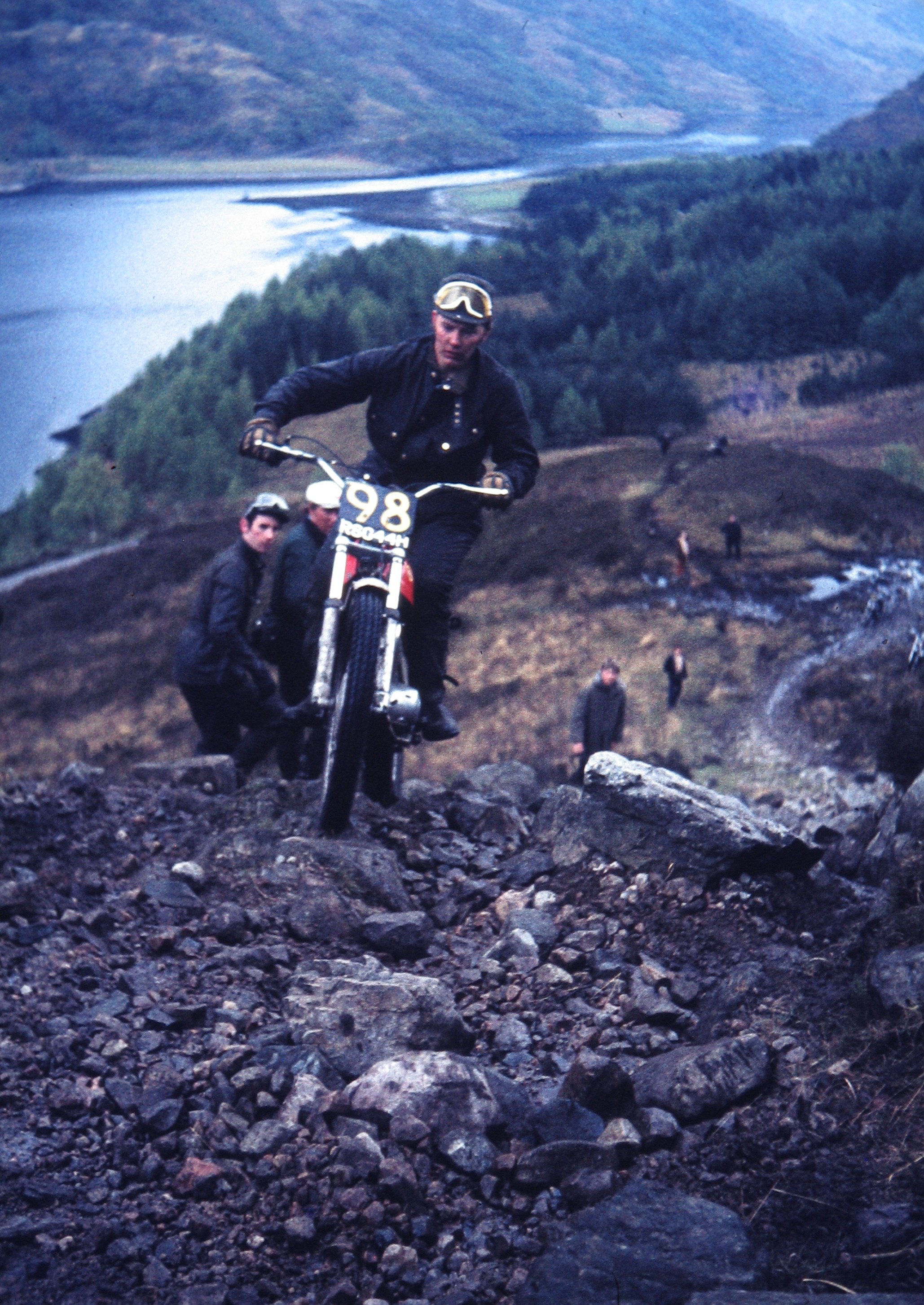
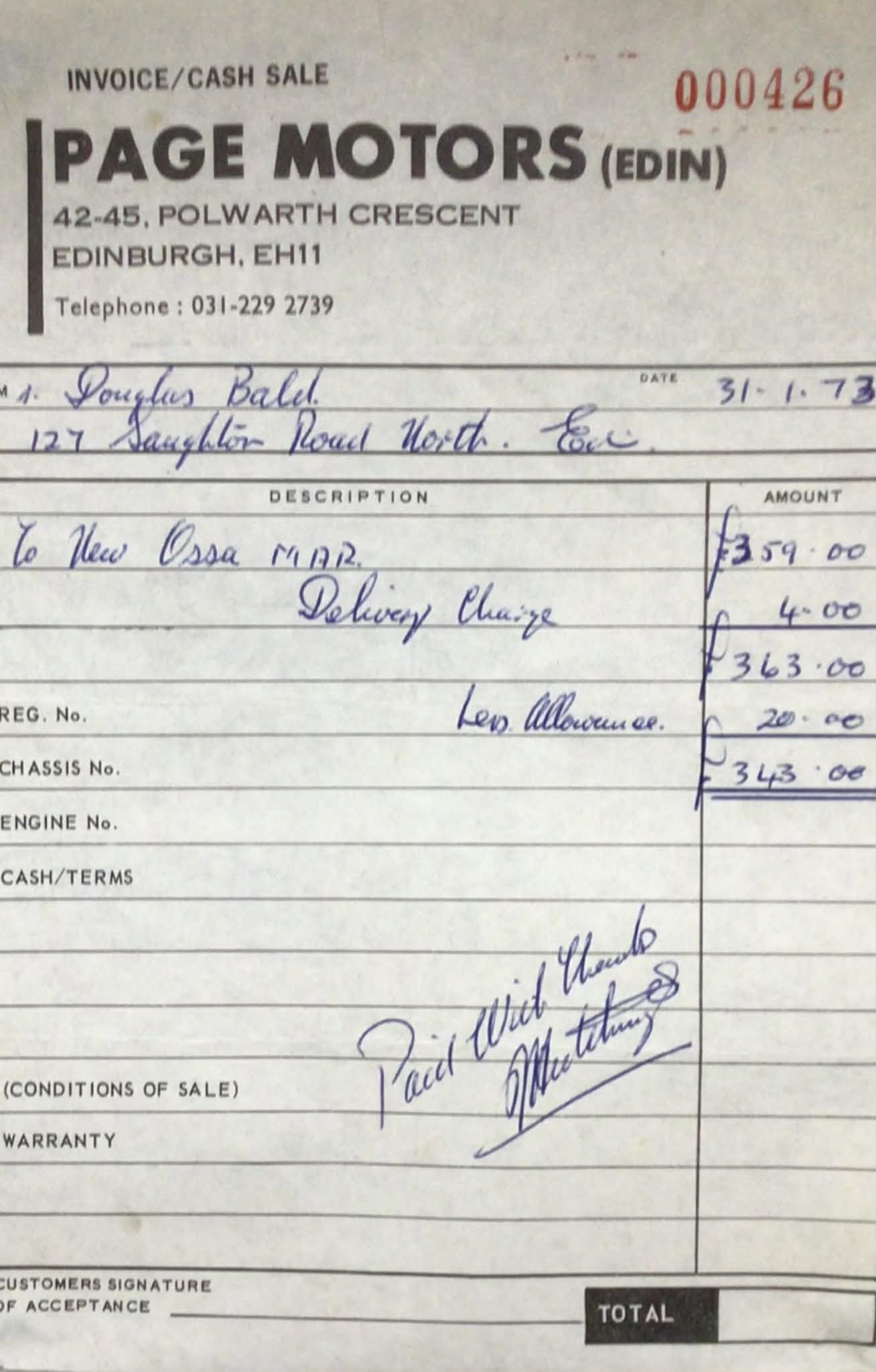
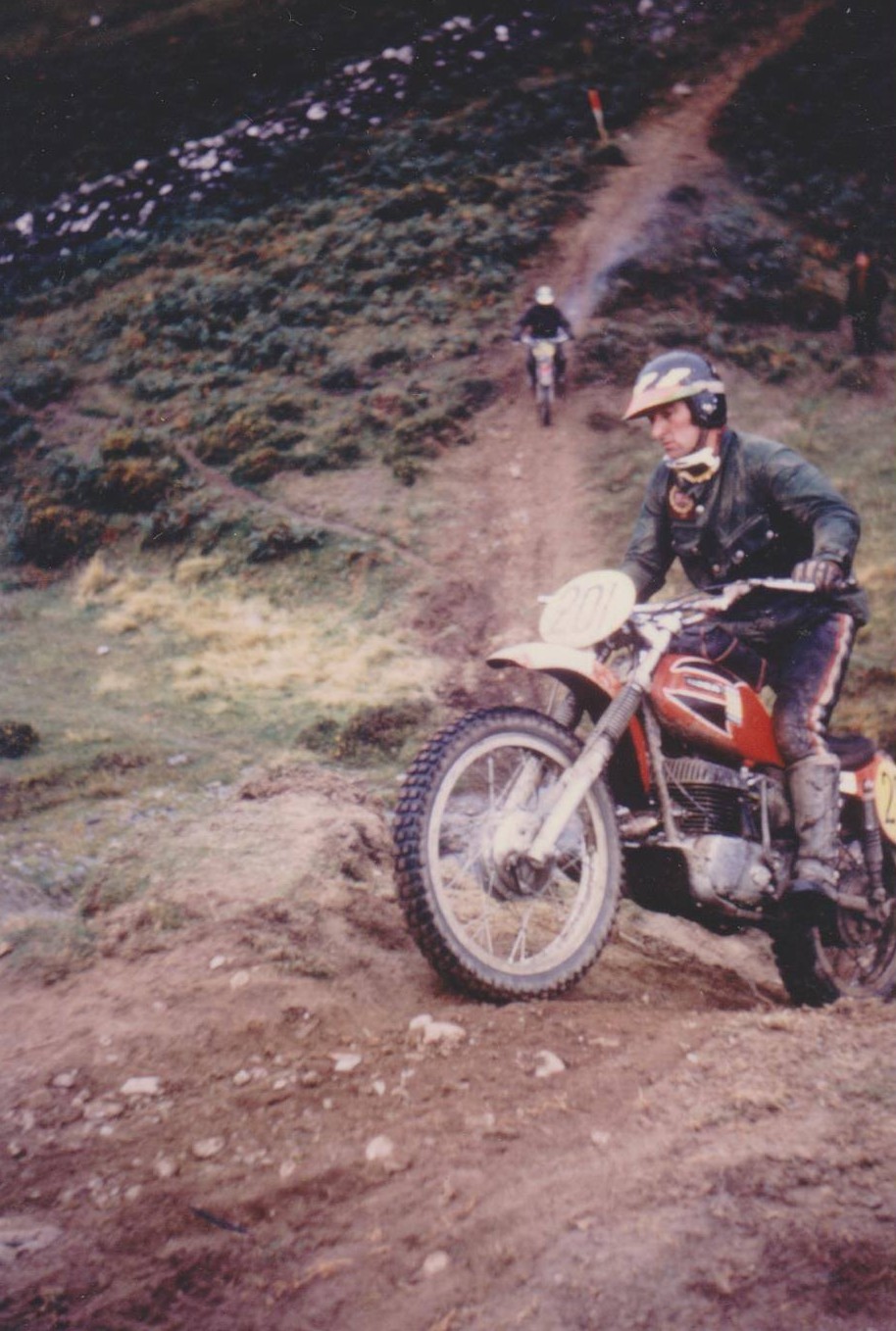
On the 244cc OSSA MAR MK2 on ‘Edramucky’ on the slopes of Ben Lawers in Perthshire during the 1976 Scottish Six Days Trial.

“Well, my time in Catterick, soon passed, and it was time to be demobbed! But almost as soon, I was being recruited again!

A certain Captain Smith of 150 Regiment, Royal Corps of Transport wanted me in his motorcycle team!

I tried to resist, but he made me an offer that was difficult to turn down. Whenever there was a Army event, they would bring me a bike to ride and that was all I had to do, plus I would get paid, and a motoring allowance.  Captain Smith had a pretty good team, so we were in with a chance. In fact we won the Army Championship best team, and best individual, and much more too.

This was the first time a Territorial Army team had won the Championship, and I was the first Territorial Army Champion, which I won in 1978 and 1979.  So when I thought it was all over, well it wasn’t quite.

I did eventually leave the T.A. to start my own Business in 1980, but not before winning another Gold in the Welsh Two Day International.”

An interesting Honda:

“It all started with a surprise call from Colin Tipping. ‘Would you like to ride a Fraser Honda 250 in the Scottish Six Days?”

George Webb on the 250cc Fraser Honda at ‘Callart Falls’ on Day one of the 1980 Scottish Six Days Trial.

“Well I had never seen one or even heard of them to be honest, but yes I was interested. I mean who would turn down a chance to ride in the most famous trial in the world?

I was attracted in that the bike was a four-stroke, and a Honda engine at that! Reliability ought to be good. However, the fact that it had an unconventional final drive was an unknown risk. I understood about the two chain set up, but had no clue if it worked well.

The bike was delivered to Fort William and I took collection of it. Once I had a chance to ride it, there was some concern about the two chain system. It was a way of achieving better gearing for trials work. But it was very noisy and the short chain was getting very hot. This did not bode well for the amount of road miles.

Never mind, we will give it a go!

Monday morning start and it’s off up the Mamore Road, the noisy chains were very noticeable and attracting attention. My thoughts were, how will I stand a week of all this?

There must have been a group of sections before Kinlochleven, but my memory is a bit vague and there is no programme of that year in my collection, so I would guess that Blackwater were the second group.

On route I came to a river crossing where I had to carry out a bit of life-saving. An Army rider had been swept off his bike by the force of the water. His bike had him pined down and his head was partially submerged. I wadded out and got the bike off him, but he was totally immersed and soaked to the skin. I couldn’t imagine a worse start to an SSDT but he was fine and carried on.

Arriving at the Blackwater group of sections, it was sunny and dry and after a quick inspection it was my turn to go. I did not get far though, after getting caught on a large boulder, the spectators were shouting and pointing at the boulder, it was covered in oil! The thin sumpguard had bent and the crankcase was holed. So no first class award that year to add to the five that I already had. I really didn’t think the bike would have lasted the week anyway.”

North Yorkshire –  God’s own County:

“After leaving the service, I had the oportunity to partake in a resettlement course. As my whole career had revolved around transport and vehicles, I chose to due a thirty week heavy goods vehicle mechanics course. This was run in Bradford, so I had to drive there every day. It was a good course and my instructor was ex-Army, who had served in North Africa in world war two, so we had some interesting stories about his experiences there, keeping their vehicles road worthy.

After the course finished, employment was found for me in Harrogate, at a small transport company, with their own maintainence facility. This turned out to be far from ideal. After twenty years of military organization, this was the opposite! The working conditions were rather chaotic and unpleasant, and after a few weeks, I was planning to leave and start my own business, which would be in the transport business.

However, just before I made the move, I received a telephone call from an old army friend, who was now working for Len Thwaites, of TT Leathers fame. The company that started the fashion of coloured motorcycle clothing.

Tom Walker, an ex-Army White Helmets display team member, was now working for Len, and they needed another sales representative – was I interested?  Well yes, it would allow me to leave my present job, and do something in the motorcycle industry. I was accepted for the position, and started in my new role. After a few weeks, I was starting to find my feet and sales were building up nicely. This was all new to me, selling was teaching me a few new lessons in life!

Within the company, there were some handy bike riders, Len the Boss, did scrambles and trials. Jimmy Aird was a top scrambler, and Tom and myself were trials and enduro riders. For a while we formed a TT Leathers team, and entered some of the early rounds of new British Enduro Championships, with some good results too. 

Scot, Jimmy Aird on his factory Y4 AJS Stormer was a director in TT Leathers at Barnard Castle – Photo: OffRoad Archive.

The idea of setting up my own business was still at the back of my mind though, I had that ambition to fulfill.

Back in 1968, I had married my German girlfriend Trudi, and we had two children, Karen and Mark. Because of my service and sport, much of my time was spent away from home, and my family had not had as much of my time, as they should have. I could not have changed what had gone before, so it would need to change for the future.”

George Webb with first born Grandson in 1990.

“My new plan was to open a retail motorcycle clothing shop in Harrogate, and be nearer to my family. Welcome to ‘Sportex Gear’, my new business, a new era.”

George Webb’s grandson in 2025, now a top Army mountaineer, winter warfare and skiing instructor.

The final chapter:

“Just to finish this brief look back over what has mainly been about my Army and and business career, here are some details about where we ended up.”

Still competing, here in the 1996 Scottish Six Days on a Beta.

“In the late nineties we were approached by a couple of companies who expressed an interest in buying Sportex. This came about due to a rumor going around at one of the motorcycle shows, that we were being taken over by the Carnell Motor Group in Doncaster. This was a big surprise to us as we knew nothing about it, how the rumour started we had no idea, but it did arouse some interest within the trade.”

The brightly coloured leisure and riding apparel from Sportex.

“Jack Knoops and I had expressed an interest in early retirement, and this seemed like an opportunity. To cut a long story short, we did eventually sell the business but in two parts, with all the road based products going to one company, and all the off road stuff going to C.I Sport, run by ex Comerford’s people, Don Howlett and Stuart Miller. It took a little while for it all to go through, but eventually it was sorted.”

Copy of a trade journal featuring the success of Sportex Gear based in Harrogate.

“Jack Knoops stayed in Ripon, and took up his hobby of photography to another level, providing photos for trials riders at Yorkshire events, and also sometimes for magazines.”

George with business partner, the late Jack Knoops at a Wetherby & District trial.

“I believe he really enjoyed this, and often provided Special Awards at annual prizegivings of enlarged and framed photographs of riders, which were really appreciated.

I decided to move to Spain for some warm weather, and a change of scenery. I had once been down on a business trip in November, and the weather was fabulous.

On the plane I met someone who was on his way down to buy a property, and this had planted a seed, that got my interest.

Jack and his wife Marie, came many times to holiday with us, and visit differant parts of Spain too.

Spain is great for biking and we did many trips out whilst there, and I had some trail riding chums too. The area around southern Spain has hundreds of trails, but I also went up north to the Picos Mountains many times. Lots of our retirement has been about biking and also non biking trips to places of interest, and we have been very lucky to have had these opportunitys. Neither of us smoke, and we drink very little, but we do like to travel.

We stayed in Spain for some ten years, Trudi was complaining that the summers were getting to hot for her, and she wanted to come home. Thinking she might mean Germany, where she came from, I asked where in Germany, hoping it might be in the south. ‘No’ she said, ‘not Germany, North Yorkshire’!

So here we are back in God’s country again, since the last seventeen years. No trials riding since I left for Spain, or enduros, but plenty of trail rides and road trips.

I’m tending to slow down now due to age, but still enjoying riding my bikes.

Sorry to report the loss of my good friends Jack and Marie Knoops in recent years, due to poor health. Rest in peace, we still have our memories.”

Final chapter Part Two:

George Webb had a liking for Triumph Twins, so treated himself to this lovely Cheney Triumph in ISDT spec, which he used for road runs.

Here are some motorcycling highlights that I have experienced over the years.

  • A near three-hundred mile journey from Suffolk to North Devon through the 1963 winter freeze and blizzards, on my Triumph 350. Never saw another motorbike the whole journey!
  • Three-thousand mile trail bike tour around the Peruvian Andes, as high as sixteen-thousand feet.
  • Trail bike ride from Yorkshire, to the the Sahara desert.
  • Two tours of the Wild West, one on a Harley and one on an Indian Chieftain.
  • Numerous European bike tours.
  • The Scottish Six Days Trial
  • The International Six Days Trial
Bike cleaning time for George Webb’s prototype Triumph ‘Adventurer’ after the ISDT at Spindlruv Myln in Czechoslovakia in 1972. A third place in the up to 750cc class and an ISDT Silver Medal.
  • The Welsh Three Day Trial/Enduro
George Webb on the 441cc Cheney Victor in the 1971 Welsh Three Day Trial.
  • Army Championships Trials
  • Twenty years of Yorkshire trials. 
  • Bike tour of Malaya.
1972, after the bike is cleaned, the trophies are next for some bull!

“I hope you enjoy what has been a brief look, at my riding career, my Military service, and our Sportex business.

Best wishes to Trials Guru, their readers and all bikers everywhere – George Webb

Trials Guru VIP – George Webb is of course a member of the Trials Guru VIP Club.

George Webb’s photos from his personal collection:

Army days with the amphibious D.U.K.W craft.
A ‘D.U.K.W’ out of the water, loading onto HMS Bulwark.
George Webb in control of his Army D.U.K.W.
Enduro results from July 1977 at the Melville MC enduro in Scotland.
Results from 1993, Wetherby Trial.
1996 trials results from Eboracum Motor Club (York).
ISDT 1971 in the Isle of Man on the 441cc Cheney BSA Victor.
1971 German Three Day at Isny, after the event. Left to right  Tom Fayers, the late Brian Cowshall and George Webb.
Mr. Fourstroke, Rudi Munsterman from Germany, who ran an International Trial for Pre65 machines for many years. George is holding a copy of ‘Trialsport’ the German trial only magazine.
Fun at the SSDT with Bill Wilkinson and ‘Wee Jimmy’ at Bill’s stall.
Fun at the SSDT – 1993 George on the Yamaha TY250R on ‘Lagnaha’.
George Webb’s last trials bike, the 350 Bultaco Sherpa.

‘Army Man George’ – the story of George Webb is copyright of George Webb and Trials Guru – 2025.

Credits:

Motor Cycle News – Press cutting, author, Ralph Venables.

Footnote:

Apart from ‘Fair Dealing’ for the purpose of private study, research, criticism or review as permitted under the Copyright, Design and Patents Act, 1988, no part of any article may be copied, reproduced, stored in any form of retrieval system, electronic or otherwise or transmitted in any form or by any means, electronic, electrical, mechanical, optical, chemical, photocopying, recording or otherwise without the prior written permission of the author as stated above and below. All articles are not published for any monetary reward or monetisation, be that online or in print.

Nevis Radio, SSDT 2025

In case you didn’t know, Trials Guru was represented on Nevis Radio during the Scottish Six Days Trial week in Fort William. The website owner, John Moffat was the guest presenter on the daily show which broadcast from 7-11am Monday to Friday and 7-12.30 on the Saturday as the last man, John Shirt (240) left the Parc Ferme.

Thanks to: Nevis Radio; Michelin; Gavin Cairns Roughcasting Ltd; Thistle Access and Comms West for their support.

If you want to review the interviews and commentaries on the SSDT Show, here are the links:

Youtube: Sound and Video Links:

Day 1

Day 2

Day 3

Day 4

Day 5

Day 6

MixCloud – Sound only:

Day 1

Day 2

Day 3

Day 4

Day 5

Day 6

Mike Hann chats with Mike Naish

Words: Mike Hann & Mike Naish.

Photos: Mike Naish; Linda Ashford; Glenn Carney; Mike Rapley.

This is a profile, which dates back to 2007, of one of the most pleasant riders you would ever wish to meet. Enthusiastic, courteous, friendly, always willing to lend a hand. Somebody who encouraged young riders to take up the sport; an organiser, co-ordinator and course plotter. A rider who at sixty-six was the oldest rider in the South West Centre, and performing well at that. Who could have a bad word to say about a real genuine gentleman? Mike Hann.

Mike Hann (325 Bultaco) – Photo: Mike Rapley

Mike Naish: Have you always lived in Dorset, and how did you become interested in motorcycles?

Mike Hann: “I was born in the small Dorset village of Leigh near Sherbourne in 1941. My grandparents and parents were very keen motorcycling families and my father was an excellent engineer. He had been in the Royal Signals during the war and was captured by the Japanese in Singapore. During his captivity he was made to work on the Burma railway. I did not see him until he came home after the war when I was seven years old. He was an enthusiastic motorcyclist but all his bikes were road going models.

Every evening all the local bikers would gather at our house, drink tea and coffee, maintain their bikes and of course all the talk was about bikes, so I suppose it was inevitable that I would become interested. I saw in them a great sense of comradeship and I was learning lots from an early age.”

“When I was about thirteen, along with Badger Goss and Tony Chant, we joined the legendary grass tracker, Lew Coffin as trainee assistants at his parent’s place at Pond Farm, Hillfield. We worked five days a week for no money because Lew said it was ‘training’. Lew had a spare stock bike which we used to share at grass track meetings. Badger was useless as a mechanic but as you know he became a world class competitor joining first Cotton and then Greeves. My father and I looked after Badger’s machinery in his early days.”

“Tony was excellent at both grass and scrambles but he used to annoy Lew by going out at ten o’clock at night to see his girlfriend. Lew reckoned that if you were going to be dedicated to bikes there was no time for anything else. I enjoyed my time with Lew, he taught me a lot.”

MN: Apart from the odd grass track, what was your first competition bike?

MH: “At fourteen, I joined Yeo Vale and Somerton Clubs and very soon became involved in the running of events which I still am today. In 1957 I purchased my first scrambles bike, a 250 Greeves that was followed through my scrambling period by a succession of Husqvarna and Maicos. In 1958 I started work as an apprentice motor mechanic. This enabled me to afford to start scrambling which I did until the mid 70s when it was motocross.”

Mike Hann struggles to control his wayward 250 Greeves at a South West scramble.

MN: Any highlights you want to share?

MH: “Reaching good ‘Expert’ status.  Scoring two British Championship points at a South Molton British Championship round and winning a support race at a Farleigh Castle World Grand Prix in the 1960s. After a short engagement of ten Years, I married my wife Evelyn. It cost me seven shillings and six pence, thats thirty-seven and a half new pence.  She was a farmer’s daughter, excellent value for money, because we also gained three family farm venues for trials which we still use today. Not bad hey?”

Mike Hann aboard his 400 Maico in 1974.

“It was in about 1973 that I had an unfortunate crash in a support race at a winter TV Grandstand meeting. It left me with a nasty broken leg and thigh damage. I missed half of a season being repaired and as much as I tried I could never quite get back into it. It was no longer enjoyable. This coincided with a new daughter and I had started the garage business at Bishops Caundle. Before that I had worked for ten years at Yeovil Technical College teaching motor vehicle maintenance. Common sense and family advice prevailed, motocross ceased and the magical world of trials began.”

Mike Hann guns his 250 Husqvarna.


MN: So how did you start your trials career?

MH: “I met up with my long standing friend Keith ‘Ringo’ Ring and then started the long uphill climb up the trials ladder. Although good riders made it look easy we both found trials a lot harder than we first anticipated. Our local heroes at that time were Martin Strang, Geoff Parken and Hedley Ashford. They seemed to win an event on about ten marks lost and we took simply ages to get under one hundred marks. Remember, no dual routes in those days!”

Mike trialling an early model 10 250cc Bultaco Sherpa.

MN: How did you find trials compared with scrambling?

MH: “Right from the very beginning of my trials it was the sense of help from others and the general friendliness of everyone which was very apparent and different from motocross-which is still very true today. As I have already said we found trials at the start very difficult, but after quite a long time we eventually worked our way to ‘Non Expert’ and then ‘Expert’ status. Because I am living in Sherborne Dorset, I am officially resident in the Southern Centre ACU but right from the very beginning I have always considered myself a South West Centre person. I always loved my scrambling days as much as anyone but the magic of the trials world is absolutely the tops with me which of course includes all the people within it.”

Mike Hann on a Bultaco riding ‘Ruby Rocks’ – Photo: Mike Rapley

MN: You have competed the SSDT a number of times?

MH: “Yes, our Yeo Vale chairman in the early days was the well known Percy Butler. We all admired his dedication to the club and the South West Centre; he was admired by all who knew him. This was with the exception at some of the South West Centre board meetings because when Percy was there you knew it was going to be a long evening!

I always remember Percy saying to me “Son, thee can’t call thee sell a trials rider till thee have ridden and finished the Scottish Six Days Trial”.

Mike Hann tackles ‘Fersit’ on his 240 Fantic in the 1984 Scottish Six Days Trial.

“Yes Percy” I replied, “OK, if that’s what it takes Percy, then that’s what it will be”. Well I tried to make entries in 1976, through to 1979, but all were refused as the event was full up. Then in 1980 that special Edinburgh letter said ‘YES’ riding number 180. What the hell have I done now I thought, as the realisation dawned? There was no backing out and I really did not know what I was letting myself into.  That was the start of ten superb Scottish Six Days that I rode in with enough good memories to keep me going for ever. It included two retirements and I can never thank Percy enough for urging me to enter in the first place.”

The Fantic 301 of Thierry Michaud at the 1986 SSDT – Photo: Glenn Carney

MN: What about your bike dealership?

MH: “From 1980 to 1990 I was a Fantic trials main dealer. I loved every second of it but it took up lots of my time and in reality it was difficult to keep going with the main garage. Sadly when my parents passed away a tough decision had to be made, the garage earned my bread and butter and the bikes didn’t, so regrettably the Fantic Agency had to go.  I have to say that during those ten years the Fantic importer Roy Cary and his wife Helen were absolutely fantastic. For example in 1981 a spectator stole my riding jacket at the top of Pipeline, having put it at the ‘ends cards’ prior to riding the section. Mrs Cary was there and insisted I use her own coat to continue the event. That was beyond the call of duty. Following this I have been privileged to take part in six Pre65 Scottish events in total, with a variety of machinery, and once again my good friend Jack Coles allowed me to use his beautiful 500 Ariel, a machine which I rated as perhaps the best bike I have ever ridden.” 

Mike Hann on ‘Pipeline’ in the Pre65 Scottish Trial on the 500 Ariel HT5.

“In fact I did actually own it for a short time but a long standing back injury incurred a few years prior made riding the Ariel continuously a very painful exercise, so Jack had it back.”

Mike Hann, seen here on a 240 model, will always be associated with the Italian Fantic marque, having ridden and sold them for many years at Bishops Caundle.

MN: Do you run any road bikes?

MH: “I love the older bikes and am a very keen member of the Dorset Vintage Club and sometimes take part in their club runs on my 1929 BSA 350.  My brother Rodney, a retired policeman is chairman of the Vintage Club and in my capacity of car and bike MOT testing I get my oily hands on some very exotic machinery which I really enjoy. I consider myself lucky to be able to compete in the South West for fifty two years continuously and above all still very much like to get up early on a Sunday morning to meet the Yeo Vale gang and centre friends and enjoy another good days sport.  I am often asked ‘What are the highlights of your trials life?’ and my immediate reply is ‘Every Sunday’.  I am not afraid to admit that no one enjoys their sport more than I do.”

Mike Hann on a 1921 Sunbeam 1000cc vee-twin taking part in the Banbury Road Run.

MN: What do you think of the Pre65 scene?

MH: “My father was often Clerk of the Course for the Yeo Vale trials and I was helping him one day when he said to his helpers ‘Let’s get the Experts to ride over this part of the fallen tree and the rest of the entry over this lower part’.  That was the very beginning of the dual sections and now of course many times a triple route. In the sixties and seventies when single route sections were the norm you very rarely saw competitors over forty years old, but look at us now with multi route sections, we are all catered for which perhaps is the best and most sensible thing to happen to our sport.”

TALMAG Trial action from Mike Hann on a Matchless.

“One side of our sport which really saddens me is the mad mad world of Pre65 British bike trials, you could write a whole book on the subject. But when you have a section of people spending £12,000 building up an exotic engineered super bike and then entering it in a Pre65 event when the original cost was £300 it is a complete sad joke. The premier event is obviously the Scottish Pre-65 Two day and you could correct the situation overnight if you gave the awards to the competitors whose machine is in the correct spirit of the pre-65 movement.”

MN: And what of the future?

MH: “At sixty six and feeling sixteen you certainly appreciate much more all the things we take for granted. We appreciated our fortunate health, also the massive amount of club work, the observers, the help and support from my wife and family. Every Sunday I am riding Evelyn is running the garage forecourt. A customer recently asked me what I am going to do when I retire from the Garage. I said I would like to be a professional Trials rider and to be sponsored by my wife. She said that she had been doing that for years. In all a happy appreciative South West Centre rider whose favourite day of the week is Sunday. All the best to everyone.” – Mike Hann

Mike Hann entertains during an ‘Up Memory Lane’ gathering organised by the SWCTA – Photo: Mike Naish

This interview took place in November 2007, so the dates and ages will have change considerably. – Mike Naish

Trials Guru Post Script: When Mike Hann rode the 1980 Scottish Six Days with riding number 180, an enthusiastic parc ferme marshal when calling out the numbers in the morning, when he came to Mike’s number he called out in a loud voice “One Hundred and Eightyyyyy” in the way they do at darts competitions. This happened every morning with people laughing. Mike had to ask what the joke was!

Mike Hann (Fantic) at the Somerton Classic Trial – Photo: Linda Ashford

‘Mike Hann chats to Mike Naish’ is the copyright of Trials Guru and Mike Naish.

More interviews with Mike Naish HERE

Apart from ‘Fair Dealing’ for the purpose of private study, research, criticism or review as permitted under the Copyright, Design and Patents Act, 1988, no part of this article may be copied, reproduced, stored in any form of retrieval system, electronic or otherwise or transmitted in any form or by any means, electronic, electrical, mechanical, optical, chemical, photocopying, recording or otherwise without the prior written permission of the author as stated above. This article is not being published for any monetary reward or monetisation, be that online or in print.
Gordon O. Mclaughlan passes

It is with sadness that we announce that the former AJS factory trials rider, Gordon O. Mclaughlan has passed away.

From Thornaby on Tees, North Yorkshire, Mclaughlan was one of the ‘Three Gordons’ AJS factory team comprising of Gordon Mclaughlan, Gordon Blakeway and Gordon Jackson. he was a motor dealer and owned Gordon Mclaughlan Motors, BMC and British Leyland agents.

AJS teamster Gordon McLaughlan seen here on his factory AJS 164BLL at the Colonial Trial in 1963 – Photo: Charlie Watson, Hull

Gordon was a member of the Middlesbrough & District Motor Club, a keen Scottish Six Days and Scott Trial competitor in the 1950s and 60s.

His last motorcycling event was the Scott Trial Reunion dinner, hosted by Sid Lampkin at the Kings Head Hotel on November 9th 2024, where he sat at the top table and conversed most of the evening with his friend, Arthur Lampkin.

A Brian Holder photo of Gordon Mclaughlan in the 1960 SSDT on Devil’s Staircase. Watched closely by SACU official Jim Birrell ( standing with camera) and Ralph Venables (seated, top left) – Photo couresy of Ian Harland

Gordon Mclaughlan’s funeral will be held on Friday, 20th December 2024 at 11:00 in St. Bedes Chapel, Acklam Crematorium, Middlesbrough, TS5 7HD and at Middlesbrough Motor Club thereafter.

It all started with a Renault 4 – The story of the ‘Jerred Hondas’

Words: Trials Guru & Peter Jerred

Photos: Iain Lawrie; Alistair MacMillan Studio, Fort William; Jimmy Young; Peter Jerred; Anthony Hylton.

In late 1972, Honda Motor Company launched their trials effort in Japan, code-named quirkily as ‘Bials for Trials’ debuting their small capacity which later became the production TL125 for the UK and Europe and the TL250 specifically for the North American market in 1975. From that time, there were to become official Honda trials models, but mainly the giant Japanese manufacturer created some very good motorcycles for the sport of trials, but few reached series production. This encouraged smaller concerns to build their own, using Honda engines. Honda even adopted a model made in the UK, built by Colin Seeley International, the Seeley Honda TL200E. This was in collaboration with Honda’s Racing Service Centre (RSC). The Seeley frame featured top and down tubing of square section as did some of the factory special Hondas.

The original 124cc TL was to provide an entry level machine for trials sport and with ten times British Champion, Sammy Miller MBE effectively in charge of development, it came as no surprise that he would eventually provide upgrade parts through his New Milton trials emporium. He would later produce a ‘Hi-Boy’ frame kit, as Sammy had produced for the Bultaco Sherpa T which he also developed from 1964 until 1974.

Honda publicity material from 1975 – Photo: Honda Motor Co

Conversely, down in St. Ives, Cambridgeshire, Peter Jerred ran a motorcycle dealership in the mid 1970s, he had taken a shine to the little Honda.

Peter was educated at Ottershaw boarding school at Ottershaw in Surrey and had studied building and land surveying at Guildford College and went on to become a senior engineer on various road projects in the south of England. He was at that time a keen scrambles rider.

Nick Holt on Ben Nevis during the 1979 SSDT – Photo: Jimmy Young.

Jerred set about building his own version of the Honda TL125 and pulled a team together for the 1979 Scottish Six Days Trial, which attracted a good bit of interest in Fort William that year, during the weigh-in Sunday. The team comprised of Nick Holt, Nick Fossey and Jim Kelly.

Nick Fossey on his Jerred Honda, tackles ‘Ben Nevis’ section in the 1979 Scottish Six Days Trial – Photo: Jimmy Young.

The previous year, 1978, Nick Holt had ridden his Jerred Honda to 104th position losing 460 marks. He received a first class award and was third best 200 that year on the prototype.

Nick Holt (200 Jerred Honda) on ‘Laggan Locks’ in the 1978 SSDT, watched closely by Austrian, Joe Wallmann. Photo: Alastair MacMillan Studio, Fort William

Peter Jerred tells it in his own words:

“I had a TL125 which was rather short of power and lacked quite a lot more. Sammy Miller began selling piston kits which took them up to 150cc, which was actually a modified standard Honda 750/4 piston with some machining work done on the piston crown. So, using one of those the next thing to do was ‘stroke’ the engine. The obvious amount was six millimeters, as each link of the cam-chain was six millimeters.”

The Jerred chassis in all its glory – Photo: Peter Jerred

It all started with a Renault 4:

“Next on the list was the chassis department, Mike Mills of BSA fame had got involved, having ridden in my Renault 4 across a ploughed field, no real power but long travel soft suspension. This allowed the drive wheels to stay on the ground rather than hop across the ‘undulations’ with thanks to Murray Walker, losing grip every time it was in the air. Mike therefore designed that frame so that all standard TL parts would fit but massively increased rear travel built in to the design. Mike at that time was possibly the best engineer in the field of suspension in Europe if not the World having worked for Ohlins with international racing star, Kenny Roberts.”

The long travel rear end can be seen in this photo, the dampers were inclined and the lower mounts located closer to the engine than the TL125 Honda – Photo: Peter Jerred.

“The TL125 frame was re-designed with only two slightly bent tubes and tig welded, very unusual at the time, by talented fabricator, Bill Wooldridge in his workshop at Weedon, Northamptonshire. The frame numbers begin with the year they were built, for example 1979 begins 79. The frames were finished in bright nickle, just like the Rickman Metisse frames were.”

“Nick Holt rode the prototype which had the rear mudguard loop made from a pair of bicycle front fork legs and it used a standard TL tank and aluminium side panels. The side stand was fitted to the offside, whereas later bikes had it fitted on the nearside.”

The prototype Jerred Honda ridden by Nick Holt in 1978. The standard TL Honda fuel tank and aluminium side panels can be seen here clearly. XL front forks with a forward wheel spindle was used. The name ‘Mills’ is also on the fuel tank. The exhaust was a one-off special item. Holt rode this machine in the 1978 SSDT. Photo: Peter Jerred Archive.

“The exhaust was also very different as it only had the front box with a short tail pipe. The kick start was reworked, which allows the bike to be started without lifting the footrest. I used to offer that modification on the basis that the customer sent me his old kick start that I would modify for the next customer. It was a good little mod.”

Angular Fuel Tank:

“The fuel tank was folded aluminium, in a similar style to a CCM tank which was another Mike Mills project. Fibre glass was used for the air filter and the side-panel and seat unit.”

The ‘Jerred Honda’ of Colin Moyce from Rye at the 1979 SSDT – Photo: Peter Jerred Archive.

“At the time, nothing was written down like professional race teams except the drawings for the frame. As mentioned, the first remit was that standard parts from the TL125 Honda should fit perfectly. Obviously, the tank and air filter and exhaust were special and supplied as part of the kit.”

The alloy fuel tank and Fibre glass components for the Jerred Honda – Photo: Peter Jerred Archive.

Suspension:

“Forks were standard straight exchange including yokes. Rear suspension, now that where the biggest and most significant change was made, by the standards at the time, the late 1960s and early 1970s. As I said previously it was massively long and unbelievably soft, controlled by the blue Girling Gas shocks with the twin spring set up. Many people did not understand that the combination of a long soft spring and the inclusion of the short square section orange spring actually further reduced the rate of the long soft spring.”

Nick Holt (200 Jerred Honda) takes a steadying dab in the 1978 SSDT on ‘Garbh Bheinn’ – Photo: Alastair MacMillan Studio, Fort William.

“Let us say the soft spring was rated at 60lbs per inch, then for every inch the unit moved both springs would compress, therefore the soft spring had not moved an inch, the 60lb/inch rate is reduced. Still with me? The suspension movement was just a little over ten inches! In general, when a rider was sat/stood on the bicycle, approximately half of that was taken up, around five inches, so plenty remaining to absorb impact and the same amount to drop in a hole and still retain grip. The hubs were standard TL125 Honda but on the “works” versions the fins were turned off; rims were re- anodised gold.”

Front End:

“Back to the front forks, although standard forks were okay. We tried several options, Bultaco/Betor, Marzocchi, Honda XL, the ones with the leading axle and the XL forks ran without springs but with air. Mudguards were Bultaco/Gonelli standard on rear, but the front version turned round with the flap trimmed off, which is very popular nowadays.”

Engines:

“There were three variations. 220cc in the bored and stroked version and 175cc with just the over-size bore however that came in the Over Head Cam TL engine and also in the push-rod version based on the CG 125 motor with trials gears added. In a funny sort of way, I liked the CG based engine, it was unusual, quiet and a little lighter. Going back to the 220cc engines, there was a lot of work to produce one. A spacer was required to lift the barrel 6mm, the cam chain had to be two links longer, extra weight was added internally to the crankshaft which also needed the piston to have a little of the skirt removed for clearance.”

“The crank pin had to be moved to account for the barrel being lifted 6mm. We over-bored the flywheels, plugged the hole and bored the new position for the crank pin 6mm offset.”

“There was also additional weight added to the external ignition flywheel. To do this there was a skim taken the external diameter and a stepped sleeve pressed on. To allow for the extra width of the ignition flywheel the near side outer case was spaced out 15mm.”

Lubrication:

“As far as lubrication was concerned, Jim Kelly had a connection with ELF lubricants, hence the large sticker on the tank of his bike. All the others ran on a standard 10/40 oil. They never used a drop between oil changes.”

Carburation:

“Fuel continued to be delivered via the standard TL carburettor but attached to the cylinder head by a purposed made manifold. From memory, surprisingly little was changed in the jetting department.”

Exhaust:

“As far as the exhaust was concerned, the front pipe was retained but married to a large fabricated open chamber and one to a pipe with a quite simple muffler on the end exiting just behind the top of the offside rear unit. The exhaust was relatively quiet, and Mike Mills explained it like this. If you had a motorcycle exhaust pipe going in the front door of the Albert Hall and a pipe coming out of the rear door, there would be little sound to be heard. I know it’s more complicated, but the principle has some logic.”

“Although we made twenty-five Jerred Honda kits, records of who they were sold to are unfortunately long gone! I have two, one of which I have begun to restore, frame number 15 and I hope that perhaps Sammy Miller could find a space at Bashley Manor for it. The complete frame weights in at 14lbs (6.36 kg).”

“Nick Fossey was exceptionally good on one, Nick Holt enjoyed his time on one, Jim Kelly and Mike Butcher also had one. Finally, I think, the bicycle was ridden briefly by both a Honda and a Yamaha test rider at an SSDT and within six months, if my memory serves me correctly, they both had long travel soft suspension.”

“For the 1979 Scottish Six Days, Nick Holt’s bike had Marzocchi forks, Nick Fossey had Bultaco on his. I also used XL125 on one of them and they didn’t use springs, the fork caps were linked together with a valve on one and were pumped up from that valve. Air gives a progressive rate and it worked quite well. The issue for the rider of course is that what is going on in the head, often overrides what is going on with the bike!

M. Miyashita samples the Jerred Honda of Nick Holt at the Scottish Six Days Trial at Fort William in 1979 – Photo: Peter Jerred Archive.

“I’d like to think that in its own way the bicycle was a little special for its time which must be credited to Mike Mills who was just a talented motorcycle designer/engineer.”

Nick Fossey pilots his Jerred Honda, entered as a ‘Mills honda 200’ in the 1979 Scottish Six Days. The Bultaco front forks are clearly distinguishable in this photo – Peter Jerred Archive.

The Jerred Hondas in the SSDT:

The Jerred Honda enterprise at the 1979 Scottish Six Days. Left to right: Nick Fossey; Jim Kelly and Peter Jerred. Number 59 was Nick Holt’s machine, 95 was Nick Fossey and 90 was Jim Kelly. Not in photo is Nick Holt – Photo: Peter Jerred Archive.

History records that all three of the Jerred Honda team riders competing in the 1979 Scottish Six Days, finished the event. Nick Fossey who was entered on a ‘Mills Honda 200’ riding number 95, was 87th losing 387 marks for the week. Nick Holt (Honda 200) riding number 59 came home in 130th position losing 478 marks.

Watched by a full gallery of spectators, Jim Kelly (Honda 190) on ‘Altnafeadh’ in the 1979 Scottish Six Days – Photo: Iain Lawrie

Third man in the Jerred team was Jim Kelly (Honda 190) whose riding number was 90 and came home in 164th position on 547 marks.

SSDT 1980, Nick Holt on the Jerred Honda 200 on ‘Calliach’ the machine is sporting Marzocchi front forks – Photo: Iain Lawrie

The following year, 1980, Nick Holt was entered under number 18 and finished in 123rd position on 464 marks.

Peter Jerred still has fun with off-road motorcycles. Photo copyright: Anthony Hylton

Peter Jerred: “Mike Mills was not only my brother in law, but also a great friend and talented design engineer who is sorely missed to this day. He really was the man behind this venture and I will always be truly thankful for his help. Mike had an affinity to the sport of motorcycling which we all love.”

Peter Jerred is still involved with motorcycle sport, having become immersed in classic scrambles in recent years, campaigning specially tuned and modified CZs. He also makes gear shift kits for the Czechoslovakian machines.

Trials Guru’s John Moffat got to know Peter Jerred when he purchased a jack-up stand from him in the early 1990s.

Moffat: “I bought one of Peter’s jack-up stands that he was selling at the Scottish Six Days one year. It was a very sturdy and well built item and was finished in red powder coating with a good quality bottle jack and securing bar. The jack has been in my workshop since then and has been used countless times when working on my motorcycles. I always ask Peter when I see him at scrambles if the warranty is still in date and we have a laugh about it. Peter is a great character, very knowledgeable and an enthusiast. He is always willing to help when required.

Colin Moyce’s privately entered Jerred Honda at the SSDT in 1979 – Photo: Peter Jerred Archive.

Following the publishing of this article, we discovered that the Jerred Honda bearing the number 137 was the machine owned by Colin Moyce from Rye, East Sussex.

Colin Moyce:Honda number 137 was my bike, you could buy the kit from Peter and build the bike yourself. I loved that little Honda and never went back to a two-stroke trials bike after owning the Honda. The rear suspension was amazing, it found grip like no other bike at the time. This was based on the trials in South East centre, where our conditions consisted of mud, more mud and total mud. The little Honda was in a world of its own, my club mates were just in shock on how much grip it achieved. Currently I’m riding a Triumph Cub or BSA B40 in pre65 events.

I rode the Honda in the 1979 Scottish Six Days, I then won the Scottish raffle for a free entry the following year, Jim McColm was SSDT secretary at the time, unfortunately I did not manage to claim the free ride as I was working in the Middle East for five years. I understand the bike is in Scotland now, I’m trying to get a contact number as would love to have it back. I wonder if Brian Fowlers’ Rapid Araldite is still covering the hole in the casing after hitting a rock on the Tuesday? That Araldite rescued me from retiring.”

It all started with a Renault 4 – The story of the ‘Jerred Hondas’ article is the copyright of Trials Guru and Peter Jerred.

Tribute to Mike Mills

Words: John Dickinson

From Kendal, John Dickinson, former editor of Trials & Motocross News on his Suzuki at the 1980 Aberfeldy Two-Day Trial. Photo: Jimmy Young, Armadale.

John Dickinson remembers time spent with Mick Mills, a man so far ahead in his field, then listens to tales of old at the Crooklands Hotel.

Sad news greeted me, and many other enthusiasts when they learnt the news I imagine, the other day as I arrived at work between Christmas and the New Year when I was told of the death of Mick Mills. Now, to our younger readers, this might not mean anything at all, but whether you have heard of Mick Mills or not, if you ride a modern off-road bike you unknowingly owe a lot to the man.

Mick was a remarkable engineer, whose forte was suspension. Now I am not going to rashly claim that he actually invented’ the modern linkage type of rear suspension, or Upside Down Forks, because as we all know there is nothing new under the sun, but he most definitely led the way in their development and thus to their almost universal adaptation.

Mick was the man behind the Swindon Swing-link, which was the first linkage type rear suspension system most of us had seen or heard of. It was so far ahead of its time in the days of twin-shock and linkless single shock systems that it enjoyed a tremendous run of success in British motocross with riders Paul Hunt and Gary Dunn. T+MX ran out of headlines as the duo relentlessly clocked-up success after success on the National circuit. The major MX manufacturers then ran riot with the idea and suddenly everyone was running a single-shock link system. Kawasaki ‘Uni-Trak’, Suzuki ‘Full-Floater’, Honda ‘Pro-Link’, all different but all basically a four-bar’ system as Mick described it to me one day.

I was fortunate to be invited down to Armstrong Motorcycles, formerly CCM, in the early 1980s by Alan Clews to meet and talk to both his talented designers who just happened to be Mick Mills and Mike Eatough and who were absolutely chalk and cheese in every aspect as I quickly learnt.

I met Mills first and in his drawing office found him to be a quiet, friendly, softly-spoken man who patiently talked myself and fellow T+MX staffman at the time, Mike Sweeney, through the theory of the four-bar rear suspension system, aided by the beautiful technical drawings on his draughtsman’s board, of his latest system due to be fitted to the next generation Armstrong. All the time, Mike Eatough was standing impatiently in the doorway, waiting for Mills to finish his explanations. As we thanked Mick and made our exit, Eatough grabbed us and whisked us off to his workshop saying something along the lines of, All that theory is all very well but THIS is how you really do it, in the workshop. Mike proceeded to show us how he converted his own ideas in hard metal with saws, tools and welders. Two totally different approaches yet each worked for the individual.

Mick Mills then went on to work for Ohlins, one of the most respected of suspension companies, becoming their chief designer where he did pioneering work with USD forks, working with the factory Yamaha MotoGP team and their famous rider, Kenny Roberts.

I occasionally met Mick down the years and he was unbelievably modest regarding his life’s work but was always willing to sit and chat with an interested amateur engineer such as myself and carefully explain why he did this or why such and such works and something else doesn’t. I always enjoyed our encounters and am sure I gained far more from them than Mick did but he was always happy to talk. The USD forks idea came from us looking for the stiffest possible triple-clamp structure… he told me one day when I encountered him in a Gloucestershire pub following one of Mark Kemp’s BVM trials test days.

I even once built a trials bike that Mick had designed, the Jerred Honda. Again, this was the early 1980s and again Mick was years ahead of his time, having come up with a long-travel twin-shock chassis for the TL 125 Honda engine. Out of the blue he rang me up just a couple of years ago and joked: “If you fancy building another I’ve just found my original drawings for the Jerred so we can knock one up if you like!”

I enjoyed an afternoon over the holiday period which was basically a get-together of old gits’ from the northern centre who gathered at the Crooklands Hotel, near Kendal, for a pint of Black Sheep, a plate of chips and a listen to well-known northern character Tony Bingley. ‘Bing’, who has enjoyed an enviably varied life in motorcycle sport, kept us amused for several hours, which just flew by. It wasn’t just entertaining, I learned a few things as well and eventually came away determined as Tony urged us to attend as many similar get-togethers and reunions as possible. There are a lot of characters out there with a tale to tell, so get them to tell it and make sure you listen.

‘Tribute to Mike Mills’ is the copyright of John Dickinson, Kendal.

Acknowlegement of source:

Article first appeared in TMX January 2010, R.I.M. Publishing Ltd.

More Honda Trials articles: HERE

Apart from ‘Fair Dealing’ for the purpose of private study, research, criticism or review as permitted under the Copyright, Design and Patents Act, 1988, no part of this article may be copied, reproduced, stored in any form of retrieval system, electronic or otherwise or transmitted in any form or by any means, electronic, electrical, mechanical, optical, chemical, photocopying, recording or otherwise without the prior written permission of the author as stated above. This article is not being published for any monetary reward or monetisation, be that online or in print.
The Missing Link

– Honda RTL305 Testimony

Words: Trials Guru & Mervyn Smith

Photos: Mervyn Smith; Barry Robinson (by permission of his estate); Andrew Moorhouse/Studio Six Creative; Morio, Japan; Jean Caillou; Rainer Heise; Iain Lawrie.

One of our avid Trials Guru readers is Mervyn Smith from Shropshire who has Honda connections, having worked for Honda UK. He unearthed an old photo of himself holding a very interesting and special motorcycle, here is the story of that photograph and the motorcycle.

Mervyn Smith discovered this historic Honda RTL305 resting against a wall – Photo: Mervyn Smith Archive.

Mervyn Smith: “The photo supplied is a young and serious looking me in 1984. I was working for Honda UK Motorcycles and had found this bike dumped unceremoniously against a dark wall in the soon to be closed race team workshop at Power Road, Chiswick. It was in a very sorry state. With the former Off-Road Coordinator, Trevor Kemp, having left the company, l was possibly the only person in Honda UK who actually knew what it was, being the RTL305, long stroke machine. One of the bikes that Rob Shepherd used to win the 1977 British Trials Championship and a forerunner of later models which were to give Honda their first World Trials title in 1982 under the control of Belgian, Eddy Lejeune. With regard to trials history therefore it was a very important bike, but this motorcycle, I was told, was going to be scrapped, crushed in fact, which is how many of the ex-works bikes ended up as manufacturers, like Honda, did not want any racing technology to fall into the hands of their competitors.”

Rob Shepherd on one of his many factory Hondas in the Scott Trial – Photo: Andrew Moorhouse/Studio Six Creative.

“So, explaining the significance of the machine to the then General Manager (Motorcycles) Bob McMillan, I asked if l could rescue it for restoration and he agreed. I trailered the bike up to John Taylor Motorcycles, Fenton, Stoke on Trent, where John and his brother Jim, good friends, both keen trials riders and both sadly no longer with us, did most of the restoration work. It looked superb when finished and I was going to compete on it at least once, but was advised against it as apparently the magnesium cases on the bike were not robust having become very thin.”    

Rob Shepherd when he rode for Honda Racing Corporation on the factory short-stroke RTL360 tackles a steep hill at full noise in 1978 – Photo copyright: Barry Robinson (with permission by his estate)

Smith continued: “Along with Graham Noyce’s 1979 Motocross World Championship winning CR500, the new race team manager, Neil Tuxworth, shipped the RTL305 back to Japan to be added to the Honda Collection at the Motegi museum and, over time, all knowledge of it just disappeared. Years later out of curiosity I was frustrated that my enquiries about it led to a series of dead-ends and wondered if, after all, it had been destroyed. The answer proved to be somewhat more interesting.”

Honda factory rider, Nick Jefferies on his RTL in the 1977 SSDT on Blackwater – Photo: Iain Lawrie.

“I enlisted the help of recently retired Koji Kawanami the former Honda USA boss, now residing back in Japan, who very kindly said he would make further inquiries for me. For many months I heard nothing and was resigned to the real possibility that the bike was lost. Then suddenly out of the blue a photograph was sent to me by Koji San of a trials bike which had been located in the Motegi Collection, but they, having no idea exactly what it was, had mothballed it. I recognised it immediately of course – the missing RTL305 had been found.”

Jean Caillou, Rob Shepherd, Olivier Barjon, Yrjo Vesterinen and Nick Jefferies soak up the atmosphere at the 2017 ‘Honda Edition’ of the Highland Classic Two-Day Trial in Scotland.

“It seems there had been a fire at Honda Racing Corporation (HRC) and a lot of information had been destroyed, including record of this particular bike. The staff at Motegi, although knowing it was certainly some sort of Honda works trials bike, had no idea exactly what it was or indeed who had ridden it and were therefore unable to display it.”

“With the help of my good friend Jean Caillou, who is the expert in all things regarding the history of Honda trials, we were able to inform them of the exact provenance of the machine.”

Rob Shepherd with ex-factory Hondas at the Highland Classic Two-Day Trial in 2017 – The Honda Edition – Photo: Jean Caillou

Smith: “I am so pleased I made the effort to follow this up for two reasons. Firstly, an important bit of Honda off road history has been preserved and, secondly, as it is now on display in the museum from time to time, it is a fitting tribute to a brilliant trials rider, Rob Shepherd, and to the Taylor brothers who did so much work to restore it.”  

Rob Shepherd (GB, Honda RTL300 Long-stroke) at the Belgian World Round in 1977 – Photo: Rainer Heise Archive.

“My one regret in all this? I should have taken the risk and ridden it in at least one trial before it was shipped. Such is life.”

Mervyn Smith, Bridgnorth, Shropshire.

Mervyn Smith, former Honda UK Area Sales Manager and trials rider is a Trials Guru VIP.

‘The Missing Link – Honda RTL305 Testimony’ is copyright of Trials Guru & Mervyn Smith.

More on Honda Trials HERE

References:

Honda Collection Hall: Mobility Resort, Motegi, 120-1 Hiyama, Motegi, Haga District, Tochigi 321-3533, Japan.

Honda Collection Hall, Motegi – Photo: Morio, Japan

Apart from ‘Fair Dealing’ for the purpose of private study, research, criticism or review as permitted under the Copyright, Design and Patents Act, 1988, no part of this article may be copied, reproduced, stored in any form of retrieval system, electronic or otherwise or transmitted in any form or by any means, electronic, electrical, mechanical, optical, chemical, photocopying, recording or otherwise without the prior written permission of the author as stated above. This article is not being published for any monetary reward or monetisation, be that online or in print.
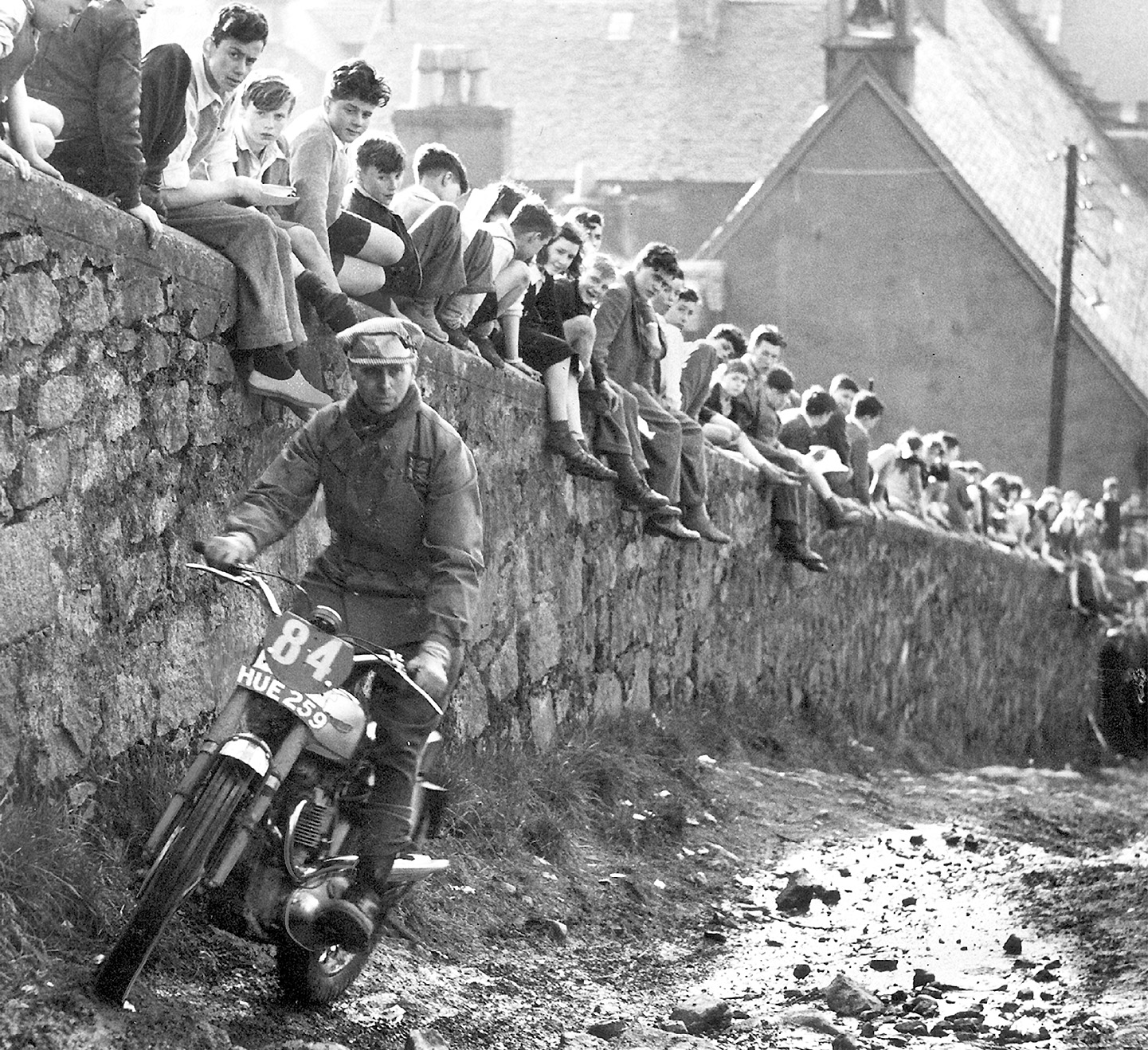
Stig’s Matchless

Words: Trials Guru

Photos: Tim Bell; Babs Bell & Bell Family Archive; Stig Karlsson; Don Morley; Colin Bullock; Eric Kitchen and Iain Lawrie (Main Photo: Colin Bullock).

With the assistance of: Tim Bell, Northallerton, England

We are always looking out for articles to interest our readers here on Trials Guru and this is such an article. But it is not one for the purist.

Many will remember a Swede called Stig Karlsson who rode a home-brewed Matchless in the Scottish Six Days Trial on three separate occasions. The last time was in 1985, but more recently he competed in the Pre65 Scottish Trial on what appeared to be the same machine and won the event in 2000.

Stig Karlsson on his 410cc Matchless G3C in 1990 – Photo: Stig Karlsson Archive.

In fact, he won the Pre65 Scottish twice, the first time being on a Triumph in 1999.

Stig Karlsson won the 1999 Pre65 Scottish Trial on this Triumph – Photo: Eric Kitchen

Truth is, it was not the same Matchless that Karlsson rode in both the SSDT and Pre65 Scottish. The pre65 entry was a 410cc Matchless, more in keeping with what Associated Motor Cycles produced in the early 1960s. The machine Stig rode in the SSDT was somewhat different.

Karlsson the man:

Stig Karlsson on his 350cc Triumph on which he won the 1999 Pre65 Scottish Trial – Photo: Stig Karlsson Archive.

Stig Karlsson was born in Smaland county, southern Sweden in 1946. He was a keen football player and when he attained fourteen years of age, he was playing for a local youth football team when he injured his heel. It was during this time of inactivity he discovered the sport of trials.

Like so many of the period, Stig set about altering a road machine for trials riding, his choice was a machine called a Rex Roadmaster powered by a 198cc Villiers engine. These machines were built at Halmstad on the Swedish west coast and was a 1950 model with four-speed gearbox and rigid frame.

The 175cc Husqvarna ‘Silverpilen’ model (Silver Arrow) similar to the one Stig Karlsson modified for trials. (Photo: MXA – Motocross Action, USA)

Two years later, Stig took his lightweight motorcycle test and purchased a 175cc Husqvarna ‘Silverpilen’ (Silver Arrow) which was a machine that several Swedish riders adapted for trials use at that time. He called this machine an ‘Antelope’ and ventured to England to ride some events with it and took part in European Championship rounds.

Eventually Karlsson took up employment as a historian, giving lectures at universities, then latterly as a security guard, but in reality, he was a self-taught engineer, many regarded him as a genius given the skills he had accumulated. He lived at Estentorp near Malmback in Smaland county.

It was the Scottish Six Days that got Karlsson noticed, when he entered on his self developed Matchless, a machine that was outdated by around twenty years and viewed as a museum piece rather than a useable trials motorcycle. Many admired the machine at the ‘weigh-in’ at Fort William’s West End Car Park. Stig rode the Scottish three times, Matchless mounted in 1980, 1984 and finally in 1985. But each year he rode, the machine was different, he was continually changing things.

It was during the 1985 SSDT that Northallerton trials rider, Tim Bell first met Stig Karlsson and they became great friends.

Tim Bell: “I was at the sections known then as Kentallen, now called Lagnaha, and I engaged Stig in conversation. We met the following year at the same place and of course that was the year the Chernobyl nuclear disaster which occurred only a few days previously, and he said that we shouldn’t be standing outside in the rain! He came over and rode his Matchless in the Northallerton Three Day Trial and stayed with us. I was riding my 500 Royal Enfield Bullet, narrowly beating Stig after a good battle during the event.”

Northallerton’s Tim Bell stands proudly beside Stig Karlsson’s Matchless in 1991 in Sweden. Tim’s son David is sat in the pushchair, Stig’s wife Siv and Stig are in deckchairs. Photo: Bell Family Archive.

Tim Bell was lucky enough to obtain Stig Karlsson’s Matchless a couple of years after his death in 2021 having been good friends over the years. In fact, Karlsson entered the Pre65 Scottish as a Northallerton club member, winning the event twice, the first time being 1999 on his 350 Triumph twin and again on the more traditional Matchless the following year.

Stig Karlsson works on his more ‘traditional’ Matchless 410 – Photo: Stig Karlsson Archive.

It is the heavily modified machine that we have obtained photographs of and describe the specification as it is to this day. Obviously, the specification of the machine has varied considerably since Karlsson built it, so don’t be surprised if you read something different or conflicting in a magazine or periodical, which has covered this motorcycle in the past. It would have been nice to interview Stig to get the inside line on the Matchless, being the creator, but sadly this was not to be, and the bike cannot speak for itself.

The current custodian, Tim Bell, has been very co-operative with information about the machine and has taken photographs when he was forced to remove components to service and make repairs recently.

Stig Karlsson’s Matchless as it is today showing the Paioli front forks, Gremica hub and aluminium primary chaincase – Photo: Tim Bell.

One noticeable change is the front forks which appear now to be Paioli components, possibly of Sherco origin, the Marzocchis possibly having been damaged or simply worn out. A modern style white front mudguard has now been fitted.

Bell: “Stig loaned me his traditional 410cc Matchless to ride the 1990 Pre65 Scottish and was on hand at Pipeline to show me the line. However, some miles previously, the front forks went totally solid and refused to move. I explained this to a bemused Stig who said: ‘Ah, I know what has happened, something has gone wrong with the damping valve which I modified’.”

Scottish Six Days Trial:

Stig Karlsson (Matchless) in the 1980 Scottish Six Days Trial on Muirshearlich (Trotter’s Burn) – Photo: Iain Lawrie.

In the 1980 SSDT, riding number 193, Stig finished in 171st place. The Matchless he rode was very different to the models that dominated the SSDT in the mid-1950s.

Stig Karlsson with his Matchless poses for the camera of Eric Kitchen at the 1980 SSDT.

The front forks were of Italian origin, probably Marzocchi married to a Husqvarna front hub laced to a 21-inch alloy rim, but most of the Stig developments were hidden below the tank as this was no standard Matchless. The primary chaincase looked fairly standard, taken from the 1950 G3LC Matchless.

1980 Scottish Six Days action with Stig Karlsson piloting the Matchless on Cnoc a Linnhe – Photo: Iain Lawrie.

The rest of the motorcycle was clearly a much-modified version of what Plumstead produced. Photographs indicate that Stig used the very reputable American made ‘Preston Petty’ black plastic mudguards, a wise move as they were virtually unbreakable. This particular event was won by Yrjo Vesterinen who had switched camps from Bultaco to Montesa and he was recorded as the first overseas rider to win the Scottish Six Days Trial.

1984, Fort William’s West End Car Park for the weigh-in of the Scottish Six Days Trial, note the original front forks of AMC design and the AJS tining case, gearbox is Burman B52. Photo: Colin Bullock.

In the 1984 SSDT, Stig rode number 175 and had reverted to using front forks of AMC origin and surprisingly the yokes also looked fairly standard. Front hub was still the Husqvarna component. Without a doubt the AMC internals would have been upgraded, certainly modified by Karlsson to give improved damping.

Karlsson in 1984 at ‘Chairlift’ section in the Scottish Six Days – Photo: Iain Lawrie

Karlsson was a firm favourite with the SSDT spectators who marvelled at someone who had the desire to ride such an antique machine, when monoshock bikes had already appeared in trials with the first model Yamaha TY250R. Unfortunately, he failed to finish the event in 1984.

Stig with his Matchless in 1985 at the SSDT at ‘Fersit’ showing the offside of the machine. The Girling Gas Shocks and AJS timing case can be seen clearly. Photo: Babs Bell.

Karlsson’s third attempt at the SSDT was in 1985, he was allocated number 93 and the Matchless was listed as a 400c and once again sported Italian manufactured forks once again and the machine looked very much like it does today. The Husqvarna front and rear hubs still deployed.

Stig Karlsson in the 1985 Scottish Six Days, captured at ‘Fersit’ by ace photographer, Iain Lawrie.

Stig finished the event in 182nd position on 563 marks, a sterling effort, given that the sections were pretty much against such a twinshock machine.

Rear wheel:

1985 SSDT at ‘Lagnaha’ (Kentallan) which shows more detail of Stig Karlsson’s Matchless – Photo: Babs Bell.

The rear hub on Stig’s Matchless was always conical and upon closer inspection he deployed an alloy Husqvarna component. With the drive on the kerbside, rear brake within the driven hub and gear shift on the offside, there was no need for a heavier full width hub at any time in his bike’s development. The wheel is built with an 18-inch alloy rim. It could well be that the rear hub came from his Husqvarna Silverpilen.

The powerhouse of the Matchless as it is today – Photo: Tim Bell

Looking at the Karlsson Matchless, it is evident that it is a very short stroke motor and very compact compared with the original short stroke engines made by AMC. It is believed that Stig Karlsson reworked the frame multiple times for his machine over a twenty-year period.

John Reynolds watches Stig Karlsson’s line on ‘Kilmalieu’ during the 1985 Scottish Six Days Trial – Photo: Iain Lawrie

Front Hub:

At various stages of the machine’s development, it was fitted with an alloy Husqvarna Silverpilen front hub, but this was changed for a Italian Grimeca component as used on SWM. The background information reveals that Karlsson sold the Husqvarna without wheels, so it is reasonable to assume the hubs came from the Silverpilen Husky.

Frame:

Nearside view shows the lines of the modified Matchless G2 frame and the PVL ignition run off the crankshaft – Photo: Tim Bell

The frame is not as AMC produced, but a home brewed assembly of steel tubing using the Matchless G2 frame as a starting point. It fitted around the engine and in no stretch of the imagination could it be described as original. Stig did things his own way and he constantly altered and improved the chassis as he saw fit. His bikes were an extension of himself, he was an individual and so was his Matchless. Just looking at the photos of the machine today with the tank removed proves this. The engine is a very snug fit in the chassis, but it works well, the weight is low down so benefits from a low centre of gravity, ideal for a trials motorcycle. Each time the engine was changed, the frame was altered accordingly. The DNA of his first Matchless is undoubtedly in the final version.

Rear Suspension:

The rear dampers were Girling Gas Shocks and were probably used as early as his 1980 attempt in the SSDT. Girling started producing the Gas Shock range from 1976 and Stig favoured these units as they had a thicker damper tube that other brands, plus the benefit if progressive springing, using two sets of springs per damper unit.

Gearbox:

Stig used the Burman B52 component which appeared in October 1951, but internally he had made his own gears from scratch, hand filed, trued on a lathe, then heat treated for the job in hand. The result was lower first and second cogs for sections, with a high top gear for any road and fast track work. One can only but marvel at the fact that Karlsson hand-made the gear wheels. This ensured that he got the ratios that he desired.

Crankcase:

Karlsson used the crankcases from a 1948 G3LC and the crankshaft from the 250cc G2 model giving a stroke of 64.4mm. A ‘slipper’ piston of 85mm giving a displacement of approximately 365cc.

Over the years Stig’s Matchless lost the traditional look on the timing side. When he rode it in the early eighties, it had the magneto drive casing not with the familiar ‘M’ symbol, but an ‘AJS’ version. This disappeared some years later when he opted to use a PVL ignition system running on the crankshaft output side. Traditionally Matchless singles up to 1951 had the magneto behind the cylinder and the AJS in front. This changed for the 1952 models when AMC standardised crankcase production and kept the AJS style for both marques, being the forward positioning of the magneto.

Bell: “Stig told me that by using an AJS timing chest rather than the Matchless version, saved a few grammes in weight.

Cylinder head:

The cylinder head is from the Matchless G80 500cc with very large valves, while he sourced a suitable barrel from a Yamaha XT500, suitably doctored and modified to be married with the crankcases and cylinder head. The engine breathes through an AMAL carburettor.

Karlsson made this Triumph Twin monoshock trials machine – Photo: Stig Karlsson Archive

It is without question that Stig Karlsson was a very good trials rider and a clever engineer who campaigned an outdated machine without making it look so modern that it was not recognisable. He achieved a good balance between a 1950s design and the application in a 1980s world which no one else has attempted. Having said that, we display a Triumph twin which he did create with a perimeter frame and monoshock suspension.

Trials Guru’s John Moffat met Stig Karlsson when he was riding the Pre65 Scottish Trial, the first encounter was in 1994 when Moffat first attempted the event on his 1959 G3C Matchless.

AJS factory rider, Gordon Jackson with Trials Guru’s John Moffat at a Pre65 Scottish trial – Photo: DON MORLEY

Moffat: “1994 was the first year I entered the Pre65 Scottish at Kinlochleven when it started from the old school and was a one-day affair. I was getting suited up for the day, the bike had been topped up and I was making a few checks before I was to start riding under number two. Someone said ‘hello’ and I looked up and there stood Stig Karlsson, who I had never spoken to previously. He pointed at the footrests of my bike and said: ‘does it handle like a fish with those high footrests?’ making his hand weave like a fish thrashing through water. I thought for a moment and then confessed to Stig that I had no idea, as I had not actually ridden the bike in a section before, I explained that I had no time due to work and family commitments. I had not practiced with the machine as it needed a lot of remedial work when I bought it the year previously. Stig was visibly surprised and said: ‘well good luck, because you will need it!’ I then wondered if I had made the right decision entering with no practice beforehand. However, I was much younger then, in my early thirties and I still had a bit of determination. I got round and on time, lost a pile of marks getting used to my new ‘old’ steed, thoroughly enjoyed the ride, but my arms and back ached as the handlebars were much too low and the footrests set much too high.”

John Moffat on his very standard 1959 Matchless G3C in the 2006 Pre65 Scottish Trial, after taking heed of Stig Karlsson’s advice to alter the footrest position – Photo: Iain Lawrie

“Needless to say, I rode the next and a further twelve Pre65 Scottish’s on that bike but did some little improvements each time. I will always remember with a smile, what Stig said to me that year and he must have thought I was totally barmy. We did talk a few times after that initial meeting because he realised, I was an AMC enthusiast.

It is fair to say that Stig Karlsson was very much an individual and certainly did things his way, this was his Matchless and as stated at the beginning of this article, the machine is not one for the purist.

Stig’s Matchless’ article was written by and is the copyright of Trials Guru.

1991 in Sweden. Tim Bell is stood astride Stig’s Matchless after a test session. Stig is standing in the background – Photo: Bell Family Archive.

Recommended further reading:

Classic Dirtbike – Issue 71 – Summer 2024

Pages 34-41 – ‘An Individual Approach’ by Tim Britton Media Ltd.

Apart from ‘Fair Dealing’ for the purpose of private study, research, criticism or review as permitted under the Copyright, Design and Patents Act, 1988, no part of this article may be copied, reproduced, stored in any form of retrieval system, electronic or otherwise or transmitted in any form or by any means, electronic, electrical, mechanical, optical, chemical, photocopying, recording or otherwise without the prior written permission of the author as stated above. This article is not being published for any monetary reward or monetisation, be that online or in print.
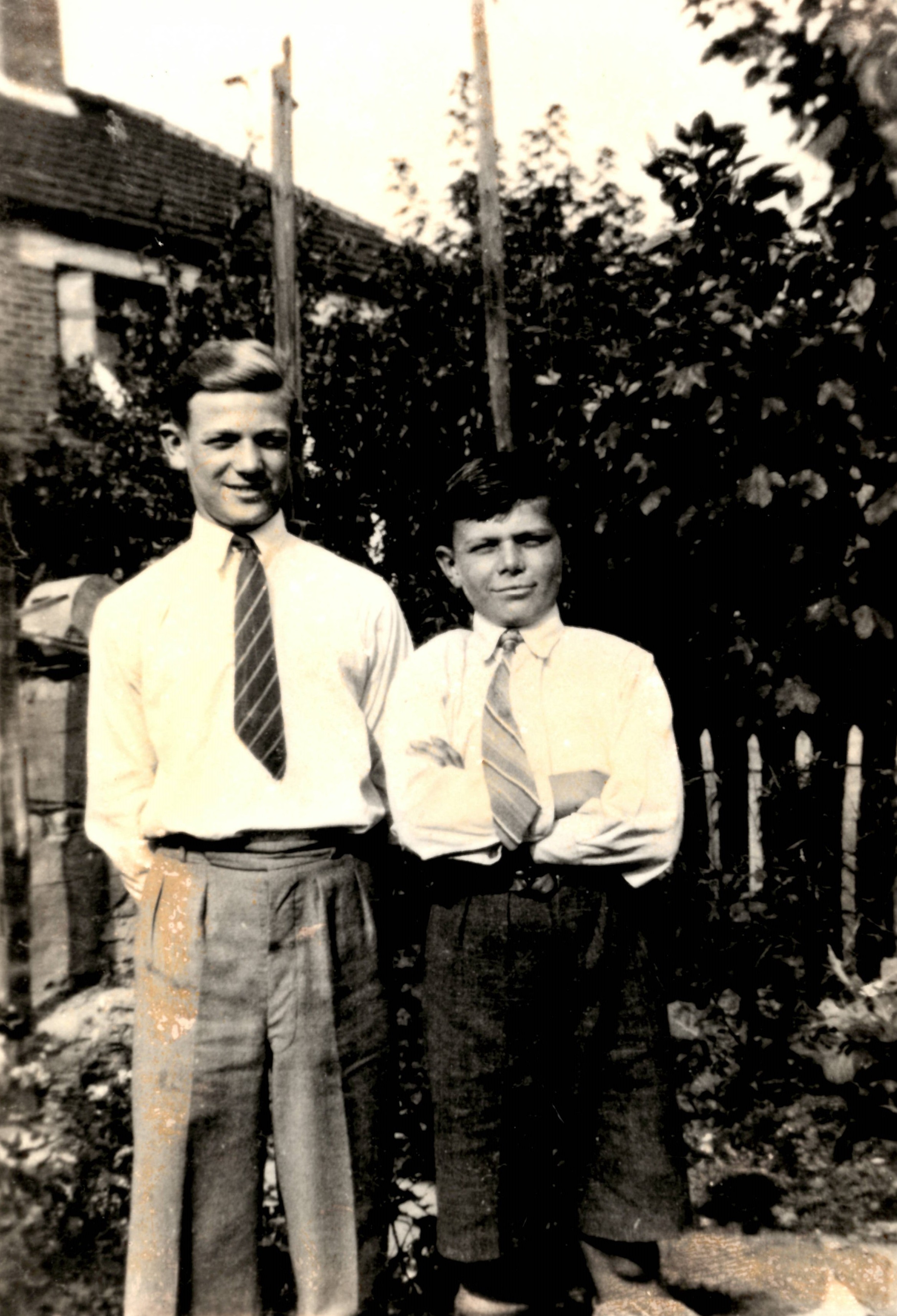
George Greenland a life in the sport

George A. Greenland – Photo: Colin Bullock

Words: Trials Guru & George Greenland

With assistance from: Kerry Greenland; Karen and Neil Clarke.

Photos: Colin Bullock; Jean Caillou; Mike Rapley; Alistair MacMillan Studio, Fort William (Permission by Anthony MacMillan); Ray Biddle; SpeedTrackTales (ISDT website); Derek Soden; Salisbury Journal; Greenland Family Archive. (Main photo: Mike Rapley).

Most people that have been around the Pre65 trials scene for some time, will have heard the name or have met George Greenland. But George has been around a long time, a very long time in fact!

This article has been written with the full co-operation of George and his family. In truth, it doesn’t begin to cover everything he was involved with, or all of his adventures, but it gives the reader a fascinating insight into the life and times of a man and his love of motorcycles and the sport of motorcycling.

George Greenland on the 500 Ariel on Callart Cottage during the 2006 Pre65 Scottish Trial – Photo: Jean Caillou.

The thing that you experience when you meet George Arthur Greenland is his ‘schoolboy enthusiasm’ for the sport of motorcycling, that he hasn’t lost since he was a youth. Here we find out more about the trials rider, sidecar trials driver and five times British Enduro sidecar champion.

George Greenland with passenger Nick Moores, 1981 Welsh Two Day action with the Norton Wasp outfit carrying the number 1 plate – Photo: Colin Bullock

Early Days:

George was born on the 7th July 1932 to parents, George Arthur Hughes Greenland and Annie Gertrude Greenland, at North Middlesex County Hospital.

The family lived at Prairie Farm, Carbon Hill, Cuffley, Herts and George attended the local school in Newgate Street. He was the youngest of four children with three sisters, Glad, born in 1915; Pad, born 1920 and Olive, born 1930.

George and Olive grew up during the second world war at Prairie Farm, which was a small poultry farm. George aged thirteen and sister Olive then moved to Salisbury, Wiltshire in 1945 to St. Martins Terrace in the city. By this time both his elder sisters, Glad and Pad were married and stayed in and around the London area.

George attended St Thomas Boys School, St Thomas Square, Salisbury and left school in the July of 1946, aged fourteen.

George’s first interest in motorcycles started that same year when he was walking home from school, he would pass a chap washing his motorcycle which was covered in mud. After a few weeks of this, George’s curiosity got the better of him and he had to find out how it got so muddy!

On leaving school, George’s first job was at Avon Motors, which was a Rootes Group garage. He used to walk past the garage on the way home from school and decided to go in and ask for a job.

Sid Clark, who owned the business, asked George why he wanted to work there? George replied “When I walk past, everyone is so happy and I would like to work in a happy place.” So Sid took him on, but George wasn’t able to start his apprenticeship at age fourteen, so worked there until he was sixteen years of age and then started his five year apprenticeship.

Having found out why the chap’s motorcycle was always covered in mud, George went to see a local trial on his push bike. He liked what he saw so much that he just had to have a motorcycle himself.

It was Fred Pendle who started George’s motorcycle enthusiasm, Fred had a friend with a 250cc Royal Enfield, a 1935 genuine trials model, with foot change and girder forks. It had been used by factory rider, Arthur Ellis. George purchased it in 1948, now aged sixteen, from Arthur Beeston for £35 complete with a spare engine. With a little the help from his Dad, George bought it. From then on there was no stopping him, the die was cast!

George Greenland sits astride his first motorcycle, a 1935 250 Royal Enfield trials model in 1948. – Photo: Greenland Family Archive.

By 1946, George was friendly with Maureen’s brothers, Brian and Dick Barber at the time but Maureen was of the same age, fourteen, so he was unable to date her until she was sixteen, they were all good friends so ideally, George saw a lot of Maureen.

George Greenland and his 500T Norton. Photo: Greenland Family Archive.

George started riding a 500cc Norton 500T in 1950 and notched up his first win on this bike at the Ernie Britton Trial.

Victory Trial action in 1950 with George on the 500T Norton – Photo: Ray Biddle

Most weekends, George was riding to events with girlfriend Maureen as pillion passenger. He would drop her off at a section with the lights which he had removed from his bike, compete in the trial and then pick her up, refit the lights and the pair would ride back home.

Get some in:

National Service was of course a feature of life in these days, and in 1953 at the ripe old age of twenty-one, George was called up and joined the R.E.M.E with a posting to Kent.

May 1953 with George Greenland aboard the 500T Norton during the Welsh Two Day Trial – Photo Ray Biddle.

George was competing on a twin cylinder 500cc Trophy Triumph in 1953, which he used as a road bike and trials machine. It was this machine that created the attachment between George and Triumph engines later on in his trials career.

George on the Triumph Trophy competing in the November 1953 Perce Simon National trial – Photo: Ray Biddle

The following year, George was using the Army supplied Matchless G3L in all major road trials London to Landsend; Hampshire 100; Sunbeam 200 and London to Exeter. He was the best army rider in all these events. His collection of trophies then started to grow considerably.

Army Days:

George on a standard army issue 347cc Matchless G3L, riding in a long distance event during his National Service in 1954.

During his army National Service, George rode an Army Matchless G3L in many events and was eventually invited to go to the selection events for the International Six Days Trial in 1954.

Photo credit: Speedtracktales (ISDT website)

He was selected as first reserve for the British Army team for the ISDT. This was held in Wales in the September of 1954 and George was supplied with a BSA Gold Star. The army team consisted of Captain Betty; Captain Fred Miles; Captain Eddie Dow; Cumbrian, Eddie Crooks; Staff Sgt. Nicholson; Corporal Mick Waller. The British Trophy team won this year’s ISDT, captained by Hugh Viney of Associated Motorcycles.

George takes up the story: “Eddie Dow once asked me during our training sessions in Brecon, why do you always ride at the back? I said well, if one of you comes off I’ll make sure I get a place in the team. After that he pulled rank and rode behind me.”

Eddie Dow and Eddie Crooks were both on BSA Gold Stars and were unhappy that mine seemed to go much better. I had to admit that I had taken the compression plate out from under the barrel. So, that evening, I had to work on two more Gold Stars to remove their compression plates.

Thirty or so years later at a reunion, Eddie Dow asked me, would I really have run over him if the opportunity presented itself? I had to say at the time most probably.”

It was now 1955 and George left the army as his National Service had come to an end, so it was back to ‘civvy street’ and a job with Smallshaw Brothers and Andrews Garage in Bournemouth. BSA had also loaned him one of their 350 Gold Stars to continue competing. However, his freedom was short lived as George was recalled by the Government in June due to the Suez Crisis in 1956. This was a joint operation by British, French and Israeli forces, invading Egypt, thus regaining access through the Suez Canal. George and Maureen had only just got married on the 2nd of April that year, so things were a bit hectic.

George astride the BSA Gold Star, loaned by the factory in 1955, note the works Royal Enfield – HNP332. Photo: Greenland Family Archive.

Back again:

George Greenland on the Smallshaw Special Triumph in 1958 – Photo: Greenland Family Archive.

Demobbed once more, George resumed his trials riding activities, this time on a special Triumph, called the ‘Smallshaw Special’ in 1958. Using a Triumph Cub engine, with James hubs and AMC front forks, it was registered 28EFC, built by Des Smallshaw who had built special trials bikes previously.

At this time, George made the move to work for a very large company, Morris Motors, shortly to become the British Motor Corporation with the merger of Austin and other car brands, this was at the Cowley plant in Oxfordshire. BMC was the largest motor manufacturing company in Britain at that time. George was to be employed there until 1965. His main job was that of a trouble-shooter, being part of a specialist team that rectified faults when vehicles were being assembled on the Cowley production lines. His team worked very closely with designers and vehicle production staff. Some faults were rectified on the production line, with others out in the field, post-production.

During George’s time at BMC, Maureen gave birth to three daughters, Katrina Jane, born 1958; 1959, Karen Ann in 1959 and in 1961, Kerry Lyn. All three daughters took up motorcycling, with Karen taking it up competitively.

George Greenland in 1961 on the factory supported 250cc DOT – Photo: Greenland Family Archive.

In 1961, a trials bike was despatched from DOT motorcycles in Manchester. This machine was entered for that year’s Scottish Six Days and George rode two Scott trials on this machine, earning himself a coveted Scott spoon in the process.

In the mud on the home made Triumph in 1964 – Photo: Greenland Family Archive.

George got the urge to build his own trials bike, a Triumph Special, registered AEW176A, with a 350cc engine which he upgraded to a 500 in March 1964, using an engine from a crashed road bike. The Triumph was fitted with Norton Roadholder forks and a James front hub. He purchased some tubing to rebuild the frame for trials use. He had been told it was Cold Drawn Steel tubing, whereas it turned out to be mild steel, which would later cause problems! He loved the bike, but after a while the wheelbase started to lengthen by itself, so he rode it until late 1965. By then, he had left the BMC to move back to Salisbury with Maureen and their three daughters. He formed a partnership with his brother-in-laws, Dick and Brian, called R.D. Barber & Company at Milford, Salisbury. They were in the business of repairing damaged cars and fabrication work, but also did some outsourced work for the BMC rally teams.

Rhind-Tutt Wasp:

GG: “l moved back to Salisbury in 1965, and went to see Robin Rhind-Tutt at Wasp Motorcycles at Berwick St. James, and asked him to build me a trials frame as I had now obtained a Triumph 500 engine. This he duly did, and the following year I had a second bike built, it was very similar to the first Wasp. I ran SU carbs on both these bikes. In 1966 I didn’t get to ride any trials, I spent all of my spare time on building our new house at Potters Way and building up the car repair business.”

Although known as ‘Robin’, ‘Robbie’ or ‘Rob’, Rhind-Tutt’s actual name was Charles Norman Rhind-Tutt and he became known throughout the world as the ‘go to man’ for competition motorcycle sidecars. Wasp outfits literally dominated the world of sidecar motocross in the 1970s. That first 1965 Triumph Wasp set the scene for many years to come, as George would not only build bikes for himself, but for other riders as well. Although well-known in the sidecar motocross market, the Rhind-Tutt connection would eventually pull the Wasp frame manufacturer more into trials, with a neat Bultaco powered example appearing at the 1970 Scottish Six Days, in the hands of Arthur Headland and a German rider, Wolfgang Zahn. The first solo trials frame had been made as early as 1963 and Geoff Chandler used a 250 Bultaco powered Wasp ‘RT4’ in 1968.

The Wasp frames were well built and finished in bright nickle plating. Later, the Rhind-Tutt/Greenland friendship would branch out into enduro.

Bike builder! Two of George’s Triumph engined Wasps, the one nearest the camera is the 1971 machine fitted with Rickman hubs – Photo: Greenland Family Archive.

GG: “In 1969, when building another Wasp framed bike, I actually built two, one for me and one for Arthur Dovey, who rode it very successfully. My own bike had Rickman hubs fitted.

George on his Triumph Wasp – VMR3K in 1972 – Photo: Greenland Family Archive.
A group photo taken in 1971. Mick Noyce on the left, Brian Williams, George Greenland on the Triumph Wasp (VMR3K), Dick Ramplee, Keith Mitchell and Arthur Dovey. – Photo: Greenland Family Archive.

I built another 500cc Triumph Wasp in 1971, which was registered as VMR3K. The following year I built a third 500cc Triumph Wasp, registered CAM56L the one which I rode in the 1973 Scottish Six Days. The start was still in Edinburgh at that time and I won a First Class award.

On the 500 Triumph Wasp during the 1973 SSDT – Photo: Alistair MacMillan Studio, Fort William.

I was disappointed that I didn’t win the best 500 cup, my bike had the largest capacity in the event, but Kawasaki had entered bikes in each capacity to get all the capacity classes covered. Later, Don Smith told me if he had known, he wouldn’t have done it.”

History records that Richard Sunter on the 450cc Kawasaki factory prototype picked up the over 350cc cup in the 1973 Scottish, finishing in 20th position on 137 marks. George Greenland came home in 99th place on 355 marks on the 498cc Triumph/Wasp.

CAM56L is still being ridden in competition with son-in-law Neil Clarke on board, seen here at the 2024 Pre65 Scottish Trial.

GG: “Of all the bikes I built, the last 500cc Triumph twin with Wasp frame, CAM56L is probably my favourite. I have still got that bike. It has done a lot of work. I did all the Southern centre time trials in the 1970s, the odd Euro championship round, the Scottish Six Days, the Scott trial and many Pre65 Scottish Two Days and quite a few trials on the continent.”

CAM56L being ridden in the ‘Greybeards’ trial in 1981. Photo: Greenland Family Archive.

George went two-stroke again and purchased a new 325 Bultaco Sherpa in 1973, but initially was disappointed with its performance.

On the 325 Bultaco Sherpa, bought from Comerfords in 1973. Photo: Greenland Family Archive.

GG: “I bought the new Bultaco from Comerfords, it ‘pinked’ all the time on acceleration. I saw Reg May at a trial, he told me to bring it back to ‘have a look at it.’ When I got it back a week later it was transformed after Reg set it up properly.”

The Bultaco Sherpa that George bought was one of the early 325cc models imported by Comerfords into the UK and they were jetted on the weak side. This was remedied by changing the slide in the 627 AMAL carburettor and also the needle jet.

In 1972, George had turned forty and effectively moved over to ride sidecar trials on a 500cc Triumph Wasp. His first passenger was Dave Lane, who remained so from 1973 through to 1977.

2 Day Enduro in Germany, 1975 with Dick Ramplee as passenger aboard the Norton Wasp. This was to be the first of five trips to ride in Germany.

This was to become an interesting and exciting time for George, experimenting with a variety of engines in Wasp chassis. This ranged from Triumph through to Kawasaki, CCM and Suzuki. It was also a springboard for George’s foray into enduro racing.

With passenger, Dave Lane on the Kawasaki engined Wasp outfit – Photo Greenland Family Archive.

GG: “Mike Guilford, the sidecar cross British Champion, said he was building a trials sidecar but was unsure about preparing a Triumph engine for trials, so I got involved. When it was completed Mike suggested a test day. My mate Dave Lane had passengered at grass track, so he came along as ballast. Neither of us did very well. Then Mike decided it was not for him, so told me that I could use it if I wanted. So that was my first trials sidecar.”

Their first trial was The Jack White at Brice’s Farm. The going was dry with lots of grip, but it was not a fairy-tale debut as George and Dave finished last. The following week, they rode the Wessex Centre trial, it was very wet and muddy, they won on the Triumph and the die was cast.

GG: “Dave Lane and myself decided to have a crack at the Welsh Two Day on the trials sidecar outfit, but we were very disappointed we lost the win, by clocking in one minute early.

Riding in the 1974 Welsh Two Day with passenger, Dave Lane and the Triumph Wasp outfit. Photo: Derek Soden.

Dave however wasn’t too keen on the Enduros, so Dick Ramplee was to become my regular passenger from 1973 -1980.”

George Greenland and Phil Whitlock on board the 250 Kawasaki Wasp outfit were 5th in the 1978 British Experts Trial – Photo: Mike Rapley.

The continent was calling in the late 1970s and that was an expensive time for sidecar crews as outfits are much bulkier than solos. George set about finding a solution and came up with the ‘double-decker’ trailer. This carried three outfits on one trialer.

Greenland’s ‘double-decker’ trialer, George’s 500 CCM powered Wasp outfit is nearest the camera in this photo – Greenland Family Archive.

George won the inaugural but as yet, ‘unofficial’ ACU British Enduro sidecar championship in 1980 and he went on to win a further four times when the ACU incorporated the championship into the sporting calendar. His passenger from 1980 until 1982 was Nick Moores.

Friend Dick Ramplee was passenger to George Greenland in enduros, but was also a sidecar driver in his own right. Seen here on a 360 AJS outfit.

By 1980 George was still working at R.D. Barber full time and spending every evening working on the outfit for the next enduro. All events during George’s riding career were attended by his wife Maureen, who loved to travel. Many times she drove round the countryside to find the next check for refuelling. In 1981, George purchased a 207D Mercedes van so that Maureen could have a bit of comfort to travel to enduros and holidays abroad, this was built by George in between events.

George adapted this Mercedes for travelling to events in the UK and the continent. Photo: Greenland Family Archive.

GG: “At the Natterjack Enduro in the November of 1981, my regular passenger Phil fell off his Moto Guzzi and broke his wrist, so couldn’t make it, so at the start Roy Humphries volunteered. On the first day he was shattered, everybody including his father said I would need a new passenger for the second day, but Roy turned up and we went well all day until the gearbox failed.”

Competing in a Natterjack Enduro on the Norton Wasp with passenger, Nick Moores. George was sponsored by Tsubaki chain and Silkolene Lubricants at this time.

Out of the seven times riding the Natterjack Enduro, George won five events with passengers Nick Moores, Phil Whitlock and Neil Clarke.

George discusses the Wasp 1,000cc engine with Robin Rhind-Tutt in 1980. Photo: Salisbury Journal.

Rhind-Tutt decided to design and build a bespoke double overhead cam 998cc Wasp engine/gearbox unit in 1980. The engine was a twin cylinder, eight valve configuration and a four-speed gearbox with dry sump lublication. It breathed through a pair of MK2 AMAL concentric carburettors. This took nearly three years to develop and George was heavily involved in the project. This involved development and getting the prototype built and tested. Approximately fifty machines were built, an early version of which George rode to victory in enduros. This package was capable of transporting rider and passenger, fully loaded at speeds up to 100 miles per hour.

1982:

1982 was to be a very busy year for George. In February, the 1,000cc Wasp engine had its first real outing at the Enduro Le Touquet, the famous beach race in France. He was passengered by Nick Moores, but the engine seized up on the long straight at mid race.

GG: “I blamed Silkolene oils, but they insisted I should have used their caster based oil called ‘Pro4’. Mr. Brooks from Silkolene came down from Buxton to have a look at the Wasp and said it was a ‘racing engine’, so I needed to change the oil over to caster base which is ‘Castorene’. There were no more problems after that, and we were best sidecars in 1984 and again in 1985.

George now in his 50s and his new passenger was to be Neil Clarke from 1982 through to 1985 in trials on a 250cc Suzuki. George and Maureen’s first grandchild was born, Ellie MacQuarrie. Their eldest daughter, Katrina married sidecar passenger, Phil Whitlock – as if George hadn’t scared him enough! At the 1982 SETRA Enduro at Tidworth, George had used one of the prototype twin-cylinder 1,000cc Wasp motors.

Enduro du Super-Mare:

From 1983 to 2001, the Weston Beach Race organisers were George, Jack Mathews, Eddie Chandler and Dave Smith, culminating in eighteen years of running Weston.

GG: “We were coming back from the Le Touquet beach race, Jack Mathews, Eddie Chandler and myself had all been competing in the sidecar class, it was our first time at the event.”

On the ferry crossing, we were discussing what a superb event it was and bemoaning the fact that there was not a similar type of event held in England. During the two-hour crossing, we had decided we would try and organize and run our own event. Many venues were thought of and finally it was left to me to approach Weston-Super-Mare council to obtain there help and permission to use the beach.

During the following week I was able to contact Weston council and make an appointment to meet the council members responsible for outside events. I took with me photos of the Le Touquet newspaper that had a full report and picture. After much discussion and deliberation, the decision was ‘sorry but NO’ as they already had a scooter rally on the seafront in the September. I had mentioned this to Mannix Devlin of Trials and Motocross News as to what we were hoping to run at Weston-Super-Mare. The following Friday TMX carried a paragraph about our meeting with Weston and the result that we were turned down. A week after this, I received a telephone call from a resident in Weston he asked if I was the same George Greenland that rode trials with him in the 1950s. I confirmed that yes I was, he said his name was Tony Jones and he said he thought a Beach Race at Weston would be good for the town. If he could arrange another meeting with the Council would I be prepared to come down again? So once again I’m at a council meeting, the same people agreed they had a re-think and their outside events officer would give us every assistance, but it would be a one-off event only! The event officer was a young lady, Carol Ridge, she immediately arranged for the three of us would-be-organisers to go to Weston to discuss our and their requirements. Carol turned out to be the most helpful and efficient member of the whole council. Eddie, Jack and I got together to discuss what we needed as a plan of action. We realised that we would need someone to help with organising the paperwork, licences, insurance, and so on. The only person we could think of was Dave Smith who we all knew, he was into organisation and also had many contacts in the Motocross world. We phoned Dave and talked him into meeting the three of us with a view to joining the team. We arranged all our meetings in a pub in Swindon as we could all get there in about the same time from our respective homes. Jack from Chester, Eddie from Newberry, Dave from Birmingham and myself from Salisbury. Dave agreed to join us, so our first meeting with Weston events committee included the four of us calling ourselves ‘Enduro Promotions’ as we had decided to run the event as an Enduro to be called ‘Enduro du Supermare’. The Council agreed that they would make their loading shovel and driver available, to move sand as we required. We were also introduced to the council yard manager, Geoff Tucker everybody was keen to help. We needed a A.C.U. permit for the event, so we approached Jim Webb of the Frome & District M.C. & L.C.C., he was really helpful. Not only did he arrange the permit, but got most of the club helping. I think Jim was responsible for getting all the clubs in the Wessex Centre to help out. We had quite a few meetings during the following months mostly with Carole Ridge and St Johns Ambulance, although the Police and the Fire Service did briefly make an appearance to find out what the format was. As all the event was taking place on the beach and the lawns they considered it did not affect them a great deal. We got tide timetables and advice on the best weekend to have the event the 29th and 30th October were agreed upon. At this stage we had suggested to the council that we would expect about 150 riders and hopefully 2 to 3,000 spectators. There was no charge to watch the racing, the only money coming in was from the riders’ entry fee and trade stands. On the weekend before the event, we all arrived in Weston to build up the course. Just four of us, Jim Webb loaned us all the ropes that he used for building the scramble course and also the posts. We marked out the course and started putting in posts, by hand. As it was a school holiday, we had many youngsters watching the proceedings. We explained what was going on and had offers of help which we gratefully accepted. What started as twenty helpers soon dropped to about eight, but these continued to help all week and most of these lads came back year after year. Meanwhile, the entries kept rolling in from solos, sidecars and trikes.

As the weekend got closer, people started to arrive in their thousands, it was winter and everything was closed down, over 10,000 people turned up and they ran out of food, all roads to Weston were blocked before, during and after the event, all the accommodation was full.

The police were tearing their hair out, it was total chaos. People were parking everywhere. The first year the start of the event was from a flare, which the lifeboat people provided, I was standing in the digger.

After the event, the meeting with Carole, the police and the Ambulance, they all said that we needed to be better organized for the following year. They said they would fence it and charge spectators, so another event was planned.”

George Greenland’s daughter, Karen in sidecar enduro action. George instilled enthusiasm for the sport in his family. Photo: Greenland Family Archive.

Maureen Greenland:

Sadly, Maureen Greenland passed away on May 14th 2024, George and Maureen had been married for 68 years and she was a big part of this story.

Karen Clarke: “Mum was such a major part of all our lives, she even stood in the Wasp outfit when Dad did test runs with it, now that is above and beyond the call of duty!

George Greenland BSA 285cc C15 mounted – Photo: Colin Bullock

Many a lesser mortal would have by now said ‘enough is enough’ and hung up their boots as far as taking part in trials is concerned, but not George Greenland. George continued to ride in events both in the UK and in Europe for many years thereafter. He was a regular competitor in the Pre65 Scottish Trial at Kinlochleven on his special BSA C15 and Ariel HT5. George has ridden in most of the European classic events over the years and has, as a result, met many new friends in the sport.

There cannot be many riders who can boast that they have ridden in eight decades!

Super-enthusiast, trials rider, trials and enduro sidecar driver, George Greenland is very much a Trials Guru VIP.

Trials Guru comment: George Greenland is an inspiration to us all. He has maintained such enthusiasm for motorcycles and the sport for so long. He is simply unique. He talks, sleeps, eats and breathes the sport and has such a depth of knowledge. He is always willing to pass on his vast experience to others.

George Arthur Greenland left us on Monday, 21st April 2025, aged 92 years while holidaying with his family in Belgium. He left the trials world with some great memories.

George Greenland with Trials Guru’s John Moffat at the 2012 Pre65 Scottish Trial – Photo: Jean Caillou.

George Greenland a life in the sport’ is the copyright of Trials Guru & George Greenland – 2024.

Apart from ‘Fair Dealing’ for the purpose of private study, research, criticism or review as permitted under the Copyright, Design and Patents Act, 1988, no part of this article may be copied, reproduced, stored in any form of retrieval system, electronic or otherwise or transmitted in any form or by any means, electronic, electrical, mechanical, optical, chemical, photocopying, recording or otherwise without the prior written permission of the author as stated above. This article is not being published for any monetary reward or monetisation, be that online or in print.
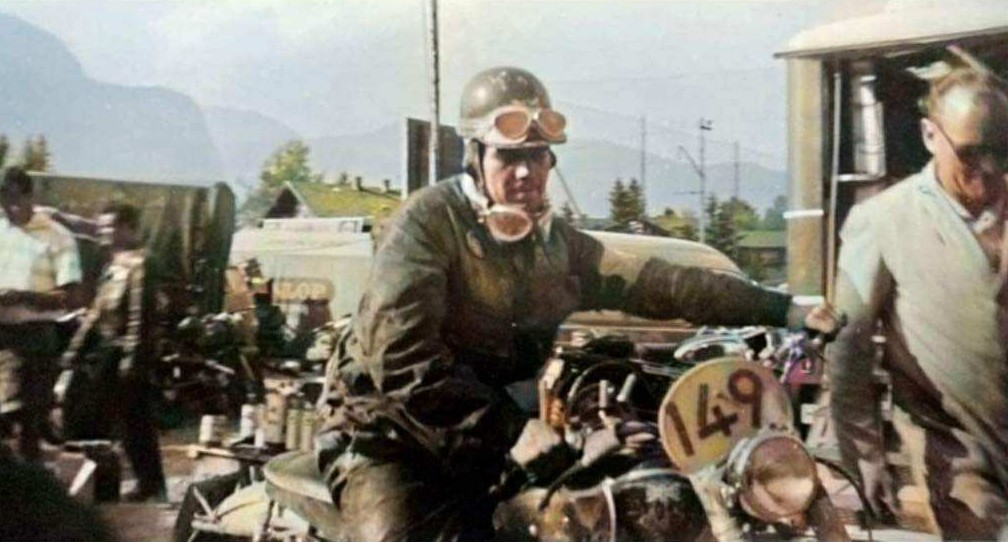
Gordon L. Jackson 1931-2024

Gordon L. Jackson, the AJS factory rider who won the 1961 Scottish Six Days Trial on one solitary mark, has died aged 92 years of age, on Sunday 7th July 2024.

Gordon had endured a period of bad health and passed away in the South Charente area of France, where he had lived for many years.

Gordon Jackson. 347cc AJS – Newcastle Motor Club, Allan trial, Alston. 1953 – Photo courtesy of Tommy Reynolds, Ashington

A ‘Kentish Man’, born on the north side of the River Medway, he was a farmer by profession and became a full factory AJS supported rider in 1953.

He won the SSDT four times (1956, 58, 60 & 61) and the ACU British Trials Star twice, in 1955 and 1958, the equivalent of the British Trials Championship.

When Jackson won the 1961 SSDT on 187BLF, Bert Thorn of Comerfords, Thames Ditton, immediately ordered 100 replicas of Jackson’s AJS, a factory order that remained unfulfilled, much to the disappointment of Gordon and AJS customers.

Gordon lost his single dab in 1961 on the top sub-section of Grey Mare’s Ridge, in more recent years the section became known as ‘Jacksons’ in his honour. Mortons Media own the image taken by Peter Howdle which is one of the most famous trials photographs in the history of the sport.
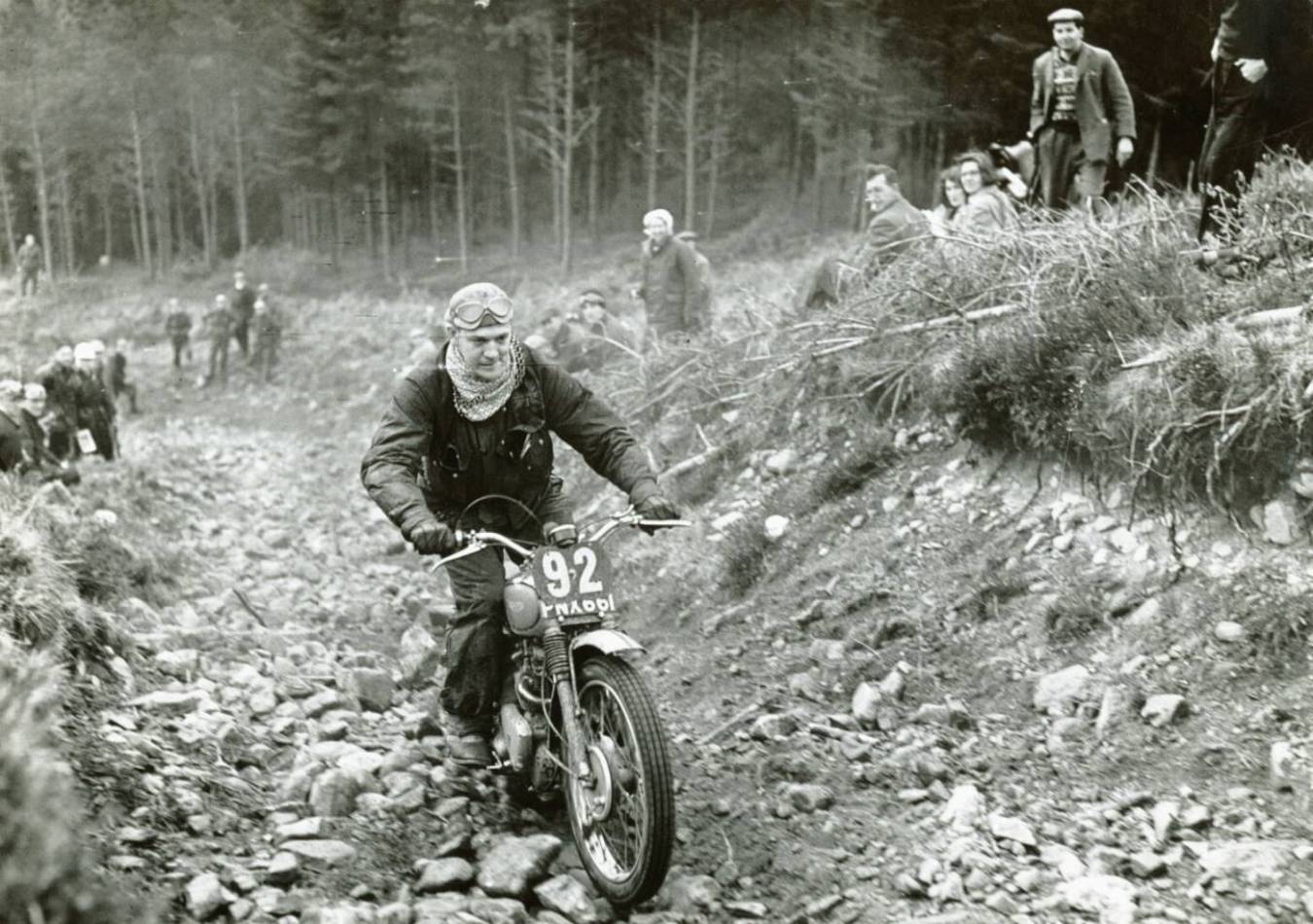
Gordon presenting trophies at John Luckett’s trial in Devon.
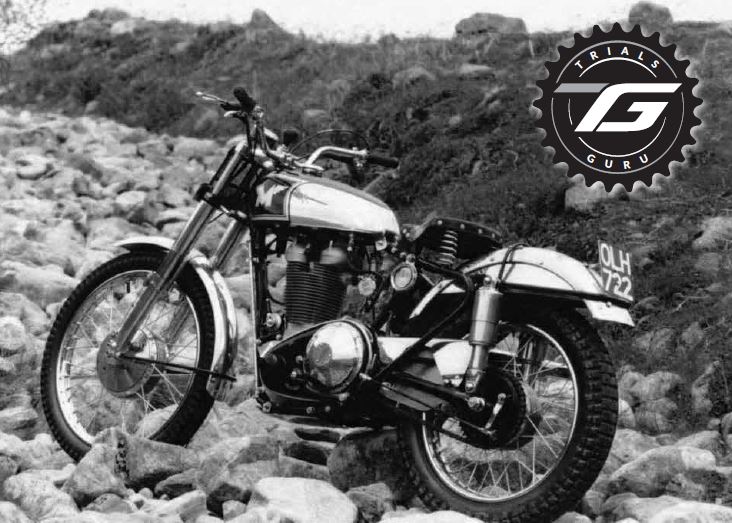
His wife Peggy pre-deceased him some years ago, Gordon leaves two sons, Drew and Ross and grandchildren, Lynn and Catherine. He was highly respected by his peers which included, Sammy Miller; Roy Peplow; Johnny Brittain; Gordon Blakeway; Gordon McLaughlan; Peter Fletcher; Geoff Ward; John Giles and Jeff Smith, to name but a few.

In his days with AJS, Gordon also competing in scrambles both in Britain and in France, as well as representing Britain at the International Six Days Trial.

Gordon Jackson with his famous AJS 187BLF on which he won the 1961 SSDT on one solitary mark! (Photo: Trials Guru)
Gordon Jackson on his factory AJS (TLP686) on Kinlochrannoch in the 1957 Scottish Six Days Trial.

John Moffat of Trials Guru said: ” I feel that this is the end of an era, Gordon Jackson was one of my heroes and was truly a legend in the history of motorcycle trials. G.L. Jackson excelled at motorcycle trials and when he retired from the sport, he took up car trialing and became British Champion in that sport also. I got to know Gordon in the late 1990s and we used to speak to each other by telephone over the years. I spoke very little during our chats, as he was such a wealth of knowledge, I enjoyed listening to him. I was truly saddened when I took the phone call from Drew Jackson to inform me of his father’s passing this morning. Gordon Jackson was a gentleman and a highly respected one at that.”

SSDT Centenary 2011 – Two of the most famous trials machines, of all time – 187BLF (350 AJS) which won the 1961 SSDT ridden by Gordon Jackson losing only one mark. GOV132 (500 Ariel) Sammy Miller’s famous machine that won the SSDT (1962 & 1964) – Photo: Iain Lawrie, Kinlochleven

Gordon Jackson’s famous AJS (187BLF) now fully restored is displayed in Sammy Miller’s museum at New Milton.

Five giants of off-road motorcycle sport: Left to right – Jeff Smith OBE; Peter Fletcher; Gordon Jackson; Alan ‘Sid’ Lampkin & Arthur ‘Ping’ Lampkin – Photo courtesy of Colin Bullock/CJB Photographic

Gordon Leonard Jackson 28 December 1931 – 7 July 2024

Tributes to Gordon Jackson:

Nick Jefferies: “Very sad news. You couldn’t wish to meet a more decent bloke. One of the true greats of motorcycling.”

Tony Davis: “Very sad news indeed. I had the pleasure of riding around the SSDT when he famously lost just one dab, what a brilliant ride that was. The sport has lost another great ambassador.”

Bernie Schreiber: “Trials Legend. R.I.P.”

Jeff Smith: “Very sorry to hear this. Gordon was a great rider and a gentleman.we had wonderful battles In 1950s .Rest In Peace old friend. See you soon!”

George Greenland: “So sorry to hear about Gordon he was a very pleasant and friendly person.”

Gordon McLaughlan: “Sorry to see my old team mate passing, he was a colossus in our time together. We will not forget his riding style.”

Tommy Sandham: “An all time great. He wrote a Foreword to my first book about the SSDT and made me feel like a millionaire! Condolences to the family.”

Freddie Mayes: “Very sad news! R.I.P Gordon.”