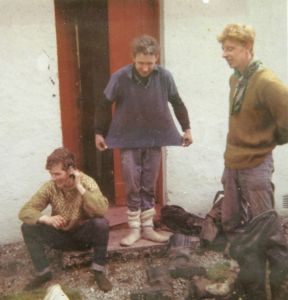
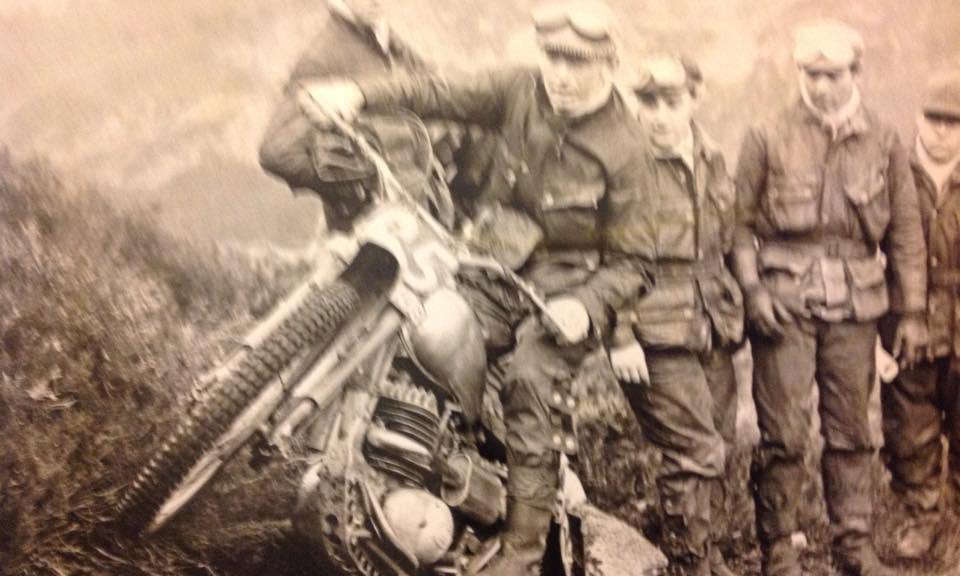
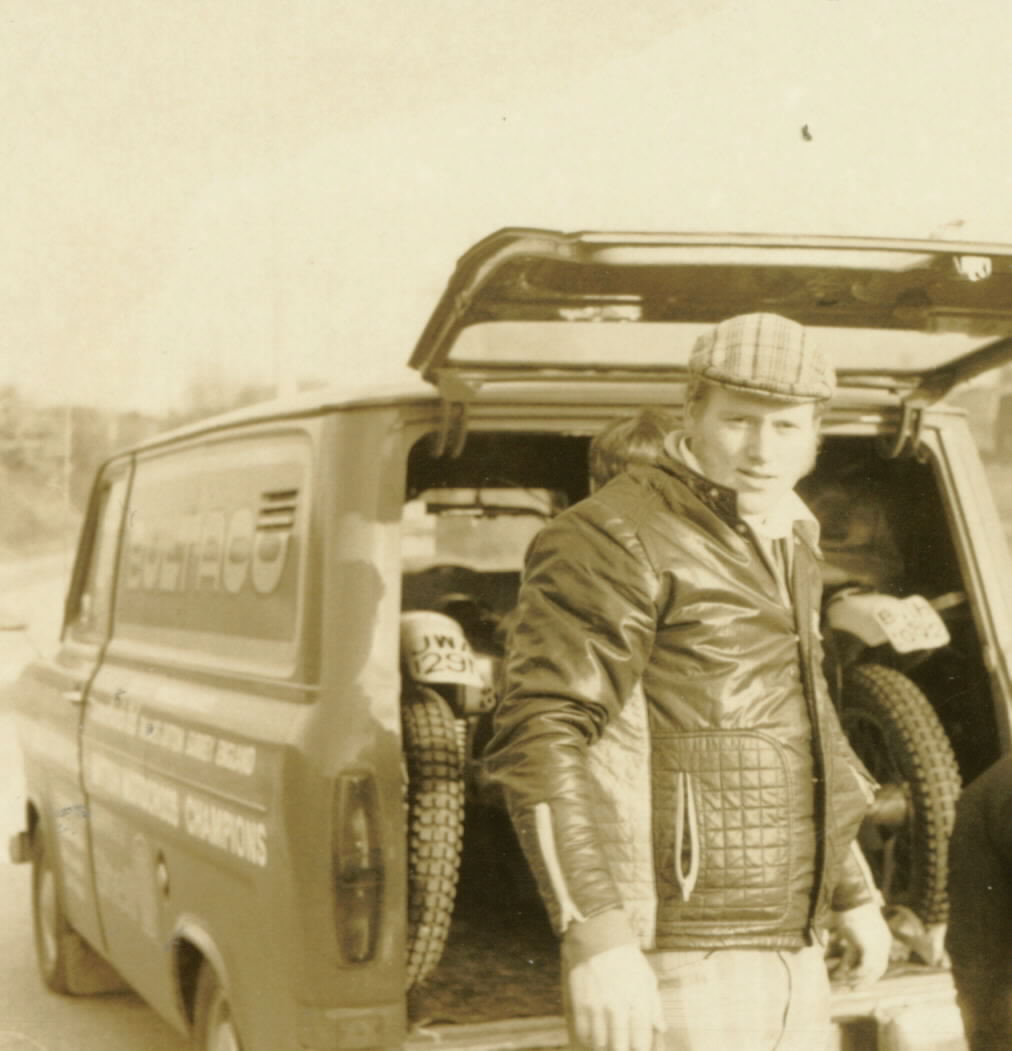
Rob Edwards (centre) with Brian Hutchinson (right) at the Scottish in 1968, showing what every discerning trials rider wore under their Barbour suit back then!
– I recently noticed a comment from a fellow Thornaby lad, Ian Instone. Ian remembers me as being a good friend to his late father in law Jack Russell.
Jack had a small Motor Cycle Shop in Thornaby, the like of which we will never see again.
He was a main agent for Villiers engine parts.
If it was a motorbike a lawnmower or concrete mixer or whatever Jack could fix it or supply the necessary spares.
I cycled past Jacks shop everyday on my way to Head Wrightsons where I was an apprentice.
We became great pals and the friendship lasted for years. Many people will remember seeing him around Thornaby on his motorbike and sidecar.
The sidecar had been removed and its chassis had been adapted to carry a motorcycle or anything that had been dumped that he could make a few shillings from.
My first bike was a 197cc Dot and I desperately wanted a longer throttle cable.When I turned the handlebars from lock to lock the engine revs went up and down, but finances couldn’t stretch to a longer cable.
One evening I was on my way home from work and I called in for a chat with Jack. He gave me a bag and when I looked inside,yes it was an extra long throttle cable.
“You can pay me for it when you have finished your apprenticeship”. – “Now in the meantime off you go and get some Trials won!”
Jack built a Motorcycle especially for speed events on Pendine Sands in Wales.
The cylinder liner was a piece of cast iron drainpipe that he machined to size in his lathe.
The bike was considered a bit of a joke but he set a time at Pendine sands that wasn’t beaten for years.
He was probably what we might call eccentric today and I am proud to say that we were friends.
Trials Guruhas been asked recently to provide a ‘forum’ facility for trials enthusiasts.
We apologise, but our view on this matter is that forums on any sport tend to become counter-productive over a period of time.
They also require careful moderation for legal and other reasons, which we simply do not have the free time to do.
As a result, Trials Guru has no plans to introduce this facility, however, we are able to bring you some facts and stories on the great sport of trials worldwide ~ with the assistance of our contributors and photographers ~ all with the free promotion of the sport.
Is an independent site aims to remember the trials motorcycles and top riders of the 1980’s to the mid 1990’s, as well as celebrating the Catalan motorcycles of that era. Many of these manufacturers have long since disappeared.
Most of what is featured in the site is linked to the Spanish machines, which are the speciality of Retrotrials. The Spanish have been very influential in the history of motorcycle trials since the 1960’s. This rise in fortune followed the British motorcycle industry’s decline.
Thousands of miles have been travelled in collecting this information. Sit back and read what you have not seen before.
Trials Guru recommends that you explore the web site and you will find:
My mum was a name known to all in the motorcycle trials world, she was born in East London’s Canning Town.
From humble beginnings she emerged as Britain’s best known lady rider in a career spanning a quarter of a century.
Renee’s interest in trials riding began watching father ‘Wag‘, an East London nickname for ‘Charles‘, riding motorcycles around the docks near his cycle and motorcycle shop. Renee’s parents were hard working East Londoners. They opened their first shop in the late 1920’s in Victoria Dock Road.
The popular shop hired and sold cycles, and the name Wag Bennett has been carried through to successive generations.
All during World War II, Wag and Esther Bennett remained in Canning Town, running their shop, keeping the dockworkers going with cycles and motorcycles, and staying open late til 11.00am waiting for the last shift of workmen to pass the shop.
Renee stunt doubling
Renee stood on a box at the counter, testing bulbs and batteries and giving the customers their change, by candlelight. She recalls she was about 4 or 5 years old.
In 1939, Wag was picked for the British ISDT Team, held that year in Nazi Germany. He shook hands with Hitler, unaware of the gathering storm then, quite suddenly, the team was ordered to leave Germany immediately WWII had begun!
The old shop was a target in the blitz being so near the docks, and eventually took a bomb, as did every other shop and house around it. Almost blown to smithereens, the bedroom ceiling was somehow held together with cycles magazines and newspapers. The whole shop was supported by a few wooden beams, keeping it standing.
Buckets were strategically placed on the bed to catch water, which poured in every time it rained. As a child, this was normal daily life for Renee and her brother, Wag jnr.
At night, they watched the ‘doodlebugs’ the V1 flying bomb, on their way to decimate the London docks and surrounding area.
Standing outside the shop every night, one of these unmanned rockets, would suddenly stop, drop, hit it’s target and blow the shop windows out.
During these blitzes, the family would hastily run to the nearest underground station or the Anderson shelter behind the shop, where they would remain until an ‘All Clear’ siren sounded.
Getting through the war was a daily struggle for survival. The harshness of life though at least prepared Renee for the tough sport of motorcycle trials that was to come.
After the war, Wag sold Ariel motorcycles; strong serviceable machines they were used thoughout the war, by soldiers and civilians alike. He worked all hours repairing and selling them to the dockers and factory workers.
Renee left school at 15, and went into the family business. It was now well known, a beacon for all the major British bikes: AJS, Matchless, Ariel, BSA, Triumph, Panther, James, Velocette, Frances Barnett, NSU ‘Quickly’ to name but a few.
Around this time, Renee began riding in earnest on a James Captain 198cc, but at only 7 stone and of slender build the skill of trials riding was not easy to master.
In her own words: “Why I never got killed I’ll never know, I was useless!“
Wag Bennett jnr. also worked in the shop, but diversified into bodybuilding. He would train every night in the hope of becoming Mr Britain. He eventually opened his own gymnasium training some of the greatest names in bodybuilding including Arnold Schwarzenneggar, who lived with him and wife Dianne for a few years. Wag was instrumental in teaching Arnie to pose to music. He won every title in Wag’s shows and soon became a household name. Arnie remained a lifelong friend of the family and invited Wag & Dianne to his Hollywood wedding to Maria Shriver.
In the mid-50s Renee met husband Howard Powell through her brother’s bodybuilding connections. Howard won many titles throughout the UK including Mr. South East Britain and Mr. Navy.
They married and in 1956 I came along. Renee juggled motherhood with helping Howard run their motorcycle shop in London’s East Ham, the first of five.
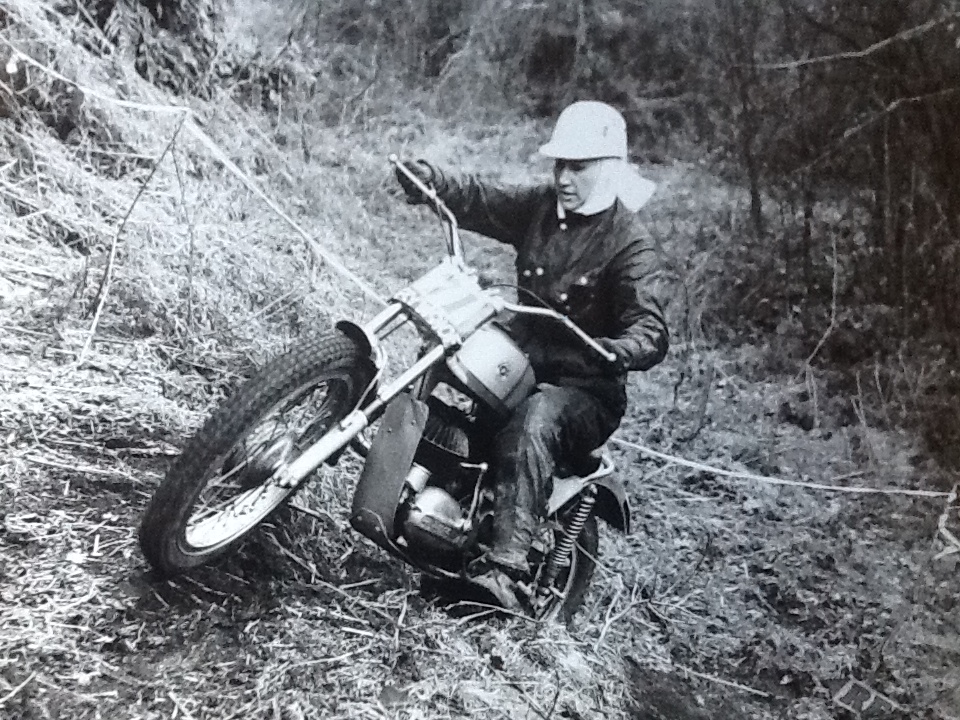
Determined to follow in the footsteps of her father, a factory supported rider for Matchless, Renee rode daily on wasteland nearby, and competed every Sunday in Kent and Surrey in timed trials along with husband Howard, also an avid trials rider.
By this time, and winning several awards in open-to-centre trials, Renee was riding a Greeves 250cc slimline, alloy frame, perfect for her. They were made by a small factory at Thundersley, Benfleet, Essex.
Renee was ready for the challenging Scottish Six Day event, following in her father’s footsteps.
Renee’s entered the Scottish Six Day Trial in 1961. The first of many.
She finished the event, earning her an award and a myriad of bruises all over her body!
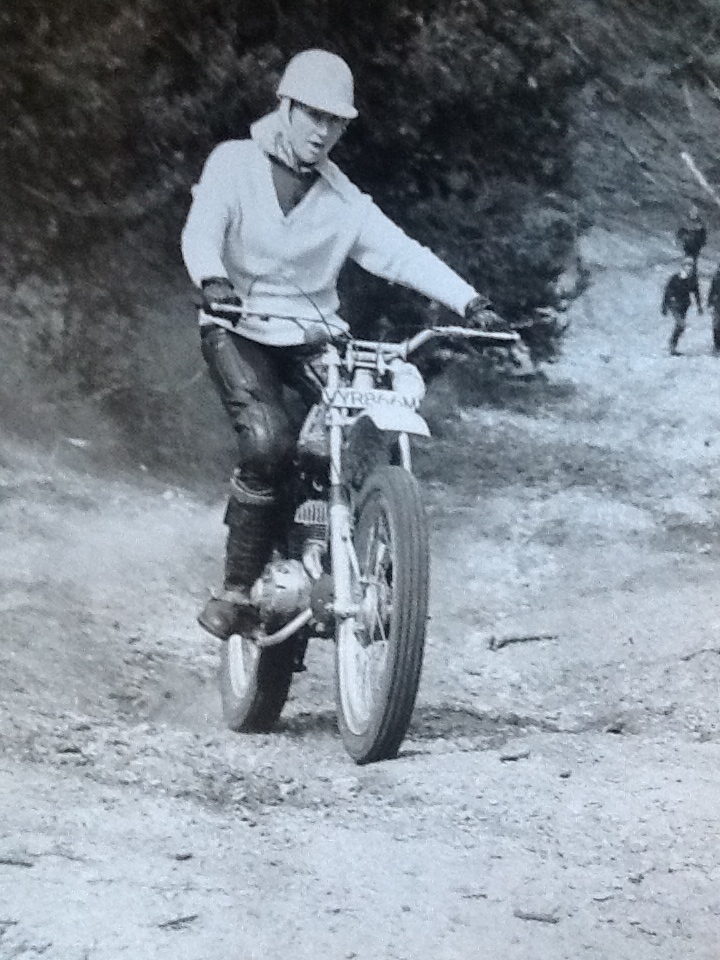
The Welsh Three Day Trial featured prominently in Renee’s riding career as she says: “My favourite, fast and furious!” Renee rode a Bultaco 250cc with a Wasp frame for that event.
Her son, my brother, Charles was born in 1964.
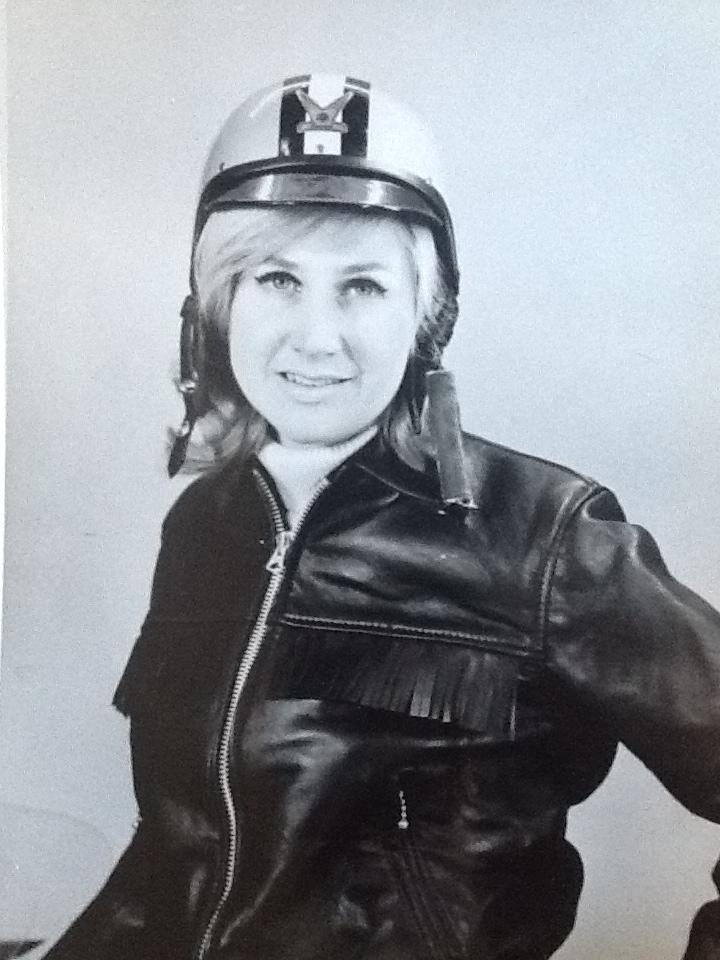
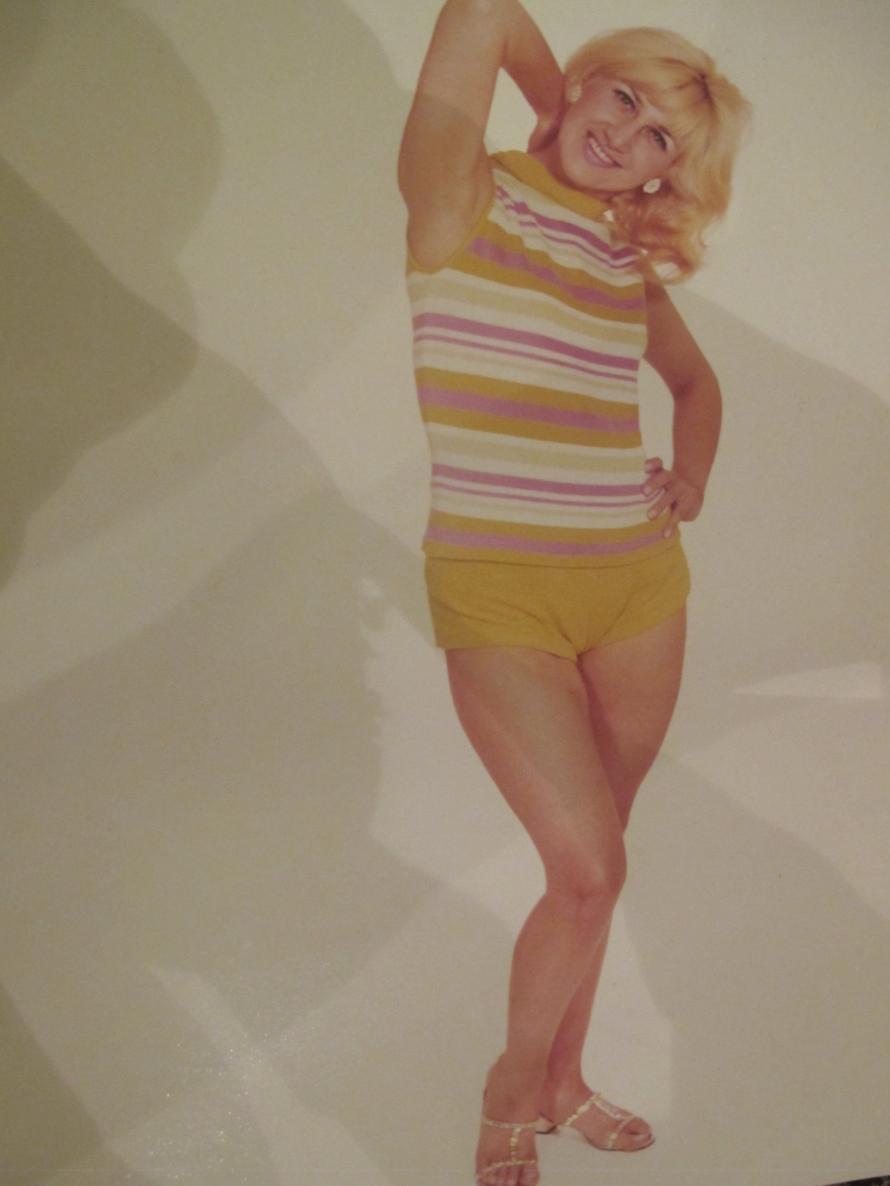
But that wasn’t all, she was much in demand as a motorcycle stunt double, known by all in the film and TV business as The Girl On A Motorcycle. Renee also enjoyed a successful modelling career, advertising everything from make-up to Ovaltine.
In the early 1970s, Renee switched to riding a Bultaco Sherpa 250cc, which she still has today along with her Greeves, Bultaco Enduro (used in the Welsh Three-Day) and the much-loved James 198cc.
In 1973, Renee competed in the Scottish Six Day Trials on the Bultaco. The 6th so far.
At around here, she converted one of her East London shops into a motorcycle competition centre. “Renee Bennett’s East London Sportman’s Centre”, which became a beacon from as far afield as Europe and the USA. Customers visiting the shop immediately asked for ‘Renee Bennett!’
Renee and Howard became known for sponsoring many up and coming young trials riders in the 80s, kitting them out with helmet and suits, their own name signwritten on the petrol tank, and cheques sent when they had won the event.
Renee’s competitive spirit continued well into the 1980s. She ran a popular trial of her own: The Renee Bennett Sunbeam Novice Trial, which became a much awaited event each year. Every finisher received a scrolled certificate, adorned with red ribbon. It is still talked about today in vintage trials circles!
Howard, being into health and fitness since his time as a bodybuilder, set up a gymnasium above one of the shops. They trained daily, and Renee found the toning and strengthening a big help when dragging her bike out of the mud!
Howard, who sadly passed away in 2003, was a talented amateur film maker, often being invited to the premieres of the top films of the day. He counted among his friends actors and top stunt men from all the Bond films.
Renee recalls meeting the movie stars of the day like Yul Brynner and Steve McQueen, who was over from the states for the ISDT in 1964.
Now a grandmother but still with an interest in motorcycles, Renee continues to run her busy motorcycle shop in East Ham, the first one she and Howard acquired some 58 years ago.
As if that is not enough, she is very ‘hands on’ in her property renovating company assisted by son Charles.
Grandchildren have come along, my daughter Sophie, nearly 16 and a three-times published author! Oliver nearly 12, and young Charles, 22, who runs his own foreign exchange business.
Film on Renee Bennett by British Pathe on YouTube: HERE
Renee’s mother died only recently in 2012, aged 103! Father Wag died in 1989. As Renee says: “Perhaps I’ll live to be a ripe old age… see you around!”
This recent comment on a trials forum site sums up the amazing Renee Bennett : “Well.. Renee Bennett,. what can I say..! I think my old man had a fancy for her! I remember her riding the SSDT on a Bultaco in 1973. All the lads were fighting over themselves to help her when she got into difficulty. Her shop was called ‘Renee Bennett’s East London Sportsman’s Centre’. – Anyone know who wrote that?
– Julie Powell
Renee Bennett photographed in 2013 by daughter Julie Powell
Article Copyright: Trials Guru/Julie Powell
Photos: Julie Powell
Renee Bennett in Spanish! – Todotrial website Article:
Javier Cruz from Madrid has taken the Renee Bennett story to Spain, read about it: HERE
Trials Guru talked with Derek Cranfield, a trials rider who recently rode his sixtieth anniversary trial with the Witley MCC and who began his life in motor cycling when called up to do two-years national service. Here is his story:
On the 197 OEC, Derek’s first trials bike
“I was called up for my National Service, I went eight miles from home to learn to drive lorries and tanks, when I passed I was sent to Germany and when I got there, usual army thinking, no position, but would I like to ride a motor cycle?”
“I had never been on one, so I became a police rider and then company dispatch rider, doing thousands of miles throughout Germany. When I was demobbed, I bought a little James 125 and joined the local motorcycle club, the famous Witley MCC which I have now been a member for the last sixty-four years. After a couple of years observing, I decided I could ride better than some of the riders, so I sold the James and bought a trials 197 OEC“.
Scrambling a very special Francis Barnett with Norton forks and other special modifications. Photo taken at Trafalgar Farm, Portsdown Hill, Portsmouth (Gosport Club)
“One of my first events being a complete novice going down a steep slippery slope, both brakes full on I tried to turn left the front wheel wanted to go straight on, off I came, when up-right the handle bars where straight the front wheel forty-five degrees to the right.
The stanchions were still bent when I exchanged the bike for a James Commando, rigid rear end. I used this machine for a few years in trials and scrambles, my next bike was a 250 BSA with the outside distributor. This was a terrible starter when hot until I put a separate earth-wire from distributor to the frame.
Derek bought this DOT in 1961
“Next came the DOT 250, I bought this in December 1961 and in January probably had one of best wins when I won the 3 Musketeers trial near Reading. It was then a regional restricted trial and in the entry list were people like Peter Stirland; Mick Dismore; Gordon Farley; Bill Faulkner and the great Johnnie Giles. The following week I won the 250 cup in the Dunlop Trophy trial in Kent followed by a group trial win“.
Culross, Fife in the 1965 Scottish Six Days
“These wins got me a bit of support from DOTs for the Scottish Six Days. I rode the Scottish eight times, getting a Special first and seven First class awards. Not too bad for a south-east sand and ‘mud-plugger’!
I then started working for Comerfords, the biggest sporting dealer in the world. At one time, we had twenty-two of the staff all riding trials, scrambles, road racing or speedway. On the staff we had people like Bert Thorn; Don Howlett; Jock Wilson; Dave Thorpe snr and of course my great traveling friend Reg May. We traveled together all over the country to all the nationals“.
Foyers, South Loch Ness in the 1965 SSDT on the Greeves.
“At Comerfords, I had my Bultaco and Greeves machines and it was at Comerfords that I met some wonderful people from all over the world like Bud Ekins and Steve McQueen, when the USA ISDT team came down to part prepare their machines.
I left Comerfords to join Len Savage motorcycles in Farnborough as a director, the first day Len had a heart attack and so the firm became my sole responsibility. The bikes I had there were Fantic, Yamaha, SWM and Gas Gas, or what was in the shop. After I sold the firm I have had Yamahas, Gas Gas and now Beta. My current machine is a Beta 200, a little beauty. My favourite trial was the Scottish Six Days, when I stopped riding it in 1978, I have been up to spectate every year since until three years ago“.
‘Creag an Eillen’ A section used up until 1967 on the Rothiemurchus Estate near Aviemore this photo was taken in 1965 with Derek Cranfield on the Greeves in the Scottish Six days.
“Another great trial down here is the ‘Greybeards Trial’ started by the great Ralph ‘Rafe’ Venables. I started when I was about forty-seven I have won this trial five times, the last being in 2001. This trial is on a Sunday and the Bognor club started up the ‘Bluebeards Trial’ on the Saturday to make a weekend of it. I won this trial, five or six times and up to about 2001, I was the only person to have won both on the same weekend“.
Derek on his TY250R Yamaha.Thames Valley Trials Combine Trial 2015 – Sixty Years on and still riding! – Derek Cranfield. Photo: Dave Renham, Bultaco UK/ In Motion
Copyright: John Moffat/ Trials Guru 2024
Photos: Supplied by the Derek Cranfield Archive; Dave Renham, Bultaco UK/InMotion 2015
Apart from ‘Fair Dealing’ for the purpose of private study, research, criticism or review as permitted under the Copyright, Design and Patents Act, 1988, no part of this article may be copied, reproduced, stored in any form of retrieval system, electronic or otherwise or transmitted in any form or by any means, electronic, electrical, mechanical, optical, chemical, photocopying, recording or otherwise without the prior written permission of the author as stated above. This article is not being published for any monetary reward or monetisation, be that online or in print.
John Davies on his Scottish Championship winning BSA Gold Star seen here in 1959. Photo courtesy: Mrs Peggy Davies
Words: Trials Guru
Photos: Mrs Peggy Davies; Jimmy Young.
Born on 5th January 1934 at Liskeard, Devon, John Davies moved to live in Scotland when his father, Bill, also a keen trials rider transferred from Devonport to Rosyth Naval dockyard.
John became a shipwright and later a draughtsman at the Royal Naval establishment, where he worked all his life.
John Davies and Maurice Duffin with their silver-ware in 1958
Davies was what was known as an all-rounder, he rode trials, scrambles, grass-track and enduro. He had the ability to ride a trial one Sunday and grass-track the following sabbath, such was his adaptability.
Known to Scottish riders as ‘Johnny’, he started competing in 1951 on a 197cc James in trials. He entered his first Scottish Six Days on a B32 350cc BSA in 1953, finishing on 232 marks and a second class award to put on his Mum’s mantle-shelf!
1960 on the BSA Gold Star, shifting – Photo: Courtesy, Peggy Davies
He had joined the local Dunfermline and District Motor Cycle Club and retained his membership all his riding career.
He joined the RAF for his national service and was stationed at RAF Leeming and joined the local Northallerton club. His father and he built up a very quick Velocette 500 for riding in local scrambles while he was stationed there.
John gets a wheel ahead of George Shearer, both on MDS Greeves 250. Photo: Peggy Davies
Davies rode regularly against the famous Tate brothers, Maurice and Ron, bike dealer Norman Crooks, Dickie Preston and Peter Hodgson. All top riders in their day.
1973 – Montesa Cota 247 mounted at the Edinburgh Southern, Coronation Trial at Woodside section, near Muiravonside.
Although his first love was trials riding, John became an expert scrambler, taking the Scottish 250cc title (Alexander Trophy) in 1957 on a 197cc Francis Barnett and the 350cc Scottish championship (D&J Bell Trophy) on his DBD32 BSA Gold Star. His contemporaries included George Hodge and Ian Bell, both multiple Scottish champions.
John Davies at Caldcoats Farm, Newton Mearns in 1959 aboard his BSA Gold Star. Photographer Unknown.
George Hodge said recently: “Johnny was such a smooth relaxed rider in scrambles, you thought he was riding down the street to get his Sunday paper, whereas he was really flying!”.
Davies married his sweetheart, Peggy Hopkins from Edinburgh, but the wedding was planned in such a way that it was after the final race of the scrambles season, not only that they honeymooned in the Manchester area so that he could pick up an ex-works Dot from the factory on the way home to Dunfermline. They had two daughters, Sharon and Lynn.
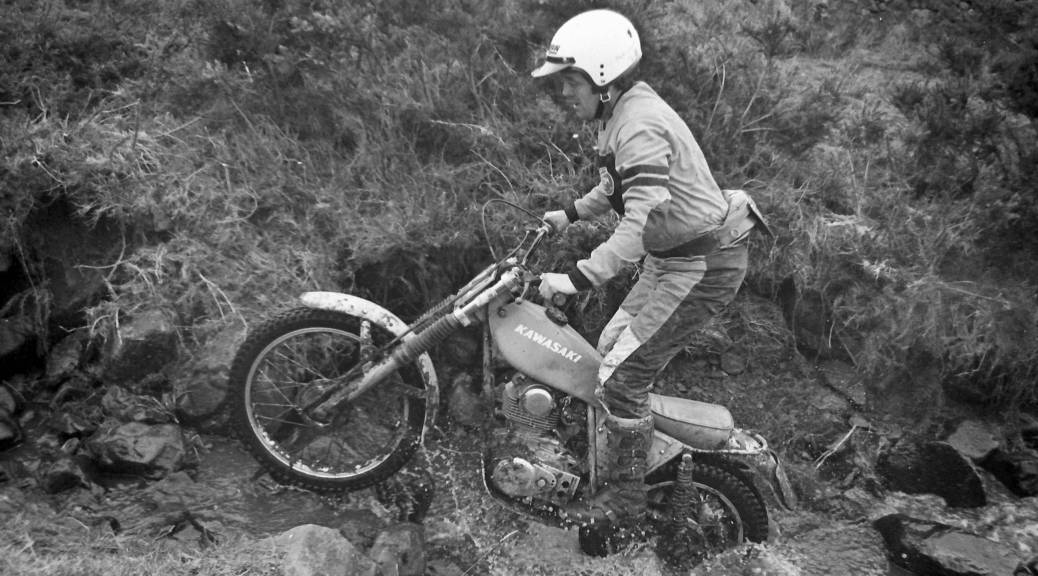
Johnny was a clever man with the spanners and was an engineer at heart. He built many trials specials, which included a four-stroke Kawasaki trials bike in 1978. He converted a Honda Seeley TL200E to mono-shock rear suspension and a Yamaha TY250R mono converted to take a Yamaha Serrow four-stroke motor with electric starter when his Rheumatoid Arthritis became more progressed in 2002.
1979 – Valente Trial – Johnny Davies on his self-built Kawasaki 250 Four-Stroke – Photo: Jim Young, Armadale.
He also helped friend Ian Bell to build two Royal Enfield Trials Bullets, a 350 and a 500, from parts sourced from the factory competition department at Reddich in 1956.
John on his Honda Seeley TL200E at Callender around 1988, a bike which he converted to Mono-shock rear suspension. The bike was previously owned by Robbie Paterson of Cumbernauld. Photo courtesy: Jock Taylor, Perth.
Johnny’s great phrase when something went wrong was this: “What was the last thing you did before the bike wouldn’t go?”.
When he ceased competitive riding, Davies joined the Scottish ACU trials committee, stewarding many trials, he became trials chairman and held the position until his death on Saturday, 8th July, 2006 aged 72 years.
Davies was the driving force to ensure that Scotland hosted a round of the ACU British Trials Championship.
Johnny was always spotting trials ability in young riders and was one of the first to spot the talent of Gary Macdonald, who went on to become the most successful Scottish born trials rider of all time.
Macdonald said in a recent interview with Trials Guru: “Johnny Davies was a great man, he believed in me and helped me no end when he was on the SACU”.
His memory lives on as he was the creator of the ‘Scottish Clubman Trials Championship’ – the John Davies Trophy is awarded annually.
Trials Guru’s John Moffat on John Davies:
Johnny Davies was a dyed in the wool motorcyclist. He loved bikes, rode them virtually all his life, a passion handed down by his father Bill. He even rode a pillion trial in glorious Devon as passenger for his Dad when he was still at school.
When I travelled away from home on business around 1999 to 2005, I would be driving homeward when the mobile would ring and it was Johnny. “Where are you John? On your way back North? Fancy something to eat? I’ll get Peggy to put some extra potatoes on then, we’re having chicken! See you in an hour?”.
I would drive straight to Johnny’s house having phoned ahead to home explaining that I’d be late home and then spent an evening having a meal and talking trials with Johnny for around four hours at a stretch, then continued on my homeward journey, arriving at my house around one in the morning!
Johnny was my mentor when I became involved with the Scottish ACU. It was he who invited me to join their trials committee as one of the members, Jim McMeechan had died a few months earlier and Johnny had thought I would make a worthy replacement, so I was co-opted on.
When it came to the politics, Johnny advised me to say little in public and begged me to stay off internet forums as he believed they did more harm than good. “Only discuss it at committee John” he would say. “And bloody well don’t respond to these forums, it just makes things worse, stick to the rules and you won’t go far wrong.”
I wish I had listened more to the wise man, Mr. Davies, he made a lot of sense. If Johnny could help, he did. The trials world was much richer, when John Davies was around! It was one of my most privileged times when I was asked to speak at Johnny’s funeral in 2006. – John Moffat
John Davies 1934 – 2006
John Davies article is the copyright of Trials Guru – 2015
Apart from ‘Fair Dealing’ for the purpose of private study, research, criticism or review as permitted under the Copyright, Design and Patents Act, 1988, no part of this article may be copied, reproduced, stored in any form of retrieval system, electronic or otherwise or transmitted in any form or by any means, electronic, electrical, mechanical, optical, chemical, photocopying, recording or otherwise without the prior written permission of the author as stated above. This article is not being published for any monetary reward or monetisation, be that online or in print.
Martin Lampkin could be saying: ‘Have you lost your licence again Rob?’
Hello Everybody, here are more of my Bits ‘n Bobs, I hope you will enjoy them.
My next tale happened in France.
Malcolm Rathmell, Martin Lampkin and I were travelling to the French round of the European Championship. We stayed the night at a hotel that was about 20 miles from the Trial start.
First thing next day we set off in the direction of the start. As soon as we got going, we rummaged about to find the regulations for the event. These stated that the start was at ‘Le Mari’. We still had a fair way to go, so we could relax and keep one eye on the map. Suddenly Malc bellowed: ‘LEFT, LEFT, LEFT‘ and sure enough as we broad sided into this rather grand gateway the sign read ‘Le Mari’.
Almost in harmony we said ‘bloody hell! this looks a bit posh for a Trial?‘.
At the end of the drive was a magnificent French Chateau. Still the sign said ‘Le Mari’ so we must be right.
We parked in front of the Chateau and Mart and Malc set off up the stone steps. Says Mart: ‘Come on Rob what are you piddling about at?‘
I said: ‘I cant find my Passport or my money and my international trials licence’.
It was at this point Mart washed his hands of me.
Mart: ‘Every time you put your documents safe you forget where you have put them’.
‘Anyway’ said Mart, ‘I am not even going to help you look for them, you won’t have lost them look in all your pockets’.
Mart said: ‘Me and Malc are off to sign on you can catch us up’.
Sure enough I found my documents and set off in hot pursuit. The lads were on their way back down the stone steps.
Malc said: ‘Up the steps Rob, oh have you got your international Trials licence they wont let you sign on without it. Go through the glass doors and up the staircase in front of you at the top turn right go down the corridor and into the third door on the right’.
I opened the door and walked in expecting to see three or four people waiting to sign competitors on. Instead the room had about thirty people seated around a huge oval table all looking a bit bemused. It didn’t take me long to realize that I had been set up by the lads but not before I had got half-way around the table shouting in my best pigeon French Allo Allo sign on for ‘Trieeaal‘.
The look on their faces said it all and I beat a hasty retreat back through the door and off down the corridor.
Once outside I saw Mart and Malc laid on the ground with tears rolling down their cheeks. ‘Did you get signed on Rob?‘
‘No I bloody didn’t!’ was my reply.
We learn’t later that every town and village had a ‘Le Mari’. This is not maybe how to spell it but roughly translated it means ‘Town Hall’.
No wonder the people in the board meeting thought that the village idiot had popped in!
Anthony Ayrton’s 2RT Montesa. Photo: Barry Robinson
We have a breeding programme around Barnoldswick (Barlick to the locals in Lancashire).
Montesa 315’s are being caught and put into quarantine. Those are refurbished but some, Anthony Ayrton’s 4RT, had a blown engine so costly to ‘fettle’ that they are cannibalised. The 4RT frame requires some modifications to slot in a 315 engine, radiator etc. The 4RT air-box is utilised. The 315 forks fit. The end product is a responsive good handling trialler that will not wear out. As it is breeding season in the Pennine regions any lurking Montesa 315s are being trapped by the Yorkies crossing the border without a permit. At least twenty such machines are nesting in the hills above Barlick. It’s that old Yorkshire/Lancashire rivalry again!
Nathan Wrigglesworth and Anthony Ayrton. Photo: Barry Robinson
The Premier Trial Website – Recording the History of the Sport 'Established 2014'

















 TRIALS GURU - DEDICATED TO TRIAL