It is with great pleasure that we grant this gentleman Trials Guru ‘VIP status’.
He is a well-known figure in the sport of motorcycling.
A former Westland helicopter engineer who set up his own business, prompted by his love of motorcycle sport. Inspired by his hero the great Lew Coffin, he was responsible for the manufacture of a range of motorcycle components to the highest quality by his company, Talon Engineering Ltd of Yeovil.
Talon Engineering in the early 1980s, George Sartin is on the extreme right.
He was first to manufacture a front disc brake assembly in 1971 for the Dalesman Sachs of Peter Gaunt. He also sponsored a full day at the Scottish Six Days Trial for many years, as well as sponsoring many riders from his ACU centre.
Our VIP gets excited at opening the box – Photo: Linda Ashford
His company linked up with Mick Martin to develop the Mickmar 250cc trials engine and if fact built a complete machine, which is now exhibited in Sammy Miller’s museum at New Milton, Hampshire.
But it was Talon Engineering that brought him to the attention of the motorcycle press as the company became the OEM supplier to many of the trials motorcycle manufacturers the world over.
George Sartin is a Trials Guru VIP – Photo: Linda Ashford.
He is of course GEORGE SARTIN, a gentleman that is DEDICATED TO TRIAL. Trials Guru salutes you and all you have done and achieved as a captain of industry within motorcycle sport across the globe.
We are delighted to announce that this gentleman has received the Trials Guru VIP award of a coveted red cap. He was a rider, an official and a hard working enthusiast when he had a day job. Having just turned 95 years young, he devoted his life to motorcycle sport.
A Competing Sportsman: He started trials riding with his local club, the Farnham Royal MC & LCC and he went on to compete and represent Great Britain in several International Six Days Trials, including one for the army whilst doing his National Service.
In Wales, the Isle of Man, Austria and Czechoslovakia. He was part of the GB Trophy team which included Sammy Miller, Johnny Britain, Johnny Giles and Eric Chiltern. He certainly has lots of interesting stories to tell!
1959 ISDT at Gottwaldov, Czechoslovakia.
In the picture wearing the Trials Guru cap he’s wearing one of his made to measure Barbour jackets, complete with the 1961 GB team badge, proudly worn.
1959 ISDT – Colin Moram on the 500cc AJS number 224. (Photo: Speedtracktales website)
He also rode in the Clubman’s TT in 1956 in the Isle of Man and the Scottish Six Days Trial on a 350cc Matchless.
A Voluntary Official: 1961 was the start of 64 years of voluntary official involvement with all disciplines of motorcycle sport. From the early days with the Farnham Royal MC & LCC, South Midland Centre, ACU to the FIM in 1980. He was on the board of directors for the FIM until 2000. He is currently Honorary Vice Presidents of both ACU and FIM. There are a lot of technical titles over the years within all of the above organisations. Growing up, most weekends, he and his family were at some event or other. Only a couple of years ago he chaired a South Midland conference Centre meeting via a zoom meeting.
The Day Job: He took over the running of his father’s motorcycle business, Sid Moram’s of Slough when his father died in 1959. Started in 1924 Sid Moram’s was one of the UK’s first Honda dealers. He opened the ‘Windsor Comp Shop’ which was the ‘go to’ place for off-road motorcycles and kit. He also sponsored many riders who went on to do very well, including the grass track World Champion Simon Wigg. One of his sponsored riders won the 250 class Welsh 3 day trial, the first time Honda had won an individual off-road competition in the UK. Both shops have their own Facebook pages where people regularly share memories and memorabilia.
He is of course COLIN MORAM – Dedicated to the sport.
ISDT in Czechoslovakia
ISDT
ISDT on a Matchless
Sid Moram’s of Slough
With Jorge Vegas of the FIM
With Sammy Miller MBE
Close inspection
With Ron Haslam’s factory Honda
With the Hemingway family at the FIM
With Emma Bristow
The National at Birmingham
With daughter Paula at the FIM museum in Switzerland.
Photos: Alistair MacMillan Studio/West Highland News Agency, Fort William (Courtesy of Anthony MacMillan); Iain C. Clark, Fort William; Bob Hosie; Iain Lawrie; OffRoad Archive; Ernie Page; Graeme Millar; Brian Catt; Glenn Carney; Peter Bremner; Allan Forbes; Javier Benito Aguado; Roy Varty; Ian T. Robertson; Ken Haydon; Ray Daniel; A. Dickson McLaren, Edinburgh; Derek Soden.
We take it for granted nowadays with the ‘information super-highway’ which brings data, items of news and articles, straight to your mobile device. So we bring you something a little different from the normal, in that the subject has taken the time to recount his life, well before the ‘worldwide web’ was even thought of. It’s a story not just of trial sport but other sports, events and employment that led up to him riding in trials. One man’s passion for the sport that has never deminished.
Who is Douglas Bald?
Douglas Bald on ‘Caolasnacoan’, 1971 Scottish Six Days Trial with Derek Edgar (left) and Mick Andrews in white cap watching the line – Photo: Bob Hosie
Douglas Bald was born in the family home in the Broombank Terrace, Broomhall area of Corstorphine, Edinburgh, Scotland on the 8th of July 1947, his father was a time-served Electrical Engineer and mother a Civil Servant, Douglas Bald had two younger siblings, sister Eileen and brother Alan.
A member of the Edinburgh St. George Motor Club, he was known across the Scottish trials scene as ‘Dougie’, he went on to win the 1968 Scottish ACU Scottish Premier Trials Championship, riding a 250cc Cotton. But there is much more to Dougie Bald than that single achievement.
This story is told by the man himself.
THE EARLY YEARS
“Whilst getting my gear together for the coming season, I decided a new pair of boots was definitely required. My third pair in so many years and, to be truthful, all still wearable. How extravagant, and how lucky we are. The phrase springs to mind: ‘We’ve never had it so good!’ And there started a train of thought that it may be of interest to some of the ‘young team‘ what it was like to ride trials in the days when I was classed as young.”
Horseplay at the Scottish Six Days Trial at Fort William, Douglas Bald photobombs an unsuspecting Ian Millar, on the right is Allan Poynton – Photo: Douglas Bald Collection.
“The time was the early 1960s, and I was having some success on my cycle speedway bike, a sport that was very popular in central Scotland. I became interested in motorcycle trials when Ian D.B. Millar, Darren’s father, would ride down to our affiliated meetings on his James trials bike just to spectate.”
The late Ian Millar photographed in 1967 – Photo: Graeme Millar Collection, Edinburgh.
“Enquiries followed as to what, how and when, for I had always ridden off-road on my push-bike, staying away from home for hours, and the muddier it got the more fun was had. However, the push-bikes of that era were a far cry from today’s, but we did experiment with front suspension, this required replacing the front forks with longer forks straightened in a vice, and using conduit pipe for handlebars. We also inserted a spring under the headstock; no bearings were used, but it did work. The forerunner of the mountain bike perhaps? Nothing new really. Little did I know at that time that I would go on to win both individual, team championships, and Scotland honours travelling all over the UK.”
Douglas Bald (centre) during his cycle speedway days at Southampton – Photo: Douglas Bald Collection.
“As mentioned when growing up, there was hardly a day that I was not riding a bike. At that time, recycling as we know it now did not exist. Scrap yards were readily accessible, therefore building bikes couldn’t have been easier. One of our first ‘off road’ riding areas was at ‘Cramond Brig’ on the Edinburgh City boundary, where I would meet up with guys, unbeknown to me then, who would later become friends, fellow competitors and team-mates. It was not long before I became a ‘skid kid’ as it was called in the early days before it became known as a cycle speedway rider, albeit a very informal one. I was affiliated to a fledgling club called the ‘Sighthill Hammers’, this would be around 1961. It wasn’t long before the sport in Edinburgh boomed to an extent that at one time, there were thirty or so clubs that were eventually formed into three leagues. Now sadly, there is only one Edinburgh club, one in the Scottish borders, which is under construction, and one in Dunfermline. The Dunfermline club also compete indoors in the winter. This was unheard of in my time.”
CYCLE SPEEDWAY
Cycle speedway was a popular spectator and competitor sport in Scotland in the 1950s and 1960s. Allan Forbes seen here at full stretch and at speed. Photo: Allan Forbes Collection.
The Sighthill Hammers
“At Sighthill, the team were Scotland’s best and most consistent club, having a run of seventy-one matches unbeaten. We also competed down south, where like today’s trials, the competition was much stiffer. The Hammers gained a reputation as to how good we all were, and by 1965 we reached the British Championship held at Halifax. Sadly we lost that year, but in 1966, we again made the final and would again ride against the same Manchester club at Southampton. All the way there in a ‘midi’ bus, no motorway at this time, but we managed to reverse the exact score. This made us the proud winners. My ride on the day is remembered for my tactics on the final heat of the match. We were tied and needed just one point to win. However, that was to be a hard task, for the opposition team had arguably two of the world’s best cycle speedway riders of all times. I did know that my heat leader would ‘out gate’ them as he was also considered one of the best.”
Douglas Bald during his cycle speedway days, drifting on a snow lined track at Sighthill, Edinburgh – Photo: Douglas Bald Collection.
“However, the opposition team had chosen to ‘outclass’ me, I was always second string to my heat leade. A cool level head was required whilst racing on what was one of British biggest tracks and they stooped to dirty tactics. One was excluded for his actions, therefore allowing us to cruise to a four-two score, thus giving us the one point needed to make us British National Champions and Scotland’s very first. Elation was an understatement, and I was pulled from my bike and tossed into the air. There are many photos of the occasion with me in the middle, unseen. I was also Edinburgh’s individual champion in 1966. This competition was held on a snowy day, late in the year and I hadn’t even qualified, nor did I have my own bike with me. Unfortunately, there had been a number of ‘call offs’ so I was asked to fill the spot.”
1966 and Douglas Bald has a new trials machine FFS171D, Greeves Anglian 250 – Photo: Douglas Bald Collection.
“The track on the day was badly rutted and muddy, perhaps my trials experience may have helped, as this was the year I got my first new trials bike, a Greeves Anglian (FFS171D) and I was lying eighth in the Scottish Premier Trials Championship.”
1979 Scottish Individual championship Cycle Speedway action at Davidson’s Mains, Edinburgh. Left to right: speedway legend Jackie Pinkerton; Davie Baxter; Roy Varty and Dougie Muir.
“I have recently been enquiring as to how many Scottish trial riders rode cycle speedway seriously and have come up with only two, myself and Roy Varty. Roy is based in the west of Scotland, an area which had some good riders but perhaps not as many as us, as an individual or teams in the east of Scotland. Roy rode to a very good standard, but in a different era.”
EARLY DAYS – MOTORCYCLING
“Around this time, I became a regular spectator at local scramble events. I would often cycle there and back, sometimes forty to fifty miles round trip on a Sunday. It would be later on, that I would have my first shot at scrambling at Ryeflat Farm, Carstairs, Lanarkshire. My long time good friend, Allan Forbes, who used the anadrome name ‘Nalla Sebrof‘ when racing cycle speedway, we had a reciprocal arrangement where he would trial my Cotton and me race his BSA Gold Star.”
Edinburgh’s Allan Forbes with his BSA Gold Star DBD34 looking rather pleased with himself. (Photo: Allan Forbes Collection)
“The scene was set and I was on the starting line but unfortunately I took off too quickly. I up-ended the bike, stepping off the rear end and causing damage to the rear aluminium mudguard. All was sorted, and in the next heat, I had a good run showing some potential. However, I did exactly the same, but a bit quicker this time, and that was the last of my scrambling. I now meet up with Allan on a weekly basis and the subject comes up frequently. Strange, but I never knew then that he won three awards that day on my Cotton. I also worked as a ‘bike pusher’ at Edinburgh speedway for many years, and it was during this time that I got the enviable opportunity to ride a speedway bike. Among the speedway riders were Dave Younghusband and Eric Boocock, who to this day are trials acquaintances. I even got the chance to ride in the novice class, using Brian Collins’ bike, which was held after the main event. Whilst I never became fully fledged, I did manage to ‘slide the bike’ probably more to do with luck than skill. What a thrill. The Army Motorcycle Display Team, the ‘White Helmets’ gave a display in the centre green of the stadium. I cheekily asked a rider if l could get a shot of one of the big twin cylinder four-stroke bikes and surprisingly, after the speedway meeting, the guy gave me a go. I doubt if this would happen in this day and age. I actually frequently rode an old girder fork BSA army bike, ridden in the adjacent field to my parents’ house, which I got from a mate for nothing. The speedway at that time was very well attended, and the Edinburgh Monarchs mascot was a very young Campbell Chatham of Scottish Enduro and Motocross fame. He travelled around the track on his mini motorbike! He is looking for photos of that time, anyone? I had also previously witnessed the passing of the Scottish Six Days Trial from a distance on the road outside my school in the first week of May. I never liked school and no doubt had my face glued to the classroom window. Little did I know that within two years, I would be involved with the Scottish, when I was a ‘van laddie’ helping Dave Fisher and Bill Harper set out the road markings.”
The late Dave Fisher and Bill Harper with the Land Rover that dispensed the ‘yellow ochre’ road marking compound for the road sections of the Scottish Six Days Trial.
“At this time, the markings were made by discharging yellow ochre down a chute onto the roadway. The van used was supplied by Watsons of Airdrie at the time. These lines lasted many weeks after the event had finished. For that reason, this method was eventually abandoned. Somedays, it was a very early rise, before covering hundreds of miles whereas the bikes riding overland were doing much less miles. I did this along with observing as a standby, all based at the Highland Hotel, Fort William for a couple of years. This was before my first ride in 1966. For my effort, Dave awarded me a first class award pewter tankard supplied by Sydney Latimer of Edinburgh. This was a novelty award which had been spoiled during the engraving process and was therefore surplus to requirements. Happily, this would be the first of these tankards that I would be awarded for competing in the SSDT.”
1963
“So trials riding was the natural progression for me, and in 1963, I purchased my first trials bike with Ian Millar’s guidance, it was a Greeves Scottish model.”
1963 – Douglas Bald in his first trial, a Melville MC event at Avon Gorge, West Lothian on a second hand Greeves ‘Scottish’ – Photo: Douglas Bald Collection.
“This was bought using a hire purchase agreement from Hughsons of Edinburgh the motorcycle dealers, as l had limited funds available from my cabinet makers apprenticeship wage. However, I did have help with some riding gear from Ian and his family, who were all great SSDT and trials enthusiasts.”
Ian Millar Senior at the 1950 Scottish Six Days Trial on his 350cc Matchless. The Millar family were steeped in Scottish Trials tradition.
“This gear was my pride and joy, a waxed cotton Barbour suit. Unfortunately, it fitted only where it touched, with the crotch sitting around the knee region. Old wellies, being the footwear of the day, were assisted by old inner-tubes cut into rubber bands, thus holding the leggings in place. The surplus bands also had various other uses on the bike. However, the wellies were soon superseded by a pair of ex-army dispatch rider’s boots, these were the bee’s knees, calf-length with laces all the way up the front, a scunner to undo when wet and muddy. What a fashion statement. I was then set to enter my first trial, the Melville, in the Avon Gorge area near Bathgate, West Lothian. Of course, in those days, many still rode to the start on the same bike you intended to compete on. Did I finish? – to be honest, I can’t remember. During this period, people were asking who the new kid on the block was. Only because there simply weren’t many young riders. I believe that I did become the youngest rider to win the championship? It has to be said that this was because, although the old four-stroke bikes were still in abundance, they were heavy and not really suitable for youths, there was no under sixteen years of age riders in those days.”
“Lack of wheels to get to a meeting was also a big problem. I remember often riding my bike to South Queensferry to catch the ferry, the Forth Road Bridge having opened in the September of 1964. Always hoping to meet someone willing to give me a lift north. l can’t remember riding home after an event, so l must have got a lift. Trials at that time were largely based in central Scotland, though occasionally we had to travel north of Perth. Most good meetings were, in fact, further north. I will concede that riders from the north were not as skilled as they are today, with the exception of some Fort William lads . A common term often used was ‘pot-hunting’ and that needs no further explanation. After many years of northern domination, nowadays the role is fairly balanced having had a handful of lowland based champions.”
1964
The Edinburgh Southern MC, a club which ran trials and scrambles events up until 1975.
“The Coronation Trial, run by the Edinburgh Southern Motor Club, was centred in an area still used today and best known to modern riders as ‘The Knock’ in the Bathgate Hills, but in bygone days lt was largely known as the ‘Khyber Pass’. This name was obviously a wartime reference, from perhaps guys who had been in the forces, fighting or training in that country, but that was before my time. The area had been used by many clubs since time immemorial, with entrances from the road from both the west and east . All trials were held on public highways, usually in a two-lap loop. Sections were situated just off the road and observed by book and scribe. It’s difficult to compare riding then and now, but even some of the less challenging trials grounds back then were far inferior to today’s venues. The ideal trial for some riders would include passing a hotel bar, affectionately known as a ‘watering hole’, the only licensed premises open on a Sunday in those days. l rode sporadically through 1963 and 1964 on my Greeves Scottish, gaining novice and non-expert awards. However, in 1964, I got my first taste of real success at the Edinburgh St. George Edinburgh News, novice and non-expert trial held at Lamancha, Peeblesshire.”
My First Disappointment!
“I thought l had won on Ian’s brand new Greeves, but imagine my dismay when what l thought was a win, was subsequently taken from me because I wasn’t insured to ride his bike. Of course the rules state that the change of bikes in competition is prohibited. That was the first of my three major disappointments in all the years that I rode.”
1966
Douglas Bald’s brand new 1966 Greeves Anglian, bought from Edgar Brothers in Edinburgh – Photo: Douglas Bald Collection.
“1966 beckoned and I acquired my first all-new model from Greeves — the ‘Anglian’. The registration number is forever in my head: FFS 171D, bought new from Edgar Brothers in Edinburgh. They had contact with an employee in the local registration office, and he was able to give them either short numbers or with ones in it, which would fit better on a trials bike number plate. I know the bike is still around and restored somewhere in the Edinburgh area. If anyone has any information as to its whereabouts, I would love to see it. The reason l know this is l had a call from the ‘Trials Guru’ some years ago, informing me a guy had been in touch with him enquiring on the status of me, as he had just inherited the bike and had the original log book and wanted information. ‘The Guru’ was able to tell him l was well and back riding, but alas this was in the early days of social media and I was unable to contact the guy again.”
Douglas Bald (Greeves) passes Jack Young who seems to have stopped for a breather. The photo was taken during the ‘John Bull Trial’ near the Antonine Wall. Photo: Douglas Bald Collection.
“I have a good photo and programme of yours truly wearing a Barbour suit, a flat cap, and the obligatory ‘terry towelling nappy’ around my neck, adorning the front cover of the 1968 SSDT programme. This came about one night when l was in the Edinburgh District Motor Club in Nelson Street. I was summoned to the SSDT Trial Office and not sure why, but I was convinced that it was more than likely that a bollocking was imminent. However, l was told that the photo of me riding my Greeves in the 1967 event was to be the cover photo of the 1968 programme.”
Douglas Bald on the front cover of the 1968 SSDT official programme, it is believed the only time that a Scottish Champion’s image has been on the front cover of any SSDT programme. (Photo: Trials Guru Archive)
“How privileged l was and grateful to the club and Tom Melville the secretary at the time. I was soon riding consistently and it wasn’t long before I was now classed as an Expert, gaining first-class awards and the odd Premier.
Long time friends and rivals, Allan Poynton (1976 Scottish Trials Champion) and Douglas Bald (1968 Scottish Trials Champion) captured at the Scottish Six Days Trial at the official overnight garage. Photo: Douglas Bald Collection.
This continued for the next few years thanks to the help of Allan Poynton, who became the 1976 Scottish Premier Trials champion.”
Allan Poynton (Texaco Heron Suzuki) in the 1977 SSDT on Kilmonivaig – Photo Iain C. Clark, Fort William.
“Allan had a Morris 1000 pickup, and often we would have three up, plus three bikes. l remember one day travelling to Ayrshire, pre-motorway days, with Allan driving, he hadn’t seen some sheep on the roadway. In the early morning dusk and at only at the last minute did he brake severely. However, the motor swerved to two right angle turns across the road before straightening itself up. A bit careless perhaps, but no less brilliant driving, at our time of life when we thought we all were immortal.”
Jackie Williamson (244 Bultaco Sherpa) from Newtongrange, a three time Scottish Trials Champion, on Tyndrum in the 1968 SSDT – Photo: Ian Robertson, Midlothian
“Jackie Williamson, the three time, 1962,63,64 Scottish Trials Champion in his Audi RO80 Wankel engined car also gave me lots of lifts. I am obliged to both these gentleman.“
1968
“Thus 1968 dawned and, having paid off the finance due on my other bike and using my savings from ‘Homer’ joinery jobs. I bought my first motor vehicle, a rare vehicle even for those days, a Standard Pennant pickup ‘JSX 30’ was its registration number.”
“Sadly, that didn’t last too long, because when driving to a trial up north, two bikes and two up, the motor grounded on iron works on the road leading out of Plean, Stirling, ripping out the sump plug causing a catastrophic engine failure. However, all was not lost for the trialing day as we just onloaded the bikes and rode there, where? I can’t remember but the pick up was recovered and eventually scrapped. Vehicles then were much more disposable in those days compared to today. Eventually I then bought a Ford Thames forward control 400E, the predecessor to the Ford Transit and also, most importantly, a new Cotton trials machine. The bike arrived in a box, in kit form, thus saving the purchase tax. It had conventional telecopic forks made by Metal Profiles, quite an advancement compared to the Greeves with the leading link banana forks. It also was powered by the Villiers 37A engine of 246cc. On this machine my success rate increased to the extent that I won the championship. I believe there were more potential winners in the field than there are now, but they were mostly Lowland riders, probably because of the topography. The Fort William competitors didn’t seem to travel far from home, but they were all good riders, Cameron, Cassidy, McDonald, Mount, and others. Changed days, but a great bunch of lads.
1968 Scottish Trials Champion with the winning machine, a 250cc Cotton – Photo: Douglas Bald Collection.
1968 was my winning year, and what a year it was. I can remember the tension as if it were yesterday. There were no punch cards then, and although we discussed our scores at the end, much as we do today, results were provisional, and many potential winners, including myself, were disappointed days later, when the results were finally available.
Happy at taking the 1968 Scottish Trials Championship, a smiling Douglas Bald and his 250cc Cotton. – Photo: A, Dickson McLaren, Edinburgh.
The marking system back then was 1, 3, and 5. Some trial committees didn’t have results collated until Monday evening and beyond with some working into the small hours before settling. In that era, however, there were perks to winning. Most clubs sent you an invitation to their annual prize-giving to collect the award. These functions were very formal dinner-jacket affairs, with the ladies beautifully dressed in long gowns, these were great nights. It’s a pity this tradition has finished. My dedication and will to win in those days kept me off alcohol and to this day, I still don’t drink.”
1969
“As reigning Scottish trials champion, this year brought change. It’s often said that it’s easier to ‘get there than to stay there’, and l believe that to be true. The great Spanish machine invasion had arrived. These bikes were far superior and much more reliable than my latest new bike, which was a Villiers-powered AJS model 37A-T.”
Norman F. W. Edgar (125cc Puch) on Tyndrum in 1968. Norman was Scottish Trials Champion in 1966/67 & 69. Photo: Ian Robertson, Midlothian
“My fellow competitor, Norman Edgar whom l had ousted from winning his third championship in 1968, had been riding Bultaco bikes successfully, but managed to switch over to an AJS, as his father and uncles were pushing sales of that model of machine at their shop in Leith Walk. Norman won the 1969 Scottish title, the only time the two-stroke AJS 37A-T won a national title. The first Bultaco l ever saw belonged to Sandy Pitblado, a member of the Dunfermline Club.”
The 1969 AJS 37A-T – Photo OffRoad Archive
“Along with his younger brother Derek, the Edgars virtually rode as a team. This in modern terms could be called a ‘minder’ I suppose. Not only were they both very good riders with perhaps, in my opinion, Derek being the better rider, despite Norman’s three time Championships. On a Sunday, riding a trial in Scotland, you didn’t just have to beat one Edgar, you had two to contend with.”
Norman F.W. Edgar (250 AJS) in the 1969 Scottish Six Days Trial on Loch Eild Path – Photo: Ken Haydon Collection on Trials Guru.
“Both were very good at the ‘mind-games’ and their ability to ‘psych out’ other competitors, all calculated to give an advantage. l don’t remember either of them saying too many words to me in that season.”
The late Derek J. Edgar from Edinburgh on his Greeves/Puch 170cc Pathfinder in the 1971 Scottish Six Days Trial on ‘Laggan Locks’ – Photo: Bob Hosie.
“Derek eventually relocated to America where he eventually rode for Montesa America as a development rider riding alongside, among others, filmstar Steve McQueen. He also took part in many desert races during his time in the USA.”
The wedding in 1969 of Douglas Bald to his first wife, June. The guard of honour consisting of (from the left) Stuart J. McLuckie; Peter Bremner; Allan Forbes; Stan Young and Alan Gordon. (Photo: A. Dickson McLaren, Edinburgh)
“I got married in a blaze of publicity as the current champion, with a guard of honour lined with trials bikes, and went off to Spain on my honeymoon in the same week as the Scottish. I couldn’t afford to get married and ride the Scottish on my income, but had it not been for the unwritten Scots trials-rider rule of the time that no females were allowed, I might have combined my honeymoon and competition and enjoyed the best of both worlds. That unwritten rule probably came about through the term wine, women and song although the second to my knowledge wasn’t the case but the drink in general certainly was. So was the singing, most nights till late. Songs from guys who perhaps had been in the services, along with us young ones had great times, but perhaps it would have been more beneficial if we had all been tucked up in bed refreshed for the following day’s trial. The Scottish was a totally different event then. It started and finished frequently in cold, wet weather, sometimes snowing in Edinburgh. The Edinburgh and District Motor Club had their own club rooms at 28 Nelson Street, where the organising took place throughout the year.”
A photo taken at Gorgie Market showing preparations for the 1963 Scottish Six Days Trial – Photo: OffRoad Archive.
“Riders booked in there before heading over to Gorgie Market, where the trial actually started. In the days leading up to the event, the club rooms buzzed with activity, with the bar open until 10 pm, extended on the Saturday night. The surrounding streets were full of bikes on pick-ups and trailers, all tied down with ropes, tie downs hadn’t been invented, but most could tie the lorryman’s hitch. I can never remember seeing a padlock. There was a similar scene on the following Saturday, the last day of the trial at the presentation of awards in Edinburgh’s Assembly Rooms. On Sunday, the market area was hectic. Tyres were changed, Dunlop being the only supplier and petrol was dispensed by Shell or BP from a promotional wagon.”
Trade support was a feature of the Scottish Six Days Trial – Photo: OffRoad Archive
“Everyone’s needs were catered for, although fuel still had to be paid for unless you were a name, an official or a cheeky champion. With the help of my good friend Jackie Williamson and his contacts, l was able to secure a free fuel deal with Shell. Later, changes in petrol legislation required refuelling to move to registered sites, and eventually we filled up at local garages. Some of the teams based themselves in local premises. l name one, Peter Stirland the Royal Enfield rider who as a motor dealer was friendly with our local Datsun Dealer.”
Peter Stirland (Royal Enfield) in the SSDT – Photo: OffRoad Archive.
“l was fortunate through a friend to acquire a pile of hardly used tyres which had been abandoned. About forty years later at a funeral l told that tale to that Datsun dealer whilst he was sitting in his chauffeur driven Rolls Royce, and as quick as a flash he said ‘did you ever pay me for them’ – that’s the way to become a multi-millionaire. Fuel shortages were always a problem. I remember fitting a larger tank to my modern bike and carrying spare fuel, some things never change. Starting on Monday morning was much as it is today, except that the famous Barbour suit really came into its own along with a pair of overmitts. Helmets were not required until legislation in 1973, so it was good old flat caps, frightening really. The belt carried spare tubes, which were often needed and the suit offered protection from snow showers and early morning frost.”
“In 1969, the Scottish ACU were charged with organising the Great Britain Vase B team for the 44th International Six Days Trial, or ISDT for short held at Garmisch Partenkirchen in Bavaria, Germany, the forerunner of the present ISDE. Bikes were derivatives of scramblers or trials machines. My fellow Edinburgh St. George clubman, Jim Hendry at one time an East Neuk of Fife motorcycle dealer, rode his DOT on knobblies to great success. The Scottish ACU acquired with the financial assistance of President, Jim Birrell, two Dalesman Puch machines for this event, but despite being Scottish Trials champion, I was excluded from the selection. Was this political? Who knows?”
The Colonial Trial – Edinburgh St. George Motor Club
“The Edinburgh St. George club had elected me as organiser, responsible for setting out trials, four nationals and eventually a two-day event all on using the public highway. The exception was the Colonial, our only Scott-type trial, a time and observation event.”
“I have specifically mentioned this Trial, held annually at the ‘Hungry Snout’, beyond Gifford in the Scottish Lammermuir Hills. At this time it was Scotland’s only time and observation trial, I’m not sure if there were any others, or any since. Perhaps not fully comparable with the famous Scott Trial, but nonetheless, a great event. As the club trials organiser on a few occasions during my winning years of the event, the organising was a major job. Especially getting permission from land owners, which entailed knocking on doors as the event crossed over many different properties and the effort to man and flag many gates. Looking back, I am sure the timing of the riders was probably not as good as the technology available to us today.”
Disappointment number two:
“We knew no different of course. I was privileged to win this event on six consecutive occasions, the results being verified by members of the Dalling family, custodians of the St. George archive. I am not aware if I was the fastest on the time section as I was competing against the likes of Ernie Page, perhaps Scotland’s best all-rounder to date, and the fast Jim Hendry amongst others. I suppose I had a bit of an advantage because I knew the course, which on occasion I helped to set out. Probably not that different from the guys taking part in the Scott today, with local knowledge and ability. Because of this achievement and the fact that I was Scottish champion, no wonder I was gutted when I was not selected for the inaugural Scottish team to compete in the ISDT at Garmisch Partenkirchen, perhaps karma, for most of the Scottish riders did not make it past the first day. The 1969 line up consisted of Jackie Williamson (250 Montesa); Ian Millar (125 Dalesman/Puch); Ernie Page (125 Dalesman/Puch); Jimmy Ballantyne (250 BSA) and Kenny Fleming (500 Triumph). The team manager was George Baird, himself a former semi-works Ariel trials rider. Not being selected was my second biggest disappointment. However, my time was coming.”
George Baird was Clerk of Course of the SSDT, a former semi works Ariel trials rider pre-war and SACU Team Manager for the 1969 ISDT Vase B team in Bavaria, seen here on the far right. Second right is Tommy Melville, former SSDT Secretary and on the far left is George F. Simpson, former Chairman of the SSDT. Photo from 1969.
“Organising trials can be a thankless job, it’s impossible to please everyone. My sympathy goes to today’s organisers, especially with multiple routes. I’ve never openly criticised sections, though I’ve often thought ‘ooh!’ because I’ve been there and done that and remember it well. I never won another championship. Why? Well, marriage, mortgage, and lack of money didn’t help. Diversifying on two wheels didn’t help either. But most importantly, I simply wasn’t good enough or consistent enough.”
1970 and the ISDT
“The Scottish ACU were by now really into the ISDT, the 45th of which was to be held at San Lorenzo de El Escorial, north west of Madrid in Spain, and were invited to run the British Vase B team. That was my goal. By this time I was on a 247cc Montesa Cota trials machine and was riding regularly. The SACU invited Scotland’s best off-road riders from both disciplines of trials and scrambles to participate in fully simulated speed trials. I had a point to prove from my previous disappointment, the second of my biking career, of the previous year and I set a very fast pace. I did have tough opposition as some of the top scrambles riders who were there were good enough to have appeared on television. Not only that, but some trials riders including Ernie Page, himself a former scrambles champion, literally gave me a run for my money.”
Preparation is the key
“One of the simulated routes, all manned by officials and properly timed, took place on ground which will be very familiar to today’s riders but this would never happen again due to environmental issues.”
Route start: Bridge of Orchy Hotel
Over General Wade’s Road – Altnafeadh, Glencoe Checkpoint;
Over the Devil’s Staircase to Kinlochleven Checkpoint:
Up Loch Eild Path, over the Mamore Road to Fort William Checkpoint:
And back again!
1970 International Six Days Trial, Spain
“Not without incident on the return section approaching the Bridge of Orchy, I hit a pothole and bottomed out, but the handlebars got bent by about a couple of inches. Somehow I managed to hang on. Both routes were tough and a good distance, but neither truly prepared us for the actual event.”
“However, I made the cut. Once the team was picked, the SACU were promised purpose built, Spanish made Ossa machines from the factory. At that time, dedicated bikes were slowly being developed, with Mick Andrews, the Ossa factory rider, heavily involved.”
Mick Andrews, heavily involved with the development of trials and ISDT machines, seen here on his factory development 250cc Ossa in the 1968 SSDT, on Tyndrum on the last day – Photo: Ian Robertson, Midlothian.
“Because these bikes would be handed over in Spain, there was no practice machine available. SACU President and haulage contractor, Jim Birrell kindly bought an earlier model, with the intention of practice. Actually, the name ‘enduro’ hadn’t been used, except in the USA. I remember Jim arriving at Hillhouse Farm scrambles track, high above Linlithgow for what we thought would be the first night of practice. We were certainly given a shot, but that was all we got, for Jim had to ride the Ossa back to Markinch in Fife. It really wouldn’t have mattered too much as Jim’s bike was nothing like what we were about to ride in Spain! During the build-up to the event, the SACU with George Baird as Team Manager, he supervised workouts with a professional trainer George Bryce, which were held at Meadowbank Stadium. We were all fitted out with posh polyester blazers, emblazoned with British Team badges. Yes, I still have my badge.”
Douglas Bald (166 – 250cc Ossa) prepares to start his machine at the 1970 ISDT at El Escorial. Riders left the Parc Ferme three riders per minute. Behind Douglas is number 170, Jackie Williamson (250cc Ossa)
“We eventually arrived in Spain about a week before the event again with the intention of practice. However, I do remember we spent more time by the pool than anything else. The delivery of the bikes from the factory had been delayed and only arrived a couple of days before signing on. Of course it was a mad rush to fettle the bikes to our personal preferences etc. The arrival of the bikes was a fantastic sight. Dozens of new orange and black coloured ‘Pioneers’ sitting transverse across an open car transporter. These were nothing like the Ossa we tried in Scotland.”
The Parc Ferme of the 1970 ISDT at El Escorial, Madrid in the October – Photo: Aleversurai.
“We were billeted in a hotel with the new ISDT Canadian team who were riding Kawasakis for the first time and they had brightly coloured riding gear, the likes of which we’d never seen before as we were still wearing drab waxed-cotton riding suits. The bikes were finally secured in the Parc Ferme. The parade was held with us all wearing our new blazers proudly displaying the British team badge. The Monday morning arrived and the event had started and me surrounded by service conscript riders from the Eastern Block were off on their superb MZs and Jawas. It was not long before I was literally off as when riding round a bend, with a typically hot Spanish sun blazing down when my engine seized, through lack of running in. I broadsided then rolled down a roadside banking seeing the ground and then sky several times over. I picked myself up, feeling a bit sore as other than my Barbour suit, I only had underwear on. I dusted myself down and used my trusty belt to tie up the high level exhaust system, this being the only damage to the bike. That delay alone brought me down to bronze level before the first check.”
Douglas Bald (250 Ossa) high up in the Guadarrama mountains in the 1970 ISDT – Photo: Brian Catt.
“Riding these events, you need all the luck to finish unpenalised, as I would find out the following year. I rode the rest of the week without further incident. With the back up of the factory Ossa crew, high up in the Gaudarrama mountains in a fierce blizzard, I was offered a coffee. After scraping the snow from my front, little did I know that it was laced with rum and since I don’t drink, I’m sure I continued down the road wobbling.”
Dougie Bald on the Spanish registered 250cc Ossa during the 1970 ISDT high in the Guardarrama mountains near to El Escorial, Madrid.
“On the last day of the event, the speed test was held on the former GP circuit Jarama, where I finished along with my team mate, Ernie Page. He also had problems but managed to finish, but he won a Gold medal. The first of his six that he accumulated in a successful riding career.”
The 1970 ISDT had a cross-country special test which appeared in the movie ‘On Any Sunday’. Here Dougie Bald gets underway on his factory supplied 250cc Ossa.
“After the event I arranged to purchase the bike directly from Ossa, but they had a nightmare getting it to me in Scotland. So much so, since I was a member of the Scottish team chosen for the ISDT in The Isle of Man, the bike had still not arrived, in fact it would be 1972 before I saw that bike again.”
Douglas Bald on the 250cc Ossa four-speeder in the 1971 ISDT on the Isle of Man, the machine that had been used as a practice bike for ISDT hopefuls in 1970, owned by SACU President Jim Birrell – Photo: Peter Bremner.
“However, as luck would have it, the bike Jim Birrell had prior to Spain, the four-speeder, the one we had a shot of was offered to me and I complimented his offer by winning a coveted Gold medal.”
Stan Young (left), Dougie Bald (centre) and Ernie Page (right) after a tough day in the saddle at the 1971 ISDT in the Isle of Man, head back to their accommodation – Photo: Peter Bremner.
“Had that not happened I would have used my Montesa trials as I did in the 1970 Welsh Two day event winning a silver medal.”
Welsh Two Day action in 1971 with Douglas Bald on his 250cc Montesa Cota trials machine pressed into enduro action – Photo: Derek Soden.
“I also used Jim’s Ossa for the 1971 Welsh event winning another silver medal.”
Not a Beamish, but a special Suzuki modified by Scottish Ice-Racing star, Stuart J. McLuckie (right) seen here with his wife Wendy (left) in 1971.
“The seventies saw a change in the trials bike market, when I was offered one of the first Beamish Suzuki’s by the local dealer Graham Chatham. However, there was a catch insofar as I was to uplift two bikes, one for myself, and the other for Stuart McLuckie, one of the Scottish Ice Racing stars. Both bikes were being held in Portslade, Brighton. I was night-shift in the Fire Station, so that required me getting away early to catch the 8am shuttle flight from Edinburgh to Gatwick. I then caught a train arriving at their premises for their opening and a cuppa. The bikes were then loaded into their Transit van and the return journey commenced with them being loaded into the guards van up to London. After padlocking one of the bikes, I then rode across London using Chatham’s trade plates. That bike was padlocked whilst I took the underground back to repeat the exercise. Both bikes were then put on the guard’s van at Kings Cross for the return journey home. Unfortunately, there was engineering work on the line and I did not arrive in Edinburgh until late where it was arranged that my wife would pick up the bikes from the station in the horse box. I had arranged for someone to cover for me in the Fire Station as I was in charge, but we had no idea that it would be into the small hours! It came as no surprise when I got a bollocking from the Divisional Officer – OOPs!
Ice Racing
Stuart J. McLuckie on the ice in 1971. It was a popular spectator sport in Scotland with events held at Murrayfield Ice Rink, Edinburgh and at Aviemore in the Scottish Highlands.
“This brilliant innovation for the off road scene is well documented but the organisers, all Melville Motor Club members favoured their own guys. Some of course became the stars, mingling with speedway guys, who were well known, such as Wayne Briggs, Lex Milloy, Bobby Beaton, Tommy Hughson, Brian Collins and Doug Templeton.”
“Speedway being a huge spectator’s sport then. The events were a great success but sadly not lasting long. For me as a cycle speedway rider, the technique came fairly naturally because the lines were similar. I and other non-Melville trials riders were chosen, scattered among the series. A great experience to compete in front of good crowds. This was something trials riders didn’t get.”
Douglas Bald on his 247 Montesa Cota in the 1971 SSDT on ‘Achintee’ the lower slopes of Ben Nevis – Photo: Alistair MacMillan/West Highland Press Agency.
“Back to my Ossa and the ISDT, It’s now 1972, and I am still in the Scottish team and I know my bike has been shipped from Spain. Unfortunately, there was no chance of it arriving in time to be taken along with the other team bikes to Czechoslovakia for the event held at Špindlerův Mlýn, but at least it was on its way. So it was arranged that I would pick the bike up at the docks in Strafford London. But, there were further headaches for the bike which was now stranded out in the English Channel thanks to a docker strike! There was a back log of unloading to be done. However, I was very lucky and was able to uplift. I took the wheels and forks off to enable the machine to fit into my Volkswagen Beetle. I then returned north, driving to Hull to catch a pre-booked ferry. I arrived at the Czech border and was met with Eastern Block bureaucracy and told to empty the car for a search. Problems also arose prior to the weigh in as the bike, which I thought I had ridden in Spain turned out to be a brand new stock bike and therefore needed fettled prior to be used in serious competition. Along with fiddle number plates etc, I sadly had to retire early from the event when the carburetor air screw fell out, an unprepared bike. However, that was to be a savior for Ernie Page. When I was out of time and meandering my way back to the parc ferme, I crossed a muddy heavily rutted bridge, then round a tight turn, and I immediately saw a crowd of villagers staring down a grass ravine, I then recognised the British Racing Green helmet. He had obviously got out of line, I then dismounted and went down to assist the rider, who had his head stuck under the handlebars. It was only then that I realised that it was Ernie Page, my team-mate. I helped to release him from his predicament without incurring any time penalties. Ernie went on to win yet another Gold.”
Ernie Page (KTM) a member of the Great Britain Silver Vase team in the 1978 ISDT in Sweden. Page was one of Britain’s best all rounders amassing six ISDT Gold medals – Photo: Ray Daniel
“Many years later, when talking over the incident with him, Ernie told me that his main concern was that his ‘wallies’ an old Scots word for false teeth, had become dislodged, and he was actually choking to death. Not long after this trial, I became unwell and was finally admitted to hospital for five days after what was thought to be internal bleeding from injury whilst riding. That would be my last ISDT. The bike was brought home in the van as opposed to the beetle and eventually sold, I believe it is still about in the North East of England.”
Invoice for a new 1973 Ossa MAR from Ernie Page in Edinburgh. The signature is that of Jimmy Hutchings another well-known Edinburgh trials rider. Photo: Douglas Bald Collection.
“A new Ossa MAR trials bike was bought from Ernie Page’s shop in Polwarth, Edinburgh, he was the Scottish agent for Ossa at that time, and I continued riding fairly consistently and well up to my last Scottish in 1977 when I retired. The only Scottish I never finished. My newly born daughter had health problems. What with my building business and my career in the Fire Service, I found my time was limited. I just gradually slipped away from going to trials. That’s me come full circle.”
Ernie Page (250 Ossa) during the Isle of Man ISDT in 1971 – Photo: Peter Bremner.
“There is a tall tale that has done the rounds for many years which involved Ernie Page and myself. Here is how it goes. I was riding the 1970 ISDT and had to ‘flash a bladder’ which is to change a tyre inner tube in double quick time. Allegedly after refitting the tyre onto the rim, I packed up my tools and rode to the next check. I seemingly only packed one tyre lever into my tool roll. Having stated that I had lost a tyre lever, it allegedly reappeared when I repaired another puncture! Ernie Page swears that actually happened, but to be honest I can’t remember it at all. Maybe with the passage of time, the heat of the moment, the speed at which an ISDT rider has to change an inner tube, I forgot all this, who knows?”
1971 – Alan Kimber and Peter Fletcher of OSSA MOTO UK hand over a new ISDT 250cc Ossa to Scot, Ernie Page at the Gorgie Cattle Market prior to the Scottish Six Days Trial. (Photo: Ernie Page Archive)
Hazardous Pursuits
“I mentioned earlier that I was the trials organiser of the St George club and in fulfilling my duties, I remember riding out one early wet Sunday morning from Edinburgh to the venue of the Mirylees Trial at Romanno Bridge in the Scottish borders. When a motorist did a ‘U’ turn in front of me, thankfully I was on my Greeves and wasn’t going too fast when I landed on his bonnet. The guy apologised, I was shaken but unhurt. I therefore carried on to eventually check the sections that had been laid out on the Saturday. There had been heavy rain during the night and some cards had been washed away. I crossed the swollen burn to alter the section. I misjudged the force of the water in the stream that was previously shallow and I was swept away by the torrent, not helped for once with my Barbour suit and wellies, being filled with water. I remember it clearly to this day, visions of death, but was lucky enough to grasp a tuffet of grass pulling myself to safety. A lucky escape on two counts that day! Eventually, I did manage to win that trial in 1971, but not that day!
Year 2000
It is now 2000, I have just retired from the Scottish Fire Service, I’ve built twenty-three new houses, and have bought an old derelict schoolhouse with land in West Fife, some miles north-west of Edinburgh. Whilst renovating and converting, l occasionally heard the sound of trials bikes over the boundary in adjacent fields and woods. Eventually, I saw and caught up with two guys practising on their bikes. It was farmer, Ian Shedden and car trader friend, Colin Bryant on Drumfin Farm, which is still a trials venue today.”
Eddy Lejeune (right) at the 1986 SSDT, on the left is 207, Ian Shedden – Photo: Glenn Carney
“They had been confined to the farm as the country was in the grip of Foot and Mouth disease in 2001, and a shutdown was in force. I climbed the fence, wandered over to the guys and started asking about their trials rides and the modern bikes, bearing in mind l had not seen a modern trials bike in many years. l explained a bit of my background and asked if l could have a shot. After more or less vetting me, l got the nod, so dressed in works gear and safety boots, l proceeded to clean the logs, no clutching, this was the way it was when l left trials twenty three years earlier. Having passed the ‘test’ Sheddie said, ‘You have obviously ridden to a good standard’. My reply was: ‘well actually…’ revealing my previous status. l now know of course the ‘jungle drums’ sounded and various calls were made as to ascertain who this potential liar was.”
1959 Scottish Scrambles champion, John Davies was not only a stalwart of the Dunfermline MCC but a highly respected SACU official. Originally from Liskeard in Cornwall, who lived most of his life in Scotland.
“It would not have been long before local trials man, former Scottish scrambles champion and Dunfermline stalwart Johnny Davies was asked the question. Johnny’s reply, no doubt in jest, in his West Country accent was ‘Ah right Sheddie, that would be the year no-one else turned up’ Johnny’s words could not be further from the truth because up to then and with the exception of perhaps Laurie Mclean, Jackie Williamson and eventually the arrival of Leslie Winthrop, there was no single domination by any rider, but there were a handful of riders all capable of winning on the day.”
“Thankfully for the sport and as l write, we in the Scottish scene have a new previously uncrowned champion and still have a handful of guys, all still capable to take or regain that title, long may it continue.”
“Anything to do with bikes was still an attraction to me, but trials were never far from my mind in the many years l was away from the sport. Unfortunately, I had work commitments and had two daughters who both took up showjumping. The younger one rode for the Scottish team in 13.2 class. Over the years l did bump into guys still riding, and Walter Stratford who always suggested to me that I should make a comeback. I did once at Soutra Isle, but unfortunately, the buzz had gone and so had the ability. This was after buying a new Yamaha 200 from Ernie Page which l sold later having virtually done nothing, later l tried to buy it back after discovering it had been left outside rusting and unloved.”
“However, not long after the Sheddie incident l did get my appetite back for the sport and when trials picked up again there was trial on the farm and I asked about what was for sale and successfully purchased a twinshock Yamaha TY250R ‘Pinky’. I rode a few trials with that before purchasing a two stroke Montesa Cota. All new gear had to be bought, although l did use my old TT leathers suit which still fitted me and still does to this day, but it looked a bit dated. l started riding regularly, however things had changed big time. l had left the scene when the clutch was used only to change gear, only one route was available and ‘pocket hankie venues’ in other words, no road work, as they were called then, were starting to creep in, in what was a transition for me. Clutch control became a bit of a problem pulling it in at the wrong time or not at all, standing on the brake pedal was another problem. The old bikes I had left never had that problem as the brakes were so inefficient, compared to the stopping power of hydraulic brakes all made my comeback days frustrating. The ability was still there, but the brain of a sixty year old didn’t react as l expected. Did l put my feet down, rarely, did l miss marker cards, yes lots. Did l fall off? Yes, lots. Yes the will to win never leaves you, you never forget, like swimming. A new Beta two-stroke was eventually bought and I went to every national trial in Scotland in my VW crew-cab pickup. In that season, l saw rewards for my endeavours although the instinctive actions mentioned previously never came naturally right up until the day l finally gave up. I gained numerous best in class awards and best would be the perhaps the abandoned Perth Two Day, the second day saw torrential rain. However, my only real win on a single route trial was at Fintry, Stirlingshire, when l was the lowest mark on the day but it was not easy. l knew l was having a good day but it was only when l got to the well used upper sections when the observer Jim Tennant said ‘that’s a good card, but beware Michael Carruthers was chasing you!’ Well, that’s what l didn’t need to hear as from then on the adrenaline was rushing and l felt l was on a potential winner. l was wobbling all over the place in the final sections up until the last section of the day, this was a taped section, plenty tight turns and curves and over a few logs if l remember correctly, clutch control and braking were still not that good where it was needed, however l made it. Walter Stratford the observer, looked at me as if l was a nutter for my jubilation was intense. Had l won? Yes, l did and that was the most satisfying comeback ride.”
“I mentioned Jim Tennant as an observer on that day, l admire him and a few other guys such as John Palmer and there are not a lot, for their ability to take part in events and go round clean or lose minimal marks, great concentration. In the early days, l can’t remember this ever happening at our level and l have had this confirmed by a few older guys still about. We will never know the answer as there is no comparison between back then and modern trials.”
The Third Disappointment
Refuelling stop in the 1960 Scottish. Bryan Povey on his factory supported BSA, Shell’s Lew Ellis (black jacket) and helper replenish the machine. (Photo: OffRoad Archive)
“At about this time l bought an original semi-works BSA 250, Ex-Bryan Povey and decided the Scottish Pre65 Scottish Trial was for me! I rode the BSA on two occasions, which in original condition, was hard but satisfying before purchasing over the years three of Dave Stewart’s trick Triumph Cubs, the last being a 250 which l would loan to Sheddie, and he rode well to finish tenth in what was to be my last involvement in the Pre65 before l sold it. The highlight years of the Pre65 was the time l rode round with Leslie Winthrop, a lad who was starting to be noticed in the sport about the time l was finishing my first era.”
Leslie Winthrop (Triumph) in the Pre’65 Scottish 2013 – Photo: Iain Lawrie, Kinlochleven.
“Leslie would go on to become one of our greatest Scottish riders. He had been riding for most of the day with a front tyre puncture and cleaned Pipeline as did l, something that had always eluded me. A great feeling with spectators applauding your efforts. Leslie was third that year, sadly he never won it. I had thought about riding the Six Days trial just for old times sake and in all probability l could have at this period, and with all the luck required finished. Had drone video footage been available then, my opinion may have been different. But later, and what l have seen of today’s SSDT Trial that would have been no way, there doesn’t seem to be respite or easy sections these days. However in 2007 in what would have been an anniversary of my last SSDT ride, l asked the then Clerk of the Course if l could give them a hand to mark out the course over Rannoch Moor. Mark Whitham gave me the nod, but not knowing as to the time of the markers’ arrival at Achallader, l was there very early with my wife who was going on to meet me at Spean Bridge where our B&B had been booked. However, when the three guys arrived l was promptly told ‘you can’t come’ and was giving the most pathetic of excuses. This was fairly clear in the body language of one of the course markers, Kevin Dignan who l am sure could not believe what was being said. l am not going to name names, but clearly it was ‘their baw’ and l was not getting a shot of it. Yes, fair enough, other than the very early years l was not part of the team, but sufficient notice would have been nice. This was my third disappointment of my biking career.”
“After getting my old bike, It was great riding the Pre65 on a four-stroke as this was a grade of machine l had never ridden, although there was an abundance of them about when l started in 1963 on a Greeves two-stroke but the feel of the four-stroke engine encouraged me to buy a new Scorpa 250F. This was made easier because Sheddie was the Scottish Dealer over the garden fence, l had some great rides including that result at the Perth Two Day. l went on to purchase a second, which now belongs to Alan Adamson in the East Neuk.”
The 2018 Highland Classic celebrated 50 years of the Montesa Cota and also the same anniversary of Dougie Bald’s Scottish Trials Championship win – 1968
“Having said that I had suffered three disappointments in my time in trials, there was also a situation that partly reversed those three unfortunate happenings. In 2018, I received a telephone call from John Moffat, who apart from operating the Trials Guru website, was also event organiser of the Highland Classic Two Day Trial on the Alvie Estate near Aviemore. John explained that the trial had a theme each year and a Guest of Honour. In 2018 the theme was to celebrate fifty years of the first production Montesa Cota and also coincided with fifty years since my Scottish Championship victory, 1968. John then asked if I would attend with Gail to be the Guest of Honour of the event and a guest of the Inverness and District club. I accepted immediately and Gail and I thoroughly enjoyed the weekend.”
Douglas Bald rode this Montesa Cota 247 in the 1971 Scottish Six Days Trial, seen here on Callart – Photo: Alistair MacMillan/West Highland Press Agency.
“One particular trial l remember on the Scorpa was the Bob McGregor Two Day trial at Killin and l was riding on full bore up through the forest fire break. l came to this huge ditch, which l had to make the split-second decision to either jump it, or end up in the fire break ditch with a couple of struggling riders. One of the guys in the ditch must have been impressed by my antics as it was the talk of the parc ferme when l finished. l confess now l had no choice but to jump or crash heavily. I suppose that’s what makes winners. I rode consistently through that decade up to my last ride which was the Pre65 Scottish. Very early on, l twisted my knee, which l had injured playing rugby forty years ago previously and the pain got worse requiring regular doses of painkillers. On my way round l took more than the recommended dose, but l was determined to finish. I did, but that was my last trial before getting a new knee. l did make a return after that to one trial, but made the wise decision to call it a day, or so l thought. From then l have kept on the edges of the scene, occasionally observing and spectating and keeping in touch with my second era trials friends. On my wish list was to attend the Costa Brava two day trial, but I now know that l would never be able to have competed. I discovered that you can enter on what is called ‘the tourist route’. This came at the right time, as I had recently been diagnosed with Parkinson’s Disease and in order to keep me fit, l decided, given the opportunity, to buy Peter Valente’s Montesa 4RT. It had lain unused since his untimely passing, l have good memories of Peter and his dry wit, and share this one with you. He was observing at Callander and was quoted as saying: ‘Does Dougie Bald know that bike can do that’. He was referring to the time Neil Dawson borrowed my Scorpa 4 and had an exceptional ride on it. He would of course, him being the exceptional rider and stalwart to Scottish trials that he is. In order to enter and ride round some trials, l also entered for the Costa Brava as a tourist and bought the flight with my wife, and had accommodation booked. Sheddie found space in the van to take my bike to Spain so I was all sorted or so l thought ! Between riding round the odd trial and observing, l observed at the Leven Two Day and with my fellow observer Colin Mcmeechan. l had a good day in the rain and decided to have a shot of the section after the back markers had been. No problem l thought, still competent l thought, alas the long single section which took one five and about twenty marks throughout the day, and was looking like a main road. However, l proceeded and twice grounded against the banking. Taking two fives within the single long section and the humiliation of having the bike lifted off me. All was not finished as Colin took off down the track from the Blackwater Dam, disappeared but was waiting at the corners for me. I got back to the car and it hit home big time and emotionally that this was no longer for me and in the space of a few months and with medication not working as l was expecting my ability on the bike had gone, and within a couple of weeks Pete’s bike was sold back to the family, l can’t thank enough those who gave me the opportunity to compete in Spain.”
“However, in my preparation to go to the Costa Brava l had bought new boots, which is back to where l started this recall of part of my life and which proves how all things tend to go round in circles. That won’t be the last of me, l still intend being around for a while yet and look back over the years and don’t think l have become a character as l believe l was in the Fire Brigade! l don’t think l had enough time on the bikes but many did, l will name Peter Mitchell as one and tell the tale of my early comeback days when l was running the VW crew-cab dropside pickup and one day up at Stonehaven l rode the bike up the ramp and immediately the front wheel went off the edge. Somehow l managed to avoid falling off completely. Peter came running over and shouted ‘well held Dougie but that’s a five’, to the amusement and laughs of the crowd. l mention the pick up as l have just finished the ten year renovation of the now rare crew-cab VW Doka pick up and which is now for sale. l may get another project bike, the last being a Honda TLR and continue my road runs on our trail bikes with like minded guys all past trials, SSDT, ISDT, ISDE and speedway riders. Hopefully I will be able to help with Vince McIntosh’s re-enactment of the Scottish’s final run from Edinburgh fifty years ago.”
“I started this article by mentioning where my off road biking days started and stated that unbeknown to me at that time they would become friends, team-mates and competitors, so it’s perhaps fitting I name these guys, strangely all were post-war babies and stayed in prefabs in the west side of Edinburgh. Trevor Hay a regular competitor in trials, but probably best known nationally for his enthusiasm and dedication to Scottish Enduros riding many ISDTs and laterly becoming the Scottish Team manager for many years. He in partnership with Graham Chatham Edinburgh car and bike dealer, were the instigators of the ice racing in Scotland. Norman and Derek Edgar, sons of Norman of the motorcycle business Edgar Brothers. Norman jnr was a triple Scottish Champion and Clerk of the Course for the SSDT for many years, and is still on the edge of the scene assisting his two sons. Derek was a good all rounder in both trials and the ISDT would later ride for Montesa America. Finally, Jim Hendry, a fast lad and early trials rider perhaps best known for motocross and Enduro. He was a motor cycle shop owner with a business in Fife among others, one time representative for Jawa CZ and is still in ownership of a full blown works Jawa Enduro bike. Finally Tommy Milton juniour, winner of the 1967 Pinhard Prize, a very competent trials rider winning special first class awards in the SSDT riding Ariel and Bultaco, one of which in kit form came back from his world wide travels on Concord among other aircraft. My club, the Edinburgh St. George nominated me for the Pinhard in 1968 my championship year, but as a Scot had won it the previous year and a certain Malcolm Rathmell was nominated, he was the clear winner. Milton’s father, Tommy senior, was a great SACU stalwart, commentating at Scottish scrambles, and fought tirelessly campaigning against the introduction of tolls on the first road bridge over the Forth at Queensferry.”
Further and to Summarise
“With the benefit of hindsight, I should have kept riding after my knee replacement, however I have met some great folk and finally I would like to quote the Scottish rugby star Gavin Hastings when asked, if in his opinion, did he think he’d be as good in the modern era?
“Answer: for both of us – Probably, but it is better to be a has been, than a never was!” – Douglas Bald
John Moffat of Trials Guru, interviews Dougie Bald as Guest of Honour at the 2018 Highland Classic Two Day Trial.
We are truly indebted to Douglas Bald for sharing his personal accounts of his life and times, to be able to share it to a wider audience here on Trials Guru website.
‘Douglas Bald – a story of a lifetime’ article is the copyright Trials Guru and Douglas Bald – 2026.
Photographic Copyright: The photographers named in captions to the images.
Apart from ‘Fair Dealing’ for the purpose of private study, research, criticism or review as permitted under the Copyright, Design and Patents Act, 1988, no part of this article may be copied, reproduced, stored in any form of retrieval system, electronic or otherwise or transmitted in any form or by any means, electronic, electrical, mechanical, optical, chemical, photocopying, recording or otherwise without the prior written permission of the author as stated above. This article is not being published for any monetary reward or monetisation, be that online or in print.
Now inducted by nomination to those who have given up their time to promote the sport of Trial, worldwide, from VIPs through VIP Winners to Trial Legends, the VIP Club of Trials Guru has grown since it was formed in 2024 to celebrate the first ten years of Trials Guru on the world wide web.
Trials Guru salutes all of you!
‘DEDICATED TO TRIAL’
Slideshow of VIP Club, scroll right or left to view:
Trials Guru VIP is Mike Hann, nominated by several like-minded enthusiasts in the south of England. Mike is somebody who encouraged young riders to take up the sport; an organiser, co-ordinator and course plotter. A rider who at sixty-six was the oldest rider in the South West Centre, and performing well at that – Dedicated To Trial.
Sammy Miller MBE is a Trials Guru VIP Winner.
Dennis Saunders is a Trials Guru VIP, seen here with his Trials Guru VIP Winner son, Steve and ‘Willow’ Saunders.
David Cordle has run the Ipswich Club for 40 years is a Trials Guru VIP.
Murdo ‘Vertigo Guru’ MacPhail and partner, Vicki Anderson from Scotland – Trials Guru VIPs – Dedicated To Trial.
Jim Teague is a classic and modern trials enthusiast, and a Trials Guru VIP!
Mick Wilkinson is a Trials Legend!
Trevor Kemp is of course a Trials Guru VIP!
A well deserved VIP of Trials Guru, the doyen of worldwide sports photography, DON MORLEY
Graham Archer has been a rider, organiser and a leading light in Midlands Trials for over 50 years. Graham will also be known by many as the frequent start ramp and awards compere at The Pre’65 and for his similar role at many Six Days Sunday Parades.
As Leamington Victory MCC Chairman for over 40 years and more recently taking on the role as Midland Centre ACU Secretary, Graham’s commitment to Trials remains undiminished.
Trial Tube on the web is fronted by Danny Butler and Stu Day, who happen to be Trials Guru VIPs – Dedicated to Trial.
Ross Winwood, one of the creators of the famous Walwin BSAs is a ‘Trials Guru VIP’ and rightly so. The bikes were made using alloy sheet for the frame and other innovative ideas. Dedicated To Trial.
Trials rider and enthusiast, Peter McCanna from Leigh, Lancs is a Trials Guru VIP.
The one and only Andy Cripps (or ‘Crippsy’ to those who know him) is a Trials Guru VIP.
Patrick Comerford is a Trials Guru VIP: “I’m very honoured to receive this cap from Trials Guru, which I humbly accept on behalf of the Comerford family and all those who worked at or rode with the support of Comerford’s of Thames Ditton.”
Richard Sunter is a Trials Guru ‘Trial Legend’ pictured here in the heart of Scott Trial country, Noth Yorkshire, England.
Torbjorn and Ken Eyre are Trials Guru VIPs, celebrating 93 years of the Eyre family in competition – Dedicated To Trial – Dedicated to the Sport of Motorcycling!
By nomination for VIP status is Dave Austin, for many years a competitor in trials and scrambles and SSDT observer, Trials Guru salutes you Big Dave!
Mervyn Hanlon, who has had a lifelong commitment to trials in Northern Ireland, started many off in the sport over the years. Still the driving force behind Banbridge Club and MRA trials committee member. Welcome to the Trials Guru VIP Club Mervyn!
‘Factory’ Kev Hipwell is a Trials Guru VIP.
Richard and Shani Allen from Rushden, Northants are Trials Guru VIPs!
Anne Bates of the Rhayader & District MCC and ACU official is a Trials Guru VIP – Dedicated To Trial
Julian Wigg, famous Grass Tracker, motorcycle dealer and trials rider is a Trials Guru VIP.
Philippe Berlatier of France is a Trials Guru – Trial Legend, Bultaco, Italjet and Aprilia factory rider and TRRS France Importer.
Graham Baker of the South Western centre is a Trials Guru VIP.
Alan Fender (Orkney) and father Alex Fender (Comrie, Perth) are Trials Guru VIPs.
Christian Rayer of France is a Trials Guru – ‘Trial Legend’
Pietro Kuciukian is a Trials Guru VIP ‘Trial Legend’, read about his story on Trials Guru – Here
VIVA Montesa! Pere Pi Parera, he is a Trials Guru VIP ‘Trial Legend’.
Nick Jefferies with his Manx Sword of State and his Trials Guru ‘Trial Legends’ cap.
Mr. Trial of South France, Francois Marpinard is ‘Dedicated To Trial’ so he is now a Trials Guru VIP!
2025 Finland Trials National Champion, Jussi Haapanen is a Trials Guru VIP.
With Sammy Miller at Bashley, New Milton is Channel Islander, Graham Du Feu. Graham was Jersey junior and senior champion, he now has a total of 26 club championships to his name from expert to pre 65.
He won the British Bike championship in 2007 and also finished second in the Pre65 Scottish where he had several top 10 finishes, he also won the the Pre65 six Nations trial on several occasions. Graham is of course a Trials Guru VIP!
His greatest achievement was starting his own club of which he is president and has now been running for 25 years, the Jersey Classic and Modern Trials Club, whose patron is Sammy Miller MBE a family friend.
The three main super enthusiasts at ‘Trial-Club.com’ – Pascal Bénis, Eric Frugiere and Jean Finiels, are all Trials Guru VIPs!
Austrian trial enthusiast, Alfred Wagner is a Trials Guru VIP, seen here with his Norton and BSA Bantam Pre65 machines.
Trials Guru VIP family, the Wearings with father Paul, George and Ruby, all ‘Dedicated To Trial’
Arthur J. Lampkin, a true legend of trials and motocross. (Photo: A.R.C. Lampkin)
Allan Adamson from Fife is a Trials Guru VIP, seen here with Pre65 Observer and VIP, Helen Graham Fox.
West of England club official and event organiser, Kailee Coffin is a Trials Guru VIP – Dedicated To Trial!
Oriol Puig Bulto is a Trials Guru Trial Legend.
Adrian Clarke, an ace Sidecar driver and Solo competitor from Sheffield.
Jon Stoodley from Oklahoma, USA is a Trials Guru Trials Legend.
Dave Thorpe is a Trials Guru Trials Legend.
1979 FIM World Trials Champion and 1982 SSDT winner, multiple AMA National Champion – Bernie Schreiber
Trials Guru website is useful for many things, not least solving a mystery as to the winning of a now forgotten trophy back in the 1960s!
David Munro from Banavie, Fort William was preparing the eulogy for the funeral of his late father, William ‘Billy’ Munro who passed away on the 6th of January 2026, who rode trials under the Lochaber & District club in the 1950s and 1960s.
It was known that Billy had ridden in the Scottish Six Days Trial several times and being a local rider knew the local course very well.
There was an award called the ‘Meteor Challenge Trophy’, which was awarded to members of a club, not all riding the same machine.
David approached Trials Guru’s John Moffat to ascertain the year in which his father was a member of the victorious Lochaber team.
John Moffat started looking through the SSDT official programmes which are held in the Trials Guru Archive and discovered when Billy Munro had ridden. Then he turned to the official results and hey presto discovered that Lochaber ‘B’ team had won the award in 1961. Strangely, the 1961 results had been misprinted at the time as 1960!
The team comprised of local men, Billy McLean; Ron Thomson and Billy Munro, all seasoned SSDT competitors.
Billy McLean; Ron Thomson and Billy Munro, the victorious Lochaber ‘B’ Team in 1961 with the Meteor Challenge Trophy and their replicas.
The results spoke for themselves: No. 16 – W. Munro Triumph 199cc – 141 marks – FC (First Class Award); No. 49 – W. Maclean – Greeves 250cc – 99 marks – FC; No. 171 – R.S. Thomson – BSA 350cc – 110 marks – FC. All won First Class awards in the 1961 trial.
Trials Guru’s John Moffat with the official results sheet from the 1961 SSDT when the Lochaber B team won the Meteor Challenge Trophy. (Photo: Trials Guru)
Trials Guru’s John Moffat held the key to the mystery and immediately passed on the news to David Munro who was able to complete the eulogy for his father’s funeral.
Subsequently, when David was sorting out his father’s affairs he came across the replica that Billy Munro received at the presentation of awards in 1961 in Edinburgh after the trial.
Alls well that ends well as they say!
Apart from ‘Fair Dealing’ for the purpose of private study, research, criticism or review as permitted under the Copyright, Design and Patents Act, 1988, no part of this article may be copied, reproduced, stored in any form of retrieval system, electronic or otherwise or transmitted in any form or by any means, electronic, electrical, mechanical, optical, chemical, photocopying, recording or otherwise without the prior written permission of the author as stated above. This article is not being published for any monetary reward or monetisation, be that online or in print.
Words: Trials Guru; with assistance from: Stephen Wicken; Dr. Carol Arnold.
Read Time: 24 Minutes.
Photos: Off Road Archive; Speedtracktales website; Ian Robertson; Ray Biddle; Wicken Family Collection [3].
Factory-Supported:
A factory-supported competitor in motorsports is a professional competitor who receives direct funding, top tier equipment, technical help, and logistics from a vehicle manufacturer or official team, allowing them to focus solely on competing at the highest level, unlike privateers who rely on personal funds or smaller sponsorships.
Matchless:
There is a publication well known in motorcycling circles written by Peter Hartley many years ago entitled ‘Matchless – Once the largest British motorcycle manufacturer’. That was when Associated Motor Cycles or A.M.C as it was usually referred, made AJS, Matchless, James, Sunbeam and Francis Barnett. AMC was not a manufacturer in its own right, but rather the controlling, parent company of the individual manufacturers. Their main factory was situated in Plumstead, South East London and with their AJS and Matchless brands, virtually dominated British trials in the early to mid-1950s, at a time when competition was rife.
[1]
Norman motorcycles were produced by Norman Cycles Ltd, who manufactured bicycles, autocycles, mopeds, and motorcycles from 1938 through to 1961 in Ashford, Kent. Founded by Charles and Fred Norman in a garden shed after World War I, the company evolved from making cycles to producing lightweight motorcycles and autocycles, this continued until 1961.
Triumph Engineering:
In 1898 Triumph decided to extend production at Coventry to include motorcycles, and by 1902 the company had produced its first motorcycle, a bicycle fitted with a Belgian Minerva engine. In 1903, after selling more than 500 motorcycles, Triumph began motorcycle production at the Nuremberg factory in Germany. During the first few years the company based its designs on those of other manufacturers, but in 1904 Triumph began building motorcycles based on its own designs, and 1905 saw the first entirely in-house designed motorcycle. The company went in for competition in all forms of the sport including racing, trials and scrambles as well as record braking.
Triumph Engineering factory rider, Bert Gaymer (500cc Triumph) on ‘Town Hall Brae in the 1947 SSDT. The locals call this ‘Rocky Brae’ – Photo: OffRoad Archive
We go back to a time when winners of motorcycle events would attend very formal end of season dinners and dances, the men dressed in dinner suits and bow ties with sharp white shirts and polished shoes, the ladies wore long dresses. A different time, immediate post war, we are about to revisit trials history.
Occasionally, the sport of trials witnesses family members and relatives taking up competitive riding, which usually results in much sibling rivalry, as trials is very much a sport for individuals and the competitors compete to win. This is the story of two extremely competitive brothers, both rode for British motorcycle manufacturers, Jack with Triumph and Sid with Associated Motorcycles and Norman, they were the Wicken Brothers.
Jack Wicken (left) and Sid Wicken (right) in 1941 – Wicken Family Collection.
The Wicken brother’s parents were Sidney Edward and Beatrice, who set goals for both Jack and Sid to achieve and this set the tone for many competitions in life between the two brothers, Sid always striving to match his older brother Jack, or better him, which in later life, including the desire to live longer than him and reach the golden age of 85 years.
S.R. Wicken:
Sidney Ronald Wicken, known as ‘Sid’ was born in Woolwich, South East London on 17th July 1929, just a stone’s throw from the AMC factory at Plumstead, and grew up there with his brother Jack. He was to ride trials on factory prepared machines, first the Norman and secondly Matchless, in national and International trials events. His brother would eventually ride for the Meriden Triumph factory in national trials and the ISDT.
Sid Wicken in Bavaria during the 1956 International Six Days Trial at Garmisch-Partenkirchen on the factory prepared 500cc AJS. – Photo: Wicken Family Collection.
During the second World War, Sid was evacuated to Teston/Malling near Maidstone in Kent, a place where he learnt to fish, he loved to tell stories of his time there to his children, unfortunately he contracted Cerebral Meningitis. When born, Sid had what is known as a ‘cleft palate’ which required specialist surgery and this resulted in a scar on his top lip.
After his school days, Sid started a five-year apprenticeship as a carpenter with Thomas Edge, builders and joiners in Woolwich, where he was well trained.
Sid could build furniture to the standard of a cabinet maker, and could also cut and pitch a roof.
During this time Sid’s attention was captured by motorcycle trials and his first event was in 1947 on an AJS with girder forks, winning the Best Novice award in the Beggar’s Roost national trial.
Sid Wicken (AJS) in the 1947 Beggar’s Roost Trial where he was Best Novice. Photo: Wicken Family Collection.
National Service was mandatory post war and Sid was enlisted from 1948-1950 in the British Army where he was head hunted to ride for the Royal Signals.
On the AJS in the 1948 Whickham Harvest Trial organised by the North Kent Trials Combine – Photo: Wicken Family Collection.
During his National Service, Sid married Edna Yvonne Ross in 1950 and started their family with Stephen born in April 1951; followed by Linda in July 1952; Christine in January 1957; Yvonne in December 1958 and finally David in August 1960. Initially living with Edna’s parents in Elibank Road in New Eltham, London.
Edna Wicken in 1950 sat on Sid’s father’s Matchless outfit – Photo: Wicken Family Collection.
In 1954 Sid and wife Edna moved into a multi-storey flat in Putney. He joined Chelsea and Kensington as a clerk of works, later moving into Building Control as a Building Surveyor when he joined the Orpington Council around 1955.
1954 St. David’s Trial action with Sid Wicken competing on a factory Triumph Trophy twin – Photo: Wicken Family Collection.
It is believed that Sid had been loaned an AJS from the factory from time to time, as well as outings on a factory Triumph, but he accepted Karl Pugh’s offer to ride for Norman in April 1954. Sid had also struck up a friendship with the doyen of trials commentating, Ralph G.V. Venables.
Sid managed to convince the local Norman factory to support him for the forthcoming 1954 Scottish Six Days Trial. The factory fielded an eight man and machine team effort that year and provided Sid with a used machine, registered SKK59, it required a comprehensive rebuild and he only received the machine the week before the Scottish. This resulted in taking the bike up without its wheels in the lift in Putney and making it ready and reliable for the 1954 Scottish in the kitchen. The factory supported Norman riders for 1954 were: Karl Pugh, Brian Butt, Gerry Mills, Clive Mills, Don Barrett, G. Russel, Ray Peacock and Sid Wicken.
The Norman Cycles team riders for the 1954 Scottish Six Days Trial seen here at the SMT Garage at Roseburn, Edinburgh – Photo: Ray Biddle. Left to Right: 14 – S.R. Wicken; 16 – W. Fruin; 20 – G.F. Mills; 25 – K. Pugh; 35 – D.H. Barrett; 52 – D.G. Russell; 56 – B. Butt; 70 – R.W. Peacock.
Sid’s efforts were rewarded by not only a finish, but winning the Peter S. Chamberlain Trophy, for the best performance by a newcomer.
Sid Wicken on the Norman in the 1954 Scottish Six Days on ‘Devil’s Staircase’ at Lochailort – Photo: Ray Biddle, Birmingham.
The second best newcomer in 1954 was Sammy Miller on his home built SHS (Samuel Hamilton Special) who was awarded the Ben Nevis Challenge Quaich.
The magnificent Peter S. Chamberlain Trophy was awarded to the Best SSDT Newcomer, a silver Rudge motorcycle scale model. Jack Wicken won this trophy in 1953, Sid would win it a year later in 1954. Photo: Trials Guru Archive.
1955 was however to be the Norman factory’s final year at the Scottish Six Days, the model was the B2/C with the Armstrong leading link front suspension.
Pictured at Roseburn in Edinburgh. The 1955 SSDT Norman ‘A’ team with Ray Peacock, Sid Wicken, Team manager Karl Pugh and Jack Rees. (Photo: Ray Biddle, Birmingham)
Two teams were entered, the Norman Cycles Ltd ‘A’ team comprised of Sid Wicken, Ray Peacock and Jack Rees, team ‘B’ was Don Barrett, Gerry Mills and Clive Mills. Team manager was Karl Pugh.
Norman team manager Karl Pugh (left) seen here with George Greenland – Photo: OffRoad Archive.
Sid managed to finish with a Special First Class award on the Norman with the loss of 55 marks. The winner was Jeff Smith on the factory BSA Gold Star who lost 20 marks.
AMC Competitions Manager, B.H.M. ‘Hugh’ Viney (350 AJS) in the 1955 SSDT on Devil’s Staircase. (Photo: Ian Robertson)
It was time for Sid to find another mount and living fairly local to the AMC factory, he had caught the eye of Competitions Manager B.H.M. ‘Hugh’ Viney. They had two things in common, both were good trials riders and both were pretty handy at golf with Sid regularly playing off a 4-6 handicap!
Viney supplied Wicken with a competition department prepared 350cc Matchless G3LC, registered as OLH722, which had been under the previous custodianship of Fred Hickman (in rigid frame specification), Gordon McLaughlan and latterly racing’s Bill Lomas who had the machine on loan, over the winter of 1954/55. Lomas handed the Matchless back when he parted company with AMC’s racing department. Wicken was to campaign OLH722 with the short-stroke engine fitted, until early 1957.
Sid Wicken preparing his newly supplied works Matchless OLH722 in 1955 with son Stephen helping. (Photo: Wicken Family Collection)
Sid’s works Matchless had a couple of modifications carried out by previous custodian Bill Lomas who had developed a trials machine for James. Lomas had footrests specially forged to be slightly further back than the standard fit items and Wicken liked this revised riding position so left them as they were. The front end had been steepened by the factory to give quicker steering achieved by heating the front frame up and pulling the down tube in towards the engine, resulting in a slightly steeper fork angle and removing about an inch from the centre of the primary chaincase and revised engine plates in aluminium alloy.
Sid Wicken on the factory 350 Matchless OLH722 in the 1956 SSDT. The frame broke below the headstock, but he managed to finish the event with the frame wired together and claim a Special First Class award – Photo: OffRoad Archive
For the 1956 Scottish, Sid had the front frame break below the headstock near to Spean Bridge, so he drew out his pliers and set about cutting a length of wire from a farm fence to tie the Matchless back together again. That year elder brother Jack was riding number 121 on the factory Triumph and Sid was right behind with number 122 on the works Matchless, both finished with Special First Class awards, Jack managing to keep ahead of Sid by ten marks, the competition would have been intense.
Sid Wicken in the Cotswold Cup Trial in 1956 on Matchless OLH722 now fitted with the lighter steel wheel hubs – Photo Wicken Family Collection.
The AMC competition department recalled OLH722 which was replaced with a fresh Matchless in April 1957, registered TXX515.
1958 Red Rose Trophy Trial, Best 350 cup on TXX515 – Photo: Wicken Family Collection.
OLH722 was passed on to friend and team-mate Ted Usher for his last year riding for the factory. Sid’s works supplied Matchless machines were more than competition bikes, they were also his mode of transport to and from his workplace. He made full use of the motorcycles he was entrusted with.
Sid Wicken on his last works Matchless (TXX515) on ‘Foyers’ South Loch Ness, during the 1967 Scottish Six Days Trial – Photo: Wicken Family Collection.
Sid not only rode national trials but was also selected for the Great Britain International Six Days Trial twice, in 1956 at Garmisch-Partenkirchen in Bavaria and again in 1958 at the same venue riding for the GB Vase ‘A’ Team. Sid rode a factory prepared 500cc AJS (TGF706), issued with riding number V149 in 1956 riding in the GB Vase B Team, taking home a Gold Medal and a 350cc Matchless (VLF403) with riding number V226 in 1958, again a gold medalist. Both these machines were prepared specially in the AMC competition department at Plumstead.
Sid Wicken (500cc AJS) in the 1956 ISDT during the speed test. (Photo: Speedtracktales)
As a prelude to the 1956 ISDT event, Sid and his team mates at AMC including scrambles rider Dave Curtis had been entered for a Austrian three day trial for practice, but it included a ‘night run’. Unfortunately, this information had not made its way to Plumstead and although the AJS and Matchless bikes were fitted with batteries to power the lights, they were not fitted with alternators to charge the batteries! The British riders spotted a fast German rider just before their lights dimmed completely and tailed him at close quarters.
Great Britain Vase A team member, Sid Wicken (350cc Matchless) in the 1958 ISDT in Bavaria. (Photo: Speedtracktales)
Sid reckoned that his 1958 ISDT Matchless was the very best bike he had been issued with, he won another ISDT Gold Medal.
Sid Wicken on his factory 350cc Matchless (TXX515) collects a fellow competitor when competing in the 1958 St. David’s Trial in Wales. Photo: Wicken Family Collection.
Sid Wicken continued to ride for AMC on the 350cc Matchless throughout 1958, albeit the Matchless trials team had been disbanded by the factory in late 1957 primarily to concentrate in trials with the AJS brand, headed up by Gordon Jackson. Matchless would still be represented in scrambles events headed by Dave Curtis.
Hugh Viney, Sid Wicken and S.B. ‘Bob’ Manns with the AJS/Matchless racing department van at the Plumstead factory around 1958. Photo: Wicken Family Collection.
Ted Usher had by this time retired from competition, handing back OLH722 to the factory and Wicken was offered a berth with Francis Barnett, as it was of course one of the AMC group brands.
The works Matchless, OLH722 in the capable hands of Ted Usher in his last Scottish Six Days Trial in 1957 – Photo: OffRoad Archive.
The Francis-Barnett featured the unpopular, French designed, 246cc AMC two-stroke engine which was wider and more bulbous than the previous Villiers power plant it replaced and was not a popular machine which did not sell in large numbers.
Sid was entered number 93 for his last, the 1959 Scottish Six Days Golden Jubilee event with the Barnett, which had been prepared by Reg May at Comerfords, Thames Ditton. With six entries resulting in six Special First Class awards, it was an unblemished record for Sid Wicken in the Scottish Six Days.
Sid Wicken’s SSDT tally was as follows:
Year – Riding No. – Machine – Result
1954 – 14 – 197cc Norman – 51 marks – Special First
1955 – 75 – 197cc Norman – 55 marks – Special First
1956 – 122 – 347cc Matchless – 83 marks – Special First
1957 – 153 – 347cc Matchless – Special First
1958 – 156 – 347cc Matchless – 31 marks – Special First
1959 – 93 – 250cc Francis Barnett – 45 marks – Special First
Sid was no stranger to two-strokes, having campaigned the Norman machines in 1954-1955, but the Francis Barnett frame broke on the Friday, so it was a coat hanger wire that came to the rescue this time to get through the Saturday’s run back to the finish in Edinburgh. In fact Sid was plagued with frame failures when on the Francis Barnett, he had it happen three times on three different machines supplied by the factory.
Sid Wicken spectating at the 2014 Scottish Six Days with daughter Christine. (Photo: Wicken Family Collection)
Having given up top flight trials riding in 1959, returning the 250cc Francis Barnett to the factory, Sid had a short lived return, when he ended up with a 250cc Greeves in the mid 1960s. The machine was taken as part payment for a submission of drawings Sid did privately for a gentleman’s planning application. In his later years, Sid maintained an interest in trials through his son’s Stephen and David and also made the annual pilgrimage to Fort William to spectate at the Scottish Six Days Trial, right up to his death, having watched for the last time in the May that year. He was 85 years old and passed away on 24th July 2014.
The results of the 1953 Southern Experts, organised by the Sunbeam Club. Jack came tenth and brother Sid twelfth, both entered on 498cc Triumph twins.
J. E. Wicken:
Front cover of the 1954 Welsh Two Day Trial featuring the 1953 winner, Jack Wicken (500cc Triumph)
John Edward Wicken, known as ‘Jack’ was born on 3rd September 1927 in Woolwich with brother Sid, born two years later. As mentioned earlier, Sid senior had the motorcycle and sidecar combination and as kids, Jack would sit on the back of the bike and brother Sid would be in the sidecar with their mother, Beatrice or ‘Beat’ as she was known. Both were introduced to bikes at a young age. Jack always maintained that his driven nature came from his mother, Beat was a force of nature, a serious character and massively proud of her two boys. The brothers were very close, life-long friends and very competitive. The second world war was declared on Jack’s twelfth birthday.
A pre-trial photograph of Triumph Engineering factory team riders taken at Roseburn, Edinburgh at the Scottish Six Days Trial in 1953 with Jim Alves; Peter Hammond and Jack Wicken – Photo: Ray Biddle, Birmingham.
Jack Wicken was called up for national service in 1946 and spent twenty-two months in the Royal Navy, he became an Ordnance Artificer fourth class. He served on HMS Norfolk which had been involved in the sinking of the German battleship ‘Bismarck’ during the war and the post-war ‘cruise’ he was on took him out to Africa.
HMS Norfolk, the ship that Jack Wicken served on.
Jack had said that when they fired her big guns, the ship shook. However the highlight of Jack’s navy service was not looking after those guns, it was that the Norfolk’s football team, of which he was a striker, winning all twenty matches while he was on board. He couldn’t wait to get back home to become a footballer. Jack was released from the navy in April 1948 but instead of football, Jack became a trials rider. It is thought brother Sid had got the trials bug while he was overseas which was why Jack decided to give it a go. Sid soon after went into the army for his national service.
Jack Wicken (500cc Triumph) negotiates the ‘Devil’s Staircase’ third sub-section at Lochailort in the 1953 Scottish Six Days Trial in front of a huge assembly of spectators – Photo: OffRoad Archive.
Jack Wicken was training as a toolmaker in Woolwich at Pitter Gauge and Precision Tool Company, and had a pickup to transport the bike to trials. Jack would finish work at 5pm on a Friday and that night drive up to Scotch Corner in North Yorkshire, sleep the night in the cab, and then ride in a trial the next day. Then be back at work on Monday morning.
Jack and Marjorie Wicken display Jack’s trophies in 1953. The Scottish Six Days Trial ‘P.S. Chamberlain’ trophy can be seen in the centre rear of this shot. Photo: Wicken Family Collection.
As far as riding for Triumph, Jack’s wife, Marjorie who was a secretary, wrote the letter which got him a works supported ride. The most remarkable thing about the Wicken brothers trials success was that they were born and brought up in South East London surrounded by houses, not countryside and hills. The only rocks would be found in garden rockeries! Jack and Marjorie had two children, Carol born in 1957 and Trevor in 1960.
Jack Wicken (498cc Triumph Trophy) winning the 1953 Welsh Two Day Trial – Photo: Wicken Family Collection.
There are many reports of Jack’s successes, the most notable being the Welsh Two Day in 1953.
Welsh Two Day Trial results from 1953.
Triumph Engineering made full use of the publicity surrounding Jack’s Welsh victory. Also the two international Six Days Trials at Garmisch-Partenkirchen in Bavaria, Germany in 1953 and Czechoslovakia in 1955.
The Triumph manufacturer’s team riders at the 1955 ISDT at Gottwaldov, Czechoslovakia, Left to right: John Giles, Jim Alves and Jack Wicken were all on 500cc twin cylinder Triumphs. (Photo: Wicken Family Collection)
At the Bavarian ISDT, Jack’s 500cc Triumph twin was suffering from a sticking throttle slide, to attempt to control his machine, he used the ‘kill button’ on the end of the Lucas magneto, otherwise it was almost flat out all the way, such was Jack Wicken’s determination to succeed being paramount against all odds.
Bernal Osborne’s report in the Motor Cycling of 22 September 1955:
“Despite weatherproofing equipment, it jammed quite a few rider’s throttle slides and both Wicken and Alves were beaten. Fearful of stopping, Wicken continued as best he could with the carburettor slide half open, using the ignition cut-out to control speed, but nevertheless he lost much time.” [2]
Jack Wicken overcame the challenges of that very wet ISDT in Czechoslovakia to bring home a Gold Medal for his efforts in 1955.
Jack also won several special first class awards at the Scottish Six Days Trial. Jack’s first Scottish was in 1953 and was rewarded by winning the P.S. Chamberlain Trophy, for the best performance by a newcomer, a year later brother Sid would win the very same trophy.
Presented to the Edinburgh & District club by the directors of Rudge Motor Cycles, the P.S. Chamberlain trophy for the Scottish Six Days was a scale model silver Rudge ‘Ulster’ four-valve head port motorcycle on a wooden plinth, which had real rubber tyres, control cables and a drive chain with individual links which worked. It was in itself a work of art.
Jack Wicken tackles ‘Auchterawe’ near Fort Augustus in the 1957 Scottish Six Days Trial – Photo Ray Biddle, Birmingham.
Jack Wicken retired from trials riding in the latter half of 1957 when Triumph took back his 498cc twin PNX661, and wanted him to ride the much smaller 199cc Tiger Cub, which was not to his liking.
Jack was never defined by trials riding alone, he was very proud of what he achieved, but he lived in the moment but there were other sports which he came to love. Although there was a brief return to trials in the 1970s when he and Sid had one last fling at the Greybeards Trial, they were more likely to be found on the golf course together.
Jack had taken up golf when he stopped trials riding and got his handicap down to two. In the 1970s he captaining one of the Kent teams. He also skied, rode horses and also sailed. He and brother Sid played a lot of golf in their latter years, but during the winter Jack would be found on the ski slopes of Westendorf in the Austrian Tyrol, whenever the opportunity presented itself.
Jack Wicken owned and ran his own light engineering companies for forty years. Starting with All Type Tools Ltd in Woolwich which he started as a worker’s cooperative with twenty other men in the early 1960s. In the 1970s, he left All Type Tools when he bought Wheeler and Clinch Limited, a tool makers business and Glyndon Plastics Limited, which was a plastic injection moulding business, which was also based on the Woolwich Industrial Estate. At one time he had forty people in his employment. Jack retired when he sold the companies upon attaining 70 years of age, but for the last five years before stopping work, he would head off skiing at the drop of a hat. He always stayed at the same hotel and just before getting in the car to drive to the ferry, he would call the owners and tell them he was on his way. He was such a good customer and friend they always found him somewhere to stay, in the staff flat on one occassion and his photo hung above the bar where he enjoyed the apres ski.
Jack Wicken passed away in the November of 2012, aged 85 years. Once he couldn’t play sports, he didn’t see a lot of point to life, he needed the competition.
So there we have it, two very different brothers who took up the very same sport, both receiving factory support and machinery, both competed at high level observed trials and speed events. Both equally determined to win and to beat each other in the process. Never giving the other any quarter, but still brothers until the end. The sort of rivalry that we don’t see anymore in our society. The Wicken brothers brought home the spoils of competition and their results did the talking.
Trials Guru’s John Moffat: “I never had the pleasure of meeting Jack Wicken as the opportunity didn’t arise, however I had the great pleasure of meeting his younger brother, Sid on more than one occasion. The first time was at the Ben Nevis sections during the 1986 Scottish Six Days. I was spectating and I happened to notice the gentleman to my left was wearing a Barbour jacket with a Union Jack embroidered badge on his left shoulder. I asked him if he rode in the ISDT at some point. He replied, “Yes I did on more than one occasion and I rode this trial many times.” I recognised him from some old SSDT programmes I had collected, looked at him and said: “Are you S.R. Wicken by any chance?” to which he smiled and replied positively, “Yes I am S.R. Wicken!“
“We conversed for a while and then I said to him that my family owned an ex-works Matchless. He then asked me what the number was, as I had told him it was Ted Usher’s former steed. When I told him that the registration number was OLH722, he quickly and abruptly said: “That was my bike!“
“From that moment on, we had something in common and we communicated many times, the following year he even brought up some old photos of him on OLH722 for me, which I had copies made and still have. Sid also told me how his works Matchless was prepared and about the various modifications from standard.“
“Sid Wicken came across as a very knowledgeable and positive thinking gentleman, someone that didn’t let too many things bother him. The type of man that looked for solutions and implemented them. Probably that is why he was so successful in the sport and warranted factory support for so many years.”
Bibliography:
Matchless – Once the largest British motorcycle manufacturer – Peter Hartley, 1981 ISBN: 0850454042 (Osprey). (Front of dust cover) [1]
The Motor Cycling – 1955, 22 September – International Six Days Trial Report by Bernal Osborne. [2]
Various photographs supplied from the extended Wicken Family Collection of prints obtained by Jack and Sid Wicken during their active years in motorcycle trials. [3]
‘The Wicken Brothers’ is the copyright of Trials Guru 2026.
Apart from ‘Fair Dealing’ for the purpose of private study, research, criticism or review as permitted under the Copyright, Design and Patents Act, 1988, no part of this article may be copied, reproduced, stored in any form of retrieval system, electronic or otherwise or transmitted in any form or by any means, electronic, electrical, mechanical, optical, chemical, photocopying, recording or otherwise without the prior written permission of the author as stated above. This article is not being published for any monetary reward or monetisation, be that online or in print.
Dave Thorpe (325 Bultaco), in the ‘West of England’ national trial of 1977 – Photo: Mike Rapley
18 December 2025 – Trials Guru and all it’s readers, supporters, contributers and photographers would like to wish Dave Thorpe, former Ossa, Bultaco and CCM works rider all the very best on his eightieth birthday!
Happy Birthday, Dave Thorpe!
Dave Thorpe (Triumph) 2002 Pre’65 Scottish on Loch Eild Path – Photo: Iain Lawrie, Kinlochleven
Born in 1935, Oriol Puig Bultó, the nephew of founding father of Bultaco Motorcycles, Xavier FrancescoBultó turns 90 years of age on 12th December 2025.
With Pedro Pi of Montesa (left); Yrjo Vesterinen (centre) is Oriol Puig Bultó.
Born into the industrious family Bultó who would become the Competition Manager of the company which manufactured the Bultaco brand through Compañia Española De Motores.
The logo of the celebrations of 50 years of the Bultaco brand in 2009.
Oriol was a well known face in the paddocks of not just trials but also motocross and enduro, looking after the team machinery and the riders contracted to the factory and importers, worldwide.
Oriol Puig Bultó on a factory Bultaco Matador in an enduro event.
He was in his own right, a very good trials, motocross and enduro competitor.
Grenoble, 1965 – Oriol Puig Bultó on a Bultaco Sherpa with ‘Bambi’ Valera watching. Oriol is a nephew of Snr. Bultó, the Bultaco company founder. Photo: Cristina Valera Fandos Archive.
In latter years Oriol became a technical official of the FIM.
Trials Guru salutes on his 90th birthday, not only a well known figure from the sport, but a very pleasant and knowledgeable gentleman of Spain. he is of course a Trials Guru ‘Trials Legend’.
Moretonhampstead’s Club Chairman Tony Jones, Interviewed by Mike Naish
Mike Naish: Where do you originate from Tony?
Tony Jones (TJ): “I grew up in Chard in Somerset, I left school at sixteen and joined Westland Helicopters as an apprentice. I qualified in 1987 as an aircraft systems fitter and gained my HNC in Engineering, the same year as I got married.”
MN: How did you become interested in competition motorcycling?
TJ: “My first bike was a Yamaha V70 Step-thru, I was eleven years of age at the time but it was a couple of guys in work who got me interested in competition when I was an apprentice. By this time I had a XR250 Trail bike to ride to work, so I entered it in the trail bike class of a Yeo Vale trial in 1983. I quickly went on to enter it in enduros and rode from 1983 to 1985 in the clubman class.”
Tony Jones in 1984 with the Honda.
MN: I see from your scrapbook you did quite well.
TJ: “At Court Farm Buckland Newton Four Stroke scramble in 1984, I won all three of my races on the 250 Honda in the trail bike class. I had two 250cc Hondas and then a 200cc Kawasaki. I stopped doing enduros in 1985.”
MN: What happened in 1985?
TJ: “I liked the speed events so much that I decided to have a go at Scrambling. I purchased a 250cc Maico and later I had the 500cc model. Later I moved on to a Suzuki RM250 and then a Yamaha YZ250. I rode for five years, I never set the world on fire but I just enjoyed my riding.”
MN: And after that?
TJ: “I went back to enduros for a couple of years riding in the expert class before moving to trials in 1992.”
MN: Have you had any particular achievements you would like to tell us about?
TJ: “I was runner up in the South West Clubman’s trials championship in 2004. I also have ridden in the Weston Beach Race three times in 1984, 1986 and 1988. The club also supports local events like the Dunsford Carnival and this year it is Christow. We set up an arena trials course to demonstrate trials.”
MN: What do you do for a living Tony?
TJ: “I’m a Farmer with livestock and market garden vegetables, eggs and I also work for Huish Horses doing engineering and maintenance.”
MN: Why do they call you Bambi, are they getting back at you for your club notes?
TJ: “I guess so but I just report things that people tell me. With regards to ‘Bambi’, I suppose it is because of my long legs, I’m 6six feet four inches. I probably look awkward when I’m riding.”
MN: And the future?
TJ: “Just to continue riding and enjoying my motorcycling. Moretonhampstead is a great club to be with.”
‘Tony Jones’ is the copyright of Trials Guru and Mike Naish.
Apart from ‘Fair Dealing’ for the purpose of private study, research, criticism or review as permitted under the Copyright, Design and Patents Act, 1988, no part of this article may be copied, reproduced, stored in any form of retrieval system, electronic or otherwise or transmitted in any form or by any means, electronic, electrical, mechanical, optical, chemical, photocopying, recording or otherwise without the prior written permission of the author as stated above. This article is not being published for any monetary reward or monetisation, be that online or in print.
The eleventh day of November is the acknowledged Armistice Day, but it is also cause for celebration, as it is the birthday of Samuel Hamilton Miller MBE, born 1933.
Sammy outside his first shop in New Milton (Photo: Sammy Miller Museum Archive)
Sammy gets up every morning and makes his way to his beloved workshop at Bashley, New Milton. Across the door is a notice which reads: ‘Another Day In Paradise’.
A very happy birthday to Sammy from Trials Guru and all its readers!
Sammy Miller MBE outside his world famous museum at Bashley, New Milton, Hampshire with his Trials Guru ‘VIP Winners’ special edition cap. (Photo: Sammy Miller Museum)
The Premier Trial Website – Recording the History of the Sport 'Established 2014'
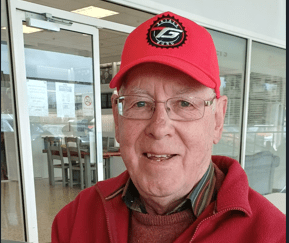
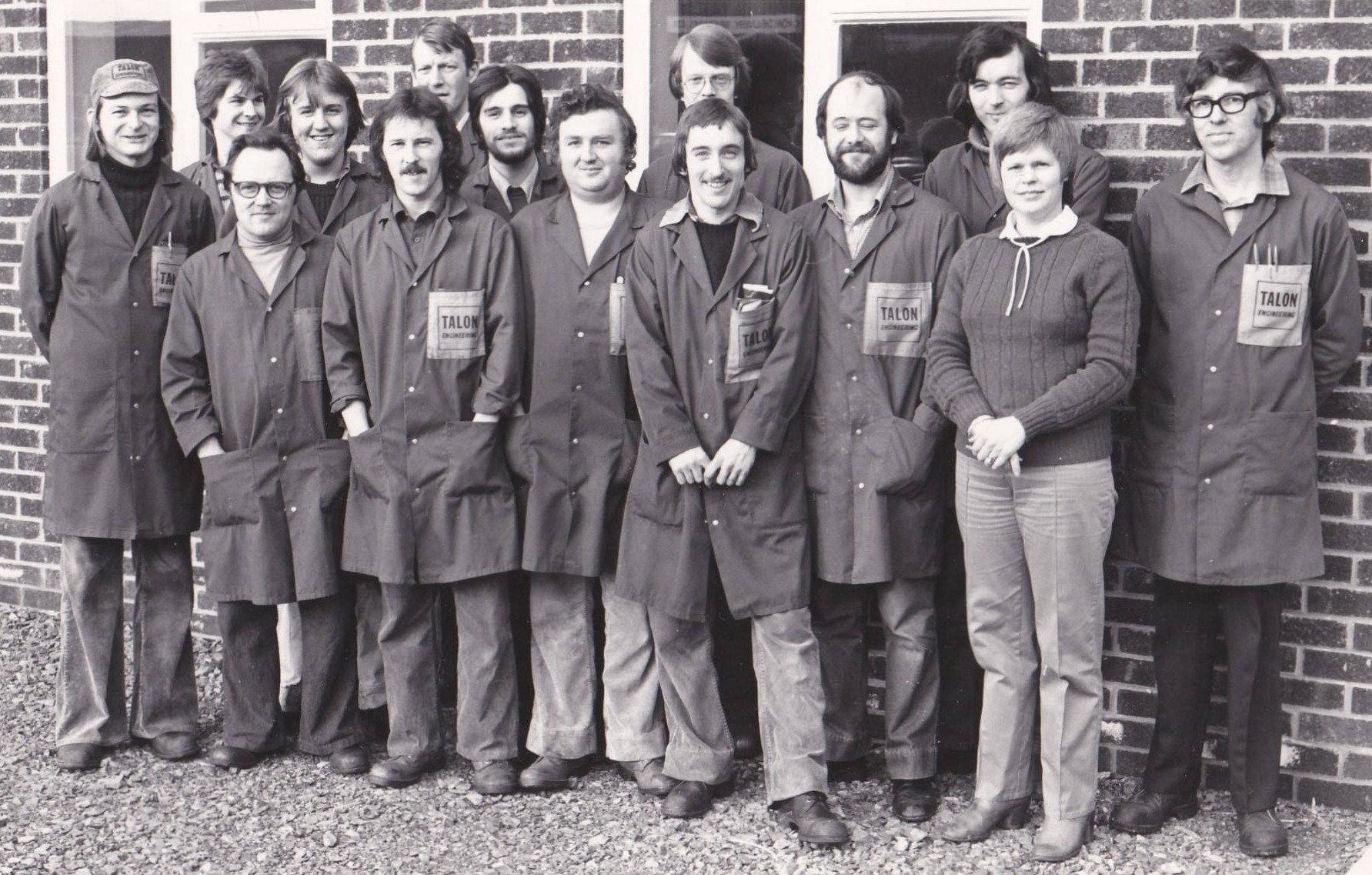
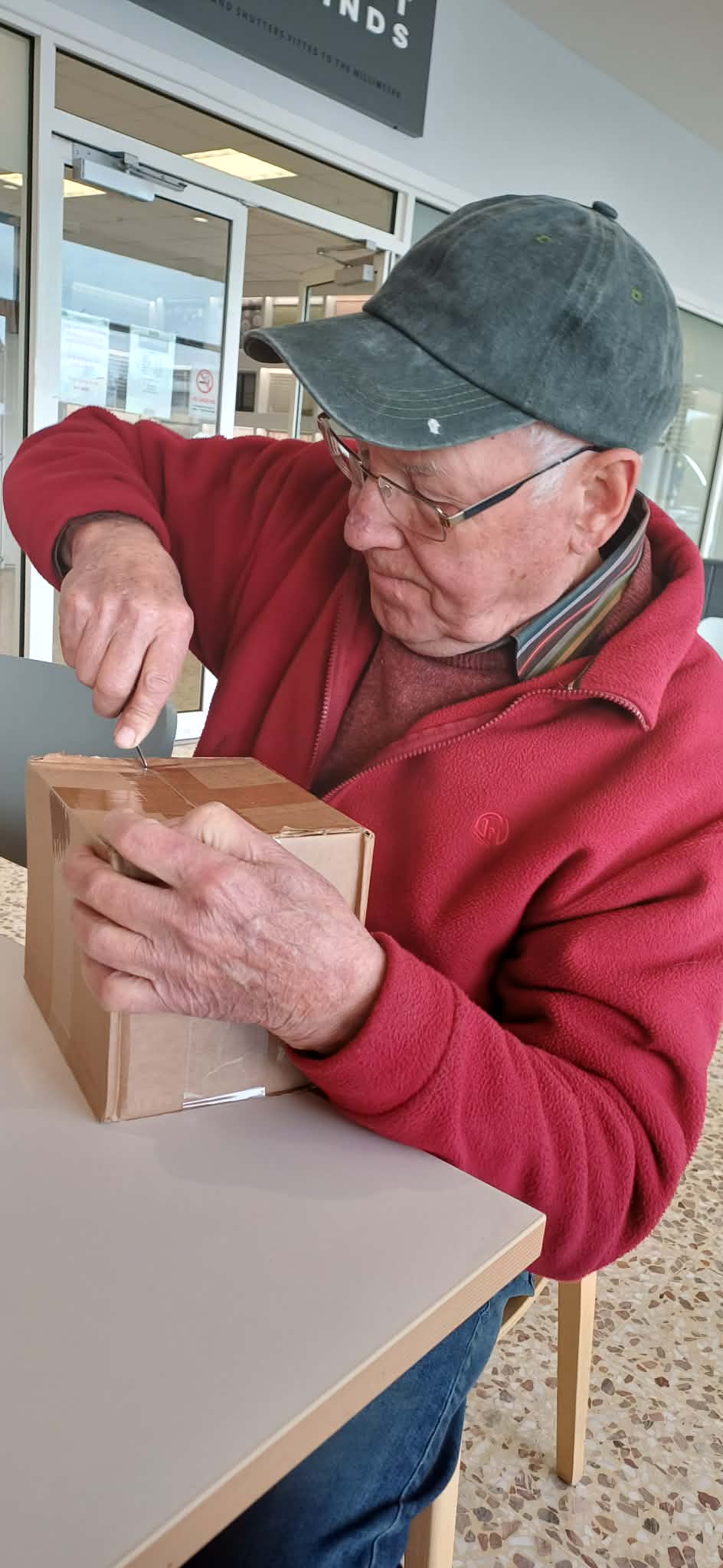

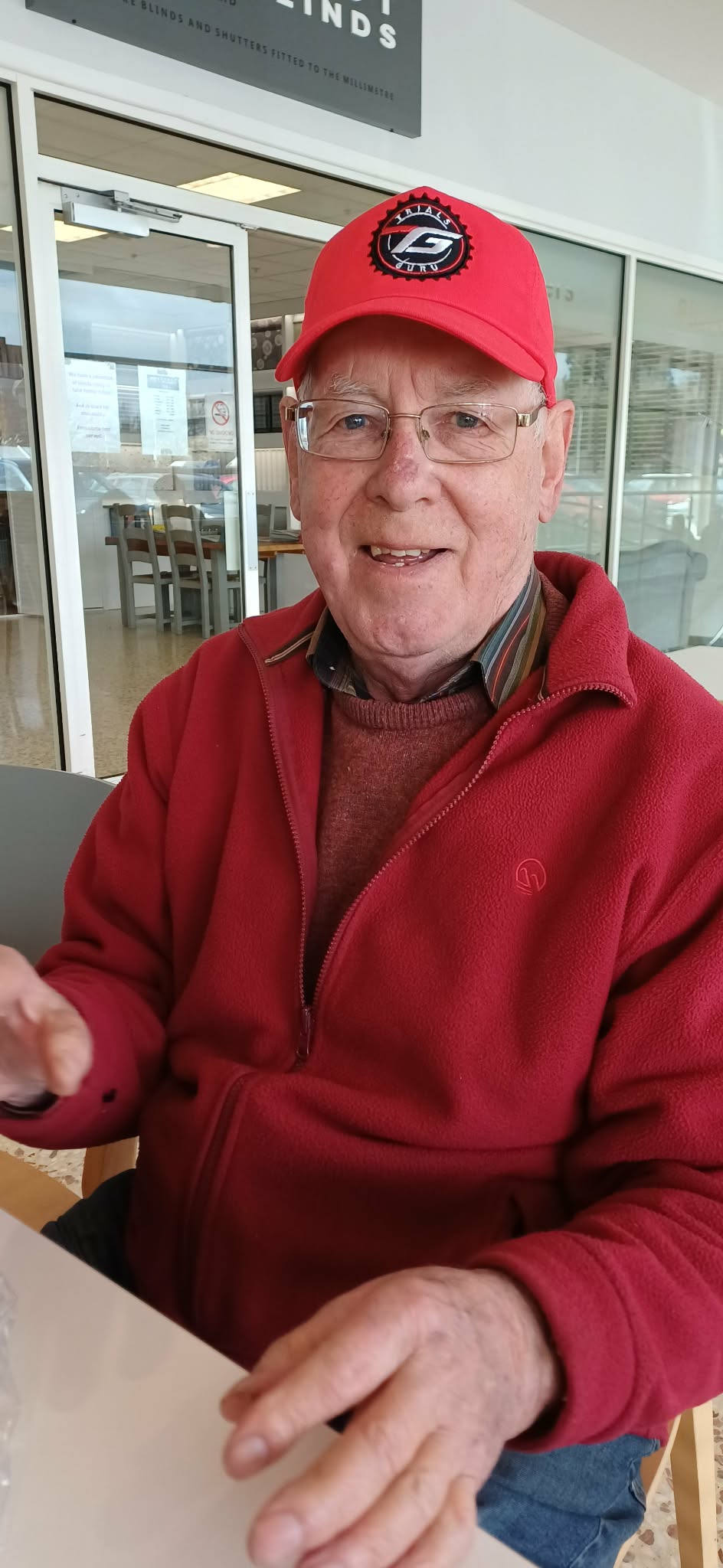
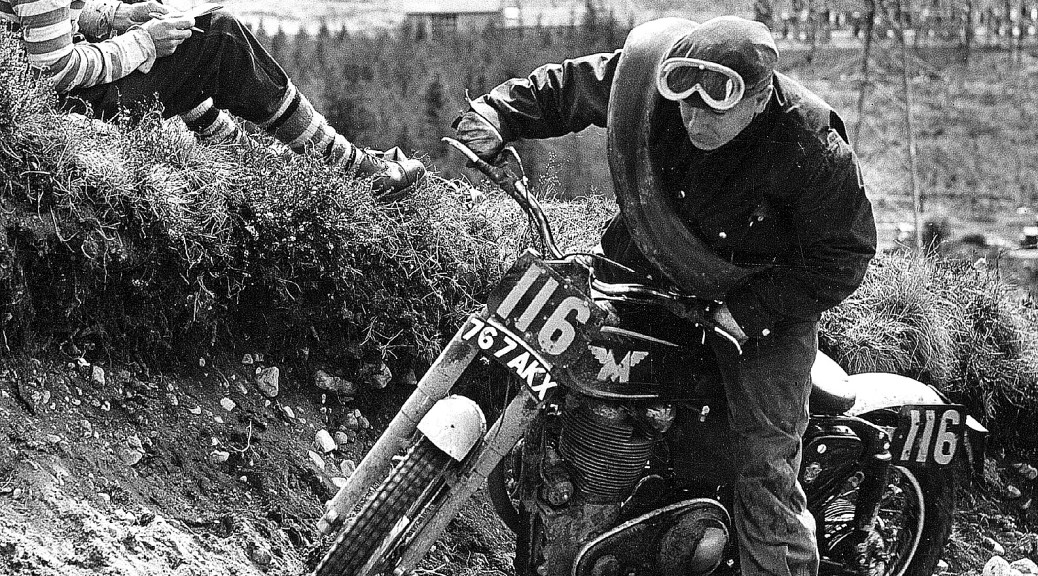
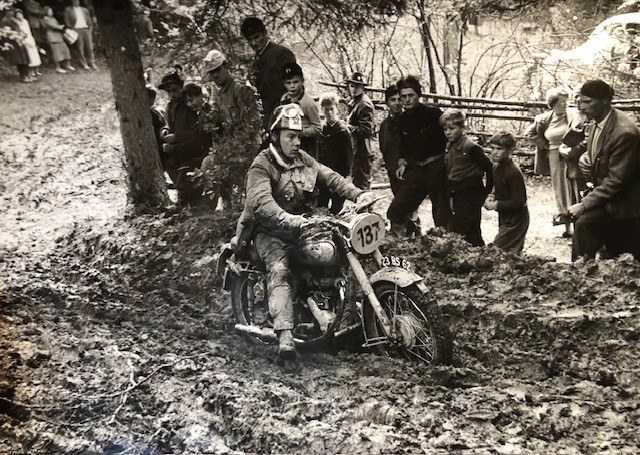
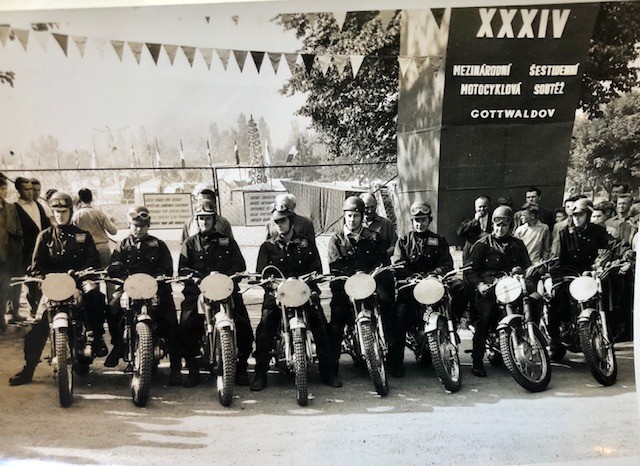
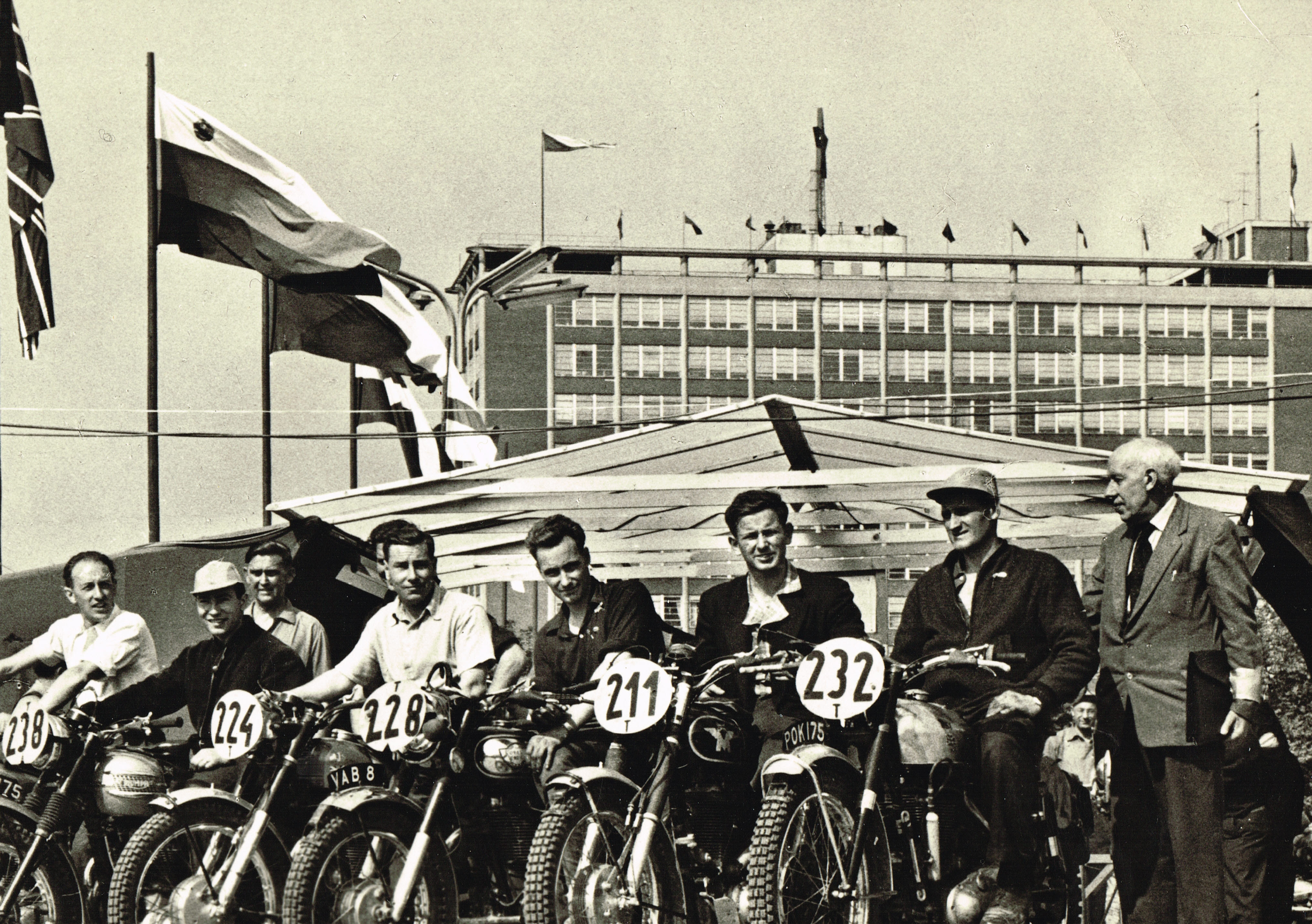
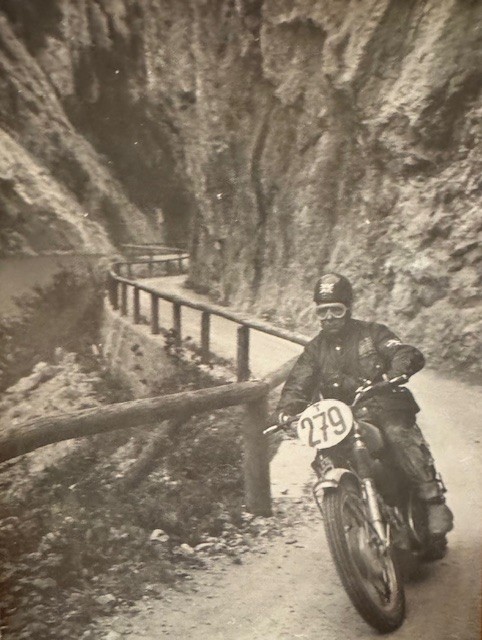
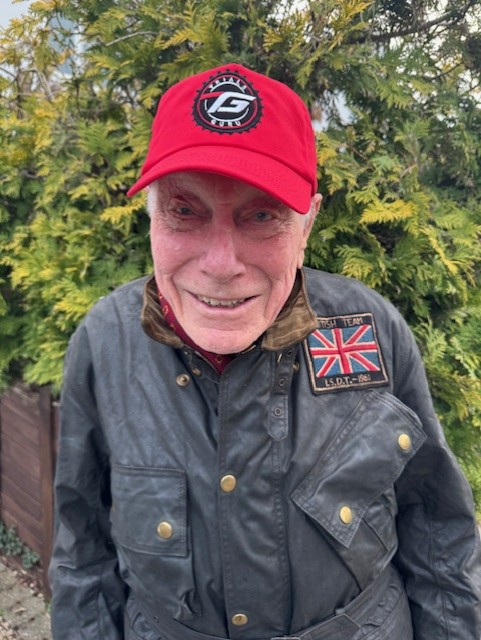
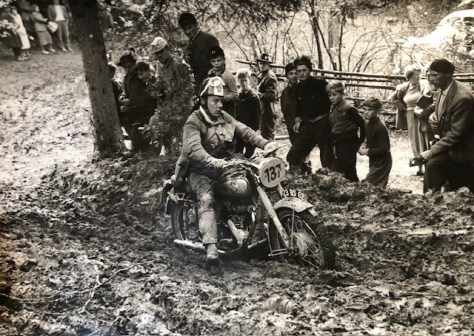
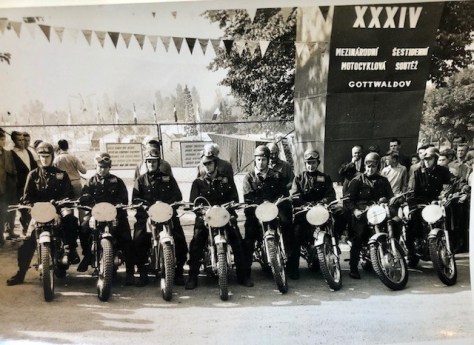
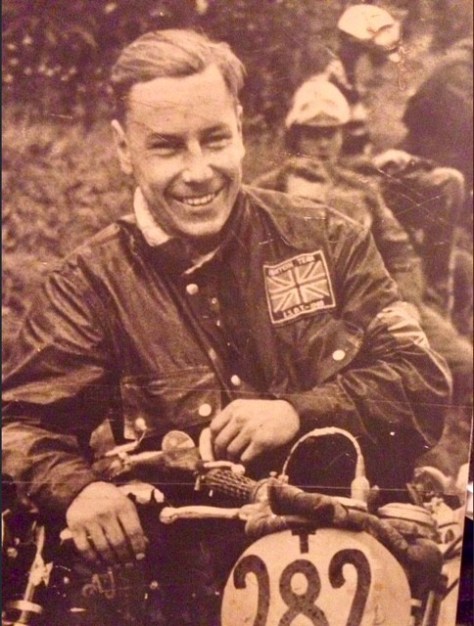
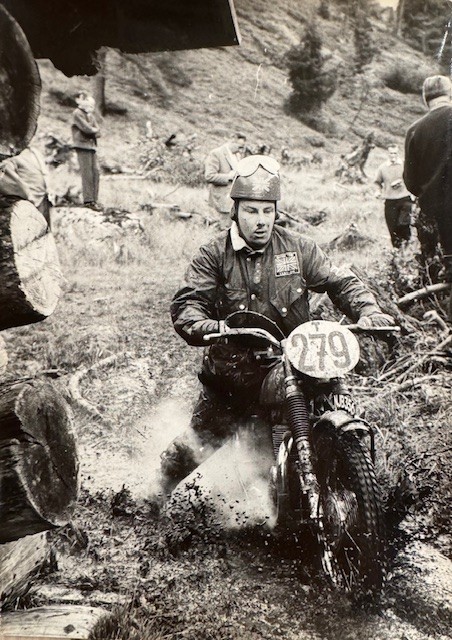
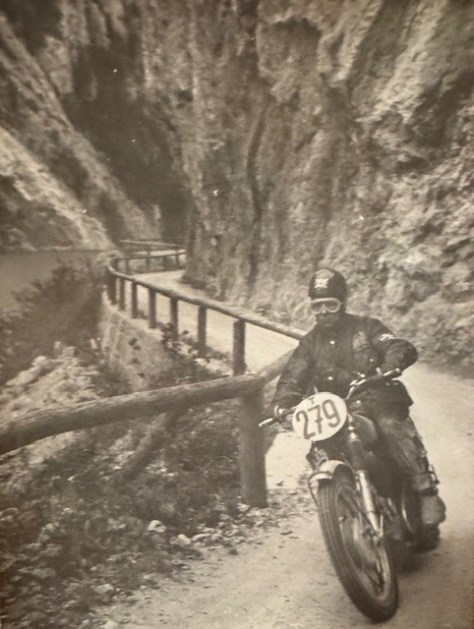
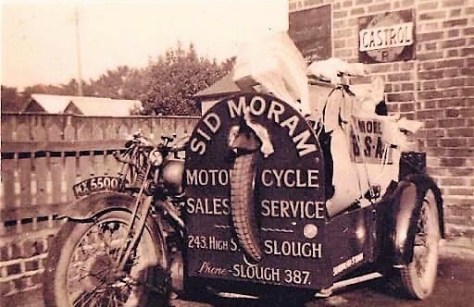
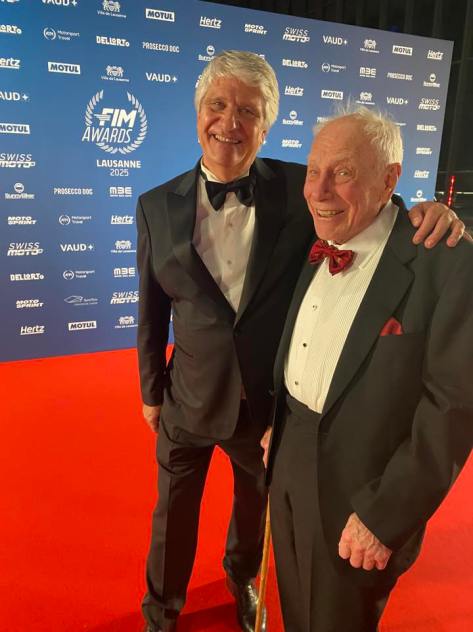
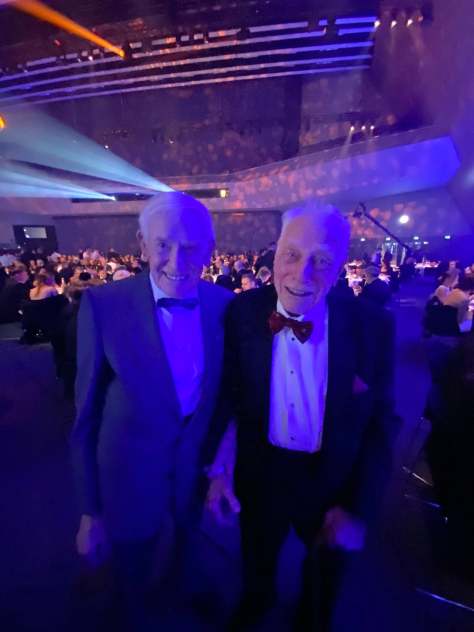
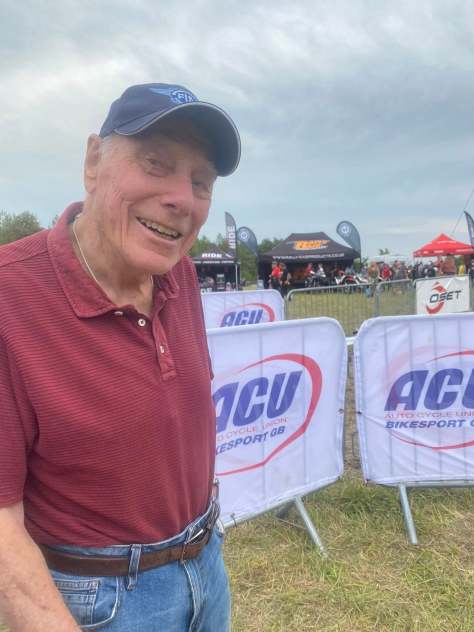
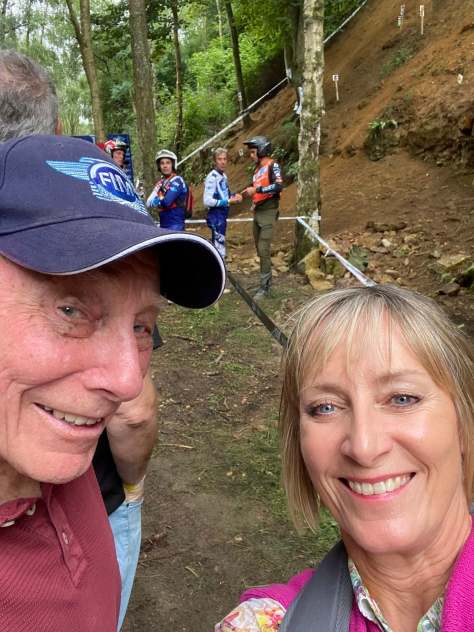
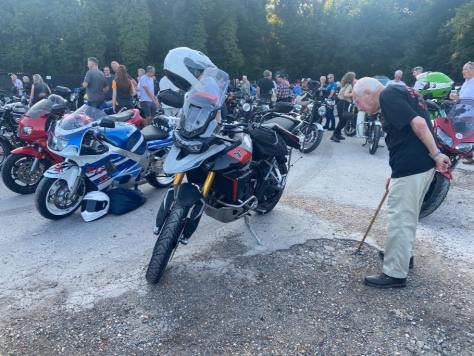
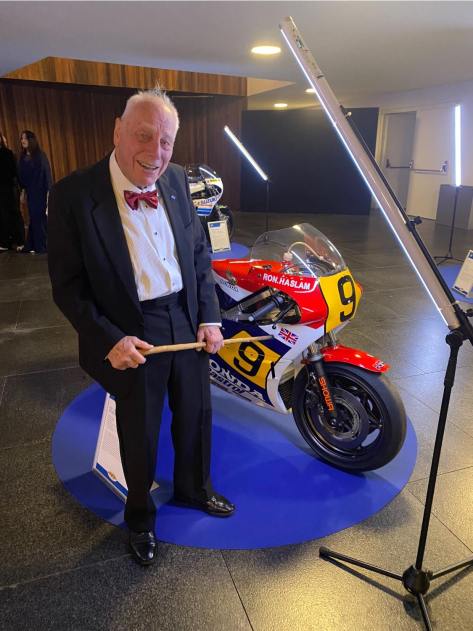
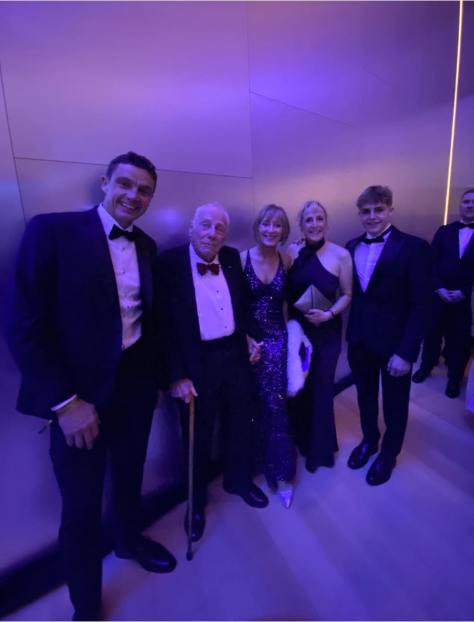
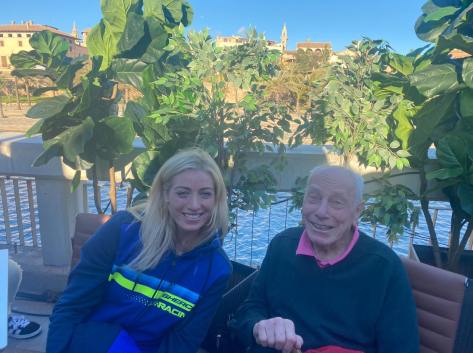
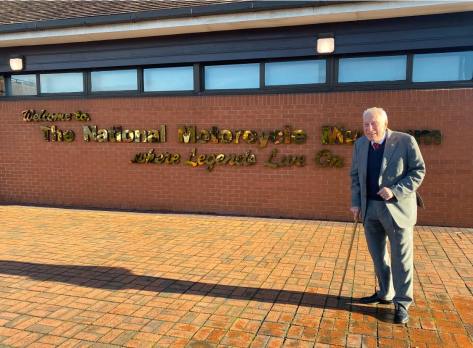
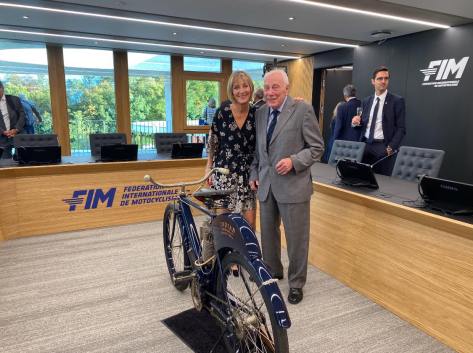
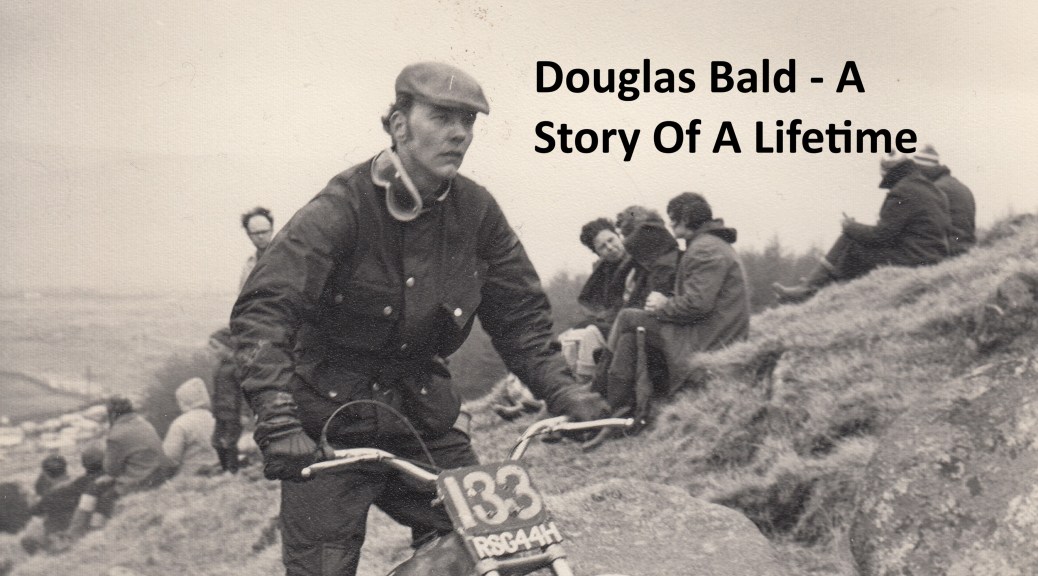
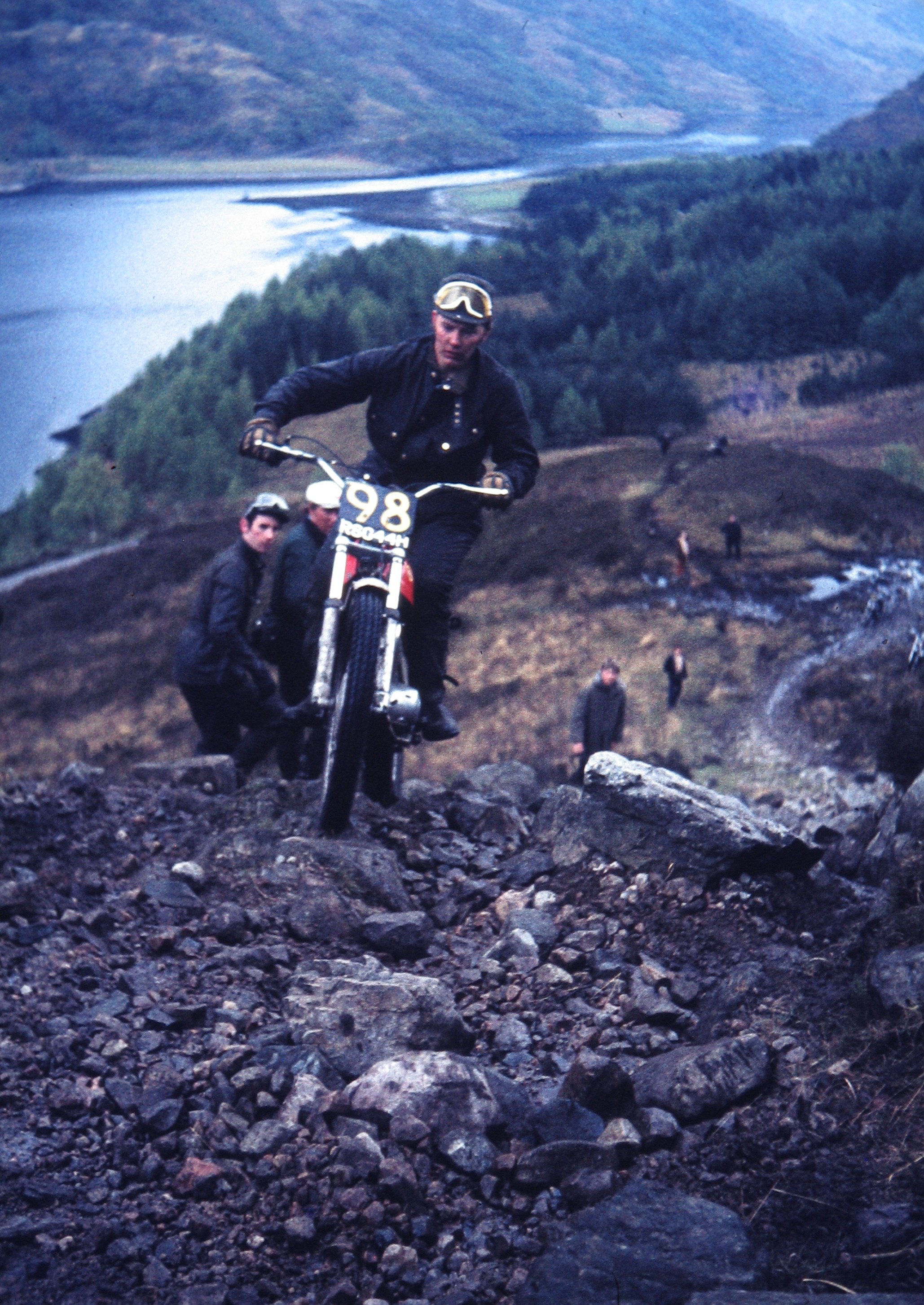
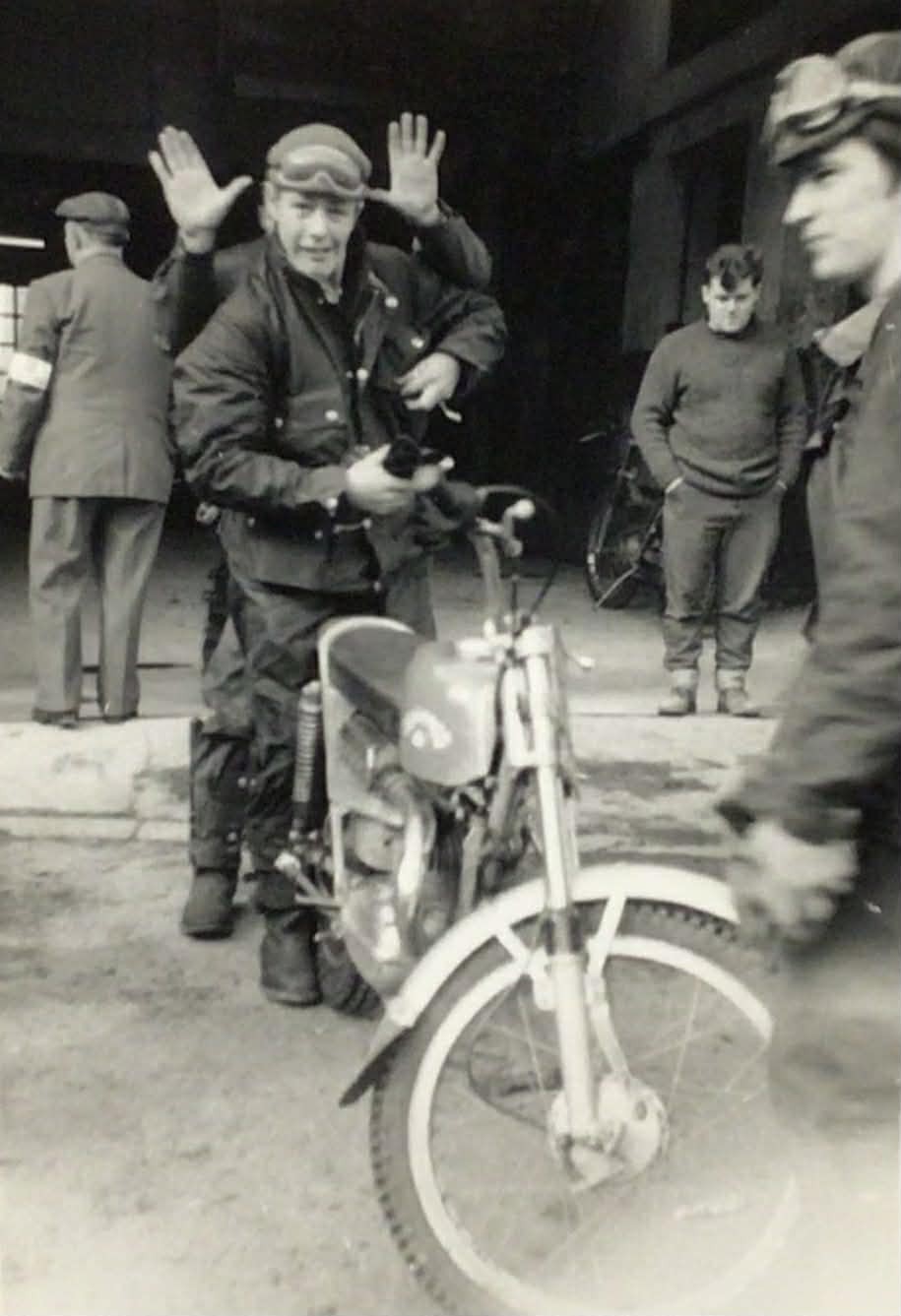
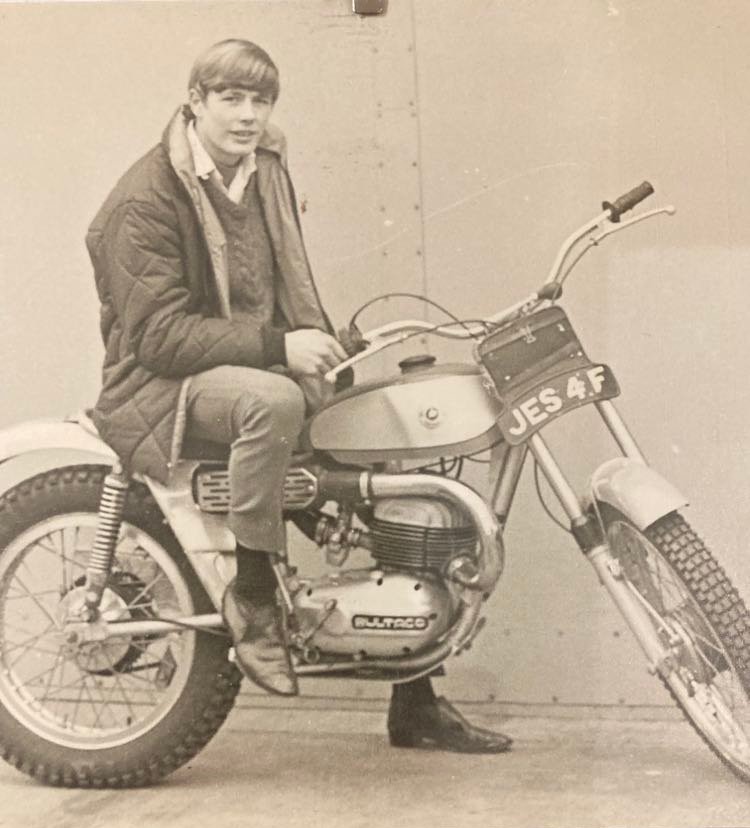
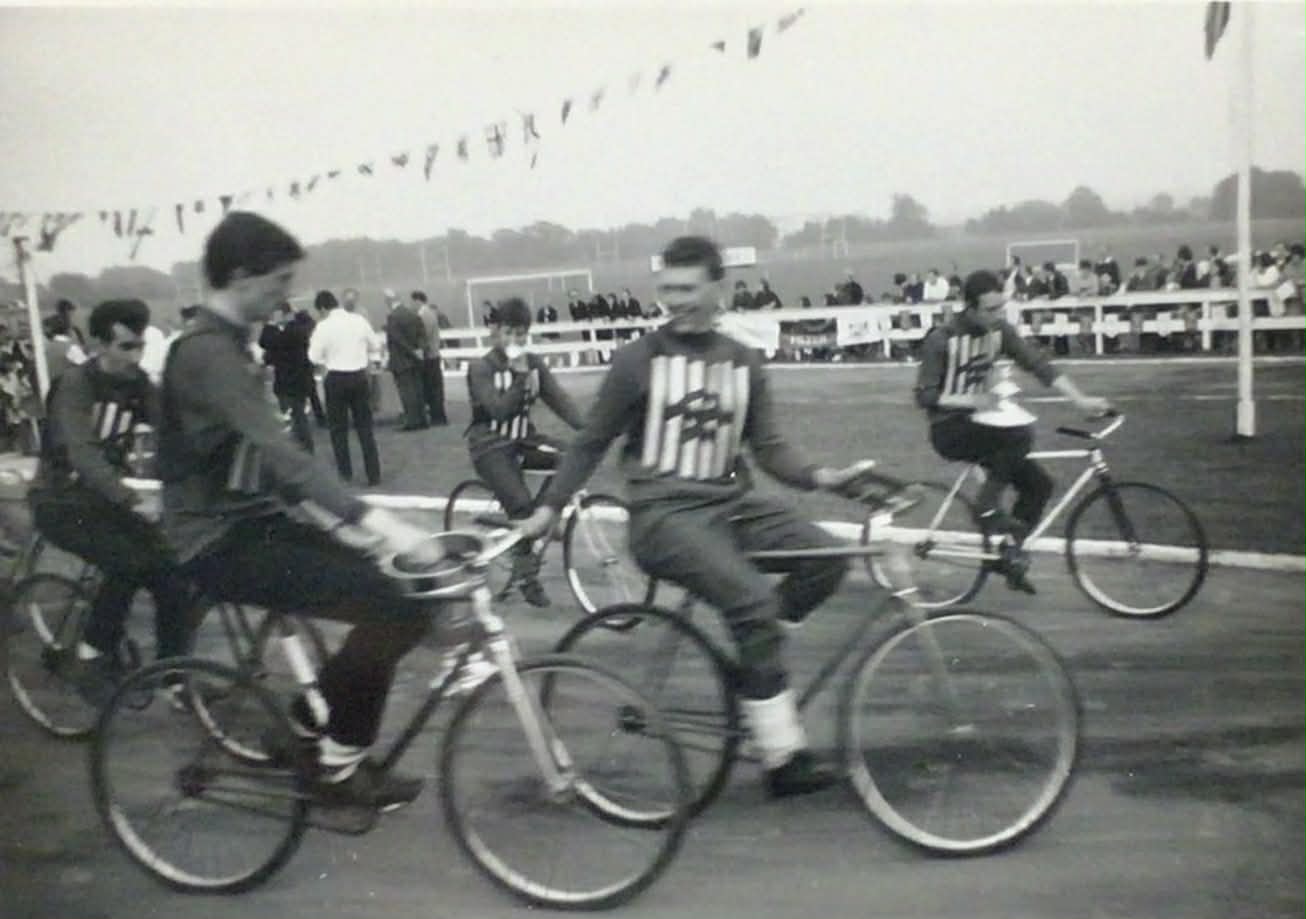
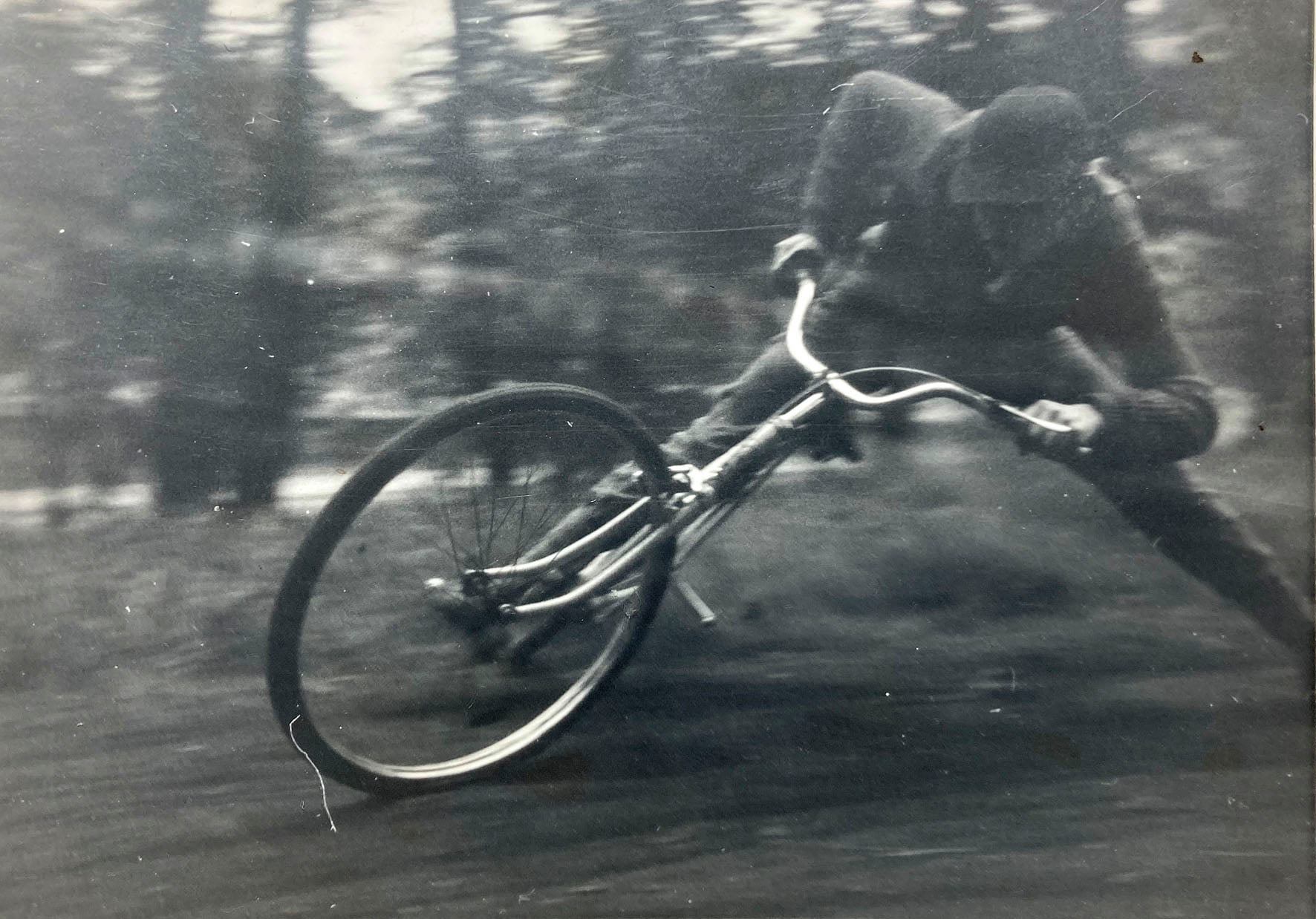
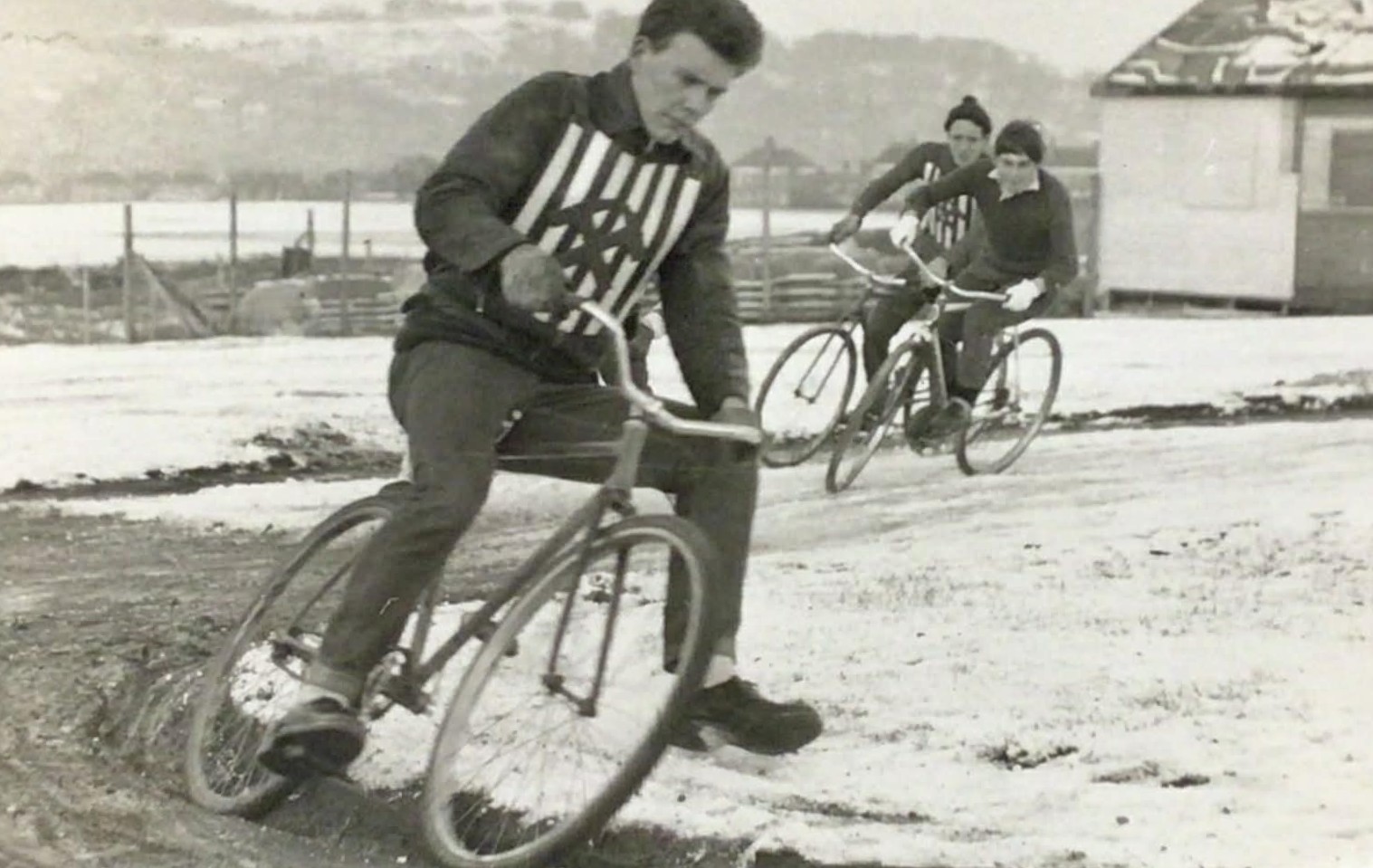
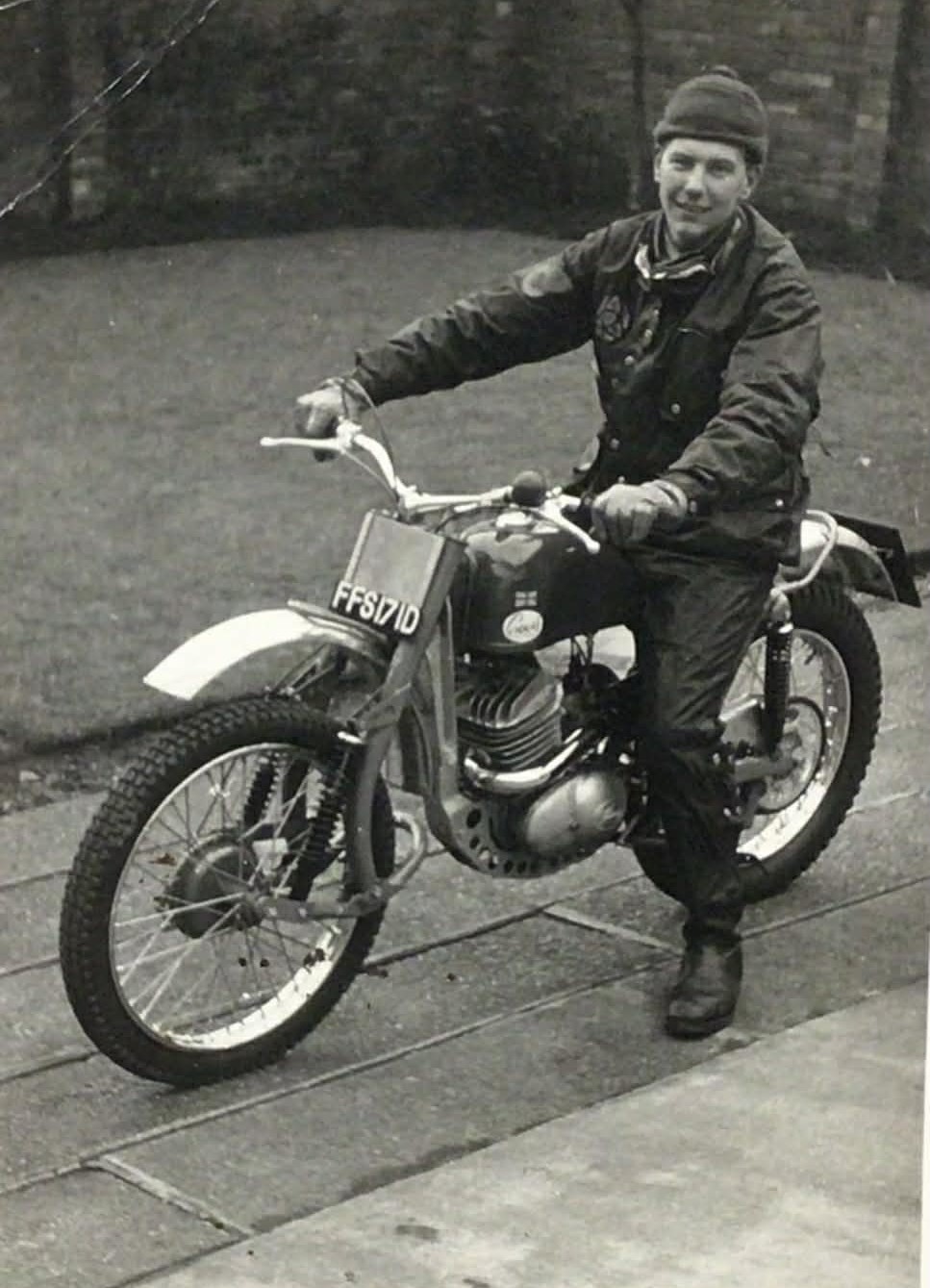
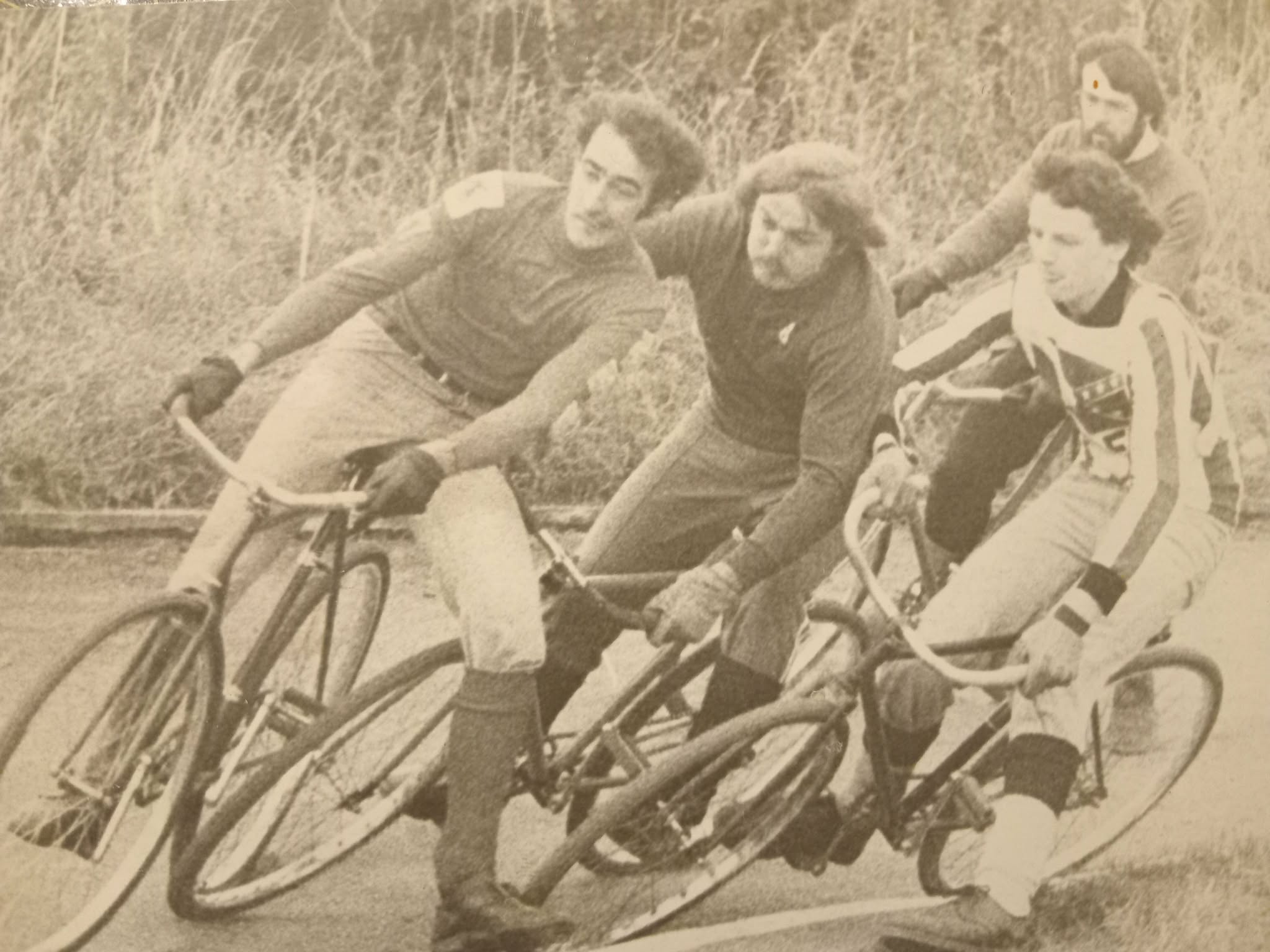
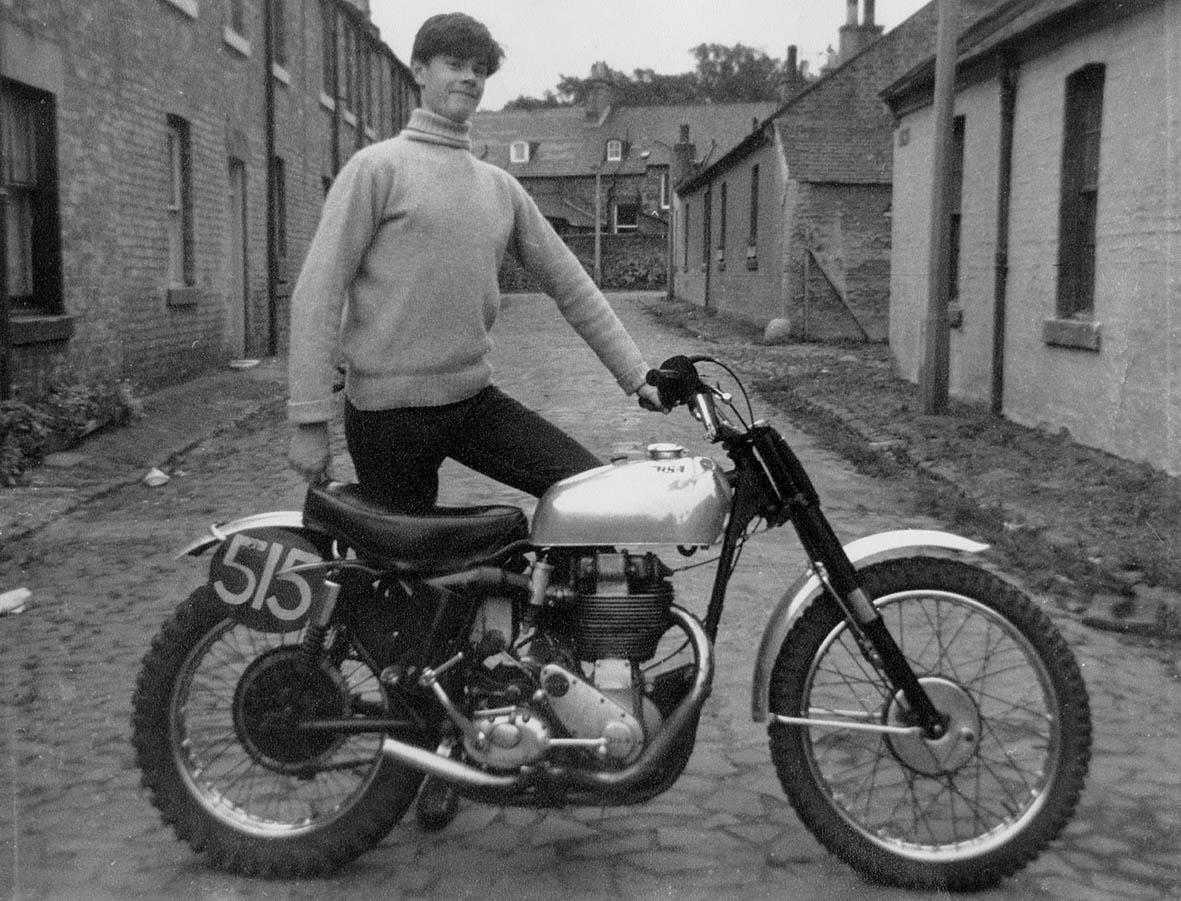
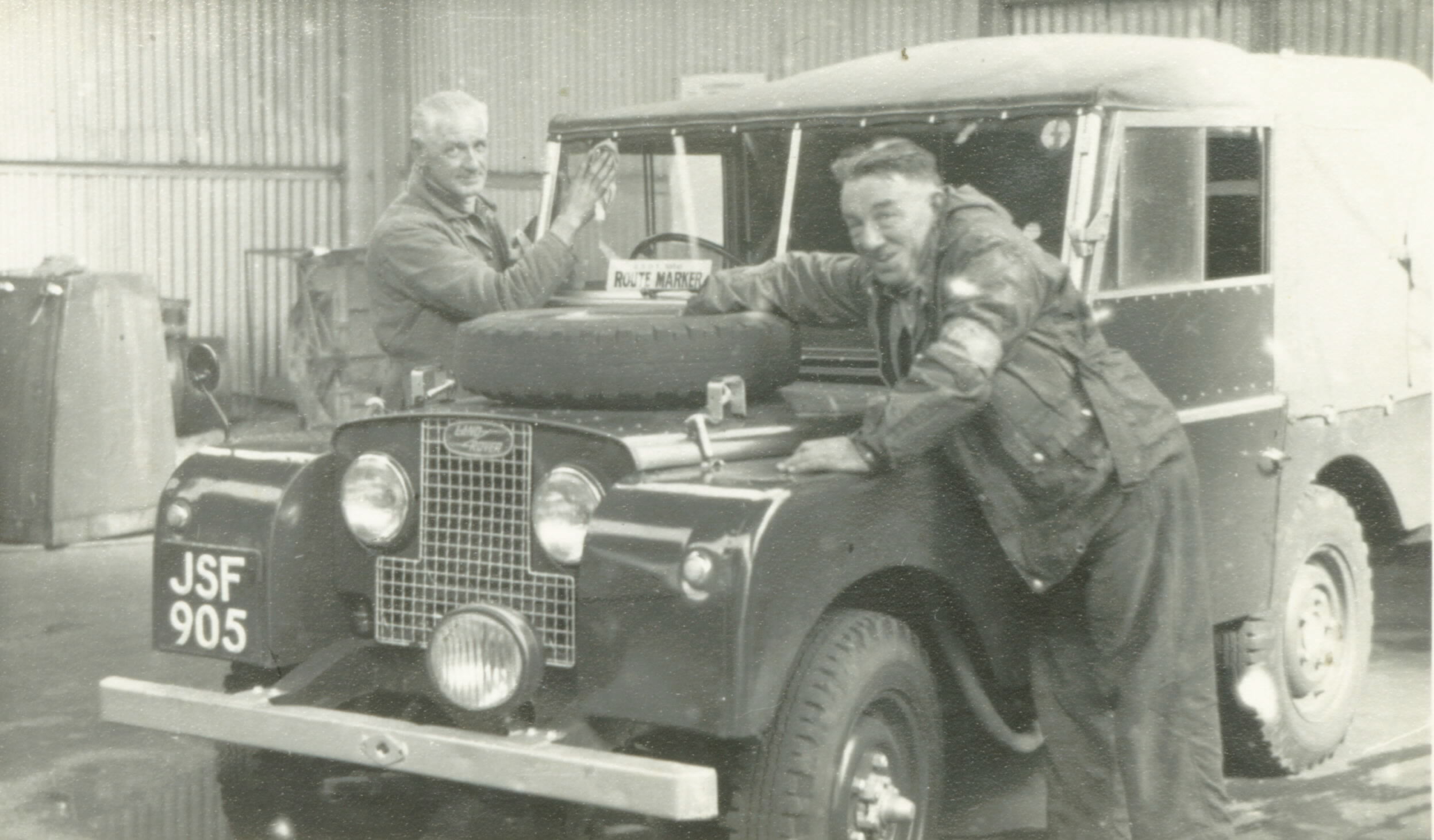
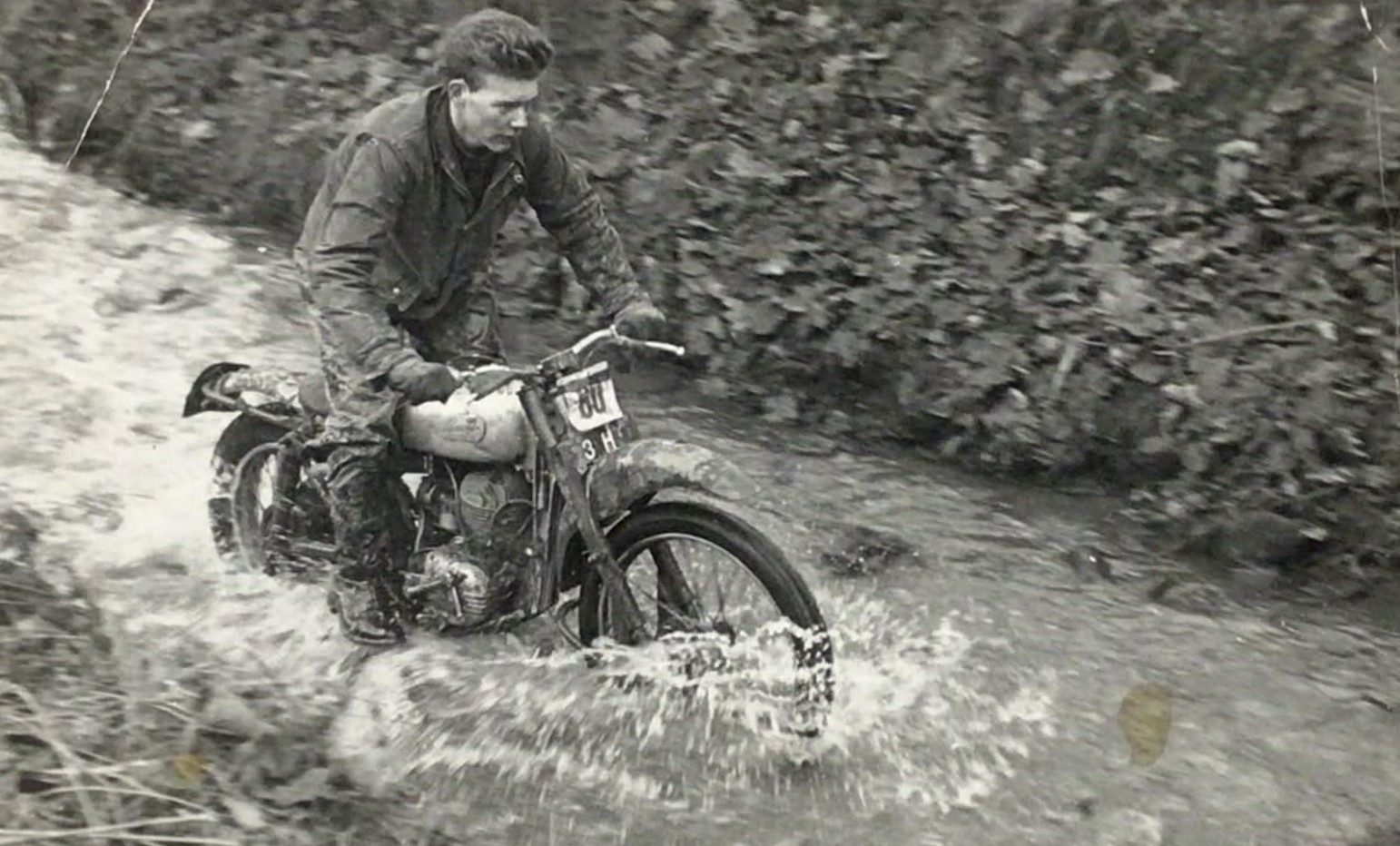
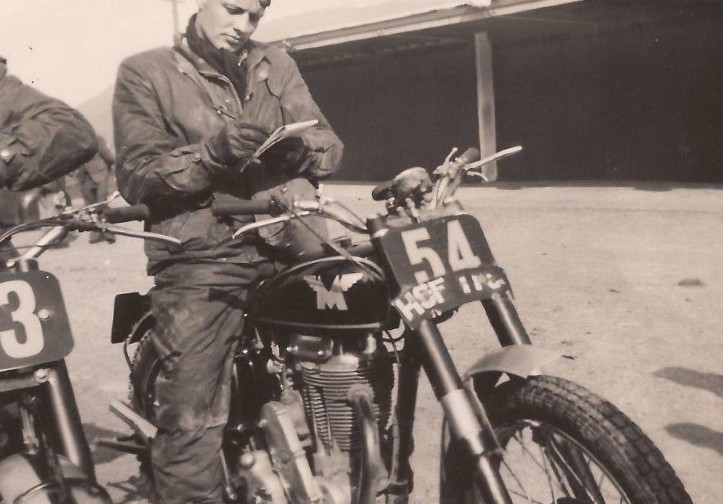
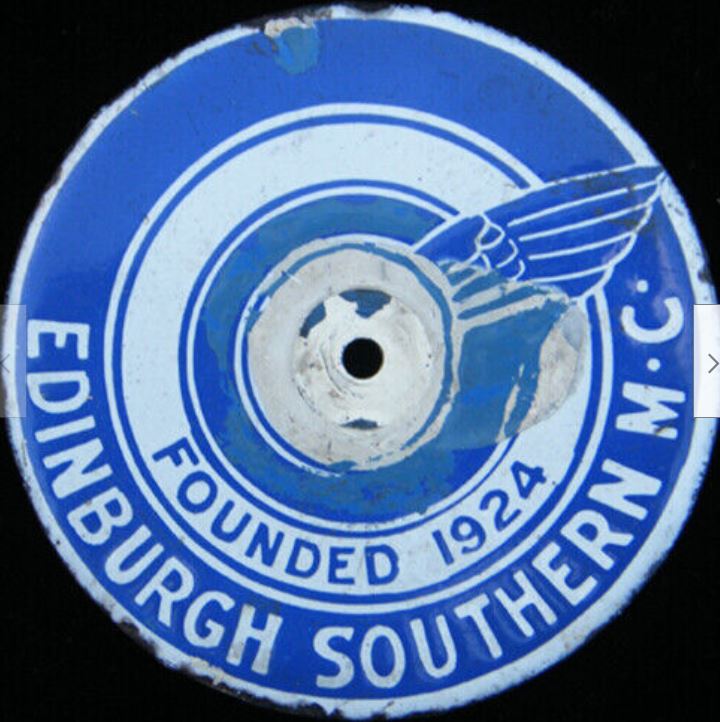
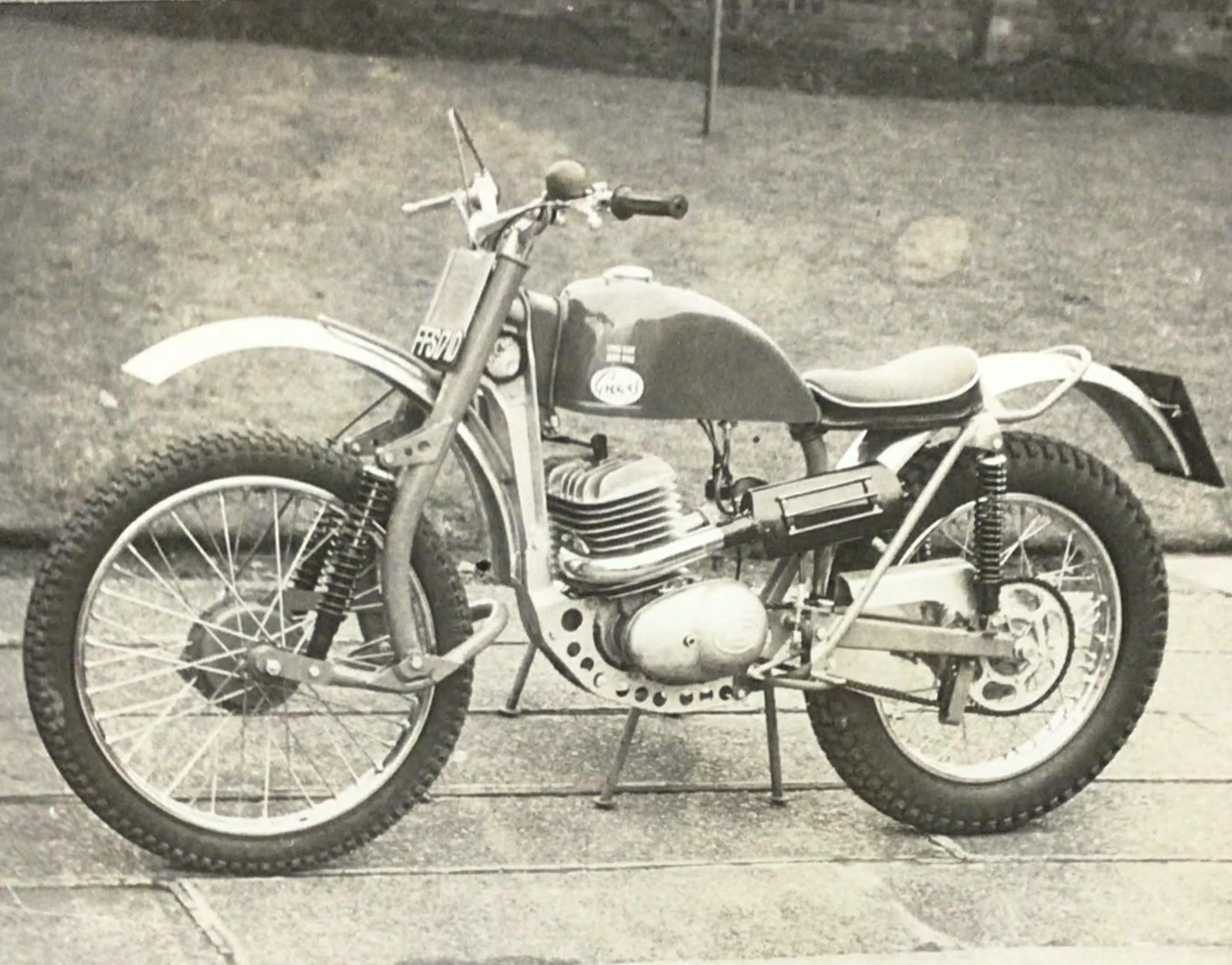
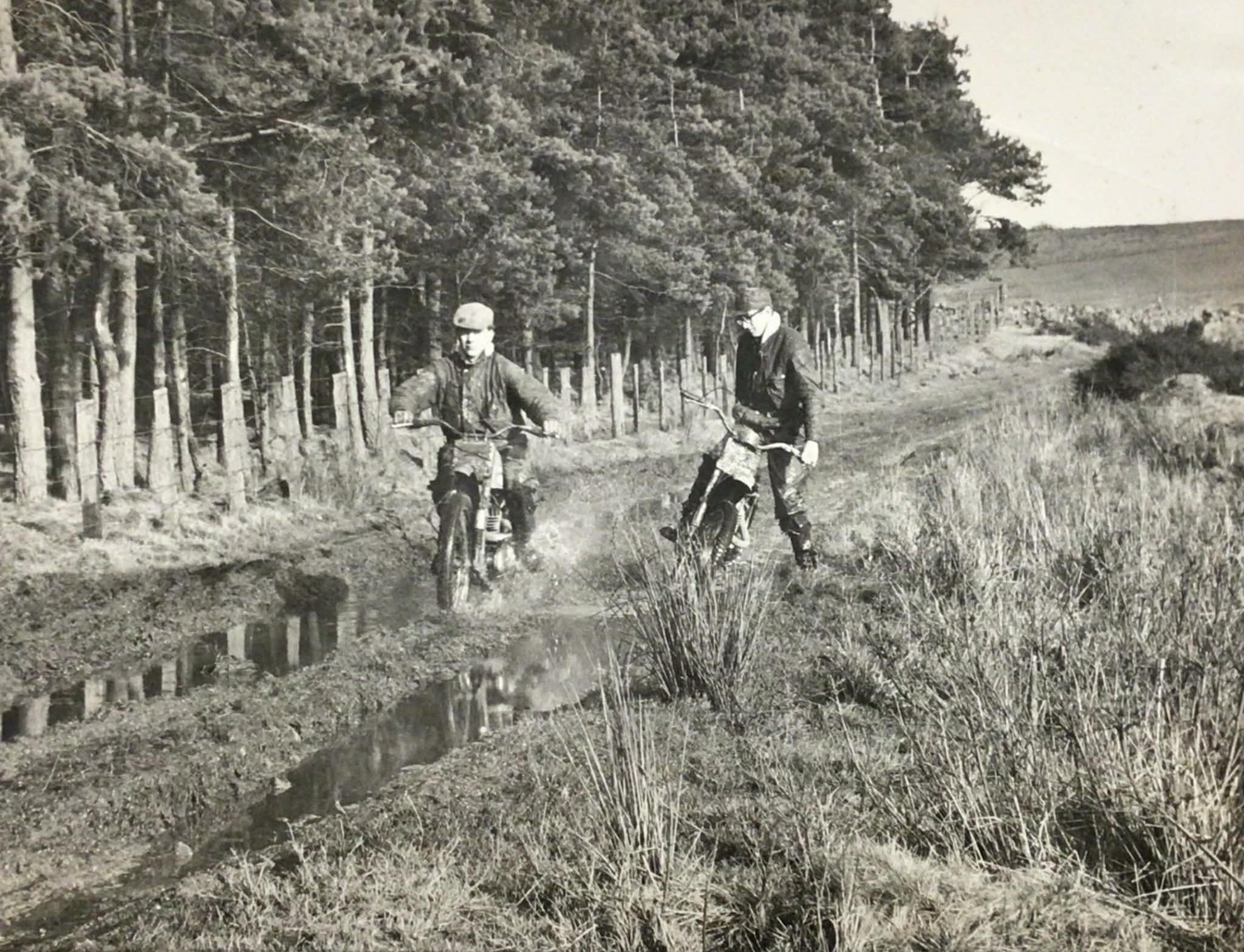

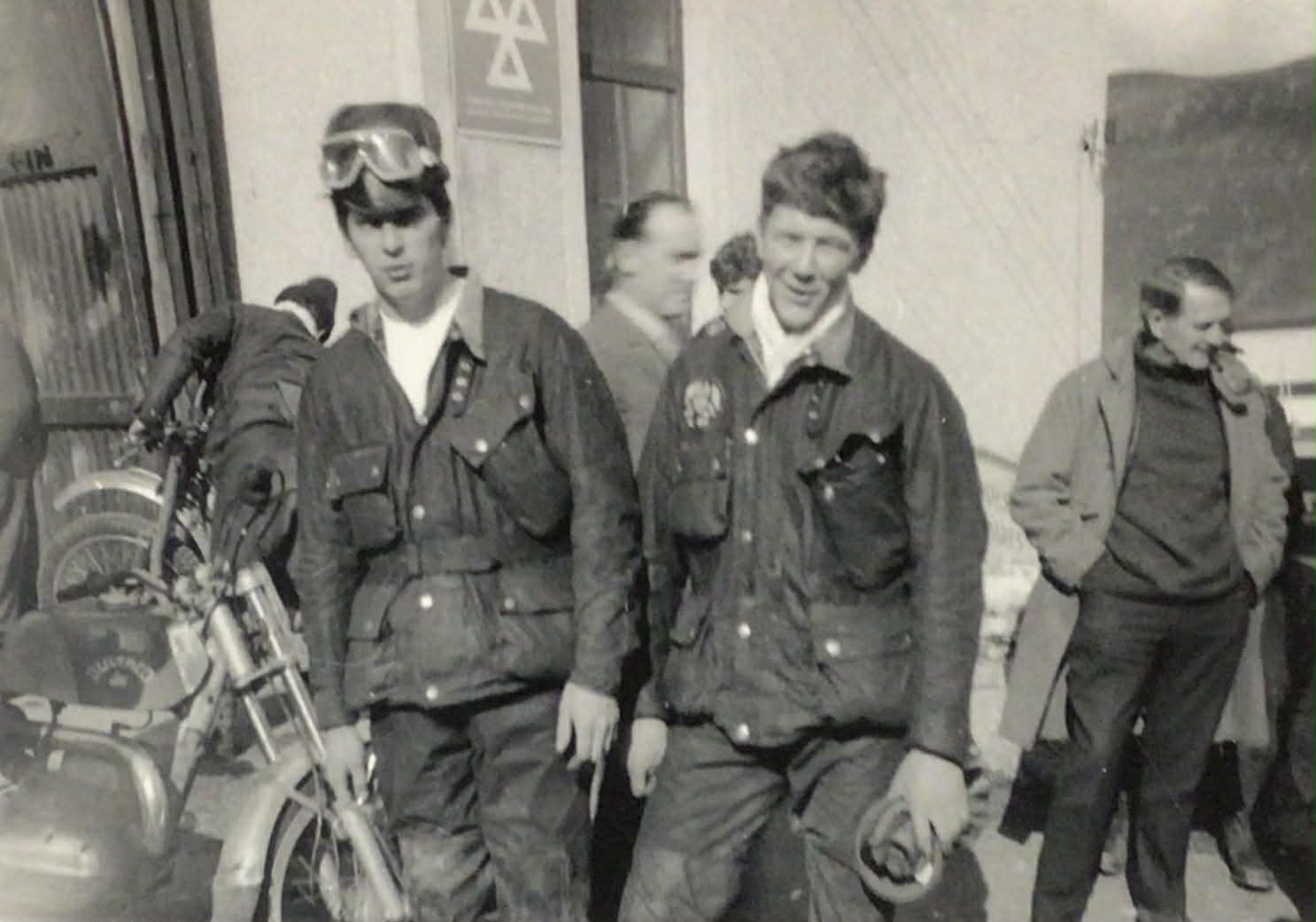
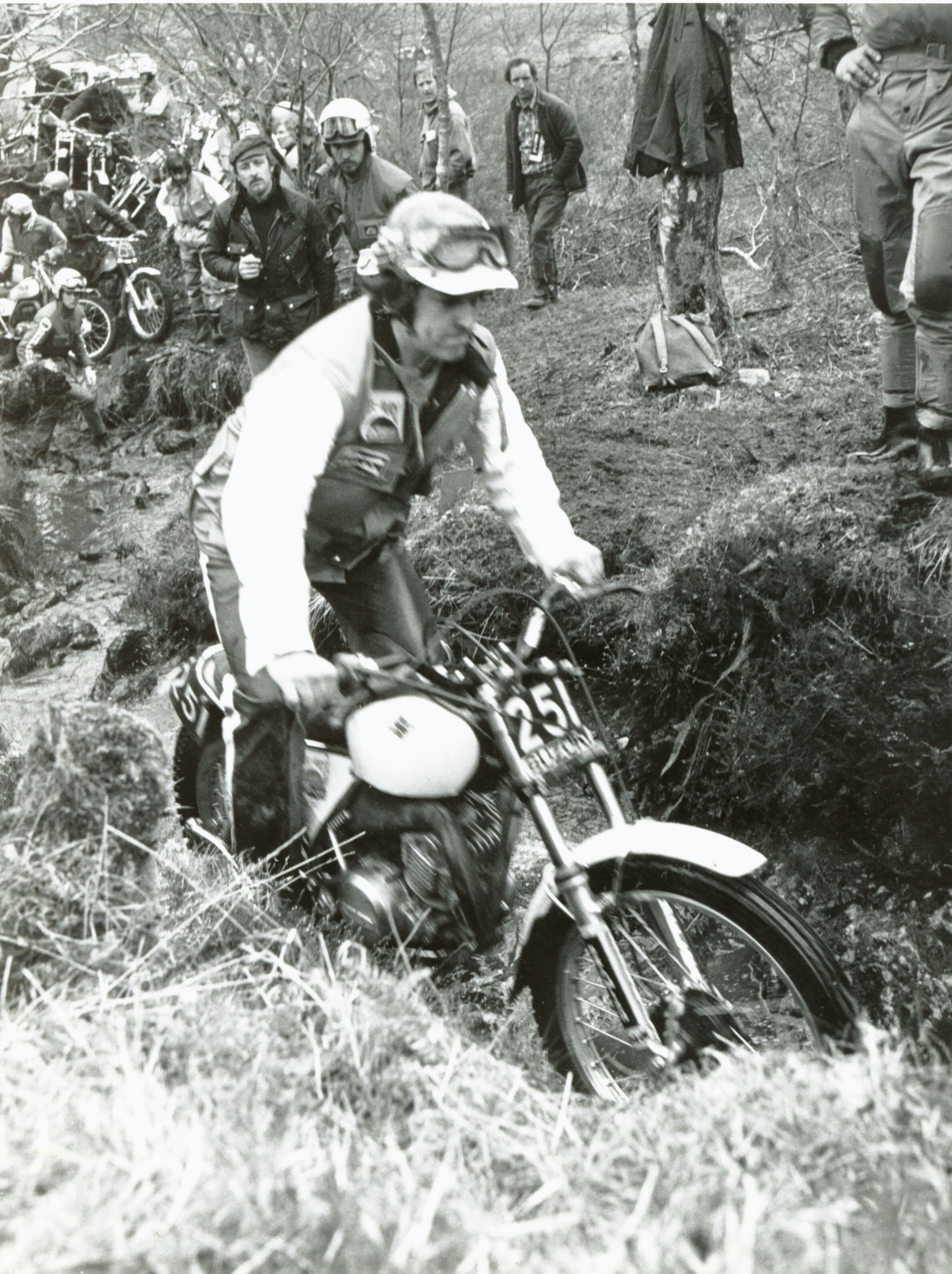
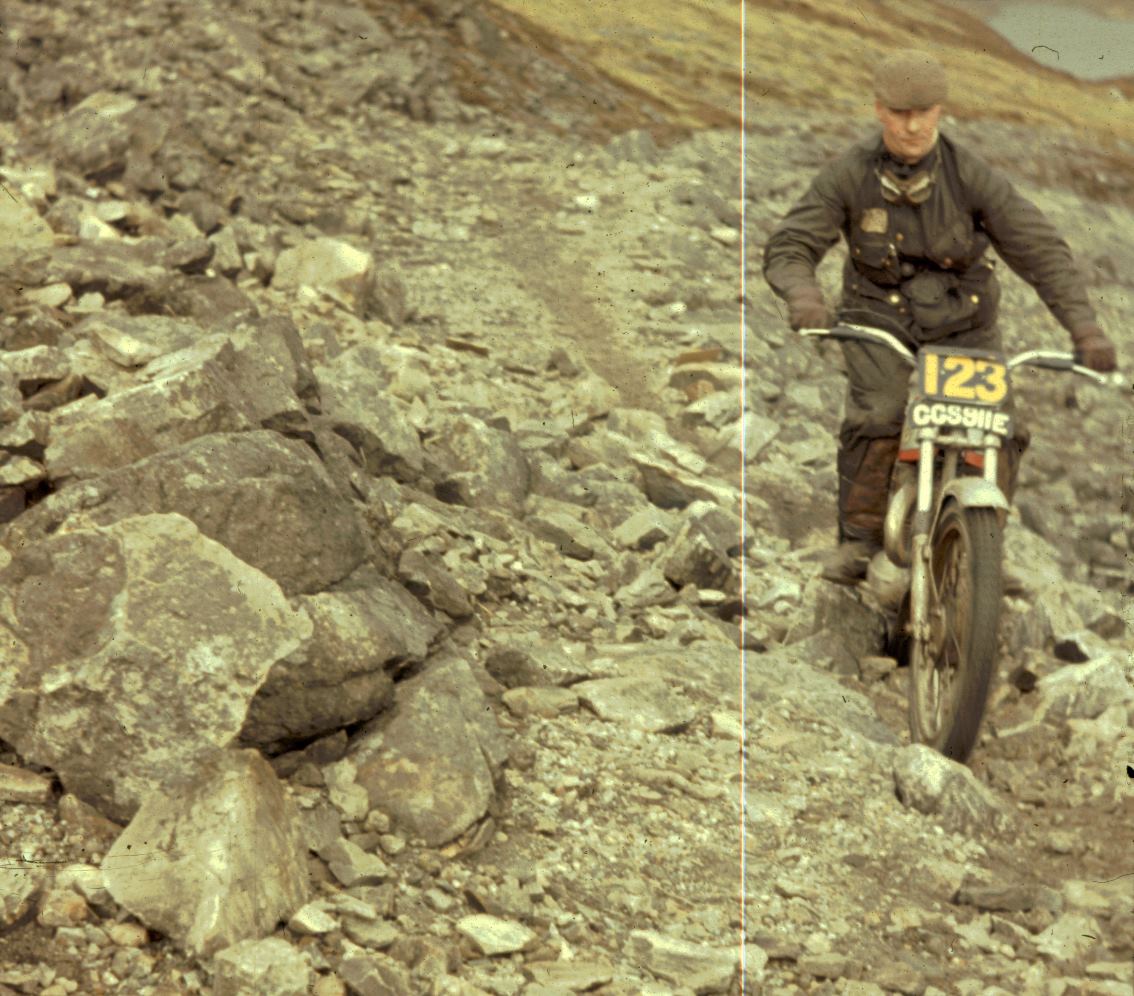
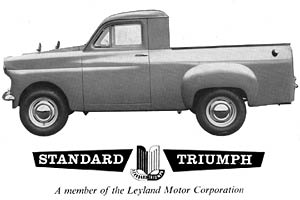
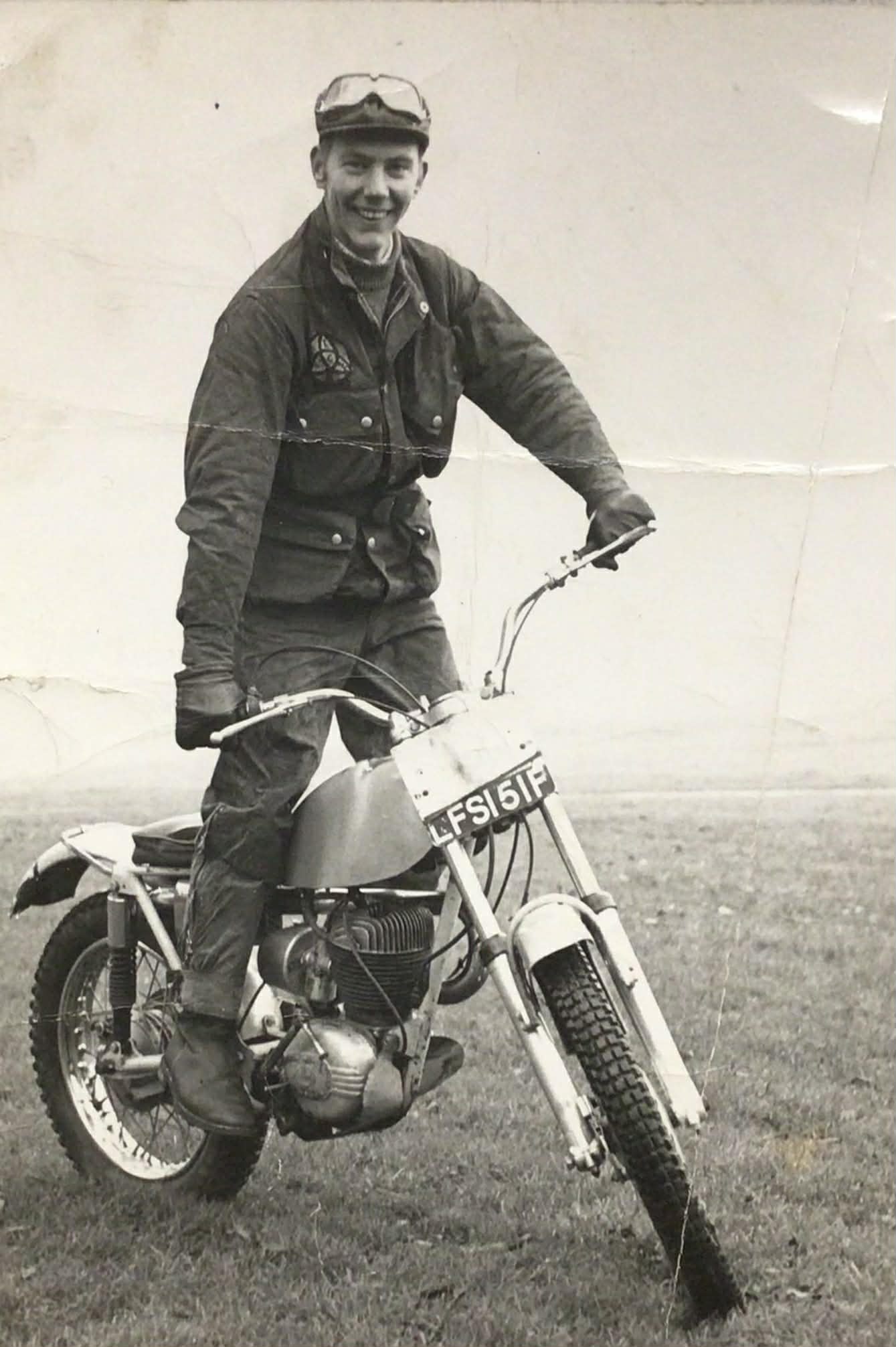
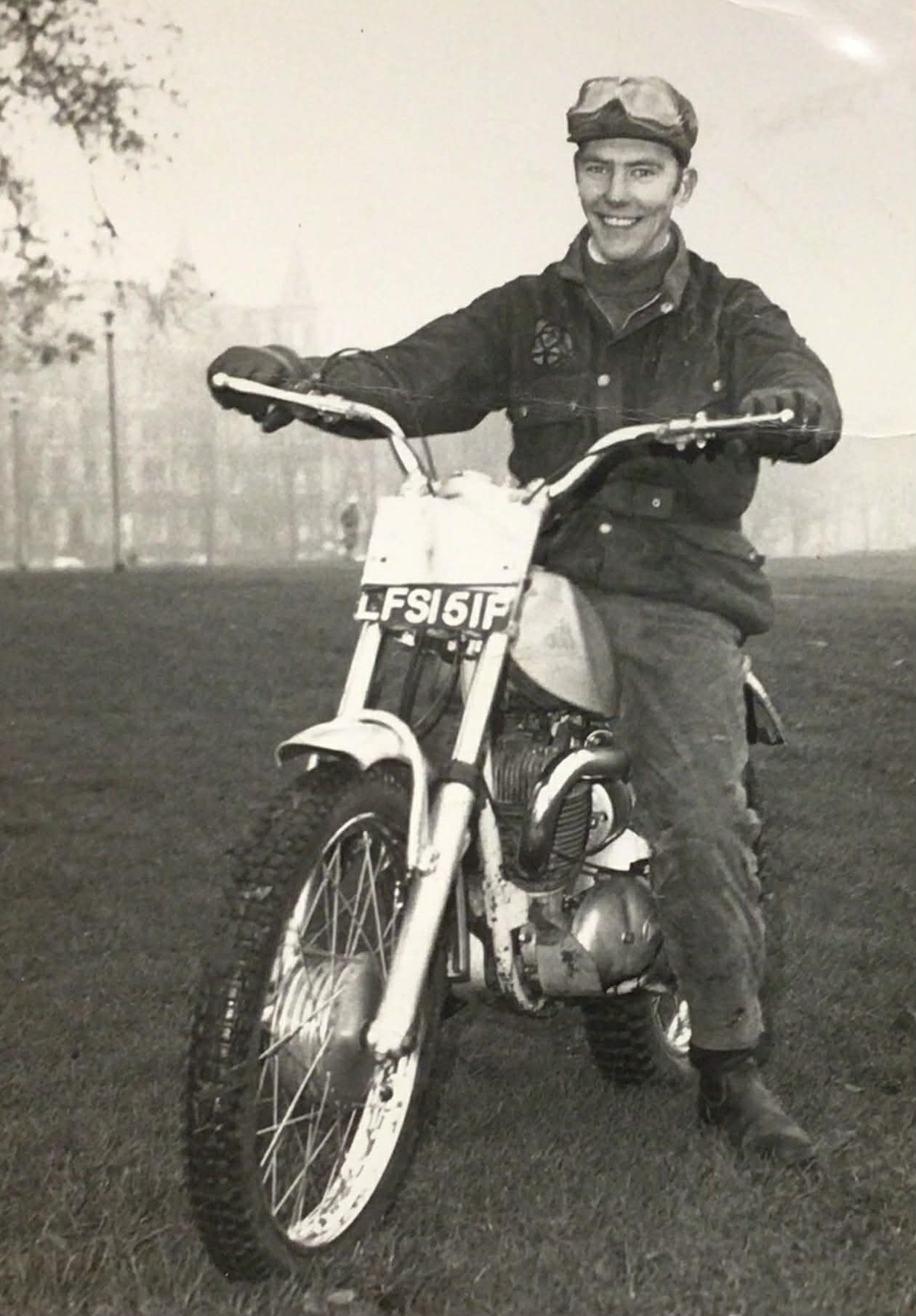
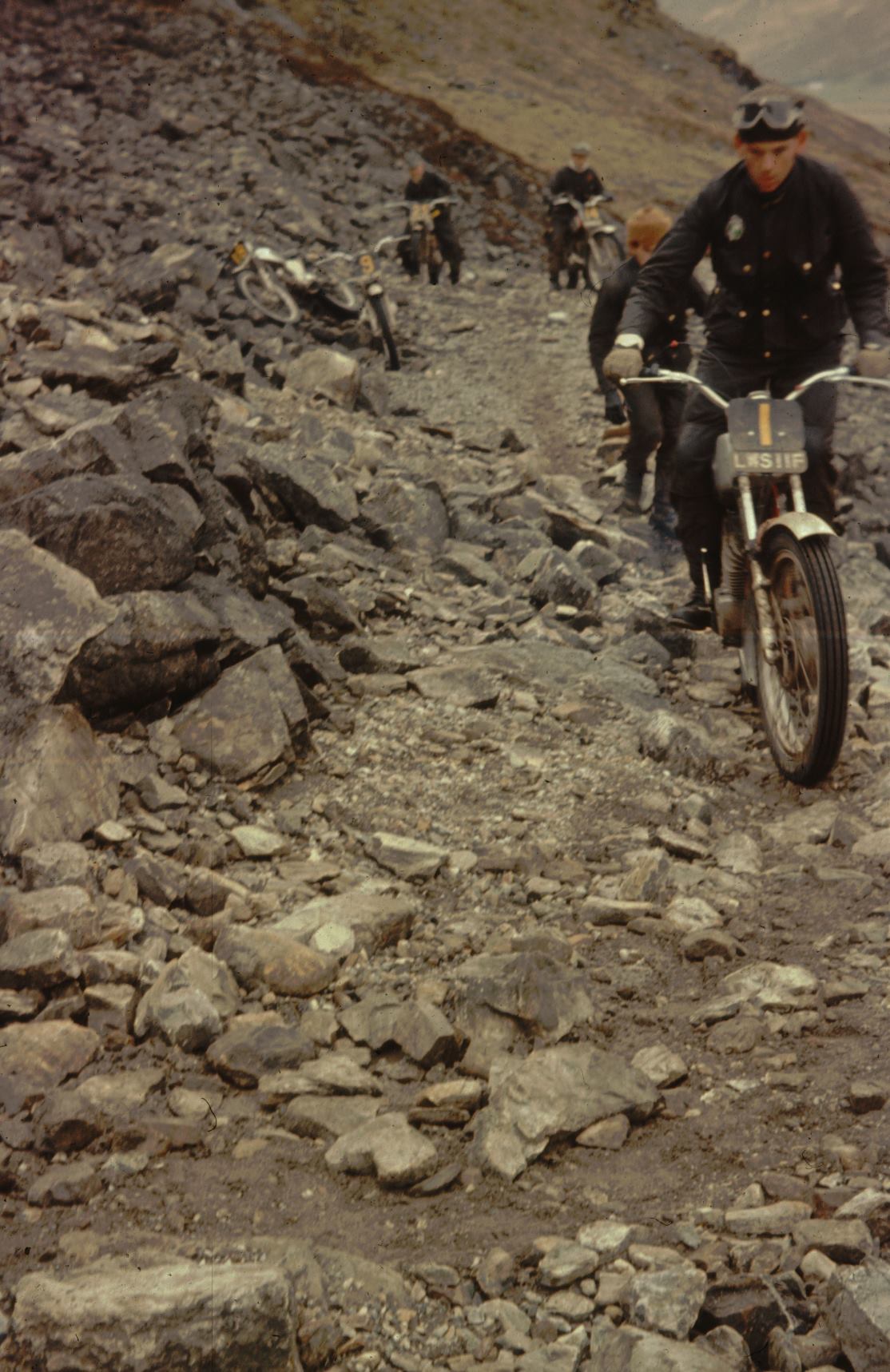


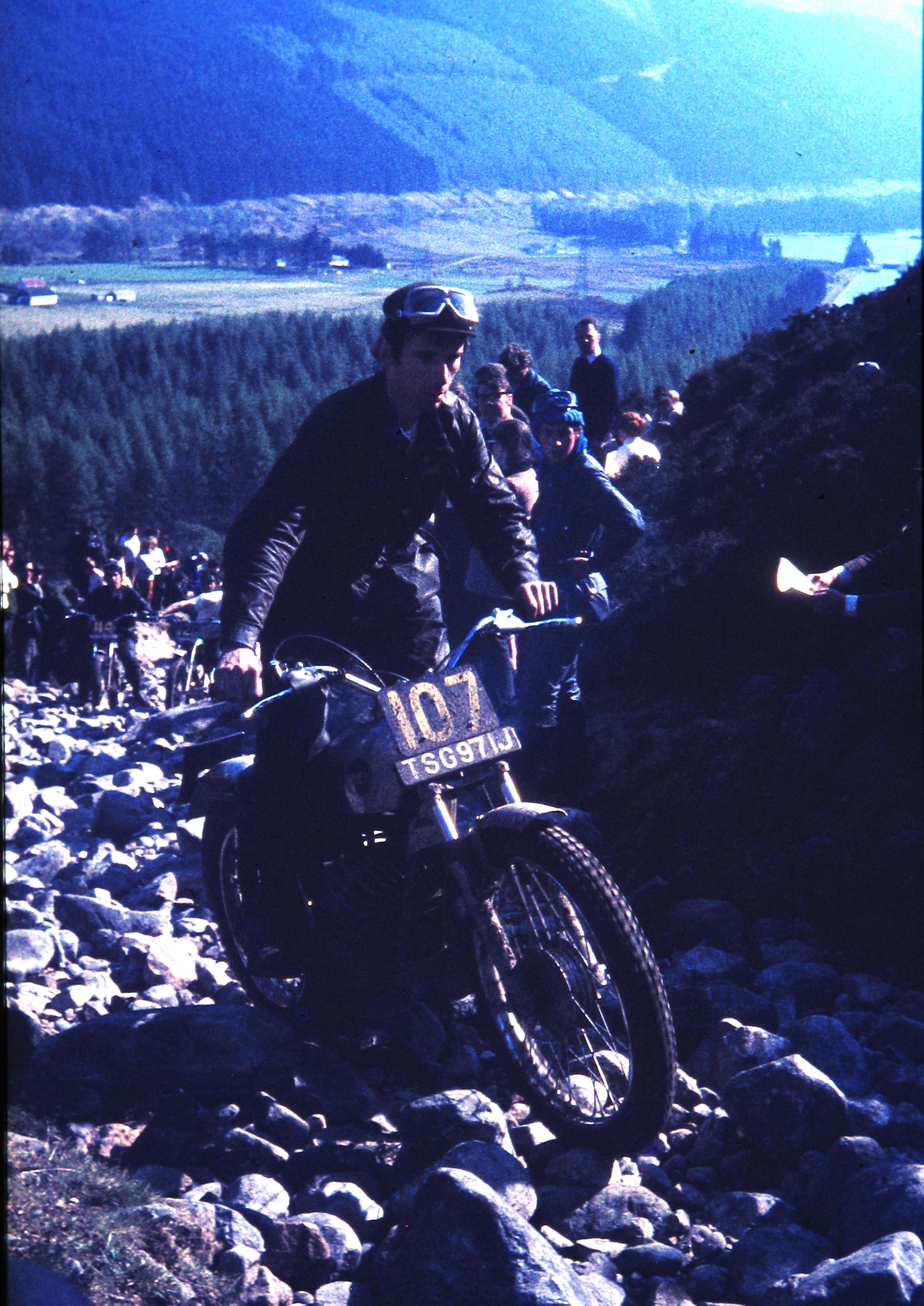
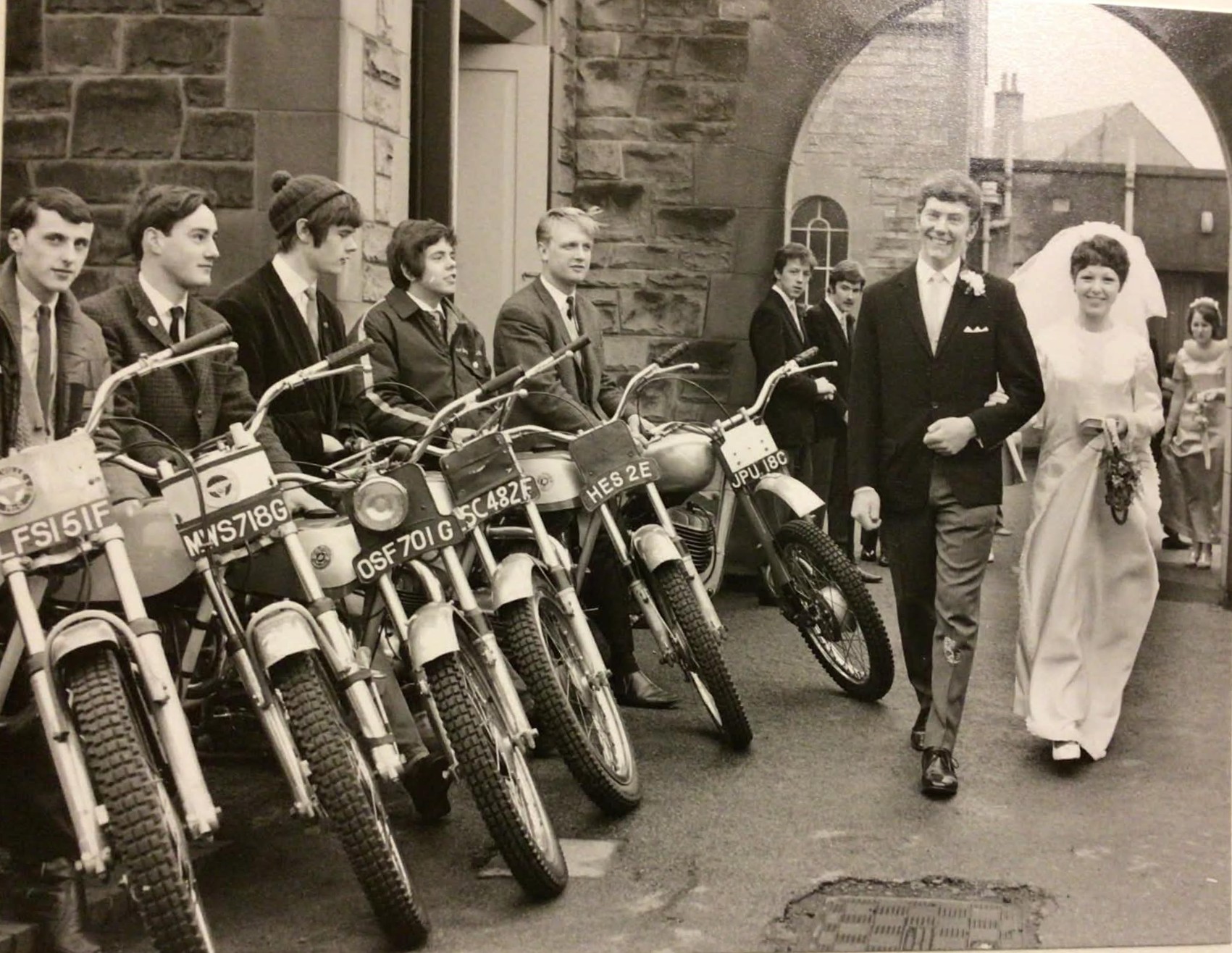
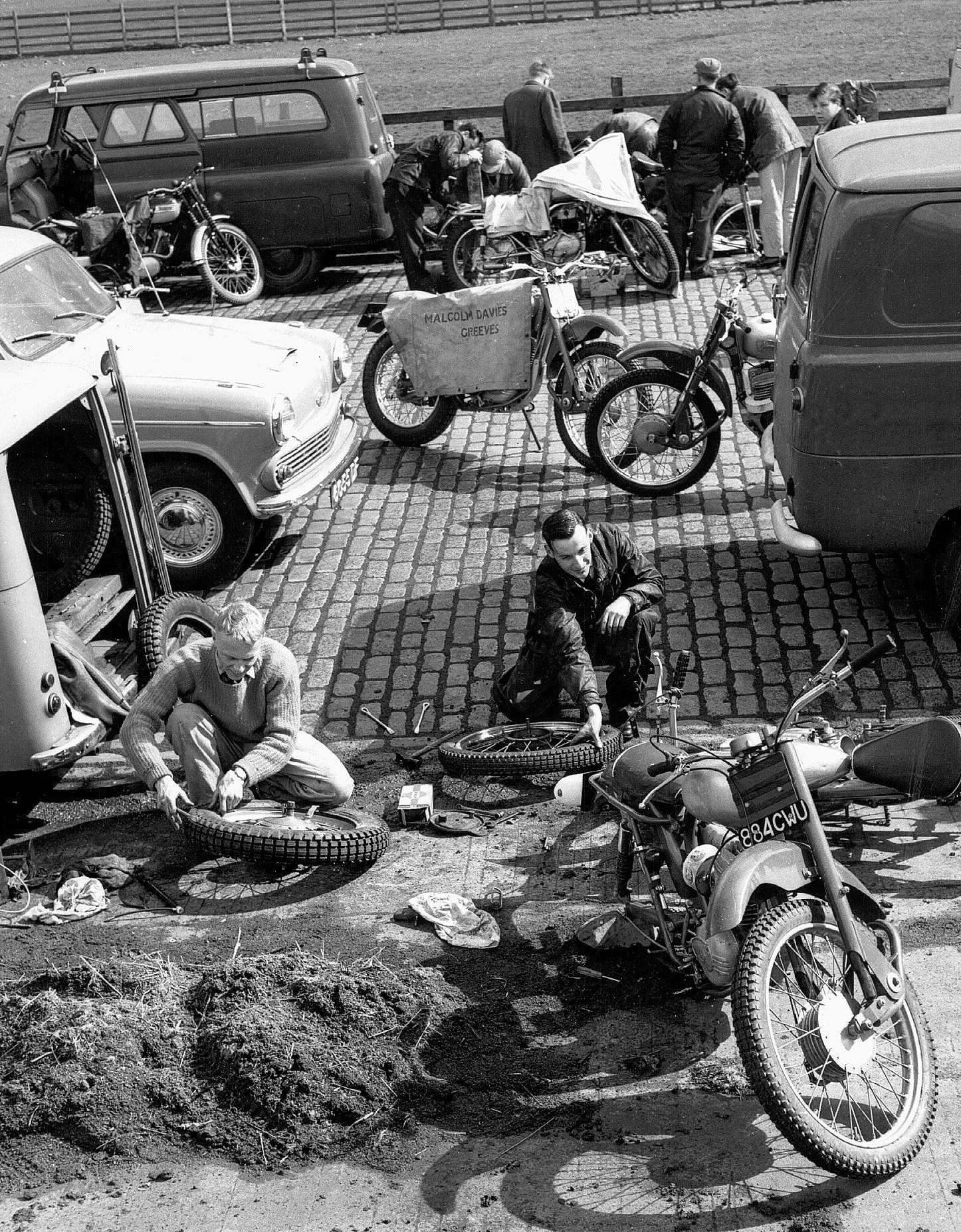
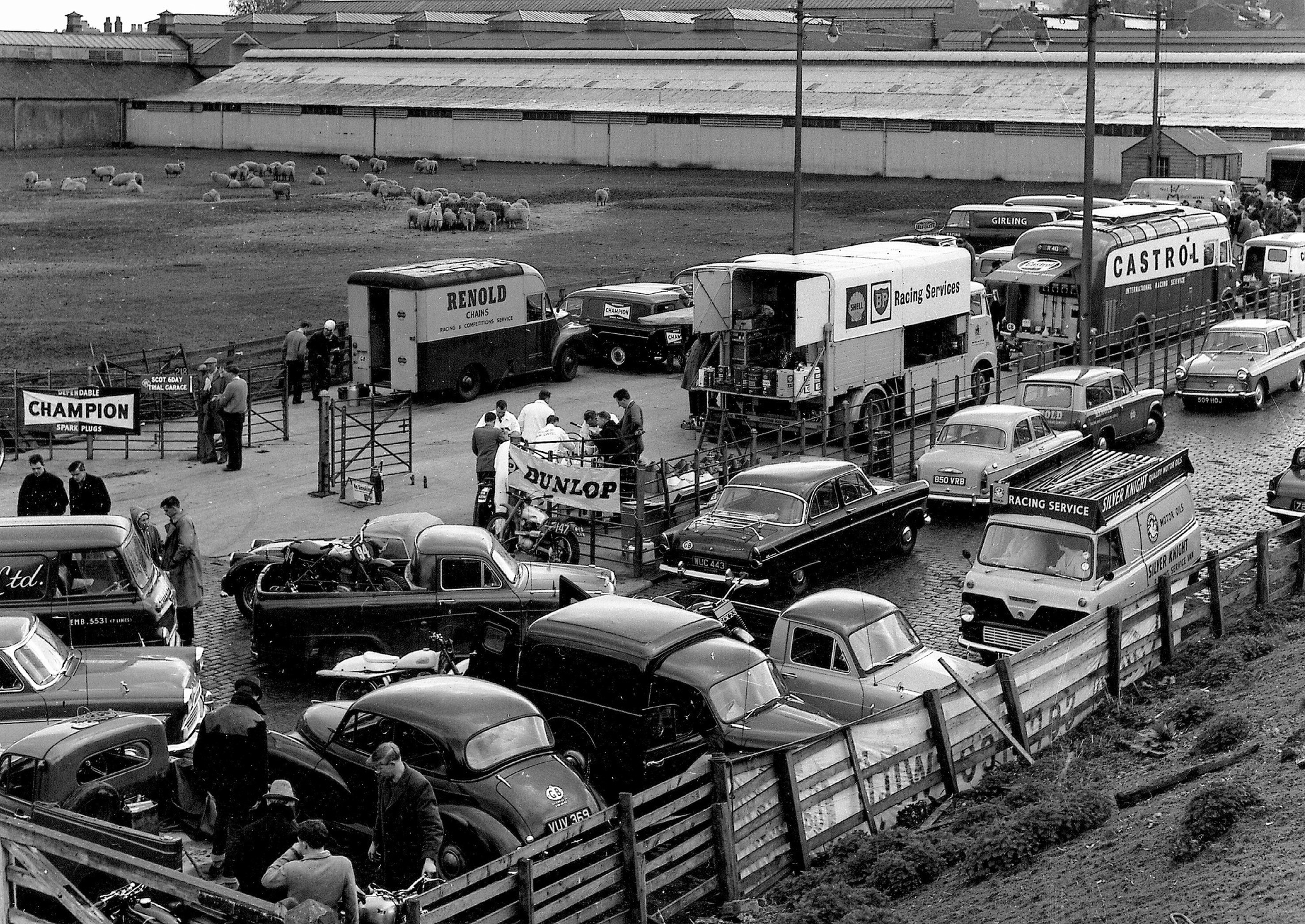
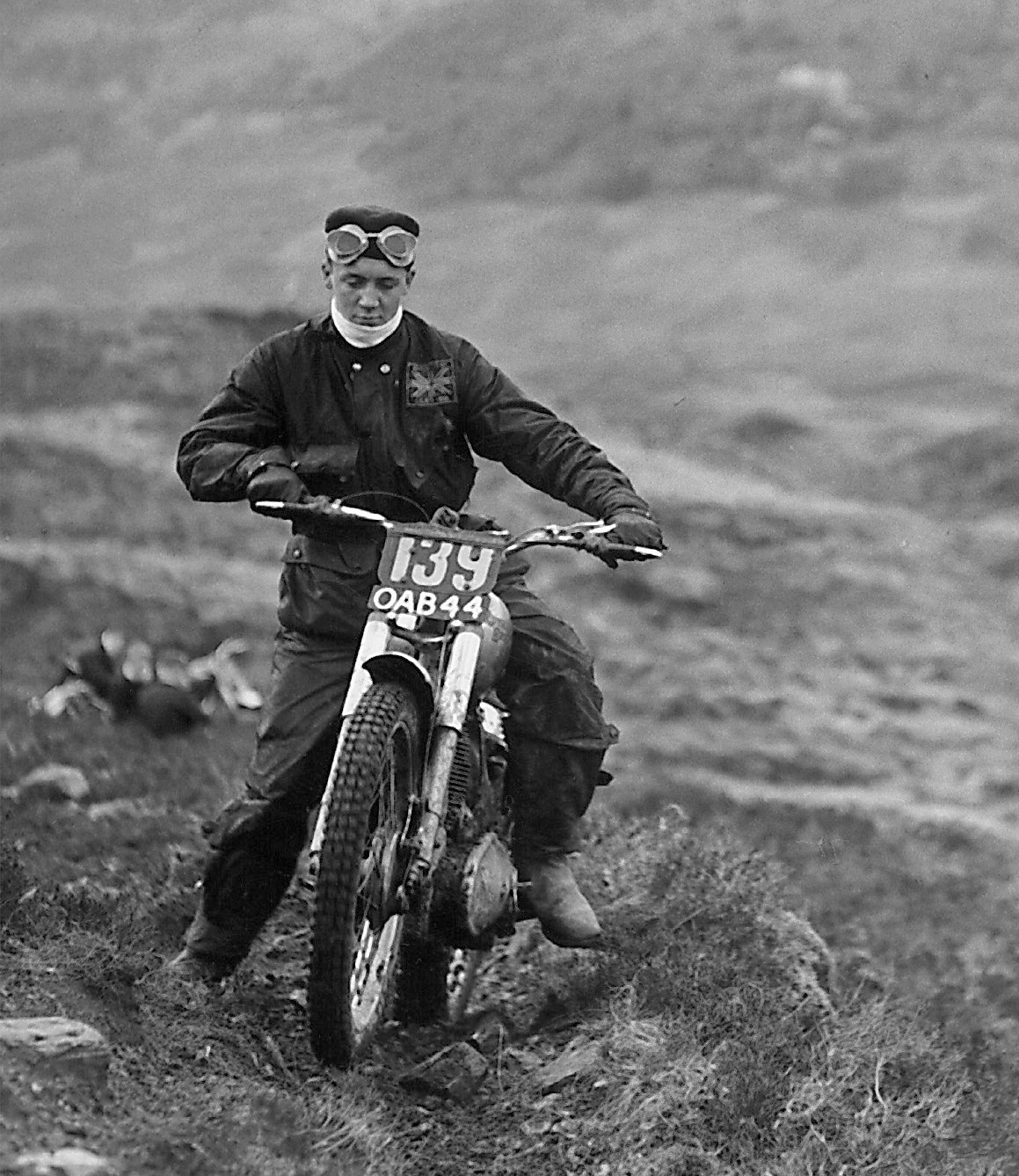

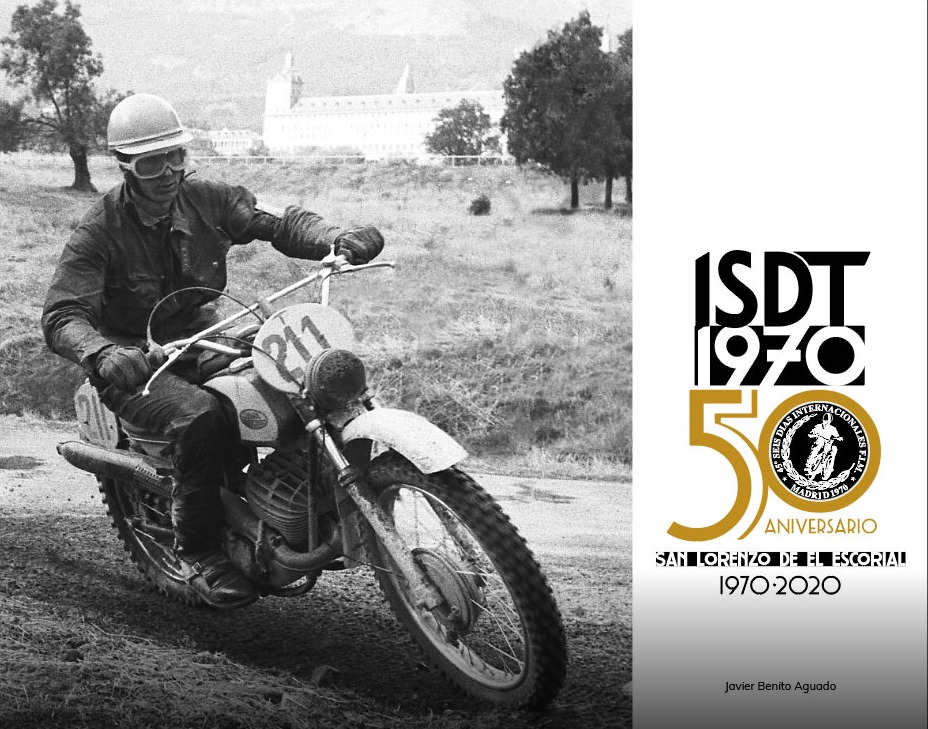
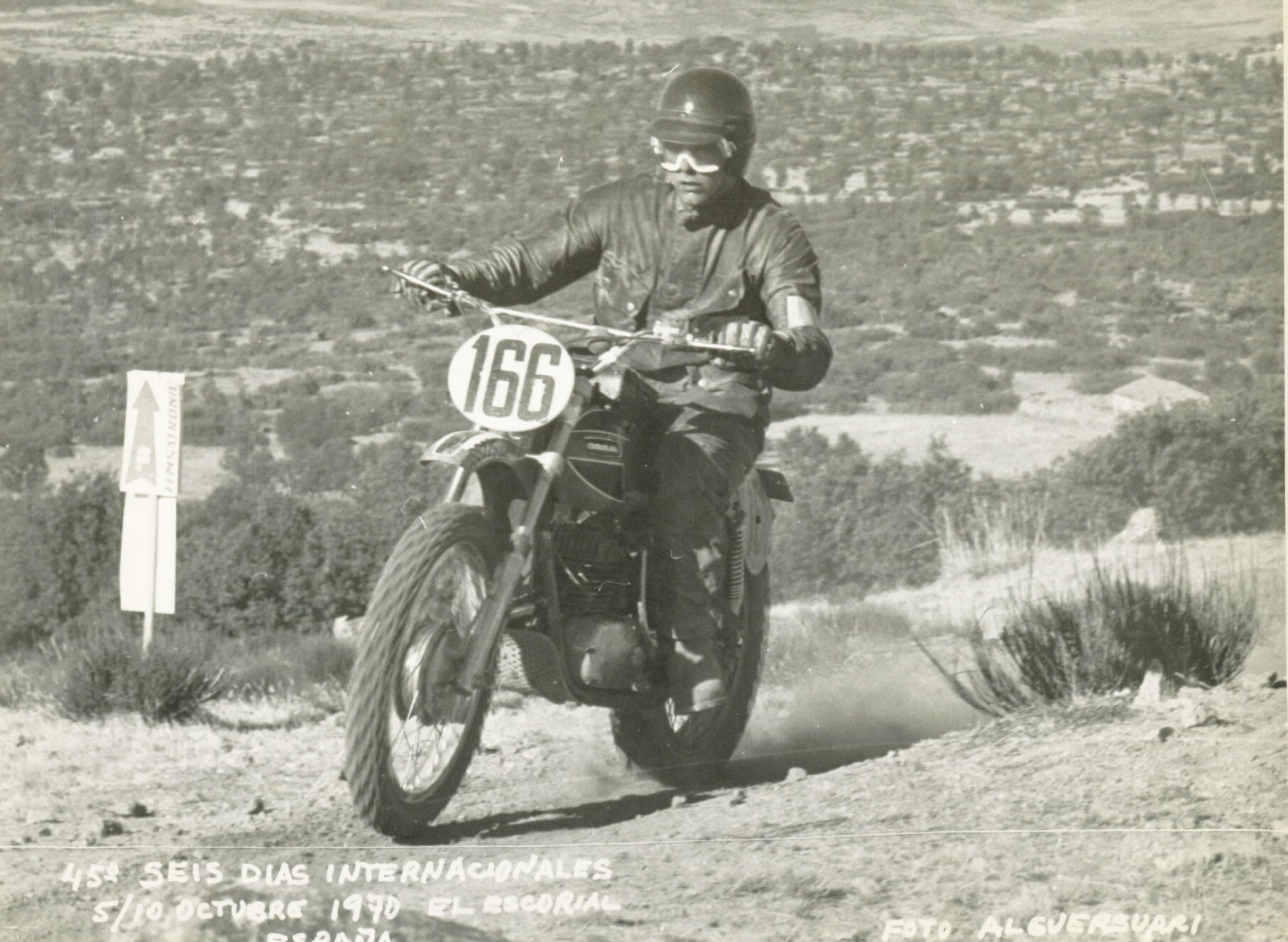
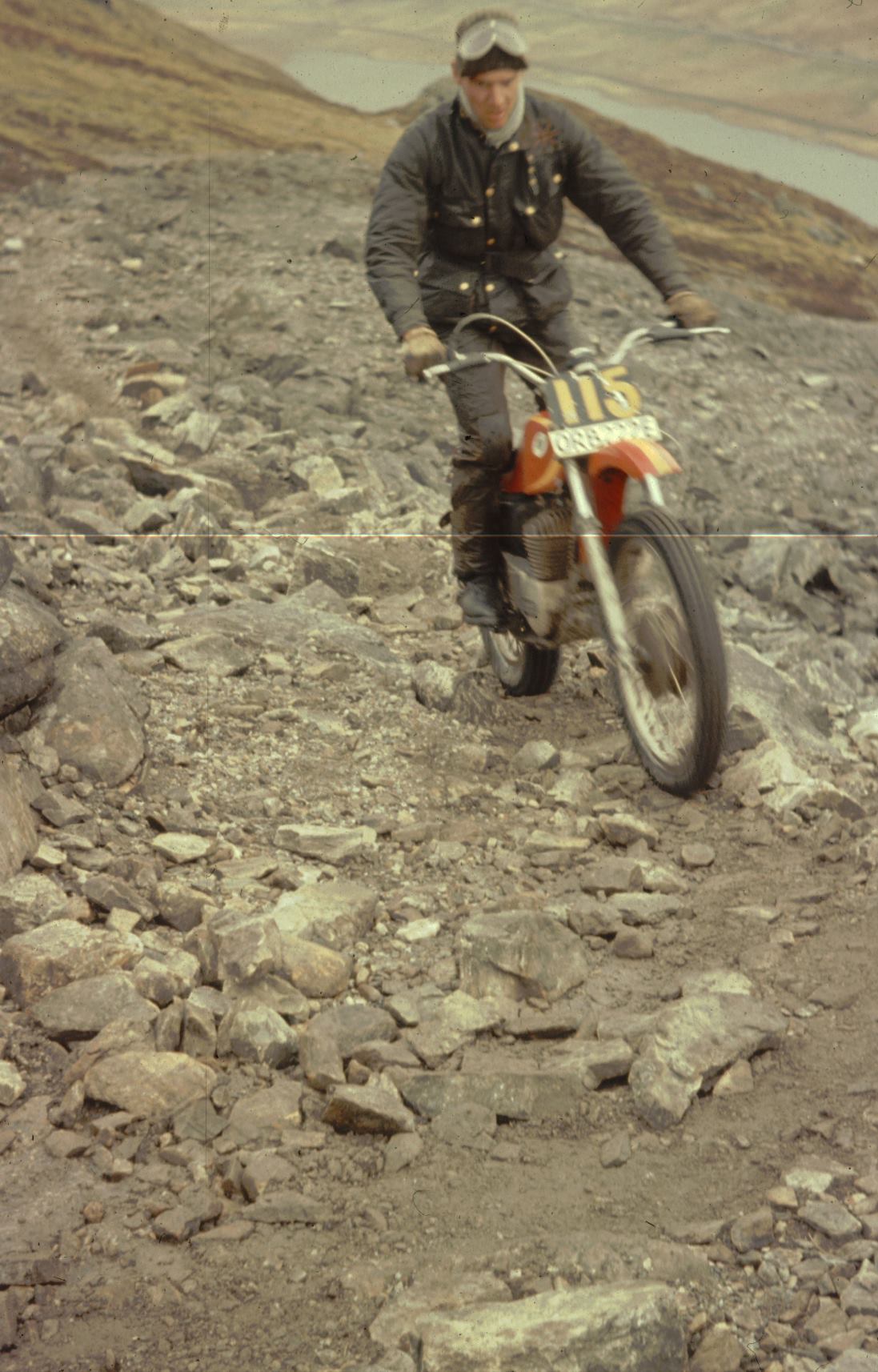
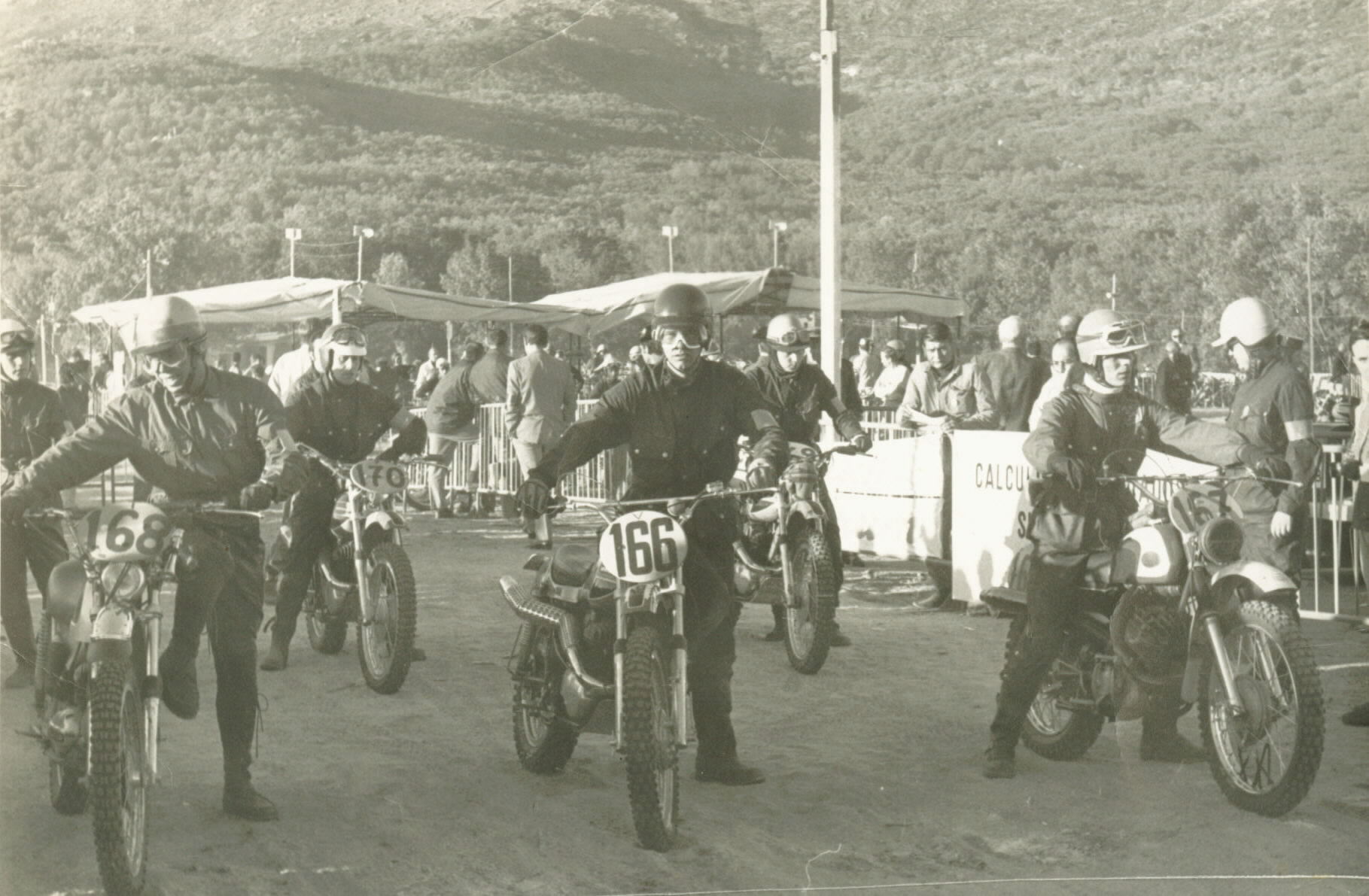
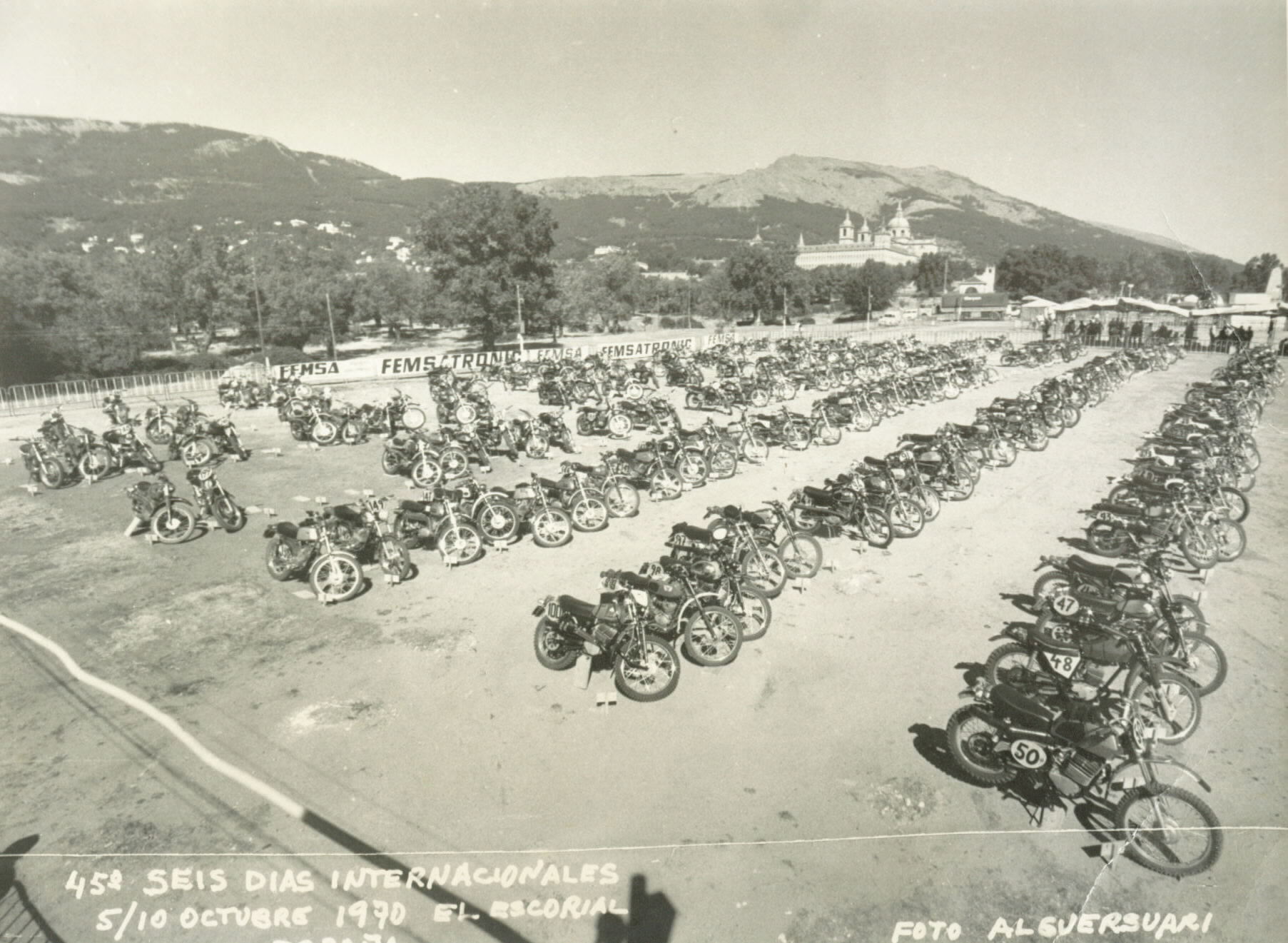
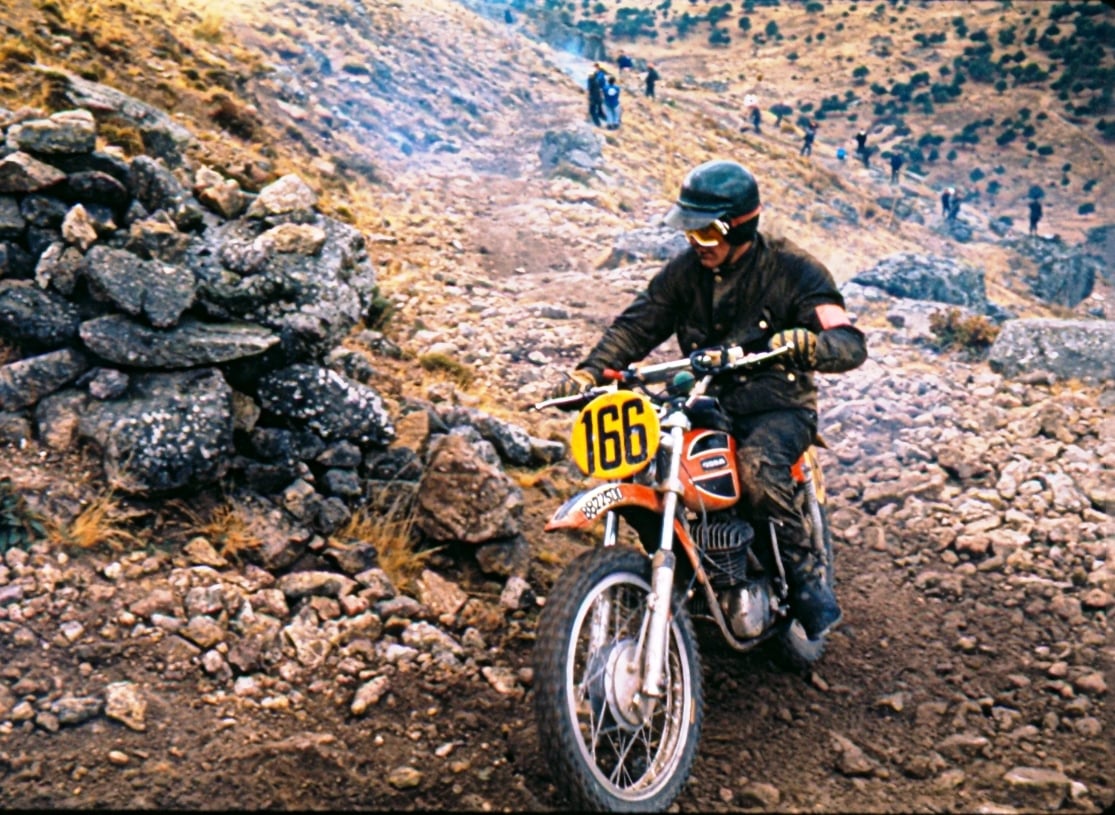
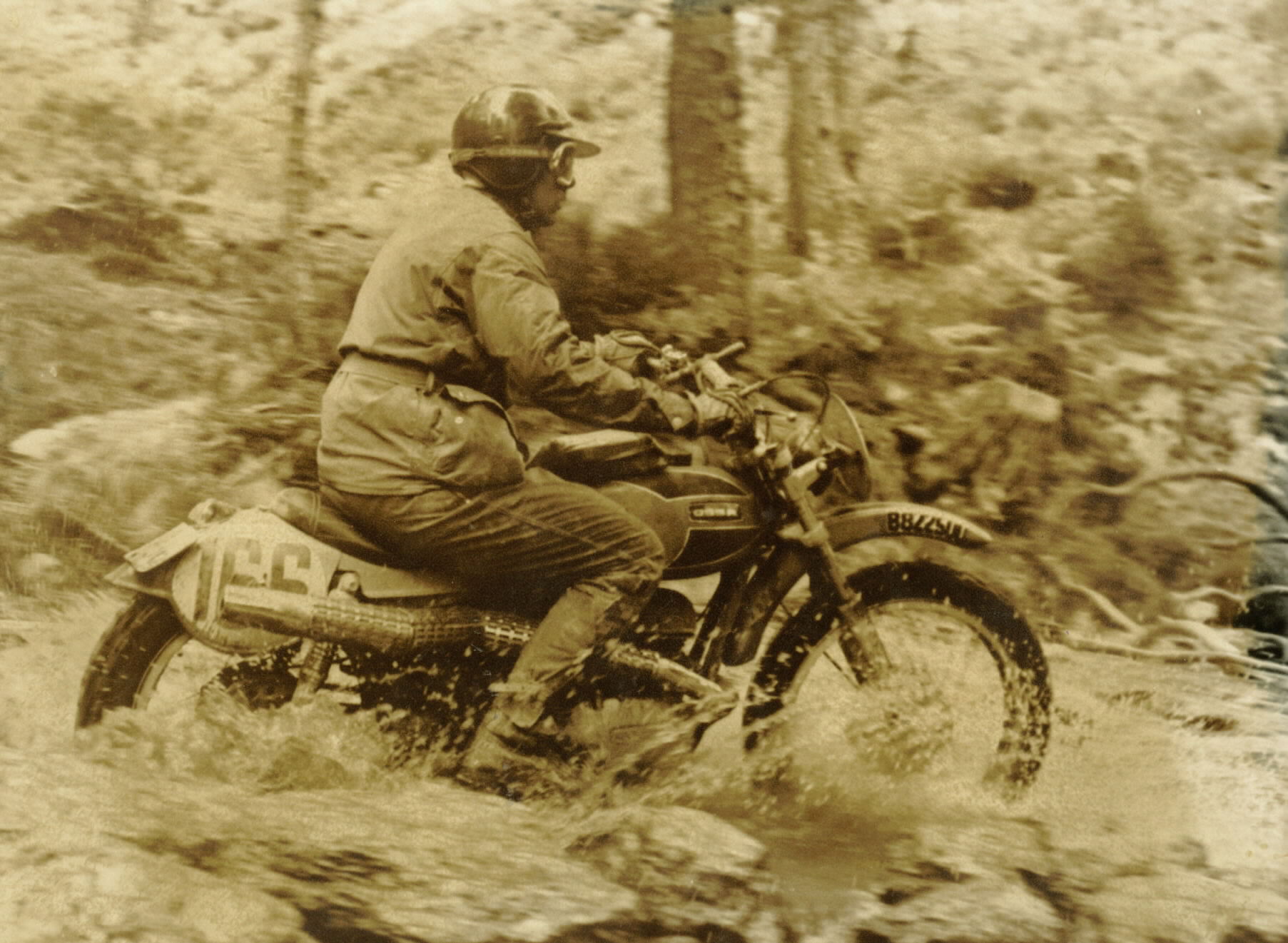
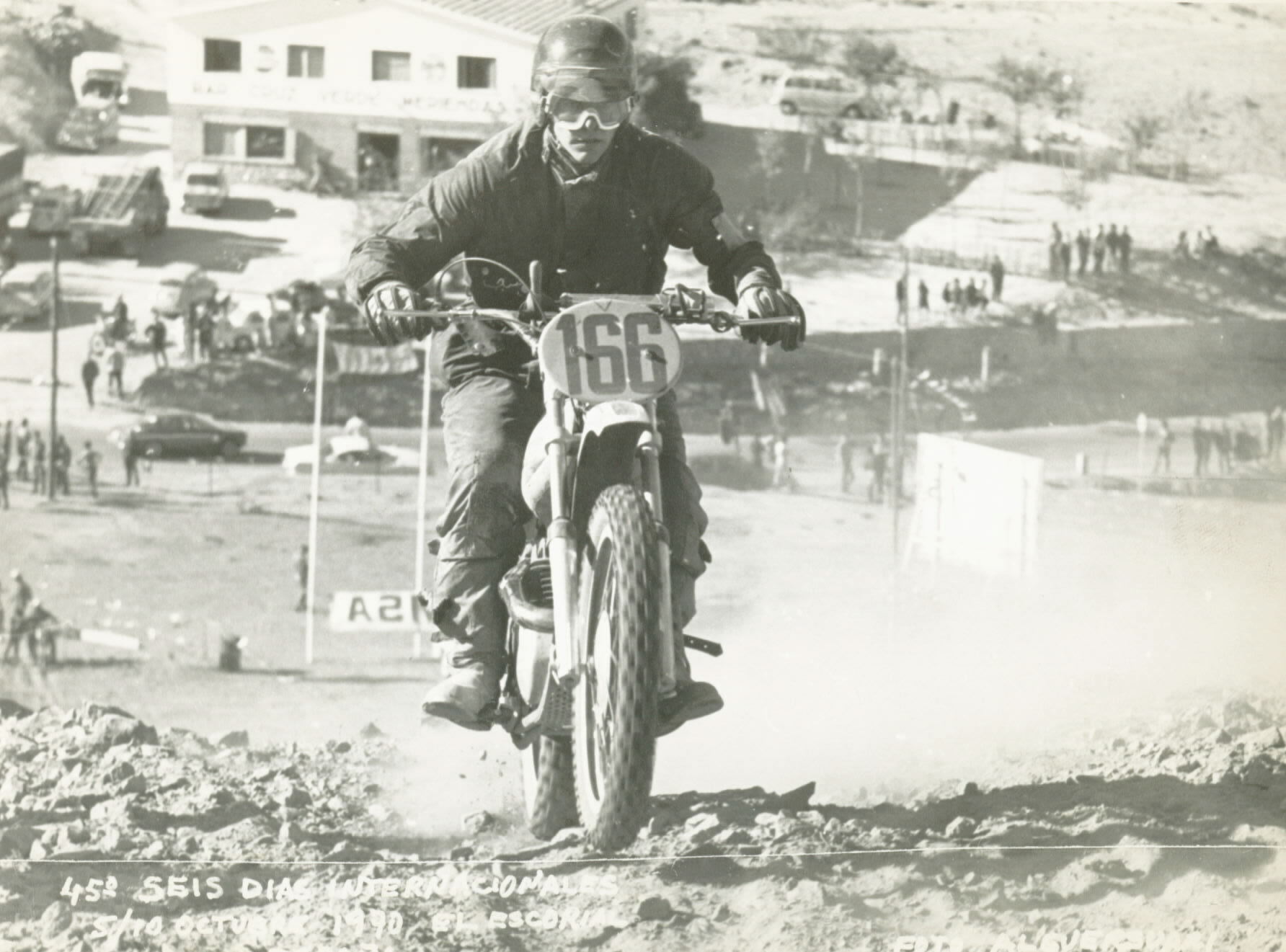
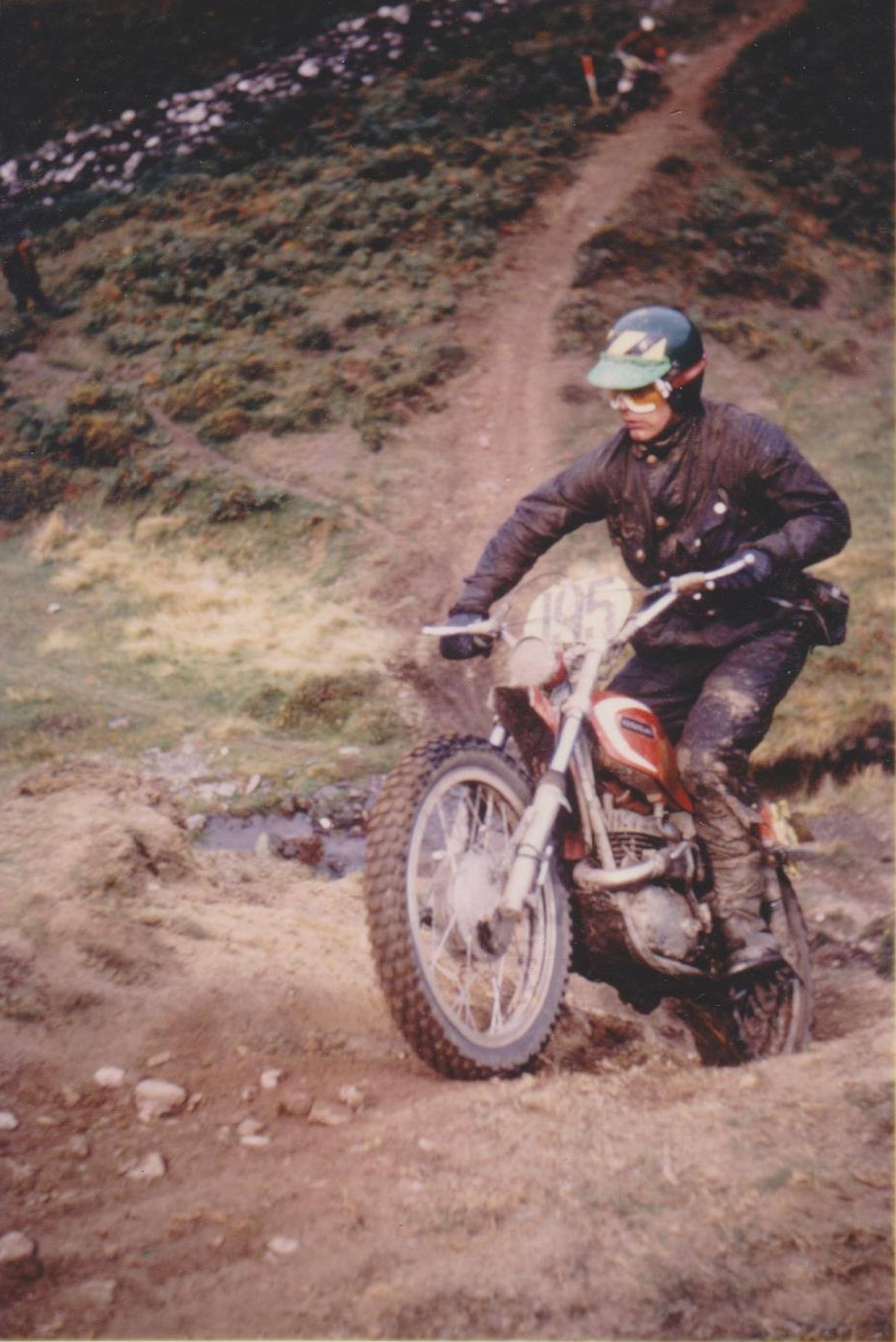
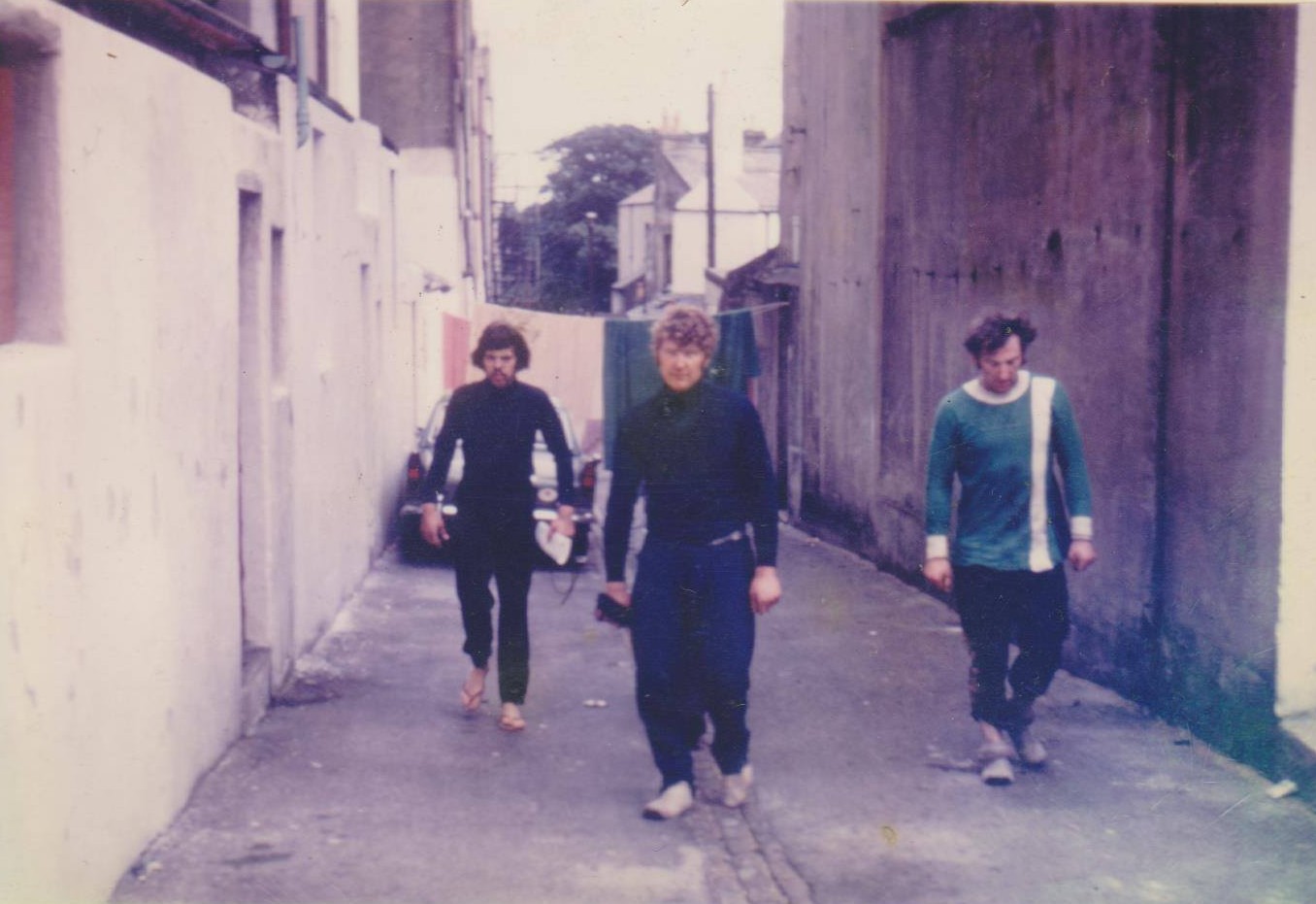
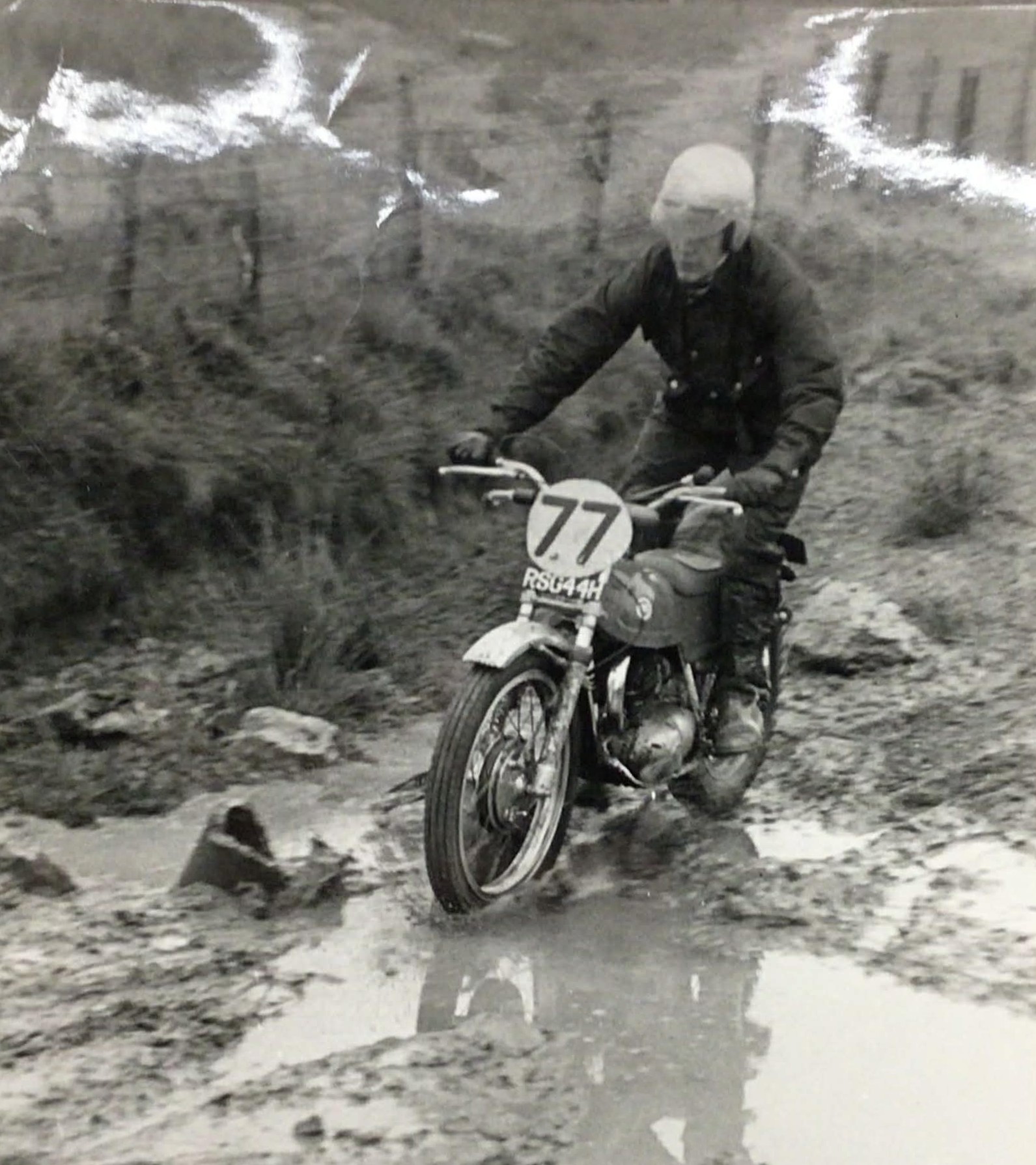
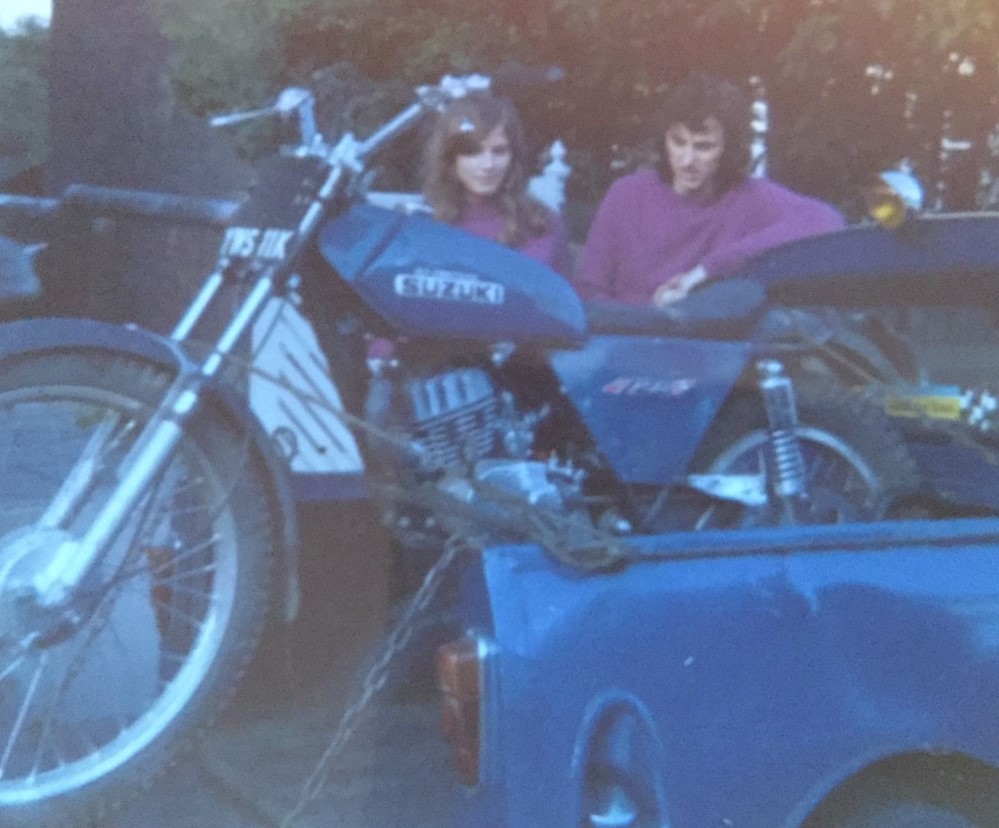
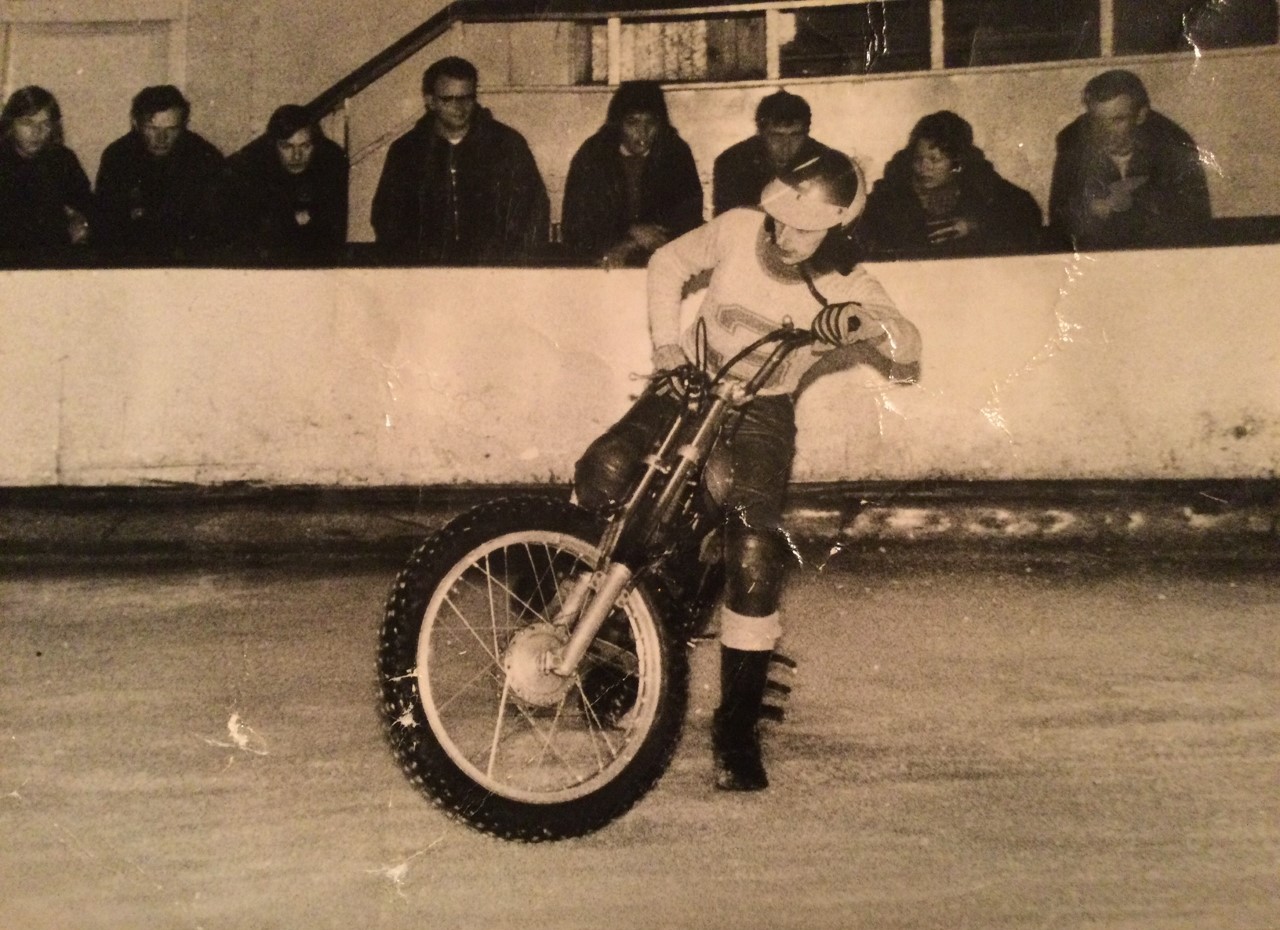
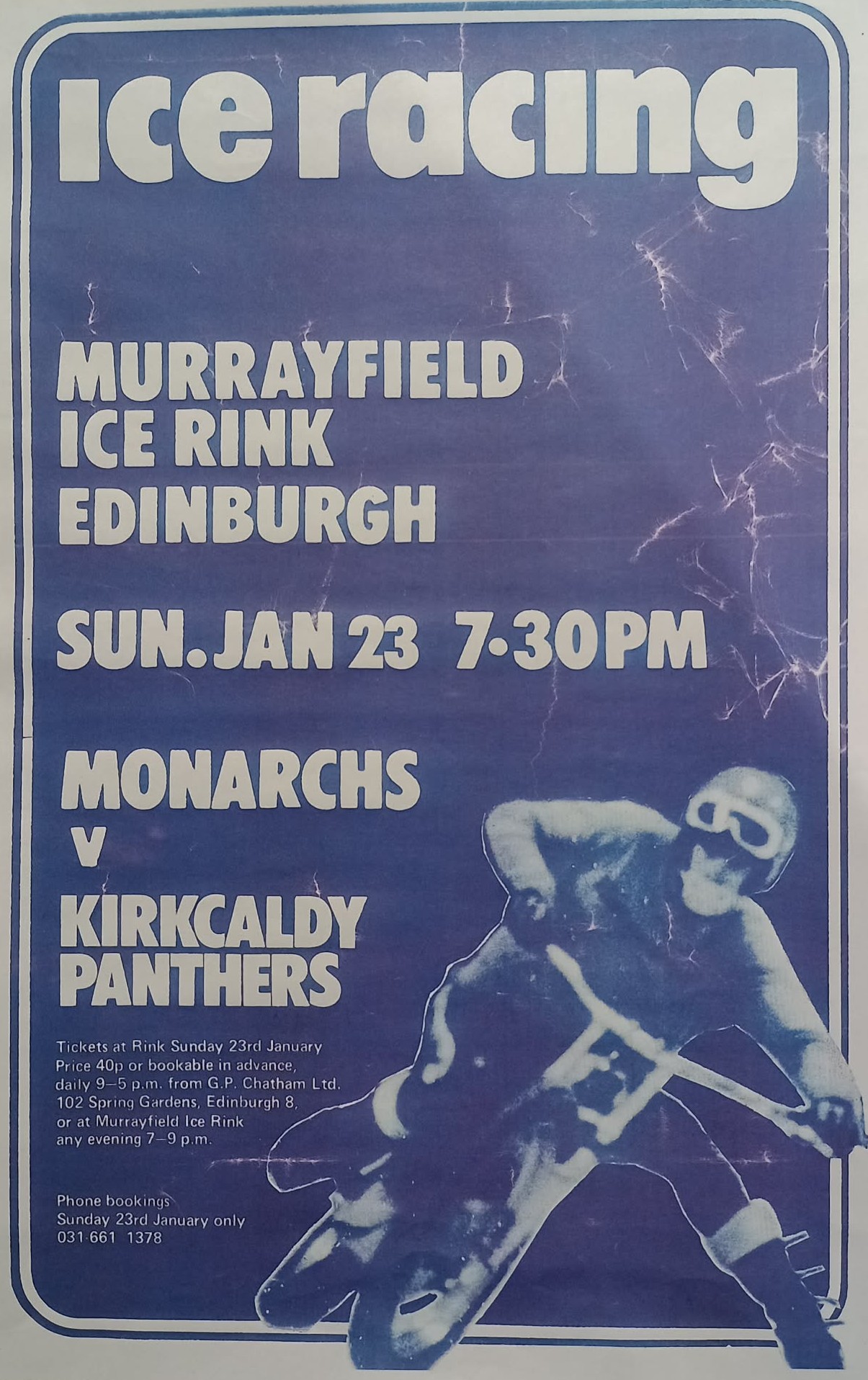
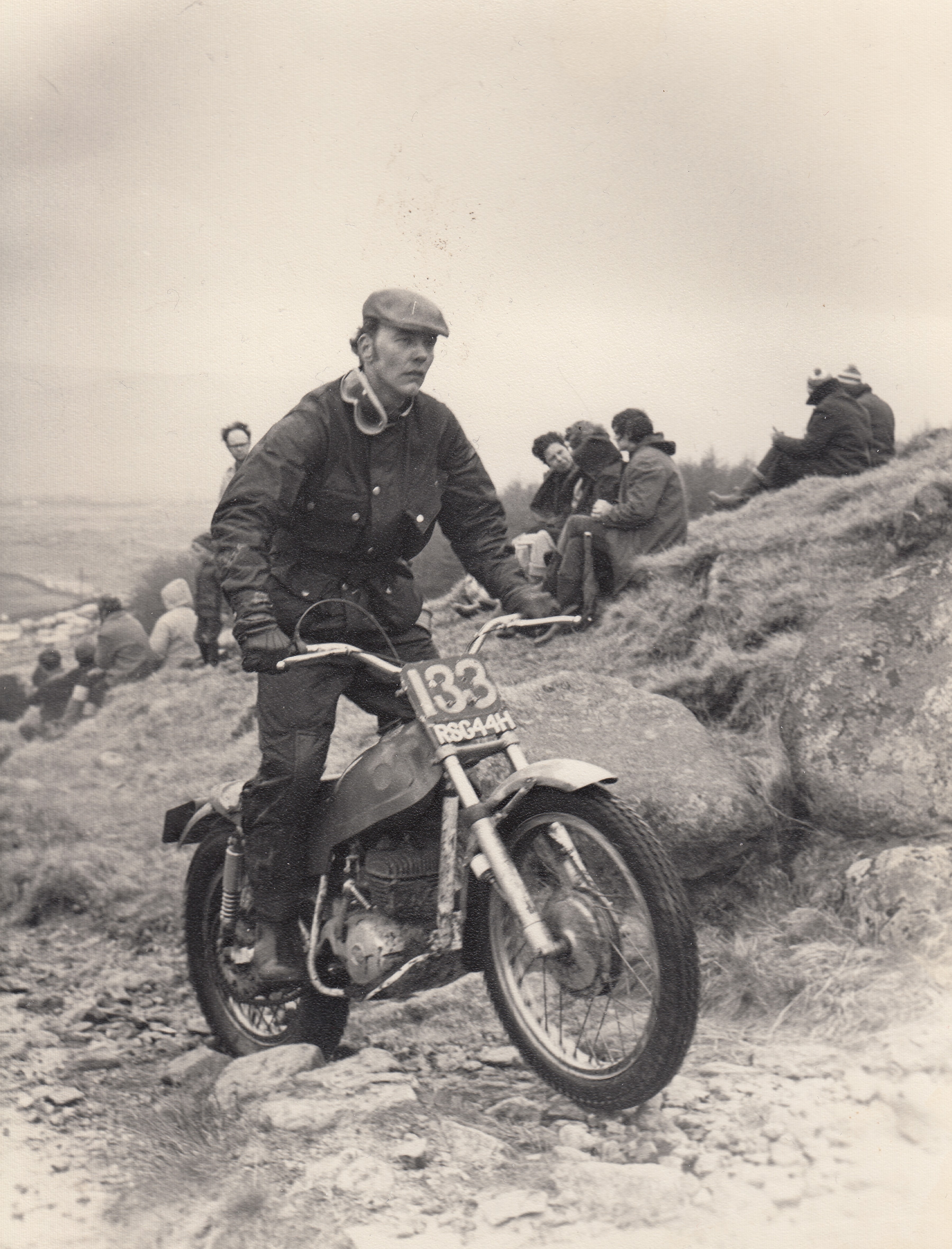
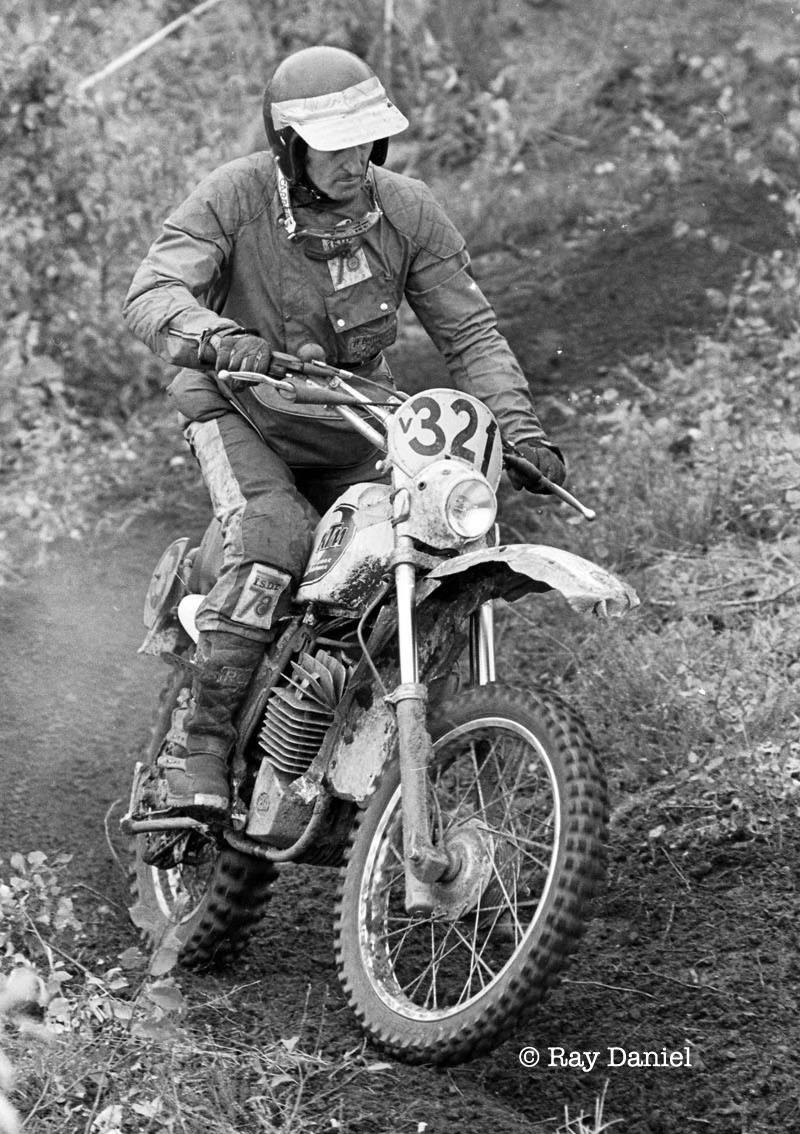
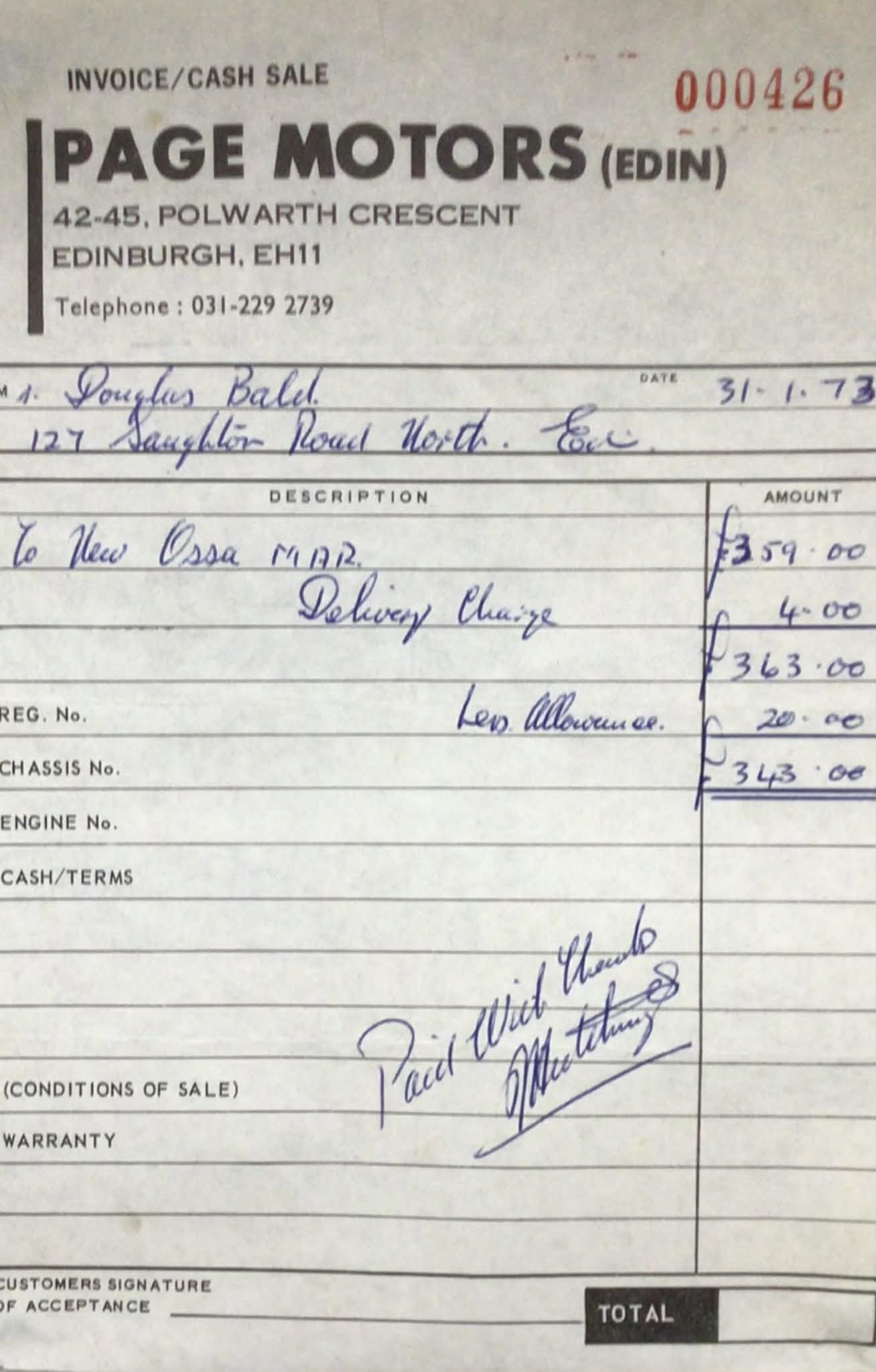
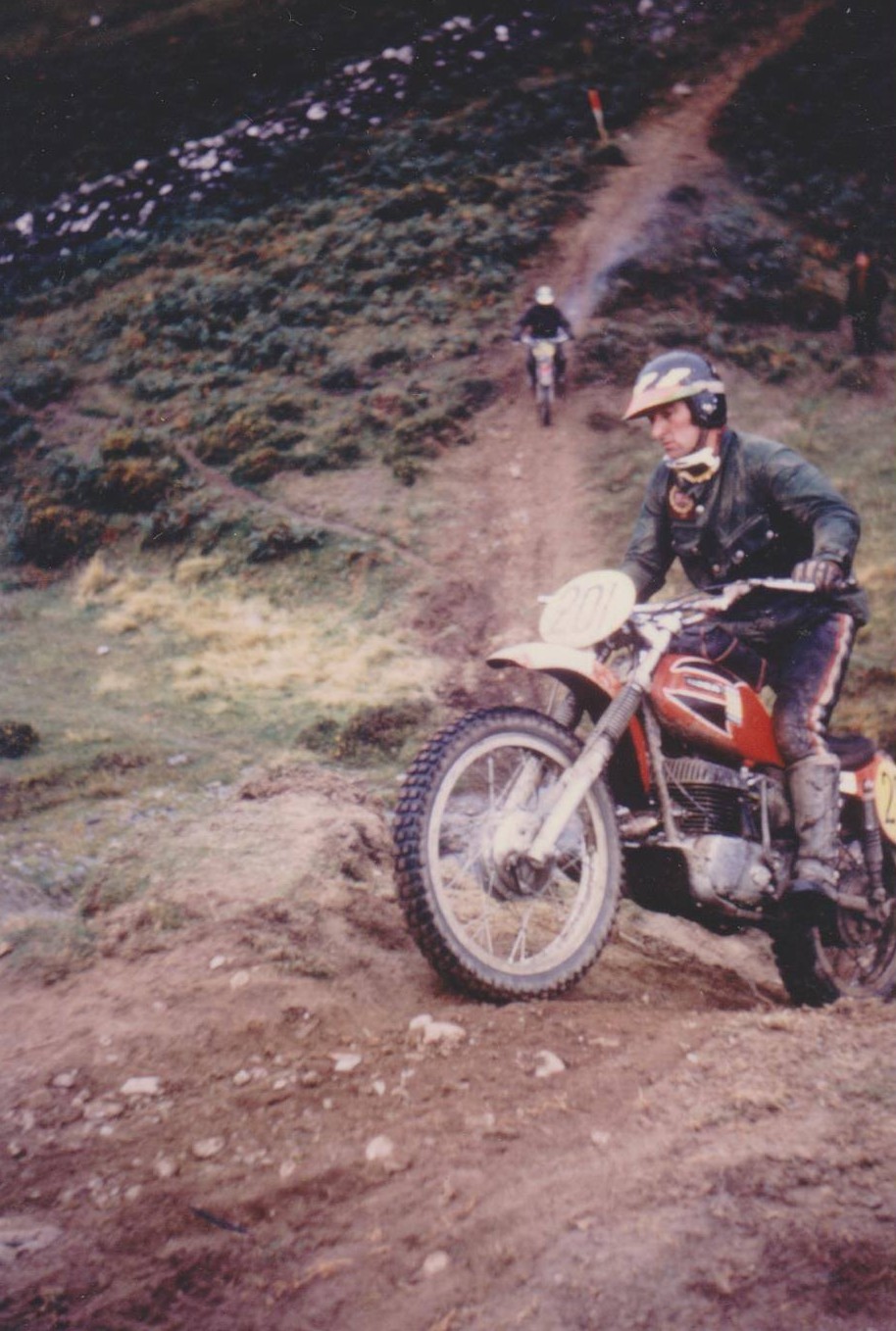
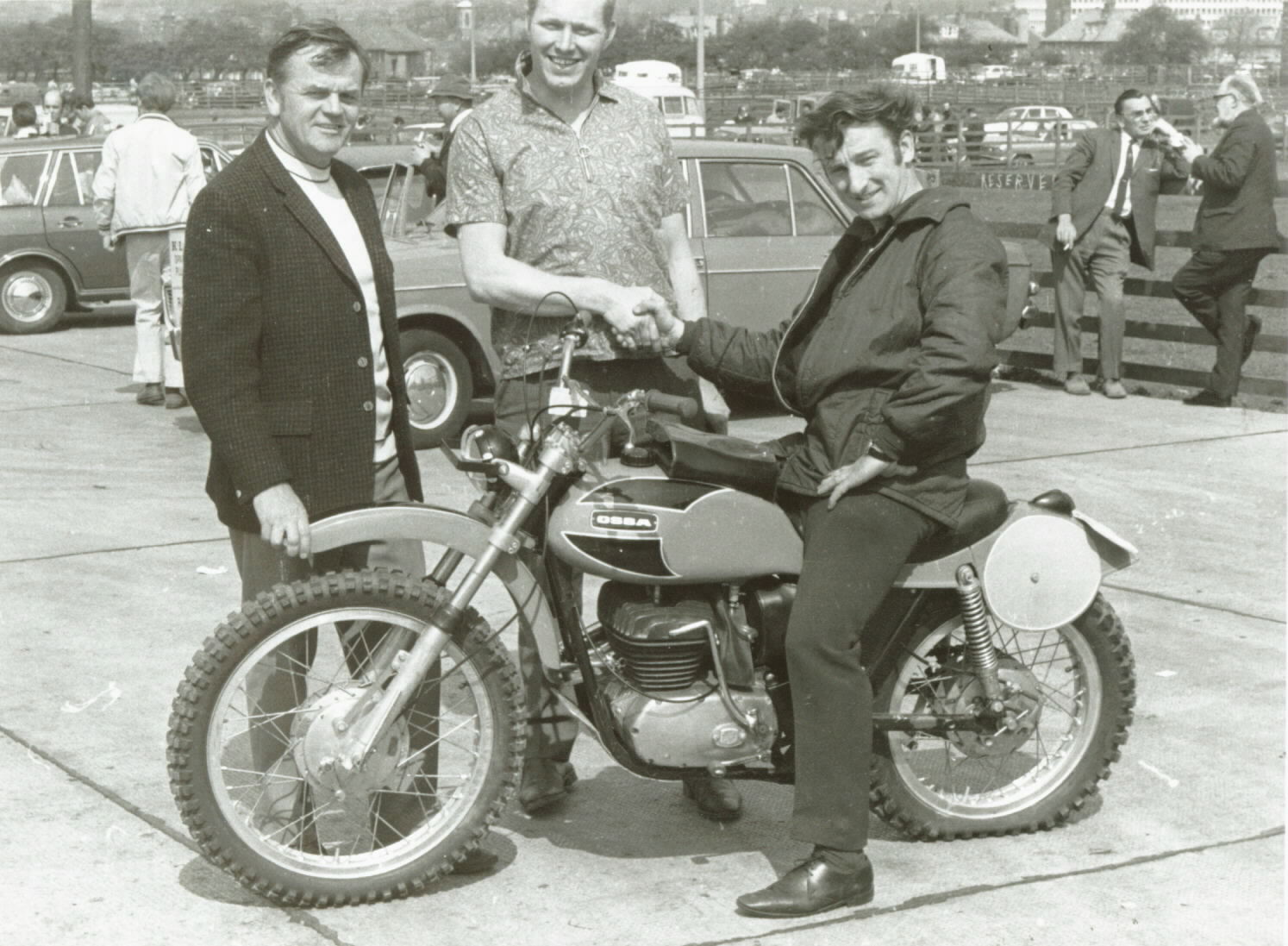
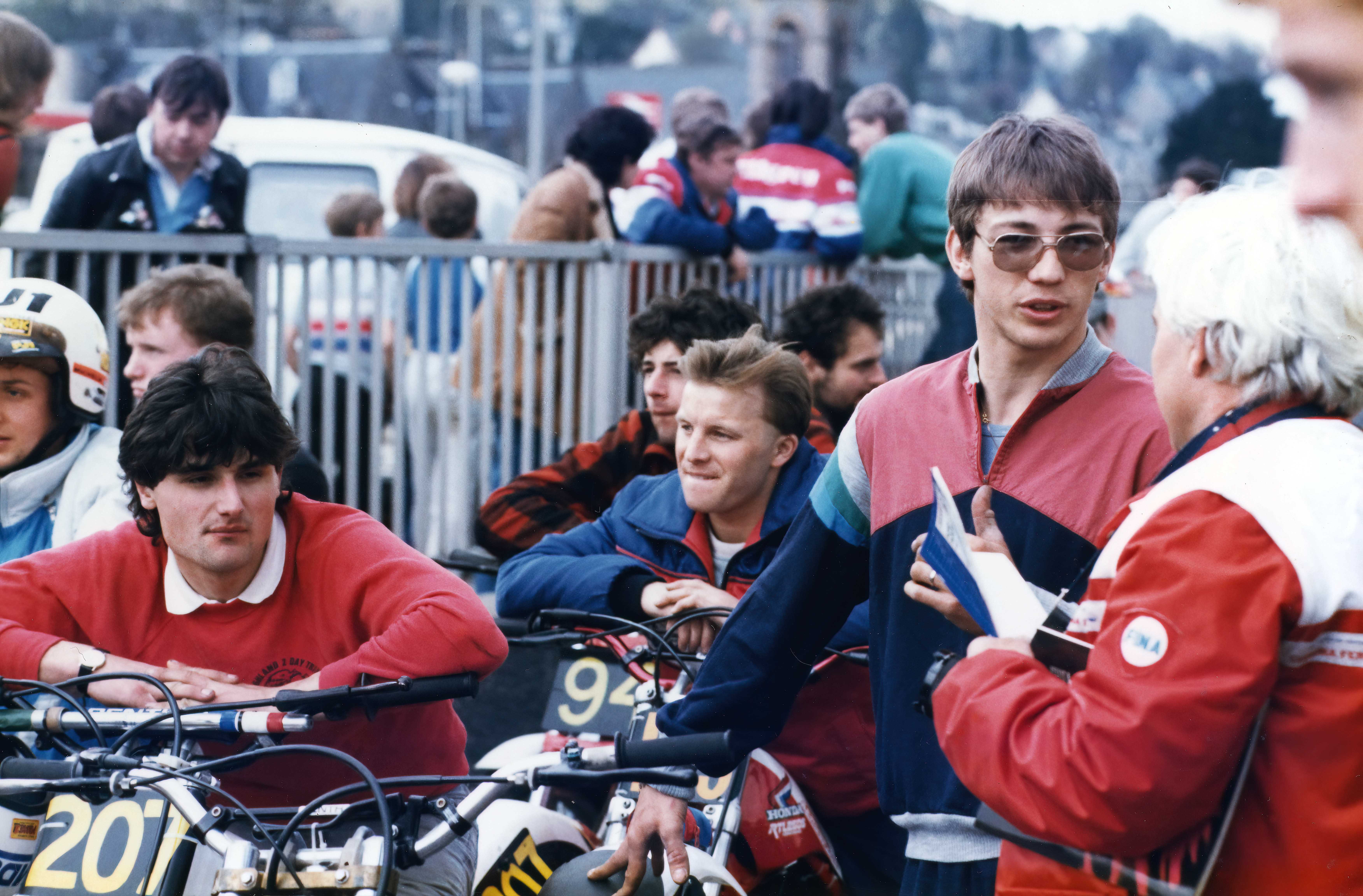

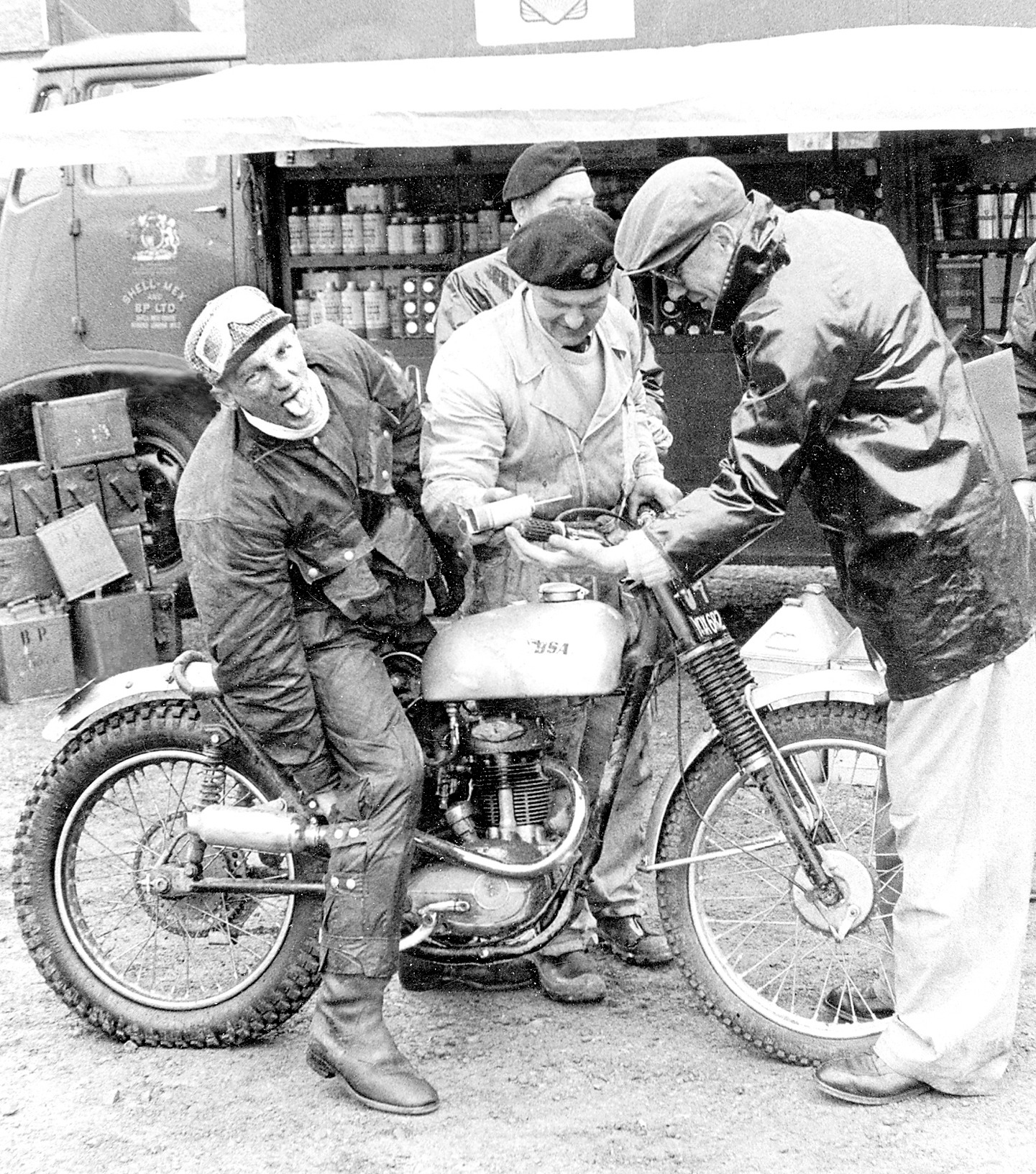

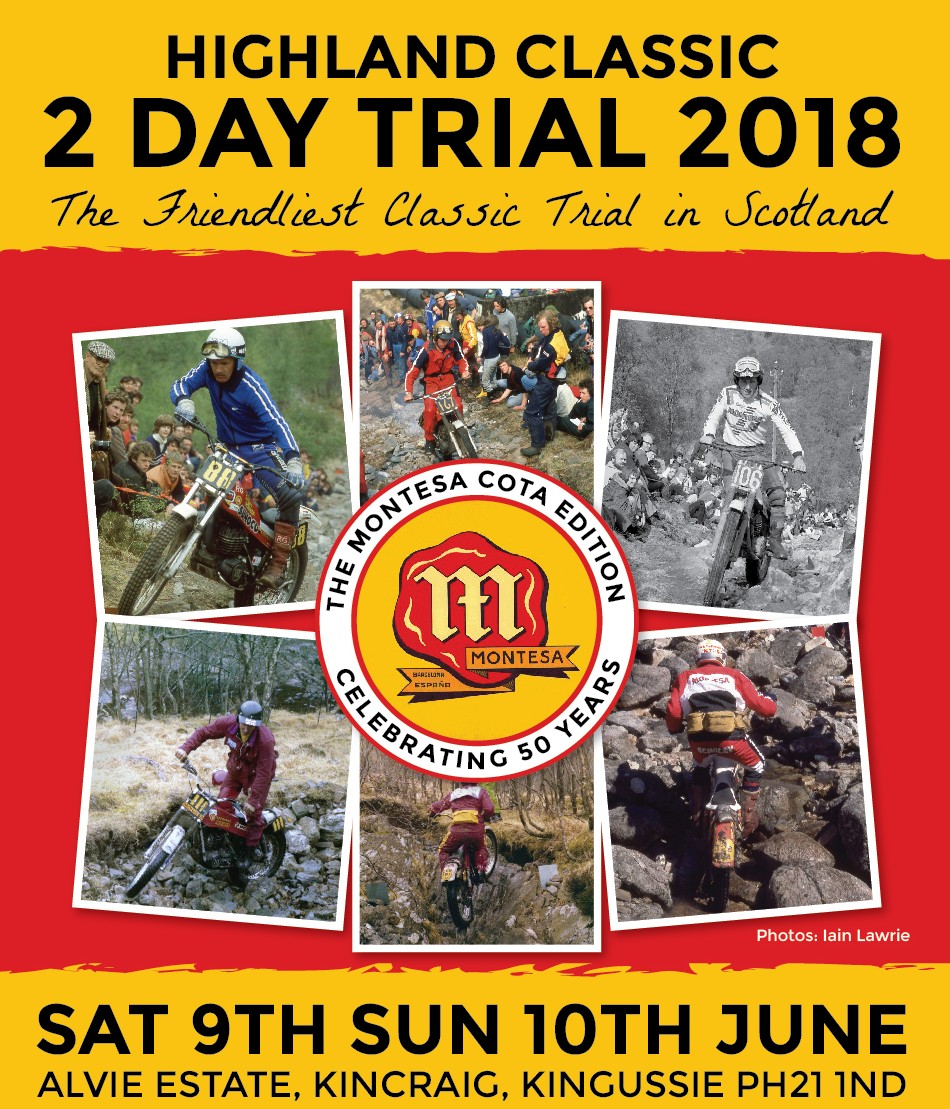
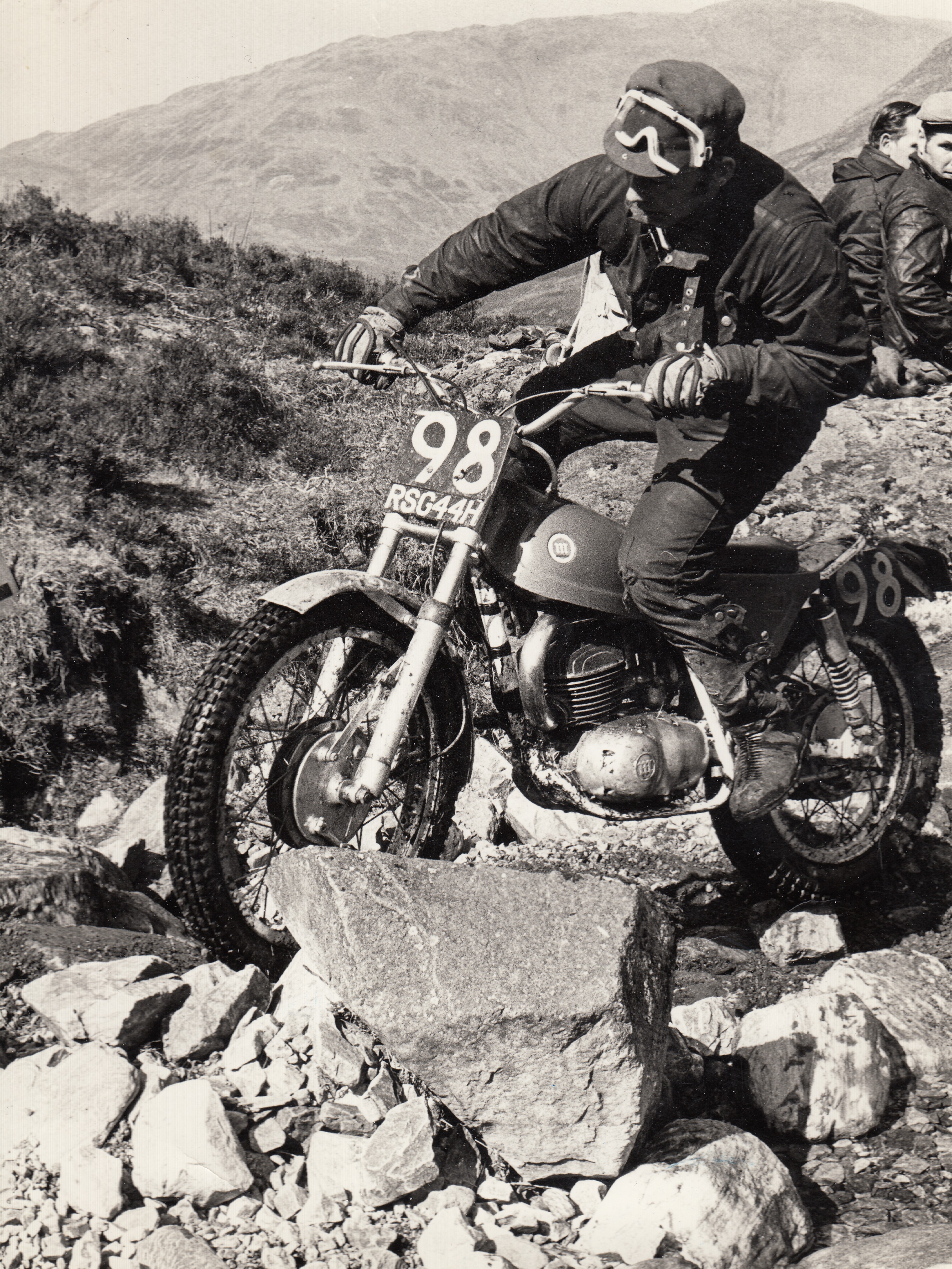
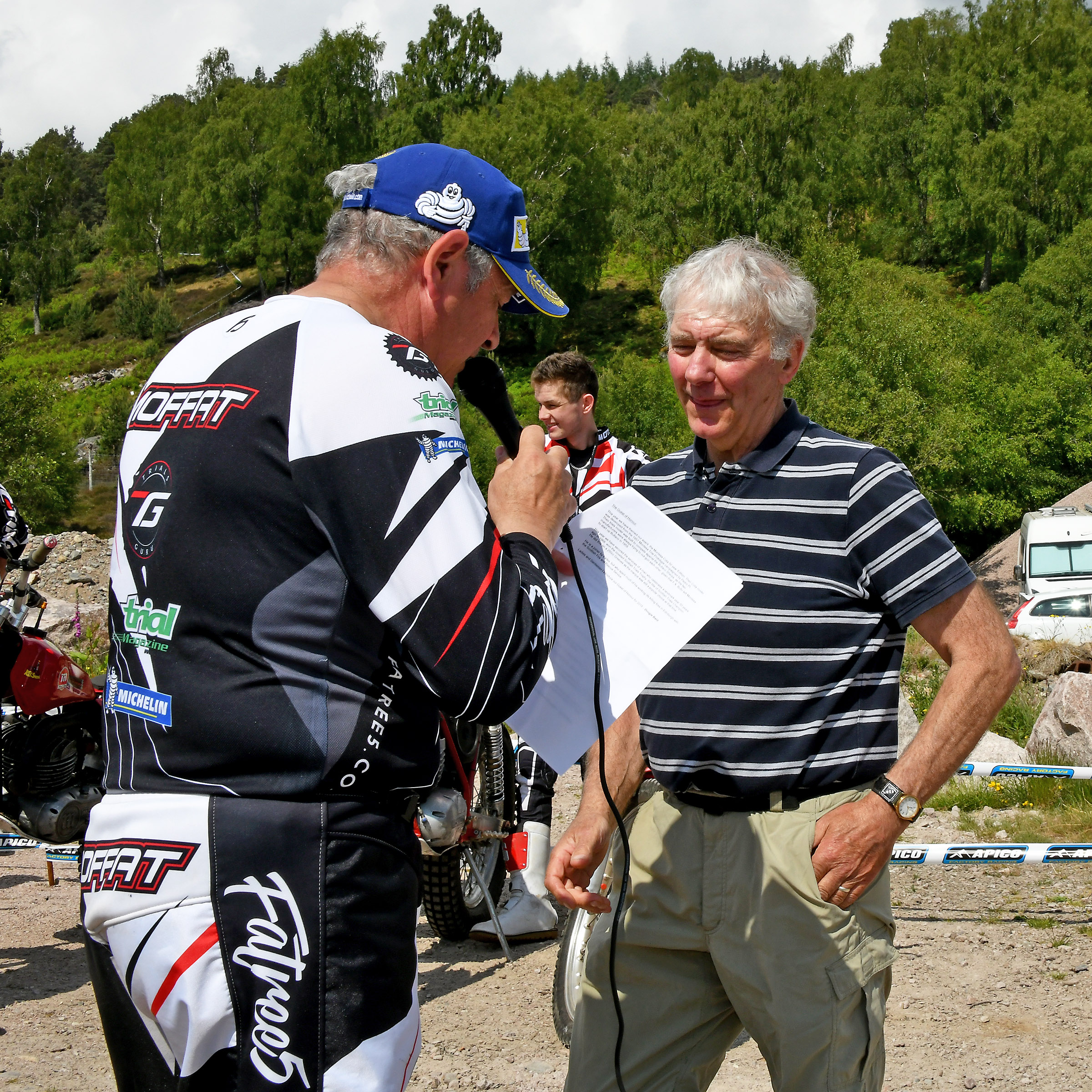
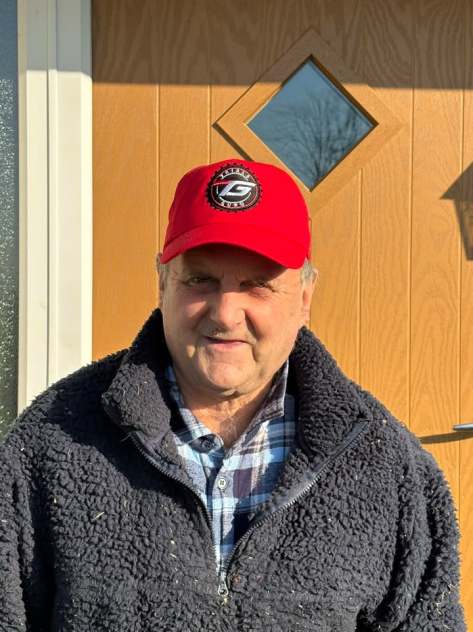
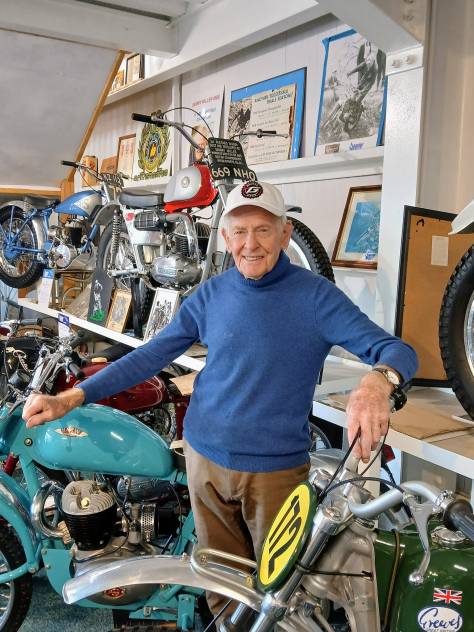
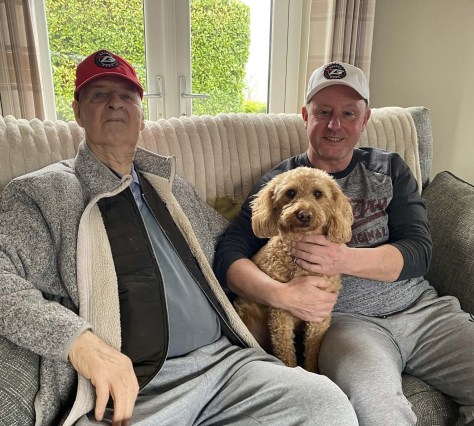
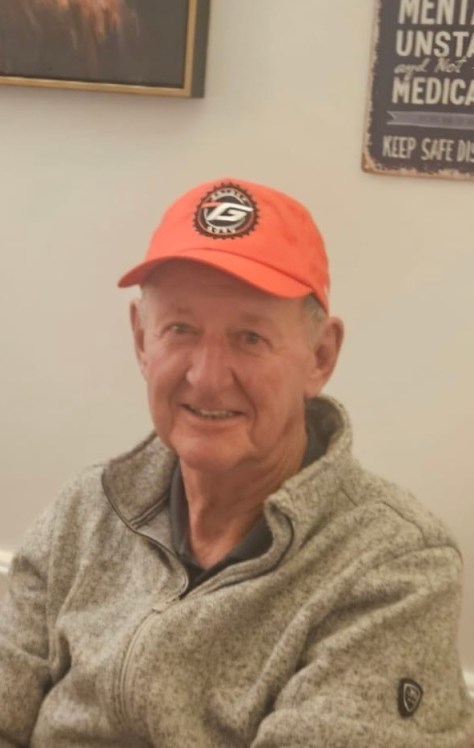
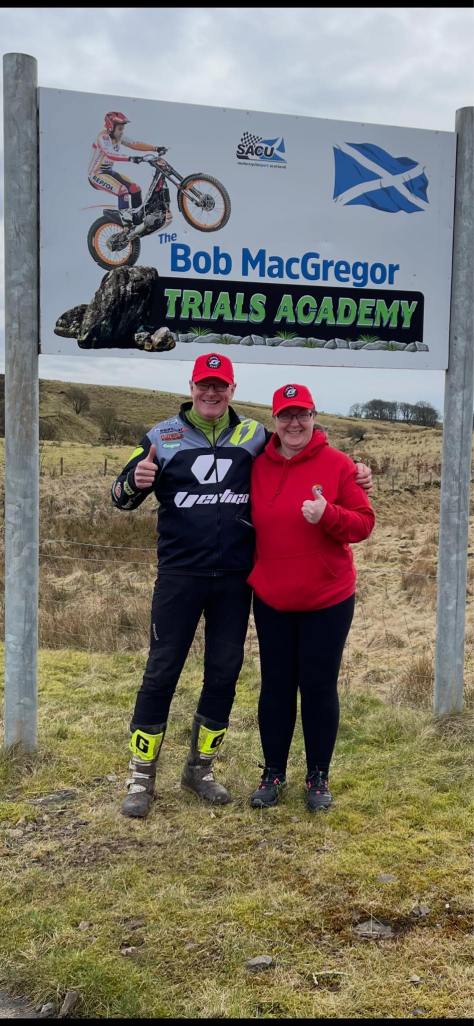
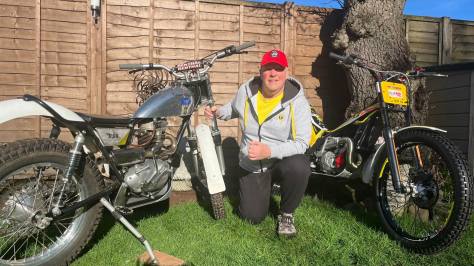
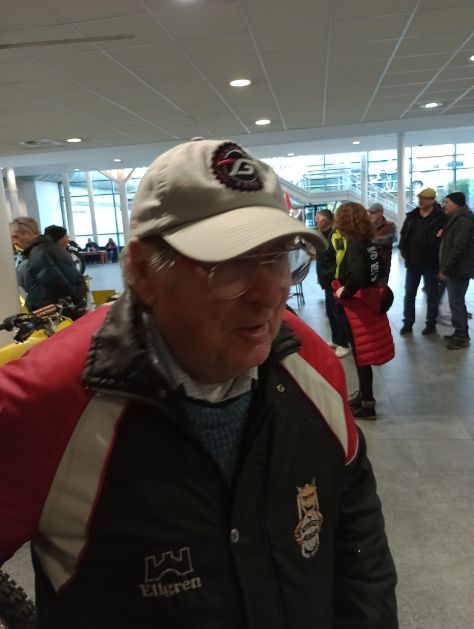
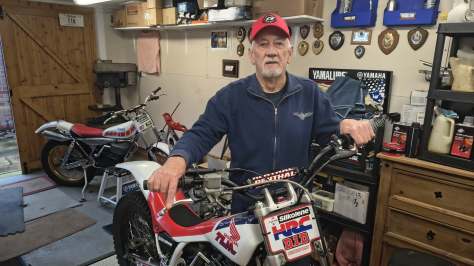
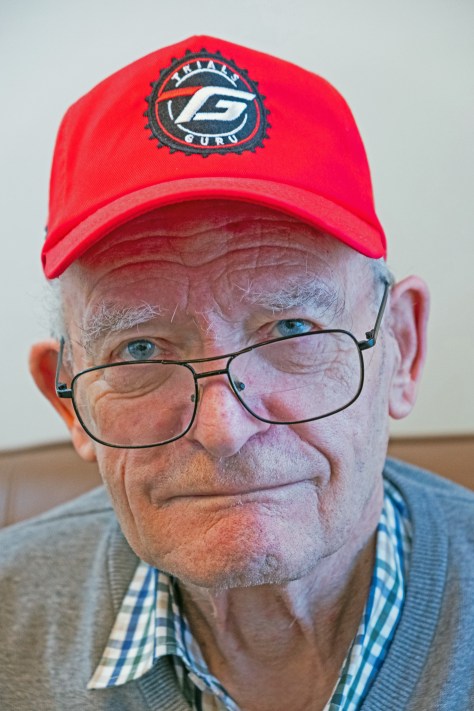

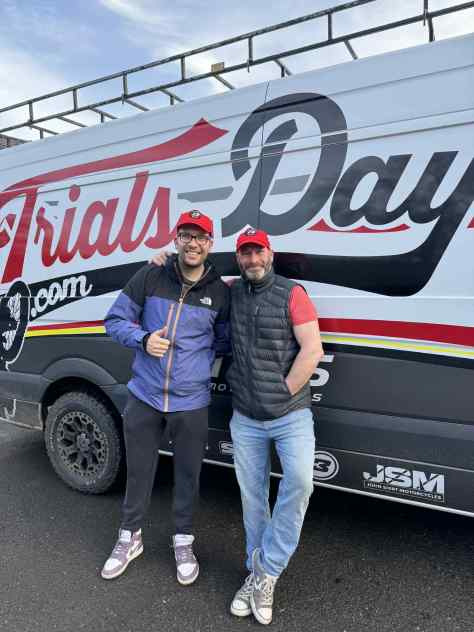




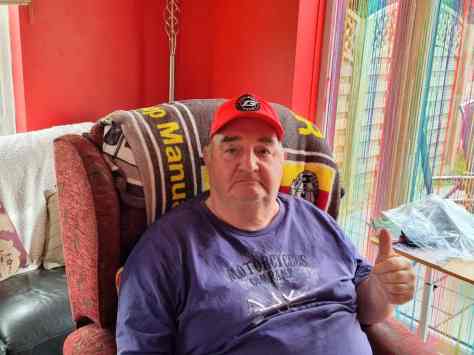

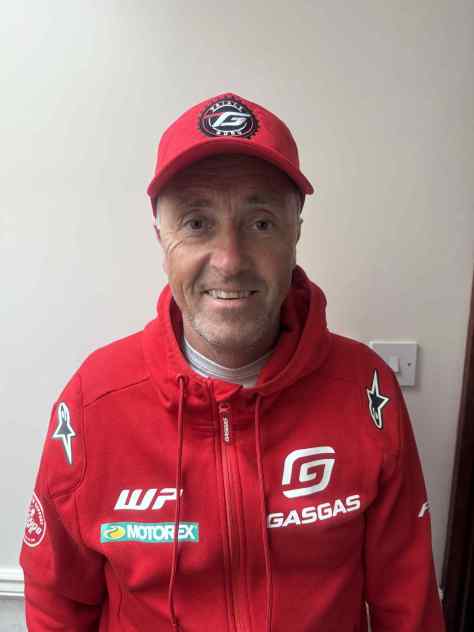


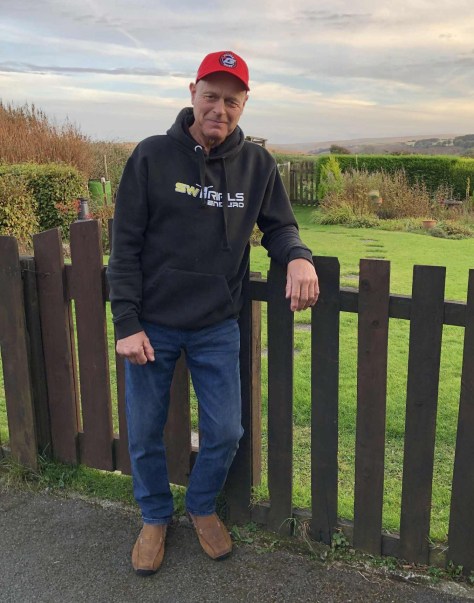

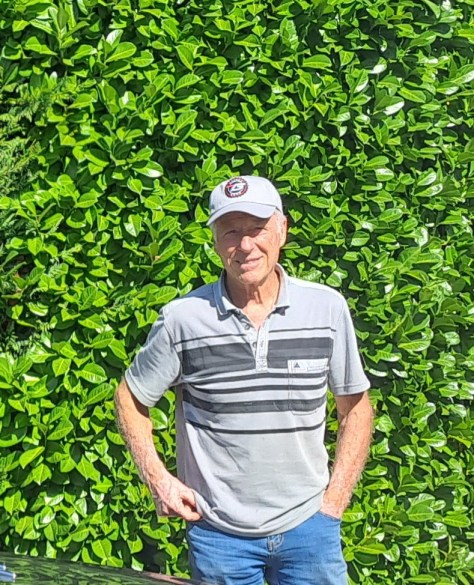
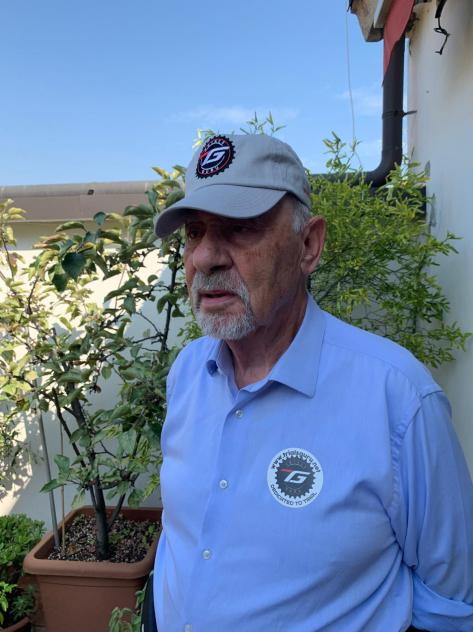
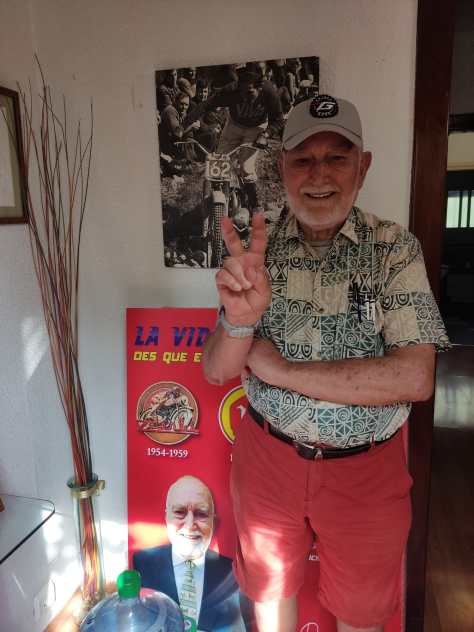


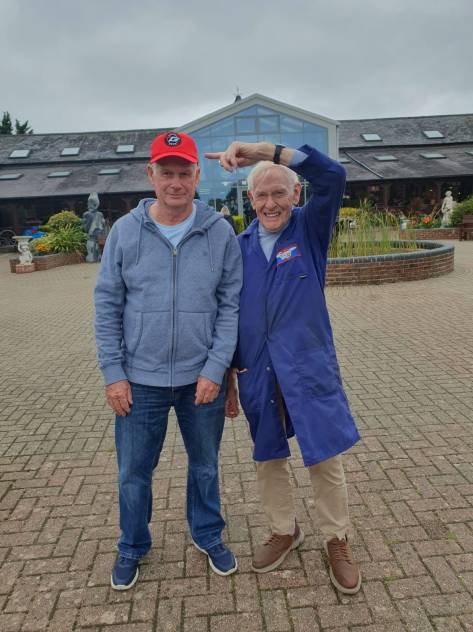


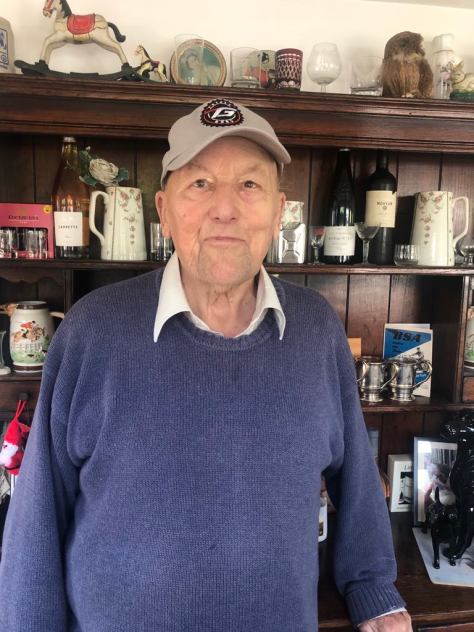



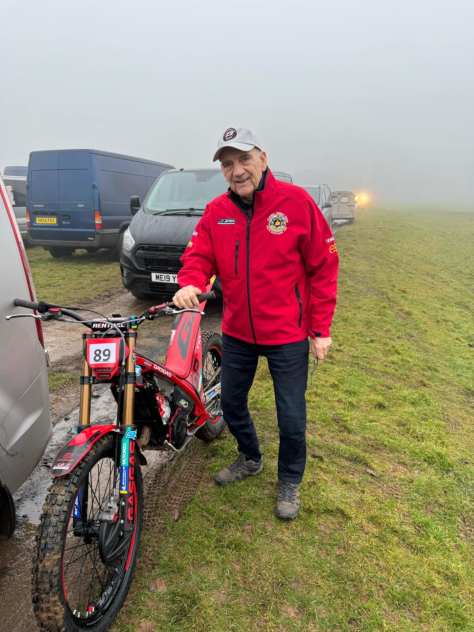

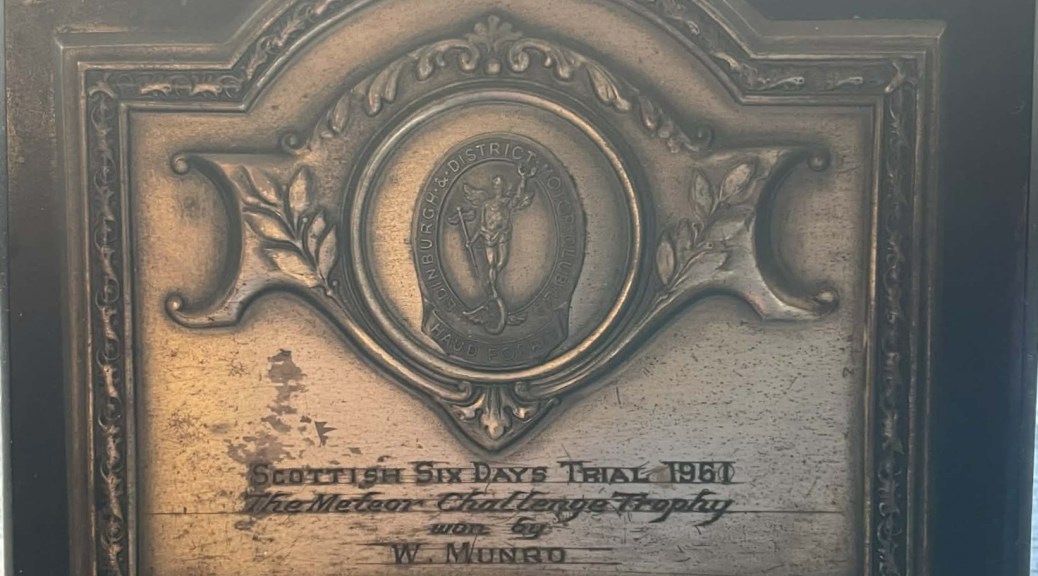

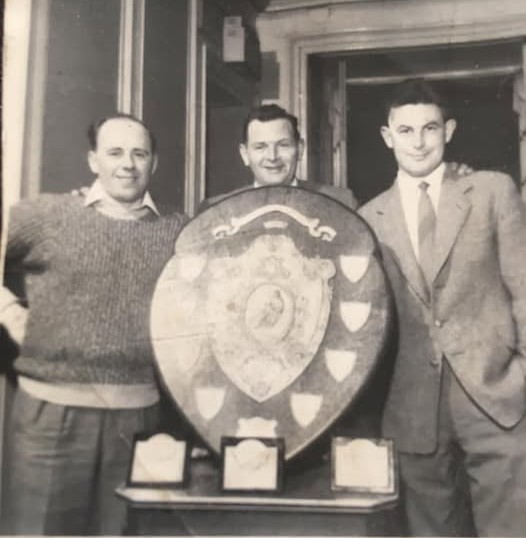
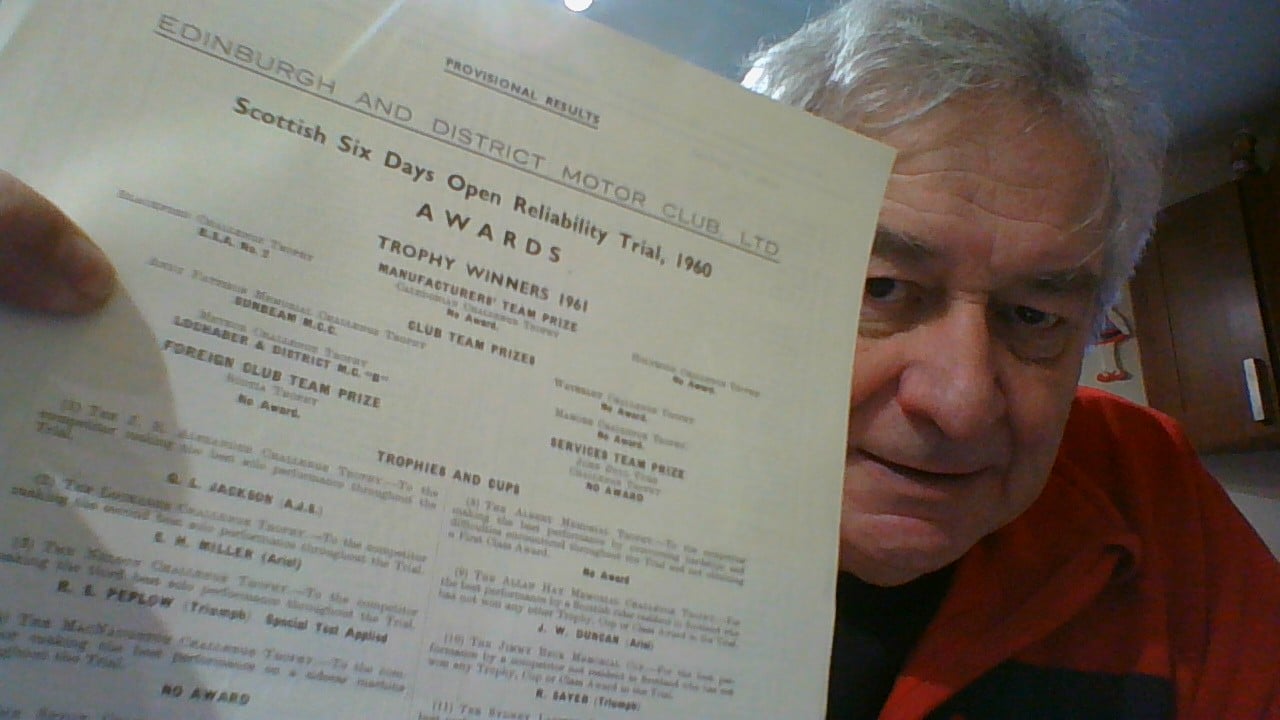
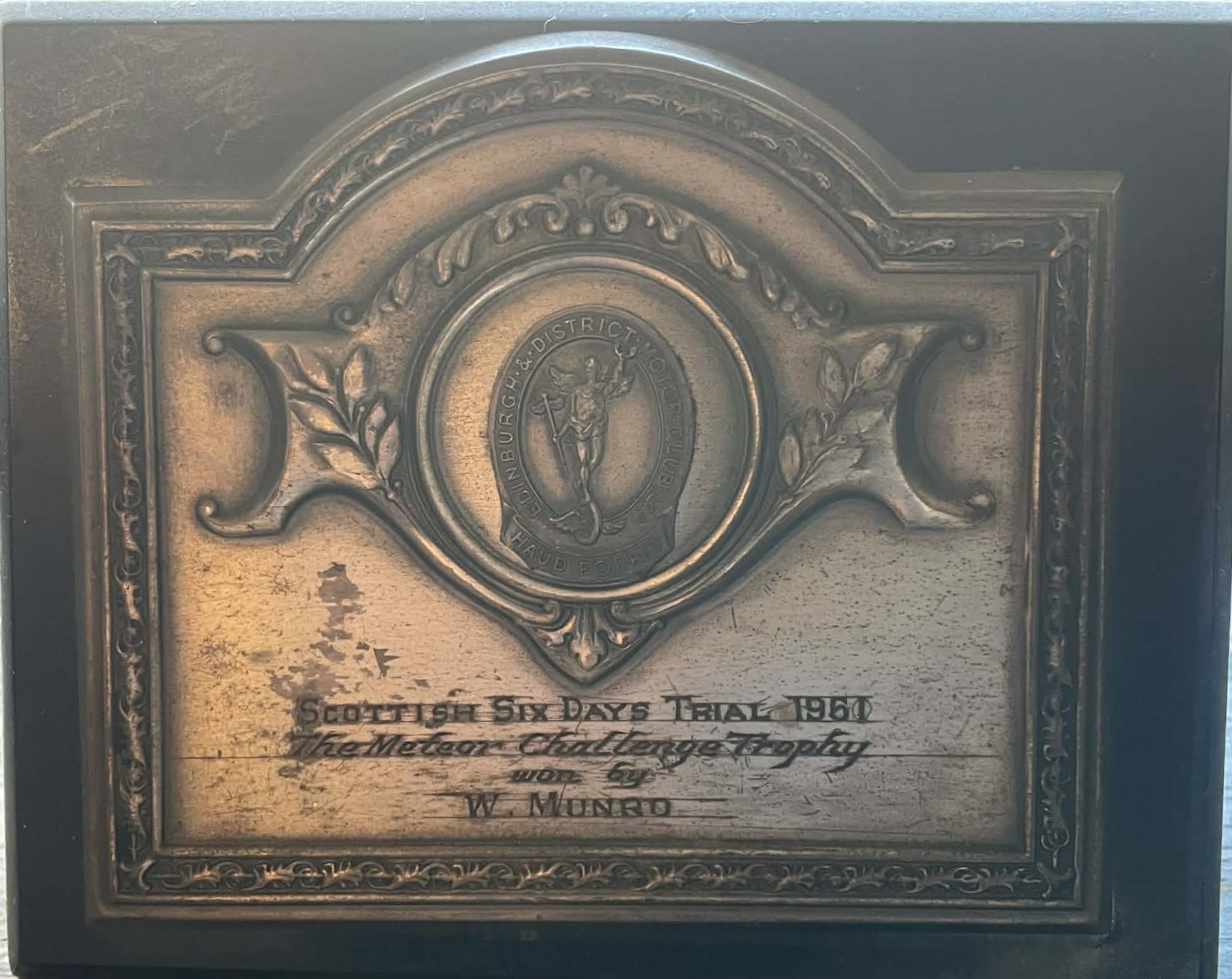

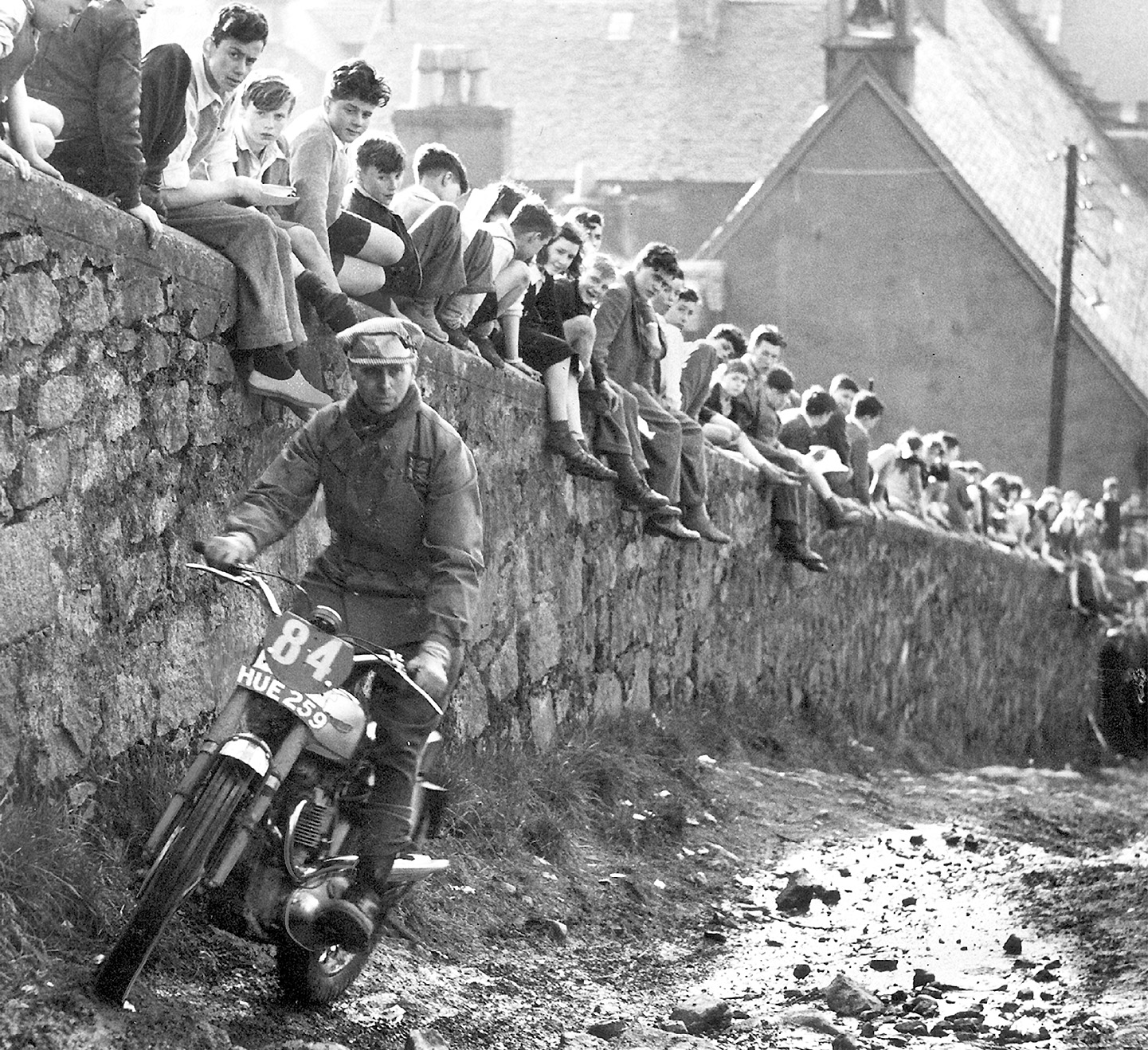
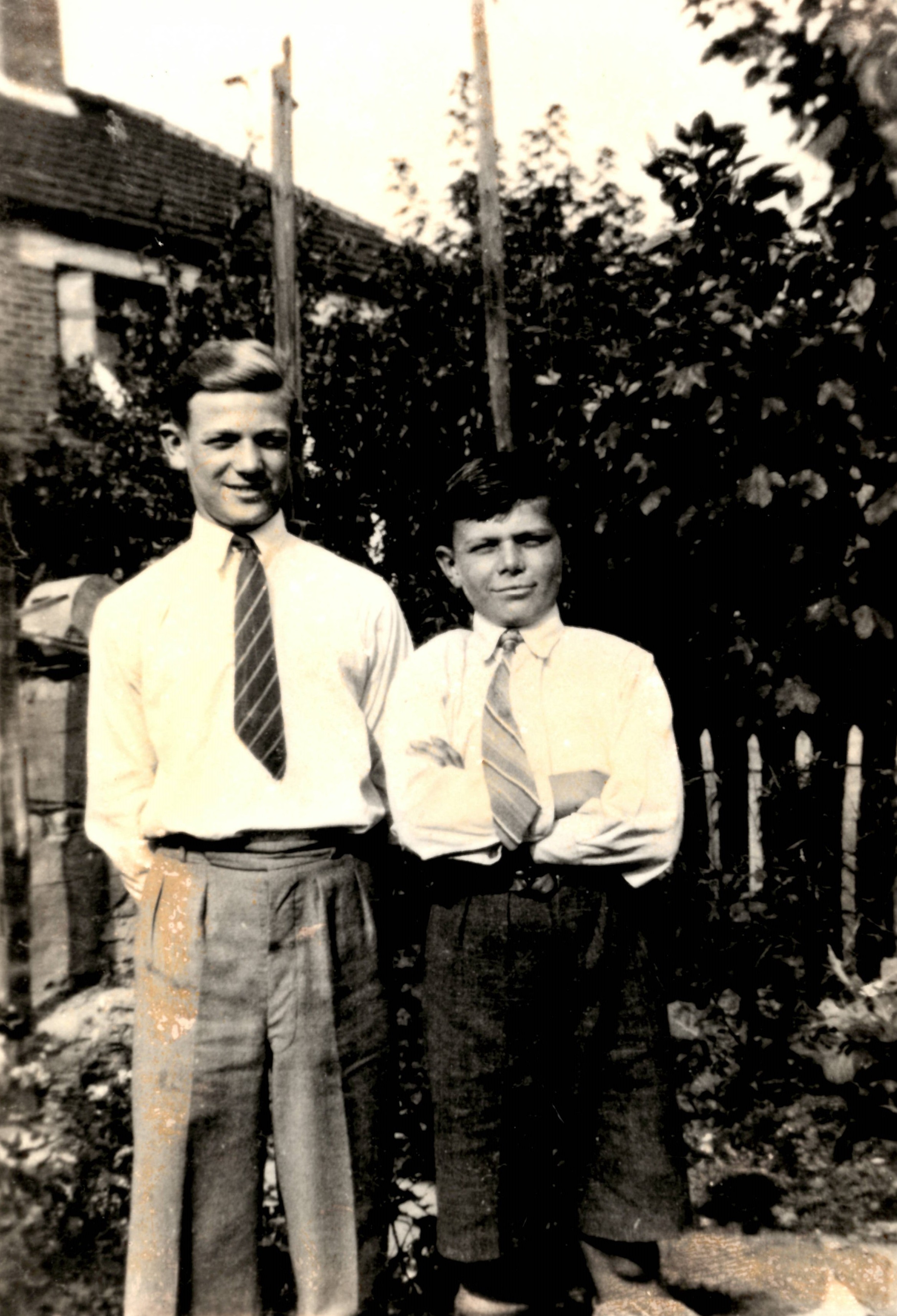
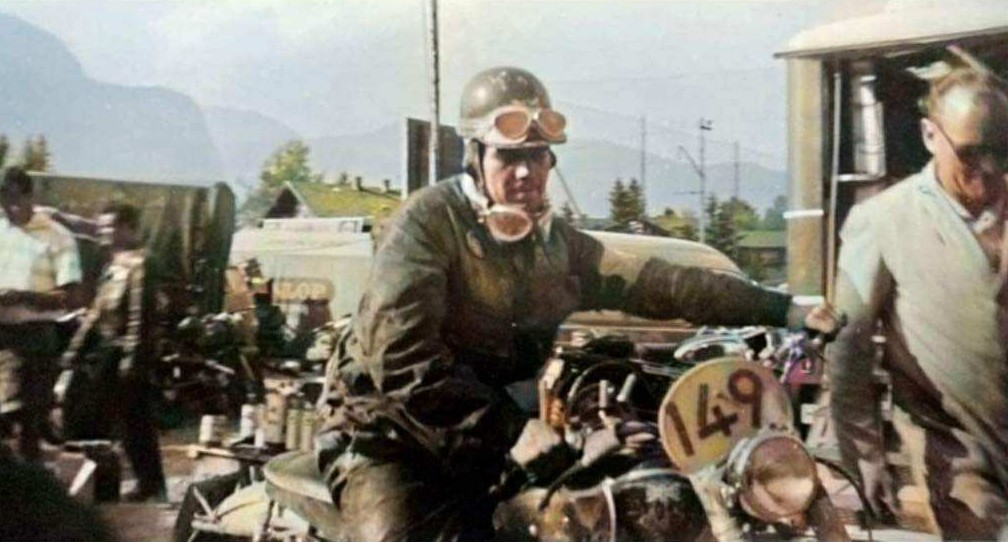
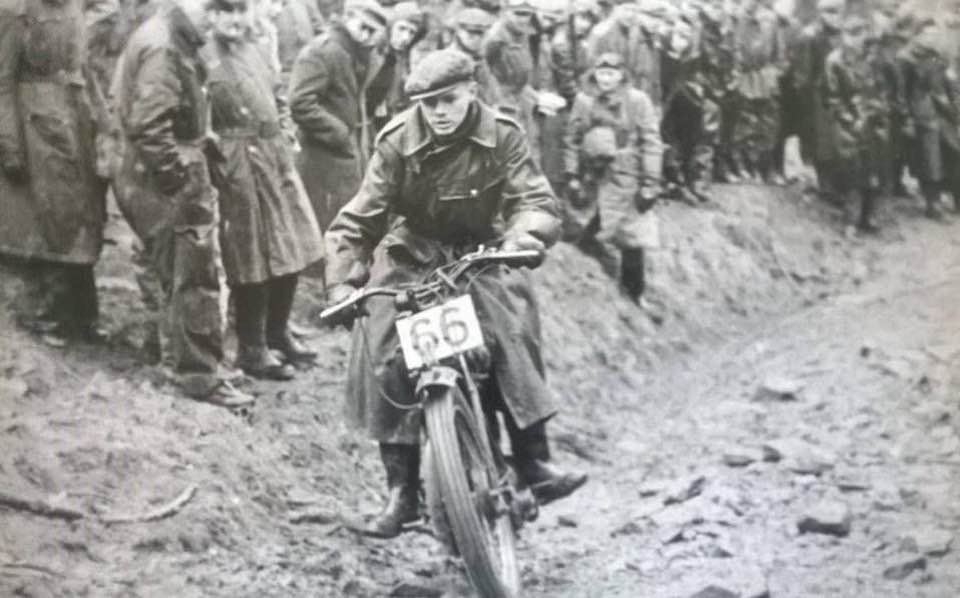
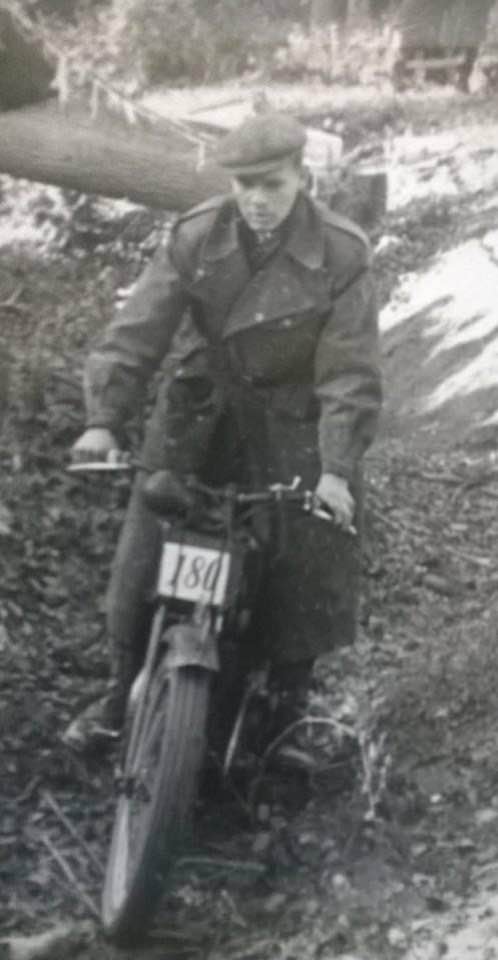
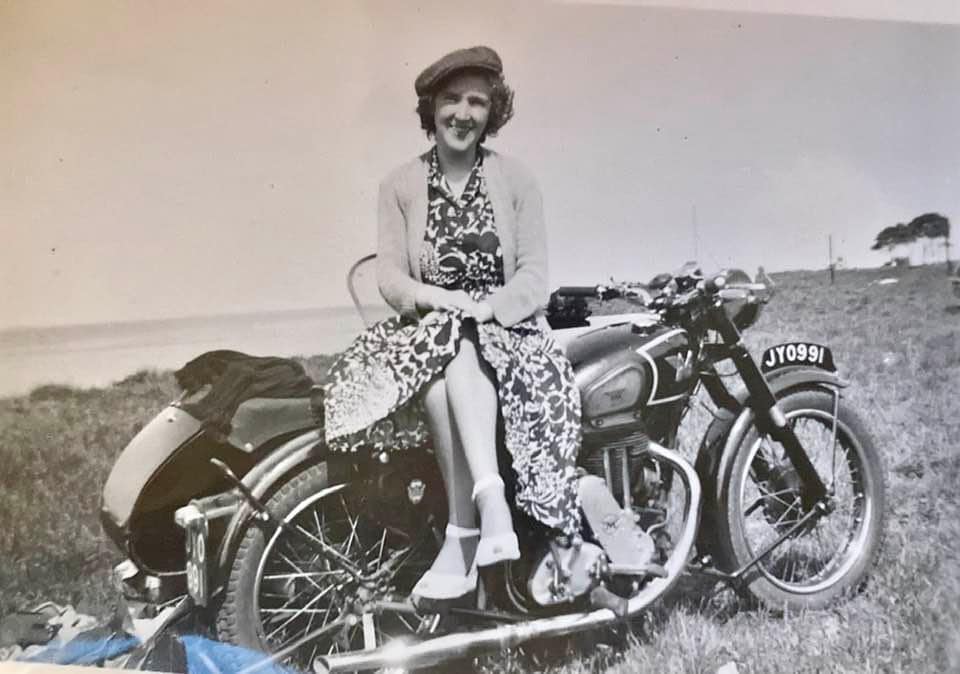
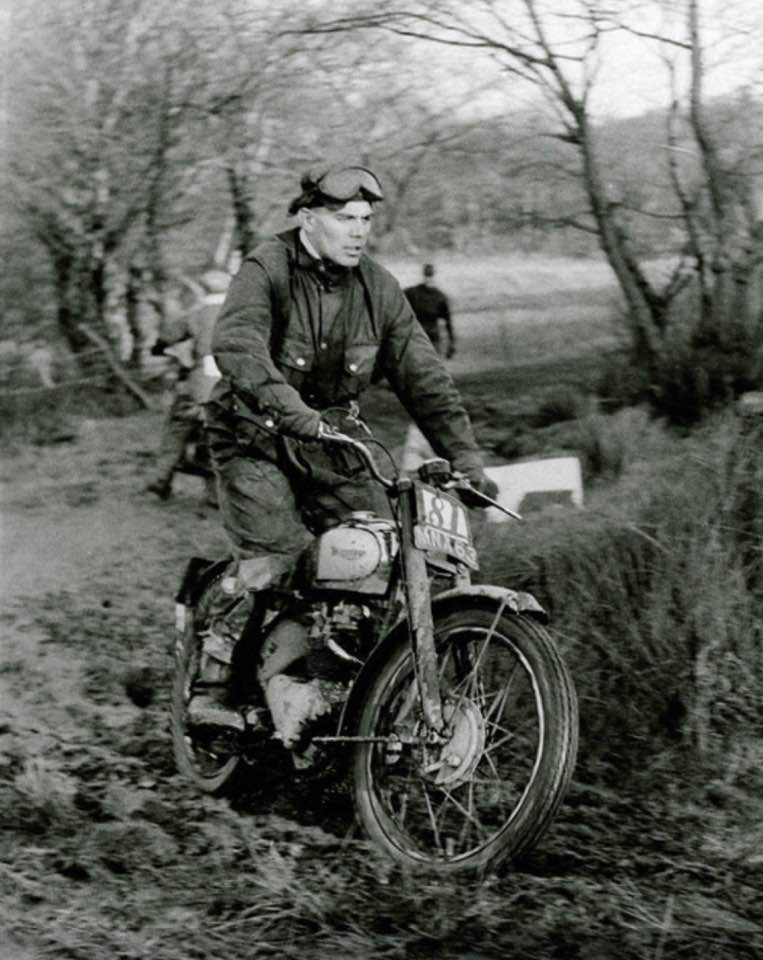
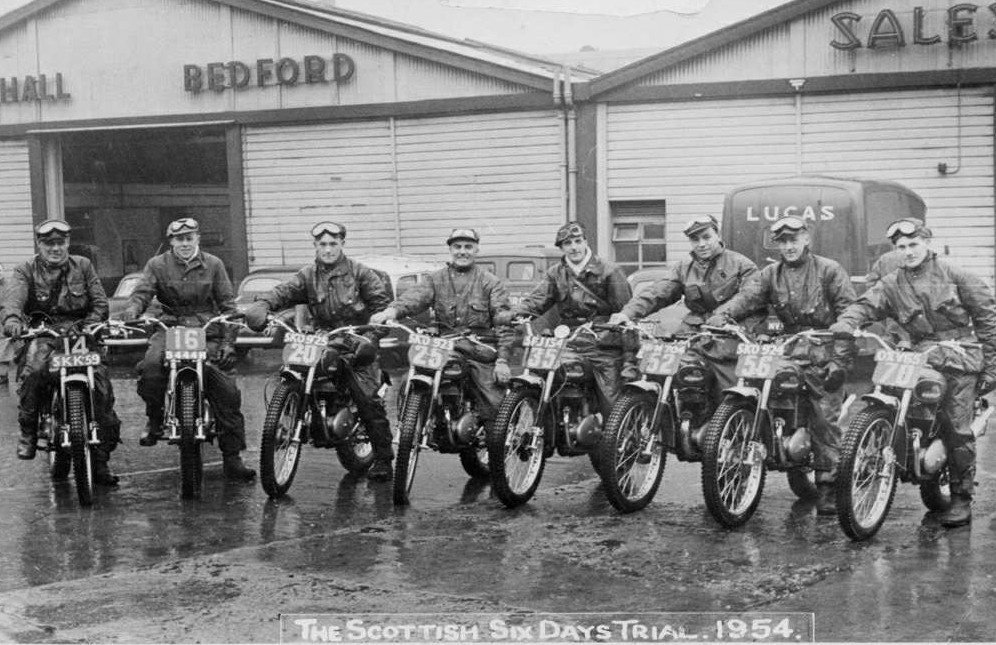
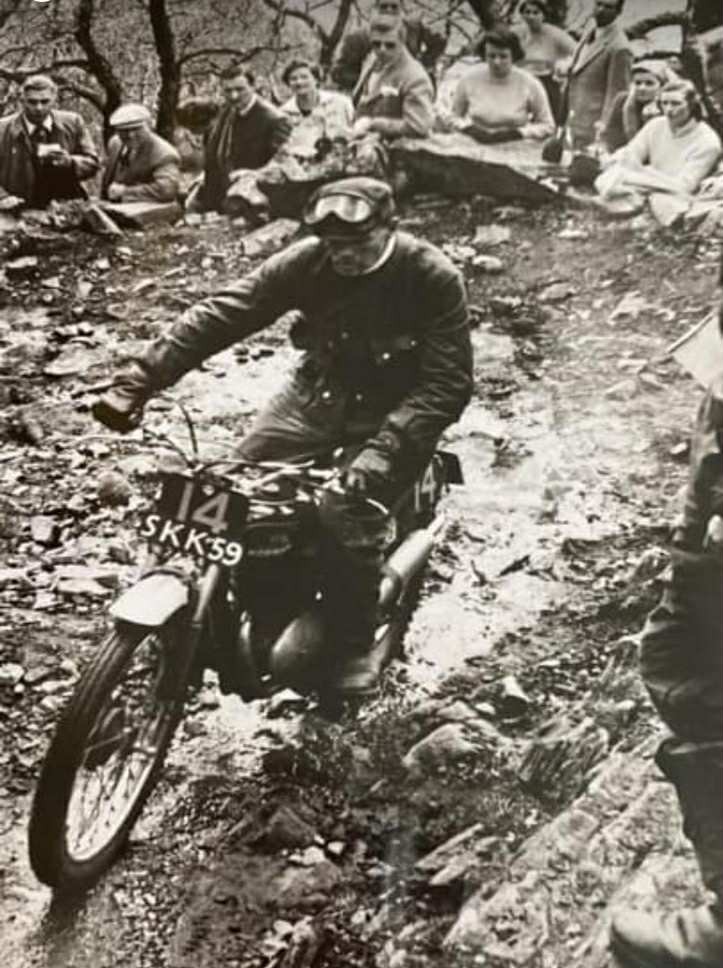
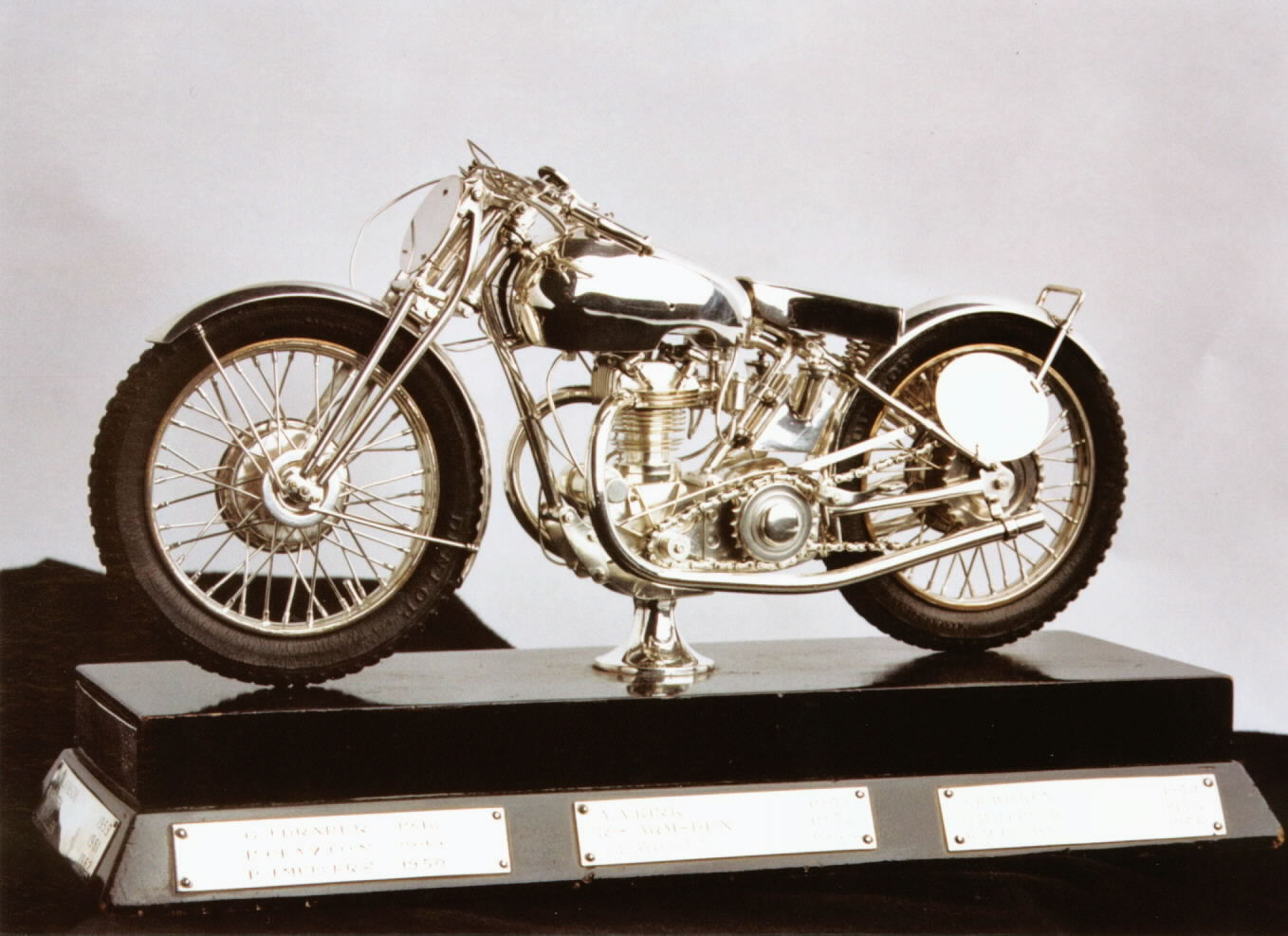
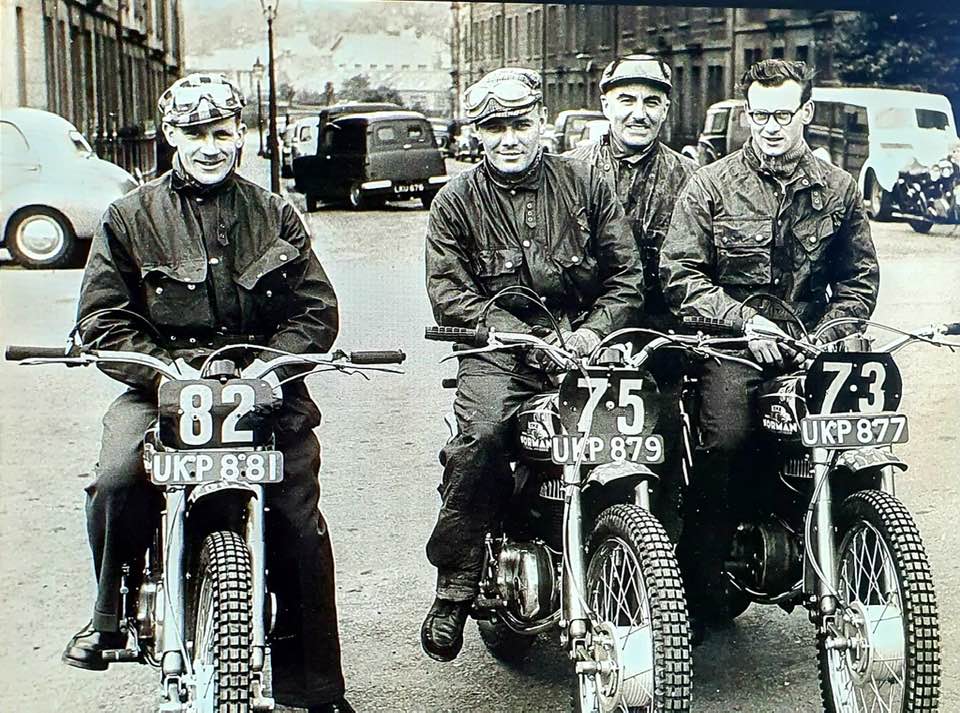


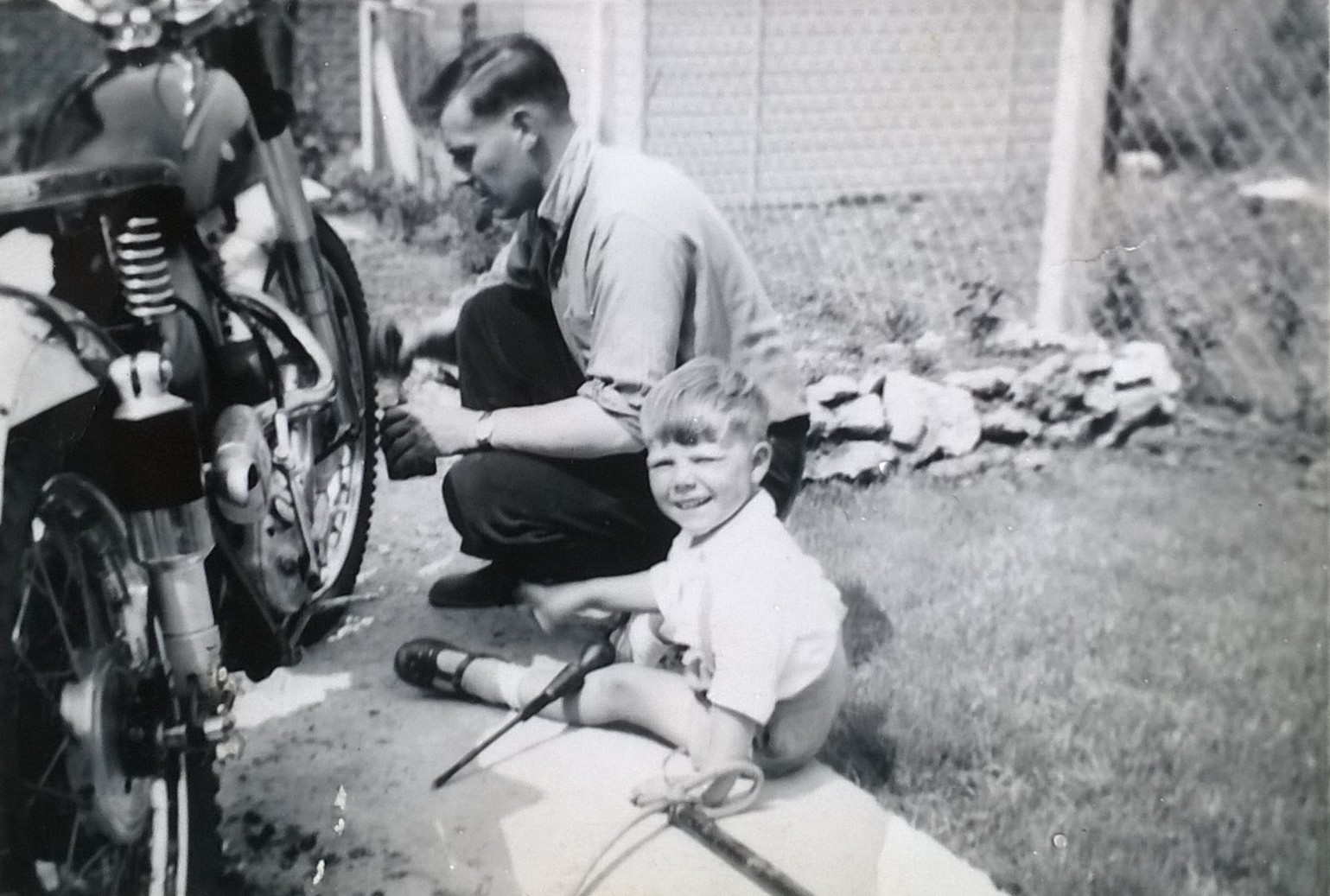
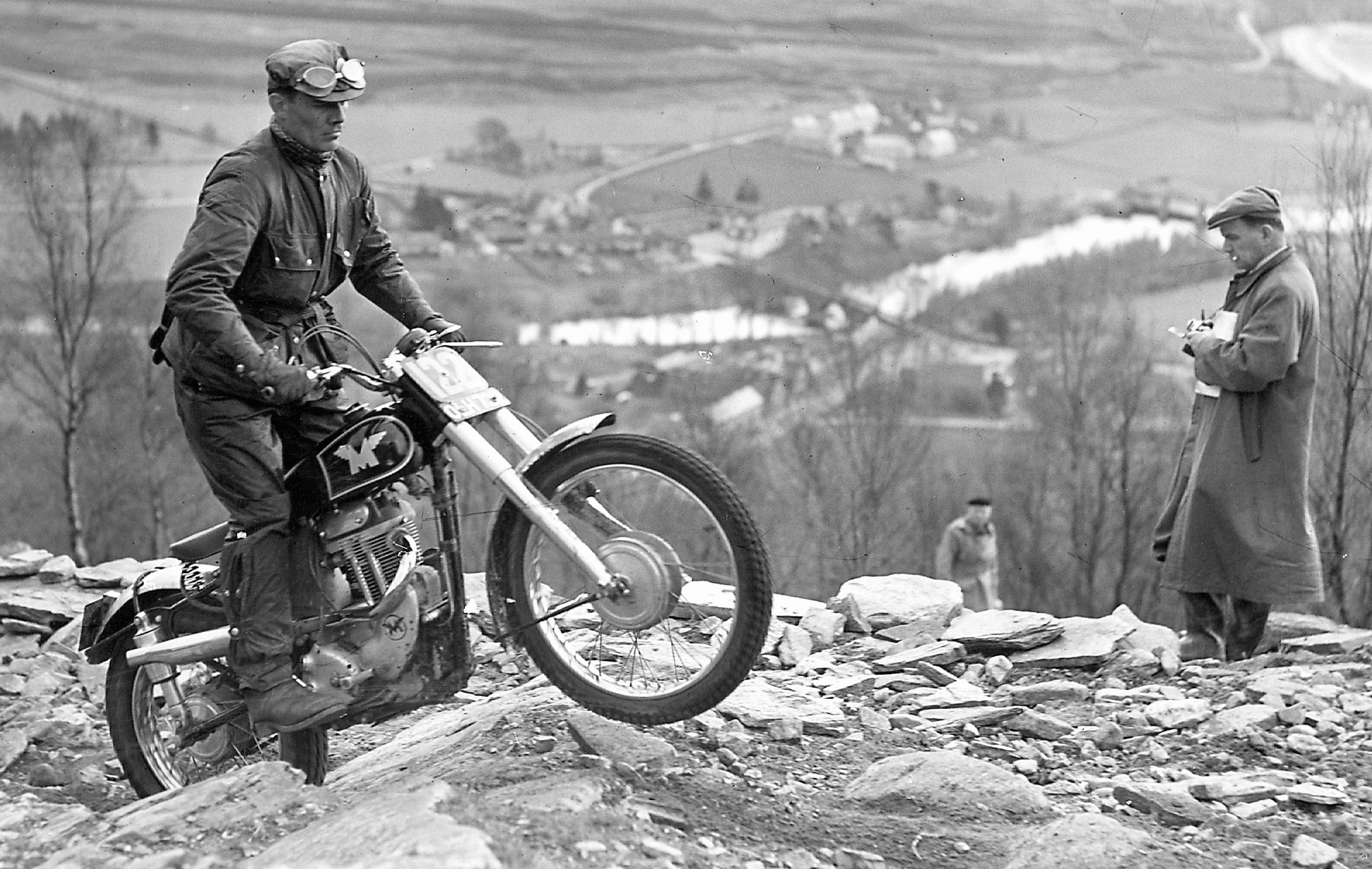
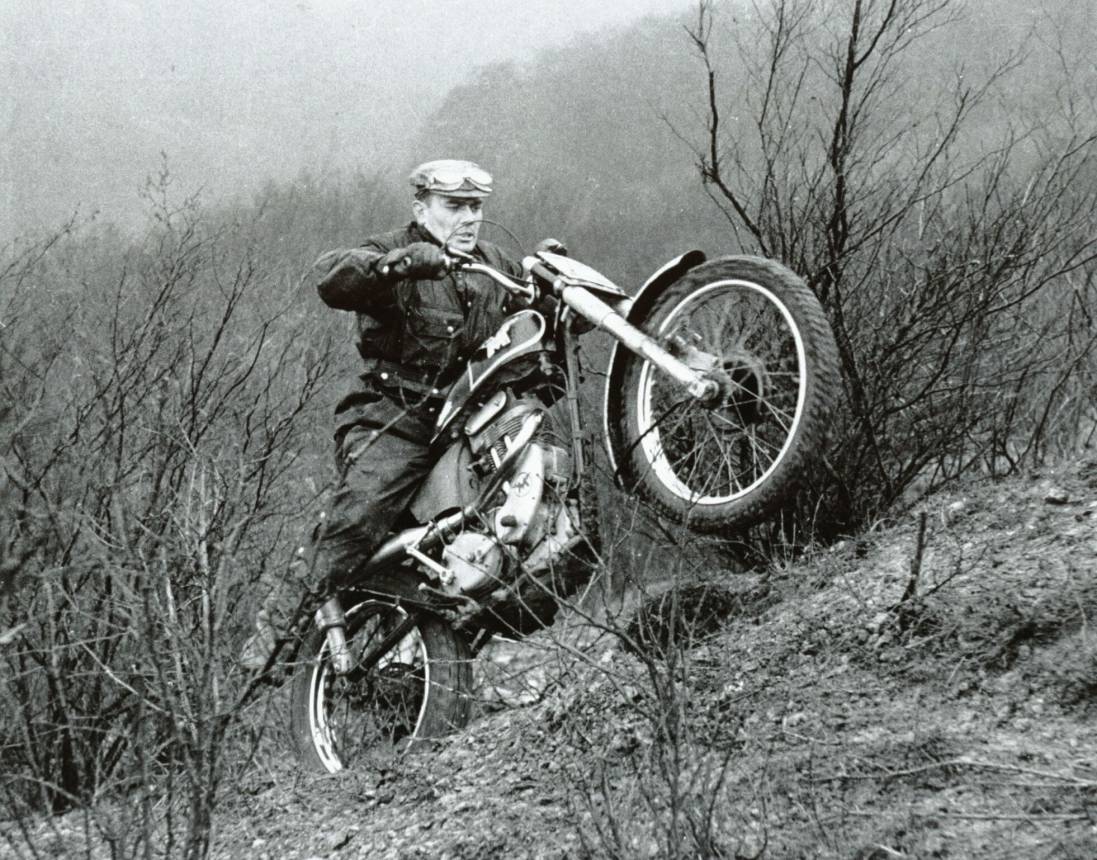
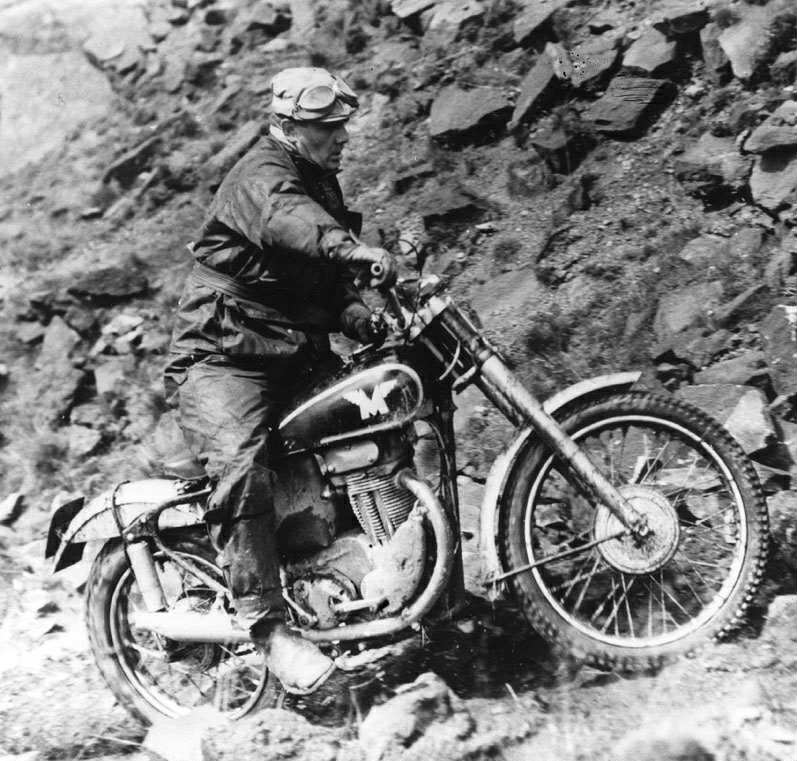
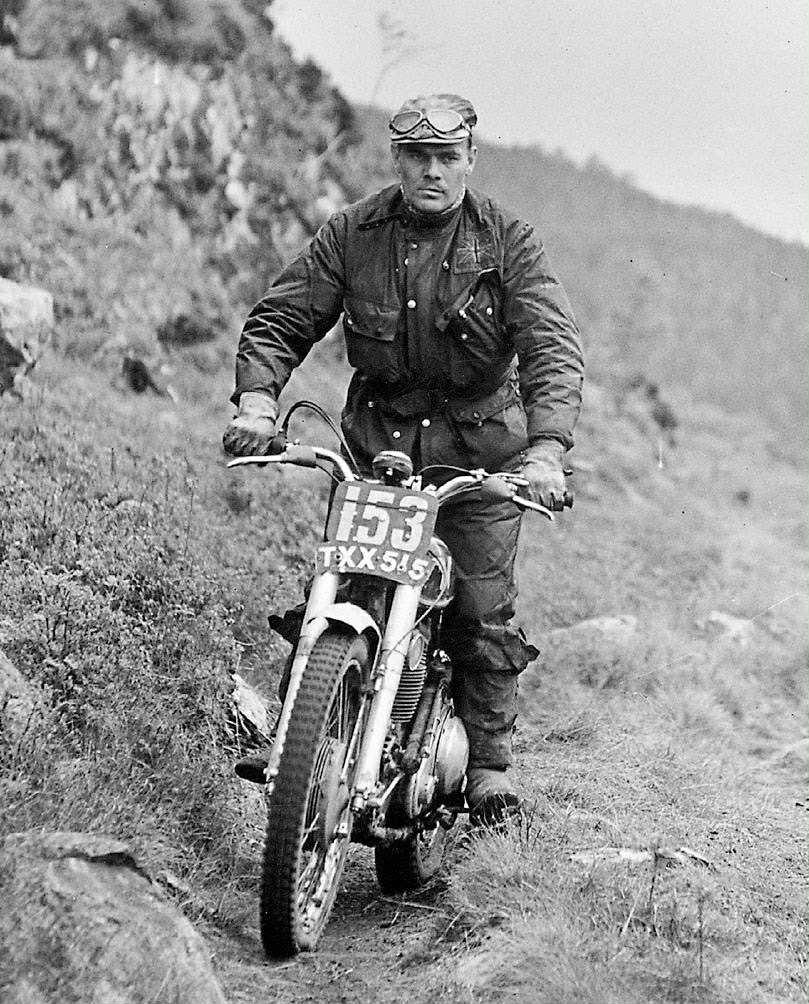
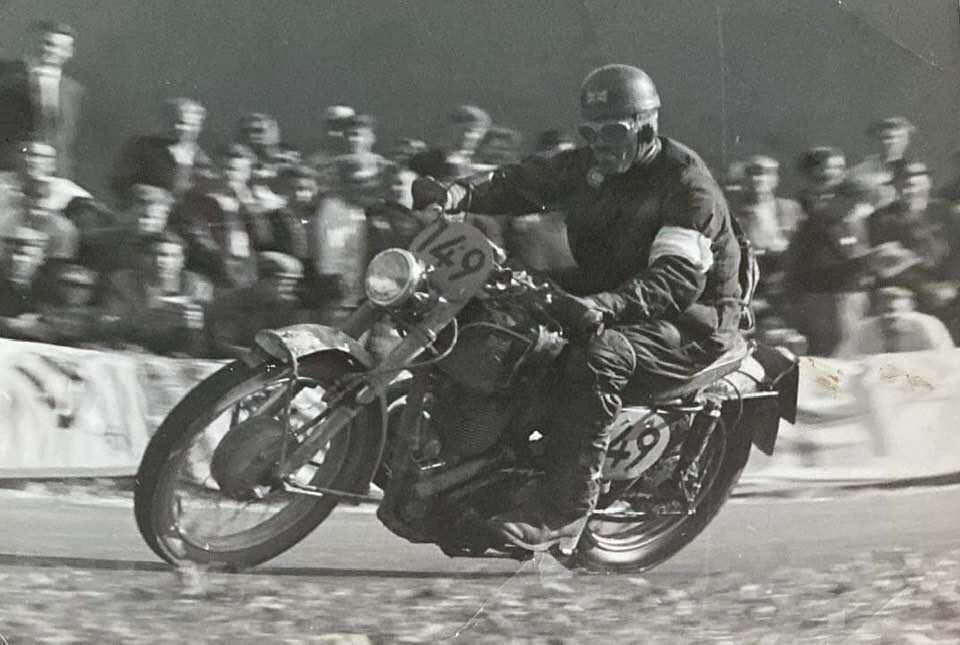
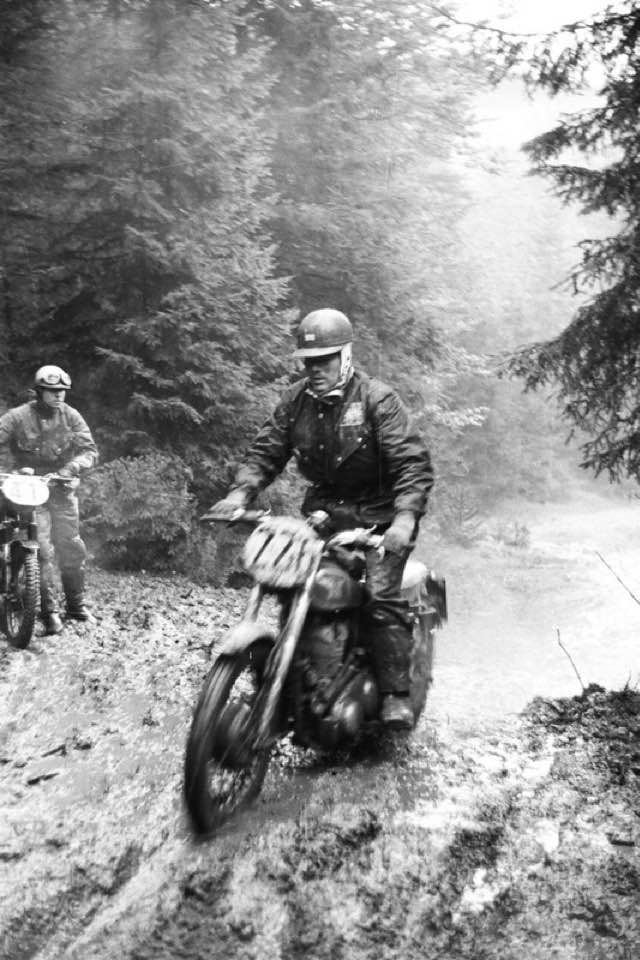
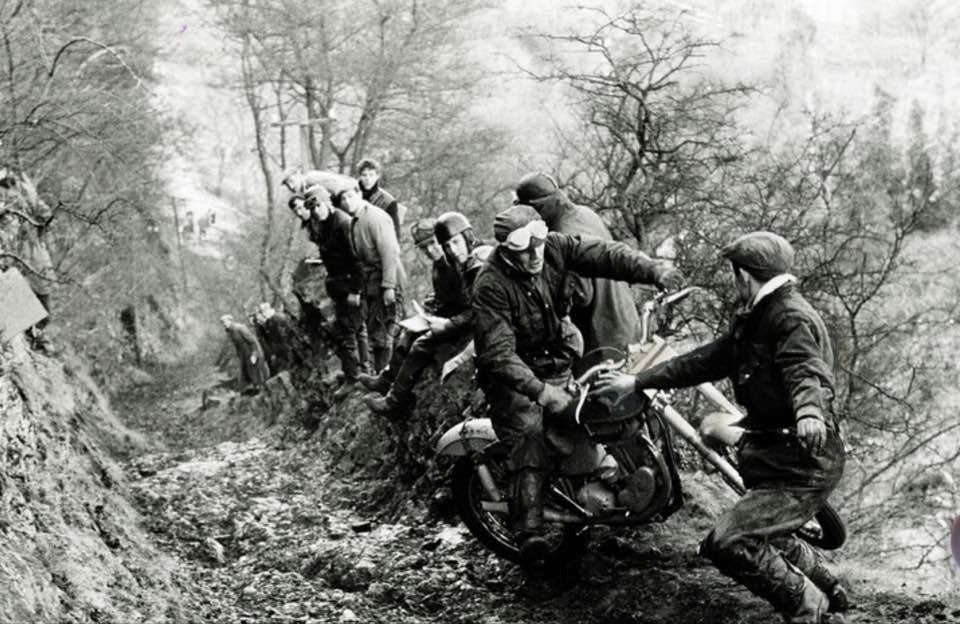
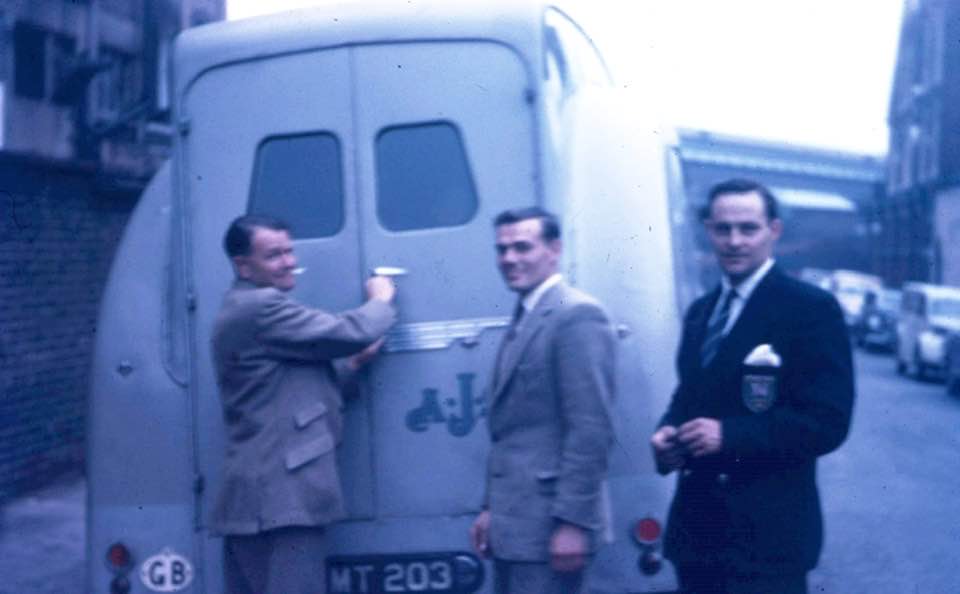
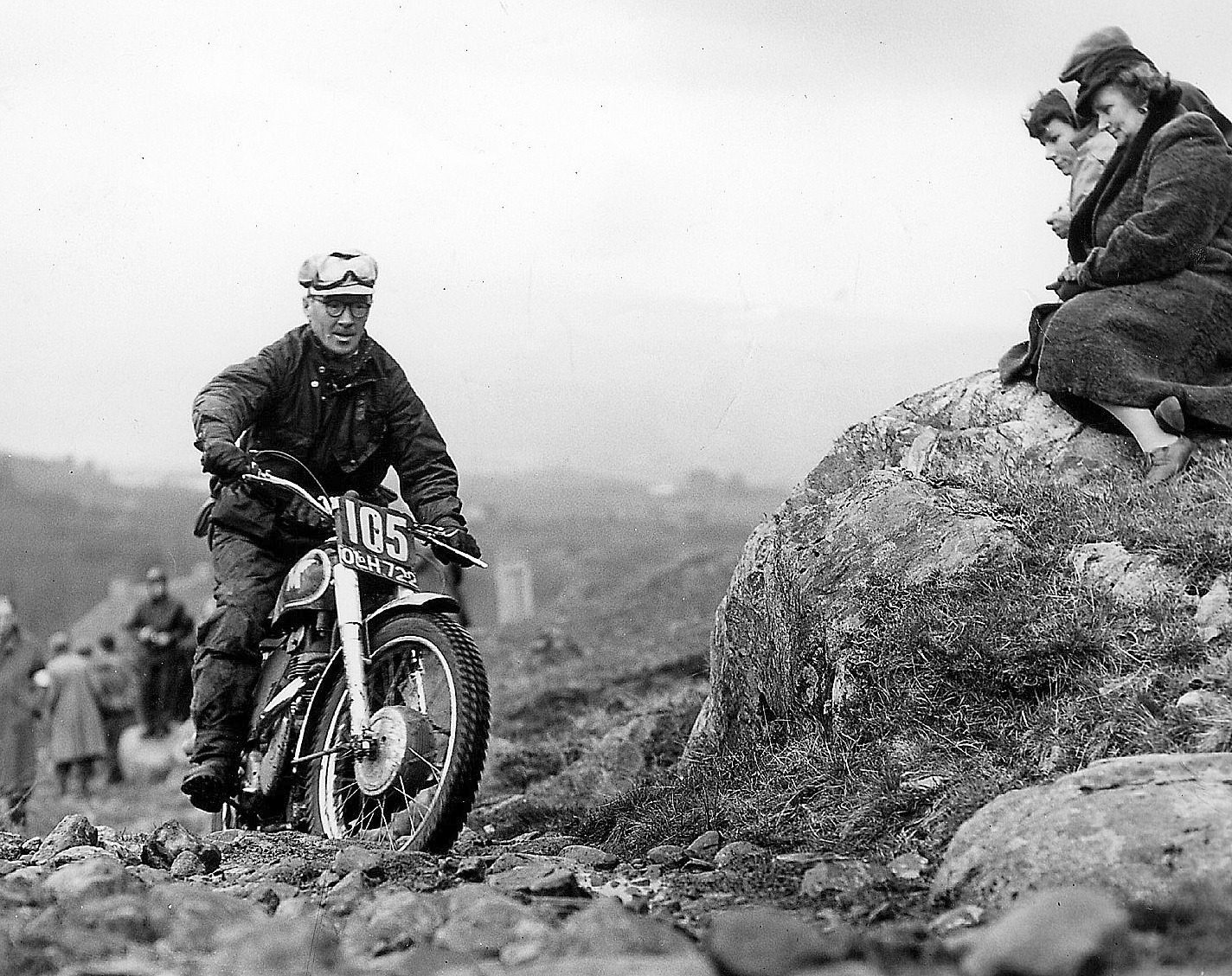
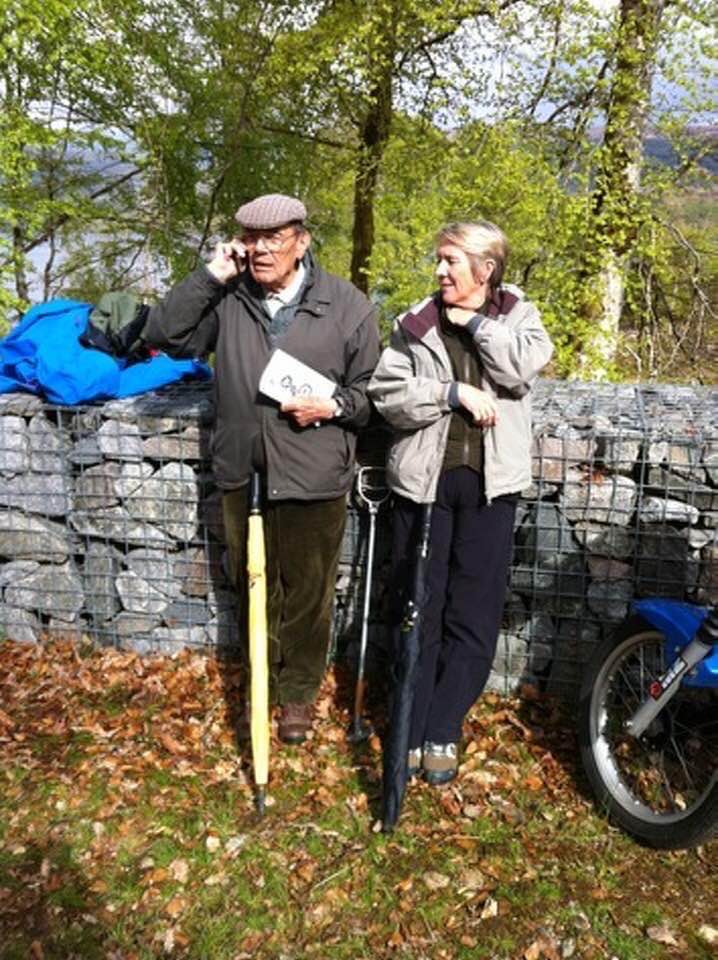
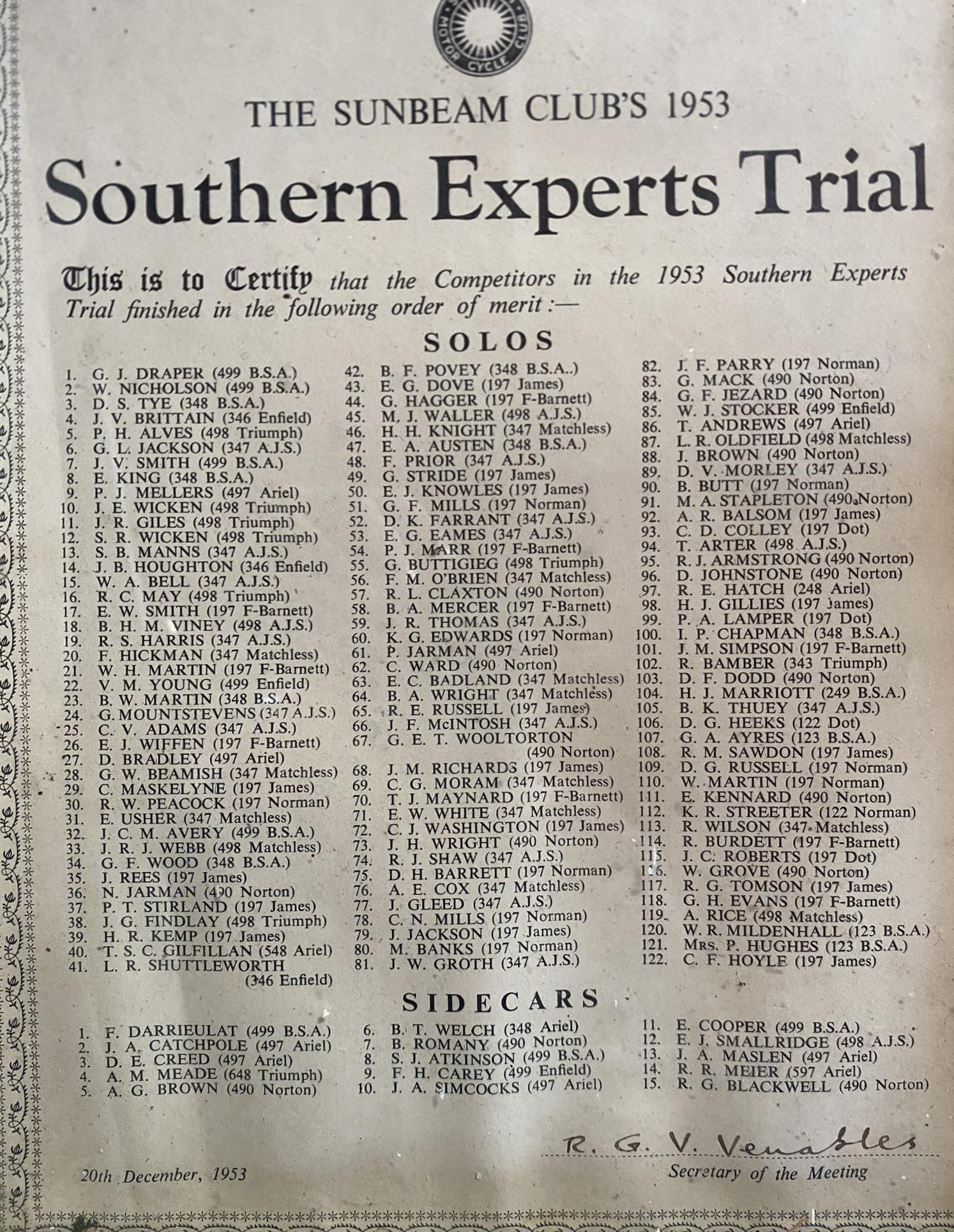
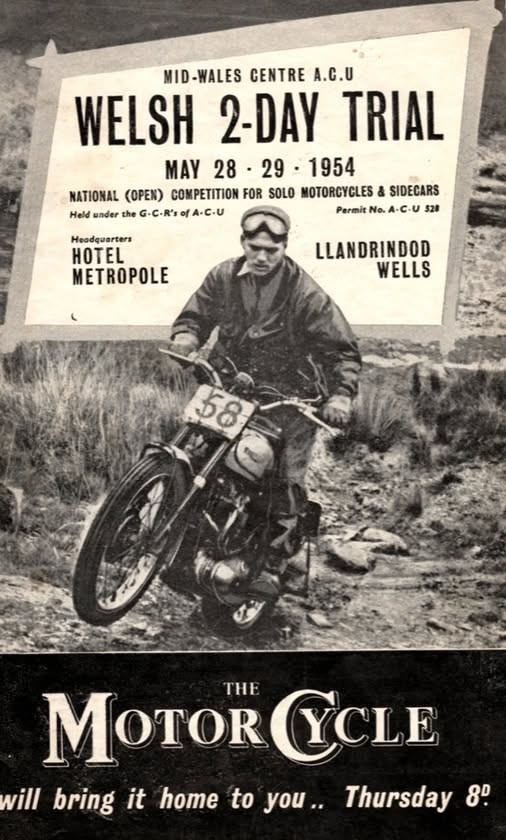
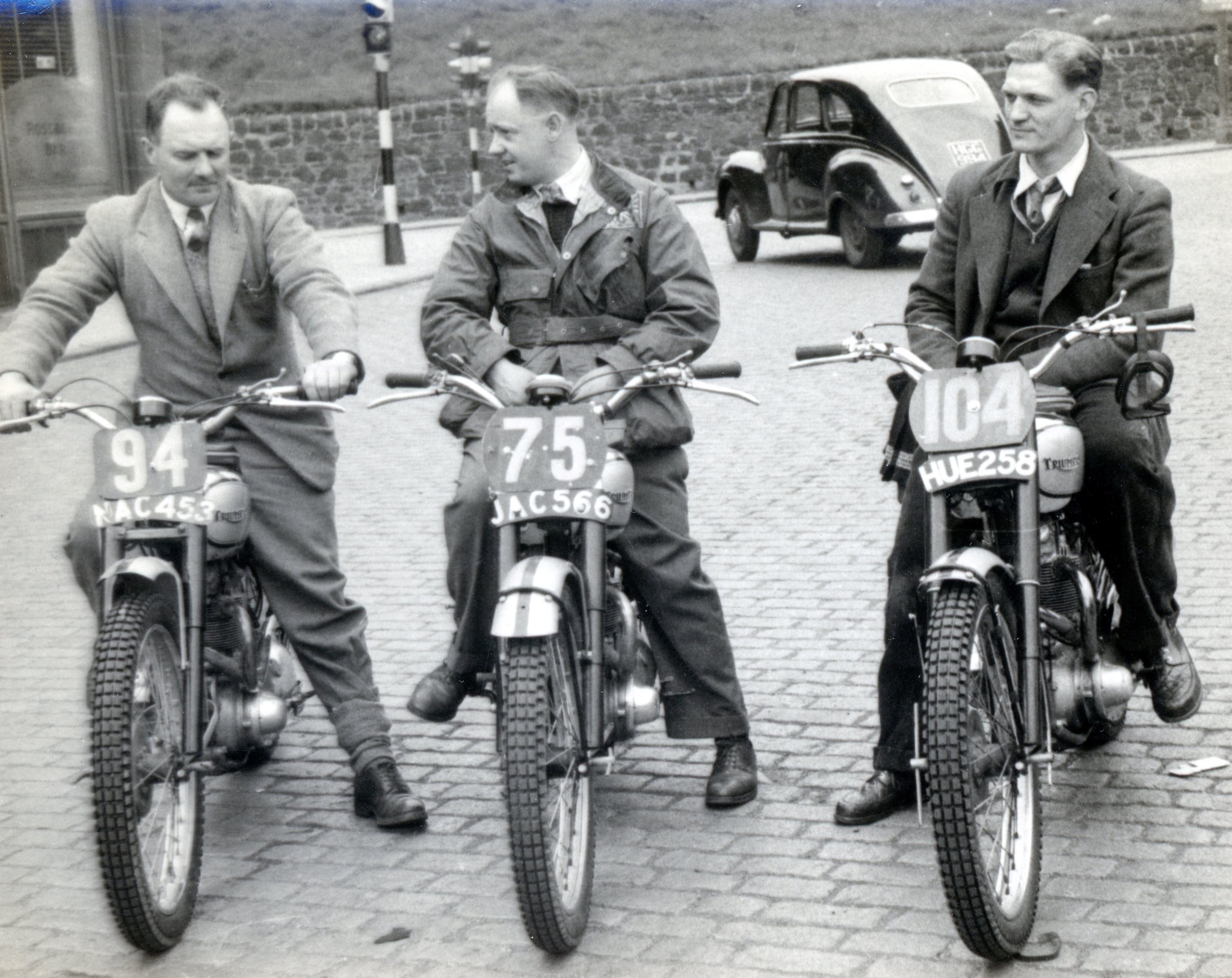
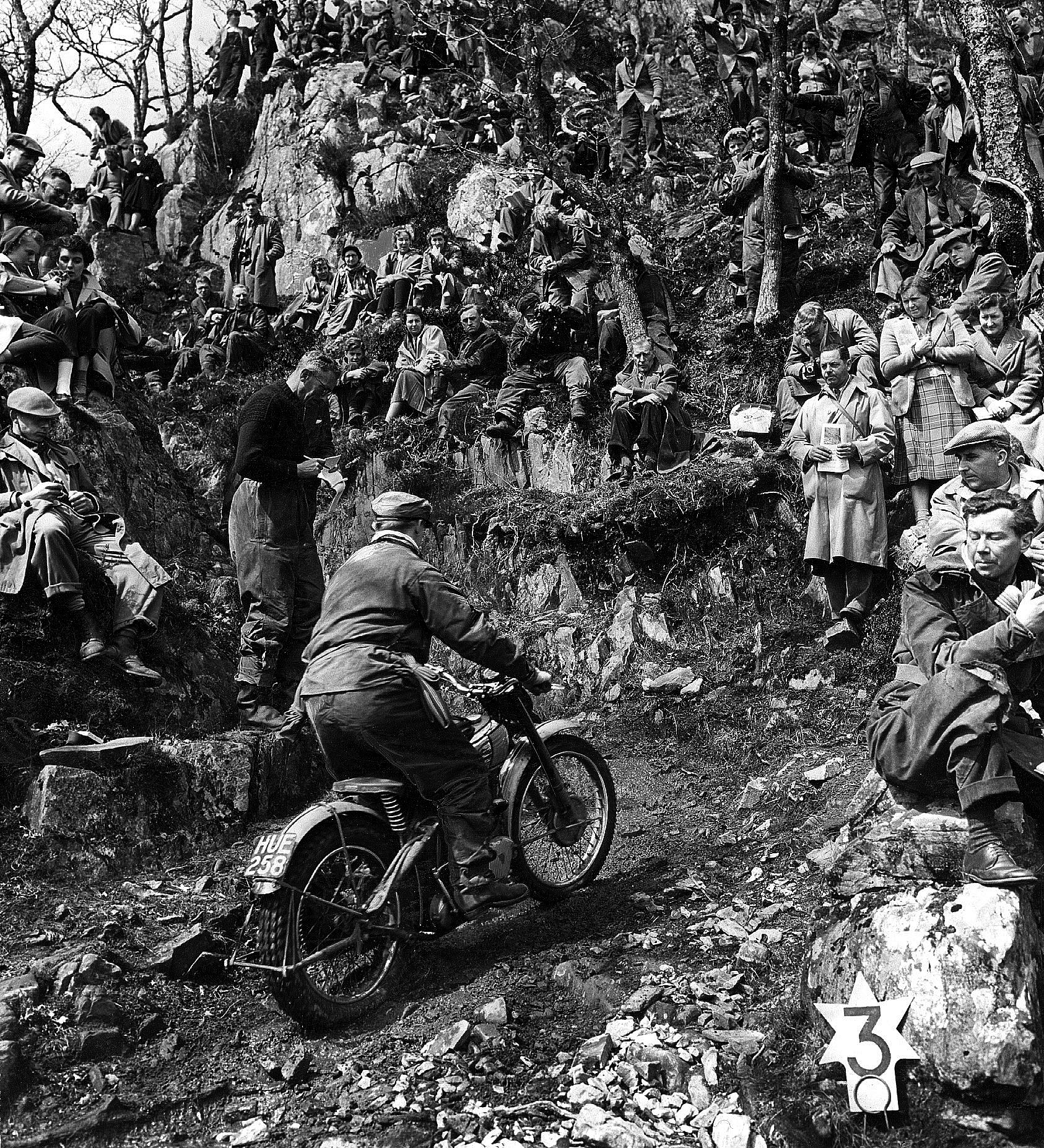
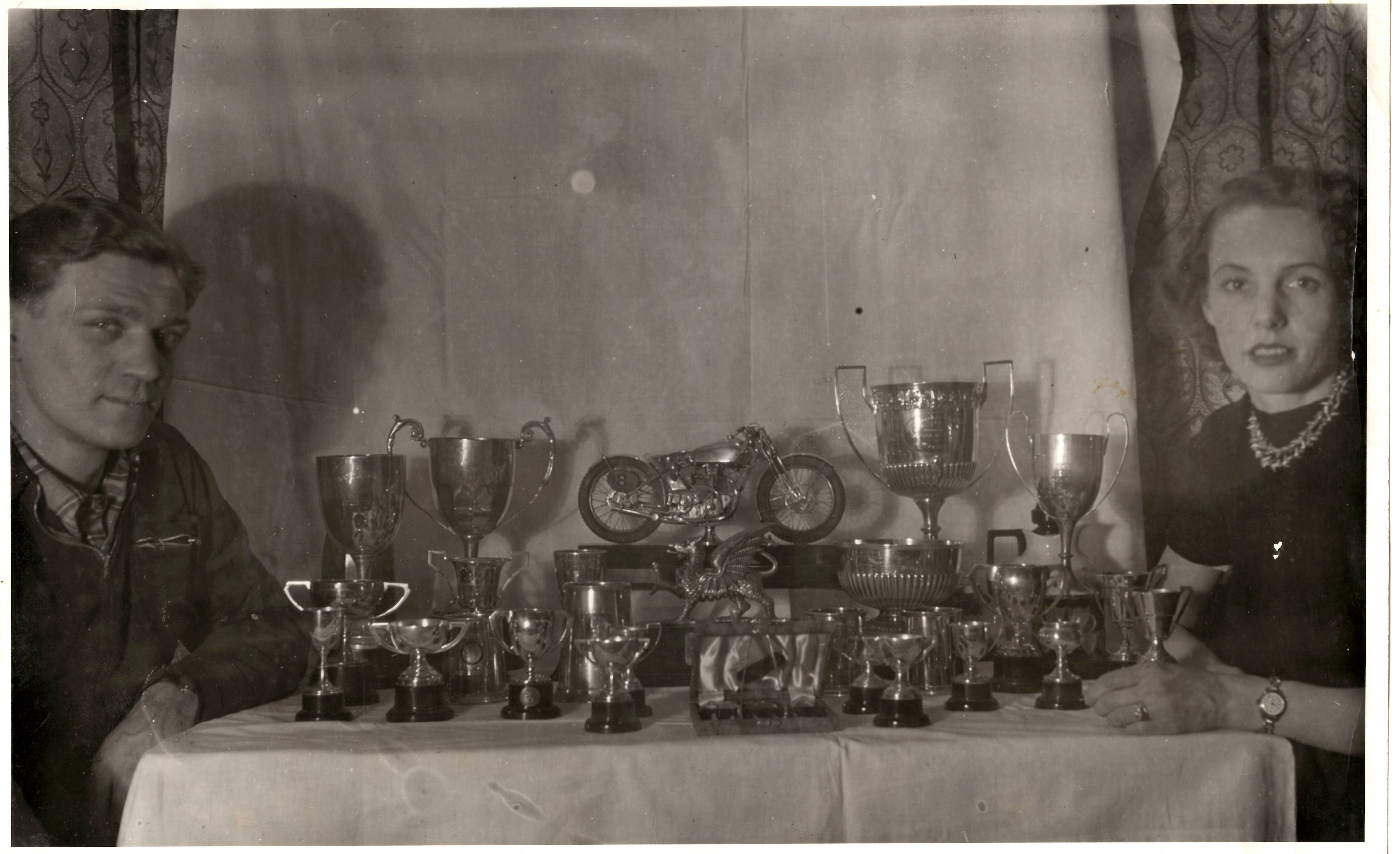
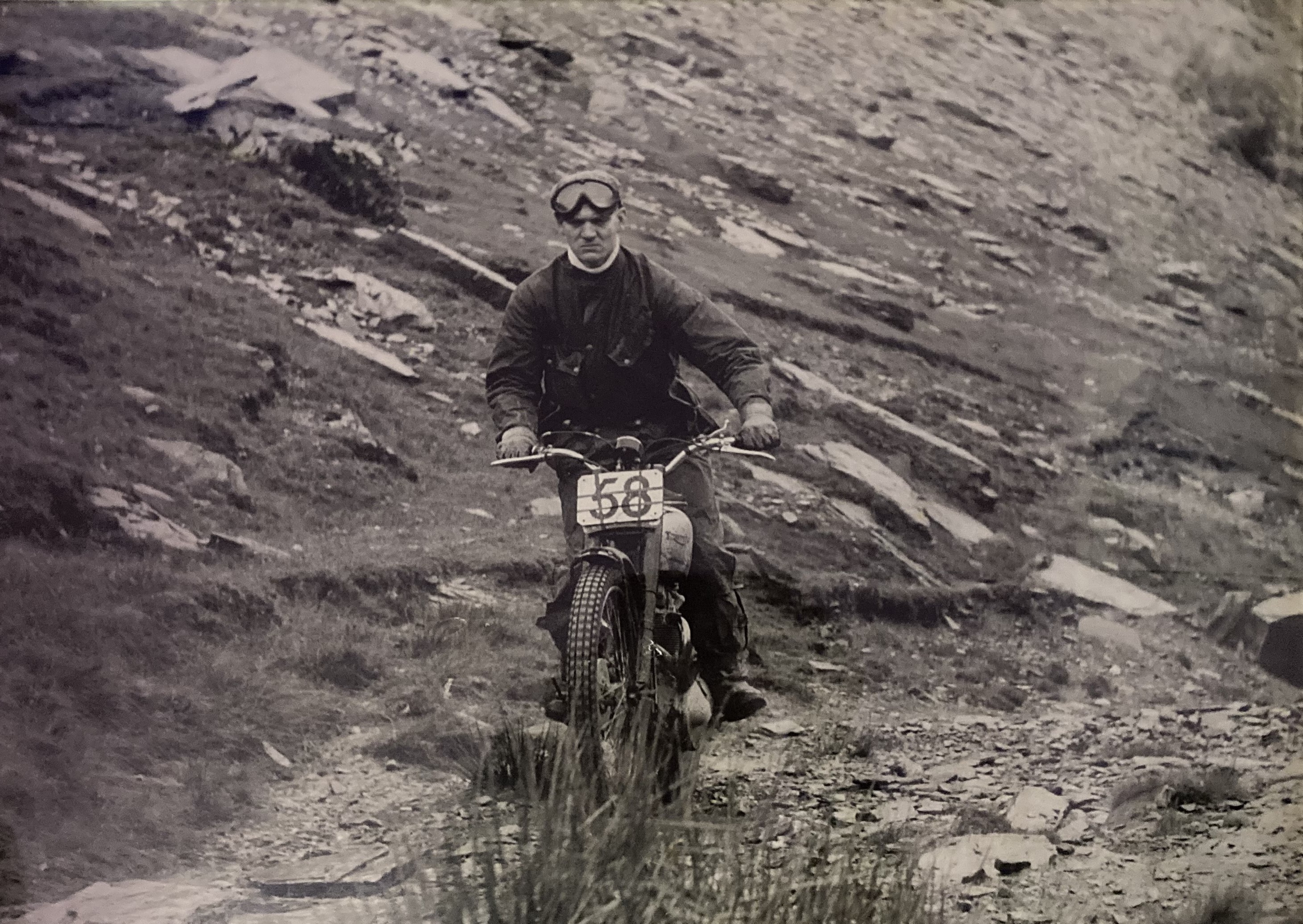
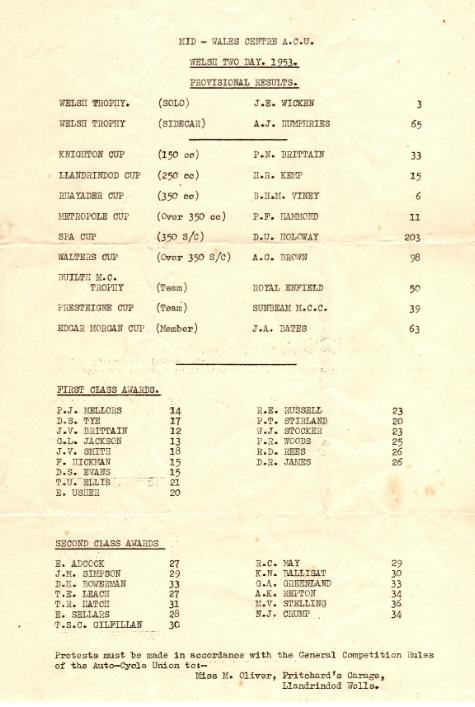
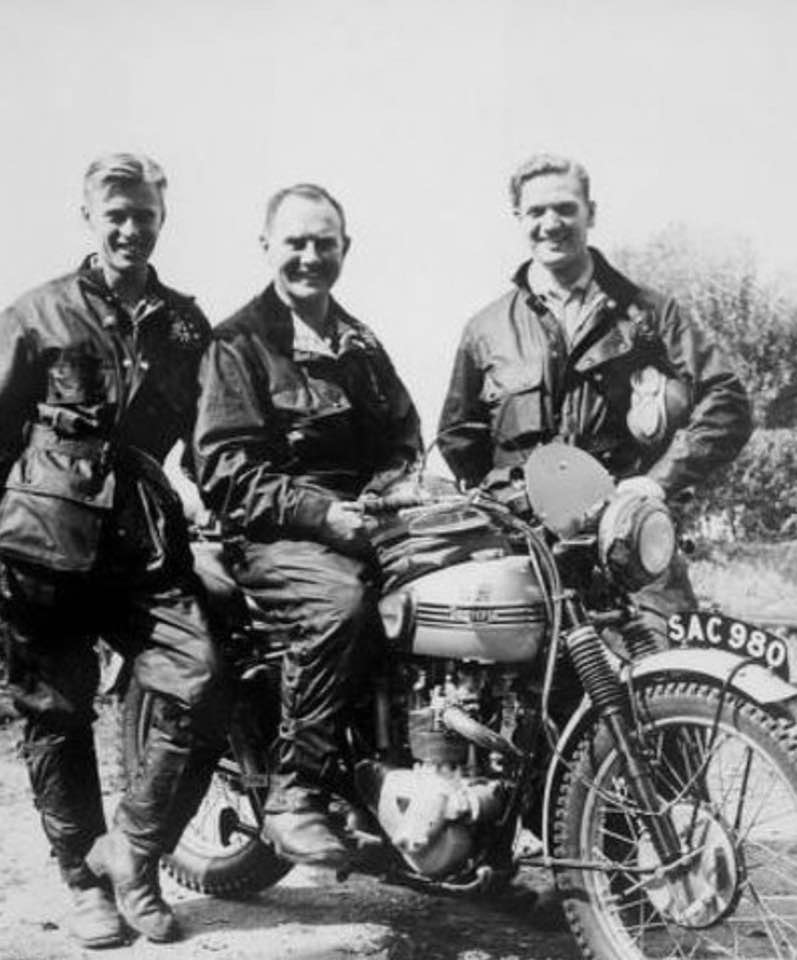
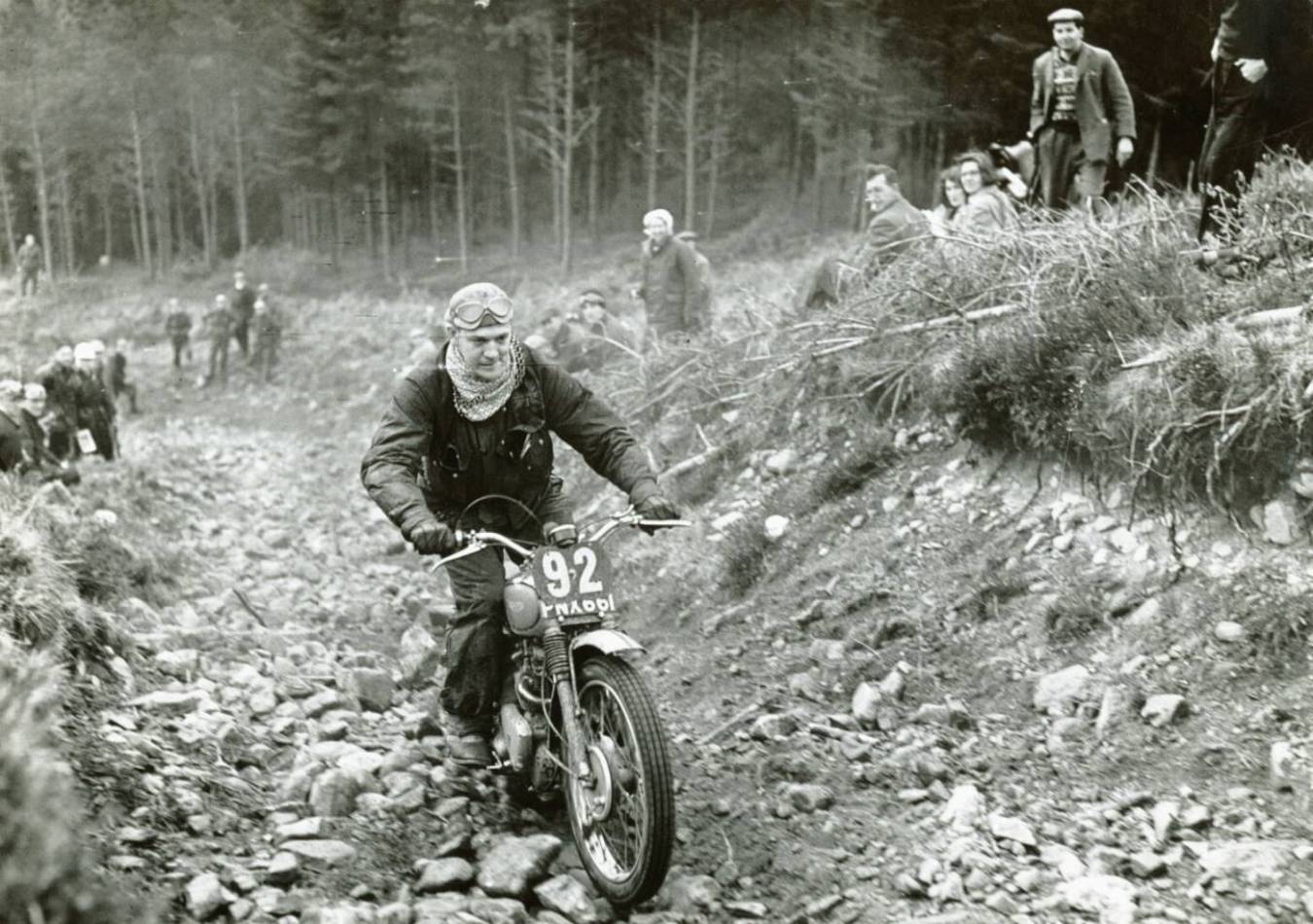

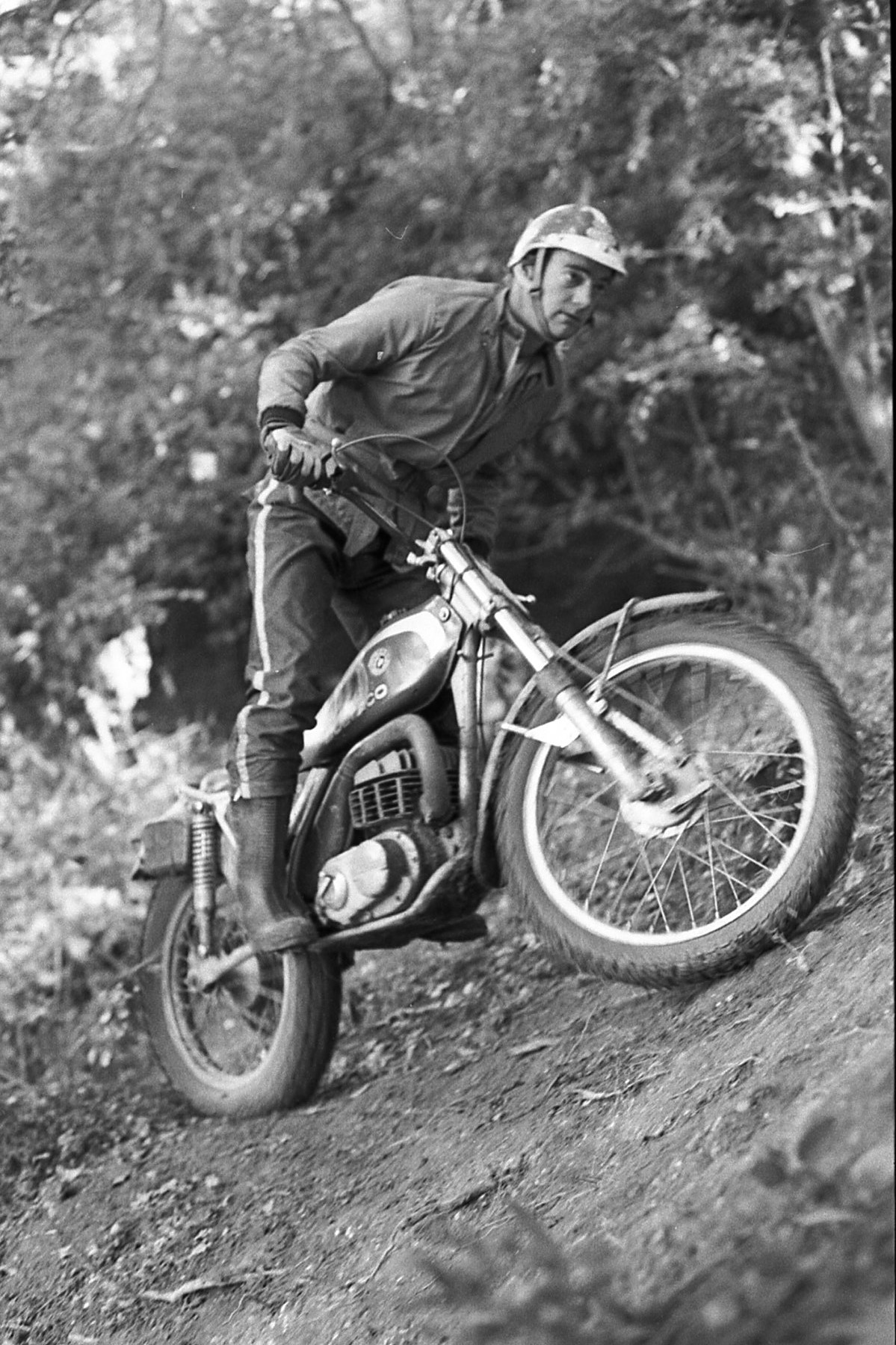
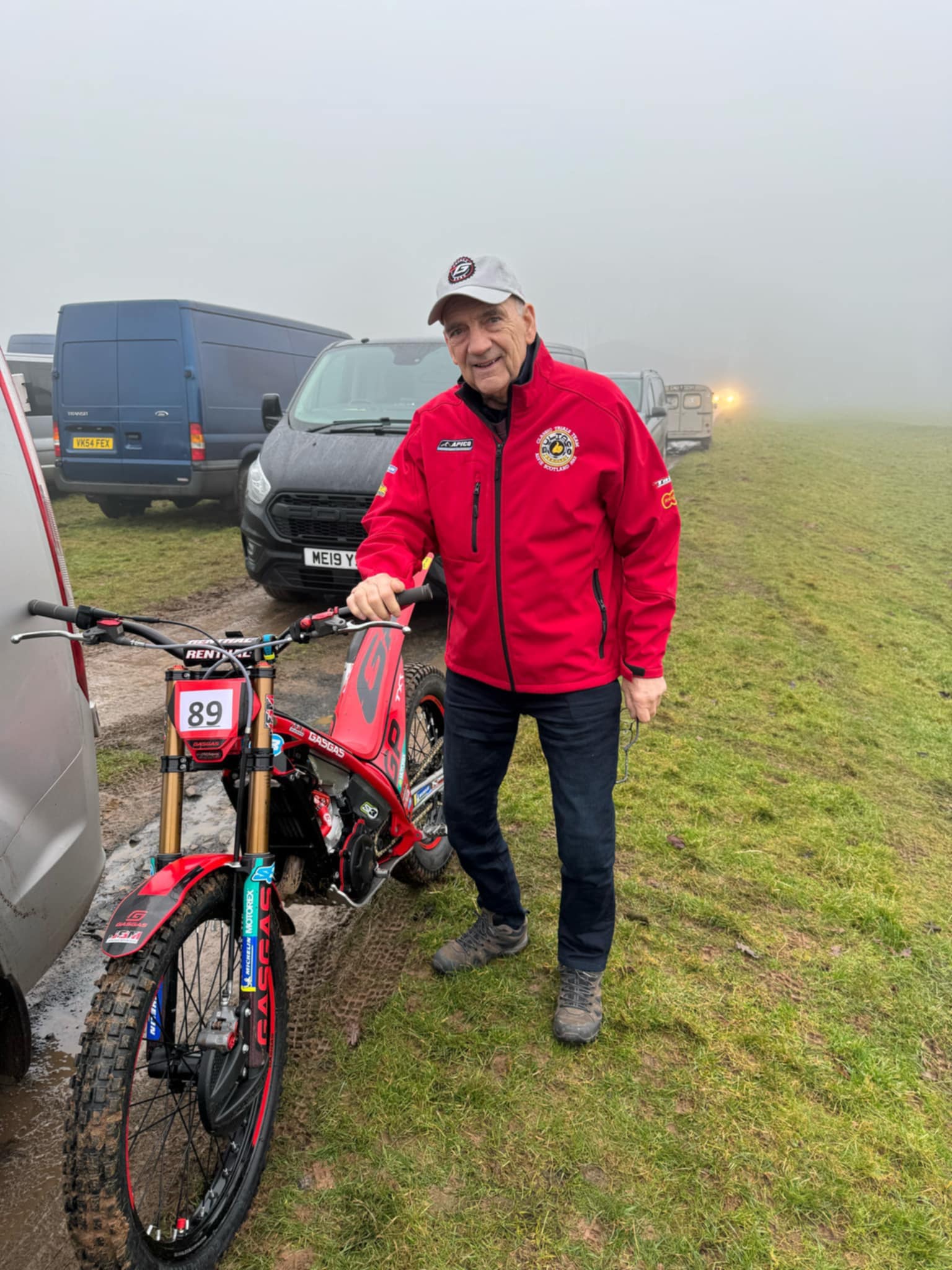
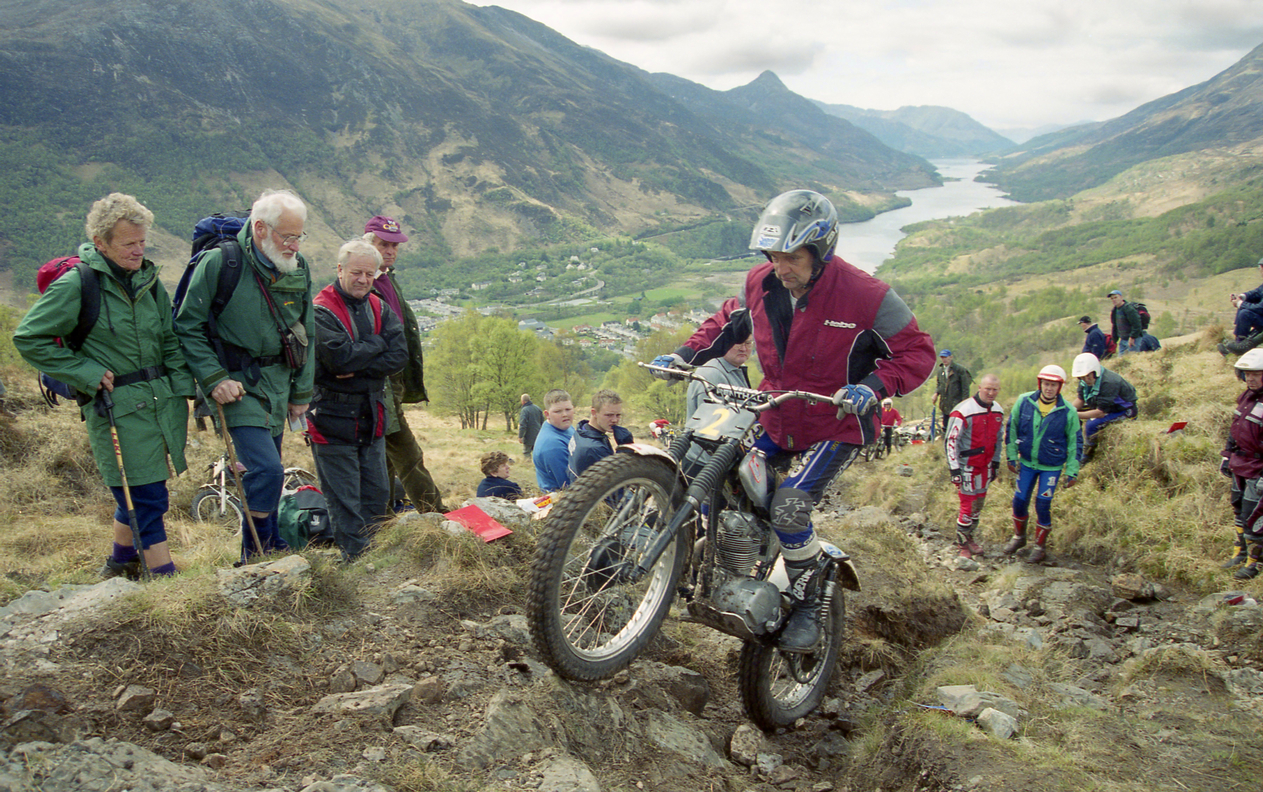


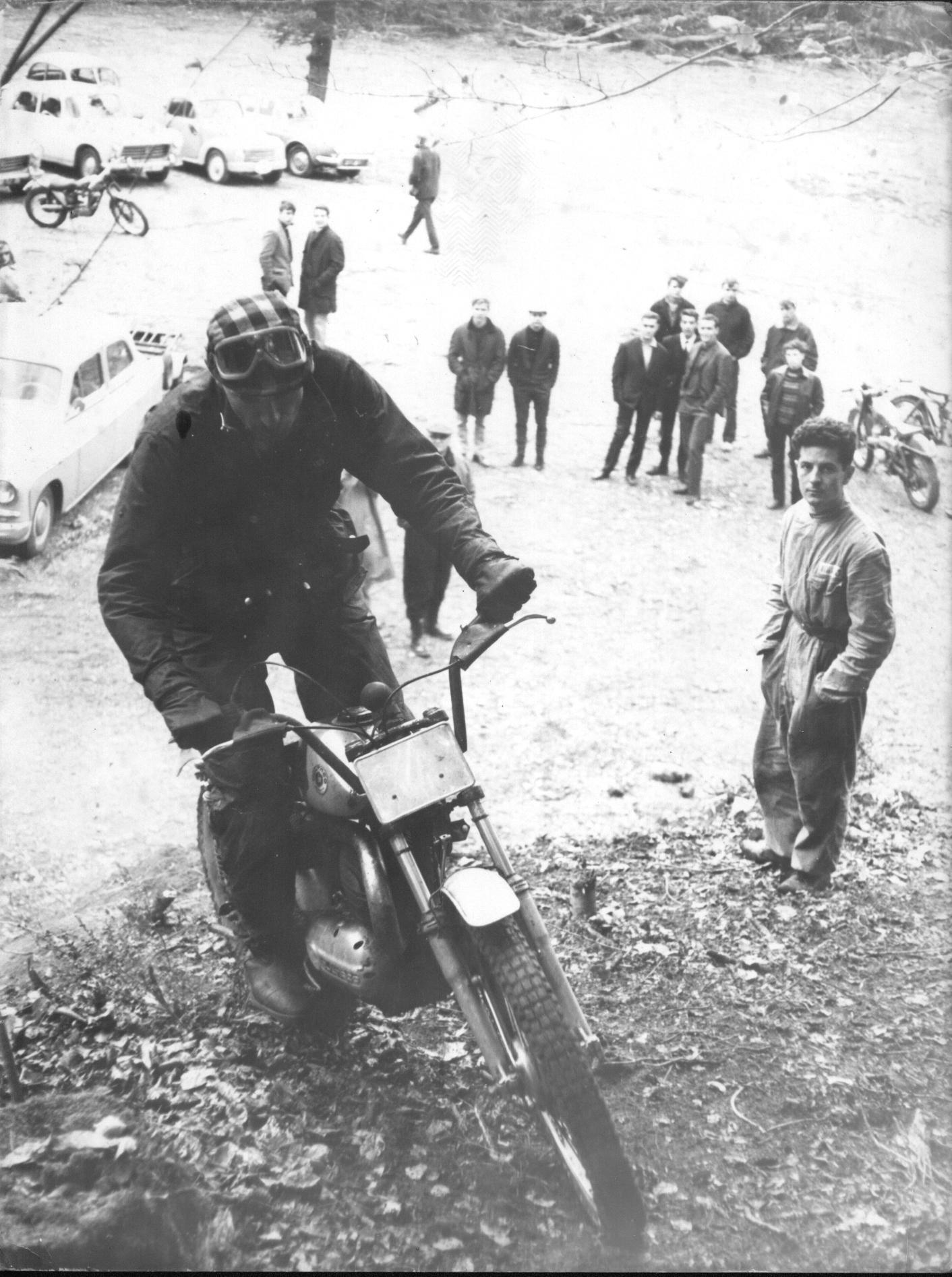

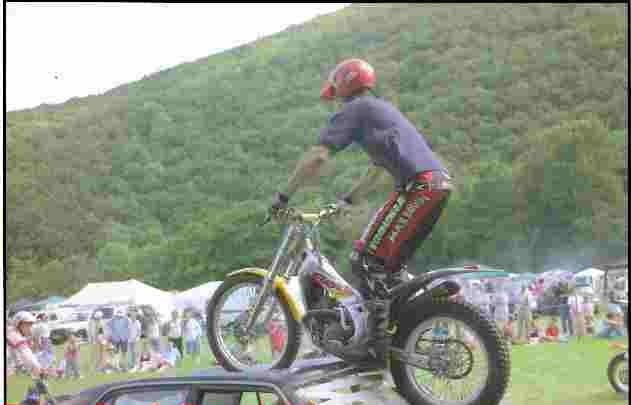


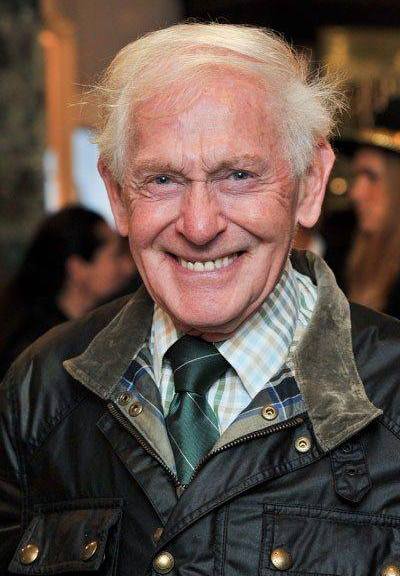


 TRIALS GURU - DEDICATED TO TRIAL