Colin Dommett 1940-2023

Totally committed to motorcycle sport for six decades! – By David Cole

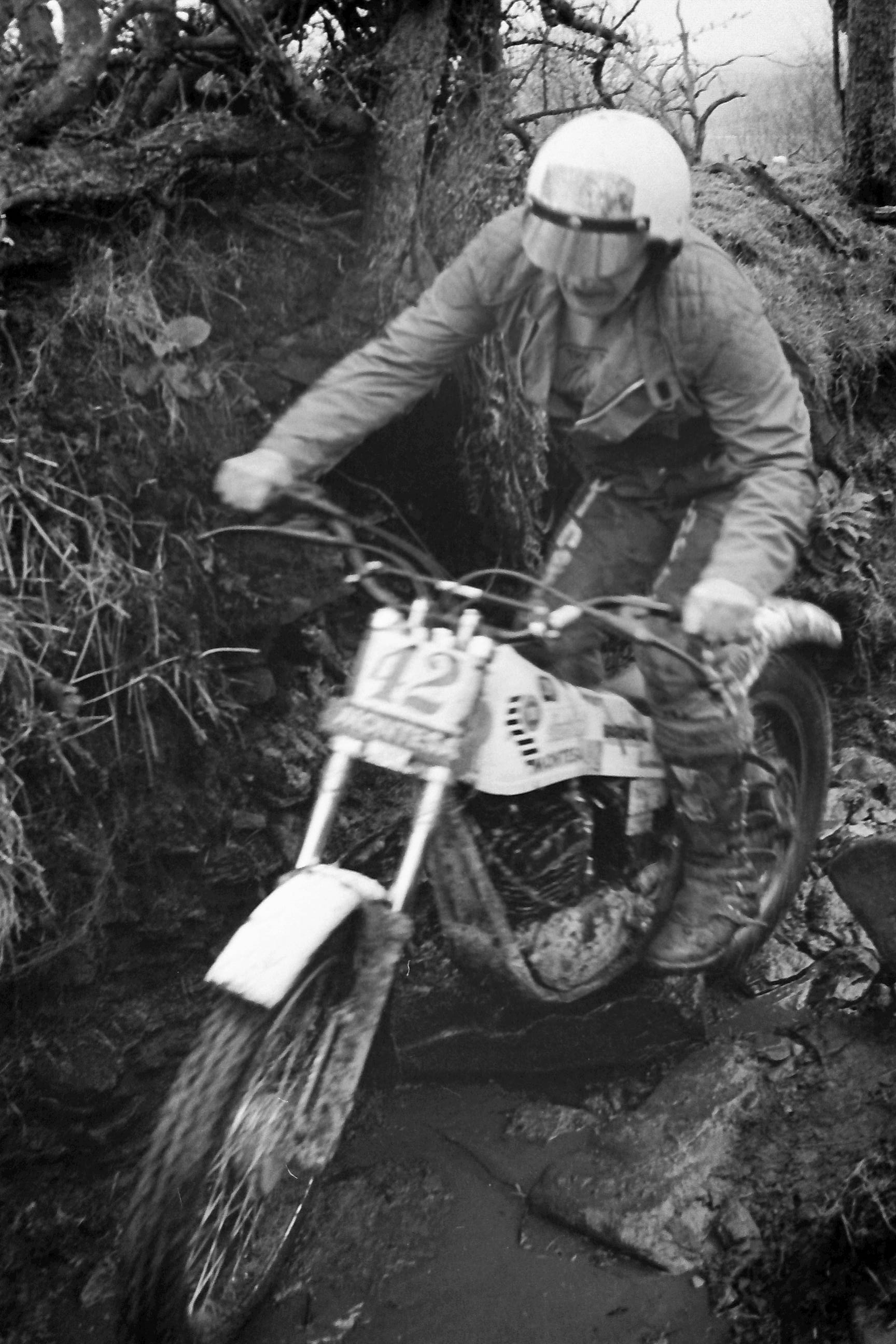
Main photograph: Mike Rapley

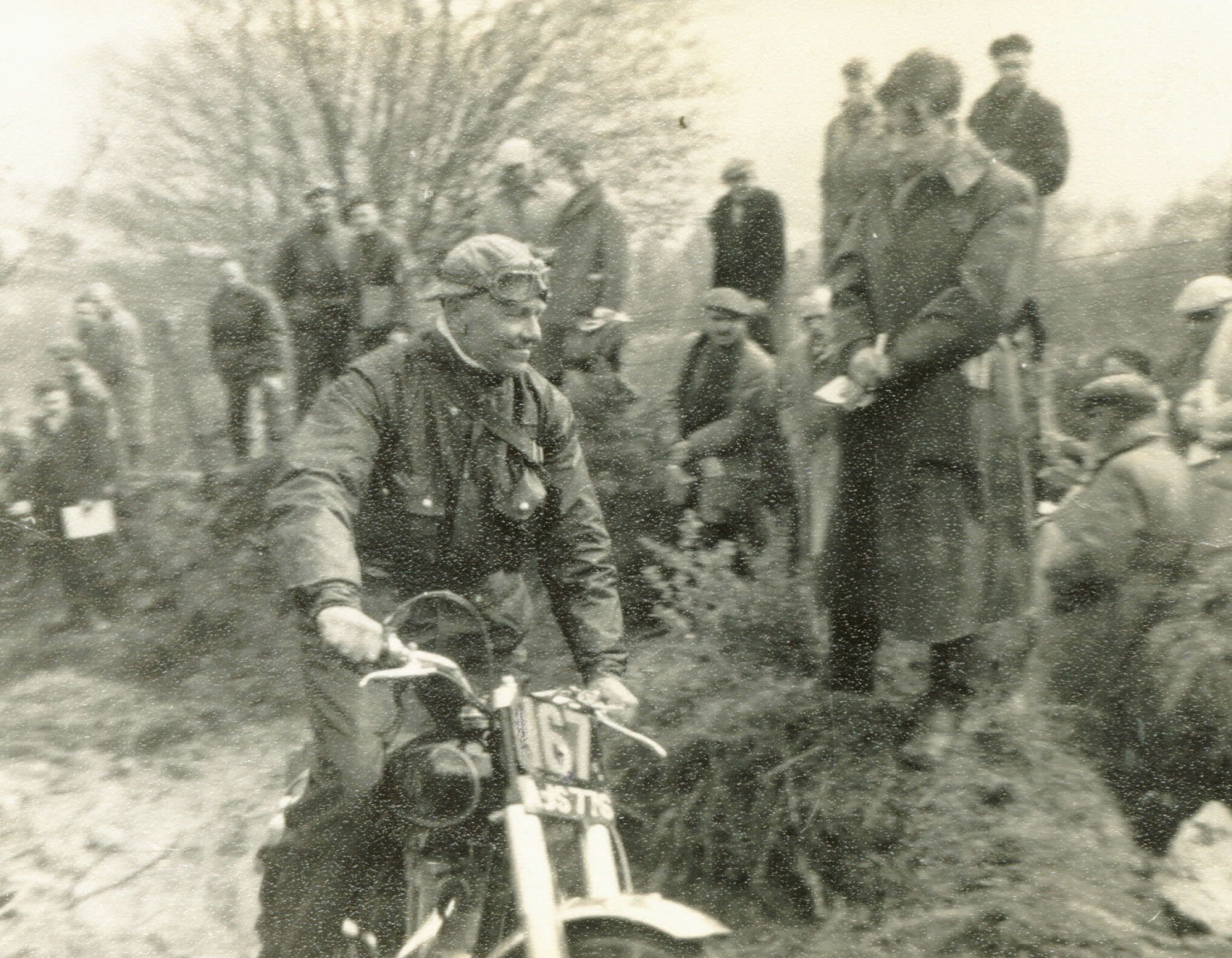
Commentating at a  North Devon Atlantic Classic Scramble Club meeting at Combe Martin a couple of weeks ago, for the last time, was Colin Dommett, one of the country’s best known, well respected and most knowledgeable men in off-road motorcycling.

Can we really believe he’s retiring? That’s not meant in any unkind or rude way, it’s just that Colin has been there, keeping us entertained and updated, on matters concerning our sport, both nationally and in particular the South Western and Cornwall Centres, for over 60 years – no doubt longer than many of us can remember.
Colin was born in Devon in 1940; he spent his early years near Broadhempston, between Newton Abbot and Totnes, on the land farmed by his father.

The first trial he witnessed was when he was six years old, a section of the annual West of England National Trial, “The Open” as it was known in those days, which was very near to the family home (I assume that this would have been 1946, the first running of this event after the war, Jim Alves of Street in Somerset won the trial on a ‘works’ 348cc Triumph). This event must have had a lasting effect on Colin, although he was upset by the noise of the bikes at the time.

At the age of eight Colin moved, with his parents to Cornwall and during the six weeks summer holiday from school he regularly stayed with an uncle on his farm near Axminster in East Devon. Whilst enjoying these holidays his cousin’s, who both owned motorbikes, took Colin to Exeter Speedway, local Scrambles and Road Race meetings at Blandford Camp and Castle Coombe, these he really enjoyed and made him decide that when he was old enough he would have a bike.

The bug had by now well and truly bitten and as Colin grew he attended as many Cornish trials and scrambles as he could get to. Too young to drive, of course, he either cycled or scrounged lifts to events from his local competitors, Ally Clift being one of the regulars.

When he was about fourteen years of age Motor Cycle News was formed (many years before Trials & MX News appeared) and Colin managed to persuade the Editor to give him the position of “Sports Reporter” for Cornwall. Colin was so keen he was a natural and continued to report for MCN until 1964.

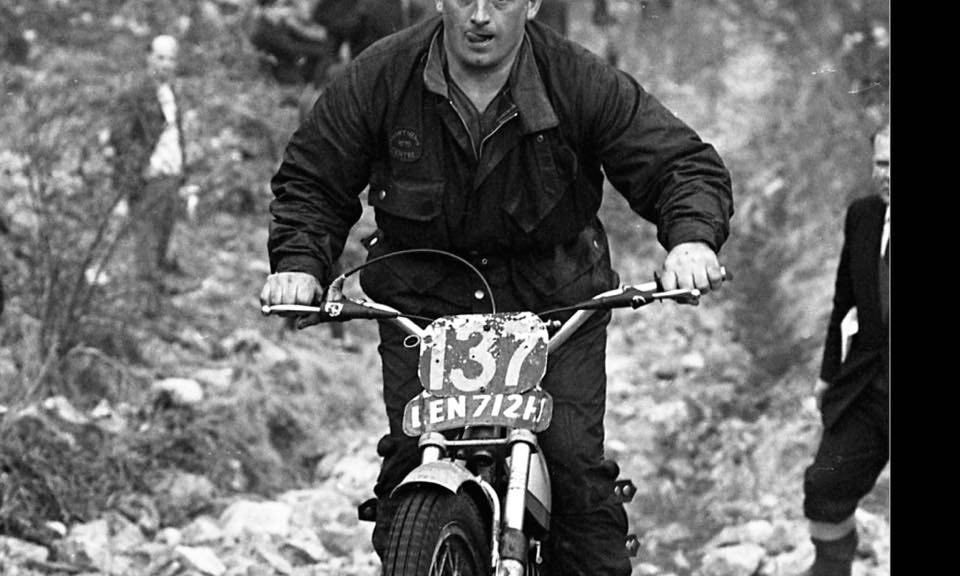
When Colin left school he went to work for W.H.Collins motorcycle shop in Truro, riding his first trial at Colwith Farm, Par, in 1957 riding a Triumph Tiger Cub. It was a week later that Colin won his first award, the event was a ‘Time Trial’ (marked on time and observation) and he picked up a first-class award for his efforts which immediately upgraded his status to ‘Expert’.
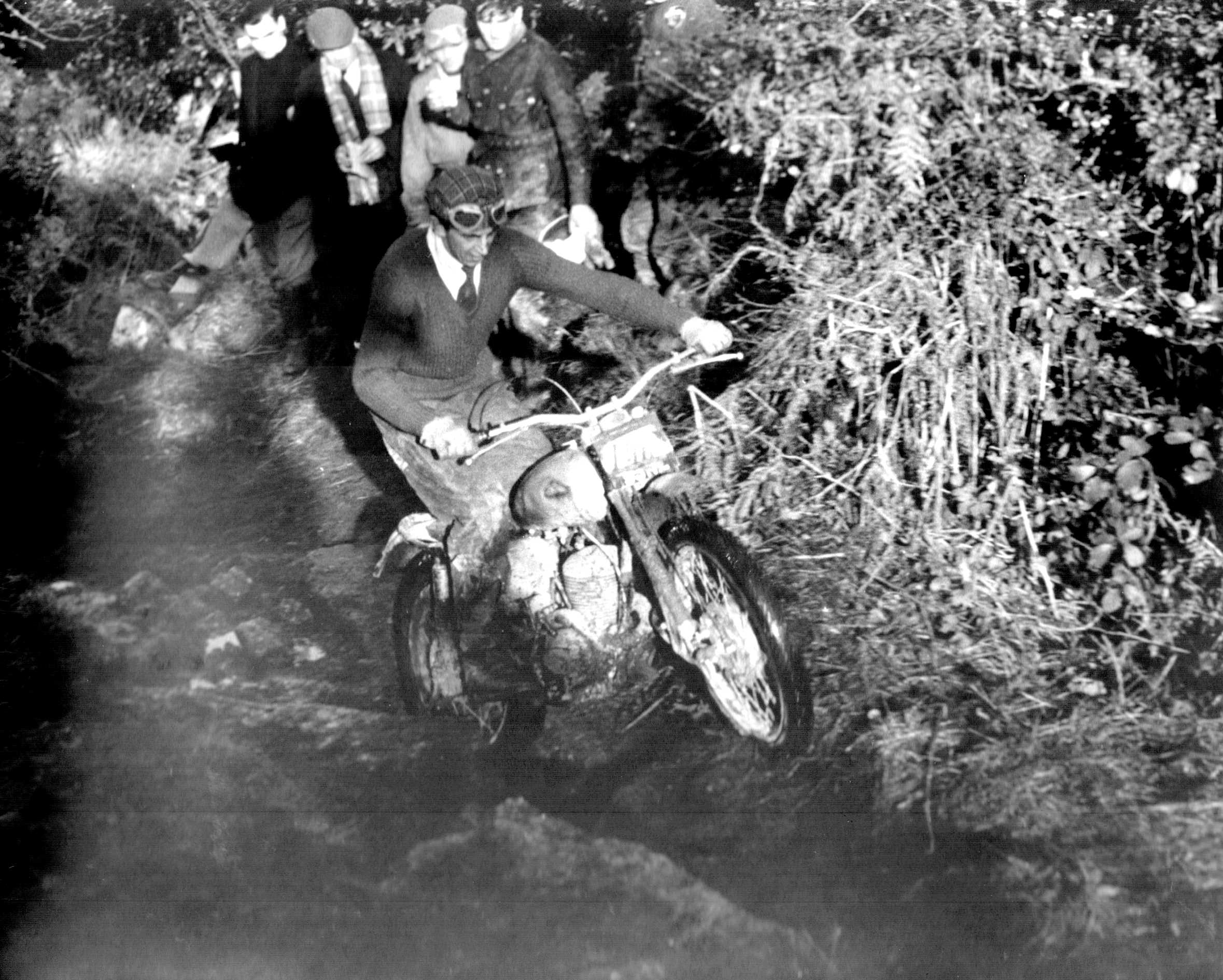
The Cub, like all Cub’s of that era, proved pretty unreliable and it wasn’t long before he changed to a 197cc A.C.S. (Ally Clift Special), a Villiers powered bike which proved very reliable and took Colin to his first Open-to-Centre win in the East Cornwall Club’s ‘Kings of Oxford Trophy’ Trial plus many other awards, as well as representing the Centre in Inter-Centre Team Trial in Wales.

It was around this time that Colin took up scrambling, again he proved to be a natural, riding a 250 Sundry (Sun/Villiers with a Vale Onslow conversion) as well as a few outings on Ally Clift’s (Collins sponsored) BSA Gold Star. Now competing in both trials and scrambles his successes continued.

In 1960 Colin bought a new Cotton trials bike and rode it from the factory in Gloucestershire, where it was built, back to his home in Truro. He immediately won five out of his first six trials on this new bike and it was not long before he was offered a ‘Works Team’ contract with the Cotton concern.
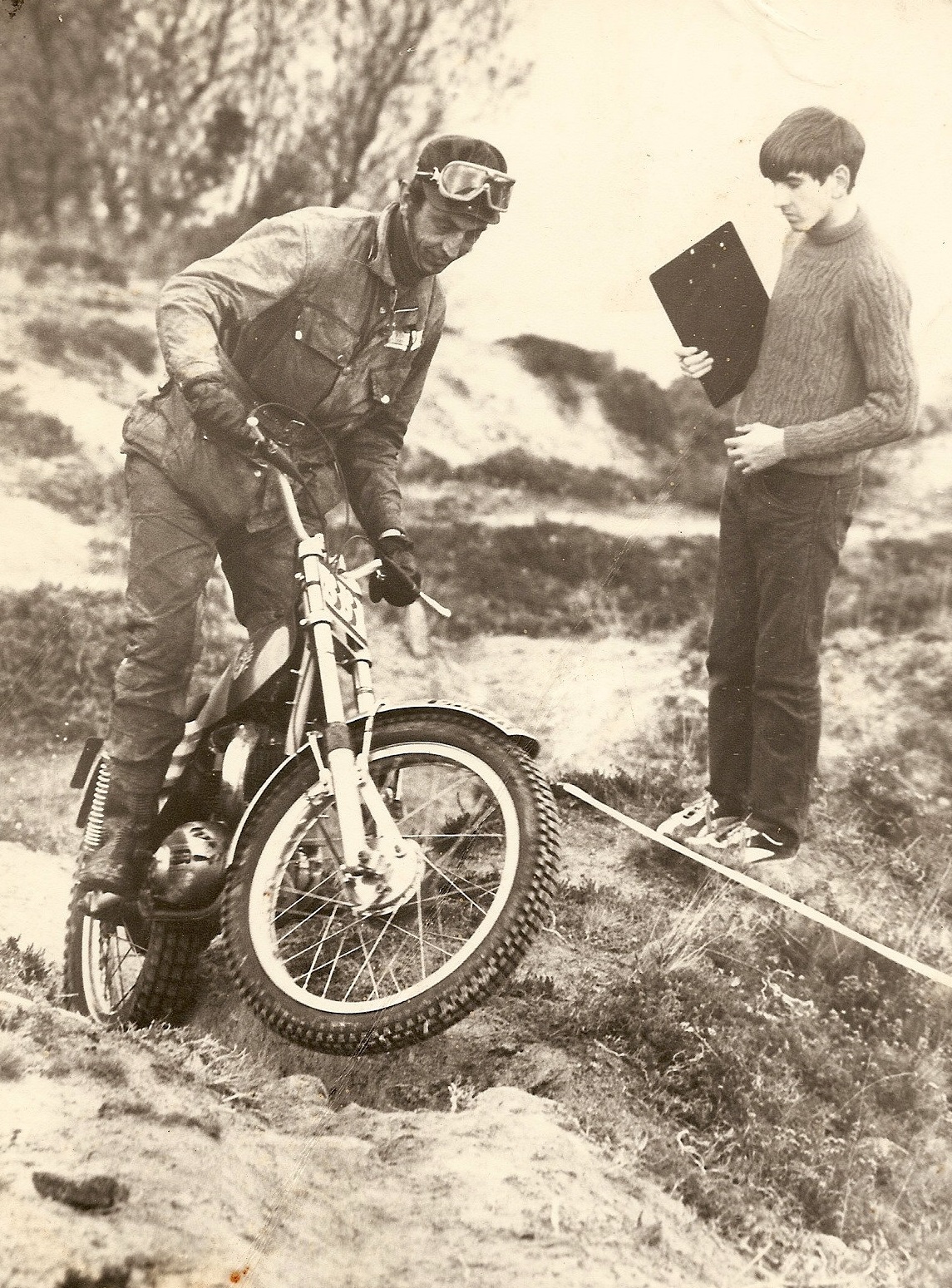
Due to a back injury whilst racing in 1963 which, more or less coincided with marriage, Colin decided to call it a day as far as scrambling was concerned and concentrate on trials.

For Pat Onions and the Cotton concern Colin rode all the important National Trials and British Championship Rounds. Covering these events meant an awful lot of travelling from deepest Cornwall so in 1964 Colin secured a job with Westbury Motorcycles in Bristol positioning him a little more centrally and thereby easing the travelling.

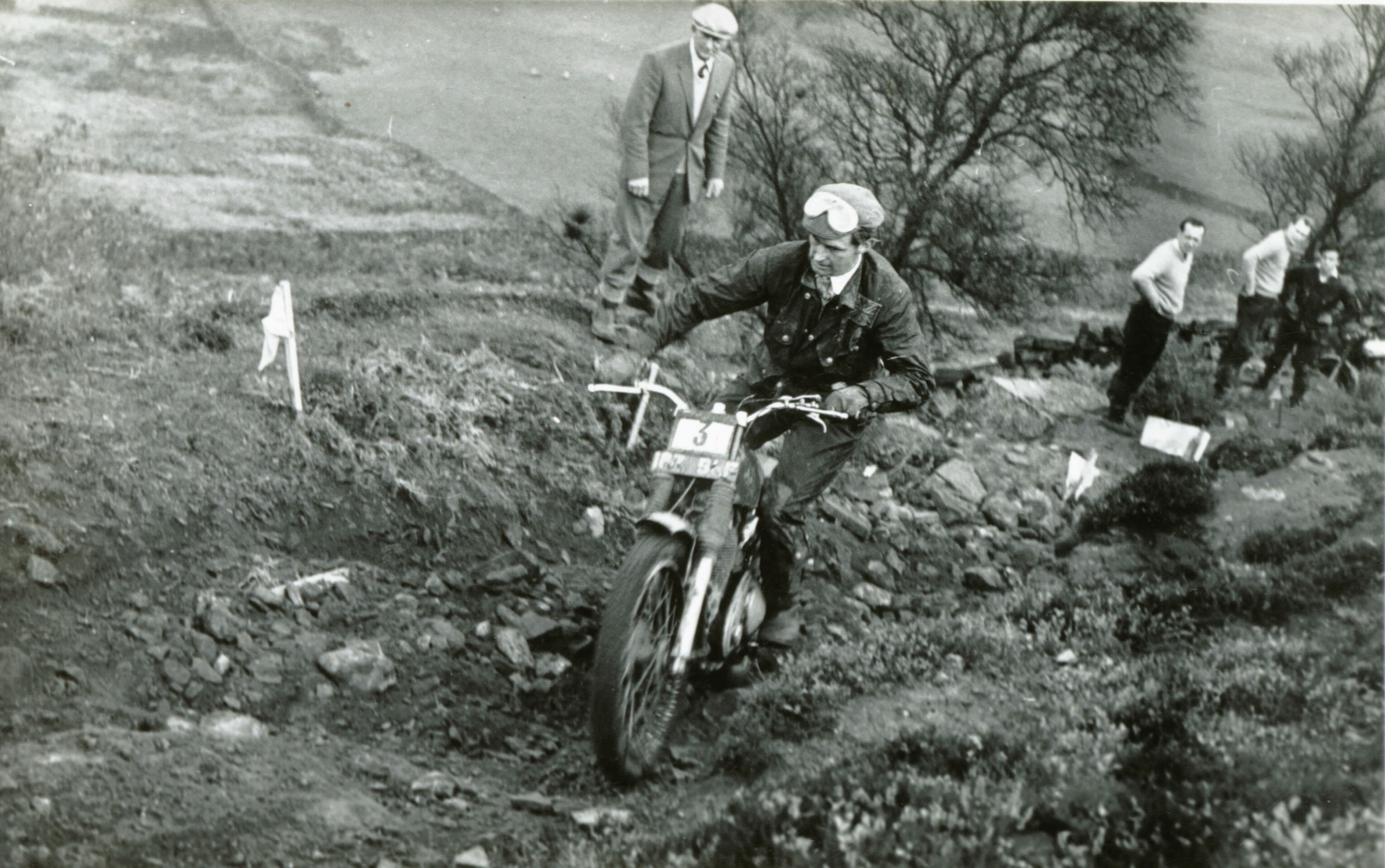
Colin Dommett on his BSA samples some Sedbergh sections in the Northwest Westmorland MCC – Nostalgia Trial

After only a couple of weeks with Westbury, during a trip to collect spares form the Cotton factory, Colin was offered a job there, how could he possibly turn it down, they were already supplying him with a bike and spares, geographically he would be perfectly placed and he had two of the best riders of that era, Malcolm and Tony Davis as travelling companions at weekends.

Colin spent the next two and a half years working for Cotton before deciding to move back to Cornwall. Factory wages were low but it was an invaluable and thoroughly enjoyable experience for Colin, he even got involved in things like testing the ‘works’ road race machines with people like Derek Minter.

Back in Cornwall and back to his old job Colin rode W.H. Collins sponsored Spanish bikes until 1970 when he acquired a 175cc Greeves Pathfinder.

He was then offered a 250cc Bultaco and sponsorship from David Paul. Dommett and the Bultaco saw a great many wins during the following season.

In 1968 Colin was selected to ride for the British Vase Squad in the International Six Days Trial (The Olympics of Motorcycling), for the event in Italy he rode a Husqvarna,

in 1969 as a British Trophy Team member in Germany he competed on a 504cc Triumph and again in 1970 at El Escorial near Madrid, Spain on a 504cc Cheney Triumph, all three events ended in misery, with mechanical failures for Colin, and the dream of a Gold Medal gone.

Colin aboard the ill-fated 504 Cheney Triumph in 1970 – Photo: Brian Catt

At the ISDT in 1970, his front fork sliders parted company from the forks, minutes before Colin had been reaching speeds of close to 100 mph, a lucky escape!
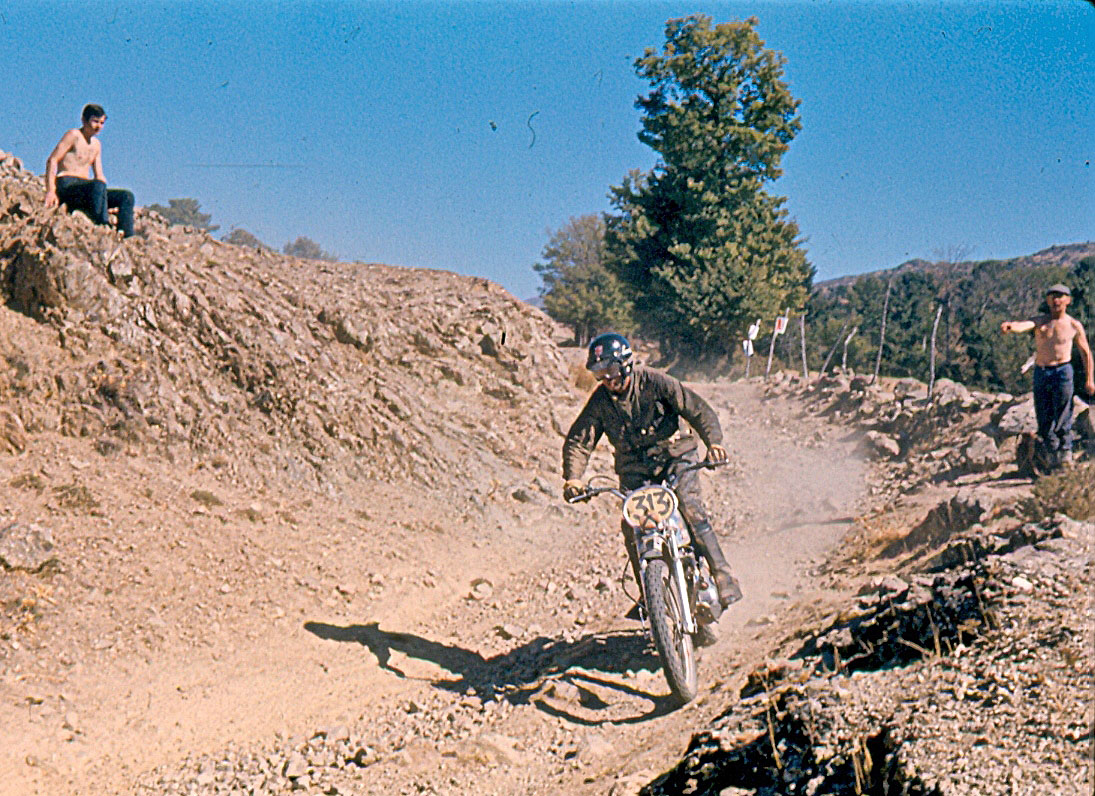
Colin Dommett on the 504 Cheney Triumph at the 1970 ISDT held at El Escorial, Madrid. Photo: Brian Catt

1971 saw Colin miss the ISDT selection tests due to a shoulder injury. The determination to succeed remained and the name C.F.Dommett appeared in the programme as a private entry, the Trial that year was held on the Isle of Man where Colin, riding a Bultaco, finally achieved his ambition by winning a coveted and well deserved gold medal.

Solo trials continued for Colin as did the successes, Colin has won the Cornwall Centre (Solo) Trials Championship, ten times.

In 1975, looking for a new challenge Colin teamed up with Eric Chamberlain for a crack at side-car trials. Their first outing on their home-built RL250 Suzuki was in mid May in the Pendennis ‘Open-to-Centre’ side-car trial; they did not figure in the results but felt they had a pretty good ride.

At the end of May the pair decided to play with the “big boys” and entered the Lyn National Trial. Despite competing against a good many of the country’s best side-car crews Colin and Eric finished in the top half of the results. The Lyn Club had also organised a ‘Closed-to-Club’ event the following day for which many of the previous day’s competitors stopped over to partake. This event saw the first of many victories for the Dommett / Chamberlain pairing.

Sharp-eyed Alec Wright had spotted the couple’s progress and offered them a new Kawasaki KT250 outfit, after a test ride the couple agreed without hesitation, which set them up ready to start the season in the winter of 1975.

Within the next six months Colin and Eric had accrued a multitude of wins including the British Experts, the Southern Experts and the Cornish Centre side-car championship.

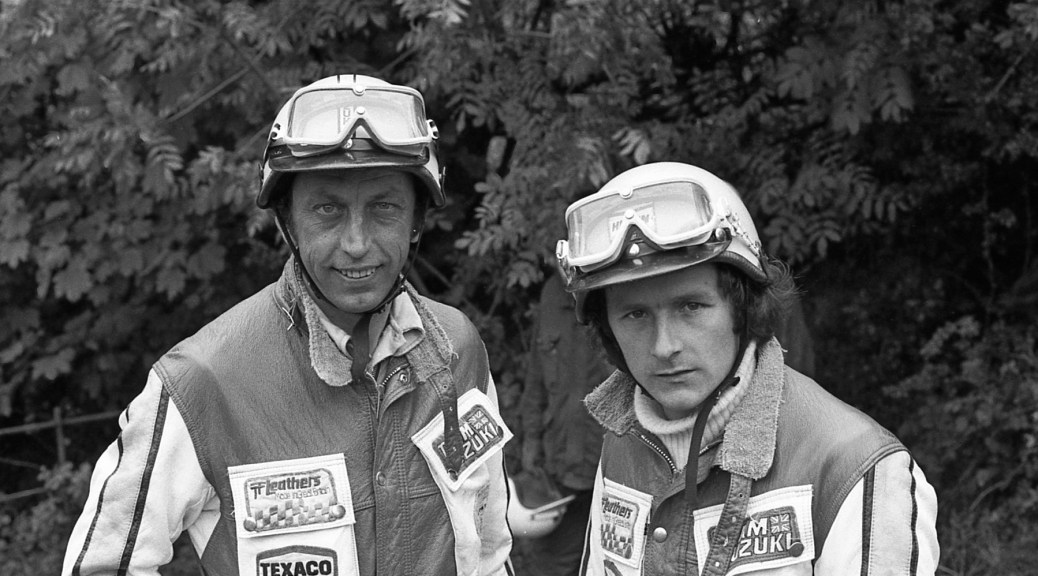
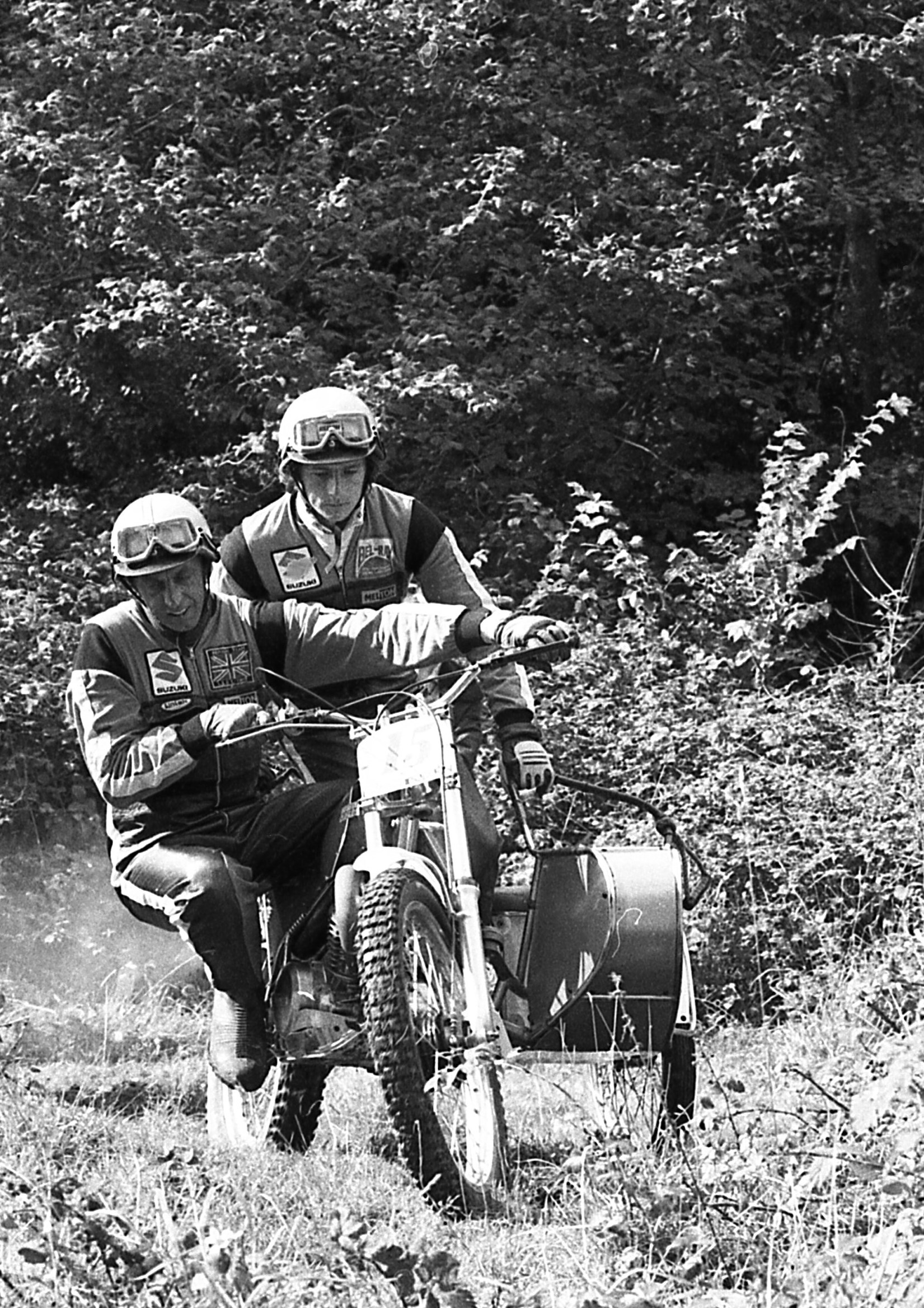
Colin Dommett and Eric Chamberlain (Suzuki) – Photo: Mike Rapley

The 1976 season saw the Cornish Champions start the season on the Kawasaki before changing to a Mick Whitlock framed, Suzuki RL powered Whitehawk outfit, a very smart bike and a machine that they skilfully piloted to win the British Championship in 1976, ’77 & ‘78 plus, to top it all, “the holy grail” was reached, Colin and Eric were crowned European Side-car Trials Champions in 1977.

Eric decided to call it a day at the end of ’78 which meant that Colin started the 1979 season on a new bike, a Comerfords Bultaco, with full factory backing, and a new passenger, Rob Clift.

British Sidecar Trials Champions, Colin Dommett & Eric Chamberlain on their Beamish Suzuki outfit – Photo copyright: Mike Rapley

Their season went well finishing the British Championship in fourth place. For the 1980 season Eric made a comeback for the important events which saw the pairing once again win the British Championship title that year.

Colin now decided to call it a day as far as Side-car Trials Championships were concerned, although he did continue to ride solo trials and had the odd outing within the Cornish Centre, with an outfit and with Rob Clift in the chair.
1990 saw Colin’s return to scrambling, choosing to ride Pre’65 events on a Triumph engined Metisse on which he had many successful outings, proving he’d lost none of his old magic.

In the year 2000 at the age of 60, Colin decided to once again, retire from scrambling and concentrate on his solo trials career.

Colin lives in the Tiverton area of Devon these days and the last fifteen years have seen him continuing to ride to a very high standard, taking many trials honours whilst campaigning a 250cc Cotton, a 270cc BSA C15 plus more recently, turning to a 185cc BSA Bantam – a lovely machine which is very much in demand in trials circles these days.
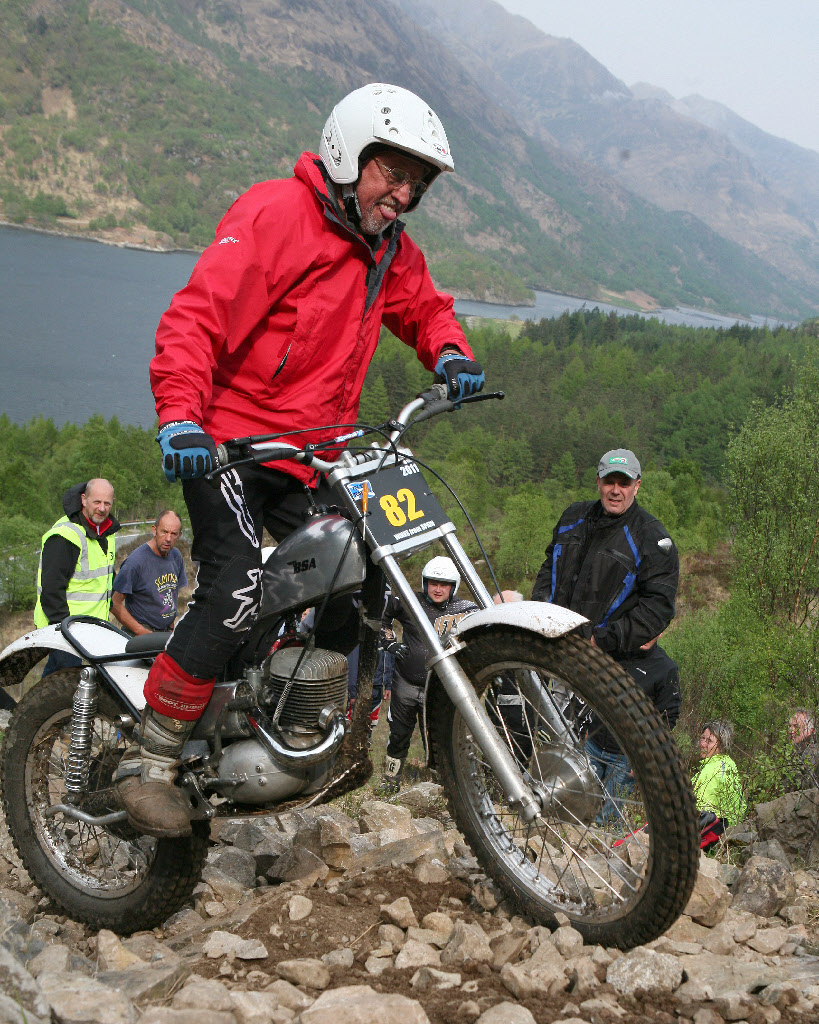
Colin’s current riding career is centred mainly around the West Country, although he still makes the odd trip to compete in events like the Isle of Man Two Day Trial.

At the time of writing, (August 2015), Colin sits comfortably in second position in the South Western Centre Pre 65 Trials Championship, trailing the current leader, Neil Hammersley, by just one point.

Two years ago Colin rode the last of his Scottish Pre 65 events, a trial he has always loved and performed well in, this being the most famous and prestigious Pre 65 Trial in the world, an event that Colin is proud to say that has previously been won by his son Scott.

Always an active member of his clubs, repaying a sport that he has for so long enjoyed, mucking in with all that it takes to organise and laying on motorcycle sporting events,

Colin has been made an Honorary Member of the Cornwall Centre, is the Chairman of the South Western Centre, Chairman of the South West Classic Trials Association, a committee member of the Tiverton Motor Club and is in much demand wherever a motorcycle sporting function is held.

Colin’s knowledge of the sport, its history and its participants is second to none; in most cases “he’s been there, done that and got the ‘T’ shirt”.

For their immense help, friendship and enthusiasm Colin and wife Greta were thanked during a presentation made by Chris Dawson, on behalf of the Club, which took place during a break in the second day’s racing. We feel sure that we speak for all when we wish Colin many more years of success and enjoyment within the sport, and, along with his wonderful and ever supportive wife, Greta, good luck and a peaceful life in their new home. – David Cole

Colin Dommett and Eric Chamberlain during their Suzuki days and of course British Sidecar Trials Champions – Photo copyright: Mike Rapley

Trials Guru on Colin Dommett:

I first came across Colin Dommett when I was spectating at the Scottish in 1975 on Ben Nevis sections. My late father and I were standing watching the action when Colin lost control of his 250 Ossa (234CFD) when he lost his footing on a rock. Colin and the Ossa hit the deck, my quick acting father then proceeded to pick the machine up, only problem was – he was at the front of the bike and of course unwittingly opened the throttle – fully when he thought he was shutting it closed! The Ossa simply took off like a rocket and promptly wound my father round the nearest tree!

Colin scrambled to his feet to attempt a rescue of his wayward machine. The look on Colin’s face said it all – he was not impressed in the slightest!

When Colin had composed himself and rode off, my father turned round, looked me straight in the eye and said… “Never pick a bike up facing it” Those within earshot burst out laughing.

Colin and I jointly ‘fronted’ the Pre’65 Scottish awards presentation at Kinlochleven for many years and we had great fun doing our double-act at the highland classic event.

Colin F. Dommett was a dyed in the wool motorcyclist, a champion, a true enthusiast and I am proud to have been his friend. – John Moffat

Sadly, Colin passed away at Manchester Royal Infirmary on Thursday, 9th February 2023.

Colin Dommett’s funeral service will take place at 11:30am on Tuesday 14th March 2023 at Taunton Crematorium.

© – Article: Colin Dommett – Text copyright: David Cole – 2015

© – Images: Brian Catt, Edgware; Mike Rapley & Colin Dommett Family Collection

© – Layout and Publishing: Trials Guru/Moffat Racing/John Moffat 2023

Ralph Venables MBE – Remembered 1914-2003

Ralph G. V. Venables MBE

‘Remembering Ralph’

Words: John Moffat

Photos: Eric Kitchen; Mike Davis; Jock McComisky; Charlie Watson; OffRoad Archive.

The title is a play on words, deliberately so, as Trials & Motocross News under the editorship of Bill Lawless ran a weekly column written by Ralph Venables which was entitled ‘Ralph Remembers’.

Ralph, pronounced ‘Rafe’ and he didn’t let anyone forget it, lived for much of his life in the small village and civil parish of Swallowcliffe, Salisbury in Wiltshire and was often referred to in articles as the ‘Squire of Swallowcliffe’ and the ‘doyen’ of trials journalist and writers. His house known as ‘The Old Forge’.

Ralph Venables’ column header in Motor Cycle News – 1976 (Bauer Media)

Ralph was very much of the old school of journalism, he took up the task after he realised that he would never be a top-flight trials rider, even although he was brought up in the company of the famous Heath brothers, Len and Joe, who were re-known trials and scrambles competitors immediately post war.

Born in the year that the First World War broke out, 1914 in Oxford, it was recorded that his first motorcycling event was not until 1920, in company with his elder brother to spectate at the Southern Scott Scramble near Camberley, Surrey.

His parents moved to ‘The Moors’, Tilford, Farnham in Surrey where he met the brothers Heath and that became a life-long friendship and Len Heath featured many times when Ralph recounted his life in the sport, so significant was his influence.

It was further recorded that Ralph suffered injuries in a road traffic accident whilst competing in a Schoolboy Trial near Croydon, Surrey. Schoolboy trials are not a new phenomenon, some private schools promoted them early last century. The accident was sufficiently serious that Venables spent some time in hospital and resulted in significant compensation being paid to him for his injuries, so it is assumed the car driver wasn’t devoid of fault.

Other interesting facts about Ralph include being an official of the Sunbeam M.C.C. which is of course the club that presents the annual Pinhard Prize through the ACU to recognise meritorious performance or efforts by a competitor or club member under the age of twenty-one years of age.

A smiling Hugh Viney on his works 347cc AJS in the 1955 Scottish, Ralph was close to Viney when he was AMC Competitions Manager – Photo: Jock McComisky, Linlithgow

In 1957, the year of the writer’s birth, Ralph reduced his motorcycle club activities and branched out into article writing for the then Motor Cycle when it was owned by the Illife family and of course now the title is owned by Mortons Media, Hornchurch.

Knowledge:

Venables had a remarkable memory for people, places and events which was second to none. He may not have been a successful competitor in his own right, but he got to know all the top flight trials and scrambles riders of various eras and could spout forth many facts and figures, which earned him the moniker of being a walking, talking encyclopaedia.

John Moffat: “I got to know Ralph many years ago, around 1988. Ralph had conversed with my late father on quite a few occasions and that was my effective ‘calling card’ to be able to speak with him.”

It has to be said though that many Scottish competitors referred to Ralph as the ‘Poison Pen’ as he could be quite unkind with his description of some of our countryfolk in his columns and this did not endear him to competitors north of Hadrian’s Wall.

I wonder who recalls Ralph’s attempts to persuade the ACU to reduce the dimensions of the standard trials tyre reduced from four inch to three and a half-inch section back in the early to mid-1970s? Gordon Farley did a back to back test using his factory Montesa Cota using both sizes with the former British Champion failed to get grip on a variety of sections using the smaller section tyre. Motor Cycle News did a photo shoot at the time and published the results.

Gordon Farley (Montesa Cota 247) at the Inter Centre Team Trial at Ludlow in 1972 – Photo: Eric Kitchen

I was fortunate, by the time I got to know him, Ralph had mellowed slightly, but he could still pack a punch. I had it on good authority that when I started writing some articles on Scottish competitors, Ralph had been heard to say: “I do hope that you are in no way paying John Moffat for his articles by the word, otherwise you will be severely out of pocket”. Ralph had made the incorrect assumption that I was writing for money. Being paid for journalism is one thing, I was only doing it for enjoyment and recording sporting matters for posterity. Ralph it is safe to say, wrote for money and I certainly never had a problem with that.

I did challenge Ralph on the point and he admitted freely that is what he had said, but gave me some advice at the same time. He told me:” Please be economical with words John, why write five when one will do?”. I took his advice on board and discovered that sometimes, less is indeed more!

Talent Scout:

Venables or ‘RGV’ as he was sometimes known in the motorcycle sporting circles was a trusted, unpaid scout for the British motorcycle factories, especially keeping company with their Competitions managers of the magnitude of Brian Martin (BSA); Hugh Viney and latterly Bob Manns of AMC, Jack Stocker of Royal Enfield and many more.

It was Ralph that effectively ‘discovered’ a sixteen year old from Derbyshire called Michael J. Andrews. Venables would have a quiet word in the ever listening ear of Hugh Viney and a factory AJS 16C was soon trundling its way to Matlock strapped to the inside wall of the guard’s van by railway from Plumstead in South East London. Andrews would soon make his name on the factory machine, going on to ride for Rickmans, then Ossa and of course Yamaha. Mick only had a short and abruptly short apprenticeship with the Kenning Motor Group, but, made a living out of riding trials machines, a facet that was in its’ infancy in 1963.

A young Mick Andrews (AJS) on Loch Eild Path in the 1963 SSDT – Photo: Mike Davies

Andrews was not alone in this special attention from Venables, many were tipped by him to these industry insiders and factory mounts were dispatched for these young men to try out the machine and eventually sign ‘works’ contracts.

Venables was the ‘eyes and ears’ of motorcycle trials and indeed scrambles in the 1950s and 1960s. He reported for the Motor Cycle and latterly Motor Cycle News when owned by EMAP (East Midland Allied Press) which had kicked off production the same year as Venables commencing writing for the rival paper Motor Cycle.

Ralph was a master wordsmith; few could beat or even equal him. He had a command of the English language and he used it sparingly but very effectively. It was indeed a matter of the pen is mightier than the sword when it came to his weekly columns. He was also known as a stickler for accuracy in his reporting.

Jazz:

But there was even more to Ralph Venables, he was also an authority on ‘White Jazz’ of the 1920s and 30s, as he took more than a keen interest in jazz music and had a comprehensive collection of recordings. One such musician was Leon Bismark ‘Bix’ Beiderbecke, an American jazz cornetist, pianist and composer. Ralph wrote many articles on the artist and his music, plus discographies of many more artists of the era. Ralph was an active discographer, his vast record collection was gifted to a Mr. J.R.T. Davies after his death in 2003.

Expert Knowledge:

In 1966 Ralph along with others, totalling 19 persons were appointed by the then Labour government under Mrs. Barbara Castle, later Baroness Castle, the then Minister of Transport, to serve on a committee to advise the government on the continuing exercise of her powers for regulating motor events on the public highway. [1]

Was he controversial? Of course he was, all good journalists can stir things up and get people thinking, it is part of their job, it sells papers, it gets people talking and R.G. Venables was in the master class at it.

Venables of course had great respect for Sammy Miller, eleven times British Champion and the most famous of all trials riders. However Ralph was not a fan of Sammy’s riding style. Ralph was quoted as saying that Sam was “far too crouched over the front of his machine for my liking”. Ralph wasn’t afraid to say what he thought or comment on what he liked or disliked. With Venables you either took it or left it, that was his terms.

Sammy Miller (Ariel) on Laggan Locks in the 1963 SSDT – Photo: Mike Davies

When I got to know Ralph a little I told him that if I was being totally honest, the first page I used to turn to in Trials & Motocross News was the one in which his column appeared. Some months later Ralph actually commented how pleased he was when people told him that very fact.

In early 1994, I asked Ralph a few times if he could perhaps feature a few Scottish competitors in his column, to me that may make up for all the negative things he had written perhaps thirty years previously about my fellow countrymen. To my astonishment and delight in the April 29th edition of the paper he did indeed feature “Highland heroes on home ground” as his full-page column, ‘Ralph Remembers’. In fact, his opening short paragraph read “…John Moffat has been nagging me mercilessly in connection with my column. He wants me to devote a whole page to Scots pictured competing in the Scottish Six Days Trial”. Not only did he feature them once he did it a second time when suitable photographs landed on his desk at Swallowcliffe. Ralph first spectated at the SSDT in 1937 an event he attended as spectator, reporter and an official observer. He particularly enjoyed staying at Gordon Blakeways’ hotel at Strontian, Kilcamb Lodge, which he described as the ‘friendliest hotel in the Highlands’ on more than one occasion.

Gordon S. Blakeway (350 AJS – 187BLF) – Colonial Trial 1963 – Photo: Charlie Watson, Hull

Sadly, Ralph passed away in February 2003, having suffered from Motor-Neuron disease, but my connection with him became very memorable indeed, as he died on exactly the same day as my late Mother, Betty Moffat.

Obviously I had my hands full in early February that year, so much so that it was only a fortnight later when I was able to catch up on affairs that I notice when Ralph has passed away and of course to my surprise that it was on the exact same day as my Mother. I wrote to Pam, his widow expressing my sincere condolences to her and mentioned that fact. Pam sent me a very nice letter, by return, thanking me and also offering her condolences to me on the loss of my maternal parent.

Sammy Miller once told me: “John, don’t tell me stories, bring me facts, I like facts”. Venables was similar and here is a fact, not a story.

I spoke to Ralph at an early Pre’65 Scottish, it was before I took up riding that event twenty-three times. He was up the ‘Loch Eild Path’, watching the trial as he had done for some years, it was a hot day and he had stripped off his shirt and was bare chested. I thought he looked very fit for an octogenarian. Later the same day I spotted him, still bare chested coming down at a fair old pace from the Pipeline back into the village of Kinlochleven. I shouted: “Hey Rafe, you must be fit, I saw you up Loch Eild Path not that long ago”. He replied: “Yes John, you certainly did and it’s not just a case of one being physically fit, but also knowing where all the short-cuts are, good day to you”.

As well as loving motorcycle sport in the form of trials and scrambles, that is of course scrambles and not motocross, Ralph had a love of fast, sports cars and he owned an Allard, MG, Aston Martin and Daimler before ending up with a Reliant Scimitar before dropping down to a more modest Ford Fiesta in later life.

Ralph Venables astride his beloved 1964 AJS 16C – registered BFN10B, it was originally owned by Mick Waller. (Photo Credit: OffRoad Archive)

He also liked the short-stroke 350 AJS, and he owned BFN10B, an ex-Mick Waller machine which he offered to me for around £3,500 in the mid-1990s, a motorcycle I regret not buying when I had the chance, I should have bought that one. Venables also obtained a rare Honda TL250 via Dixon Racing, a model that wasn’t officially imported into the UK by Honda as it was destined for the USA market primarily.

After writing three hundred columns of his ‘Competition Commentary’ for Motor Cycle News, nine-hundred and fifty-three columns entitled ‘Sporting Scene’ for MCN and a further five hundred ‘Ralph Remembers’ for Trials & Motocross News, Ralph finally retired at the age of eighty years of age. I think that must be some kind of record that will be hard to break, don’t you?

Bibliography:

Bixbeiderbecke.com – References to R.G.V. Venables & Clifford Jones – Jazz discography.

swallowcliffe.com – Village history website – Local Characters – Ralph Venables “The Sage of Swallowcliffe” – Dave Gittins

Hansard – Motoring Events (Minister’s Powers) – Debated 16/11/1966 – R.G.V. Venables and others, appointed by Mrs Barbara Castle (Minister for Transport) to committee to advise on the continuing exercise of her powers for regulating motor events on the public highway. [1]

The National Jazz Archive: nationaljazzarchive.org.uk

Bauer Media – MCN Ralph Venables Header – 1976.

Article Copyright: John Moffat/Trials Guru 2023
Photographic Copyright: is retained by the photographers named in captions above.

Apart from ‘Fair Dealing’ for the purpose of private study, research, criticism or review as permitted under the Copyright, Design and Patents Act, 1988, no part of this article may be copied, reproduced, stored in any form of retrieval system, electronic or otherwise or transmitted in any form or by any means, electronic, electrical, mechanical, optical, chemical, photocopying, recording or otherwise without the prior written permission of the author as stated above. This article is not being published for any monetary reward or monetisation, be that online or in print.

Gearhead Alert 015

Jon Stoodley of JSE Trials, Muskogee, Oklahoma talks us through….

Carburation!

Let’s talk about Carburetors. They can be fairly simple, like the pictured flat slide Keihin PWK or the Dellorto PHBL, both common on Trials bikes today. Or, they can be fairly complicated, Like the electronically controlled Mikuni on a YZ250 I modified. For this post, I’ll try to keep it simple and helpful for new riders.

Here’s one of my old articles about basic carburetors and jetting that might be helpful to newer riders. Trials engines are probably a little more difficult to properly jet and adjust because they must perform over a wider range of throttle settings, engine loads and ambient conditions than just about other form of motorcycle competition in my experience.

Here’s a couple of tips to get started. There seems to be some controversy surrounding adjusting the air/fuel screw for some reason. I’ve had riders argue with me that the factory setting (number of turns out) is what it should be set at, period. Other riders tell me that they read on the Internet that so many turns out is recommended by an “Expert” and that’s what it is supposed to be.

Here’s how I do it before each ride. The air/fuel screw “fine tunes” the low rpm circuits to handle the low-speed throttle response by compensating for changing ambient weather conditions (temperature, barometric pressure, humidity etc.). I warm up the engine to operating temperature, place it in Neutral and quickly “blip” the throttle (quickly open the throttle and let go of the grip) and adjust the air/fuel screw in or out to get the best engine response. For ever how many turns out I end up with (no matter how many turns out), that is the best setting, for this specific day, and under these specific weather conditions. This is why the screw is adjustable. I add knurled knobs to the air/fuel and idle screws so I can adjust them easily with gloved hands. When you bottom out an air/fuel screw, do it very lightly as they, like suspension adjusters, can be delicate and easily damaged.

Engine idle speed is generally a matter of personal preference, but I would suggest that you set it this way. Put the warmed up engine in gear, with the clutch lever pulled in normally the way you would ride which is usually back to a knuckle and not fully back to the grip. Then adjust the idle speed and in this way, you compensate for any “clutch drag” (GasGas riders take particular note). If you set the idle speed in Neutral, and you have too much clutch drag, when you are in a section stopped, or close to stopping, clutch drag will pull down the rpm below where you set it and you will have a much greater chance of stalling the engine.

A slight amount of clutch drag can be a positive thing as it keeps the engine’s drivetrain “loaded” (mechanical slack taken up) so that clutch modulation is much smoother than if the clutch released totally. This is particularly important under less-than-ideal traction conditions and slow going. Say you were in a tough section almost completely stopped, full-lock turn, off camber, muddy with roots, the clutch modulation (if it totally released) would result in a “jerky” take-up (and loss of traction) as the drivetrain loaded and unloaded.

One of the most frequent questions that riders ask me about is how they can properly set up their jetting. It seems like a lot of riders put up with poor performance from their bikes without realizing that, with a little time, effort and most important, a basic understanding of how that nasty little piece of aluminum and brass that some engineer stuck on their engine works, things could be a lot better. I’ll try to give a crash course (excuse the term) on what the carburetor is required to do and how you can help it do its job better.

Why would we need to change jetting anyway? Jetting doesn’t change by itself unless there is a mechanical problem in the carburetor. Conditions outside of the carburetor change and they have an effect on the engine’s air/fuel requirements.

For example, most bikes are jetted rich from the factory when they are assembled because they are shipped to various countries with a wide variety of conditions and fuel. The engineers can’t possibly anticipate and jet for all the conditions and areas they ship to, so they put in “safe” (ie rich) jetting with the idea that the individual rider or dealer will make the final adjustment to the engine requirements.

Riders who travel to different Trials find that their engines don’t operate as efficiently as they desire unless they adjust the jetting to suit the area. You may have bought a used bike that is jetted incorrectly (jetted for high altitude and brought down to sea level) and want to set it up for the area where you ride. Temperature, humidity and altitude have a direct effect on the amount of oxygen available to the engine. Ask any Ute Cup rider how much of an effect altitude has on engine performance. Fine tuning an engine to maximize performance is so important in racing that years ago when I was campaigning fuel dragsters, we would build special engines just for high altitude competition and we would refer to them as our “Denver motors”.

What is a carburetor and what does it really do? A carburetor is a device that atomizes fuel with air and meters that mixture to the engine over a wide variety of throttle openings. The stoichiometric (or, chemically correct) ratio under perfect conditions of the air and fuel is 14.7 pounds of air to one pound of non-oxygenated gasoline, although AF (air/fuel) ratios in the range of 12/1 to 14/1 seem to produce the best power in motorcycle engines.

Trials engines seem to work better on the lean end of the A/F ratios due to the conditions that they operate under. You can see that if your carb had only one metering orifice (jet) it wouldn’t be able to maintain that ratio from closed to full throttle opening. That’s why they have all those other fuel and air metering gizmos, in order to adjust the amount of fuel to the amount of air allowed into the engine by the slide opening from almost shut, to wide open.

Most modern carbs have six (and sometimes seven, a “power jet”) different air and fuel metering jets that affect the fuel mixture over the range of throttle openings. Those are the air screw (sometimes this a fuel metering needle), throttle slide, air jet, pilot jet, needle jet and main jet. Most riders can just replace the pilot and/or main jet to get the desired performance and fine-tune the engine with the air/fuel screw and needle clip adjustments.

Let’s look at where those little thingies do most of their work. The throttle settings and the air/fuel jets that affect the air/fuel ratio at those openings are:

-Closed to 1/8 throttle opening – air (or fuel) screw, pilot jet

-1/4 to ½ to full throttle opening – throttle slide, jet needle

-1/2 to full throttle – jet needle, needle jet, main jet, air jet

As you can see, most of the air/fuel circuits overlap in their functions so it’s not a black/white decision as to what to change and how far to go rich or lean. A savvy tuner spends a lot of time looking for the signs that the engine exhibits in order to make a well-educated guess, and its not unusual to see such tools as exhaust gas analyzers, air/fuel electronic sensors and relative air density meters used at the professional level of racing.

What do all those numbers and letters stamped on the parts mean? In the pilot and main jets the larger the number, the richer the jet. On the slide, the larger the number, the leaner it is. Needles have various codes, but as a general rule the smaller the number (if it doesn’t have letters), the richer the needle. To richen the needle setting when it is installed in the carburetor, lower the circlip one groove at a time. And to lean the needle, raise the circlip in the grooves (lower clip = raise the needle and vice versa).

Air/fuel screws are a little trickier. Although they may look the same, an air screw is turned clockwise to richen the mixture but a fuel screw is turned counter-clockwise to richen the mixture. To tell if its an air or fuel screw, look at the carb from the side. If the screw is located on the carburetor towards the front of the slide (manifold/reedcage area), it’s probably a fuel screw. If it’s located towards the back on the carburetor (air box side), it’s probably an air screw adjuster. Air screws usually have a blunt end and fuel screws have a sharp needle-shaped end.

The air jet, and sometimes the needle jet, are usually not replaceable on some carbs. For example, the needle jet is replaceable on most Keihin carbs and on most Mikuni carbs.

The numbers on jets, throttle slides and needles will allow you to tell how rich or lean they are from stock settings. The jets are stamped with their numbers but don’t be confused by the radical difference in the numbers between models of carbs as some jets are rated according to flow rate and some are rated according to the metric size of the orifice. For example, a 172 Keihin jet is roughly equivalent to a 350 Mikuni jet in Motocross bikes.

Needles have the number or letters stamped at the top by the clip slots. Those numbers or letters relate to the thickness and taper of the needle which will dictate how much fuel it will allow to flow around it as it is retracted out of the needle jet by the slide as the throttle is opened.

As the needle is tapered, the more it is pulled out of the needle jet by the slide, the more fuel it will allow to pass into the throat of the carb, relatively speaking. A thinner needle will pass more fuel around it than a thicker one, and it therefore a “richer” needle. Some needles have compound degrees of taper that allow individual adjustments to various throttle settings. Slides are usually stamped on the bottom front of the slide. That beveled cut on the front of the slide, near where the needle comes out (called the cutaway), has numbers that usually relate to the height of that bevel from the bottom of the slide. A #4 slide will have the top of that bevel 4mm from the bottom of the slide, a #5 slide will have a bevel 5mm high, etc. The higher the number, the leaner the slide as higher bevels allow more air to be funneled over the needle jet tower (that little protrusion that the needle retracts from in the center-lower part of the carb throat).

Before we set out jetting, we must eliminate the possibility that other problems exist that could have an effect on the jetting requirements of our engine. The engine must be in good shape with no leaking crank seals, broken reeds, air leaks in the intake system or crankcase, weak ignition system, cylinder head coolant leaks or blown-out packing in the muffler. The carburetor float level must be a factory specification, the fuel inlet float level needle must not lead and the vent hoses should be replaced if there is any possibility of clogging. Also, check to make sure that the air cleaner is clean and the engine has fresh pre-mix.

As far as special tools are concerned, you should have a good metric scale short ruler (for float level), a small magnifying glass to read jet/needle stampings accurately (Mikuni jets are notorious for being hard to read because of shallow stampings), a long, narrow screwdriver for pilot jets, a long 6mm socket for hex jets and good sharp screwdrivers, as the screws and brass jets are soft and you’ll have a hard time extracting them after you’ve rounded them off with poor tools.

As far as jets are concerned, I usually buy one size larger and three sizes smaller than stock on the main jet, and one size larger and two sizes smaller than stock on the pilot jet. I’ve usually never needed to go out of this range when jetting bikes from below sea level to about 8500 feet. A good way to store jets is in a film canister between layers of foam so they don’t rattle around.

Now for the actual jetting ritual. First, try to figure what throttle setting is not responding well by riding the bike in a practice section. Atmospheric changes have a dramatic effect on the amount of oxygen available to the engine, as mentioned before.

Higher temperature, altitude and humidity will sometimes require going leaner on the jetting. Lower temperature, altitude and humidity sometimes call for richer settings. Decide what jet to change according to what throttle setting needs adjustment. Only change one jet at a time. If jetting is a new experience for you, always start by going rich at first. This is safer than initially going too lean and it will give you a direct experience of how an engine acts when it’s running too rich.

Diagnosing jetting by listening to the exhaust note takes experience as even practiced ears can sometimes have a problem discerning the difference between a “surging” (lean) and a “bogging” (rich) sound coming from the exhaust pipe. If the engine runs worse with your change, then go two steps leaner, which will actually be one step leaner than where you started. The engine will tell you if you’re on the right track. Test the bike again to see if that solves the problem but keep an eye on spark color (it should resemble a milk chocolate color with most grades of gasoline) with any changes of the needle or main jet.

Let’s look at some common conditions and possible adjustments, starting with what to try first.

-ENGINE RUNS “FLAT” AT MID-THROTTLE – Adjust the needle, change main jet

-ENGINE STUMBLES WHEN THROTTLE IS OPENED FROM IDLE TO 1/8th – Adjust air/fuel screw, change pilot jet

-THROTTLE OPENED QUICK, ENGINE BOGS THEN CATCHES – Adjust air/fuel screw, change pilot jet, change needle clip position

-ON LONG UPHILL, POWER STARTS OUT OK, THEN FALLS OFF – Check for blocked vent tubes

-ENGINE HAS INTERMITTENT MISS FROM ABOUT 1/8TH THROTTLE ON – Check for water in float bowl.

Here are some hints and tips that might prove helpful:

-Gray, thick wall Tygon fuel line is the best I’ve found. Some small engine repair shops can get it for you. Be sure that it’s Tygon type, as that’s the tubing they make for use with fuel. The clear is not as good. For dusty, dry conditions, keep an extra, clean/oiled air cleaner in a sealed plastic bag to use in the Trial in case practice has gunked up the one on your bike. This will keep the engine from running rich. Run the vent lines of the carb relatively short (about 4-inches), as fuel can collect in longer lines and a hard hit, like splattering rock step, can cause the fuel globules to quickly drain out of the lines (creating a partial vacuum), and lower the float bowl pressure, making the engine bog. If you like long lines, run a “T” fitting at the vent hole and run the top line up under the fuel tank. This will allow the fuel to drain out without lowering the float bowl pressure.

-Check the spark plug color often to monitor mid and upper range jetting. Run a fuel filter. I like the small cone-shaped, sintered brass, clear ones. You’d be surprised how much gunk can collect in your fuel can and make its way into the fuel tank and then clog the float needle and possibly the jets. Don’t forget to clean the filter on the sides of the Dellorto carbs once in a while.

-Clean the throttle often and make sure there are no kinks. It’s a good idea to safety-wire the ends to the housings. Drain your floatbowl after wet weather Trials. Most standard bike service manuals have altitude/air temperature jetting correction charts with instructions for use. Ask a buddy who has one if you can copy it and keep it in your toolbox. They can come in handy. Keep a notebook in your toolbox of any jetting changes (along with ambient weather conditions) when you travel to a different Trials area so when you return, you have a good place to start when setting up the bike again. This goes for any other changes like tire pressure and suspension settings, too.

This should give you a good place to start. Take your time. Properly jetting an engine isn’t as esoteric as a lot of riders seem to believe it is.

That’s it for now… or have a look at my other Gearhead Alerts

Jon Stoodley, Muskogee, Oklahoma

Eric Kitchen at 90

The doyen of motorcycle trials sport photography, Eric Kitchen from Cumbria, North West England has reached 90 years of age, today 6th January 2023.

Trials Guru website salutes Eric who has over the years brought images to many people of both International and domestic trials events over a 60 year period. He came to the forefront of trials images when Trials & Motocross News appeared in late May 1977 and has been exciting us ever since with his sharp, focussed and innovative photography.

Eric Kitchen at work during a Pre65 Scottish Trial at Mamore – Photo: Jean Caillou

Not a professional photographer, Eric was for many years in the motor trade with Eric Kitchen Motors and latterly EK Brakes and EK Motor Factors Ltd. His son Anthony runs the family business nowadays, himself a former trials rider.

Trials Guru ran a bespoke article on Eric some years ago, here it is:

ERIC KITCHEN

World Champion Bernie Schreiber returning to the USA in 2023
Words by Matt Liberatore

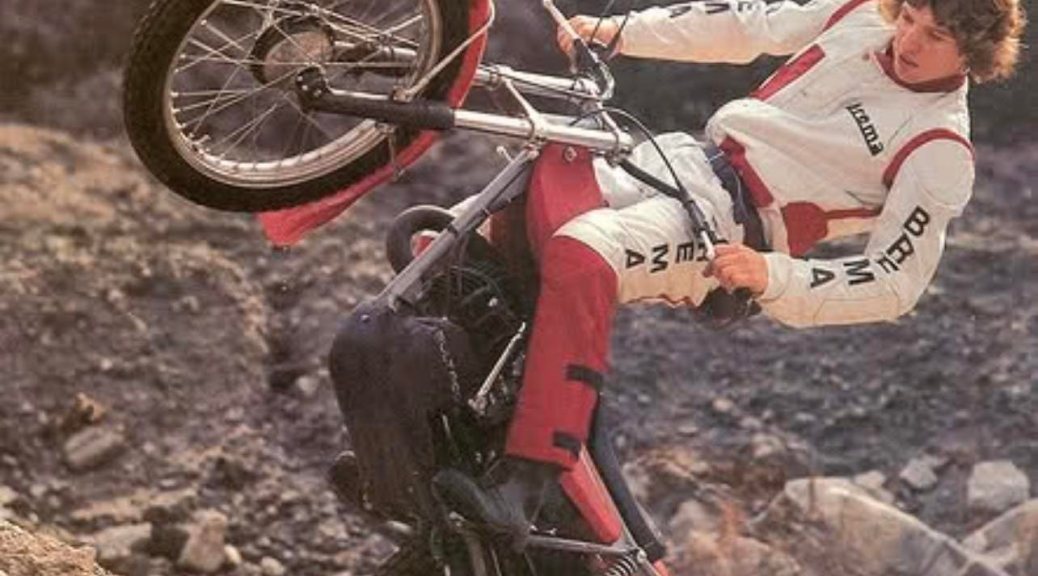
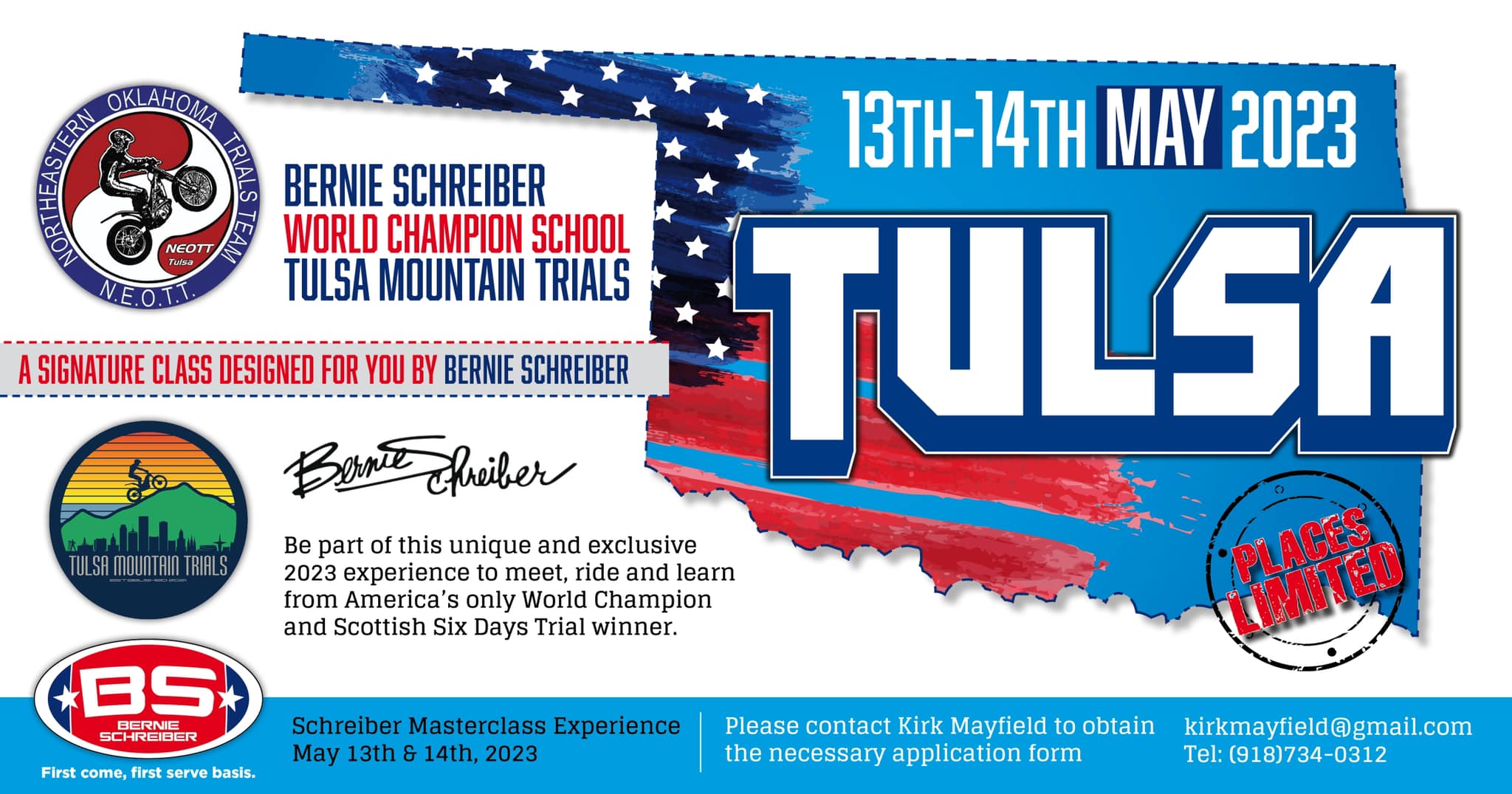
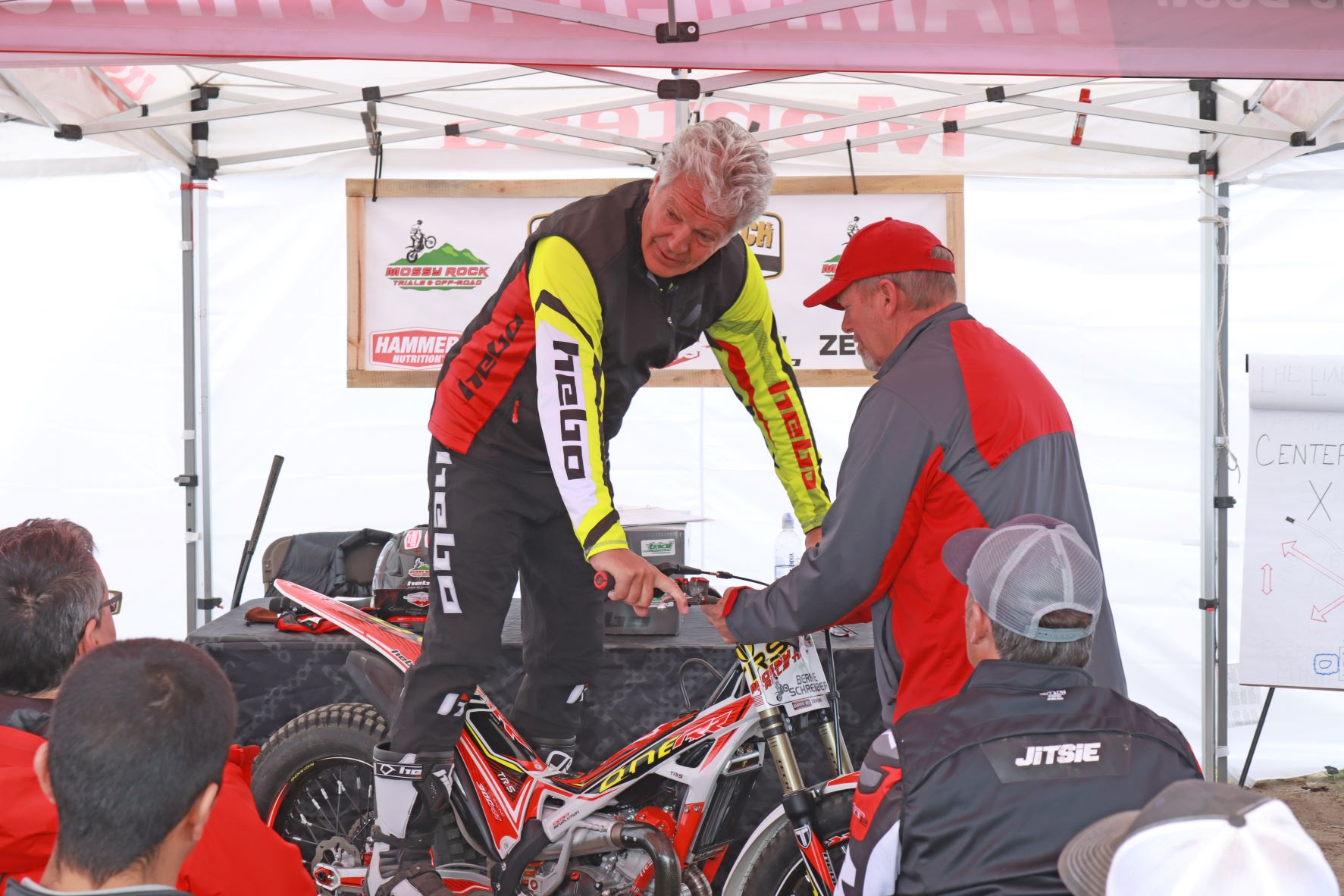
Former World Trials Champion and Scottish Six Days Trial winner, Bernie Schreiber will return once again to the USA in 2023 to conduct another ZeroBS Master Class two-day trials school on May 13/14, 2023 in Tulsa Oklahoma.

The event will be hosted by one of the oldest clubs in the USA, the North Eastern Oklahoma Trials Team, founded in 1969 by one of the legendary names in US trials history Mike McCabe, who became the first American competitor in the Scottish Six Days Trial in 1972.

In 2022 a very successful ZeroBS trials school was held in Montana hosted by Rich Hilbun. This celebrated the 40th anniversary of Schreiber’s double US National Championship victories in 1982. For 2023 the school will be held in Tulsa, Oklahoma where it will be more central and accessible to students from across the USA.
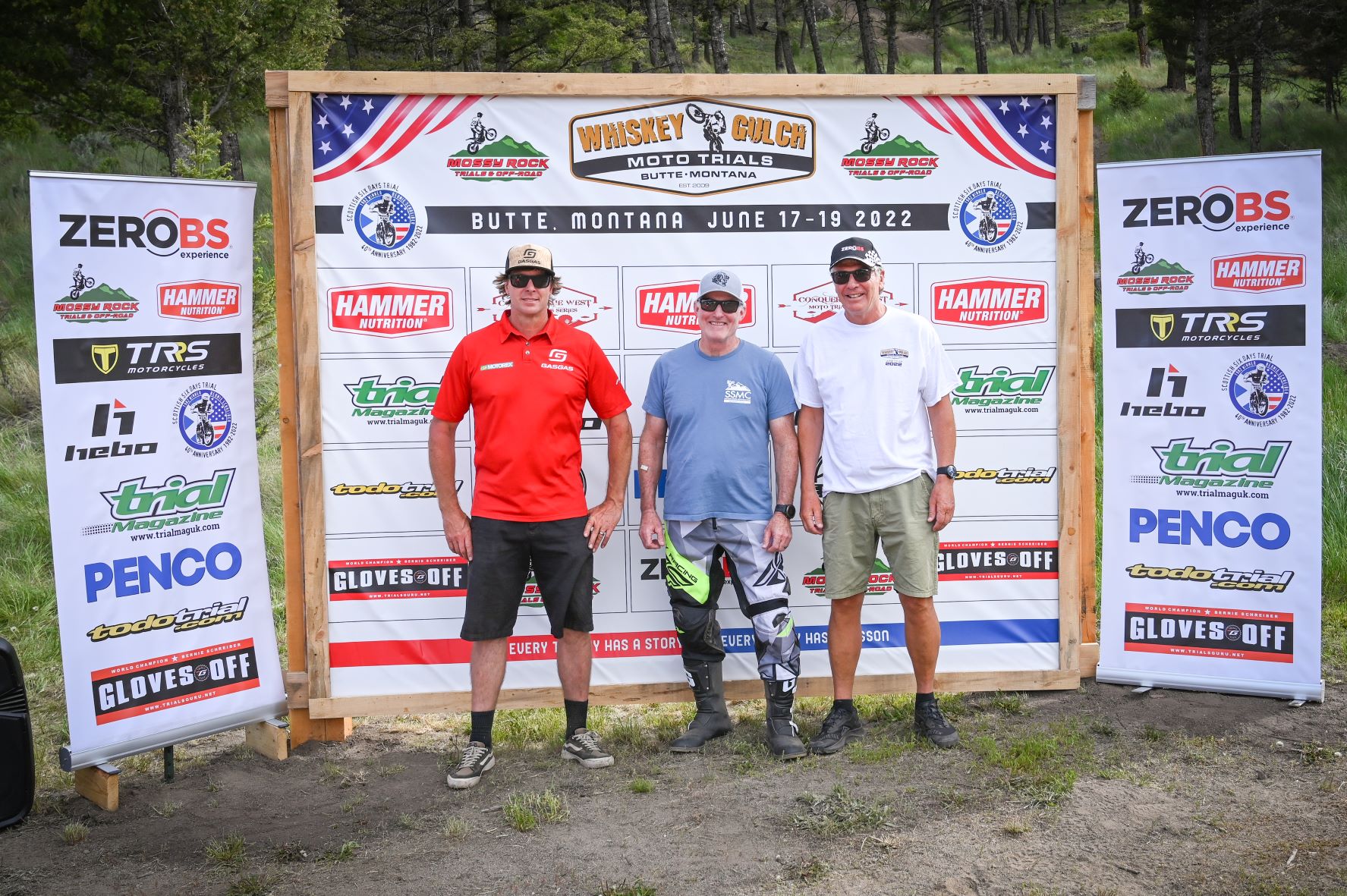
This venue became a reality after conversations with Dr. David Klein of Texas at the FIM Vintage Trial Trophy in Monza, Italy on September 24, 2022. Klein put Schreiber in contact with his long-time friend, another US trials legend Kirk Mayfield of Oklahoma who competed in the 1973 Scottish Six Days Trial on one of Mick Andrews factory Yamahas. Mayfield and Schreiber competed together in the Turkey Creek US National in September of 1975, an event that included many of the best riders in US history.

Schreiber said, “I’m excited for this opportunity in 2023 to teach, ride and encounter friends again in such a memorable place. It really is an honor to host a school with Kirk Mayfield after all these years and he is someone that many people do not realize was such an excellent rider in the history of US trials. To revisit the famous Route 66 or Mother Road is always a special experience as well. Looking forward to meet many club members and current NEOTT President Jason Shackelford who leads one of the oldest Trials clubs in American history.”

Mayfield, who is one of only six riders to have been granted life time membership in the NEOTT Said: “We have hosted many prestigious events here at our club in Tulsa, but it is such a privilege to host the USA’s only World Trials Champion and my friend for so many years here in Tulsa. Everyone is really looking forward to this, because we can share all our experiences from riding overseas and have Bernie’s instruction on how he became a world champion!”

For information about the Schreiber Masterclass on May 13 & 14, 2023 contact: Kirk Mayfield at: kirkmayfield@gmail.com

Note: Limited Spaces Available.

Competing to win

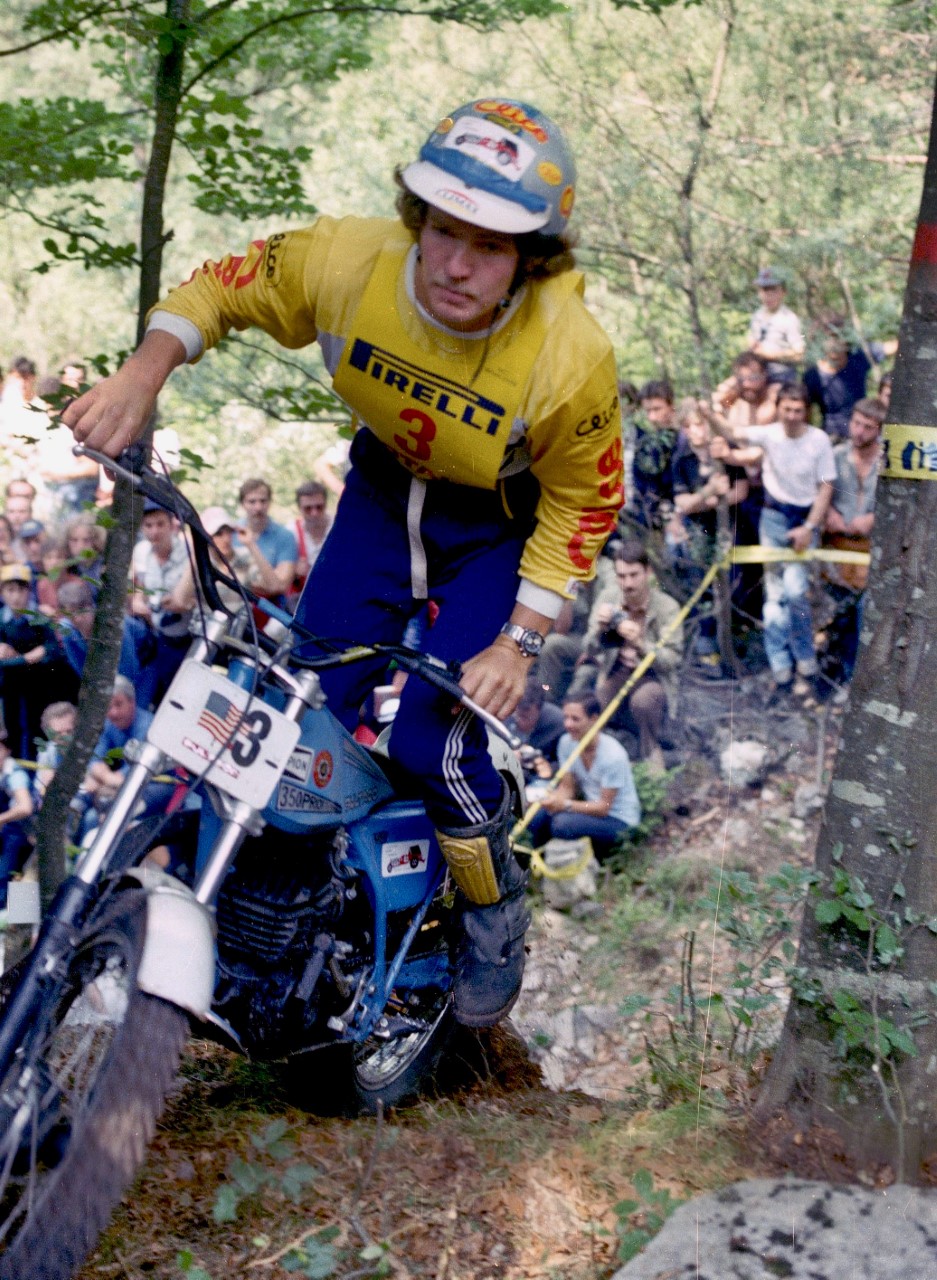
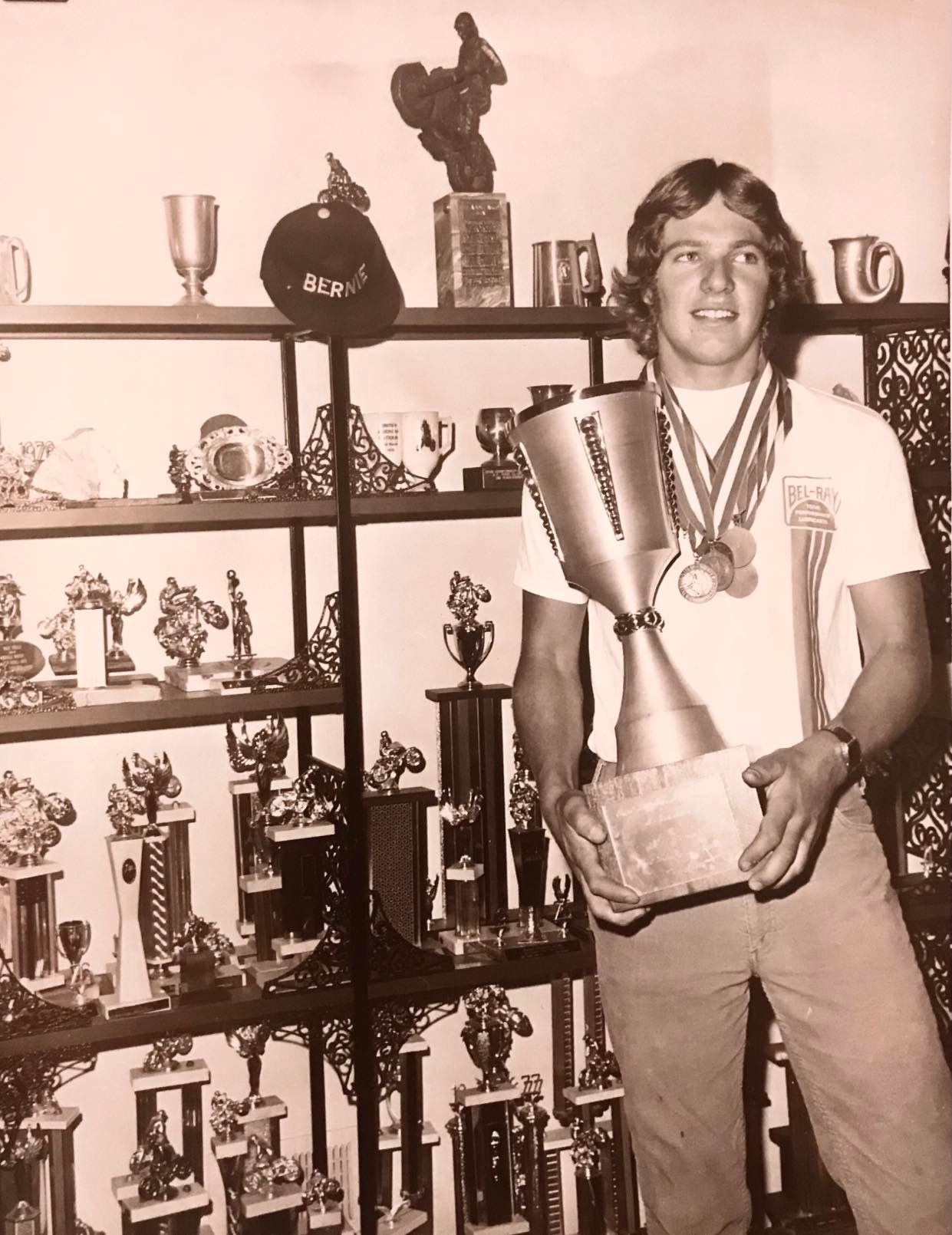
FIM World Trials Champion and Scottish Six Days Trial winner, Bernie Schreiber shares his winning attributes with Trials Guru. Schreiber is the co-Author of the renowned book “Observed Trials” with Len Weed.

Photos: Eric Kitchen; Mauri/Fontsere Collection

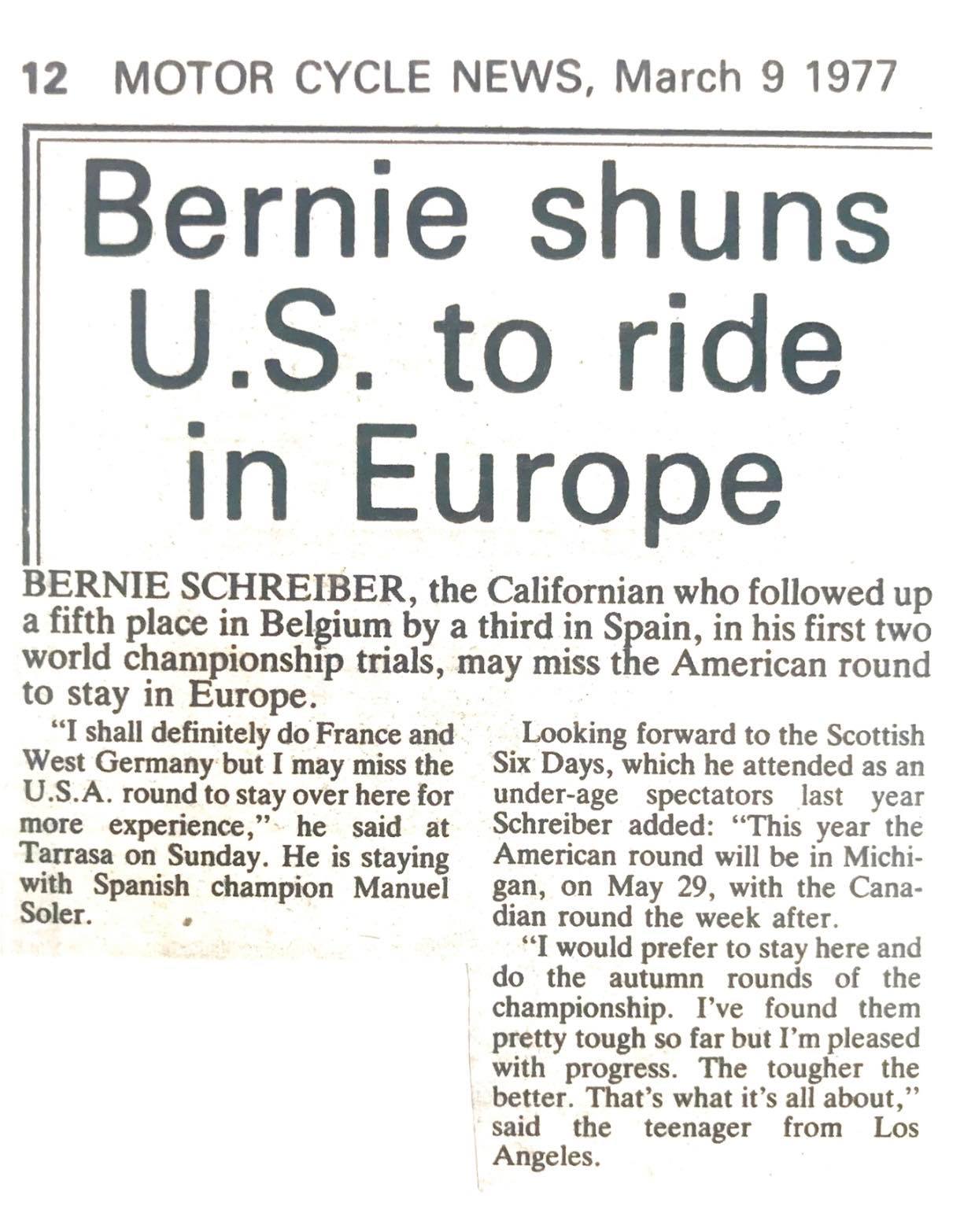
Excerpt: Motor Cycle News 1977.

TG: Everyone would like to win, but most don’t. Why?

BS: To win, you must prepare yourself to be the winner – not simply “do my best” mentality. During 40 years of off-road motorcycle Trials coaching, I continually see riders under-performing due to a lack of proper preparation. Many have plenty of potential, talent and skill, but they are often performing best at a time when it is not necessary or not focused when the big day comes along. The performance transition from skills to victory is complex in the sport of Trials even when you’ve got it right physically. Many athletes fail to get the result they could because they have not prepared themselves to be the winners but merely to ‘do my best’. This attitude might work once, but usually only once. The bigger and more important the event, the more likely the win will go to someone who has been expecting to win and who has trained him or herself to cope with all the demands that winning entails. This clearly involves mental as well as physical preparation.

TG: Can you elaborate on the transition from skills to victory?

BS: The performance transition phase depends on your level of challenge, but the higher you go, most likely the less you know and this applies to most sports athletes. If you compete at a clubman level, a National Championship or World level it’s very important to clearly understand your goals. The sport of Trials has changed over the years, along with bikes, skills and section design, but the transition to winning is a mindset, that needs very fine tuning. The nature of competition is that the unexpected will happen. A great competitor will expect the unexpected, have anticipated how to manage it effectively, know how to overcome it completely and have planned and prepared to deal with whatever challenge comes along. If your training plan only deals with what can reasonably be expected – what statistically is most likely to occur, you may be competitive but you will rarely win. Winners expect to win regardless of what happens on the field of battle. Not only that, but they train to be the unexpected: to be the competitor who does things that no one thought possible and in doing so give themselves a clear winning advantage.

TG: How important is confidence?

BS: Nothing gives an athlete confidence like winning, but knowing with absolute certainty that they have consistently out-prepared everyone they will face in their targeted competition. You can talk it up, you can tell them how great they look in practice, you can try to convince them they have improved and that they are ready for anything, but for the most part the only person getting motivated from your motivation talks is you. Athletes need evidence, real evidence that they can be successful and the only currency they will bank on is knowing that their preparation has been absolutely perfect in every detail. The cheap talk and bullshit will not help you on competition day. Competition tactics need a plan like training, you must also have a winning plan for each event and the Championship. This means that you must know the opposition and what they are likely to do when and where. You must have a response to deal with each situation, know your own strengths and weaknesses and when you have made your plan you must be able to carry it out under pressure. It always comes down to a battle of wills, and you will be the winner if you have built yourself to a point where you will not accept defeat.

TG: What are the emotional aspects of competing?

BS: If competition was only about being physically ready, then coaching would be easy. But it’s not. The emotional aspects of competition are what determines success or failure. In professional sports and among the serious competitors, physical preparation, techniques and training methods are remarkably similar the world over. The real competitive advantage comes when athletes can maintain control and calm during competition and do their “job” regardless of the situation, country, weather, rules or opposition. The capacity to do this in competition comes from practicing to do this in training. All sports have a strong technical aspect, but being able to execute good technique at training is not enough. Winning in competition means performing with technical excellence under fatigue, under pressure and doing it repeatedly. If you have only practiced executing the technical elements of your sport during the first 50% of your training session – then you are not practicing to execute the skills of your sport under competition conditions. It is important to practice techniques and skills in conditions and circumstances which simulate and even exceed the demands of competition. The athlete must execute skills accurately and consistently when they are fatigued and under emotional pressure. Performance practice makes for perfect performance.

TG: How important are Trials skills?

BS: Trials skills are very important when used correctly. The transfer of technical skills learned to competition skills and to actual winning skills are major steps at the highest level. The best skill and most difficult is to “perform well, under fatigue and under pressure consistently in competition conditions.” You’ll often find trials schools promoting a list of trick techniques to learn, but most of them are not really applicable in competition consistently and therefore results are often not achieved. It’s important to work on every basic aspect of the sport to reach your potential and do it with consistency. Most improvement strategies are based on the “more” approach: more effort, more practice, more techniques, more hours and work. Unfortunately, experience has proven that simply adding more techniques or more hours is not the answer to winning. Real performance improvement is a result of critical actions on key variables that help you take action by removing obstacles that stand in your way. As a result, you will be able to use your knowledge and skills more effectively. Each training phase must be a built-in structure of progress. In the build-up phase, this should be both in the overall quality of the training and in the proportion of high-quality competition training.

TG: Did you give your opponents a chance to win?

BS: There are two types of people in sport. Those passionate about participation and all the great, wholesome, healthy, community enriching aspects of sport and those who are just as passionate about winning. Those passionate about winning is a very low percentage of athletes. Those in the participation group will tell you that sport is all about fun, community, kindness, peace, love, happiness and about people enjoying the weekend. The reality for this passionate winning type is that sport, if you want to succeed is ruthless. For winners it’s about winning and being dedicated to and single minded about winning. It’s about consistently competing to the very best of your ability without excuses. It’s about realising that your opponents do not care how you feel, they don’t want you to enjoy the competitive experience, they don’t give a shit about your dreams, they want to beat you and if possible, beat you badly. That’s why tough training is so critical. You must prepare to a level that does not give your opponent, regardless of their talent, their resources, their training programs or their coaching support, any possible chance of victory. If you want to win, make your training more challenging and more demanding – physically, mentally, technically, tactically and every other possible way harder than the competition you are preparing for and more than your competitors.

TG: Is Trials a Sport that can prepare you for winning in life?

BS: I believe sports competition prepares individuals to challenge themselves and Trials riders are a smart and talented group of people. They are ready to go face the obstacles head on and evaluate themselves on a scorecard. Trials is measured from the ears up and very frustrating sometimes, but it can teach a person to be brave, strong and resilient. I’ve always liked individual sports like trials, golf, tennis, skiing and others. You learn to observe things differently and stay focused on your personal results without team excuses or mistakes. It is a sport that gifts its participants with the knowledge they need for the rest of their lives. A sport that can provide you the keys you need to unlock your future. Without this sport, I would have never become the person I am today.

Bernie Schreiber receiving the 2021 FIM Trial Legend trophy from FIM President, Jorge Viegas.

Copyright: Bernie Schreiber/Trials Guru 2022

Price takes Scott Trial 2022

Jack Price (Vertigo 300) has been declared winner of the annual Scott Trial which took place on Saturday 15th October 2022.

Organised by the Scott Trial committee of the Richmond Motor Club (Yorks) Ltd, the time and observation event had a full entry list of 200 riders.

Fastest time was recorded by local rider, Jonathan Richardson, himself a previous winner in 2011.

Three times winner, James Dabill came home a creditable second place, not bad considering he rarely is on a trials bike, never mind competing in national events since his retirement from the sport in 2020.

The 2022 results can be viewed on our Scott Trial page HERE

Photo credit: Trial Magazine/Trials Media 2022

Tony Bingley 1940 – 2022

On the same day as the British nation lost their Monarch, Queen Elizabeth II, the sport of motorcycling lost a veritable character and all round sportsman, Beetham born, Kentmere raised, Tony Bingley.

(Main Cover Image courtesy of Eric Kitchen)

SSDT 1980 – Tony Bingley on his 325 Bultaco tackles Muirshearlich (Trotter’s Burn) – Photo: Iain Lawrie

Known throughout the trials world as ‘Bing’, he rode many Scottish Six Days Trials on Bultaco machinery. ‘Bing’ became good friends with Sid Lampkin and Malcolm Rathmell and he gained some support from Shell during his trial career. He also took up racing in his motorcycle sporting career.

Sid Lampkin got to know ‘Bing’ as teenagers when Sid competed in trials up in the Lakes: “Tony was an infectious character, everyone liked him and he was good company. He used to bring Libby’s products with him when he visited us, when he lived near their factory at Milnthorpe.”

Tony also competed in classic racing on a 496cc Seeley G50 Matchless and was no slouch at the tarmac game, posting an 88.72 mph lap in the 1994 Manx GP Classic Senior race. However, Tony suffered a major accident at Scarborough’s Oliver’s Mount circuit which, having a physical impact, curtailed his activities somewhat.

He was also a keen supporter and eventually became a director of Carlisle United Football Club, at one time their Commercial Director. But his main occupation was at Leyland Motors in Lancashire and most of his working life was motor trade based.

Tony on the Harrison Montesa 200 in 1981 (Photo: Jimmy Young)

Tony Bingley was a friendly character, he enjoyed interacting with fellow competitors and organisers, it is true to say he was a likeable individual with an outgoing personality.

Tony’s son Gary was also an accomplished trials rider and in May 2022, Tony had great pleasure watching his Grandson, Jamie Bingley riding the Scottish Six Day Trial. Over a 50 year period, the Bingleys had a Grandfather, Father and Son competing in the same event.

Photo courtesy: Bingley Family, Carlisle.

Whiskey Gulch Two Day Spectacular 2022

Words: Team TrialZone\Matt Liberatore

Photos: Mark Matteson

Dateline: Bozeman, Montana July 4, 1982

Independence Day was celebrated as a travel day for those taking part in the 1982 United States National Trials Championship Series. The day before, the riders had completed the first national ever held in the state of Montana which happened to be one of the championship’s easiest scoring rounds ever. 1979 World Trials Champion Bernie Schreiber, one week removed from his third place finish at the World Trials Championship round held at the Donner Ski Ranch in Norden, California, won the event  by two marks over Florida’s Jack Stites while losing only five marks in the process.

Traveling to Whitefish, MT where the second of the two nationals would be held on July 5th, virtually all the participants hoped for a more difficult test, in order to give more room for errors on the scorecards, but had no idea what was in store for them. What is the old saying? “Be careful what you wish for”. Montana’s Rich Hilbun, of the hosting trials club GOTE (Glacier Observed Trials Enthusiasts), organized that second national in Whitefish and knew the sections needed to be toughened up and acted accordingly. Mother Nature also leant a helping hand as heavy overnight rain turned the jagged rocks of Whitefish into not just a difficult challenge, but simple survival for most as Schreiber once again took the victory, this time with a winning score of 144 as Colorado’s  Morgan Kavanaugh placed second 40 marks behind. The riders finishing this event were given stickers saying “Clean the Fish” but many thought “Five the Fish” would have been better. Schreiber’s winning score stands to this day as the highest winning score in the history of the United States National Trials Championship Series.

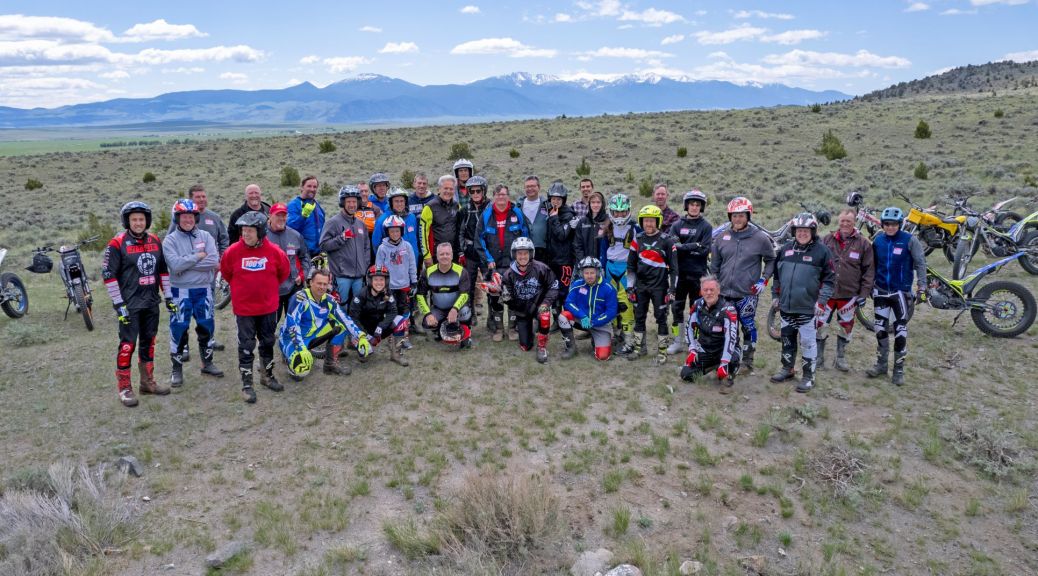
Fast forward thirty nine years later as Hilbun had the idea to contact Schreiber about returning to Montana on the 40th anniversary of those 1982 nationals. Hilbun thought Schreiber could not only conduct one of his ZeroBS Masterclass trials schools, but take part in a multi-day celebration held in conjunction with the annual Whiskey Gulch Two Day Trial that began in 2009 and has been held uninterrupted for twelve consecutive years. The conversation resulted in Bernie Schreiber’s return to Montana  June 15-19, 2022  starting with a sold out two day trials school, followed by the  celebration of Champions Day, and then the Whiskey Gulch Two Day Trial as the finale.

Global Ambassador of Montana:

Dateline: Butte, Montana June 13, 2022

Bernie Schreiber’s return to Montana, USA forty years later began with the announcement from the promoter of the Whiskey Gulch Two Day Trial, Dan Larson of Mossy Rock Trials and Off Road that Schreiber had been appointed as a Global Ambassador for motorcycle trials in the state of Montana. This affiliation will help with communication of the event as Schreiber, being the most successful rider ever from the USA, will be committing his years of experience for future growth. Together with a shared interest in unique trials events, Schreiber and Larson plan to embark on a series of exciting projects demonstrating innovative solutions for Motorcycle Trials going forward.

The Bernie Schreiber ZeroBS Masterclass school:

Butte, Montana June 15/16 2022

Bernie Schreiber conducted his first signature ZeroBS Masterclass experience since 2019 (due to COVID-19) while riding a TRRS 300 supplied by Dan Larson of Mossy Rock Trials and Off Road in beautiful dry conditions, much different than 40 years ago on the factory 280 SWM on rain saturated terrain. Schreiber treated the 30 participants to a unique structured format based on lessons learned in becoming a World, National, and Scottish Six Days Trial Champion, but also while relating other sports such as golf, where direct comparisons become involved. Classroom training, hands on riding and the all important mental approach were covered in great detail.

The classroom setting began this first day before hands on the bars riding, by covering the most important aspect of Motorcycle Trials, the proper stance. Motorcycle Trials has always been a very unique form of off-road riding which requires certain techniques that do not always apply to riding a “normal” dirt bike, especially when it comes to the basic fundamentals. Fortunately, all aspects were covered during three “Impact Zones” throughout the full day of instruction.

Hammer Nutrition founder and CEO Brian Frank spoke towards the end about the often overlooked aspect of performance in sport nutrition. Founded in 1987, Frank told of his experiences from the beginning of the Triathlon boom when the company’s first products were manufactured to help the athlete’s body combat side effects such as fatigue and recovery from high endurance training.

After lunch on the school’s second day, everyone was treated to instruction on what gave Bernie Schreiber an advantage over his rivals, that being the technique which he introduced and perfected, the floating front wheel turn. Also known as the “Pivot turn”, Schreiber used this to great effect in winning the World Trials Championship and showed exactly why this technique is just as effective now.

During each day of the school, each individual student was given one on one instruction on the techniques of this fascinating sport and an insight into what actually makes a World Champion, the attention to detail, leaving no stone unturned.

Champions Day:

Butte, Montana June 17, 2022

This day of celebration was to reconnect with old friends and get to know others while recognizing the achievements of Bernie Schreiber as the Guest of Honor. Also joining Schreiber were fellow past US Champions Geoff Aaron, now the US trials team manager for Gasgas,  and Scott Head, who happened to be Schreiber’s teammate in 1981. These three icons of US trials have a total of 17 National Championships between them. This was a relaxing off day for everyone involved getting together to enjoy the week.

The Whiskey Gulch Two Day Trials:

Butte, Montana June 19/20 2022

The final event of the five day celebration of Schreiber’s return to Montana after 40 years was held as the fourth stop in the eight event Conquer the West Trials Series which began in 2017. This is a two-day event series in the western USA where riders take part in at least four events to earn points towards their respective final positions, and has expanded to include ten-two day events in 2022. 

The Whiskey Gulch Two Day Trial brought in 122 riders from several different states and countries to take part in one of the most anticipated trials events of the year.

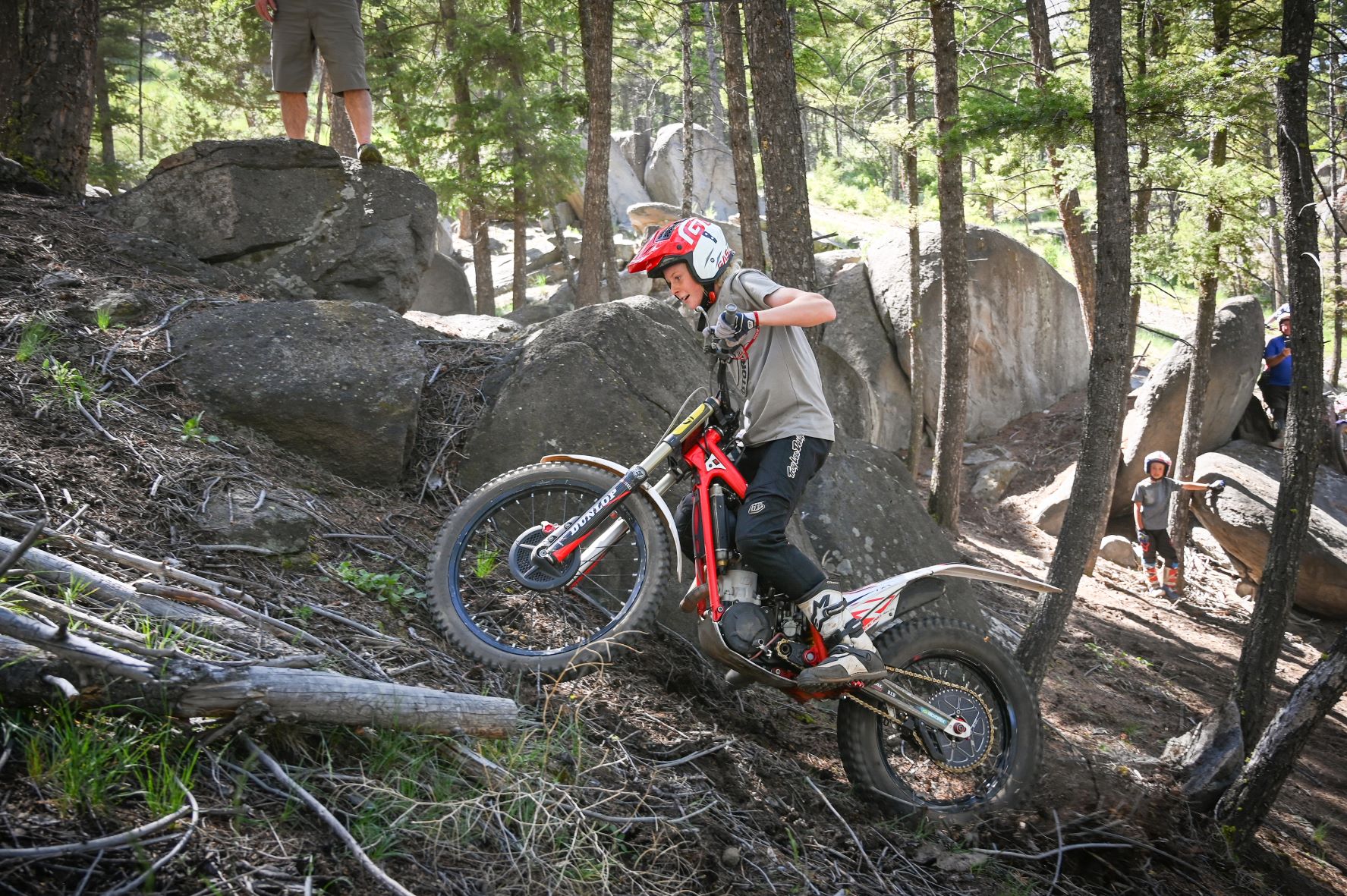
Unlike 1982 when Schreiber won the national round in Whitefish, perfect weather greeted the riders from the very start of the ZeroBS Masterclass school on Tuesday and continued throughout the week as the riders went off at 10:00 AM Saturday morning, at fifteen minute intervals depending on class, to tackle 10 sections three times on the beautiful Montana countryside. The sections featured plenty of grip on a nice combination of dry rocks, log crossings, and up and down banks. with some steep loose climbs thrown in requiring throttle control to maintain grip on the rear tire.

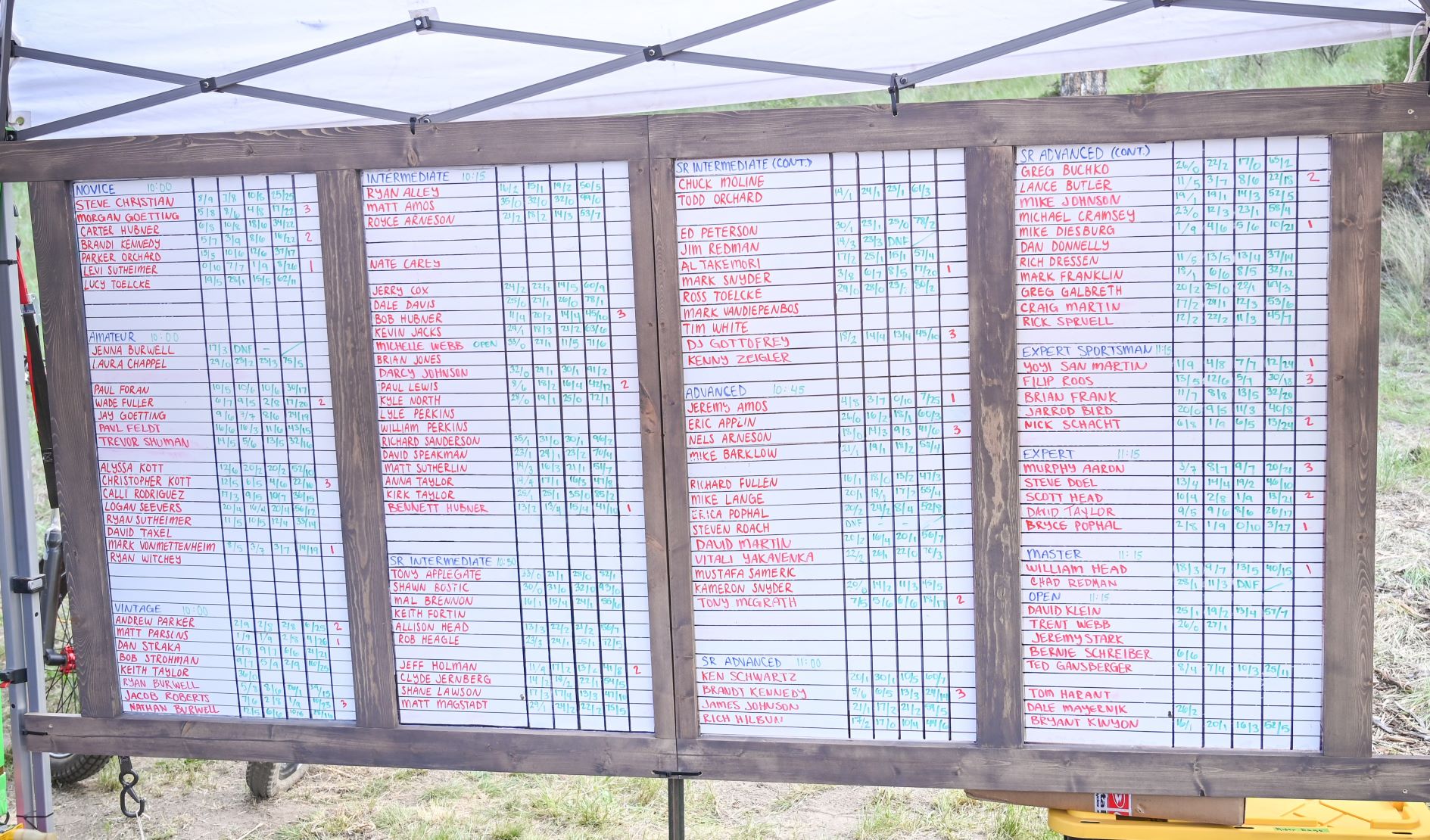
William Head took the lead on this first day in the Master Class by an 11 mark margin over Chad Redman. Head continues to improve while showing the type of skill that does not surprise anyone considering the trials career of his father Scott. 

Bryce Pophal lost only 3 marks on the day in Expert while Geoff Aaron’s son Murphy, another rider taking after his father displaying impressive form and talent for his age, took second position with 20 marks lost. David Taylor came in at third place with a score of 26.

Yoyi San Martin of todotrial.com fame, making his first ever trip to the USA traveling from Spain, took the first day lead in Expert Sportsman by a single mark over Nick Schacht. These two riders were so close that they also had the same amount of clean rides, matching 24 on the day.

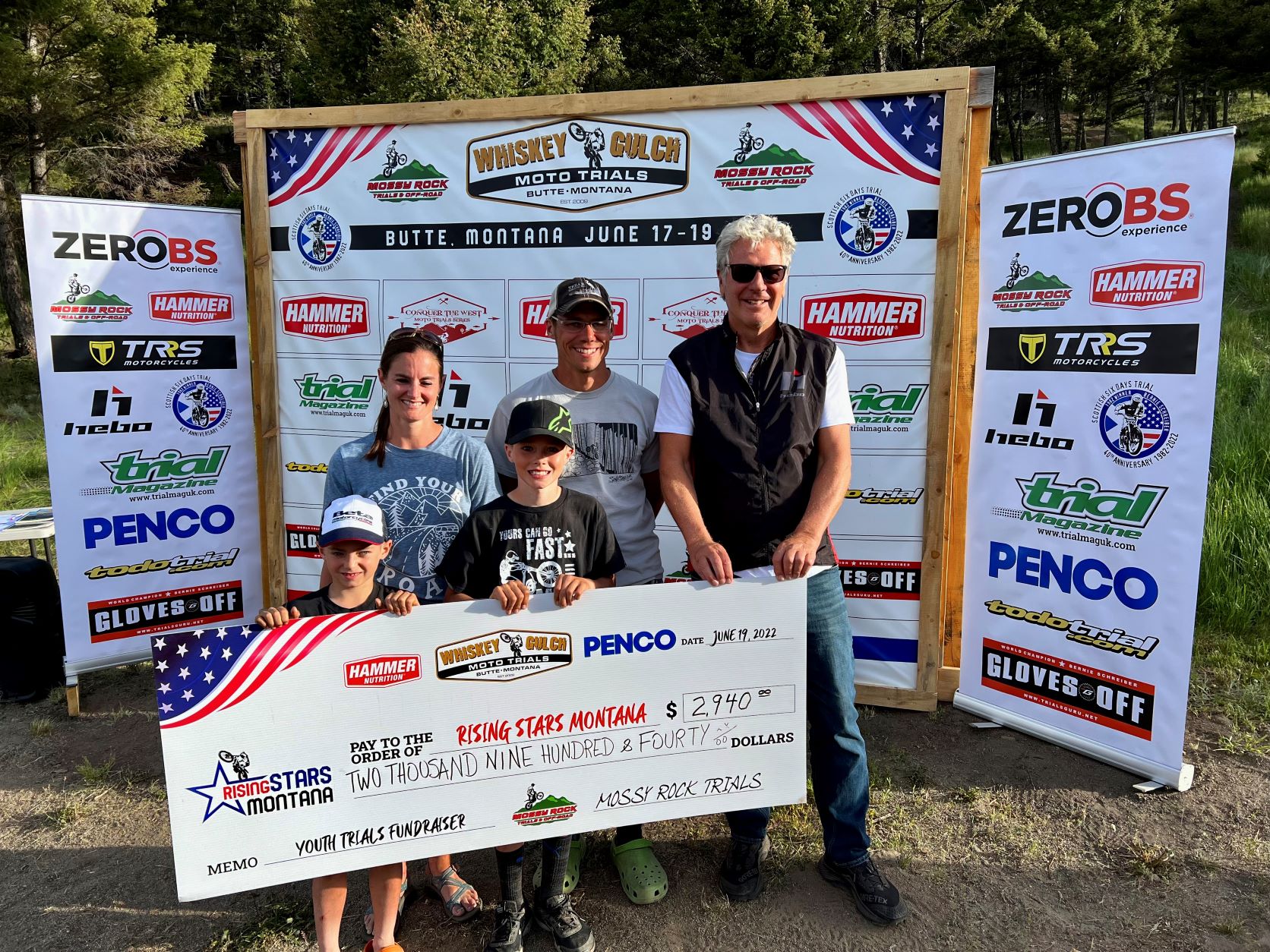
The Rising Stars Montana Silent Auction took place after the day’s riding ended. Rising Stars Montana is a fund dedicated towards the future development of up and coming youth riders in Montana. One of those promising up and comers, eleven year old Bennett Hebner took the lead in Intermediate Class by 4 marks over his father Bob 41 to 45 at the day’s end.

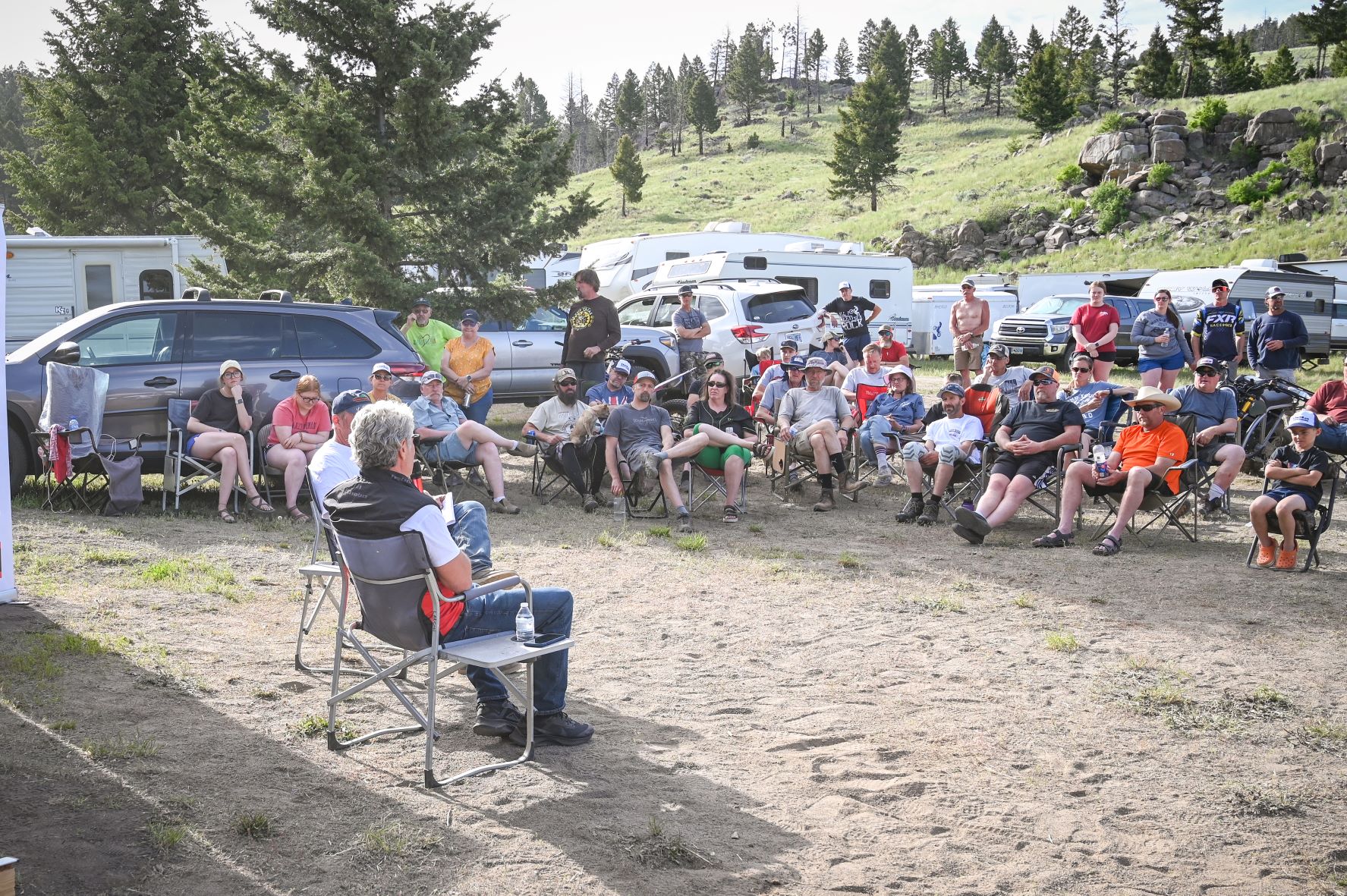
A question an answer session with Bernie Schreiber then took place before The Rising Stars Montana fund raising check of $2,940 was presented in order to give a helping hand to the youth riders of Montana in reaching their full potential.

Afterwards, landowners Keith and Heather Fortin were presented with everyone’s gratitude for their continued commitment in helping grow the sport in the state of Montana. The evening ended with the Under the Montana Stars bonfire.

Day two began with rider sign in at 8:00 AM sharp followed by once again the section scorer and gift bag distribution, thanking those who have the not so easy but rewarding job as an observer. Shortly before the riders meeting all riders were required to be in the paddock area looking up towards the sky for the Big W arial drone photo, another detail making this event so special.

The staggered start really helps in preventing the dreaded bottlenecks that can take place with everyone going out at the same time as the riders left to face another three laps, this time with 9 sections as the perfect conditions continued.

William Head once again took the day two lowest score in Master Class by only 2 marks over Chad Redman, 17 to 19 and thus took the overall event victory with a grand total of 57 marks lost to Redman’s 70.

Murphy Aaron produced very impressive rides with a closing score of 3 to lead day two in Expert as Bryce Pophal came in 7 marks adrift with a score of 12. Despite the outstanding ride on the day, it wasn’t quite enough for Aaron as Pophal  took the overall win with a grand total of 15.

Yoyi San Martin halved his day one score in Expert Sportsman to win again on day two by finishing with just 6 on his scorecard while Nick Schacht fell back, losing 23 marks on the day, San Martin now has the distinction of being undefeated on US soil as his grand total of 18 also gave him the overall win for the two days.  

Bennett Hebner placed second behind his father Bob this time, in Intermediate class but took home bragging rights with the overall win by a single mark with a grand total of 59 in one of the closest finishes.

The other close finish came in Amateur class as Mark Vonmetteheim won with 17 over Wade Fuller who dropped a total of 18 marks overall.

Afterwards, the awards presentations, drawings, and give aways ended these five days of festivities as everyone involved showed the excitement of already looking forward to 2023!

Special thanks to Dan and Laura Larson, Rich and Yoyo Hilbun, all the sponsors, observers, media, riders, photographers and everyone involved for making such a memorable weekend for us all! More photos of this event will be available at mossyrocktrials.com

Results Top Three per Class Whiskey Gulch Two Day Trial 2022

Master: 1. William Head 40+17-57; 2 Chad Redman 51+19-70

Expert:  1.Bryce Pophal 3+12=15; 2. Murphy Aaron 20+5=25; 3. David Taylor 26+26=52

Expert Sportsman:

1. Yoyi San Martin 12+6=18; 2. Nick Schacht 13+23=36

SR Advanced:

1. Mike Diesburg 10+6=16;  2. Lance Butler 22+12=34;

3. Brandt Kennedy; 24+14=38

Advanced:

1. Tony McGrath 18+9=27; 2. Richard Fullen 47+9=56;

3. Nels Arneson 41+28=69

SR Intermediate:

1. Mark Snyder 17+1=18; 2. DJ Gottofrey 45+15=60;

3. Jeff Holman 41+20=61

Intermediate:

1. Bennett Hubner 41+18=59; Bob Hubner 45+15=60;

3. Ryan Alley 50+12=62

Amateur:

1.Mark Vonmettenheim 14+3=17; 2. Wade Fuller 17+1=18;

3. Christopher Kott 22+4=26

Novice:

1. Levi Sutheimer 8+12=20; 2. Brandy Kennedy 16+13=29;

3. Morgan Goetting 17+15=32

Vintage:

1. Matt Parsons 4+0=4; 2. Andrew Parker 6+3=9;

3. Jacob Roberts 10+0=10

FIM Trial Vintage Trophy

Quite simply the biggest celebration ever staged of all things retro in the wonderful world of trial, we’re less than two months away from the inaugural FIM Trial Vintage Trophy which is scheduled to take place at the legendary Italian venue of Monza on September 24, 2022.

Trial fans from across the planet are invited to attend and it doesn’t matter whether you’re a rider or a fan, a feet-up ace or an also-ran – you will be assured of the warmest of welcomes!

Master of ceremonies will be the original American Idol and 1979 TrialGP World Champion Bernie Schreiber.

Still the only rider from the USA ever to achieve global domination, the charismatic SoCal superstar will oversee the day’s action with a packed programme of interviews with our sport’s historic heroes and major players.

“I’m excited,” said Bernie Schreiber. “This is going to be an amazing day and I can’t wait to meet up with my old rivals and friends and fans from back in the day as well as new, much younger enthusiasts. Vintage trial is booming at the moment and this is the event we’ve all been waiting for.”

Bringing old and new together, the FIM Trial Vintage Trophy will be staged over a course of two laps of 12 sections on the same weekend as the FIM Trial Des Nations. On top of this there will be an exhibition of classic trial machines at the Autodromo of Monza which will also be the base for a reservation-only Trial Des Nations and vintage cocktail dinner on Saturday after the TDN presentation.

Dinner reservations will soon be available at https://trialgp.com/2022-trial-des-nations-italy/

“Trial has such an illustrious back-story,” added Bernie, “and I’m delighted that the FIM wants to celebrate it in this way. It really is a must-not-miss weekend that encompasses the complete history of the sport we all love.”

The FIM Trial Vintage Trophy will play an integral part of the 2022 FIM Trial Des Nations so whether you’re a competitor or a spectator you’ll be given a never seen before, opportunity to rub shoulders with some of the greatest athletes this sport has ever produced.

There will be two main bits of silverware up for grabs – for best performance on a vintage motorcycle and best performance on an authentic vintage motorcycle. There will also be a support class that will compete over easier sections.

Entries will close 21 days before the event and you can register now at https://www.trialgp-registration.com to be part of this historic event.

The action kicks off at 9am on the Saturday with the start of the FIM Trial Vintage Trophy with official TDN practice getting under way one hour later. The following day the latest generation of trial heroes, both male and female, will showcase their sublime skills and bring you bang up to date starting from 8.30am.

Monza is situated around 10 miles north of Milan. There are three airports within 40 miles and road links are excellent.

For the full timetable and more information: https://trialgp.com/2022-trial-des-nations-italy/

For more practical information download the CTR Info letter 02 Trial Vintage available at the TrialGP Noticeboard.

Source: FIM Press Office

The Premier Trial Website – Recording the History of the Sport 'Established 2014'