Chris Griffin from Knaresborough

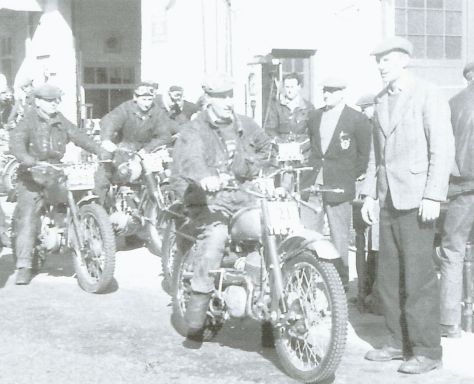
84runner up in the 1985 wetherby group trial chris griffen on his 125 fantic
Runner up in the 1985 Wetherby Group Trial, Chris Griffin on the 125 Fantic – Photo: Barry Robinson

Chris Griffin

Words: Trials Guru & Chris Griffin

Photos: Barry Robinson with permission; Bob Gollner Ltd.

At sixteen years of age a second-hand 125cc Dalesman Puch 125T sourced from G.W. Johnson’s shop in Harrogate, gave Chris Griffin his first taste of trials riding, a popular choice at the time in Yorkshire as the machines were produced in Otley by Pete Edmondson.

Passing his driving test in February 1974 helped immensely as his father worked through weekends and Chris could only get to events if his friend rode, so that he could cadge a lift to trials.

Joining the Wetherby Motor Club introduced him to John Reynolds who was to become a lifelong friend. Griffin was at college as an apprentice motor engineer, discovered that on a Wednesday, Malcolm Rathmell and Martin Lampkin with some other riders assembled at Rob Shepherd’s farm at Pately Bridge for practice. He enquired if he could tag along to watch with his bike. When they had moved on to another section, Chris would try and emulate the established stars.

Chris: “Watching Malc and Mart really brought my riding on, it was like a crash course in trials, watching them carefully and doing what they did really helped my own riding skills. I was amazed how quickly I improved.

Moving swiftly from a Novice through the ranks of Intermediate and then onto expert status, Griffin started to catch the eye of other established riders. In 1978, Chris finished fourth in the Lakes Two day and was a regular top twenty performer at national trials. Four days before the 1978 Scottish, John Reynolds appeared at OSSA UK to collect his new SWM for the SSDT and telephoned Griffin to ask if he would like to take over Geoff Guy’s entry in the OSSA team as Guy had broken his wrist. ‘JR’ had named dropped Chris to importer Cliff Holden who at that time had two importerships, the Spanish OSSA and Italian SWM. Holden agreed that Griffin would ride Reynold’s old cantilever Ossa, so the machine was despatched up along with Reynold’s new SWM for Griffin to ride as a full team member of OSSA UK.

After a quick check over, Chris collected the OSSA on the Friday before setting off for Fort William and came home a very creditable twenty-second place in the event. Not bad for a first attempt at the toughest trial in the world! He also picked up the best 250cc cup and Best Newcomer award for his efforts.

Chris continued with the OSSA until the September that year, when he was approached by Beamish Suzuki to join their team.

Chris: “My results just got better and better, in 1979, I finished fourth in the Lakes Two-Day, fourth in the Colmore, the first round British championship, nineteenth in the Irish world round, twenty-second at the English world round, thirty-forth at the Belgian round where I had a problem with engine when I cracked the crankcase which was drawing in air. I managed a fifteenth in the Netherlands, a twenty-second in France and twenty-eighth in the SSDT.

On the 325cc Beamish Suzuki, Griffin made some changes.

Griffin: “Everyone struggled with the 325 Beamish Suzuki until I had them fit the 250 model swinging arm to my bike before the Christmas in 1978. It transformed the bike into a winner. ‘JR’ and Chris Sutton could not believe the difference it made. If only Malcolm Rathmell had tried one on his bike before he left, things might have been different for him with the Suzuki. The 250 swingarm was longer with a different shock angle and that made such an improvement to the handling characteristics.”

Chris Griffin on the Fantic – Photo: Barry Robinson with permission.

Griffin’s involvement with the development of the Gollner-Griffin TLR250 Mono-shock:

Bob Gollner advert

Honda produced its TLR series which comprised of both 200 and 250cc versions. The 200cc machine would be produced in quite large quantities as a trial/trail machine over a period of years. The 250cc TLR was produced in smaller quantities making them more desirable than their smaller sibling.

In 1985, Honda Racing Corporation, the competition division of the mighty Honda Motor Company would take charge of producing the mono-shock RTL or ‘Racing’ TL version which were developed by Eddy Lejeune and latterly Steve Saunders. Saunders would ride the TLR 250 until his new RTL250 had been built in Belgium at the HRC Europe headquarters. The machines of Saunders and Lejeune were actually 270cc motors coded as ‘RTL270SW’ with an offset exhaust port which allowed for a single downtube frame as opposed to the centralised exhaust of the production RTL250 which had a twin spar downtube frame. Their campaign was sponsored by Rothmans, the tobacco company and their machines were in Rothmans livery for the 1987 season.

In Knaresborough Yorkshire, Chris Griffin needed a machine for the 1986 SSDT and a Honda TLR250 would fit the bill, or so he thought. Little did he know that it would create the ‘Gollner-Griffin’ machine.

Chris Griffin takes up the story: “I had sent away an entry for the 1986 Scottish Six Days Trial, which was accepted, but did not have a suitable machine or much spare cash. I scoured the Motor Cycle News classified adverts and spotted a TLR250 Honda, which was road registered for sale. I went to see it and bought it in late February and rode my first trial on it in March. I decided it had too much power at the bottom end, the rear suspension kicked off everything, so that was it, time to modify it! Mono-shock suspension was definitely the way to go.

I bought a new Beta TR33 rear damper and mounted it horizontally like the RTL Honda, but with no linkage. I had to remove the middle silencer and air box to fit it, so I was forced to mount the front pipe straight to the rear silencer and fabricate a new smaller air box. By a miracle it all worked perfectly by having to alter the exhaust and air box, it lost its aggressive bottom end and was super smooth. I forced on and rode it in 1986 SSDT, finishing in nineteenth place.

I rode in the company of Steve Moore that week, he was sponsored by Bob Gollner on a Honda RTL250S.

A few weeks later Bob Gollner phoned me up and said Steve Moore had told him about my TLR and he asked if he could put it in to production? I agreed and took my bike down to his shop Bob Gollner Ltd at Denmead, Hants leaving it with him for a couple of months. He let me have one of his special 200 twin-shocks to use until I got my 250 back.

I rode the modified Honda TLR for about a year. winning quite a few trials. My last ride on the Gollner-Griffin Honda was the 1987 SSDT. I finished twenty-ninth, by then the big factories had developed their versions on mono-shocked machines, with all the factory riders on them.”

Bob Gollner was no stranger to modified trials machines, he had prepared the Gollner BSA Bantam, been instrumental in the creation of the Cheetah with frames made by Mick Whitlock and his variant of Kawasaki’s KT250 into his ‘Yellow Peril’ version.

Cost was a contributing factor and the RTL250S was a comparatively expensive machine to purchase at £4,500, being almost double the retail price of a mono-shock TY250R Yamaha of the same year.

The Honda TLR250 was a good economic starting point as the Honda RTL250S was a very expensive machine to buy and only imported in small numbers enabling Honda franchise dealers control the allocation to higher calibre riders who had a good chance at posting some top podium results.

Gollner enlisted the help of Robin Packham of Falcon Shocks to produce an adjustable single alloy bodied damper. He also tidied up Griffin’s design and adopted the horizontally mounted damper position that Griffin had experimented with and developed in competition.

Dick Walker of Walker Exhaust Systems (WES) built the alloy exhaust systems which ran down the offside of the machines, whereas Honda’s production steel system had run down the nearside. The important centre expansion box was incorporated by Walker who had built up a reputation in the trials performance exhaust game. He later sold his business to Jose Franquera in Madrid, Spain who manufactures WES to this day.

The mono-shock machines were topped off with a smart one-piece tank/seat unit and a special decal proclaiming ‘Gollner-Griffin’ was attached to the front fork legs.

20200329_090028
The Gollner-Griffin decal as fitted to the Honda’s front fork leg.

Bob Gollner produced two mono-shock versions, using both TLR200 and 250 Honda platforms for the modified machines. The 200cc version retailed for £1,987 and the 250 at £2,200 both inclusive of VAT. He also marketed the modified 200 twin-shock Honda-Gollner TLR at £1,585 inclusive of VAT, aimed at the clubman market sector.

Griffin, a multi-national trials winner, debuted the little Gollner-Griffin 200 at the Richmond club’s Noel Peacock Trial in late July 1986 taking the win on 17 marks, a clear 4 marks ahead of Simon Sharp on a Yamaha mono. Later at an early season 1987 Wetherby Trial on Rob Shepherd’s farm at Pately Bridge, Griffin trounced Glen Scholey on his Colin Appleyard RTL and Yamaha’s Gerald Richardson on his over-bored 330 Yamaha.

‘Chris Griffin from Knaresborough’ article is the copyright of Trials Guru.

You are reading this article for free!

Apart from ‘Fair Dealing’ for the purpose of private study, research, criticism or review as permitted under the Copyright, Design and Patents Act, 1988, no part of this article may be copied, reproduced, stored in any form of retrieval system, electronic or otherwise or transmitted in any form or by any means, electronic, electrical, mechanical, optical, chemical, photocopying, recording or otherwise without the prior written permission of the author as stated above. This article is not being published for any monetary reward or monetisation, be that online or in print.

Batten down the hatches and get into Trials Guru

With the Covid-19 pandemic showing little signs of being resolved for most of this year, it’s time to stay healthy and keep an interest in our sport of trials, where ever you live.

The sport has been effectively shut down and mothballed and given the comments of health professionals across the globe, unless a vaccine is developed then there will be a degree of restraint applied by governments to keep us at home for some time to come. Unfortunately as a direct consequence, our sport is suspended and will be for a considerable period of time.

So when can we start the sport back up again?

Motorcycle events by their very construction are meetings or gatherings of people, something that is now forbidden in all countries. This will probably not change until much later in the year or perhaps into 2021, it is dependent on when a tested and approved vaccine is released in commercial quantities to counteract this virus. Even if we are released from what is regarded as ‘lockdown’, this may be on a phased basis, which would still restrict the organisation of events. In truth there is no ‘magic date’.

Looking through various articles, it is impossible to establish when we can expect events to come back online. The famous Isle of Man TT races, usually in early June have already been cancelled, as has the Scottish Six Days Trial in May because of the magnitude of organisation pre-event that is required to promote such events. As for the governing bodies, to name but two, the Scottish ACU will review the clampdown on 31st May and not before. The Auto Cycle-Union are in a similar position. Events just cannot be run and there is no guidance forthcoming from any governing sport, simply because they don’t know. These governing bodies, like the general public, look to the national governments for guidance and the message for some months to come is to ‘stay home, protect the NHS and save lives’. This of course is extremely important.

So what can we do? Basically, nothing! – except to keep spirits up and to look through sporting websites, potter about in our workshops and read up about events that have taken place, riders who were at the top of their game and so on.

That is where Trials Guru website plays a small part, let’s see how we can find things – there is a search text facility:

TG search
There is a search facility, look for the magnifying glass symbol – give it a try!

There is also a large Index to let you look through what we have available:

Index Finder
Click on INDEX to take you to our extensive list of articles and pages


We will be updating the index over the next few weeks to try to make your browsing experience better. We are also working virtually to bring you fresh articles over the coming months.

Stay safe, stay well and feel free to share our articles with your club mates and trials friends.

TRIALS GURU – It’s All about Trials

cropped-tg_logoheader-2018.jpg

Charlie Cope dies

2015-02-10_20
Charlie Cope from Midlothian on his home built Honda – Photo: Jimmy Young, Armadale

Midlothian based trials and racing enthusiast, Charlie Cope from Balerno passed away on Sunday, 5th April after suffering a stroke.

Cope was a well-known face at Scottish trials on both solo and sidecar machines in the 1970s and 1980s. His machines were usually well-modified and purposeful, but never highly polished. He was a member of the Scottish Classic Racing, Edinburgh St. George and Melville motor cycle clubs.

Very much an innovator, Cope also raced a Windrick Imp sidecar outfit with daughter Louise as passenger and raced throughout the late 1980s through to 2012. When a few enthusiasts, including the late Fred Hendry tried to get trials sidecars going in Scotland in the late 1970s, Charlie used a Kawasaki KT250 to power his home-built outfit.

One of his ambitions was to reach the first petrol check at the famous Scott Trial.

Charlie worked at Napier University, Edinburgh as Chief Technician of their Civil Engineering department and he also worked on two-stroke barrels for former Scottish champion road racer, Donnie Mcleod.

Trials Guru’s John Moffat said: “I knew Charlie Cope from when he first appeared on the trials scene and he was very much an unpretentious, grass roots sportsman type of chap who really enjoyed his trials riding. He loved the cameraderie that the sport provided, he was always good-humoured and a true enthusiast of the sport of motorcycling. He served for many years on the SSDT committee and was very much a club supporter. I always enjoyed a good natter with Charlie and latterly we would meet once a year at the annual Scottish Motorcycle Show where he would take a traders stall to sell various parts and accessories to fellow enthusiasts.”

We send our heartfelt sympathies to his widow Marie, son Charles, daughter Louise and son in law Brian Nichol and the extended Cope family.

ACU pull plug on sport until 31st May 2020

The ACU, the officially recognised motorcycle sport governing body of the FIM have cancelled all permitted events until 31st May 2020. This will be continually reviewed moving forward. The organisation has already cancelled the Isle of Man TT Races in June.

The statement issued 24 March 2020 by ACU central office reads:

Covid-19 Update

In light of recent developments in the COVID-19 crisis, and following the address to the nation by the Prime Minister on the evening of 23rd March, the Auto-Cycle Union has today extended its suspension of all organising permits for motorcycle events until at least 31st May but will be constantly reviewed.

This move provides clear guidance to event organisers, clubs, venues, competitors, officials of the role that the Auto-Cycle Union must play in supporting the broader UK public health agenda.

Auto-Cycle Union Chairman, Roy Humphrey explained, “The government have required that we effectively lock-down for a period of three weeks, however given that the most vulnerable in our society are required to isolate for three months, we feel it only sensible to propose a longer suspension for all motorcycle sport. This is a time of national unity and we need to come together with the broader public community to do all we can to support this battle and ultimately save lives. This evening, Health Secretary, Matt Hancock said the Government is launching a new scheme to recruit 250,000 volunteers to support the NHS through the coronavirus pandemic. A quarter of a million volunteers, people in good health to help the NHS, for shopping, for the delivery of medicines and to support those who are shielding to protect their own health. We may not be involved in any sporting activities, but, we could help support the NHS through this pandemic!”

Auto-Cycle Union will continue to monitor the prevailing advice from the UK Government in respect of the COVID-19 international pandemic and will update the motorcycle community accordingly.

Colin Bullock coming soon

We will shortly have a selection of Colin Bullock (CJB) images for you to look at on a permanent basis on Trials Guru.

Vesty British Champs - CJB
British Championship action with Yrjo Vesterinen – Photo: Colin Bullock/CJB Photographic

Colin is beavering away in his boxes of photos and will select a number for your enjoyment, so watch this space as they say.

In the meantime, why not read up about the man himself:

Here!

Eric Adcock dies

We are saddened to report that Eric Adcock, the famous Dot factory Rider, ACU President of the North Western Centre and long standing ACU official and President of the Dot Owners Club passed away peacefully at his home in Manchester on Wednesday 18th March 2020.

Adcock E 1966 SSDT
Eric Adcock in the 1966 Scottish Six Days, negotiates the Caillich Path high above Kinlochleven

He remained loyal to the DOT marque having been born into a motorcycling family, taking up the sport of trials in 1952, finishing tenth overall and taking the best novice award in the Oldham Ace Trial.

Adcock 1955
Eric Adcock with his DOT at the finish of the 1955 Scottish Six Days Trial, with Jeff Smith looking pensive.

He was also sent a 350cc Matchless from Hugh Viney at the AMC factory in October 1959 to evaluate, but returned it soon after, preferring the two-stroke DOT.

erics-photos-054
Eric Adcock aboard WJJ578 on Hawks’ Nest in Derbyshire where he tested the Matchless against his DOT – Photo courtesy of Eric Adcock

He also declined an offer in 1956 from Norman Cycles in Kent.

1966 Weigh In Adcock
1966 – Weigh in at the 1966 Scottish Six Days

Eric’s funeral will be held at Agecroft Crematorium, Salford on Wednesday, 25th March at 2.20pm.

Due to the current Corona Virus Emergency it is understood that there are guidelines in place which limit severely the number who can enter the crematorium chapel for the service and this will be limited to family members
Trials Guru extend our sincerest condolences to Eric’s widow, Dorothy and his family.

UK Governing Bodies cancel all events

The two main motorcycling governing bodies, the ACU and for Scotland, the Scottish ACU have both announced statements covering the current Coronavirus (Covid-19) pandemic.

The Scottish ACU stole a march on their English counterparts by being first to cancel all motorcycle events on 16th March until at least 31st May, with the ACU a day later, cancelling all events until 30th April 2020.

This means that the annual Scottish Six Days and Isle of Man TT races are now cancelled with no chance of them being run until 2021.

The governing bodies really had no choice, due to the global clamping down of transport, travelling, working arrangements, it was inevitable that there would be casualties for world-wide motorcycle sport.

The statement from the ACU

SSDT cancelled, so lets read about the trial itself

The news broke on March 16th 2020 that the annual Scottish Six Days Trial was not going ahead because of the Coronavirus (Covid-19) that had already become a pandemic.

But life goes on and the human race will survive beyond 2020.

So, as we will have more time on our hands, we should not get too wound up and sit back a relax for a while and if you haven’t already done so, read about this wonderful event.

It’s all here on Trials Guru:

Scottish Six Days Trial History

SSDT 2020 Cancelled

Monday 16th March 2020.

The 2020 Scottish Six Days Trial has been cancelled due to the worldwide pandemic of the Covid-19, known as the Coronavirus.

The difficult decision was made by the Scottish ACU (SACU) to cancel all motorcycle sport events in Scotland until the 31st May and this includes the SSDT and Pre’65 Scottish Trials in early May, which are permitted by the SACU.

In a statement on the SSDT website, Edinburgh & Dustrict MC Ltd Chairman, Peter Bremner posted:

“The Edinburgh and District MC confirm that the SSDT and the Pre’65 Scottish trials, due to be run in May, have been cancelled. Following advice from the Scottish Government, the Scottish Autocycle Union have cancelled all motorcycle sporting events up to 31 May. Competitors who have entered the events will be contacted shortly to advise on refunds and the next steps.”

Trials fans and riders the world over will be disappointed that the annual Highland Sporting Holiday has fallen victim to the disease, the only other time the event has been cancelled was in 2001 with the UK ‘Foot & Mouth’ outbreak. The only other years of cancellation were the two World Wars.

More on SSDT

The Premier Trial Website – Recording the History of the Sport 'Established 2014'