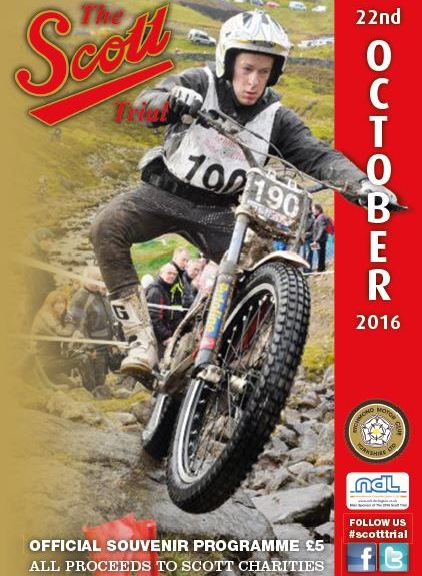
The Scott Trial 2016 Official Souvenir Programme is packed with information and features and is a ‘must have’ for the event on 22nd October.
The 2016 Scott Trial Official Souvenir Programme, which this year, is again a full colour edition is on sale now at the local outlets in and around Richmond.
Supplies are now with the usual outlets which include:
AG Bikes, Low Row – CB Inn, Arkengarthdale – Richmond Petrol Stations – Cross Lanes Store, Richmond – Smith and Allan, Darlington – Piercebridge Farm Shop, and the usual Reeth outlets for £5. Profits made, as usual, will go to The Scott Charities.
The programme which is as traditional as the trial itself, amounts to 92 pages, in full colour and packed with all the information you will need to spectate at the annual classic on 22nd October.
You can also order a copy by post, by emailing your request to: scotttrial100@gmail.com (cost: £6.50 including the postage). Please make the subject line: ‘Scott Trial Programme Order’, payment details will be made available to you by return e-mail.
Toshi Nishiyama (Japan – BSA B40) Pre’65 Scottish 1999, watched by Mick Wilkinson on far left and Robert Woodfield on right centre – Photo: Iain Lawrie, Kinlochleven
Entry forms and regulations are now available for the 2017 Pre’65 Scottish Trial on Friday 28th and Saturday 29th April.
The event has been running since 1984 and is limited to 180 competitors. It is expected to be over-subscribed which necessitates a entry ballot which is drawn just before Christmas.
The 2017 event is sponsored by Hope Technology of barnoldswick in Yorkshire and is in memory of part founder, Simon Sharpe who died this year and was a regular competitor in the event.
‘Team Sharpe’ son and father: Sam & the late Simon Sharpe at the 2016 – Photo courtesy: John Hulme, Classic Trial Magazine UK
Here are the entryform and regulations for the 2017 Pre’65 Scottish:
Former White Helmet team member, Tom Walker in 2012
Trials Guru has been chatting to a Scot who became a well known face in many motorcycle shops during the mid 1970s when employed as a sales representative for the Barnard Castle based trials and motocross clothing manufacturer, TT Leathers International.
It was TT Leathers that pioneered coloured apparel for the sport of trials in 1973 with their RUFRYDA equivalent to the world famous Barbour and Belstaff suits. Whilst these were all of a similar design, TT Leathers introduced both a green and red base colour alternative to the traditional black waxed cotton of the rival producers.
Subsequently they introduced their Vystram two piece suits and one piece summer trials suits from 1975.
The TT Leathers Vystram trials suit from 1977 brought colour to the sport – Photo: Trials Guru/Moffat Racing
Tom Walker was originally from Ayrshire and joined the British Army, he takes up the story…
Walker: “I met Jim Aird at a motor cycle show in London while I was in the Army and at the time was part of the famous Royal Signals ‘White Helmets’ motor cycle display team. Jim was by then with TT Leathers and also a professional Motocross rider from Kirkcaldy in Scotland. He was a Scottish champion and was making a name for himself having raced CZ and AJS machines for the CZ importers and the AJS factory.
We built up a friendship and I invited Jim across to Catterick Garrison in North Yorkshire where the Display Team was based and did much off road riding to train new potential riders for the forthcoming season. Jim came to the gym and cross country riding to strengthen his skills for the forthcoming racing season.
Tom Walker (left) and Jim Aird on Army issue BSA B40 models in 1971 at Catterick. Aird was riding for AJS at this point in time. – Photo courtesy Tom Walker, Harrogate.
A couple of years later, I left the White Helmets team and was in the driver training wing at Catterick and got selected for the British Army Enduro team when I rode in the ISDT, continuing my friendship with Jim and also the boss of TT Leathers, Len Thwaites”.
Len and Jim asked Tom if he would like to work for TT leathers as their first sales representative. After a great deal of thought, he decide to do join the company as his next Army posting was a two year tour of duty in Northern Ireland.
Tom: “Taking my family there, I was never comfortable with, so I decided to leave the Army and join TT Leathers. During this period of contact with Jim, the White Helmets purchased lots of riding gear from the company, such as the ‘RUFRYDA; brand trials clothing, a new invention for off road riding which was very bright and colourful but very hot when wearing it”.
K. Hall (Montesa) on Pipeline during the 1978 Scottish Six Days, wearing a TT Leathers Summer Trials one piece suit – Photo: Iain Lawrie, Kinlochleven
Walker continued: “During my time I also met a Scot called Stan Young and another called John Little who also rode in the ISDT for Scotland, I also met the SACU secretary, Arnott Moffat who was quite involved with the Scottish ISDT effort at that time. I kept up my association with Stan and John and some eight years later when I moved from TT leathers to increase my position in the motorcycle trade”.
Jimmy Aird was a multiple Scottish Motocross (Scrambles) Champion before joining Len Thwaites at TT Leathers in 1970. He rode the factory AJS Stormer models and for Alan Clews’ CCM factory. He now is MD of Scott Leathers.
“Many more years on, I became Managing Director of a German shop chain who wanted to set up in the UK, called Heine Gericke. I took the job and developed the company and when I opened the Edinburgh shop in Queens Street. Stan became the shop manager and was for many years a great enduro rider and just a really nice guy”.
“Jim Aird and myself continued in the industry and I also assisted Jim develop his company with Euro Helmets, the AGV importer and we created the brand ‘SCOTT Leathers’ from there it has gone on to be one of the best racing suit manufacturers around”.
“Jim of course is still heading up SCOTT Leathers from Barnard Castle. Len Thwaites is now retired and lives in New Zealand and I am potentially retired and live in Harrogate, North Yorkshire but still active in the motor cycle industry and enjoyed every minute of this fantastic industry”.
When in the White Helmets Display Team, Tom was a Lance Corporal. He was brought up in New Cumnock, Ayrshire. He joined the Royal Signals in 1964 as a driver and served in Herford and Bielefeld, in Germany. His duties as a driver took him all over Europe, often carrying VIPs. He joined the ‘White Helmets’ team in November 1969. Always keen on sports and being a Scot, fond of football.
Richmond Motor Club/Scott Trial Press Release – 3 October 2016:
The Scott Trial 2016 Official Souvenir Programme is packed with information and features and is a ‘must have’ for the event on 22nd October.
The 2016 Scott Trial Official Souvenir Programme, which this year, is again a full colour edition is now available for trials fans. Amounting to 92 pages, it is packed with all the information you will need to spectate at the annual classic on 22nd October.
Scott Trial Programme Editor 2016, John Moffat would like to take this opportunity to thank everyone who has helped with articles, photographs and information, and for the very smooth hand-over from previous editor, Julia Robinson, wife of Scott Clerk of the Course, Paul.
Scott programmes will be available from the usual local outlets from the 10th of October – Richmond Petrol Stations; Cross Lanes Store, Richmond; Smith and Allan, Darlington; Piercebridge Farm Shop, and the usual Reeth outlets for £5. Profits made, as usual, will go to The Scott Charities.
You can also order a copy by post, by emailing your request to: scotttrial100@gmail.com (cost: £6.50 including the postage). Please make the subject line: ‘Scott Trial Programme Order’, payment details will be made available.
‘The Scott Trial’ logo is copyright Richmond Motor Club (Yorks) Ltd.
Trials Guru takes this opportunity to congratulate Dougie Lampkin MBE (12 times World Champion) on completing his ‘one wheel’ ride of the entire TT course on the Isle of Man on Sunday 25th September 2016.
Dougie Lampkin on his specially adapted Vertigo 300 which he used for his one-wheeled lap of the Isle of Man ‘Mountain Circuit’ on 25th September 2016. – Photo courtesy: Dougie Lampkin Publicity/Red Bull TV (copyright)
…
Twelve times FIM World Trials Champion, Dougie Lampkin added another achievement to his long list of attainments, when he successfully ‘wheelied’ his modified Vertigo around the 37 ¾ mile Isle of Man TT Mountain Course on Sunday 25th September. This is the first time it has been done continuously without the front wheel touching down until he crossed the finish line.
Previous attempts were made as early as 1976 by stunt rider, the late Dave Taylor on a Yamaha XS650. Taylor made various attempts over the years during TT week, however it was never documented and therefore assumed that he failed to complete a full circuit with the front wheel off the ground.
Known as The Wheelie King, his last attempt was in 1993. His daughter, Katie Taylor spoke to Trials Guru:
“Dad did his last wheelie attempt in 1993, but he did it with a broken wrist. He touched down because the rear brake link broke on his machine. By then he was suffering with terminal cancer quite severely. He had stomach cancer but by then it had spread to his throat. He also did this attempt all in the name of charity, riders for health, he was never paid for it”.
Taylor died in 1996 aged 53, he had been for many years a leading road safety campaigner in an effort to make motorcycle riding safer.
The Lampkin/Vertigo/RedBull attempt was watched live by many thousands of people on Red Bull TV, Lampkin’s main sponsor.
Many months of training and machine preparation went into the attempt. The Vertigo Combat machine was modified slightly to enable a serious attempt at the feat. The bulk of the modification work was undertaken by Hope Technology of Barnoldswick, Yorkshire with considerable input by life-long friend, Blackie Holden, himself a former trials rider.
Valuable input was received from the Vertigo Technical Manager, Francesc Romani.
Detail of the specially made auxiliary fuel cell, added to increase the range but also to assist in steering the Vertigo when on the rear wheel – Photo: Dougie Lampkin
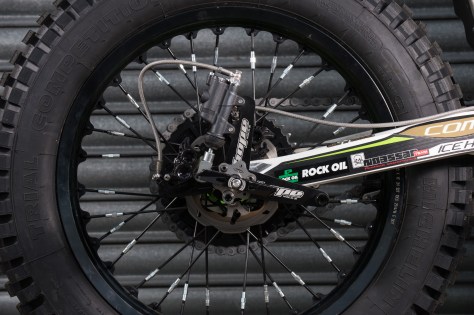
The modifications included a special footrest set up with hydraulic brake mechanisms mounted on the rear wheel spindle to allow Lampkin to stand bolt upright and to lower the centre of gravity when the front wheel was pawing the air.
Detail of the footrest/rear brake fitment by Hope Technology – Photo: Dougie Lampkin
A 36 volt electric motor was attached to the front wheel hub, with a special twin rear brake caliper set up designed to cope with the excess heat generated during the extensive downhill parts of the Isle of Man TT course. The two-separate brake systems were operated by Dougie by both a foot pedal and a hand lever, which was mounted on the handlebars where the front brake lever would normally be fitted.
The front wheel was effectively kept spinning throughout the attempt by the electric motor, thus maintaining the ‘gyroscopic effect’ which assists in stabilising the plot when being ridden on the rear wheel.
The special handmade, large capacity carbon fibre auxiliary fuel tank was mounted on the rear mudguard area to extend the range of the 300cc, fuel-injected two stroke Vertigo trials machine. It also allowed Lampkin to steer the machine with his knees by gripping the fuel cell when the machine was in motion.
Gale force winds on the Isle of Man on the Saturday, 24th September forced a re-think and the attempt was postponed 24 hours to allow for more favourable weather conditions.
Prior to the attempt, critics poured scorn on the effort, likening the modified Vertigo to a ‘Segway’ (the two-wheeled, self-balancing, battery-powered electric leisure vehicle invented by Dean Kamen), on social media . However, this was somewhat misguided as the machine was very much a trials machine with some suitable modifications and adaptations described above and bore no resemblence to the leisure vehicle.
The modified factory Vertigo Combat 300 used by Dougie Lampkin in his Isle of Man TT course wheelie attempt – Photo: Dougie Lampkin
It was noticeable that Lampkin had complete input to maintaining the front wheel clear of the ground and had to use all his trials skills learned over thirty years of intense competition. It was not only a feat of balance but also endurance, he was visibly exhausted when he crossed the official finish line in the early evening.
Doug Lampkin showed his usual gritty determination to succeed, a well-known trait of the Silsden based family who have literally dominated off-road motorcycle sport for over fifty years. There is no doubt that his late father, Martin who passed away after a battle with cancer in March this year, would have been proud of the attempt and Dougie’s ultimate success and achievement. This endeavour follows on from a tenth victory at the annual Scottish Six Days Trial in May, an event that the Lampkin family have featured in the winning of many times in half a century.
Current international motorcycle stunt performer and former Scottish Motocross champion, Kevin Carmichael told Trials Guru: “I think what Dougie Lampkin has done was absolutely awesome. It required huge concentration and lots of preparation! – Anyone who thinks it was easy should try it!”
Doug Lampkin’s wheelie of the entire 37.73 mile circuit is a feat in itself, but still a bit far short of the World’s Longest motorcycle wheelie which, at the time of this article, stands at a staggering 205.7 miles, set in 1991 by Yasuyuki Kudo at the Japan Auto Research Institute!
Thanks to Trial Magazine UK, we bring you the report on last year’s Scott Trial to whet your appetite for this year’s gruelling event! (Reproduced with permission)
The 2015 Scott Trial – A Grand National event
Words: Jonny – Pictures: Trials Media & Eric Kitchen
You can compare the Grand National horse race very much with the traditional Scott Motorcycle Trial, as both have a very long sporting heritage and both are about runners and riders. Many questions are similar, such as looking at the form of the competitors and the day’s conditions as both play a big part in the event’s results, but what competitors in both need to excel on the day is a little piece of good fortune. This year’s Scott conditions were very dry despite the overcast weather at the start, and the talk was that we could see a new winner with a host of young riders coming through the ranks having served their Scott apprenticeships. Some of the more experienced Scott Trial pundits were not sure about the younger riders and, as we shall see, they were proved correct at the end of a long hard day’s motorcycling.
Alexz Wigg (JST Gas Gas)
With the start-field commentary in the experienced hands of Scotsman, John Moffat it was his friend from Richmond Councillor John Blackie who flagged the first man away, Robert Hunter, who gave the crowd a traditional wave of the hand at exactly 09.00am.
Dougie Lampkin (Vertigo)
The overcast conditions would soon clear as the remainder of the 200 riders left the start field at Feldom Range near Marske to set out on the course, which was over 70 miles long and contained 76 hazards.
Jonathan Richardson (Beta) – Fourth overall, fastest rider setting standard time.
Racing
By the time the riders reach the exposed rock outcrop at ‘Reals Head 1’ they have passed through other aptly named hazards such as ‘Cold Knuckles’ and ‘Underbanks’, and it’s quite a good early indicator of the riders on form. The first rider to arrive was number 14, Andrew Woodward at 10.18.08, who looked relaxed and fresh. From this point on the bedlam begins as rider after rider arrives. The first of the fast riders to arrive was Billy Bolt at 10.56.58 followed by Sam Haslam, Alexz Wigg with Ladies’ World Champion Emma Bristow on his tail, Jonathan Richardson, Ian Austermuhle, John Sunter, Richard Sadler and then, in tandem, last year’s winner James Dabill followed by his Vertigo team-mate Dougie Lampkin who was looking for another victory.
Ross Danby (SXS) – Fifth overall
Tales of problems even before the first hazard were coming through, such as Dan Thorpe’s front wheel puncture before the first hazard had even been reached, and Iwan Roberts who had crashed and broken his front mudguard.
Who’s Hot?
The mass exodus of the hundreds of spectators from the ‘Reals Head’ hazards and ‘Underbanks’, which is close by, sees them travel to the next vantage points at around the halfway point, such as ‘By-Pass’ where the river had three hazards on offer with the middle one the most testing. The lead rider was now number 37 Gareth Palmer, who arrived at 12.09.04 as more riders arrived with some looking very hot and bothered from the physical exertion that they had just been through over the ‘Grouse Moor’ crossing that they had just made. The third rider through and looking very much on a mission was lady rider Chloe Richardson, with John Sunter arriving a few minutes later and obviously in a rush as he knew the chasing pack of front runners was coming fast. Sixteen seconds later was Bolt and at the change of the minute Haslam, Richardson and Wigg, and then a couple of minutes down was Austermuhle, Guy Kendrew and then Lampkin, who had moved in front of Dabill, and Ross Danby who had certainly picked up the pace as he pushed towards the front.
Richard Sadler (Beta)
Bridge End
Yes it was case of ‘Bridge End’ for both Lampkin and Dabill as the new Vertigo machines they were riding hit trouble with electrical problems. Lampkin managed to rectify his machine pretty quickly but for Dabill it was game over as it was quite a while before his machine would burst back into life, and he knew he would not be repeating his victory of 2014. On the return journey the competitors pick up the course they used in the morning and also take in the hazards once again at Reels Head where two hazards were waiting.
Sam Haslam (Gas Gas UK)
The crowd tension was pretty high as they waited for the first rider to arrive, who was Sunter at 13.52.08 followed by eventual fastest rider Richardson at 13.54.23, and then Bolt at 13.54.56, Haslam who crashed taking five marks with it and then ‘Wiggy’ who also fived it, and then Austermuhle at 13.59.05 who remained feet-up, as did Danby and Lampkin who would eventually provide the best observation score of the day with 24 marks lost. It’s now time for the fast riders to push as much as they can to be the first rider back to the finish and set the ‘Standard Time’.
Jack Price (Gas Gas)
Chequered Flag
The first rider back was Richardson at 14.48.03 followed by a fresh looking eventual winner Austermuhle at 14.50.24, who had really put the hammer down in the closing stages passing Billy Bolt whose motor had expired and John Sunter who’d punctured his front tyre. It was then ‘Wiggy’ at 14.51.27 who looked very happy with his day’s work which would be rewarded with a very strong second position overall. His Southern team-mate Haslam was next followed by Sunter and local Game Keeper, Will Reynolds. Ben Hemingway was next and then the young James Stones and his mate Richard Sadler, and Ross Danby who looked very fresh. There was still no sign of Lampkin as Guy Kendrew and the first of the young stars Jack Price, and a couple of minutes later Iwan Roberts, appeared. It was then the turn of a disappointed Lampkin, who was not sure he had done enough for the victory eventually finishing third overall. The Scott had once again lived up to its reputation as the toughest one-day trial in the world as the last official finisher in time, Paul Marwood, arrived back having been on the course for seven hours, eleven minutes and fifty-one seconds – well done that man.
John Lampkin (Beta-UK); Beth Austermuhle; Ian Austermuhle with his parents.
Scott Trial 2015 Abbreviated Results:
Gold Spoons
1: Ian Austermuhle (Beta-UK) 42; 2: Alexz Wigg (JST Gas Gas) 46; 3: Dougie Lampkin (Vertigo) 49; 4: Jonathan Richardson (Beta-UK) 61; 5: Ross Danby (SXS) 62; 6: Richard Sadler (Acklams Beta) 65.
Silver Spoons
7: Sam Haslam (JST Gas Gas) 69; 8: Jack Price (Gas Gas) 70; 9: Iwan Roberts (Beta-UK) 84; 10: Guy Kendrew (Beta-UK) 84; 11: James Stones (AGB Sherco) 84; 12: Dan Thorpe (JST Gas Gas) 93; 13: James Dabill (Vertigo) 97; 14: Chris Pearson (Splat Sherco) 108; 15: Rob Waite (Acklams Beta) 110; 16: James Fry (Sherco) 111; 17: John Sunter (Appleyard’s Montesa) 112; 18: Ben Hemingway (Beta-UK) 114; 19: William Reynolds (Montesa) 119; 20: Luke Walker (Sherco) 125; 21: James Lampkin (Beta-UK) 127; 22: Dec Bullock (Team Roundhouse Beta-UK) 132; 23: Thomas Hick (Acklams Beta) 149; 24: Stephen Dixon (BMS Scorpa) 153; 25: Jack Stones (Acklams Beta) 154; 26: Andy Cripps (DCR Sherco) 169.
Standard Time: Jonathan Richardson (Beta-UK) 4.42.22
The Last Official Finisher: Paul Marwood (Sherco) 7.11.51
Best on Observation: Dougie Lampkin (Vertigo) 25
Manufactures Team Award: Beta
Club Team Award: Richmond MC
Best Under 21 Rider: Jack Price (Gas Gas) 70
Best Lady Rider: Emma Bristow (Sherco) 172
Best First Time Rider: Thomas Housecroft (Beta) 254
Best Over 40 Rider: Chris Shorey (Sherco) 373
Top 26 Machines: Beta: 11; Sherco: 5; Gas Gas 4; Montesa/Honda 2; Vertigo 2; SXS 1; Scorpa 1.
‘The Scott Trial’ logo is copyright Richmond Motor Club (Yorks) Ltd.
The annual Scott Trial, 2016 edition is just but one month distant!
The first rider will leave the start field at 9.00am on Saturday, 22nd October at Feldom Lane, near Richmond, North Yorkshire (Sat-Nav DL10 4AR); flagged away by Councillor John Blackie of the Richmondshire District Council.
The Scott is a time and observation trial which has been going since 1914, and 2016 marks the 25th anniversary of its running by the Richmond Motor Club for the Yorkshire Centre ACU.
Entries closed on September 9th with a full compliment of 200 competitors, the alphabetic entry list is now available on the Richmond Motor Club (Yorks) Ltd official website.
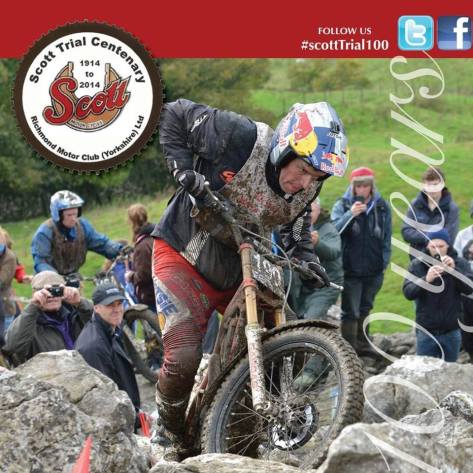
The Scott Trial celebrated its centenary in 2014.
However, as is normal, the event will have an 88 page full colour, official souvenir programme for sale pre-event, priced at £5.00 for spectators and Scott enthusiasts. The proceeds of which are distributed, (post event in February) to the ‘Scott Charities’, which is traditional and part of the event. Riding numbers will be shown in the official programme.
There are some new features at the trial this year, so please ensure that you pick up your copy of the programme at the usual local Richmond outlets from Monday 10th October, or from the stall at the start field on the day of the trial. If you do buy at the field, get there early as the programme is likely to sell out quickly.
The Scott Trial programme is a comprehensive publication which raises funds for the Scott Charities every year.
Trials Guru’s John Moffat, a keen supporter of the event, has taken on the task of producing the official programme this year from Julia Robinson, wife of Clerk of Course, Paul Robinson.
Moffat said: “I have had a busy, but enjoyable time collecting all the photographs, information, adverts and articles to help make the programme a souvenir of the 2016 Scott. I am grateful to Julia Robinson for conducting a very smooth hand-over to me and to those who have written articles, accounts and the foreword for this years edition. The programme will be printed locally in Richmond and distributed pre-trial and available at the usual outlets in and around the Richmond area. I will still be undertaking duties at the Scott, which includes some course laying out on the Friday and start/finish line commentary as the action happens on the day”.
He added: “I’m grateful to those who have helped me obtain information and the articles and remember, everything that is raised by the programme and this magnificent event is for the Scott charities, all very worthy causes”.
Stay tuned to Trials Guru for more Scott Trial 2016 updates …
Scott Trial enthusiast, John Moffat has taken on the task of ‘Scott Trial Programme Editor 2016’ – Photo: John Hulme/Trials Media/Trial Magazine UK
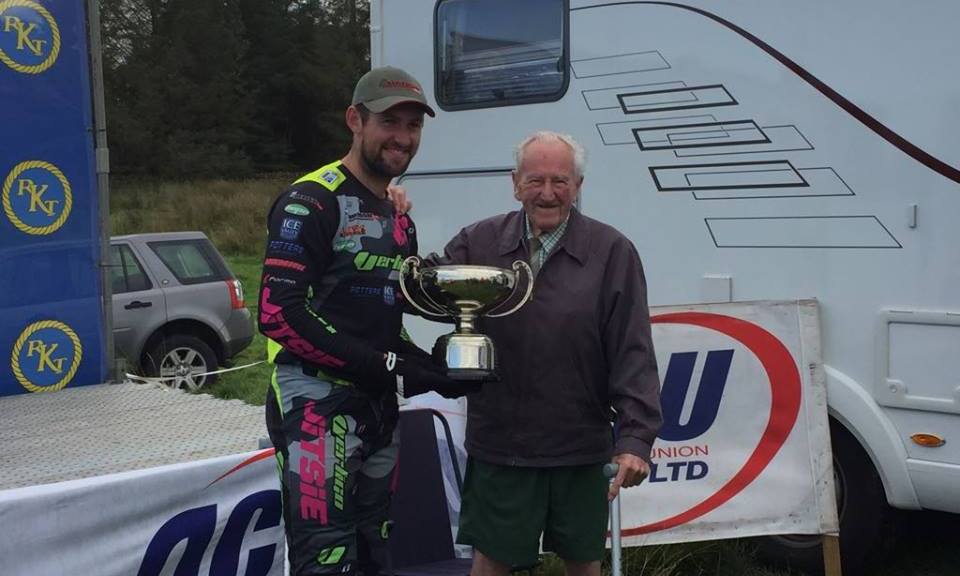
James Dabill (Vertigo) has claimed his seventh ACU Trials Championship at the Tynemouth & District Motor Club round near Newcastle at Morpeth’s Shaftoe Crags, Middleton on Sunday 18th September round nine.
James Dabill from Leeds claims his seventh BTC title, the second British title for the Spanish built Vertigo machine – Photo: Mrs C. Dabill, Leeds
We are always on the lookout for something out of the ordinary at Trials Guru, so here we have something for you!
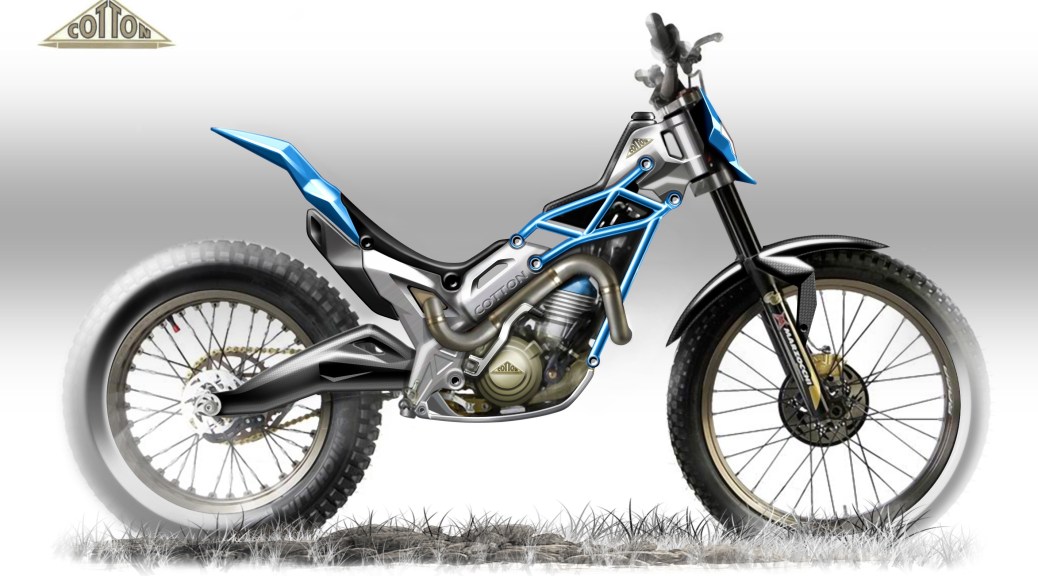
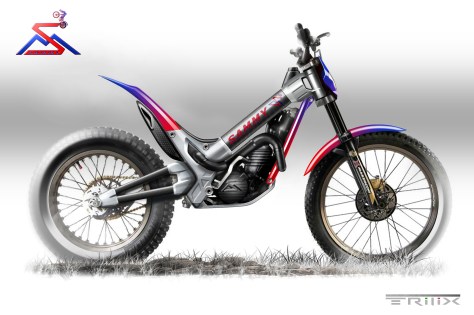
Some artwork that was undertaken by designer Justyn Norek in Milan. The drawings never made it into metal, but they are at least some nice design exercises.
…
‘Cotton’ with latticework frame – Justyn Norek Design
…
‘Dot’ with carbon fibre tube type frame with Aluminium end caps. – Justyn Norek Design
…
With obvious reference to Sammy Miller and British trials, the ‘Sammy’ has the carbon tube frame design – Justyn Norek Design
…
All images copyright of Justyn Norek Design, Turin, Italy.
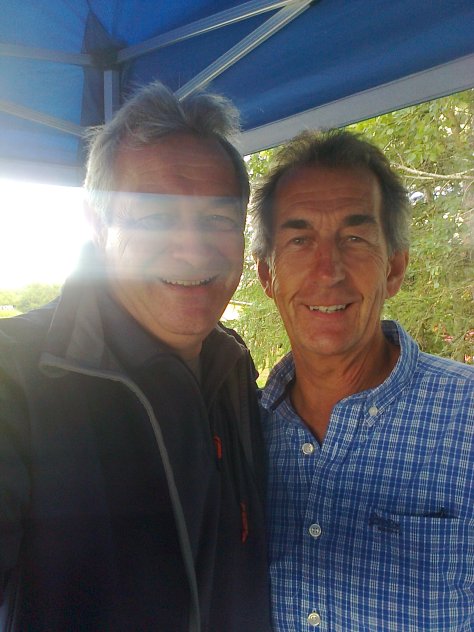
John Moffat commentating with former motorcycle racing and truck racing champion, Steve Parrish at the Grampian Motorcycle Convention at Alford – September 2016 – Photo: Trials Guru
Something a little out of the ordinary for Trials Guru’s John Moffat when he undertook some commentary work with former British ACU Motorcyle Racing champion, Rob Orme and British and European Truck racing and Motorcycle Racing champion, Steve ‘Stavros’ Parrish.
Steve Parrish (right) is a well-known practical joker as well as being a very fast man on a race bike and race truck being a multiple champion. Photo: Ewan Todd
Moffat was attending the annual Grampian Motorcycle Convention at Alford, Aberdeenshire, organised jointly by the Bon Accord MCC and Grampian Transport Museum on 4th September.
Attended by around 6,000 members of the public, the Convention is a showcase of motorcycle sport in Scotland. The main attractions were the ‘Purple Helmets Motorcycle Display Team’ from the Isle of Man and three times British Champion and four times SSDT winner, Steve Colley with his Mr. Showtime motorcycle Display Show, both from the Isle of Man.
Moffat: “I really enjoyed catching up with my old mate Steve Colley as he is no longer a top flight trials rider, but our paths cross form time to time. Steve Parrish I actually interviewed many years ago at the Scottish Motorcycle Show, so we have met previously. Steve Parrish is a great practical joker and he put on a mini-edition of his MAD tour evening the night before the convention. He is a great entertainer with anecdotes of his racing career which ensure that he hasn’t had a ‘proper job’ for 43 years, having been a professional motorcycle racer from the age of 20 and moving into truck racing”.
He added: “The Purple Helmets I have seen before, but they always add something new to their act and they are hilarious, if you haven’t seen them, see them, they are really funny and it’s fantastic entertainment, they should get them up for the SSDT, that would really be something else!”.
The Premier Trial Website – Recording the History of the Sport 'Established 2014'
















 TRIALS GURU - DEDICATED TO TRIAL