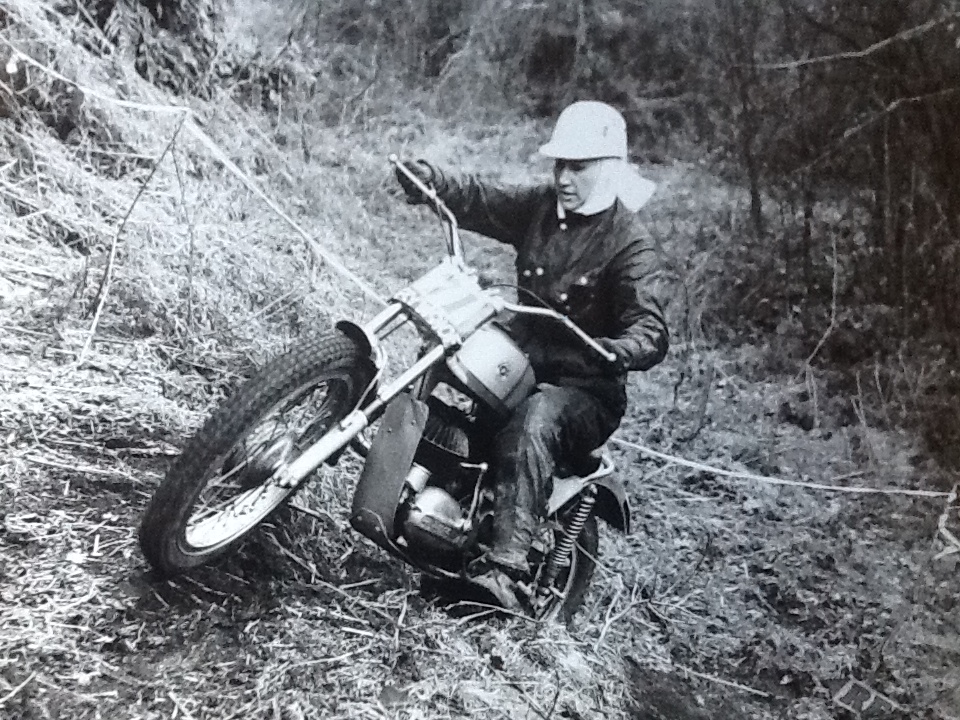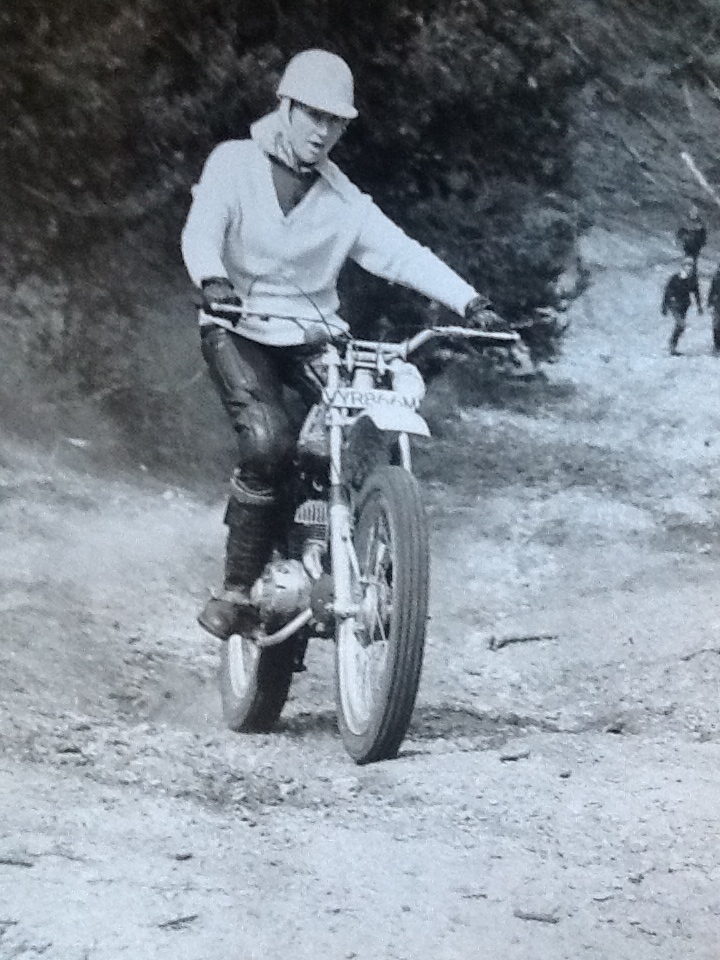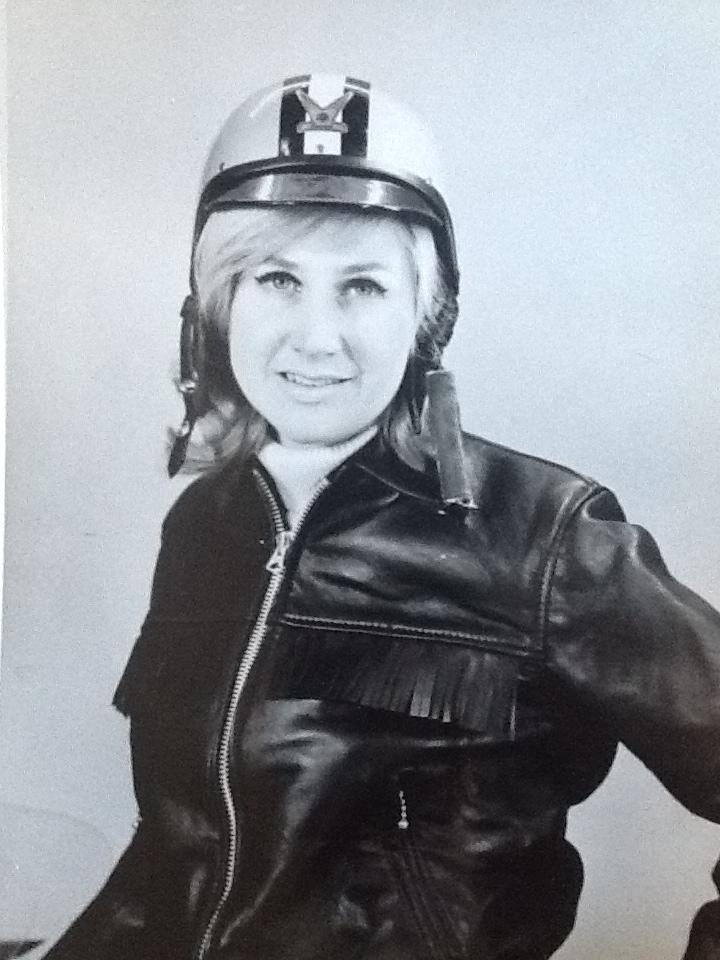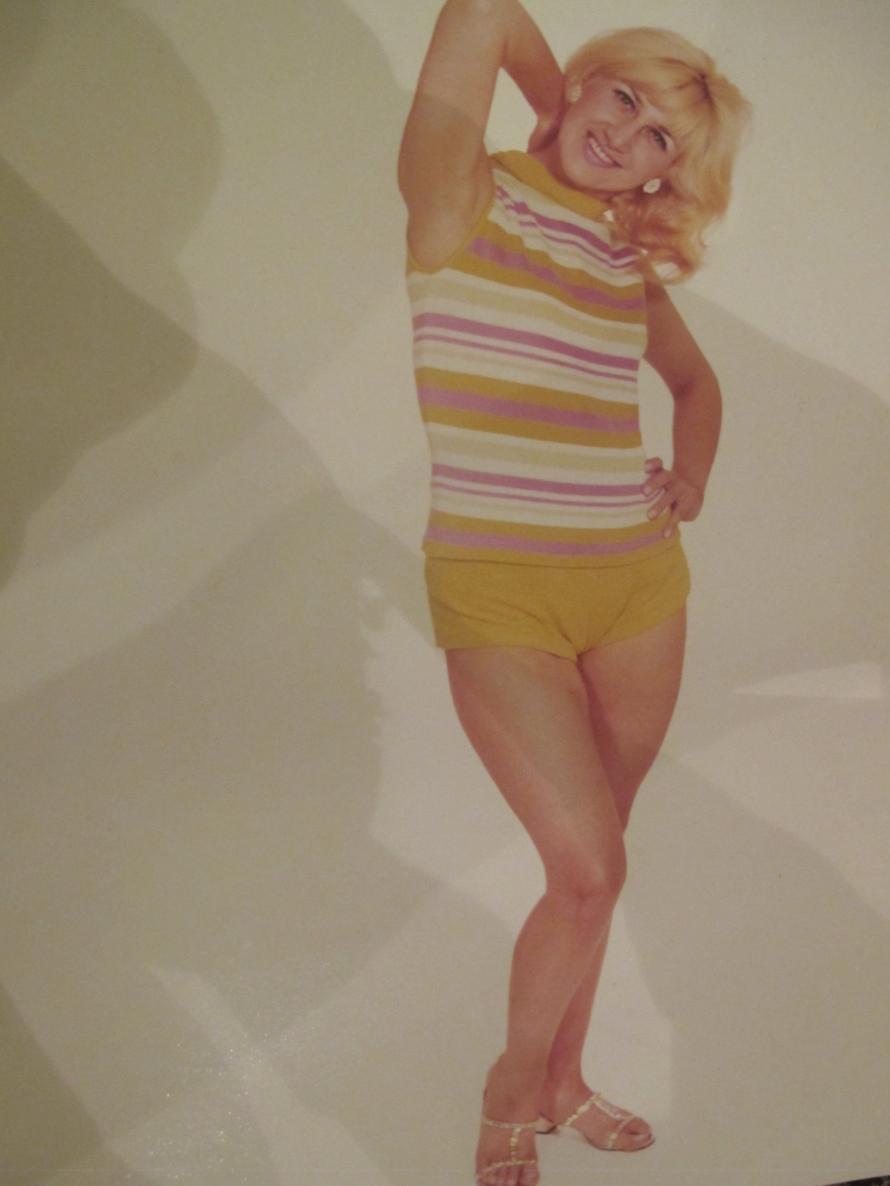
Tag Archives: AJS

Great Scots – Ian Pollock

In deepest Argyll, nestling among stunning scenery and mountains, lies the town of Kinlochleven. Many books have been written about the area, one of which is ‘Children of the Dead End – The Autobiography of a Navvy’ – By Patrick McGill – this book is exactly what the title says, it’s the story of an immigrant manual worker or ‘navvy’ as they were called. This book which is rated as one of the best 100 best Scottish books of all time, describes the times when the Aluminium smelter and factory was being constructed at the end of the 1800’s. Kinlochleven flourished as a direct result of the creation of the Aluminium factory which employed around 1,000 workers and produced high quality aluminium for the world. These employees came from far afield and settled in the town, one such settler was Ian Murray Pollock, who was originally from Falkirk, Stirlingshire. Pollock had been through the second world war, having served in the Argyll & Sutherland Highlanders regiment in Palestine. When he was effectively demobbed from the British Army, Pollock was fortunate to secure employment with the British Aluminium Company Ltd at their Kinlochleven smelter. The ‘BA’ as it was universally known, was a major employer both there and at their Fort William operation, which exists to this day.

Pollock started his career as a ‘fitter’ but quickly progressed through the ranks to become a shift foreman at the plant.

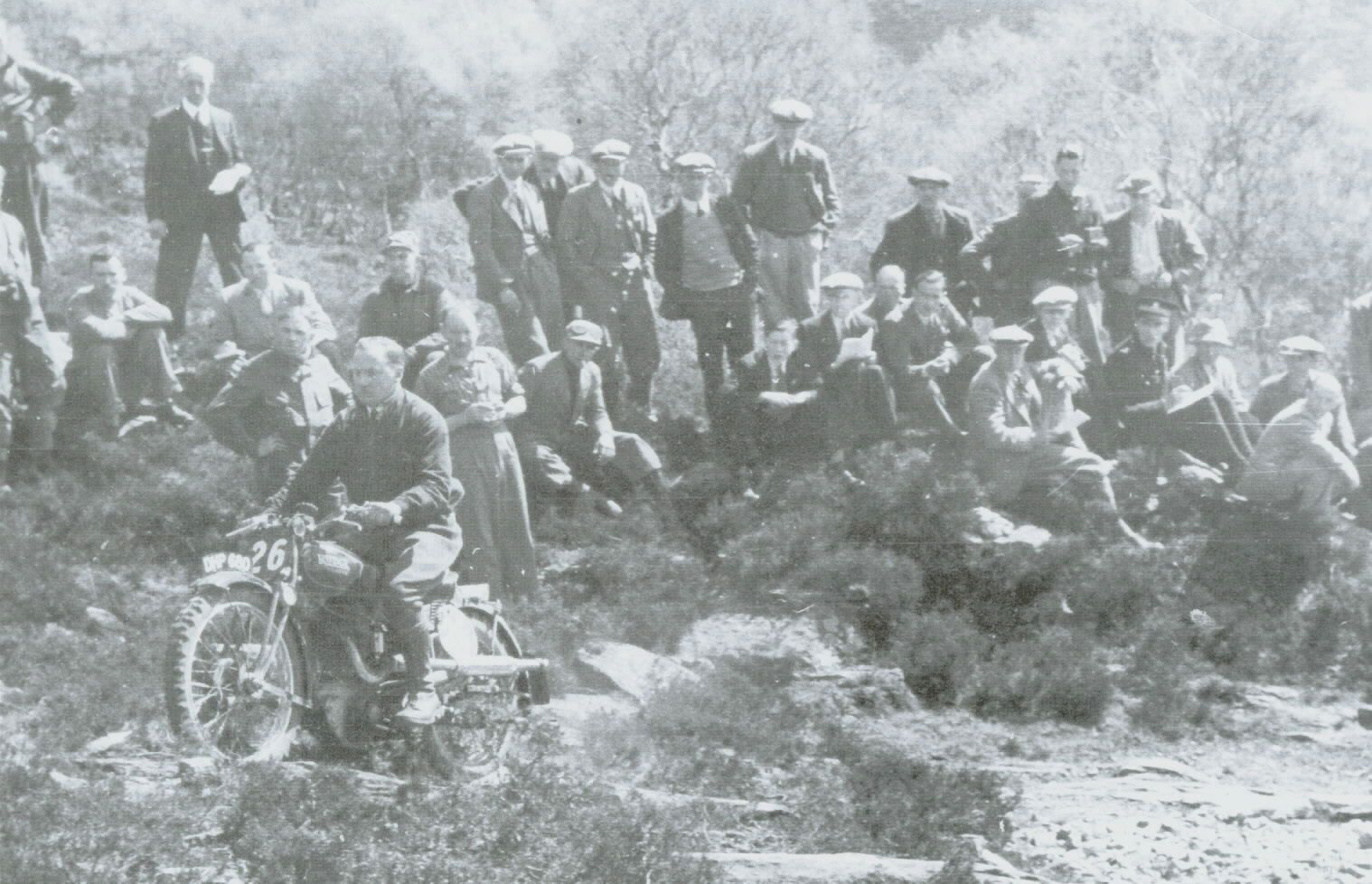
1950 - J D Williamson - Mamore - WST
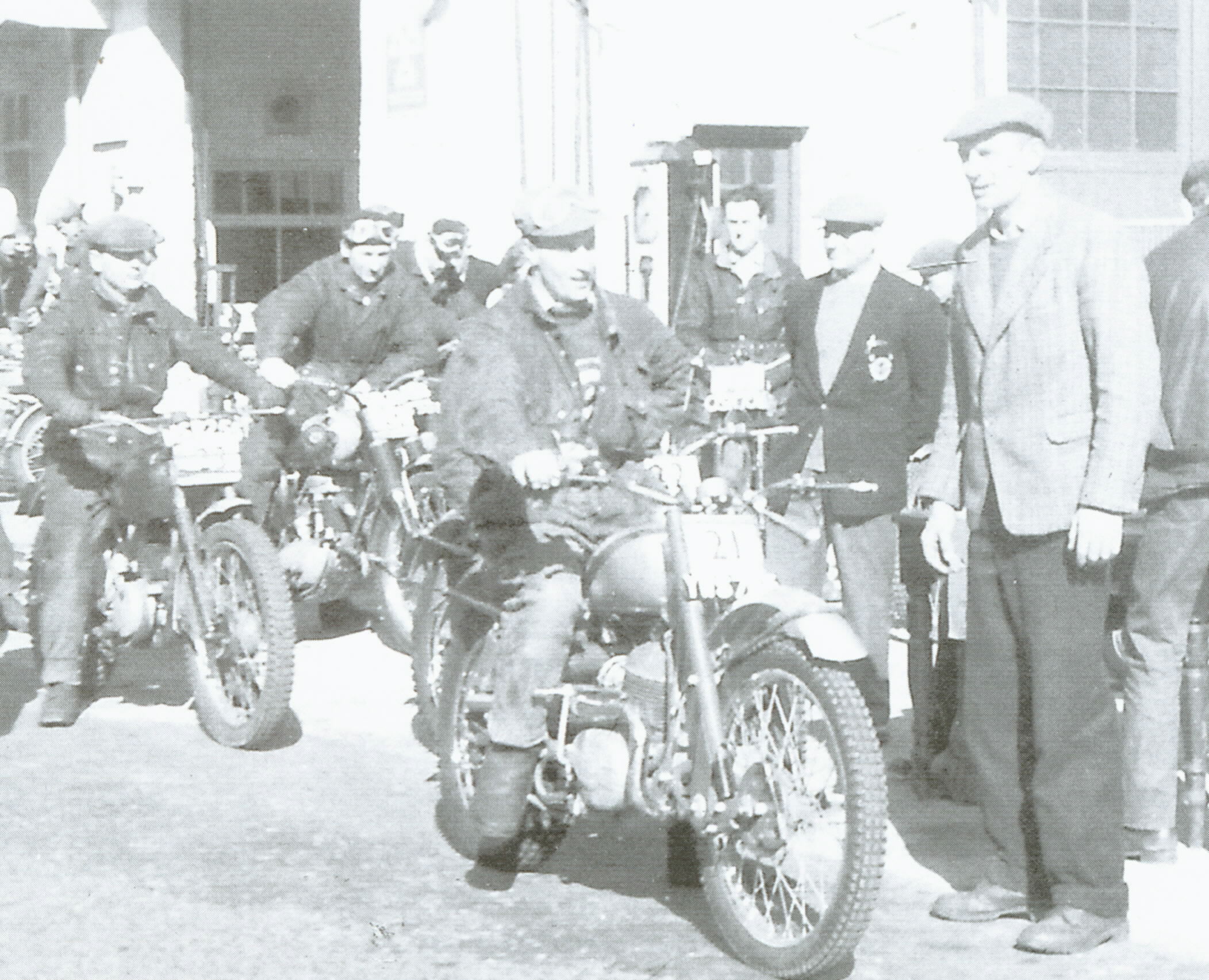
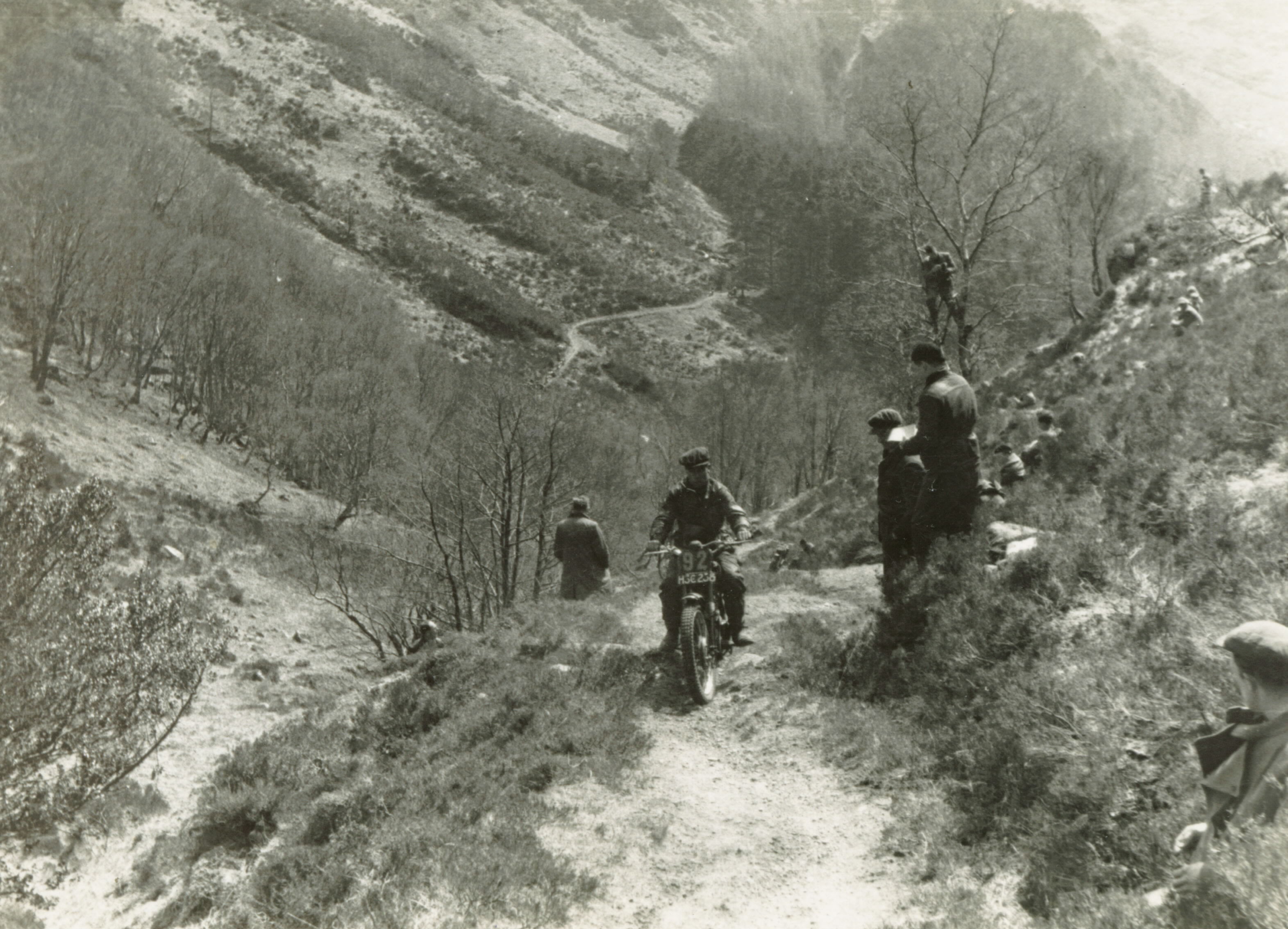
1950 – Jack Williamson from Newtongrange, Midlothian (347 AJS) on Mamore, watched by Ian Pollock (white paper in pocket) – Photo: W.S. Thomson, Fort William

Being an active young man who had forged many friendships in the locality, Pollock took an interest in the annual Scottish Six Days Trial which made use of the hills near to Kinlochleven during the ‘Sporting Holiday in the Highlands’. Pollock had amassed quite a knowledge of the local paths, bridleways and rough country high above the town. This was to eventually forge a strong bond between him and members of the Edinburgh & District Motor Club, who promoted the Scottish Six Days Trial.

Ian also became involved in local events, eventually becoming a central character in the Kinlochleven Motor Cycle Club, which he helped form.

Pollock in association with his good friend, Lithuanian refugee, Paul Kilbauskas discovered there was more land available to the SSDT than perhaps the organisers were aware of!
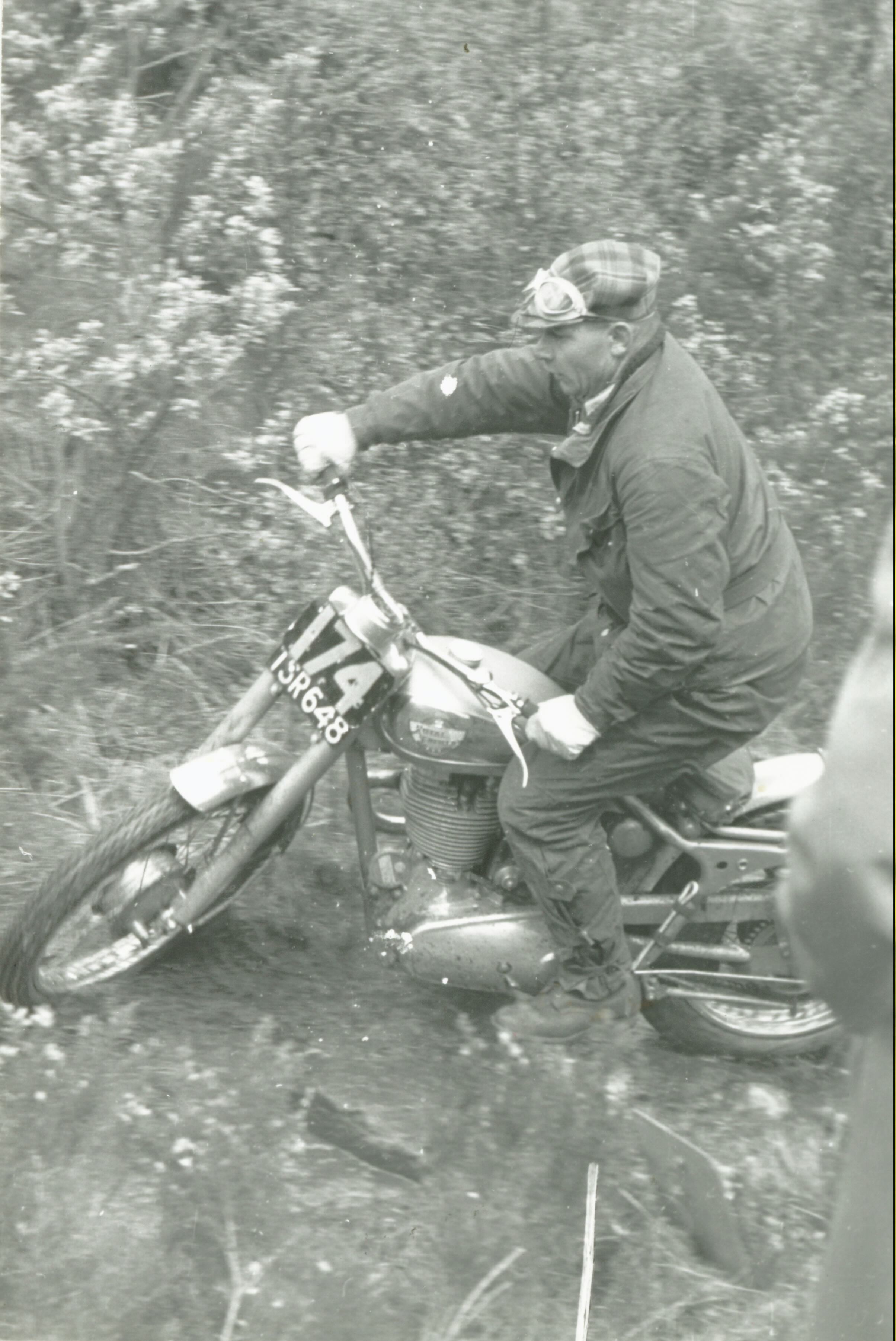
1959 - Paul Kilbauskas - Glenogle - JDavies
1959 Scottish Six Days Trial – Paul Kilbauskas with his 500 Royal Enfield – Photo: John Davies

The SSDT up until the late 1960’s, made extensive use of main and secondary roads, proper foot and bridle paths, sheep paths but very little open moorland. It wasn’t until Jimmy Mulvie became Clerk of Course that the SSDT made use of open moorland stretches.

It was Pollock and Kilbauskas that investigated the possibility of going out over the hills from Kinlochleven back over to the Fort William area other than by the original Mamore Road, which is the water bound surface that is still used by the SSDT and Pre’65 trials to this day. It stretches from Mamore Lodge across to Blarmafoldach, just outside Fort William and links into the Achintore Road.

Pollock and Kilbauskas were both energetic men, they liked the outdoors and they both jointly and severally, explored the many trails, paths and rocky burns and outcrops that littered the hills high above Kinlochleven. They also knew all the local keepers, shepherds and landowners, so permission was never a problem. Many of the hills surrounding the town had been purchased from estates at the end of the 19th century primarily for the water rights. This enabled the factory to operate and ensure plentiful supply of water via the Blackwater area, high above Kinlochleven. Pollock and Kilbauskas were trusted individuals and it helped the SSDT greatly by having reliable people such as Pollock and Kilbauskas on hand.

These explorations bore fruit aplenty, for the Pollock/Kilbauskas venture yielded many new sections in the form of ‘Loch Eild Path’; ‘Mamore’; ‘German Camp’; ‘Leitir Bo Fionn’; ‘Grey Mare’s Ridge’ and of course ‘Brump Brae’, later to be renamed ‘Pollock Hill’.
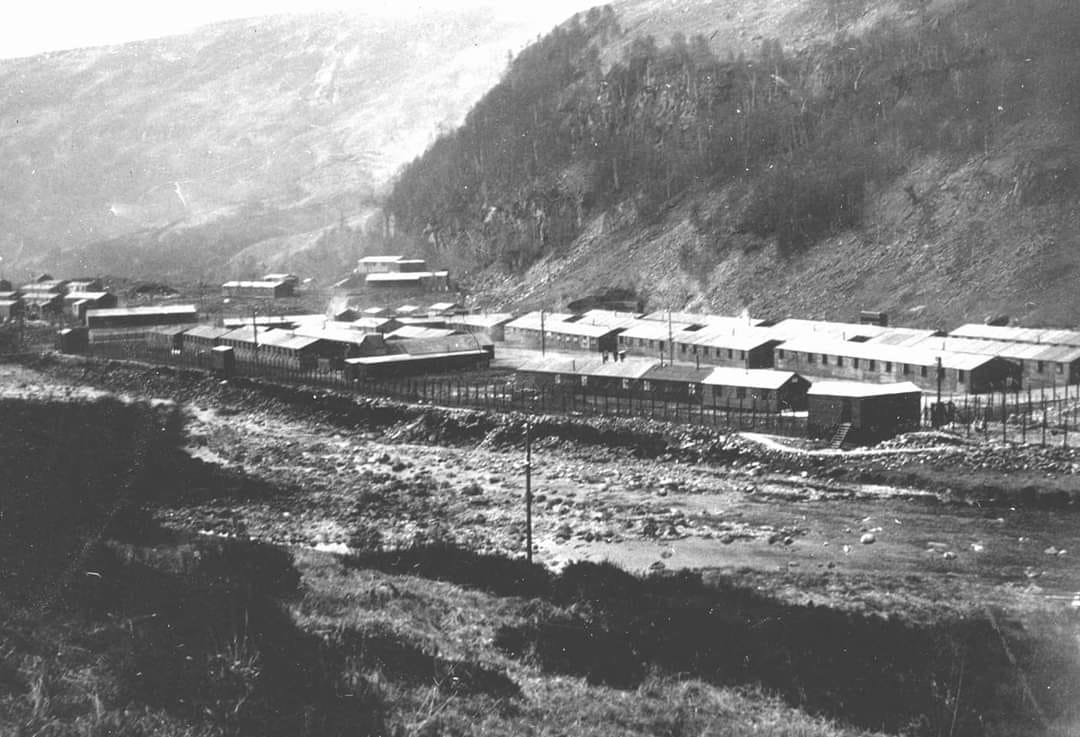
German Camp
The ‘German Camp’, a first World War prisoner of war encampment on the banking of the River Leven high above Kinlochleven. Photo courtesy of Peter Anderson, Clackmannan

In the period 1955 through to 1959, Ian was listed in the official programmes of the SSDT as an observer, but Pollock was much more than that, he was the journeyman who discovered many of the iconic hills that would eventually unearth the most famous of them all, ‘Pipeline’ probably the most famous motorcycle trial section of all time! Alex Smith, from Bathgate, a former assistant Clerk of Course confirms that ‘Pipeline’ was first used as an observed section in the 1967 SSDT.

jdw - 1963
Jack Williamson (250cc Greeves) awaits the signal to start in the 1963 Spring Trial at Kinlochleven. Ian Pollock was a driving force in this event which was re-named in his honour after his death.

‘Pipeline’ is just a couple of miles out of the town and is the subject of many of the most stunning motorcycle trials photos to come from the cameras of Nick Nichols, Eric Kitchen and photographers of their age.

Pipeline - PA
The Pipeline under construction, photo taken from an original glass negative, courtesy of Peter Anderson, Clackmannan

Pollock was an enthusiastic observer at the SSDT and when Johnny Brittain won the 1957 Scottish, his photo adorned the cover of the following year’s programme, the observer in the background watching intently being Ian Pollock. The original photo used on the 1958 SSDT programme front cover was a ‘Motor Cycling’ print which is now the property of Mortons Motorcycle Media, Hornchurch, but a personal copy still hangs in Pollock’s daughter Pamela’s home in Glencoe.

1958 SSDT
The 1958 SSDT Official Programme, with 1957 winner Johnny Brittain (Royal Enfield) being watched by Ian Pollock. The section is at the top of Loch Eild Path, one of the hills discovered by Pollock himself.

By 1962, Pollock was now listed as an Assistant Clerk of the Course and was held in high esteem by his peers and by the ‘Clerk’ himself, the late George Baird who described Ian as ‘our man on the spot’ in the official programme.

Paul Kilbauskas:

Paul Kilbauskas was also a ‘Tunnel Tiger’ who worked on the many hydro-electric schemes in the Scottish Highlands, he was an explosives handler during his time on these massive projects. He concentrated more on riding the Six Days on Matchless, Royal Enfield and BSA machinery, always a 500cc machine. He helped find a sizeable part of the route was in effect a ‘displaced person’ who had to flee his native Lithuania in 1947. His first port of call was Market Harborough in Leicestershire. Paul eventually settled in Kinlochleven, worked at the Aluminium factory for a period where he met and eventually married his sweetheart, Rose who also worked at the BA factory and was originally from the Orkney Islands. They had two daughters, Marina and Rachel. There is now a Paul Kilbauskas award in the SSDT in remembrance of the one-time course plotter and explorer for the event.

Paul Kilbauskas 1
The late Paul Kilbauskas, a native of Lithuania who made the Scottish Highlands his home. A life member of Inverness & District Motorcycle Club.

‘Mambrec’ was yet another of the sections discovered by Ian Pollock, a section that has been used in the Pre’65 Scottish Trial many times. Pollock was fortunate to strike up a good friendship with Johnny Graham who also became Clerk of Course SSDT. Graham would leave a trials motorcycle at Ian’s home to give him something to explore with. One such machine was the ex-works 350cc Matchless registered ‘OLH722’ of Ted Usher and another was the ex-factory BSA of Brian Martin registered ‘BSA350’.

Lochaber April Trial 1959
The Lochaber Spring Trial in 1959. Taken at Kinlochleven near the war memorial. From Left: Bobby Macleod (Francis Barnett); Ali McDonald (Ariel); Hugh McDonald (Royal Enfield); Ian Pollock (standing); Paul Kilbauskas (Royal Enfield); Tommy McNab (BSA – ex-works BSA 350) and Billy MacLeod (Ariel). The trial in modern times is known as The Ian Pollock Memorial Trial.

Pollock would regularly fire these ‘loan bikes’ up and take them up onto the Dam Road and into the hills to see what he could find.

In 1963 the SSDT committee honoured Ian by calling one of the sections ‘Pollock Way’, this was just off one of the many paths near the River Leven, that Ian and Paul Kilbauskas discovered on their explorations.

When the Lochaber and District Club was founded, they enlisted Ian’s help to organise their ‘Spring Trial’. This particular event was eventually re-named as The Ian Pollock Trial in his honour and is regarded as one of the best one-day trials in the Scottish trial calendar to this day.

Ian Pollock is survived by his only daughter, Pamela who married local man and trials rider, John MacGregor, they live in Glencoe and regularly watch the Pre’65 Scottish Two-Day Trial.
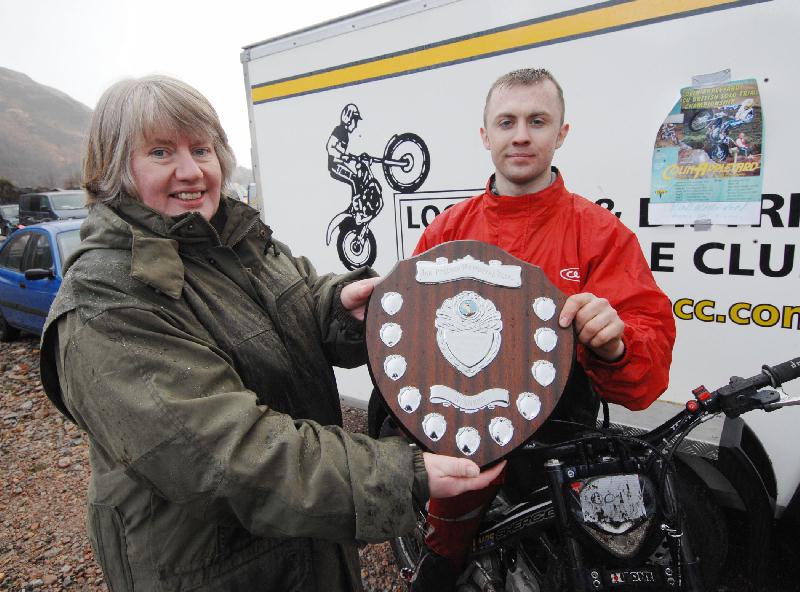
POLLOCK SHIELD 2008
Pamela MacGregor (nee Pollock) presents the Ian Pollock Memorial trophy to local rider, ten times Scottish trials champion, Gary Macdonald in 2008. – Photo copyright and courtesy of: Iain Ferguson, The Write Image, Fort William.

John MacGregor was at one time himself an Assistant Clerk of Course SSDT and Pre’65 Scottish in its formative years.

So next time you climb up the ‘Dam Road’ to watch riders in either the SSDT or Pre’65 Scottish trials, spare a thought for the man who discovered many of these sections – Ian Murray Pollock.

More on Kinlochleven:

Kinlochleven in Scots Gaelic is Ceann Loch Liobhann, it was the first village in Scotland to have electric street lighting because of the electric power generated by the British Aluminium Company smelter. It used hydro or water power which was pioneered at Foyers in 1895 on the south side of Loch Ness, not far from Inverness. Kinlochleven was actually formed from two small villages, Kinlochmore (Large head of the loch) and Kinlochbeg (Small head of the loch). Kinlochmore on the north and Kinlochbeg on the south of the River Leven that runs into Loch Leven of which Kinlochleven sits at the head of.

The British Aluminium Company became part of Alcan, the Canadian based aluminium producer which laterly became Rio Tinto Alcan, part of the multi-national Rio Tinto company, which employs local personnel at their Fort William smelter operation. Rio Tinto (Alcan) is the world’s leading aluminium mining and producer. Rio Tinto Alcan can trace its roots back to Alcoa founded in 1928.

High quality, pure Aluminium was first produced at Kinlochleven at the ‘wee factory’ which was a temporary establishment high up in the hills on the Blackwater path. The ‘wee or temporary factory’ opened in 1907 with the main factory opening in Kinlochleven in 1909. The Blackwater dam or reservoir was formed purely to hold water reserves for the British Aluminium Company by flooding a sparsely populated valley high above the town, effectively trapping many of the River Leven’s tributaries and led down to the power house by six pipes, which are of course visible and beside the famous ‘Pipeline’ SSDT section group.

Trials Guru is indebted to Pamela and John MacGregor of Glencoe, Argyll for information supplied which made this article possible.

Text Copyright: Trials Guru / Moffat Racing, John Moffat – 2015

Photo Copyright: Iain Ferguson – ‘The Write Image’, Fort William – All Rights Reserved.

Photo of Paul Kilbauskas, by kind permission of Ms. Marina Kilbauskas.

Special thanks to: Alex Smith, former SSDT Assistant Clerk of Course and former Chairman, Pre’65 Scottish Trial.

Thanks to the Edinburgh & District Motor Club Ltd – For use of the cover of the 1958 SSDT official programme.
cropped-tg_logoheader-2018.jpg

Book Release – 30 March 2015

Motorcycle Competition: Scotland 1975-2005 is released on Monday 30th March 2015. Be sure to order your copy Here

Cover shot MCS

‘Great Scots’ – Tommy Robertson

Continuing our series of articles of Scottish off-road personalities ‘Great Scots’, we now are pleased to bring you the story of Tommy Robertson.

Tommy Robertson on Inshriach in the 1953 SSDT
Tommy Robertson (200 DMW) on Inshriach (also known as Creag An Eilein) in the 1953 Scottish Six Days Trial. A section that Robertson himself helped discover and was put in the event.

Tommy Robertson is a well-known name known to many of the more senior competitors and enthusiasts in Scotland.

He was a time-served joiner by trade and worked most of his life with D. B. Gunn (Builders) Ltd of Edinburgh, which was established in 1949, rising to ‘foreman joiner’ with the firm.

He was a life-long member of the Edinburgh Southern MC, a club that was established in 1924 and met in ‘The Southern’ bar, a public-house in 26 South Clerk Street in Edinburgh’s South-Side, hence the name.
Tommy on his AJS 350 16MC at a trial near WesBathgate, West Lothian around 1951
Tommy Robertson on his AJS 350 16MC at a trial at Westfield near Bathgate, West Lothian around 1951.

Tommy was not only  a keen trials rider and no slouch on a scrambles machine either as he was runner up in the Scottish Championships in 1954 to Ludo More.
Tommy Robertson scrambling an AJS

He also rode in road hill-climbs which were popular just after the war.
Tommy Robertson on his Triumph Twin at the Bo'ness Hill Climb on 9th August 1947
Tommy Robertson on his Triumph Twin at the Bo’ness Hill Climb on 9th August 1947, the helmet is the Edinburgh Southern MC which was worn by club members in ‘speed’ events.

Thomas Robertson served in the British Army during the Second World War in India and Burma, but it was never a subject that he could be drawn on to discuss in conversation, this may have been due to the senseless atrocities that occurred on the so called ‘Burma Railway’.

Tommy Robertson on Kinloch Rannoch in the 1953 Scottish on his Edgar Brothers supplied 200 DMW

Robertson’s peers were many of the best Scottish riders of the era, Geoff Smith; Jimmy Hutchins, Jackie Williamson to name but three.

A life-long sporting motorcyclist, Tommy’s favourite event was without question the Scottish Six Days Trial and indeed Tommy was a club scout, who investigated sections for the Edinburgh & District organising club.

Tommy on his AJS in the 1950 Scottish Six Days on his AJS. This is 'Kinloch Hourn', no longer used a long climb into the hill from Loch Hourn.
Tommy on his 350 AJS in the 1951 Scottish Six Days on his AJS. This is ‘Kinloch Hourn’, no longer used, it was a long climb into the hills from Loch Hourn down in the valley. A breath-taking photograph.

In the 1970’s Tommy Robertson was the ‘number-plate official’ for the event, He issued the riders’ metal number plates at the weigh-in at Gorgie Market and took them from the riders at Blackford Hill, returning their deposit at the event finish, up to 1976 when the event moved to Fort William the year after and riders had to make their own numbers.

Arthur lampkin gets his 250 BSA 'weighed in' at the 1961 SSDT. Tommy Robertson is on second right examining paperwork
Arthur Lampkin gets his 250 BSA ‘weighed in’ at the 1961 SSDT. Tommy Robertson is on second from the right, looking down examining paperwork.

Tommy was also a machine examiner, who painted the daubs of special paint on the sealed items for the SSDT at the Gorgie Weigh-in.

In fact Robertson was one of a team of section scout riders who discovered and reconnoitered ‘Inshriach’ , also later known as Creag An Eilein near Aviemore on the Rothiemurchus Estate which was used from 1953 to 1967 before National Park status for the area forbade it’s future use.

Tommy Robertson (AJS) on the famous Devil’s Staircase at Lochailort in the SSDT

Tommy served for many years on the management committee of the Scottish ACU and being a tradesman, in those days who had no pay when off work due to a sporting injury, was the prime-mover to get rider’s insurance cover as part of their entry fee established with the then specialist motor-sport insurers brokers CT Bowring & Muir-Beddall.

Tommy and his wife, Mary had a son, Ian Thomas who also rode in trials, and was also a member of the Edinburgh Southern MC, like his father before him. The family home was at Bonnyrigg, near to Edinburgh in Midlothian.

Tommy Robertson was a very quiet, reserved individual with a commanding knowledge of the sport in Scotland. It is safe to say, when Tommy Robertson spoke, people listened to him carefully. One of the old-school competitors and officials who said little, but knew a great deal!

Tommy at home on his vintage AJS in the 1980's, the bike still owned by his son Ian.
Tommy at home on his vintage AJS in the 1980’s, the bike still owned by his son Ian.

Trials Guru wrote: Many riders were encouraged to join the Southern and take up either scrambles or trials and in fact my late father T. Arnott Moffat was one of them.

© – All text copyright: Trials Guru / Moffat Racing, John Moffat 2015.

Trials Guru would like to thank Ian T. Robertson, Lasswade for the use of the photographs accompanying this article.

Jock Wilson – ISDT Team Manager and more!

Peter ‘Jock’ Wilson … a great friend … a great man ~ By Renee Bennett.

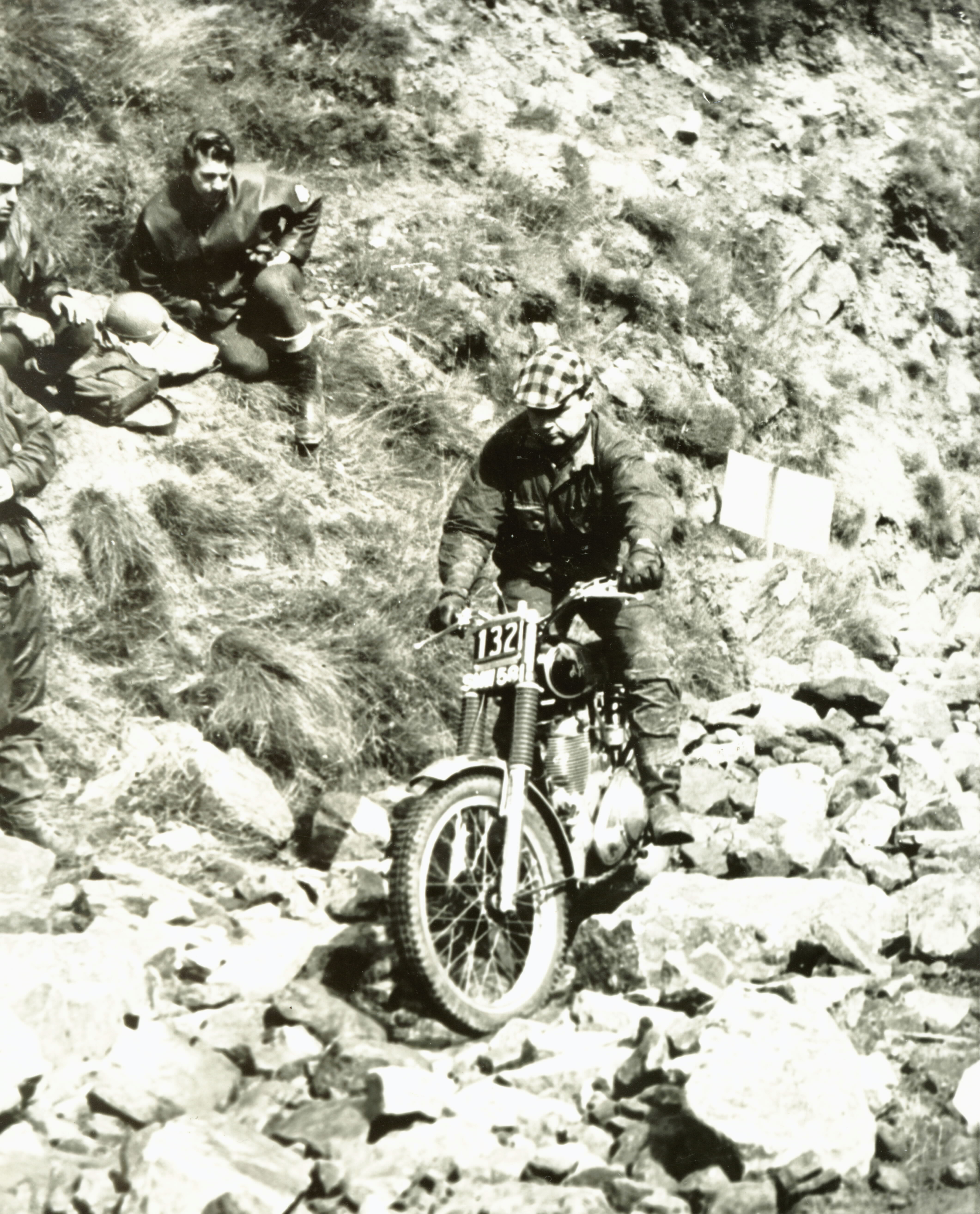
Jock Wilson - 350 AJS - SMW581 - Clayton Trial - section Cheeks - 05-08-1962 - Photo Unknown
Jock Wilson on ‘Cheeks’ at the Clayton Trial in 1962 on his specially built ultra-short-stroke AJS 350. (Photo supplied by Patricia Wilson)

When I think of Jock Wilson, it reminds me of the fantastic Thames Ditton motorcycle dealers, Comerfords, AJS trials machines, Bultaco, the Scottish Six Days and a top Home Counties based trials rider who went on to take charge of the British International Six Days Trial Trophy Team for nearly 20 years.

Peter Cameron ‘Jock’ Wilson was born in Scotland on 12th January 1934 at Oakbank, Bridge of Balgie, Glen Lyon, Perthshire. The Scottish Six Days was practically on his doorstep as the ‘Meall Glas’ section was only ¾ mile from his front door.

Jock on his short-stroke AJS in a Sidcup 60 Trial. Comerfords Sales manager Bert Thorn is following in the background.

There is the main reason he was such a good trials rider ~ with all that practice ground, he just had to be good!

‘Jock’ as I’ve always known him, started his working life as a lumberjack, then a spell in the British Army doing his national service at Aldershot, then marrying his wife Pat and moving to London to live permanently.

At Aldershot, Jock was in the Royal Army Service Corps or RASC for short, his commanding officer was Captain Eddie Dow, but he also met many of the factory trials and scrambles stars of the era who were also doing their national service. Riders such as Roy Peplow, John Giles and many more.

He took up employment at Arthur Cook Motors in Kingston-Upon-Thames and then the well-known motorcycle dealership, Comerfords based in Portsmouth Road, Thames Ditton, Surrey which he joined in 1957.

Jock started at Comerfords as a motorcycle mechanic in the workshops, soon progressing to workshop manager. When he became bored with that, he moved into sales under Sales Director, Bert Thorn.

1965 Scottish Six Days on Callert, riding the ex-Sammy Miller Ariel 786GON, which Wilson owned and rode for several years. The machine is now in Italy.

Jock’s specialty was modifying AJS trials bikes, cleverly making them lighter and more powerful. Gordon Jackson, Gordon Blakeway and Gordon McLaughlan rode AJS machines as a team in those days and Jock even named one of his sons after the trio.

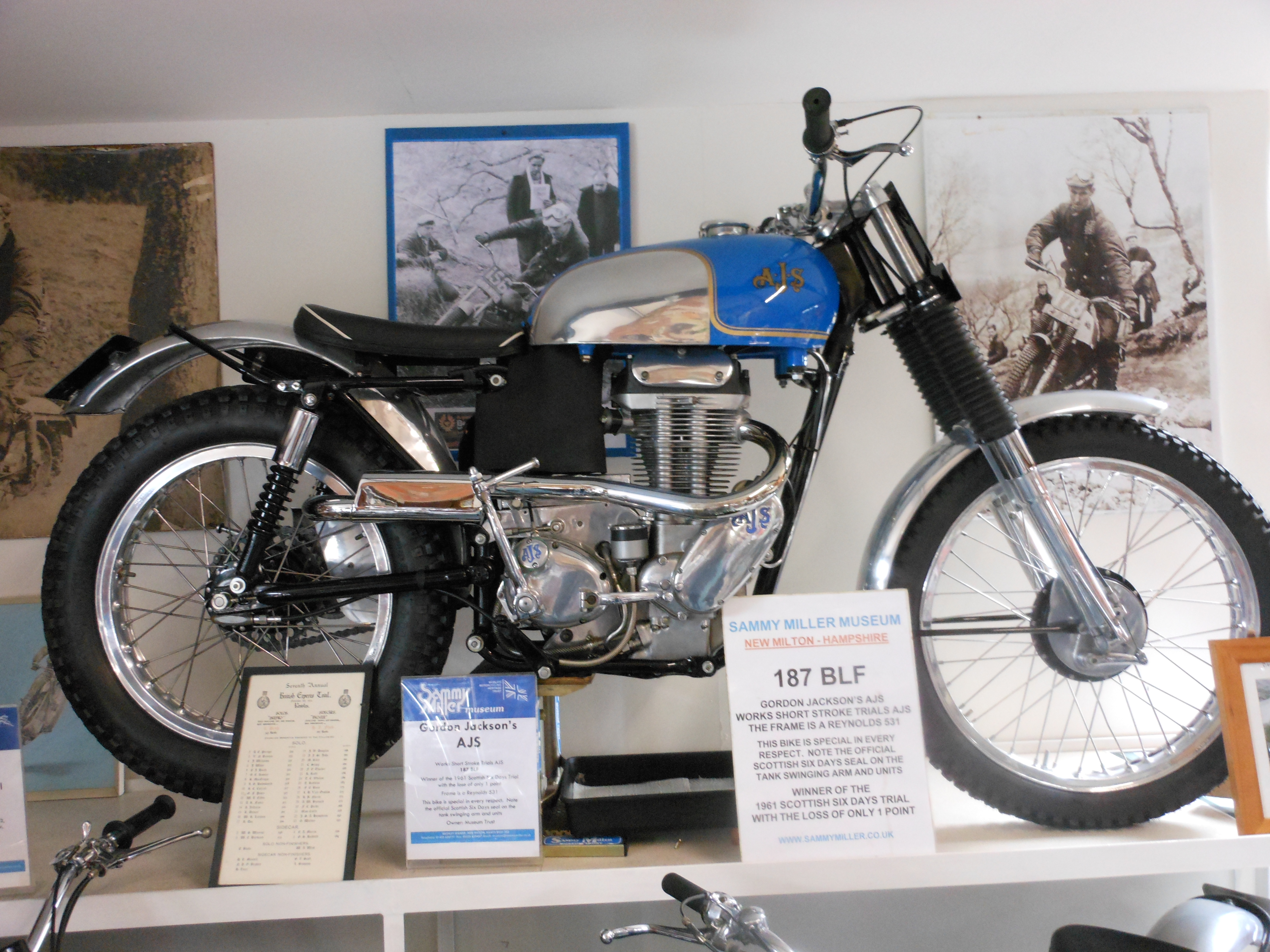
Gordon Jackson of course won the 1961 SSDT on his factory AJS (187 BLF) with just one ‘dab’ ~  Amazing!

Jock went on to manage the British International Six Days Junior Trophy and Trophy teams. His knowledge gained by riding in the ISDT many times himself on AJS and Triumph machinery gave him a valuable insight into this part of off-road sport and was a very highly thought of manager by the riders and the ACU. He actually cut his teeth initially by managing the Scottish ACU squad in Sweden in 1978.

A Scottish ACU presentation of awards ceremony at Perth in 1980. From left: Ron Wright (SACU Trials); Alex Phillip (Clubman TT winner 1948); Robbie Allan; Charlie Bruce (Scottish racing champion); Tommy Milton (SACU official); Anne Allan (wife of Vic Allan) and Jock Wilson, ISDT Team Manager.
A Scottish ACU presentation of awards ceremony at Perth in 1980. From left: Margaret Allan (SACU Chairperson); Ron Wright (SACU Trials); Alex Phillip (Clubman TT winner 1948); Robbie Allan; Charlie Bruce (former Scottish racing champion); Tommy Milton (SACU official); Anne Allan (wife of Vic Allan) and Jock Wilson, ISDT Team Manager.

When Comerfords eventually took over the importership from Rickman Brothers of the Bultaco brand, Jock was soon in charge … supplying dealers and operating a first class spares service.

When Jock left Comerfords, some many years later, he started his own business importing the Italian SWM trials and enduro macinery in partnership with Mick ‘Bonkey’ Bowers, which became equally as good as the Bultaco brand and very popular.

Jock and Bonkey set up a countrywide dealer network which included former World Trials Champion, Martin Lampkin.

After SWM stopped producing motorcycles, Jock went self-employed working from his home in Tolworth, fixing and tuning bikes and repairing damaged wheels, as he is an ace wheel-builder.

Nowadays, Jock is retired but still works a little on classic bikes in his spare time. I speak to him regularly and it’s always a pleasure.
Jock has always been a friend to me, to my late father Wag Bennett, and to my children Charles (who runs a busy London motorcycle shop) and my daughter, Julie.
I owe Jock a debt of gratitude for the support and help he gave me over twenty five years of trials riding.

Thank you Jock Wilson … Renee Bennett, Plaistow, East London.

Trials Guru: Jock Wilson, so named because this was common place for a Scotsman living and working in Southern England at the time, became one of off-road motorcycle sports’ most respected characters. Jock was a very competent mechanic and a serious trials competitor. When he was with Bultaco UK, he was responsible for setting up the contracts with the Comerfords supported riders in both motocross and trials. Wilson was mentor to Greeves rider and fellow Scotsman, Vic Allan when he moved from Aberdeenshire to Thames Ditton to ride for Comerfords in 1967. Allan then went on to ride for BSA briefly, during which time he crashed heavily at the Italian GP on his factory BSA breaking his hip and was sidelined for several months, during which time BSA closed the Small Heath competitions department. Allan then reverted to race for Comerfords on the Spanish Bultaco and became British 250cc and 500 cc Motocross champion in 1974, riding the Pursang models in both classes.

© – All text copyright: Renee Bennett & Trials Guru / Moffat Racing, John Moffat 2015.

Sammy’s Museum

Words: Trials Guru

Photos: Iain Lawrie; OffRoad Archive; Bob Dunwoody; Sammy Miller Museum.

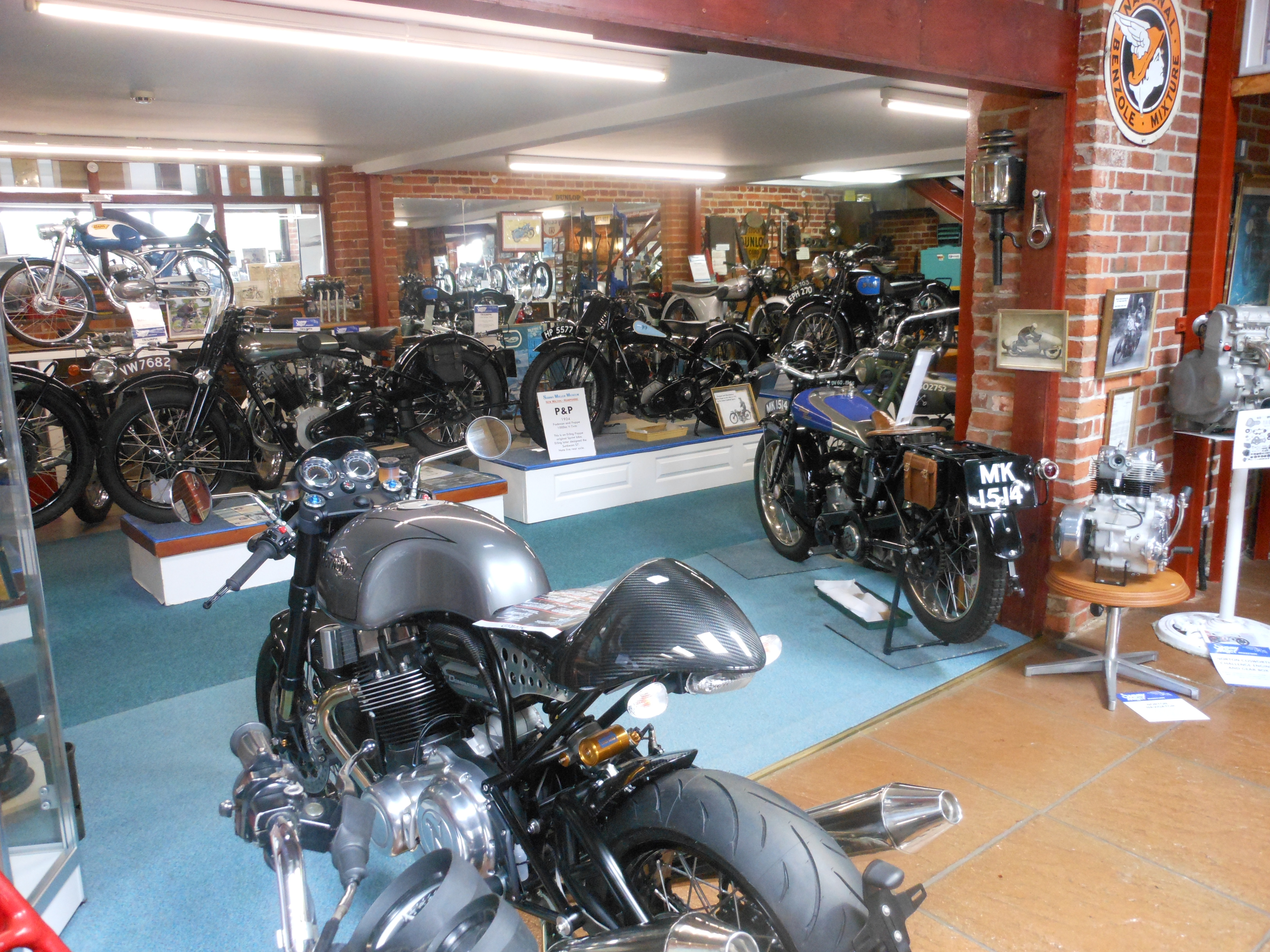
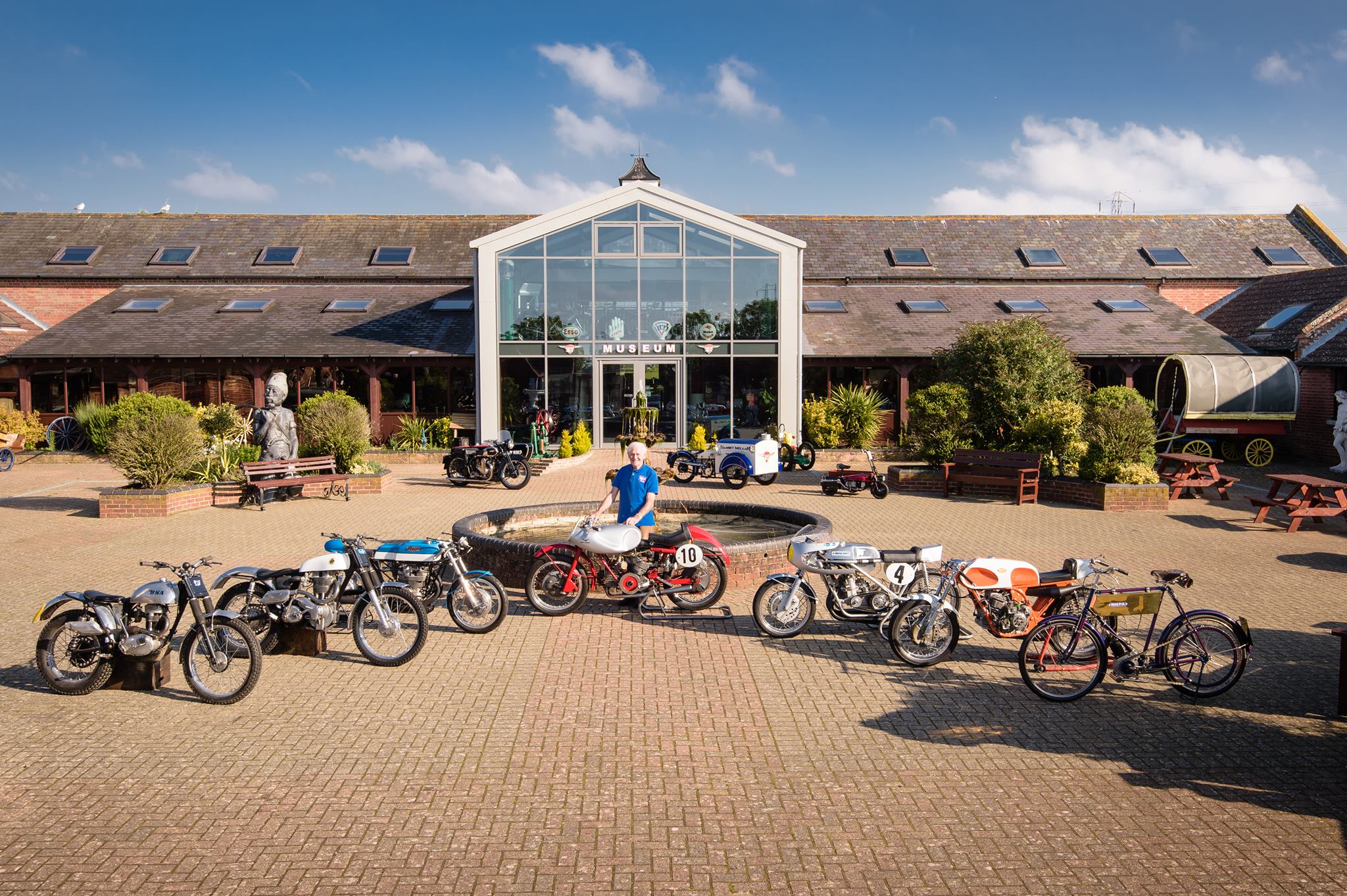
In 1996 Sammy Miller MBE took over the run-down premises of an old farm at the Bashley Cross Roads, New Milton and converted the barns into a modern, prestigious building with picturesque surroundings. It is now accepted as housing one of the finest collections of fully restored motorcycles in the world, including factory racers and exotic prototypes.

At the end of 2004 permission was granted for an extension to the museum which now allows it to house over 500 exhibits. The museum was further expanded in 2021.

Sammy Miller MBE and his wife, Rosemary. Photo
Sammy Miller MBE and his wife, Rosemary.

Sammy’s life has always been dedicated to motorcycling. As a young boy he followed motorcycle racing in Ulster and then went on to compete and win his first race meeting in 1953.

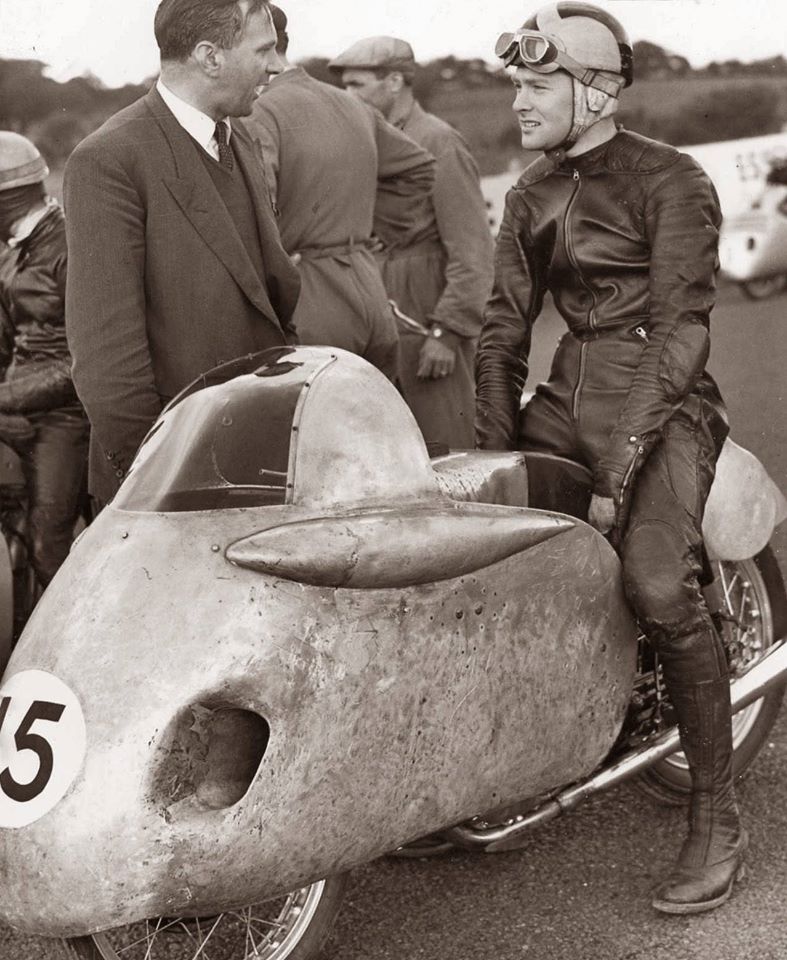
Sammy Miller (NSU) at the Ulster Grands Prix in 1957 chats with sponsor Terry Hill – Photo: Bob Dunwoody

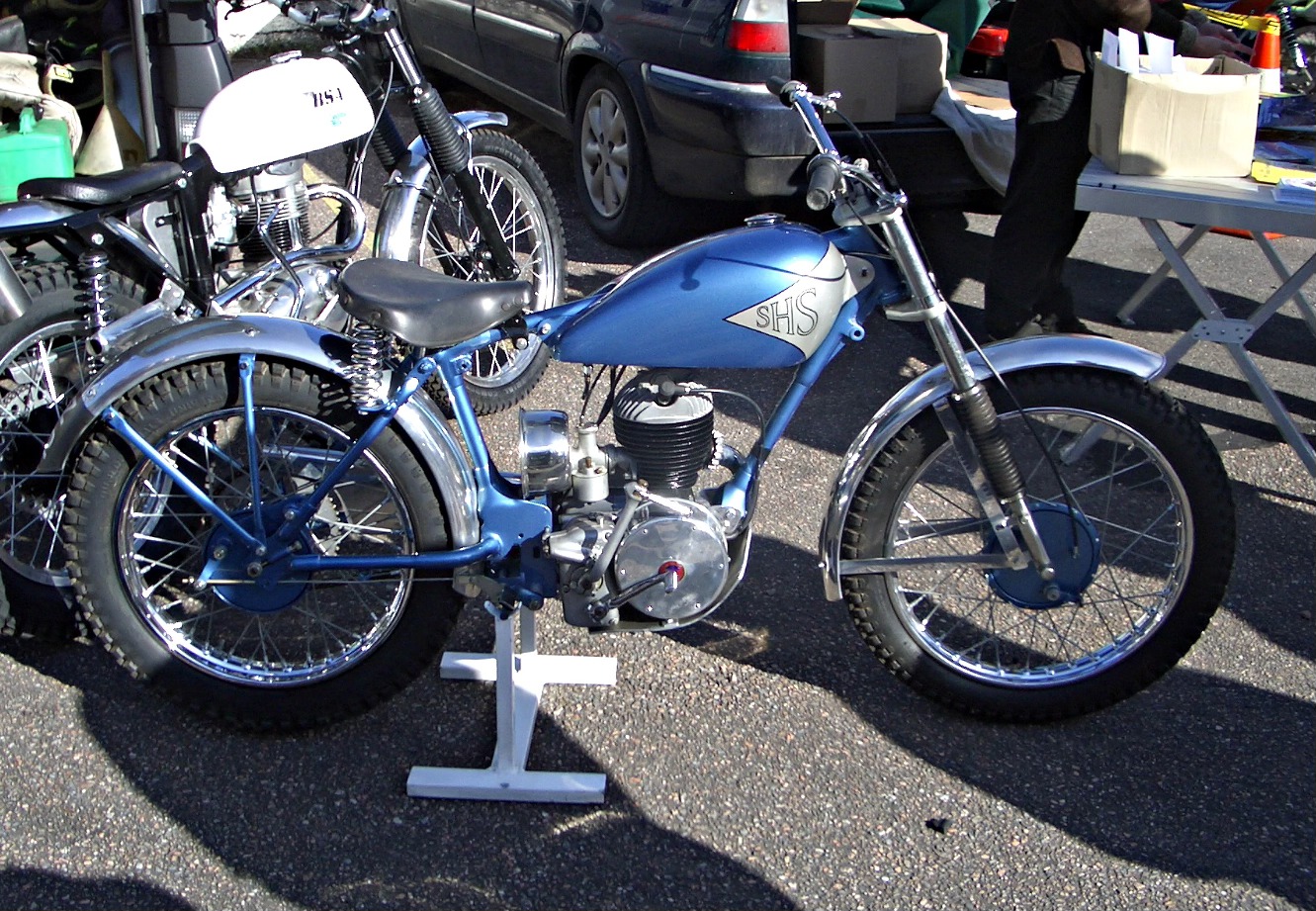
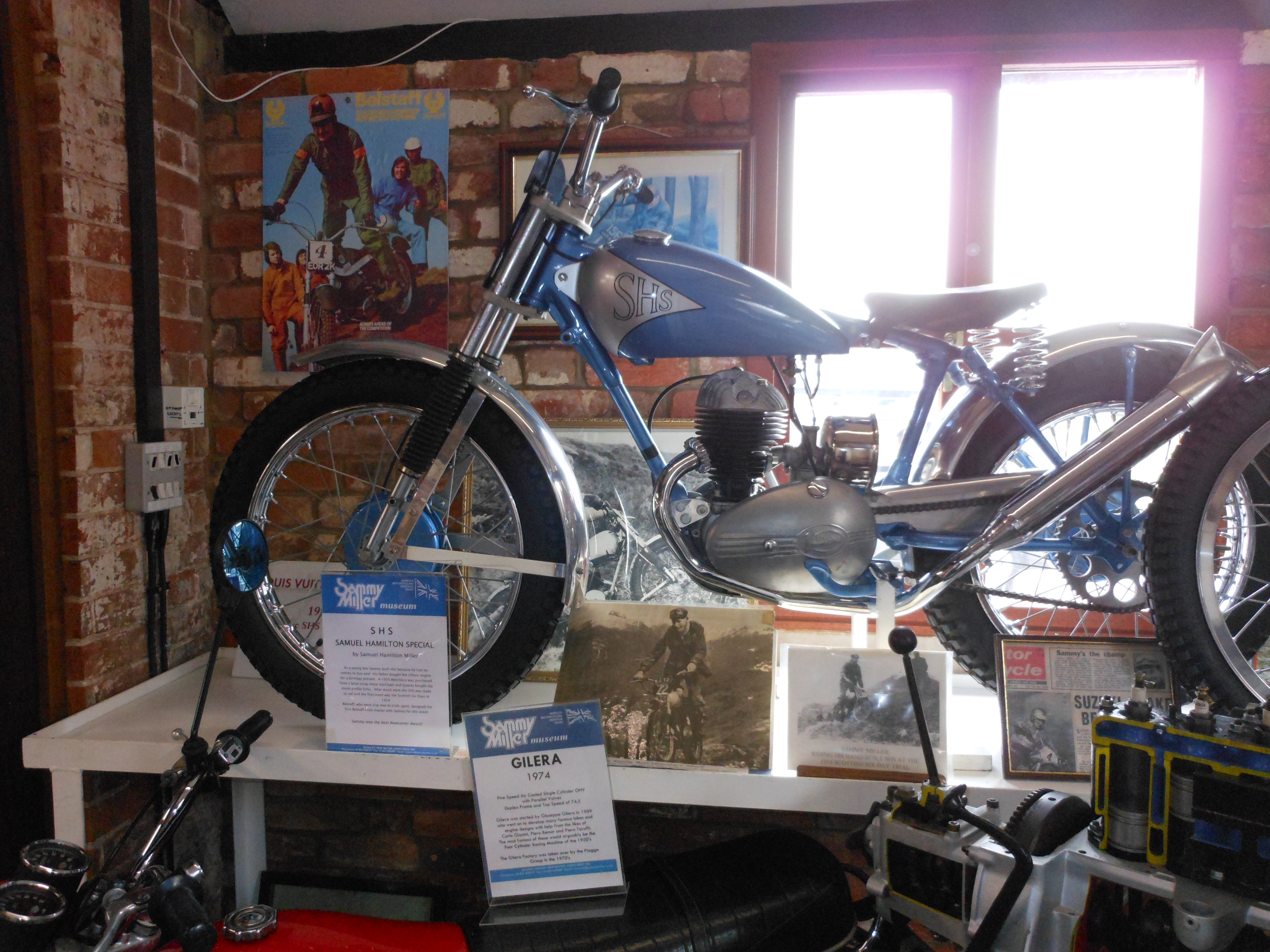
After a well documented period on the Road Racing Grand Prix circuits he switched to trials, at first building his own trials bike, the 197cc SHS (Samuel Hamilton Special) in 1954.

Sammy outside his first shop in New Milton (Photo: Sammy Miller Museum Archive)

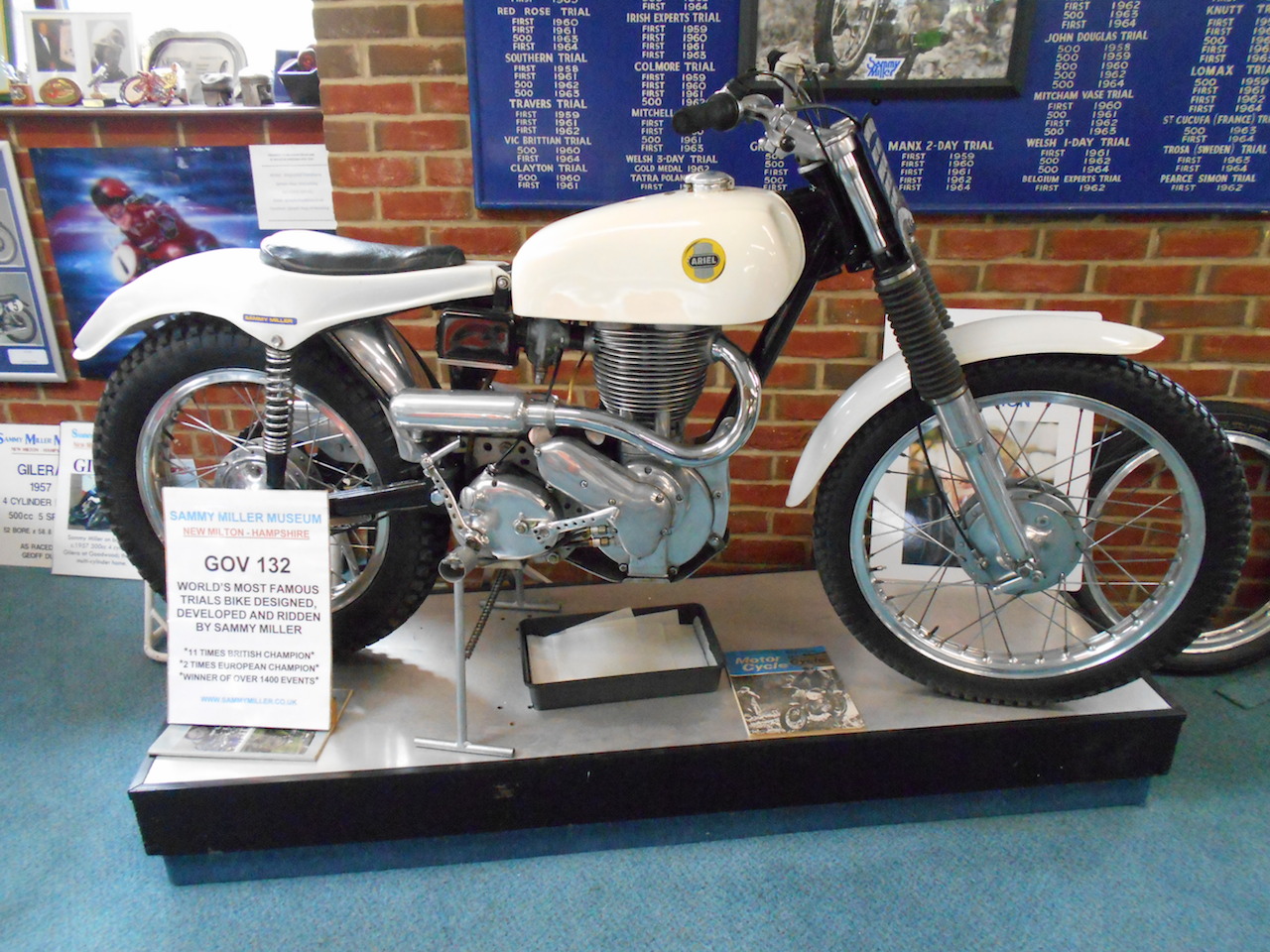
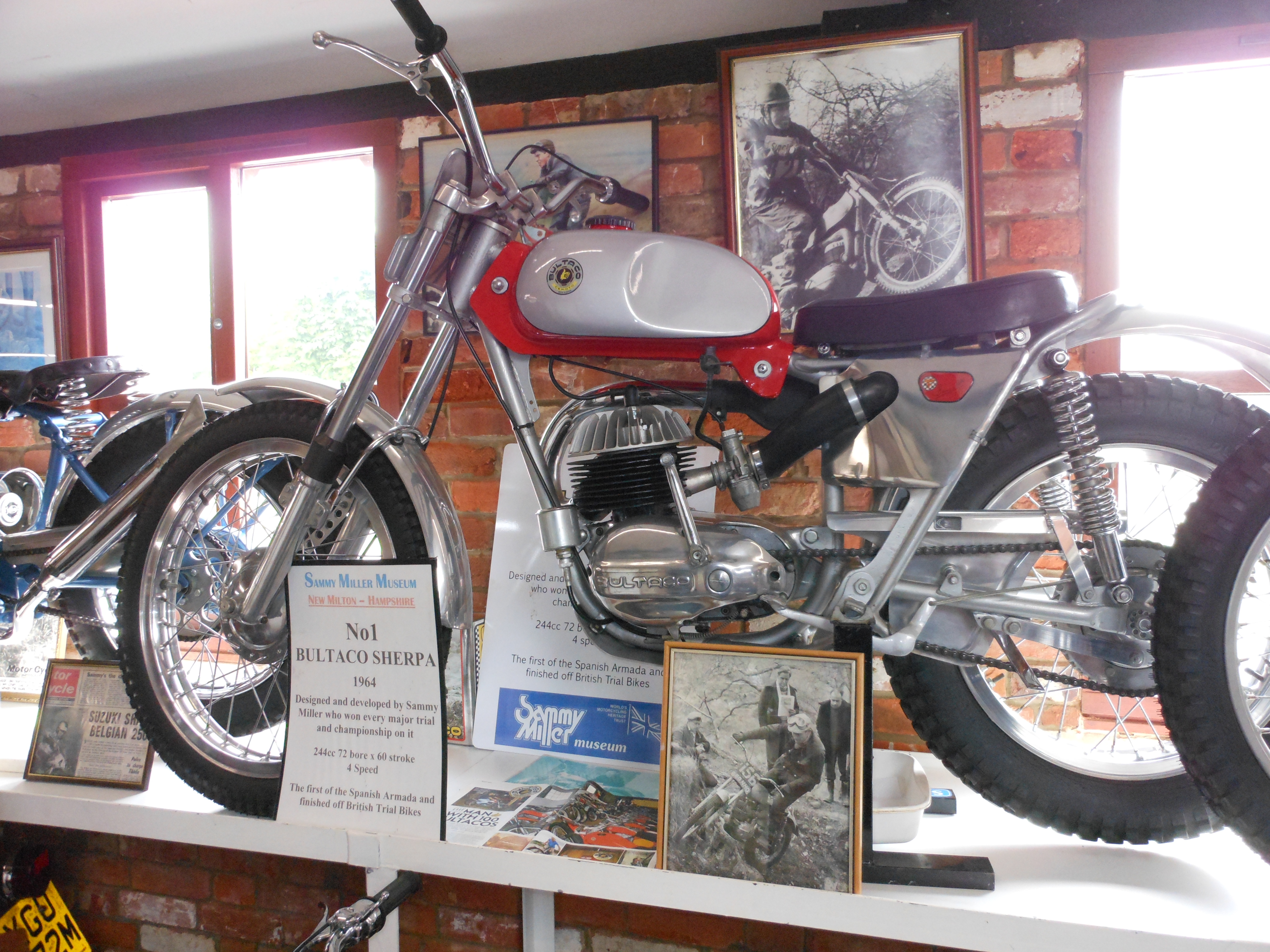
He then went on to develop the world famous Ariel trials machine GOV 132 for the Ariel factory before moving on to Bultaco in 1964 , changing the face of trials in 1965 with the Bultaco Shera T, and then on to work for Honda Motor Company in 1973 to design the world championship winning trials machine. He is still active today, but in his beloved workshop where the sign above the door reads: ‘Another Day in Paradise’.

Sammy on his GOV Replica Ariel HT5 on Loch Eild Path in the Pre'65 Scottish Trial. Photo: Copyright Iain Lawrie, Kinlochleven.
Sammy on his ‘GOV Replica’ Ariel HT5 on Grey Mare’s Ridge in the Pre’65 Scottish Trial. Photo: Copyright Iain Lawrie, Kinlochleven.

Unlike most other museums this is more than a static collection to be dusted and polished at regular intervals and displayed like butterflies with pins through them. This is a live museum, for whenever the opportunity presents itself these machines are run in classic bike events of one kind or another. There are many clubs which now organise open days and exhibitions at Sammy’s museum.

The exact replica SHS of 1953 which Sammy Miller built with a 250cc Matchless rigid frame and 197cc Villiers engine, which he rode in his first SSDT in 1954. Photo: Iain Lawrie.

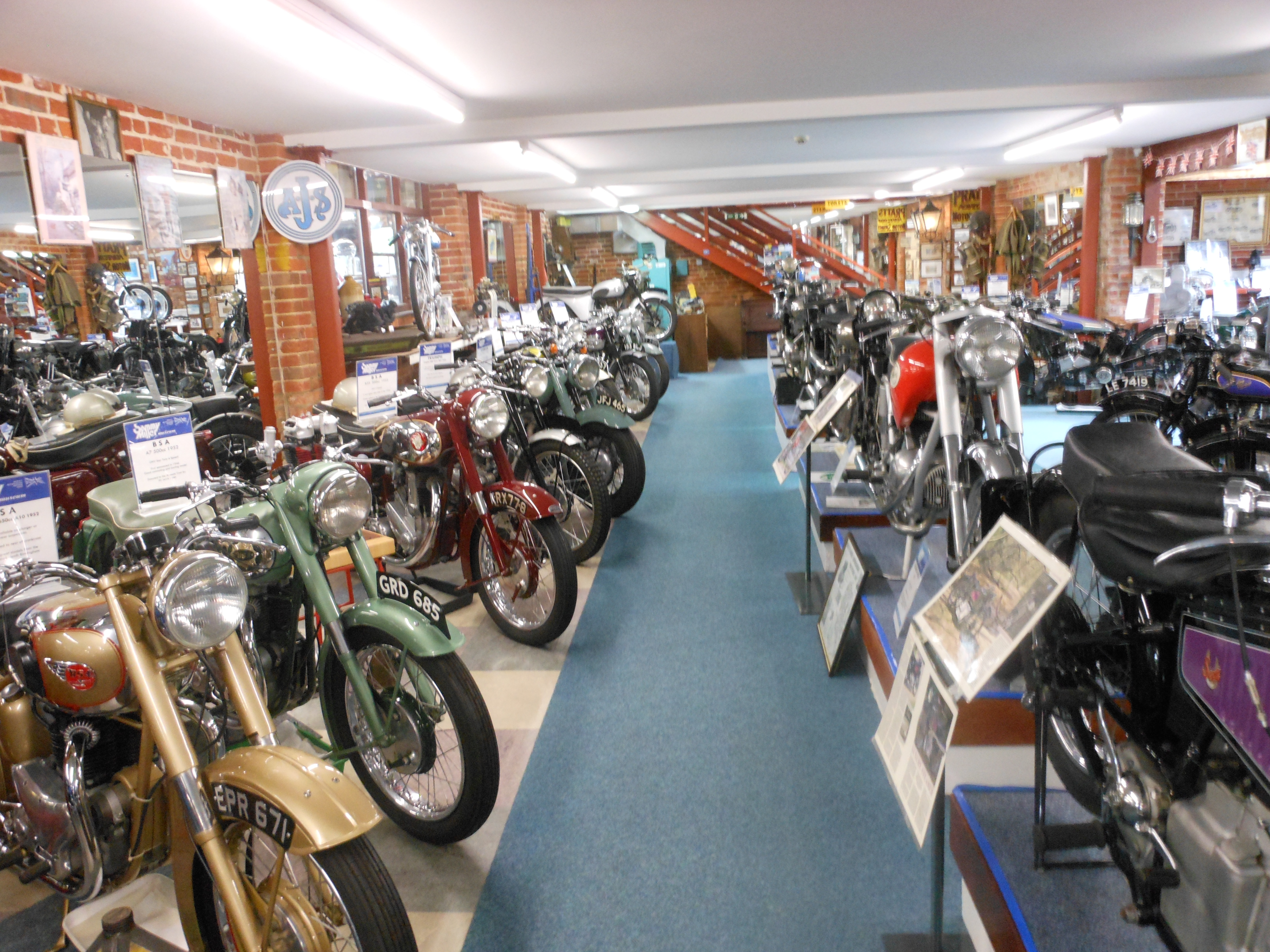
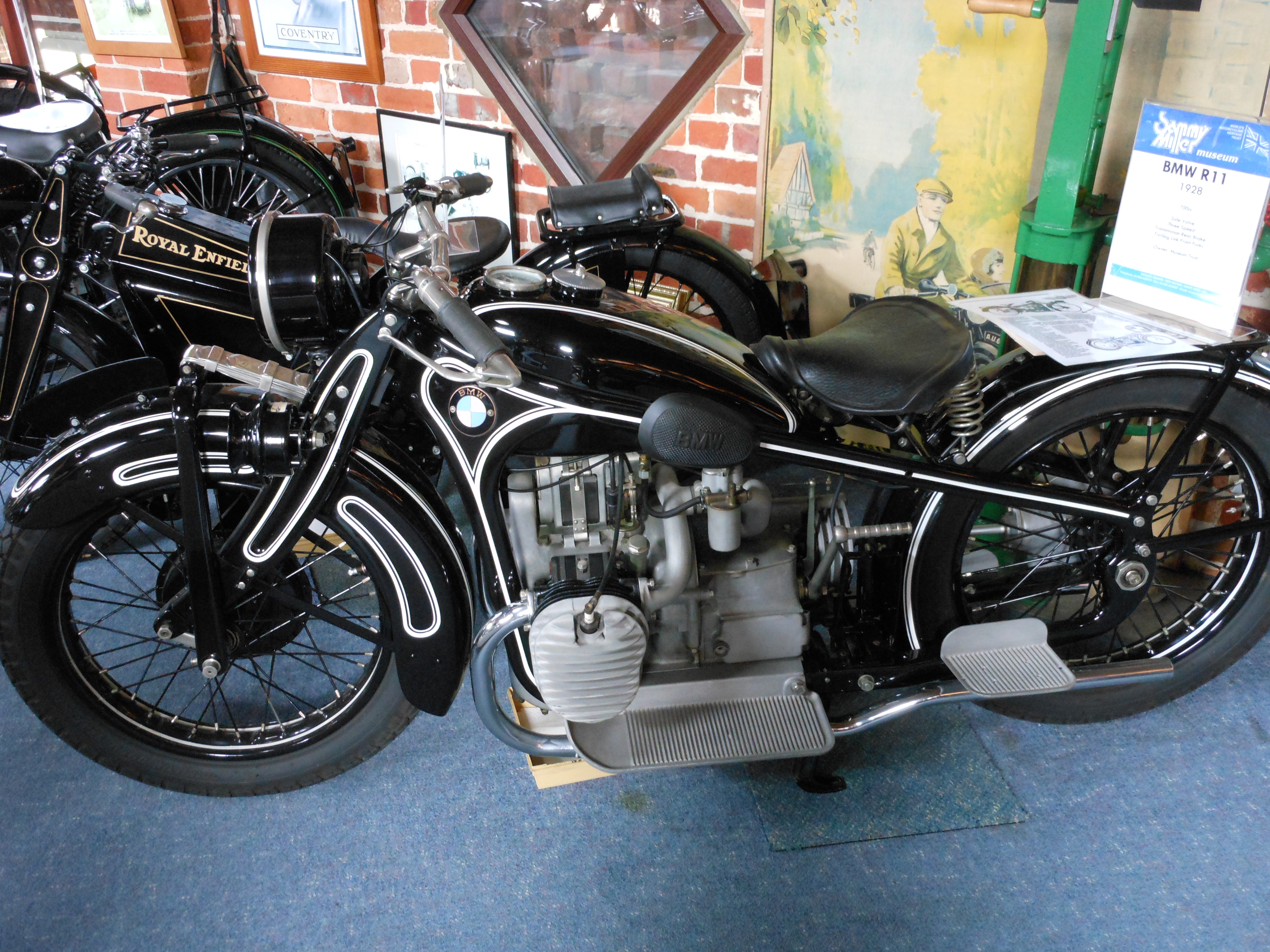
Many of the racing machines are still fully competitive and capable of giving a good account of themselves in high-speed parades. Like any good museum the contents are changing constantly. Virtually every new acquisition represents a full-scale renovation with the attendant difficulty in finding missing parts or replacements to exchange for those that are badly worn. Apart from the motorcycles on display you will also see many interesting artefacts, all of which represent a link with motorcycling of a bygone era.

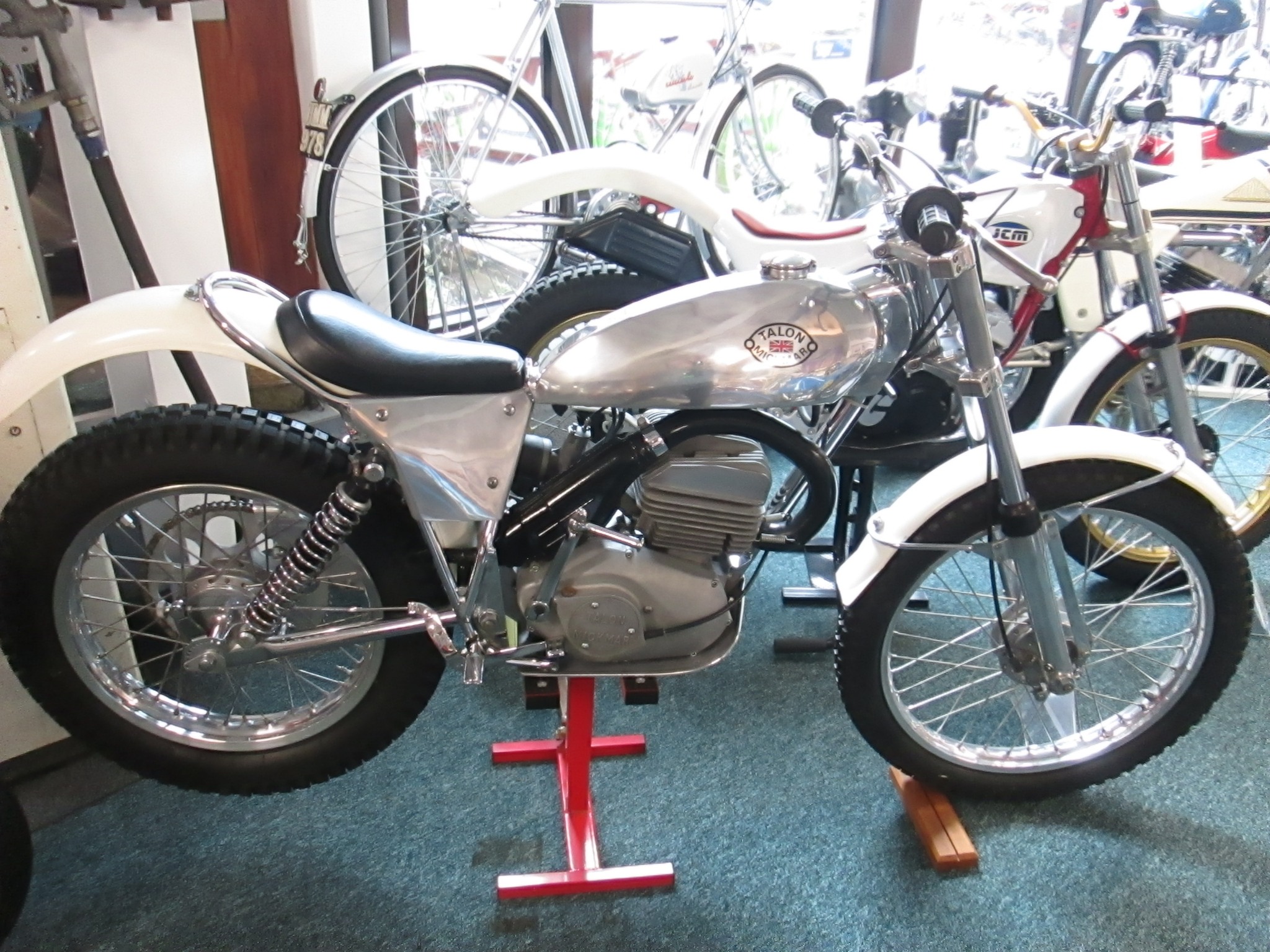
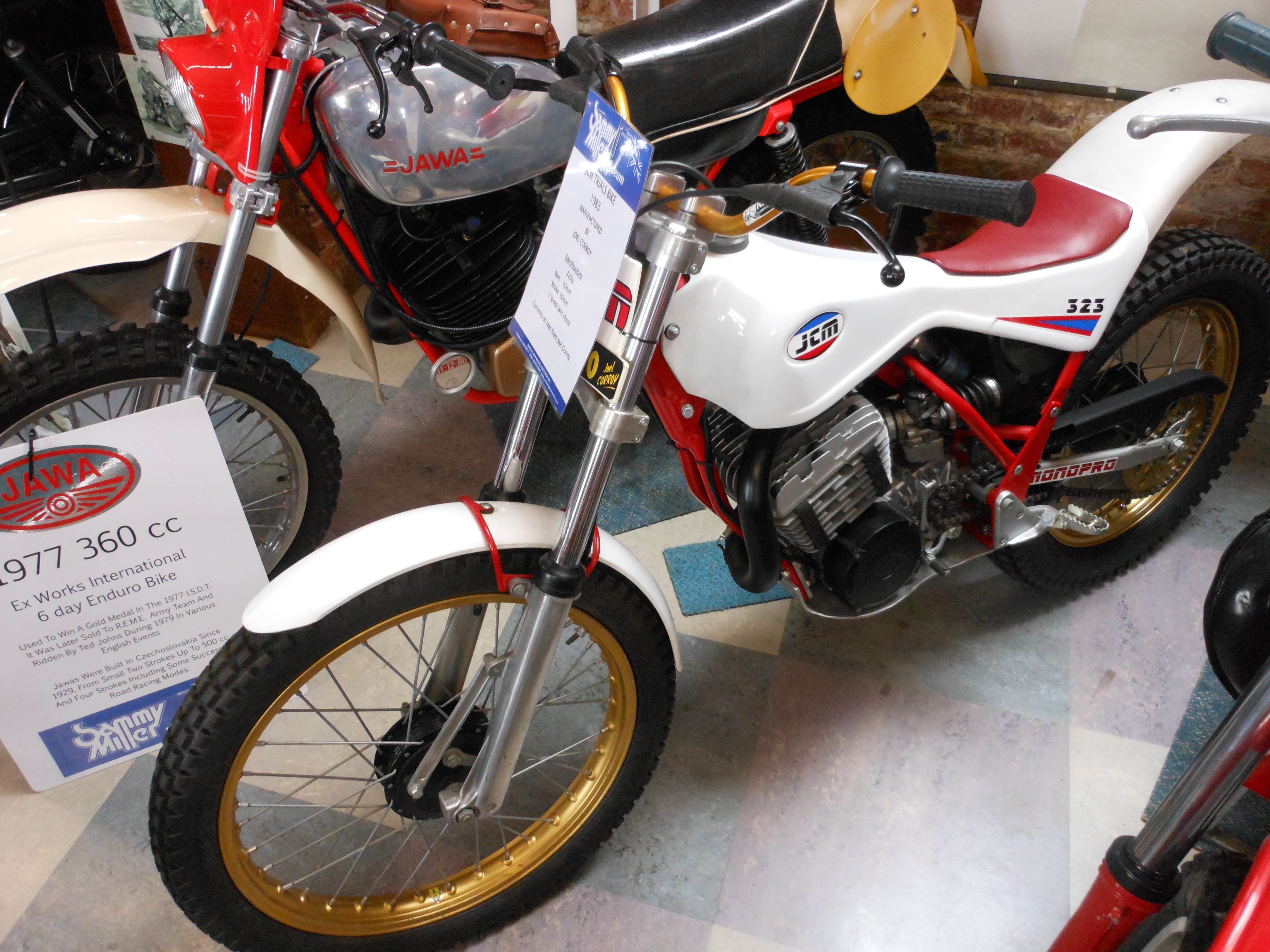
The Off-Road section is extensive and captures the past. There are many unique and rare machines to behold, one of which is the Talon Mickmar trials machine which was a prototype. There are also Jawa ISDT machines from the mid-seventies, and even the long track championship winning machine of the late Simon Wigg.

History Preserved:

The late Gordon Jackson putting the finishing touches to his factory 350cc AJS at the 1962 Scottish Six Days Trial in Gorgie Market, Edinburgh – Photo: OffRoad Archive.

Sammy managed to locate the 1961 SSDT-winning AJS (187BLF) ridden by Gordon Jackson when he recorded the famous one dab victory on the Grey Mare’s Ridge section.

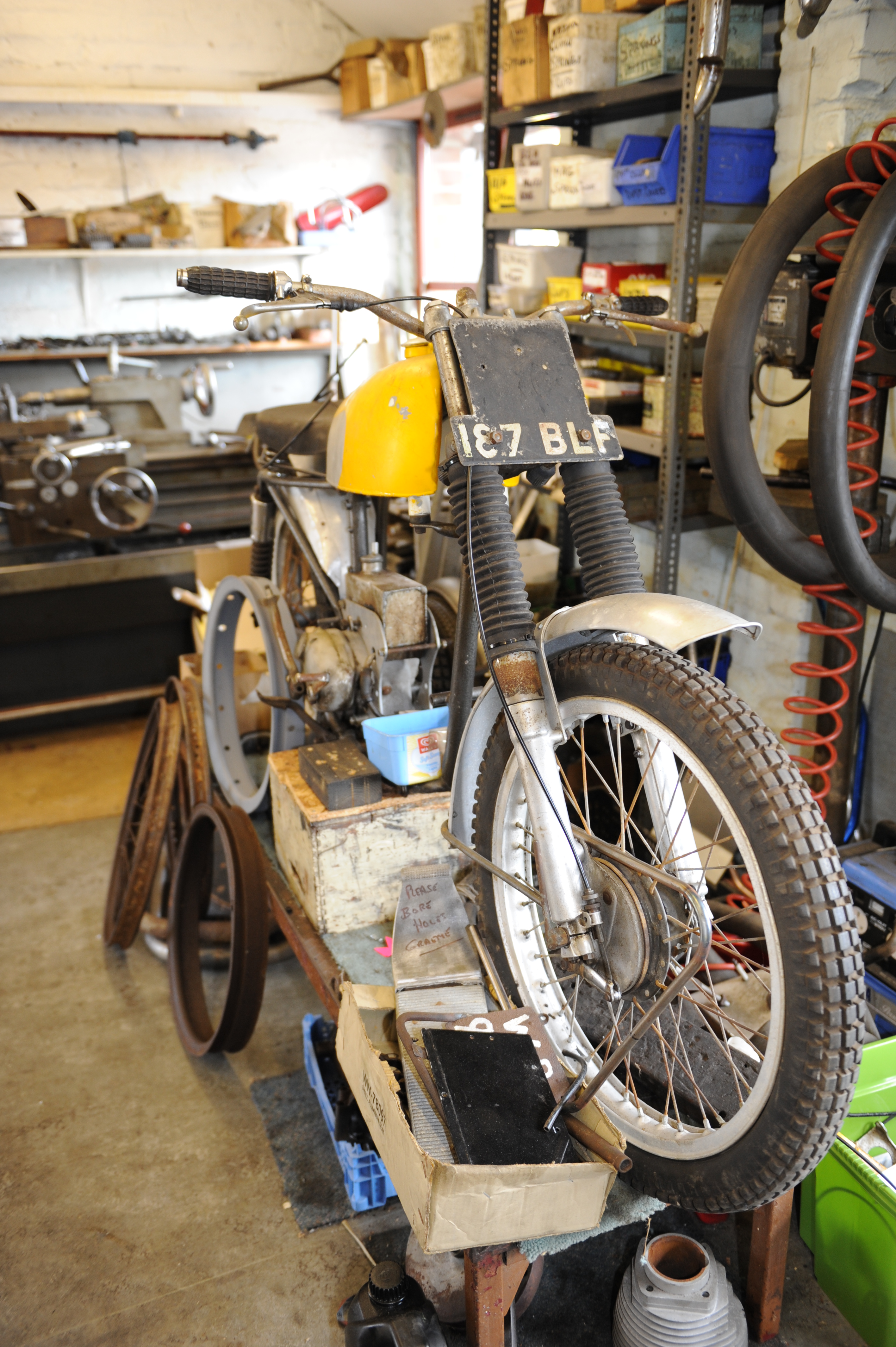
5 The famous Gordon Jackson AJS as it arrived at the museum.
Gordon Jackson’s factory AJS 187BLF in ‘as found’ condition, seen here at Sammy Miller’s ready for restoration.

The machine was in poor condition and in boxes but Sammy restored it back to its original specification, much as it had been ridden by Gordon Jackson in 1961.

OLYMPUS DIGITAL CAMERA
The Gordon Jackson AJS 187BLF rebuilt and ready to go with Sammy at his museum.

Sammy was both delighted and proud to exhibit both GOV132 and 187BLF at the Scottish Six Days Trial in 2011 to celebrate the events 100 years.

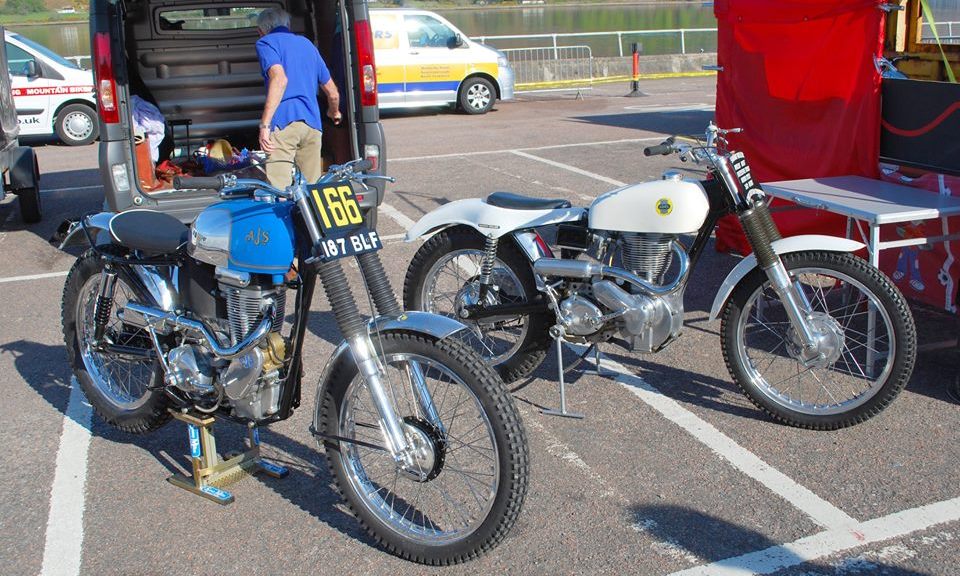
SSDT Centenary 2011 – Two of the most famous trials machines, of all time – 187BLF (350 AJS) which won the 1961 SSDT ridden by Gordon Jackson losing only one mark. GOV132 (500 Ariel) Sammy Miller’s famous machine that won the SSDT (1962 & 1964) – Photo: Iain Lawrie.

The museum houses the finest collection of fully restored motorcycles in Europe, including factory racers and exotic prototypes, plus memorabilia spanning seven decades of motorcycling for sport and for pleasure. There are over 400 rare and classic motorcycles on display in four galleries.

7
Sammy with the AJS Porcupine racer

During all this he has still found the time to restore many rare and exotic machines to concourse condition and perfect working order. These he kept as a private collection until 1980 when he opened up a museum so that the public could have a chance to see and hear them.

Friendship and mutual respect, Sammy Miller MBE and Bernie Schreiber at Sammy’s workshop at New Milton. (Photo: Bernie Schreiber Collection)

He even took some abroad to many locations, including Australia and New Zealand, so that they could be seen by as many people as possible. One of Sammy’s Museum exhibits is now on loan to the new FIM Museum in Switzerland.

The Talon Mickmar which is on permanent display at Sammy Miller’s Museum at New Milton. (Photo Sammy Miller Museum Trust)

Some years ago now, Sammy placed the entire collection into a ‘Trust’ to enable it to be kept together for future generations to experience and admire. There is no one more dedicated to motorcycling than Sam. He spends ten hours a day seven days a week working, promoting or restoring motorcycles.

GOV 132 – Sammy’s famous 500cc Ariel – Photo: Iain Lawrie

And it’s much more than a museum, it houses Craft Shops, the Bashley Manor Tea Rooms, Sammy’s Pit Stop and has Alpacas, Donkeys and Goats for the amusement of children of all ages!

The museum is open pretty much all year round and for me is a must to visit if you have not done so already. For more information please visit:  Web: www.sammymiller.co.uk – Mail: museum@sammymiller.co.uk – Tel: 01425 620777/ 01425 616644. Sammy Miller Museum Trust, Bashley Cross Roads, New Milton, Hampshire, BH25 5SZ

Sammy Miller MBE outside his world famous museum at Bashley, New Milton, Hampshire with his Trials Guru ‘VIP Winners’ special edition cap. (Photo: Sammy Miller Museum)

Sammy Miller MBE – Motorcycling Achievements

  • 11 times successive British Champion.
  • Twice European Trials Champion – the forerunner to the World Championship.
  • 13 times successive Hurst Cup winner.
  • 18 times successive Walter Rusk Trial winner.
  • 5 times winner of the famous Scottish Six Day Trial.
  • 7 times winner of the World’s most arduous trial, the Scott Trial on the harsh and unforgiving Yorkshire moors.
  • Winner of over 1482 Trials events.
  • 9 Gold medals at International Six Day Trials.
  • Irish Motocross Champion.
  • Irish Sand Racing Champion.
  • Winner of most Irish Road races, including winning the North West 200 and the Leinster 200 three years in succession.
  • Third in the World Grand Prix Championships on a works Mondial
  • Sponsor of the British Classic Trial Championships.
  • 2007 inducted into the AMA Hall of Fame in the USA.
  • 2009 awarded the MBE for services to motorcycle heritage.
  • 2014 – Named FIM Legend – 2025 inducted into the FIM Hall of Fame in Switzerland.
  • 2025 – RAC Lifetime Achievement Award Winner
  • 2025 – Trials Guru website awards Sam with one of only ten exclusive white Trials Guru VIP Winner caps!
John Moffat has interviewed 10 times British Trials Champion, Sammy Miller on many occasions.
Trials Guru’s, John Moffat has interviewed 11 times British Trials Champion, Sammy Miller on many occasions.

References:

Sammy Miller Motorcycle Museum & Trust Catalogue – Obtainable from the Museum sales office. Sammy Miller Museum Trust.

Sammy Miller and Trials Guru’s John Moffat catch up at the Classic Dirtbike Show at Telford in February 2016 – Photo: Fiona Watson

Apart from ‘Fair Dealing’ for the purpose of private study, research, criticism or review as permitted under the Copyright, Design and Patents Act, 1988, no part of this article may be copied, reproduced, stored in any form of retrieval system, electronic or otherwise or transmitted in any form or by any means, electronic, electrical, mechanical, optical, chemical, photocopying, recording or otherwise without the prior written permission of the author as stated above. This article is not being published for any monetary reward or monetisation, be that online or in print.

And finally from Rob!

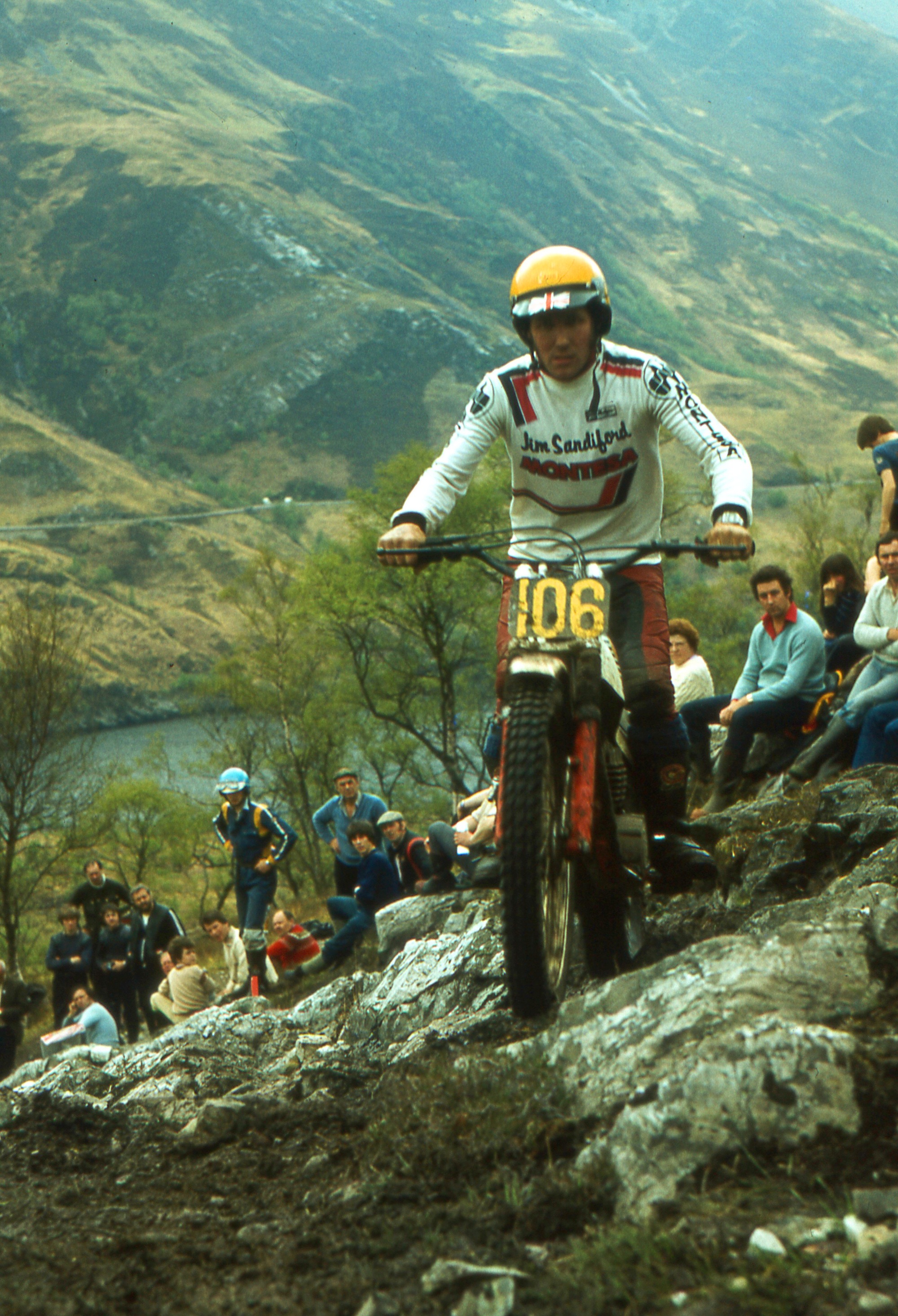
Rob Edwards (Sandiford Montesa) Scottish Six Days Trial 1981 - Mamore Section - Photo ~ Iain Lawrie, Kinlochleven
Rob Edwards (Sandiford Montesa) Scottish Six Days Trial 1981 – Mamore Section – Photo ~ Iain Lawrie, Kinlochleven
Hello Everyone,
Thanks once again for your support.
Today is rather a sad one for me. The ‘Gaffer Guru’ John Moffat has told me I can keep going as long as I want, but I feel that I have subjected you to quite enough punishment and its time to go.
Never in my wildest dreams could I have expected the support you have given me. I have had a fantastic time, a really fantastic time believe me. I was kept going by the The Trials Guru’s enthusiasm. That plus your comments and likes were a real tonic to me. Despite my health problems I still consider myself the luckiest person in the world.
I have always been a people person and the spectators who lined the sections were just as important to me as the sections and they have repaid me a thousand times!
Like all of us I had made mistakes but in general I am pretty pleased.
One thing I will miss is checking the comments and likes each day.
I was pleased and a little surprised when Benny Sellman and Thore Evertson contacted me.
Benny was a fellow Montesa rider and Thore a works Ossa rider.
I also received an e-mail from Martin Belair in California.
These plus dozens and dozens from all over Europe have done me more good than any doctor or medicine could hope to do.
The new generation of Thornaby Trials riders have been following my story – Thanks a lot lads.
I hope to get to the Telford Show again this year so please say Hello, tea with milk, no sugar please!
It is impossible to thank everybody who made this possible but Eric Kitchen, Barry Robinson, Iain Lawrie and Luis Munoz who allowed Guru John (my gaffer) to use their pictures.
When readers send in comments like Scottish Heaven you could bet that one of these are responsible.
Keep Clicking and thanks!
Many thanks again to ‘Trials Guru’ –  John Moffat and thank you finally to Alberto Mallofre, Pere Pi and Montesa for having faith in me.
A FINAL GOODBYE NOW – ROB EDWARDS
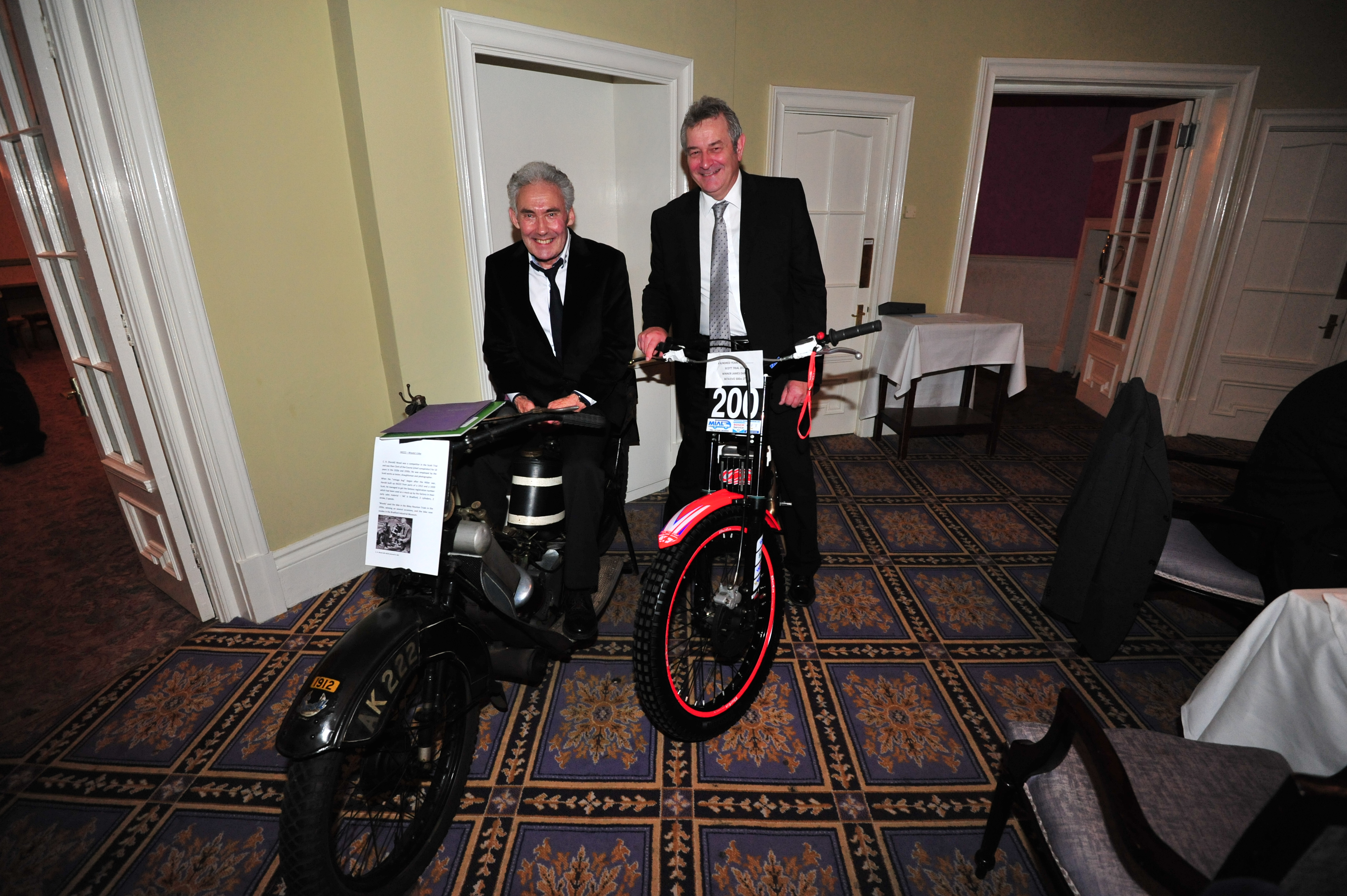
Rob Edwards left with John Moffat trying out the 1912 Scott 'AK222' for size. John is on the 2014 Scott winning Beta Evo 300 of James Dabill. Photo Copyright: John Hulme/Trials Media
Rob Edwards with John Moffat (Trials Guru) Photo Copyright: John Hulme/Trials Media
Trials Guru comment:
It has been absolutely fantastic receiving Rob’s e-mails over the last few months with details of his life in trials and to be able to share this with you all on Trials Guru.
Rob’s story now explains why he hasn’t been seen as often out and about at events, unlike most of his peers from the time when Montesa, Ossa and Bultaco were trying to out-sell each other from the late sixties, through the seventies and into the eighties.
As we have seen, if you have been following Rob’s adventures since late October 2014, what a warm human being he really is.
Despite his health problems which undoubtedly cut short his riding career, that he is as outwardly cheery as he was when some of you rode with him, worked in Head Wrightons with him or marvelled at his skill as a factory Montesa rider in the Scott and Scottish Six Days as well as countless national trials throughout the UK and the rest of the trials-riding world.
I can only say this, many grateful thanks to Rob for taking the time and effort to satisfy my request in the start field at Marske on the 18th October 2014 when I said: ‘Rob, how about doing your story on Trials Guru?’
To all of you, keep commenting and keep telling people to read this story here on Trials Guru, the “Rob Edwards Story ” button will be here on this website for a very long time to come! – The Guru.
VIVA MONTESA!
VIVA MONTESA!

The Full Rob Edwards Story … Here

Copyright: All Text: Rob Edwards & Trials Guru / Moffat Racing, John Moffat ~ 2015.

Photographic Copyrights:

  • Iain Lawrie, Kinlochleven
  • John Hulme / Trials Media


Renee Bennett – East London’s Lady Trials Rider

Renee Bennett – By her daughter Julie Powell:

Cover photo - Renee Bennett

My mum was a name known to all in the motorcycle trials world, she was born in East London’s Canning Town.

From humble beginnings she emerged as Britain’s best known lady rider in a career spanning a quarter of a century.

Renee in Action!

Renee’s interest in trials riding began watching father ‘Wag‘, an East London nickname for ‘Charles‘, riding motorcycles around the docks near his cycle and motorcycle shop. Renee’s parents were hard working East Londoners. They opened their first shop in the late 1920’s in Victoria Dock Road.

The popular shop hired and sold cycles, and the name Wag Bennett has been carried through to successive generations.

All during World War II, Wag and Esther Bennett remained in Canning Town, running their shop, keeping the dockworkers going with cycles and motorcycles, and staying open late til 11.00am waiting for the last shift of workmen to pass the shop.

Renee stunt doubling

Renee stood on a box at the counter, testing bulbs and batteries and giving the customers their change, by candlelight. She recalls she was about 4 or 5 years old.

In 1939, Wag was picked for the British ISDT Team, held that year in Nazi Germany.  He shook hands with Hitler, unaware of the gathering storm then, quite suddenly, the team was ordered to leave Germany immediately WWII had begun!

The old shop was a target in the blitz being so near the docks, and eventually took a bomb, as did every other shop and house around it. Almost blown to smithereens, the bedroom ceiling was somehow held together with cycles magazines and newspapers. The whole shop was supported by a few wooden beams, keeping it standing.

PICTURE OF MUM ON GREEVES

Buckets were strategically placed on the bed to catch water, which poured in every time it rained.  As a child, this was normal daily life for Renee and her brother, Wag jnr.

At night, they watched the ‘doodlebugs’ the V1 flying bomb, on their way to decimate the London docks and surrounding area.

Standing outside the shop every night, one of these unmanned rockets, would suddenly stop, drop, hit it’s target and blow the shop windows out.

During these blitzes, the family would hastily run to the nearest underground station or the Anderson shelter behind the shop, where they would remain until an ‘All Clear’ siren sounded.

Getting through the war was a daily struggle for survival.  The harshness of life though at least prepared Renee for the tough sport of motorcycle trials that was to come.

After the war, Wag sold Ariel motorcycles;  strong serviceable machines they were used thoughout the war, by soldiers and civilians alike.  He worked all hours repairing and selling them to the dockers and factory workers.

Renee left school at 15, and went into the family business.  It was now well known, a beacon for all the major British bikes:  AJS, Matchless, Ariel, BSA, Triumph, Panther, James, Velocette, Frances Barnett, NSU ‘Quickly’ to name but a few.

Around this time, Renee began riding in earnest on a James Captain 198cc, but at only 7 stone and of slender build the skill of trials riding was not easy to master.

In her own words: “Why I never got killed I’ll never know, I was useless!

Wag Bennett jnr. also worked in the shop, but diversified into bodybuilding.  He would train every night in the hope of becoming Mr Britain.  He eventually opened his own gymnasium training some of the greatest names in bodybuilding including Arnold Schwarzenneggar, who lived with him and wife Dianne for a few years. Wag was instrumental in teaching Arnie to pose to music.  He won every title in Wag’s shows and soon became a household name.  Arnie remained a lifelong friend of the family and invited Wag & Dianne to his Hollywood wedding to Maria Shriver.

In the mid-50s Renee met husband Howard Powell through her brother’s bodybuilding connections. Howard won many titles throughout the UK including Mr. South East Britain and Mr. Navy.

They married and in 1956 I came along.  Renee juggled motherhood with helping Howard run their  motorcycle shop in London’s East Ham, the first of five.

Determined to follow in the footsteps of her father, a factory supported rider for Matchless, Renee rode daily on wasteland nearby, and competed every Sunday in Kent and Surrey in timed trials along with husband Howard, also an avid trials rider.

By this time, and winning several awards in open-to-centre trials, Renee was riding a Greeves 250cc slimline, alloy frame, perfect for her.  They were made by a small factory at Thundersley, Benfleet, Essex.

Renee was ready for the challenging Scottish Six Day event, following in her father’s footsteps.

Renee’s entered the Scottish Six Day Trial in 1961. The first of many.

She finished the event, earning her an award and a myriad of bruises all over her body!

The Welsh Three Day Trial featured prominently in Renee’s riding career as she says:  “My favourite, fast and furious!”  Renee rode a Bultaco 250cc with a Wasp frame for that event.

Her son, my brother, Charles was born in 1964.

But that wasn’t all, she was much in demand as a motorcycle stunt double, known by all in the film and TV business as The Girl On A Motorcycle.  Renee also enjoyed a successful modelling career, advertising everything from make-up to Ovaltine.

Renee in black leathers

In the early 1970s, Renee switched to riding a Bultaco Sherpa 250cc, which she still has today along with her Greeves, Bultaco Enduro (used in the Welsh Three-Day) and the much-loved James 198cc.

In 1973, Renee competed in the Scottish Six Day Trials on the Bultaco.  The 6th so far.

At around here, she converted one of her East London shops into a motorcycle competition centre.  “Renee Bennett’s East London Sportman’s Centre”, which became a beacon from as far afield as Europe and the USA. Customers visiting the shop immediately asked for ‘Renee Bennett!’

IMGlamour shot

Renee and Howard became known for sponsoring many up and coming young trials riders in the 80s, kitting them out with helmet and suits, their own name signwritten on the petrol tank, and cheques sent when they had won the event.

Renee’s competitive spirit continued well into the 1980s.  She ran a popular trial of her own:  The Renee Bennett Sunbeam Novice Trial, which became a much awaited event each year.  Every finisher received a scrolled certificate, adorned with red ribbon.  It is still talked about today in vintage trials circles!

Howard, being into health and fitness since his time as a bodybuilder, set up a gymnasium above one of the shops. They trained daily, and Renee found the toning and strengthening a big help when dragging her bike out of the mud!

Howard, who sadly passed away in 2003,  was a talented amateur film maker, often being invited to the premieres of the top films of the day.  He counted among his friends actors and top stunt men from all the Bond films.

Renee recalls meeting the movie stars of the day like Yul Brynner and Steve McQueen, who was over from the states for the ISDT in 1964.

Now a grandmother but still with an interest in motorcycles, Renee continues to run her busy motorcycle shop in East Ham, the first one she and Howard acquired some 58 years ago.

As if that is not enough, she is very ‘hands on’ in her property renovating company assisted by son Charles.

Grandchildren have come along, my daughter Sophie, nearly 16 and a three-times published author! Oliver nearly 12, and young Charles, 22, who runs his own foreign exchange business.

Film on Renee Bennett by British Pathe on YouTube: HERE

Renee’s mother died only recently in 2012, aged 103!   Father Wag died in 1989.   As Renee says:  “Perhaps I’ll live to be a ripe old age… see you around!”

This recent comment on a trials forum site sums up the amazing Renee Bennett : “Well.. Renee Bennett,. what can I say..!  I think my old man had a fancy for her!  I remember her riding the SSDT on a Bultaco in 1973.  All the lads were fighting over themselves to help her when she got into difficulty.  Her shop was called ‘Renee Bennett’s East London Sportsman’s Centre’.  – Anyone know who wrote that?

Julie Powell

Rene Bennett photographed in 2013
Renee Bennett photographed in 2013 by daughter Julie Powell

Article Copyright: Trials Guru/Julie Powell

Photos: Julie Powell

Renee Bennett in Spanish! – Todotrial website Article:

Javier Cruz from Madrid has taken the Renee Bennett story to Spain, read about it: HERE

Website: www.reneebennett.co.uk/

Great Scots – Ron Thomson – Fort William

Ron Thomson with the only C15 BSA to finish in the 1959 SSDT. All the works bikes retired that year. Photo taken at Gorgie Market, Edinburgh. Photo Courtesy of Mrs. Ron Thomson
Ron Thomson with his C15 BSA at the ‘weigh-in’ of the 1959 SSDT at Gorgie Market, Edinburgh. Photo Courtesy of Mrs. Helen Thomson

Ron Thomson originally from St Andrews, Fife moved to Fort William in the late 1950’s. Ron was a dispatch rider during national service in Egypt and a member of the services club, the Bar-None MCC. On being de-mobbed, Ron joined the local Kirkcaldy & District club. Ron takes up the story: “In my day trials bikes were measured by the hundredweight, not by the cubic capacity! I had a Gold Star, which was dubbed the ‘Stone-Crusher’. So called because no section was ever the same after we had gone through. As for the Scottish Six Days, we used to gear the bikes up, my Trophy Triumph was good for 90 plus mph on the road, the reason for the hurry was that we used to be more interested in the ‘Seven Nights’ than the Six Days!” says Ron.

Ron on his BSA C15T in the 1959 Scottish on Glenogle section on May 4th. One of the first day hills as he made his way homeward to Fort William from the Edinburgh start. On the right is Dunfermline rider Maurice Duffin. Photo: Mrs. Peggy Davies.
Ron on his BSA C15T in the 1959 Scottish on Glenogle section on May 4th. One of the first day hills as he made his way homeward to Fort William from the Edinburgh start. On the second right is Dunfermline rider the late Maurice Duffin. Photo: Mrs. Peggy Davies.

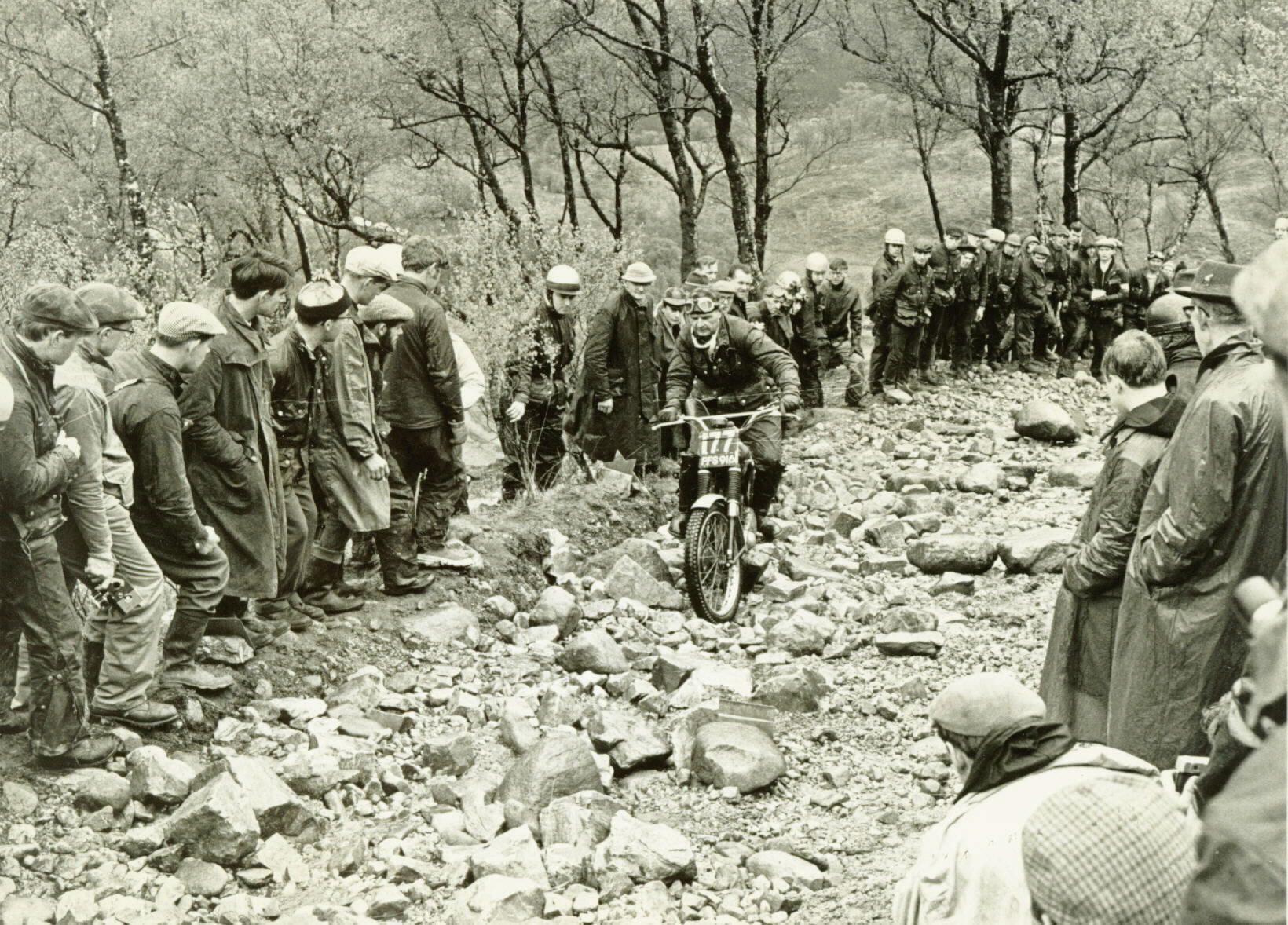
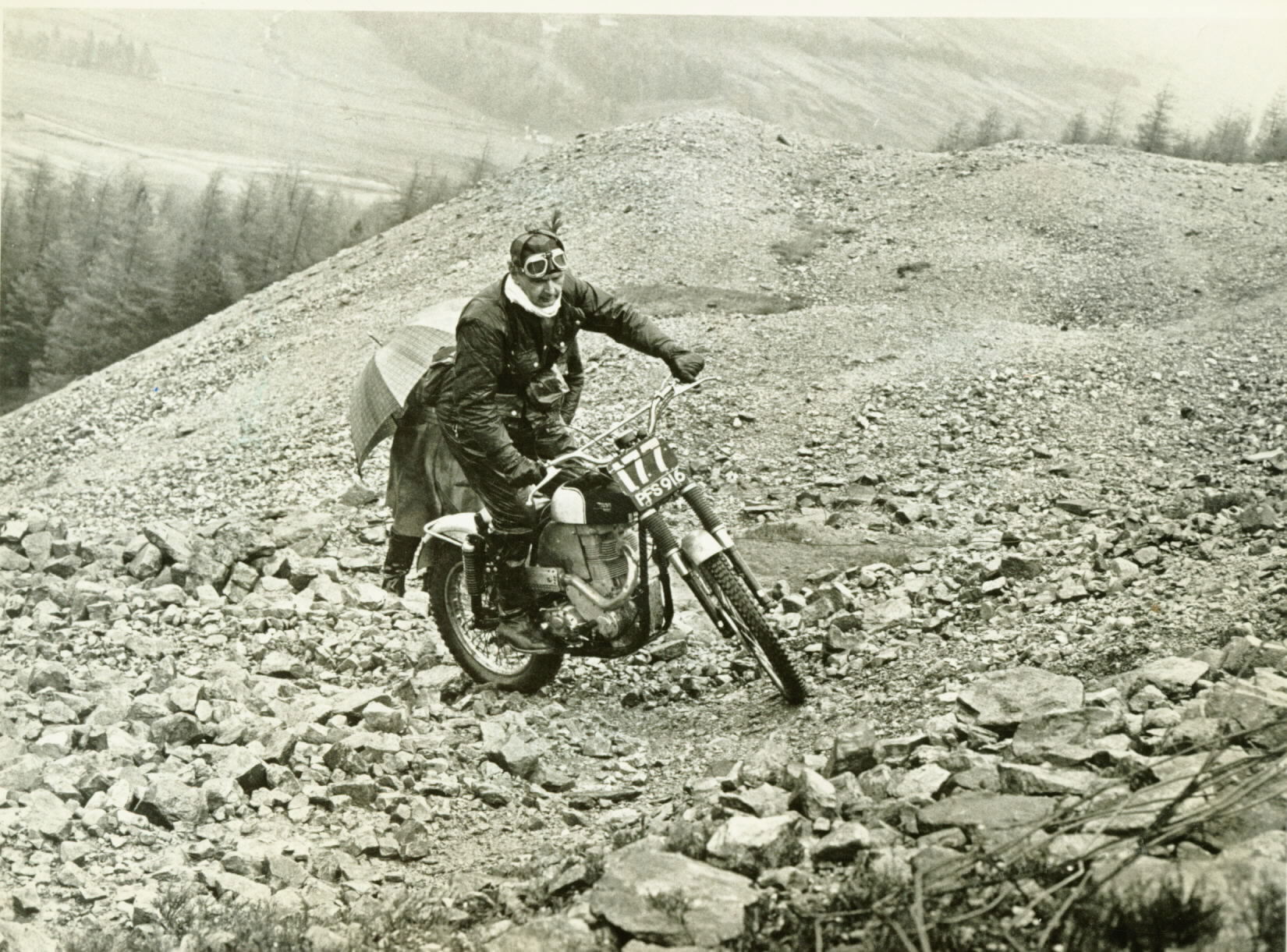
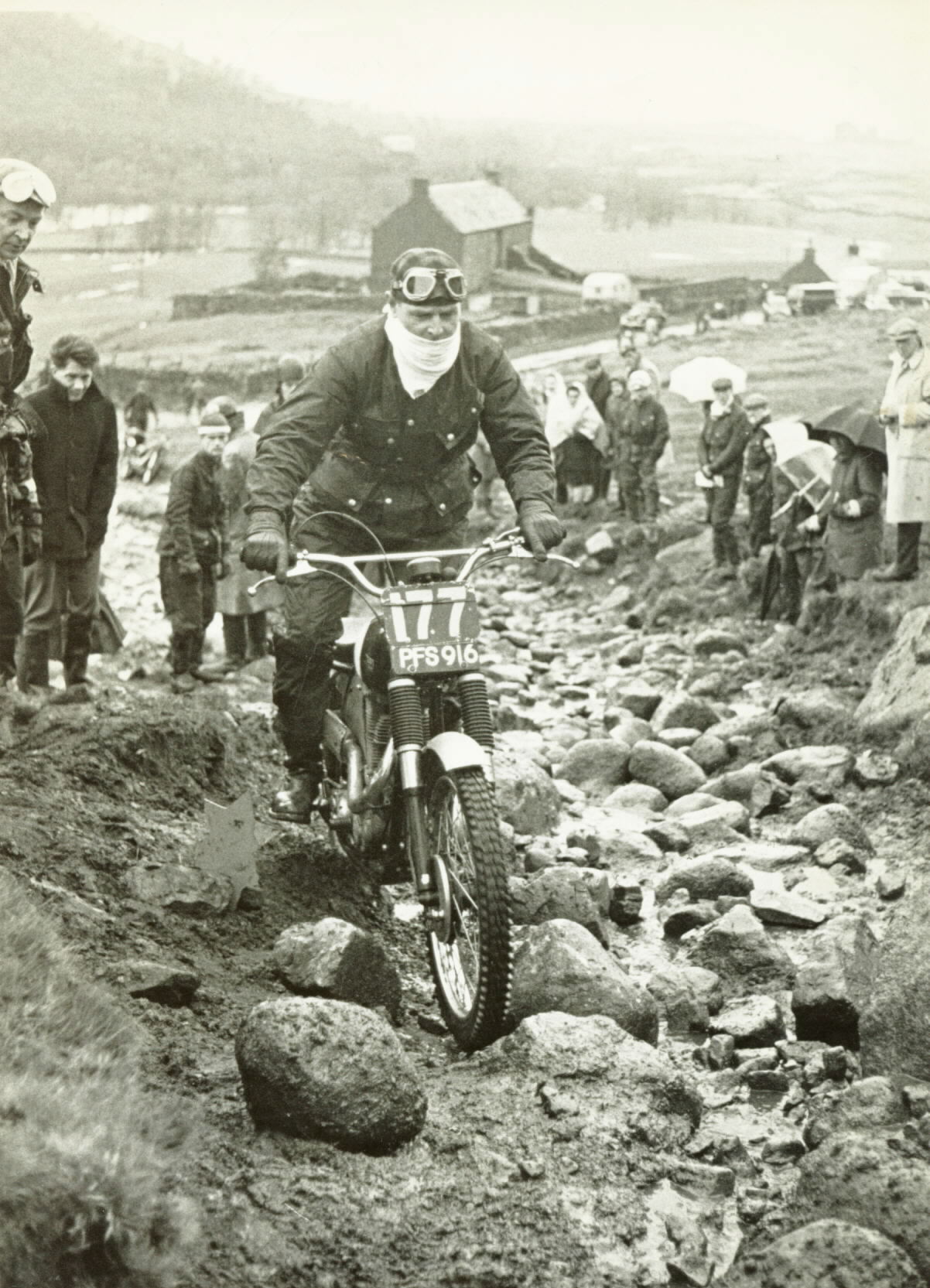
That particular Goldie, as Ron had one or two, registered PFS 916 had a neat conversion, featured in the first 1958 SSDT report in The Motor Cycle. In an attempt to reduce weight, Thomson used the gearbox as an oil reservoir for the motor thus obviating the need for an oil tank. The very machine on which Ron won the over 350 award at the 1969 Scottish which was to be his last ride in the Highland classic. That Gold Star was sold via Ernie Page’s shop in Polwarth Terrace and was passed through many ‘hands’ eventually ending up with Billy Maxwell in Newcastle Upon Tyne.

1964 SSDT on Mamore. Ron Thomson on his BSA Gold Star PFS916 - 'The Stone-Crusher'. Photo courtesy of Mrs Ron Thomson, Fort William.
1964 SSDT on Mamore. Ron Thomson on his BSA Gold Star PFS916 – ‘The Stone-Crusher’. Photo courtesy of Mrs Helen Thomson, Fort William.

Ron loved riding the Scottish Six Days which was in effect a local event for him as he lived in Inverlochy at that time. Ron said: “…well it was more the seven nights I was most interested in to be truthful, we used to get up to all sorts of fun”.

Ron knew an observer called Tommy Millar from Airdrie, a man who never had a complaint registered against him in over 25 years of observing- what was the reason? “I just gie a’ the laddies a clean”, he told Ron.

Ron said: “I’ve no doubt that the kids today on their water cooled pogo sticks in their go faster trendy bin liner suits will enjoy themselves just as much as we did, but still I think had greater fun in the golden years”.

1953 - SSDT - Kirkcaldy Club - Ray Biddle - reduced
At the end of the 1953 Scottish Six Days, Ray Biddle took this photo of the Kirkcaldy & District riders From left: Peter Victory (197 James); Dave Birrell (490 Norton); Jack Duncan (Montrose, 197 Francis Barnett); Dr. J.G. Stewart (197cc Sun); Johnny Birrell (348cc BSA) & Ron Thomson (343cc Triumph)

Ron had a reputation as the man to approach if you wanted your bike fettled for the Scottish. He worked for a spell at the Brechin dealership, Duncan’s.

2014-04-07_19
Ron prepares to start his BSA Gold Star at the beginning of the 1963 Scottish in Edinburgh’s Gorgie Market. Photo Courtesy of Jimmy Young, Armadale.

At one stage Ron, when still an active rider, prepared about a dozen Lochaber members bikes for the Highland classic.

“I couldn’t concentrate on my own ride for this one or that one coming up and saying, here! Listen to this – do you think it’s all right – will it last the week with this rattle or that rattle?”

Tyndrum, on the final day of the 1964 SSDT. Photo cortesy of Mrs. Ron Thomson, Fort William.
Tyndrum, on the final day of the 1964 SSDT. Photo courtesy of Mrs. Helen Thomson, Fort William.

John Moffat has a vivid personal recollection of the 1967 Scottish Experts held at Achallader Farm, Bridge of Orchy: “Ron Thomson was on his Gold Star, having ridden down from Fort William, a distance of some 35 miles in company with the late Ali McDonald on a 500cc Ariel. Post-trial, Ron stopped for a blether with a group of his old chums, I happened to be an interested bystander, listening in to the “banter”. Ali McDonald had decided to get home before dark and left immediately after signing off at the finish. The bold Ron then decided after quarter of an hour had elapsed to set off in pursuit of his pal, McDonald. Ron set sail from the farm, which, is about a mile from the main A82 trunk road. Within a few moments the assembled gathering could see Ron and the Goldie passing over the steel bridge which spans the River Orchy and up the “Black Mount”, overhauling several cars during his ascent, the big Goldie on full song. The exhaust note ever fading, disappearing from view as he crested the summit and onward to the Fort. What a great sight to behold.”

Alister McDonald was a greta friend of Ron Thomson. here we see Ali on his Ariel HT5 on Town Hall Brae (Rocky Brae) in Fort William in the 1964 SSDT. Photo Courtesy of Mrs Ron Thomson, Fort William.
Alister McDonald was a great friend of Ron Thomson. Here we see Ali on his Ariel HT5 on Town Hall Brae (Rocky Brae) in Fort William in the 1964 SSDT. Photo Courtesy of Mrs Helen Thomson, Fort William.

Known as a ‘big bike’ man, Ron also rode the “tiddlers” as well. In 1959 he chose the brand new C15T BSA 250cc unit construction single for the Scottish Six Days. In fact, out of eight C15’s entered, Ron was the only one to get to the finish and that included factory bikes as well!

Ron Thomson - 1959 - BSA C15
Watched by Jeff Smith in the duffle-coat, Ron Thomson on the only C15T BSA to finish in the 1959 Scottish. All the works bikes had retired from the event. This section was at Achintee farm on the slopes of Ben Nevis Photo courtesy of Mrs. Helen Thomson, Fort William.

Back in 1955 he rode a Villiers powered 197cc DMW and a year later rode a similarly powered Welsh built 197cc H.J.H.

In the 1953 Scottish, Ron rode a self-built ex-WD 343cc Triumph, the following year he rode a 347cc Matchless G3LC.

1954 - Creag An Eilein - R S Thomson - Ray Biddle Photo reduced
Ron Thomson on his new for that year 347cc Matchless G3LC in the 1954 Scottish on Creag An Eilein on the Rothiemurchus Estate, near Aviemore. Photo: Ray Biddle, Birmingham.

Ron S. Thomson passed away on 20th January 2007, never being a regular church attender, there was a humanist service held for him in the Crematorium at Inverness. Ron left the trials community of the Lochaber Club and the towns-people of Fort William with great memories of a true character of the sport of trials.

Ron Thomson in 1964 at Achintee Farm on his 500cc BSA Gold Star. Photo Courtesy Mrs Ron Thomson, Fort William.
Ron Thomson in 1964 at Achintee Farm on his 499cc BSA Gold Star. Photo Courtesy Mrs Helen Thomson, Fort William.

Trials Guru on Ron Thomson: Ron Thomson was a well liked individual who moved from his native St. Andrews to work at the British Aluminium works at Fort William. The reason was simple, so that he would live in God’s trials country! He set up business initially in a shed in his back garden fixing motorcycles and lawn-mowers for local people.

His business grew and he obtained premises at the Industrial Estate at Caol a few miles from Fort William on the A830. Many of the younger riders in the town benefited from Ron’s knowledge, which included Hugh and Alister McDonald, Alastair Macgillivray. Gary MacLennan and Rodger Mount.

Friends of Ron Thomson, Hugh McDonald Senior and Junior. Hugh Snr is on Ron thomson's BSA Gold Star and Hugh Jnr on the special bike built for him by Ron Thomson. Photo courtesy of Alister McDonald, Fort William.
Friends of Ron Thomson, Hugh McDonald Senior and Junior. Hugh Snr is on Ron Thomson’s BSA Gold Star and Hugh Jnr on the special bike built for him by Ron Thomson. Photo courtesy of Alister McDonald, Fort William.

His business was called R.S. Thomson (Inverlochy) Ltd. He ran a repair shop and MOT test centre for motorcycles. He was agent for chain-saws and garden equipment and employed Cameron ‘Cammy’ Kennedy for many years.

Ron gets his 250cc BSA C15T examined and security marked at Gorgie Market in May 1959. On Ron's left is Davie Miller, one of the course markers of the SSDT. Photo cortesy of Mrs. Helen Thomson.
Ron gets his 250cc BSA C15T examined and security marked at Gorgie Market in May 1959. On Ron’s left is Davie Miller, one of the course markers of the SSDT. Photo courtesy of Mrs. Helen Thomson.

It was quite usual to swing in past Ron’s workshop for a great natter about the old days. But as sure as guns you were never there long until another enthusiast also had the same idea! How Ron got any work done heaven knows. He was a good builder of wheels, which itself is a bit of a ‘black-art’.

When Ron passed away after a short illness the business folded and Cammy took up employment with The Hire Centre in Fort William. Ron’s friends were not only Scots riders of his era like Jack Williamson; Arnott Moffat; Tommy Robertson; Johnny Clarkson and Bob Paterson, he also enjoyed the friendship of Gordon Blakeway; Ralph Venables; Peter Stirland and some of the best known riders of his era.

24-06-1962 - Ben Nevis - Southern and Lochaber
24th June 1962 – From Left: Bobby Neilson; Billy MacLeod: David Stodart; Hugh McDonald; John Noble: Jack Williamson & Ron Thomson. A joint effort of Edinburgh Southern & Lochaber Clubs to ride up Ben Nevis

They all knew Ron Thomson!

This article was put together from notes John Moffat made during an interview he had with Ron at his workshops at Caol some years ago and personal recollections by Moffat himself of Ron Thomson pieced together over many years knowing Ron Thomson.

Ron Thomson in the Scottish Six Days Trial

Year                Riding Number         Club                            Make & CC of machine

1953                179                              Kirkcaldy                    Triumph 343

1954                148                              Kirkcaldy                    Matchless 500

1955                20                                Kirkcaldy                    DMW 197

1956                24                                Kirkcaldy                    DMW 197

1957                12                                Kirkcaldy                    DMW 197 (could be HJH)

1958                140                              Kirkcaldy                    Triumph 498 (Twin)

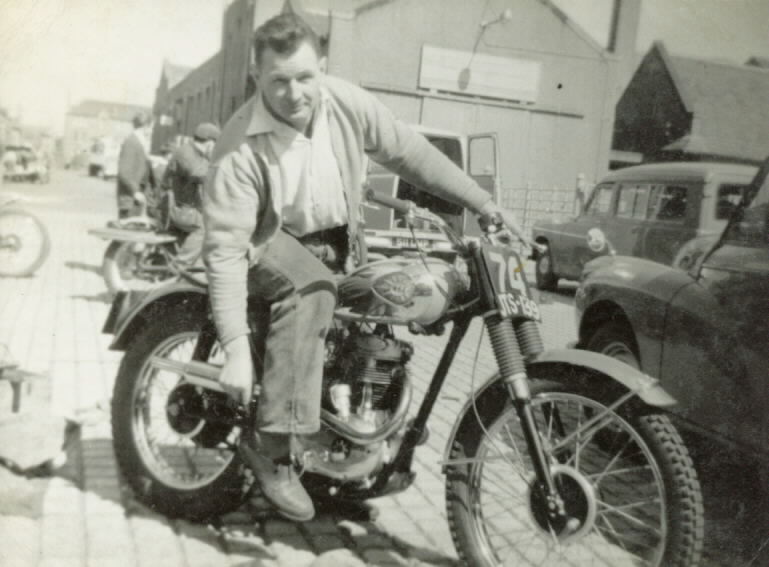
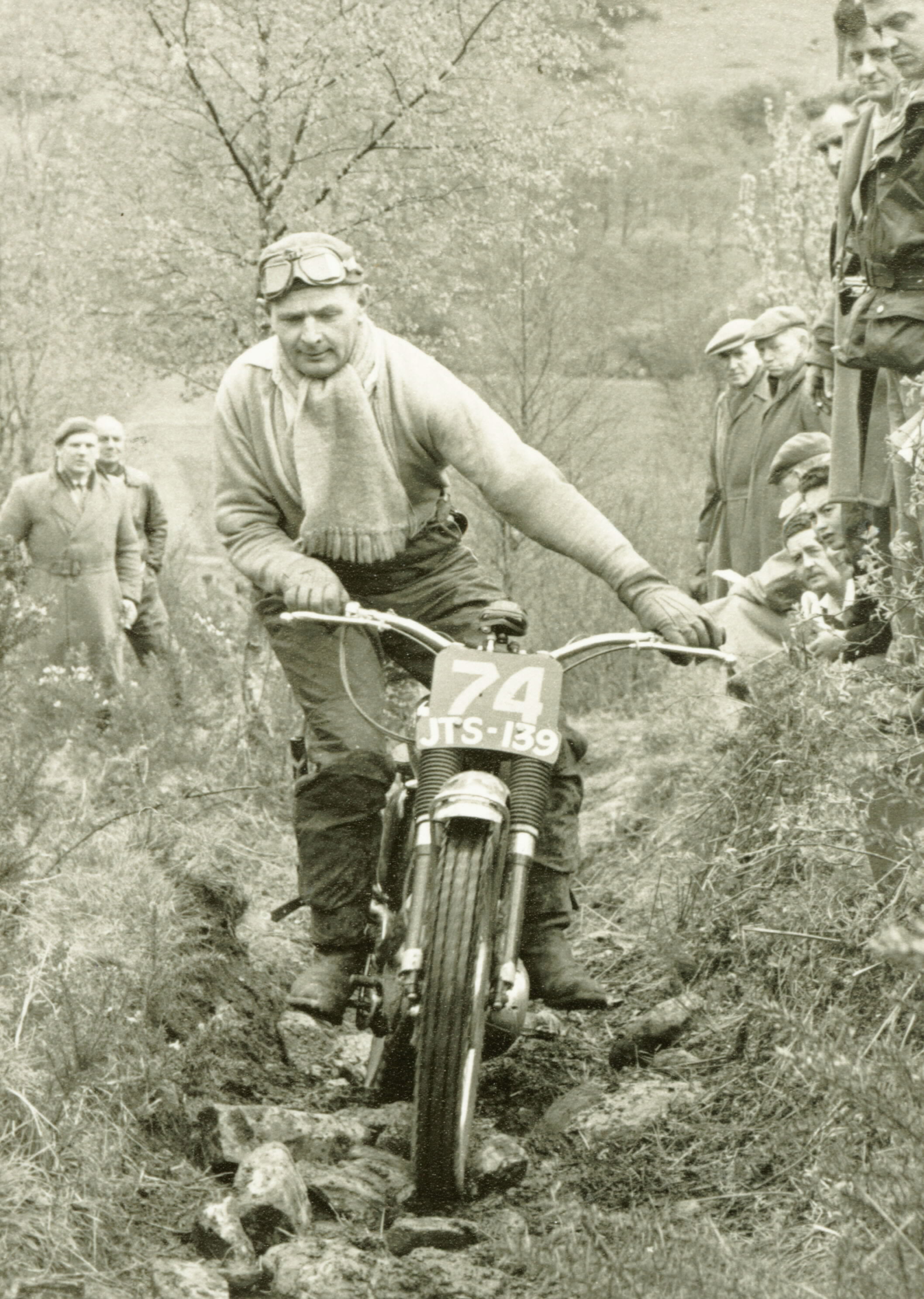
1959                74                                Edinburgh & Dist       BSA 250

1961                171                              Lochaber                     BSA 350

1962                191                              Lochaber                     BSA 348

1964                177                              Lochaber                     BSA 500

1969                195                              (not in prog.)               BSA 500

Post Script: Added 01/02/2015: This story was spotted by Ron Thomson’s Grand-nephew, Ron Fisher who lives in Canada. It brought back happy memories of a visit to Scotland back in 1997 and indeed Trials Guru has been able to put Ron Fisher and Mrs. Helen Thomson in contact as a result of the article you see above.

Copyright: Trials Guru / Moffat Racing / John Moffat – 2014

With special thanks to Mrs. Helen Thomson of Inverlochy, Fort William for the photographs which accompany this article.

Post script to Ron Thomson’s story…

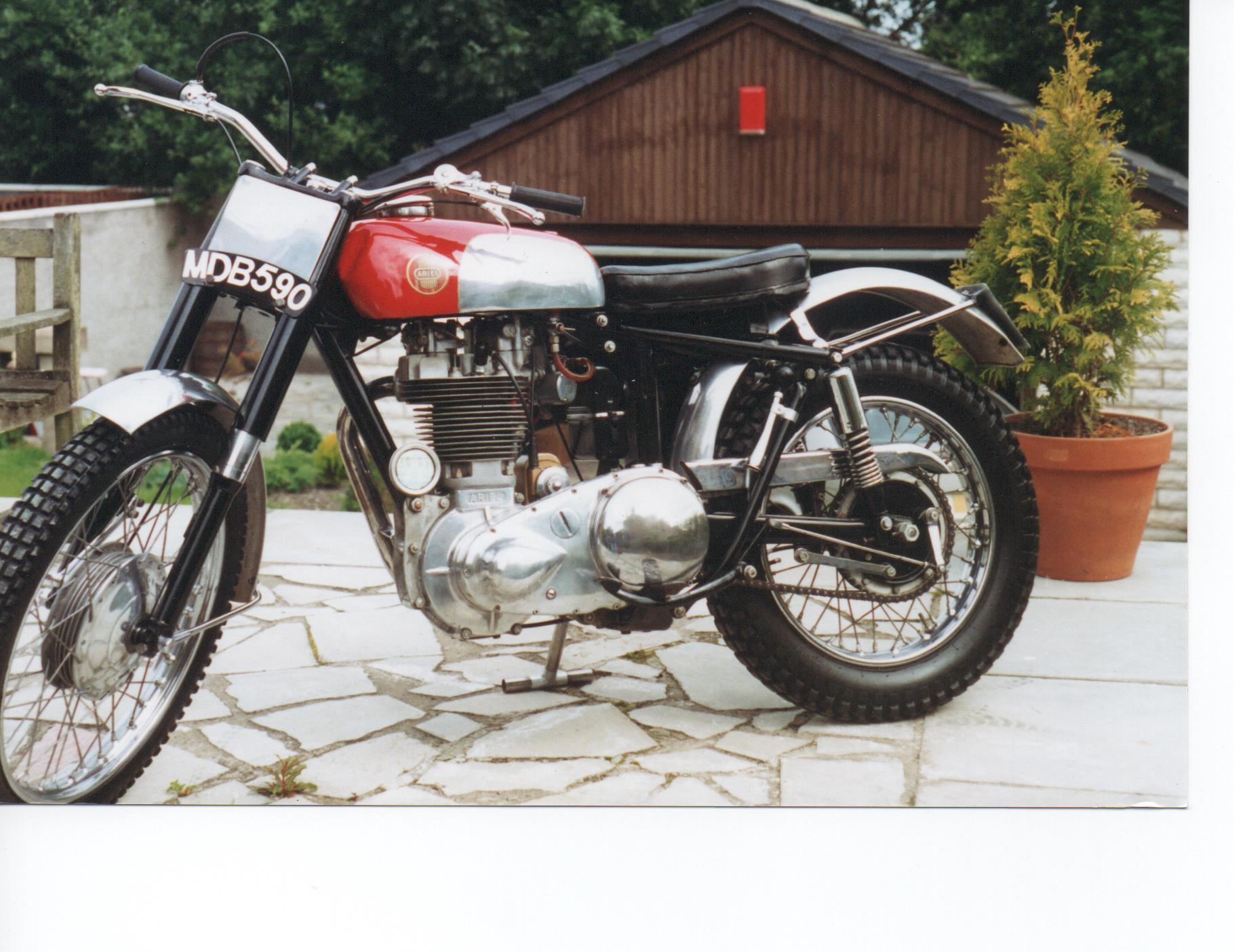
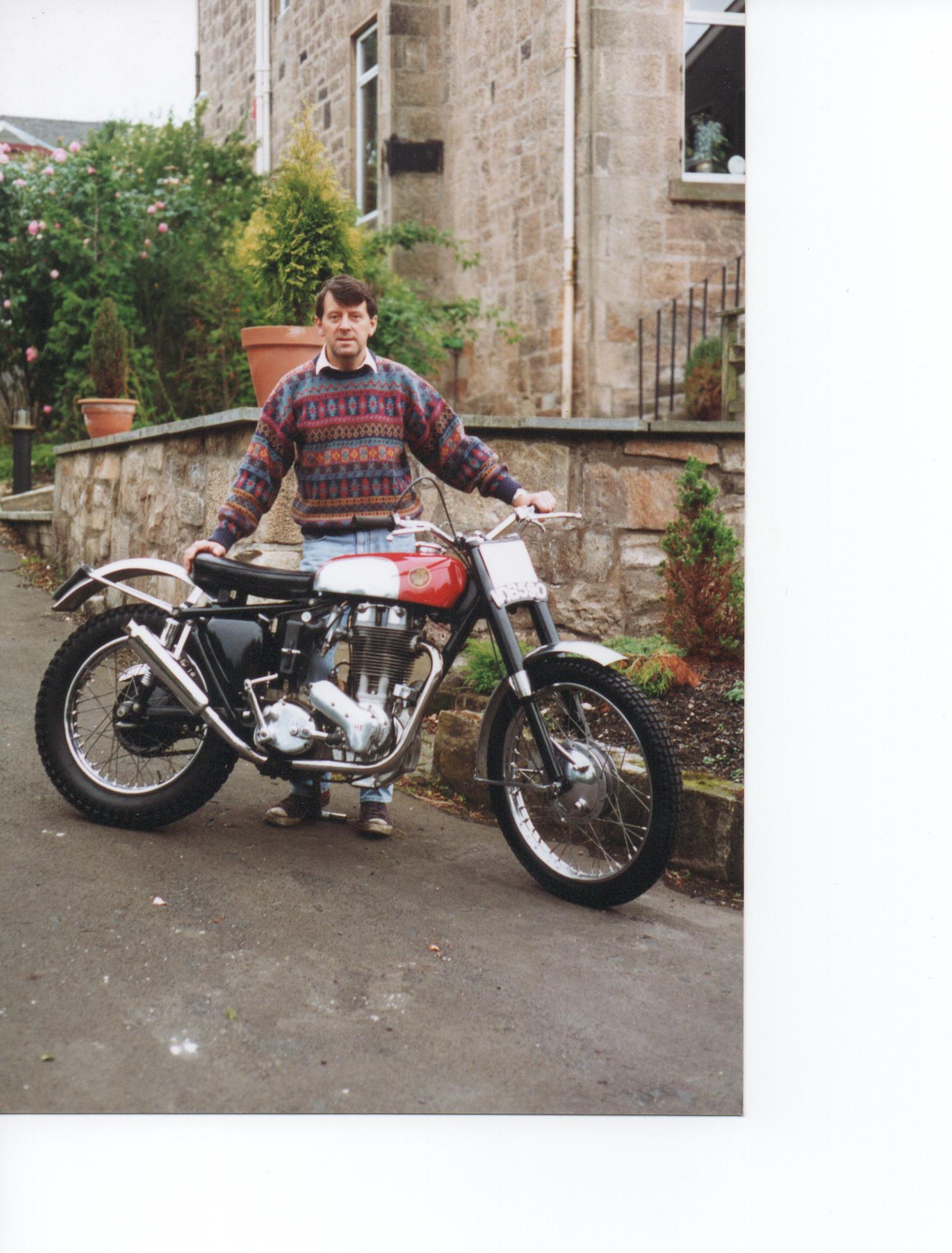
We have been contacted by former Scottish Speedway professional, John Wilson who now lives in Spain. John owned the ex-Ali McDonald Ariel MDB590 and he has kindly let us see photos of the restored machine. He sold it shortly before emigrating to Spain some years ago.

1964 - Ali McDonald on MDB590 on Grey Mare's  Ridge Photo: Holder and Osborn
1964 – Ali McDonald on MDB590 on Grey Mare’s Ridge Photo: Holder and Osborn
Ariel 1
The ex-Ali McDonald Ariel HT5 (MDB590) nestles inside John Wilson’s den. His speedway memorabilia is in the background. Photo: John Wilson.
Ariel 2
A proud John Wilson shows off his Ariel. Photo: Chris Wilson.

Mick Andrews…still going strong!

Mick Andrews

mickandrews
Mick Andrews seen here on a 244cc Bultaco Sherpa Model 10 from 1966, supplied by Rickman Brothers, New Milton, Hants. Watching every move is Ralph Venables in the flat cap, the ‘doyen’ of trials journalists and reporters.


Words: John Moffat

Photos: Mike Rapley; Iain Lawrie; Iain C. Clark; Jimmy Young; Ferry Brouwer; Barry Robinson Estate; Claudio Pictures; Colin Bullock; Malcolm Carling, courtesy of Nick Haskell; Don Morley

Mick Andrews is a name synonymous with the sport of trials since the early 1960’s. He has ridden for AJS; James; Bultaco (Rickman Brothers, 1966); Ossa and Yamaha, in a career that has taken him all over the world both as a competitor and a brand ambassador.

MC - NH 1971
Tom Andrews and Mick chatting at the 1971 Bemrose Trial – Photo: Malcolm Carling by permission of Nick Haskell.

Andrews was twice European Trials Champion in 1971 and again in 1972 on Ossa, before the official FIM World Championship commenced in 1975.

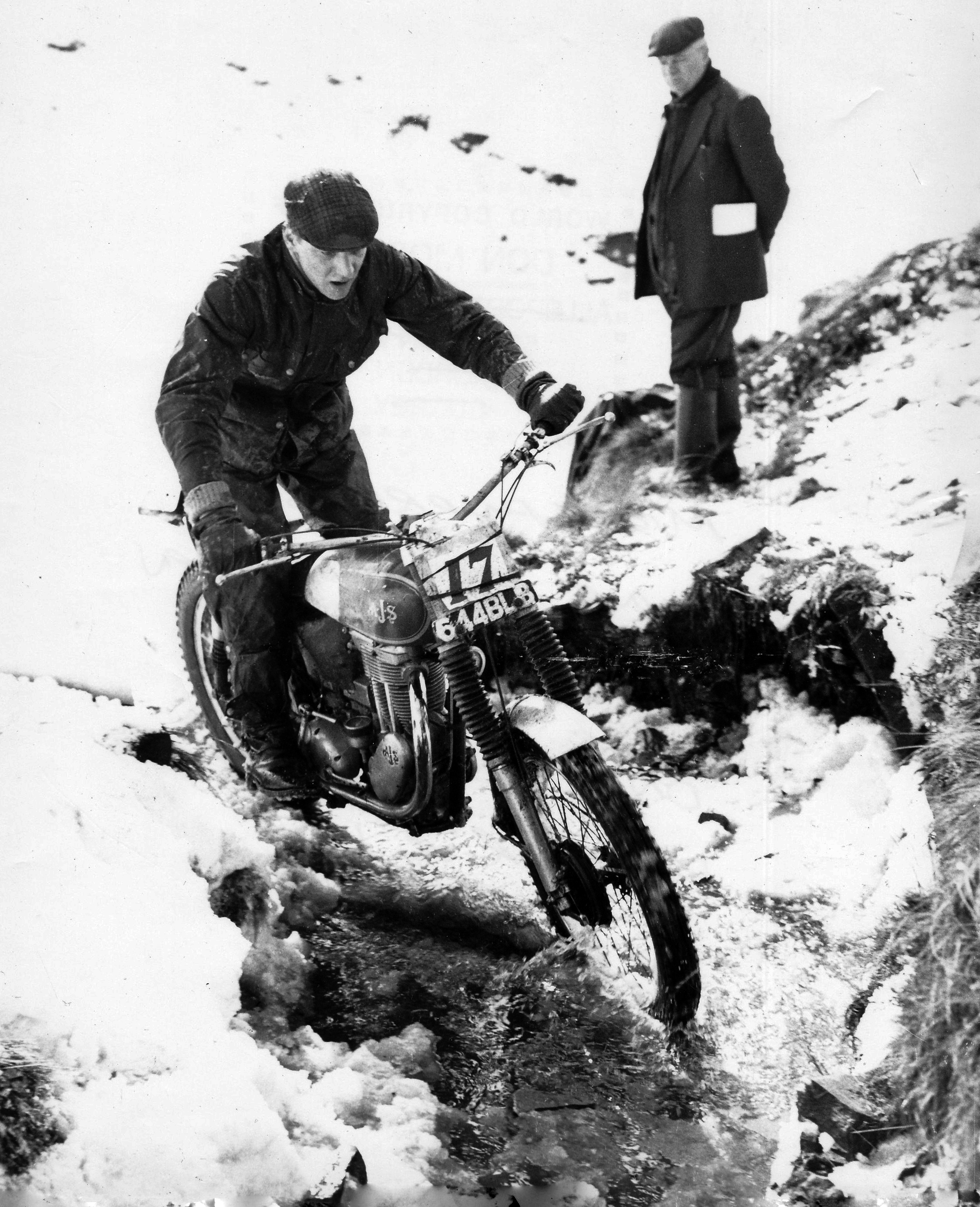
Nick-named ‘Magical Mick’ by the trials press many years ago and it stuck, he has won the famous Scottish Six Days Trial a total of 5 times, in fact he was only the second man in the events’ history to win it three times in succession, the first being B.H.M ‘Hugh’ Viney who was to become instrumental in Andrews riding for the AJS factory team in 1963, his AJS factory machine carried the index number 644BLB, registered as a 350 Matchless. Viney after retiring from active competition became AMC Competitions Manager.

Don Morley CRight Pic. Mick Andrews Wins 1963 Northern Experts
Mick Andrews winning the 1963 Northern Experts on his factory AJS – Photo: DON MORLEY

Due to his SSDT successes, Mick was also dubbed ‘Monarch of the Glen’ after the famous oil painting by Sir Edwin Landseer by the motorcycle press of the day.

Journalist, Ralph Venables (see Trials Guru’s comments below) tipped Viney off about the young Andrews, whom he had been watching the progress of, closely. A phone call to Viney and that was good enough for Hugh!

Andrews began riding for AJS in 1963 and his first SSDT on the heavyweight four-stroke saw him bag a second place finish behind Arthur Lampkin on the factory BSA C15 (XON688). A feat he repeated in 1964, finishing runner-up to Sammy Miller on the 500cc Ariel. The next two years he finished third on the 250cc James (306AKV) and again on the Bultaco (DOT289D). In 1967 on the prototype Ossa Pennine (ORB222E), machine troubles forced him to retire, but he was back the next year and came home in third, and again in 1969, a second place.

ossa pennine
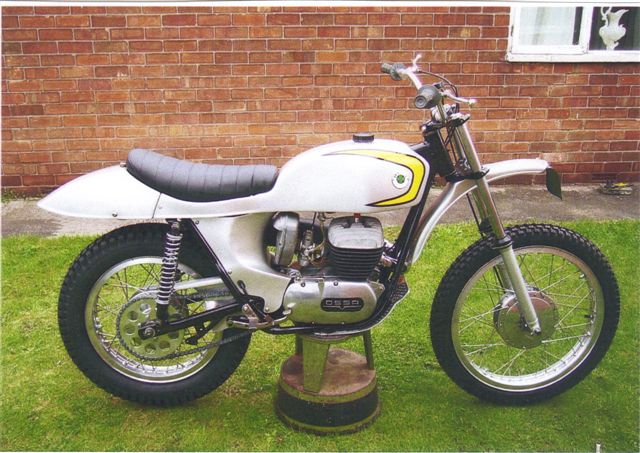
The Ossa Pennine of 1968/69, similar to the one ridden by Mick Andrews. This one is Ted Breffitt’s bike, now completely restored.

His first win in 1970 was on his factory prototype (Barcelona registered: B775073) sporting a much neater tank/seat combination, modified frame and overall a much trimmer package. This particular machine formed the basis for the production ‘Mick Andrews Replica’ (MAR) launched in 1971.

Ossa 1972 Brochure front
The announcement of the new ‘Mick Andrews Replica’ 250 in 1972 put OSSA on the trials map. Seen here in the SSDT with his prototype (B775073) on his way to win the 1971 SSDT. Brochure: OSSA Motorcycles

Mick also kept his hand in motocross for the Spanish company, racing a 230cc machine when time allowed. Coupled to this his selection for the British ISDT team on several occasions. He rode a factory prepared Ossa in 1970 at El Escorial, Madrid, Spain. For the British team he rode AJS in 1968 in Italy and a 504cc Cheney Triumph in the Isle of Man in 1971.

Repeating his SSDT successes the next two years, Mick wondered if it was time for a change. The Ossa trials machine had been developed only because of the death of Ossa factory road racer Santiago Herrero in the 250cc Lightweight TT in 1970. This saw Ossa pulling out of racing. Ossa, which stands for ‘Orpheo Sincronic Sociedad Anonima’ switched its focus to off-road development and trials in particular and Mick had signed for them in 1967 with the help of UK importer Eric Housely.

1974 - Yamaha Time No. 18

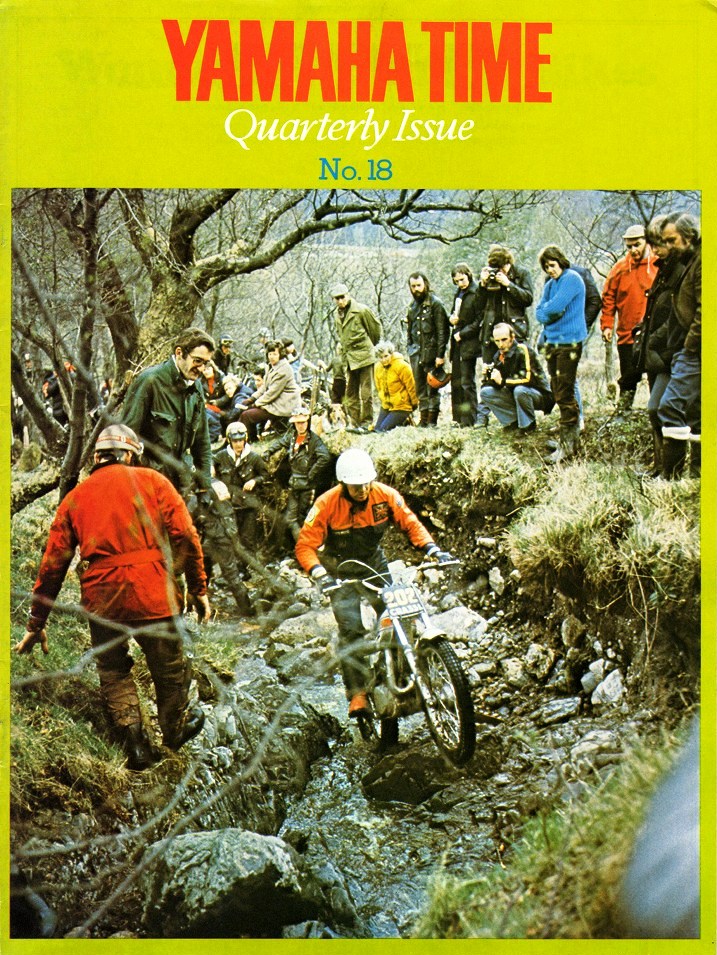
Yamaha announced the defection from Ossa in 1973. Andrews was to further develop the trials Yamaha that had been kicked off by Frenchman Christian Rayer, but it was not to be the TY (Trial Yamaha) style that Mick would be given. Factory ‘pure racing’ Yamahas were designated ‘0W’ and it was the Yamaha 0W series that Mick was to be given full reign of.

2 media
Watched by Nigel Birkett (Quinn Ossa); Mick on the factory Yamaha on his way to winning the 1974 Scottish Six Days. This is Loch Eild Path on another variant of the cantilever 0W10. – Photo credit: Yamaha Motor Co.

Yamaha’s European operation was called Yamaha Motor N.V., based in Amsterdam in the Netherlands where their race team was officially headquartered.

1973 - Yamaha YZT250 0W10
1973 – Mick Andrews on the YZT250 0W10 in front of his Dutch registered Ford Transit – Photo: Ferry Brouwer

Mick received full factory support and a contract which furnished him with Japanese technicians and a Ford Transit van, suitably liveried in Yamaha racing colours.

Mick Andrews 1977
Yamaha mounted in the 1977 Scottish Six Days, seen here on ‘Altnafeadh’. This is one of the ‘0W’ series machines. This particular machine formed the basis for the ‘Majesty’ models (the word MA/JES/TY being: MA = Mick Andrews; JES = John E. Shirt; TY = Trial Yamaha) Photo: Iain C. Clark, Fort William

As confirmed by Ferry Brouwer, then Yamaha race technician to Phil Read and Tepi Lansivoiri, all factory contracted riders were supplied with Ford Transits, all Dutch registered and suitably sign-written with the riders’ name on the driver’s door. The enormity of Yamaha Motor Company was in stark comparison to the Spanish Ossa concern.

Surprisingly, all Andrew’s factory 0W’s were all road registered in the UK, a must for many of the national trials Mick undertook in that time period.

Much of the development work was undertaken at Mick’s home near Buxton, Derbyshire with new prototypes built in Japan and freighted over to Amsterdam for test sessions.

Mick Andrews Loch Eilde path - 1979
Mick Andrews back on Ossa at the 1979 Scottish Six Days Trial, seen here on Loch Eild Path – Photo copyright: Iain Lawrie, Kinlochleven

In 1979 Andrews once again rode for Ossa in the Scottish Six Days much to the delight of spectators.

Mick on the 350 Ossa at the SSDT in 1979. He came 9th position on 135 marks. Photo Copyright: Jim Young, Armadale.
Mick on the 350 Ossa at the SSDT in 1979. He came 9th position on 135 marks. Photo Copyright: Jimmy Young, Armadale.

Andrews also took young riders under his wing, including the Oakley brothers Nick and Peter. He also started his own ‘Trials Academy’ with the help of Yamaha, the first of it’s type in the UK. Called the ‘Mick Andrews Trials Association’ or MATA for short.

Mick Andrews in a hurry during the 1975 Scott Trial. Photo: Barry Robinson.
Mick Andrews on JGF729N in a hurry during the 1975 Scott Trial. Photo: Barry Robinson.


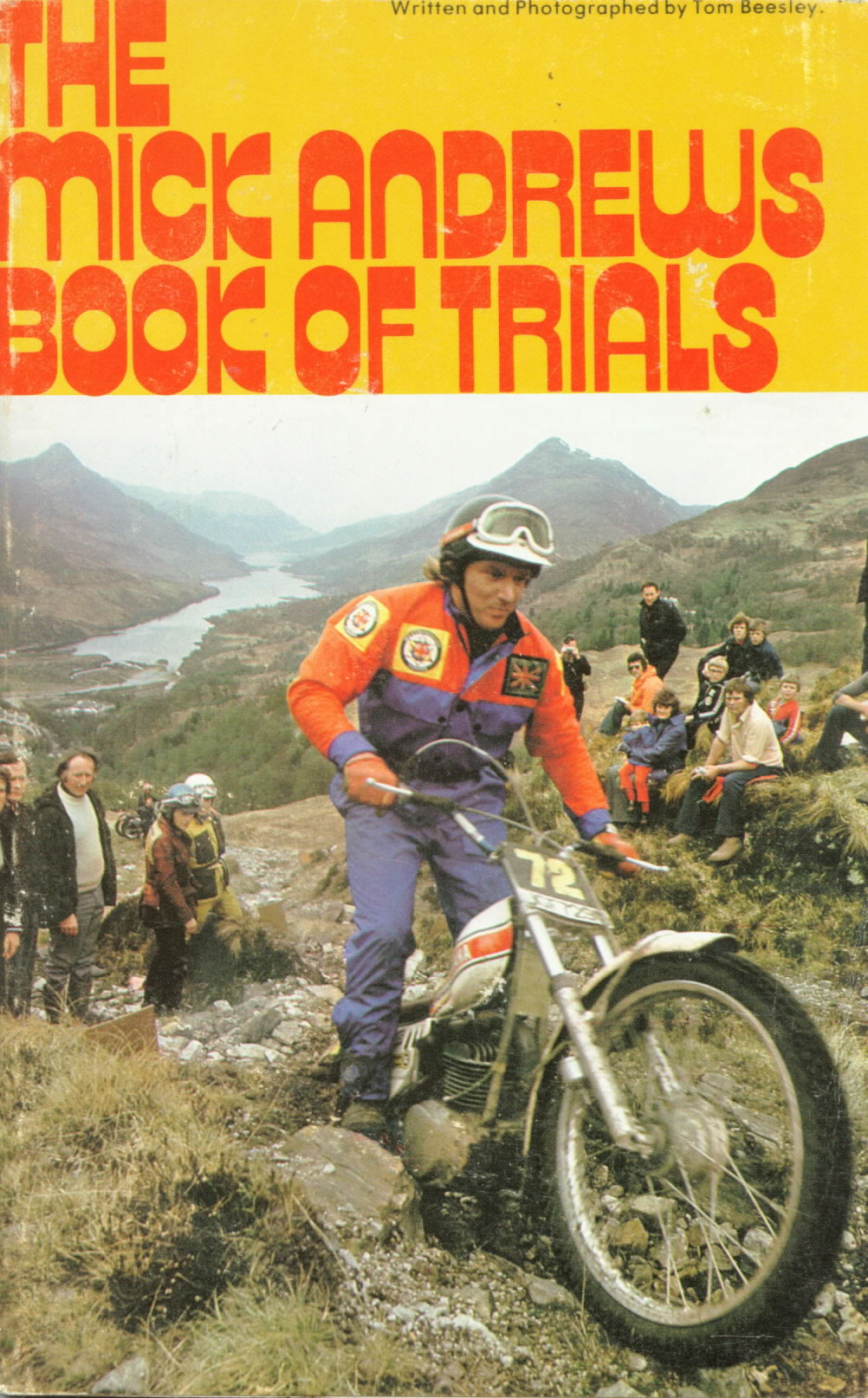
Mick’s bikes were ahead of their time in so far as Yamaha experimented with cantilever/mono shock suspension; fuel injection and reed valve induction systems. Much of the Yamaha development work is described in his 1976 book, ‘Mick Andrews Book of Trials’*, which has become a collector’s item with good copies fetching around £100 per copy.

Some works registration numbers : Mick Andrews

AJS:

644BLB

James:

306AKV

Bultaco (Rickman Bros):

DOT289D

Ossa:

B775073 (Prototype)

B-1681-C (Prototype MAR)

Yamaha:

CRA33L (1973 – Twin-shock bike/cantilever in 1974 with fuel injection module fitted); ENU29L (1973 – Cantilever bike); JGF729N (1975 – twin-shock bike)

1975 SSDT, Mick Andrews on his way to another win for Yamaha. The machine was JGF759N. Photo: Yamaha Motor Co.
1975 SSDT, Mick Andrews on his way to another win for Yamaha. The machine was JGF729N. The observer in the background is Scotsman, Simon Valente. Photo: Yamaha Motor Co.


Trials Guru on Andrews: I asked Mick when we were together in Robregordo in Spain 2006; did he ever have a job? He replied with a broad smile: “What, you mean an ordinary or proper job? – yes, I did have an apprenticeship to become a motor mechanic when I was sixteen, but then I received the offer of the AJS works ride and I only really had two employers after that, Ossa and Yamaha”.

Robrgrdo group October 2006
Group photo, Spain 2006 – Left to Right: Jenny Tye; Jill Andrews (Mick’s wife); Jonathan Tye; John Moffat; Alejandra Cruz Sotomajor; Jean Moffat. Tye is a good friend and neighbour of Mick Andrews. – Photo: Escobe Baco, Madrid


Trials Guru on Ralph Venables: Before he passed away on 4th February 2003, I spoke to Ralph (pronounced Rafe) at length about his unofficial ‘scouting’ for trials talent. “If I see a rider who has promise, I kept an eye on him for some time, not just results, but his approach and style of riding”. “If I thought a rider had the necessary qualities, I would have an idea which manufacturer was looking for riders and I would simply phone the competitions manager and give them details.”

Ralph Venables had the ‘ears’ of all the factory comp managers and his opinion was highly-valued; such was his stature in the sport.

Venables: “I didn’t quite like Sammy Miller’s riding style; he always appeared to crouching over the handlebars compared to other riders of his era, but there again he amassed quite a substantial amount of wins in his career. It just goes to show that one can be incorrect occasionally!”

Ralph was a blunt individual and was quite cutting with his comments at times. This earned him the reputation in Scotland of being ‘the poison pen’ at times such were his comments on certain Scottish-born riders!

He once told me that I, “…wrote too much” and asked if I was being paid by the word! “John, why use ten words when one will suffice?” he quipped. “Read your scripts over twice and cut them down, time is short!” he informed me. I took his advice, when Ralph spoke, people were wise to listen.

I had the utmost respect for Ralph Venables, his knowledge of the sport and the people in it was endless. It was a privilege to have known him. – Trials Guru.

Mick Andrews - CP
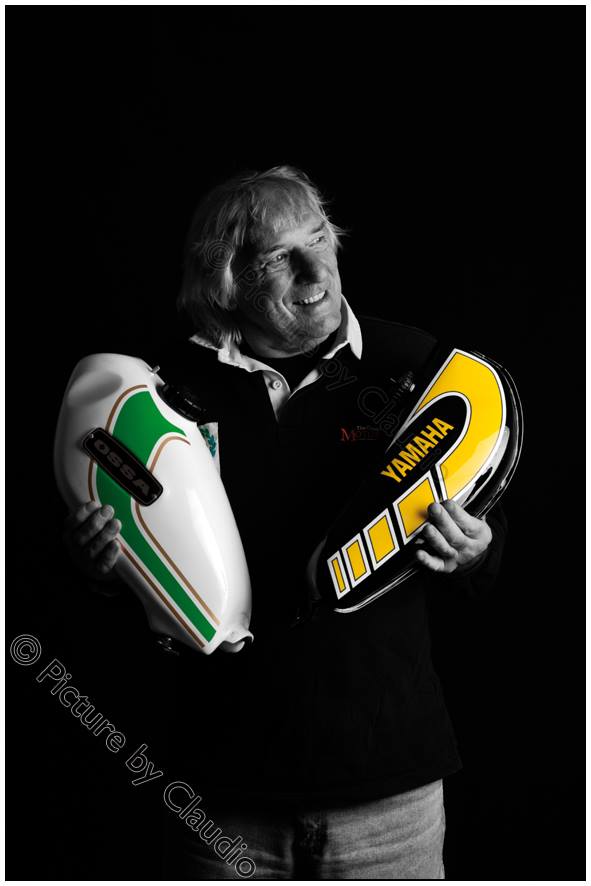
Study of Mick Andrews, former Ossa and Yamaha factory rider – Photo: Claudio Trial Pictures

References:

(*) – Mick Andrews Book of Trials by Tom Beesley & Mick Andrews (ISBN: 9780917856006) Published by: Trippe, Cox. – Now out of print.

Book Cover MA BOT
front cover of Mick Andrews’ 1976 Book of Trials is now a sought after publication of trials memorabilia.
Book rear MA BOT
Rear cover of Mick Andrews’ book.
Mick Andrews - Gas Gas - SSDT 2000 - CJB
Mick Andrews on a 250 Gas Gas in the 2000 SSDT. Photo: Colin Bullock CJB Photographic


Mick Andrews1978 Pipeline
Mick Andrews (250 Ossa) on Pipeline in the 1978 Scottish Six Days Photo: Iain Lawrie, Kinlochleven.


Photos: Copyright of individual photographers

Mick Andrews Article: John Moffat – 2014 (All Rights reserved)

Apart from ‘Fair Dealing’ for the purpose of private study, research, criticism or review as permitted under the Copyright, Design and Patents Act, 1988, no part of any article may be copied, reproduced, stored in any form of retrieval system, electronic or otherwise or transmitted in any form or by any means, electronic, electrical, mechanical, optical, chemical, photocopying, recording or otherwise without the prior written permission of the author as stated above. All articles are not published for any monetary reward or monetisation, be that online or in print.

More information and reading on MICK ANDREWS:

on the RETROTRIALS website – A full interview with Magical Mick… Here

Video of Mick Andrews: Courtesy of Ferry Brouwer, Netherlands via YouTube

Bob MacGregor Road Run 2015 – Trials Guru

Bob MacGregor 1939
Bob MacGregor is the only Scotsman to have ever won the Scottish Six Days Trial, seen here on Kinloch Rannoch in 1939 on his factory Rudge.


The fourth annual ‘Bob MacGregor Memorial Road Run‘ open for classic motorcycles (or anything special) will be taking place at Killin, Perthshire on Tuesday 28th April, 2015.

In memory of Bob MacGregor, the only Scotsman to have ever won the Scottish Six Days Trial, the event takes place two days before the preamble to the Pre’65 Scottish Trial at Kinlochleven.

MacGregor won the SSDT twice, in 1932 and again in 1935 on Rudge machines and had a greengrocers’ business in the town of Killin, the shop is still there.

Guest of Honour this year will be John Moffat, the Trials Guru, who will start the event and will travel along with local trials rider Bobby Lafferty, the event organiser. Bobby also organises the annual national trial named after MacGregor.

The route will traverse through the picturesque Glen Lyon and pass some old SSDT sections along the way.

Moffat intends bringing his 350 AJS, JSC905, which is the very bike his late Father rode in the Scottish Six Days in 1953 & 1954, the same bike that his son, David rode sixty years later, at the very wet 2013 Pre’65 Scottish Trial.

Those who want to join in the fun and nostalgia can do so by contacting event secretary, Peter Remington on 01539 560695 or click on the website: www.cumbriaclassic.co.uk

Alvie 2013
John Moffat (Trials Guru) standing, checks over JSC905 with son David. Photo copyright: Mortons Motorcycle Media.