The annual Scottish Six Days Trial starts on Monday 4th May until Saturday 9th May in Fort William and surrounding Lochaber and down into Perthshire.
The event which has been organised by the Edinburgh & District Motor Club Ltd since 1911 is always over-subscribed and covers some 600 miles during the week long excursion.
Dubbed many years ago as the ‘Sporting holiday in the Highlands’ it is far from being a holiday for most of the riders as it is still regarded as a fairly hard event to compete in.
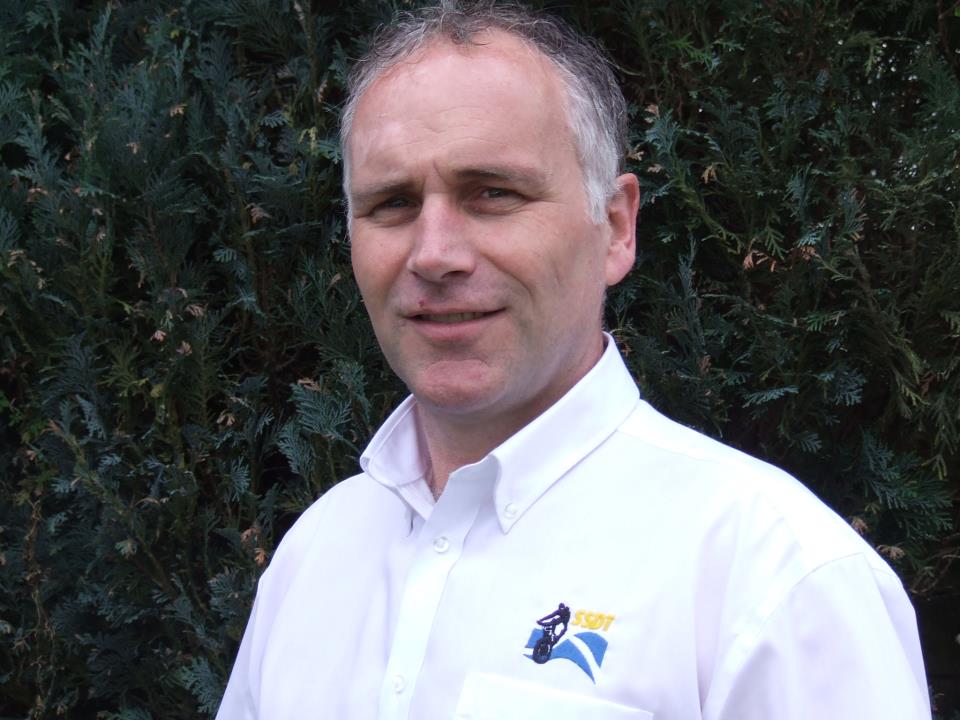
The clerk of course is Jeff Horne from Perth and he has found some interesting new hazards for 2015.
Jeff Horne is the SSDT Clerk of the Course 2015
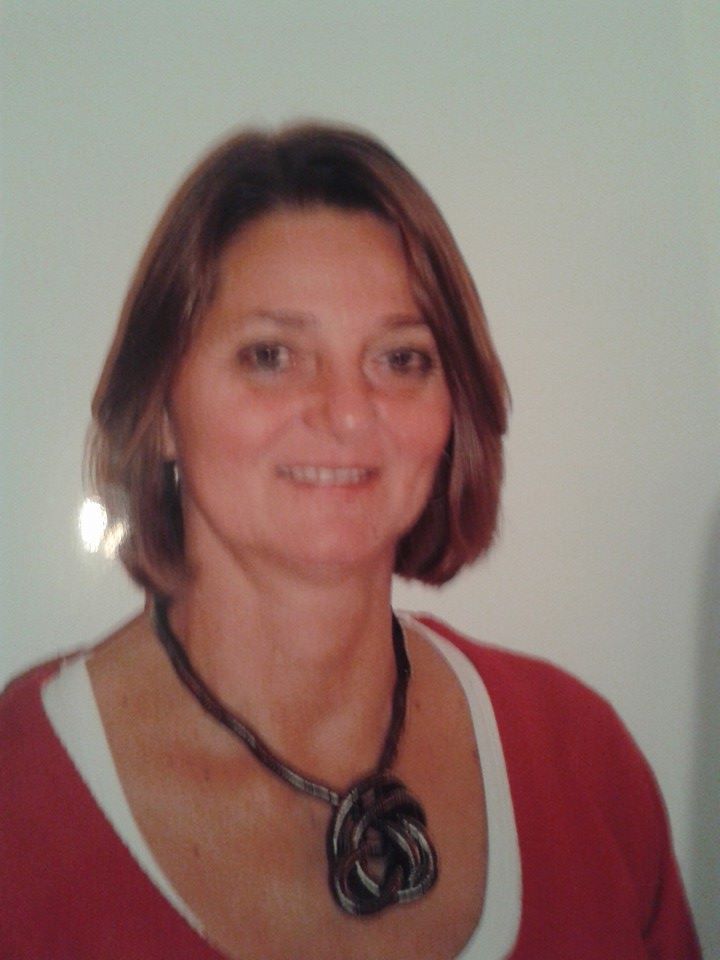
There is a new event secretary, Mieke De Vos, a Dutch born mathematics teacher who lives not far from Edinburgh. Mieke has been around the SSDT for a few years now and was the finish marshal at last year’s event.
Mieke De Vos is the new SSDT Secretary for 2015
Nevis Radio will once again be covering the SSDT live every morning from the Parc Ferme situated in Fort William’s West End. Nevis Radio is the only media group covering the event. You can listen live on your mobile device or home computer. Coverage begins every morning at 07.00 GMT.
The presenters will be Station Manager David Ogg, Si Abberley and The Moffster (aka Trials Guru – or John Moffat if you prefer!). Security will be covered by ‘Big’ John Weller another of the regular Nevis Radio weekly presenters drafted in for SSDT week!
The Nevis Radio Crazy Outside Broadcast Team for the SSDT – From left: David Ogg (The Oggster); John Moffat (The Moffster) & ‘Big John’ Weller – The Security Man!
The coverage will once again be sponsored by Michelin Competition and Trial Magazine, Britain’s foremost trials only full-colour magazine.
The Moffster (Left) interviews 12 times World Trials Champion Dougie Lampkin on Nevis Radio.
Keep tuned to NEVIS RADIO during Scottish week, whether you are in attendance or at home working!
In deepest Argyll, nestling among stunning scenery and mountains, lies the town of Kinlochleven. Many books have been written about the area, one of which is ‘Children of the Dead End – The Autobiography of a Navvy’ – By Patrick McGill – this book is exactly what the title says, it’s the story of an immigrant manual worker or ‘navvy’ as they were called. This book which is rated as one of the best 100 best Scottish books of all time, describes the times when the Aluminium smelter and factory was being constructed at the end of the 1800’s. Kinlochleven flourished as a direct result of the creation of the Aluminium factory which employed around 1,000 workers and produced high quality aluminium for the world. These employees came from far afield and settled in the town, one such settler was Ian Murray Pollock, who was originally from Falkirk, Stirlingshire. Pollock had been through the second world war, having served in the Argyll & Sutherland Highlanders regiment in Palestine. When he was effectively demobbed from the British Army, Pollock was fortunate to secure employment with the British Aluminium Company Ltd at their Kinlochleven smelter. The ‘BA’ as it was universally known, was a major employer both there and at their Fort William operation, which exists to this day.
Pollock started his career as a ‘fitter’ but quickly progressed through the ranks to become a shift foreman at the plant.
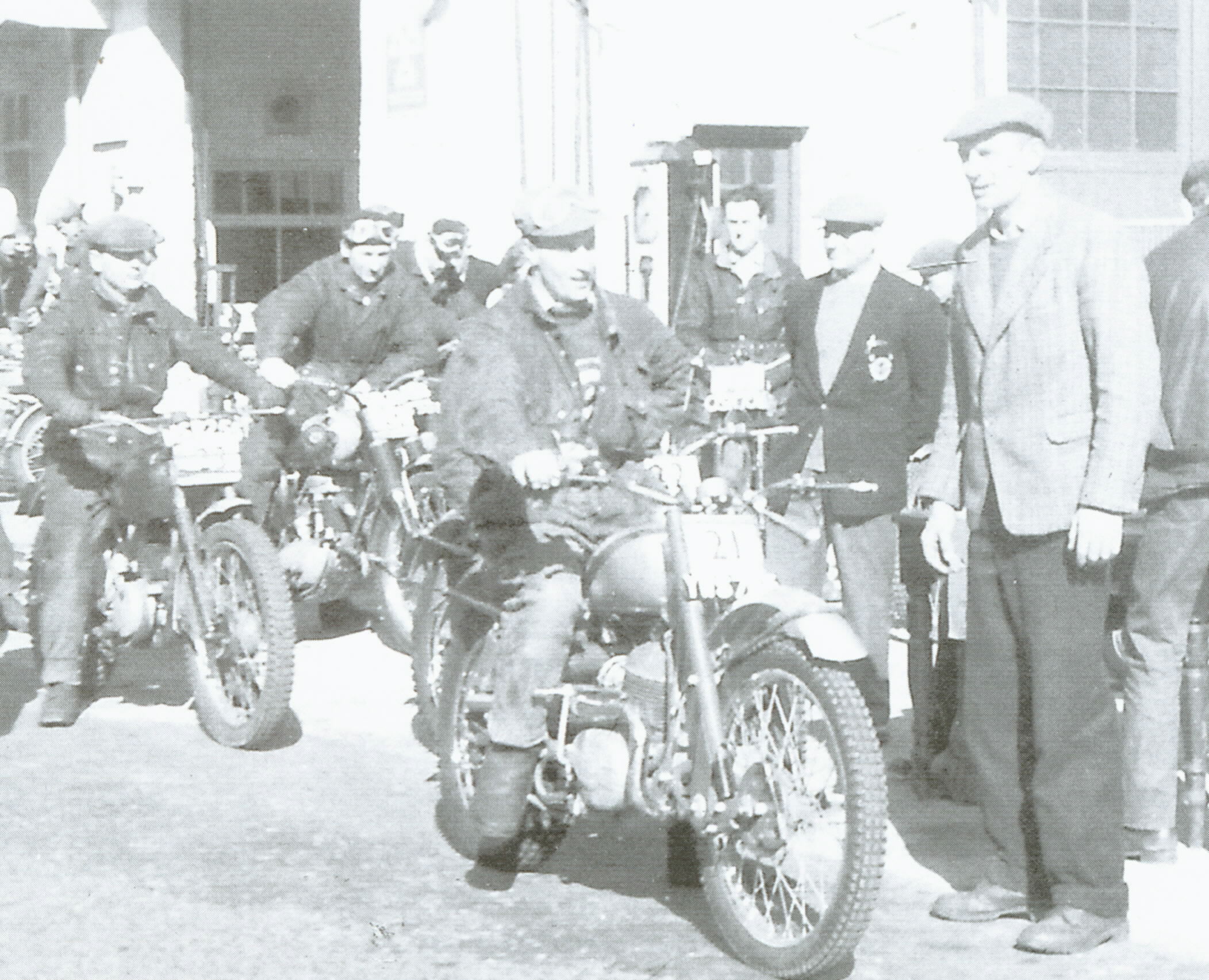
1950 – Jack Williamson from Newtongrange, Midlothian (347 AJS) on Mamore, watched by Ian Pollock (white paper in pocket) – Photo: W.S. Thomson, Fort William
Being an active young man who had forged many friendships in the locality, Pollock took an interest in the annual Scottish Six Days Trial which made use of the hills near to Kinlochleven during the ‘Sporting Holiday in the Highlands’. Pollock had amassed quite a knowledge of the local paths, bridleways and rough country high above the town. This was to eventually forge a strong bond between him and members of the Edinburgh & District Motor Club, who promoted the Scottish Six Days Trial.
Ian also became involved in local events, eventually becoming a central character in the Kinlochleven Motor Cycle Club, which he helped form.
Pollock in association with his good friend, Lithuanian refugee, Paul Kilbauskas discovered there was more land available to the SSDT than perhaps the organisers were aware of!
1959 Scottish Six Days Trial – Paul Kilbauskas with his 500 Royal Enfield – Photo: John Davies
The SSDT up until the late 1960’s, made extensive use of main and secondary roads, proper foot and bridle paths, sheep paths but very little open moorland. It wasn’t until Jimmy Mulvie became Clerk of Course that the SSDT made use of open moorland stretches.
It was Pollock and Kilbauskas that investigated the possibility of going out over the hills from Kinlochleven back over to the Fort William area other than by the original Mamore Road, which is the water bound surface that is still used by the SSDT and Pre’65 trials to this day. It stretches from Mamore Lodge across to Blarmafoldach, just outside Fort William and links into the Achintore Road.
Pollock and Kilbauskas were both energetic men, they liked the outdoors and they both jointly and severally, explored the many trails, paths and rocky burns and outcrops that littered the hills high above Kinlochleven. They also knew all the local keepers, shepherds and landowners, so permission was never a problem. Many of the hills surrounding the town had been purchased from estates at the end of the 19th century primarily for the water rights. This enabled the factory to operate and ensure plentiful supply of water via the Blackwater area, high above Kinlochleven. Pollock and Kilbauskas were trusted individuals and it helped the SSDT greatly by having reliable people such as Pollock and Kilbauskas on hand.
These explorations bore fruit aplenty, for the Pollock/Kilbauskas venture yielded many new sections in the form of ‘Loch Eild Path’; ‘Mamore’; ‘German Camp’; ‘Leitir Bo Fionn’; ‘Grey Mare’s Ridge’ and of course ‘Brump Brae’, later to be renamed ‘Pollock Hill’.
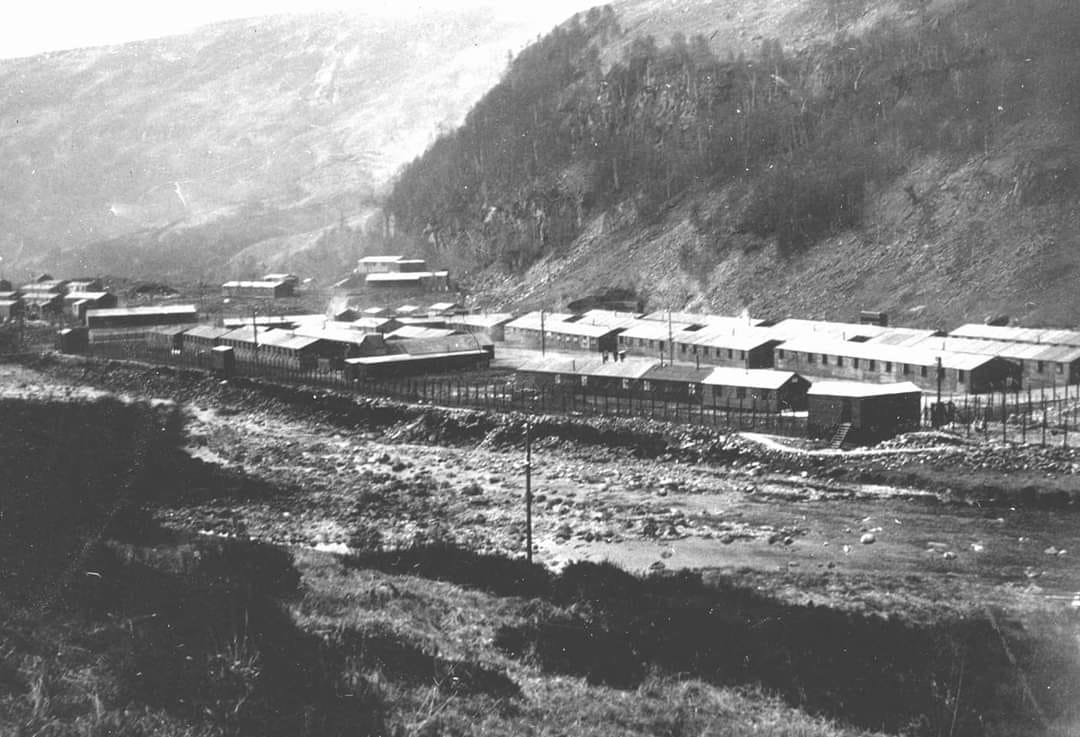
The ‘German Camp’, a first World War prisoner of war encampment on the banking of the River Leven high above Kinlochleven. Photo courtesy of Peter Anderson, Clackmannan
In the period 1955 through to 1959, Ian was listed in the official programmes of the SSDT as an observer, but Pollock was much more than that, he was the journeyman who discovered many of the iconic hills that would eventually unearth the most famous of them all, ‘Pipeline’ probably the most famous motorcycle trial section of all time! Alex Smith, from Bathgate, a former assistant Clerk of Course confirms that ‘Pipeline’ was first used as an observed section in the 1964 SSDT.
Jack Williamson (250cc Greeves) awaits the signal to start in the 1963 Spring Trial at Kinlochleven. Ian Pollock was a driving force in this event which was re-named in his honour after his death.
‘Pipeline’ is just a couple of miles out of the town and is the subject of many of the most stunning motorcycle trials photos to come from the cameras of Nick Nichols, Eric Kitchen and photographers of their age.
The Pipeline under construction, photo taken from an original glass negative, courtesy of Peter Anderson, Clackmannan
Pollock was an enthusiastic observer at the SSDT and when Johnny Brittain won the 1957 Scottish, his photo adorned the cover of the following year’s programme, the observer in the background watching intently being Ian Pollock. The original photo used on the 1958 SSDT programme front cover was a ‘Motor Cycling’ print which is now the property of Mortons Motorcycle Media, Hornchurch, but a personal copy still hangs in Pollock’s daughter Pamela’s home in Glencoe.
The 1958 SSDT Official Programme, with 1957 winner Johnny Brittain (Royal Enfield) being watched by Ian Pollock. The section is at the top of Loch Eild Path, one of the hills discovered by Pollock himself.
By 1962, Pollock was now listed as an Assistant Clerk of the Course and was held in high esteem by his peers and by the ‘Clerk’ himself, the late George Baird who described Ian as ‘our man on the spot’ in the official programme.
Paul Kilbauskas:
Paul Kilbauskas was also a ‘Tunnel Tiger’ who worked on the many hydro-electric schemes in the Scottish Highlands, he was an explosives handler during his time on these massive projects. He concentrated more on riding the Six Days on Matchless, Royal Enfield and BSA machinery, always a 500cc machine. He helped find a sizeable part of the route was in effect a ‘displaced person’ who had to flee his native Lithuania in 1947. His first port of call was Market Harborough in Leicestershire. Paul eventually settled in Kinlochleven, worked at the Aluminium factory for a period where he met and eventually married his sweetheart, Rose who also worked at the BA factory and was originally from the Orkney Islands. They had two daughters, Marina and Rachel. There is now a Paul Kilbauskas award in the SSDT in remembrance of the one-time course plotter and explorer for the event.
The late Paul Kilbauskas, a native of Lithuania who made the Scottish Highlands his home. A life member of Inverness & District Motorcycle Club.
‘Mambrec’ was yet another of the sections discovered by Ian Pollock, a section that has been used in the Pre’65 Scottish Trial many times. Pollock was fortunate to strike up a good friendship with Johnny Graham who also became Clerk of Course SSDT. Graham would leave a trials motorcycle at Ian’s home to give him something to explore with. One such machine was the ex-works 350cc Matchless registered ‘OLH722’ of Ted Usher and another was the ex-factory BSA of Brian Martin registered ‘BSA350’.
The Lochaber Spring Trial in 1959. Taken at Kinlochleven near the war memorial. From Left: Bobby Macleod (Francis Barnett); Ali McDonald (Ariel); Hugh McDonald (Royal Enfield); Ian Pollock (standing); Paul Kilbauskas (Royal Enfield); Tommy McNab (BSA – ex-works BSA 350) and Billy MacLeod (Ariel). The trial in modern times is known as The Ian Pollock Memorial Trial.
Pollock would regularly fire these ‘loan bikes’ up and take them up onto the Dam Road and into the hills to see what he could find.
In 1963 the SSDT committee honoured Ian by calling one of the sections ‘Pollock Way’, this was just off one of the many paths near the River Leven, that Ian and Paul Kilbauskas discovered on their explorations.
When the Lochaber and District Club was founded, they enlisted Ian’s help to organise their ‘Spring Trial’. This particular event was eventually re-named as The Ian Pollock Trial in his honour and is regarded as one of the best one-day trials in the Scottish trial calendar to this day.
Ian Pollock is survived by his only daughter, Pamela who married local man and trials rider, John MacGregor, they live in Glencoe and regularly watch the Pre’65 Scottish Two-Day Trial.
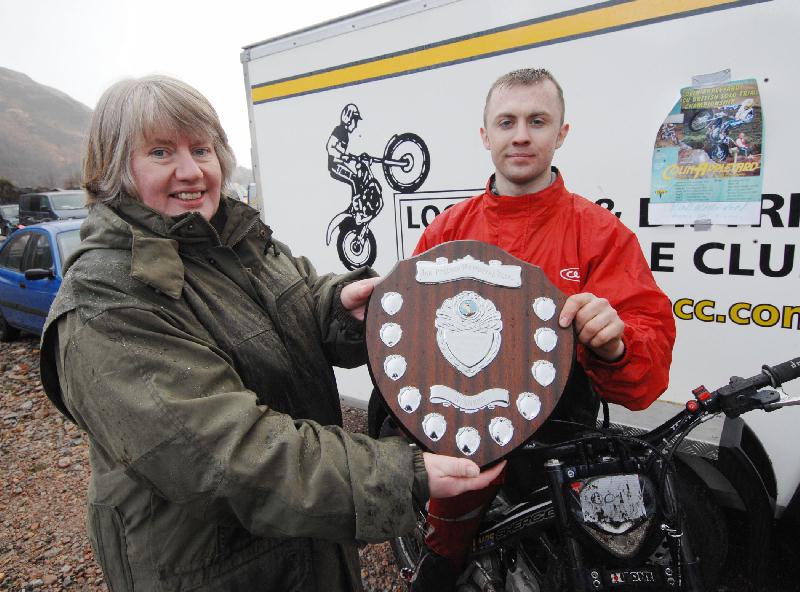
Pamela MacGregor (nee Pollock) presents the Ian Pollock Memorial trophy to local rider, ten times Scottish trials champion, Gary Macdonald in 2008. – Photo copyright and courtesy of: Iain Ferguson, The Write Image, Fort William.
John MacGregor was at one time himself an Assistant Clerk of Course SSDT and Pre’65 Scottish in its formative years.
So next time you climb up the ‘Dam Road’ to watch riders in either the SSDT or Pre’65 Scottish trials, spare a thought for the man who discovered many of these sections – Ian Murray Pollock.
More on Kinlochleven:
Kinlochleven in Scots Gaelic is Ceann Loch Liobhann, it was the first village in Scotland to have electric street lighting because of the electric power generated by the British Aluminium Company smelter. It used hydro or water power which was pioneered at Foyers in 1895 on the south side of Loch Ness, not far from Inverness. Kinlochleven was actually formed from two small villages, Kinlochmore (Large head of the loch) and Kinlochbeg (Small head of the loch). Kinlochmore on the north and Kinlochbeg on the south of the River Leven that runs into Loch Leven of which Kinlochleven sits at the head of.
The British Aluminium Company became part of Alcan, the Canadian based aluminium producer which laterly became Rio Tinto Alcan, part of the multi-national Rio Tinto company, which employs local personnel at their Fort William smelter operation. Rio Tinto (Alcan) is the world’s leading aluminium mining and producer. Rio Tinto Alcan can trace its roots back to Alcoa founded in 1928.
High quality, pure Aluminium was first produced at Kinlochleven at the ‘wee factory’ which was a temporary establishment high up in the hills on the Blackwater path. The ‘wee or temporary factory’ opened in 1907 with the main factory opening in Kinlochleven in 1909. The Blackwater dam or reservoir was formed purely to hold water reserves for the British Aluminium Company by flooding a sparsely populated valley high above the town, effectively trapping many of the River Leven’s tributaries and led down to the power house by six pipes, which are of course visible and beside the famous ‘Pipeline’ SSDT section group.
Trials Guru is indebted to Pamela and John MacGregor of Glencoe, Argyll for information supplied which made this article possible.
Text Copyright: Trials Guru / Moffat Racing, John Moffat – 2015
Photo Copyright: Iain Ferguson – ‘The Write Image’, Fort William – All Rights Reserved.
Photo of Paul Kilbauskas, by kind permission of Ms. Marina Kilbauskas.
Special thanks to: Alex Smith, former SSDT Assistant Clerk of Course and former Chairman, Pre’65 Scottish Trial.
Thanks to the Edinburgh & District Motor Club Ltd – For use of the cover of the 1958 SSDT official programme.
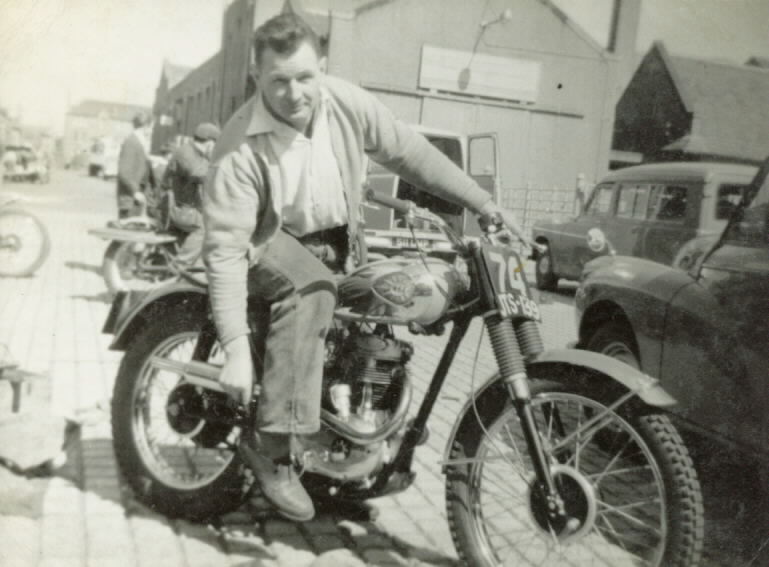
Ron Thomson with his C15 BSA at the ‘weigh-in’ of the 1959 SSDT at Gorgie Market, Edinburgh. Photo Courtesy of Mrs. Helen Thomson
Ron Thomson originally from St Andrews, Fife moved to Fort William in the late 1950’s. Ron was a dispatch rider during national service in Egypt and a member of the services club, the Bar-None MCC. On being de-mobbed, Ron joined the local Kirkcaldy & District club. Ron takes up the story: “In my day trials bikes were measured by the hundredweight, not by the cubic capacity! I had a Gold Star, which was dubbed the ‘Stone-Crusher’. So called because no section was ever the same after we had gone through. As for the Scottish Six Days, we used to gear the bikes up, my Trophy Triumph was good for 90 plus mph on the road, the reason for the hurry was that we used to be more interested in the ‘Seven Nights’ than the Six Days!” says Ron.
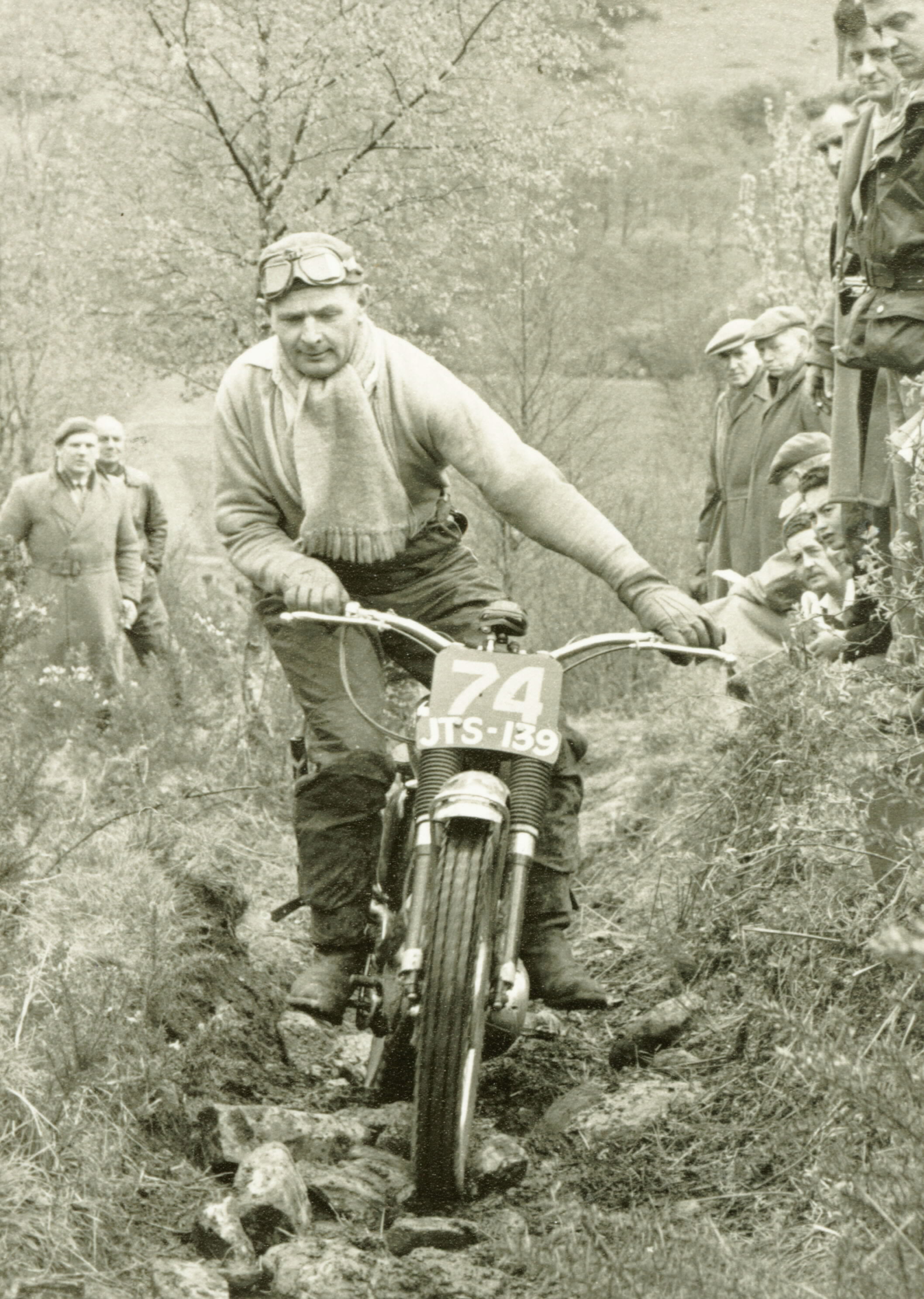
Ron on his BSA C15T in the 1959 Scottish on Glenogle section on May 4th. One of the first day hills as he made his way homeward to Fort William from the Edinburgh start. On the second right is Dunfermline rider the late Maurice Duffin. Photo: Mrs. Peggy Davies.
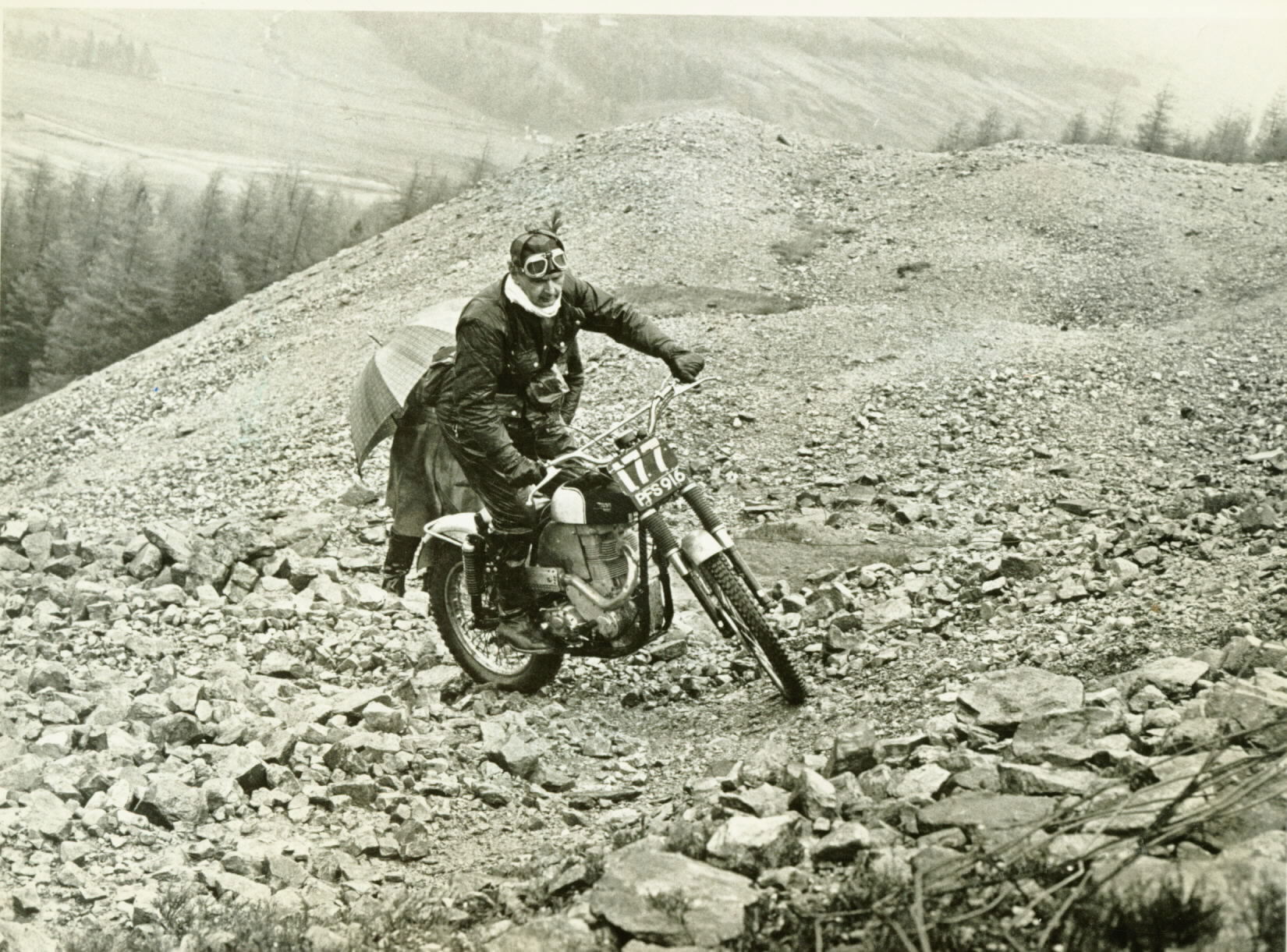
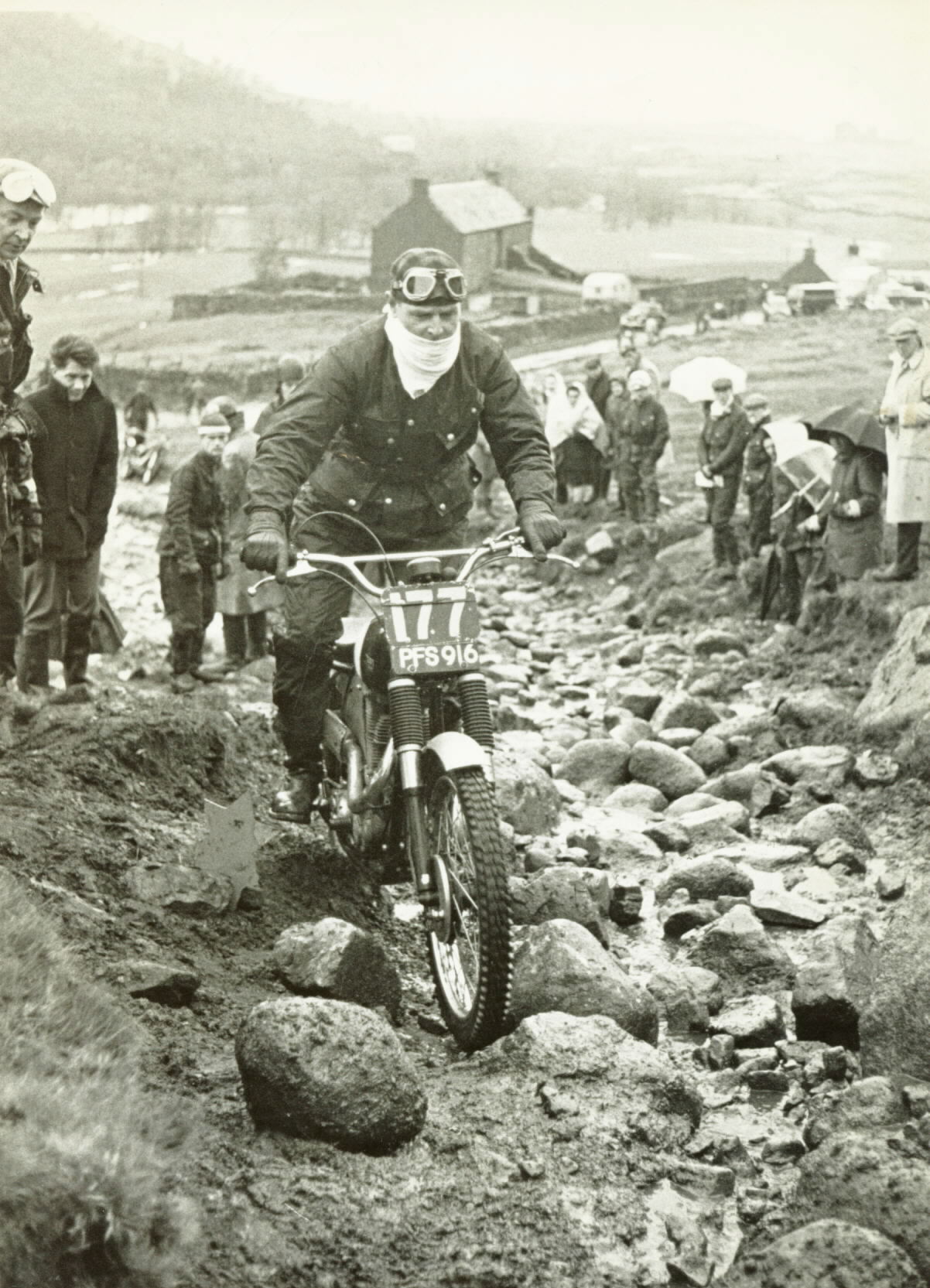
That particular Goldie, as Ron had one or two, registered PFS 916 had a neat conversion, featured in the first 1958 SSDT report in The Motor Cycle. In an attempt to reduce weight, Thomson used the gearbox as an oil reservoir for the motor thus obviating the need for an oil tank. The very machine on which Ron won the over 350 award at the 1969 Scottish which was to be his last ride in the Highland classic. That Gold Star was sold via Ernie Page’s shop in Polwarth Terrace and was passed through many ‘hands’ eventually ending up with Billy Maxwell in Newcastle Upon Tyne.
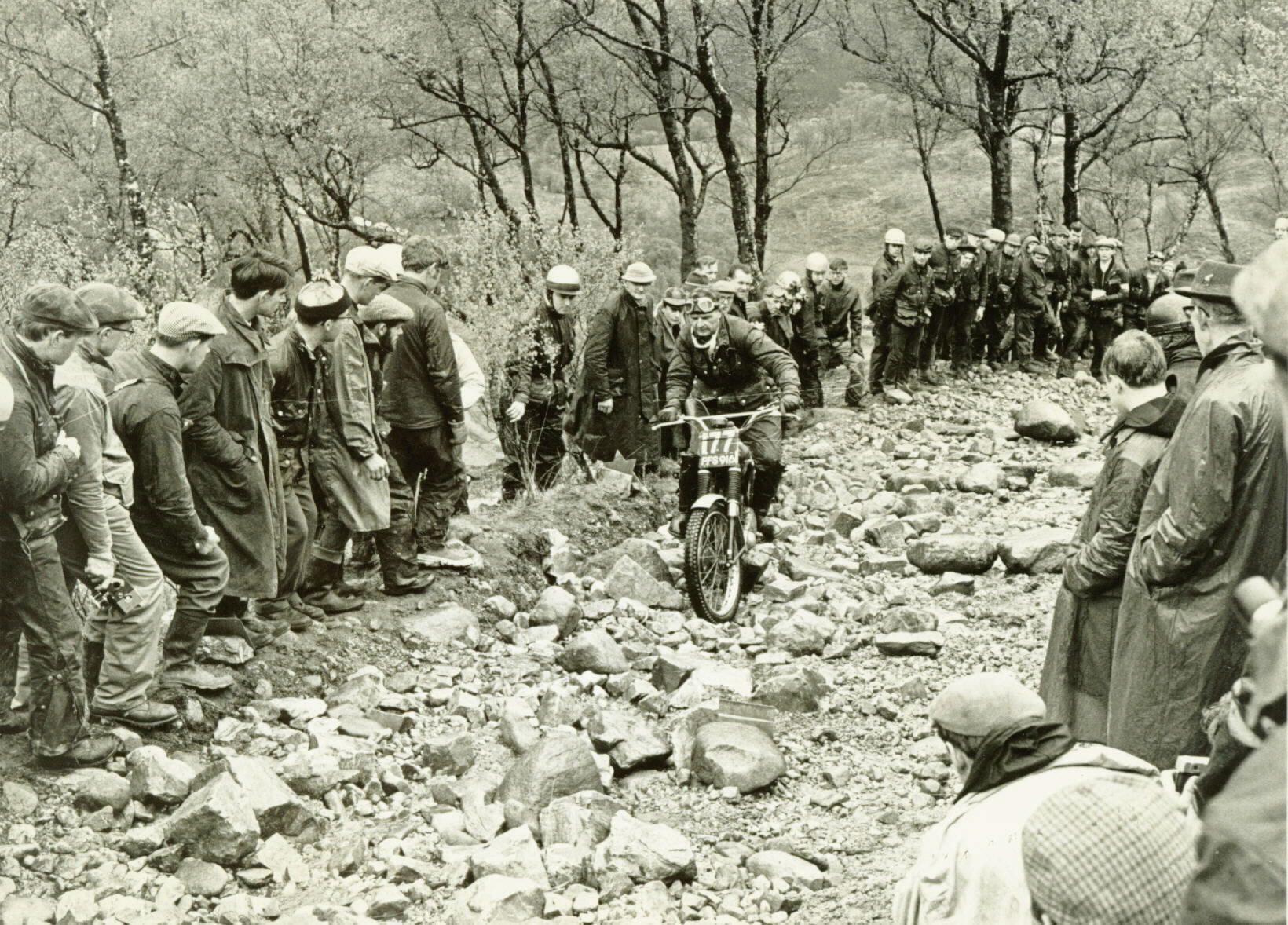
1964 SSDT on Mamore. Ron Thomson on his BSA Gold Star PFS916 – ‘The Stone-Crusher’. Photo courtesy of Mrs Helen Thomson, Fort William.
Ron loved riding the Scottish Six Days which was in effect a local event for him as he lived in Inverlochy at that time. Ron said: “…well it was more the seven nights I was most interested in to be truthful, we used to get up to all sorts of fun”.
Ron knew an observer called Tommy Millar from Airdrie, a man who never had a complaint registered against him in over 25 years of observing- what was the reason? “I just gie a’ the laddies a clean”, he told Ron.
Ron said: “I’ve no doubt that the kids today on their water cooled pogo sticks in their go faster trendy bin liner suits will enjoy themselves just as much as we did, but still I think had greater fun in the golden years”.
At the end of the 1953 Scottish Six Days, Ray Biddle took this photo of the Kirkcaldy & District riders From left: Peter Victory (197 James); Dave Birrell (490 Norton); Jack Duncan (Montrose, 197 Francis Barnett); Dr. J.G. Stewart (197cc Sun); Johnny Birrell (348cc BSA) & Ron Thomson (343cc Triumph)
Ron had a reputation as the man to approach if you wanted your bike fettled for the Scottish. He worked for a spell at the Brechin dealership, Duncan’s.
Ron prepares to start his BSA Gold Star at the beginning of the 1963 Scottish in Edinburgh’s Gorgie Market. Photo Courtesy of Jimmy Young, Armadale.
At one stage Ron, when still an active rider, prepared about a dozen Lochaber members bikes for the Highland classic.
“I couldn’t concentrate on my own ride for this one or that one coming up and saying, here! Listen to this – do you think it’s all right – will it last the week with this rattle or that rattle?”
Tyndrum, on the final day of the 1964 SSDT. Photo courtesy of Mrs. Helen Thomson, Fort William.
John Moffat has a vivid personal recollection of the 1967 Scottish Experts held at Achallader Farm, Bridge of Orchy: “Ron Thomson was on his Gold Star, having ridden down from Fort William, a distance of some 35 miles in company with the late Ali McDonald on a 500cc Ariel. Post-trial, Ron stopped for a blether with a group of his old chums, I happened to be an interested bystander, listening in to the “banter”. Ali McDonald had decided to get home before dark and left immediately after signing off at the finish. The bold Ron then decided after quarter of an hour had elapsed to set off in pursuit of his pal, McDonald. Ron set sail from the farm, which, is about a mile from the main A82 trunk road. Within a few moments the assembled gathering could see Ron and the Goldie passing over the steel bridge which spans the River Orchy and up the “Black Mount”, overhauling several cars during his ascent, the big Goldie on full song. The exhaust note ever fading, disappearing from view as he crested the summit and onward to the Fort. What a great sight to behold.”
Alister McDonald was a great friend of Ron Thomson. Here we see Ali on his Ariel HT5 on Town Hall Brae (Rocky Brae) in Fort William in the 1964 SSDT. Photo Courtesy of Mrs Helen Thomson, Fort William.
Known as a ‘big bike’ man, Ron also rode the “tiddlers” as well. In 1959 he chose the brand new C15T BSA 250cc unit construction single for the Scottish Six Days. In fact, out of eight C15’s entered, Ron was the only one to get to the finish and that included factory bikes as well!
Watched by Jeff Smith in the duffle-coat, Ron Thomson on the only C15T BSA to finish in the 1959 Scottish. All the works bikes had retired from the event. This section was at Achintee farm on the slopes of Ben Nevis Photo courtesy of Mrs. Helen Thomson, Fort William.
Back in 1955 he rode a Villiers powered 197cc DMW and a year later rode a similarly powered Welsh built 197cc H.J.H.
In the 1953 Scottish, Ron rode a self-built ex-WD 343cc Triumph, the following year he rode a 347cc Matchless G3LC.
Ron Thomson on his new for that year 347cc Matchless G3LC in the 1954 Scottish on Creag An Eilein on the Rothiemurchus Estate, near Aviemore. Photo: Ray Biddle, Birmingham.
Ron S. Thomson passed away on 20th January 2007, never being a regular church attender, there was a humanist service held for him in the Crematorium at Inverness. Ron left the trials community of the Lochaber Club and the towns-people of Fort William with great memories of a true character of the sport of trials.
Ron Thomson in 1964 at Achintee Farm on his 499cc BSA Gold Star. Photo Courtesy Mrs Helen Thomson, Fort William.
Trials Guru on Ron Thomson: Ron Thomson was a well liked individual who moved from his native St. Andrews to work at the British Aluminium works at Fort William. The reason was simple, so that he would live in God’s trials country! He set up business initially in a shed in his back garden fixing motorcycles and lawn-mowers for local people.
His business grew and he obtained premises at the Industrial Estate at Caol a few miles from Fort William on the A830. Many of the younger riders in the town benefited from Ron’s knowledge, which included Hugh and Alister McDonald, Alastair Macgillivray. Gary MacLennan and Rodger Mount.
Friends of Ron Thomson, Hugh McDonald Senior and Junior. Hugh Snr is on Ron Thomson’s BSA Gold Star and Hugh Jnr on the special bike built for him by Ron Thomson. Photo courtesy of Alister McDonald, Fort William.
His business was called R.S. Thomson (Inverlochy) Ltd. He ran a repair shop and MOT test centre for motorcycles. He was agent for chain-saws and garden equipment and employed Cameron ‘Cammy’ Kennedy for many years.
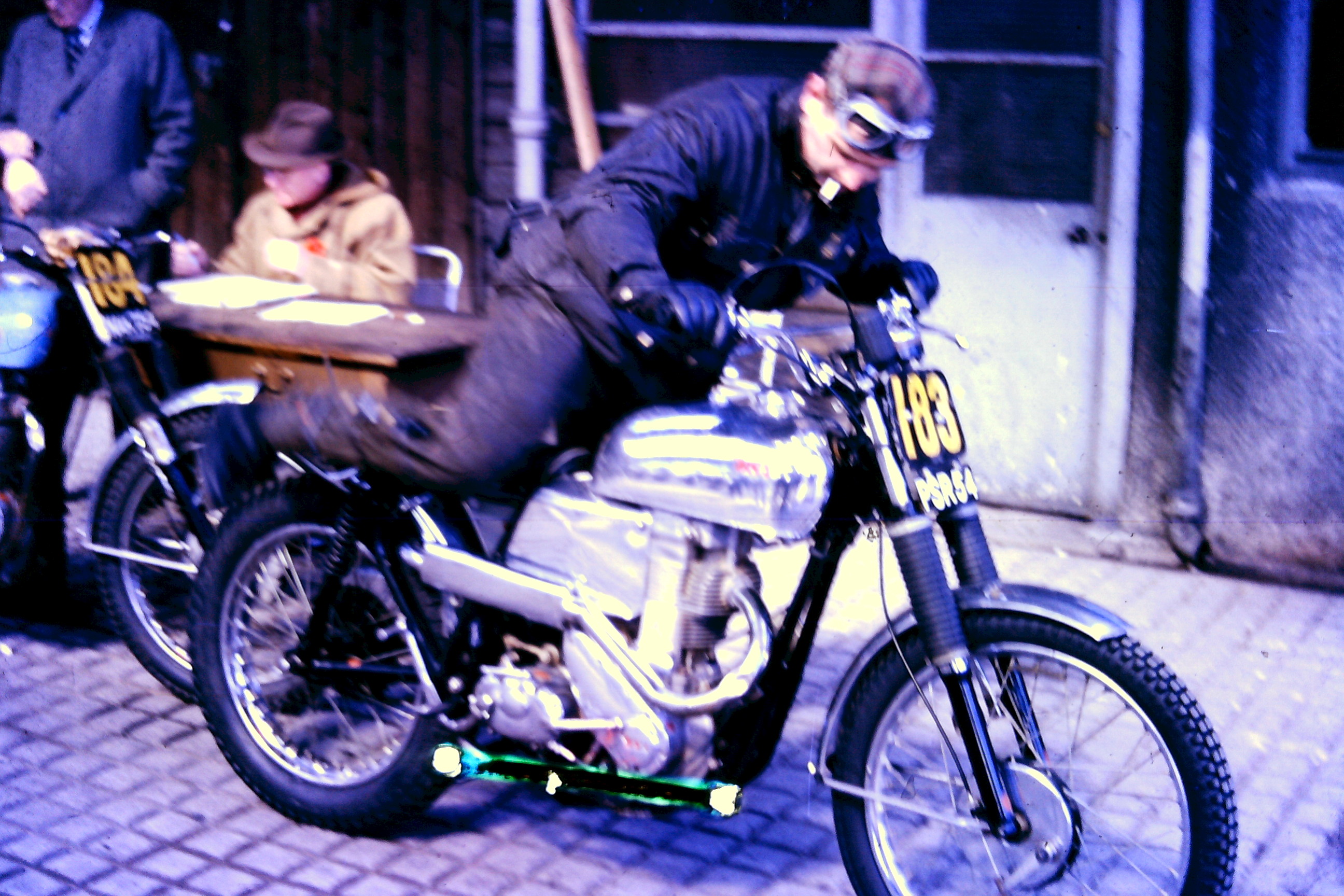
Ron gets his 250cc BSA C15T examined and security marked at Gorgie Market in May 1959. On Ron’s left is Davie Miller, one of the course markers of the SSDT. Photo courtesy of Mrs. Helen Thomson.
It was quite usual to swing in past Ron’s workshop for a great natter about the old days. But as sure as guns you were never there long until another enthusiast also had the same idea! How Ron got any work done heaven knows. He was a good builder of wheels, which itself is a bit of a ‘black-art’.
When Ron passed away after a short illness the business folded and Cammy took up employment with The Hire Centre in Fort William. Ron’s friends were not only Scots riders of his era like Jack Williamson; Arnott Moffat; Tommy Robertson; Johnny Clarkson and Bob Paterson, he also enjoyed the friendship of Gordon Blakeway; Ralph Venables; Peter Stirland and some of the best known riders of his era.
24th June 1962 – From Left: Bobby Neilson; Billy MacLeod: David Stodart; Hugh McDonald; John Noble: Jack Williamson & Ron Thomson. A joint effort of Edinburgh Southern & Lochaber Clubs to ride up Ben Nevis
They all knew Ron Thomson!
This article was put together from notes John Moffat made during an interview he had with Ron at his workshops at Caol some years ago and personal recollections by Moffat himself of Ron Thomson pieced together over many years knowing Ron Thomson.
Ron Thomson in the Scottish Six Days Trial
Year Riding Number Club Make & CC of machine
1953 179 Kirkcaldy Triumph 343
1954 148 Kirkcaldy Matchless 500
1955 20 Kirkcaldy DMW 197
1956 24 Kirkcaldy DMW 197
1957 12 Kirkcaldy DMW 197 (could be HJH)
1958 140 Kirkcaldy Triumph 498 (Twin)
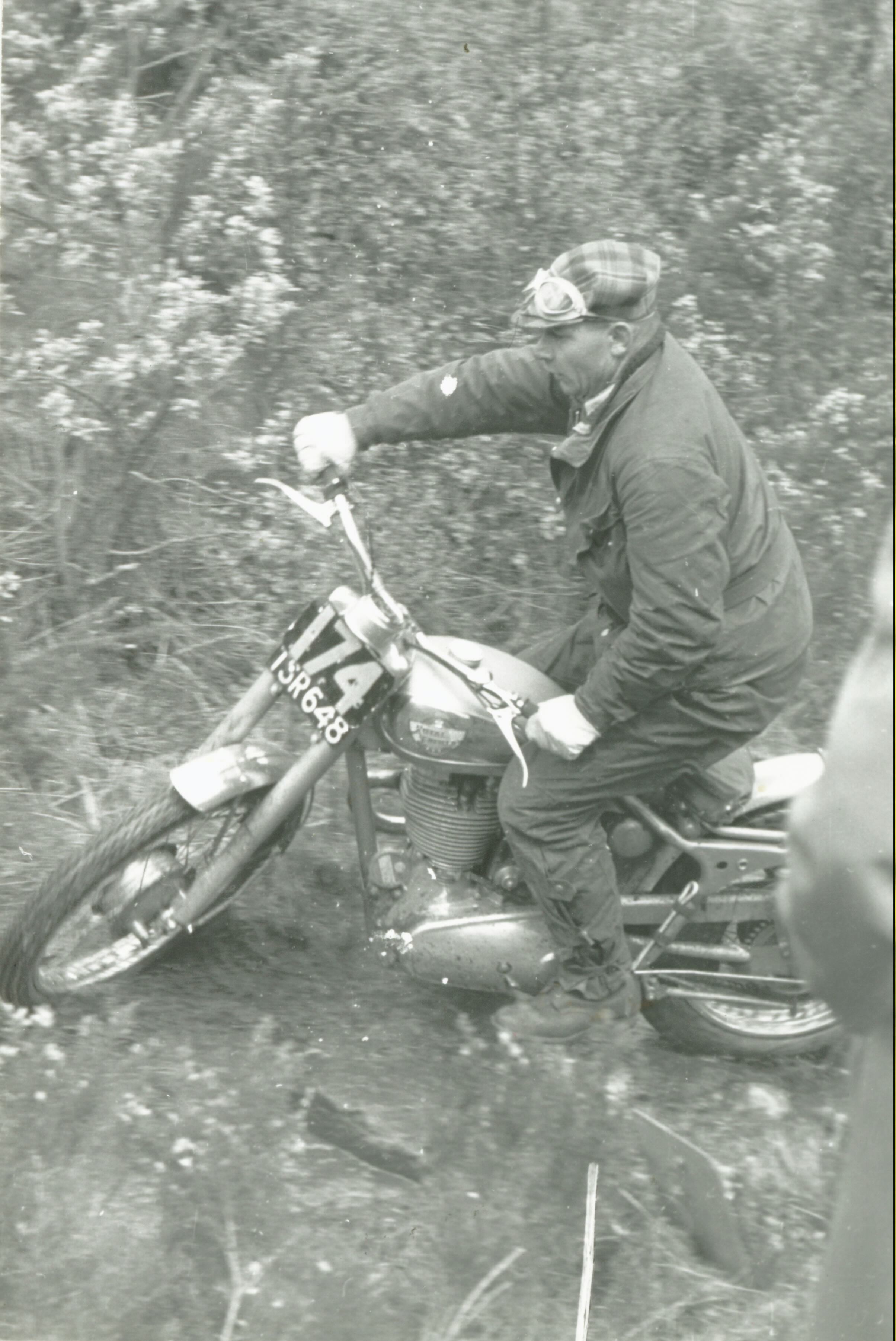
1959 74 Edinburgh & Dist BSA 250
1961 171 Lochaber BSA 350
1962 191 Lochaber BSA 348
1964 177 Lochaber BSA 500
1969 195 (not in prog.) BSA 500
Post Script: Added 01/02/2015:This story was spotted by Ron Thomson’s Grand-nephew, Ron Fisher who lives in Canada. It brought back happy memories of a visit to Scotland back in 1997 and indeed Trials Guru has been able to put Ron Fisher and Mrs. Helen Thomson in contact as a result of the article you see above.
Copyright: Trials Guru / Moffat Racing / John Moffat – 2014
With special thanks to Mrs. Helen Thomson of Inverlochy, Fort William for the photographs which accompany this article.
Post script to Ron Thomson’s story…
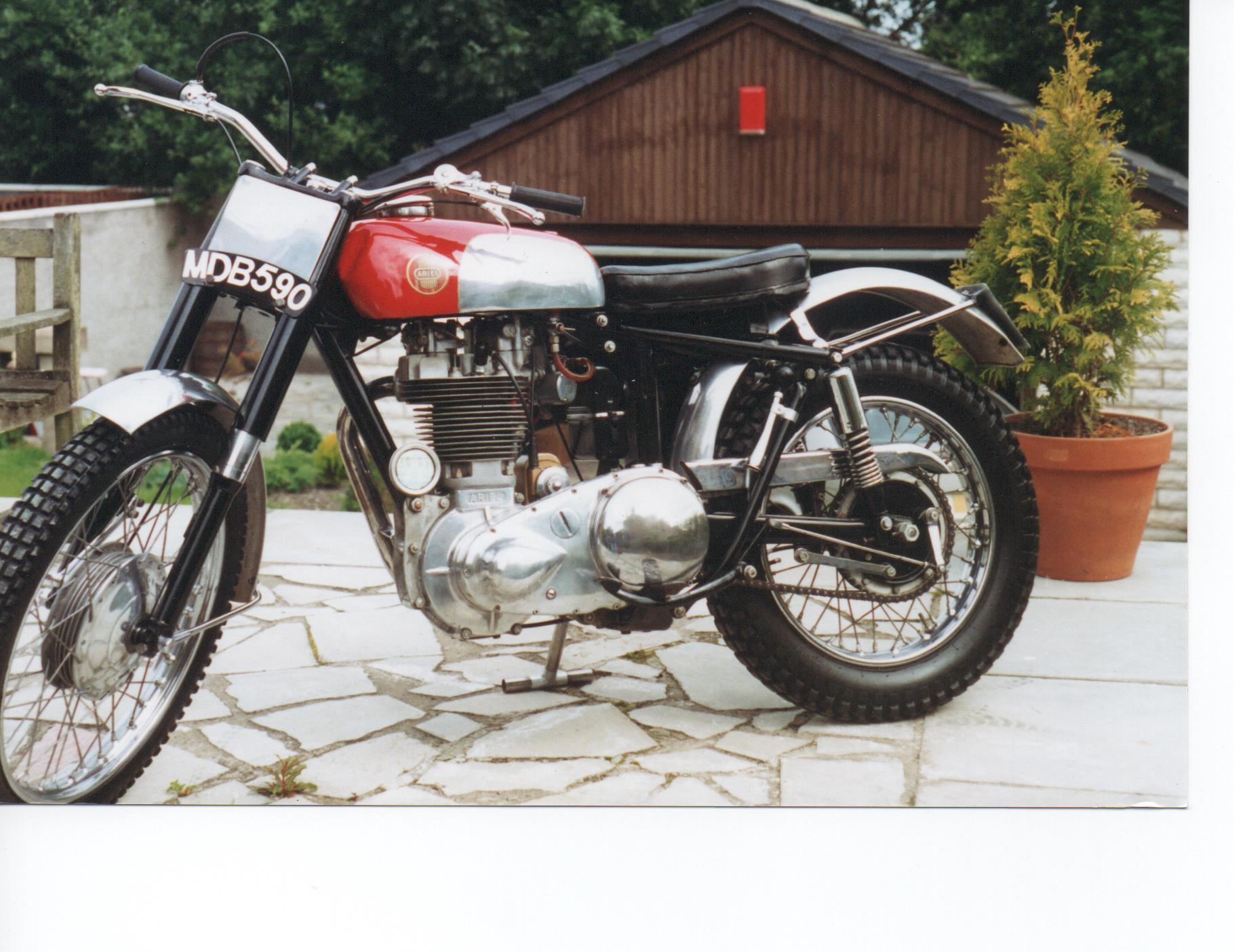
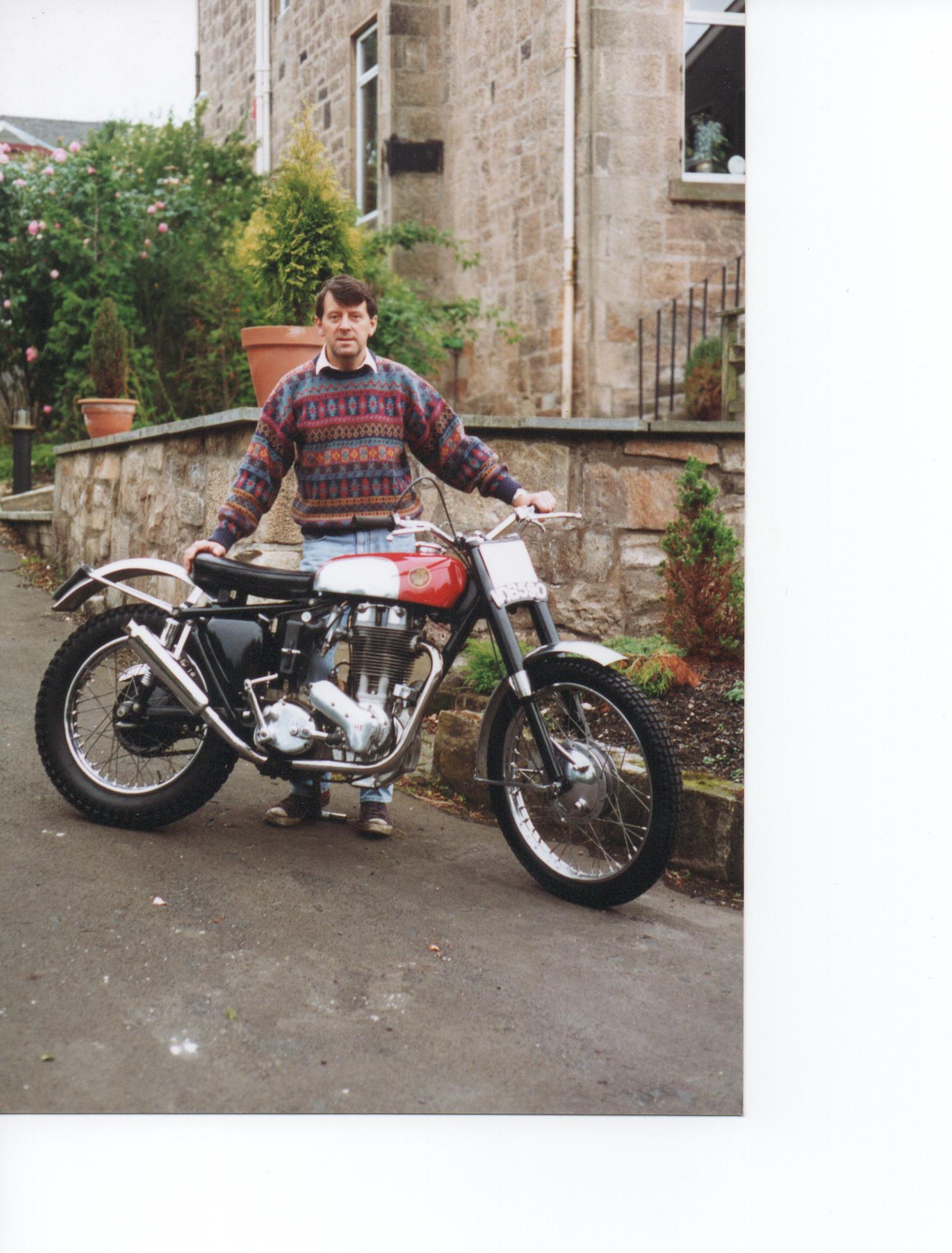
We have been contacted by former Scottish Speedway professional, John Wilson who now lives in Spain. John owned the ex-Ali McDonald Ariel MDB590 and he has kindly let us see photos of the restored machine. He sold it shortly before emigrating to Spain some years ago.
1964 – Ali McDonald on MDB590 on Grey Mare’s Ridge Photo: Holder and Osborn
The ex-Ali McDonald Ariel HT5 (MDB590) nestles inside John Wilson’s den. His speedway memorabilia is in the background. Photo: John Wilson.
A proud John Wilson shows off his Ariel. Photo: Chris Wilson.
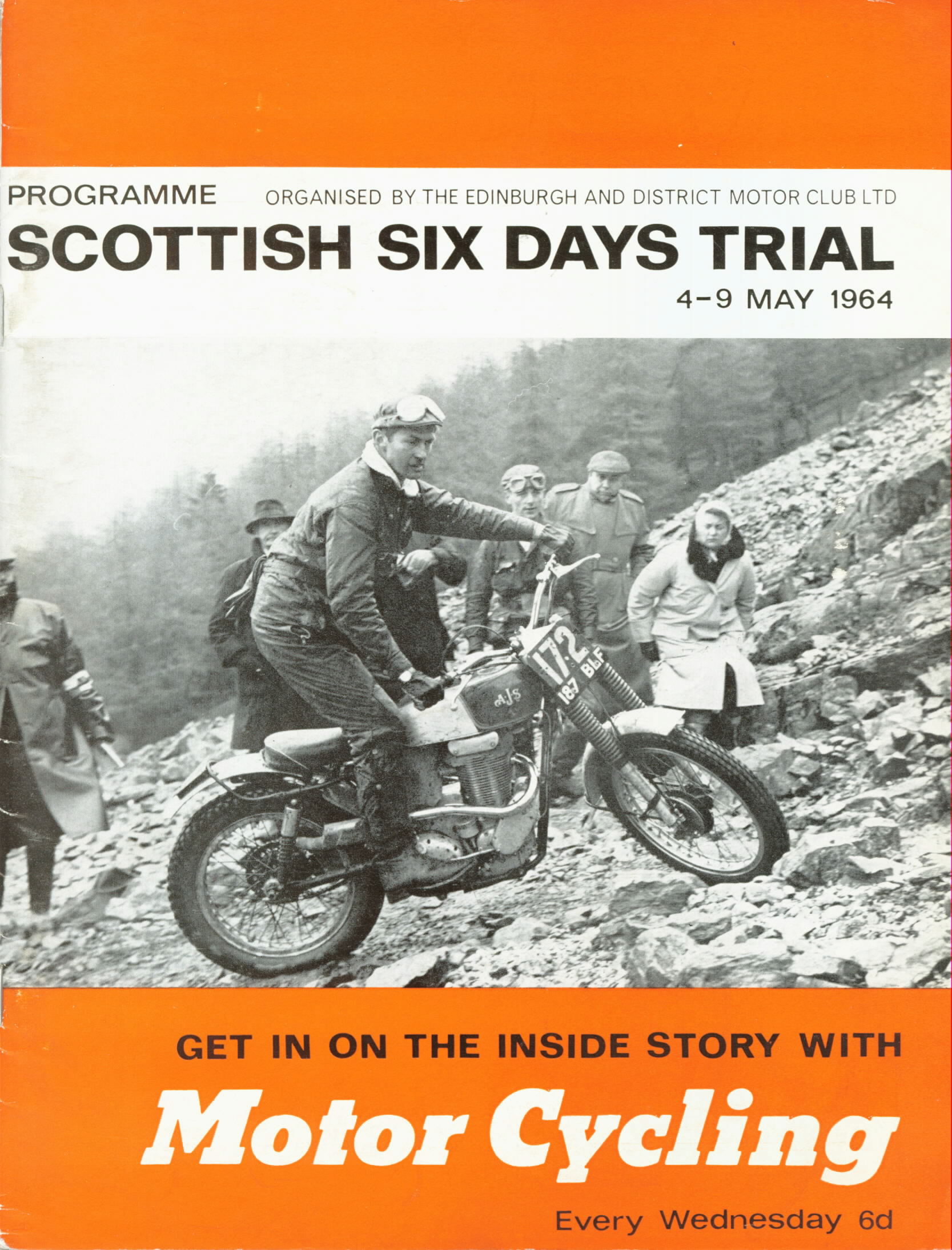
Front cover of the 1964 SSDT official programme, with Rob’s great friend Gordon Blakeway on the ex-Gordon Jackson AJS (187BLF) in 1963. The bike carried Jackson to victory losing one mark in 1961.
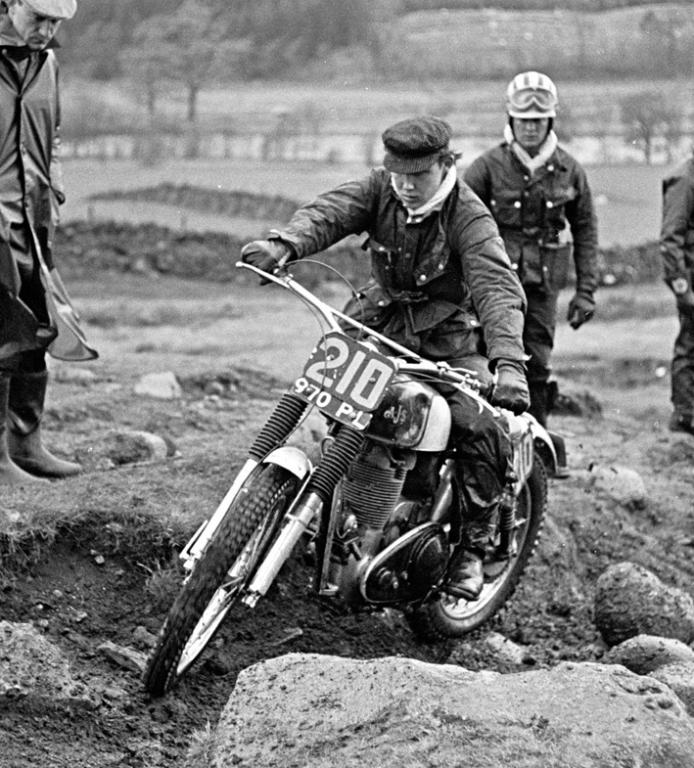
By the time the 1964 Scottish came around, I had got over my previous year’s disaster, this time I was allocated number 210 on an AJS 350 bought from Comerfords, this time entered as a ‘privateer’ and riding for the Middlesbrough & District, my home club.
The event still started and finished in Edinburgh. On the Thursday, we went over the Corrieyarrick Pass.
I think I had been following behind Peter Gaunt and what happened next I wasn’t to find out until sometime later.
I found myself sat on a banking at the side of the Pass, which is an old General Wade military road.
I had no idea at all how I came to be sitting there.
Alan Morewood from Sheffield who became a top sidecar driver, came along on his 500 Ariel as he was number 205 that year, he stopped and asked if I was Okay? ‘Yes, fine’ I said, ‘Bye’ he said and rode off.
A couple of minutes later and Alan was back. ‘Rob, are you sure you are al-right, you look dazed?’ said Alan. ‘No problem’ I said and off he went again. Somehow I managed to get back to Fort William to finish the day’s run.
The first person I spoke to asked what I had been doing to scratch my face? Then someone said, ‘never mind his face, look at the back of his bike!’
The rear end was totally out of line. I then realised that I must have hit a pothole in the road with the front wheel over Corrieyarrick, cartwheeled and that explained my rest on the bank.
We pulled the bike back into line with a length of pipe that we found. Apart from a bit of a headache, it was back to business as usual.
Rest of the week was not as eventful and had a good old needle match with my mate Sid Lampkin who was on a factory Cotton that year.For the next year, I had bought another AJS from Comerfords, Thames Ditton built by Jock Wilson. I’ll tell you about that ride next. Bye for now! – Rob
Rob on his 350 AJS at Achintee Farm, Ben Nevis, in the 1964 Scottish. The AJS supplied by Comerfords, hence the Surrey registration number 970PL. If you look closely the front wheel spindle nut has the ISDT type tommy-bar, obviating the need for a spanner. It also has the works style prop-stand tied to the front downtube by rubber bands and a small spigot mounted on the lower-most engine bolt and the attachment spigot mounting on the magneto mounting plate. Photo supplied by Rob Edwards. Photo copyright: Brian Holder.
Post Script by Rob Edwards:I’ve just been looking again at this fine Brian Holder photograph of me on the AJS on ‘Ben Nevis’ in 1964. The chap directly behind me is Mick Ward from Scarborough.
He built a bike especially for this event. He had the novel idea of taking the exhaust through the back frame loop to save a bit of weight.
However, when he got stuck, the ever helpful spectators would rush to his aid, not realising the exhaust was the rear frame loop and severely burn their hands in their quest to assist! I’m sure the A&E at Fort William were extra busy that week with burns!
I bet Mick never thought that one day Valentino Rossi would copy his helmet design! – Bye for now! – Rob
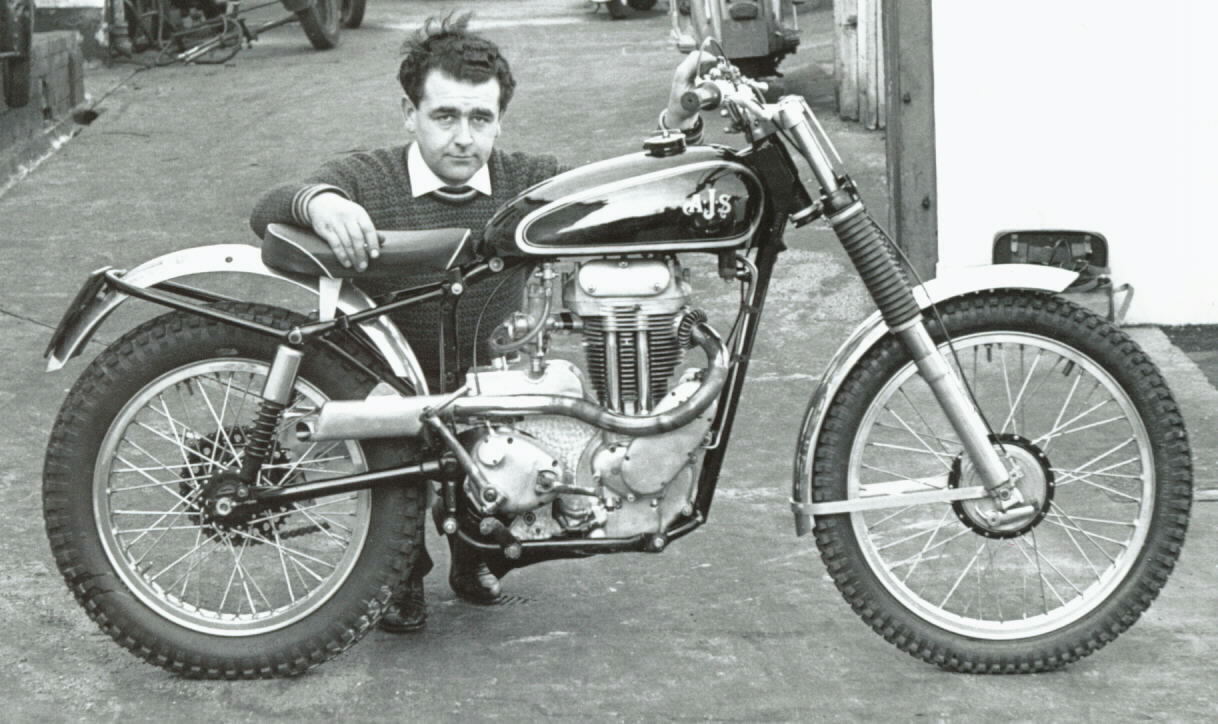
Comerford’s employee, Peter ‘Jock’ Wilson with one of his creations, an ultra short-stroke AJS 16C, photo taken at the back of Comerfords workshop at Portsmouth Road, Thames Ditton. Jock was brought up a mile from the old SSDT sections at ‘Meall Glas’ in Glen Lyon, Perthshire. Photo Copyright: Don Morley, Reigate, Surrey
TRIALS GURU: – 1964 Scottish Six Days, this edition was won by Sammy Miller riding the much modified and much weight reduced, Ariel HT5. This would be the last time he would do so on the British four-stroke, Miller had already been secret testing the 200cc Bultaco Sherpa which he was later to develop to an increased 244cc and thus created a world beating machine with the San Adrien De Besos factory.
From the 1964 Scottish Six Days Trial Results:
No. 210. R. Edwards, Middlesbrough & Dist. M.C., A.J.S. 350 c.c. …. 124 marks S F C (Special First Class Award)
1964 SSDT another Achintee photo taken the same day as that of Rob Edwards. Here we see the late Ron Thomson a great character originally from St. Andrews who made his home in Inverlochy, Fort William. Seen here on his 500cc BSA Gold Star. Ron called this bike the ‘Stone Crusher’ and was later owned by Billy Maxwell of Newcastle. Thomson and Ali McDonald were great friends. Photo courtesy: Mrs Ron Thomson, Inverlochy, Fort William.
Rob’s eventful Scottish ‘Thursday’ was May 7th 1964. The route was as follows, let’s follow where Rob went that day: Start, Fort William; Inverlochy; 2 sections at Annat; Banavie; Gairlochy; 8 sections at Laggan Locks; Corrieyarrick Pass (where Rob has his big off!); Melgarve; Laggan Inn; Roy Bridge; Inverlochy – Lunch control; Glen Nevis; 4 sections at Ben Nevis; Fort William – Down Ashburn Lane; Onich; Kinlochleven; 1 section on Pollock Way; 8 sections at Leitir Bo Fionn; Down Loch Eild Path; 8 sections at Mamore; Check at top of hill; Mamore Road; 2 sections on the Town Hall Brae and Finish of day. Total Mileage 132 miles. 33 sections.
1964 SSDT shot of the late Ali McDonald, a Fort William man, on his Ariel HT5 on Town Hall Brae in Fort William. Photo courtesy: Mrs. Ron Thomson, Inverlochy, Fort William.
SSDT Point of interest: The number plates you see in the SSDT photos were issued to riders by the organising club. The rider paid a fee of ten shillings and forfeited the deposit if they didn’t hand the plates back at the end of the event. In 1964 the number plate official was Bob Adamson who later was to become SSDT Assistant Secretary and Secretary of the Pre’65 Scottish Trial.
1964 Scottish at the same section group, Achintee, Ben Nevis that we saw Rob on his AJS, here we have the late Blackie Holden from Bradford on his works Cotton. Blackie Holden junior supplied this photo and said: “My Dad rode with Rob Edwards many times and considered him a true gentleman of the sport”.
Copyright: Rob Edwards/Trials Guru, Moffat Racing (c) 2014
Acknowledgements:
Don Morley, Reigate, Surrey for permission to use the photograph of Peter ‘Jock’ Wilson for this article.
Edinburgh & District Motor Club Ltd for the use of 1964 programme cover.
Rob Edwards for the use of the Brian Holder photo.
Blackie Holden Junior for the photo of Blackie Holden Snr in 1964.
Mrs Ron Thomson, Inverlochy, Fort William for the photos of Ali McDonald & Ron Thomson.
To read all of Rob Edwards’ story of his life in trials, click … here
Alexander John Cameron, known to the townsfolk of his native Fort William as ‘Allie Beag’ or just ‘The Beag’, this Gaelic nickname means ‘Wee Allie’.
At the Parade Garage in Fort William, where he served his apprenticeship as a mechanic, there were two ‘Allies’ so there had to be a distinction and it stuck with him for the rest of his life. Allie was originally inspired by watching the Scottish Six Days and ventured into trials at eighteen years of age, when he could afford a James Commando in 1958. This beginner bike soon made way for a brand new 20TA Greeves, purchased from Duncan’s of Brechin a year later.
Allie progressed to a 250 DOT in 1961, which, he rode for only one year.
Allie Cameron on the 150cc Triumph Cub in the 1962 SSDT on Tyndrum – Photo: Ian T. Robertson
Next season, Allie bought the ex- Jimmy Hutchings Triumph Tiger Cub and had it reduced in capacity by the factory at Meriden, near Coventry with the intention of winning the 150cc cup at the Scottish, which he did. Henry Vale, the competitions manager at Triumphs had a Terrier 150cc barrel fitted to reduce the capacity accordingly. That particular Cub had a twenty-one inch front wheel and a widened swinging arm to accommodate a full four-inch section trials tyre at the rear.
A smiling Allie gets ready for an event at Todholes Farm, Fintry in 1963 – Photo: Jack Williamson, Rosewell.
His Scottish 150cc capacity win on the Triumph soon attracted the attention of the Greeves factory at Thundersley, Essex and Allie received factory support in the shape of a 149cc bike (XWC 264) for the 1963 Scottish.
Cameron lifted the cup a second time for the loss of 120 marks with his closest rival being Gordon Farley, on a Triumph supported by Jock Hitchcock, who dropped 174 marks. Greeves were happy with the result and used it to best effect in their adverts in the motorcycle press for many months later.
On his special Greeves 149 (XWC264) winning the 150cc cup at the Scottish for his employers, Greeves Motorcycles of Thundersley, Essex; seen here on Achintee in the 1963 Scottish Six Days Trial. Photo: Mrs Florence Cameron, Fort William.
The same year Allie was runner up in the Scottish Trials championship, two points behind Jackie Williamson. By 1967, ‘Beag’ had two special firsts, four first class and four capacity class wins to his credit in six rides in the Scottish Six Days Trial.
Allie was offered a job as mechanic in the competitions department at Thundersley, preparing the factory trials and scrambles machinery for the works riders. He also prepared many of the special ISDT machines including those supplied to Thames Ditton dealers Comerfords. Allie worked in company with John Pease on the ISDT bikes.
An accomplished mechanic, Allie fettles his 150cc Greeves factory machine at Gorgie Market in May 1965 (NEV5C). He won the 150cc cup on 169 marks. Photo: Mrs Florence Cameron, Fort William.
Pease who as well as working at the factory was selected on many occasions as a British Trophy team member. The duo fabricated the special engine cradles to carry centre stands, rock guards and the various brackets to carry headlamps, number plates and compressed air bottles for tyre inflation.
Allie became friends with Don ‘D.R.’ Smith who came up to the factory once a week for testing and development discussions. ‘Beag’ would go practising at Kelvedon Hatch near Brentwood with Smith who was one of Britain’s top trials riders, by then, European Champion.
Allie Cameron on Loch Eild Path in the 1968 Scottish on his factory Greeves (XHK14F). Allie won the Henderson Challenge Trophy for the best performance by a member of the promoting club. – Photo: Alistair MacMillan / West Highland News Agency, Fort William (with permission of current copyright holder: Anthony MacMillan, Fort William – All rights reserved)
‘Beag’ knew all the ‘works boys’ and was highly regarded as not only an excellent spanner-man but as a handy rider in the Wessex Centre ACU. He spannered for Bryan Goss and many of the other factory motocross riders.
In 1971, Allie decided to return home to Fort William and took up a position with the area’s largest employer, The British Aluminium Company (‘BA’ for short). He wasn’t home long when he received a call from Jim Sandiford offering him a job at Sandiford’s Montesa import business. Allie thought long and hard but decided to stay at the BA.
1971 SSDT – Allie ‘Beag’ Cameron (247 Montesa Cota) on Loch Eild Path. Allie took home the ‘Henderson Challenge Trophy’ for the second best performance by a member of the promoting club, and was 24th position in the trial with a special first class award on 126 marks. – Photo: Ian Robertson, Midlothian
Having been diagnosed as having Hodgkin’s disease, the Beag had to restrict his trials riding but never lost his enthusiasm for motorcycling. He rode up until the late 1970’s and was a willing observer at both the annual Ian Pollock Memorial Trial and Pre-65 Scottish.
Sadly, Allie died in the November of 1998. His funeral at the Duncansburgh Church, Fort William was filled to overflowing, such was the popularity of the little man known affectionately as ‘The Beag’ to the towns-folk. Many modern day competitors and “old hands” converged on the Fort to pay their last respects.
Allie Beag at home in Fort William in 1996 with the trophies he won during an accomplished career in trials. Photo: John Moffat
Article: Copyright – John Moffat -2005
Photos:
Jimmy Young, Armadale
Alistair MacMillan / West Highland News Agency, Fort William (with permission of current copyright holder: Anthony MacMillan, Fort William – All rights reserved)
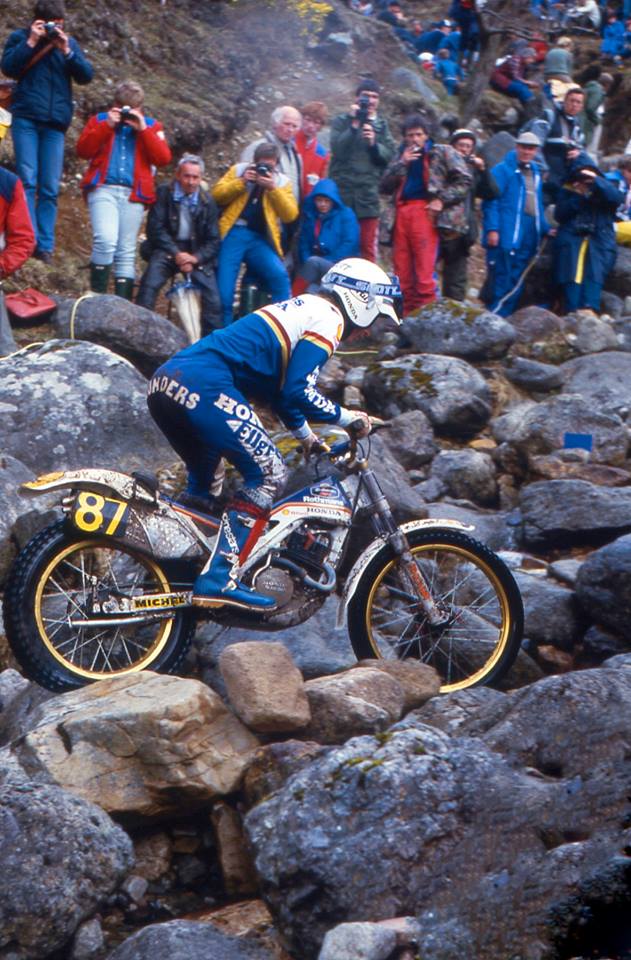
The 1987 Honda (HRC) RTL250S (actual capacity 270cc) of Eddy Lejeune (Belgium) seen in the paddock at the 1987 Scottish Six Days Trial in Fort William. The machine was maintained by mechanic and enduro competitor, Derrick Edmondston. The machine differed in many respects from the production version having a much more voluminous exhaust and single spar downtube frame and was also fitted with an oil-cooler. Lejeune came home in 3rd position on this machine losing 82 marks. The machine was registered in the UK by Honda Britain. Photo copyright: Donald Young, Stonehaven, Scotland UK.
The Premier Trial Website – Recording the History of the Sport 'Established 2014'
















 TRIALS GURU - DEDICATED TO TRIAL