Chris Milner Remembered

Chesterfield is a large market town in Derbyshire, England, and was home to trials and motocross rider Chris Milner, born on 1st January 1952, a quiet, extremely modest man who let his performances on a motorcycle speak for him. Chris passed away after a long battle with cancer on 25th September 2017, but before he succumbed to the disease he made some notes to enable his story in motorcycle sport to be told and recorded for the benefit of his family. This showed the courage of the individual and his desire to record his life as a sporting motorcycle rider for his children and grandchildren. His widow Ann Milner agreed to have his notes released to a wider audience, those who are motorcycle enthusiasts and the friends he made when competing in trials and motocross events over the years.

Words: John Moffat and the late Chris Milner

Photos: Colin Bullock

In the beginning:

“My interest in motorcycles started by my Dad taking me to scrambles almost every weekend since I was ten years old; I really wanted to be a scrambler. When I was 12 years old he bought me a 197 DOT to ride in our local wood. The DOT made way for an almost new Triumph Tiger Cub which we bought for £98. I started riding in trials from the age of 14 and managed to get a Saturday job with the then Ossa importer Eric Housley at his Clay Cross workshop. I sold the Triumph to buy a new Cotton 32A, and started getting results in the local club and centre trials.  Mick Andrews worked at Eric Housley’s and started to take me practising, and my results really improved. When the Ossas arrived I was given the use of a demonstrator model and really enjoyed the extra power. In 1969 I started to do a few nationals, and Eric entered me in to the Scottish Six Days Trial and the Hurst Cup Trial in Northern Ireland. Dave Thorpe left Triumph and started riding an Ossa for Housley; he lived locally and offered to take me to Scotland. This was to be a very interesting trip – two motorcycles in the back of Hillman Imp van with the back doors open all the way to Edinburgh!”
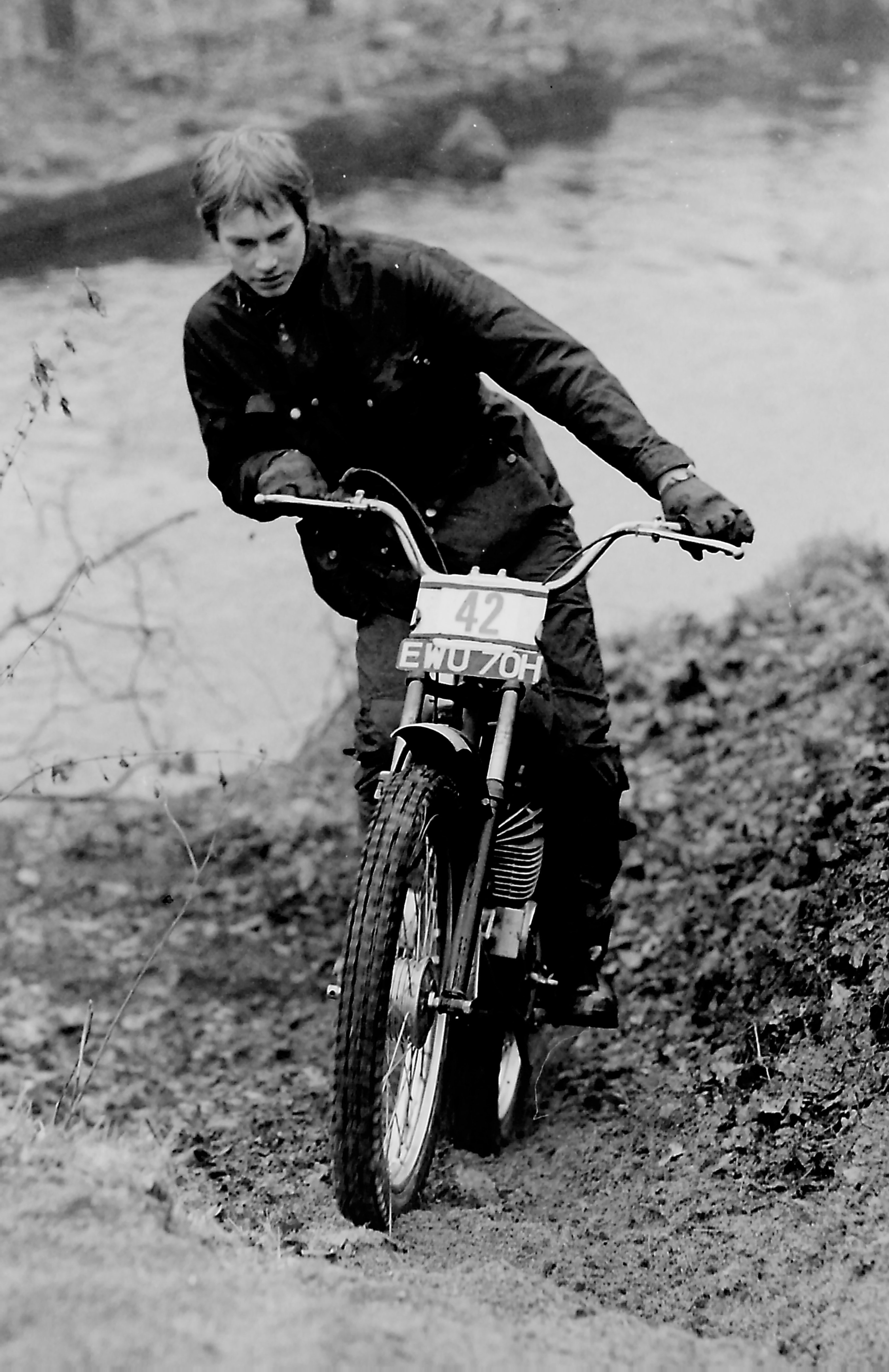
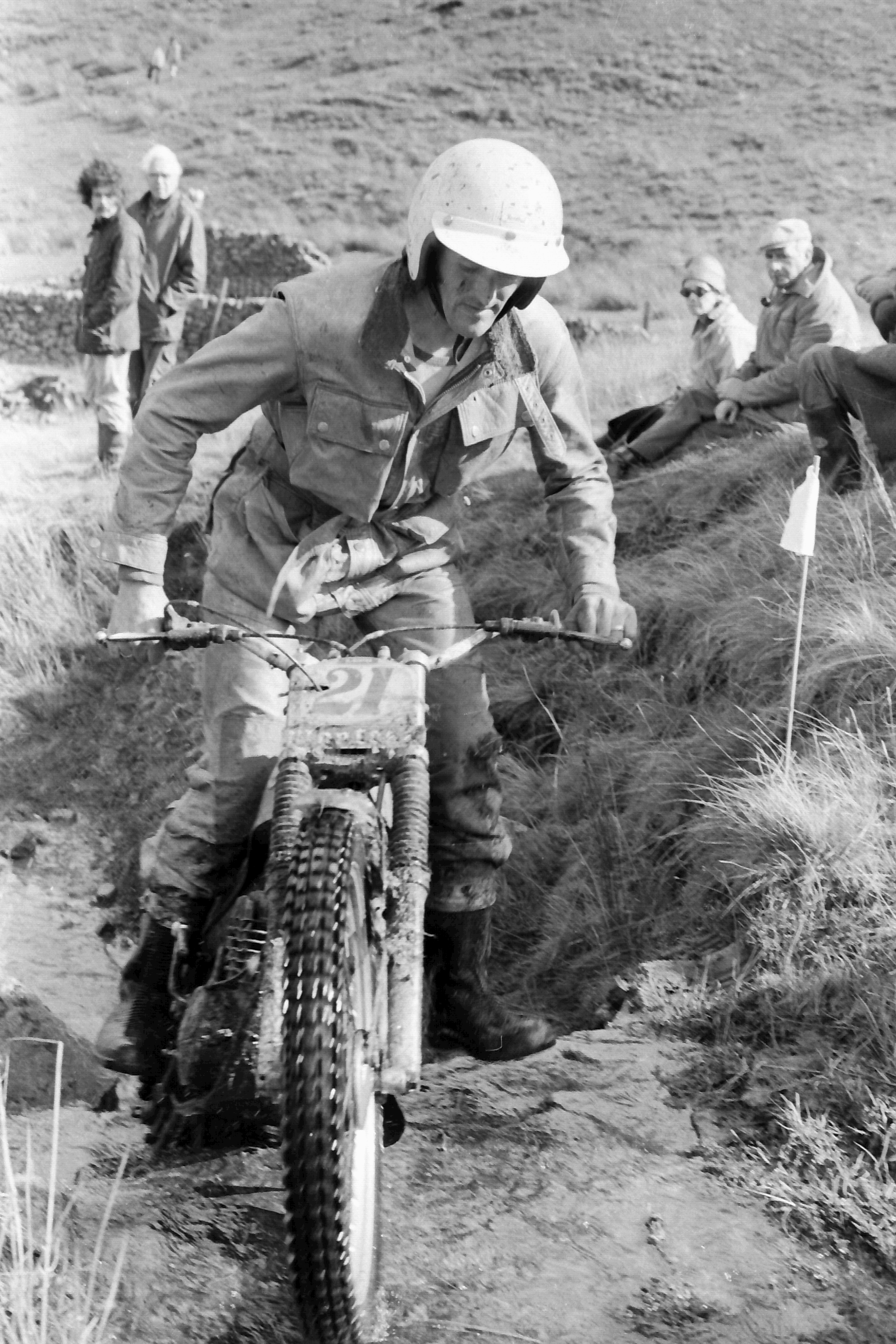
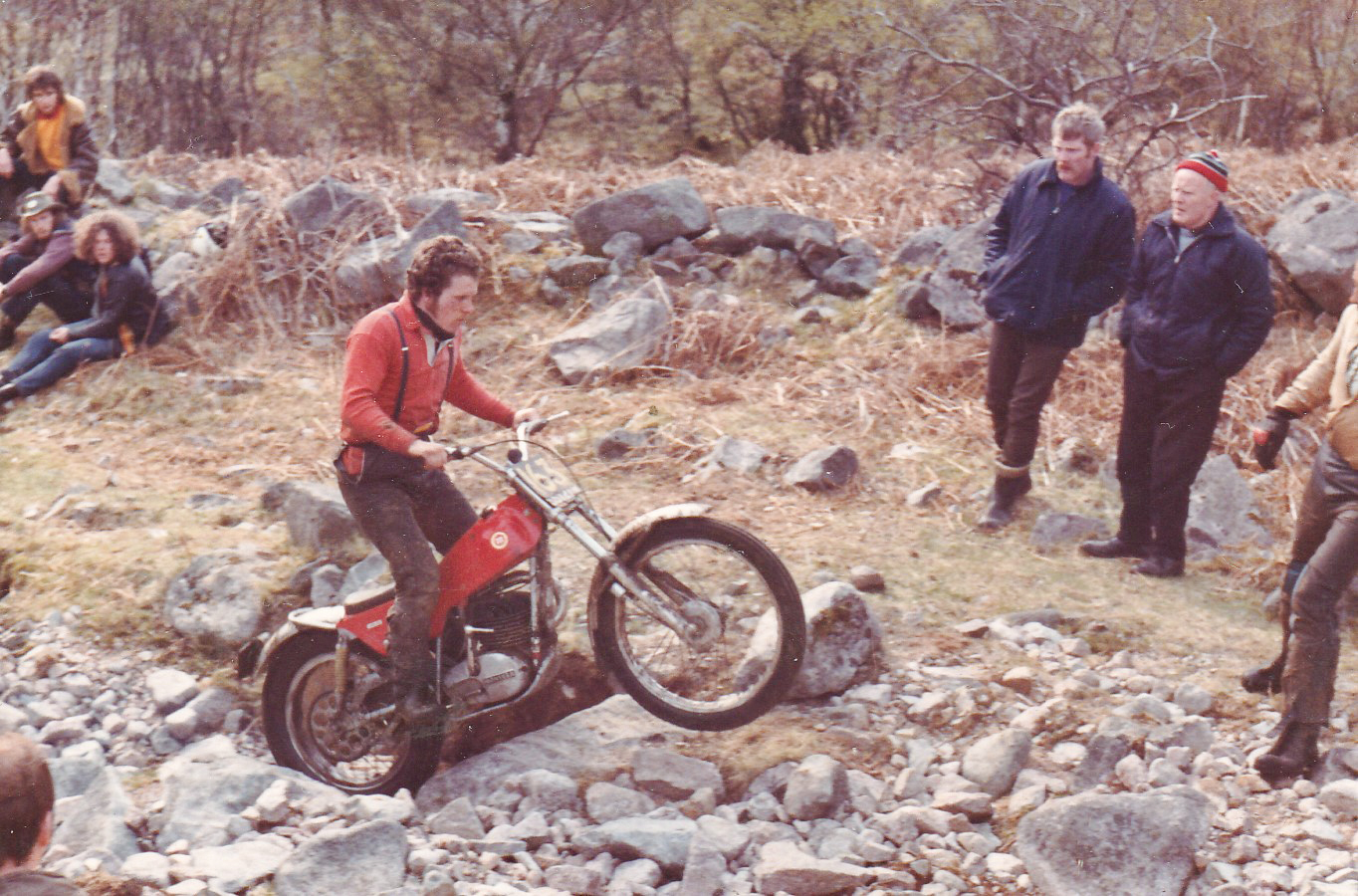
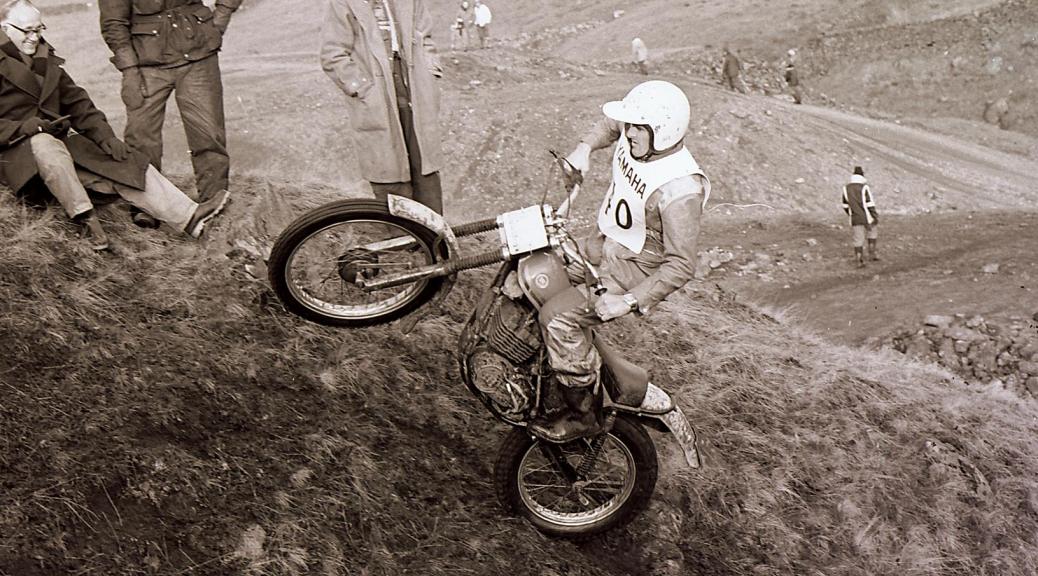
1970: On the Otley built 125cc Dalesman Puch on ‘Worsleys Wash’ in the Northern Experts Trial.

Romance:

Chris met his wife Ann by chance the same year, when he was 17 and Ann was 16 years old. Accompanied by a friend, Ann went to the Chesterfield supporting riders’ meetings to socialise. After a few meetings Chris eventually asked Ann out on a date but trials riding was still the main priority.

“In 1969 Dave Thorpe had a much earlier number than I did for the SSDT, so he arranged for me to go to the start at Gorgie Market with John Hemingway. Unfortunately my riding gear was in Stephanie Wood’s van and she had left to follow Dave over the Forth Bridge so I was left at the start with no riding gear or tools.  Luckily, other riders came to my rescue with their spare gear although some did not fit me very well. I somehow managed to finish the first day in second place behind Don Smith. The next job was to find my riding gear! I managed to track it down to the Station Hotel where a lot of the Yorkshire lads were staying. They bought me a few pints to celebrate my first day’s result, but I was not used to drinking. I was a bit rough the next day and my results slumped down to around 13th place, I ended up finishing the week in 50th position. I rode the Ossa again the next year in Scotland, finishing in 48th position. Around this time I also got to ride in my first scramble on an Ossa; unfortunately it ended badly, with me waking up in Darley Dale Hospital. When I eventually managed to persuade my dad to let me have another go, we bought a new 250 Greeves while still riding the Ossa in trials. Then Eric Housley lost the Ossa importership to Peter Fletcher and Alan Kimber, who had set up OSSA MOTO UK. I had to sell the Greeves as I had decided to concentrate on trials and so bought a new 250 Bultaco.”
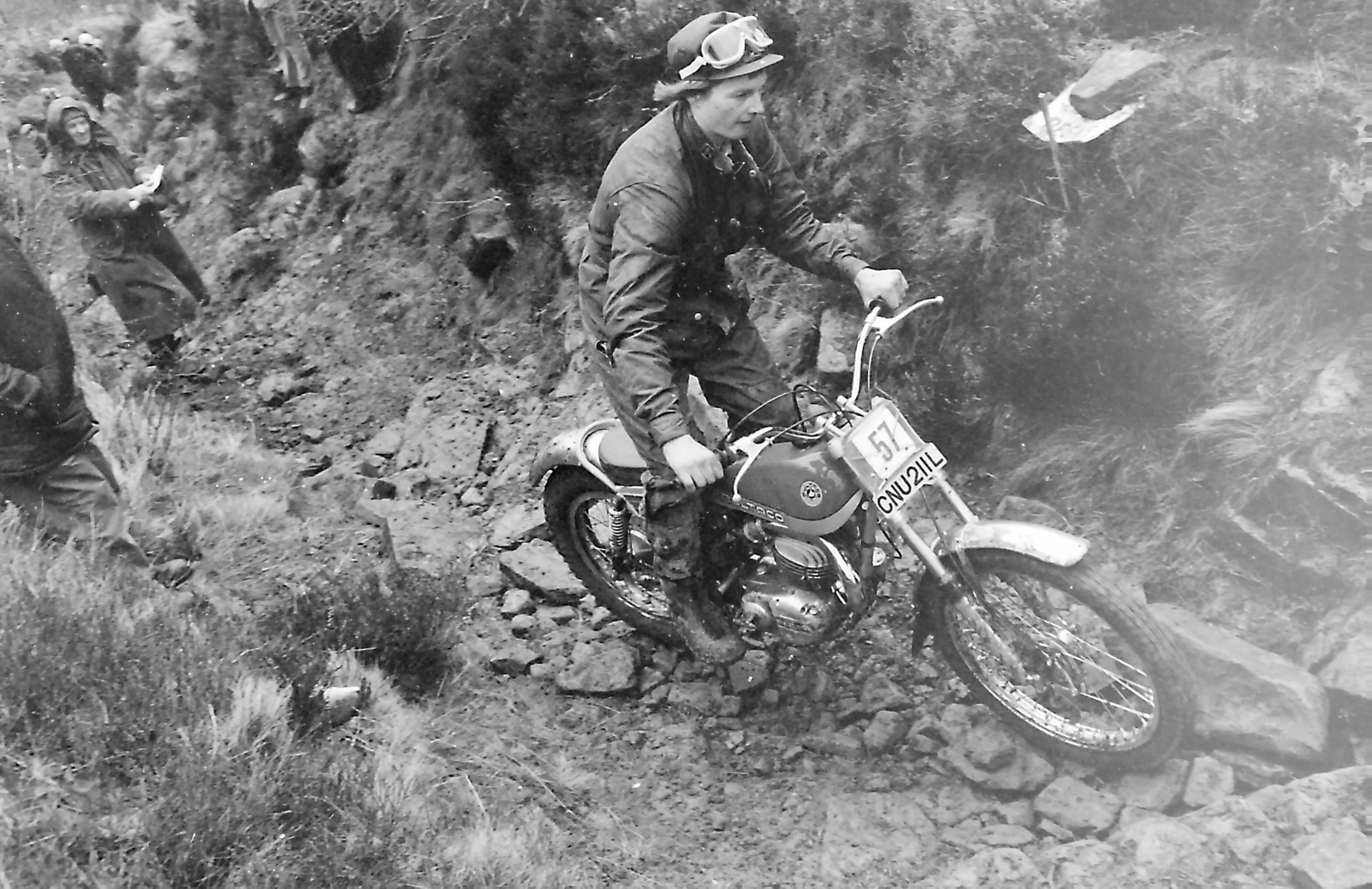
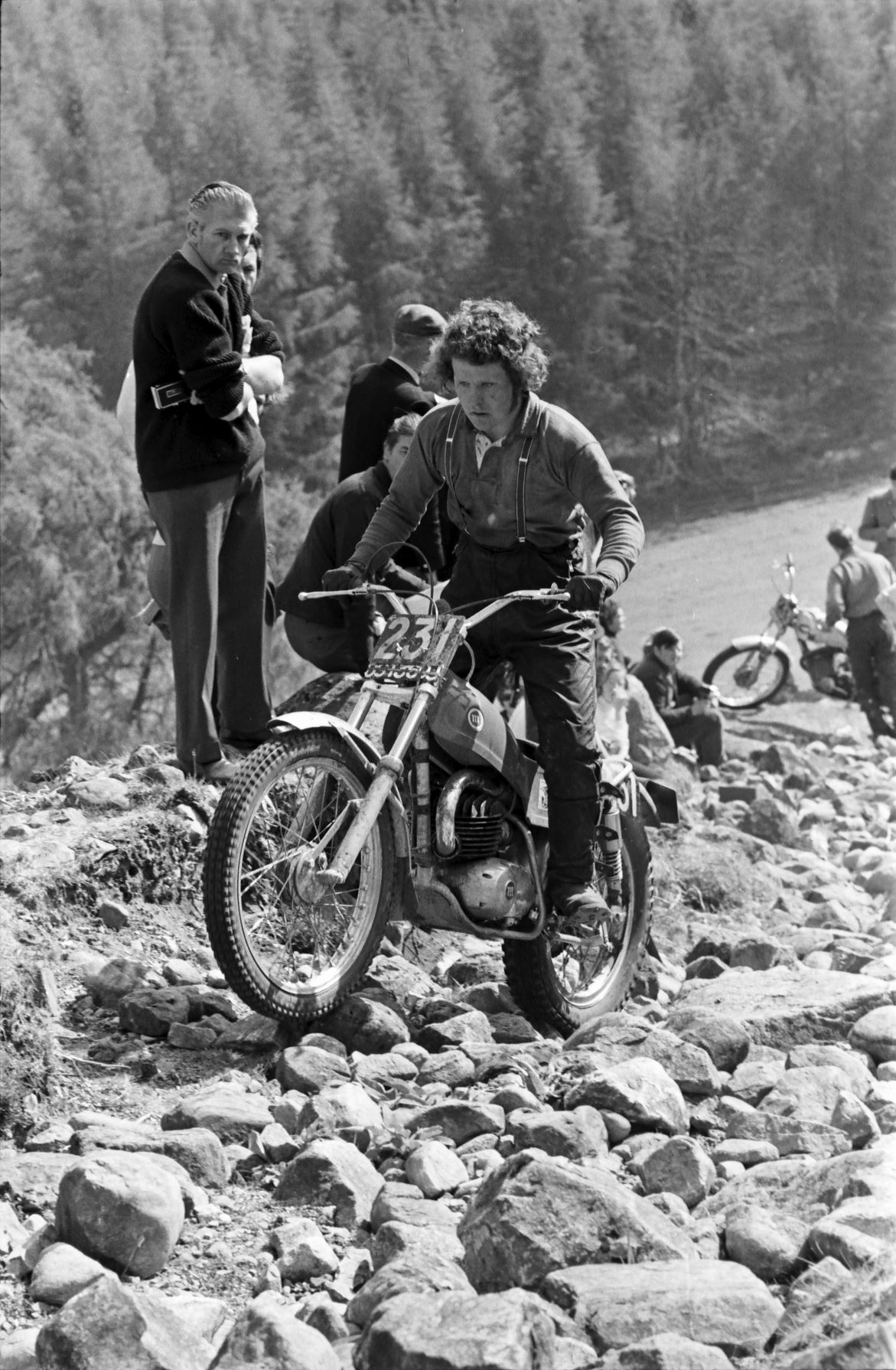
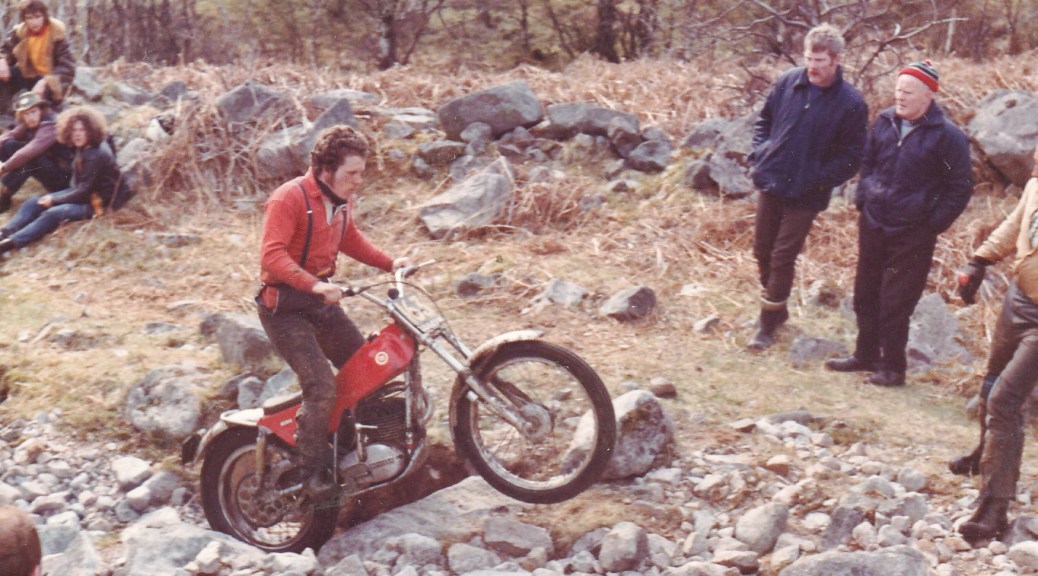
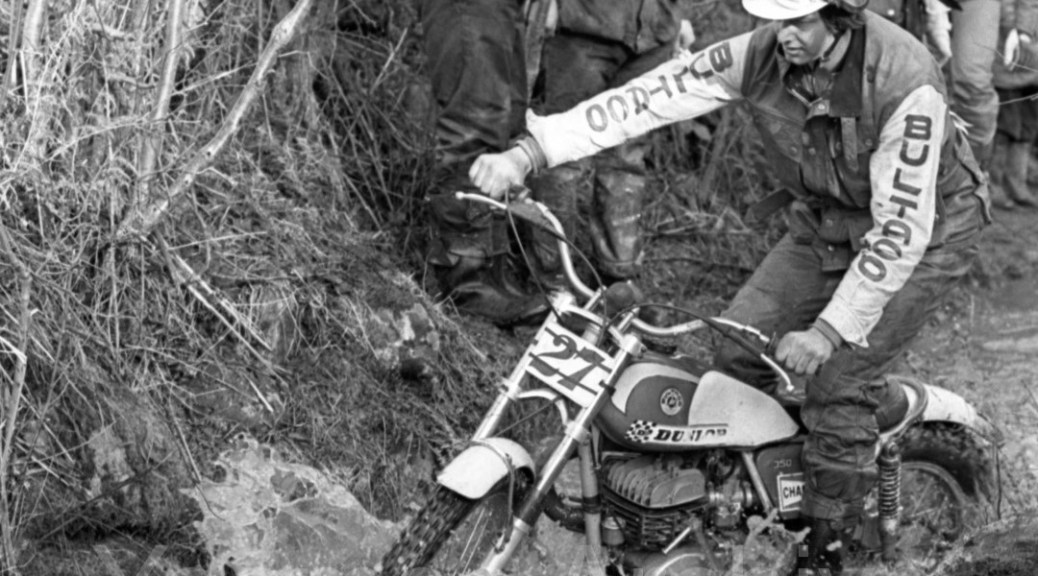
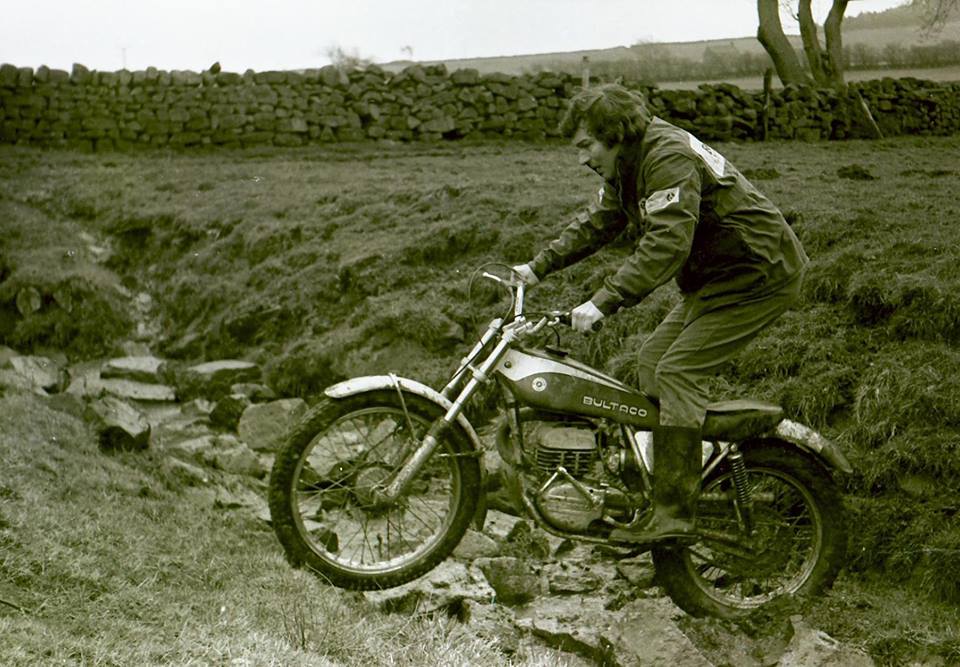
1972: In total control on the 250cc Bultaco on Hollinsclough during the Bemrose Trophy Trial.

“I began to get some good results in the nationals, which was when Comerfords got in touch and gave me a 325 Bultaco with sponsorship through Barrie Rodgers’ Derby motorcycle dealership.”
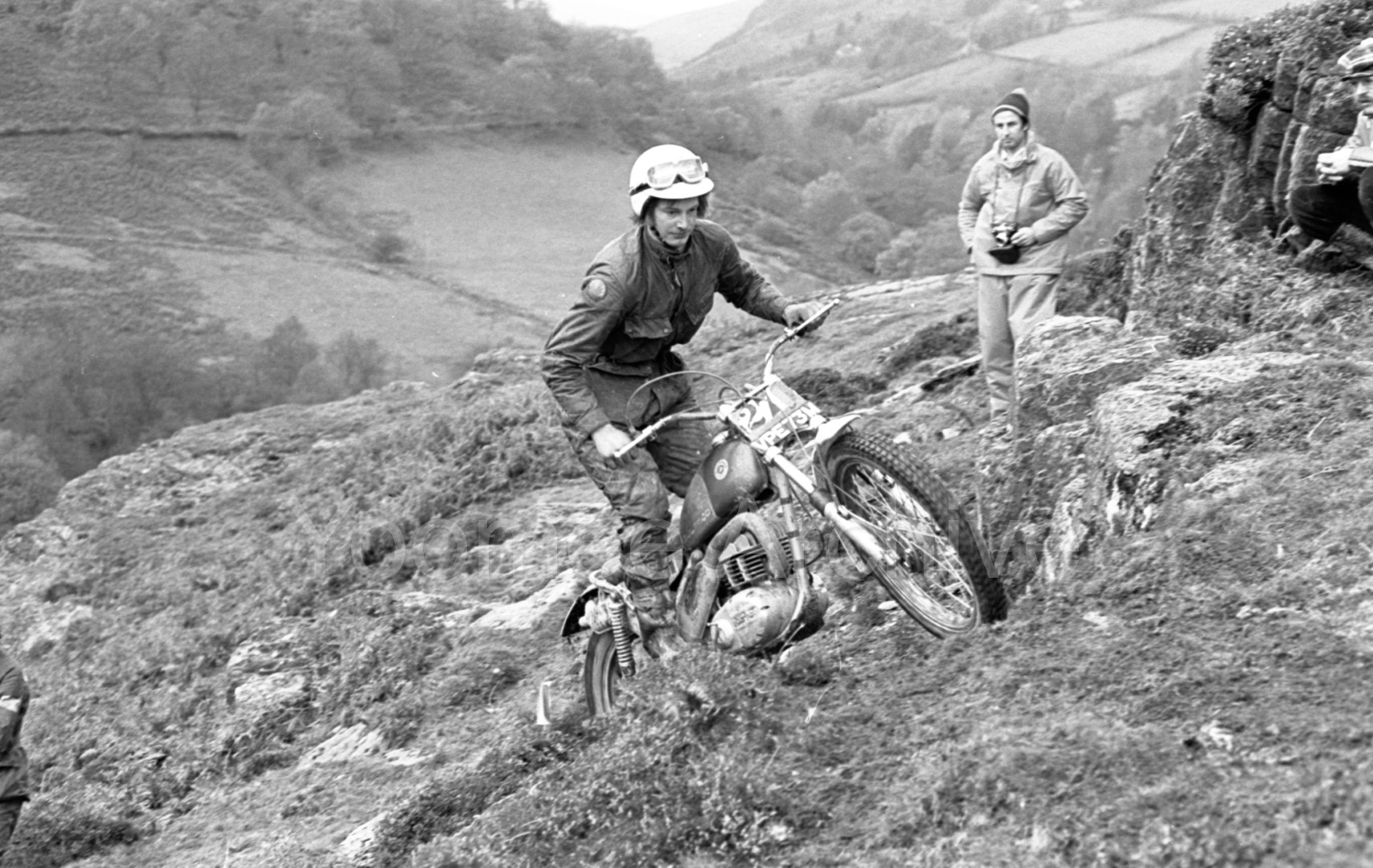
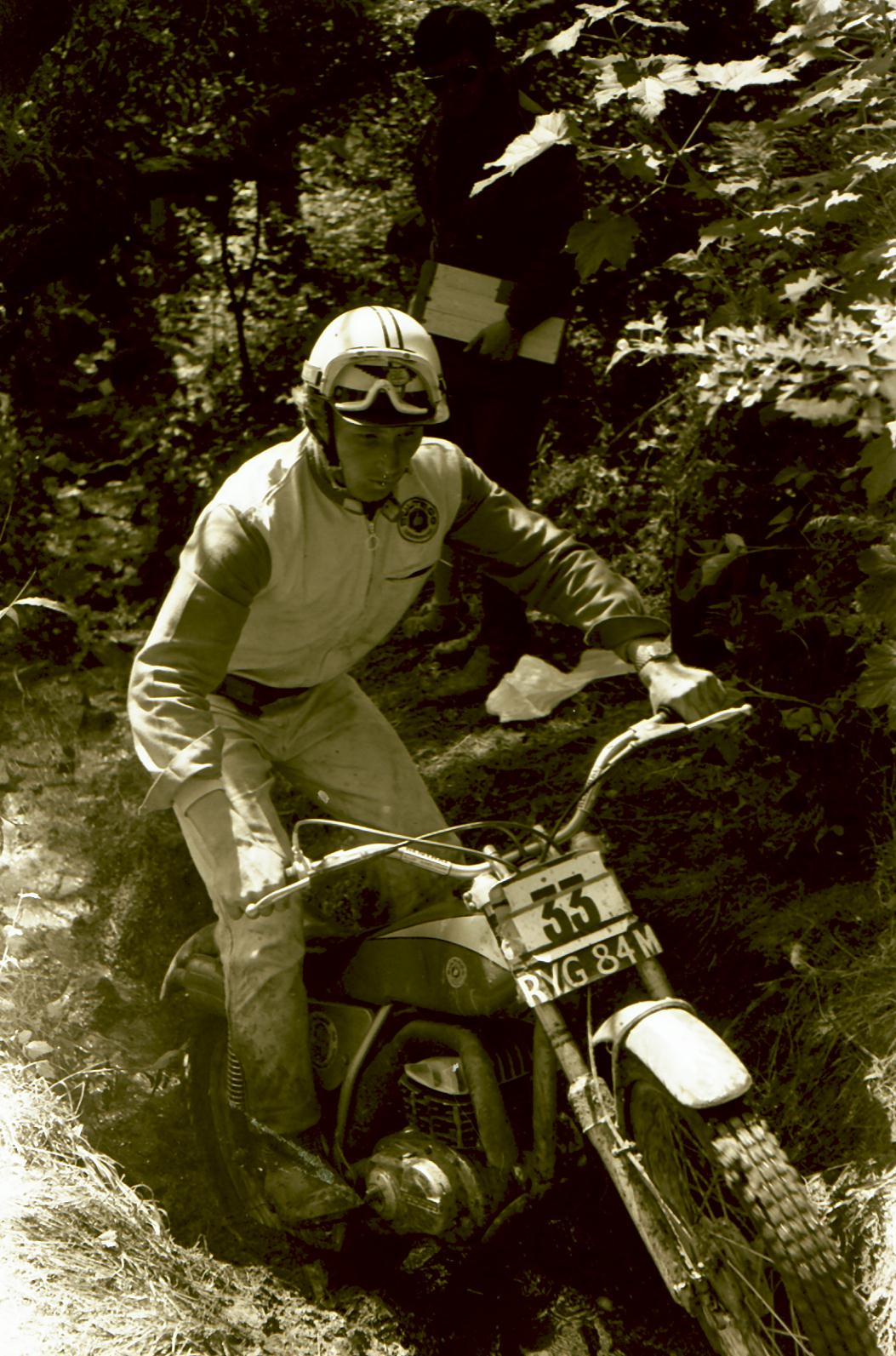
1974 at the British Experts on the Barry Rodgers supported, Comerfords supplied 325cc Bultaco Sherpa (Model 125)

“In 1975 I was lying in fourth place in the Scottish on the Friday when, going up the very steep ‘Caillich’, I fell and broke a bone in my left hand. Somehow, I managed to get the Bultaco down the hill and onto the Mamore road to ride back to Fort William. Jock Wilson took me to the hospital in Fort William, and they confirmed it was broken and put a pot on it. I took the pot off in the morning and managed to ride the machine back to the finish in Edinburgh but unfortunately dropped down to sixth place.”

Kawasaki Offer:

1976 Kickham Trial, Chris Milner on the standard 250cc KT250 Kawasaki

“The next year I was offered a Kawasaki. I was promised a machine the same as Don Smith but I only received the standard KT250 machine. I soon realised it was a big mistake, so I contacted Comerfords a week before the ‘Scottish’ and they agreed to give me a 250 Sherpa for the SSDT and I came home in 15th place. They followed that up with another 325 Sherpa after Scotland. Comerfords were incredibly good to me and gave me a new machine every six months; I also got a bonus payment for good results, funded by Shell, and I had my entry fee paid along with some expenses.”

Wedding bells:

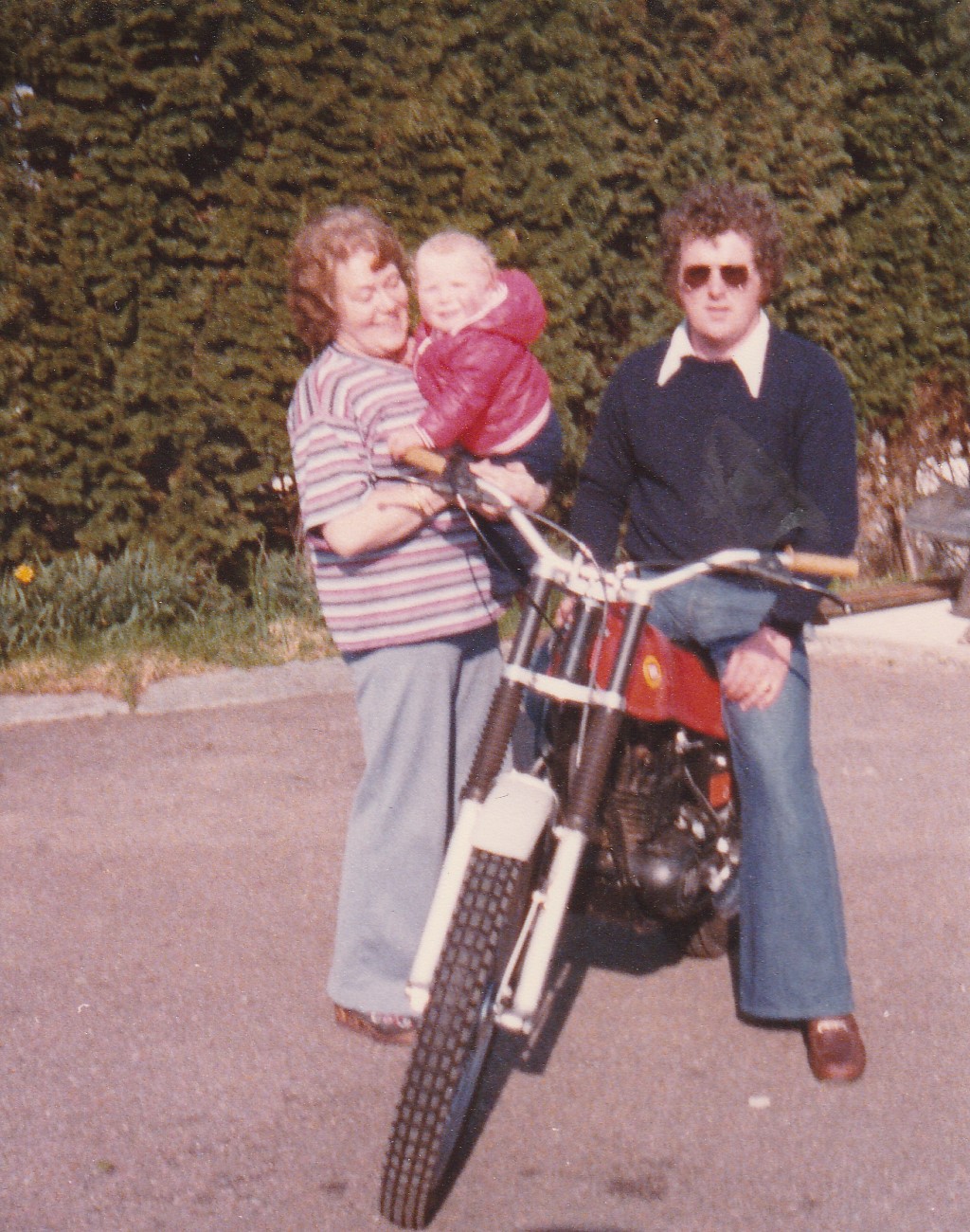
Chris and Ann married in 1976 after a two-year engagement.

“I started racing again and bought a new 250 Bultaco Pursang from Comerfords, and gained expert status in the East Midlands centre. In those days there was a meeting within a 60-mile radius of home every weekend, and the prize money was rather good too. I decided I need something a bit quicker and so I bought a 400 Maico. I was still riding for Comerfords in trials and they noticed I was winning a few centre meetings and so they sent me an ex-Vaughan Semmens 360 Pursang. It was a quick motorcycle but not as good as the Maico, but it was almost new with free spares thrown in.”
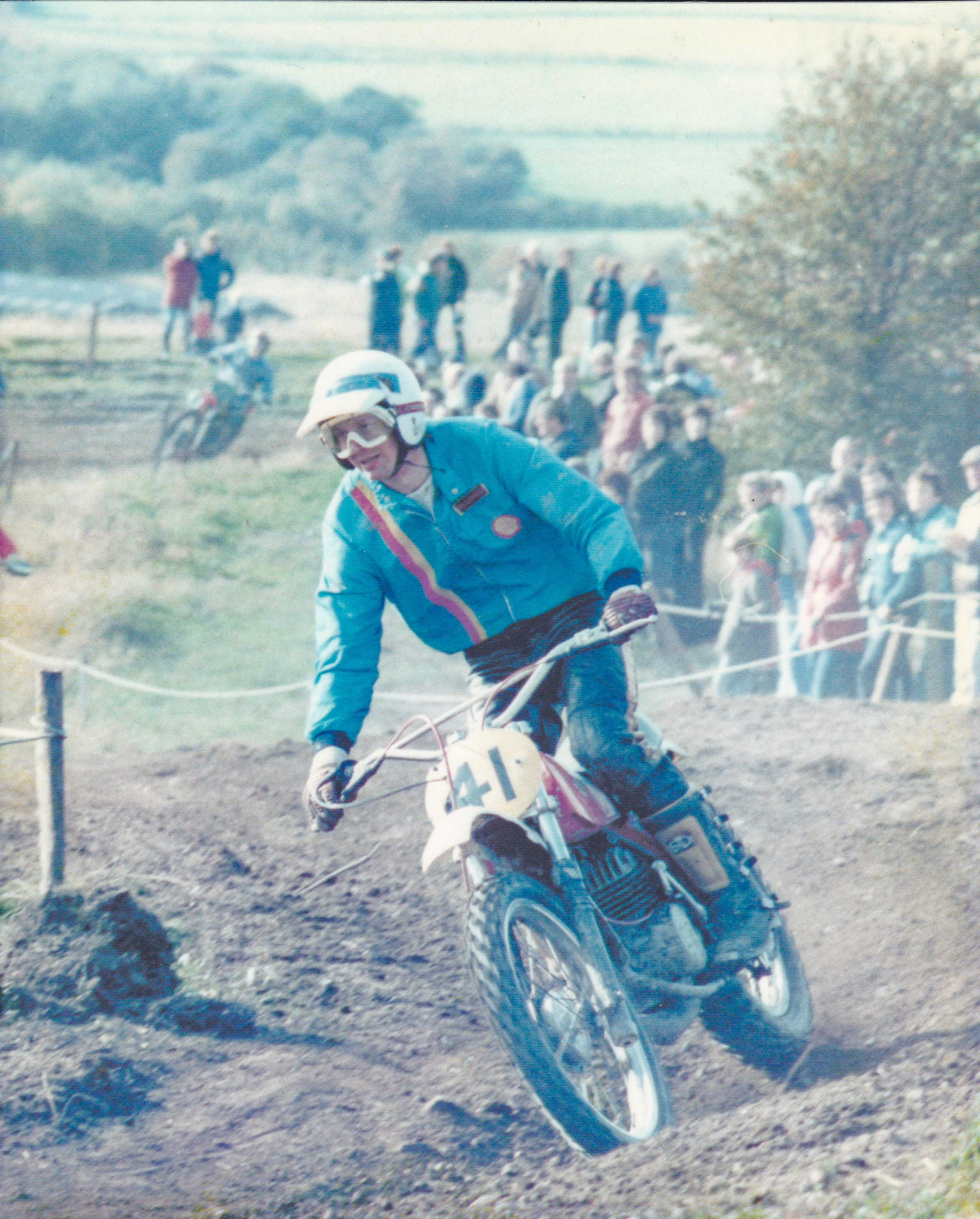
1978 motocrossing on the 360cc Bultaco Pursang

“In 1978 I decided to have a go at the East Midlands Championship in both trials and scrambles – luckily the meetings did not clash – and I won both that year. I managed a 15th position in the Scottish also the same year. I really enjoyed the Scott Trial, finishing 12th one year. I won four Scott spoons and was immensely proud to have finished both the Scottish and Scott Trials every time I entered.”

1979: Winning the Best 250cc award on the Comerfords’ Bultaco Sherpa Model 198A at the SSDT.

Patter of tiny feet

Ann gave birth to their first child, Karen, in 1978, followed by Debbie in 1980 and then Alison in 1987. “By 1978, Comerfords was importing KTM motocross and enduro machines and they arranged a sponsorship deal for me through P&S Motorcycles. I rode the KTMs for about four years, still with a deal through P&S. I rode Bultacos for about seven years for Comerfords then gave up scrambling to concentrate on trials.” 

Chris was now receiving support through a local dealer on Fantics in 1982 and he rode the SSDT on the 200 model in 1982, coming home in 35th place, and then the new 240 Fantic.

1981 – Under the umbrella, working on the Fantic 200 at the SSDT

“I then bought a Tiger Cub with the Pre-65 Scottish in mind. The first time I competed was in 1990 and I finished third, with Mick Andrews and Dave Thorpe on zero marks; I lost one dab on Pipeline. I entered most years from 1990 but unfortunately I did not have much luck in the dreaded ballot! I rode my last in 2016 and finished in 50th position, as I was not very fit after being in hospital for a month with Sepsis prior to the trial.”

:2016: Chris Milner rode his last Pre-65 Scottish, finishing in 50th position.

Grandchildren:

Chris and Ann were blessed with seven grandchildren, four girls and three boys. Their grandson, Jack, showed a keen interest in motorcycles from a young age. For Jack’s third birthday Chris bought him an electric OSET, which he loved. As Jack got older he often went cycling and attended the trials events with Chris. None of the girls really took an interest in motorcycles but they did enjoy supporting him whenever he rode. The couple’s last grandson was born in May 2017 and Chris was fortunate enough to have seen him for a few months before he died at the age of 65.

Results Do the Talking:

In a riding career that spanned almost five decades, Chris Milner won five Nationals trials including best performance and tied with Martin Lampkin at the ACU Inter Centre Team Trial. He competed 12 times in the Scottish Six Days Trial; twice on an Ossa, seven times on a Bultaco, twice on a Fantic and lastly on a mono-shock Yamaha TY250R. He came sixth overall in the British round of the World Championship at Congresbury, Bristol, in 1978. Chris is the only rider ever to have won the East Midlands Champion Trials and Scrambles in the same year – 1978.

Adrian Clarke 1979 British Trials Sidecar Champion and four-time British Experts sidecar winner 1977–80: “Chris was already a competitor in trials when I started road-based trials in 1969 on an Ossa Pennine. Ralph Venables dubbed him the next Sammy Miller. He had some very strong early results and he was also an incredibly good scrambler, and was the only person to win East Midlands trials and scrambles championships in the same year. Chris was a sheet metal worker and an excellent car body repairer. He was self-employed most of his working life. He used his fabrication and engineering skills to build some extremely competitive motorcycles over the years. He just seemed to be always around, riding locally when he stopped doing the big national events. A true enthusiast, a very nice guy, and it was a pleasure to have known him.”

Dave Thorpe on Chris Milner: “He was an exceptionally talented trials and motocross rider and I had to be on my game to try and beat him. We travelled to events quite a few times together, one particular time we travelled to the Scottish Six Days, when it started in Edinburgh. We stayed in a bed and breakfast where the landlady came across as being very prim and proper, but she took a shine to young Chris. The next morning at breakfast, which was a cooked ‘full English’, Chris had been given a rather runny egg. He said, “I cannot eat this”. I said “well, you’ll have to, or she will be offended!” Chris then opened a drawer and tipped the egg inside it! Another time we travelled to Ireland for the Hurst Cup, leaving our van at Liverpool. On the way to the boat I lost him but got on the boat with all the other riders, assuming Chris must have got on as well. During the journey I was called to the radio room; it was Chris. He had managed to get on the wrong boat and was on his way to Heysham!”

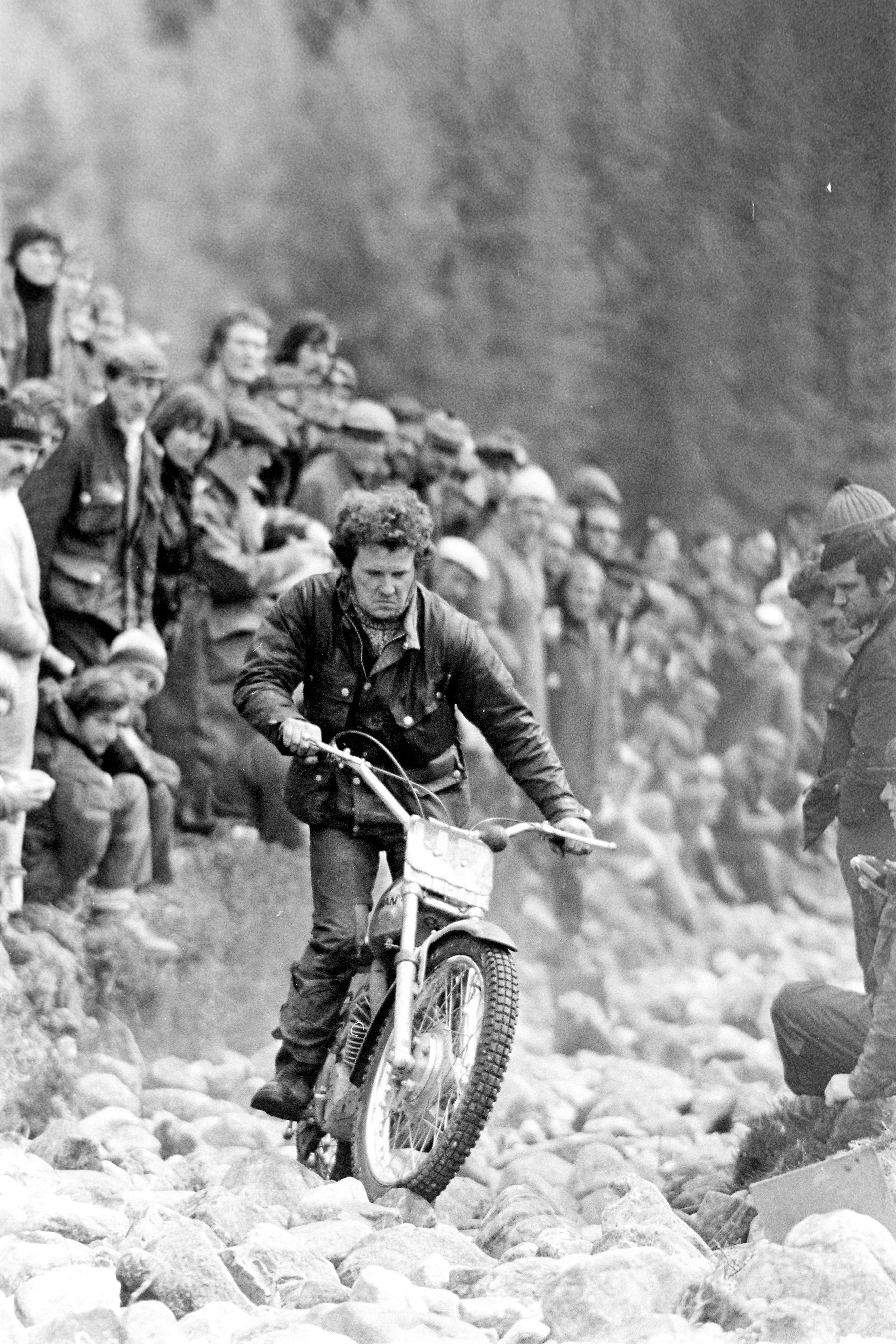
Chris Milner on the Eric Housley supported 250cc Ossa ‘Pennine’ seen here on Hollingsclough section of the Bemrose Trophy Trial in the Peak District in 1968.

Steve Wilson on Chris Milner: “Everything Chris did, he did well; everyone he met, he treated well; simply one of the nicest people you could ever wish to meet.”

We are left with fond memories of a quiet, unassuming man from Chesterfield that excelled at his chosen sports in off-road motorcycling, his results certainly spoke for him.
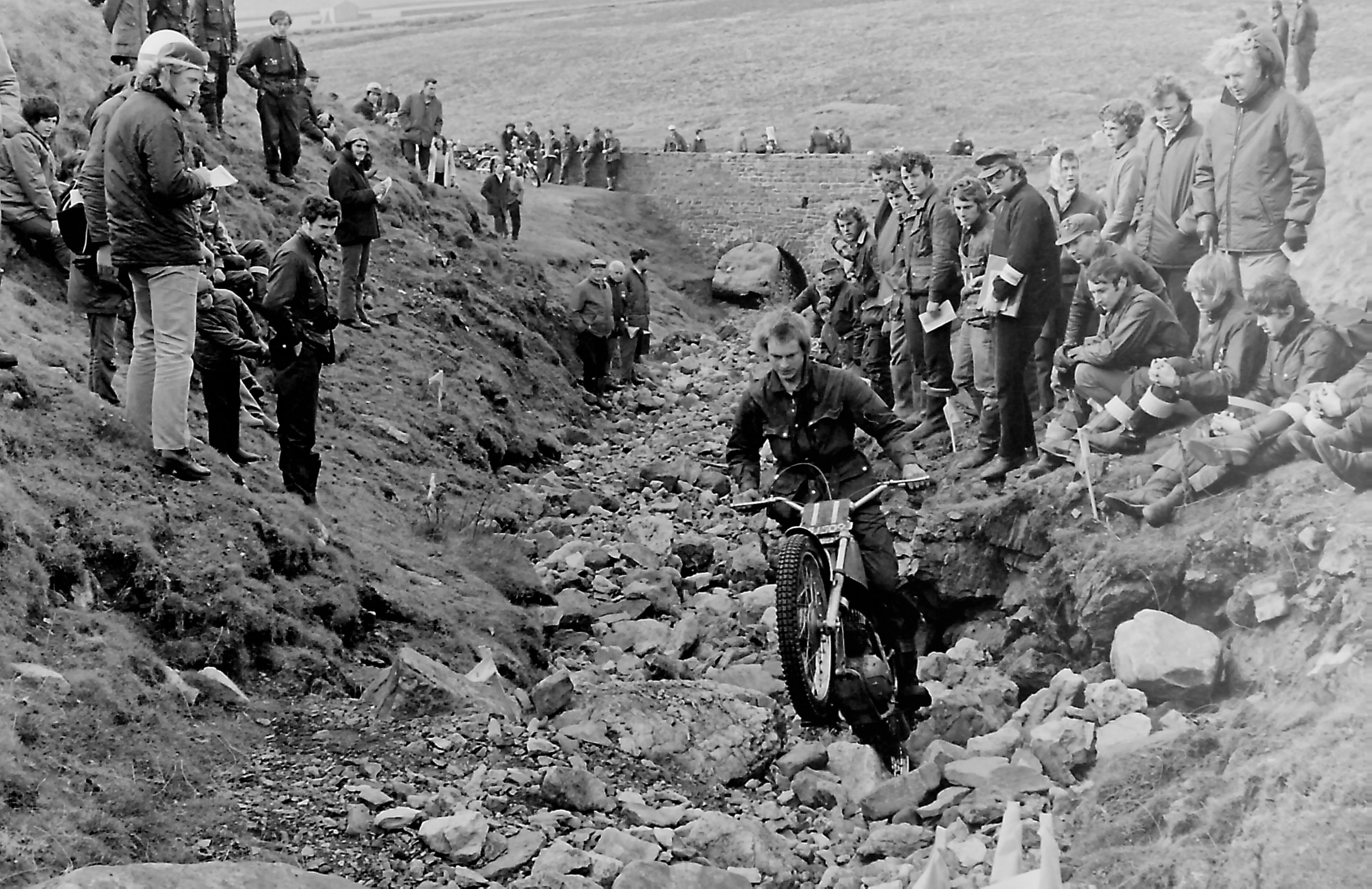
1971: Chris Milner riding against the clock at ‘Bridge End’ on the Cotton Minarelli in the Scott Trial.

Copyright: John Moffat/Trials Guru 2021.

Apart from ‘Fair Dealing’ for the purpose of private study, research, criticism or review as permitted under the Copyright, Design and Patents Act, 1988, no part of this article may be copied, reproduced, stored in any form of retrieval system, electronic or otherwise or transmitted in any form or by any means, electronic, electrical, mechanical, optical, chemical, photocopying, recording or otherwise without the prior written permission of the author as stated above. This article is not being published for any monetary reward or monetisation, be that online or in print.
Richard Sunter

1975 SSDT – Richard Sunter (247 Montesa) on ‘Garbh Beinn’ (Photo: Walker Brothers Archive).

The name Sunter in the world of motorcycle trials covers five decades of competition, which started with Richard and carries on into the present era with his two sons Mark, John and daughter Katy. Residing from what many term the home of trials, North Yorkshire, the farm at Healaugh is situated close to Reeth and is in the heart of Scott Trial country. It was this event back in 1968 that we first witnessed Richard’s name in the awards of this world famous event. Married to the sister of former Scott Trial winner, Philip Alderson and with daughter Katy married to Dan Thorpe, it’s certainly created a Yorkshire trials dynasty.

Words: Trials Guru; Richard J. Sunter

Pictures: Reiner Heise; Barry Robinson’s Estate with permission; Walker Brothers Archive; Kim Ferguson/Kimages.

Born in 1951 into a farming family which had no real interest in the sport, Richard J. Sunter, later to be known to all as either ‘Ritchie’ or ‘Sunt’ was to break the family mould at aged twelve when his Dad bought him a 150cc James three-speeder for four pounds and a replacement tyre which cost eight pounds, double the price of the motorcycle.

Richard was the first of his family to have a trials machine and has lived his whole life in the North Yorkshire Village of Healaugh, moving only a few hundred yards, “from one end to the other”.

Living on the back-door step of the Scott Trial, the event grabbed his attention as a young boy and he had to have a trials machine.

His first real trials motorcycle was in 1968, the Otley built Dalesman with the Austrian Puch 125cc four-speed motor, supplied by The Kart House at Darlington.

Richard Sunter:I didn’t really like it that much, my Dalesman had those spindly front forks from a Puch moped and to be honest Ray Sayer had a six speeder and it went much better than my model. I eventually bought the 250cc Cotton with the Villiers motor and got on much better with that, riding my first Scott in 1968”.

The Cotton was replaced by the 170cc Minarelli powered model, which was developed for the factory by Rob Edwards.

With Montesa making in-roads into the UK trials market in the late 1960s, it was inevitable that Sunter would sample the 247 Cota and really liked it. Rider/dealer, Norman Crooks at Northallerton supplied such a model and Richard was happy to remain on the marque for two years before obtaining support from Len Thwaites of TT Leathers on an Ossa MAR in 1972.

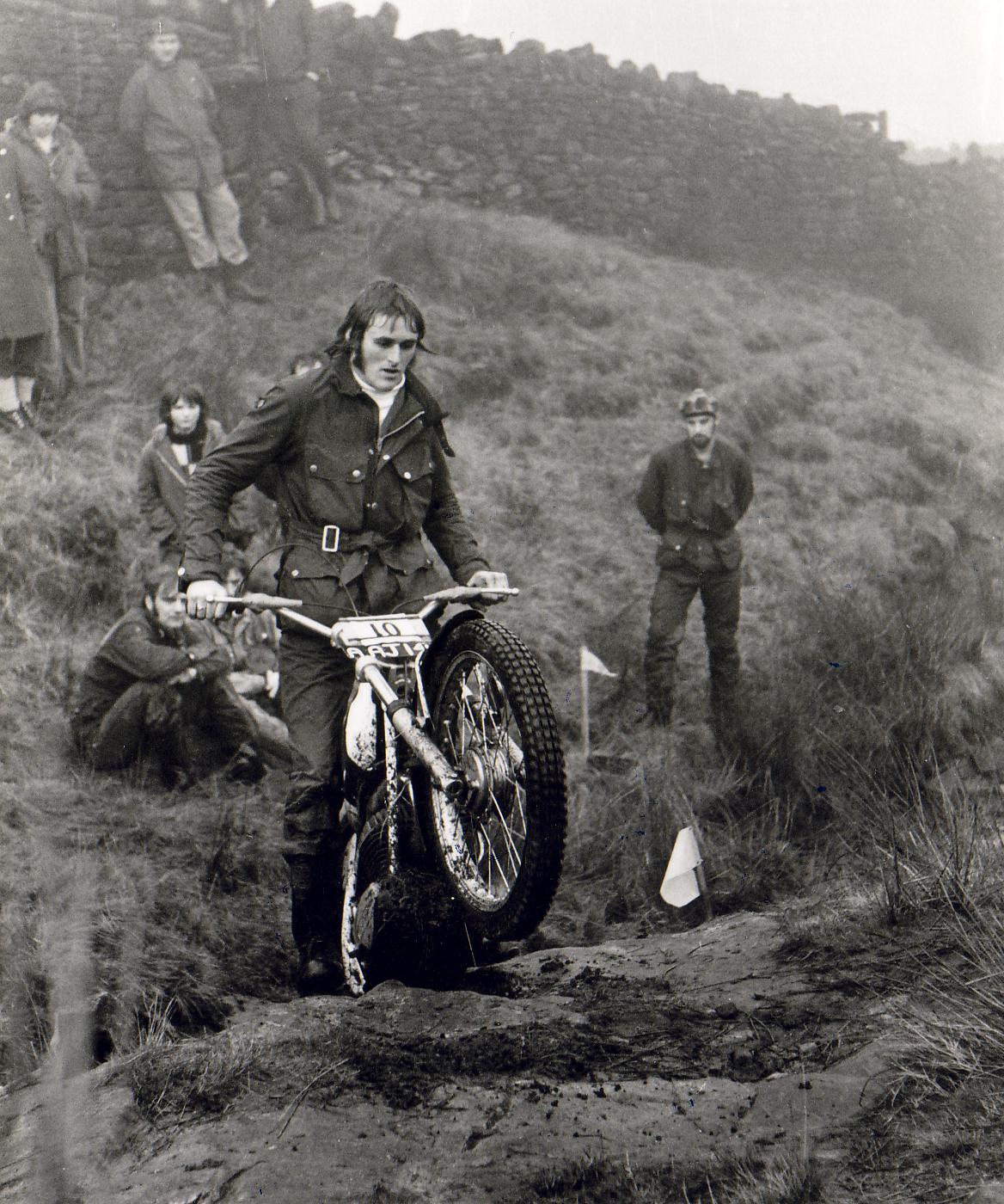
Richard Sunter on the 250cc Ossa MAR at the 1973 Timperley Trial, supported at this time by Len Thwaites of TT Leathers – Photo: Barry Robinson with permission.

Richard rode the 1972 Scottish on the Ossa and finished in a very creditable fifteenth position and best newcomer, losing 115 marks and took home the Albert Memorial Trophy for his efforts.

Sunter: That was when the Scottish started and finished in Edinburgh, it was a long haul on the road back then on the first and last days”.

Sunt became friends with Michael Alderson from Woodhall, near Askrigg. “Michael was a handy trials rider and keen to do nationals and we were good friends. I got to know his younger sister Angela, we started courting in 1976 and we got married in 1978. We all knew each other through trials, farming and the Aldersons being agricultural engineers”.

Richard and Angela Sunter have three children, John Richard who was born in 1980; Mark born the year later, and Katy who arrived in 1984. All three followed in their father’s footsteps by becoming trials riders in their own right. Katy of course married Dan Thorpe in 2015. This effectively created a trials dynasty in North Yorkshire with Angela’s younger brother, Philip Alderson part of the extended family of well-known trials riders.

Richard Sunter hasn’t changed much over the years and still sports an all year round tanned face due to his continued working on the farm, out in all weathers. He is a very modest individual who points out that he never won a national trial. However, the reader needs to appreciate that Ritchie rode against the very best riders in the world, at the top of their game and any number of twenty riders were capable of winning a national trial week in, week out.

Sunter:I was approached by Team Kawasaki Trials manager, the late Don Smith who was also their development rider. The first machine I had off Kawasaki was the 450 model, which was quite honestly a beast of a thing to ride. When I signed for Kawasaki, they had no motorcycles available for me to ride, so I rode my Ossa in the meantime and my expenses were paid by Kawasaki. I was never paid a salary, I was still earning a living from farming and they covered my travel expenses to nationals and European Championship rounds”.

Richard Sunter aboard the works 450 Kawasaki in a typical Yorkshire Centre event – Photo: Barry Robinson with permission.

The lime green coloured Kawasaki KT prototypes arrived three days before the 1973 Scottish Six Days and like most experimental machines, they required careful preparation for what was the toughest trial in the world. The team were still fettling them at the Gorgie Market on the Sunday weigh-in in Edinburgh on the cobbled roadways that intersected the market. His team mates were Mark Kemp and paratrooper, Jack Galloway.

‘Sunt’ posted a twentieth place overall in the 1973 Scottish, losing 137 marks and took home the best over 350cc award for his efforts, wrestling with the big bore machine and was the best performer of the Kawasaki team that year.

1975 SSDT on the 247cc Montesa Cota UKR on the Ben Nevis group of sections. – Photo: Rainer Heise

With production planned of the KT ‘Kawasaki Trials’ model, Richard received his pre-production 250cc machine from the factory in August 1973. Two months later, on October 2nd, he came home in second place in the Scott Trial, this was to be his best Scott result finishing second behind Bultaco’s Malcolm Rathmell.

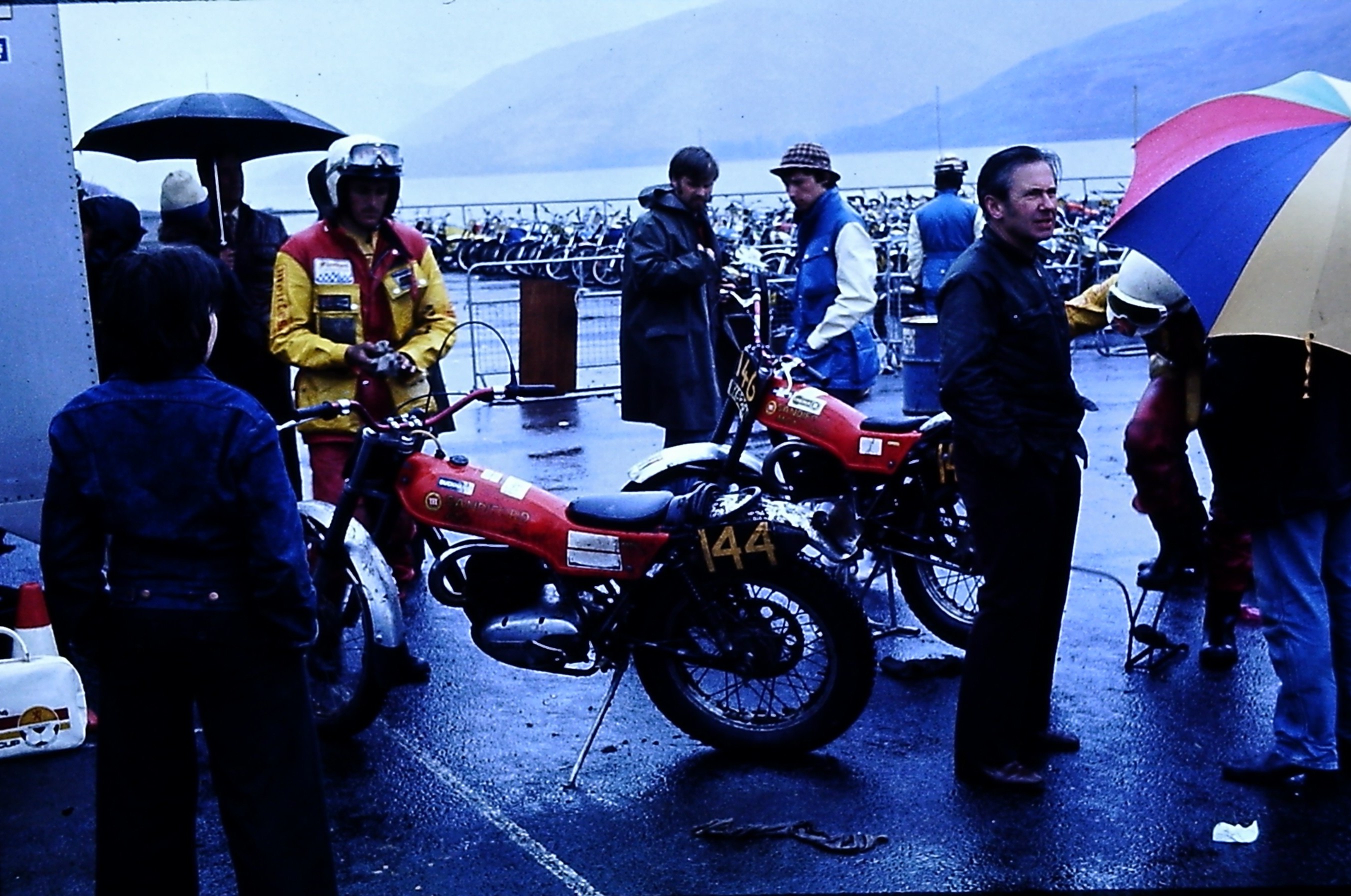
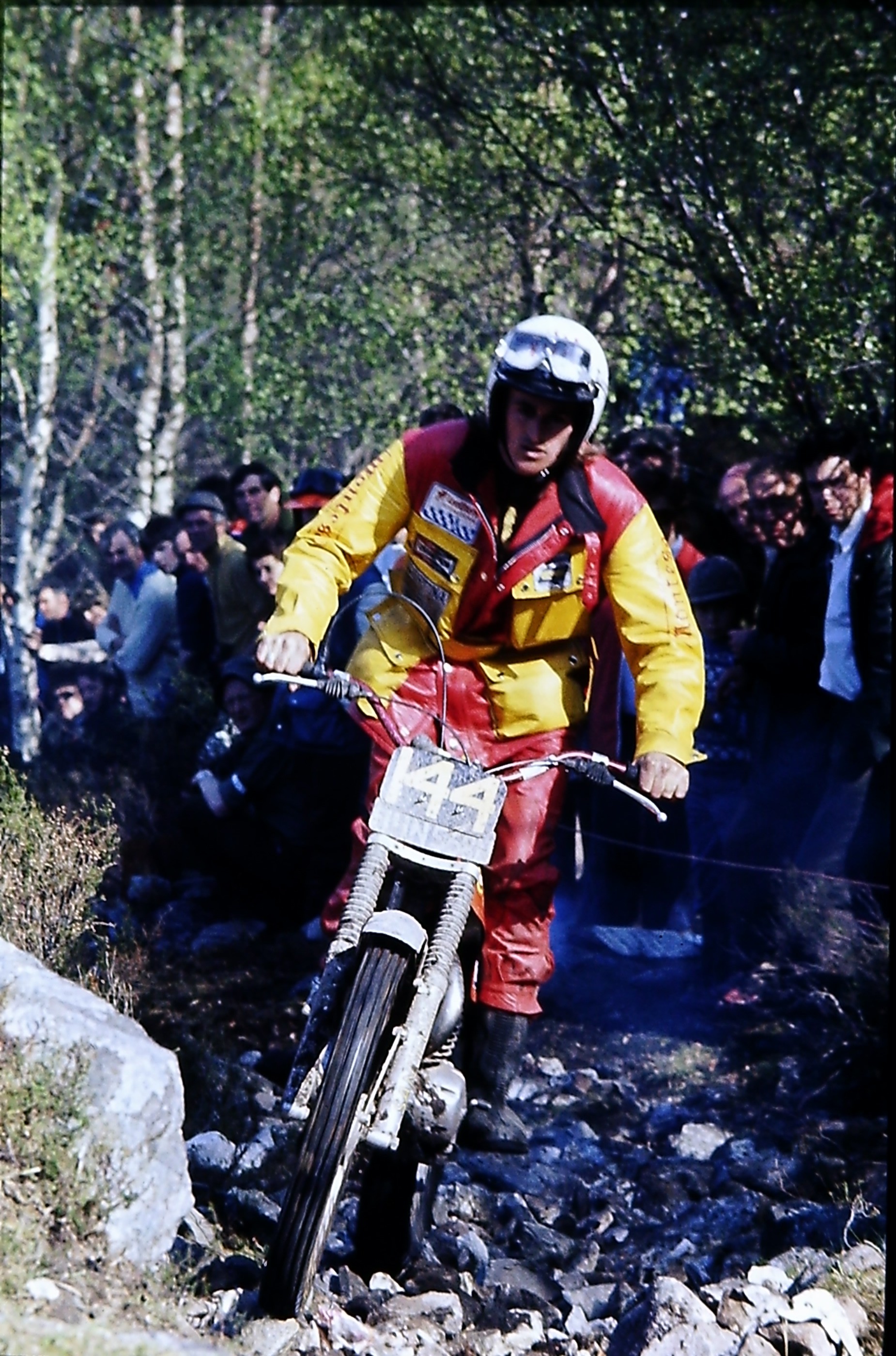
1975 SSDT – Richard Sunter (144. Montesa 250) Photo: Walker Brothers Archive.

Richard enjoyed riding the Montesa Ulf Karlson Replica 247 model which appeared in 1975 after the he left the Kawasaki factory team having enjoyed two seasons on the ‘green-meanie’. The Montesa was provided by Jim Sandiford, the Montesa importer and this relationship lasted up until 1977, by then Richard was riding the 348 model for Sandifords. This was the year of the inaugural World Trials Championship and Sunter took part.

Richard Sunter on the 348 Montesa at the 1978 White Rose Trial – Photo: Barry Robinson with permission.

At the early season Hurst Cup, he posted a seventeenth place and in that years’ Scottish a nineteenth place.

Richard Sunter is listed for posterity as winning fifteen Scott Silver spoons and is classified as a top spoon winner with other famous names in the trials world.

1979 Northern Experts on the 349 Montesa – Barry Robinson photo with permission.

With farming being an all-consuming occupation, time came at a premium for the Sunters and trials riding had to take a back seat from 1977 onwards, such were the pressures of being self-employed.

Sunter: I didn’t give up completely, back in 1971 I did a bit of scrambling on a 1969 side-pipe CZ that I traded for a trials machine for a bit of the fast stuff, which I enjoyed when time allowed. I still have the CZ and Mark has ridden it a few times in classic scrambling. I recall racing it at Pickering and one of the North East events near Doddington, but trials were my true love really, I still like to do my bit as it were”.

Richard has indeed maintained a strong interest in the sport by helping the Richmond Motor Club and in particular their Scott and Reeth Three Days events. His favourite piece of ground for marking out is beyond By-Pass and for many years was in charge of route-marking the Scott onto the moors there.

Sunter:I usually inherit Katy’s cast off Gas Gas machines which allowed me to get some bike-time in which I still enjoy”.

Katy Sunter (GasGas) on Fersit – 2016 SSDT – Photo: Kimages

Richard Sunter was one of those riders who competed with the very best of that era, which included the Lampkins, Rathmell, Hemingway, Edwards, Andrews, Shepherd and just about anyone else who made up the who’s who of trials in the days when British riders were the force to be reckoned with in European and then World class events. His place in the history of trials is assured.

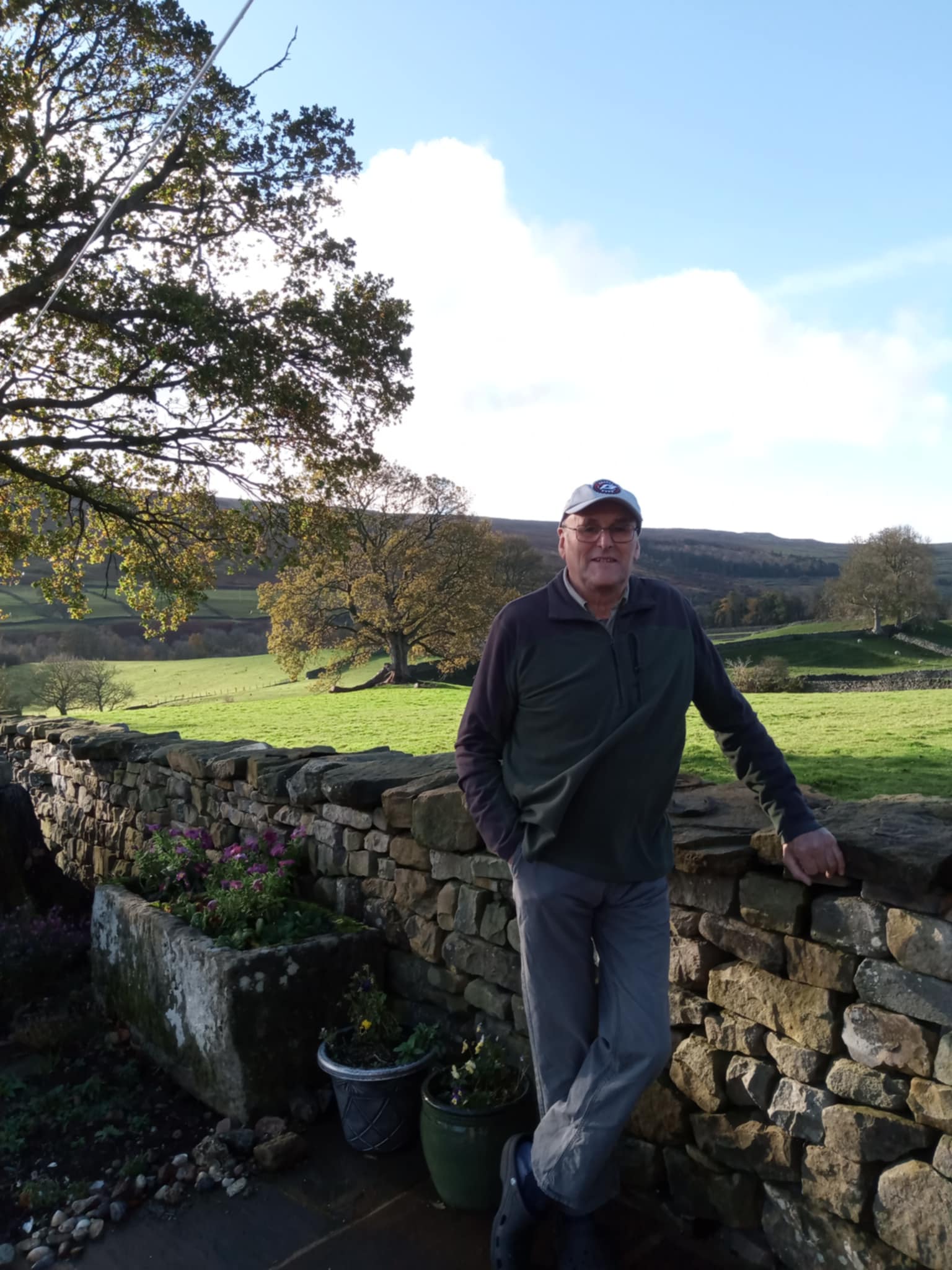
Richard Sunter is a Trials Guru ‘Trial Legend’ pictured here in the heart of Scott Trial country, North Yorkshire, England.

‘Richard Sunter’ is copyright: John Moffat/Trials Guru 2024

Photographic Copyright: is retained by the photographers named in captions above.

You are reading this article for free:

Apart from ‘Fair Dealing’ for the purpose of private study, research, criticism or review as permitted under the Copyright, Design and Patents Act, 1988, no part of this article may be copied, reproduced, stored in any form of retrieval system, electronic or otherwise or transmitted in any form or by any means, electronic, electrical, mechanical, optical, chemical, photocopying, recording or otherwise without the prior written permission of the author as stated above. This article is not being published for any monetary reward or monetisation, be that online or in print.
Rodger Mount

FORT WILLIAM’S FINEST

John Moffat: – For a few years now I have been pestering a resident of Fort William to tell me about his trials riding days. Initially this fell on deaf ears – all the excuses were dragged out, such as “I have a terrible memory” and “nobody will remember me riding now”.

I was undeterred, however; this man had been the Best Scottish Rider in the Scottish Six Days Trial in 1971, 1972 and 1974, I had to get his story.

Finally, during a vacation at the luxury accommodation at his Fort William establishment, I wore him down over a perfect breakfast one morning.

The proviso was that if he gave an interview, I had to be finished by eight o’clock at night as he is an early riser.

Lochaber in North West Scotland has produced many fine trials riders over the years, and also several Scottish Trials Champions. This is possibly due to the Scottish Six Days Trial being run on their doorstep, where the terrain ensures a steady supply of ground to hone trials riding skills.

One such man is Rodger Charles Mount.

Words: John Moffat & Rodger Mount

Photos: John Moffat/Trials Guru; Alistair MacMillan Studio, Fort William (permission of Anthony MacMillan); John MacDonald, Fort William; The Mount Family, Fort William; Eric Kitchen; Iain Lawrie, Kinlochleven.

Rodger Mount (247cc Montesa) on Loch Eilde Path in the 1972 Scottish Six Days.

Born in the March of 1951 in Inverness and raised in Fort William, Rodger was the oldest son of Charles and Elizabeth Mount. Rodger’s mother and Farquhar ‘Fachie’ MacGillivray were siblings, which makes Rodger Mount and Alastair MacGillivray, who was Scottish Trials Champion in 1974 and 1979, first cousins. Rodger was the oldest of three brothers, followed by Kenneth and the late Colin Mount.

Royal Marines:

The Commando Memorial at Spean Bridge, “In memory of the officers and men of the commandos who died in the Second World War 1939–1945. This country was their training ground.”

Rodger’s father, Charlie Mount, and business partner to be Mike Beacham, arrived in Fort William as Royal Marines in 1939 at the outbreak of the Second World War. Charlie was brought up in Birchington, near Margate, Kent and was a time-served bricklayer, as was Mike Beacham. Originally deployed on the Orkney Islands, when the commanding officer realised both men had a trade they were directed to the engineering deployment and began laying the foundations for the Army Nissan huts and buildings at Achnacarry Castle, the home of the famous ‘Commandos’ from 1942, based in Lochaber, which was to be their training ground. Most of the big houses in Lochaber were commandeered by the British Army for Commando training, including the ‘secret’ base at Inverailort Castle, close to ‘Piper’s Burn’ and the home of Mrs Cameron-Head, a supporter and landowner of the Scottish Six Days in later years.

Charlie Mount struck up a friendship with Mrs Cameron-Head, doing building and renovation work on her property after the war years in exchange for shooting rights on her property. When the war had ended, both Beacham and Mount had met their intended spouses in Fort William so they returned to make their home and livelihoods in the Lochaber town. They formed their builder’s partnership, ‘B&M’ – Beacham & Mount, which lasted for several years until Charlie Mount decided to go on his own and formed ‘Modern Builders Limited’ who had their base in Fort William’s North Road.

Schooling:

Young Rodger was to be educated at Fort William Primary and Lochaber High schools.

Mount:I couldn’t really be bothered with school, I wanted to leave as soon as I could; so at fifteen, I packed in school and began a bricklayer’s apprenticeship with my father’s firm, Beacham and Mount in Fort William.” Rodger worked hard at his apprenticeship and by the time he was ‘time-served’ he could lay up to one-thousand bricks or three-hundred blocks per day, and made a good living out of it.

Modern Builders Ltd yard in North Road, Fort William – Photo: John MacDonald, Fort William Collection.

First Taste of Off Road:

When he was fourteen and still at school, Rodger and his good friend Alister ‘Queerie’ Weir were allowed to take turns riding around on Ali McDonald’s BSA C15T at the back of McDonald’s shop in Alma Road. McDonald was, along with his brother Hugh, an accomplished trials rider and had ridden the Scottish Six Days many times with their friend Ron Thompson. Rodger was quite taken with the little BSA and reckoned he could get good at this trials lark, so at the age of sixteen he bought a 250cc Greeves from local rider K.K. ‘Kimmy’ Cameron in 1967. He can’t remember exactly which Edinburgh-organised trial that he first entered, but he did pick up the ‘Best Novice’ award at his first attempt. At the next event he took the ‘Best Non-Expert’ award and soon rose to the ranks of a ‘Scottish Expert’. He learned his craft on the Greeves but soon needed something a bit more up to date.

Rodger Mount on his first trials machine, a 250cc Greeves bought from friend, K.K. ‘Kimmy’ Cameron. – Photo: Mount Family Collection.

Rodger was becoming a more forceful rider; being a bricklayer kept him physically fit and he was as strong as an ox. He was stockily built and was a rider who took charge of his machine. He favoured the state-of-the-art ‘knees bent outwards’ style of riding similar to Malcolm Rathmell. Mount was known to throw himself around on top of his machine to maintain both balance and forward motion, and refused to take a dab unless absolutely necessary!

Practice Makes Perfect:

Rodger had joined the local Lochaber and District MCC, and his eye was firmly set on riding the big local trial, which of course was the Scottish Six Days. He entered the 1969 event, aged 18, on a new 247cc MK1 Montesa Cota and was issued with riding number 112. The Montesa was bought for Rodger by his father, who had taken a keen interest in his eldest son’s sport. The machine was supplied by Donald Buchan of Perth and registered LES711G.

Rodger Mount on the first of his 247cc Montesa Cota machines in the 1969 Scottish Six Days Trial – Photo Alistair MacMillan Studio, Fort William

Mount:I had a new machine every year without fail; that way you had less effort to keep it running spot-on and I had a good wage packet from working for my father. I practised a lot back then, in fact I was never off the motorcycle, they were well used. Starting in 1968, for three years we had sixty council houses to renovate for Highland Council in Kinlochleven.”

Rodger Mount on the first of his Montesa Cotas at a Scottish national trial in 1969.

I would ride the trials machine from Fort William over the hills and Mamore Road to Kinloch, timing myself for the journey. Then at lunch time I would go practising on some sections near the village, then ride home again at dinner time, then go out for another hour on some sections near the house after dinner.

Rodger found the handling and power characteristics of the Montesa Cota much to his liking and far superior to his second-hand Greeves. His first SSDT was uneventful but disappointing, as he failed to finish.

1970 SSDT on the 247cc Montesa, Rodger Mount tackles ‘Pipeline’ – Photo: Alistair MacMillan Studio, Fort William.

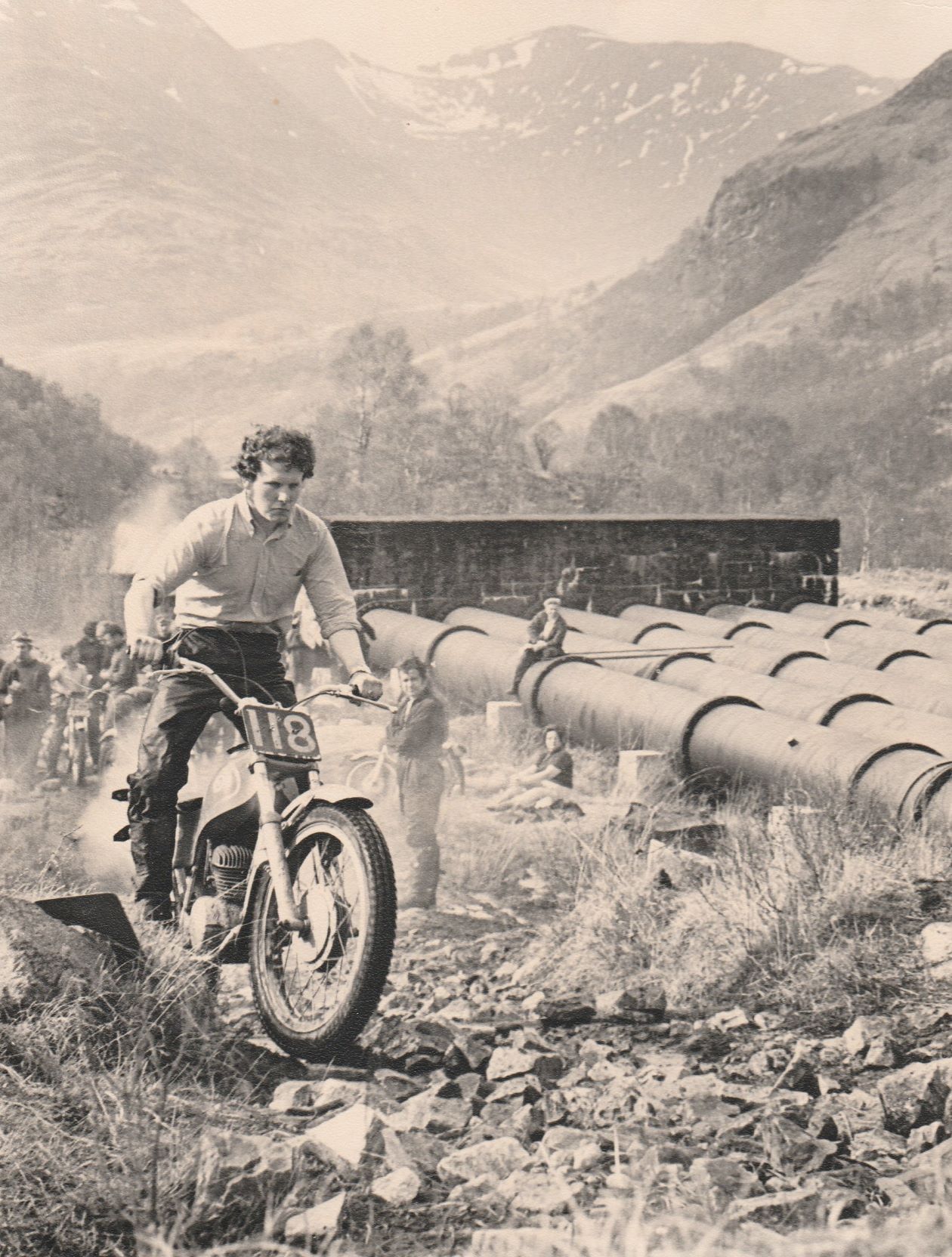
At this time he was riding in all the Scottish national events along with Lochaber stalwarts Allie ‘Beag’ Cameron, Archie MacDonald, James McManus and his cousin Alastair MacGillivray, known locally as ‘Ali MacGill’. The following year, 1970, Rodger entered the SSDT on a MK2 Montesa Cota and was allocated number 118. He came home a very creditable 37th place, beaten only by fellow clubman Archie MacDonald who had his best ever placement in 32nd place. Best Scot that year was Allie Cameron, also on a Montesa, with Mount fifth-best Scotsman. This made Rodger even more determined to better his score and final position.

Front Cover:

In 1971 Rodger’s photo appeared on the front cover of the SSDT official programme, but not feet up; he was captured in a position where the front wheel had connected with a large boulder and was set to go over the handlebars on the famous ‘Grey Mare’s Ridge’.

Watched by Billy McMaster Jnr, Sammy Miller and SSDT Secretary, Jim McColm (on the far right), Rodger Mount comes to grief on the Grey Mare’s Ridge, this photo adorned the cover of the 1971 Scottish Six Days official programme.

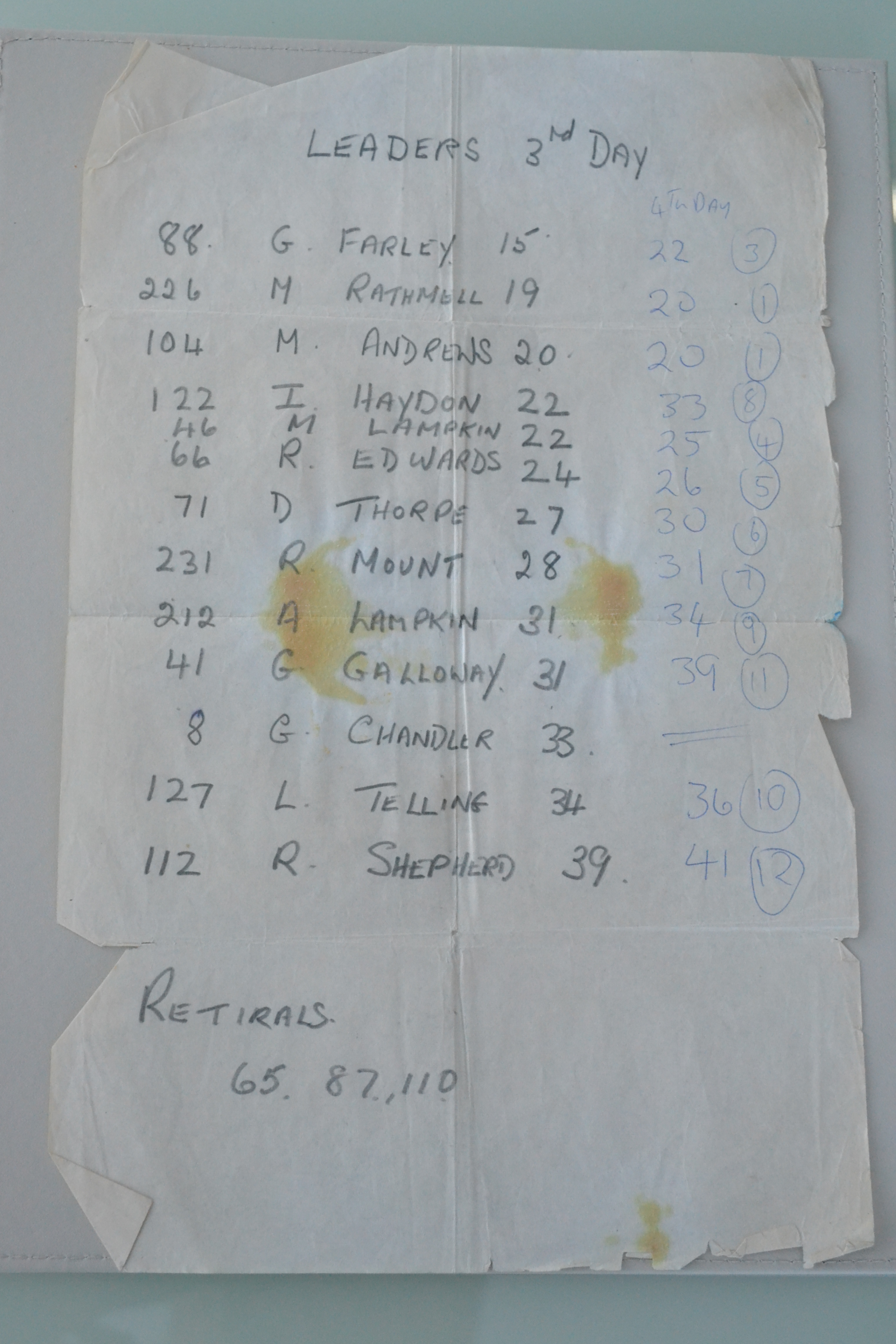
However, 1971 was to be Rodger’s year, on yet another Montesa Cota, but the model with the much smaller and lighter alloy hubs. He was to win the Allan Hay Memorial Trophy for the Best Scottish Rider, in 12th position, and that made RC Mount the highest ever Scottish-born finisher since 1935 when Bob MacGregor won the second of his SSDTs. This record he held until Les Winthrop finished in ninth position some 19 years later. The headquarters for the ‘Scottish’ at that time was the Highland Hotel in Alma Road, Fort William. The daily results were posted up manually each evening and Rodger was astonished to find he was lying in 12th position. A local man who frequented the hotel bar ‘acquired’ the leaderboard sheet that night, and it is one of Rodger’s prized possessions from 1971 to this day.

One of Rodger Mount’s prized possessions, the hand-written Day 3 results taken from the master scoreboard which was at the SSDT headquarters at the Highland Hotel in 1971, (Photo copyright: John Moffat/Trials Guru)

Rodger also claimed the Scottish ACU Trials Trophy, wrestling the crown from his rival, Kenny Fleming. This was Rodger’s first title, just five years after taking up the sport, and he went on to dominate the series, being Scottish Trials Champion in three successive years 1971 to 1973. He relinquished his crown to his ever-improving cousin and travelling companion, Ali MacGillivray.

Mount:I literally handed the 1974 Scottish Championship title to my cousin Ali MacGill. I had met my wife Dora in 1973 and spent some time with her when she was a teacher at Gracemount Primary School down in Edinburgh and I couldn’t be bothered competing in the final two championship rounds, and that gave the title to Ali!”

Alastair MacGillivray seen here in the 1980 SSDT on Cnoc A Linnhe, was handed the 1974 Scottish Championship by cousin Rodger Mount – Photo: Iain Lawrie, Kinlochleven

Bitter-Sweet:

1973 was to be a bitter-sweet season for Rodger. He had bought a new Montesa for the SSDT, but he failed to secure an entry in the dreaded ‘ballot’. This greatly frustrated the reigning Scottish Champion as he had a good chance for not only the Best ‘Scot’ award but perhaps an even higher finishing position, having finished in 20th place in 1972 as a member of a Montesa team, but still no ride! Rodger approached the Yorkshire-based Dalesman concern through Competitions Manager Bill Brooker, who agreed to let Mount ride in the official works Dalesman team. This was the first time a reigning Scottish Champion had not secured an entry in the Scottish Six Days, the Scottish trials community was rather surprised at the time and the tongues were wagging.

Rodger Mount on the works Dalesman-Sachs in the 1973 Scottish Six Days – Photo copyright: Eric Kitchen

Mount:I thought Jim Sandiford might have entered me in the official Montesa team as I had remained loyal to the brand, but his teams were by then full – Jim was a gentleman and couldn’t put someone out when he had already agreed a place. Bill Brooker came to my rescue and gave me a 125 Sachs-powered Dalesman that had been ridden by Peter Gaunt. It was quite a good machine really, but we couldn’t get it to respond correctly when we got it home to Fort William. I contacted my friend Ron Thompson who was a good engineer and mechanic, he played about with the carburetion until he got it running crisper.”

Grim determination written all over his face, Rodger Mount makes a concerted effort on ‘Laggan Locks’ on the factory Dalesman in 1973. Photo copyright: Eric Kitchen

Rodger weighed the little Dalesman into the Gorgie Market sheep pens in Edinburgh on the Sunday and noticed that the rear wheel had only one security bolt. He spoke to Bill Brooker, who said it would be fine as it was only a 125 and wouldn’t be a problem. He started off the week with some good rides and was in front of his two team members. On the Friday, however, the security bolt sheared, and it is not an item that riders usually carry or an item that support crews carry in vans either! Rodger had three punctures as the wheel kept pulling the valve into the rim, and he became two hours over the allotted time and was excluded.

Mount:When Bill Brooker heard what had happened, he was not only horrified but very apologetic, it had never happened before!

Montesa:

With the bitterness behind him, Rodger switched back to his Montesa after the Scottish and bought another new Montesa Cota towards the end of the 1973 season, which was to become sweeter. The final round of the Scottish Championship was to end in a nail-biting finish at the Edinburgh St George Club’s Colonial Trial at the ‘Hungry Snout’ near Gifford in East Lothian, a four-hour drive from Fort William. Two riders had gathered enough points to win and were level-pegging going into the final round. They were Mount and rival Ernie Page, who had by then established himself as a British Trophy International Six Days Team rider. Page was the Ossa distributor for Scotland, Mount was on the Montesa. The Scottish ACU Championship was an 11-round series in those days and Rodger was keen to take his third Scottish title.

Mount:It was a tension-filled day, I can tell you! Ernie wanted to be Scottish Champion as he had won a Scottish Scrambles Championship a few years before and this would have made him the only Scotsman to win both Scrambles and Trials titles, but I was riding well and wasn’t going to give in.” The final scores were tallied, RC Mount was proclaimed the trial winner on 33 marks lost, and the title went to the Fort William man once again. Ernie was runner-up on 46 marks. Rodger finished on the championship on 77 points, runner-up was Ernie page on 76, Alastair MacGillivray was third on 61 and Allan Poynton fourth on 53. MacGillivray was title winner the following year and Poynton became Scottish Champion in 1976. Rodger married his sweetheart Dora Black in 1976 after a short engagement and they had three children: daughter Laurie was born in the April of 1977; Roger, who became Scottish Youth Trials Champion and latterly Scottish Premier Trials Champion in 2004, was born in January 1982 and Steven, also an exceptionally good trials rider, was born in April 1983. Son Roger served an electrical apprenticeship with Archie MacDonald, another trials connection.

So why did Rodger Mount stop riding trials at the ripe old age of 25?

Mount:The family came along and that took up a lot of time, I was still working for my father’s firm and, in 1978, he had bought the Cruachan Hotel in Achintore Road which is the main A82 trunk road. I had won the Scottish Championship three times, so I reckoned I had proved myself. It was a busy hotel, and I built the main extension, which doubled its size. I was also the breakfast chef, so I’ve been cooking full Scottish breakfasts for nearly 40 years! My Dad said I missed my vocation, I should have been a chef. I ran the Cruachan with my brothers for two years then I wanted out, so they bought my share in the hotel and I bought Myrtlebank to run it with Dora as a guest house. Then a few years later we bought the property next door, which had been hotel owner Ian Milton’s house and doubled the accommodation of the business. I was just too busy to ride trials. I had another go when I treated myself to a new 349 Montesa in 1979, but I had lost my edge and I don’t like coming anywhere other than first! I did the Scottish on it that year, but the gearbox broke and I was out due mechanical failure.”

Rodger made a return to trials in 1979 with this 349 Montesa Cota, watched here by his mother, Elizabeth and infant daughter Laurie Mount – Photo: Mount Family Collection.

Business Life:

Rodger and Dora have built up a successful guest house business which is regarded as one of the best in Lochaber, all done through sheer hard work and maintaining high standards.

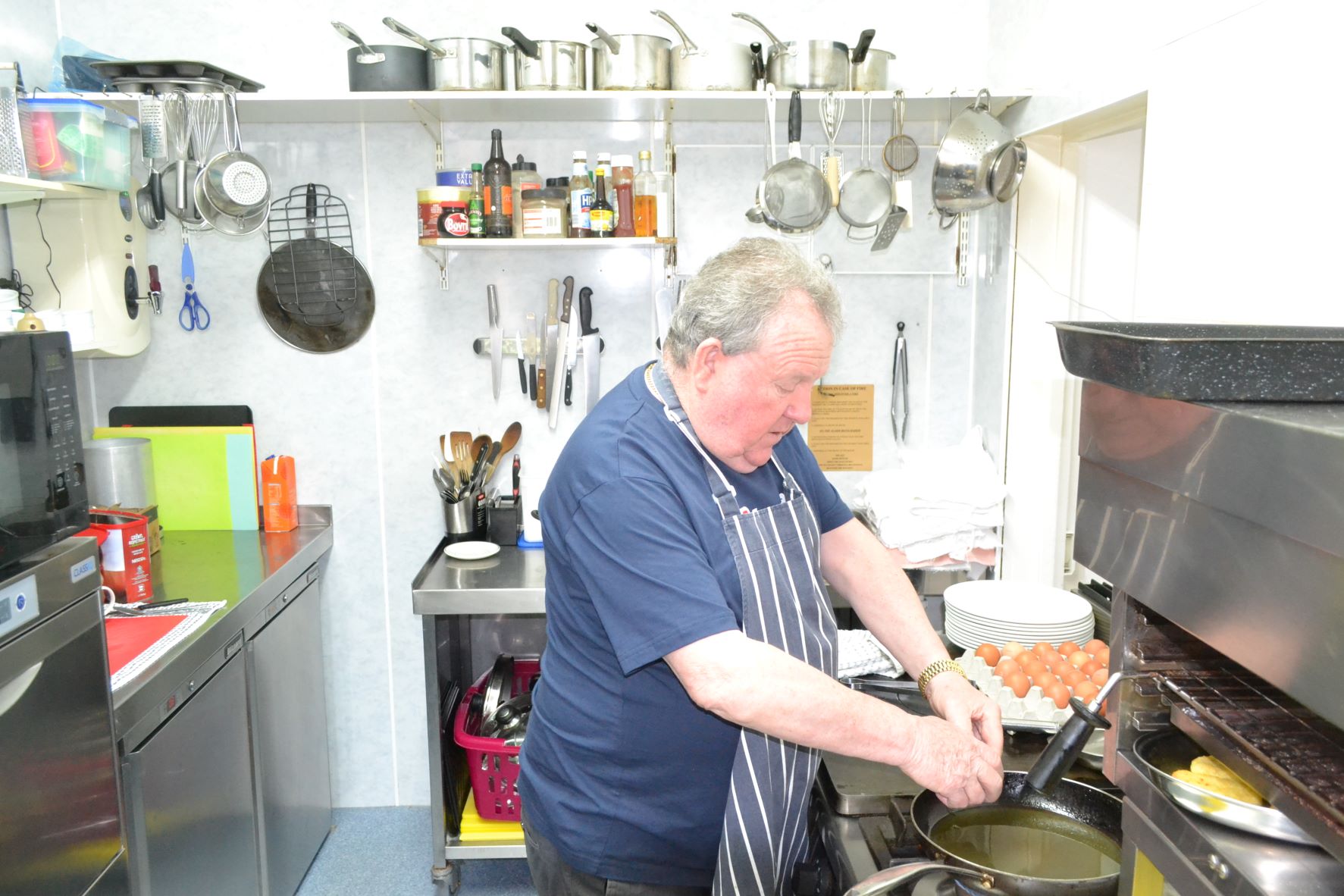
Rodger Mount hard at work as ever in the kitchen of the Myrtlebank Guest House, Fort William – Photo copyright: John Moffat/Trials Guru

Mount:Quite a few of the people I rode in the Scottish with stay here at Six Days’ time; they have stayed here for years and so have their children, who now compete. We are usually fully booked for SSDT week and I start the breakfasts at 06.00am, so that the early riders have a good breakfast in them for the daily run – that is important! My oldest son Roger is a keen fisherman like myself and he also took a liking to the trials, so I bought him a machine and he was a natural at it. He became Scottish Youth Champion and then won the Scottish Trials Championship in 2004. He should have ridden for longer as he was particularly good, but then work and children came along.”

SSDT 2000 – Roger Mount – Gas Gas – Cameron Hill – Photo: Iain Lawrie, Kinlochleven

Steven was also an exceptionally good rider, he also had a natural talent for trials, and he too should have ridden longer. They both fancy riding the SSDT together next year – if they get through the ballot, of course.”

1971, left to right: Allie ‘Beag’ Cameron, Kenny Fleming, Rodger Mount and Alastair MacGillivray

On asking Rodger if he had ever been paid for riding or winning trials he smiled and replied: “Only once, Hugh McDonald told me that if I beat Kenny Fleming in the Scottish Championship to win it, he would give me 100 pounds. This was at the time when new Montesas were around 400 pounds to buy new. Well, guess what, I did beat Kenny and Hughie paid me the 100 pounds in cash.”

The time had flown by and it was now close to nine o’clock in the evening. True to form, Rodger took a yawn and said: “Right, it’s past my bedtime; see you in the morning!

1971 SSDT with Rodger Mount at home on the 247cc Montesa on ‘Laggan Locks’

 Alistair MacMillan & West Highland News Agency:

Whenever the 1970s SSDT photos are looked at when pulling together an article, photos emerge with the copyright of Alistair MacMillan or West Highland News Agency stamped on the back. Alistair, affectionately known in Lochaber as ‘Scoop’, was a journalist and photographer. He initially reported for the Highland News, covering news and pictures in the Lochaber area to the extent that the local newspaper: ‘The Lochaber News’ was born. He also covered articles for the Press & Journal, playing a significant role in increasing circulation locally from six copies to around three thousand, as well as national papers and radio stations. 

Mr. Alistair MacMillan of West Highland News Agency was a great supporter of the Scottish Six Days Trial and made every effort to contact the daily newspapers with photographs and reports from Fort William and Lochaber during SSDT week each May.

The Express called him ‘Our man on the mountains’ due to the number of mountain rescue reports he covered! Alistair reported extensively on the Lochaber & District Motor Club and the Scottish Six Days Trial from the early 1960s, for both the Lochaber News and the Press & Journal. He also took footage of the events for Grampian TV, BBC and STV news as well as performing radio interviews for BBC Radio Scotland. A lot of skill and bulky equipment was required to do this back in the day! A trials magazine used his dark room to process their photographs and would take their prints, still wet, to the nearby telephone exchange for a wire-man to transmit them to make it for that week’s edition. Again, a far cry from everything being done from one device at the touch of a button and being instantly accessible. However, it was his forward thinking that meant he was the first to photograph all competitors of the Scottish Six Day Trials at a specific section, which gave riders the opportunity to purchase a copy at his office at 101 High Street, Fort William and later at the Milton Hotel, the Trial Headquarters. Alistair MacMillan’s images are now copyright of his son, Anthony MacMillan, who has given permission for Mr. MacMillan’s work to be exhibited on Trials Guru website.

Watched by local man, Archie MacDonald, Rodger Mount (247cc Montesa) in the 1972 SSDT – Photo: Alistair MacMillan Studio, Fort William.

Copyright: John Moffat/Trials Guru 2021

For more articles on Scottish trials riders, go to Great Scots on Trials Guru: HERE

Photographic Copyright: is retained by the photographers named in captions above.

Apart from ‘Fair Dealing’ for the purpose of private study, research, criticism or review as permitted under the Copyright, Design and Patents Act, 1988, no part of this article may be copied, reproduced, stored in any form of retrieval system, electronic or otherwise or transmitted in any form or by any means, electronic, electrical, mechanical, optical, chemical, photocopying, recording or otherwise without the prior written permission of the author as stated above. This article is not being published for any monetary reward or monetisation, be that online or in print.
Coming soon… The Rodger Mount Story

Mount: “It was a tension-filled day, I can tell you! Ernie wanted to be Scottish Champion as he had won a Scottish Scrambles Championship a few years before and this would have made him the only Scotsman to win both Scrambles and Trials titles, but I was riding well and wasn’t going to give in.”

Read all about one of the finest Scottish trials riders to come from Fort William, here on Trials Guru – Dedicated To The Sport.
NOW PUBLISHED: HERE

Manuel Soler Replica

Words: John Moffat; Yrjo Vesterinen

Photos: Bultaco Motorcycles; Todotrial – Horatio San-Martin; Malcolm Rathmell; Carlos Bosch; Yrjo Vesterinen; Barry Robinson; Eric Kitchen.
Manuel Soler – Photo: Horatio San-Martin/Todotrial

Manuel Soler, son of Juan Soler Bulto and the Grand-nephew of Bultaco founder, F.X. Bulto was a development trials rider with the family factory.

Sadly Manuel died a relatively young man in January 2021 at the age of 63. He was revered in his native Spain (Catalan) and after his death many tributes were made on social media and a trials series named in his memory.

Madrid trials enthusiast, Carlos Bosch a hotelier and lover of Bultaco motorcycles decided to create a tribute- replica of Manuel’s 1974 model 133, a machine that never reached volume production, but was a rare development model only supplied to factory riders and some importer supported Bultaco riders. The recognised number of these machines constructed was a lowly 13 units.

The factory prototype Sherpa T model 133 of French Champion, Charles Coutard taken in 1974, identified by Yrjo Vesterinen as the early type frame of the 133 model – Image Credit: Bultaco Motorcycles

Less than a handful were ever made and they found their way into the hands of Manuel, Ignacio Bulto, Charles Coutard, Martin Lampkin, Yrjo Vesterinen, Alan Lampkin and Javier Cuccurella.

Photojournalist, Barry Robinson tests the rare factory model 133 Bultaco Sherpa of Malcolm Rathmell in 1974. It is believed there were only 13 ever made and were supplied to factory riders only. Photo: M.C. Rathmell

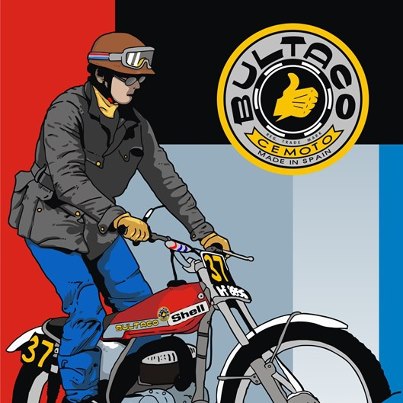
Carlos Bosch was inspired by a photograph of Manuel Soler competing in the 1974 Scottish Six Days Trial in Glen Nevis, issued with racing number 37. The photograph is the copyright of Mortons Publications, Hornchurch and therefore we are not in a position to show the image. However, an artist made a caracatuer drawing based on the photo, which Manuel used in his social media pages.

Artwork based on a photograph taken of Manuel Soler in the 1974 Scottish Six Days Trial – Artist: Unknown

Soler’s machine was registered by the Bultaco factory in Barcelona as B-F-8896. Bosch realised that he had a healthy stock of Bultaco components that would possibly make a nice replica machine, so he set to work, using the photograph as a guide.

Factory rider Javier Cucurella on his 325cc Sherpa model 133 carefully guiding the machine over the rock slabs of ‘Edramucky’ Ben Lawers in the 1974 Scottish Six Days Trial – Photo Copyright: Eric Kitchen

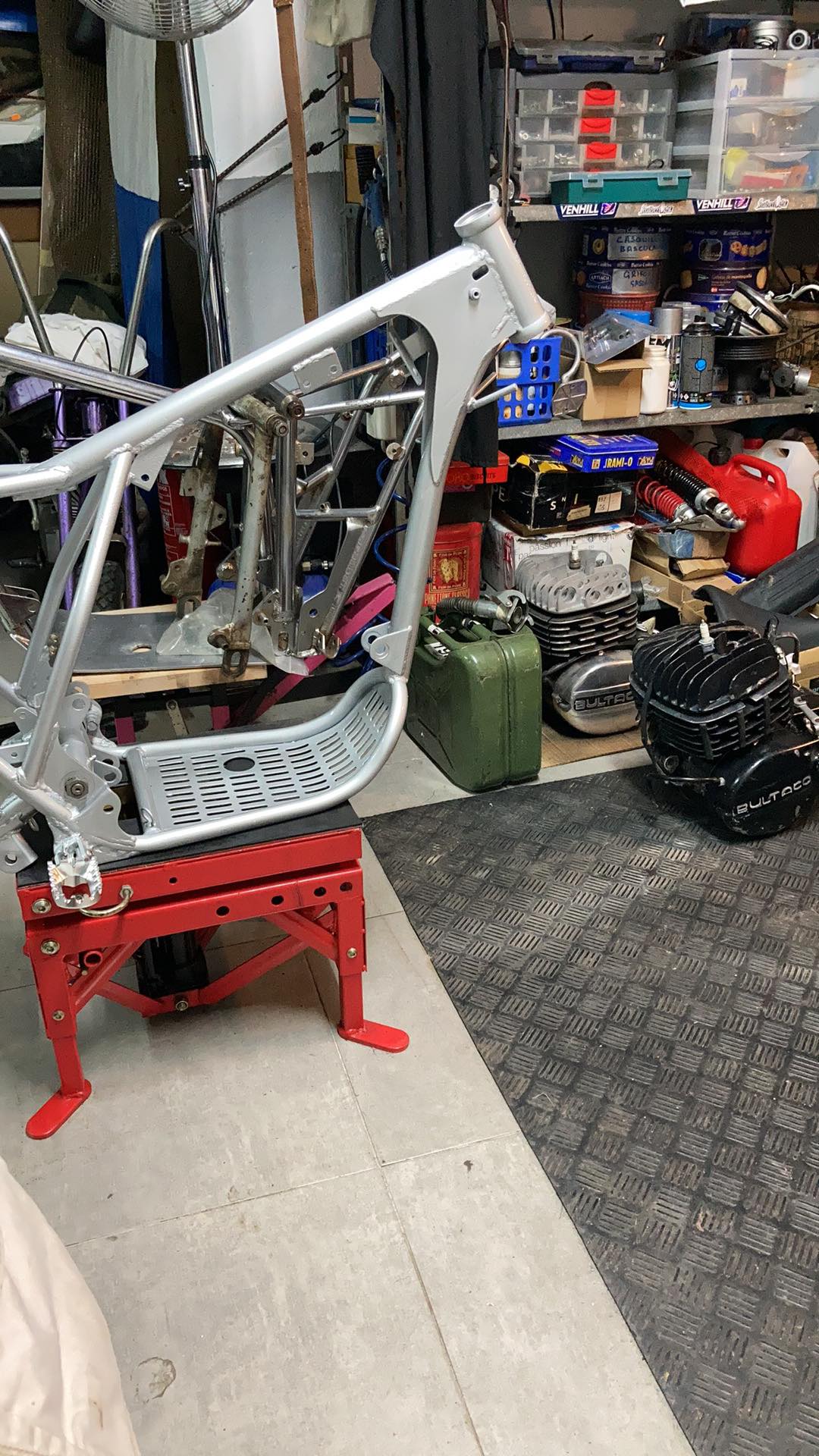
Bosch selected a Sherpa 250cc frame as a starting point, the short version used on the 1977 M190, which is almost identical to the 1975 model 158 frame.

Malcolm Rathmell on one of his special Bultaco Sherpa model 133 with English registration in 1974, this is probably the later frame type – Photo copyright: Barry Robinson.

The tribute bike motor is taken from the Sherpa model 199A, a 325cc, five speed from 1979 and creator, Carlos Bosch reports that it is a strong one and pulls really well. In keeping with the 133 model, the cylinder head has been copiously drilled to save weight and improve heat dissipation, as carried out by the factory at the time.

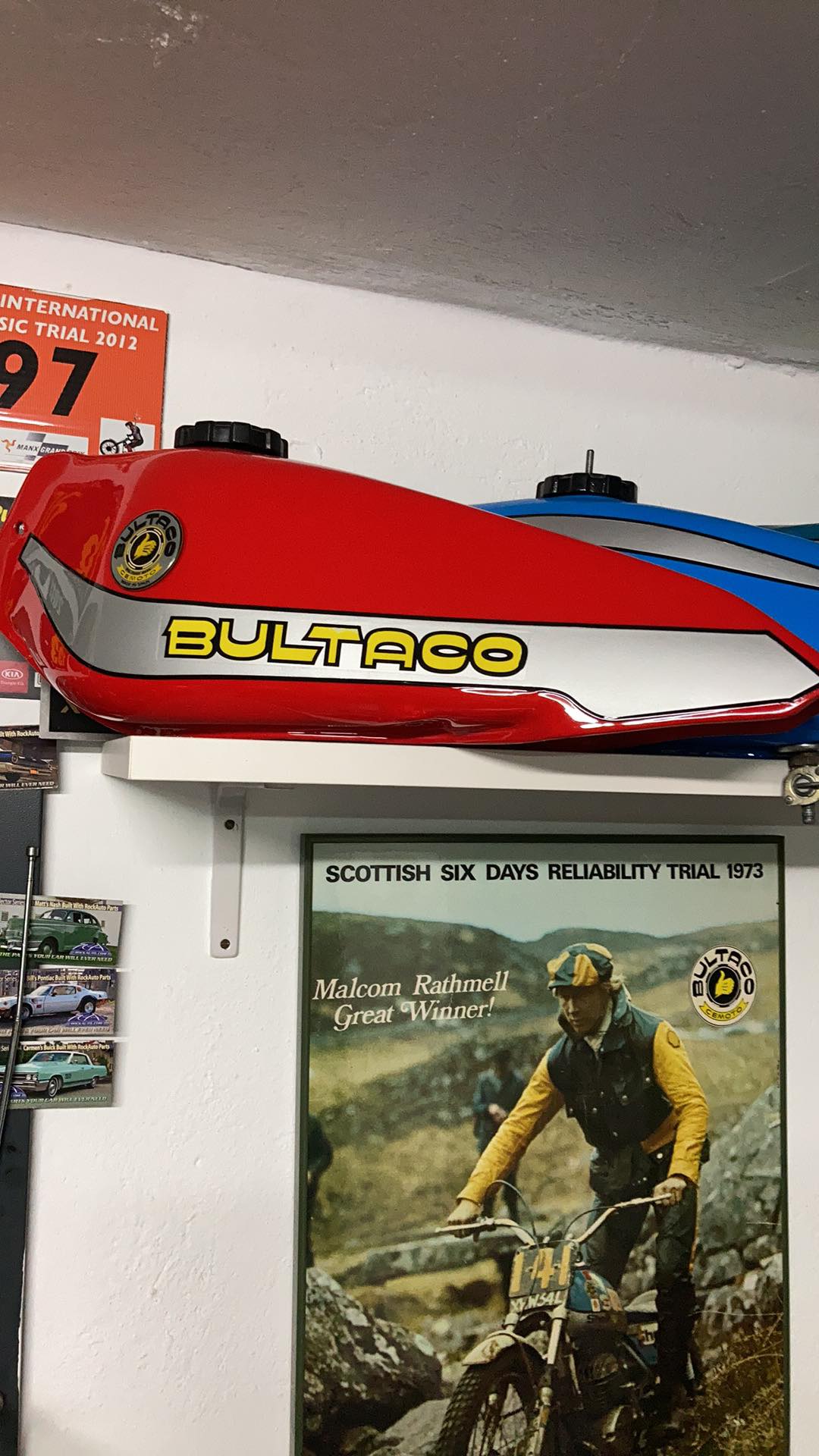
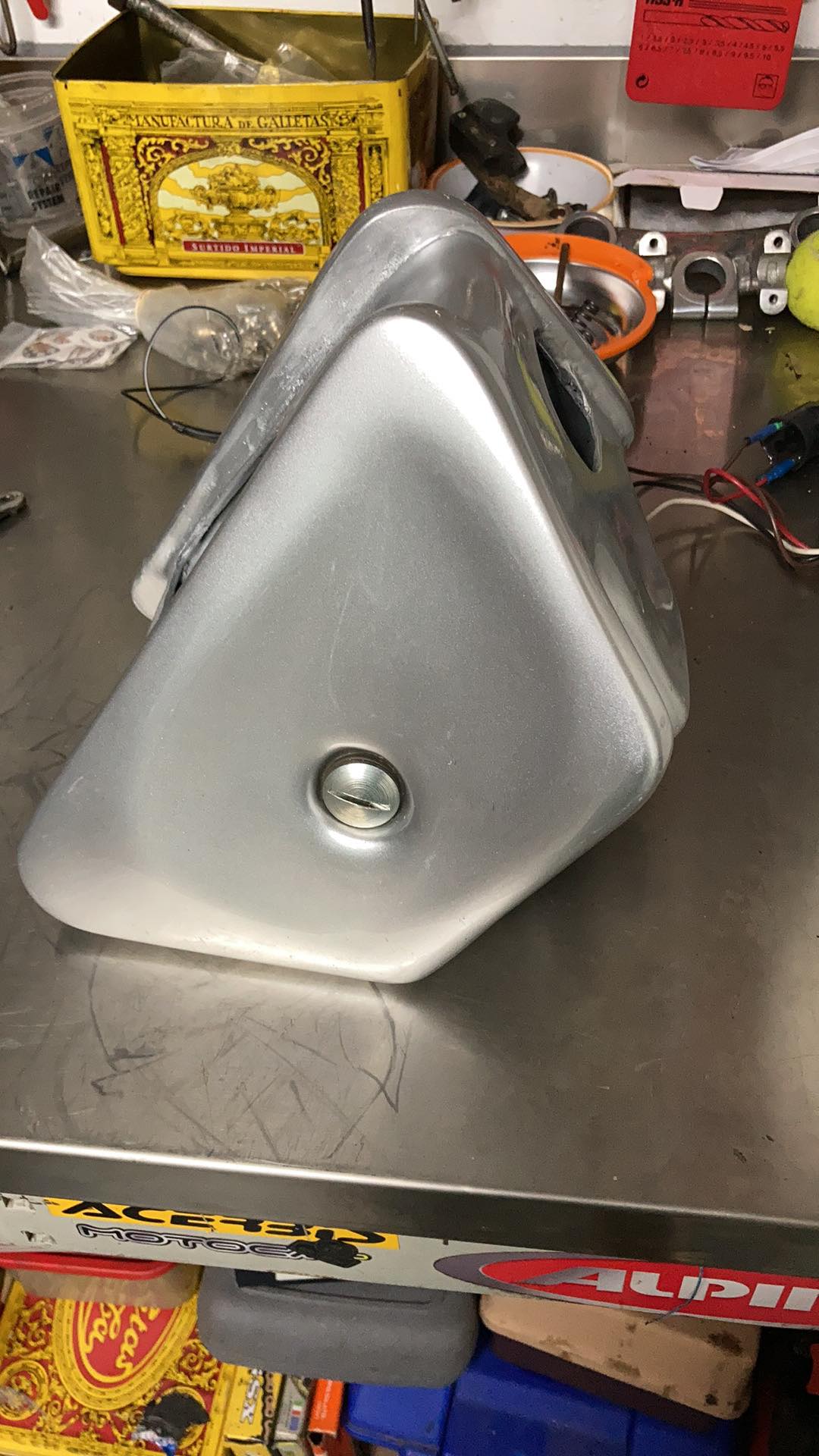
Fuel tank and airbox were taken from the 1975 model 159 Sherpa, which is quite fitting as that Sherpa model is known in Spain as the ‘Manel Soler’ the machine developed by Manuel in 1975 from the later version of the model 133.

Manuel Soler seen here in 1974 testing the prototype Sherpa model 133, B-F-8896, which the factory used as a publicity shot for brochures, posters and advertising cards – Image: Bultaco Motorcycles

Obviously the shape is not identical to the 133 model as the component was bespoke to that model and made of fibreglass, although a few had aluminium versions.

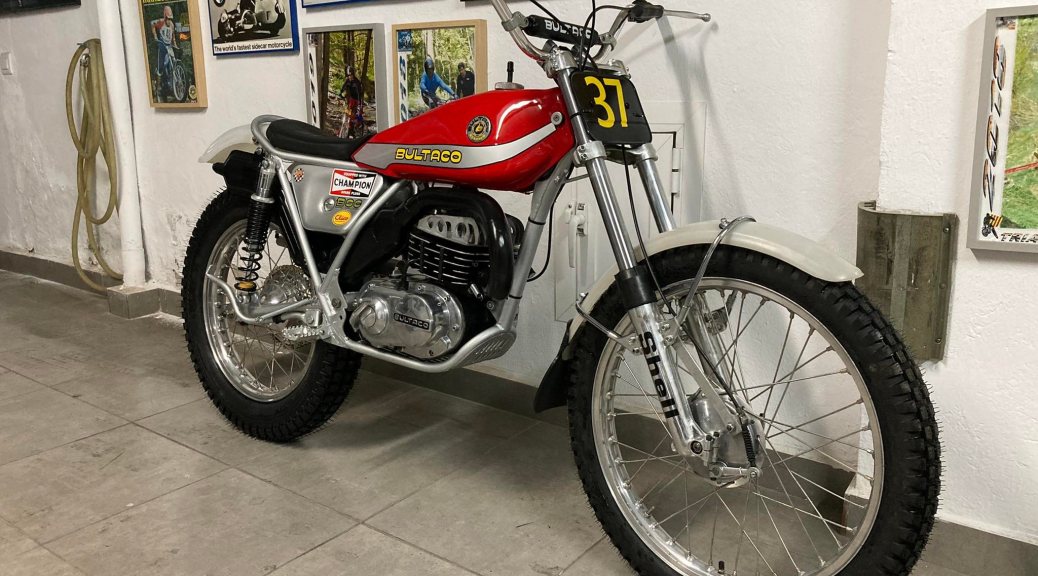
The 159 Sherpa tank was repainted and liveried to resemble Soler’s works model 133 tank – Photo: Carlos Bosch

The 133 frame was distinctive and unlike the previous and subsequent production machines. There was also more than one version of the 133.

The model 190 frame (250cc) makes a good starting point for a tribute-replica Bultaco, due to the curved front down-tube feature. Photo: Carlos Bosch

Trials Guru took the liberty of contacting three times World Champion, Yrjo Vesterinen, having been a factory contracted rider at the time of the Sherpa 133.

Vesty: “Of course I had a Sherpa 133, in fact I had two because riders who were not Spanish, did not have the opportunity to visit the Bultaco factory very often and it made sense to have a spare machine to hand. Manuel Soler, Ignacio Bulto and Javier Cucurella usually had one bike as they could leave their machine at the fatory for repairs and any upgrades or modifications. It was not a popular version of the Sherpa for the riders and there were changes made to try an overcome the rider resistance.

“The 133 was a true prototype/development bike and went through quite a few changes during an eighteen months development cycle. It was not the same as the model 159 which was mass produced from 1975 and known in Spain as the ‘Manuel Soler’ model. The steering stops were quite different on the 133, it used a bracket fixed to the steering head which comes up against a concentric pair of yoke stops, whereas the production Sherpa relied on two rods fitted to the frame with nylon bump stops which contact the lower yoke. The front frame of the early version of the 133 and production model 158 (250cc) are similar with the curved down-tube. The model 159 frame was different and based on a subsequent frame design. The engine of the 133 was set further back in the frame than the model 92 of 1973.”

Photo: Carlos Bosch ‘Manuel Soler tribute-replica’

Carlos Bosh’s Bultaco M133 tribute/replica – Photo: Carlos Bosch

“I have looked at the photographs of Carlos’s tribute Sherpa and it looks very nice indeed, he has captured the escence of the 133 without having the components to make an exact replica.”

A Sherpa model 159 airbox was used in the Carlos Bosch build.

“The airbox of course is not the same as the 133 bike, but the colour scheme utilised gives an acknowlegement to the factory model.”

The Vesterinen Sherpa 133:

Yrjo Vesterinen’s Bultaco Sherpa 133 from 1974, clearly shows the steering stop on the steering head, flat bottom yoke and the exhaust of that year used on the model 124/125 Sherpa. ‘Vesty’ retained this machine and is now in his private collection.

Vesty continued: “Comparing the tribute bike to my own 133, you can spot the differences, but Carlos Bosch’s machine looks very purposeful and I believe he is happy with the finished article. He has tried very hard to keep the machine looking similar to what Manuel’s works bike was like in the 1974 Scottish.”

Photo: Carlos Bosch ‘Manuel Soler tribute-replica’

The offside rear view of the Manuel Soler 133 tribute-replica.

Photo: Carlos Bosch ‘Manuel Soler tribute-replica’

The Soler 133 tribute-replica is a fine looking machine – Photo: Carlos Bosch

In memory of Manuel Soler 1957-2021

New! Trials Guru Archive

Just launched, the Trials Guru Archive, all the photographers accessible in one place on this website!

To make life easier and so that you can all enjoy the many photographs with this online facility, we have put all the various pages together in one section so you can browse or find photos easier than before!

All copyright is attributable to the photographer in every case. Have a look and see what is available on Trials Guru.

Link: TRIALS PHOTO ARCHIVE