New, for the trials enthusiast, a forty years celebration since the only American to win a Trials World Championship, won the Scottish Six Days Trial, Trials Guru will present a new venture online!
“I’m very excited about this new venture in 2022 and you’ll hear untold stories with GLOVES OFF. I’ll be expressing my thoughts about the sport then and now.” – Bernie Schreiber
‘GLOVES OFF – Bernie Schreiber’, will launch in 2022 on TRIALS GURU as a regular and exclusive column in the news feed, and will be archived on a page for trials enthusiasts.
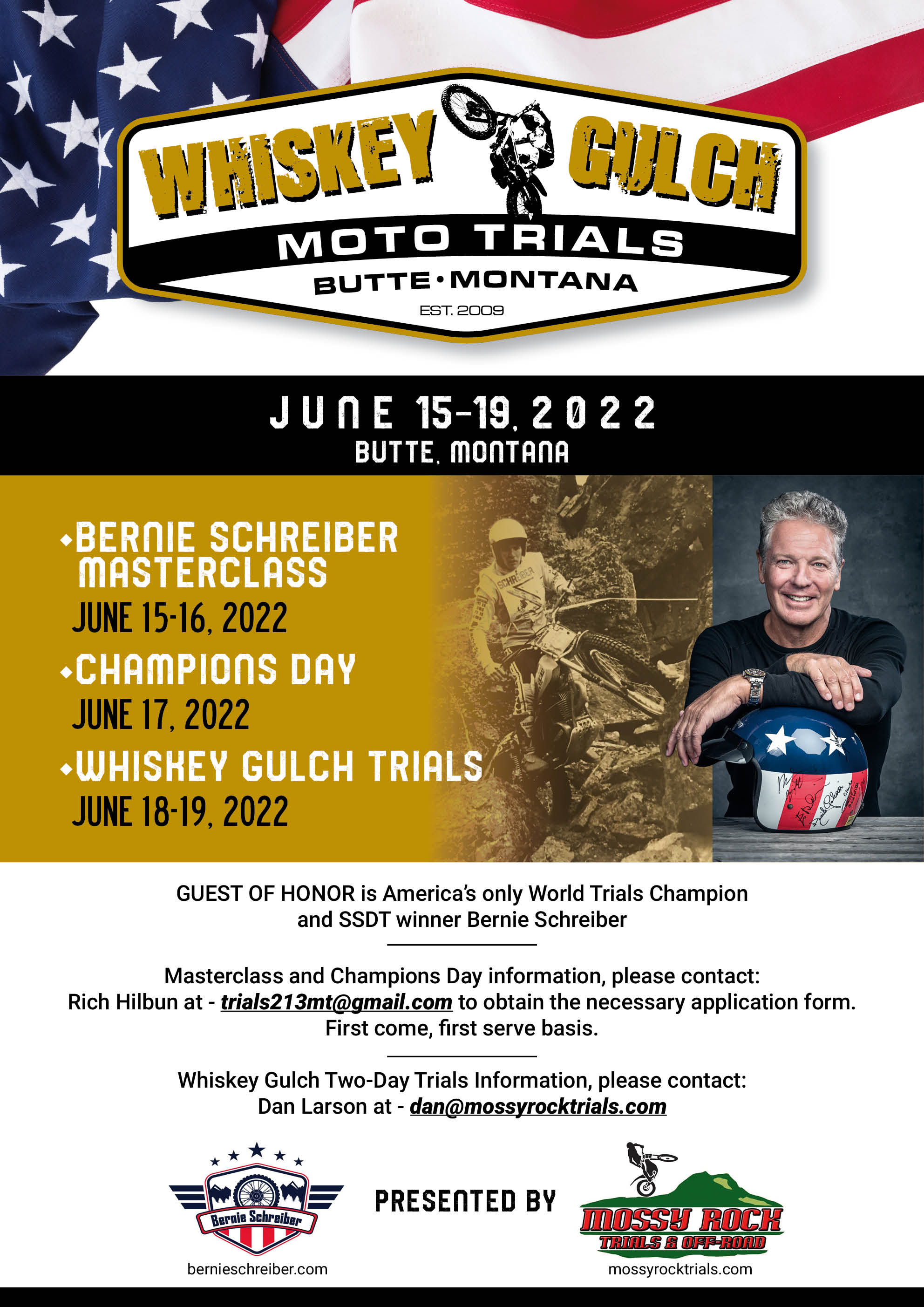
Exciting news has been made available to Trials Guru that former World Trials Champion Bernie Schreiber will be returning to Montana USA on the 40th anniversary of his double US National Championship victories there in 1982 to conduct a two day trials school during an event of five consecutive days that includes the annual Whiskey Gulch Two-Day Trials in Butte, Montana, June 15-19, 2022.
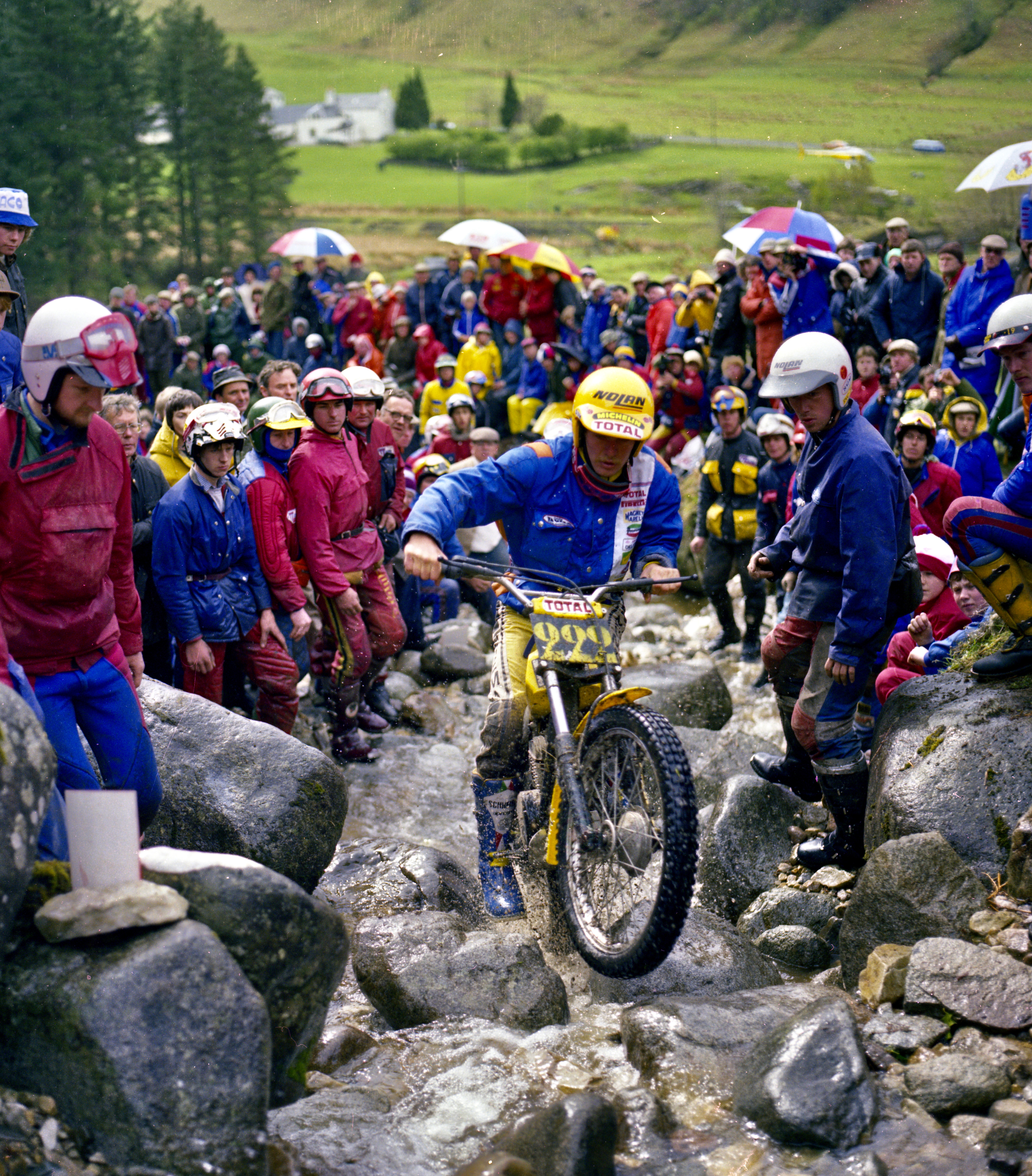
Schreiber, America’s only World Trials Champion (1979) and Scottish Six Days Trial winner (1982) will be holding his signature “Master Class Experience” two day school to start off the festivities and will be the Guest of Honour for the ‘Champions Day’ celebration held on the third day. Schreiber will also take part in the finale, the Whiskey Gulch Two-Day Trials, an event that brought in over 100 riders from eight different states in 2020 as part of the Conquer The West Trials Series which began in 2017. This is a two day event series in the western USA where riders take part in at least four events to earn points towards their respective final positions and has expanded to include ten-two day events in 2022.
Montana is of particular interest to the 1979 World Champion ever since winning those two US Nationals on his way to securing the 1982 US National Championship title as the two events were a stark contrast of back to back days. The first National held in Bozeman on July 3 was very easy as Schreiber’s 7 mark winning score proved, yet the second one in Whitefish was anything but as Schreiber’s 144 mark score still stands as the highest winning score in the history of The US National Championship series.
Montana native Rich Hilbun organized that second record setting national in Whitefish and recently had the idea to contact Schreiber about returning on the anniversary to conduct a trials school. The five day format was the result of their following discussions along with Dan Larson of Mossy Rock Trials & Off-Road who organizes and sponsors The Whiskey Gulch Two- Day Trials which began in 2009 and has taken place annually without interruption since.
Schreiber, who has a very unique approach to instruction that combines elements of hands on riding together with a strong focus on the mental side of the sport said, “I’m proud to be Guest of Honor at the Whiskey Gulch Two Day Trials in the beautiful state of Montana. The gold and silver treasure state of America is every trials rider’s dream destination to discover the outdoors and off-road riding. In 1982, I remember taking home gold twice in Montana. Rich Hilbun and Dan Larson at Mossy Rock Trials & Off-Road are excellent organizers and together we came up with a plan to make this happen. It is very exciting returning in 2022 to teach, ride and celebrate in such a memorable place. Who knows, I might take gold again, but will be very happy with silver as well!”
Hilbun, who made first contact with Schreiber about his return said, “ That second 1982 national in Whitefish, we set the sections up to be difficult because the previous round in Bozeman was so easy. The weather didn’t cooperate and it poured down rain. I remember Bernie saying it was like a round of the world championship. That was a great compliment and with Bernie doing his trials schools all these years later we thought to have him come back on the 40th anniversary, and are honored to have the legend of US trials return. Bernie made such an impact on the sport then and still today. We are all excited to host him as the Guest of Honor for the 2022 Whiskey Gulch Two-Day Trials week!”
Larson, who has owned Mossy Rock Trials & Off Road since 2011 and is an authorized dealer for TRS and Beta motorcycles, began his shop repairing bikes for trials riders primarily providing a means for riders in the South Central Montana area to have support and also specializes in restoring used bikes said, “ As the organizer of the Whiskey Gulch Two Day Trials for the past 12 years and sponsor of the event with Mossy Rock Trials & Off Road since 2011, it is such a privilege to host America’s greatest of all time trials riders. We have such a beautiful trials area here near Butte and I am thrilled Bernie will be making history with us once again! We will have the following classes for the Whiskey Gulch Two-Day: Novice, Amateur, Intermediate, SR Intermediate, Advanced, SR Advanced, Expert Sportsman, Expert, Championship & Vintage/Classic.”
For information on the Schreiber Masterclass Experience Trials School and Champions Day, please contact: Rich Hilbun at trials213mt@gmail.com
For information on the Whiskey Gulch Two Day Trials and partnership opportunities, please contact:
A new feature under ‘Major Events’ has been opened on Trials Guru.
Entitled ‘SSDT Archive’, it has just been opened by showcasing the front covers of the Scottish Six Days Trial programmes from 1947 until now.
There are still a few to be displayed as their images are currently being worked on, but the full set will be online for all to see shortly.
Some of the programmes appear for sale on internet auction sites from time to time and the older editions command high prices for a piece of trials history.
Have a look, there may be one that quite interests you.
The trials world on the south east was saddened by the death of well-known trials rider, Alan Ketley.
Alan was an accomplished rider in the SE ACU centre and at one time worked for Comerfords/Bultaco UK as a sales representative, looking after the many Bultaco agencies throughout the UK.
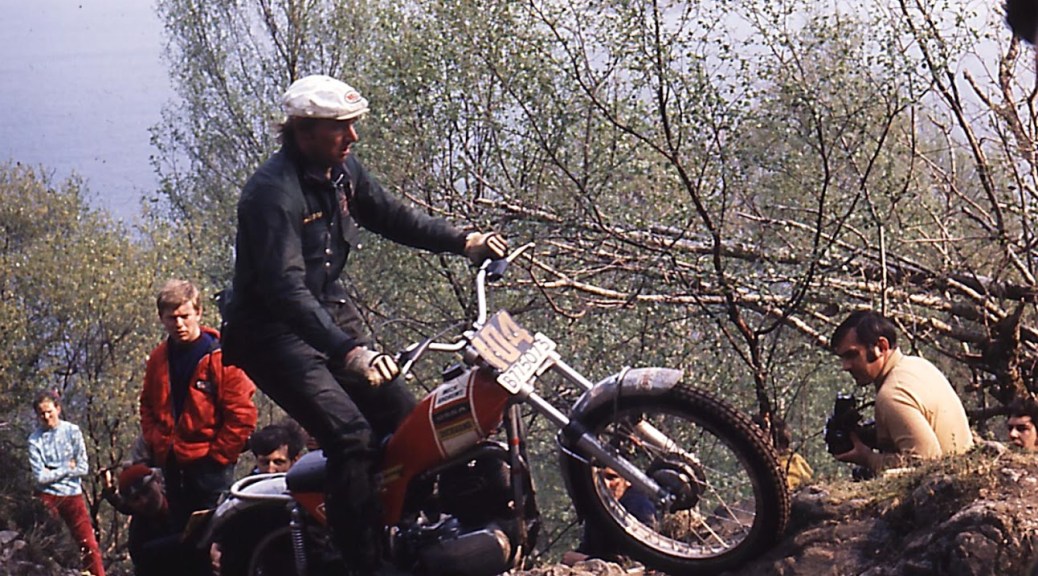
Alan Ketley (325 Bultaco) – Photo: Mike Rapley
He had been sufering from Parkinson’s Disease for some years and was from Erith, South East London..
Details of Alan’s funeral arrangements are:
Friday, 29th October 2021 at Beckenham Crematorium at 09.30 am.
Trials Guru wish to convey our heartfelt condolences to his daughter at this very sad time.
Tribute to Alan Ketley from his friend Bob Adams:
The passing of Alan KETLEY “ Ketters “ is a huge loss to the trials scene. We travelled the UK & continent in his mini pick-up as well as tackling National trials. His most remembered achievement was beating Sammy Miller to win his first National.
Al rode for the South Eastern Centre team many times but the North Kent combine was his favourite scene. He was a champ in every class, Ariel, James , B40. He was a wiz on long steep hills where throttle control was key. He was truly a class act Brands Hatch in 1965.
Al was asked to ride the Bultaco Sherpa and rode it brilliantly. His dad only ever came to one trial, Weavers Down, and Al finished on clean THATS the way to show your dad how good you are! He worked for Comerfords in his younger years selling Bultacos all over the UK and servicing the dealers. Parkinson’s put paid to a trials return in the last decade. Al leaves a daughter “Amanda” and two grandchildren.
The Scott Trial official programme which is sold to raise money for the local Scott Trial charities is now on sale, priced £5.00 per copy.
Edited by Michelle Wilkinson, it is packed with information for the event and is a must have for any Scott Trial follower or enthusiast.
Copies are now on sale at the following outlets:
Brookes Garage, Richmond, Neeps & Tatties, Richmond, Reeth Post Office, Reeth Paper Shop, Copper Kettle Cafe, Reeth; CB Inn, Arkengarthdale; The Red Lion pub, Langthwaite; CJ Tennants, Richmond and X Lanes Store, Richmond.
The event is being held on Saturday 16th October 2021, starting from Feldom Ranges, Sturdey House Lane, Richmond, DL11 7LS.
In an open letter issued on Monday 27th September, 2021 to Croft Trials Club and local enthusiasts of the sport, Croft Club Chairman, Bob Pickersgill has made an appeal following action taken by a neighbour who lives near the AMCA affiliated Croft Club’s trials ground, who is obviously opposed to the sport of trials.
The implications could be far reaching if the requirement for planning permission to change the layout of sections is imposed country wide.
Pickersgill’s open letter urged members to take immediate action and read as follows:
“Dear Member and supporter of Croft Trials Club,
You may be aware that the Club has been on the receiving end of a number of complaints, primarily from our neighbour at Clervaux, Mrs Sarah-Jane Burns.
Since she moved in about 6 years ago, she has been haranguing members, telling us that we wouldn’t be riding there much longer, and making numerous vexatious complaints to Richmondshire Council, the Environment Agency, the Public Rights of Way Officer, the Parish Council, the Police, the Woodland Trust etc. She even attempted to take possession of the land and caused criminal damage in doing so, to which she admitted and settled out of court.
Because of this, the Club has now been required to formally apply for Planning Permission for the creation of four new sections and the maintenance of the existing sections. If not granted, the facility could be under threat. Any support would be much appreciated. Supporters have until Friday 15th October to email: planning.enquiries@richmondshire.gov.uk or write to the Planning Manager at Mercury House, Station Road, Richmond, North Yorkshire DL10 4JX.
Please see below suggested points, but submit in your own words.
Croft Trials Club has been established in its location at Dalton Woods for the past 40 years. At its inception it was granted a Certificate of Lawfulness from Richmond District Council. – It is an important facility for members of all ages from 4 to 70+. There are more than a dozen femaleriders and many family memberships. It is one of few locations in the north east to offer off-road practice for youngsters who might otherwise use unauthorized public grounds. All riders must display their photo ID cards on their bikes and are fully aware of the need to respect our neighbours, not ride their bikes outside the grounds or run them in the car park. The club is fully regulated and affiliated to the AMCA, and is one of hundreds of clubs in the UK. – Trials riding is a popular low-speed motorsport which requires dedication, balance and skill, and enables its participants to spend time outdoors with their families and meet other riders. – Indeed, Yorkshire has produced the 8-times World Champion, Dougie Lampkin. The world champion female rider, Emma Bristow, who started riding at the age of 4, has been champion since 2015. – The Club is seeking approval for four new sections, out of more than 100 existing sections in its 66 acres. It is the only club in Yorkshire (and probably the UK) to be required to apply for planning permission for the creation of new sections with natural rock, which blends perfectly with the naturally occurring rocky sections already existing in the grounds.
Many thanks for your support.
Bob Pickersgill – Croft Trials Club – crofttrials.uk “
The Scott Trial is a test of man and machine, on observation and time. It is regardest as the toughest one day trial in the UK and to compete in it year after year takes committment.
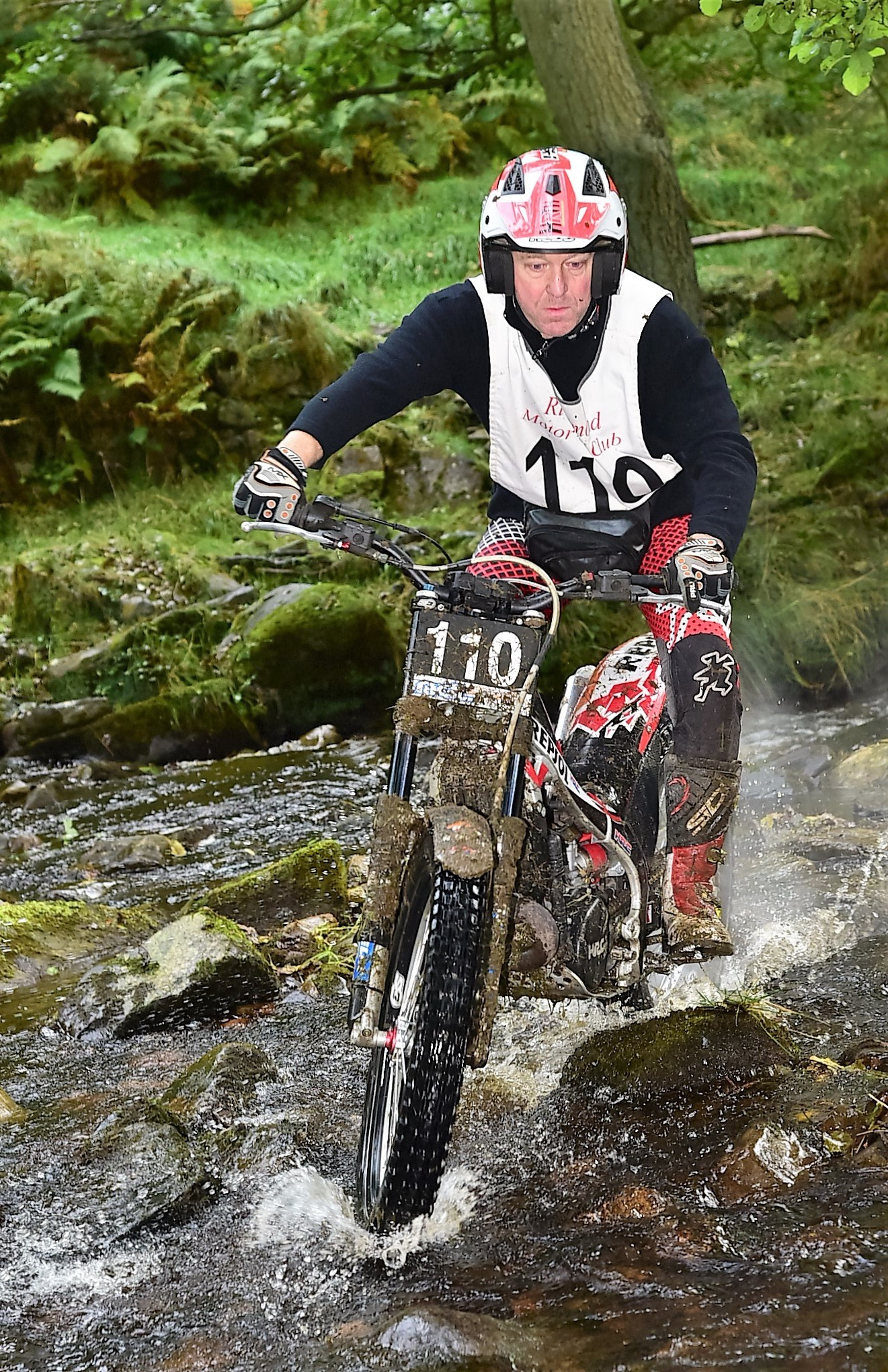
Graham Tales at the 2016 Scott Trial at Orgate Falls – Photo Barry Robinson copyright.
One such Yorkshire man has taken part in the annual event 39 times and 2021 will be his final attempt at the famous event.
His name is Graham Tales from Ilkley, West Yorkshire and 2021 will be his fortieth and final Scott Trial.
A painter/decorator by trade, Graham still loves his trials but feels that 40 attempts at the Scott is plenty.
He has had quite an innings: Graham has 19 Scott spoons; 16 certificates; 2 mechanical retirements and twice outwith the time limit.
We wish Graham well in his fortieth Scott and hope to see him at the finish line on October 16th.
The Richmond Motor Club (Yorkshire) Ltd’s Scott Trial committee have been working hard behind the scenes to kick start the return of the annual time and observation event which will make a welcome appearance back on the trials calendar on Saturday 16th October.
The event has been cancelled twice, due to the global pandemic and returns with a new Clerk of the Course, Nathan Stones who has been part of the organising team for many years. He will be ably assisted by Bruce Storr, himself a former Scott Trial Clerk of Course.
The event is run on behalf of the Yorkshire Centre, ACU by the Richmond club and 2021 marks 30 years of the club’s involvement, having taken the organisation over from the Darlington & District Motor Club in 1991.
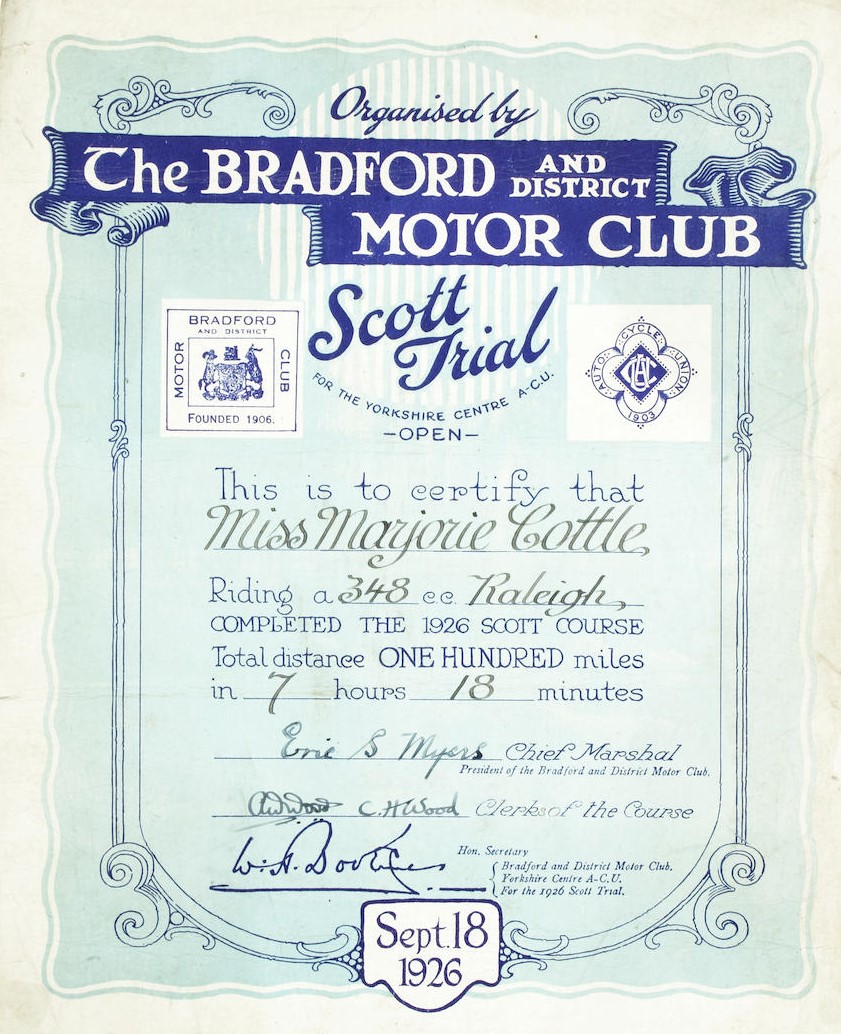
Marjorie Cottle’s 1926 Scott Trial Finisher’s Certificate when riding for Raleigh Motorcycles. At this time, the Bradford & District club organised the Scott Trial. (This certificate forms part of the ‘Marjorie Cottle collection’ of memorabilia which is privately owned).
There is always a lot to do in the organisation of this prestigeous event, with much negotiation with the Yorkshire Dales National Park Authority and the many landowners, farmers and estate management representatives who give permission for the event to take place.
It is hoped that the usual Scott Charity auction will also make its return, prior to the prize-giving at Richmond School on the Saturday evening.
Entries closed on Friday, 10th September.
For more information on the famous Scott Trial, click HERE
(The ‘Scott Trial’ logo is copyright Richmond Motor Club (Yorkshire) Ltd.)
The Premier Trial Website – Recording the History of the Sport 'Established 2014'






 TRIALS GURU - DEDICATED TO TRIAL