It is with regret that we deliver the news that former Pre65 Scottish Trial joint winner with Mick Andrews in 1994, Roy Wilson has passed away at a hospice in the Isle of Man on 10th August. Roy was one of the three musketeers, comprising of Dave Thorpe and Kurt Hobson, travelling all over the UK and Europe together. Originally from Sheffield, then Chesterfield, he leaves a widow Carol, daughters Claire, Kate and grandchildren, Tia, Miles and Cole.
Kurt Hobson, Roy Wilson and Dave Thorpe in 1978. (Photo: Dave Thorpe)
Roy Wilson’s funeral will be held on Friday 5th September at Douglas Crematorium on the Isle of Man.
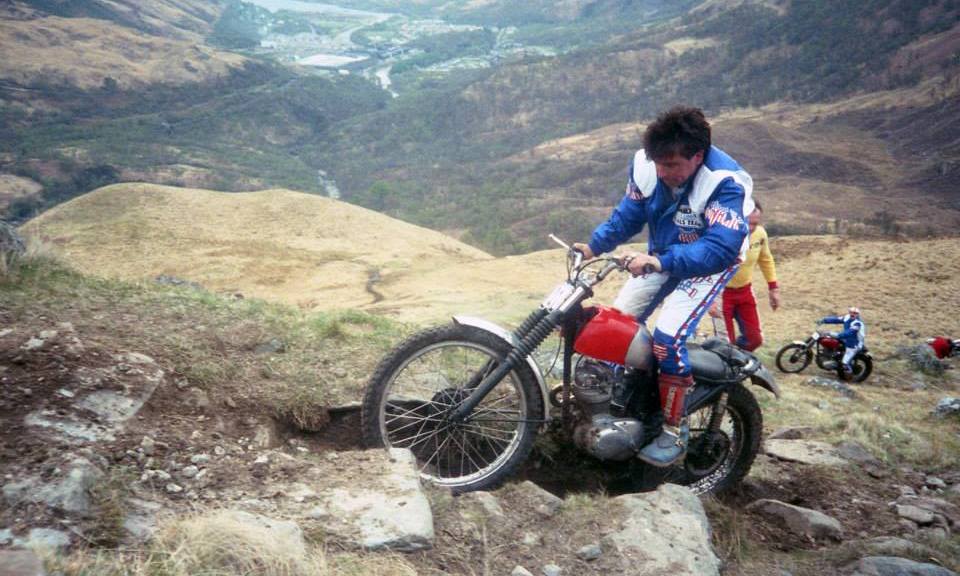
Bernard Gore on the experimental ‘Mickmar’ in 1973.
Known as the Welsh Sammy Miller for his similar dedicated and determined style, he lived his whole life in the small village of Newchurch in Radnorshire near to the English border. Although a farmer’s son, he trained as a mechanic excelling at bodywork. He started riding trials in the mid-sixties for his local club Builth Wells and he was soon challenging for wins locally and like many trials riders of the time progressed from local to national trials getting amongst the awards on a regular basis. He won the Welsh Trials Championship on four occasions which qualified him to ride in the British Experts held locally at Rhayader. Also he won the Mid Wales Centre Trials Championship on five consecutive occasions from 1967 to 1972 with the exception of one year due to foot and mouth disease.
Bernard was best known for riding a Bultaco including an ex-Sammy Miller machine which he gained most of his success on. He was involved as development rider for Michael Martin’s ‘Mickmar’ trials machine in the seventies who incidentally now lives just over a few miles away from Bernard’s home. After that he finished his career on Ossa by then he had met and married Vicky James, daughter of a Builth club official and sister to another local trials rider. Although trials was his first love which he excelled at Bernard also dabbled a few times riding scrambles on a Bultaco Metisse.
Bernard passed away on 9th July, he is survived by his wife, Vicky, son Gareth and daughter Emma. Motorcycling still plays a part in the Gore household with son Gareth firstly road racing but in recent years competing in trials.
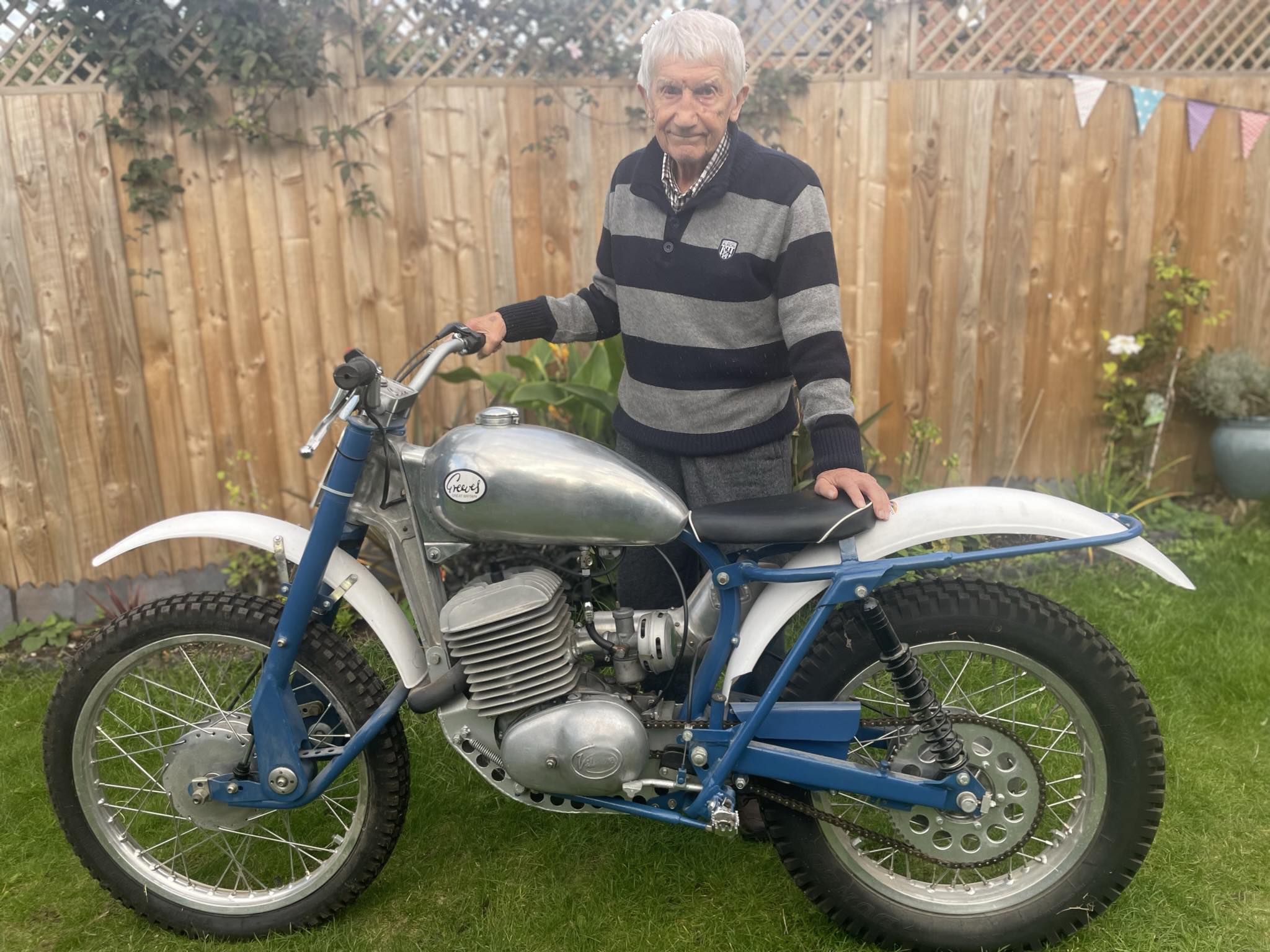
Ken Sedgley 1935-2025
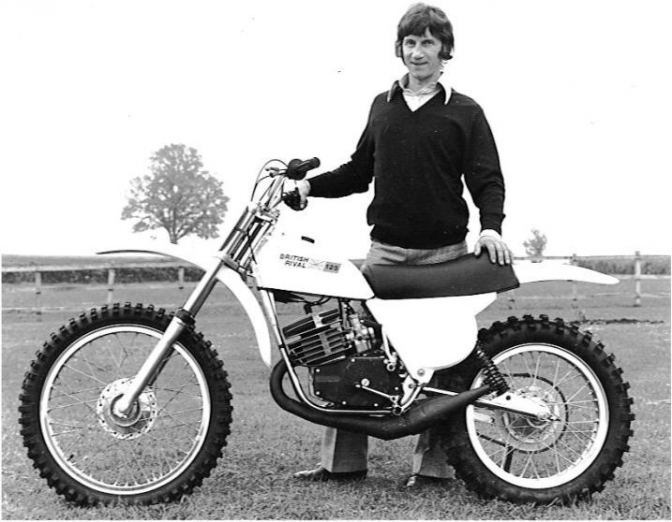
Ken Sedgley with his motocross creation, the British Rival
Words: Keith Gardner
Ken Sedgley was a well known rider, particularly in the Midlands of England. He ran a motorcycle shop in Northfield, Birmingham, with his wife, Pat. But he was best known as a scrambles rider, initially on a Tiger Cub but later as a works Greeves and Dot rider. He was also an excellent trials rider, competing in many SSDT and the ISDT, with much success. After his riding career he was a sales representative for Silkolene Lubricants. Small in stature, he achieved tremendous results, particularly when he was one of the first to ride the twin-port CZ. He also built his own motocross machine in 1977, named the British Rival. He died peacefully, aged 91 with his family by his side. Details of funeral will be posted in due course.
Neil Sedgley wrote: Thank you so much for all your kind messages, it means a great deal and my Dad would be so pleased that you remember him from back in the day.
Dad’s funeral will be on Tuesday 2nd September at 10am at The Vale Crematorium, Evesham Road, Fladbury, Pershore WR10 2QR
Followed by a wake at, The Vale Golf Club, Hill Furze Road, Bishampton, Pershore, Worcestershire, WR10 2LZ
Our only dress code request is that you wear something navy blue and white – you could take the boy out of West Bromwich, but you can never take West Bromwich Albion out of the boy!
Just so readers know, we will shortly be making a few changes to the Trials Guru ‘Menu’.
Currently there are three drop down menus entitled: ‘Photographers’; ‘More Photographers’ and ‘Even More Photographers’. These will be removed as the contents are now merged into the ‘Trials Photo Archives‘ as they are already listed in that feature and are alphabetically listed.
None of the photographers work will be adversely affected and it will tidy up the main menu to make things easier to locate and enjoy!
In the meantime feast your eyes over the wonderful trials images supplied free of charge by our worldwide photographers!
This interview was with somebody who is a quiet, unassuming, reserved man, yet a rider who had great determination and skill in his chosen sport of scrambling/motocross through the years. Perhaps recognised more in the Pre’65 era, he had a riding style and reputation as a gutsy wild man and was instantly recognisable, a Triumph Metisse, throttle wide open, bike broad-siding but fully under control, the rider in a determined concentrated posture. Now retired from Motocross but keeping his hand in at local trials, that man is Roger Neale.
Roger Neale in 1974
Mike Naish: Where are you from and how did you get into motorcycling?
Roger Neale: “I was born in Dittisham in 1949 and went to the local school until I was 15. My Dad used to do a bit of grass track and he also used to go and watch scrambles with a bloke in the village, and I went with them. There was a rider near the village that used to ride and I thought ‘I could do that’. In 1963 I was given the opportunity to have a ride at Plymouth speedway. I was fitted out in all the gear and then I went into the fence in the first race and that was that, Dad would not sign the contract.”
“I had an Enfield road bike and in 1964 I traded it in for an old 1961 Greeves MCS at ‘Crooks’ in Totnes, where Brian Trott used to work. In fact it was Brian who brought the bike down to me in a pick-up. My Dad didn’t want me to ride in scrambles so I kept it up at the farm where I worked at the top of Dittisham, so of course then I had to walk to work every day having sold the road bike. I used to ride the bike around the fields and my parents wondered where I was going every Sunday, so one day they followed me and saw me riding but in fact they were all right about it. I had a BSA C15 road bike after a while to ride on the road.”
MN: What was your first event?
RN: “It was a South Molton scramble in 1964 on the MCS Greeves. I remember it was a course where we had to go up and down a valley with a river in the bottom. I did about five or six meetings on the MCS and then we found we were pushing it more than riding it so my Gran lent me the money to buy a Greeves Challenger. I rode Greeves from 1965 to 1969 finishing up with a Griffon. I started off in junior events and picked up a little bit of money and did additional work cutting grass which helped to pay my Gran back and then after a couple of seasons I got upgraded. We went up and rode at Tweseldown and did well on the two-fifty and Greeves started helping me with spares. Pat Trott had rang them up and asked them to sponsor me, and they did with 50% in the cost of spares. The Trott family were good to me. Pat could be a bit fiery at times but she has a heart of gold. My Dad and Cyril Tucker who owned the local shop used to do the maintenance on the bikes. When Arthur Browning and Dick Clayton had the Greeves Griffon they had very big frames, but because Vic Allan was quite short they made him a special low-line frame. They also gave me the same low-line rolling chassis that I could put my engine in because I was also quite short.”
MN: Who was your next sponsor?
RN: “I was sponsored by Bernard Taylor on Husqvarna on the understanding that Reg Squires looked after the bike. Of course in those days sponsorship was quite good they would give you the bike, all the spares, riding kit, the lot. That was followed with a BSA B50 from Pete Tizard and Weymouth Motorcycles and a succession of Japanese two-strokes from dealers in the South West which included Bernard Singleton, Fluff Brown, Torbay Motorcycles, Devon Motocross and Damerells of Cornwall. Probably my most successful partnership of that era was with Badger Goss and the Maico.”
MN: You have had a few bad accidents?
RN: “Yes unfortunately, I have some bad bangs in the head. I came off the Maico second time out. I was racing against Freddie Mayes somewhere up country in a TV scramble and I got pushed out on a corner and fell and a footrest split my helmet and cut my head open from front to rear. After that I was riding grass track on a BSA and I had it laid down when I hit a piece of steel that had come off in an earlier sidecar accident. Well I came off and Richard Heslick went over the top of me and a footrest hit my head and I was out for two days. The worst was down in Cornwall at Nancemellin near Camborne. I came off coming down after a jump and was hit in the back by a rider following me. I was badly injured and lost the feelings in my legs for some months. It was a very worrying time because I could not work. I had to give up work on the farm but the family and the local community helped me out when we needed it most, they were brilliant. Then I gave up scrambling for six years. When I was a bit better I got a job with the water board. I had started my own business on the side in 1978, breaking bikes and then I went full time in 1985.”
1978 at Devonport.
MN: When did you start Pre65 racing?
RN: “In 1986 at the Bonanza. I had this old Metisse, it was an old Rob Taylor machine in the bike breaking yard, so I did it up with the help of Pat French and entered the Bonanza. It was OK but it had a BSA gearbox which had a big gap between second and third; so I would overtake them going down the hill and then they would all pass me going up the other side. We soon sorted it out and I’ll tell you what, it was the most natural bike I ever rode, it was beautiful. So then Pat French persuaded me to do the British Championships.”
Roger Neale in full flight at Beauval.
“Terry Hobbs of Plymouth used to set up the Triumphs. He used to take the engine and do it in the evenings. He would not even let his mechanics watch him working. He would have three sets of different timing wheels with additional splines machined on them so that you could get greater adjustment with them. He would time the bike depending on the course being ridden. He would also use modified manifolds on the six-fifty Triumph, they were very fast.“
Trophee de Nations 1995.
MN: So when did you give up?
RN: “I had a bad smack up. I had a hell of an accident up at Yatton Kenall, all cow ruts. All I remember was kissing my little maid goodbye before the race and then waking up in Frenchay Hospital three days later. Apparently I had a bad start and was catching up. Going down the hill jumping off the top and landing, the backend started to twitch so I gave it a big handful and lost it in a big way. Well the bike missed me and so did four riders following, but Stuart Bowden hit me full on the helmet. It wasn’t his fault, bless him, and he was very cut up about it. The air ambulance had to take me to hospital. They didn’t think I would ever walk again and the neurosurgeon gave me some very strong advice. I had to see him every month for a year because I got a lot of migraines, and he said to me that if I had another accident and get hit on the head again I would probably be in a wheelchair for the rest of my life. Well Mike I can tell you, I don’t mind dying but I don’t want to spend my life like a cabbage in a wheelchair, so I gave it all up.”
Roger Neale in 1989 at Nottingham.
MN: You now ride in twinshock trials, how does it compare?
RN: “I’ll tell you Mike, I thoroughly enjoy it. It is a lot more comradely than Motocross. We just chat all the time going around the sections. I wish I had done it before, they are a great bunch of lads. It is a totally different technique for me and of course it is a different sort of throttle control. I have to admit that sometimes in the past the old red mist came down, but I am more settled now and accept that the old days are past. I hope to keep on riding in trials for as long as possible and when time constraints of the business allow. I have actually changed my closing day from Wednesday to Thursday to allow me to ride some Wednesday evening trials. I still have my Metisse and I look at it sometimes because I have fond memories of those good years.”
MN: Thanks Roger, I hope the following years are good to you.
Roger Neale behind the counter at his garage.
Mike Naish writes: I have only grazed the surface when talking to Roger and so much else has been written about him and his successes elsewhere in the press and many books. He is reticent to talk about his successes so here is a list of just some of his achievements:
1972 Member of the South West Centre team when winning the inter CentreTeam Scramble together with Badger Goss, Guy Winsor, Rob Gapper, Ted Thompson and Ron Kallaway.
1974 Winner of the International Motocross in the Isle of Man.
1974 South West Scrambles Champion.
1978 Cornish Centre 250cc Scrambles Champion.
1988 Member of the England Team at the Pre65 Motocross des Nations together with Mick Andrews, Simon Cheney and Arthur Browning.
1988-1995 Winner of the Pre-Unit class at the Norman Scramble at Beauval.
1989 Winner of best pairs with John May.
1990 Won the World team championship in the England team together with Dave Bickers, Adrian Moss and Roy Abbot.
1991-1994 European Pre65 Motocross Champion.
A Chat with Roger Neale is copyright, Mike Naish and Trials Guru 2025
Apart from ‘Fair Dealing’ for the purpose of private study, research, criticism or review as permitted under the Copyright, Design and Patents Act, 1988, no part of this article may be copied, reproduced, stored in any form of retrieval system, electronic or otherwise or transmitted in any form or by any means, electronic, electrical, mechanical, optical, chemical, photocopying, recording or otherwise without the prior written permission of the author as stated above. This article is not being published for any monetary reward or monetisation, be that online or in print.
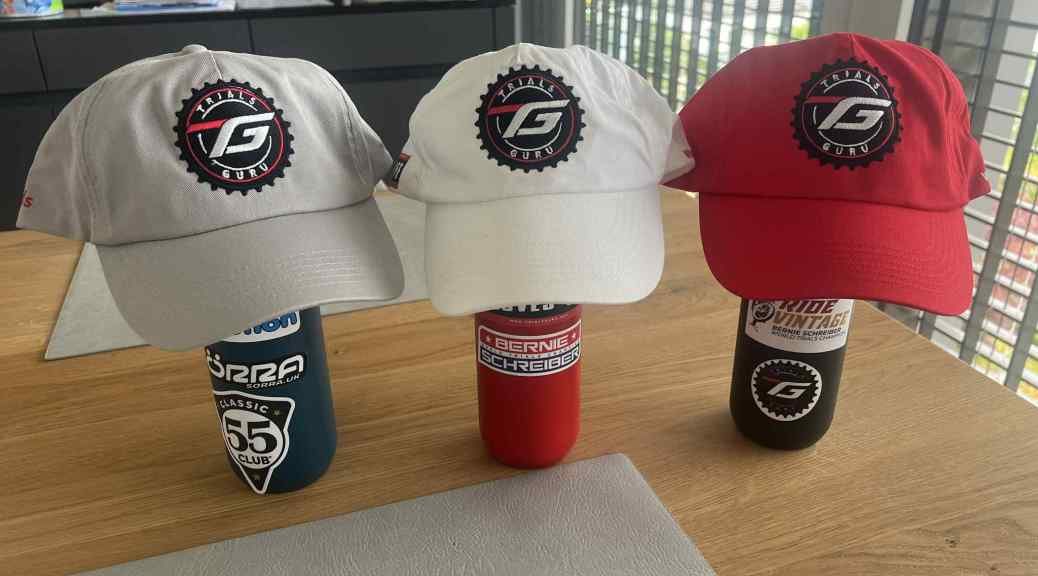
Since June 2024, Trials Guru has been shipping out the now famous Trials Guru VIP caps across the globe and we also created a celebratory ‘VIP Club‘ on the website.
There are three types of VIP cap, the red VIP cap; the white VIP Winners Cap and the light grey, VIP Trial Legends cap!
Only one person in the universe owns all three, none other than Trials Guru contributor, the 1979 World Trials Champion, Bernie Schreiber!
1979 FIM World Trials Champion and 1982 SSDT winner, multiple AMA National Champion – Bernie Schreiber
Bernie is a true ambassador for the sport of Trials and also an ambassador for the Trials Guru website.
The VIP cap in all styles has now become a collectors item. Not everyone who owns one wears it, they have it on display in their trophy cabinet or den. That isn’t a problem, they were commissioned to bring enjoyment to their chosen owners.
The VIP cap is not sold anywhere at any price, they were commissioned by Trials Guru and distributed free of charge. Truly a unique form of headwear for people who are ‘DEDICATED TO TRIAL’ across the world.
We are constantly on the lookout for something out of the ordinary at Trials Guru. We think we have found it with this interesting article, penned for us specially by the subject himself.
Words: George Webb; Trials Guru. (50 minutes read time)
Photos: Alistair MacMillan Studio, Fort William; National Motorcycle Museum, Birmingham; David Strickland; Rainer Heise, Germany; OffRoad Archive; Brian Catt; George Webb personal Archive.
Born on 7th April 1943, George Webb is a well-known and respected Army MCA rider from the 1960s through the 1970s and into the 1980s. He rode trials, long distance trials, Army trials, enduros, the Scottish Six Days and the International Six Days Trials, representing Great Britain and the British Army. George Webb wasn’t a ‘works rider’ as such, but he was paid to ride motorcycles by the British Army and occasionally he was issued with some very specialised kit! Now George has agreed to share details of his many adventures while serving in the British Army and beyond. We think you will enjoy this article.
Here is George Webb’s story, written specially for the Trials Guru website by the man himself:
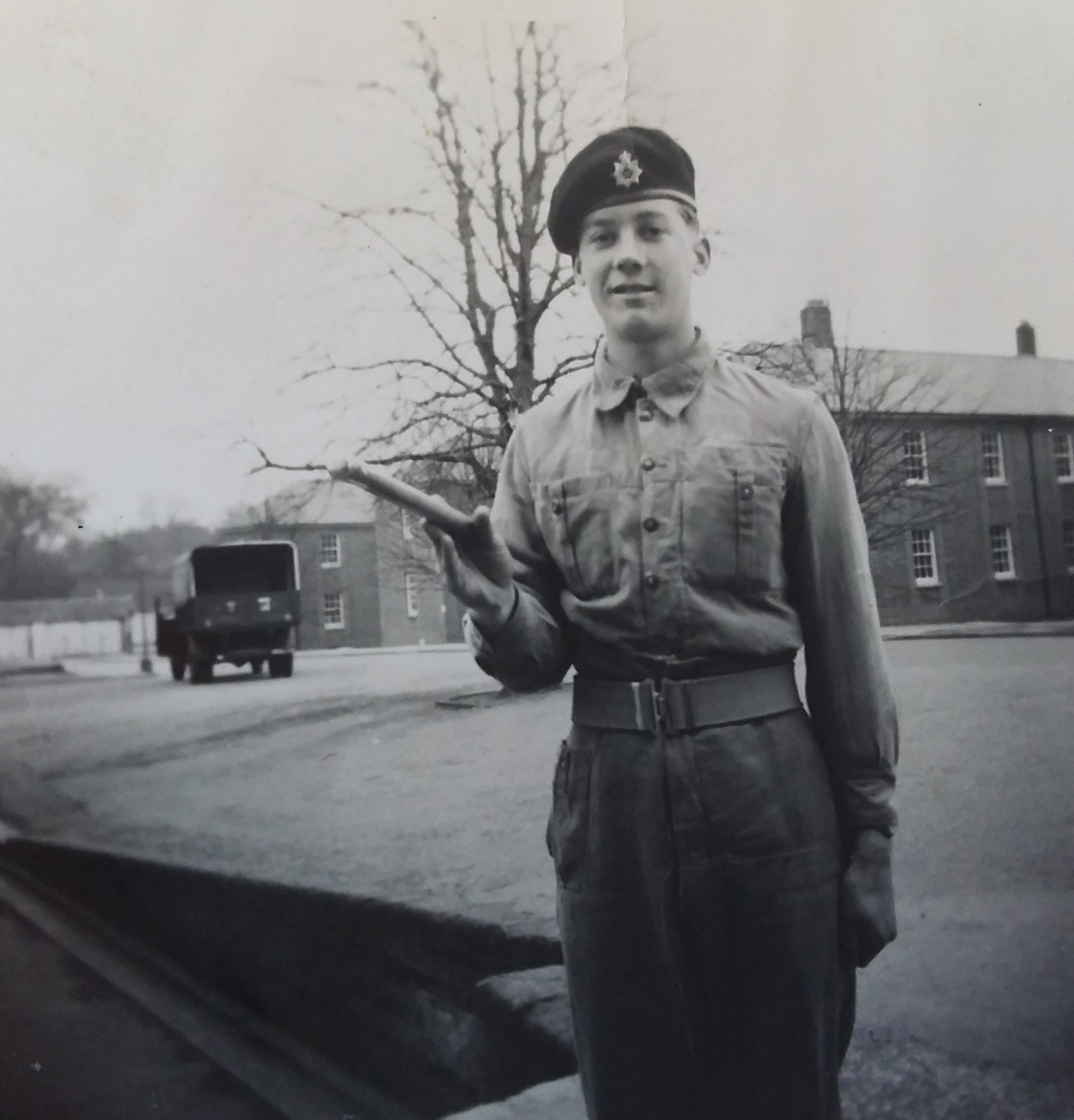
“It was the 6th of April 1959 and I had just enlisted for nine years in the British Army. Tomorrow was my sixteenth birthday and my favourite subject at school had been Geography, which gave me the desire to travel and drive things, the services seemed the best option to me.”
1959/60 at Borden, Hampshire. George Webb at sixteen years of age. ATTENTION!
“Growing up in West Suffolk in a small village between two airbases, most of my time was spent working on farms, trying to earn some pocket money. Times were hard in those days and rationing after the second World War lasted well into the fifties. My Mother had a hard upbringing with five other siblings, there were times when there was no food in the house and they had to rely on neighbours for bread. My Father’s history was not much different, he worked his whole life and, to the best of my knowledge, he ever had a holiday. All my immediate family have passed on.
During the war we missed being killed when a Short Stirling bomber, returning from a raid in Germany, missed our chimney by about six feet and crashed in a field at the bottom of our garden, sadly there were no survivors. Mother related later to us that this often happened and she would hear the screams of the crew when the aircraft burst into flames. There were no good wars.
My two brothers had motorcycles, but were not much into competition and like myself, bikes were seen as a mode of transport. My first bike was a 1960 250cc Francis Barnett fitted with an Avon fairing, which I could use to get about on, and travel to my Army base and home for leave.”
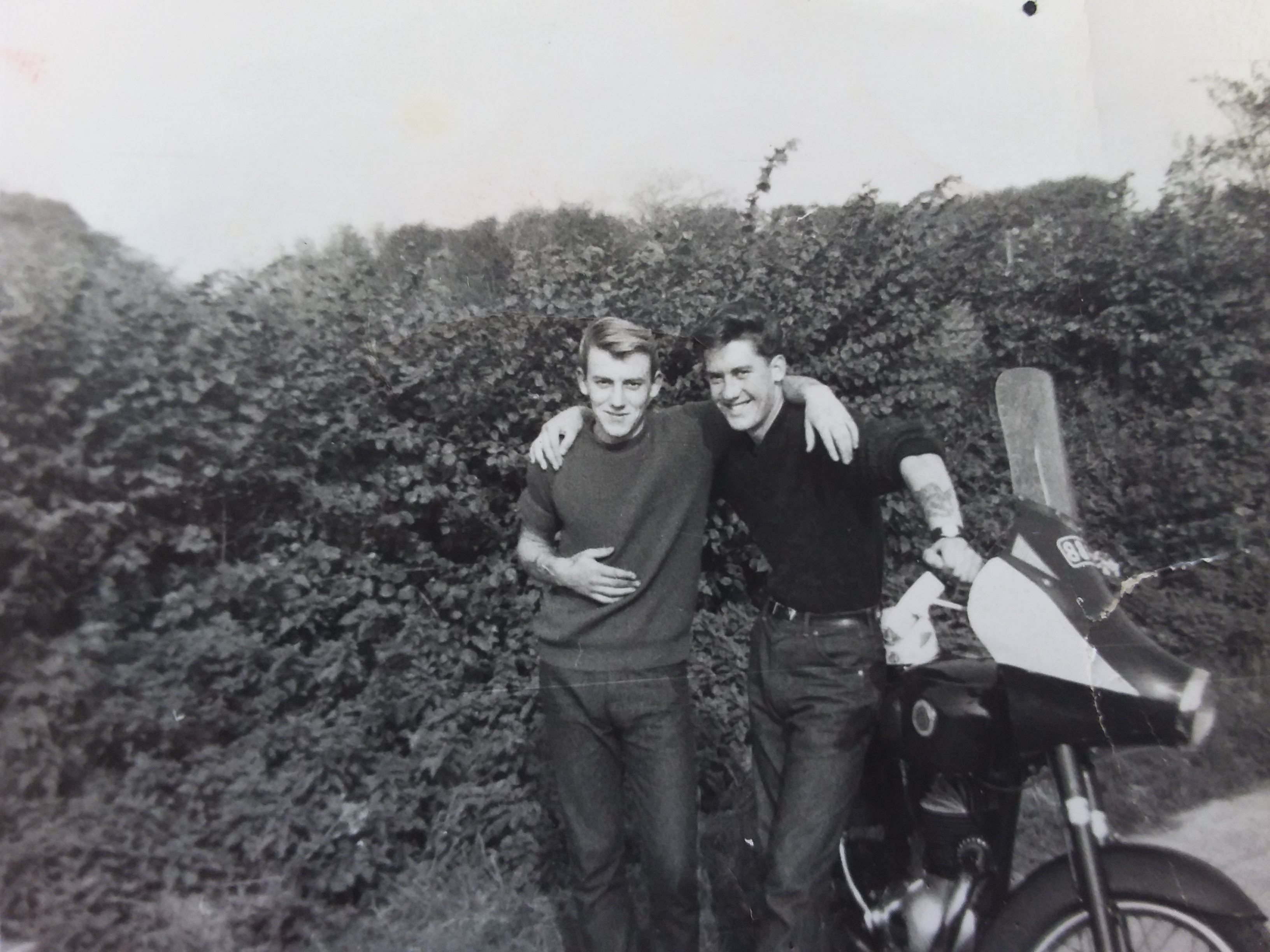
George Webb and his best mate, and pillion rider, the late Pete ‘Ossie’ Osbourne. He was always going to sleep on the back! 1960 250 Francis Barnet, 888VF.
“My first couple of years were training for junior leaders and we spent most of this time doing things like weapons training, drill, fitness and assault course, map reading and compass work and further education.
I also took my HGV training with the driving test on 1st November 1960 and was the only one of eight to pass. Later the same day, I passed my motorcycle test, both tests at the first attempt. I was truly chuffed to bits.”
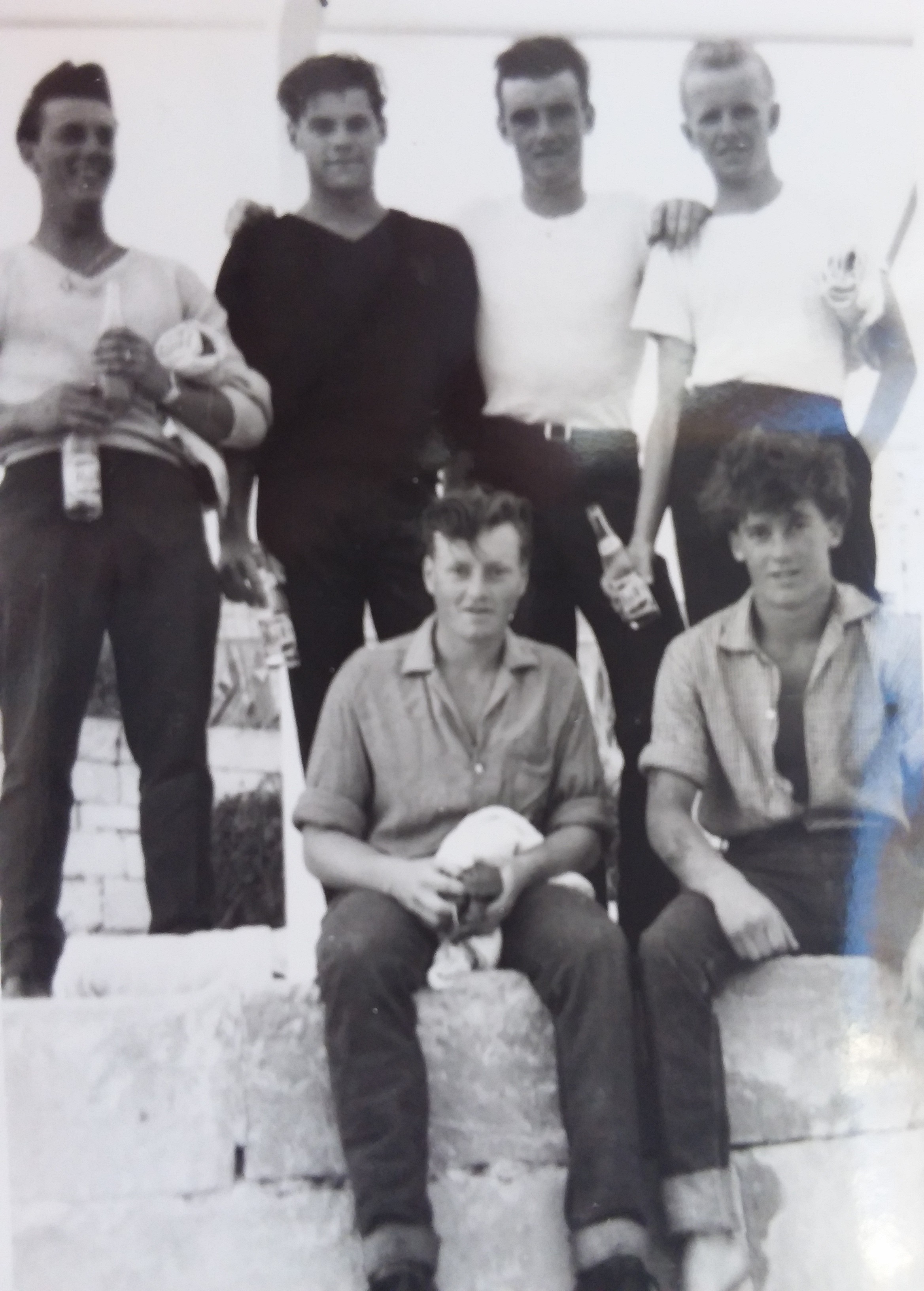
George Webb, bottom right, Malta 1962, after a swim. Following Amphibious training.
“Fast forward to 1963, I was now stationed in North Devon, having trained as an Amphibious Specialist, operating in rivers, estuaries and the open sea. Ours were the only such unit operating in the British Army and we were operating WW2 six wheeldrive D.U.K.W, referred to as a ‘Duck’ made in the USA.”
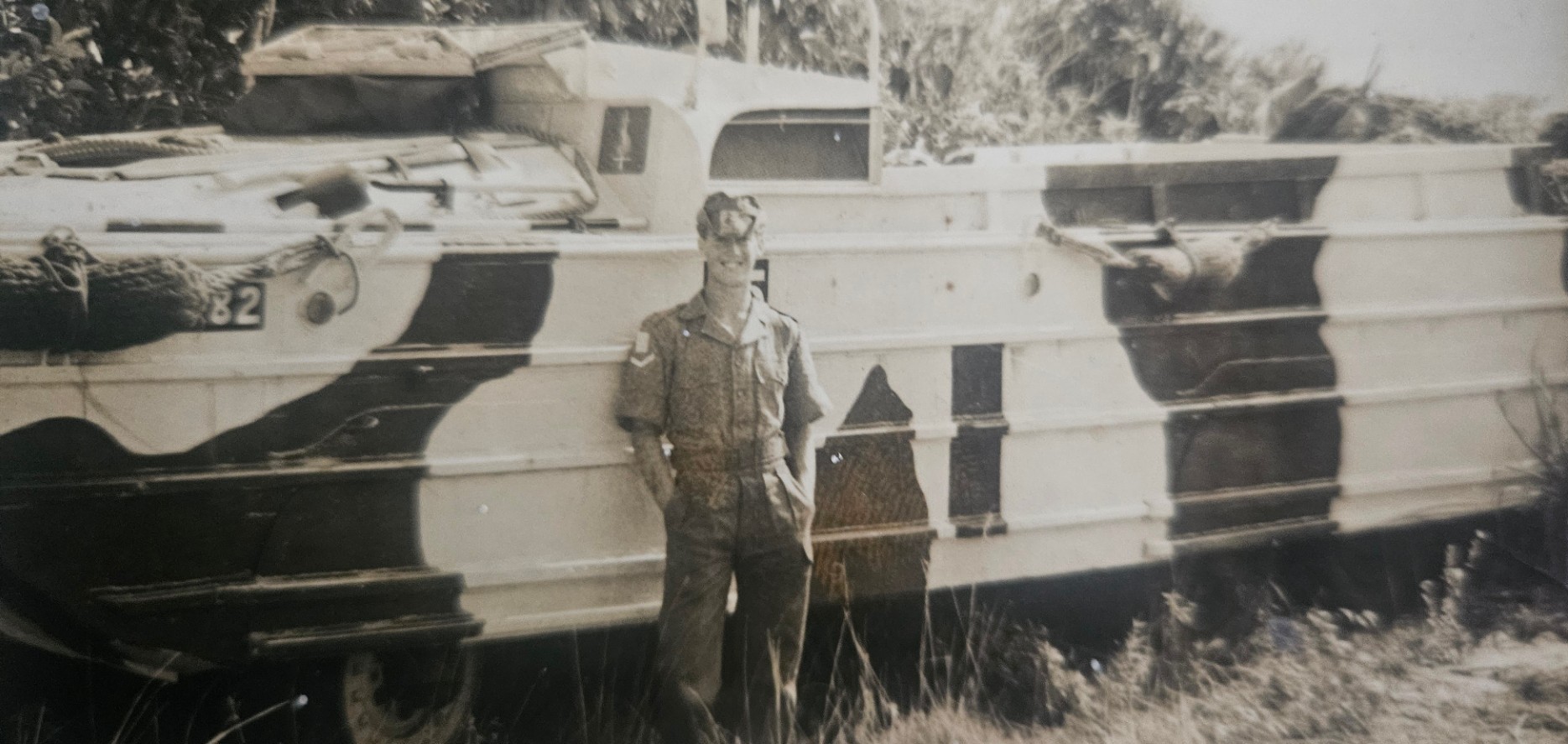
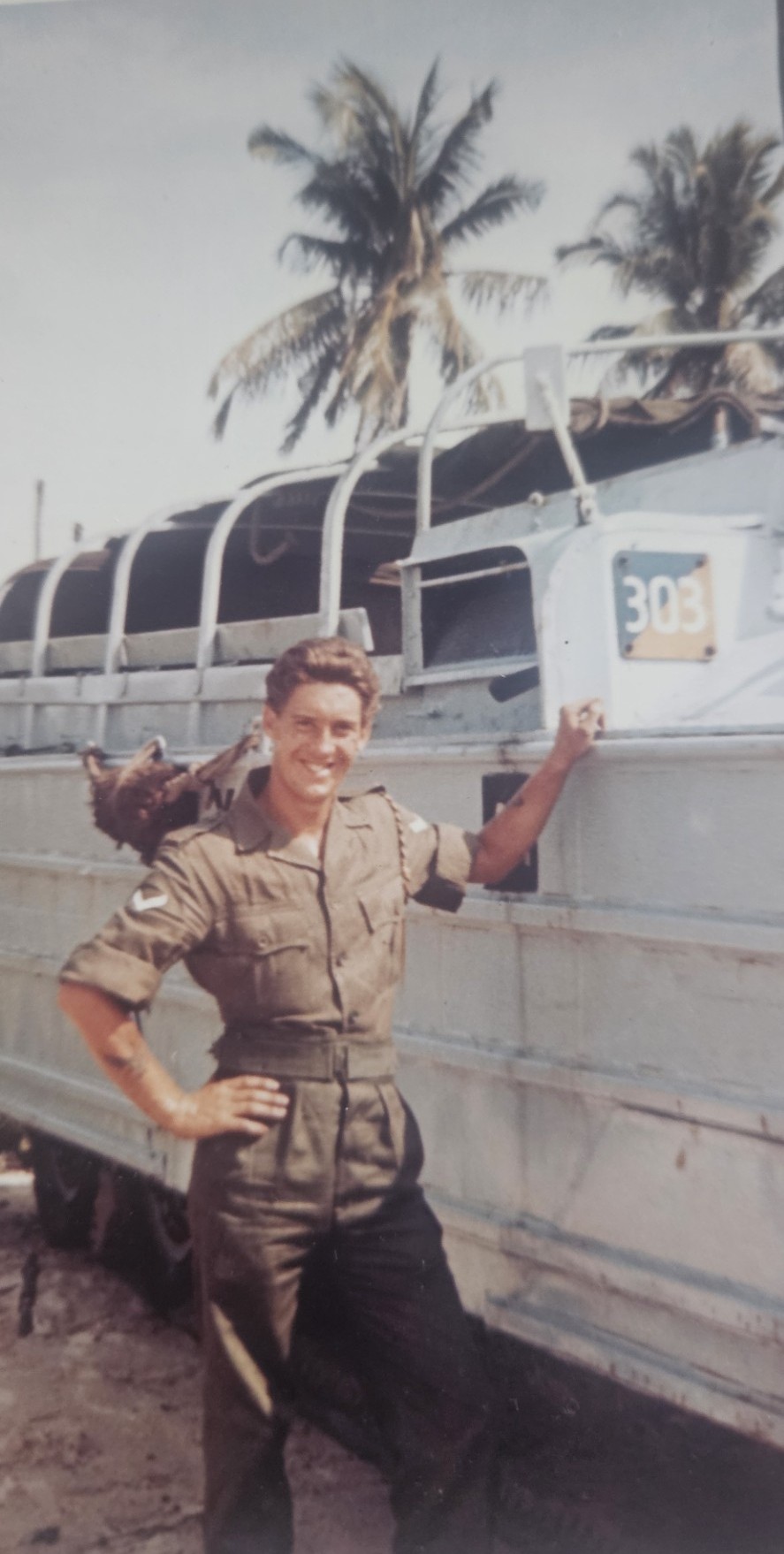
George Webb poses with a British Army amphibious DUKW.
“Our job was to deliver ship to shore, troops, supplies such as food, ammunition and fuel. We could deliver this up onto the beach or miles inland, and then return to the supply ship for more loads. There is of course much more I could tell you about, but Trials Guru is about trials, right?”
George Webb beside one of the amphibious DUKW vehicles it was his job to drive in the British Army.
“We had a new Sergeant Major arrive at our unit in 1963 who happened to be an Army motorcyclist. He wanted to enter a unit team in some upcoming Army event. After a bit of practice with his selected team, one didn’t make the grade, so he invited me in as I had now been riding for three years. However I had never ridden in a trial, so I had to quickly find out what was involved.
To explain, an Army trial is not quite the same as a civil trial, because it was classed as training. Generally speaking, all riders or entrants would ride the same service issue machines, which at that time was the WW2 issue M20 BSA, a 500cc side-valve, which had poor ground clearance, poor steering lock, no rear suspension and girder forks. We also had to wear standard issue riding gear and helmets.
First of all came a map reading exercise, we were handed an Ordnance Survey map and a route to plot and then ride, taking in a number of check points and within a set time limit. This was usually done on minor roads and green lanes.
Secondly, came a number of sections to be ridden within a time limit.
Third, was a cross country timed course.
Points could be lost on all three stages, but also the condition of the bike at the final inspection of rider and machine.
At this stage of my life, I now had a Triumph twin which was far and away better than the Army M20 BSA, but hey-ho this was still fun and I was getting paid to ride. Did this mean that I was a works supported rider? Hardly!”
The 1941 M20 BSA a machine similar to those ridden by George Webb in his early career with the British Army – Photo: National Motorcycle Museum, Birmingham.
“The map reading I could do, but reading a map and riding down bumpy lanes, steering with one hand and holding up the map board to follow the route was somewhat risky. I had an enormous tank-slapper when a puddle turned out to be deep! Desperately trying to grab the handlebars while my tin helmet was flip-flopping over my eyes. ‘Bugger that’, I thought to myself, and shortly after the Sergeant Major went passed, going the wrong way. When he stopped and I put him right, he said ‘OK, you can lead’.
So, off I went, I suppose I was trying to impress him, when I missed a turn by going too fast. He took off at some speed, trying to impress me I guess, which he did of course. As I entered a sharp bend with those West Country high banks and hedges, well of course there was a field entrance mid corner, so as I ride up the bank, which I am forced to do by the footrests digging into the tarmac. Back down the bank, heart rate up slightly, remembering that this isn’t the Triumph I am used to – slow down Boyo!
In no time at all I find the Sergeant Major sitting up a bank on his machine which had seized up. He said: “You carry on and finish and come and fetch me with the truck. Well the other team members didn’t finish either so it was just me and I never got any results, and to this day I do not know which position I finished up with.
There was one more episode with the M20 BSA, but that was up the Jungle three years later.
Singapore and Malaysia:
In 1964, it was time for my next posting. I was not keen to go, as I had a steady girlfriend, and a BSA Super Rocket as my transport! This would mean two and a half years with no home leave. What would happen to my girl? You guessed! – She found someone new!
It was a long flight to Singapore on the old Bristol Brittania nicknamed the ‘whispering giant’, with stops at Ankarra, and Bombay where we could get out of the plane for a bit of excercise and fresh air. Wow, it was eight in the evening and 108 degrees! By next morning we arrived in Singapore.
We now had to get used to high heat and high humidity for the next thirty months, phew!
We were still operating our amphibious D.U.K.Ws there, as half of them were shipped out by sea in a LCT, a sea going Landing Craft, Tank.”
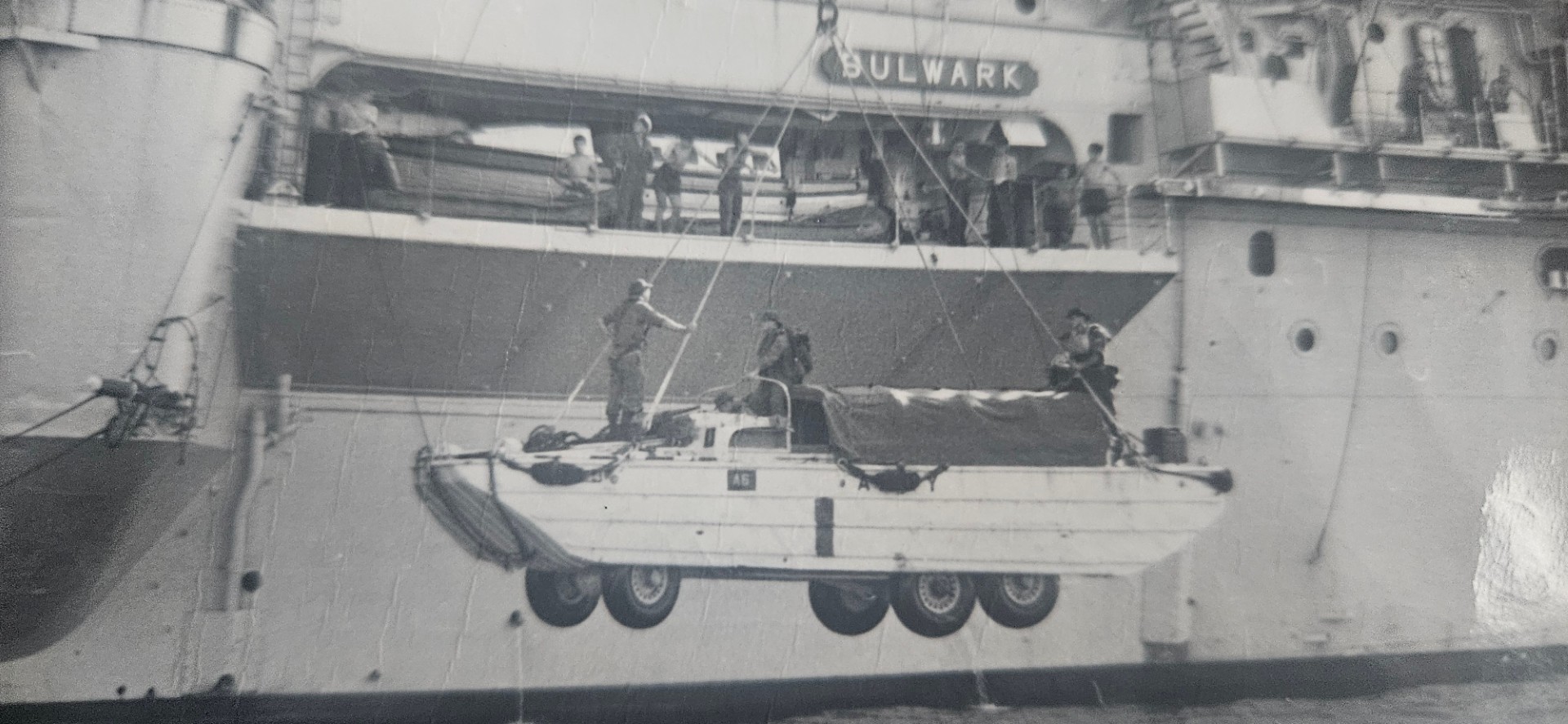
A British Army DUKW as driven by George Webb is hoisted aboard HMS Bulwark – Photo: George Webb personal Archive.
“Malaysia was having trouble with incursions by the Indonesians, mainly in Borneo, but also in Malaysia and Singapore. I guess somebody thought our unit would be of some use out there. As it happened, we did not get much involved as it required a lot of Jungle warfare, with specially trained troops such as the Gurhka Rifles, and real locally recruited Borneo Head Hunters. I kid you not! My friend served there for a while and he took years to get over what he had seen. Anyway, the Indonesians got fed up of being killed, and after a few years, it all settled down.
We spent our time doing exercises, and training, and maintainence. I bought a bike and could now explore the Island and up into the Malay Peninsular. This was great, my new Triumph Tiger 100SS was a cracking bike, a 1962 model, had been in its shipping crate for 3 years, and I got a big discount. The locals stopped buying the bigger more expensive bikes, when the Japanese bike invasion began.
I joined the the Singapore Forces Driving Club, and took part in some light hearted trials and quite a few rallies, both as driver and also navigator.
Before I left England, I took part in the Army Driving Championship in 1963. Over five days and a two thousand mile course of navigation, special tests, cross country, and night map reading. Out of an entry of many hundreds, we came home in fifth place at our first attempt, but even more important, we had won a major trophy. The R.O.S.P.A. Cup, for road safety.
Our Boss was so chuffed, he gave us two weeks holidays – Bloody Brilliant!
Terendak, Malaya:
After eighteen months in Singapore, I was sent up north to a base near Malacca. This was a general transport unit equipped with Bedford RL trucks, nicknamed the ‘Flying Tigers’.”
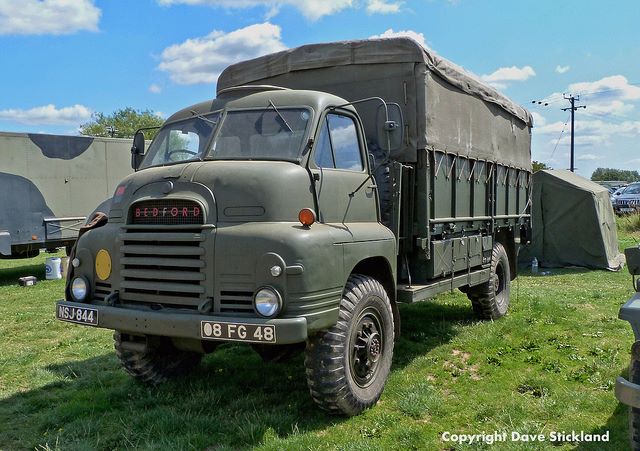
Bedford RL truck of the type used by the British Army – Photo: David Strickland.
“Perhaps something to do with the fact, they seemed to go flat out everywhere!
Very soon we were off on excercise, as I had a bike licence, I got to ride the motorcycle! A BSA M20 500cc side valve. Well, that made things interesting, how to control a convoy on a bike that was slower than the trucks! As usual on excercise, one had to carry a personal weapon which would normally be a 7.62 SLR Rifle. But that is a bit large to carry on a bike, so I had a Sterling sub machine gun, and magazine, but no live rounds! Now this is quite normal for army exercises, no point in taking unessary risks. Live firing exercises would be carefully planned and more in line with preperation for genuine Ops, or war.
One night I was sent on a job on my own to some jungle location, I can’t tell you what it was, because I have forgotten. What I can tell you is that after some time of riding there was a sudden tropical downpour of very heavy rain. Luckily my heavy DR Mac kept out the rain which was good. However, some of the rain flowed down the Mac and into the open carburrettor, and the bike conked out!
This was quite worrying to say the least, and especially because on an earlier excise in the central Malayan Highlands, I and two friends had a very close encounter with three tigers! I always thought tigers were solitary creatures, and right now in the pitch blackness I was thinking of tigers, and all manner of other stuff. This is when I really, really, wanted a magazine full of lovely bullets! I cursed the Army for not thinking about what might happen to one of theirs, who might end up in such a predicament! If there had been two of us on bikes, my fear level would have been less!
There was no doubt what the trouble was, the rain had entered the open carburettor and wet the spark plug. What happened next was one of the fastest fixes that you could imagine. The bike burst into life, and I was off in an instant. I never saw another human on that jungle track, not your average trail ride. That was my second experience on the BSA M20, and probably the most memorable.
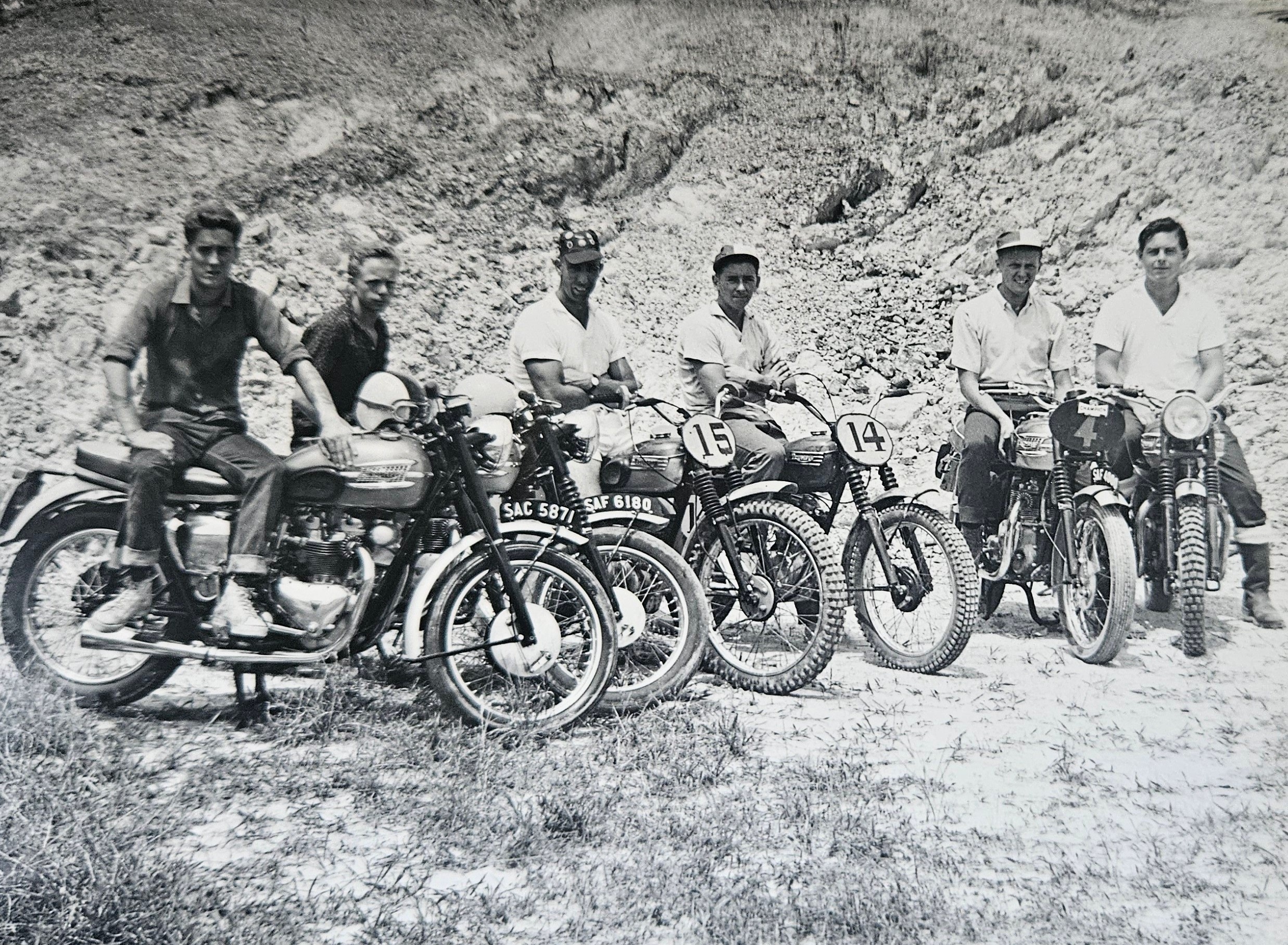
Rally success in Singapore and Malaya around 1964/65. George Webb is second from right front row.
I will tell you another little story for the benefit of anybody that may not have ‘served’, and for those that have.
On this occasion I was still down in Singapore, and we had an exercise up on the east coast of Malaya with our D.U.K.W.s. One evening, we had a briefing, about what our next task would be…….. ‘OK lads, tonight the Marine Commandos are doing a landing on our beach. Your job will be to capture them’. – Your kidding right Sarge? ‘No, I am not kidding’. Well, the imagination starts working overtime, how this might turn out.
I mean we are drivers and landing craft operators, not front line storm troopers! Anyway, we have been tasked, and me and my mate Ray were concealed just back in the jungle line waiting anxiously. It was a full moon night and we could see quite well, we have to get this right – Bayonets fixed!
We waited not more than thirty minutes, then we saw him coming towards us. we were well concealed and hoped he could not see us. The element of surprise being essential.
Then, as he went to pass, I rose up swiftly and put the bayonet at his throat, hoping he would come quietly. He did, and we were both pleased, and relieved.
My time in the Far East was very interesting, I had in my time there both a Tiger 100 and a Triumph Bonneville, which I used to travel around the country. I was fullfilling my love of travelling and motorcycling. The weather was warm and mostly dry in those days, and it was a pleasure to be out. The roads were better than ours are now, and traffic was light.”
A brace of Triumph Twins, George Webb is on the right of the photo. Photo was taken at the top of Gunung Brinchang mountain in the Cameron Highlands, near the village of Tana Rata.
“Singapore has changed tremendously, we thought it was great before, but now its amazing what they have achieved. If only we had their politicians here!
In November 1966, I made my way to catch an RAF flight from Kuala Lumpur back to the UK, and to see my family. VC10 jet power all the way.”
George Webb far left on his Triumph in Singapore enjoying the company of like minded motorcyclists, the Forces Driving group at Columbo Camp who did trials and scrambles.
“Although this is a very condensed version of my time in the Far East, I hope it will give a flavour of what life can be like in the Armed Forces. It was only a short time of my twenty odd years in uniform, but there is more to come, when I get to Germany.
Germany – British Army of the Rhein
In the post war years many British Soldiers spent time serving in B.A.O.R. short for British Army of the Rhein. For myself, I had two different postings there, the first was to a town called Bielefeld, in Northern Germany, where most of the British were. In the south were the Americans and the French. This was really the start of my Trial riding.
10 Regiment Royal Corp of Transport, equipped with AEC 10 tonners general transport. Very slow, very noisy, and no power steering! In addition a crash gearbox, and driving these beasts on the Autobahn was like being in a mobile chicane!
After a few days I met up with a John Wigham, who was in charge of the motorcycle bay. When he discovered I was a biker, he asked did I want to come out and do some cross country riding, and that’s how I got involved in Army Motorcycling.
We had some great places to ride and train, and John was heavily involved with the local German trials scene. Our bikes at that time were the Triumph TRW side valve 500 twin, as issued to the Army at that time. There were also some BSA M20 still on the books, but the Triumph was better, marginally! Soon we were off at weekends riding in events all over Northern Germany. Of course we were at a disadvantage riding against proper trials bikes, but invariable there would be a class for road orientated bikes. But hey, it was fun and it only cost us the entry fee, as army transport was provided for us.
After a while I decided to get a proper trials bike, and settled on a 250 Sprite from Frank Hipkin’s empire. In kit form it was relatively cheap, and as army wages never ammounted to very much, cost always entered into the equation.
Well, this didn’t turn out to be such a good decision, as it never handled very well, and I have never had a bike that needed so much maintainence! I named it the ‘Bendy Bike’. When my mate asked to have a ride on it, he went over the handle bars in no time at all! I was soon looking for something else!
I ordered a Bultaco from the factory in Spain, and soon it arrived at the local railway station, Whoopee! I couldn’t wait to pick it up, but when I arrived at the station to collect it they told me I could not have it today because it was 3.45pm and they stop work at 4.00pm. So much for German effiency! I stormed out, slamming the door behind me!
Of course I had to go back the next day and put my best friendly face on, and I got the Bultaco, things were looking up.
A big thank you to Mr. Sammy Miller, this Bulto was chalk and cheese against the Sprite. Next year I would get to ride this bike in the 1969 Scottish Six Days Trial as part of the Official Army Team.
The Army had now been issued with the new BSA B40 and this was a big leap forward from the M20, and the Triumph TRW. It had a couple of shortcomings but was a big improvement.
The Bi-annual Army Motorcycle Championships was coming up soon, and we were going to enter on the new machines.
The Army Championships:
My friend John Wigham had been posted to another unit, but there were a couple of other riders to make up our team of three. With myself as team leader, backed up by Tom Methven and Bill Hutley we set off with our three new BSA B40 bikes to Leek in Staffordshire. We were all novices, and all first timers at the championships. We made the journey over to England in a Bedford RL truck, with bikes in the back.”
George Webb, far right, with British Army issue 343cc BSA B40 machines that were used in Army trials.
“On arrival at Leek we found the conditions wet and the course very muddy, which often means a more difficult course. We began with the usual map-reading route on day one, and then part two the sections. I had lost no marks for map reading and only ten on the sections, it appeared I was in the lead. Bill and Tom were also well up, and we began to think we were in with a chance. Only the cross country to do now, and if we complete this with no loss of time, we were a strong position.
Day two and we were in high spirits, and trying our best. I caught up with my team mates at a particularly difficult part of the course, where many were stuck trying to cross a big ditch. We worked together, when I jumped the bike to the other bank and they pulled me up and sent me on ahead to try and get the win. I was really on the gas and sliding about on the slippery ground. If only I can stay upright, and not crash is what went through my mind.
The final time control came into sight, and I was ten minutes early which surprised me, as the set time is usually quite tight.
Anyway I awaited my allotted time and booked in, only to be told I was four minutes late! I was chatting to the time controller for most of my waiting time, how could I be late? Was it my mistake, had I worked out my due time incorrectly?
I was now in third place, behind two Army International riders, the late Mike Soames and Tom Fayers, but, we had won best Army Team, We were the Army Champions!
This result got me into the official Army Team, and next year I was selected to ride in the Scottish Six Days Trial, with John Wigham, (Greeves), Tom Fayers (Greeves), Jack Galloway, (Saracen), and myself on the Bultaco.
We travelled back to Germany with a fair haul of silverware, and I think it would be fare to say we were all pretty chuffed. Its very sad to lose the win, not on riding ability, but getting the timing wrong, should have worked harder at school!
We arrived at the Camp main gates and were told we had to remain at the Guard room! Whats going on we thought, had we been reported for some traffic infringement?
Were we in trouble, thats always the first thing that goes through your mind. After a few minutes were saw some Soldiers coming down the main entrance pulling a four wheel carriage. We were ordered into the carriage and pulled through camp, and everyone turned out to cheer us back. Things were looking up!
Off to the Mess for Champagne with the C. O. – Yes!
1969 the main events, still in Germany
This year I got promotion to Sergeant, but instead of moving to a new base, I was lucky and stayed in Bielefeld. We continued with our local events and Army Trials in Germany.
However, now that I was in the Army Team, the main focus would be the following events: The Scottish Six Days; The German Three Days Enduro in Isny; The Welsh Three Days Trial; The I.S.D.T. in Garmisch-Partenkirken, Bavaria, Germany.
In Brief: The Scottish went well and lived up to expectations. We started in Edinburgh back then, and there was considerably more mileage than there is today.
We all had good rides and and Jack Galloway on the Saracen had a top ten ride! We won the John Bull Tyre Trophy for best Services Team and I won a first class award, which I was happy with, especially as a First timer, then aged 26.”
The 1969 Scottish Six Days, with George Webb on the 250cc Bultaco Sherpa running with British Army registration plates on the iconic ‘Pipeline’ section. Photo: Alistair MacMillan Studio, Fort William.
“Just a few weeks later, we were off to Isny, in Southern Germany, for my first International Enduro. This event became a European Championship round the following year.
The course was very wet with some big hills and thick forestry. Our BSA B40s had been uprated to 441 cc Victor motors and heavier chains, and the extra power was a benefit. However, our bikes were no match for some of the ‘works’ machines that were far lighter. This would become a patern in following years, where we would be running uncompetitive machinery, in World class events.
At this time we were officially in Training, nowadays this is recognised as Sport, within the Army. Now the Army can purchase the right bikes, as funds are provided.
As soon as we finished here, we had to drive a one thousand miles back to take part the in the Welsh Three Day Trial/enduro.
This is the big event of the year for enduro riders, although at this time it was still refered to as a trial, as was the I.S.D.T.
Starting in Llandindrod Wells, this event had been running I believe for some years and always attracted a big entry. Our B40s had been modified to run with the Capacitor Discharge ignition system to try and save some weight by taking off the heavy battery. However, it was giving problems with starting, and when it came to my turn to start it was playing up!
Well, you only have one minute to start, and ride over the line one hundred yards away, or you lose marks. The seconds were passing and nothing, and then when time was almost up it burst into life! I was into gear and the clutch was out in a fraction of a second and from start to way passed the one hundred yard line was on the back wheel only!
After a good first day, we went down to check the results at the Metropole Hotel, Llandrindod Wells. Well, I couldn’t believe it, I was in second place, behind Scott Ellis the eventual winner that year. If I could maintain this position tomorrow?
The second day started off well, no problems staying on time, until the Strate Florida part of the course, several water crossings. After coming across the stream for the last time the engine just died, no sparks! Catastrophe!
I had been there trying to discover the problem for about an hour or slightly more, when suddenly it started. Could I reach the next time check before I was over my hour of lateness allowance?
Well, I really did fly to the next time control. and I skidded past the time clock as it ticked passed the hour. However, there was an ACU Steward there and he said I actually made it within my hour, and could continue.
Unfortunately, I was so dejected at the time I made the mistake of retiring from the event, forgetting that I was in a team, and that retirement would cost the team many more marks.
So, remember, if you are in a team, even if you have lost a lot of marks, try and keep going for your team mates.
I never found out what the fault had been with the bike but I suspected a faulty diode.
The Welsh was one of my favorite events, due to the great variety of the course, with forestry, open moorland, and many dirt tracks. Over the next ten years, I won several Gold medals, and one class win. On the last occasion I rode there I had for the very first time a competitive machine, a 250cc Can-Am, and finished with another Gold medal.
The 1969 I.S.D.T. was in Southern Germany, in Garmisch-Partenkirken, and we were riding the Army modified B40. The ignition system was still giving us starting problems, mostly from the initial cold start in the mornings. It was a great course but I was soon running on Bronze medal time due to starting problems.”
The Army modified BSA B40 for ISDT use, seen here ridden by George Webb.
“The event each day consisted of two laps of a hundred mile long course and on the Thursday things got worse!
As I had almost completed the first lap when the engine cut out. I quickly diagnosed that the Alternator had stopped working, using my test kit.
This did not bode well, but I decided to investigate further, and after removing the side cover (many screws) I found the 3 wires badly damaged. The heat from the engine had shrunk the insulation, and there was only a couple of strands from each cable left! I seperated the strands and insulated each one and got a current and a spark. Whilst I was doing this I had got another of our riders to get a message to our support crew located at the start finish area. By the time I had finished the repair, they had got a new Stator to me and I packed it away in my tool bag, and set off. I was now forty minutes down.
Just before completing my first lap, aproaching a blind bend which went around a big black barn, three support riders came straight at me, going against the course!
I took out the middle one, and flew over the other two, to land incredibly uninjured in the long grass. I was out, taken out by three Russians, riding illegally.”
George Webb’s 1969 Army issue ISDT BSA 441cc B40 after its coming together with three Russian outriders going in the opposite direction to the course. The front Dunlop ‘Sports’ tyre completely ripped from the wheel rim.
“Bloody Russians, always causing trouble!”
The Army School of Transport:
George Webb cut his teeth on standard British Army motorcycles, like this a 343cc BSA B40, in fact this particular bike was a ‘good one’ and George’s favourite! With two Army Championships and many other awards to its credit, it was a sad day when this bike was damaged beyond repair. When George’s friend, Dave Le-cheminant asked to borrow it for an errand, he parked it behind a Scammel recovery vehicle, the driver of which reversed over it. One dead BSA B40.
After winning the 1970 Army Championship, I received my next posting to the Army M.T. School at Borden in Hampshire. Borden is where I started my Army career some years earlier, so it was familiar area.
This would turn out to be the best time that I had in the services, as I would be in charge of all the Motorcycle Training.”
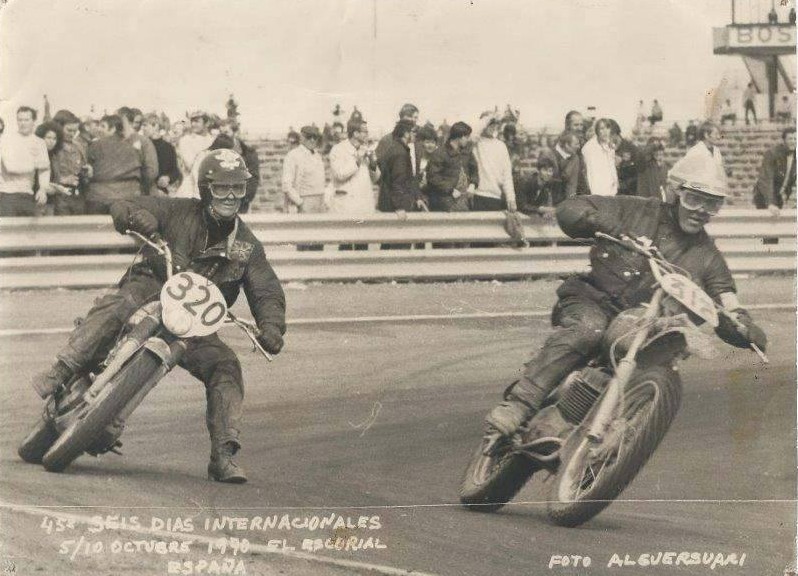
1970 saw George Webb ride in the British Vase A team on the 441cc BSA B40. The event was held around El Escorial north of Madrid, Spain.
“We had one week courses for Junior Officers to get their bike licences. Can you imagine what folk would think today, just a week, well five days actually!
Before all that I would be required to train as a driving test examiner to D.O.E. standards, in order to take students on their test. I always promised them half a days cross country riding if they had advanced enough with the road work, This was a great incentive, and improved their riding skills at the same time.”
Jarama racing circuit action on the final speed test in the 1970 ISDT at El Escorial with George Webb, left BSA chasing a Swede on a Husqvarna. Official photo as watermarked.
“There were three week instructors courses, for soldiers who already had a bike licence, so that they could go back to their units and teach more to ride. This would involve more advanced riding lessons and cross country, to a higher standard. This would also include maintenance lessons and tyre changing practice.”
Press cutting from Motor Cycle News, penned by Ralph Venables.
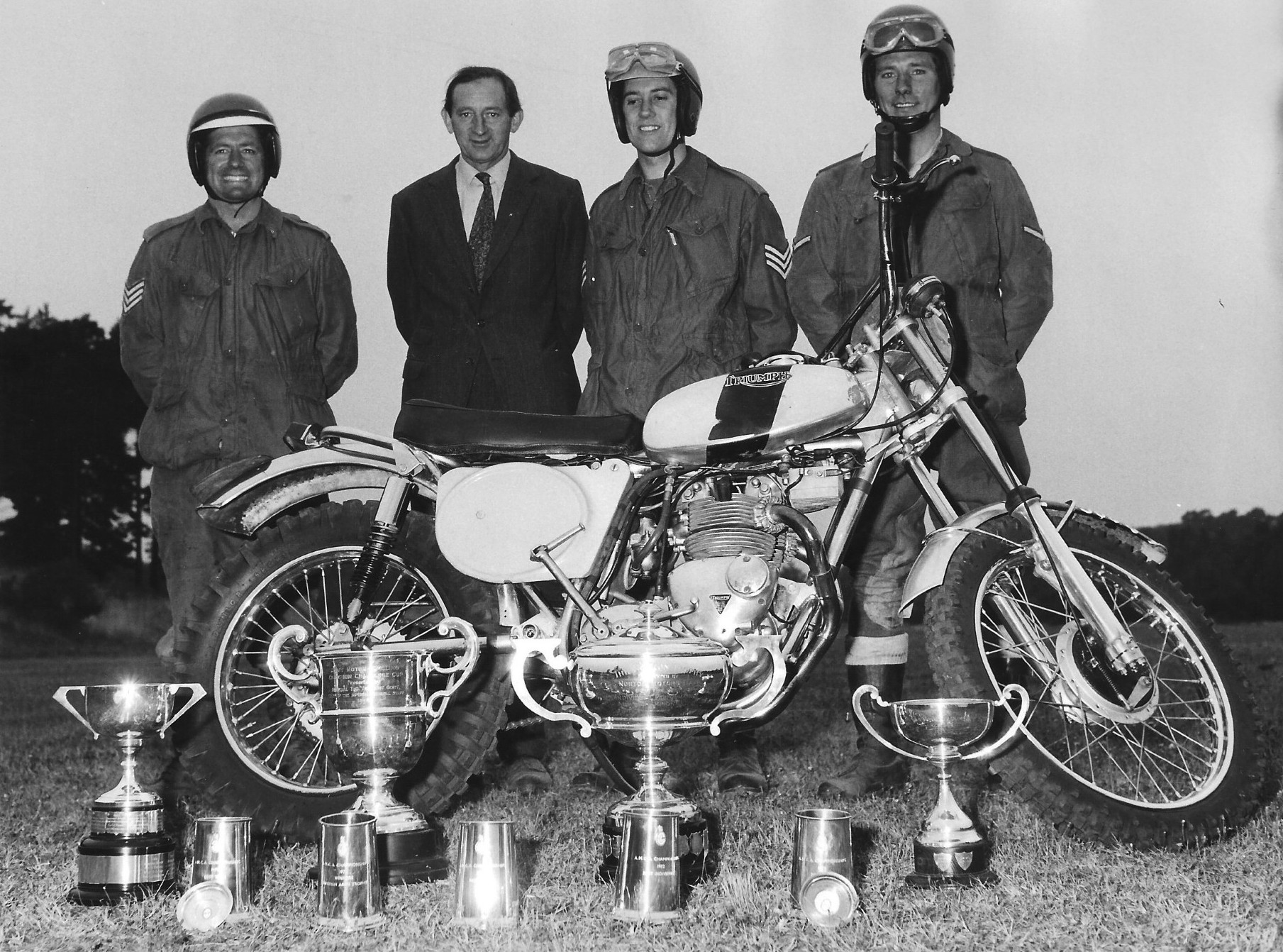
Left to Right: Sgt. John Nightingale, Col. Burnett Commandant ASOT, George Webb, and Ken Ablewhite following our second Championship win. Machine is the prototype Triumph ‘Adventurer’ that George rode in several events in 1972, including the I.S.D.T. in Czechoslovakia gaining a Silver Medal.
“On one of these courses, I had some Ghurkas soldiers from Hong Kong, and we were out on a cold winters day, doing some of Hampshires green lanes. We had come to a very steep down hill section which was frozen ice, with just a touch of water on the surface. There was a barbed wire fence each side. I talked them through the procedure for tackling this and then did a demonstration ride down. It was quite scary, and I said it was not necessary for them to do it, but they were up for it. Once again, keep the bike absolutely straight, first gear, and don’t touch the brakes! Well, they all came down like tobogans, but perfect, and no mishaps! That took some guts!
During my time at the School, I was always impressed by our Ghurka troops, but always ashamed that we payed them so little. On one occasion when I was taking a Ghurka on his class two HGV test in Aldershot, he finished up with the lowest score of anybody I have tested, just two minor faults. Brilliant, as this was a very heavy Leyland six wheeler Artillery Tractor.
Then we ran three week courses for Special Forces which involved lightweight 125cc bikes, instead of Army B40s. The purpose for this was to be able to Helicopter in for an Operation, then ride the bikes, to where ever?”
Another shot of British Vase A team member, George Webb on the Army supplied 441cc BSA B40 in the 1970 ISDT at El Escorial – Photo: Brian Catt
“These courses were good fun, the Guys were quick to learn, even when they had never ridden before. Not only did they need to get their licence, but it was required that they would need much cross country training too. What made things different was the need to carry so much kit on these lightweight bikes, such as spare fuel, and weapons, which weighed half as much as the bikes. This made the cross country riding much more difficult, as this weight completely changed the bikes handling!”
International Three Day Trial at Isny, Germany in the Baden-Wurttemberg area in 1971. The machine is a 441cc Cheney BSA Victor.
“With perseverance we got the job done, there were so many places that we had to test differant kinds of terrain. Soon the Guys were coping with everything we could throw at them!”
The 1971 ISDT was hosted by the ACU in the Isle of Man. George was riding an Army registered 441cc Cheney BSA Victor.
Army MT School:
“In addition to running the motorcycle wing, there were other tasks at the school. In order to test candidates it was necessary to hold the appropriate qualification to do so. I remember taking my HGV Class 1 test in Aldershot in an AEC articulated truck that was so old that it had no power steering! It took all my strength to manouvre it around a mini-roundabout during the test, but luckily I did pass.
Other vehicles we had to drive and test on were tracked vehicles, amphibious and buses. So all in all an interesting time. I also did a course in Devon to water-proof vehicles, in order that they could be driven ashore from landing craft without drowning before hitting the beach.
Motorcycles were my main job and took about 85% of my time there. From a sporting aspect it was really great, because there were so many trials in the area. Not only did I get to ride during the week, but also at the weekend too. As we had the facilities and the training areas, I got plenty of practice time too.
During my time there I won the Army Championships two more times which made me the first multiple winner of the title.
The seventies were really my best years, as I held on to the titles for ten years in all. Add to that the B.O.A.R championship; Berlin Championship and Southern Command champion.
Two wins in the Pathfinders Trial and many more in Army prelim events and civilian events too.
Even when my time at the school was coming to an end, I would have the good fortune to remain in the Army International team until I left the service in 1980.
For now I was going back to Germany to run the Transport Department at a Brigade headquarters in Osnabruck – Aufweidersehn Pet!
Osnabruck, Germany – Second tour:
I was soon able to take off from when I left Germany three years earlier, and joined the local motor sport club. They ran Trials and also some car events too. Before long I had made friends with some of their members, such as Helmut Stanik, German national 125cc Champion in 1974, and a regular Scottish Six Days rider.”
Helmut Stanik (Montesa) in 1974 riding in the German Championship at Luneberg Trial – Photo: Rainer Heise
“Also Gerd Bücker, who owned a bicycle and moped business in town. Gerd and myself often travelled to events together. One day when travelling down south we were pulled off the Autobahn by the Highway Police, for speeding! We were in a little Renault 4 with a trailer. Anyway, after a very friendly chat, we thought we got away with it, but not quite, fined ten marks, quite a bargain!
Work entailed taking care of transport requirements of Brigade HQ, day to day stuff and also the exercise requirements. I have to say I was quite lucky, because of the Army Team, I had quite a lot of time away to ride the international events.”
Welsh Three Day action in 1973 on the 100cc Dalesman. George won his class, was 6th overall and a gold medal to his credit. Flat out the machine topped 55mph!
“During my time there I received into my office some information that the Army were looking to reduce their numbers with a redundancy scheme. After reading all the detail, I filled in the forms thinking it will never happen to me, but its worth a punt.
I had been thinking about a second career for a while.
Anyway a year went by and the Chief Clerk comes into my office and says to me you’re redundant! I looked at him and said, what are you on about. He retorted, did you apply for redundancy a year ago? After answering yes, he told me, well you have got it! Well, what a surprise, and what am I going to do?? Never gave it a second thought, had I.”
The 1976 ISDT was held at Zeltweg in Austria and centred at the then Oesterreichring (now Red Bull Ring) racing circuit. Here is George aboard the 250cc OSSA SDR Enduro model in the ‘Motocross Special Test’ within the outfield of the racing circuit.
“Luckily, I still had some time to serve in Germany, before getting posted to Catterick for my last six months of service. In the intervening time, we had been back to the U.K. to sort out some accomodation, and had settled on Harrogate, North Yorkshire.
Coincidently, where there just happened to be some very good Trials Clubs!”
On the 244cc OSSA MAR MK2 on ‘Edramucky’ on the slopes of Ben Lawers in Perthshire during the 1976 Scottish Six Days Trial.
“Well, my time in Catterick, soon passed, and it was time to be demobbed! But almost as soon, I was being recruited again!
A certain Captain Smith of 150 Regiment, Royal Corps of Transport wanted me in his motorcycle team!
I tried to resist, but he made me an offer that was difficult to turn down. Whenever there was a Army event, they would bring me a bike to ride and that was all I had to do, plus I would get paid, and a motoring allowance. Captain Smith had a pretty good team, so we were in with a chance. In fact we won the Army Championship best team, and best individual, and much more too.
This was the first time a Territorial Army team had won the Championship, and I was the first Territorial Army Champion, which I won in 1978 and 1979. So when I thought it was all over, well it wasn’t quite.
I did eventually leave the T.A. to start my own Business in 1980, but not before winning another Gold in the Welsh Two Day International.”
An interesting Honda:
“It all started with a surprise call from Colin Tipping. ‘Would you like to ride a Fraser Honda 250 in the Scottish Six Days?”
George Webb on the 250cc Fraser Honda at ‘Callart Falls’ on Day one of the 1980 Scottish Six Days Trial.
“Well I had never seen one or even heard of them to be honest, but yes I was interested. I mean who would turn down a chance to ride in the most famous trial in the world?
I was attracted in that the bike was a four-stroke, and a Honda engine at that! Reliability ought to be good. However, the fact that it had an unconventional final drive was an unknown risk. I understood about the two chain set up, but had no clue if it worked well.
The bike was delivered to Fort William and I took collection of it. Once I had a chance to ride it, there was some concern about the two chain system. It was a way of achieving better gearing for trials work. But it was very noisy and the short chain was getting very hot. This did not bode well for the amount of road miles.
Never mind, we will give it a go!
Monday morning start and it’s off up the Mamore Road, the noisy chains were very noticeable and attracting attention. My thoughts were, how will I stand a week of all this?
There must have been a group of sections before Kinlochleven, but my memory is a bit vague and there is no programme of that year in my collection, so I would guess that Blackwater were the second group.
On route I came to a river crossing where I had to carry out a bit of life-saving. An Army rider had been swept off his bike by the force of the water. His bike had him pined down and his head was partially submerged. I wadded out and got the bike off him, but he was totally immersed and soaked to the skin. I couldn’t imagine a worse start to an SSDT but he was fine and carried on.
Arriving at the Blackwater group of sections, it was sunny and dry and after a quick inspection it was my turn to go. I did not get far though, after getting caught on a large boulder, the spectators were shouting and pointing at the boulder, it was covered in oil! The thin sumpguard had bent and the crankcase was holed. So no first class award that year to add to the five that I already had. I really didn’t think the bike would have lasted the week anyway.”
North Yorkshire – God’s own County:
“After leaving the service, I had the oportunity to partake in a resettlement course. As my whole career had revolved around transport and vehicles, I chose to due a thirty week heavy goods vehicle mechanics course. This was run in Bradford, so I had to drive there every day. It was a good course and my instructor was ex-Army, who had served in North Africa in world war two, so we had some interesting stories about his experiences there, keeping their vehicles road worthy.
After the course finished, employment was found for me in Harrogate, at a small transport company, with their own maintainence facility. This turned out to be far from ideal. After twenty years of military organization, this was the opposite! The working conditions were rather chaotic and unpleasant, and after a few weeks, I was planning to leave and start my own business, which would be in the transport business.
However, just before I made the move, I received a telephone call from an old army friend, who was now working for Len Thwaites, of TT Leathers fame. The company that started the fashion of coloured motorcycle clothing.
Tom Walker, an ex-Army White Helmets display team member, was now working for Len, and they needed another sales representative – was I interested? Well yes, it would allow me to leave my present job, and do something in the motorcycle industry. I was accepted for the position, and started in my new role. After a few weeks, I was starting to find my feet and sales were building up nicely. This was all new to me, selling was teaching me a few new lessons in life!
Within the company, there were some handy bike riders, Len the Boss, did scrambles and trials. Jimmy Aird was a top scrambler, and Tom and myself were trials and enduro riders. For a while we formed a TT Leathers team, and entered some of the early rounds of new British Enduro Championships, with some good results too.
Scot, Jimmy Aird on his factory Y4 AJS Stormer was a director in TT Leathers at Barnard Castle – Photo: OffRoad Archive.
The idea of setting up my own business was still at the back of my mind though, I had that ambition to fulfill.
Back in 1968, I had married my German girlfriend Trudi, and we had two children, Karen and Mark. Because of my service and sport, much of my time was spent away from home, and my family had not had as much of my time, as they should have. I could not have changed what had gone before, so it would need to change for the future.”
George Webb with first born Grandson in 1990.
“My new plan was to open a retail motorcycle clothing shop in Harrogate, and be nearer to my family. Welcome to ‘Sportex Gear’, my new business, a new era.”
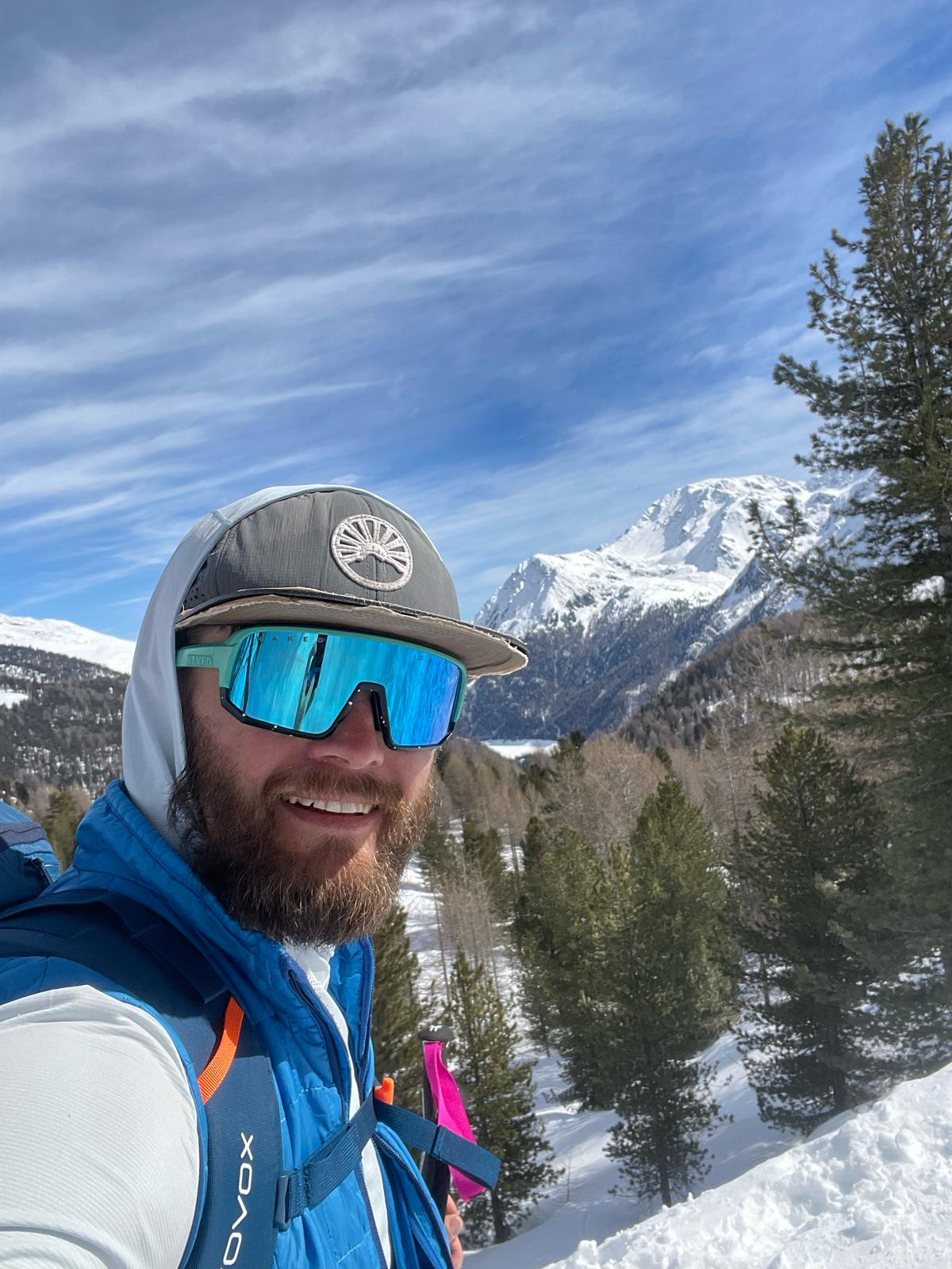
George Webb’s grandson in 2025, now a top Army mountaineer, winter warfare and skiing instructor.
The final chapter:
“Just to finish this brief look back over what has mainly been about my Army and and business career, here are some details about where we ended up.”
Still competing, here in the 1996 Scottish Six Days on a Beta.
“In the late nineties we were approached by a couple of companies who expressed an interest in buying Sportex. This came about due to a rumor going around at one of the motorcycle shows, that we were being taken over by the Carnell Motor Group in Doncaster. This was a big surprise to us as we knew nothing about it, how the rumour started we had no idea, but it did arouse some interest within the trade.”
The brightly coloured leisure and riding apparel from Sportex.
“Jack Knoops and I had expressed an interest in early retirement, and this seemed like an opportunity. To cut a long story short, we did eventually sell the business but in two parts, with all the road based products going to one company, and all the off road stuff going to C.I Sport, run by ex Comerford’s people, Don Howlett and Stuart Miller. It took a little while for it all to go through, but eventually it was sorted.”
Copy of a trade journal featuring the success of Sportex Gear based in Harrogate.
“Jack Knoops stayed in Ripon, and took up his hobby of photography to another level, providing photos for trials riders at Yorkshire events, and also sometimes for magazines.”
George with business partner, the late Jack Knoops at a Wetherby & District trial.
“I believe he really enjoyed this, and often provided Special Awards at annual prizegivings of enlarged and framed photographs of riders, which were really appreciated.
I decided to move to Spain for some warm weather, and a change of scenery. I had once been down on a business trip in November, and the weather was fabulous.
On the plane I met someone who was on his way down to buy a property, and this had planted a seed, that got my interest.
Jack and his wife Marie, came many times to holiday with us, and visit differant parts of Spain too.
Spain is great for biking and we did many trips out whilst there, and I had some trail riding chums too. The area around southern Spain has hundreds of trails, but I also went up north to the Picos Mountains many times. Lots of our retirement has been about biking and also non biking trips to places of interest, and we have been very lucky to have had these opportunitys. Neither of us smoke, and we drink very little, but we do like to travel.
We stayed in Spain for some ten years, Trudi was complaining that the summers were getting to hot for her, and she wanted to come home. Thinking she might mean Germany, where she came from, I asked where in Germany, hoping it might be in the south. ‘No’ she said, ‘not Germany, North Yorkshire’!
So here we are back in God’s country again, since the last seventeen years. No trials riding since I left for Spain, or enduros, but plenty of trail rides and road trips.
I’m tending to slow down now due to age, but still enjoying riding my bikes.
Sorry to report the loss of my good friends Jack and Marie Knoops in recent years, due to poor health. Rest in peace, we still have our memories.”
Final chapter Part Two:
George Webb had a liking for Triumph Twins, so treated himself to this lovely Cheney Triumph in ISDT spec, which he used for road runs.
Here are some motorcycling highlights that I have experienced over the years.
A near three-hundred mile journey from Suffolk to North Devon through the 1963 winter freeze and blizzards, on my Triumph 350. Never saw another motorbike the whole journey!
Three-thousand mile trail bike tour around the Peruvian Andes, as high as sixteen-thousand feet.
Trail bike ride from Yorkshire, to the the Sahara desert.
Two tours of the Wild West, one on a Harley and one on an Indian Chieftain.
Numerous European bike tours.
The Scottish Six Days Trial
The International Six Days Trial
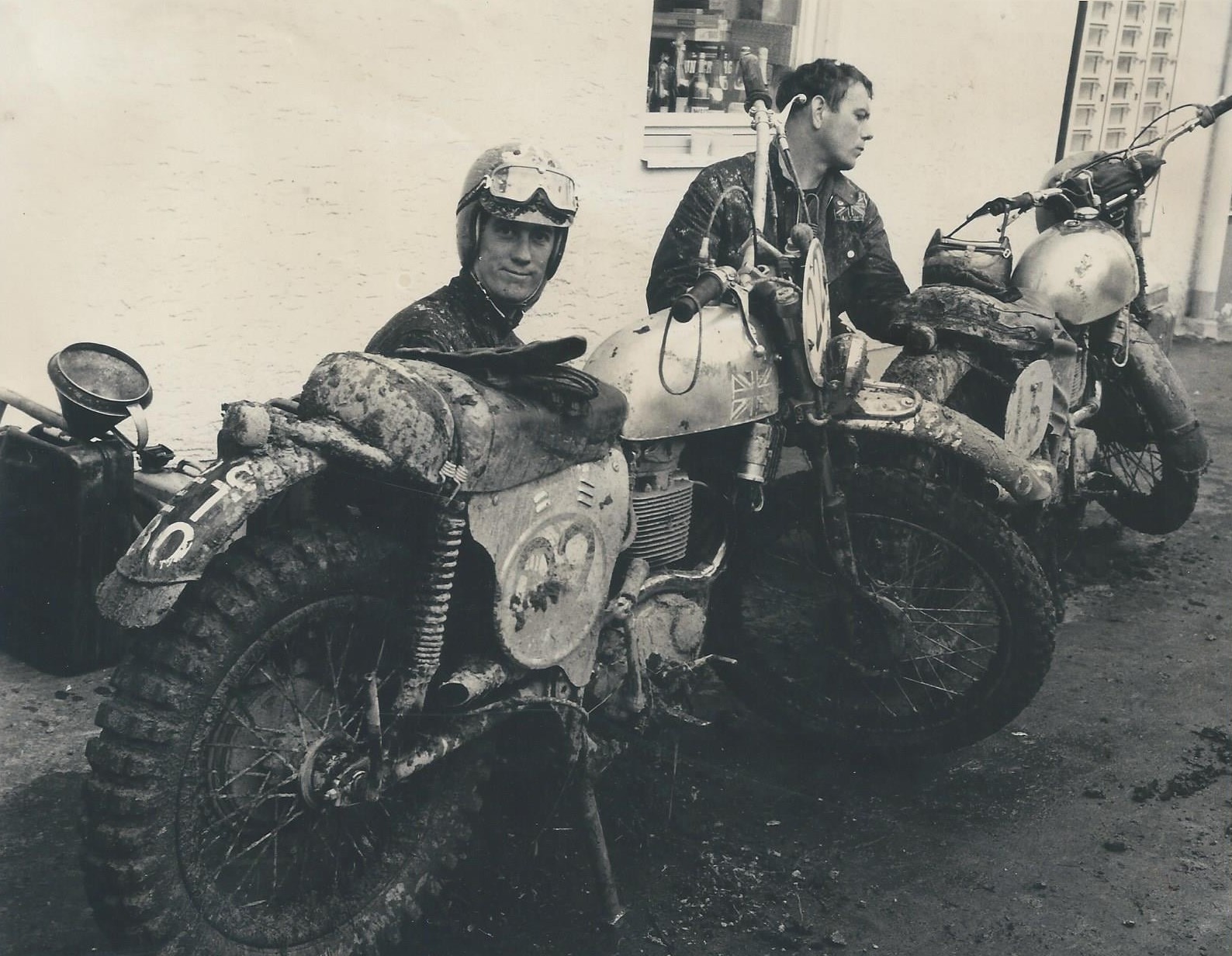
Bike cleaning time for George Webb’s prototype Triumph ‘Adventurer’ after the ISDT at Spindlruv Myln in Czechoslovakia in 1972. A third place in the up to 750cc class and an ISDT Silver Medal.
The Welsh Three Day Trial/Enduro
George Webb on the 441cc Cheney Victor in the 1971 Welsh Three Day Trial.
Army Championships Trials
Twenty years of Yorkshire trials.
Bike tour of Malaya.
1972, after the bike is cleaned, the trophies are next for some bull!
“I hope you enjoy what has been a brief look, at my riding career, my Military service, and our Sportex business.
Best wishes to Trials Guru, their readers and all bikers everywhere – George Webb“
Trials Guru VIP – George Webb is of course a member of the Trials Guru VIP Club.
George Webb’s photos from his personal collection:
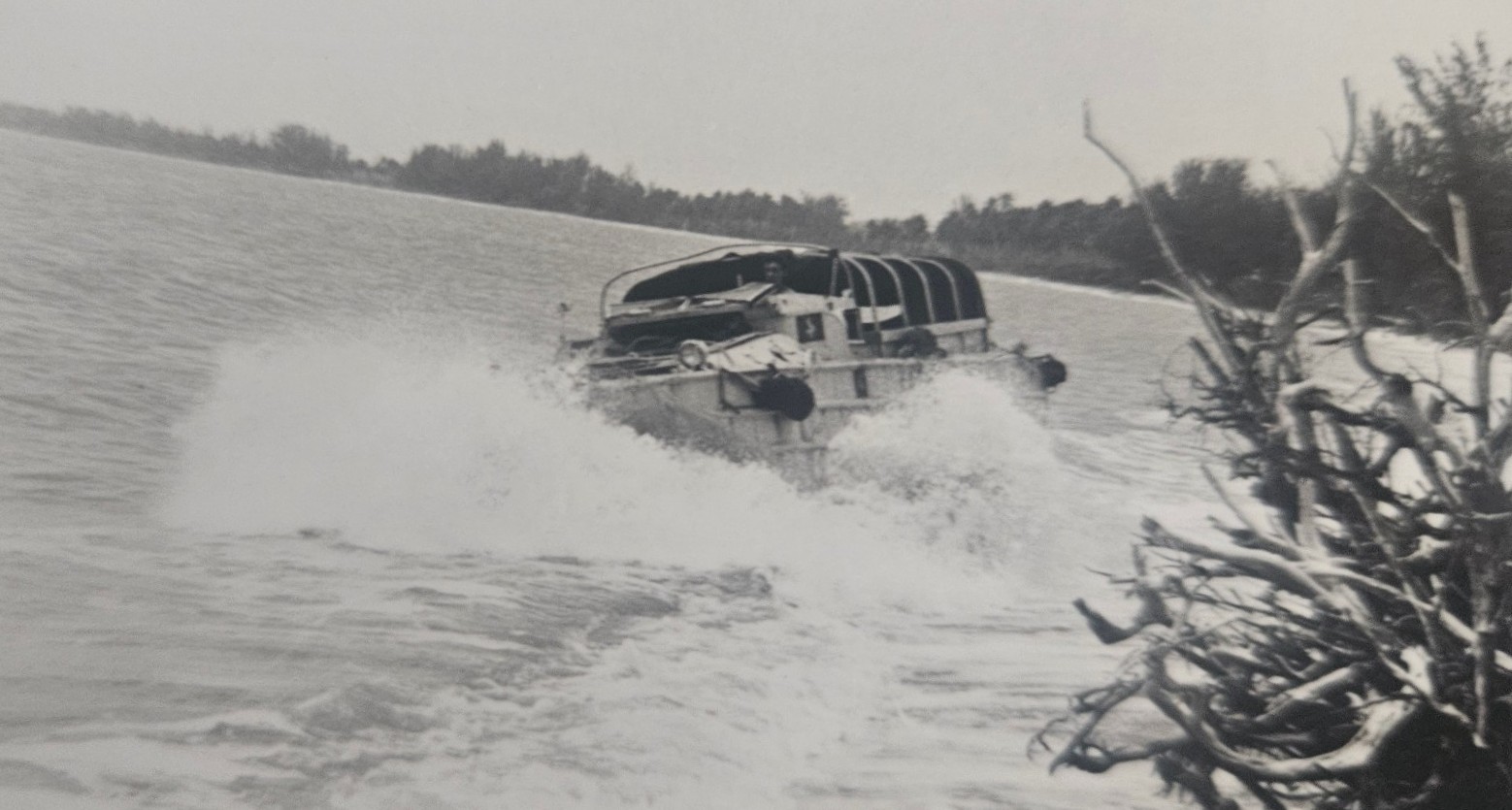
Army days with the amphibious D.U.K.W craft.
A ‘D.U.K.W’ out of the water, loading onto HMS Bulwark.
George Webb in control of his Army D.U.K.W.
Enduro results from July 1977 at the Melville MC enduro in Scotland.
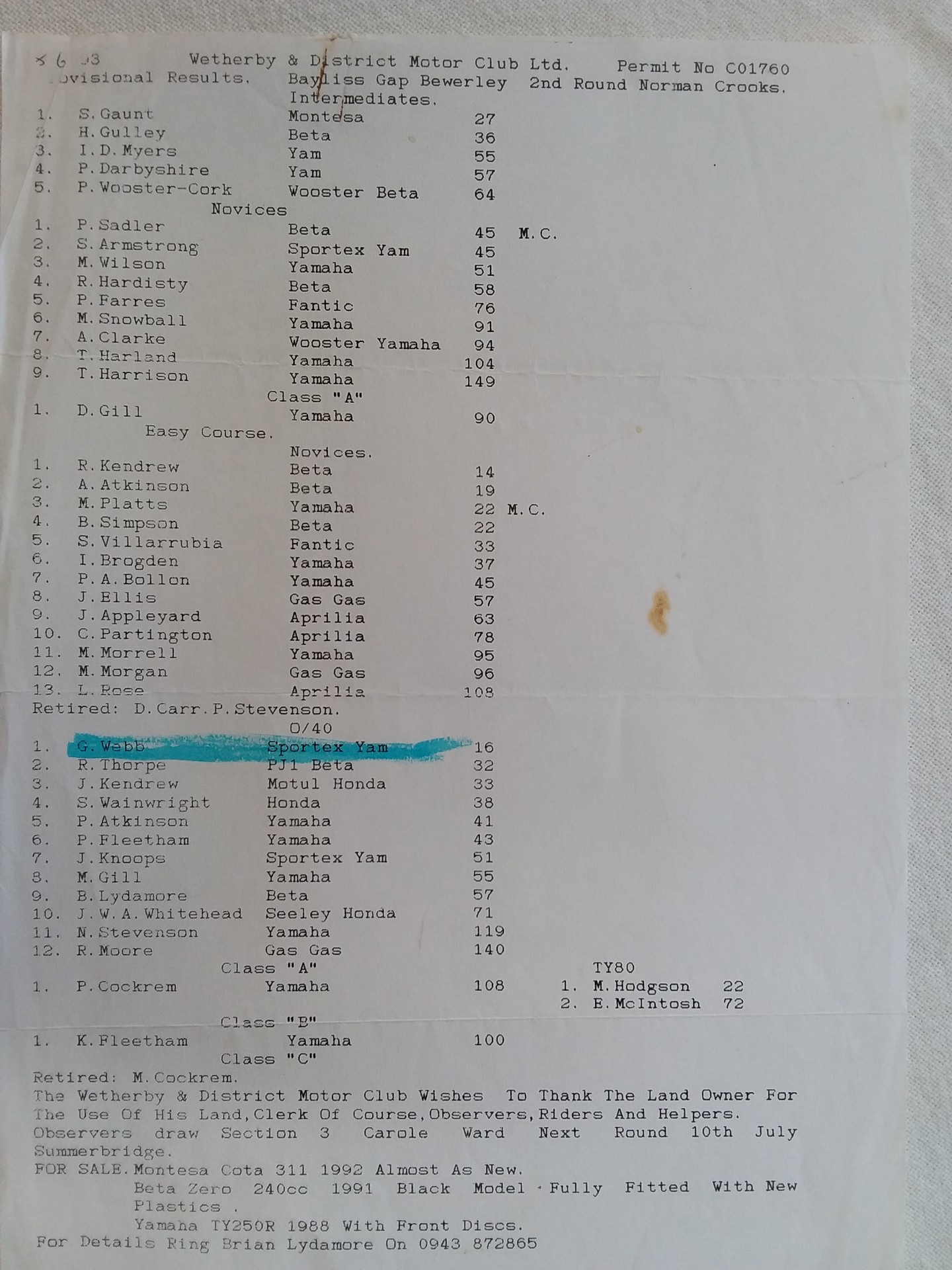
Results from 1993, Wetherby Trial.
1996 trials results from Eboracum Motor Club (York).
ISDT 1971 in the Isle of Man on the 441cc Cheney BSA Victor.
1971 German Three Day at Isny, after the event. Left to right Tom Fayers, the late Brian Cowshall and George Webb.
Mr. Fourstroke, Rudi Munsterman from Germany, who ran an International Trial for Pre65 machines for many years. George is holding a copy of ‘Trialsport’ the German trial only magazine.
Fun at the SSDT with Bill Wilkinson and ‘Wee Jimmy’ at Bill’s stall.
Fun at the SSDT – 1993 George on the Yamaha TY250R on ‘Lagnaha’.
George Webb’s last trials bike, the 350 Bultaco Sherpa.
‘Army Man George’ – the story of George Webb is copyright of George Webb and Trials Guru – 2025.
Credits:
Motor Cycle News – Press cutting, author, Ralph Venables.
Footnote:
Apart from ‘Fair Dealing’ for the purpose of private study, research, criticism or review as permitted under the Copyright, Design and Patents Act, 1988, no part of any article may be copied, reproduced, stored in any form of retrieval system, electronic or otherwise or transmitted in any form or by any means, electronic, electrical, mechanical, optical, chemical, photocopying, recording or otherwise without the prior written permission of the author as stated above and below. All articles are not published for any monetary reward or monetisation, be that online or in print.
Bill Wilkinson turns on the style on the Greeves Anglian (WWC169F) that took him to his SSDT win in 1969 – (Photo: the late Barry Robinson with permission of Liz Old)
It is with great sadness that Trials Guru announces the passing of Bill Wilkinson, the last British trials rider to win the Scottish Six Days Trial on a British built machine, the 250cc Greeves Anglian, WWC169F in 1969.
Bill Wilkinson (right) with Trials Guru’s John Moffat in 2015 at the Highland Classic 2 Day Trial. Bill was Guest of Honour. (Photo: Jean Caillou)
Bill was a true Yorkshire character, who called a ‘spade a spade’ and wasn’t afraid to say so! He was quick-witted and enjoyed the company of like-minded individuals. Bill was a proud Englishman and even prouder Yorkshireman. He rode for the Greeves factory from 1960 until 1971, when he switched to ride for OSSA Moto UK under the ownership of Peter Fletcher. When he rode for the Greeves factory, he never had a written contract, it was done by the shake of a hand, because Bill’s word was his bond.
Bill Wilkinson with his wife Pearl in 2015 (Photo: Jean Caillou)
Bill Wilkinson will be sorely missed in the world of trials, he was a national, British Experts, Scott Trial and SSDT winner. Our sincere condolences go to his brother Mick, sister Shirley, his wife Pearl and his son, Andrew and daughter, Michelle and the extended Wilkinson family. (Photos courtesy of Jean Caillou, France)
Bill Wilkinson tries one of Trials Guru’s John Moffat’s Vazquez Bultacos for size in 2015 (Photo: Jean Caillou)
John Moffat of Trials Guru added: “Bill Wilkinson was a superstar of trials when I was a schoolboy, a man that I looked up to along with his peers of the late 1960s. Little did I know then that I would become a firm friend in later years. I got to know him by speaking with him at his stall in the Parc Ferme at the SSDT in the late 1980s. He knew my late father well and always spoke highly of him. Over the years, our paths crossed many times and in 2015 I invited him to be the Guest of Honour at the tenth edition of the Highland Classic Two Day Trial, which he happily accepted and what a great time we had. He was simply superb. I had the honour of interviewing Bill on stage at many functions and also on Nevis Radio at the SSDT in Fort William. Bill will leave a huge hole in the sport of trials that cannot be filled. He was one in a million“.
Bill Wilkinson’s funeral is on Monday 28th July 2025 at 1pm at Skipton Crematorium, Waltonwrays Cemetery, Carleton Rd, Skipton BD23 3BT. Thereafter a ‘Bun Fight’ at the Rolls Royce Social Club in Barnoldswick. All welcome, trials attire and colourful clothes to celebrate the colourful fella that he was.
Vintage Weekend with World Champion Bernie Schreiber in Indiana, U.S.A.
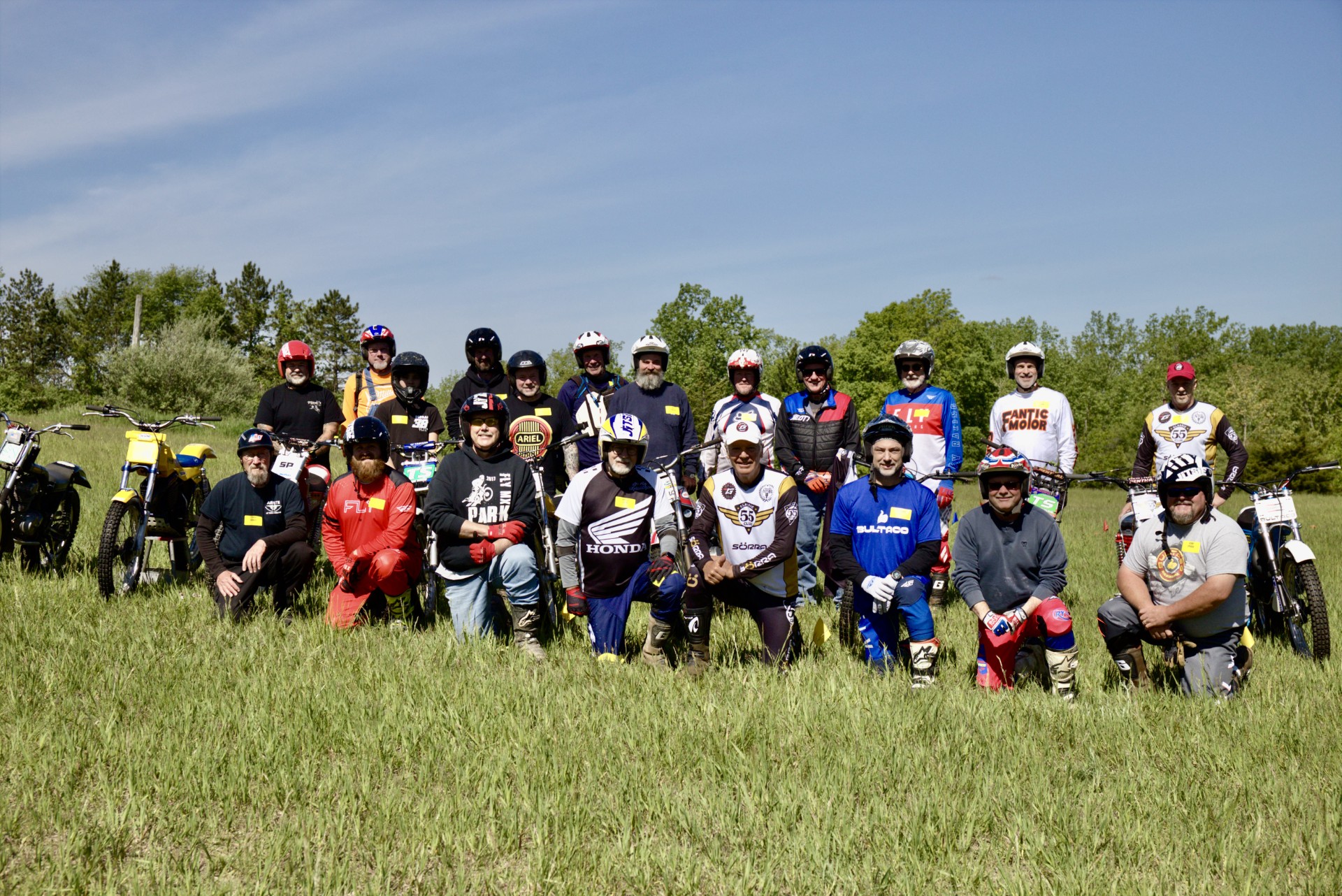
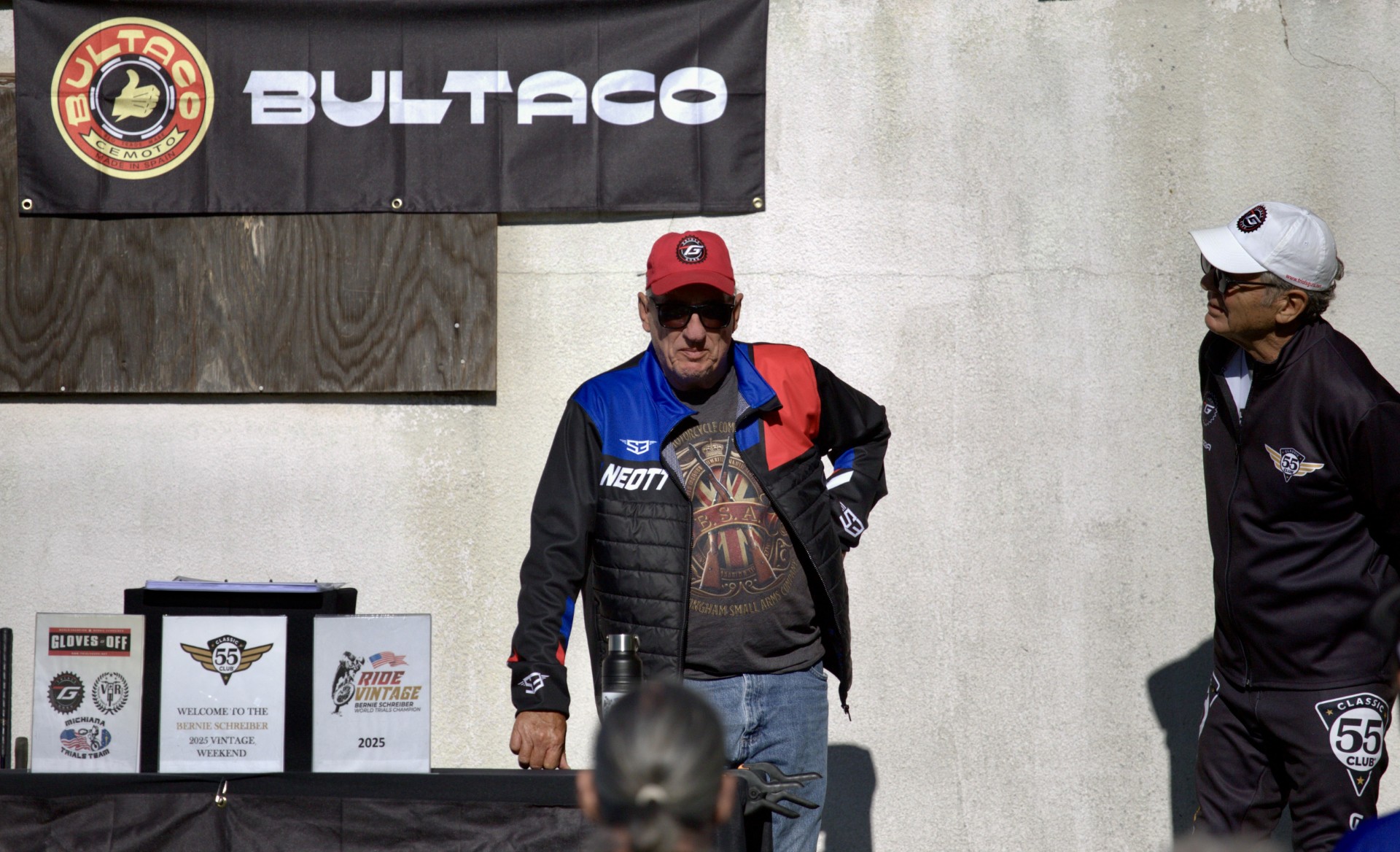
American’s only World Trials Champion and Scottish Six Days Trial winner Bernie Schreiber conducted his first RIDE VINTAGE two-day Training weekend on May, 24/25 at Mount Wawasee Lodge in Indiana. Schreiber, being the most successful Trials rider ever from the USA, shared his wealth of knowledge and overseas experience with twenty participants attending from five States. The weekend was exclusively reserved for twin-shock machines.
The Vintage weekend event was hosted by Michiana Trials Team in Indiana a member club of (MOTA) The Michigan Ontario Trials Association created on February 19, 1967, in Detroit, Michigan. MOTA has a long history in American Trials hosting American National Championships and a World Championship in 1977 of which Schreiber competed. Just two years later Schreiber competed at the AMA National Championship on May 26th, 1979 in Indiana, the same year he won the World Championship.
2025 marks a special moment for Schreiber who started Trials competition fifty-five years ago in California and still competes in Vintage events today. 1970 was the beginning of what later became a successful Trials career overseas in the late 1970’s and 80’s. This year is a celebration of 55 years of competing in a sport which originated in 1909 throughout parts of the United Kingdom.
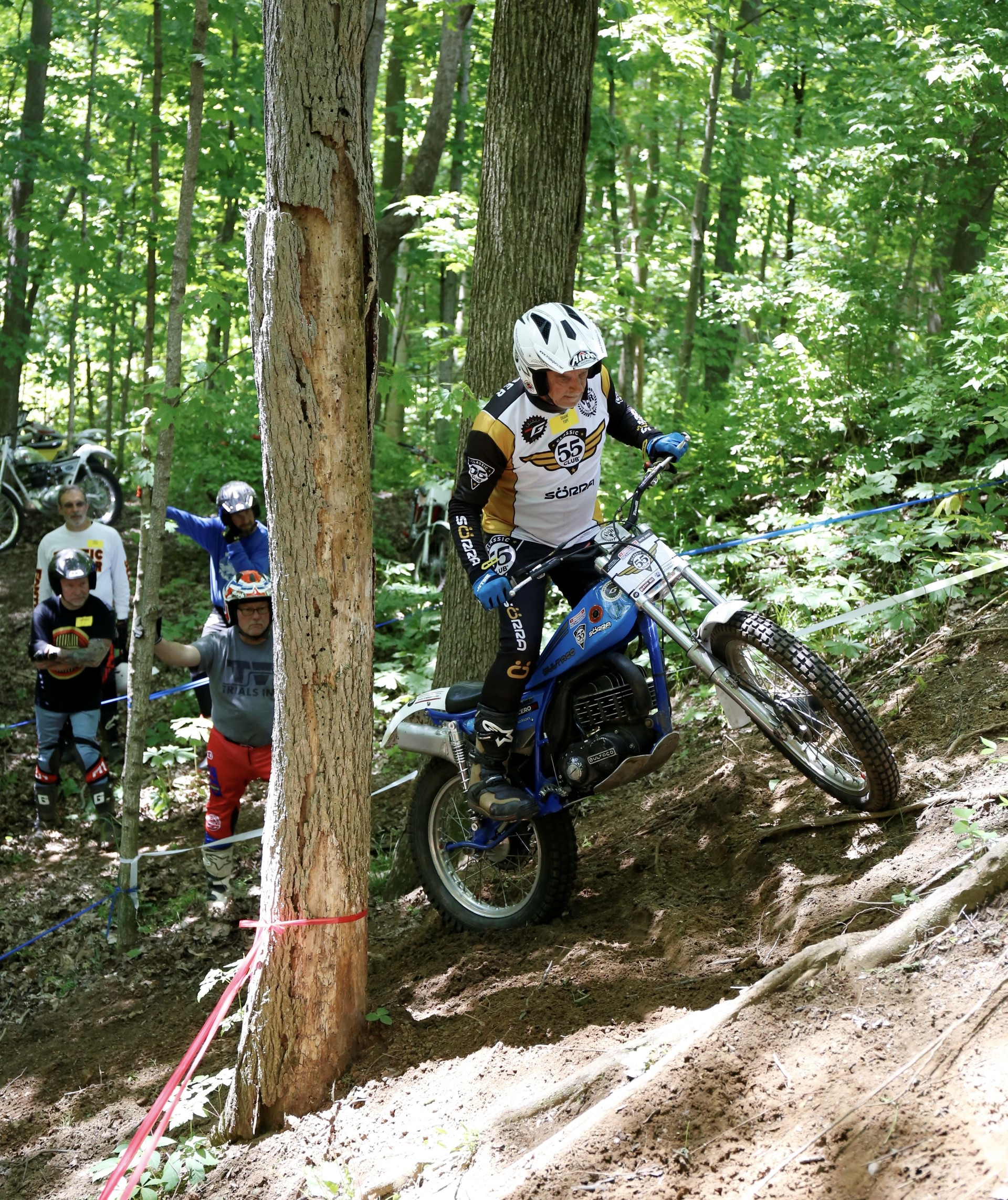
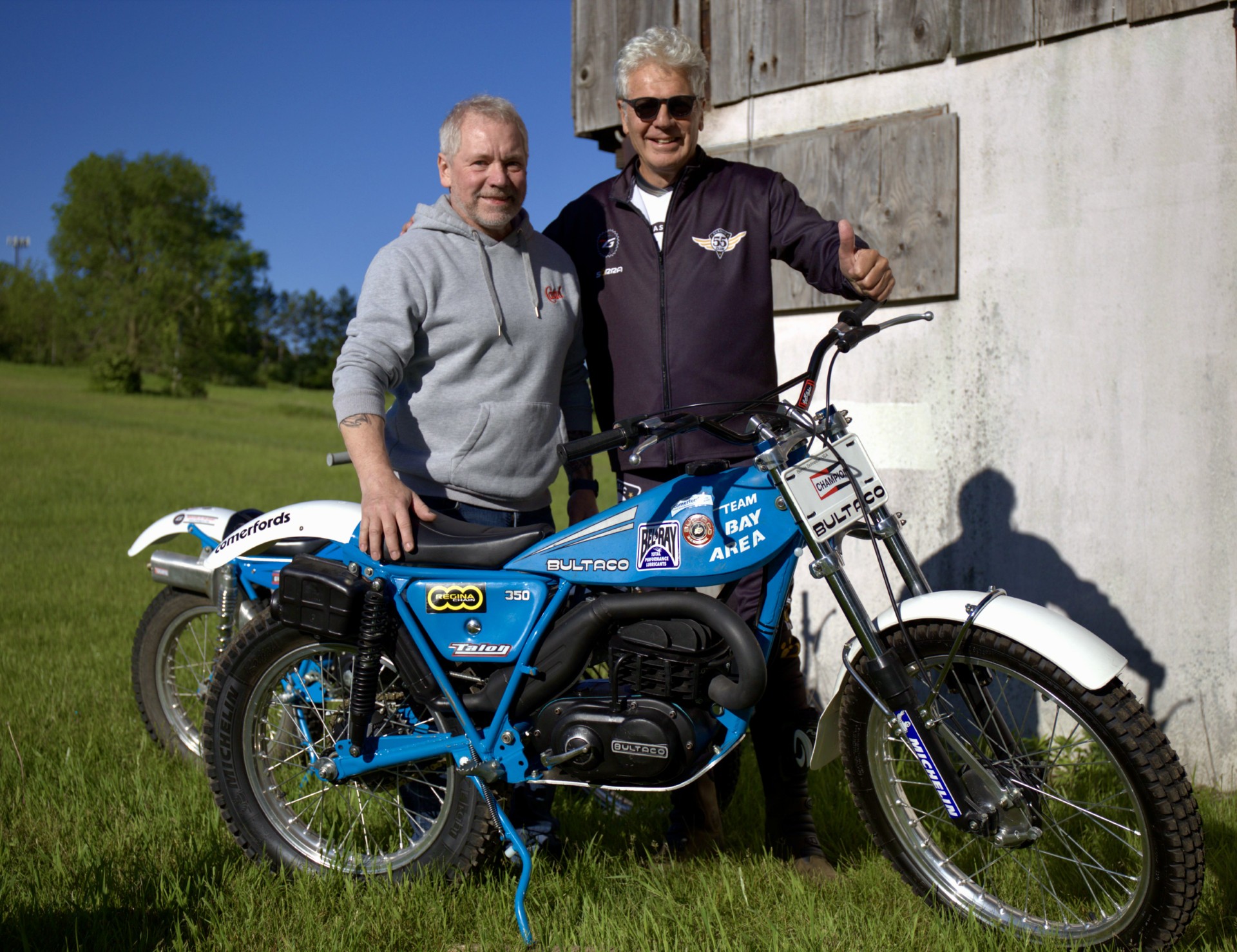
Schreiber was thrilled to ride his late fathers 1972 Bultaco Sherpa which has been fully restored by Duane Tope for the occasion. Tope from Indiana has a long history in Vintage Trials bikes restorations and competition, winning the AMA Twin-shock Trials Champion title in 2023.
Schreiber treated the 20 Vintage enthusiasts to his structured training format based on lessons learned in becoming a World, National, and Scottish Six Days Trials Champion, which included fundamental techniques from his book ‘Observed Trials’ by Len Weed. Schreiber said: “Its not just skills and hard work, everyone at the top level has great techniques, but your mindset is what makes you a winner. That’s the only difference. Learning to ride a Trials bike, is not the same as learning to ride Trials.” He continued to focus on competition successes and practicing with purpose by design. “The best way to practice is to prioritize on the things you need to practice, and knowing which tasks should get top priority, then act to get maximum returns.”
Kirk Mayfield (left) delivers a tribute in honour of Lane Leavitt who recently passed away.
Scotland is Schreiber’s next stop at the annual Highland Classic two-day trial on June 7/8 to compete with 200 twin-shock participants at Alvie Estate, near Aviemore.
Bernie demonstrates ‘body position’ on his 1972 Bultaco.
Event organiser and American twinshock champion, Duane Tope.
Englishman Francis Hall on his Ariel.
Bernie Schreiber’s 1979 Bultaco 199A now owned by Francis Hall.
It is with great sadness that we announce the passing of Lane Leavitt, former Bultaco factory trials rider who passed away on May 16th aged 74 years.
Lane Leavitt on his 325 Sherpa ‘Dual Tank’ in the 1975 Rhode Island event.
Lane was AMA trials champion on three occasions and was a world championship contender, who competed against the Lampkins, Rathmell, Schreiber and Whaley. He switched to Montesa, when the Bultaco company hit financial trouble in 1979.
His achievements were: three times US National Champion; five times California Champion; twice Oregon Champion; he rode in the SSDT four times; USA ISDE Team Member; AMA Sportsman of the Year and inducted to the Trials Hall of Fame of the AMA in 2006.
Lane wrote a book on observed trials with photojournalist Len Weed entitled ‘Motor Cycle Trials – Techniques and Training’.
Lane Leavitt on the 349 Montesa on Ben Nevis section, SSDT – Photo: Jimmy Young, Armadale
He married his teenage sweet-heart, Debbie Evans, herself a well known trials rider and stunt performer. Lane set up his business with Debbie, called Leavittation Inc., based at Santa Clarita, California, which arranged stunt work for the movie industry. He turned to professional stunt performing in 1980 on the ‘Fall Guy’ TV series.
Lane Leavitt from the USA (Montesa) on Cnoc-a-Linnhe in the SSDT – Photo: Iain Lawrie, Kinlochleven.
1979 World Trials Champion, Bernie Schreiber wrote on learning about Lane Leavitt’s passing: “A unique individual in his own way, but a true friend who always brought his honest opinions on all topics. He was innovative, passionate and constantly in search of a better motorcycle, better trials events and better results. His opinions on trials events, motorcycles and riders development were direct and honest. He enjoyed pushing the envelope in Trials and all facets of his stunt work in an industry he loved so much.“
Trials Guru sends sincere condolences to Debbie and the Leavitt family at this difficult time. The trials community of the USA have lost not only a champion, but an enthusiast of the sport.
Lane Leavitt – 10 November 1950 – 16 May 2025
The Premier Trial Website – Recording the History of the Sport 'Established 2014'






































 TRIALS GURU - DEDICATED TO TRIAL