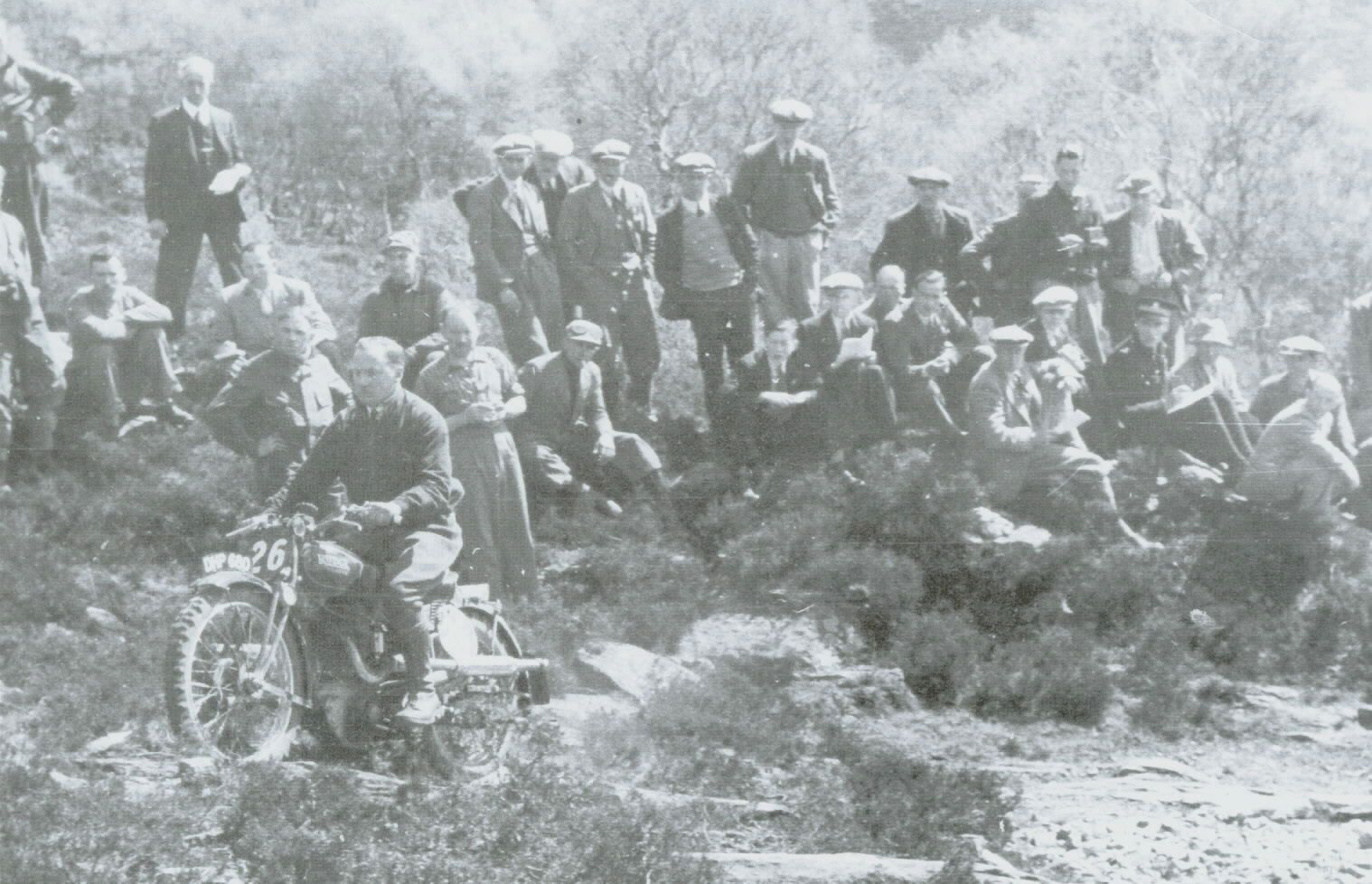
MOTORCYCLE COMPETITION SCOTLAND 1975 – 2005 by John Moffat
– Foreword by 8 times TT winner, JIM MOODIE –
Yoomee Ltd is proud to present this superb semi-hardback book which covers the history of Motorcycle Competition in Scotland from 1975 – 2005 by John Moffat. With foreword written by eight times TT winner, Jim Moodie, it is presented with a mixture of exciting, and in many cases un-seen, colour and black and white images, this book is in A4 size format with over 100 pages of informative and interesting text.
This is a book which explores and describes in words and photographs, competitors and enthusiasts from motorcycle sport in Scotland and more! It’s about people, places and events from this era, the endeavours and performances by motorcycle sports most respected riders, who were either born or brought up in Scotland.
A book which will convey you back to a time-period when Scotland produced not only British, but World championship contenders. Riders who endeavoured to create performances, which proved they were serious competitors in racing, trials, enduro, and motocross.
This is a publication aimed at the motorcycle enthusiast.
Payment can be made securely by ‘Paypal’, debit or credit card
Full details of price, how and where to buy Motorcycle Competition Scotland 1975-2005is available … Here
UPDATE: Initial reports indicate that there has been healthy demand for this publication. Many thanks to all in the UK who have ‘pre-ordered’ and therefore saved on UK postage! However there are also a number of readers who have already placed an overseas order, thank you very much for your support!
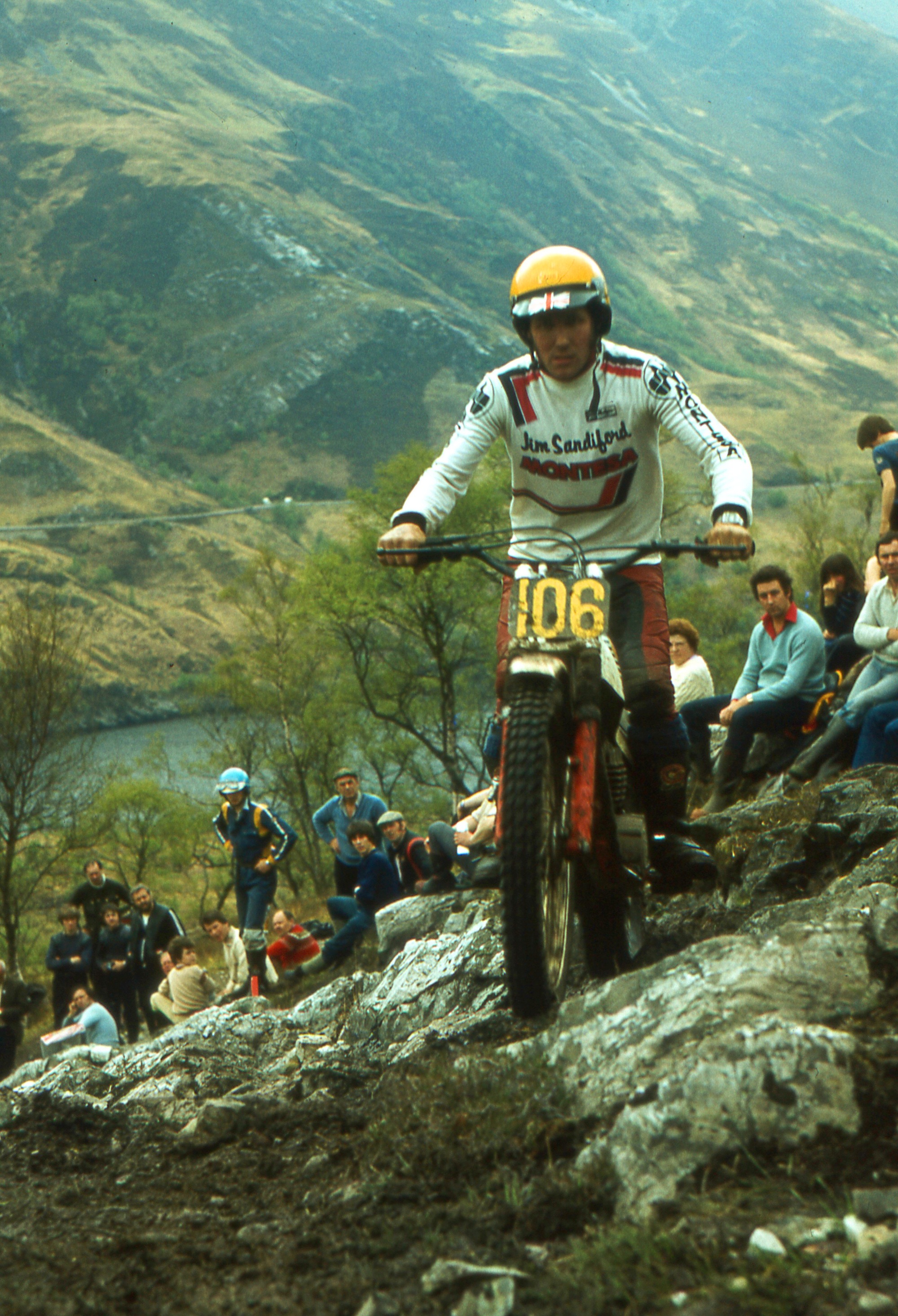
Rob Edwards (Sandiford Montesa) Scottish Six Days Trial 1981 – Mamore Section – Photo ~ Iain Lawrie, Kinlochleven
Hello Everyone,
Thanks once again for your support.
Today is rather a sad one for me. The ‘Gaffer Guru’ John Moffat has told me I can keep going as long as I want, but I feel that I have subjected you to quite enough punishment and its time to go.
Never in my wildest dreams could I have expected the support you have given me. I have had a fantastic time, a really fantastic time believe me. I was kept going by the The Trials Guru’s enthusiasm. That plus your comments and likes were a real tonic to me. Despite my health problems I still consider myself the luckiest person in the world.
I have always been a people person and the spectators who lined the sections were just as important to me as the sections and they have repaid me a thousand times!
Like all of us I had made mistakes but in general I am pretty pleased.
One thing I will miss is checking the comments and likes each day.
I was pleased and a little surprised when Benny Sellman and Thore Evertson contacted me.
Benny was a fellow Montesa rider and Thore a works Ossa rider.
I also received an e-mail from Martin Belair in California.
These plus dozens and dozens from all over Europe have done me more good than any doctor or medicine could hope to do.
The new generation of Thornaby Trials riders have been following my story – Thanks a lot lads.
I hope to get to the Telford Show again this year so please say Hello, tea with milk, no sugar please!
It is impossible to thank everybody who made this possible but Eric Kitchen, Barry Robinson, Iain Lawrie and Luis Munoz who allowed Guru John (my gaffer) to use their pictures.
When readers send in comments like Scottish Heaven you could bet that one of these are responsible.
Keep Clicking and thanks!
Many thanks again to ‘Trials Guru’ – John Moffat and thank you finally to Alberto Mallofre, Pere Pi and Montesa for having faith in me.
A FINAL GOODBYE NOW – ROB EDWARDS
Rob Edwards with John Moffat (Trials Guru) Photo Copyright: John Hulme/Trials Media
Trials Guru comment:
It has been absolutely fantastic receiving Rob’s e-mails over the last few months with details of his life in trials and to be able to share this with you all on Trials Guru.
Rob’s story now explains why he hasn’t been seen as often out and about at events, unlike most of his peers from the time when Montesa, Ossa and Bultaco were trying to out-sell each other from the late sixties, through the seventies and into the eighties.
As we have seen, if you have been following Rob’s adventures since late October 2014, what a warm human being he really is.
Despite his health problems which undoubtedly cut short his riding career, that he is as outwardly cheery as he was when some of you rode with him, worked in Head Wrightons with him or marvelled at his skill as a factory Montesa rider in the Scott and Scottish Six Days as well as countless national trials throughout the UK and the rest of the trials-riding world.
I can only say this, many grateful thanks to Rob for taking the time and effort to satisfy my request in the start field at Marske on the 18th October 2014 when I said: ‘Rob, how about doing your story on Trials Guru?’
To all of you, keep commenting and keep telling people to read this story here on Trials Guru, the “Rob Edwards Story ” button will be here on this website for a very long time to come! – The Guru.
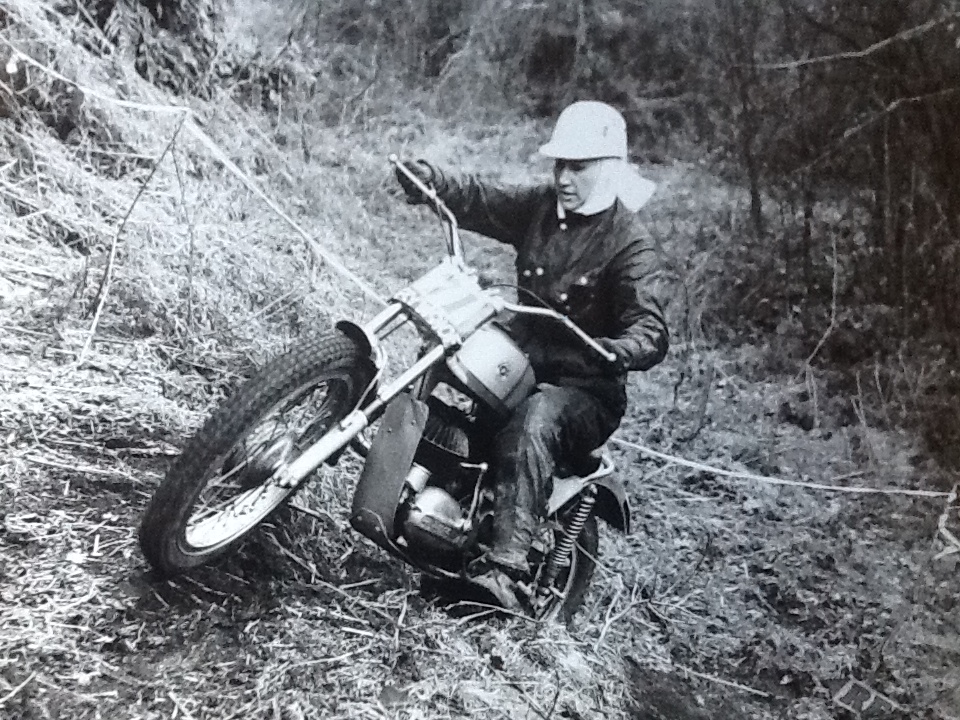
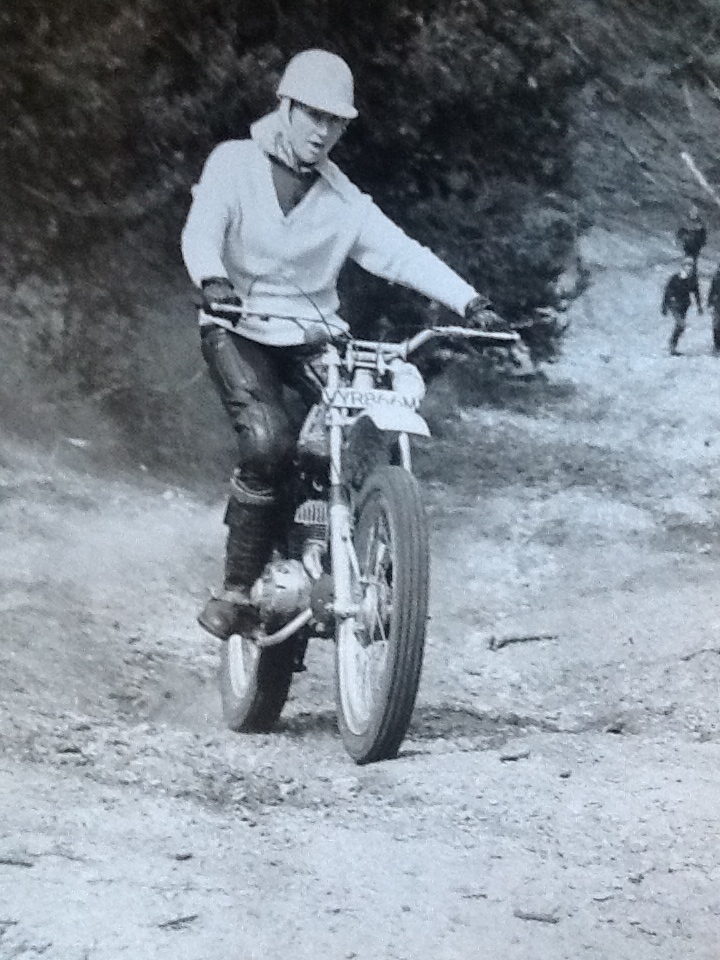
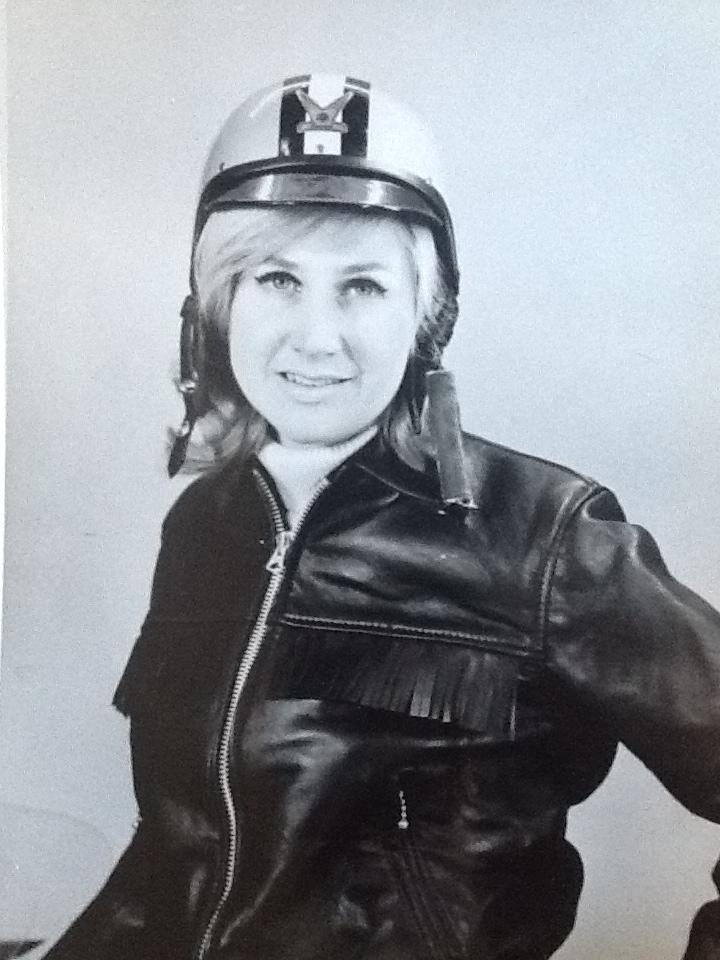
My mum was a name known to all in the motorcycle trials world, she was born in East London’s Canning Town.
From humble beginnings she emerged as Britain’s best known lady rider in a career spanning a quarter of a century.
Renee’s interest in trials riding began watching father ‘Wag‘, an East London nickname for ‘Charles‘, riding motorcycles around the docks near his cycle and motorcycle shop. Renee’s parents were hard working East Londoners. They opened their first shop in the late 1920’s in Victoria Dock Road.
The popular shop hired and sold cycles, and the name Wag Bennett has been carried through to successive generations.
All during World War II, Wag and Esther Bennett remained in Canning Town, running their shop, keeping the dockworkers going with cycles and motorcycles, and staying open late til 11.00am waiting for the last shift of workmen to pass the shop.
Renee stunt doubling
Renee stood on a box at the counter, testing bulbs and batteries and giving the customers their change, by candlelight. She recalls she was about 4 or 5 years old.
In 1939, Wag was picked for the British ISDT Team, held that year in Nazi Germany. He shook hands with Hitler, unaware of the gathering storm then, quite suddenly, the team was ordered to leave Germany immediately WWII had begun!
The old shop was a target in the blitz being so near the docks, and eventually took a bomb, as did every other shop and house around it. Almost blown to smithereens, the bedroom ceiling was somehow held together with cycles magazines and newspapers. The whole shop was supported by a few wooden beams, keeping it standing.
Buckets were strategically placed on the bed to catch water, which poured in every time it rained. As a child, this was normal daily life for Renee and her brother, Wag jnr.
At night, they watched the ‘doodlebugs’ the V1 flying bomb, on their way to decimate the London docks and surrounding area.
Standing outside the shop every night, one of these unmanned rockets, would suddenly stop, drop, hit it’s target and blow the shop windows out.
During these blitzes, the family would hastily run to the nearest underground station or the Anderson shelter behind the shop, where they would remain until an ‘All Clear’ siren sounded.
Getting through the war was a daily struggle for survival. The harshness of life though at least prepared Renee for the tough sport of motorcycle trials that was to come.
After the war, Wag sold Ariel motorcycles; strong serviceable machines they were used thoughout the war, by soldiers and civilians alike. He worked all hours repairing and selling them to the dockers and factory workers.
Renee left school at 15, and went into the family business. It was now well known, a beacon for all the major British bikes: AJS, Matchless, Ariel, BSA, Triumph, Panther, James, Velocette, Frances Barnett, NSU ‘Quickly’ to name but a few.
Around this time, Renee began riding in earnest on a James Captain 198cc, but at only 7 stone and of slender build the skill of trials riding was not easy to master.
In her own words: “Why I never got killed I’ll never know, I was useless!“
Wag Bennett jnr. also worked in the shop, but diversified into bodybuilding. He would train every night in the hope of becoming Mr Britain. He eventually opened his own gymnasium training some of the greatest names in bodybuilding including Arnold Schwarzenneggar, who lived with him and wife Dianne for a few years. Wag was instrumental in teaching Arnie to pose to music. He won every title in Wag’s shows and soon became a household name. Arnie remained a lifelong friend of the family and invited Wag & Dianne to his Hollywood wedding to Maria Shriver.
In the mid-50s Renee met husband Howard Powell through her brother’s bodybuilding connections. Howard won many titles throughout the UK including Mr. South East Britain and Mr. Navy.
They married and in 1956 I came along. Renee juggled motherhood with helping Howard run their motorcycle shop in London’s East Ham, the first of five.
Determined to follow in the footsteps of her father, a factory supported rider for Matchless, Renee rode daily on wasteland nearby, and competed every Sunday in Kent and Surrey in timed trials along with husband Howard, also an avid trials rider.
By this time, and winning several awards in open-to-centre trials, Renee was riding a Greeves 250cc slimline, alloy frame, perfect for her. They were made by a small factory at Thundersley, Benfleet, Essex.
Renee was ready for the challenging Scottish Six Day event, following in her father’s footsteps.
Renee’s entered the Scottish Six Day Trial in 1961. The first of many.
She finished the event, earning her an award and a myriad of bruises all over her body!
The Welsh Three Day Trial featured prominently in Renee’s riding career as she says: “My favourite, fast and furious!” Renee rode a Bultaco 250cc with a Wasp frame for that event.
Her son, my brother, Charles was born in 1964.
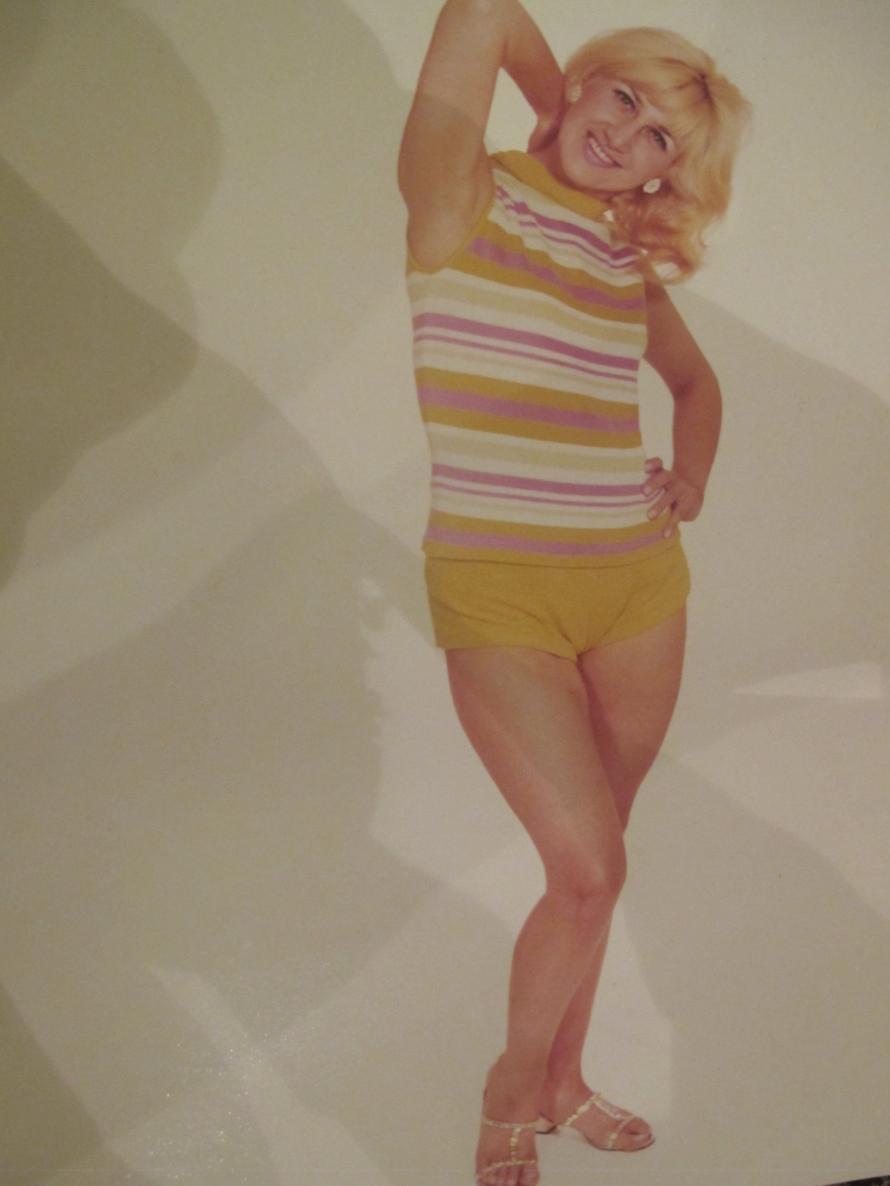
But that wasn’t all, she was much in demand as a motorcycle stunt double, known by all in the film and TV business as The Girl On A Motorcycle. Renee also enjoyed a successful modelling career, advertising everything from make-up to Ovaltine.
In the early 1970s, Renee switched to riding a Bultaco Sherpa 250cc, which she still has today along with her Greeves, Bultaco Enduro (used in the Welsh Three-Day) and the much-loved James 198cc.
In 1973, Renee competed in the Scottish Six Day Trials on the Bultaco. The 6th so far.
At around here, she converted one of her East London shops into a motorcycle competition centre. “Renee Bennett’s East London Sportman’s Centre”, which became a beacon from as far afield as Europe and the USA. Customers visiting the shop immediately asked for ‘Renee Bennett!’
Renee and Howard became known for sponsoring many up and coming young trials riders in the 80s, kitting them out with helmet and suits, their own name signwritten on the petrol tank, and cheques sent when they had won the event.
Renee’s competitive spirit continued well into the 1980s. She ran a popular trial of her own: The Renee Bennett Sunbeam Novice Trial, which became a much awaited event each year. Every finisher received a scrolled certificate, adorned with red ribbon. It is still talked about today in vintage trials circles!
Howard, being into health and fitness since his time as a bodybuilder, set up a gymnasium above one of the shops. They trained daily, and Renee found the toning and strengthening a big help when dragging her bike out of the mud!
Howard, who sadly passed away in 2003, was a talented amateur film maker, often being invited to the premieres of the top films of the day. He counted among his friends actors and top stunt men from all the Bond films.
Renee recalls meeting the movie stars of the day like Yul Brynner and Steve McQueen, who was over from the states for the ISDT in 1964.
Now a grandmother but still with an interest in motorcycles, Renee continues to run her busy motorcycle shop in East Ham, the first one she and Howard acquired some 58 years ago.
As if that is not enough, she is very ‘hands on’ in her property renovating company assisted by son Charles.
Grandchildren have come along, my daughter Sophie, nearly 16 and a three-times published author! Oliver nearly 12, and young Charles, 22, who runs his own foreign exchange business.
Film on Renee Bennett by British Pathe on YouTube: HERE
Renee’s mother died only recently in 2012, aged 103! Father Wag died in 1989. As Renee says: “Perhaps I’ll live to be a ripe old age… see you around!”
This recent comment on a trials forum site sums up the amazing Renee Bennett : “Well.. Renee Bennett,. what can I say..! I think my old man had a fancy for her! I remember her riding the SSDT on a Bultaco in 1973. All the lads were fighting over themselves to help her when she got into difficulty. Her shop was called ‘Renee Bennett’s East London Sportsman’s Centre’. – Anyone know who wrote that?
– Julie Powell
Renee Bennett photographed in 2013 by daughter Julie Powell
Article Copyright: Trials Guru/Julie Powell
Photos: Julie Powell
Renee Bennett in Spanish! – Todotrial website Article:
Javier Cruz from Madrid has taken the Renee Bennett story to Spain, read about it: HERE
Walther Luft (Puch 250) on ‘Laggan Locks’ – Scottish Six Days Trial 1983 – Photo: Iain Lawrie, Kinlochleven, Scotland.
Walther Luft, former Austrian Trials Champion, Puch factory rider and exceptional machine developer and innovator is 70 years of age!
Happy Birthday Walther from Trials Guru!
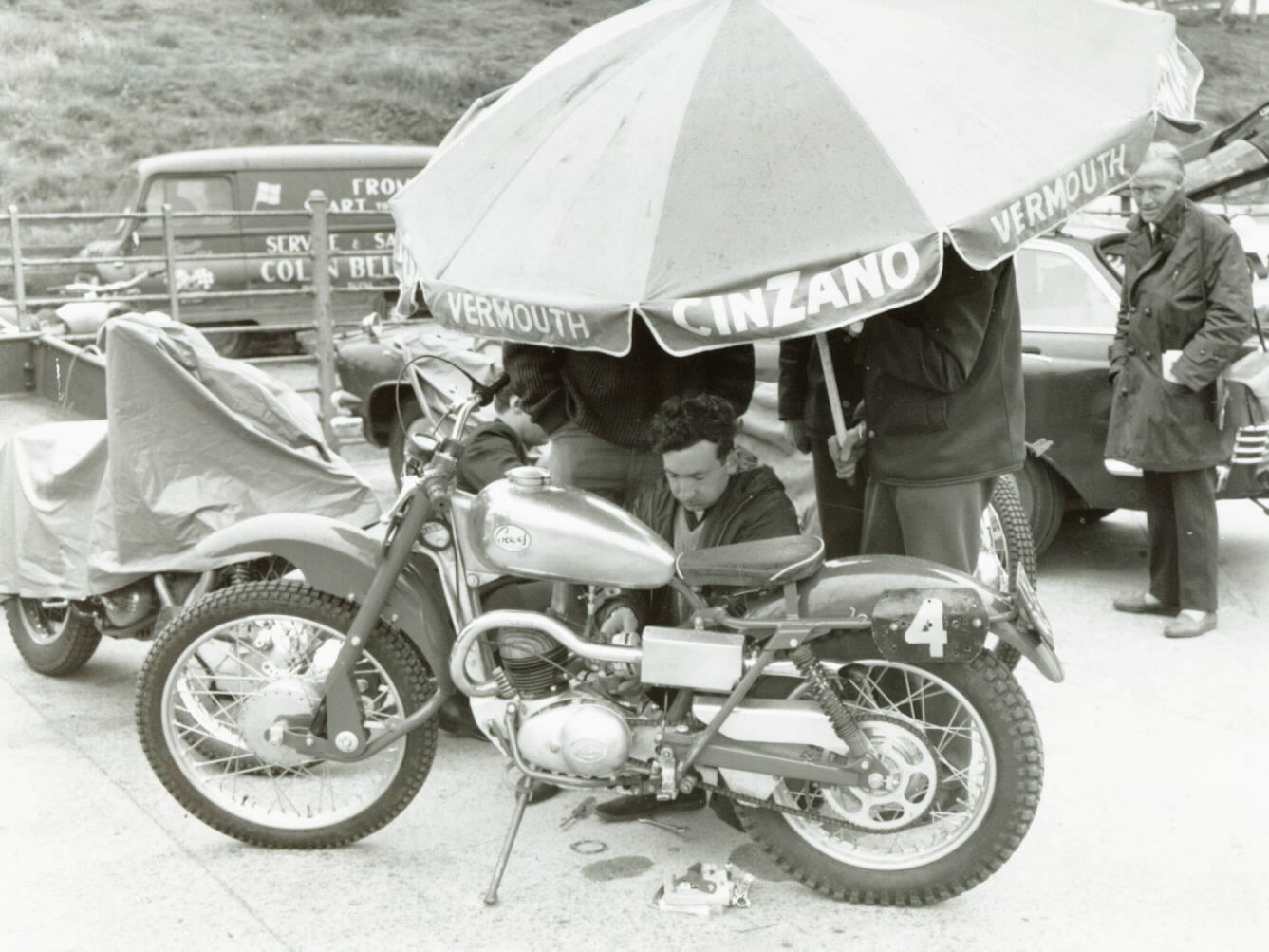
Walther Luft (crouched) examines the Walwin BSA of Ross Winwood at Gorgie Market, Edinburgh in 1970. Standing middle is Austrian Peter Bous and looking away is Scottish ACU secretary T. Arnott Moffat, a great friend of Luft and Bous. Photo: Hans Maiditz, Graz
Walther’s first Scottish Six Days Trial was in 1970 on a 169cc Puch which he made himself. He was accompanied by his good friend Peter Bous and Puch manager Hans Maiditz a former ISDT rider for Steyr-Daimler Puch A.G. (Graz).
Walther won the Edinburgh Trophy for the best foreign rider at his first attempt.
Luft developed the Puch trials machine virtually on his own with parts supplied by the factory at Graz. He took the Puch 169cc six speed motor out to a full 250cc displacement. It was a machine which was nearly 20 years in development.
Luft was always making components lighter, in fact well before his time the same processes were used many years later my mountain bike riders and manufacturers.
Walther was a talented engineer and exceptionally good at metal working as this was his trade or craft.
Much of the Puch was made from Nylon 66 material, such as the sump guard and chain tubes which was a feature of Luft’s machine and was copied by Montesa when they brought out the production Malcolm Rathmell Replica 348 machine in 1976.
Luft also went on to develop along with German champion, Felix Krahnstover the KTM trials machine. However the growing KTM concern decided to pursue motocross and enduro markets, as they were more lucrative and profitable for the Mattighoven based organisation.
A story here from the premier Austrian ‘Trial.at’ website:
Bob MacGregor is the only Scotsman to have ever won the Scottish Six Days Trial, seen here on Kinloch Rannoch in 1939 on his factory Rudge.
The fourth annual ‘Bob MacGregor Memorial Road Run‘ open for classic motorcycles (or anything special) will be taking place at Killin, Perthshire on Tuesday 28th April, 2015.
In memory of Bob MacGregor, the only Scotsman to have ever won the Scottish Six Days Trial, the event takes place two days before the preamble to the Pre’65 Scottish Trial at Kinlochleven.
MacGregor won the SSDT twice, in 1932 and again in 1935 on Rudge machines and had a greengrocers’ business in the town of Killin, the shop is still there.
Guest of Honour this year will be John Moffat, the Trials Guru, who will start the event and will travel along with local trials rider Bobby Lafferty, the event organiser. Bobby also organises the annual national trial named after MacGregor.
The route will traverse through the picturesque Glen Lyon and pass some old SSDT sections along the way.
Moffat intends bringing his 350 AJS, JSC905, which is the very bike his late Father rode in the Scottish Six Days in 1953 & 1954, the same bike that his son, David rode sixty years later, at the very wet 2013 Pre’65 Scottish Trial.
Those who want to join in the fun and nostalgia can do so by contacting event secretary, Peter Remington on 01539 560695 or click on the website: www.cumbriaclassic.co.uk
John Moffat (Trials Guru) standing, checks over JSC905 with son David. Photo copyright: Mortons Motorcycle Media.
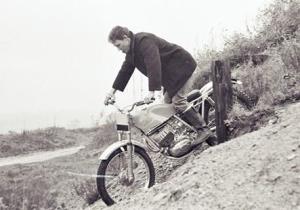
Rob testing the Cotton Minarelli 170cc trials machine in 1968. Italian Minarelli motors replaced the 37A Villiers powerplant.
Hi Reader and thanks for your support.
I am enjoying it and I hope you are too?
Having ridden a 250 Bultaco in the 1966 Scottish, I moved on to ride Cottons and rode a 250 Villiers powered bike in the 1967 & 1968 events.
1968 SSDT on Foyers with the 37A Villiers powered Cotton. Rob was fourth in the event.
In the late sixties Cotton changed from the 250cc Villiers 37A motor to the Italian made 170cc Minarelli engine. I was given a large gearbox sprocket to carry in my pocket.
The idea was to fit it when we were due to do long stretches of road work.
The problem was, I was always so late on time I didn’t have the time to swap it!
On the final days’ lunch check, the thought of doing 30 miles an hour back to Edinburgh was very daunting indeed. It wasn’t helped by seeing the works Greeves fitted with minute rear sprockets.
Their cruising speed was around 70mph. Bill Brooker was the Greeves competition manager and he really had his finger on the pulse.
On more than one occasion he went out of his way to help me. My idea of a true sportsman and excellent competition manager.
It was short on ‘flywheel effect’ inertia and dreadfully low geared. Thanks to my pals at Head Wrightsons, a brass band was machined to fit onto the flywheel.
This made a big improvement to the engine characteristics, wheel grip and so on.
Entered by Norman Crooks Motorcycles, I rode with this modification in the 1969 Scottish and won the best up to 200cc class.
Rob Edwards in 1969 on the Cotton at Coalasnacoan in the SSDT on his way to win the 200cc Cup.
To solve the low top speed problem, I had sent Cotton a drawing of my flywheel modification but had heard nothing back. I wasn’t surprised when one week after the SSDT there was a half page advert in the Motor Cycle News, telling riders how good the modification was and how much they would sell you one for. I was gobsmacked!
However, I didn’t receive any thanks for the 200cc cup win or flywheel modification!
After winning the Alan Jefferies Trial, I decided to treat the Minarelli to a set of piston rings. I rang the Cotton factory up and in due course they posted them to me.
Unfortunately you’ve guessed it – I broke one when fitting them.
I rang Cottons for another set. Two weeks later they still hadn’t arrived.
When I phoned them, the top man answered the phone. ‘Mr. D’ said that he wasn’t going to send me anymore rings until I explained exactly what I had done with the others.
It was then I decided it was time to move on.
When Pat Onions was in charge of the competition shop there was never a problem.
Things were changing and it was time to abandon ship. But where to? – Rob
1968 – Rob Edwards (centre) discusses the Cotton Minarelli with Cotton’s competition manager, Pat Onions (left) and frame builder Eric Lee. The photo was a factory publicity shot.
Rob testing the Cotton Minarelli 170 a bike which he made some modifications to make it more competitive.
To Be continued …
Trials Guru: The factory Cotton Minarelli that Rob Edwards rode was to become the production Cotton ‘Cavalier’which was produced at around five machines per week. Supplied to customers in ‘kit’ form to avoid purchase tax. The 1969 Scottish– Rob Edwards came home in a creditable tenth position and another Special First Class award on 59 marks on his 170cc Cotton. The eventual winner was Yorkshireman, Bill Wilkinson who was to be the last British rider to win on a British built machine, a 250cc Greeves (WWC169F).
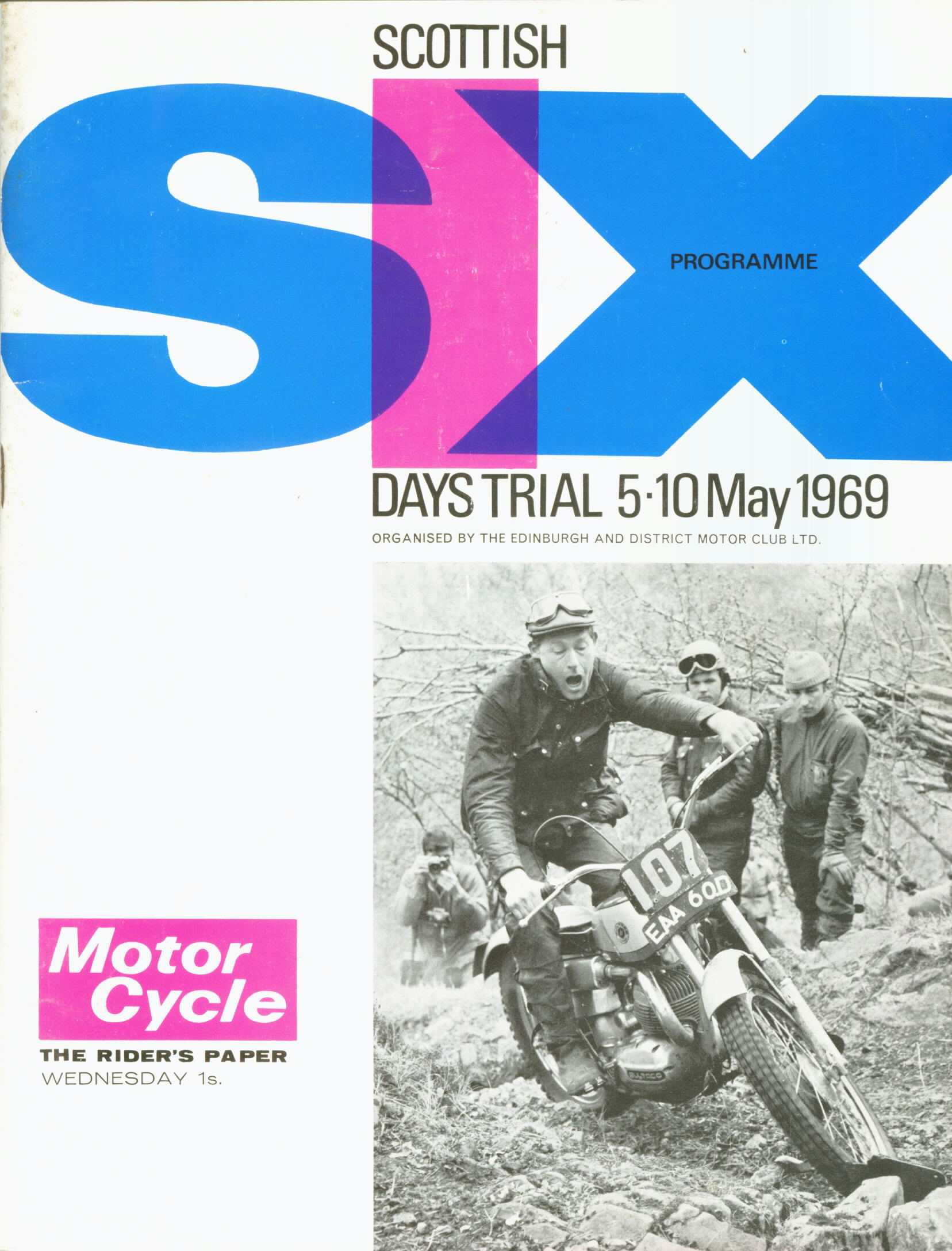
1969 SSDT Programme with a 1968 photo of Rob Edwards on the 250cc Cotton on Glenogle section on the first day.
Rob remembers! : Isn’t it always the way? You start writing about one thing and another one pops into your head! Anyway, here is something I remembered about my Cotton days.
I traveled a lot with Brian Hutchinson. The problem was that Brian worked on the family farm. I would be at the farm at 4.30pm but it would be 6.30 pm before we started our journey.
One time in particular we set off for South Wales with light snow falling.When we reached the M1 motorway, the traffic was almost at a standstill. This didn’t bother ‘Hutch’ – he went straight across into the fast lane that nobody was using because the snow was too deep.
No problem! he had the Austin A55 pick-up to 80mph in no time and we had the fast lane to ourselves all the way to Sheffield!
We finally arrived at Merthyr Tydfil at 1.30am. No bed and breakfast or anywhere was open. It was freezing cold – you know its cold when your breath freezes on the windscreen. Close to death, we drove to the railway station and as luck would have it there was a gas heater on the wall.
You had to reset it every minute but this was the Ritz compared with the pickup. We took turns pressing the start button.
Unfortunately one time it didn’t ignite. I was woken up by the smell of gas and a hissing sound. The next second, there was a tremendous bang and the heater left the wall it was on and splattered against the opposite one.
We were last seen running flat out along the platform with the station master in hot pursuit shouting: “I’ve rung the police boyo you’ll not get away”. It was back to the “pickup hotel” after that! – Great memories – Rob
The 1969 SSDT Official programme front cover, the year Rob Edwards came home 10th and won the up to 200cc cup on the Cotton Minarelli.
Copyright:
Words: Rob Edwards/Trials Guru, John Moffat 2014.
To read all of Rob Edward’s story of his life in trials, click… here
Alexander John Cameron, known to the townsfolk of his native Fort William as ‘Allie Beag’ or just ‘The Beag’, this Gaelic nickname means ‘Wee Allie’.
At the Parade Garage in Fort William, where he served his apprenticeship as a mechanic, there were two ‘Allies’ so there had to be a distinction and it stuck with him for the rest of his life. Allie was originally inspired by watching the Scottish Six Days and ventured into trials at eighteen years of age, when he could afford a James Commando in 1958. This beginner bike soon made way for a brand new 20TA Greeves, purchased from Duncan’s of Brechin a year later.
Allie progressed to a 250 DOT in 1961, which, he rode for only one year.
Allie Cameron on the 150cc Triumph Cub in the 1962 SSDT on Tyndrum – Photo: Ian T. Robertson
Next season, Allie bought the ex- Jimmy Hutchings Triumph Tiger Cub and had it reduced in capacity by the factory at Meriden, near Coventry with the intention of winning the 150cc cup at the Scottish, which he did. Henry Vale, the competitions manager at Triumphs had a Terrier 150cc barrel fitted to reduce the capacity accordingly. That particular Cub had a twenty-one inch front wheel and a widened swinging arm to accommodate a full four-inch section trials tyre at the rear.
A smiling Allie gets ready for an event at Todholes Farm, Fintry in 1963 – Photo: Jack Williamson, Rosewell.
His Scottish 150cc capacity win on the Triumph soon attracted the attention of the Greeves factory at Thundersley, Essex and Allie received factory support in the shape of a 149cc bike (XWC 264) for the 1963 Scottish.
Cameron lifted the cup a second time for the loss of 120 marks with his closest rival being Gordon Farley, on a Triumph supported by Jock Hitchcock, who dropped 174 marks. Greeves were happy with the result and used it to best effect in their adverts in the motorcycle press for many months later.
On his special Greeves 149 (XWC264) winning the 150cc cup at the Scottish for his employers, Greeves Motorcycles of Thundersley, Essex; seen here on Achintee in the 1963 Scottish Six Days Trial. Photo: Mrs Florence Cameron, Fort William.
The same year Allie was runner up in the Scottish Trials championship, two points behind Jackie Williamson. By 1967, ‘Beag’ had two special firsts, four first class and four capacity class wins to his credit in six rides in the Scottish Six Days Trial.
Allie was offered a job as mechanic in the competitions department at Thundersley, preparing the factory trials and scrambles machinery for the works riders. He also prepared many of the special ISDT machines including those supplied to Thames Ditton dealers Comerfords. Allie worked in company with John Pease on the ISDT bikes.
An accomplished mechanic, Allie fettles his 150cc Greeves factory machine at Gorgie Market in May 1965 (NEV5C). He won the 150cc cup on 169 marks. Photo: Mrs Florence Cameron, Fort William.
Pease who as well as working at the factory was selected on many occasions as a British Trophy team member. The duo fabricated the special engine cradles to carry centre stands, rock guards and the various brackets to carry headlamps, number plates and compressed air bottles for tyre inflation.
Allie became friends with Don ‘D.R.’ Smith who came up to the factory once a week for testing and development discussions. ‘Beag’ would go practising at Kelvedon Hatch near Brentwood with Smith who was one of Britain’s top trials riders, by then, European Champion.
Allie Cameron on Loch Eild Path in the 1968 Scottish on his factory Greeves (XHK14F). Allie won the Henderson Challenge Trophy for the best performance by a member of the promoting club. – Photo: Alistair MacMillan / West Highland News Agency, Fort William (with permission of current copyright holder: Anthony MacMillan, Fort William – All rights reserved)
‘Beag’ knew all the ‘works boys’ and was highly regarded as not only an excellent spanner-man but as a handy rider in the Wessex Centre ACU. He spannered for Bryan Goss and many of the other factory motocross riders.
In 1971, Allie decided to return home to Fort William and took up a position with the area’s largest employer, The British Aluminium Company (‘BA’ for short). He wasn’t home long when he received a call from Jim Sandiford offering him a job at Sandiford’s Montesa import business. Allie thought long and hard but decided to stay at the BA.
1971 SSDT – Allie ‘Beag’ Cameron (247 Montesa Cota) on Loch Eild Path. Allie took home the ‘Henderson Challenge Trophy’ for the second best performance by a member of the promoting club, and was 24th position in the trial with a special first class award on 126 marks. – Photo: Ian Robertson, Midlothian
Having been diagnosed as having Hodgkin’s disease, the Beag had to restrict his trials riding but never lost his enthusiasm for motorcycling. He rode up until the late 1970’s and was a willing observer at both the annual Ian Pollock Memorial Trial and Pre-65 Scottish.
Sadly, Allie died in the November of 1998. His funeral at the Duncansburgh Church, Fort William was filled to overflowing, such was the popularity of the little man known affectionately as ‘The Beag’ to the towns-folk. Many modern day competitors and “old hands” converged on the Fort to pay their last respects.
Allie Beag at home in Fort William in 1996 with the trophies he won during an accomplished career in trials. Photo: John Moffat
Article: Copyright – John Moffat -2005
Photos:
Jimmy Young, Armadale
Alistair MacMillan / West Highland News Agency, Fort William (with permission of current copyright holder: Anthony MacMillan, Fort William – All rights reserved)