Former White Helmet team member, Tom Walker in 2012
Trials Guru has been chatting to a Scot who became a well known face in many motorcycle shops during the mid 1970s when employed as a sales representative for the Barnard Castle based trials and motocross clothing manufacturer, TT Leathers International.
It was TT Leathers that pioneered coloured apparel for the sport of trials in 1973 with their RUFRYDA equivalent to the world famous Barbour and Belstaff suits. Whilst these were all of a similar design, TT Leathers introduced both a green and red base colour alternative to the traditional black waxed cotton of the rival producers.
Subsequently they introduced their Vystram two piece suits and one piece summer trials suits from 1975.
The TT Leathers Vystram trials suit from 1977 brought colour to the sport – Photo: Trials Guru/Moffat Racing
Tom Walker was originally from Ayrshire and joined the British Army, he takes up the story…
Walker: “I met Jim Aird at a motor cycle show in London while I was in the Army and at the time was part of the famous Royal Signals ‘White Helmets’ motor cycle display team. Jim was by then with TT Leathers and also a professional Motocross rider from Kirkcaldy in Scotland. He was a Scottish champion and was making a name for himself having raced CZ and AJS machines for the CZ importers and the AJS factory.
We built up a friendship and I invited Jim across to Catterick Garrison in North Yorkshire where the Display Team was based and did much off road riding to train new potential riders for the forthcoming season. Jim came to the gym and cross country riding to strengthen his skills for the forthcoming racing season.
Tom Walker (left) and Jim Aird on Army issue BSA B40 models in 1971 at Catterick. Aird was riding for AJS at this point in time. – Photo courtesy Tom Walker, Harrogate.
A couple of years later, I left the White Helmets team and was in the driver training wing at Catterick and got selected for the British Army Enduro team when I rode in the ISDT, continuing my friendship with Jim and also the boss of TT Leathers, Len Thwaites”.
Len and Jim asked Tom if he would like to work for TT leathers as their first sales representative. After a great deal of thought, he decide to do join the company as his next Army posting was a two year tour of duty in Northern Ireland.
Tom: “Taking my family there, I was never comfortable with, so I decided to leave the Army and join TT Leathers. During this period of contact with Jim, the White Helmets purchased lots of riding gear from the company, such as the ‘RUFRYDA; brand trials clothing, a new invention for off road riding which was very bright and colourful but very hot when wearing it”.
K. Hall (Montesa) on Pipeline during the 1978 Scottish Six Days, wearing a TT Leathers Summer Trials one piece suit – Photo: Iain Lawrie, Kinlochleven
Walker continued: “During my time I also met a Scot called Stan Young and another called John Little who also rode in the ISDT for Scotland, I also met the SACU secretary, Arnott Moffat who was quite involved with the Scottish ISDT effort at that time. I kept up my association with Stan and John and some eight years later when I moved from TT leathers to increase my position in the motorcycle trade”.
Jimmy Aird was a multiple Scottish Motocross (Scrambles) Champion before joining Len Thwaites at TT Leathers in 1970. He rode the factory AJS Stormer models and for Alan Clews’ CCM factory. He now is MD of Scott Leathers.
“Many more years on, I became Managing Director of a German shop chain who wanted to set up in the UK, called Heine Gericke. I took the job and developed the company and when I opened the Edinburgh shop in Queens Street. Stan became the shop manager and was for many years a great enduro rider and just a really nice guy”.
“Jim Aird and myself continued in the industry and I also assisted Jim develop his company with Euro Helmets, the AGV importer and we created the brand ‘SCOTT Leathers’ from there it has gone on to be one of the best racing suit manufacturers around”.
“Jim of course is still heading up SCOTT Leathers from Barnard Castle. Len Thwaites is now retired and lives in New Zealand and I am potentially retired and live in Harrogate, North Yorkshire but still active in the motor cycle industry and enjoyed every minute of this fantastic industry”.
When in the White Helmets Display Team, Tom was a Lance Corporal. He was brought up in New Cumnock, Ayrshire. He joined the Royal Signals in 1964 as a driver and served in Herford and Bielefeld, in Germany. His duties as a driver took him all over Europe, often carrying VIPs. He joined the ‘White Helmets’ team in November 1969. Always keen on sports and being a Scot, fond of football.
World famous, the manual magnetic scoreboard of Charly Demathieu, wearing his Ecole de Trial Happy shirt provided by TRAP – Transfers Racing Adrien Prato
The Guardian of Trial Memories – Charly Demathieu
Thirty years in the world of trials, if one man has made his mark it’s the Belgian, Charly Demathieu. The absolute reference point for the scorecards at both the Belgian and Spanish Championships as well as all the World rounds, he is the true living memory of our sport. The guardian of trials history he has put his treasured archive on his fabulous website www.trialonline.org This is the story of an encounter with a genuinely passionate individual that does not only live by numbers.
“I was the first minder in the history of trials with Jean-Marie Lejeune.” – Charly Demathieu
“Trialonline has 4000 pages and almost all the results of all the big events since the birth of our discipline.” – Charly Demathieu
Words: Philippe Pilat; Charly Demathieu
Pictures: Eric Kitchen; Colin Bullock and private collections.
Who is Charly Demathieu?
Charly: “I was born on 12th June 1952 at Cheratte (North of Liege – Belgium), in fact I still live there. I followed my humanities course until the sixth year, which is the equivalent of ‘A’ levels in the UK. Then I got my driving licence and I became a truck driver for the Public Welfare Centre of Liege for whom I worked for twenty years. The centre later closed and I found myself as an archivist in a psychiatric hospital, completely different but really not an obvious career change at first but it was a very rewarding experience to live in contact with patients with severe drug and alcohol problems. I learned a lot through these people that we really do not need to be afraid of them, yet they frighten almost everyone … Another twenty years passed very quickly and for the last two years I have been a pensioner, but not quite retired!“
Before the computer revolution, the world trials series was covered by a 400 page book
Which is the source of your passion for trials?
Charly: “Oh, I feel a bit like Obelix, I fell into a tiny cauldron filled with a potion (passion!) for the magic of trials. Still in my pram, my mother often took me to see my godfather, Rene Georges, and my cousin Roger ride. Later there was one man who gave me a really genuine passion for the sport, Jean-Marie Lejeune (Eddy Lejeune’s elder brother). In 1975 I was a spectator at the Grand Prix held in Sommieres and Jean-Marie was looking for a driver to take him to the next round in Sweden. It started well and I was soon driving the Lejeune family truck to all the Grand Prix’s and once there I tried to occupy myself so I started making small rankings of the results.“
You rode trials in the seventies … why did you stop?
Charly: “I just rode as a Novice and then Intermediate but without any impressive results. In fact at the time I was especially fond of my road cycle. My claim to fame is that I was the first minder in the history of trials with Jean-Marie but my job was so very different from their current duties. I followed my rider between sections with my backpack filled with essentials as this was the time when motorcycles were much less reliable than today. I helped with repairs for Rathmell, Lampkin and Karlson. Solidarity amongst riders was much stronger than today. I was almost never seen in sections, I stood at the ends cards, ready to intervene if necessary. I watched the lines and rides of his competitors but I never set foot inside the section. I remember one time when Jean-Marie made me stand in the middle of a river with water up to my waist to mark the deep hole where he should not ride. We were very close to each other and then we lost contact for nearly fifteen years since I was often on results duty in Spain and rarely in Belgium. We met again by chance in 2011 during the GP of France at Isola 2000.“
1970s shot of (from left) Jean-Marie Lejeune, Charly Demathieu and Jean Lejeune
How do you convert from competitor to official – organiser?
Charly: “I rode events for a few years. I drove the Lejeune family to all events using holidays that I could earn by working on other weekends of the year. For a long time I looked after the Belgian Championship but I finally stopped because it took me too much time. I was race director, timekeeper, starter and closer of the event too, you know the one who leaves after the last rider to remove and collect the section markers. I also worked with the setting out of sections; at the time we marked the inter-section route with methylene blue mixed with plaster. You finished the day blue all over; the colour did not want to wash off! I also managed entries for the GP’s, allocation of riding numbers; I standardised the various documents for the Championship so we could use the same media everywhere.“
You became the “Grand Vizier” of the scoreboard with your famous magnetic board?
Charly: “It was with Jean-Marie Lejeune that we came up with the idea of a magnetic board to display the scores but I did not actually put into practice until 1982. On one side there were the rankings of the day, on the other those of the Championship and I got to the final result by sliding my magnets up or down. I managed to calculate the score very quickly so when riders brought me their score card I put the results on the famous board and everyone could see where they had finished compared to their competitors in almost real time. I was doing all this alone at many events. At Bilstain for the Belgian GP I arrived with a large format magnetic board that I installed on the podium. The Italians asked me to do the same at their home round: I said yes, then it was the turn of the Finns … and I was away, I did it all over the world. It lasted nearly twenty years and then one day the truck of the Spanish Federation was stolen in Poland along with the famous scoreboard that was in it. I then finally moved onto the computer but suddenly I could not see the riders as I did before and I was no longer on the podium with the public: I was tapping on my keyboard in a corner.“
What is your current status? Are you an employee of the FIM, do you still work for the Spanish Federation? Charly: “I work for the FIM at the World rounds. I am in a team of three with Jordi Pascuet and Jake Miller: it’s a package imposed by the International Federation (FIM), it is not I who makes the decision to go or not to a particular GP. It may not suit the organisers who prefer to use the services of ‘locals’ who are more often than not very competent, but they do not calculate the overall rankings throughout the season. In addition we represent for them a significant cost. A few years ago I took my car and I went to the other end of Europe but with age I can no longer do things in the same way. So the organisers of the GP must support our airfare, accommodation etc… This represents a budget they would like to distribute down to the volunteers already in place. I did the same job for the Spanish Championship for eighteen years; I stopped only four years ago. I was away twenty seven weekends a year. Since I am a pensioner I have more time but there were still two years that I spent all my holidays to travel. I was always away but I loved it. I loved certain events such as the trial of Montmartre in Paris in the nineties. I found it wonderful to be able to bring trials machines here! They should have done the same thing in Barcelona. The urban trial at Cahor’s in France is superb it seems but I never went there. We must find a way to introduce trials to the public who know nothing of our discipline.“
What were the various stages or changes in your work?
Charly: “There came a time when I was forced to stop organising events in Belgium due to a lack of time, I was spending so many weekends at the Spanish Championship whilst working at the hospital in Liege during the week. I was often with Jordi Prat; it is we two who have defined the current format of the Trial des Nations. Before we took only the top three total scores of the four members of the team, later we decided to only take into account the three best results of the four teammates in each section. Our principle was tested and finally accepted by Ignacio Verneda then President of the FIM, it was he who insisted on my presence at each Grand Prix. That gave me more time to spend on the road.“
Charly explains the scores to Gas Gas UK boss, John Shirt Jnr at a world round
Any anecdotes, vivid memories?
Charly: “Many, inevitably, there are often amazing things that happen at a trial! For example at the GP of San Marino in 2008 when the local club wanted to refuse the technical controls being undertaken by the Italian Federation as it obviously did not please them, they had a real zealous approach, so they thoroughly checked all the dates of various documents (insurance, motorcycle registrations etc) of all foreign riders, it was a massive panic, as some of the riders feared they would be excluded from starting! Eight days later in Foppolo for the Italian Grand Prix, it was again the same controllers; they finished at lightning speed without any real checks. Still at the same event, we went back home on Sunday evening without being able to send out any results. Italian TV had saturated all internet connections; it took ten minutes to send an email of three words.“
1982 Scottish Six Days, Charly with Eddy Lejeune (Honda)
You created ‘Trialonline’ and have written dozens of books: you’re a pretty verbose boy!
Charly: “It is only for personal pleasure that I did all that. I’ve always loved creating stories from the passion that I witnessed. I have written fifteen books on Belgian, Spanish and World events, but I have even more to give. I have created a CD Rom containing all the results from around the world, which works in the same way as my website that I created at the request of the FIM in 2004. Since then I keep feeding Trialonline the results of trials in the most diverse countries such as Israel, New Zealand and even some South American countries. I update the results of the latest events even those held last weekend. You click on the flag of a country and you get the corresponding results, you click on the photo of a rider, you know his record. Trialonline has 4,000 pages through which we find almost all the results of all events since the birth of our discipline: it is only missing 21 ranking events! Sometimes it is very difficult to obtain results; I often prefer to speak to organising clubs rather than National Federations who are not really making big communication efforts in this area. You can find the results of the year, but not those from previous seasons! In France, it is Oliver de la Garoulaye who took the trouble to dig through the archives of the FFM to find the results since the first World round. Here I absolutely have all the results, but only thanks to fans like him, not because of the Federation.“
Charly chats to Thierry Michaud at the Belgian world round in 1988
What are your plans for the future?
Charly: “To finalise my archives, finding the 21 results I am still missing. I am also concerned about what will happen if I stop Trialonline work with the FIM. I renew the partnership each year, but I may not want to one day, it worries me to leave because there would be nobody to take it on after me. I’m also a big fan of Asterix: I have 600 volumes published in 42 different languages, I am very proud of my collection and I have some very rare specimens. I need to update my rankings for Trialonline; right now I’m working on a trial in New Zealand. I also plan a new grading program offering a choice between two or three rounds, a variable number of sections, all this is a lot of work.“
Takahisa Fujinami pops into the FIM Press office to say ‘Hi’ to his old friend Charly Demathieu
What is the state of health of Belgian trials?
Charly: “As elsewhere, is too often a single person who takes care of everything in his club and when this guy stops, the club dies. We also have the organisation related to ecological constraints that are huge in Belgium, much worse than your problems. For example, in the province of Liege, in the eighties, there were more than ten events per year, now we have only one quarter and in the rest of the country, it is the same problem. There is still a trial in Mons, Aywaille, and Bilstain and in Wavre and that is almost everything. You really have to go to private land such as Bilstain for young people to ride legally. This is the only way forward. Obviously the financial crisis is even worse for young people who have much difficulty in finding the budget to ride. It is certain that Belgian trials have seen better days.“
How do you feel about the disappearance of the GP in Belgium?
Charly: “This is something that really saddens me the as last GP was already six years ago and I look forward to the next one in Comblain-au-Pont close to Aywaille on the 13th July this year. At the last Bilstain round there was a strong divergence between the organisers and the FIM in particular with regard to the departure time. Since then the FIM does not want to go back. There was later a GP at Spa – Francorchamps in 2006 but that also ended badly. In the late afternoon there was an anti-doping control which lasted a long time and the prize ceremony could not take place until the test results were known. Inevitably the public became impatient and left without waiting for the podium presentation, the party was spoiled! It struck me as a tough decision as the results had been ready for a long time…. So I’d like to set the record straight, contrary to what has been said by many, it is not the fault of Charly Demathieu that there were no more Belgian GP’s! In 2007 the request by the organisation for a date was too late and the GP has not occurred since. This is obviously very unfortunate, if only because of the central location of our country, it is not such an expensive event for the vast majority of participants.“
If you could see the realisation of your three wishes, what would they be?
Charly: “To make the most popular trial by creating attractive and free to spectator trials, so not really like our current indoor circus … Reaching out to people I do not know and of course find the 21 results I miss between 1964 and today.“
Charly Demathieu “I love Yrjo Vesterinen, the first truly professional rider”. Vesty seen here at the 1981 Scottish Six Days in the paddock – Photo: Colin Bullock/CJB Photographic
What else would you want to say?
Charly: “I wanted to tell you about my favourite riders. Obviously there is Jean-Marie Lejeune but Mick Andrews for his ability to adapt quickly to different machines whilst remaining competitive. I love Yrjo Vesterinen, the first truly professional rider. I also appreciate Fujinami as he is someone who respects everyone and always passes by to say hello. Thank you and hello, they cost nothing, but it is important to all the hard working enthusiasts who create our sport. I would also like to take my hat off to people who have the courage to write about trials.”
Charly Demathieu, happy in his work
This article was first published in Trial Magazine, France and we thank them for the cooperation and use of this article.
For Charly Demathieu’s Trialsonline website – HERE
Apart from ‘Fair Dealing’ for the purpose of private study, research, criticism or review as permitted under the Copyright, Design and Patents Act, 1988, no part of this article may be copied, reproduced, stored in any form of retrieval system, electronic or otherwise or transmitted in any form or by any means, electronic, electrical, mechanical, optical, chemical, photocopying, recording or otherwise without the prior written permission of the author as stated above. This article is not being published for any monetary reward or monetisation, be that online or in print.
Recently, we created a Trials Guru ‘section’ on Colin Bullock who has been taking trials photos for many years and we were proud to feature some of his most excellent images. It was when we were studying one of Colin’s photos from the 1985 Scottish Six Days of Steve Saunders on his Honda Britain supported RTL250 Honda. In the photo was a man well-known to Trials Guru’s John Moffat, that man was Bob Paterson, former Scotland and Northern Ireland Sales Executive with Honda motorcycles and power equipment.
Bob Paterson in the 1952 Scott Trial on his 350 Matchless – Photo: Ray Biddle, Birmingham
Bob Paterson, known as ‘Big Bob’ to the Scottish trials community of the period was a keen trials rider of the old school. He was a stalwart of the Lanarkshire Motor Cycle & Car Club which is based in west-central Scotland and had a history as being a scrambles and trials club which could trace it’s roots back to the 1930s. In the early days it was a joint club, for motorcycles and light cars.
The Lanarkshire MCC was the first Scottish motorcycle club to organise ‘scrambles’ events.
Watsons of Airdrie service department in 1956. Bob Paterson is second from the left in the front row, Director, Bill Watson is fifth from left. Photo courtesy of Carrick Watson
Back in 1998, John Moffat was writing some articles on Scottish motorcycle personalities for a magazine and visited quite a few former riders to get their story. These riders included Ian Bell, John Davies, Jackie Williamson and Bob Paterson. They were all people that knew John well, through his father T. Arnott Moffat, secretary of the Scottish ACU.
Bob Paterson on his 350 Matchless in the 1950 Scottish Experts Trial, the section is at Westfield near Bathgate, West Lothian – Photo Courtesy Paterson family
Bob Paterson had by this time unfortunately passed away, but Moffat went to visit his widow, May Paterson at her home at Luggiebank, near Cumbernauld. Moffat had also by this time started collecting material for his first book which was to be called ‘Scotland’s Rich Mixture, Memories of Motorcycle Sport 1945-1975’. May Paterson has since passed away.
Lochaber MCC Spring Trial – Grey Mares Ridge with Bob Paterson getting a helping hand with his 350 Matchless, Ian Pollock on the left and Laurie McLean on the right. – Photo: Courtesy of Paterson family
Bob Paterson was brought up in Glenmavis, a village in North Lanarkshire two miles north-west of the town of Airdrie. He took up employment at Watson Brothers in Airdrie and was a faithful employee for thirty-eight years before moving to Honda of which Watson’s had a dealership in their Cumbernauld branch.
It is believed that Bob became frustrated with Watsons when a promise of a directorship in the family run business failed to materialise. Paterson resigned, moved on and became the Scotland and Northern Ireland Sales executive for the Japanese car and motorcycle giant. Bob was a well-known face amongst the motorcycle trade, he was a valued sales-person with years of experience gained in a busy motorcycle then a large Vauxhall-Opel multi branch dealership.
1946 Lanarkshire MCC Scramble. The middle rider is Bill Smith (AJS) formerly a Levis supported rider and later became a director of Associated Motor Cycles, the manufacturers of Matchless and AJS and on the right is Bill Watson of Watson Bros, Airdrie on a Lanarkshire registered AJS – Photo: Carrick Watson
Bob and May had a daughter, Shona and son Robert Junior, but they also adopted May’s younger brother, Kenneth who had been orphaned when May’s parents died suddenly. A very difficult decision to make for a couple, but ‘Big Bob’ and May just took it in their stride.
Paterson rode in both scrambles and trials, he had a particular liking for ‘colonial’ type trials which would form the basis of time-trials and latterly enduros. His favourite was the Edinburgh St. George Colonial Trial at Gifford, East Lothian. He rode several Scottish Six Days trials and rode in the 1952 Scott Trial on his 350 Matchless (HSG211).
Prior to the start of the 1970 SSDT at Edinburgh’s Gorgie Market, we see Bob Paterson quietly smoking a ‘cigarillo’ and closely examining the finer points of Austrian Walther Luft’s 169cc Puch – Photo Hans Maiditz.
Paterson was a great supporter of the Scottish Six Days, he had ridden the event, his first being 1950 course marked it in the 1960s and was an SACU steward in the 1970s. He sat on the International stewards jury when the event was at it’s pinnacle and was over-subscribed and all the factory riders had it written into their contracts that they rode the Highland classic.
Bob for many years assisted in the course marking from Stirlingshire up over Fersit to Fort William, a run he thoroughly enjoyed either on his own Matchless G3C or a machine supplied by the Edinburgh & District club.
SSDT 1970 – Group photo at the ‘weigh-in’ From Left: Walther Luft; Peter Bous (crouched down), Tommy Ritchie; John Graham; Trevor Hay; Bob Paterson; Jackie Williamson; Unknown; John Moffat; Unknown; T.Arnott Moffat – Photo: Hans Maiditz, Graz
Paterson enjoyed setting the course for the Lanarkshire MCC’s annual Valente Trial held at Kilsyth, he used his Matchless to set the moor and road work for the event which had a lap of approximately 15 miles.
Bob was elected President of the Scottish Auto Cycle Union upon the retiral of the haulage firm owner from Markinch, Fife the late Jim Birrell, Bob held the post until 1983.
The late JIM BIRRELL from Markinch, Fife on his 197cc James Commando in the 1951 Highland Two-Day Trial at Inverness. Birrell and Paterson were not only past Presidents of the SACU but great friends also. Photo courtesy of the Birrell family
He was asked by the SSDT Secretary, Jim McColm in 1983 to write an article for the official SSDT programme when he was president of the Scottish ACU, in it he wrote a fascinating account:
“I feel privileged to be asked to write this article for this years’ Scottish Six Days programme and probably like many contributors before, find it difficult to begin. As a layman at this kind of task, I feel hopelessly inadequate to try and put into words the feeling one gets in attending the SSDT. Be that as it may, there is no doubt if one rides or even attends the Scottish, forever after come hell or high water, the first week of May will be reserved for the Sporting Holiday in the Highlands or as the late Allan Jefferies once described it ‘A religion or an incurable disease.
It was 1950 before I had the good fortune to enter the SSDT and as over the previous few years I had listened awestruck to older hands talking and reminisce regarding this great event, the big day rushed nearer with all the attendant forms, what with signing up for oil and petrol etc and then obtaining my international licence. I was beginning to feel taller than my then 6′ 2″ frame. Finally being allocated riding number 53 only one place behind the great man himself, Hugh Viney at 52.
This was to prove a great benefit, for B.H.M.V actually came over and spoke to me at the weigh-in and from then on throughout the week I felt quite at home. The fact that I was to lose 100’s of points to his tens or was it single figures? Didn’t matter.
When the great man took the time to advise and follow him, like getting up onto the pegs and into top and blasting over the Mamore Road it made it feel like a main road compared to my 1st and 2nd gear slitherings, prior to his advice.
Sometimes the lessons learned from the big boys were well driven home certainly I never forgot one occasion when after leaving Altnafeadh and heading down the main road for about 46 miles to Camushurich on South Tayside past Killin, I found myself at the front of a long line of the big names and feeling quite proud to be heading a procession of about a dozen machines in close company, that was until I spluttered to a near stop and had to go on reserve with the string passing and waving their thanks for the tow, probably getting them to a lonely pump somewhat short of Lix Toll
Those were the days of course when the petrol and oil tankers followed the route of the trial and one drew alongside when suction pumps emptied the 4 stroke oil tanks, replenished with fresh oil and tanks were topped up with petrol. The International flavour created by the properly sited tankers and trade barons in those days were much better than many varied vehicles we see today, spread all over the countryside to give the necessary support to their riders. it is a great pity that the petrol barons have withdrawn from our sport and of course new legislations also prevent some of this assistance.
Within days of the trial the newcomers are seen in close contact with the stars and while today I’m sure some of the big names are easy to converse with and obtain some guidance, there can be no doubt the stars have more pressures, with all the backing, sponsorship and manufacturers to contend with than in earlier times.
As trials are no longer a British sport but International, we can now gauge the strengths and expertise of our overseas visitors by their performance over the pas few years and one never ceases to be amazed by the severity of sections we now see in national and World rounds of our trials sport.
The Edinburgh & District Club have managed to accommodate this welcome involvement from our overseas and home top runners and yet provide possible sections which continue to ensure a fully subscribed entry, made up in the main from club riders and most importantly newcomers.
It may be that a special section per day to fully test the top runners will soon be required and the rest of the sections something less than the crankcase breakers we are now seeing in World rounds, whatever is decided I’m sure the E&D will live up to the test, requirements and pleasures the Scottish has provided over the years.
One could not exclude from this article the efforts, work and hours the organising committee put into the running of this event, from the many long, hard, wet, snow covered and just occasionally dry weekends covered by the scouts who are out and about in the area of the trial on motor-cycles, visiting landowners, looking at new hills etc. and during the trial out marking the hills, to the hard pressed office staff in getting the results out as soon as possible. All their efforts must of course be assisted by the voluntary observers and other officials during the week, ready and willing numbers of people to fill those duties are always available and speak volumes for the popularity of the event, Having experience on most of those duties, i.e. to route marking and back marking, I can recall, as this years assistants will, the pleasure of getting back to the Hotel, having a bath, catching a meal (sometimes) and as in the past, off to the bar for a small talk of the day.
Having had previous experience as a steward of the trial, I wish this years’ jury a good trial with not too many nights on duty into the ‘wee sma hours’ and above all trust that our secretary of the trial, Jim McColm keeps his cool as usual and has yet another successful trial under his belt.
I look forward to being with you all this year in Fort William and trust that our Scottish greeting of haste ye back will be remembered as the first week in May keeps coming around“.
In the 1980s he was a spectator, but also a Honda representative and took an close interest on the Honda factory riders of the day, especially Eddy Lejeune and Steve Saunders. Bob would be found standing silently wearing his deer-stalker style hat at the side of many of the sections eagerly awaiting the arrival of the Honda mounted riders. He would continue to watch the riders walk the sections and then ride them. Bob enjoyed a small cigar called a cigarillo and would smoke one while waiting for the riders to arrive.
Steve Saunders on the Honda Britain RTL250S at the 1985 Scottish Six Days on Achlain section, watched closely by Honda UK representative Scotland & Northern Ireland, BOB PATERSON – Photo copyright: Colin Bullock/CJB Photographic
On quite a few occassions in later life, Bob would take his specially imported 1976 Honda TL250 up with him to the SSDT to observe and used the machine as transport instead of his car. Often he rode around to follow the trial for a number of years with fellow SACU man, Adam Brownlie, but never off-road.
There was a rider called Fransisco ‘Paco’ Nistal who came over to compete in the SSDT in 1986 from Guatemala who stayed with the Macgillivray family at Muirhearlich just outside Fort William. He was having trouble coming to terms with the machine he had entered for the event and wanted to buy a Honda RTL which was a machine in short supply. Alastair Macgillivray mentioned this to Bob Paterson, who knew Tom Robinson of Robinsons of Rochdale, a main Honda dealer and one of a select few chosen by Honda UK to handle sales of the specialist machine. Robinson’s happened to have a brand new RTL250S in stock. The RTL was sent up to Scotland for the Guatemalan to ride, all due to Bob’s interaction.
Bob Paterson Trophy:
The Pre’65 Scottish Trial accepted a trophy from his son Robert and widow, May to remember Bob and his significant contribution to Scottish motorcycle sport. Called ‘The Bob Paterson Trophy’, it is awarded annually for the best performance of a competitor riding a machine up to 500cc.
‘Bob Paterson – Scotland’s Mr. Honda’ article is the copyright of Trials Guru 2016
Here at Trials Guru we have been allowed access to an article or two from the back copies of Trial Magazine UK.
We bring you the story of one of Britain’s best known trials photographers who has been pointing lenses at riders all over the country for many years. He is also a good friend of Trials Guru’s John Moffat.
One who has been around a long time but who remains as keen as ever is Colin Bullock, the man from the Midlands who has been covering motorcycle sport since the early seventies.He is also a ‘Silver Surfer’ – read on!
Colin Bullock
Words: John Hulme
Pictures: CJB & Yoomee Archive
Colin’s introduction to motorcycling came in his last year at school, when, walking home one day a classmate pulled up on his Honda 50cc step through and offered him a lift. Despite the poor little thing being flat out at 30 mph he was taken to two wheels, much to his parent’s horror.
Note the drummer, our man Bullock!
After some weeks of constant badgering for a similar machine one came up for sale locally. The lady who owned it had forgotten to unlock the steering head security lock and a trip into someone’s garden when she was trying to turn right put her off the whole idea. The cost was thirty pounds but it was not his idea of a motorcycle, but it was a start and despite the parental objections, they thought he would grow out of the fascination, like many he never did.
Trialing on a 350cc Matchless
From the 50cc to the first of the 500cc Honda fours, he got hooked on road riding and then motorcycle sport but it was not trials but road racing that grabbed his attention. It was off to the Leicestershire circuit at Mallory Park for every meeting followed up with regular trips to Oulton, Cadwell Park and occasionally Brands Hatch. The 1971 Race of the Year with John Cooper and Ago was probably the standout of them all for Colin and he remembers the sight of Mike Hailwood in his heyday which was just magic. As you will have noticed there is still no mention of a camera or off-road events at this point in his life. His first camera was a little Agfa which he started taking to all the meetings, taking many pictures which he still has, but they are in the old size printed format and need a magnifying glass to see who they were.
Off Road
His first off-road event was a Grandstand International Scramble at Clifton in Derbyshire which he remembers for the wrong reasons. He and a friend had seen the TV series which the BBC used to run and thought they would go and see one live. The machine he owned at the time was a Honda 150cc (always Honda) and he managed to cook the spark plugs when they were within a mile of the circuit which required them to have a fifteen minute wait while it all cooled down. He soon decided that the 150cc was insufficient for his needs and bought a 450cc twin cylinder he named the ‘Black Bomber’. This was much more fun for getting around and for the fortnightly trips to watch Luton Town FC on a Saturday (he laughs about this) and then a motorcycle meeting on Sunday. All of his machines came from his local dealer, Sherwood Garage, which was owned by Peter Rose. Peter was indirectly responsible for a couple of things that changed his activities for the next forty years. First, whilst mooching around the workshop area he found a strange looking machine that was in fact a BSA C15T that was being sorted for the Aston Auto trial that coming weekend. Peter Rose suggested he went and had a look at a trial and as they say, the rest is history. He took his camera and found that he could actually fill the frame of the little camera with a machine and rider due to the slow speed action of trials. Secondly, Sherwood’s often advertised in the Birmingham Mail and somehow he talked Colin into letting him write the advert. Seeing his ideas in print for some reason made him quite excited. Around that time he upgraded to a fixed lens range finder for the camera, still nothing special but light years ahead of anything he had previously owned. Another road racing moment he members well is when he took a Paddock picture of Barry Sheene and then asked him to autograph it and much to his shock Sheene’s father, Frank, asked him for a copy of the shot. This prompted him to purchase a better camera. One of his early jobs was selling photographs of the Birmingham Speedway riders though one of the officials down at the Perry Bar Stadium who he told him he wanted a head and shoulders shot of the Captain Arthur Browning. Knowing Browning’s reputation as a fierce competitor, Colin panicked. The track official said, “Right after his next race, in the pits you go”. Arthur promptly fell off, had an altercation with the opposing rider and then Colin had to take his picture, which fortunately turned out fine.
Arthur Browning, captured by Colin Bullock
They know each other well these days and always have some friendly banter and if you ever meet up with him his tale of how to get a round of drinks in a crowded Isle of Man bar is classic according to Colin.
More Involved
Although going to all types of meetings was a huge part of his weekend’s interests, he was heavily involved for many years in the RAC/ACU training scheme for learner riders. They used to run twelve week courses covering theory, basic maintenance and road riding. Everyone was an unpaid volunteer and the schemes, which were held all over the country, were hugely popular and great fun to be a part of. Colin found it very rewarding to see the riders actually pass the test and go out on the roads a safer and more competent motorcyclist. By the mid-seventies he came across a character well known to trials, one Alan Wright, who besides being a very good national runner used to do work for the now defunct Motor Cycling Weekly. Alan lived half a mile from Colin and he got him some commissions for the paper and the dye was set. It was a different world back then though. There was none of the digital nonsense and often he would come back from a meeting, develop his rolls of films and then have to drive down to deliver them to Oxford, the home of staff member Nick Harris, who would then take them in on Monday morning. When Trials and Motocross News, the weekly off-road paper, went into colour pages he would head down to Jessop’s camera shop very early on Monday morning, pick up the prints at lunch and then take them to the post office for special overnight delivery. As all photographers will agree, life is much easier these days with digital equipment where you can take as many pictures as you like and then play around with them at home on the computer. The one bit of advice he always remembers though is from an old army man, who was more than a bit useful with a camera, who told him to make every shot count and he has never forgotten the advice, although sometimes it never quite happens of course. In 1979 ‘Wrighty’ was freelancing for TMX and he got a job covering the opening national of the trials season, the Vic Brittain. On his own admission though he almost completely messed it up with a shocking set of negatives and no picture of John Reynolds, who, if memory serves him correctly, came home second to Chris Sutton by just a couple of marks. Colin admits he still gets nervous in case he misses ‘The Shot’ at the major events.
The Social Side
The one thing that sold him on trials over everything else was the riders and the social side of the sport. He had heard of the top riders and often taken pictures of them but considered himself as accepted amongst the ‘Pro’ riders when after a few events, Malcolm Rathmell said ‘good morning’ to Colin. He was becoming part of the scene in a small way. This is something that is still important today as you go out to a meeting, whether a club or a current British Championship event, and the riders whatever the age difference talk to you.
Colin on an ex-Bill Price BSA B40 at Minehead in the 1980s.
In what other sport would you get that? In the mid-eighties a chance of something completely new came along with the Coventry local radio station deciding to put in a ‘Motorcycle Slot’ in its Tuesday night ‘Rock Show’. Somehow or another they heard about Colin and he did that for around three years, during which time he got to meet Barry Sheene again at the NEC Car Show of all places. He had a twenty minute interview time slot that ran over to forty five minutes, Sheene was superb. You will note that we have said nothing at this point about riding a trials machine himself. Well he did, but it was nothing short of abysmal. ‘Wrighty’ tried to teach him but to no avail and he has watched all the training films he has made and taken advice from Mick Andrews and Dan Thorpe but without success. The only thing he ever achieved was breaking his leg and ankle at the Frank Jones Pre-65 in the late eighties and he did it properly. He was two miles from the nearest road and had to be carted back in the rear of a Land Rover. The local farmer told him to swear a bit to ease the pain! In the early nineties, with his videos getting well received on the trials scene he would diversify and started in at the deep end with the Weston Beach Race.
Colin Bullock, filming Adam Norris at the Scottish Six Days
The following year he filmed the Scottish Six Days and British World Round events, as well as producing their first training film, ‘How to Ride Trials’ with Mick Andrews. Further training films with Steve Saunders and Dan Thorpe gave him more than an insight into why these riders have been so successful. He noted that the riders were completely different in that Mick just looked like the machine was an extension of himself, whereas Steve was the total perfectionist, ‘let’s do that again’ was his motto. Dan on the other hand would quietly analyse everything.
Filming the Mick Andrews training DVD from the bucket of a telehandler
The second DVD with Steve was very successful but after two days of filming down at Joe Baker’s patch in Lynton they looked through the footage and he put so much on the cutting room floor that they had to go out and do it again. It was certainly not a problem but an indication of Steve’s commitment to having everything spot on. Near enough was not good enough and ten adult British Championship titles did not happen by accident. Thorpey is also the main man for the commentary work on the DVD’s these days but he has found it fascinating to sit down with so many people over the years and listen to them talk trials for a few hours. Messrs Saunders, Wayne Braybrook, Colin Dommett and Martin Crosswaite have all kept Colin entertained with their wise words and humour. Colin thinks that they ought to get ‘Crosser’ on the Strictly Come Dancing panel as he would knock Bruno Tonioli on the head for sheer enthusiasm. He and the Archer family have always been good friends and without their support, especially at the ‘Scottish’, it would have been very hard work to say the least.
Fond Memories
He will openly tell you that his favourite events are the Scottish Six Days trial, Scott trial and the North Berkshire Super-trial. He considers the latter to be a photographers dream with so many interesting and accessible hazards available to take some superb action shots. His first encounter with Scotland was in 1979 and he has been back every year since, except 1982 when his daughter Elaine arrived in late April, many weeks early.
Colin’s favourite Pre’65 photo of Scott Dommett on the BSA on ‘Am Bodach’ – Photo Colin Bullock/CJB Photographic
Over the following years she would travel with him all over the UK as she also became keen on trials and he enjoyed these dad and daughter trips. She is now married but still keeps an eye on the trials scene. Colin’s wife Barbara has also shared his passion for trials, travelling in the back seat to many events. Away from trials and photography he still plays the drums a dozen times a year in a ‘silver surfers’ band. It’s mainly classic covers stuff but he still finds it very enjoyable.
Silver Surfer!
Sincere thanks to John Hulme, editor, Trial Magazine UK for the use of this article and to Colin Bullock of CJB Photographic for providing the accompanying images.
Don Morley riding his ex-works 250cc Greeves Anglian in the 1995 Pre’65 Scottish Trial. Photo Copyright: Iain Lawrie, Kinlochleven, Scotland. When Don Morley was made aware of this very image, he was keen to obtain a copy and willing to pay for it. Iain Lawrie immediately provided Don with a copy with his compliments!
Words: Trials Guru
Photos: Don Morley; Iain Lawrie & John Knight
Trials Guru recognises the talents of a man from Redhill, Reigate in Surrey who has brought literally thousands of wonderful and exciting colour sporting images into magazines, periodicals and books the world over. His name is Don Morleyand what’s more he’s a trials rider! Well actually, Don is a frustrated road racer at heart as he didn’t have the funds available to race when he was a young man, so took up trials riding instead, being the less expensive motorcycle sport option!
Don Morley aboard his 1949 ex-factory Royal Enfield (HWP731) – Morley is an acknowledged expert on the marque. (Photo supplied by Don Morley for this article from his personal collection)
Described as the ‘Godfather’ of sports photography by Fast Bikes Magazinein the article they ran on Don in their September 2010 edition, Morley is respected the world over by riders, athletes and team managers because of his uncanny ability to press the button just at the right moment.
Raised in Derby, Don started taking photographs for a living in the 1950’s when it was all glass negatives, progressing to processed roll film. He began his motorcycle photography as a staff photographer with Motor Cycle News in 1957.
Morley is a 100% professional sports photographer, joining forces with Tony Duffy’s “All-Sport International Photographic Agency/Don Morley” in the 1970’s, his images of sporting events and competitors are highly sought after around the globe.
Puiblished by Osprey, Don Morley’s book on Classic British Two-Stroke Trials Bikes is a much sought after publication. Truly a collectors item now.
Don is also an accomplished author, writing several books which include: Classic British Trials Bikes& Classic British Two-Stroke Trials Bikes; Spanish Trials Bikesand Trials: – A Riders Guide, to name but four!
Published by Osprey in 1984, Don Morley’s Classic British Trials Bikes book was a top seller. Original copies fetch high prices to this day.
“TT – In Camera”, One of the many titles written by Don Morley over the years, with foreword by Geoff Duke.
Morley has photographed many events, not just sporting events, witnessed the Munich Olympic Games terrorism atrocity to name but one major international incident and much, much more. He has had a varied and interesting life as a sports photographer.
Don has owned several ex-factory trials machines in his time as a rider, including the Johnny Brittain Royal Enfield 500 Bullet HNP331 and another ex-factory Enfield, LUY86. He appeared in the BBC TV series, ‘Perpetual Motion’ in an edition which covered the Royal Enfield and Enfield of India story in 1992. Morley is an acknowledged expert on the Royal Enfield marque. He built a few special trials machines including a BSA B40 and also wrote a series of articles on the development of four-stroke trials machines for the ‘Classic Motor Cycle’.
Don Morley (right) recieves his chain of office from Chairman, Ken Brady – Photo: John Knight (former British Trophy team member ISDT)
Don was one of the first to take up Pre’65 trials competition back in the early 1980’s on an ex-Brian ‘Tiger’ Payne AJS.
The one thing you notice about Don is his serious nature, he is a professional after all, he took photographs to make a living, but he does have a good sense of humour as well.
Trials Guru’s John Moffat met Don Morley many years ago at the Pre’65 Scottish at Kinlochleven, initially it was a frosty meeting as ‘The Guru’ intimated that Don had made a “slight mistake with a factory registration number” in one of his books! After a good frank chat, it was all ended very amicably, as this was merely an amateur enthusiast correcting a professional. Let’s face it EVERYONE can make a mistake. Happily, from that day on ‘Trials Guru’ and Don Morley have been good friends, their paths crossing occasionally and they are always happy to meet each other.
Don saw the funny side of the argument and said jokingly: “John, that’s OK, as long as you don’t want Osprey to reprint my book to make a correction!”
Morley once took a photo of ‘The Guru’ on his G3C Matchless with the great Gordon Jackson standing alongside, at Kinlochleven, the machine which was loaned to Jackson for the 2000 parade at the Scottish Six Days. The image has been a prized possession of ‘The Guru’ ever since.
Photo copyright: Don Morley (All Rights Reserved)
So, the next time you see a photo credit as “All-Sport/Don Morley” under an image of a racing bike at speed, you can say that this image was taken by a true enthusiast and … a trials rider!
Don Morley, Reigate, Surrey, England. – Trials Gurusalutes you, because you are an enthusiast as well as a photographic professional. – Thank you also for the kind permission to use one of your wonderful photographs on this website.
Beyond the call of duty! – Don Morley was lying on his side taking this shot of racer Dennis Ireland on his RG500 Suzuki. Unfortunately the throttles stuck wide open, the machine went out of control just a split second after Morley clicked the button. Don suffered a broken leg, Ireland more serious injuries, spending five months in hospital, having eleven operations on leg, ankle foot and tendons. A truly evocative image taken by a true professional. – Photo: strictly not for reproduction without permission of Don Morley – All Rights Reserved. Worldwide copyright.
The intellectual property formerly of ‘All-Sport’ photograph agency is now owned by Getty Images UK.
Please remember, all Don Morley’s photographs and those of his company ‘All-Sport’ are world-wide copyright and must not be used without prior express permission.
Photographic Copyright – Don Morley:
Please note that from 19th September 2024, all of Don Morley’s motorcycling photographic collection, the ownership, custody and copyright belong to Hitchcock Motorcycles, Rosemary Court, Oldwich Lane West, Chadwick End, Solihull, England. We wish to thank Allan Hitchcock for the continued permission to display Don Morley’s photographs on Trials Guru.
Trials Guru tells the story of a trials rider turned movie stunt performer.
Words: John Moffat
Photos: Iain Lawrie; Debbie Evans-Leavitt
Debbie Evans number 112 (Yamaha 175) at the 1978 Scottish Six Days, this is the final machine inspection in down-town Fort William parc ferme. Number 109 is Mick Wilkinson (Ossa).
Over the years there have been numerous female riders compete in the annual Scottish Six Days Trial, which had traditionally been a male dominated sport. Times have now changed with female competitors very much the norm.
Before the Second World War, there was Louie McLean, Edyth Foley and Marjorie Cottle. Post-war, the 1950’s had Mollie Briggs, Lesley Blackburn, Olga Kevelos and Gwen Wickham; the 1960’s had Jill Savage and Renee Bennett. They had one thing in common, they were all British, but in the late seventies a female rider emerged who inspired even more women to compete in trials and the ‘Scottish’ than ever before, and she was the first female rider from overseas to compete in the SSDT, an American called Debbie Evans.
Trials Guru was fortunate to catch up with Debbie, now Evans-Leavitt having married her trials riding boyfriend Lane Leavitt, during a hectic schedule in Glasgow city centre, Scotland in September 2012 when filming for ‘The Fast & the Furious 6’ an action-packed movie which was released in May 2013.
Debbie refuses to slow down in an amazingly tight schedule which took her to England, twice, Scotland and Tenerife for filming plus a short break to go home to the United States to see her first grandchild born. I still couldn’t believe that I was talking with a stunt-performing grand-mother!
Born in 1958, Debbie, originally from Lakewood, now resident in Santa Clarita, California has been in the movie business for just over thirty-three years. She has stunt-doubled for some of the world’s best known superstars including Carrie-Ann Moss in ‘Matrix Reloaded’ – 2003; Linda Hamilton in ‘The Terminator: Judgement Day’ – 1991 and many more. Have a look at the credits of some of the world’s most famous action-packed films and you will see the name ‘Debbie Evans’ appear in more than just a few. Her speciality is car and motorcycle stunt performance and she has appeared in over two-hundred movies and TV programmes which included ‘CHiPS’ & ‘The Dukes of Hazzard’.
The Scottish connection…
Debbie Evans on Blackwater sections in 1978 on her 175cc TY175 Yamaha. Debbie came 109th position on 473 marks. Photo copyright: Iain Lawrie, Kinlochleven, Scotland.
Having followed the history of the SSDT and watched Lane in action at the Six Days, I got to know Debbie and her three time AMA National Trials Champion husband back in 2007, when I put together an audio-visual presentation of the SSDT in the February of that year for the Fort William Mountain Film Festival.
Permission was sought to use material from Debbie’s website as part of the presentation, just for a bit of extra interest for the audience, which she willingly gave.
Debbie had entered the 1978 Scottish Six Days Trial on a TY175 Yamaha supplied by Gordon Farley Motorcycles, Aldershot, Hmpshire, England and her airline ticket was paid for by Yamaha USA. Lane had also competed in previous Scottish Six Days his first being 1973, as a supported rider for both the Spanish Bultaco and laterly Montesa factories.
Sunday lunch…
Having discovered that she would be in the UK during filming for the forthcoming ‘Fast 6’ movie, Debbie sent me a message via Lane through facebook which read: “Hi John, I’m sending my wife to Scotland in a few days. Maybe you guys can get together? She may have some cool stuff for you!”
On making contact upon her arrival in England, she suggested that we meet up with her one Sunday afternoon, when she was between filming schedules in Glasgow. Part of the car chase footage was shot late at night in city-centre Glasgow, including the famous George Square area.
After a pleasant lunch in Glasgow’s Princes Square, we all go back to Debbie’s hotel and ‘Skype call’ Lane in the USA, who takes us a virtual tour around the couple’s home. Lane picks out their Scottish Six Days trophies and Debbie’s stunt trophies and awards; culminating in a quick tour of their impressive garage.
Debbie was an accomplished trials rider when she began motion picture stunt performing at the age of twenty. I asked her how she entered into the movie business.
She explained: “I wondered why so many stunts involving women were carried out by male performers dressed to look like females? I thought… hey, I could do that… I researched it further and eventually obtained the necessary regulatory permissions and began training for my new chosen career with established professional stunt performers.”
The rest is history, Evans-Leavitt is a multiple award winner obtaining seven Red Bull Stunt ‘Taurus awards’ and was inducted into the American Motorcycle Association – Motorcyclist Hall of Fame in 2003.
Unique…
Debbie is probably the only competitor world-wide who can static balance a trials motorcycle upside down with her head on the seat, the bike is not supported in any way and the only extra piece of equipment is a rubber band on the front brake lever! Eric Kitchen was on hand in 1978 to photograph this very stunt, right in the middle of the traffic roundabout at the West End of Fort William, now an iconic SSDT photo.
Debbie performing her world famous ‘head-stand’ on the roundabout in down-town Fort William, Scotland, prior to the 1978 Scottish Six Days. Photo: Worldwide copyright, Eric Kitchen. All rights reserved.
In movies, she is best known for the 2001 award-winning scene where she doubled for actress Michelle Rodriguez in the Fast & the Furious. Debbie drove a tuned Honda Civic hatch-back under an artic semi-trailer at high speed, ending in a barrel-roll when emerging out the other side.
“…being a stunt-woman is that you get to ride fast motorcycles and drive real cool cars” – Debbie in a classic Jaguar with son Daniel – Photo: Lane Leavitt Archive – All rights reserved.
Debbie says: “I have to keep physically fit and in shape but the real neat part about being a stunt-woman is that you get to ride fast motorcycles and drive real cool cars!”
Dreaming…
Back to that Scottish Six Days ride at Fort William in May 1978, it was for Debbie the event of her lifetime. Debbie takes up the story:
“I had harboured a secret wish to ride in the ‘Scottish’ when I was quite young. I got into trials at the age of six with the help of my father Dave Evans, who was already an established trials and enduro rider in the USA and it was he who taught me all I know about bike control. I then read all about the Scottish Six Days in the American motorcycle press. I never really thought it was possible until an Englishman called Bill Emmison of BERM Specialities, a UK company which imported US off-road products. Bill on a visit to source parts asked me what I really wanted to do and on hearing my crazy wish said he could arrange the trip to Scotland and make it all happen. I was overjoyed at the thought of actually competing in the Six Days, for me it was truly a real dream come true. I hadn’t told anyone previously, because I believed it to be too wild to ever come true!
I packed my heavy bags and took a pair of handlebars, grips, foot-pegs and my Bell helmet and spent a few days sight-seeing in London on my own, before heading north to Fort William.
Bill supplied me with some riding suits, my riding number was one-hundred and twelve and so I rode all week in the company of Mick Wilkinson and Rob Shepherd, two of the best riders in Britain at the time and guys who knew their way around Scotland. The whole experience for a nineteen year old girl was really awesome; the Scottish was a great adventure!”
She continued: “Riding over the tracks and moors with Mick as my guide was great fun, Lane told me to ‘stick to this guy like glue’, which I did! However, I probably stuck to him too well and one day when hauling across a moor, Mick suddenly pulled up, I sat and waited for a little while, then he turned around and said, ‘Debbie! Can you sort of disappear for a minute, the call of nature beckons’ – or words to that effect?”
Wilkinson…
Mick Wilkinson remembers all too well the 1978 event with Debbie Evans in tow!
Mick recounts: “Soon after the trial started, I said to Rob (Shepherd), come on Rob let’s have a bit of fun, let’s leave this American lass on’t moor. We took off at a cracking rate as we knew where we were going and after a few miles we looked round. To our surprise, there she was, slap bang on our back mudguards. We didn’t try to pull that trick again!”
After their marriage Lane and Debbie had planned to ride once more in the 1980 Scottish together, but when they discovered that she was expecting their first child, Steve, this put paid to that idea and she reluctantly but sensibly withdrew her entry. The couple had another son, Daniel born in 1994.
On the left is Alan Wright, former Suzuki team rider and Telford Show organiser. On the right, Debbie Evans-Leavitt, the American trials rider turned movie stunt perfomer. Photographed here at the Scottish Six Days Trial on Pipeline in May 1978 by Iain Lawrie, Kinlochleven, Scotland. (All rights reserved.)
Inspiration…
But by then, Evans had already unwittingly captivated a whole new generation of women trials riders, one of which was Lisa Bayley (then Lisa Jones) from Sutton, Surrey who herself was inspired by reading about Debbie’s 1978 ride to compete herself in the 1981 Scottish at the tender age of eighteen on a 200cc SWM modified from a 125cc by her Father, Derek Jones.
Lisa Jones was so inspired by Debbie’s SSDT ride in 1978 that she trained hard and entered the 1981 event on a 200cc SWM prepared by her father Derek. – Photo: Derek Jones, Surrey, England.
Having read and been inspired by Evans, Lisa never actually met Debbie in person, although she did get to know former US National and World Champion, Bernie Schreiber during his time at Comerfords, Thames Ditton in 1979 and later, when on trips to the US riding Fantic.
Debbie on Town Hall Brae in down-town Fort William in 1978 – Photo: Iain C Clark, Fort William, Scotland (All rights reserved)
Fitness coach Lisa commented: “I was truly inspired by Debbie Evans’ 1978 ride at the Scottish which I did twice. For me it is the most brilliant event in the world. I have run in both the New York & London Marathons in 2005 and 2006; they were far easier by a long shot than the 600 miles and 180 Scottish sections of fantastic challenging and on some-days, impossible terrain. In my lifetime I have risen to the challenge of the hardest marathon and finished New York in three hours forty-eight minutes and London in three hours thirty-eight minutes, well within a veterans’ respectable timeframe, but still the SSDT was the hardest ever human achievement and the most enjoyable I have ever undertaken.”
Debbie in the 1978 Scottish Six Days. Photo copyright: Jimmy Young, Armadale, Scotland. (All rights reserved)
Bloodline…
Motorcycle observed trials is in Debbie’s blood, her father, Dave Evans is the guy who wheelies a Bultaco Sherpa for miles near the beginning of the Bruce Brown film ‘On Any Sunday’ the definitive bike-sport movie of all time. Her sister, Donna Evans is also a stunt performer, having worked with Debbie in a number of motion pictures.
Debbie in 1979. The top right image is Debbie doubling for Lynda Carter in the TV series, Wonder Woman – Photo copyright: Michael Vendrel, USA.
Debbie: “Being a trials rider really helped me throughout my stunt career, because you walk the section and memorise in your head many things, like when to go up or down a gear, where to brake, where to make the turn or change direction, which part is slippery and so on. The same thing applies when performing a motion picture stunt; you walk the set and plan everything, very carefully. It’s technical, just like trials. However, I knew that I would never make a living from just riding trials, at that time there were very few who were professional riders world-wide, whereas I could at movie stunt-performing. I grew up with trials riding ‘no-stop’; stop-allowed was alien to me. We do stunts no-stop too!”
Debbie in a scene from the ‘Dukes of Hazzard’ a CBS network TV series. She doubled for the postmistress and Hazzard Gazette reporter, Miz “Emma” Tisdale who delivered parcels by motorcycle.
Debbie stayed fairly loyal to the Yamaha brand during her riding years, having gained support from the company via their USA importers and promoted the brand wherever she rode.
After a eighteen years away from the sport, Debbie made a brief return to competitive trials in 1998, when she rode in the Women’s World Trials Championships. She was now forty years of age, but came a creditable eighth place overall, riding a 250cc Gas Gas.
Today…
Debbie tries out Lane’s Bultaco for size in his office. Photo: Lane Leavitt.
Lane, now a respected stunt technician in the US movie business still has a collection of interesting Bultaco trials machines and some modern road bikes to hand, as the area in which the Leavitts live is ‘canyon country’ and a Sunday afternoon ride out with the family is very much the order of the day.
Leavitt reckons Debbie would still be riding in trials competitively today had she not suffered a very serious accident when stunt doubling for the 2008 movie “Yes Man” starring Jim Carrey in which she was hit by a car when riding a bike during a sequence which went horribly wrong.
British actress Amanda Holden was trained by Debbie and Lane to do stunts for the UK TV series ‘Amanda Holden – Fantasy Lives’ in 2010 in which Debbie and Lane both appeared.
Debbie, Dick Mann and Lane at Dick Mann’s house discussing a Matchless build. Bike is one of Dick’s creations, a Triel (Triumph engined Ariel)
Return…
Debbie really enjoyed her film work in Glasgow; she even cultivated a Scots accent during her stay. Both she and Lane are planning a return trip to spectate at the SSDT in a few years time, once their youngest child, daughter Rebecca, graduates from high-school. It will be really nice to have the couple back at the SSDT where they have so many happy memories of competing many years ago.
Debbie Evans-Leavitt and Trials Guru’s John Moffat taken in Glasgow, during a break from filming ‘Fast 6’ in Glasgow, September 2012. Photo: Trials Guru copyright, all rights reserved.
Both Debbie and Lane felt honoured to be asked to write a few lines each for the one-hundred years celebration book on the SSDT that the Edinburgh Club produced in 2011. Only problem was they didn’t get a copy, as the limited edition book was quickly sold out! However, after a plea, Kinlochleven trials enthusiasts David & Lorna Dougan who had a pristine copy, came to the rescue and gifted their copy to Lane and Debbie. The photo of Debbie in the book was taken by Eric Kitchen on Grey Mare’s Ridge, only half a mile from the Dougan’s home.
Finally…
Oh yes and finally, the ‘cool stuff’ she gave me as a memento of our Glasgow meeting? A commemorative tee-shirt and poster from the ‘On Any Sunday Re-union’, all signed by some of the all-time greats of USA bike-sport – now that’s what I call neat!
Apart from ‘Fair Dealing’ for the purpose of private study, research, criticism or review as permitted under the Copyright, Design and Patents Act, 1988, no part of this article may be copied, reproduced, stored in any form of retrieval system, electronic or otherwise or transmitted in any form or by any means, electronic, electrical, mechanical, optical, chemical, photocopying, recording or otherwise without the prior written permission of the author as stated above. This article is not being published for any monetary reward or monetisation, be that online or in print.
Clive Dopson on his ‘500T NOTRON’ at Upper Mamore section in the 2015 Pre’65 Scottish trial. Photo copyright Jean Caillou.
Trials Guru caught up with Clive Dopson, talented engineer and trials rider who is well-known in the sport as the man who rides the Norton 500T in Pre’65 events. Many may not know that for the last couple of years, Clive has been building from scratch a replica of his now famous 500T Norton or as he calls it “the 500T NOTRON!” just to distinguish the two bikes. Clive has kept very much within the spirit of a true replica, attempting to improve but not depart from the original build of a 500T Norton. TG asked Clive to write a short account of his 2015 Pre’65 Scottish ride for readers enjoyment.
Words and photos provided by Clive Dopson:
“Hi John, Scotland was good fun again for me. I lost more marks than I had hoped for, but the new bike (known as ‘Notron’ not Norton) performed well. I was worried about it not being the ‘real one’ before the trial, but I don’t think many noticed the difference, those who did notice, did not care.
On the Friday on Meall Na Cruaidhe I landed on a rock and had a strange but very unlucky failure. As I had had oil scavenging issues I had put a hole in the bash plate to get to the drain plug, the rock went in the hole and smashed the plug onto the crankcase.
The oil was dripping out and all present thought I should turn back and retire! I thought if it seizes it needs a rebuild whatever, so I bit the bulleyt and much to the horror and surprise of on-lookers, I carried on carefully.
I assumed that even down hill keeping the engine running kept the scavenge pump working. Going very steady and not looking at any sections I got to the Sma’dam where I met Chris Greenwood, who owed me a big favour from when I gave him a placement at Lotus – it was payback time!
He was despatched to ride back to the van and get some oil to deliver to Pipeline. I got to Pipeline where, due to lack of time and energy, I decided to only do the first sub. The queue agreed that when at the front I should put some oil in and then start. In the confusion I pulled away in second, it took me a while to realise so I decided to stay in the gear.
It went really well up to the big step, I think the crowd thought I was going to be a real hero due to the speed of approach before I turned right. Back at the van I carefully cleaned the crankcase and applied some two pack filler which went off over night.
Saturday I filled up with oil and it ran well all day. I have done a few checks but cannot find anything to make it worth stripping the engine, so I will ride in a local trial on 1st August 2015 to prove if any more repair is needed, I have the engine of the ‘real’ Norton in pieces as I was not happy with the rebuild I did before this years Talmag.”
Spot the original! Clive has done a fantastic job of building his Norton replica NOTRON 500T! – The original is actually on the left! (Photo: Clive Dopson)
Being a qualified engineer, Clive analyses everything he does in great detail, here are some facts for you all:
1) My original Norton did 42 days in Scotland from 1986 to 2014, with no retirements, several major rebuilds and many punctures.
2) Highest position 28th, 1991, on 25 marks lost in one day
3) Least marks per day, 12.5 in 2000, when finishing 51st 4) Most marks per day, 80 in 2014, when finishing 134th. also lowest position.
Best wishes to all my friends out there in trials world, I hope to see you all soon – Clive Dopson.
The timing side, or what many call the best side of a British four-stroke trials machine! The original has the low-level pipe on the left. (Photo: Clive Dopson) These are Clive’s fantastic Norton twins!
In deepest Argyll, nestling among stunning scenery and mountains, lies the town of Kinlochleven. Many books have been written about the area, one of which is ‘Children of the Dead End – The Autobiography of a Navvy’ – By Patrick McGill – this book is exactly what the title says, it’s the story of an immigrant manual worker or ‘navvy’ as they were called. This book which is rated as one of the best 100 best Scottish books of all time, describes the times when the Aluminium smelter and factory was being constructed at the end of the 1800’s. Kinlochleven flourished as a direct result of the creation of the Aluminium factory which employed around 1,000 workers and produced high quality aluminium for the world. These employees came from far afield and settled in the town, one such settler was Ian Murray Pollock, who was originally from Falkirk, Stirlingshire. Pollock had been through the second world war, having served in the Argyll & Sutherland Highlanders regiment in Palestine. When he was effectively demobbed from the British Army, Pollock was fortunate to secure employment with the British Aluminium Company Ltd at their Kinlochleven smelter. The ‘BA’ as it was universally known, was a major employer both there and at their Fort William operation, which exists to this day.
Pollock started his career as a ‘fitter’ but quickly progressed through the ranks to become a shift foreman at the plant.
1950 – Jack Williamson from Newtongrange, Midlothian (347 AJS) on Mamore, watched by Ian Pollock (white paper in pocket) – Photo: W.S. Thomson, Fort William
Being an active young man who had forged many friendships in the locality, Pollock took an interest in the annual Scottish Six Days Trial which made use of the hills near to Kinlochleven during the ‘Sporting Holiday in the Highlands’. Pollock had amassed quite a knowledge of the local paths, bridleways and rough country high above the town. This was to eventually forge a strong bond between him and members of the Edinburgh & District Motor Club, who promoted the Scottish Six Days Trial.
Ian also became involved in local events, eventually becoming a central character in the Kinlochleven Motor Cycle Club, which he helped form.
Pollock in association with his good friend, Lithuanian refugee, Paul Kilbauskas discovered there was more land available to the SSDT than perhaps the organisers were aware of!
1959 Scottish Six Days Trial – Paul Kilbauskas with his 500 Royal Enfield – Photo: John Davies
The SSDT up until the late 1960’s, made extensive use of main and secondary roads, proper foot and bridle paths, sheep paths but very little open moorland. It wasn’t until Jimmy Mulvie became Clerk of Course that the SSDT made use of open moorland stretches.
It was Pollock and Kilbauskas that investigated the possibility of going out over the hills from Kinlochleven back over to the Fort William area other than by the original Mamore Road, which is the water bound surface that is still used by the SSDT and Pre’65 trials to this day. It stretches from Mamore Lodge across to Blarmafoldach, just outside Fort William and links into the Achintore Road.
Pollock and Kilbauskas were both energetic men, they liked the outdoors and they both jointly and severally, explored the many trails, paths and rocky burns and outcrops that littered the hills high above Kinlochleven. They also knew all the local keepers, shepherds and landowners, so permission was never a problem. Many of the hills surrounding the town had been purchased from estates at the end of the 19th century primarily for the water rights. This enabled the factory to operate and ensure plentiful supply of water via the Blackwater area, high above Kinlochleven. Pollock and Kilbauskas were trusted individuals and it helped the SSDT greatly by having reliable people such as Pollock and Kilbauskas on hand.
These explorations bore fruit aplenty, for the Pollock/Kilbauskas venture yielded many new sections in the form of ‘Loch Eild Path’; ‘Mamore’; ‘German Camp’; ‘Leitir Bo Fionn’; ‘Grey Mare’s Ridge’ and of course ‘Brump Brae’, later to be renamed ‘Pollock Hill’.
The ‘German Camp’, a first World War prisoner of war encampment on the banking of the River Leven high above Kinlochleven. Photo courtesy of Peter Anderson, Clackmannan
In the period 1955 through to 1959, Ian was listed in the official programmes of the SSDT as an observer, but Pollock was much more than that, he was the journeyman who discovered many of the iconic hills that would eventually unearth the most famous of them all, ‘Pipeline’ probably the most famous motorcycle trial section of all time! Alex Smith, from Bathgate, a former assistant Clerk of Course confirms that ‘Pipeline’ was first used as an observed section in the 1964 SSDT.
Jack Williamson (250cc Greeves) awaits the signal to start in the 1963 Spring Trial at Kinlochleven. Ian Pollock was a driving force in this event which was re-named in his honour after his death.
‘Pipeline’ is just a couple of miles out of the town and is the subject of many of the most stunning motorcycle trials photos to come from the cameras of Nick Nichols, Eric Kitchen and photographers of their age.
The Pipeline under construction, photo taken from an original glass negative, courtesy of Peter Anderson, Clackmannan
Pollock was an enthusiastic observer at the SSDT and when Johnny Brittain won the 1957 Scottish, his photo adorned the cover of the following year’s programme, the observer in the background watching intently being Ian Pollock. The original photo used on the 1958 SSDT programme front cover was a ‘Motor Cycling’ print which is now the property of Mortons Motorcycle Media, Hornchurch, but a personal copy still hangs in Pollock’s daughter Pamela’s home in Glencoe.
The 1958 SSDT Official Programme, with 1957 winner Johnny Brittain (Royal Enfield) being watched by Ian Pollock. The section is at the top of Loch Eild Path, one of the hills discovered by Pollock himself.
By 1962, Pollock was now listed as an Assistant Clerk of the Course and was held in high esteem by his peers and by the ‘Clerk’ himself, the late George Baird who described Ian as ‘our man on the spot’ in the official programme.
Paul Kilbauskas:
Paul Kilbauskas was also a ‘Tunnel Tiger’ who worked on the many hydro-electric schemes in the Scottish Highlands, he was an explosives handler during his time on these massive projects. He concentrated more on riding the Six Days on Matchless, Royal Enfield and BSA machinery, always a 500cc machine. He helped find a sizeable part of the route was in effect a ‘displaced person’ who had to flee his native Lithuania in 1947. His first port of call was Market Harborough in Leicestershire. Paul eventually settled in Kinlochleven, worked at the Aluminium factory for a period where he met and eventually married his sweetheart, Rose who also worked at the BA factory and was originally from the Orkney Islands. They had two daughters, Marina and Rachel. There is now a Paul Kilbauskas award in the SSDT in remembrance of the one-time course plotter and explorer for the event.
The late Paul Kilbauskas, a native of Lithuania who made the Scottish Highlands his home. A life member of Inverness & District Motorcycle Club.
‘Mambrec’ was yet another of the sections discovered by Ian Pollock, a section that has been used in the Pre’65 Scottish Trial many times. Pollock was fortunate to strike up a good friendship with Johnny Graham who also became Clerk of Course SSDT. Graham would leave a trials motorcycle at Ian’s home to give him something to explore with. One such machine was the ex-works 350cc Matchless registered ‘OLH722’ of Ted Usher and another was the ex-factory BSA of Brian Martin registered ‘BSA350’.
The Lochaber Spring Trial in 1959. Taken at Kinlochleven near the war memorial. From Left: Bobby Macleod (Francis Barnett); Ali McDonald (Ariel); Hugh McDonald (Royal Enfield); Ian Pollock (standing); Paul Kilbauskas (Royal Enfield); Tommy McNab (BSA – ex-works BSA 350) and Billy MacLeod (Ariel). The trial in modern times is known as The Ian Pollock Memorial Trial.
Pollock would regularly fire these ‘loan bikes’ up and take them up onto the Dam Road and into the hills to see what he could find.
In 1963 the SSDT committee honoured Ian by calling one of the sections ‘Pollock Way’, this was just off one of the many paths near the River Leven, that Ian and Paul Kilbauskas discovered on their explorations.
When the Lochaber and District Club was founded, they enlisted Ian’s help to organise their ‘Spring Trial’. This particular event was eventually re-named as The Ian Pollock Trial in his honour and is regarded as one of the best one-day trials in the Scottish trial calendar to this day.
Ian Pollock is survived by his only daughter, Pamela who married local man and trials rider, John MacGregor, they live in Glencoe and regularly watch the Pre’65 Scottish Two-Day Trial.
Pamela MacGregor (nee Pollock) presents the Ian Pollock Memorial trophy to local rider, ten times Scottish trials champion, Gary Macdonald in 2008. – Photo copyright and courtesy of: Iain Ferguson, The Write Image, Fort William.
John MacGregor was at one time himself an Assistant Clerk of Course SSDT and Pre’65 Scottish in its formative years.
So next time you climb up the ‘Dam Road’ to watch riders in either the SSDT or Pre’65 Scottish trials, spare a thought for the man who discovered many of these sections – Ian Murray Pollock.
More on Kinlochleven:
Kinlochleven in Scots Gaelic is Ceann Loch Liobhann, it was the first village in Scotland to have electric street lighting because of the electric power generated by the British Aluminium Company smelter. It used hydro or water power which was pioneered at Foyers in 1895 on the south side of Loch Ness, not far from Inverness. Kinlochleven was actually formed from two small villages, Kinlochmore (Large head of the loch) and Kinlochbeg (Small head of the loch). Kinlochmore on the north and Kinlochbeg on the south of the River Leven that runs into Loch Leven of which Kinlochleven sits at the head of.
The British Aluminium Company became part of Alcan, the Canadian based aluminium producer which laterly became Rio Tinto Alcan, part of the multi-national Rio Tinto company, which employs local personnel at their Fort William smelter operation. Rio Tinto (Alcan) is the world’s leading aluminium mining and producer. Rio Tinto Alcan can trace its roots back to Alcoa founded in 1928.
High quality, pure Aluminium was first produced at Kinlochleven at the ‘wee factory’ which was a temporary establishment high up in the hills on the Blackwater path. The ‘wee or temporary factory’ opened in 1907 with the main factory opening in Kinlochleven in 1909. The Blackwater dam or reservoir was formed purely to hold water reserves for the British Aluminium Company by flooding a sparsely populated valley high above the town, effectively trapping many of the River Leven’s tributaries and led down to the power house by six pipes, which are of course visible and beside the famous ‘Pipeline’ SSDT section group.
Trials Guru is indebted to Pamela and John MacGregor of Glencoe, Argyll for information supplied which made this article possible.
Text Copyright: Trials Guru / Moffat Racing, John Moffat – 2015
Photo Copyright: Iain Ferguson – ‘The Write Image’, Fort William – All Rights Reserved.
Photo of Paul Kilbauskas, by kind permission of Ms. Marina Kilbauskas.
Special thanks to: Alex Smith, former SSDT Assistant Clerk of Course and former Chairman, Pre’65 Scottish Trial.
Thanks to the Edinburgh & District Motor Club Ltd – For use of the cover of the 1958 SSDT official programme.
Wheels from an early age! – Tommy Milton with a tricycle around 1919
Tommy Milton was born in Leith, Edinburgh, Scotland in March, 1916. Sadly, his mother died a few days later, so he was raised in the home of his mother’s aunt. He attended Yardheads Primary School and Leith Academy, but left when he was fourteen to begin work. From his early teenage years, he had enjoyed cycling and ‘tinkering’ with his bicycle, a necessity since he did not have the means to buy a new one. His circle of friends were into motorcycles and he duly acquired a 1936 New Imperial, on which he competed in a few reliability trials prior to 1939. He joined the recently formed Melville Motor Club around this time.
1947 – Bo’Ness Hillclimb at Snake Bend at Kineill on the Ariel.
With the advent of war, he enlisted early, without waiting for his ‘call-up papers’, so that he had a good chance of becoming a dispatch rider, and this he did.
He was selected to attend a three week course in basic maintenance which, in the confusion of the early war years, turned out to be a three month course to train Army fitters, and he was allowed to remain, passing out with flying colours.
After the war, the trade unions recognised this qualification as equivalent to an apprenticeship, thus enabling Tommy to become a Navy fitter at Port Edgar in South Queensferry, his job for the rest of his working life.
Tommy’s faithful Ariel DFS122 used here as a hill-climber machine. Harry Darling an Edinburgh Monarchs speedway rider is on the right.
While Tommy was in the Army, he was sent to the Gold Coast (now Ghana) and his particular friend there, also from Leith, had left his new Ariel Red Hunter at home. Sadly, his friend was drowned in an accident and so, after the war, Tommy acquired DFS 122 from his friend’s mother, the bike on which he was to compete in trials, grass tracks and, especially, hill climbs in the forties and fifties. He won the Scottish Hill-Climb Championship (Standard Class) in 1949.
In the early fifties, as his riding career was winding down, he became a committee member of the Melville Motor Club, going on to become Secretary and Treasurer, and generally the main pillar of the Melville for the next fifteen years or so, eventually handing over to the next generation to Trevor Hay (see article: Great Scots – Trevor Hay).
Tommy Milton with his Ariel DFS122 at a Melville Gymkhana event in 1946 riding the plank!
Tommy married Margaret (Peggy) Wood, also from Leith, in 1942, while on leave. The couple were separated by the war, meeting for a few days over Christmas, 1944 in Sheffield, before Tommy was de-mobbed in mid-1945.
Tommy and Peggy had two children – son, Tommy Junior and daughter Maureen.
In addition to his Melville duties, Tommy was also a member of the Scottish Auto-Cycle Union Management Committee, serving as an SACU Steward at many events, especially scrambles. He was also one of the founding group of the popular ‘Scottish Clubman’ magazine, under editor Fred Stephens of Stonehaven. Tommy undertook distribution of the magazine to all the Edinburgh motorcycle shops each month, as well as roping in son Tommy and daughter, Maureen to sell them at each Sunday’s events. He also contributed a regular monthly column on whatever took his fancy, under the pen name ‘NOTLIM’ – simply his surname reversed!
With his outgoing nature and willingness to help others, Tommy had become a mentor to a legion of younger riders. These included Scotland’s celebrated racer, Bob McIntyre who began his illustrious career competing with Tommy in hill climbs. In recognition of his many years of service to the Club and the sport, the Melville made him an honorary life member, an honour the SACU also made him later as an honorary vice-president.
Tommy Milton receives an award at an presentation night, these were big affairs back in the day! Peggy Milton is the young lady just to the left of the presenter.
In addition to his Melville Club activities and his day job, Tommy also had a dance band, which specialised in ‘old time dance’ music and had regular ‘gigs’ in various clubs in and around Edinburgh and the surrounding townships. Members of Tommy’s band included pianist Tommy Merrilees, the brother of Edinburgh’s celebrated Police Chief Constable Willie Merrilees, and drummer Sammy Marks, whose brother Bob was captain of the Edinburgh Monarchs speedway team. The band would play at the Melville’s frequent social evenings at the Edinburgh Southern Harriers’ sports club at Fernieside in Edinburgh.
Tommy Milton in his band days with The Harmony Players at a night in Leith, he is the musician with the button accordion third on the right.
With the closure of the Port Edgar in the mid-seventies, Tommy transferred to Rosyth. In the Queen’s 1977 Birthday Honours he was awarded the Imperial Service Medal, recognising his 30 years of meritorious service.
The first Karting try out at Meadowbank in 1960 – Tommy Milton leads Bill Landells the well-known speedway rider and Stan Sproat who was to become part of the great Ecuire Ecosse car racing organisation and a director of Lothian Sports Cars in Edinburgh.
Tommy decided to take early retirement in 1978 as he did not enjoy being a regular user of the Forth Road Bridge, having famously led a vigorous campaign against tolls prior to its opening in 1965! He had also started to take a back seat in Melville activities but continued to be involved in motorcycle sport and, especially, the Clubman magazine. In the mid-eighties he suffered a stroke from which he recovered but with some vision impairment which meant he could no longer drive.
With Scottish Clubman editor, Fred Stevens on the left, Tommy Milton on the right as many of our more mature readers will remember him!
For the first time in his life, he became a regular bus user, still getting around Scotland’s capital city. Although a non-smoker since his mid-thirties, Tommy sadly contracted lung cancer in 1993 and succumbed to this the following year, at 78 years of age.
Trials Guru: Tommy Milton was a 100% died in the wool motorcyclist of the old school. A respected member of the Scottish ACU, Melville MC (Scotland) and the Scottish motorcycle sporting community. He was a true enthusiast who was a stickler for fair play and sticking to the rules.
On one occasion, Tommy decided to prove a point. He inserted a clause to the standard rider’s declaration of the entry form at a Melville scramble which read: “I promise to pay the sum of five-pounds sterling to Thomas Milton on signing on at the start”.
When Tommy was signing the riders into the event he asked them for the five-pounds! Many asked what the extra five-pounds was for? Tommy had proved the point – many riders had simply signed the entry form without reading it!
Tommy Milton decided to encourage his son Tommy junior to stick in at school. He gave Milton junior a challenge, get good results at school and he would be bought a new trials bike of his choice. Young Tommy not only stuck in at school he became ‘dux’ at his school, the top performer. True to his word Tommy senior bought his son a brand new Greeves in 1962 straight from the Thundersley factory.
The article about Tom Milton Junior’s first Greeves TE250 is HERE
Tommy junior was one of only three Scot’s born people to have ever won the Sunbeam MCC Pinhard Prize in 1967 for his services to trials. The other two Scot’s born winners are: Gordon W. Phillip (Enduro) in 1978 and Paul Chatham (Enduro) in 2005.
Born in Edinburgh in 1943, Trevor Hay attended Leith Academy, thereafter Edinburgh College of Art. He started working in 1958 as a commercial artist in a small advertising agency in Scotland’s capital.
He moved to a larger agency in 1972 as Accounts Executive and formed ‘Hay Smith Advertising’ in 1977. Many motorcycling accounts were handled including Kangol Helmets, J. Barbour and Sons, South Shields; Feridax and Hein Gericke, as well as many automotive accounts. The business ran until 2013.
Motorcycling began for Trevor in the early 50’s when taken by his father to the Old Meadowbank in Edinburgh to watch the Speedway.
Later in the 1950’s, the Edgar family took him to see Road Racing at Errol Airfield in Perthshire. At that time, Norman and Derek Edgar and Tommy Milton Jnr all became friends with Trevor and went scrambling on pedal-cycles before getting to the licence age to ride competition motorcycles. Hay was the last of the four to get a trials machine but Tommy Milton Senior used to drop his son Tommy Junior and Trevor at Standburn scrambles course on Sundays where they shared a 1937 Ariel 350 Trials machine for many happy apprenticeship hours until Tommy Junior got a new Greeves for being best academical at his school.
Hay couldn’t afford his first trials bike until 1963 when he bought an ex Willie Pitblado 250 Greeves (WWS415) and he campaigned that until 1965 when it was replaced with a new TFS Greeves 250. The Pitblado bike is still in existence, now owned by Willie Robertson, Clerk of Course Pre’65 Scottish. Over those years Trevor made progress in the sport and gained a number of respectable results.
He rode only once in the SSDT in 1965 and didn’t enjoy it too much, as he listened to every rattle for the entire week thinking it was going to pack up and lose his investment in the entry fee! Hay did finish with a first class award.
Trevor Hay on the ex-Willie Pitblado Greeves 250.
Trevor then vowed to enjoy himself as an SSDT back-marker for many years with so many great adventures. In 1968, the E & D organisers gave him an ex-Mick Andrew Suzuki Super Six 250cc twin which was a real flying machine, claiming that Hay was the only one ‘daft enough’ to ride it!
That prompted him to ask Edinburgh dealer Tommy Hughson who was the Suzuki dealer in Edinburgh as he wanted one of those to ride in the ISDT that year.
After a few meetings with dealer Graeme Chatham, who had acquired the four Suzuki team machines from the 1967 Welsh Three Day Trial. They were 125cc rotary valves which were very fast, but wide and heavy so they moved to a switch-gear six speed P100P which turned out to be much slower than needed for climbing the Italian Alps. Hay’s first ISDT in 1968 ended on Wednesday when he collided with an Italian spectator head on on a big Moto Guzzi V-twin on a narrow mountain path. Fortunately, the president of the jury had explicitly forbidden him to ride down that path and Hay was exonerated of the blame.
The liason with Graeme Chatham developed into building JOV198E the Chatham Suzuki 125 trials bike which Trevor competed upon for a number of years until 1971.
JOV198E, the ex-ISDT Suzuki converted to trials use by Graeme Chatham.
The frame and engine came from the ISDT machine with new trials wheels fitted. He did manage a number of respectable wins on the little Suzuki.
Hay was also a director, committee member of the Scottish Clubman magazine.
Trevor Hay samples a 125 Puch-engined Dalesman for the Scottish Clubman magazine in 1972. The bike was suppied by Atholl Motors. Photo by the late Fred Stevens – Scottish Clubman copyright.
In 1971, as Melville secretary, Trevor, in the company of Kenny Birch, negotiated permission with landowner, Tom Pate and opened the East Fortune Circuit near Haddington and Trevor ran the first race meeting as Secretary and Clerk of Course.
Hay rode in several further ISDT events, 1970, 71, 72, each a rather sore retirement, but in 1974 he returned to ride a very standard Suzuki 250 Trail model and managed a bronze finish and was awarded ‘The Arthur Prince trophy’ as the best British privateer. The following year he was given a 250 Beamish Suzuki which split its exhaust, hence another retirement.
For 1976 Hay switched to the popular 250cc KTM GS at Zeltweg in Austria and the 400 KTM for 1979 in Germany, both netted him silver medals. The 1979 ISDT was his final attempt. His last enduro was in 1981 at Newton Stewart, finishing second to Nigel Finnigan, but Hay had fallen heavily and broke six ribs in the process!
1976 ISDT in Austria, Hay on the 250 KTM on his way to win a silver medal.
While all this was going on, Trevor was deeply involved in promoting and organising enduro and other events.
In 1972, he was joint promoter with Graeme Chatham of a four month series of Indoor Ice Racing or as some called it, Ice Speedway. Hay stopped riding trials in 1973.
In the mid 1970s, Hay plus others of the Melville MC ran the Melville Two-Day enduros which gained British Championship status for many years.
Trevor also continued to develop the event into the World Championship Two-Day Enduro in 1998.
From the mid 1960’s to the 2000’s as the Melville MC Secretary and later President, countless scrambles, motocross, trials and one day enduros all helped the years to fly by.
Text Copyright: Trials Guru / Moffat Racing, John Moffat 2015
Photos: Courtesy of Trevor Hay, North Berwick.
The Premier Trial Website – Recording the History of the Sport 'Established 2014'
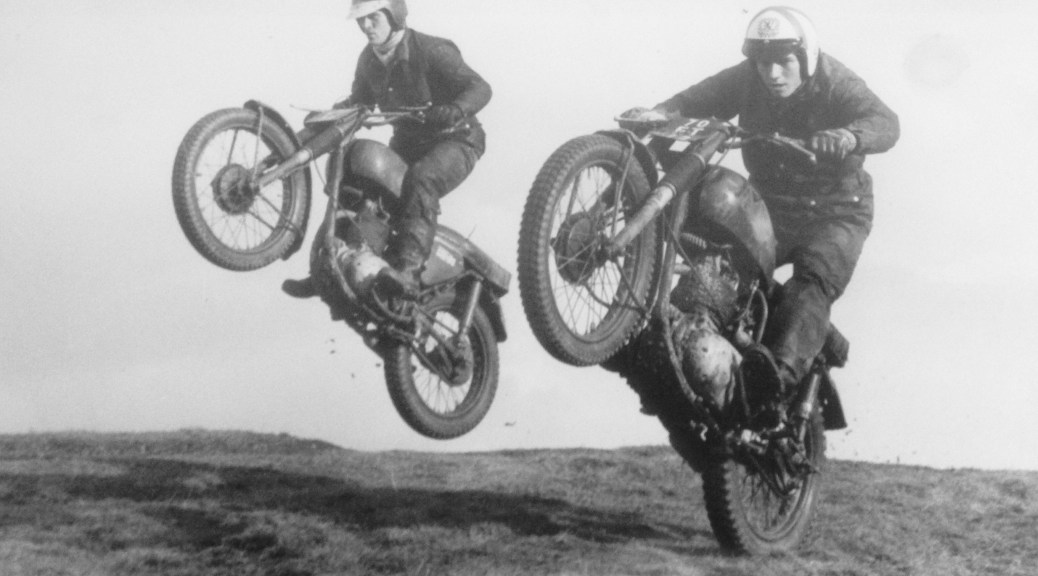
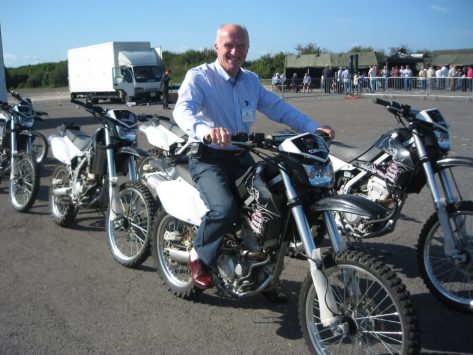
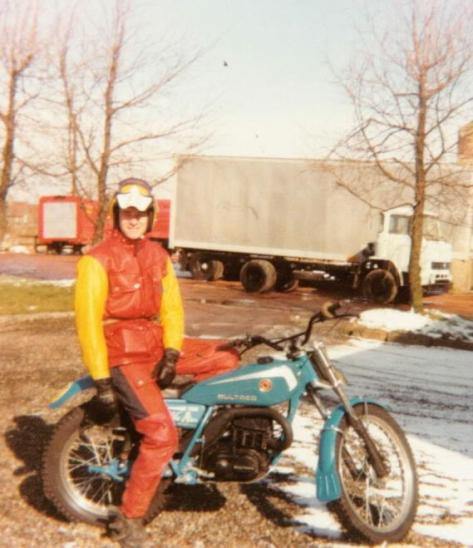
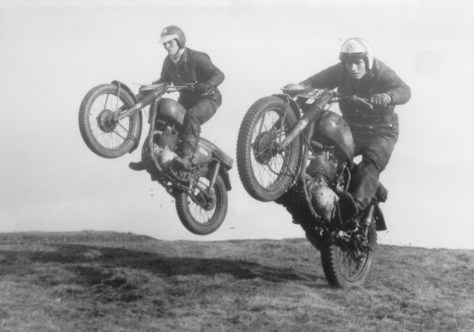

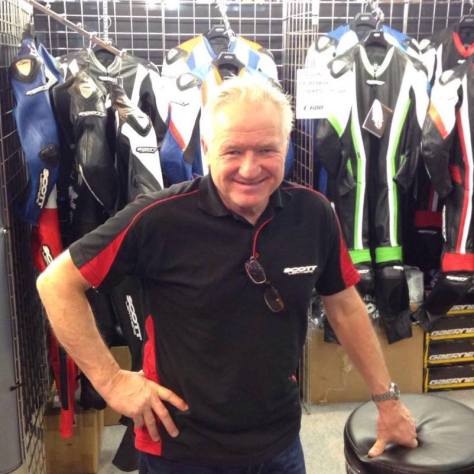

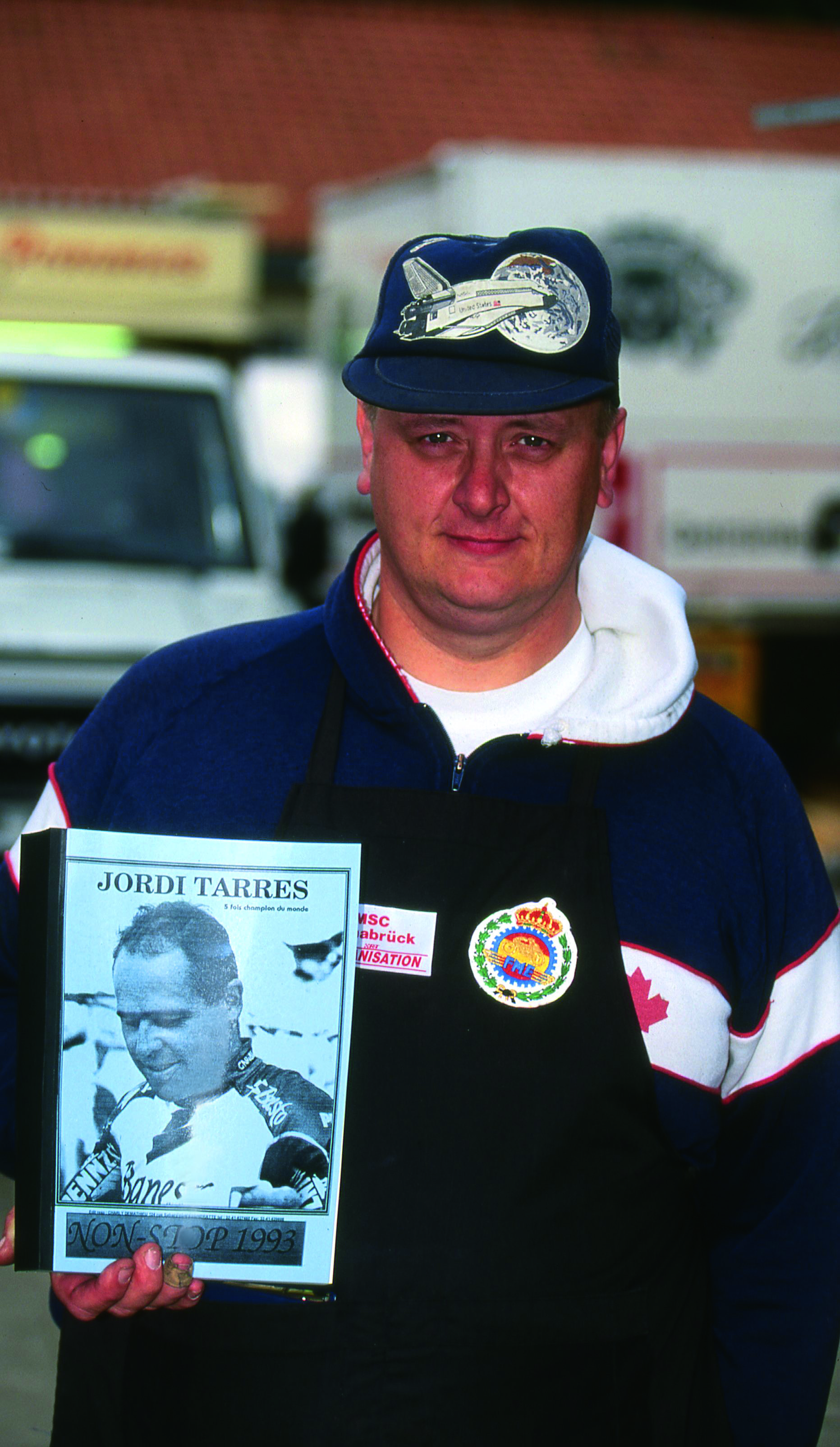
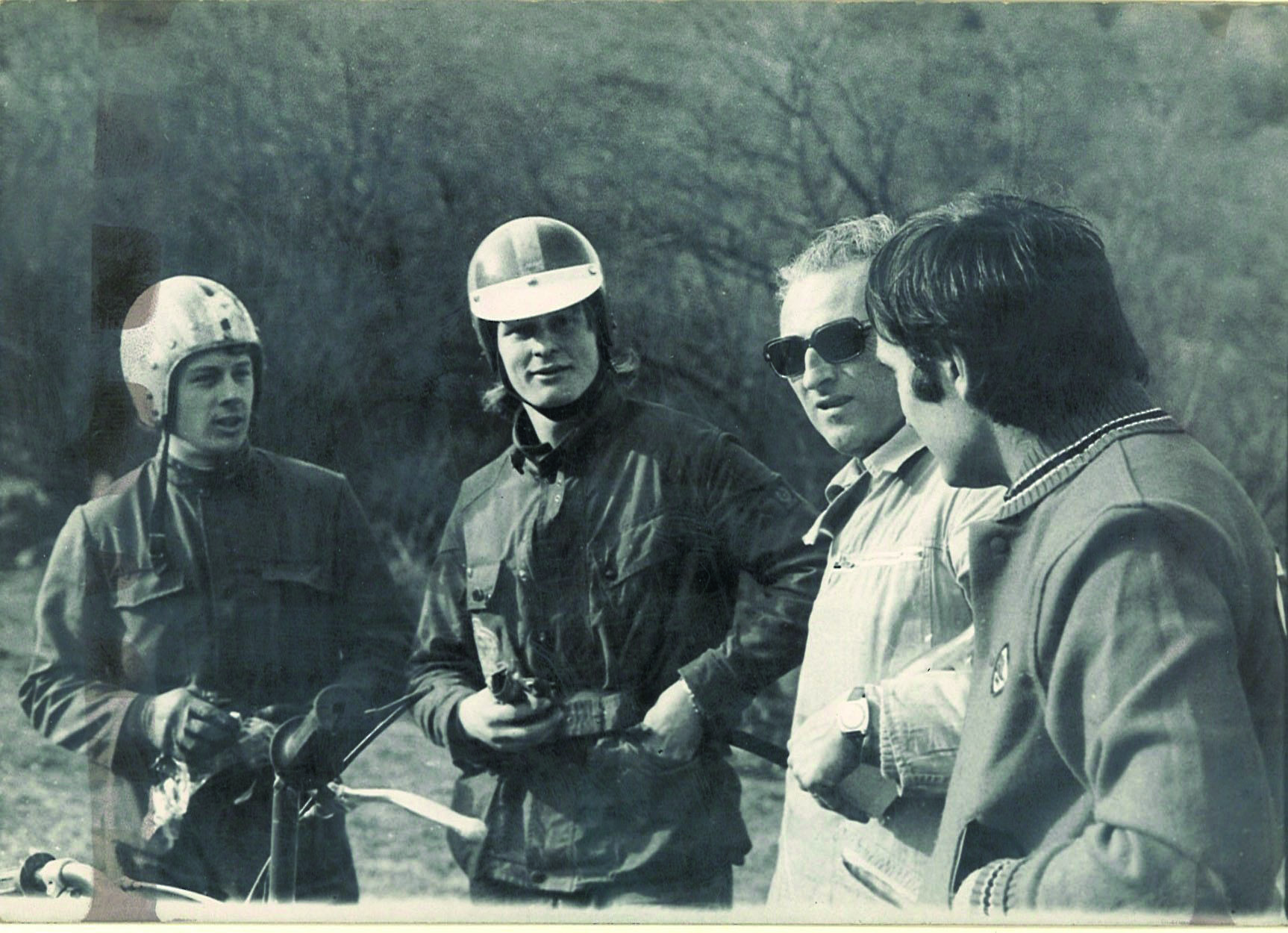


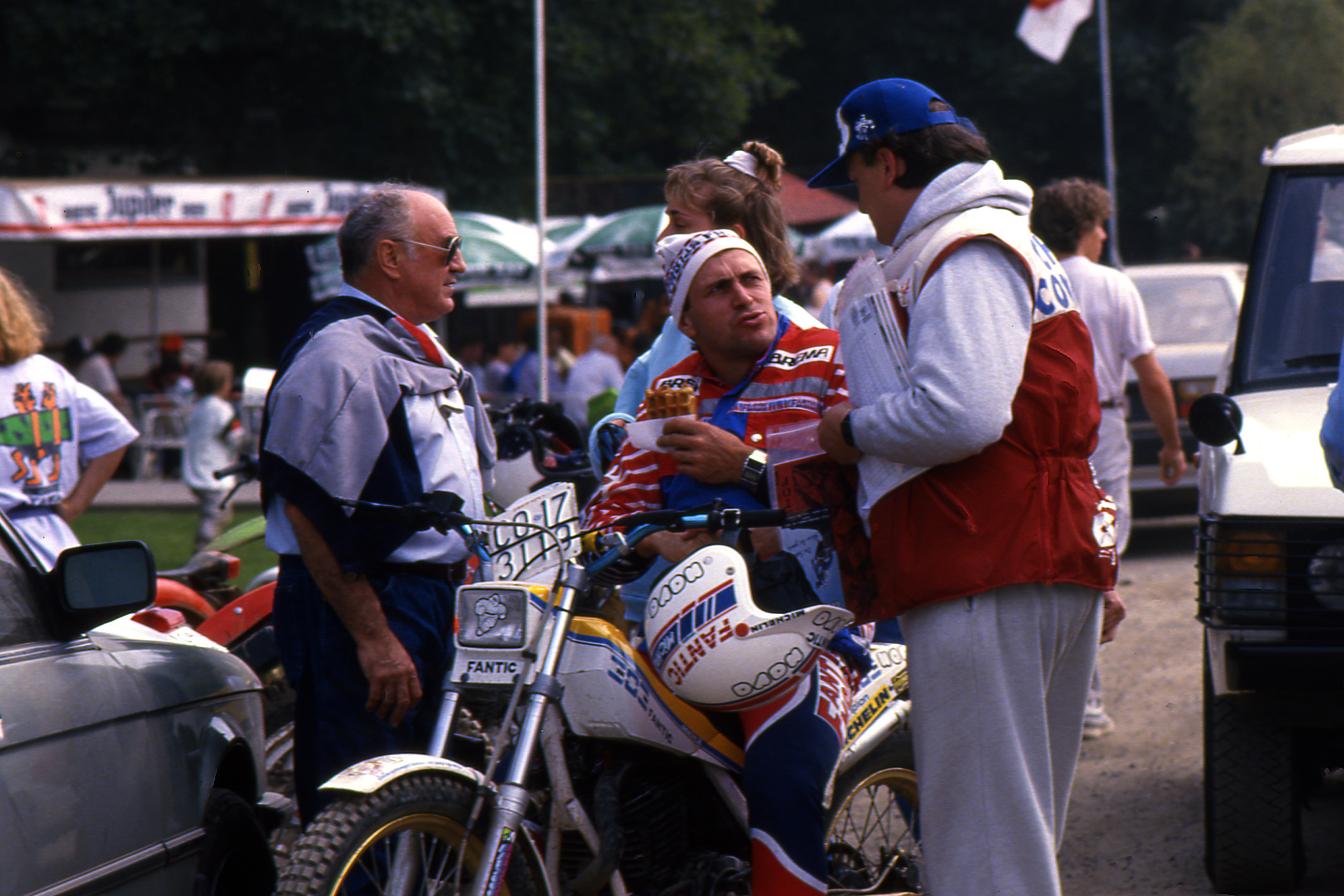


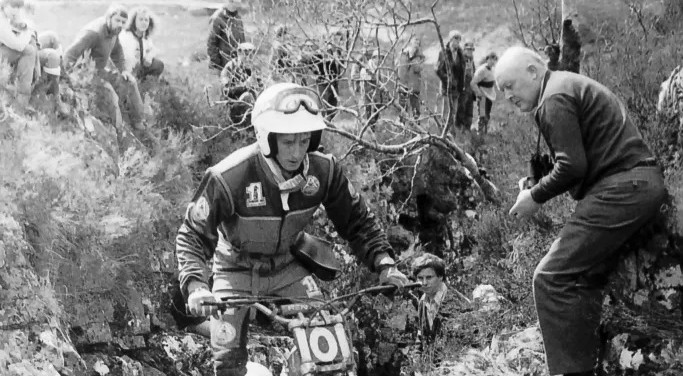

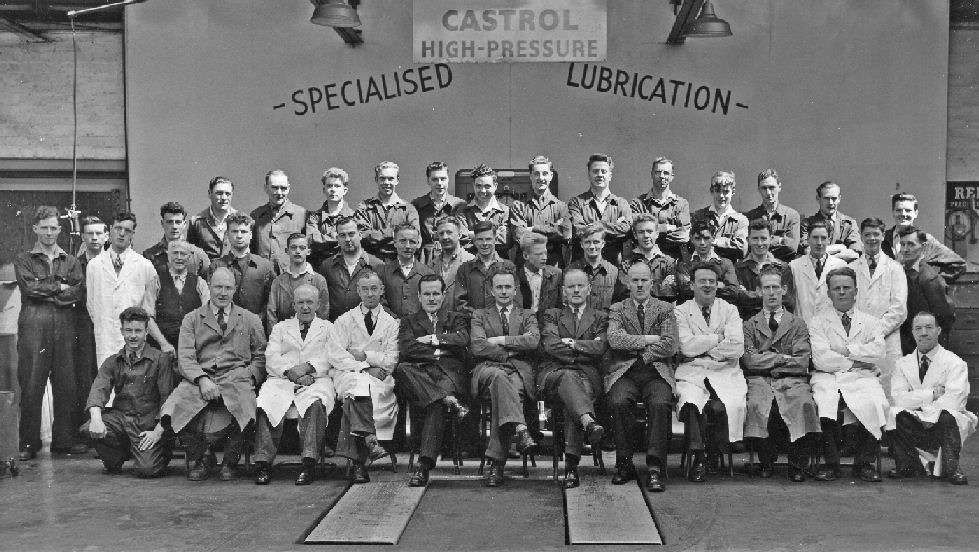


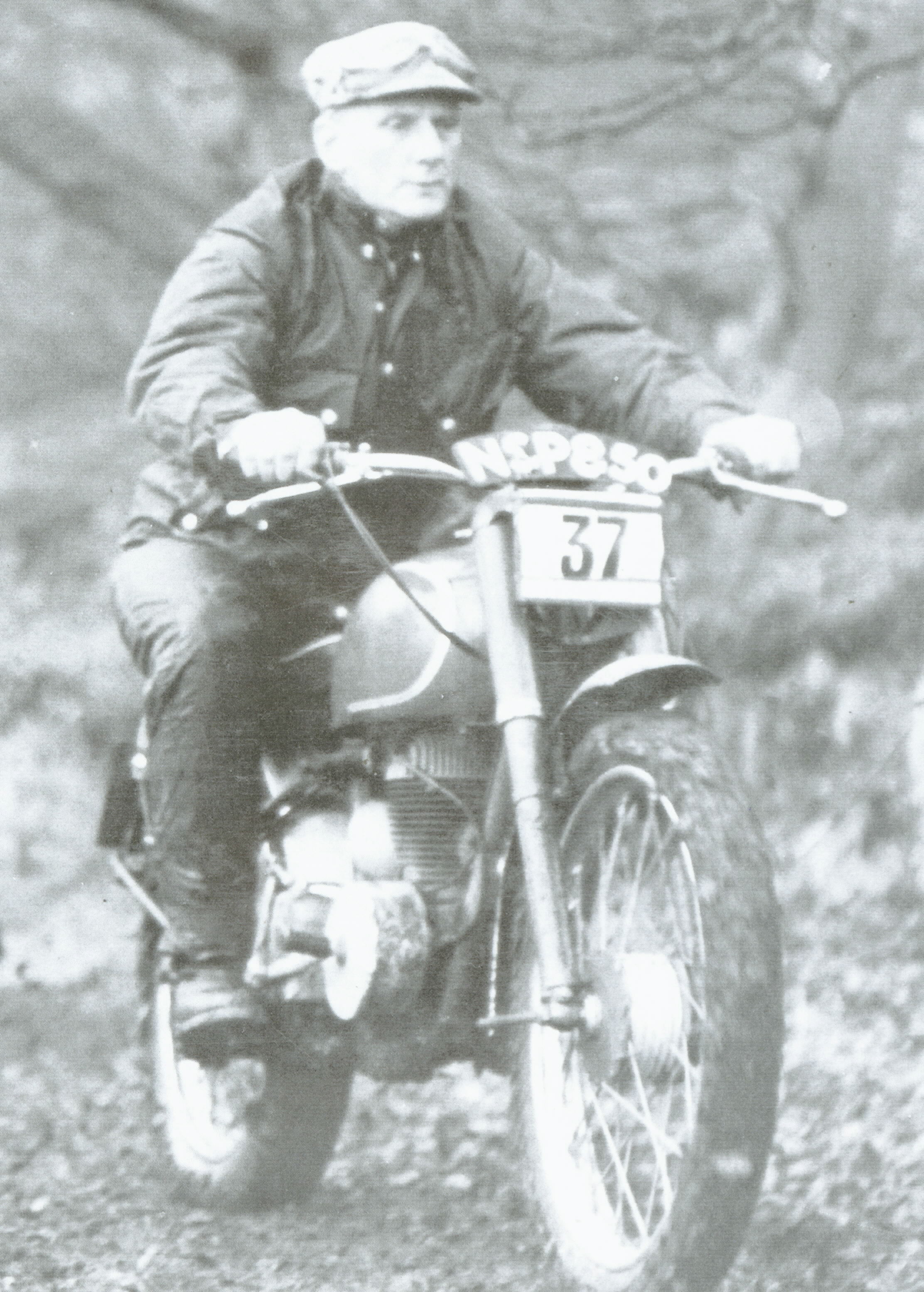
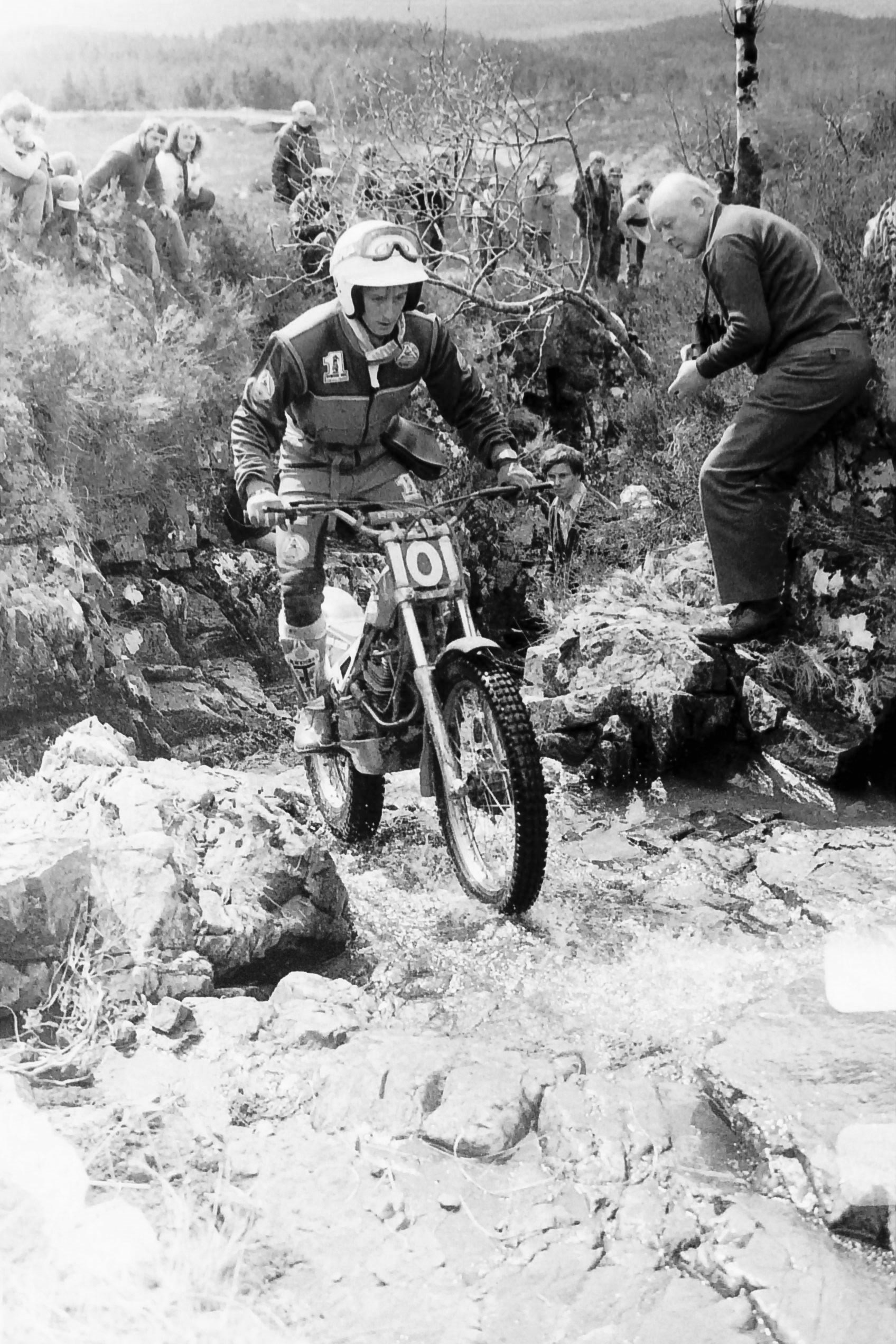

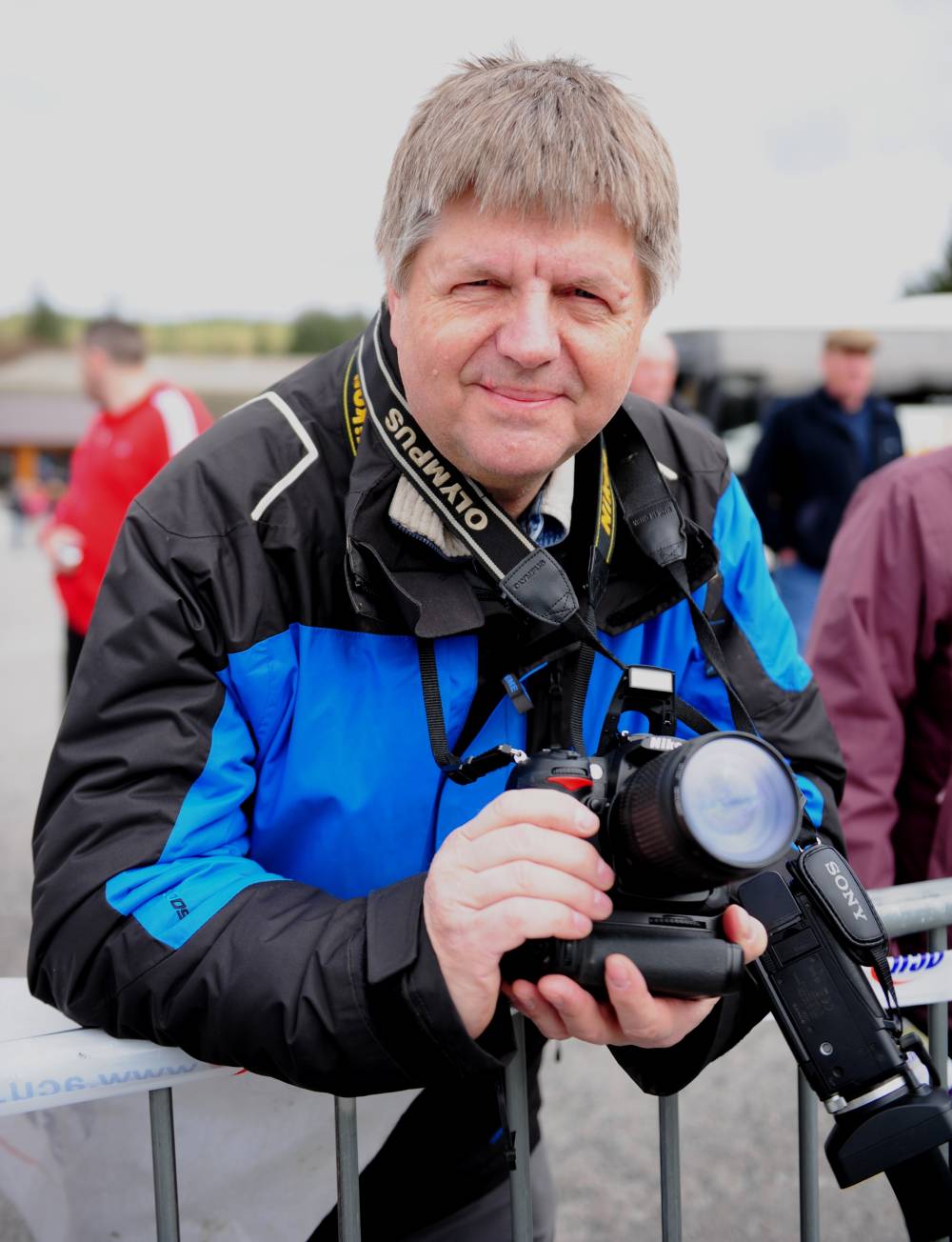
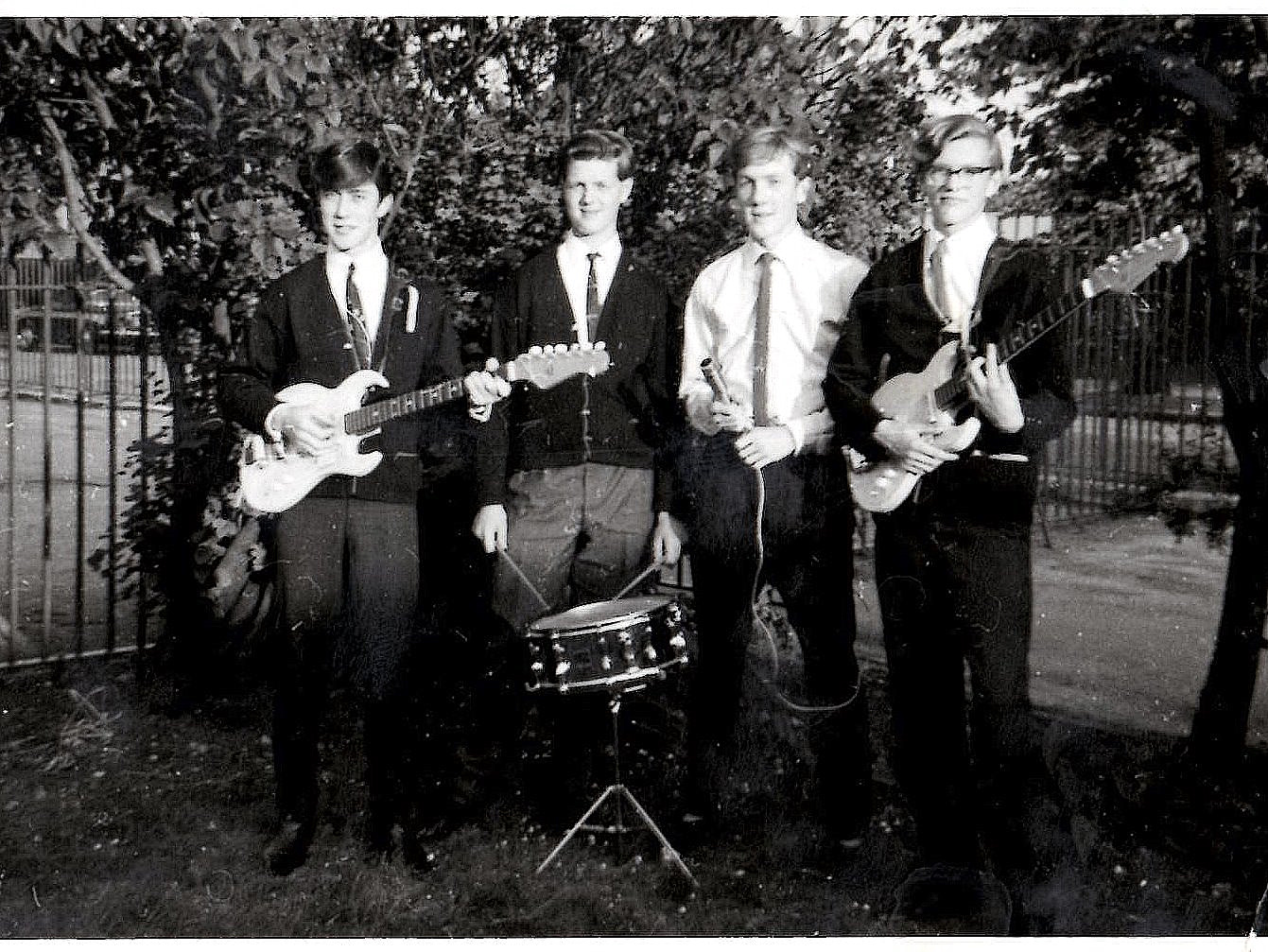
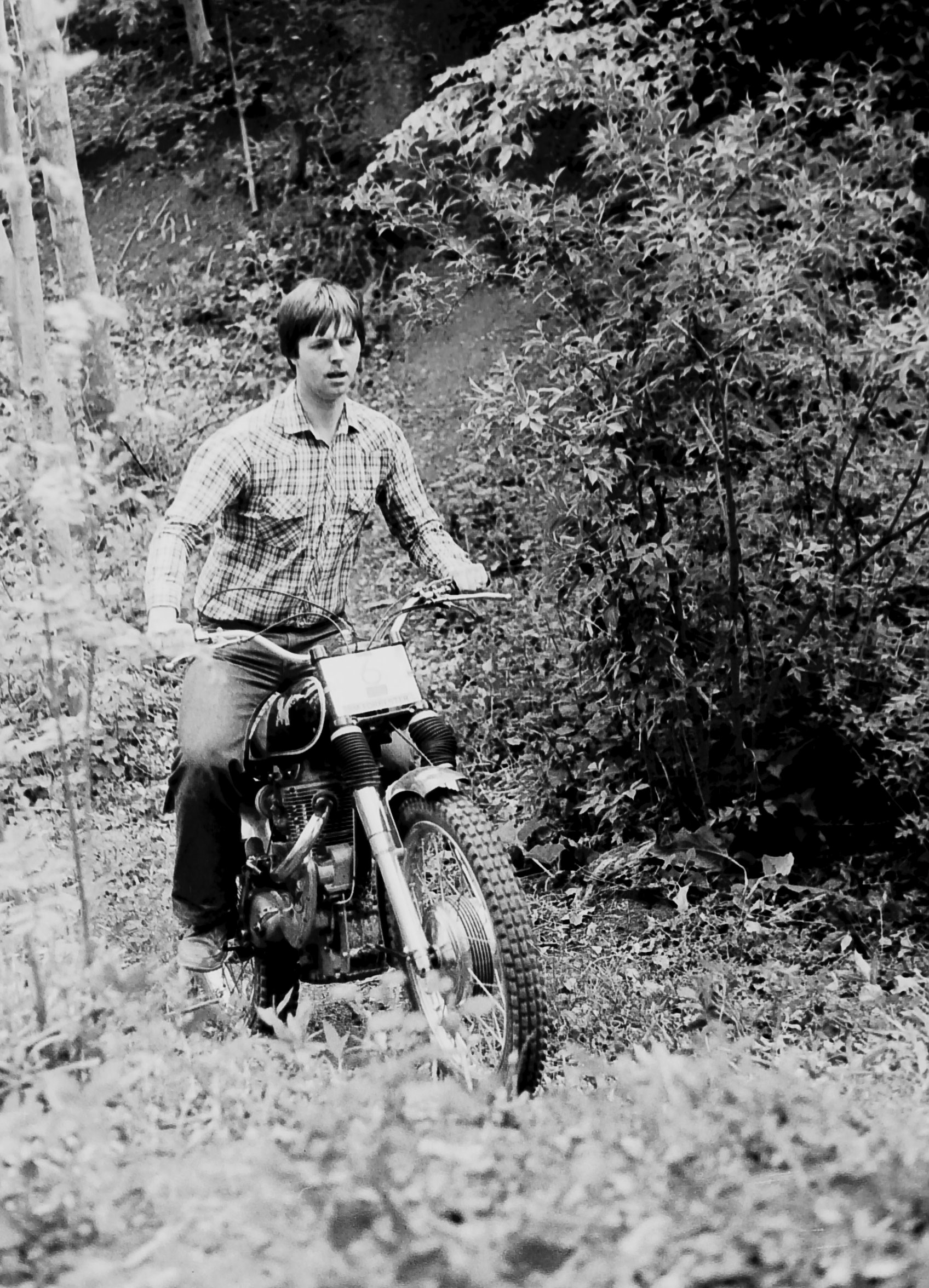
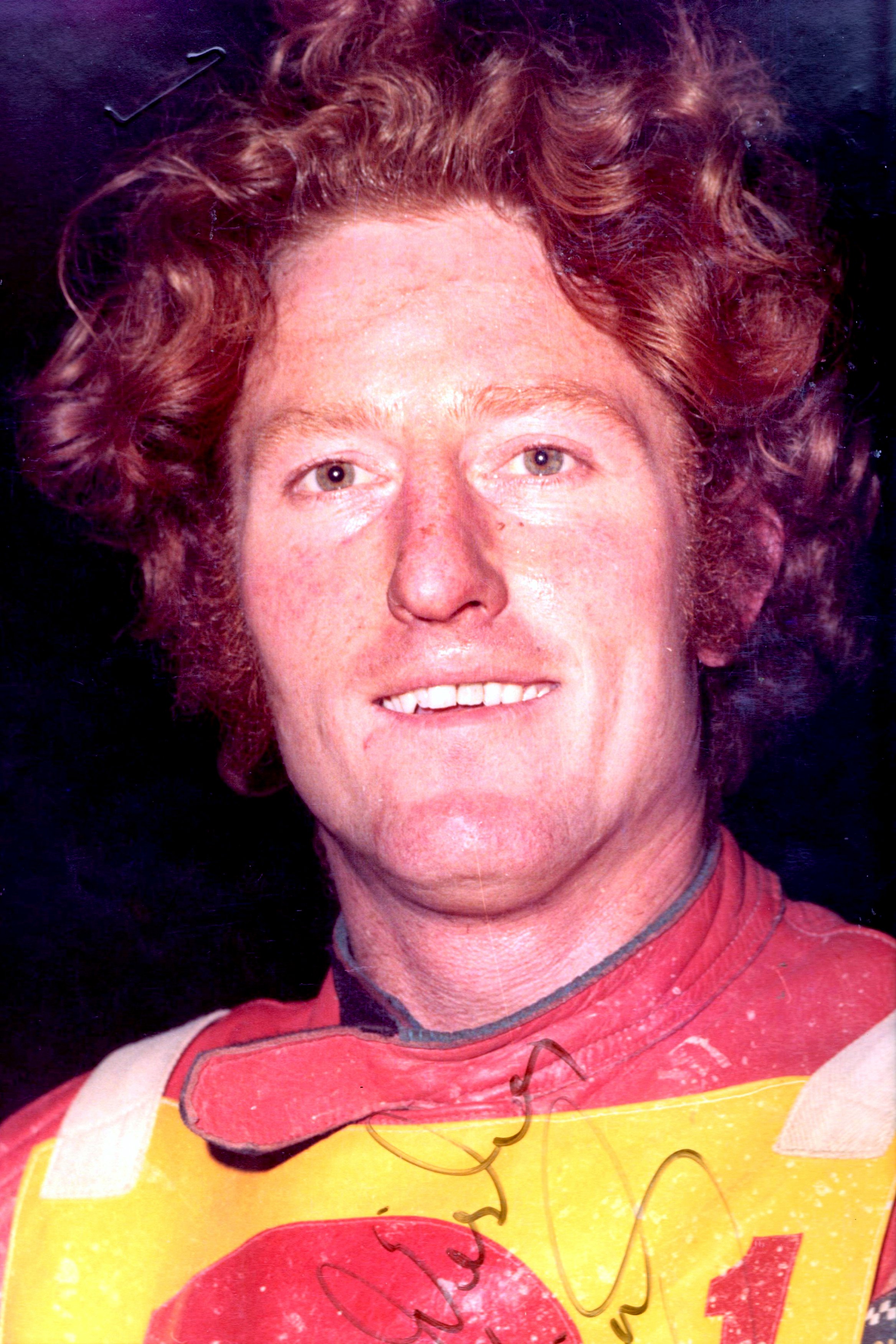

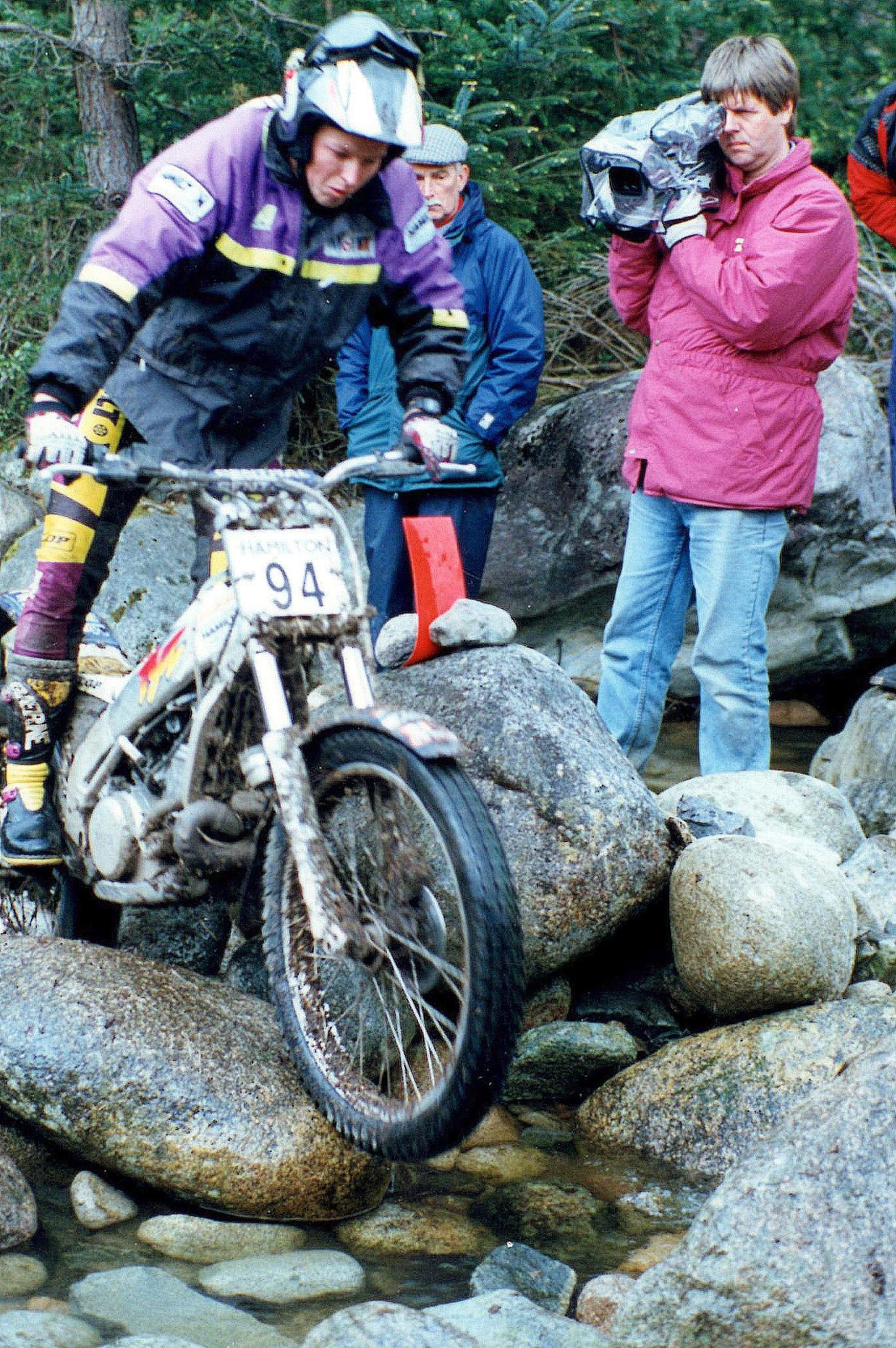
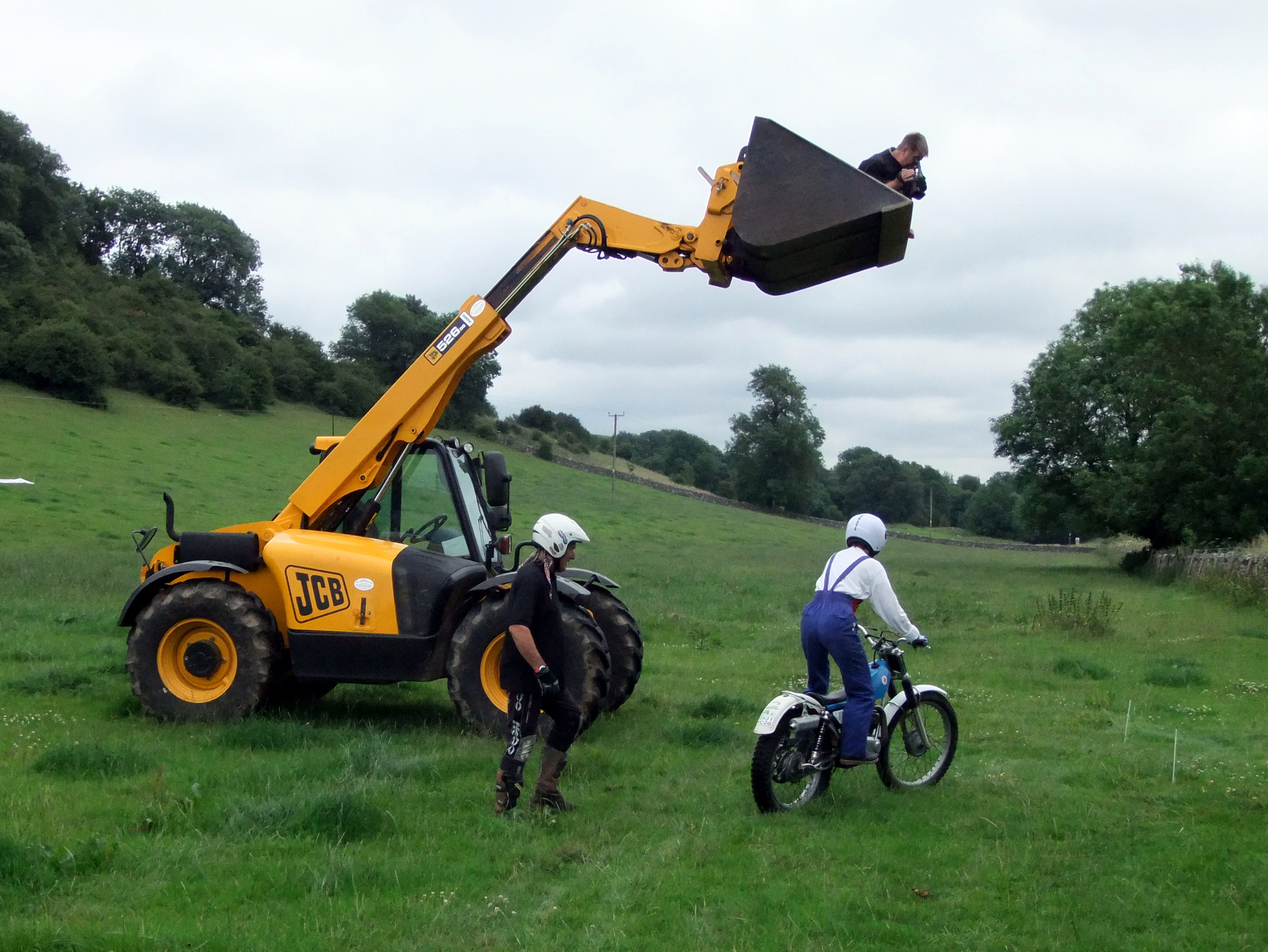
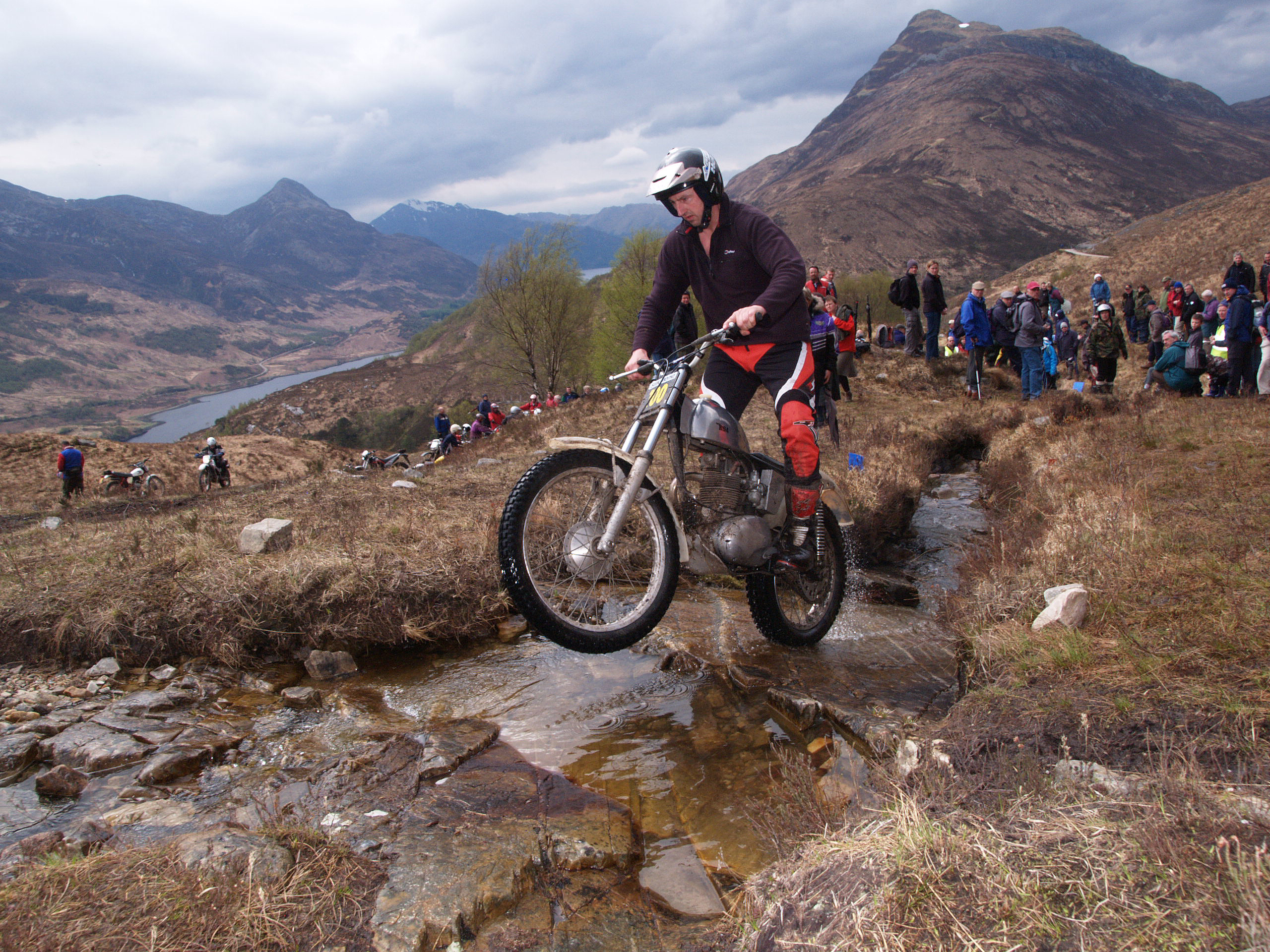
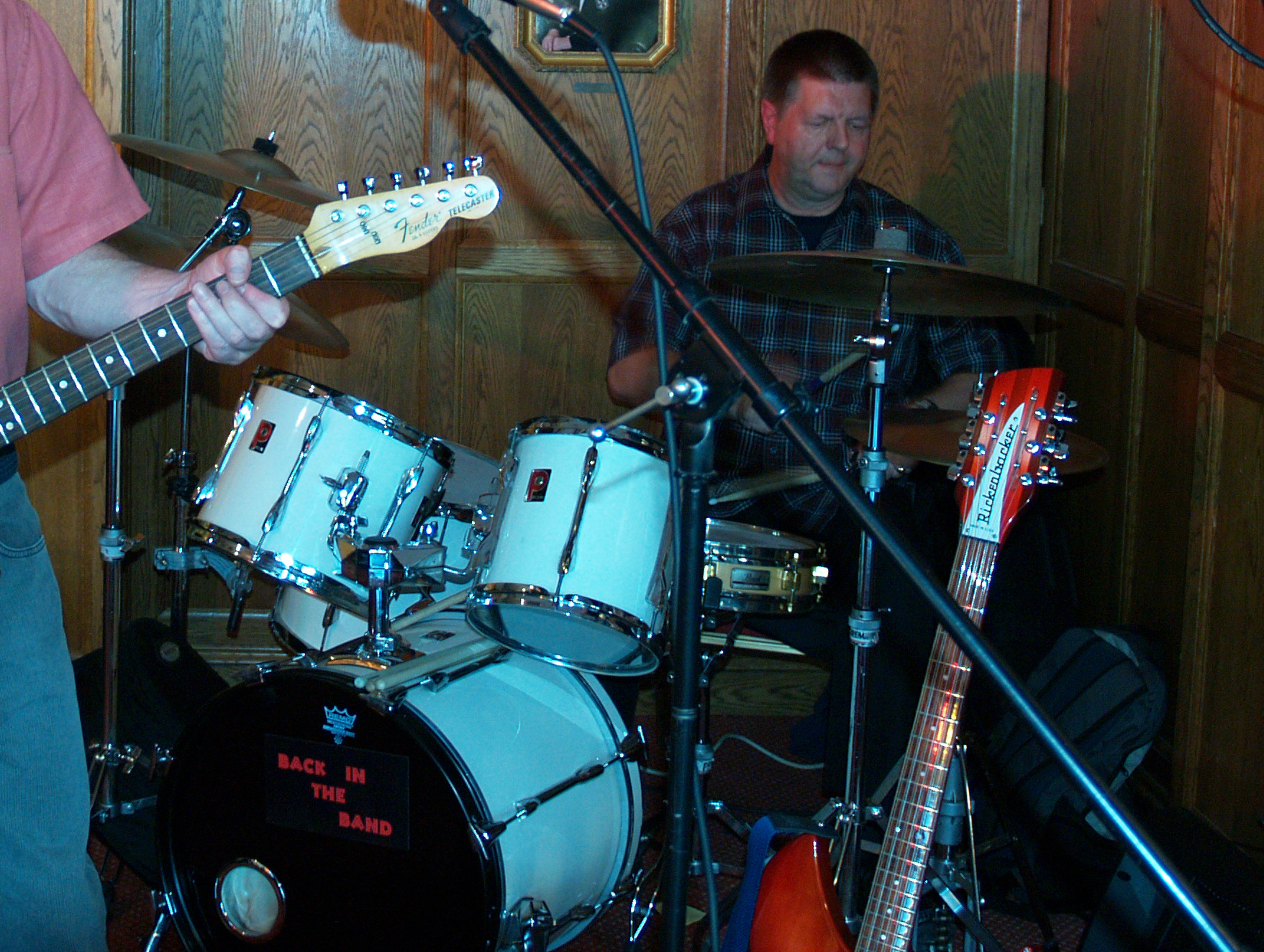


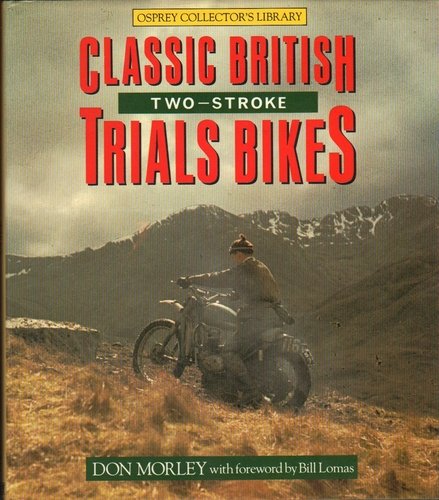
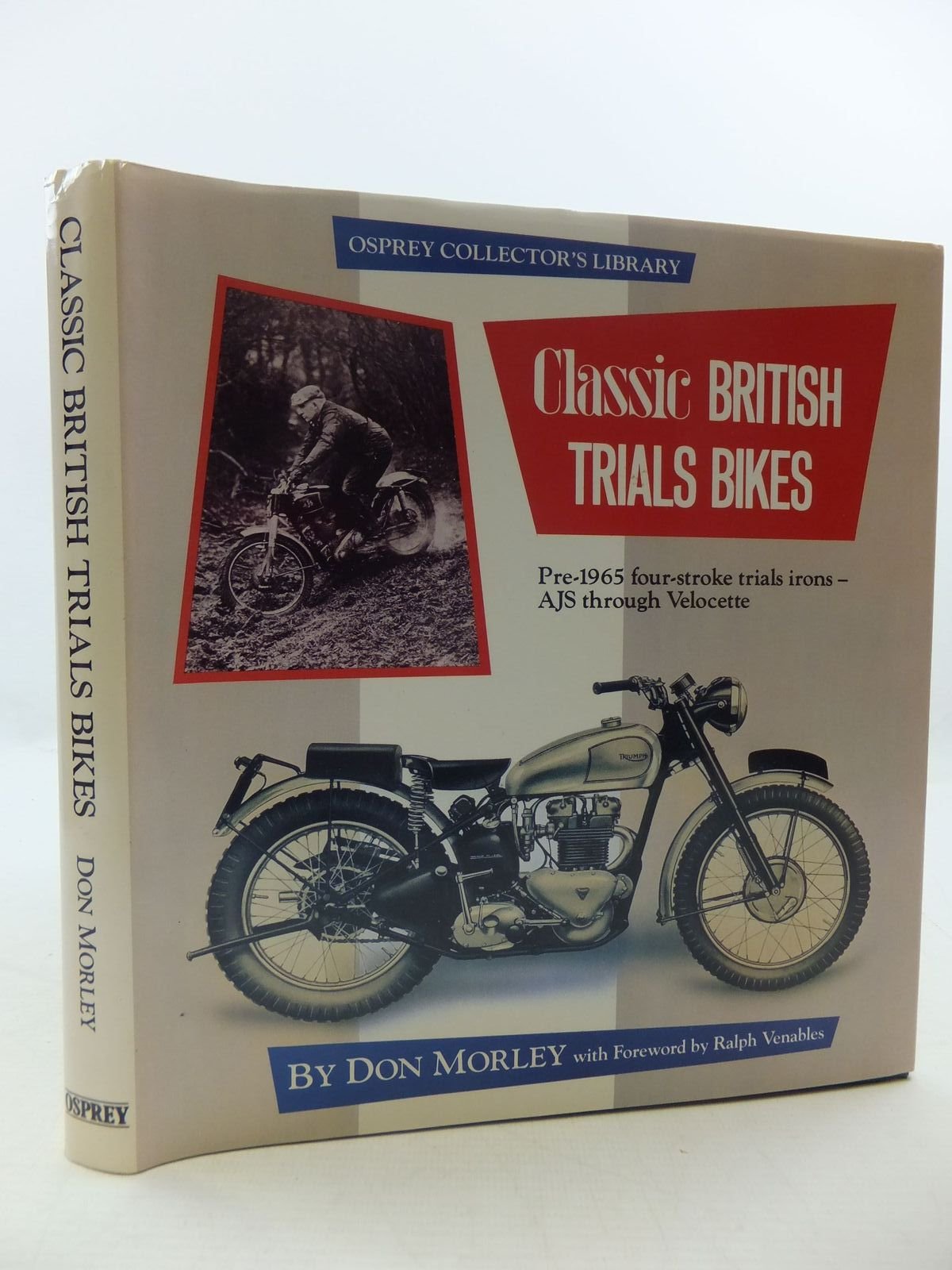
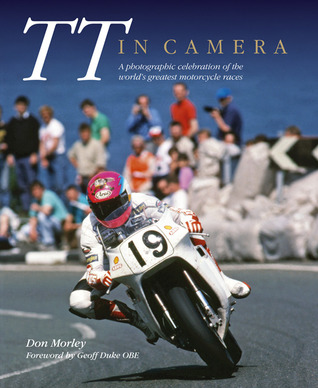
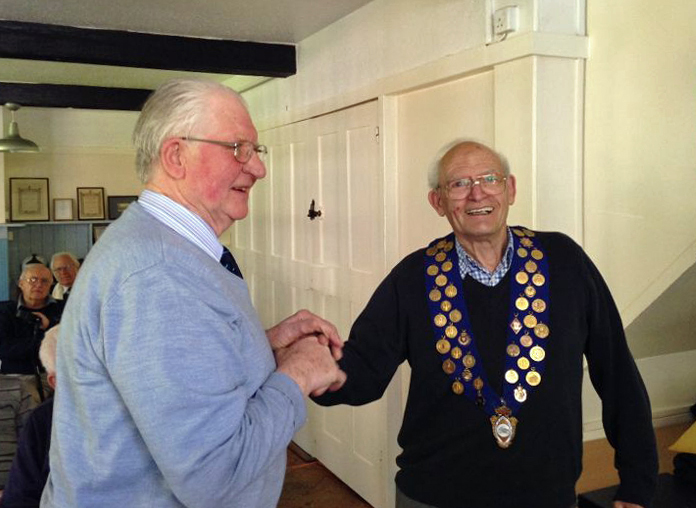
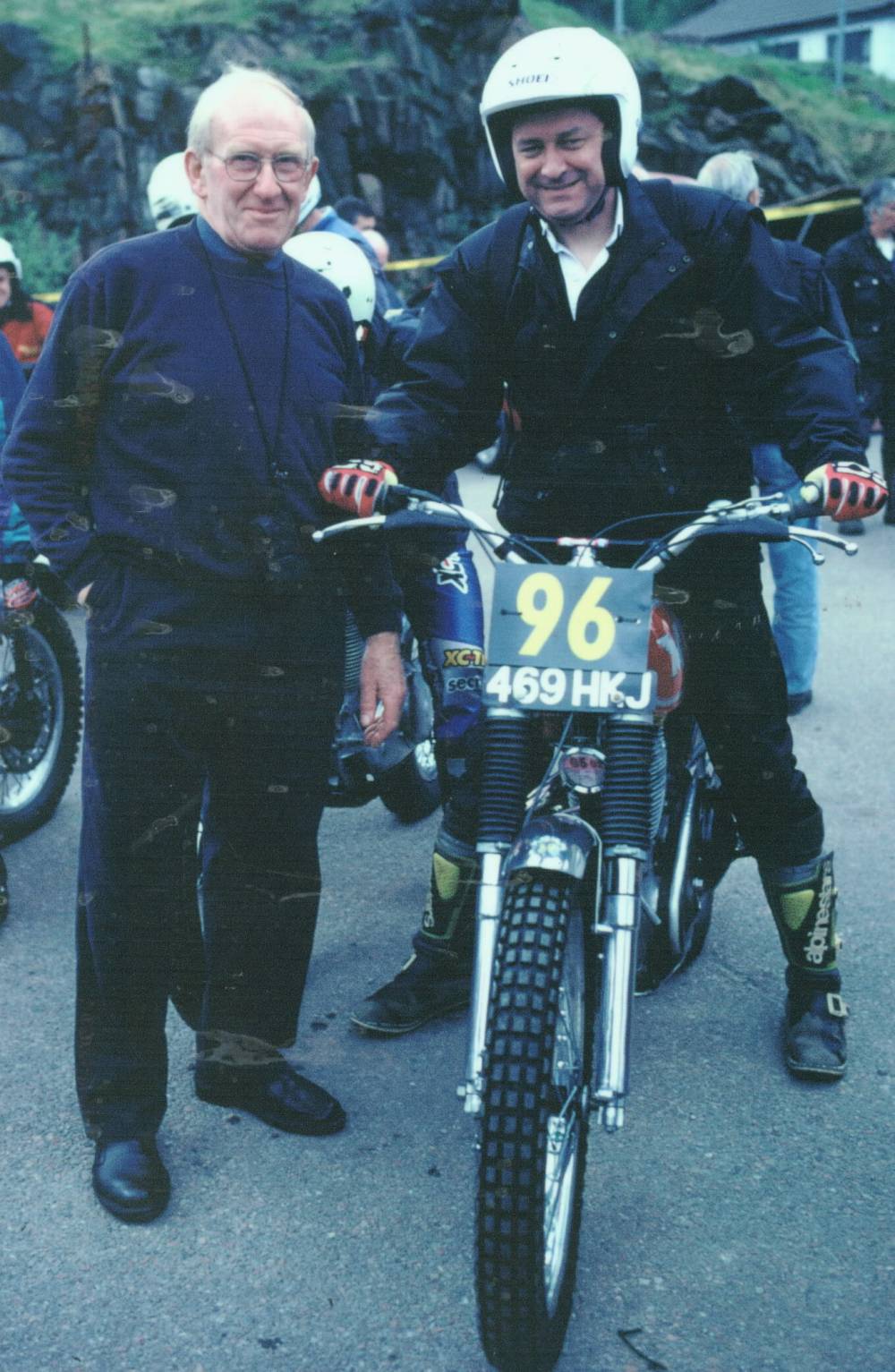
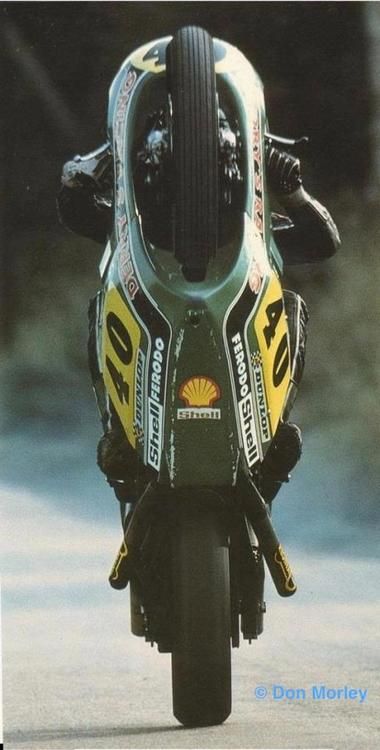


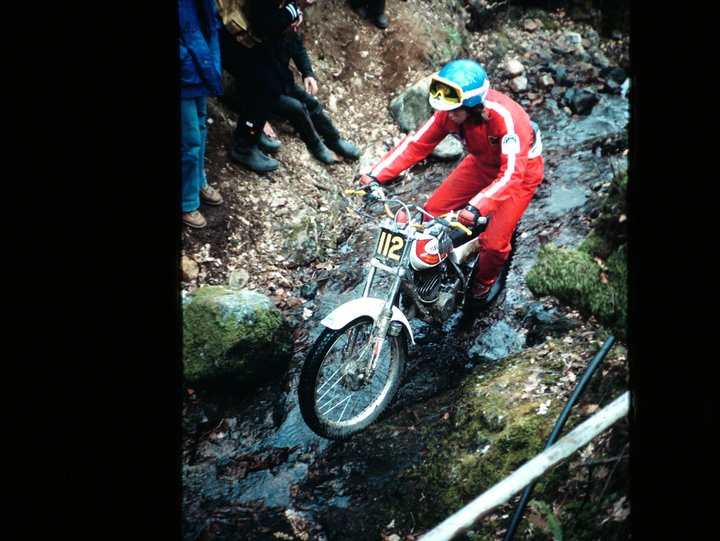


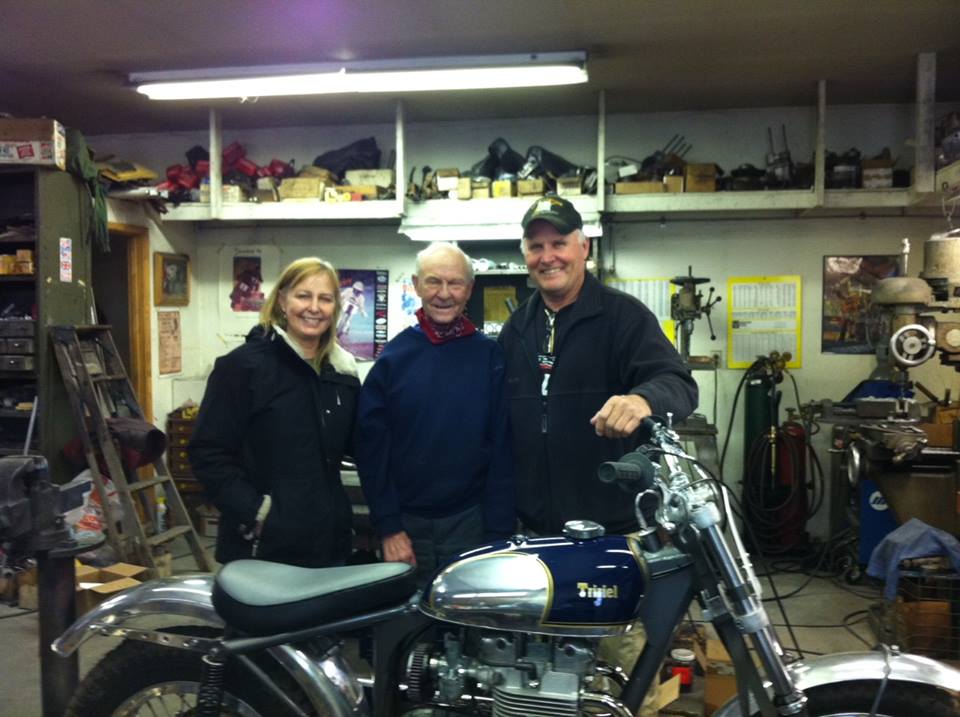



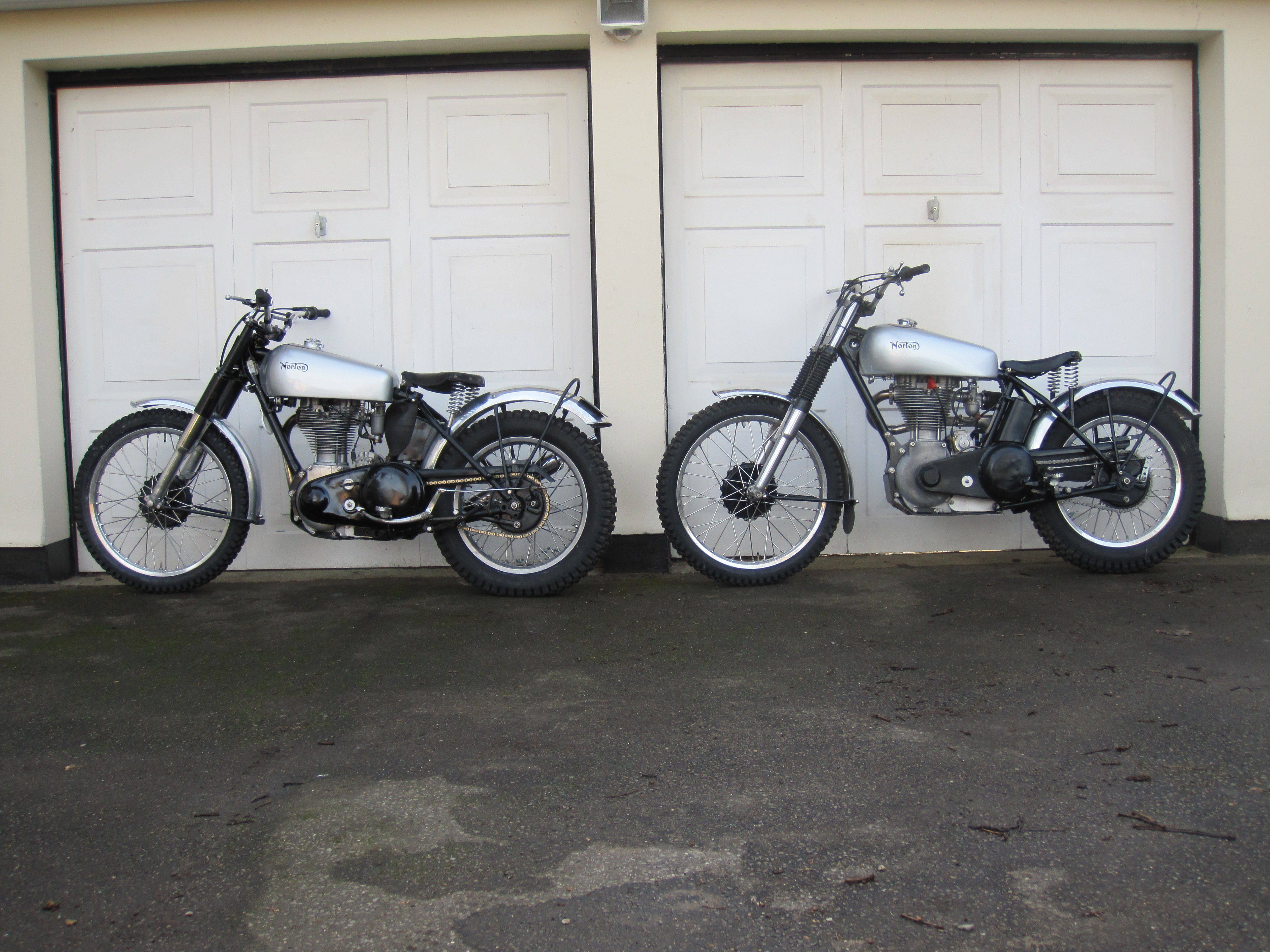
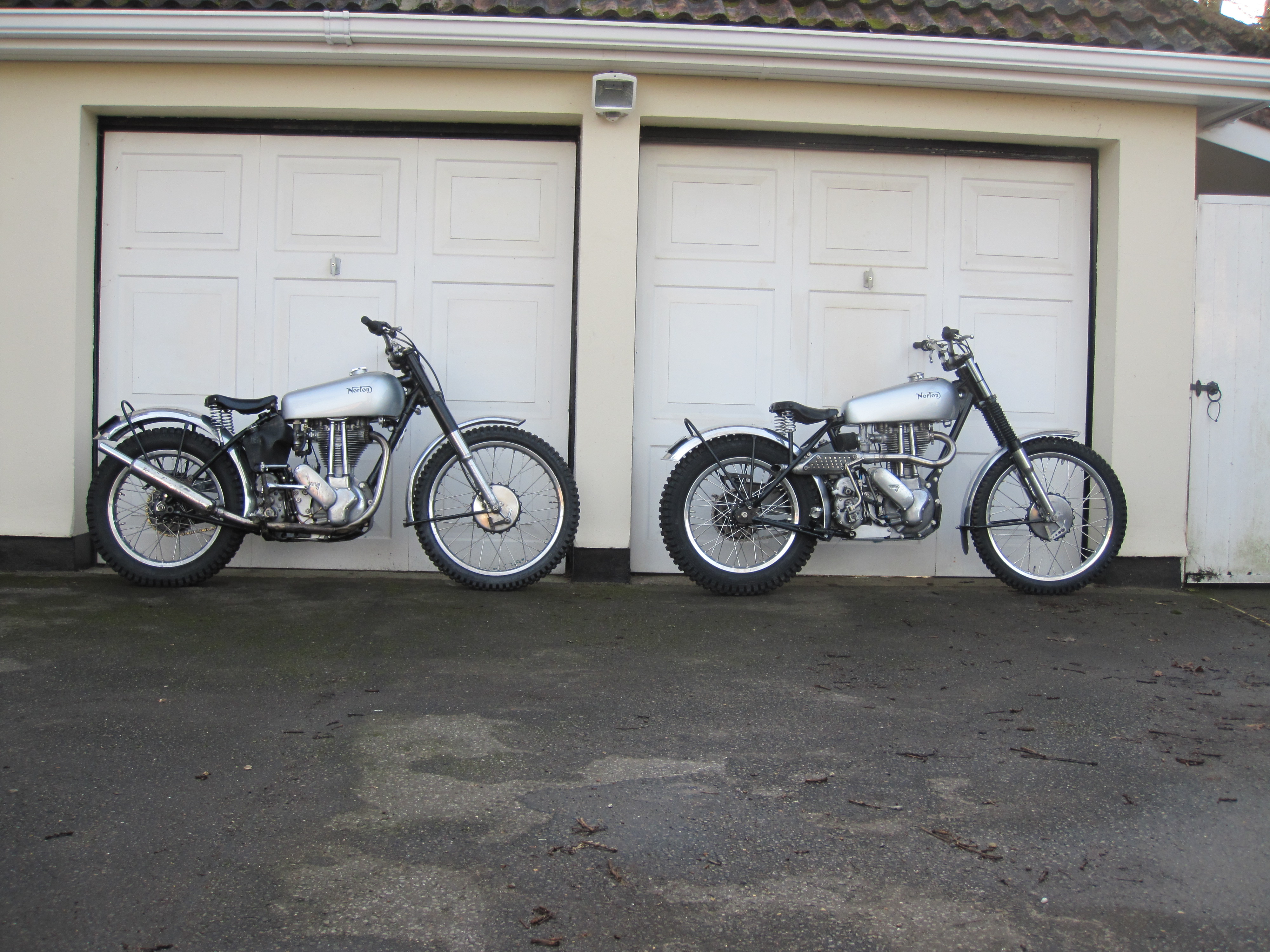


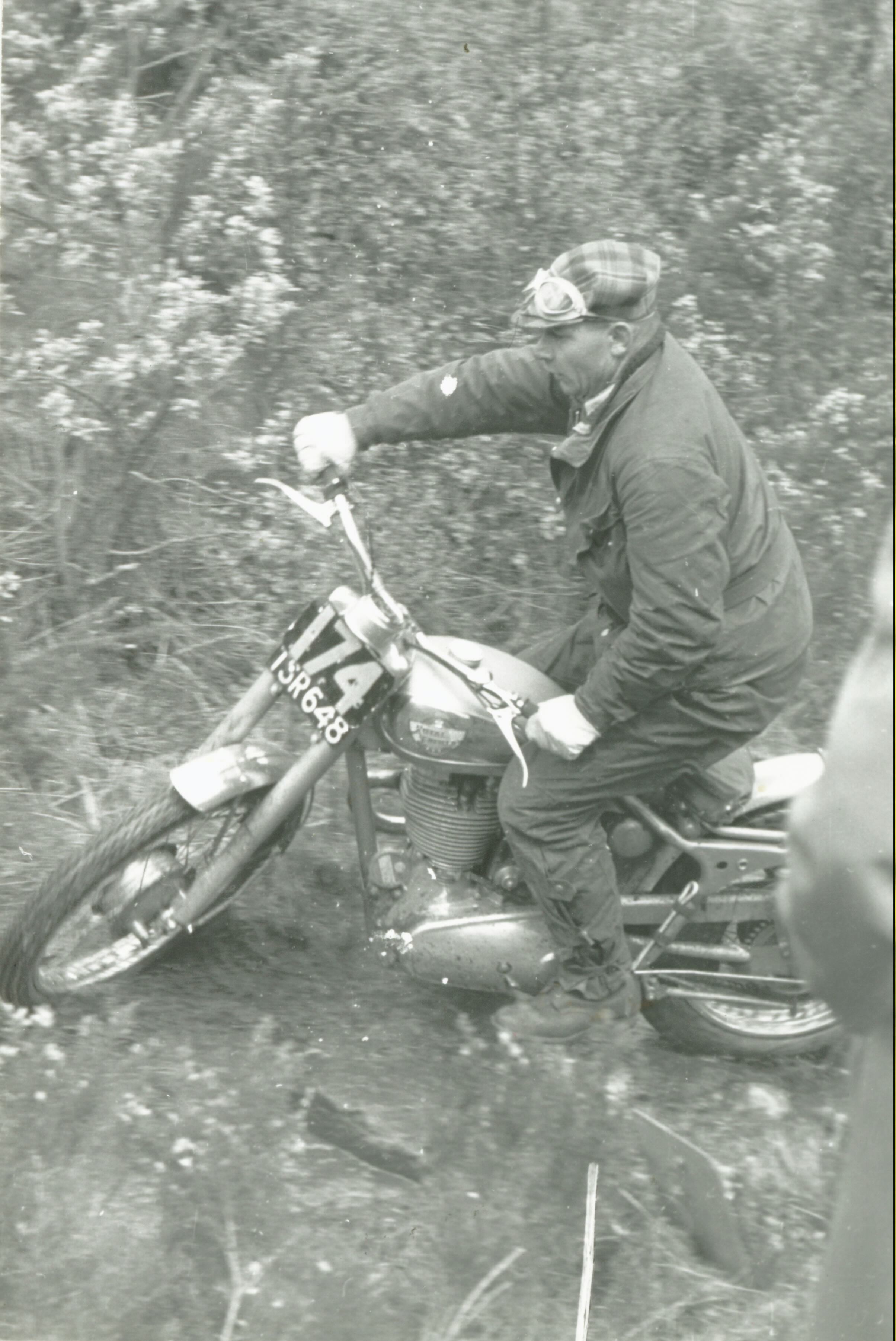
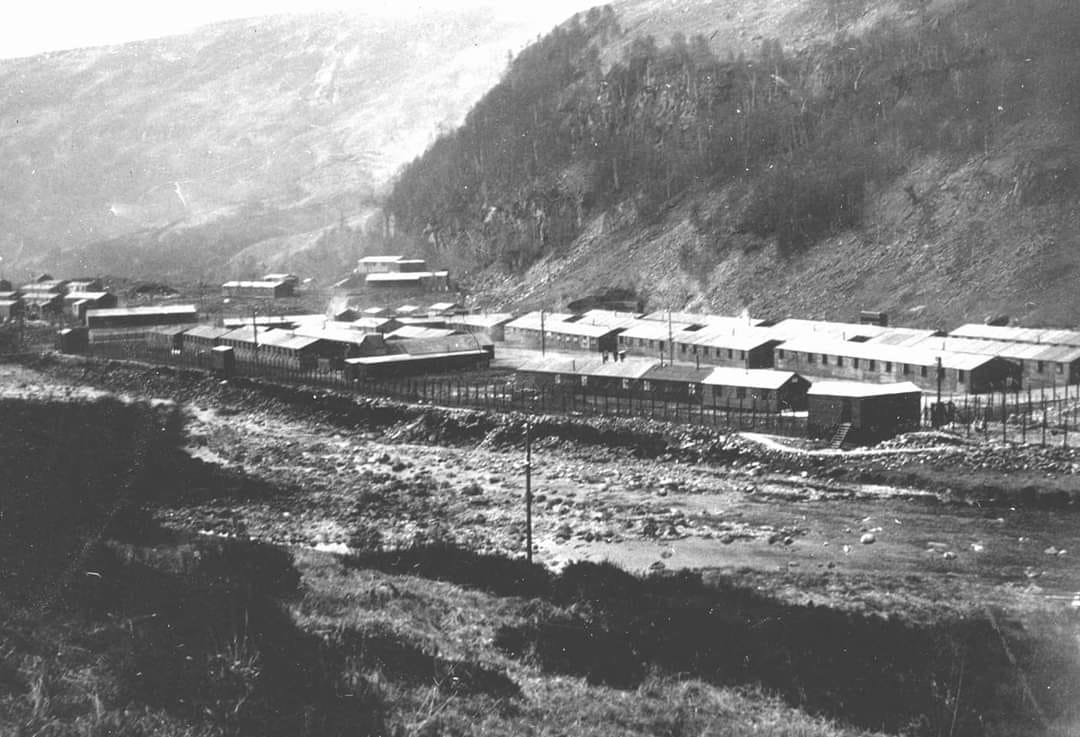
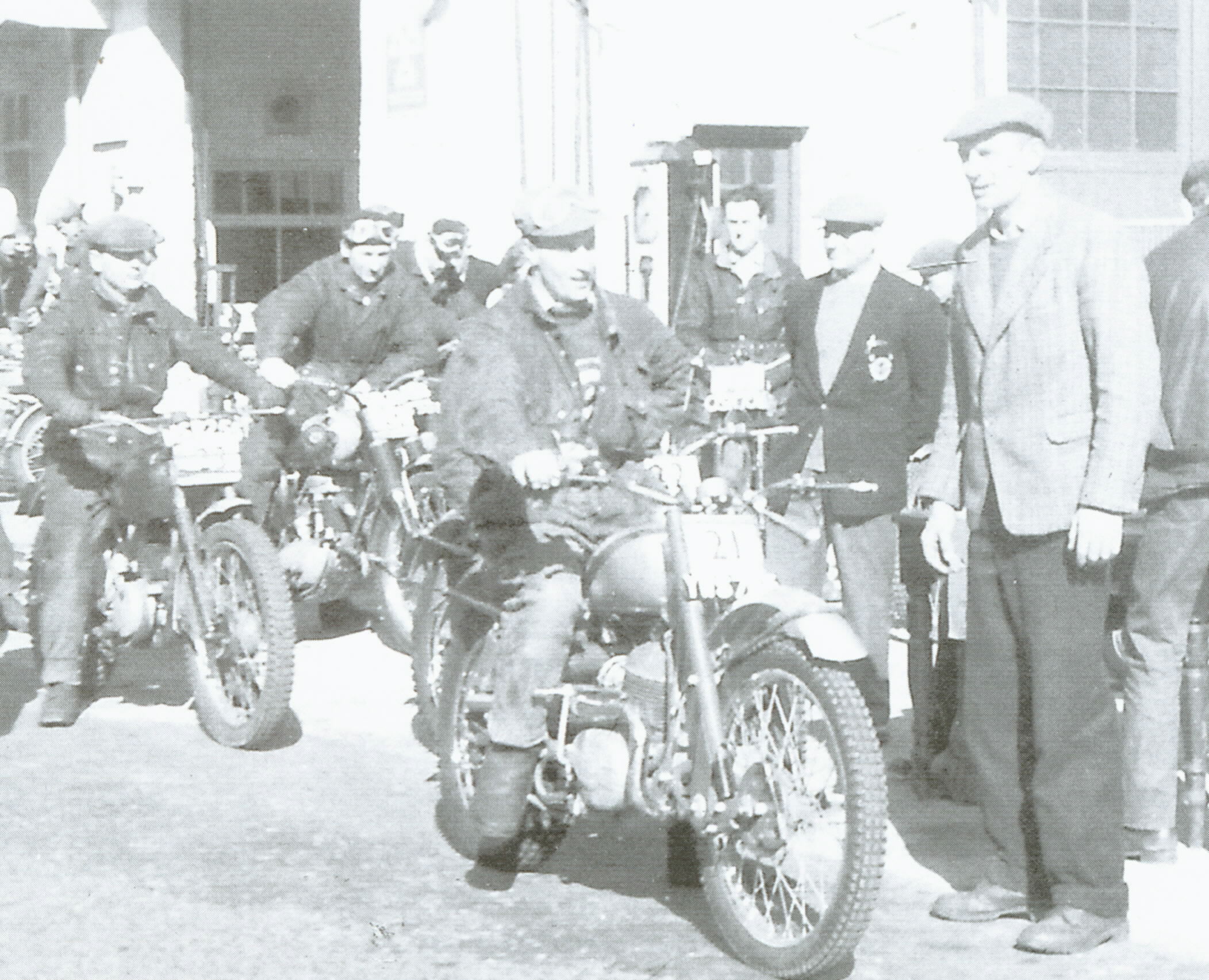


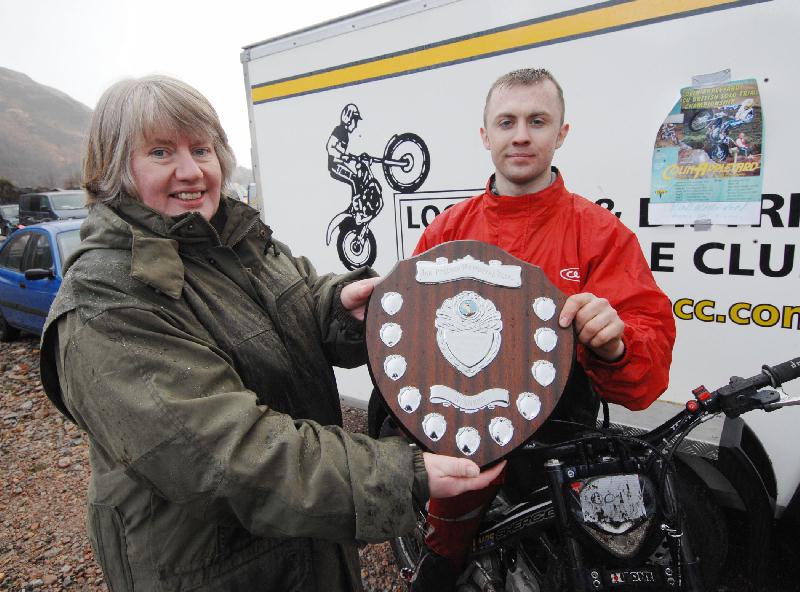

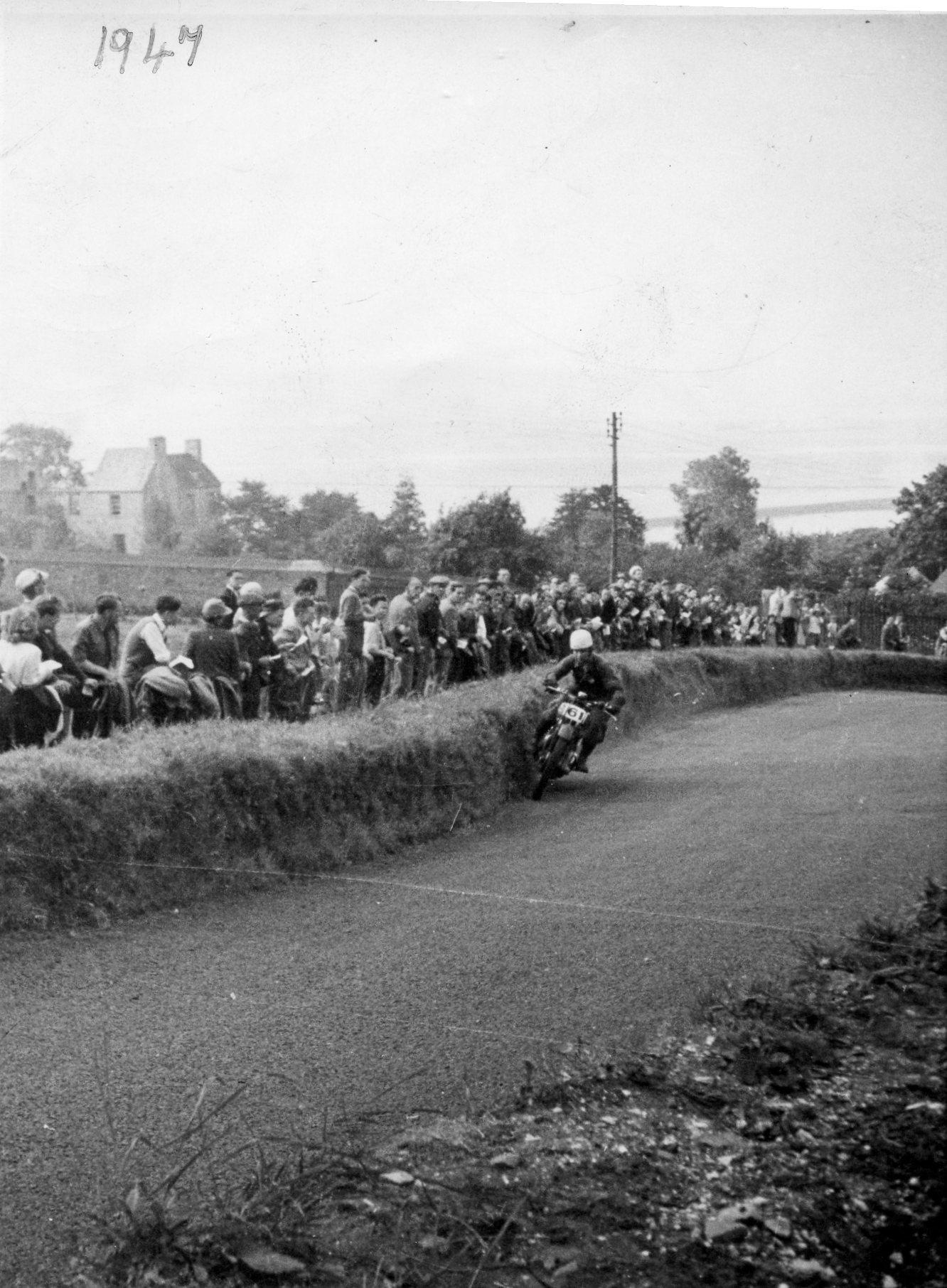
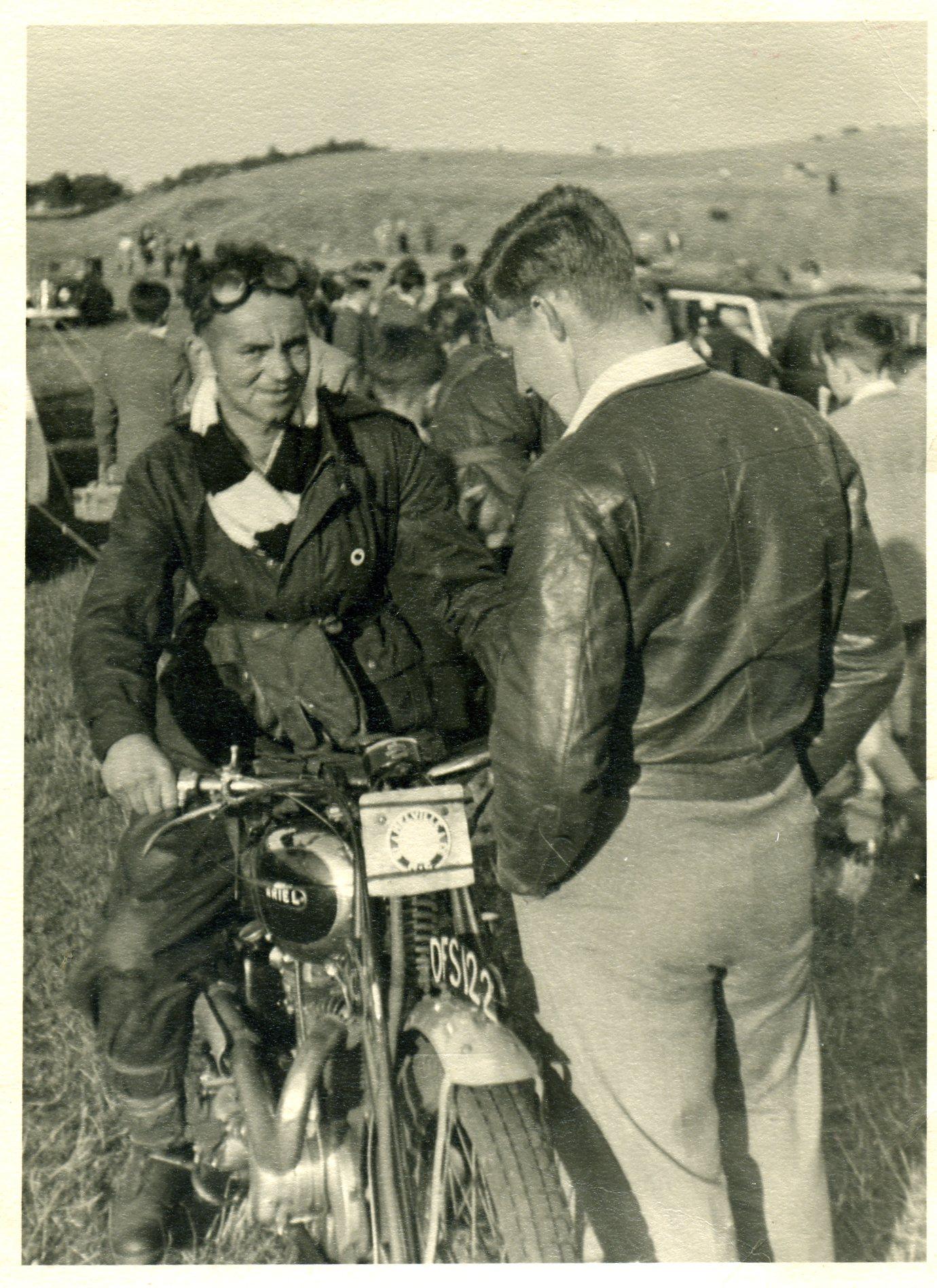


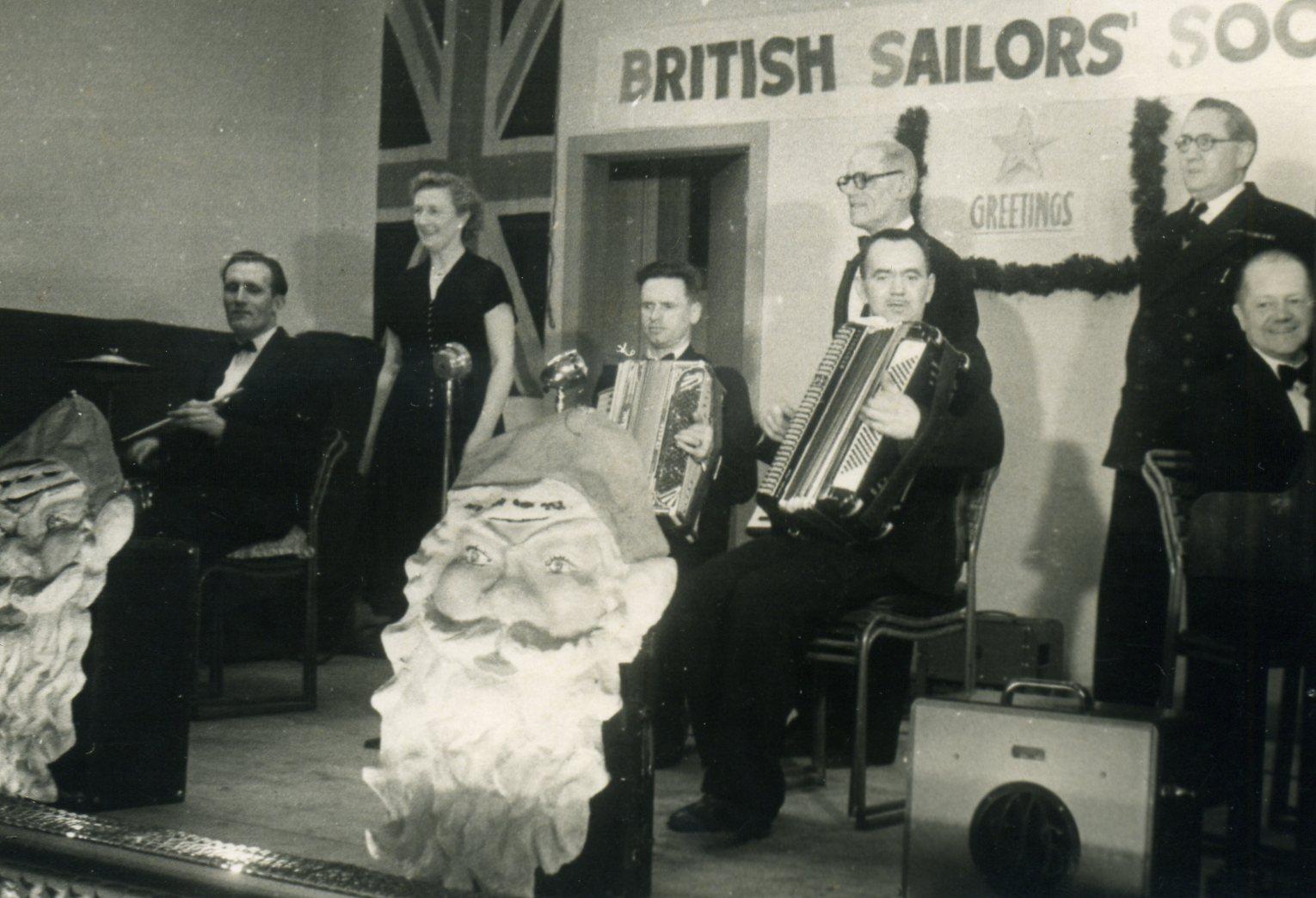


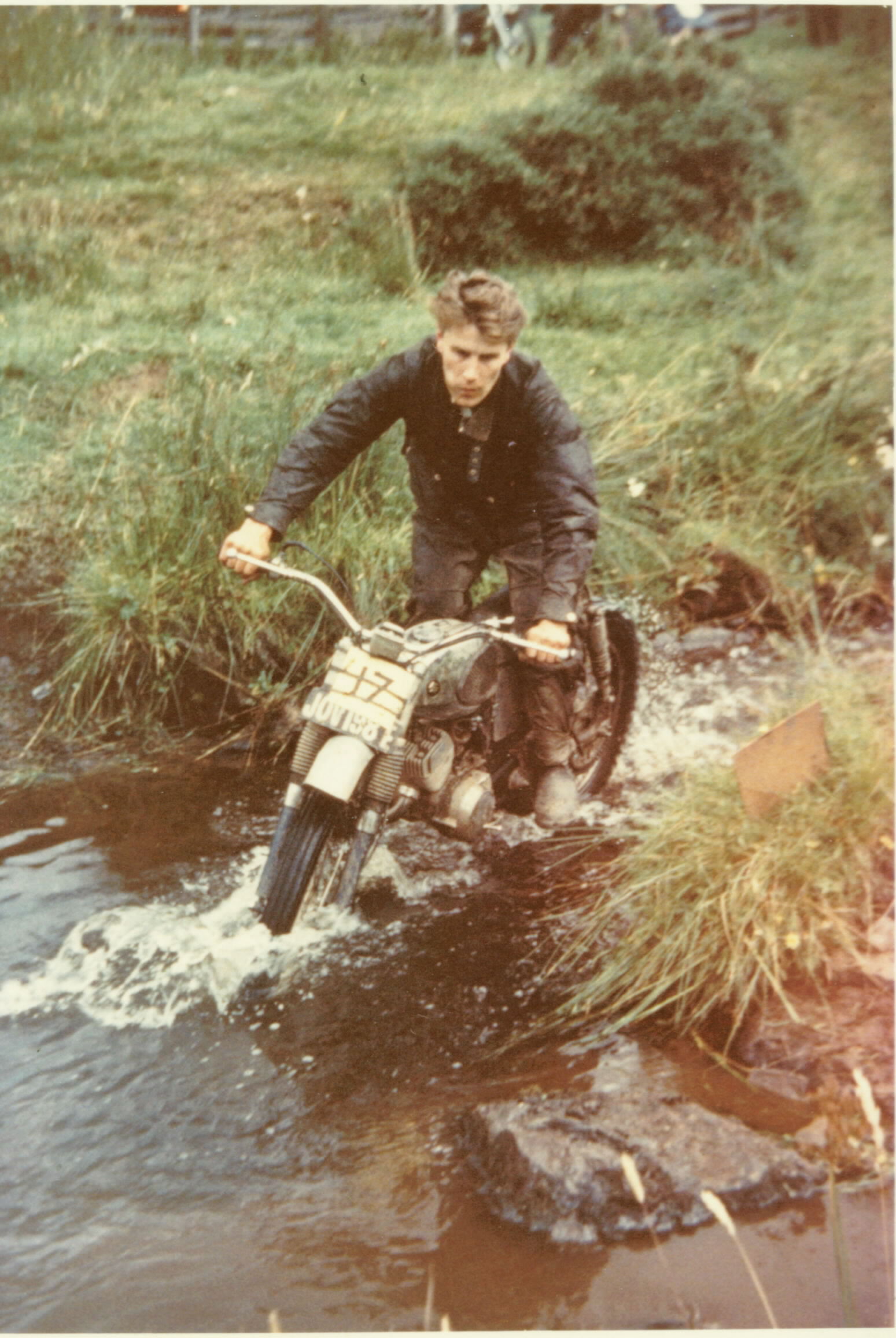
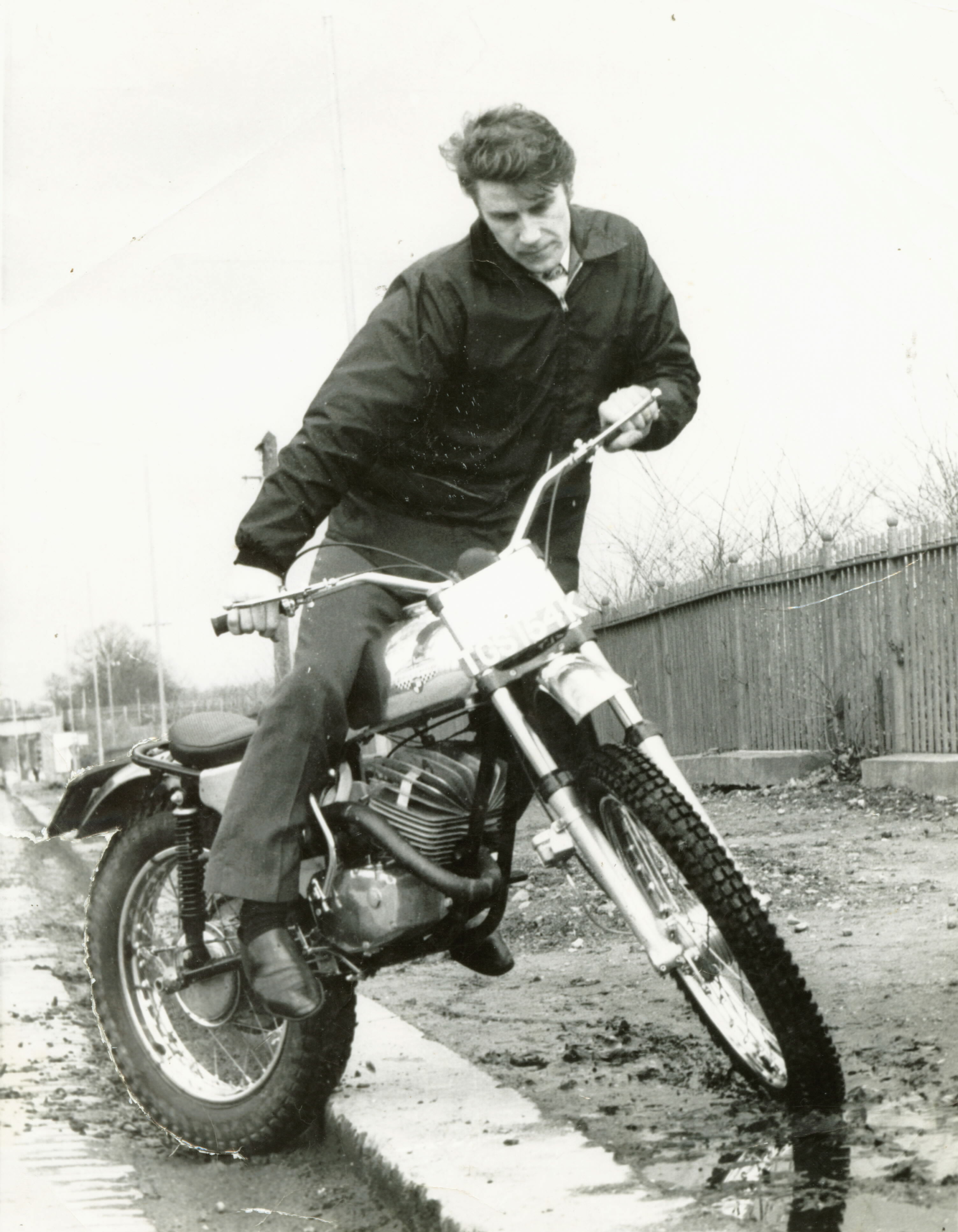

 TRIALS GURU - DEDICATED TO TRIAL