All posts by bigjohn2014

Jock Wilson a lifetime in the trade and sport

Jock Wilson (1934-2019) – A lifetime in the motorcycle trade and sport.

Words: John Moffat

Additional information: Don Morley; Dave Campling; Roy Kerr; Gordon Blakeway; Derrick Edmondson; Yrjo Vesterinen & the late H. Martin Lampkin.

Photos: Don Morley; Iain Lawrie; John Neaves; John Knight; Roy A. Kerr; Charlie Watson; Mike Rapley; Len Thorpe; Rainer Heise – (Photos, except those by Iain Lawrie, John Neaves, Roy Kerr, John Knight, Rainer Heise and Charlie Watson were supplied by P.C. Wilson specifically for this article)

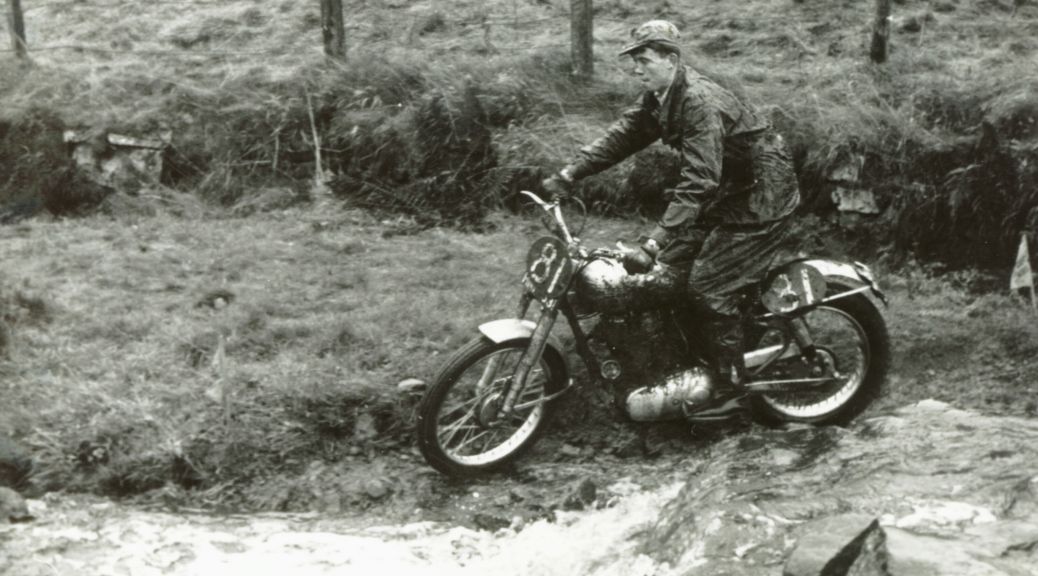
PCW AJS 1962
Jock Wilson with his ultra short stroke AJS 16C. Photo was taken at the rear of Comerfords, Portsmouth Road, Thames Ditton – Photo Supplied by Mr. P.C. Wilson – Copyright: Don Morley (All Rights Reserved)

The world of off-road motorcycle sport has been made all the richer with a variety of personalities and characters over the years, many of whom were closely connected to or part of, the motorcycle trade.

One such character was at the very heart of the off-road scene for many years, being a competitor; trade baron; team manager and much more. He was one of the sports’ most respected and knowledgeable individuals.

Son of the local postman, Peter Cameron ‘Jock’ Wilson was born on 13th January 1934 at Oakbank, Bridge of Balgie, Glen Lyon in rural Perthshire. His resourceful father made use of motorcycles as his mode of transport to deliver the mail in the glen.

An early initiation to off-road motorcycle sport with the Scottish Six Days Trial which practically ran past his doorstep, the observed section called ‘Meall Glas’ was but three-quarters of a mile from his parent’s house. Coupled with the fact that the primary school-children were granted a half-day from classes to watch the SSDT, how could the young Wilson resist the call to the sport?

Glen Lyon is a beautiful part of the country, it is one of Scotland’s longest glens with the River Lyon meandering eastwards throughout its length to join the much larger River Tay.

Wilson was educated locally at Innerwick Primary School, Glen Lyon followed by Breadalbane Academy in Aberfeldy. Like most schoolboys he was always interested in all things mechanical.

His first motorcycle was an elderly BSA which he obtained as a non-runner. It was this machine on which he cut his teeth and opened up to him the world of motorcycle mechanics. Much of this was by trial, error and experimentation and very much ‘self-taught’. He even fashioned his own set of piston rings, for funding was scarce and ingenuity was very much to the fore-front!

Down south:

Known to all his friends and acquaintances as Jock, which was bestowed upon him during his period in National Service in the British Army, this was usual for a Scotsman living and working in Southern England at the time. Wilson soon became a well-known face at trials and scrambles events throughout the country.

Wilson on leaving school commenced employment locally as a lumberjack, followed by the then compulsory national service at Aldershot Garrison in Hampshire, the recognised ‘Home of the British Army’.

Jock Wilson - Army trial - 350 Matchless G3L - Photo Len Thorpe - Finchley
Jock Wilson (350 G3L WD Matchless) taking part in an Army trial in 1956 – Photo: Len Thorpe, Finchley

It was during his time at the famous military establishment, serving in the Royal Army Service Corps or RASC for short, under the guidance of commanding officer, Captain Eddie Dow, that Jock met many of the factory trials and scrambles stars of the era through his national service. Jock met and rode with Roy Peplow; Ron Langston; John Giles and many more. Wilson not only learned new skills but also forged life-long friendships in the sport during his military service and participation in army trials.

His good friend in the army, George Morrison from Aberdeen was nervous about going on a date, asking Jock to go in his place and that is how he met his eventual wife Patricia, a local girl from Surbiton. Romance blossomed; they married and moved to London to live permanently.

Civvy Street:

Comerfords 1965 SSDT - John Neaves
Sporting dealers, Comerfords of Thames Ditton were great supporters of the SSDT, they supplied many machines to the Edinburgh Club for course marking. This is their 1965 Ford Thames van at Gorgie Market that year – Photo courtesy of John Neaves, Edinburgh

On leaving military service, Jock took up employment at Arthur Cook Motors in Kingston-Upon-Thames, followed by a move to the then well-known large scale motorcycle dealership, Comerfords Ltd based in Portsmouth Road, Thames Ditton, Surrey joining them in 1957.

Jock started out at Comerfords as a motorcycle mechanic in their workshops, quickly progressing to workshop manager. When he became bored with that job, he moved into sales under their highly experienced Sales Director, Bert Thorn who became a close friend and riding partner in many southern-centre trials.

Sporting dealers:

Comerfords took great pride in promoting themselves as the rider/dealer style of organisation. Employees were openly encouraged to participate in all forms of motorcycle sport on their weekends. Thorn was an accomplished trials rider as were Wilson’s work-mates, Reg May, Roger Davy, Derek Cranfield, Peter Hudson and Don Howlett, all of which were in the employment of the company.

Comerfords 1968
Jock Wilson top left (ISDT Greeves) – Comerfords proudly declared that they were the ‘Sporting Dealers’ in their advertising, here is proof in 1968 with the employees and directors photographed with their competition machines. Image supplied by Dave Campling.

One of Wilson’s specialties was modifying AJS trials machines; he replicated many of the factory modifications by making them lighter and more tractable. At one stage, Jock had an ultra-short barrel fitted on his personal 16C, which had one cylinder fin less than the factory barrels issued to the team riders. Gordon Jackson, Gordon Blakeway and Gordon McLaughlan who rode for AJS as a factory team in those days were all friends of Jock. During the 1963 event at the top of Grey Mare’s Ridge, Jackson asked why Jock’s wife was not at the trial.

Gordon McLaughlan (AJS) Colonial Trial 1963 - CW
AJS teamster Gordon McLaughlan was a good friend of Jock Wilson, seen here on his factory steed (164BLL) at the Colonial Trial in 1963 – Photo: Charlie Watson, Hull

Wilson recounted: “I replied that Pat was expecting our second child, to which Gordon Jackson replied, well if it’s a boy you should call him Gordon”. And so the Wilson’s second born son was aptly named. The Wilson’s had two sons, the first born being Andrew.

Gordon Blakeway on Jock Wilson: “Jock was and still is a great guy. I remember riding the Scottish in Jock’s company and as we rode through a Perthshire glen, Jock was just in front as he knew the local roads like the back of his hand, with me sitting right on his tail. Suddenly I noticed a postman sitting on the wall with his post-bag and he waved at Jock and I as we swept past. When we got to the sections, I said, aren’t the locals friendly, did you see the postie waving at us? Jock replied: Yeah, that was me Dad.”

Don Morley on Jock Wilson:I have known Jock for more years than I care to remember. He was a very good rider in his day, which people seem to have forgotten and I have photographed Jock many times in my career as a professional photographer both at the annual Scottish Six Days and various national trials in which he competed.”

Don Morley New APMC Hon President. 1402
Don Morley, author, professional photographer and motorcycling enthusiast (right) receives his chain of office from Chairman, Ken Brady of the Association of Pioneer Motorcyclists in 2017 – Photo: John Knight (former British Trophy team member ISDT)

When Sammy Miller defected from Ariel to Bultaco in late 1964, his two HT5 machines were put up for sale in Comerfords who were by that time funding the Miller/Ariel trials effort.

1965 Scottish Six Days - Ariel 786GON
1965 Scottish Six Days on ‘Callart’, riding the ex-Sammy Miller Ariel 786GON, which Wilson owned and rode for several years. The machine is now in Italy. Photo: Supplied by Mr. P.C. Wilson

Both his machines, registered GOV132 and 786GON were up for grabs. Wilson liked the idea of riding one of these machines himself. But it was the second string, 786GON that Jock purchased from his employers.

786_lhs
The ex-Sammy Miller Ariel 786GON when in the ownership of Roy Kerr from Lauder in Scotland who purchased it from ISDT rider Ernie Page who had bought it from Jock Wilson. Page was a former Scottish Scrambles champion and Kerr a former Scottish Trials champion – Photo Copyright: Roy A. Kerr

Jock recounted: “786GON had most of the lightweight alloy parts installed when it was brought in for sale, plus it was advertised at a much cheaper price than GOV132, it was a no brainer really, so I bought it”.

Jock rode the Ariel in the SSDT twice, in 1966 and again in 1967 winning the 500cc cup that year.

Sidcup 60 Trial - AJS - Bert Thorn in background
Jock on his short-stroke AJS in a Sidcup 60 Trial. Comerfords Sales manager Bert Thorn is following in the background. Photo: Supplied by Mr. P.C. Wilson

Jock Wilson often rode the Comerfords improved products, such as carefully prepared Greeves (UPA22F in the ISDT) and BSA machinery which had been breathed on in the competitions department, headed up by ace tuner, Reg May.

Jock Wilson - 1966 - Comerford BSA 441 - Photo - Don Morley
Jock on the 441 BSA Victor, modified and prepared at Comerfords in 1966 – Photo: Don Morley

Influence …

In the 1960’s, Comerfords had a very close relationship with the Greeves factory at Thundersley, supporting many local trials and scrambles riders on the Essex-built machines. One such rider was Scotsman, Vic Allan who had moved to Surrey from his Garlogie, Aberdeenshire home in early 1967 to race the Challenger models and then the later Griffon motocross machines.

Vic Allan was the reigning Scottish champion in 1966 and was keen to enter the cut and thrust of British motocross. He was a hard riding and boisterous character back then and took great delight in a bit of show-boating by pulling wheelies down the start and finish straights. It was Wilson who had a quiet word with Vic and “calmed him down a little”.

The advice was taken totally in the spirit intended and Allan started getting much needed results for both Greeves and his employers, Comerfords.

In 1971, Vic joined the mighty BSA concern primarily to contest the Grand Prix series, during which time he crashed heavily at the Italian round on the factory 441cc Victor.

Allan badly smashed his hip and was sidelined for several months. It was during his convalescence that BSA closed the Small Heath competitions department.

Being a professional rider and now effectively unemployed, Allan reverted to race once again for Comerfords, but this time on the Spanish Bultaco, eventually becoming the British 250cc and 500 cc Motocross champion in 1974, riding the Pursang models in both classes, the last rider to do so.

Vic became very close friends with Jock Wilson who was effectively his mentor in the early days and during his British championship efforts, they live only two streets distant to this day. They have great respect for one another.

Jock recalls: “The only time I ever had a cross word with Vic Allan was at Farleigh Castle when the Greeves broke down. Vic literally threw the bike on the ground in disgust and was about to storm off. It happened right in front of me, so I went up to him and said, if you are going to treat a bike like that, you can bugger off back to Aberdeen right now!

Jock Wilson - 1963 SSDT - 250 Greeves - Grey Mare's Ridge - Photo - DON MORLEY
250cc Greeves mounted for the 1963 SSDT, Jock negotiates Grey Mare’s Ridge with cigarette to aid concentration. Photo world-wide copyright of Don Morley, image supplied by P.C. Wilson (All rights reserved)

In 1968 when Comerfords had become UK concessionaires having taken over the UK importer-ship from Rickman Brothers of the Bultaco brand, Jock Wilson became heavily involved in that side of the business, supplying the dealer network and operating a first-class spares service.

Now with Bultaco UK, Wilson was responsible for negotiating and setting up the contracts with the Comerfords supported riders in both motocross and trials.

Having competed in the Scottish Six Days several times, Jock was a very useful ‘support man’ for ‘Team Bultaco’ at the annual Highland event.

The bright red Comerfords’ Ford Transit piloted by Wilson could be seen at several points daily throughout the event, always bang on time to catch the Comerford and Bultaco runners as they came off the rough with spare parts and sustenance for the Lampkin brothers; Malcolm Rathmell; Yrjo Vesterinen; Lane Leavitt; Manuel Soler and anyone else entered by Comerfords or the Bultaco factory.

Yrjo Vesterinen'79 Pipeline
Yrjo Vesterinen (325 Bultaco) on Pipeline in 1979. ‘Vesty’ benefited from Jock Wilson’s support at the Highland event – Photo: Iain Lawrie, Kinlochleven

Jock Wilson’s personal SSDT and ISDT experience was invaluable when giving support to the factory men. He was trusted and kept many of them both on time and focused on the job in hand, in many cases to win the event!

The International scene:

Jock went on to manage the British International Six Days Junior Trophy and Trophy teams. His knowledge gained by riding in the ISDT many times himself on AJS, Triumph and Greeves machinery gave him a valuable insight into this part of off-road sport and was a very highly thought of manager by not only the riders but the ACU.

VYW659 - Jock Wilson

The initial suggestion of Jock’s involvement in team management came in late 1977 from fellow Scot, T. Arnott Moffat, the honorary secretary of the Scottish ACU and father of Trials Guru’s John Moffat. The persuasive Moffat phoned Jock up, with the deliberate intention of making the idea become a reality.

Jock Wilson recalls the conversation: “It was one of Arnott’s legendary long telephone calls, but he did a good job of convincing me to take up the challenge, I had a lot of respect for him and trusted his judgement”.

Arnott Moffat swiftly convinced Jock that he had all the necessary skills and experience needed for such a weighty task.

SACU Presentation
Jock Wilson (far right) proudly displaying his SACU ISDT Team Manager’s badge on his blazer at an SACU Awards presentation at The Golden Lion Hotel, Stirling in 1978. Others in the photo are from left: Mrs. Margaret Allan (SACU chairperson), Ronnie Wright; Alex Phillip; Robbie Allan; Charlie Bruce; Tommy Milton; Anne Allan (wife of Vic Allan)

Wilson cut his managerial teeth by taking charge of the Scottish ACU ISDT squad in Sweden at the High Chaparral, Varnamo in 1978. He quickly earned the respect of the riders and team supporters, but the ACU were in the wings watching closely and had taken note. A short time later the ACU enlisted Wilson’s services to manage their GB ISDT Junior Trophy and World Trophy teams, taking on the task from Ian Driver.

Ian Driver - Reg May - John Knight photo
Sweden 1978 – Dick Ward (Left) Ian Driver (second from left) was the GB ISDT Trophy Team Manager immediately before Jock Wilson. Also in photo is official team mechanic, Reg May (second from right) and Ted Knight – Photo courtesy of John Knight, former ISDT Trophy team rider

The SWM connection …

With Bultaco finances already showing signs of stress, Jock left Comerfords employment in 1979 starting out in business to import the Italian SWM trials and enduro machines, this was achieved by forming a partnership with the accomplished trials and ISDT competitor, Mick ‘Bonkey’ Bowers from Studley, Warwickshire.

Wilson and Bowers, trading as SWM UK Limited quickly established a country-wide dealership network which included the former World Trials Champion, Martin Lampkin who was by that time competing on the brand. This ultimately involved the support of good centre riders such as Andrew Watson and David Clinkard to name but two.

Jock Wilson - Workshop - Tolworth - Photo - Mike Rapley
Jock trues up a crankshaft assembly in his workshop at home – Photo copyright: Mike Rapley

Two years prior to SWM’s eventual cessation of motorcycle production in 1984, the SWM UK partnership was dissolved and Jock reverted to self-employment, working from his home in Tolworth, repairing and tuning motorcycles and repairing damaged wheels for local dealers, as he was a self-taught ace wheel-builder.

Now in his eighties, Jock Wilson is now fully retired, still living with wife Pat in Tolworth and can reflect on a lifetime of achievement as a rider; first class mechanic; salesman; team manager; importer and all round good-guy, who contributed so much to to British motorcycle sport.

Jock Wilson - Kitchen wheelbuilding - Tolworth - Photo - Patricia Wilson
Jock Wilson rebuilding a rear wheel at his Tolworth home. Photo: Mrs Patricia Wilson, Tolworth

Appreciation of Jock Wilson from within the sport:

yrjo-vesterinen81-muirshearlich
Yrjo Vesterinen on Muirshearlich in the 1981 SSDT – Photo: Iain Lawrie, Kinlochleven

Yrjo Vesterinen on Jock Wilson:It would have been in 1974 during my first ride in Scotland that I first met Jock Wilson. As I often said, first impressions count and with Jock this certainly wa sthe case, a warm friendly smile and the firmest handshake I had even encountered.

As the week progressed I felt that Jock genuinely tried to help me by giving me useful tips and encouragement during the week. This paved the way for a lifelong friendship. Whilst in Fort William, I noticed that Jock very much enjoyed the evenings in the bar, usually having an interesting conversation about the trial with a glass of his favourite whisky in his hand.

Some years later when I saw him he said that he had to adjust the fuel mixture a bit. I didn’t get it! He noticed, laughed and said I hav had to add a bit of water to the whisky as the engine was running a touch too rich!

After we got married, my wife Diane and I moved to live down south in Woking, we were in regular contact with Pat and Jock. The highlight of every year was the Wilson family New Year’s Eve party at their house on Red Lioan Road on the leafy outskirts of London. Soon after our son Mika was born, Jock and Pat presented him, for his first birthday, with a jolly nice trike with big fat wheels. That was a gesture that we very much appreciated. At first the trike was a bit too big for him.

Later when Mika had grown up a little and was already cruising around the house on his trike and also at that point he was beginning to speak a little. We said to him, “Please thank Uncle Jock for this new toy of yours.” Mika being a smart young lad took it on board and when Jock arrived he said: “… thank you very much Auntie Dock”. Jock smiled broadly. That name stuck and in our family Jock is still affectionately known as Auntie Dock!” – Yrjo Vesterinen

Derrick Edmondson
Derrick Edmondson (SWM) – Photo Mike Rapley

Derrick Edmondson on Jock Wilson:Jock was a big man in stature and respect, especially for those who were prepared to earn ‘his’ in return. His handshake was legendary and if you managed to keep a smile on your face without ‘wincing’ from his vice-like firm grip, then the friendship you would gain friom him was endless. A great character with so much experience and one who was always there to help both with advice and mechanical knowledge. My secret admiration for him was his simple ability to paint perfect numbers ‘free-hand’ on a race plate in the days when they were hand painted with a paint brush like an old-fashioned sign writer and not the modern stick on jobs!” – Derrick Edmondson

martin-lampkin81-pipeline
The late Martin Lampkin (SWM) on Pipeline in the 1981 SSDT – Photo: Iain Lawrie, Kinlochleven

Before his untimely death in 2016, the late Martin Lampkin commented:

I had known Jock Wilson from my early days in trials and when I moved to Bultaco it was a privilege to be aroun sucha  good and genuine man. During my Bultaco years, Jock, along with Reg May at Comerfords, were the men you spoke to when you had a problem and if you needed some good advice or help as nothing was too much trouble. With the Spanish Bultaco concern in financial trouble, I had no choice with a young family to support but to move to another brand and it was SWM that I chose. Fortunately for me it was around the same time that Jock had become involved with importing them and I knew when we shook hands that the deal would always be honoured. I rewarded him with both the Britisj Cahmpionship and the Scott Trial victories making some very happy memories which I still cherish to this day.” – H. Martin Lampkin, 2015

IMG_0003y
1975 SSDT with Jock Wilson (left) keeping an eye on Martin Lampkin (right) as he fettles the works Bultaco. Conversing with Jock Wilson is North East England rider, Dave Younghusband. The Bultaco is the machine which carried Lampkin to the first ever World Championship title in the same year – Photo Copyright: Rainer Heise Archive, with permission

Jock Wilson passed away peacefully, aged 85 years on 21st August 2019.

Copyright: John Moffat/Trials Guru 2021

Copyright restrictions: The images included in this article are the world-wide copyright of the image owners and are not to be displayed elsewhere without the prior written permission of the copyright owners. Please respect their intellectual property by not sharing any of the images separately from this article. Trials Guru are particularly grateful to Mr. Don Morley, Reigate, Surrey for allowing his images to be permitted within this article.

Engine Number EXHS 99
The motor shows its pedigree. The engine number indicates that this is no ordinary HT5, but an experimental motor. (Photo copyright: Roy Kerr)

Jock Wilson’s Ariel HT5 – 786GON – additional article on Trials Guru HERE

Apart from ‘Fair Dealing’ for the purpose of private study, research, criticism or review as permitted under the Copyright, Design and Patents Act, 1988, no part of this article may be copied, reproduced, stored in any form of retrieval system, electronic or otherwise or transmitted in any form or by any means, electronic, electrical, mechanical, optical, chemical, photocopying, recording or otherwise without the prior written permission of the author as stated above. This article is not being published for any monetary reward or monetisation, be that online or in print.

cropped-tg_logoheader-2018.jpg

Here Now! Jock Wilson

Coalasnacoan - 1966 - SSDT
Bob Currie of ‘The Motor Cycle’; Edward Damadian (ACU Steward) and Ralph Venables watch Peter ‘Jock’ Wilson (498cc Ariel – 786GON) footing on ‘Coalasnacoan’ in the 1966 SSDT – Photo supplied by P.C. Wilson, Tolworth.

Available now only on Trials Guru, the full story of Peter ‘Jock’ Wilson – respected competitor in trials and the ISDT; top class mechanic; salesman; team manager; importer and general all-round good guy. Written by Trials Guru’s John Moffat with the direct assistance of Jock and Pat Wilson; Dave Campling & Yrjo Vesterinen.

(Article first published in Issue 14 of Classic Trial Magazine by CJ Publishing, reproduced with their kind permission on Trials Guru. Back issues of Classic Trial Magazine available HERE)

‘Jock Wilson – A lifetime in the trade and sport’ – click HERE only Trials Guru

cropped-tg_logoheader-2018.jpg

Reg May the master craftsman

Author: John Moffat

talmag-reg-may-norton-500t-john-may-ajs-bob-gollner-ajs-reduced
Talmag Trial left to right: Reg May (Norton 500T); John May (350 AJS) & Bob Gollner on WJJ580 – Photo courtesy of John May – May Family Archive

Words: John May, Yrjo Vesterinen, Derek Cranfield, Dave Campling and John Moffat

Photos: May Family Archive; Eric Kitchen, Barry Robinson Estate, Heath Brindley & Norman Hawkins.

Reg John May was born on 18th May 1925 in Chiddingfold Farm-Hand Cottage in Surrey, moving in 1929 to Honey-suckle Cottage, Hambledon which was next to the local pub called the ‘Merrie Harriers’.

An only son, Reg was educated at the local school, his father was known as ‘Punch’ and his mother was Edith.

Young Reg was particularly good with his hands and excelled at wood-work at school. He initially took up employment in the local brick-works and coal-yard. He was conscripted into national service in the army, serving in Germany and then in Palestine as part of the peace-keeping force.

On his de-mob, Reg took up employment at G&S Valves at Milford, Godalming, Surrey. It was at this time he met an Irish girl called Mary, who was one of two sisters who worked at a stately home in the village. Reg and Mary married in 1949 and moved into ‘Hatch Cottage’ where he remained for the rest of his life.

In the 1950s, Reg took up employment at Vickers Armstrong at Weighbridge in Kent where he rode to and from work on his trials bike. May’s first competition machine was a DKW in 1952. A year later he was winning events riding under the Weyburn club, before switching allegiance to the Witley and Waterlooville clubs.

Reg and Mary had two children, John and Pam. John May went on to be one of Britain’s finest ISDT and enduro riders in the 1970s.

He started with Comerfords at Thames Ditton in 1959 as a motorcycle mechanic. Reg had many good friends in the sport and in particular Bill Elliot, Mick Dismore, Bob Gollner and Comerfords work colleague, Derek Cranfield to take in the national trials.

In 1967, Comerfords promoted Reg to foreman/manager of their new competitions department. It was where the company developed the Comerford Cub and Bantam machines. They also built the Comerford Triumph Trophy 250.

However, Reg May will be forever remembered for his capability of tuning and improving Bultacos, which Comerfords imported to the UK. It was said many times that May could set up a Bultaco better than the factory; such was his reputation and skill.

Reg rode in the International Six Days on two occasions, 1962 and 1965 on a Greeves which expired during the event. He had struck up a friendship with movie star, Steve McQueen.

McQueen’s 500cc Triumph was prepared at Comerfords where the actor visited a number of times to check on progress for the 1964 ISDT at Erfurt in East Germany. Reg had ridden with McQueen in the 1961 Welsh Two Day trial.

John May: “Steve McQueen was riding one minute ahead of my Dad and called him his smoking buddy”.

Reg May in 1965 on his personal Bultaco Sherpa T, one of the very first batch to arrive in the UK. (Photo: OffRoad Archive)

In 1965 when the new Bultaco Sherpa was eagerly awaited, Sammy Miller loaned Reg his spare Sherpa on which he won the Beggars Roost Trial, a trade supported national event. He then went on to ride the first of the Bultaco Sherpa T models to come to the UK, a machine that is still in the family.

Reg May mod10 - Heath
One of the very first Bultaco Sherpa T model 10s to be imported to the UK was this one, owned and ridden by the late Reg May of Comerfords, now owned by his son John – Photo copyright Heath Brindley, Bristol

Reg also prepared close friend and motorcycle dealer Bob Gollner’s BSA Gold Star on which he won many scrambles in the early 1960s.

May Reg 1972 2 - red
Reg May working on his Bultaco in Fort William, which had suffered tank damage in the 1972 SSDT – Photo copyright: Eric Kitchen

John May: “Dad had many friends in the sport, probably too many to list, he enjoyed a game of snooker when away from bikes which he played with Derek Cranfield. He also liked gardening and grew his own vegetables. He really did have green fingers, he was good at it. He also liked a little whisky which he took from time to time”.

Reg May - Alan Lampkin - 1977 SSDT
Reg May (left) watches over Bultaco teamster Alan ‘Sid’ Lampkin as he fixes a puncture in the 1977 Scottish Six Days – Photo: Norman Hawkins

Derek Cranfield: “Reg and I became real good friends when we both worked at Comerfords; we travelled together all over the country to all the national events. We always used my car and trailer as Reg did sometimes like a wee dram now and then. We both liked traditional jazz music and every week would see us at some gig, we even promoted the odd do at the village hall at Hambledon where Reg lived. He was brilliant at making bits for bikes, if he found that a part needed modifying, he would make it or mod it, he was the first to put Bultaco fork inserts in to AJS and Matchless forks and if he found a modification that worked he would share it. I have so many memories of things that we got up to. Like when traveling with the car and trailer, a wheel went past us down the road from the trailer but somehow Reg would rig something up to get us home, or coming home from jazz on an icy night Reg and Mary, his wife were in their car behind me. His lights suddenly went out, then went on, then out, then on again. Reg was spinning round and round down the middle of the road on black ice. In my rear view mirror, it was like a light house, we did so many things together. We were both in charge of the British Bultaco team in the ISDT at the Isle Of Man when the down tubes on the front frames cracked, the team being Sammy Miller, Mart and Sid Lampkin. We found a garage where they would be passing the next day and had a man ready with welding gear waiting, pulled Sid in first, he laid the bike on its side, the bloke started to heat the parts up when whoosh, there were flames as petrol had leaked from the carb, in two seconds Sid had gone, Sammy and Mart did not want to try that, so the frames were wired together, they did not retire. We had great back up on that occasion by a lot of Bultaco dealers”.

When a young Barry Sheene was racing 125cc Bultacos, he and father Frank would engage Reg to solve their mechanical problems. They visited him at Comerfords many times to improve their race bikes.

Keith Thorpe was the workshop manager at Comerfords and his son Dave who was eventually to become World Motocross champion for Honda. Reg made a frame for Dave’s Suzuki when he was racing in the schoolboys.

Reg, adept at modifying frames and experimented with suspension set-ups, not only carrying out work at Comerfords, but also privately in his garden shed at home. He took on a lot of private work for friends and local riders.

John May: “When I was twelve, Dad built me a Triumph Cub. I did all the nationals and attempted the Scott and Scottish Six Days. He wouldn’t let me loose on a motocross bike until I had done two full seasons at trials. I did six seasons at motocross before specialising in enduro. Dad was behind me all the time with advice and encouragement, when it was needed. I qualified for the top thirty-five British Motocross championship two years running. In 1975 my name was put forward by Ralph Venables for selection for the British Trophy team. I eventually rode in eight ISDTs and had five golds, one silver and two retirements”.

Reg May assisted Robin Humphries with the development of the R.E.H. forks, hubs and cylinder barrels in particular. He also developed the 200cc Yamaha motor for use in the Whitehawk, built by Mick Whitlock and assisted Bob Gollner with his projects.

Reg May was mechanic and tuner to Martin Lampkin when he won the first World Trials Championship in 1975 and was there when Lampkin won the SSDT for Bultaco. Later there was a Finnish superstar that benefitted from Reg May’s input, three times world Trials Champion, Yrjo Vesterinen.

Mart 2 Reg
During a testing session in 1975, Reg May (left) checks the jetting on Martin Lampkin’s Bultaco with Martin himself doing some work to his machine – Photo: Barry Robinson Estate

Comerfords’ directors sanctioned forty standard 340cc Sherpa model 199B machines to be modified by May to create the ‘Comerford 340 Vesterinen Replicas’.

May was well-known for keeping his cards close to his chest when it came to machine set ups. Customers were not permitted to enter the completion department at Comerfords. But one thing Reg kept secret from his employers was the machine preparation he carried out for Gordon Farley who had worked at Comerfords and had been responsible for the creation of their Comerford Cub.

Farley had moved to Montesa in 1969, but his friendship and trust built up with Reg May was to continue with May preparing the Montesa engine in secret. At that time there was intense rivalry between the Bultaco and Montesa factories and it simply was work that could not be carried out in the public eye.

John May: “Dad and Gordon would take themselves away from preying eyes to meet up to set the Montesa carburation up for the Scottish, no-one knew about it at the time. It wouldn’t have looked good if it had got out”.

Dave Campling has been around the motorcycle trade most of his life, retiring from MCN in 2002. He was an engineer until Bert Thorn invited him to work for Comerfords in 1967. He remembers Reg May: “When Reg was experimenting with engine sizes on the works Bultacos and also John’s Villiers Cheetah, he had all the ideas and knew how much he could get away with in terms of sleeving the barrels and boring out to maximums, but he couldn’t work out what the cc’s would end up as .We sat in the cafe opposite Comerfords one morning chatting about it and he gave me the measurements on the back of his fag packet. I then worked the maths and told him what he would end up with. He was over the moon and later in the week we had a couple of Low Flyers (Famous Grouse) in the Witley clubroom to celebrate”.

All the Bultaco riders who were contracted to Comerfords had utmost faith in Reg May’s ability, this included Malcolm Davis and New Zealander, Ivan Miller and Vic Allan whose bikes were all breathed on by May. This culminated in Allan’s double British Motocross Championship wins in 1974 on the Spanish built Pursang models.

1979 - Martin Lampkin - Reg May - EK Photo
Scottish Six Days Trial 1979 – Martin Lampkin inspects the rear tyre of his Bultaco, with Reg May offering advice. John Metcalfe is watching closely. Martin was narrowly beaten into second place to Malcolm Rathmell (Montesa) – Photo world-wide copyright: Eric Kitchen – all rights reserved.

With the advent of Pre’65 trials, this gave Reg May a new interest in riding trials with a beautifully prepared 16C AJS and a 500T Norton. He even built a girder forked 250cc BSA and enjoyed many Witley club events and the annual Talmag in the early days. He also rode in the Pre’65 Scottish with his AJS.

Yrjo Vesterinen remembers Reg May:

“Nineteen seventy-four was an important year for me. For the first time I was able to ride all the European Championship series. The series opener was in Northern Ireland in February, with the second round in Belgium. On route, my travelling companion Tom Sjoman and I, decided to stop in London and visit my sister, who was living there at the time.

An important and exciting visit to Comerfords, the Bultaco importers in Thames Ditton, just outside Central London, would follow. What an experience that was, I had never seen so many motorcycles in one location before.

Successful businesses are not solely about the merchandise, it is about the people that do the magic day in day out. It was a really friendly bunch of capable and knowledgeable people that we came across.

At the back, behind the car workshops there was a smaller workshop that we were told was a special place. There Tom and I were greeted by a certain white-haired gentleman with friendly warm smile on his face. This was the famous Reg May, he was the ace spanner-man at Comerfords that every self-respecting Bultaco customer craved to get their bikes fine-tuned by.

Reg knew everything that was worth knowing about Bultacos, it was all in his head. He didn’t use manuals; Reg knew more than any manual could ever hold. Be it carburation, ignition timing, in fact anything that would make a Bultaco run and perform better than the factory settings. That was his speciality.

After our initial meeting, the next time I was to meet Reg would be In Scotland that same year, 1974. He had been persuaded by Comerfords to lend me his own Sherpa for that occasion. My own machine had been left in Italy after the European Championship round there as there was not enough time to drive from Italy to Edinburgh. Bultaco had chartered a private aircraft to fly Martin, Sid and me to Scotland immediately after the trial in Italy. All the English riders had their own spare machines waiting for them, naturally all prepared by Reg. However, mine was special though, as it was Reg’s own 325 Bultaco!

The bike ran beautifully all week apart from some usual mid-week repairs. However, Reg was not happy as I was not cleaning his bike on arrival to the car park like most others did with their mounts. My excuse was that scrubbing his bike with a dry rag would scratch the paint work. Reg was still not impressed, but said no more on the matter. I did try clean the bike properly after the trial though.

It would take many years before my bikes would start to get a full ‘Reg May treatment’.  In 1981 I had returned to Bultaco after a year with Montesa. My Contract with Bultaco was backed by Comerfords and I started to spend more time in England and Reg was looking after my bikes whilst I was there. In the summer of 81 I met Diane Hadfield and from then on I spent most of my spare time with her. Diane’s parent’s house was not far from Comerfords and that led to me working with Reg on an almost daily basis whilst in England. It was then that I really got to know Reg well However I disliked the smell of his workshop. That odour was a mixture of exhaust fumes, welding gases, cigarette smoke, oil and petrol. It would stick to your clothes it was not pleasant and ultimately I suspect that those fumes may have ultimately damaged Reg’s lungs as well.

What I learned was that Reg was an especially talented fabricator. That came very handy when we started designing a new frame for my Sherpa. I had some new and fresh ideas that I was convinced would help to improve the handling and in particular the rear suspension of the Sherpa. Reg tirelessly cut and re-welded the frame as well as fabricated new air-filter boxes, exhausts and winging arms. I would then go testing, quite often with my friend Colin Boniface, who also worked at Comerfords. It was handy to swap bikes in order to see what progress we had made, if any!

Both Reg and I were working on the theory that my bike would be the basis for the next new production bike and once ready and tested we would hand it over to the factory.

That was never to happen as the factory finally closed its doors for good in 1983. Like they say, the rest is history. I moved on, got married, and started a family with Diane as well as building a new business with her. Reg stayed on and continued to develop bikes from the point where we, together, had managed to achieve.

Reg of course used to look after the bikes for Martin and Sid Lampkin and Scot, Vic Allan in their quests for stardom. Only decades later did I find out about some of the magic details that he had engineered into Martin Lampkin’s 1978 works bike. I am the current custodian of that very bike and whilst rebuilding the engine I came across an ingenious main bearing arrangement in it. I suspect that they didn’t even know about this little secret at the factory. It was designed to reduce engine vibration that the 348cc long-stroke engine suffered from. Whilst Martin’s bikes ran beautifully, Vic Allan’s bikes literally flew.

Reg May was passionate, energetic; he loved motorcycles and Bultacos in particular. He had a great dry sense of humour, I have been told, although I rarely understood his jokes. It would take years of practise for a foreigner to achieve that. I still miss Reg May to this day”. – Yrjo Vesterinen

Article Copyright: John Moffat/Trials Guru 2023

Apart from ‘Fair Dealing’ for the purpose of private study, research, criticism or review as permitted under the Copyright, Design and Patents Act, 1988, no part of this article may be copied, reproduced, stored in any form of retrieval system, electronic or otherwise or transmitted in any form or by any means, electronic, electrical, mechanical, optical, chemical, photocopying, recording or otherwise without the prior written permission of the author as stated above. This article is not being published for any monetary reward or monetisation, be that online or in print.

guru_header_new 2024

Trials Guru isn’t just for Christmas

We all know that Christmas can be a little boring sometimes with not much happening? Change that, have a peek into the world of trials on Trials Guru, its so easy, either put some words into the search box and hit the little magnifying glass symbol… or have a look at the Index, either way you will be looking at some awesome photos from our photographers who willingly give Trials Guru permission to use.

Before you know it you will have spent many happy hours getting a fix of the trials habit!

Happy viewing from all of us here at Trials Guru.

tg_logoheader - 2018

Mr PJ1 passes away

Richard-Thorpe.Rob-Shepherd.Craig-Holmes.jpg
Richard Thorpe (left) with Rob Shepherd and Craig Holmes at the Off-Road show at Telford.


Richard Thorpe from Batley, better known in the world of trials as ‘Mr. PJ1’ has died aged 72.

Richard was a keen trials rider and in later life was an enthusiastic supporter of the Pre’65 movement and a very well-known face in paddocks across the country and beyond. Yorkshire-man John Reynolds was a long time supported rider of the UK PJ1 concern, in fact he rode Richard’s Suzuki in a Kia championship round this year and won his class on the machine.

For many years the UK representative of the USA based chemical manufacturer PJ1, Richard was in effect the ‘face’ of the brand for dealers and customers alike within the United Kingdom.

Richard Thorpe lost his battle with cancer on the morning of 21st December 2018, his wife Christine was with him at the end. He was in Pinderfields Hospital, Wakefield when he died.

Trials Guru wish to record sincere condolences to Richard’s family at this difficult time.


richard thorpe.1.jpg (2)
Richard Thorpe on his Montesa Cota 4RT – Photo: Barry Robinson

Photos on Trials Guru

Trials Guru is indebted to the work and kind permission to use images on this website. Without photographs our articles and stories of Motorcycle Trial Sport would be shallow.

A good photograph tells a thousand words, that is why we are grateful to those men and women who have given us express permission to use their ‘Intellectual Property’ since 2014.

Please be aware that every photograph on Trials Guru is the copyright of the photographer, except where stated, the photographs are not the intellectual property of Trials Guru. We do not maintain an archive of photographs, each photographer has the right to have any image that they own removed without reason being given, that is our policy.

Please be respectful of this and do not share any of the photos on Trials Guru on any other website or social media without prior express permission being granted in this regard by the photographer.

The Kiwi’s 1979 Scottish

Written at the time of the event, now forty years ago, here is a New Zealander’s recount of the 1979 Scottish Six Days Trial.

TG - VIP - Kerry Miles
New Zealander, Kerry Miles is a Trials Guru VIP, seen here with the Bultaco Sherpa he rode in the 1979 SSDT and his Honda/HRC RTL250S.

Words: Kerry Miles, Rangiora, New Zealand

Photos: Mrs. Joan Miles – Lynette Barnett

The 1979 Scottish – Kerry Miles

Friday 27th April. Final preparation:
What a hectic day, my biggest worry being whether to use my Mikuni carb or stick with the leaky Bing.
After the morning’s tuning session I decided on the Mikuni as I had a range of jets and wanted the bike on the rich side. It took ages to sort what tools and spares to carry, also where to put them all was another problem. I had purchased a Preston Petty tool box number plate which held most things except a rear tube which I strapped behind my seat. I carried a plug spanner in my jacket pocket along with a plug and plenty of glucose sweets and chocolate.
The time came to pack the car, god what a hell of a job … the poor old Fiat had its tail on the ground and I still had the bike to go on.

Saturday 28th April:
With the bike loaded we set off about 8.30 am up to M6, then on to Glasgow where we arrived in time for lunch. We were advised not to visit the centre of Glasgow and didn’t. From Glasgow we made our way to Stirling where we turned off the motorway for Fort William. A few miles along the road we spotted a safari park (Blair Drummond) so we went to investigate. On trying to obtain entry we were informed the bike would have to come off, so off it came giving the car a new lease of life, albeit short. Well it was good but surprisingly not as good as Orana Park, the bloody monkeys just wouldn’t get off the car and I expected scratches, but luckily there were none. We then headed on towards Fort William passing through some of the best looking trials country I have ever seen, which later turned out to be covered in ‘Scottish’ sections. Travelling through Scotland is very similar to NZ, especially the south of the South Island. We arrived in Fort William about 4 pm, the first thing to greet us was the parc fermé, even at this early stage it was a mass of colour.
The trade vans were there in force selling clothing, spares, accessories and NEW bikes, incredible. Driving through the main street one is greeted by a welcoming sign. We also noticed Mick Andrews walking along the street. There were blokes everywhere with Montesa, Bultaco, Honda, Yamaha and Suzuki jackets on. We drove around and after asking finally found our hotel. It was easily recognised as there were many dealers vans and utes. Motorcycle and Motorcycle News had banners up on the pub and all over the grounds. We had a good view from our window, looking up at Ben Nevis. We could also watch everybody arriving. The weather had been beautiful but everybody said it wouldn’t last, boy were they right. That night we had dinner early and a couple of drinks and retired early.

K Miles 1
Kerry Miles on ‘Town Hall Brae’ in the 1979 SSDT

Sunday 29th April:
We awoke to the sound of rain and hail beating against the window. What a contrast to Saturday. Ben Nevis was covered in snow, what little we could see in the murk. After a leisurely breakfast (2 hours) which we enjoyed with two friends from the Bradford Club we sorted out our gear. About 10.30 we drove down to the parc fermé. Joan sat in the car as it was still hosing down while I wandered around looking at the machinery. I stopped and had a good look at Rob Shepherd’s RTL and a good natter with Rob and his mechanic Mike, really nice guys. Just behind the Honda van I spotted two odd looking machines being unloaded so I went off to investigate. They turned out to be Moto Guzzi 230cc four strokes mounted in modified 348 Montesa frames and painted the worst colour green I have ever seen.

Moto guzzi Test -20
One of the Moto Guzzi 230 bikes that Kerry saw at the 1979 SSDT, seen here being tested in 2016 by Justyn Norek Jnr – Photo: Justyn Norek

Then I spotted this Commer van with a NZ sticker so I went and made myself known. There were 3 guys from the Tauranga area over for the Scottish and the Isle of Man. While talking to them I spotted this blue LHP Bedford diesel arrive, turned out it was Vesterinen. His bike was immaculate as was his mechanic (his brother) and his dress. While wandering around in a dream trying to remember where the car was I heard a voice say in a broad Yorkshire accent “are ya alright?” It turned out to be Martin Lampkin. After discussing our strategy I wished him well as it was time for scrutineering. Being one of the early numbers I was one of the first through. It didn’t take long at all, they painted my wheels, frame and motor. I pushed my bike off the ramp and parked it, leaving it looking lonely amongst several Montesas.
Well by this time the cold weather was taking its toll and nature was calling in a big way so a mad dash was in order to the nearest pub. Whilst standing you know where, a bloke comes in with the same problem and says “there’s a guy out there from NZ who knows you”. I asked if it was Jock Cain as I had heard he was coming over but he said no. Strange I thought who could it be? Well standing in the bar was Nods (Neil Harris). We shared drinks and he told me he was riding a 175 Fantic. It was really great to meet someone like Neil. As it was time for him to get his bike scrutineered we left. Joan and I then drove back to the hotel.
After a long hot bath and some dry clothes we thawed out then it was down to the bar for a couple of whiskeys and on to the dining room where we met up with a work mate from Yorkshire who was riding no. 7 (I was no. 2). After dinner we had a few quiet drinks and called it quits about 10.30.

K Miles 2

Monday 30th April – Day one, 85 miles:
Well what an early start, I was away at 7.31 am. From Fort William it was up the Mamore Road to Callart Falls group of 8 sections. Being the first riders there the rocks were slimy and very tricky. The sections were rock outcrops with water flowing down them and they were pegged tight. I did not do very well here but nor did the riders around my number. From Callart we climbed up the side of a mountain into the snow where the only way to find grip was to sit down and paddle. I fell off once and it took a couple of minutes rest in the snow to get my breath back after heaving the bike about 30 yards uphill. We then went down the other side to the road and on to Garbh Bhein. Here there were two sections just off the road up a rocky loose creek bed and fairly steep. I attacked it in second with full noise and had a couple of prods. This section got a lot harder later and took points off many of the top men. From Garbh Beinn it was 16 miles of road to Altnfeadh (four sections). I had a 0,0,5,5. God they were slippery. Joan was watching here and said the later riders cleared the top two easily but had problems on the first two. I was chuffed and annoyed. It was then 8 miles over the tops through more snow to the lunch stop at Kinlochleven. After lunch we went onto Blackwater. I had fives on the first two then a one on a section with a net on one side to stop riders, machines or both going over a 70 foot drop into a stream. One rider that night said he had tred on the net and the rope was rotten, a shuddering thought. There were two more sections here in a rocky creek bed, the sections were open but really limited to one line. I had a clean and a five. From the sections at Blackwater we had a long ride across Blackwater moor. It was
about 23 miles across and took about 2 hours during which time it snowed, hailed, rained and the sun shone. Going across we encountered bogs, rocks, streams and really narrow tracks. It paid to skirt the bogs because if stuck it can take up to 3 men to extract your machine. You can always find a way around them, takes time though! Bradileig was the next group. By the time I arrived there I was knackered. I had some silly feet here (I am certain in a normal trial I would have cleaned them easily). After this it was a ride of about 10 miles to the road and on another 12 miles to Fort William and Town Hall Brae right in the middle of town. I rode both clean. From here it was back to parc fermé where I checked in two minutes late (2 points). What a day, I ached all over from that 33 miles of moor.

K Miles 3

Tuesday 1st May – Day 2, 104 miles:
Having a late number today I wasn’t off until about 11.00. They work on a system where on Monday its no. 1 to 280, Tuesday: 45-280, 1 to 44; Wednesday: 95-280, 1 to 94 etc. during the week.
First off we set off on a 23 mile road ride to Laggan Locks through snow and hail. I was really thankful for my faceguard I had bought along with my damart undergloves. Laggan Locks are four sections on a hillside with loose rolling rocks. When I arrived, there were about 20 riders in front of me. In the Scottish they operate a system called delay where you hand in your card if there is a queue. They then time it and when you are about to ride the section they hand you the card back with the time delay noted. This is then added to your time at the next check. I used this system at Laggan Locks and when my turn came to ride there were more riders and I had to start about a foot from the start cards. I ended up with a 0,1,2,0 and I was thrilled. On to Switchback for four sections in a creek bed with lots of water and several big rock steps. I did these for 2,0,0,1. We had several miles of moor work to cross before Achlain. Here things started to go wrong. It was a rocky creek bed and with really big rocks and huge rock steps I had threes and fives here. On the road to Allt a Chaoruinn I had to put the bike onto reserve and I was panicking a bit by the time I got to the sections, five in total. I had a really mixed bag: a five, cleans, one and a three. Fortunately down the road was the Comerfords van with petrol. Comerfords will, if you are lucky, look after all petrol supplies for a sum of £27. It may seem a lot but it is well worth it as they are always there with petrol about every 20 miles. They also carry spares, give your chain a lube and the rider half an orange or a drink, very welcome. This was the only time during the week that I had to use reserve. Down the road about five miles was a check. We had to wait there about one and a half hours while they rerouted us. The reason was that through Clunes Forest, our intended route there was 6 foot of snow. Everybody got cold at this check even though the sun was shining. Whilst we were coming down the road toward the check my mate’s bike (no. 7) seized at about 65 mph and he left a great black strip down the highway before getting to the clutch. He was a bit white when he got to the check. After our delay at this check it was back to Laggan Locks again. When I got there, there was a queue of about 100 riders so it was definitely a case of using the delay system. Normally with delay your card goes to the bottom and when you come up to ride
yours should be the top card, but here there were different riders queued and it was first in first served.
After two hours I started to get a bit worried about getting back in time for dinner as it was about 6.30 pm. I had eyed some Spaniards backing into the front of the queue speaking in pigeon English to the observer and being allowed to ride so I thought it was worth a go, and it was. I rode straight away, so quickly in fact that I forgot to turn the petrol on causing a five in the top section. The NZ sticker on the tank paid off!
While I was watching there someone knocked my bike over bending one shock and putting a huge dent in the tank. I managed to straighten the shock a bit by brute strength and rage, more of the latter.
When I pulled the bike down after the trial I found the shock was bent so bad you could not push it down by hand. I feel that must have upset the handling later in the week.
After Laggan Locks came a short ride to Muirshearlich. Four sections up a narrow solid rock stream with some huge rock faces, vertical (well nearly) and about 10-12 feet high. I would have hated to step off on these. I had a fairly good ride with about 4 points in total. Back to Fort William for Town Hall Brae (two more cleans). During the week they change the sections there by juggling the cards around. I think most NZ novices could clean these sections but they are the only easy ones all week. I finished at about 8pm and fortunately in time for dinner with a bath first. Today had been a bit easier, but not much.

K Miles 4

Wednesday 2nd May Day 3, 96 miles:
I was a bit earlier off today. While I was waiting the sun shone beautifully, but the minute I set off it snowed like nothing I have ever seen before. It was really cold and hard to see. I arrived at Callart group (different to Callart Fall on Monday) frozen stiff and white from head to toe. Just after I had parked my bike the sun came out and filled the whole valley. What a contrast.
There were 4 sections in a rocky creek bed with rocks and several solid rock steps. Whilst riding one of these a certain part of my anatomy crunched into the tank and it took me several minutes to come right before continuing. Old Military Road was next, two sections, both fairly short twisting rocky climbs in an old creek bed (two threes for me). More road work before riding up the side of the river to Achallader for 10 sections. The sections here were very similar to New Zealand sections especially in the Wellington
area, I enjoyed them all. I had a five, several threes, ones and cleans. We were then faced with a bit more moor and road to Inveroran Hotel for lunch. After lunch, normally about 3/4 of an hour, it was on to Ba House for four very hard sections up these massive boulders about 6 ft. high. One section here you had to drop your bike into a hole, swing the back around by hand before starting only 6 inches from the start flags. Chair lift was next. After travelling across this narrow road I got carried away here and took
off my jacket and let down my tyres and had a real go at them. I had a clean up the first and a three on the second. The latter took fives from Andrews, Rathmell and Lampkin. I was really pleased because Jock and Beryl Cain were here, so was my boss Colin Appleyard. The eight sections of Loch Eilde path were fairly easy taking several prods off me. At Sleubaich it was up a huge waterfall with loose rocks on it and at the bottom. I got my wheel over the top but the bike stopped then all of a sudden fired up backwards. Fortunately a marshal managed to stop it going right back over. Believe it or not I did the
same thing on the section later in the week, this time it nearly took the marshals with it. They were not impressed. I had a three in the top section before riding down Mamore road to Fort William and check in. There was no Town hall Brae this day.

Thursday 3rd May Day 4, 112.5 miles:
Each morning, 15 minutes before you ride off you are allowed this time to fettle your bike. The aces all put on new tyres and chains this day but I didn’t bother as I
reckoned at this stage I was not going to win anyway.
This was the biggest day for mileage, heading out on a peninsula, but first we rode up to Ben Nevis for three sections in a flat rocky creek bed with a bit of water.
Then there were five more up the hill further. These were diabolical, large boulders on a fairly steep hill. It was like trying to go straight up the hill at Prices Valley to the fence line and beyond. We then faced a long cold ride in snow and hail to Camp group. Joan was here with camera and got a good shot of yours truly in his customary stance (with his foot down). This was another rocky creek bed with a step over a root about 3 ft. high
then up over some rocks and a tight turn out the end. On the first section over the root a rider before had moved out a rock from under the root and this made it very hard
to get up it. I lost a five on it as did many other riders. On the other three I lost 3,2,1. Next group was Glenuig – four sections, then two at Bay Hill and onto Salen for lunch. After lunch we headed onto Liddsdales two sections: a little flowing creek with a few twists. I
dropped a couple here. On the road to Beinn Nam my google strap broke and I wasn’t looking forward to fixing it as time was tight. I didn’t fancy riding without them but at the sections a R.A.F. support man fixed them for me while I rode the sections … sorry did I say ride? Tried to ride would be more appropriate 3,5,5. They were on shingle or rock with loose rocks in a bed, really hard. The Montesas looked really good in this section.
We did three at Camasnacroise before heading to the infamous Rubharuadh. The first two here were reasonably simple but the last two were very hard being a rocky bed (hard) at odd angles and very narrow with high banks and several tight turns with holes. I cleaned the first two and had a five and a really hard earned three. It was only then a short ride to the Corran ferry crossing about a mile across on a barge, 20p was the charge. Bikes got preference here over the cars (mainly spectators). From the ferry
it was an eight mile ride to Fort William. It was on this road I was motoring along quickly about 70 mph when one of Neil’s mates on a Fantic 175 flew past, god they fly on the road. So the race was on, a Fantic, 350 Ossa, me and another Bulto who soon got left behind. Well I won, sort of, going into the roundabout the mad Swede on the 350 Ossa left his braking late and nearly hit a granada on the roundabout.

K Miles 5
Kerry Miles still owns the Bultaco he rode in the 1979 SSDT to this day – Photo: Lynette Barnett

Friday 4th May Day 5, 76 miles:
The first section was Cnoc a Linnhe, 24 miles from Fort William. I had two fives, a two and a one. Pipeline was next after 20 more miles of road and tracks. What a fabulous section. It starts off on loose rocks and gets steeper as you go up, also the large rocks get bigger ending with a big rock face at the end which is breaking up and a bit loose. I rode it in third ending up with a 0, 2, 5 (about 2 ft. from the end flags). It is a harder section than it looks in photos as you have to zig zag up even though the section is marked straight. Joan was there and took a couple of photos.
Next was Leiter Bo From (also called German Camp). The sections here were all on a hillside with a narrow path winding up with rocks and a bit of mud. I had a mixed bag here. It was then onto Mamore for four sections on a rocky track with several tight turns and a couple of steep rocky outcrops with a mixture of loose rocks. I lost a 5,2,0,1 after attacking it in too low a gear, a mistake I made a lot. During the week everybody had been saying wait until you get to Callaich, well here I was at Callaich. From the bottom all you could see was a mountain side. It turned out to be a twisting zig zagging track with about ten turns, some were sections (eight in total). On the way up I had a five, a couple of cleans and lots of prods and threes. Once at the top the riders at the bottom looked like pinheads, god we were high up. I had thought that going up was hard but going down was worse I reckon. About 1/4 mile at least straight down the mountain side trying to miss fallen riders, big rocks, bogs and holes. Most of the way down all wheels were locked in first gear. A guy in front went over the bars into a hole and just managed to wave me away in time. From here it was a short ride down Mamore road to Sleubaich for three sections. This time the top two were the same but they added one below in the creek bed. I had a silly prod about six inches from the end card, then another five and a three in the top two. From here it was a short ride back to Fort William. I was fortunate to be able to get a hot bath every night as we shared bathrooms and it was first in first served. The meals in the hotel were good but the service was slack as many temporary staff had been employed for the Scottish riders and supporters.

Saturday 5th May and final day 63 miles:
First sections today were Callart Falls again. This time not so slippery but pegged fairly tightly. I had a mixed bag here again. One problem here was getting to the sections, with snow on the ground and mud holes around, it was very hard to get lined up as many riders had parked their machines in the road. At one section my front wheel was right in before I even got started. Grey Mares Ridge was fairly simple, another winding track with a couple of detours up rock outcrops and over the heather. I only lost a couple here. We then shot across more moor to Bradileig again for eight sections. This time it was covered in snow and iced over in places, but I rode up the stream and had several cleans, a five and a few feet. It was then back on the road onto Fort William and up to the Ben Nevis group again. This time pegged harder (in fact the hardest sections I have ever seen, ridiculous for most people) and two more added up top. I lost 48 points on 10 sections only getting through one. The reason the organisers said they made them harder was to get a winner which as it turned out the sections did do. Rob Shepherd who was still well in contention for a win lost 27, Lampkin 10 and Rathmell was fantastic losing only about 4 or 5. These guys are unbelievable.
After Ben Nevis it was a short ride to Fort William for Town Hall Brae for two more cleans. My mate from Yorkshire (no. 7) lost two fives here by missing the two centre cards and going straight up. As it turned out I beat him by 9 points, he was not very happy that night.
It was a fantastic sensation to ride in and push your bike up on the ramp to have its sealing paint checked before you sign off. Well that was the Scottish over.
That night the hotel was packed as they were making all the presentations there. They cleared the dining room early and we all tried to get in to hear the results but it turned out to be an impossible task. It wasn’t until the next morning I found out that I lost 517 points and had won a second class award. First class went down to about 480 points. During the week Neil and I had been close on points but in the end he triumphed losing 16 less than me. Neil also won a second class. I was 150th and Neil 142nd out of 280 riders. Although the winner lost less this year than last, the clubmen lost more.
During the week I saw very little of the top men and I never saw Rathmell or Mart at all. I rode a lot with Jamie Subira, Dave Thorpe and John Reynolds. While waiting at Laggan Locks I saw Vesty and Andrews ride.
The sections were all called hills and they were as hard and more often harder than any in New Zealand. Although it was a shocking week for weather I did not really feel the cold. I think it was because I had just been through one of the worst Yorkshire winters ever. At times the hail become a bit
uncomfortable, but my face mask was a blessing. During the week I used two riding suits: a Belstaff and a TT Leathers new nylon suit, but the best combination was my Belstaff trousers (more durable) and my TT Leathers jacket (a bit lighter). Both trousers have rips in the leg but otherwise are still good suits.
My biggest fear was getting a puncture so I rode most of the week with 8 and 7 pounds in my tyres which I filled with a puncture preventative beforehand. I lost lots of marks because of the pressure but on the other hand Neil suffered a puncture and lost a lot on time. Ideally one should let them down for the section and pump them up in between but with 30 sections a day it becomes a bit impossible as time is very tight some days.
I was fairly fit beforehand but I suffered mainly in the shoulders during the week. Next year I think I’ll use Renthals instead of the original steel ones. At times I was doing well over 70 mph on the road to keep to time and to make time a bit easier when crossing the moors etc. I used to get cold on the roads and really sweat on the moors. The bike behaved itself all week but it has a dented tank, bent shock and the shock retaining screw broke off causing the shock to fall off on Friday, but wire and duct tape held it on for Saturday. I think I’ll treat it to a new set of rings and a primary chain. But I may trade it on a 200 Jerred Honda or a TL200 as they look very impressive. Peter Jerred has several versions using TL125, TL185, TL125s and CG125 engines. Colin Seeley is at present making frames for Honda’s machine but no one knows what form it will take. Marland Whaley told me Montesa are about to release a full 350 with a plastic tank and many other changes. I believe it will be based on Rathmell’s winning machine.
At present we are considering going to America as England is a poor country now. The cost of living is unbelievable and petrol is up to about £1.30 a gallon at some stations and is very hard to get. If we go to America I will sell my Bulto and probably buy a Montesa as I suit them better than Bultacos. But heaven knows, it’s nice to dream eh?
The Scottish is a fantastic event and the atmosphere is mighty, well worth doing but get fit first and ride in Yorkshire during the winter season.

Results: 1979 SSDT
1st – Malcolm Rathmell – 69 marks

2nd – Martin Lampkin – 71 marks

3rd – Yrjo Vesterinen – 87 marks

4th – Rob Shepherd – 87 marks

5th – Charles Coutard – 100 marks

6th – Manuel Soler – 106 marks

7th – Jamie Subira – 108 marks

8th – John Metcalfe – 124 marks

9th – Mick Andrews – 135 marks

10th – John Reynolds – 136 marks

TG - VIP - Kerry Miles 1
Kerry Miles is a Trials Guru VIP.

Many thanks to Kerry Miles for sharing his recollections of riding the most famous trial in the world and to his wife, Joan for taking the photographs.

TG Decal 2024

It’s all here on Trials Guru

If you haven’t had a good rummage through this website, it’s maybe time you did!

martin-lampkin81-pipeline
Martin Lampkin (SWM) on Pipeline in the 1981 SSDT – Photo: Iain Lawrie, Kinlochleven

Did you know there are special sections dedicated to Bultaco; Honda; Trials Legends; Lampkin family; Sammy Miller and much much more.

Fletcher - Lampkin - Ellis
Arthur J. Lampkin (Centre) at the Scottish Six Days with friends, Peter Fletcher (Left) and Tom U. Ellis from Ripon – Photo: David Wood Archive, Bradford

Have a look through the Index page to see what you have missed!

1st Dougie Lampkin
Scott Trial 2017 Winner Doug Lampkin with Trials Guru’s John Moffat and the coveted Alfred Angas Scott Memorial trophy – Photo: John Hulme/Trial Magazine UK

Check out the Index HERE


Trial Legends Celebration is a big hit

Photo B S 1

Words: Oriol Puig Bultó – Bernie Schreiber – Yrjo Vesterinen – Trials Guru

Photos: Bernard Schreiber – Diane Vesterinen – Joan Font Creixems

A very special weekend in Barcelona and on Friday, November 16 2018, the city witnessed many of the former World Champions and National trial champions congregate to celebrate the sport.

PHOTO-2018-11-16-23-35-02 - Oriol
Pere Pi; Yrjo Vesterinen and event organiser, Oriol Puig Bultó – all very respected men from the sport of trial – Photo: Joan Font Creixems

Organised very ably by Oriol Puig Bultó, former competitions manager of Bultaco and also an FIM official of many years, along with a small but very efficient team, Oriol and friends pulled in favours and a few strings to get this amazing gathering underway. This involved many phone calls and e-mails across the globe.

What a gathering they pulled together, a veritable ‘who’s who’ of the top trials riders the world has ever seen. Sadly not all could attend of course, with Martin Lampkin and Ulf Karlson missing.

Photo B S 2
Old rivals and life-long friends in the sport – Oriol Puig Bultó (Bultaco) and Pere Pi (Montesa)

1979 World Champion, at this time, the only American to have won the title made a heartfelt speech:

Good Afternoon Everyone, It’s such an honor to be here with all of you today. All my Trials memories remain deep in my heart and especially my time spent here in Barcelona.

Many questioned that young kid from California, but some truly believed. For me the American dream began with Senor Bultó, my dear friend Manuel Soler, his family and my team manager Oriol Puig Bultó who supported me from the very start to my world championship victory.

So many unforgettable moments with the Bultó family, importers, race teams and riders. All my respect and thanks to every Spanish and International Trials riders who educated me about their countries cultures, language and riding styles.

Many thanks to those world championship motor-clubs for all their hard work organizing world class events at legendary venues. My memories span across the world, but my heart remains in Sant LIorenc.

Today we stand near the birthplace of the greatest Indoor Trials dating back to 1978…the Solo Moto Indoor. This was the beginning of a new and revolutionary era that eventually changed the sport of Trials forever.

A special thanks to all the media who reported our sport extensively over the years, supported the industry brands and made us riders iconic along the way.

Many of you here today are part of our Trials history and without your passion over the years for our sport, the next generation has no heritage or legacy to look back upon.

Some legends are no longer with us as they rest in peace, but we remember them, we hear them, we love them and we still see them riding sections or working championship events to make it an unforgettable experience for everyone.

I truly appreciate your friendships, loyalty, recognition and the opportunity to participate in this Trial Legends event. 

Thank you so much for all your support and precious memories.” – Bernie Schreiber, 1979 FIM World Trials Champion

Photo D Vesty 2
Signing the souviner photograph, Yrjo Vesterinen with Oriol Puig Bultó and Pere Pi at the Trial Legends celebration – Photo: Diane Vesterinen

Yrjo Vesterinen the gave his passionate and informative speech:

Good afternoon Ladies and Gentlemen,

It is a great privilege and honour to be here today.

Let me ask a question, why am I here? To answer that, we need to go back in time.

In August 1971 Finland was hosting a European Championship Trial in Solvalla. Oriol Puig Bultó and his cousin, Ignacio had travelled all the way from Barcelona to participate there. After the trial Oriol came to speak with me. I had been noticed! What followed was a dream come true. I was later offered a contract to join the famous Team Bultaco.

What also followed was that as my career as a trials rider progressed I was becoming more self-centred and started to think that the team was there to help me to achieve my own goals. I am sure that happened to many of us, whom some call legends. We forget that we were there to do a job for the factories and that we were extremely lucky to have been spotted by the team managers in the first place. We were offered jobs that most people only dreamt of.

Some of you here today may have noticed that I was collecting signatures, signatures of World Champions, European Champions, National Champions, Winners of the Six Days and many other important events in the world of trials, on these picture boards that I have here with me. What unites these people is that they were, once upon time, given a chance and an opportunity to prove themselves. For many of us it was through two remarkable gentlemen, who are here today with us. They are Oriol Puig Bultó from Bultaco and Pere Pi from Montesa. What makes these gentlemen truly remarkable is that they were pioneers of all aspects of off road competition, being great trials riders, motocross racers and enduro riders. They were development engineers, test riders and great ambassadors of our sport.

As riders we probably remember them as wise and patient team mangers that we didn’t thank enough at the time.

What could we as riders give to these remarkable men that they do not already have? Perhaps these printed boards with the signatures of their grateful riders will go a small way to deliver this message that some of us forgot to convey decades ago.

May I ask Oriol Puig Bultó and Pere Pi to come forward. May I also propose that both of these gentlemen sign these pictures in front of us all. In doing so I would like to think of this occasion as the long overdue signing of a peace treaty between Bultaco and Montesa. The war, albeit always a friendly one, between Bultaco, Montesa and their respective teams is now over!

Finally, one signed copy of this print will be auctioned off at the Telford Classic Dirt Bike show, February 2019, in memory of Martin Lampkin for the family’s chosen cancer charity.

Thank you very much.” – Yrjo Vesterinen, 1976-78 FIM World Trials Champion

Background…

Oriol Bultó told Trials Guru the background to the celebration and gathering of champions past and present:

“The idea of organizing the “Trial Legends” celebration held last Friday emerged following a discussion I had with Pere Pi (former Montesa) and Estanislao Soler (former Bultaco and owner of the Museu de la Moto) after a similar event we organized for the Spanish “Motocross Legends” in May 2015, together with Pere Mas, President of Motor Club Micorella, very active in organizing Classic Trial events. The Motocross meeting was a success, and we thought that it would good to do a similar event for Trial, open also to foreign riders.
The aim was to meet with the older riders who started riding Trials before 1986, pay tribute to the Champions who left us (Juan Soler Bultó, Fernando Muñoz, Don Smith, Martin Lampkin and Ulf Karlsson), recognize the participants in the first official Trial held in Spain (Trial del Tibidabo, Barcelona 2 November 1964), pioneers Motorcycle Clubs (organizing the SSDT, the early Spanish rounds of the Trial World Championship, the ‘3 Days Cingles del Bertí Trial’ and the ‘3 Days Santigosa Trial’. Also to the inventors of the Indoor Trial (Barcelona 1978), recognize the Women Trial Legends and celebrate the Catalan, Spanish, European and World Champions of those times.
In addition to Pere Pi, Estanislao Soler, Pere Mas and myself we incorporated to the organizing group Joan Font and Xavi Foj, also ‘Trial Legends’. We have been working in this project during 14 months and we are very happy by the number of ‘Legends’ attending (about 248), and the positive response of Catalan, Spanish, European and World Champions.
Too young to be ‘Legends’ we invited Dougie Lampkin, Tony Bou and Laia Sanz, who together with Jordi Tarrés formed the podium with most World Champion titles, totaling 56!
Of the big names of those times Trial only Eddy Lejeune (too difficult to get him travelling) and Mick Andrews (injured) did not attend.
It was a great day, and looking to the happy faces of the people attending we feel rewarded for the effort made. In total, about 400 people attended the event last Friday.”

photo-d-vesty-3.jpg

History…

Oriol Bultó compiled the following shortened history of the sport:

THE BEGINNINGS OF TRIAL

Like in all the beginnings there are some doubts about the origin of Trial, the exact place where it started and by whom. On one hand, it is known that there was an event in Scotland, on the other hand there was the Scott Trial on an unspecified date, and in 1914 a similar competition of skills named “Litton Slack”, with the participation of 132 riders, that feat was important as the motorcycles did not have a clutch, they had a single gear, pedals and belt transmission, and climbing a normal hill was already an accomplishment.

In 1909, in Scotland, after having the idea of organizing a tough competition through the mountains of the Highlands, a group of young people created the Moto Club Edinburg to organize the first Five Days of Trial. The course was about 1000 miles long (1.600 Km) with the participation also of cars and motorcycles with sidecar. In 1911, it already turned into the well known Six Days SSDT up to the present times, although with a halt from 1914 to 1918 during the First World War. In similar dates, Mr. Scott, who had a company under his name, organized the “Scott Trial” only for his employees, with start and arrival at the factory’s own door. In the first edition, 14 riders participated and 9 finished.

During the first few years there was only British participation in the SSDT, because travelling to a foreign country was too expensive and the prices were a medal  and a piece of Scottish fabric hand embroidered. From 1940 to 1945 there was another halt due to the Second World War.

It wasn’t until 1955 that the British brands took a real interest in Trials. The BSA factory prepared its Moto Cross rider Jeff Smith to run the SSDT and he won. In 1956, Gordon Jackson set the unbeaten record of losing only one mark in all 6 days. It would have been nice to have Gordon Jackson here with us today. The companies that showed interest were: BSA, Rudge, Ariel, Norton, Velocette, Triumph, AJS, Matchless and Royal Enfield. Almost all of those won the SSDT until the arrival of the light Bultaco motorcycles in 1965 at the hands of Sammy Miller.

At the end of the Second World War, Trial started in Belgium and from there expanded to the rest of Europe. It was November 1962 when Joan Soler Bultó and Oriol Puig Bultó decided to go to Saint Cucufa (France) to participate in a new modality called “Trial” with Bultaco motorcycles that had been modified according to what they had seen in British, French and Spanish motorcycling magazines. When they returned they decided to introduce this new modality into Spain, organizing an experimental competition in the estate of Sant Antonio owned by Don Paco Bultó. It was beginning of 1963, and that would be the first initiation Trial in Spain (Catalonia). There is also information about “Trial” competitions in 1961, one in Viladrau (Barcelona) won by Oriol Puig Bultó, and another in Sant Vicenç de Castellet, both with regulations that rewarded the speed and the ability to negotiate the sections.

PHOTO-2018-11-16-23-35-17 - Sammy
The most famous of all trials riders, Sammy Miller MBE – Photo: Joan Font Creixems

In 1964 the FIM created the first international Trial championship, the “Challenge Henry Groutards, won by Don Smith on a Greeves. In 1968 there was the first “European Championship” won by Sammy Miller on a Bultaco, and in 1975 the first “World Championship” won by Martin Lampkin on a Bultaco.

In order to promote Trials in the European southern countries, the FIM favored a Trial short course in Laffrey (Grenoble) directed by the French rider Claude Peugeot on 10-11 October 1964 for riders from France, Spain, Switzerland and Italy.

A few weeks later, on 2nd of November 1964 the Real Moto Club de Cataluña organized the ‘Trial del Tibidabo’ near Barcelona, being the first official Trial in Spain. It was won by Joan Soler Bultó on a Bultaco. In 1965 there was the first “Catalonia Championship” won by Joan Soler Bultó on a Bultaco, and in 1968 the first “Spanish Championship” won by Pere Pi on a Montesa.

Photo D Vesty 4

Activities…

The proceedings for the event were as follows:

TRIAL LEGENDS, PROGRAM OF ACTIVITIES

– Identification of the Legendary riders and accompanying persons

– Signature of the Legendary Sheet

Photo B S 6

Photo B S 7

– Exhibition of a selection of Legendary Trial Motorcycles

– Photo-call

– Drone photo of the world’s widest gathering of the Legends

– Entrance to the restaurant. Collection of the magazine MotoCiclismo Clásico and the program of activities.

– Lunch

– Presentation of the party by the Legendary Xavier Foj

– Book of Honor: Where all Legends had the opportunity to make a dedication

– Reading of the “History of the Trial” in Spanish and English

– Presentation of the riders of the modern history of the Trial

– Toni Bou thanked the Legends of the Trial

– The building of the podium with the most titles of “World Champions in all sports” (43 / 56).

– Tribute to the “Champions who have left us”

PHOTO-2018-11-16-23-35-00(1)
Pere Pi; Sammy Miller; Jordi Tarres; Isobel Lampkin & Dougie lampkin, tribute to the late H. Martin Lampkin – Photo: Joan Font Creixems

– Presentation of the trophy “Trial Legends” to the relatives of the Champions who have left us.

– Recognition of the riders present, participants in the first official Trial in Spain (Catalonia)

– MotoCiclismo Clásico opens an account to rebuild the monument to Ramón Torras

– Awards to Motor Club Terrassa, Moto Club Cingles de Bertí and Moto Club Santigosa

– Recognition of the representatives of the Legendary Motorcycle Brands

– Recognition of the first Trial Indoor Solo-Moto

– Recognition of the Legendary Women of Trial

– Surprise: “You are the Trial Champions”

– Recognition of the first Catalan Trial Champions

– The hostesses will hand the bracelet “Trial Legends” of concord

– The hostesses will deliver the text “History of the Trial”.

– Recognition of the Spanish Trial Champions

– Recognition of the European Trial Champions

– Recognition of the first Trial World Champions

– Delivery of the sheets to all Legendaries

– Delivery of the photo of the world’s widest hug

– Finale (with music for the occasion)

Photo B S 8
Sammy Miller with Bernie Schreiber at the Trial Legend celebrations

Trials Guru is indebted to Oriol Puig Bultó for allowing us to share the details of this fantastic event with us, and to Bernie Schreiber and Yrjo Vesterinen for allowing reproduction of their speeches from this magnificent event.

Trials Guru commented: Oriol Puig Bultó is a very modest gentleman with an incredible knowledge not only of the Bultaco brand, but also the sports of trial, motocross and enduro. However he insists that the Trial Legends Fiesta was the result of a team:

Oriol Bultó : “The Trial Legends was organised by a small group, originally formed by Pere Pi, Estanislao Soler, Pere Mas and myself. Soon after, we were joined by Joan Font and Xavi Foj. From the very beginning we have worked together as a team“.

Oriol continued: “The speeches by Bernie Schreiber and Yrjo Vesterinen were very toching, they are both great persons and champions“.

Powerpoint of Trial Legends Presentation – click on this link:

OPB – z2018.11.15 POWERPOINT PRESENTACIÓN LEGENDS, final – OPB