We are delighted to confirm that this years event will again besponsored by Trevor Willans and his company, NDL based in Darlington.
The Scott Trial is one of those trials that appears to be over and done in a matter of hours, but in reality it takes the organising committee around 10 months to prepare, run and complete all the paperwork, planning and marking out needed to run the toughest one-day trial in the world!
So as you can imagine there has already been a lot of preparation work already completed for this year’s event, with the distribution of the 2015 Charity monies completed in February, the Regs, permit and permissions gained, the Clerk of the Course has already been out and about with his assistants to try and give the course a few new dimensions. Last year the new sections and partly new route were said by some riders to be a new challenge and enjoyable!
One thing is for certain, it will be another great traditional event with a worthy winner at the end of the day.
Entries are coming in fast now and of the first 68 entries, a fantastic 25 are from first timers so those of you who have ridden before, you better get a move on and get your entries in as soon as possible. We are also having quite a bit of interest from riders wanting to enter charity teams, so please get those entries in quick, as we can only take 3 teams.
Our friends from overseas are hoping to join us again this year and we already have two teams entered from Rhondda MC so don’t forget to make sure that you enter for all of the individual and team awards that you are eligible for.
As ever the entry is first come first served with a 200 rider limit, you can download your entries from RMC website www.richmondmotorclub.com .
We do things differently on Trials Guru – The Scottish Six Days Trial ‘special section’ has recently been updated with more information and photographs, don’t miss it!
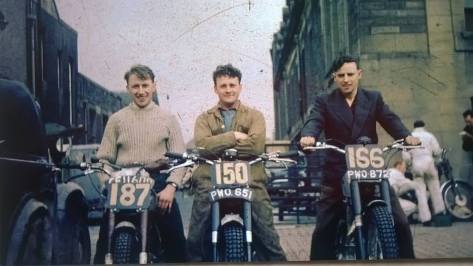
Alan King (346 – Royal Enfield); Don J. Page (348 BSA) and Norman Hawkins (348 BSA) at Gorgie Market on Sunday 5th May 1958 – Photo courtesy of Rhosalyn Price
Trials Enthusiast from Germany, Michael Ernst on his Ducati
Words: Michael Ernst
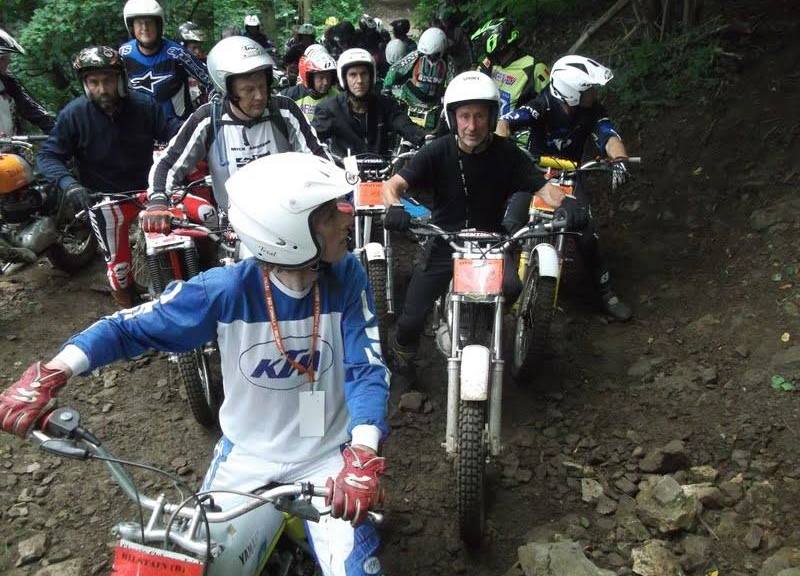
Bilstain, Belgium 2016 – Photo: Michael Ernst
If you want to go overseas to ride a Classic Trial, it is always nice to have two in one week. This is so you can spent a few days to relax, visit friends etc. A good week is always the last in July. This year it was 23rd/24th and 30st/31st of July. The first weekend was a round for the German classic-trial championship for pre‘65 and twin-shock in Hergenroth.
Hergenroth is located in the ‘Westerwald’ close to Montabauer and less the one hundred kilometers from Cologne (Koln).This is not a bad area to ride with your classic trials bike.
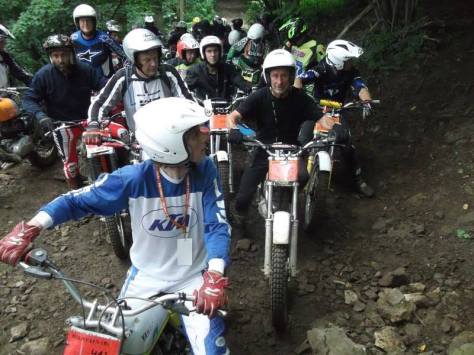
The Hergenroth weekend is very sociable with always a big entery of foriegn competitors. Every year, one-hundred and fifty or more riders compete here. The village is very small and mostly everyone is involved in the trial and the local firebrigade as well. The course is about five kilometers with ten sections and three or four laps every day, this depends on the weather.
Start on the Saturday is always at 13.00 hours and Sunday at 10.00 hours and it is a very laid back type of organisation.
You can turn up on the day and sign on then. You do not need any licence. However it is adviseable to have personal insurance to repatriate you back home. The ground has a bit of everything, nice climbs, nice wood sections, rocky sections in a quarry and some stream sections.
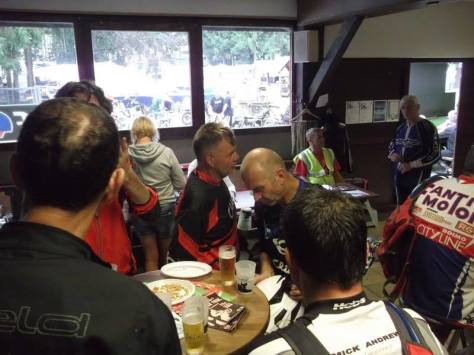
Every Day is a seperate trial. There are five routes, so that everybody can find the right one for himself or the machine. There is a clubhouse and a barbeque where you can get good food and drinks for the weekend.
A weekend later there is always the ‘Bilstain Two-day Classic Trial’ in Bilstain/Belgium what is a good drive of one hundred and sixty kilometers from Hergenroth. Bilstain is a round of the Classictrial Eurocup.The Trial is held on the ex-world championship ground from the 1970s and 1980s. It is a Off-roadpark with all his facilities such as: bar, resturant, showers, jet-wash, chalets (for 6 people) and basic rooms. The paddock is on the tarmac of the Supermoto track. As in Hergenroth, the entry can go up to two-hndred riders.
As in Germany, it is all laid back, no licence, sign on the day. Within the entry which is about 30-40 Euros for both days, mostly a drink, a snack, a Tee-Shirt or umbrella is included. The ground is in a valley with a stream and woods on the left and right side. So a bit of everything.
This year the sections were very old-fashioned. Classes are pre’65; pre‘78 and Twin-shock with four routes. Every day there are three laps about five kilometers long with ten to twelve sections and a time limit between five and six hours.
Both days count together.
If you like to ride in one (or both) of these events, here are a few links with information, details and pictures as well.
Website for Info’s for the Trial in Hergenroth
This is the website of Michael Ernst, who can help you with the regulations or any other questions. You can email Michael in english no problem: Michael Ernst link
This is the website from the Classictrial in Bilstain (Regulations, pictures, video’s and results) – Bilstain
Website of the Offroad park when you want to book accomodation: RDMC-Bilstain
…
The Scottish Six Days Trial is one of those events that every trials rider not only wants to take part in at least once in their lifetime, but to win it, well that is something really special.
Motorcycle manufacturers have entered works machines to the event with the sole aim of achieving victory, pure and simple.
Tommy Sandham, who has written four books on the subject, has asked me to undertake a tricky task – to find out how many SSDT winning machines still exist!
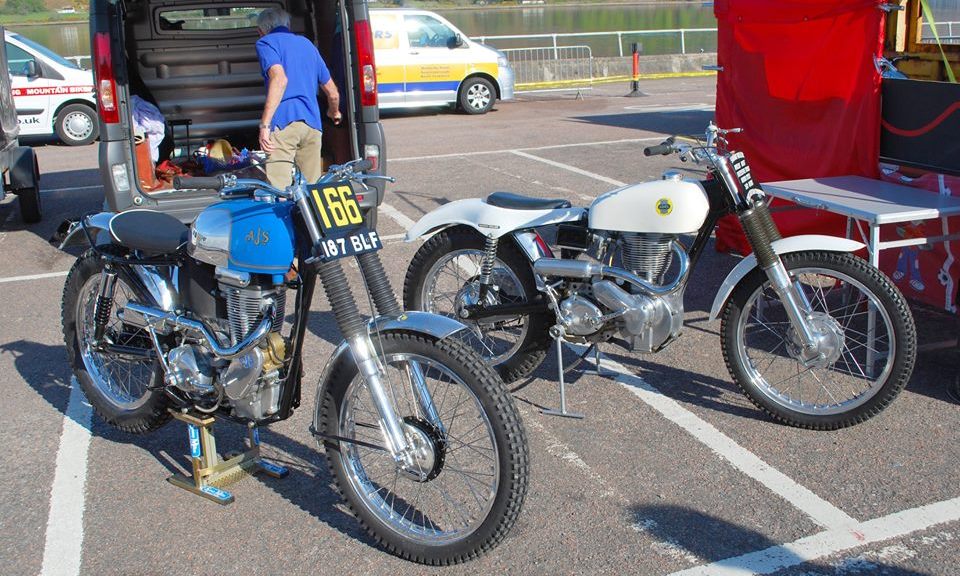
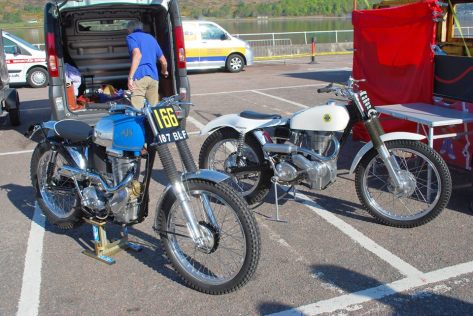
SSDT Centenary 2011 – Two of the most famous trials machines, of all time – 187BLF (350 AJS) which won the 1961 SSDT ridden by Gordon Jackson losing only one mark. GOV132 (500 Ariel) Sammy Miller’s famous machine that won the SSDT (1962 & 1964) – Photo: Iain Lawrie, Kinlochleven
We know of a few that are still around, these are as follows:
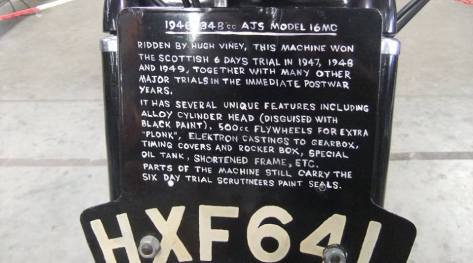
1946/47/48 – HughViney’s 350 AJS (HXF641)
Hugh Viney’s AJS with some details painted on the front plate of HXF641 as it is to this day – Photo: David Lewis, London
…
Hugh Viney’s factory AJS HXF641 on which he won three successive SSDTs post-war – Photo: David Lewis, London
1957 – Johnny Brittain’s 500 Royal Enfield Bullet (HNP331) – National Motorcycle Museum.
Now on Trials Guru, the second volume of Jimmy Young trials action in Jimmy Young – Take 2…
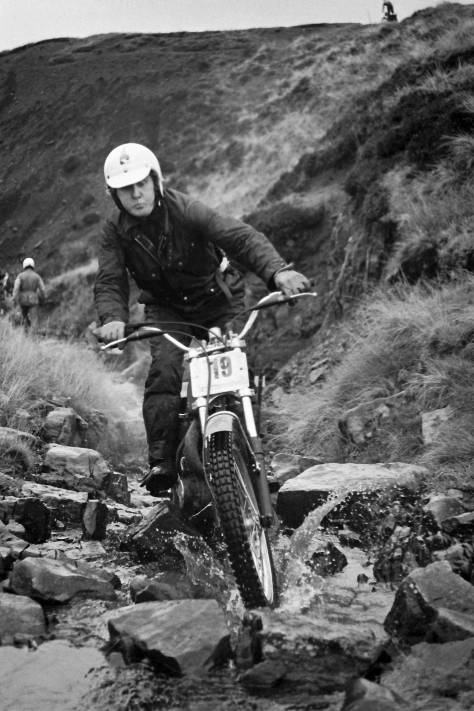
The late Jimmy Morton (J.D. Morton) motorcycle dealer and rider from Sorn, Ayrshire on a 325 Bultaco – Photo: Jimmy Young, Armadale
Featuring black and white images from the late 1970 and early 1980 era of Scottish trials.
Billy McMaster Jnr from Ireland was a regular competitor in Scotland when he worked for Olio Fiat. Here seen on his Lloyd Bros, Hamilton sponsored Suzuki – Photo: Jimmy Young, Armadale
Carlisle’s Billy Tiffen won the 1936 SSDT on a 343cc Velocette, here is Billy on Creag-An-Eilein in the 1954 event – Photo: Ray Biddle, Birmingham
New on Trials Guru, a special section dedicated to the North West corner of England from where came many exceptional competitors over the years. Read all about them in this new section of Trials Guru – Dedicated to the sport – no fees, no fiction, just facts and the sport!
World famous, the manual magnetic scoreboard of Charly Demathieu, wearing his Ecole de Trial Happy shirt provided by TRAP – Transfers Racing Adrien Prato
The Guardian of Trial Memories – Charly Demathieu
Thirty years in the world of trials, if one man has made his mark it’s the Belgian, Charly Demathieu. The absolute reference point for the scorecards at both the Belgian and Spanish Championships as well as all the World rounds, he is the true living memory of our sport. The guardian of trials history he has put his treasured archive on his fabulous website www.trialonline.org This is the story of an encounter with a genuinely passionate individual that does not only live by numbers.
“I was the first minder in the history of trials with Jean-Marie Lejeune.” – Charly Demathieu
“Trialonline has 4000 pages and almost all the results of all the big events since the birth of our discipline.” – Charly Demathieu
Words: Philippe Pilat; Charly Demathieu
Pictures: Eric Kitchen; Colin Bullock and private collections.
Who is Charly Demathieu?
Charly: “I was born on 12th June 1952 at Cheratte (North of Liege – Belgium), in fact I still live there. I followed my humanities course until the sixth year, which is the equivalent of ‘A’ levels in the UK. Then I got my driving licence and I became a truck driver for the Public Welfare Centre of Liege for whom I worked for twenty years. The centre later closed and I found myself as an archivist in a psychiatric hospital, completely different but really not an obvious career change at first but it was a very rewarding experience to live in contact with patients with severe drug and alcohol problems. I learned a lot through these people that we really do not need to be afraid of them, yet they frighten almost everyone … Another twenty years passed very quickly and for the last two years I have been a pensioner, but not quite retired!“
Before the computer revolution, the world trials series was covered by a 400 page book
Which is the source of your passion for trials?
Charly: “Oh, I feel a bit like Obelix, I fell into a tiny cauldron filled with a potion (passion!) for the magic of trials. Still in my pram, my mother often took me to see my godfather, Rene Georges, and my cousin Roger ride. Later there was one man who gave me a really genuine passion for the sport, Jean-Marie Lejeune (Eddy Lejeune’s elder brother). In 1975 I was a spectator at the Grand Prix held in Sommieres and Jean-Marie was looking for a driver to take him to the next round in Sweden. It started well and I was soon driving the Lejeune family truck to all the Grand Prix’s and once there I tried to occupy myself so I started making small rankings of the results.“
You rode trials in the seventies … why did you stop?
Charly: “I just rode as a Novice and then Intermediate but without any impressive results. In fact at the time I was especially fond of my road cycle. My claim to fame is that I was the first minder in the history of trials with Jean-Marie but my job was so very different from their current duties. I followed my rider between sections with my backpack filled with essentials as this was the time when motorcycles were much less reliable than today. I helped with repairs for Rathmell, Lampkin and Karlson. Solidarity amongst riders was much stronger than today. I was almost never seen in sections, I stood at the ends cards, ready to intervene if necessary. I watched the lines and rides of his competitors but I never set foot inside the section. I remember one time when Jean-Marie made me stand in the middle of a river with water up to my waist to mark the deep hole where he should not ride. We were very close to each other and then we lost contact for nearly fifteen years since I was often on results duty in Spain and rarely in Belgium. We met again by chance in 2011 during the GP of France at Isola 2000.“
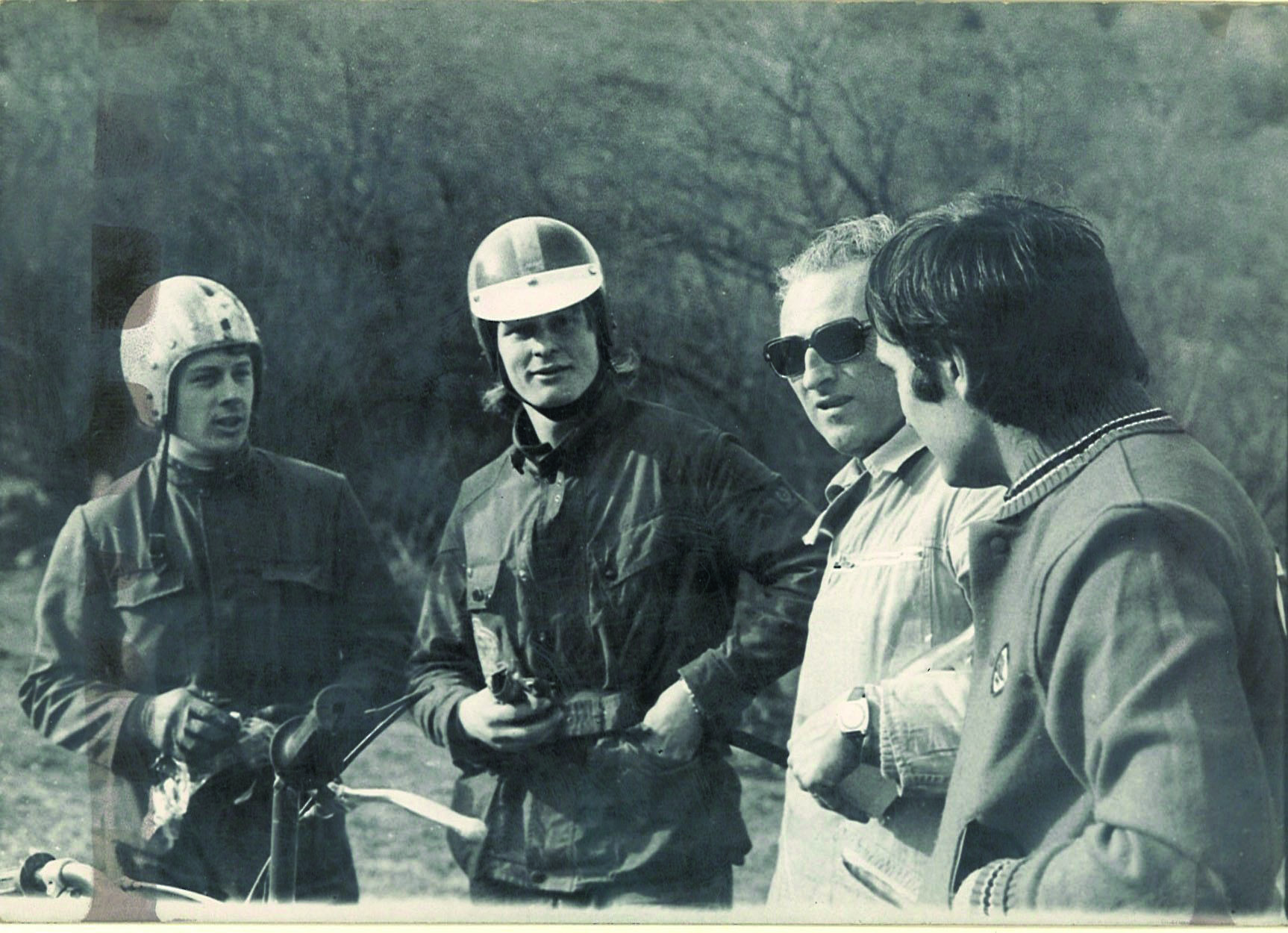
1970s shot of (from left) Jean-Marie Lejeune, Charly Demathieu and Jean Lejeune
How do you convert from competitor to official – organiser?
Charly: “I rode events for a few years. I drove the Lejeune family to all events using holidays that I could earn by working on other weekends of the year. For a long time I looked after the Belgian Championship but I finally stopped because it took me too much time. I was race director, timekeeper, starter and closer of the event too, you know the one who leaves after the last rider to remove and collect the section markers. I also worked with the setting out of sections; at the time we marked the inter-section route with methylene blue mixed with plaster. You finished the day blue all over; the colour did not want to wash off! I also managed entries for the GP’s, allocation of riding numbers; I standardised the various documents for the Championship so we could use the same media everywhere.“
You became the “Grand Vizier” of the scoreboard with your famous magnetic board?
Charly: “It was with Jean-Marie Lejeune that we came up with the idea of a magnetic board to display the scores but I did not actually put into practice until 1982. On one side there were the rankings of the day, on the other those of the Championship and I got to the final result by sliding my magnets up or down. I managed to calculate the score very quickly so when riders brought me their score card I put the results on the famous board and everyone could see where they had finished compared to their competitors in almost real time. I was doing all this alone at many events. At Bilstain for the Belgian GP I arrived with a large format magnetic board that I installed on the podium. The Italians asked me to do the same at their home round: I said yes, then it was the turn of the Finns … and I was away, I did it all over the world. It lasted nearly twenty years and then one day the truck of the Spanish Federation was stolen in Poland along with the famous scoreboard that was in it. I then finally moved onto the computer but suddenly I could not see the riders as I did before and I was no longer on the podium with the public: I was tapping on my keyboard in a corner.“
What is your current status? Are you an employee of the FIM, do you still work for the Spanish Federation? Charly: “I work for the FIM at the World rounds. I am in a team of three with Jordi Pascuet and Jake Miller: it’s a package imposed by the International Federation (FIM), it is not I who makes the decision to go or not to a particular GP. It may not suit the organisers who prefer to use the services of ‘locals’ who are more often than not very competent, but they do not calculate the overall rankings throughout the season. In addition we represent for them a significant cost. A few years ago I took my car and I went to the other end of Europe but with age I can no longer do things in the same way. So the organisers of the GP must support our airfare, accommodation etc… This represents a budget they would like to distribute down to the volunteers already in place. I did the same job for the Spanish Championship for eighteen years; I stopped only four years ago. I was away twenty seven weekends a year. Since I am a pensioner I have more time but there were still two years that I spent all my holidays to travel. I was always away but I loved it. I loved certain events such as the trial of Montmartre in Paris in the nineties. I found it wonderful to be able to bring trials machines here! They should have done the same thing in Barcelona. The urban trial at Cahor’s in France is superb it seems but I never went there. We must find a way to introduce trials to the public who know nothing of our discipline.“
What were the various stages or changes in your work?
Charly: “There came a time when I was forced to stop organising events in Belgium due to a lack of time, I was spending so many weekends at the Spanish Championship whilst working at the hospital in Liege during the week. I was often with Jordi Prat; it is we two who have defined the current format of the Trial des Nations. Before we took only the top three total scores of the four members of the team, later we decided to only take into account the three best results of the four teammates in each section. Our principle was tested and finally accepted by Ignacio Verneda then President of the FIM, it was he who insisted on my presence at each Grand Prix. That gave me more time to spend on the road.“
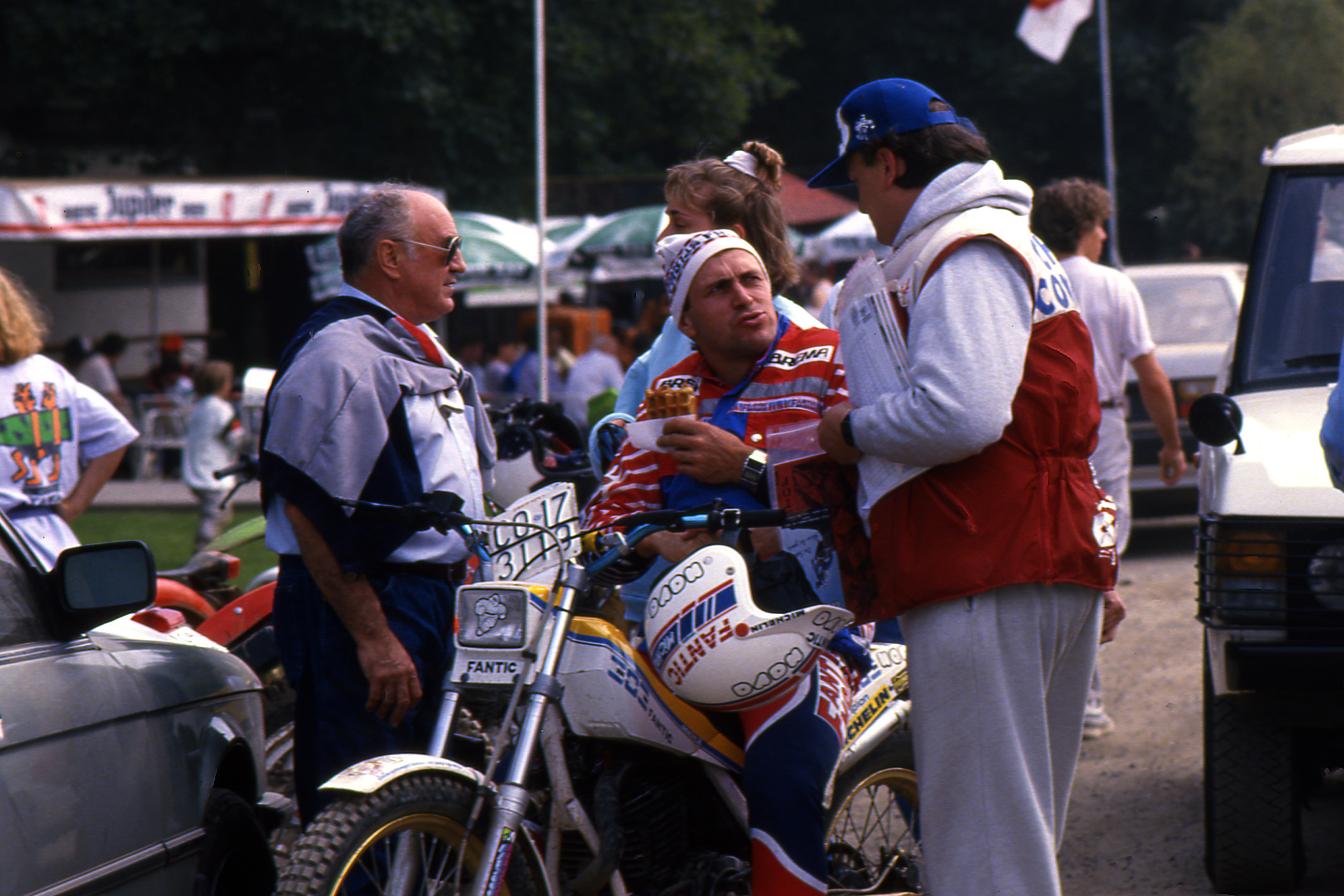
Charly explains the scores to Gas Gas UK boss, John Shirt Jnr at a world round
Any anecdotes, vivid memories?
Charly: “Many, inevitably, there are often amazing things that happen at a trial! For example at the GP of San Marino in 2008 when the local club wanted to refuse the technical controls being undertaken by the Italian Federation as it obviously did not please them, they had a real zealous approach, so they thoroughly checked all the dates of various documents (insurance, motorcycle registrations etc) of all foreign riders, it was a massive panic, as some of the riders feared they would be excluded from starting! Eight days later in Foppolo for the Italian Grand Prix, it was again the same controllers; they finished at lightning speed without any real checks. Still at the same event, we went back home on Sunday evening without being able to send out any results. Italian TV had saturated all internet connections; it took ten minutes to send an email of three words.“
1982 Scottish Six Days, Charly with Eddy Lejeune (Honda)
You created ‘Trialonline’ and have written dozens of books: you’re a pretty verbose boy!
Charly: “It is only for personal pleasure that I did all that. I’ve always loved creating stories from the passion that I witnessed. I have written fifteen books on Belgian, Spanish and World events, but I have even more to give. I have created a CD Rom containing all the results from around the world, which works in the same way as my website that I created at the request of the FIM in 2004. Since then I keep feeding Trialonline the results of trials in the most diverse countries such as Israel, New Zealand and even some South American countries. I update the results of the latest events even those held last weekend. You click on the flag of a country and you get the corresponding results, you click on the photo of a rider, you know his record. Trialonline has 4,000 pages through which we find almost all the results of all events since the birth of our discipline: it is only missing 21 ranking events! Sometimes it is very difficult to obtain results; I often prefer to speak to organising clubs rather than National Federations who are not really making big communication efforts in this area. You can find the results of the year, but not those from previous seasons! In France, it is Oliver de la Garoulaye who took the trouble to dig through the archives of the FFM to find the results since the first World round. Here I absolutely have all the results, but only thanks to fans like him, not because of the Federation.“
Charly chats to Thierry Michaud at the Belgian world round in 1988
What are your plans for the future?
Charly: “To finalise my archives, finding the 21 results I am still missing. I am also concerned about what will happen if I stop Trialonline work with the FIM. I renew the partnership each year, but I may not want to one day, it worries me to leave because there would be nobody to take it on after me. I’m also a big fan of Asterix: I have 600 volumes published in 42 different languages, I am very proud of my collection and I have some very rare specimens. I need to update my rankings for Trialonline; right now I’m working on a trial in New Zealand. I also plan a new grading program offering a choice between two or three rounds, a variable number of sections, all this is a lot of work.“
Takahisa Fujinami pops into the FIM Press office to say ‘Hi’ to his old friend Charly Demathieu
What is the state of health of Belgian trials?
Charly: “As elsewhere, is too often a single person who takes care of everything in his club and when this guy stops, the club dies. We also have the organisation related to ecological constraints that are huge in Belgium, much worse than your problems. For example, in the province of Liege, in the eighties, there were more than ten events per year, now we have only one quarter and in the rest of the country, it is the same problem. There is still a trial in Mons, Aywaille, and Bilstain and in Wavre and that is almost everything. You really have to go to private land such as Bilstain for young people to ride legally. This is the only way forward. Obviously the financial crisis is even worse for young people who have much difficulty in finding the budget to ride. It is certain that Belgian trials have seen better days.“
How do you feel about the disappearance of the GP in Belgium?
Charly: “This is something that really saddens me the as last GP was already six years ago and I look forward to the next one in Comblain-au-Pont close to Aywaille on the 13th July this year. At the last Bilstain round there was a strong divergence between the organisers and the FIM in particular with regard to the departure time. Since then the FIM does not want to go back. There was later a GP at Spa – Francorchamps in 2006 but that also ended badly. In the late afternoon there was an anti-doping control which lasted a long time and the prize ceremony could not take place until the test results were known. Inevitably the public became impatient and left without waiting for the podium presentation, the party was spoiled! It struck me as a tough decision as the results had been ready for a long time…. So I’d like to set the record straight, contrary to what has been said by many, it is not the fault of Charly Demathieu that there were no more Belgian GP’s! In 2007 the request by the organisation for a date was too late and the GP has not occurred since. This is obviously very unfortunate, if only because of the central location of our country, it is not such an expensive event for the vast majority of participants.“
If you could see the realisation of your three wishes, what would they be?
Charly: “To make the most popular trial by creating attractive and free to spectator trials, so not really like our current indoor circus … Reaching out to people I do not know and of course find the 21 results I miss between 1964 and today.“
Charly Demathieu “I love Yrjo Vesterinen, the first truly professional rider”. Vesty seen here at the 1981 Scottish Six Days in the paddock – Photo: Colin Bullock/CJB Photographic
What else would you want to say?
Charly: “I wanted to tell you about my favourite riders. Obviously there is Jean-Marie Lejeune but Mick Andrews for his ability to adapt quickly to different machines whilst remaining competitive. I love Yrjo Vesterinen, the first truly professional rider. I also appreciate Fujinami as he is someone who respects everyone and always passes by to say hello. Thank you and hello, they cost nothing, but it is important to all the hard working enthusiasts who create our sport. I would also like to take my hat off to people who have the courage to write about trials.”
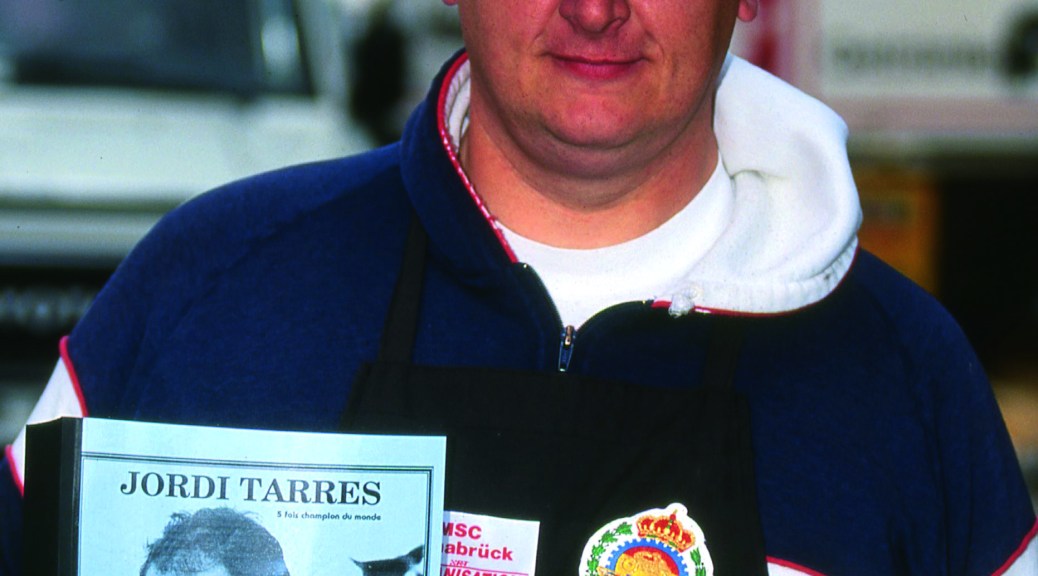
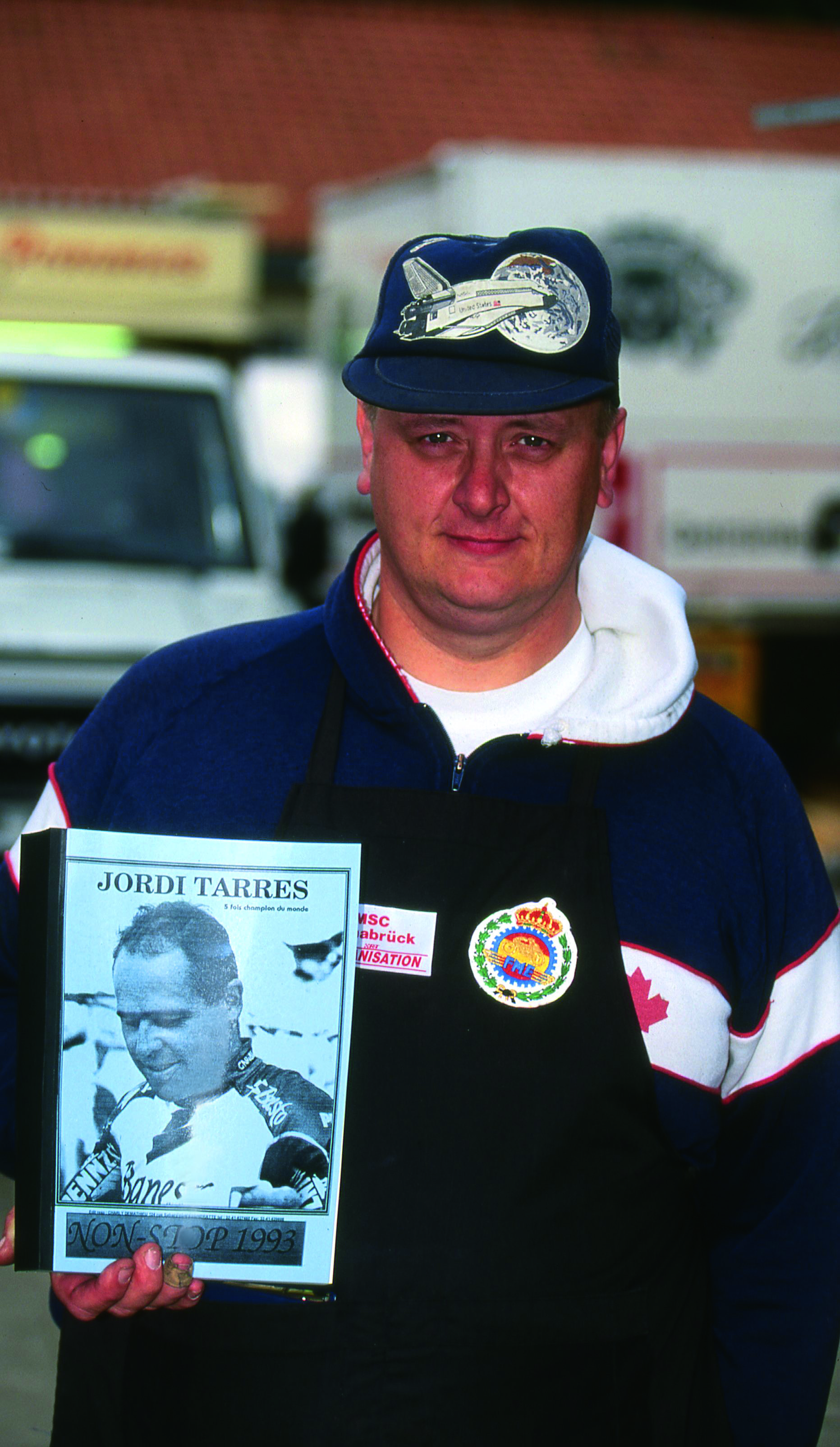
Charly Demathieu, happy in his work
This article was first published in Trial Magazine, France and we thank them for the cooperation and use of this article.
For Charly Demathieu’s Trialsonline website – HERE
Apart from ‘Fair Dealing’ for the purpose of private study, research, criticism or review as permitted under the Copyright, Design and Patents Act, 1988, no part of this article may be copied, reproduced, stored in any form of retrieval system, electronic or otherwise or transmitted in any form or by any means, electronic, electrical, mechanical, optical, chemical, photocopying, recording or otherwise without the prior written permission of the author as stated above. This article is not being published for any monetary reward or monetisation, be that online or in print.
The Premier Trial Website – Recording the History of the Sport 'Established 2014'



















 TRIALS GURU - DEDICATED TO TRIAL