A film made by C.H. Wood (Bradford) Ltd for YAMAHA MOTOR Co on the 1973 Scottish Six Days, featuring MICK ANDREWS.
Thanks to Ferry Brouwer, former Yamaha Racing Technician and Arai Europe, for posting this film on YOUTUBE.
A film made by C.H. Wood (Bradford) Ltd for YAMAHA MOTOR Co on the 1973 Scottish Six Days, featuring MICK ANDREWS.
Thanks to Ferry Brouwer, former Yamaha Racing Technician and Arai Europe, for posting this film on YOUTUBE.
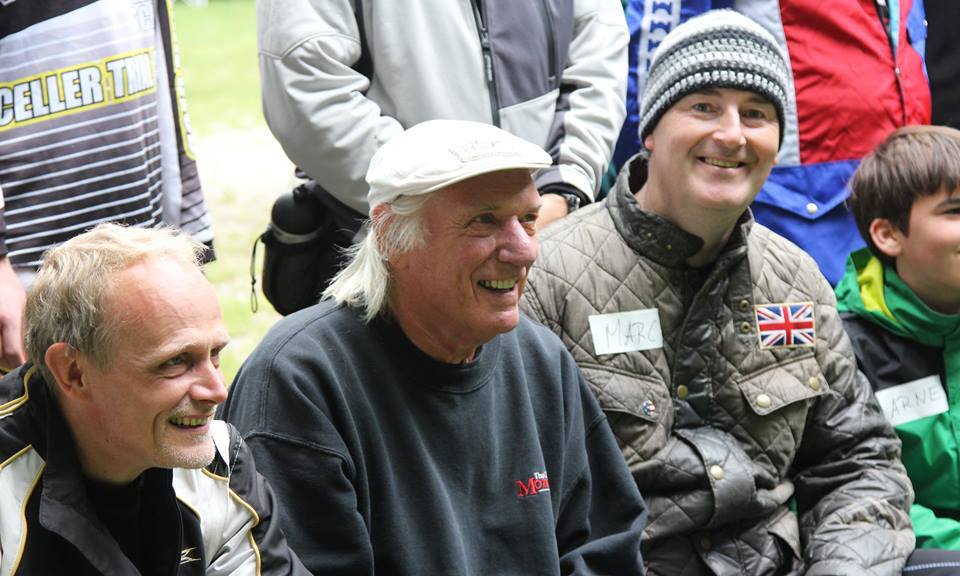
Recently, we created a Trials Guru ‘section’ on Colin Bullock who has been taking trials photos for many years and we were proud to feature some of his most excellent images. It was when we were studying one of Colin’s photos from the 1985 Scottish Six Days of Steve Saunders on his Honda Britain supported RTL250 Honda. In the photo was a man well-known to Trials Guru’s John Moffat, that man was Bob Paterson, former Scotland and Northern Ireland Sales Executive with Honda motorcycles and power equipment.

Bob Paterson, known as ‘Big Bob’ to the Scottish trials community of the period was a keen trials rider of the old school. He was a stalwart of the Lanarkshire Motor Cycle & Car Club which is based in west-central Scotland and had a history as being a scrambles and trials club which could trace it’s roots back to the 1930s. In the early days it was a joint club, for motorcycles and light cars.
The Lanarkshire MCC was the first Scottish motorcycle club to organise ‘scrambles’ events.

Back in 1998, John Moffat was writing some articles on Scottish motorcycle personalities for a magazine and visited quite a few former riders to get their story. These riders included Ian Bell, John Davies, Jackie Williamson and Bob Paterson. They were all people that knew John well, through his father T. Arnott Moffat, secretary of the Scottish ACU.

Bob Paterson had by this time unfortunately passed away, but Moffat went to visit his widow, May Paterson at her home at Luggiebank, near Cumbernauld. Moffat had also by this time started collecting material for his first book which was to be called Scotland’s Rich Mixture, Memories of Motorcycle Sport 1945-1975. May Paterson has since passed away.

Bob Paterson was brought up in Glenmavis, a village in North Lanarkshire two miles north-west of the town of Airdrie. He took up employment at Watson Brothers in Airdrie and was a faithful employee for thirty-eight years before moving to Honda of which Watson’s had a dealership in their Cumbernauld branch.
It is believed that Bob became frustrated with Watsons when a promise of a directorship in the family run business failed to materialise. Paterson resigned, moved on and became the Scotland and Northern Ireland Sales executive for the Japanese car and motorcycle giant. Bob was a well-known face amongst the motorcycle trade, he was a valued sales-person with years of experience gained in a busy motorcycle then a large Vauxhall-Opel multi branch dealership.
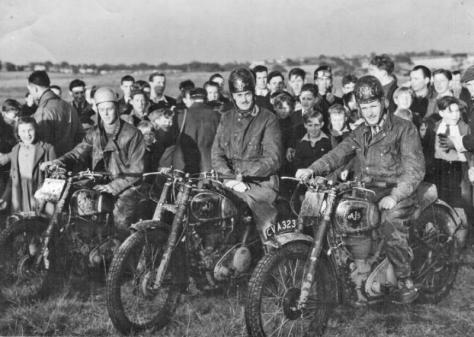
Bob and May had a daughter, Shona and son Robert Junior, but they also adopted May’s younger brother, Kenneth who had been orphaned when May’s parents died suddenly. A very difficult decision to make for a couple, but ‘Big Bob’ and May just took it in their stride.
Paterson rode in both scrambles and trials, he had a particular liking for ‘colonial’ type trials which would form the basis of time-trials and latterly enduros. His favourite was the Edinburgh St. George Colonial Trial at Gifford, East Lothian. He rode several Scottish Six Days trials and rode in the 1952 Scott Trial on his 350 Matchless (HSG211).

Paterson was a great supporter of the Scottish Six Days, he had ridden the event, his first being 1950 course marked it in the 1960s and was an SACU steward in the 1970s. He sat on the International stewards jury when the event was at it’s pinnacle and was over-subscribed and all the factory riders had it written into their contracts that they rode the Highland classic.
Bob for many years assisted in the course marking from Stirlingshire up over Fersit to Fort William, a run he thoroughly enjoyed either on his own Matchless G3C or a machine supplied by the Edinburgh & District club.

Paterson enjoyed setting the course for the Lanarkshire MCC’s annual Valente Trial held at Kilsyth, he used his Matchless to set the moor and road work for the event which had a lap of approximately 15 miles.
Bob was elected President of the Scottish Auto Cycle Union upon the retiral of the haulage firm owner from Markinch, Fife the late Jim Birrell, Bob held the post until 1983.

He was asked by the SSDT Secretary, Jim McColm in 1983 to write an article for the official programme when he was president of the Scottish ACU, in it he wrote a fascinating account:
“I feel priviledged to be asked to write this article for this years’ Scottish Six Days programme and probably like many contributors before, find it difficult to begin. As a layman at this kind of task, I feel hopelessly inadequate to try and put into words the feeling one gets in attending the SSDT. Be that as it may, there is no doubt if one rides or even attends the Scottish, forever after come hell or high water, the first week of May will be reserved for the Sporting Holiday in the Highlands or as the late Allan Jefferies once described it ‘A religion or an incurable disease.
It was 1950 before I had the good fortune to enter the SSDT and as over the previous few years I had listened awestruck to older hands talking and reminisce regarding this great event, the big day rushed nearer with all the attendant forms, what with signing up for oil and petrol etc and then obtaining my international licence. I was beginning to feel taller than my then 6′ 1 1/2 ” frame. Finally being allocated riding number 53 only one place behind the great man himself, High Viney at 52.
This was to prove a great benefit, for B.H.M.V actually came over and spoke to me at the weigh-in and from then on throughout the week I felt quite at home. The fact that I was to lose 100’s of points to his tens or was it single figures? Didn’t matter.
When the great man took the time to advise and follow him, like getting up onto the pegs and into top and blasting over the Mamore Road it made it feel like a main road compared to my 1st and 2nd gear slitherings, prior to his advice.
Sometimes the lessons learned from the big boys were well driven home certainly I never forgot one occasion when after leaving Altnafeadh and heading down the main road for about 46 miles to Camushurich on South Tayside past Killin, I found myself at the front of a long line of the big names and feeling quite proud to be heading a procession of about a dozen machines in close company, that was until I spluttered to a near stop and had to go on reserve with the string passing and waving their thanks for the tow, probably getting them to a lonely pump somewhat short of Lix Toll
Those were the days of course when the petrol and oil tankers followed the route of the trial and one drew alongside when suction pumps emptied the 4 stroke oil tanks, replenished with fresh oil and tanks were topped up with petrol. The International flavour created by the properly sited tankers and trade barons in those days were much better than many varied vehicles we see today, spread all over the countryside to give the necessary support to their riders. it is a great pity that the petrol barons have withdrawn from our sport and of course new legislations also prevent some of this assistance.
Within days of the trial the newcomers are seen in close contact with the stars and while today I’m sure some of the big names are easy to converse with and obtain some guidance, there can be no doubt the stars have more pressures, with all the backing, sponsorship and manufacturers to contend with than in earlier times.
As trials are no longer a British sport but International, we can now gauge the strengths and expertise of our overseas visitors by their performance over the pas few years and one never ceases to be amazed by the severity of sections we now see in national and World rounds of our trials sport.
The Edinburgh & District Club have managed to accommodate this welcome involvement from our overseas and home top runners and yet provide possible sections which continue to ensure a fully subscribed entry, made up in the main from club riders and most importantly newcomers.
It may be that a special section per day to fully test the top runners will soon be required and the rest of the sections something less than the crankcase breakers we are now seeing in World rounds, whatever is decided I’m sure the E&D will live up to the test, requirements and pleasures the Scottish has provided over the years.
One could not exclude from this article the efforts, work and hours the organising committee put into the running of this event, from the many long, hard, wet, snow covered and just occasionally dry weekends covered by the scouts who are out and about in the area of the trial on motor-cycles, visiting landowners, looking at new hills etc. and during the trial out marking the hills, to the hard pressed office staff in getting the results out as soon as possible. All their efforts must of course be assisted by the voluntary observers and other officials during the week, ready and willing numbers of people to fill those duties are always available and speak volumes for the popularity of the event, Having experience on most of those duties, i.e. to route marking and back marking, I can recall, as this years assistants will, the pleasure of getting back to the Hotel, having a bath, catching a meal (sometimes) and as in the past, off to the bar for a small talk of the day.
Having had previous experience as a steward of the trial, I wish this years’ jury a good trial with not too many nights on duty into the ‘wee sma hours’ and above all trust that our secretary of the trial, Jim McColm keeps his cool as usual and has yet another successful trial under his belt.
I look forward to being with you all this year in Fort William and trust that our Scottish greeting of haste ye back will be remembered as the first week in May keeps coming around“.
In the 1980s he was a spectator, but also a Honda representative and took an close interest on the Honda factory riders of the day, especially Eddy Lejeune and Steve Saunders. Bob would be found standing silently wearing his deer-stalker style hat at the side of many of the sections eagerly awaiting the arrival of the Honda mounted riders. He would continue to watch the riders walk the sections and then ride them. Bob enjoyed a small cigar called a cigarillo and would smoke one while waiting for the riders to arrive.

On quite a few occassions in later life, Bob would take his specially imported 1976 Honda TL250 up with him to the SSDT to observe and used the machine as transport instead of his car. Often he rode around to follow the trial for a number of years with fellow SACU man, Adam Brownlie, but never off-road.
There was a rider called Fransisco ‘Paco’ Nistal who came over to compete in the SSDT in 1986 from Guatemala who stayed with the Macgillivray family at Muirhearlich just outside Fort William. He was having trouble coming to terms with the machine he had entered for the event and wanted to buy a Honda RTL which was a machine in short supply. Alastair Macgillivray mentioned this to Bob Paterson, who knew Tom Robinson of Robinsons of Rochdale, a main Honda dealer and one of a select few chosen by Honda UK to handle sales of the specialist machine. Robinson’s happened to have a brand new RTL250S in stock. The RTL was sent up to Scotland for the Guatemalan to ride, all due to Bob’s interaction.
The Pre’65 Scottish Trial accepted a trophy from his son Robert and widow, May to remember Bob and his significant contribution to Scottish motorcycle sport. Called ‘The Bob Paterson Trophy’, it is awarded annually for the best performance of a competitor riding a machine up to 500cc.
Article Text Copyright: Trials Guru / Moffat Racing – John Moffat 1997-2016
Photos:
– Photo Credit: Sandra Fowler
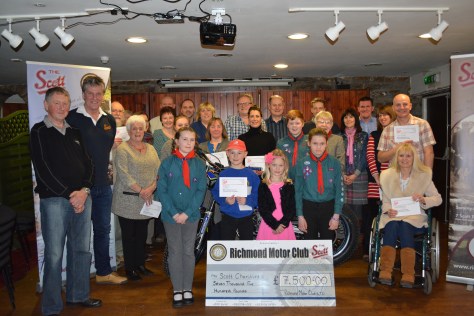
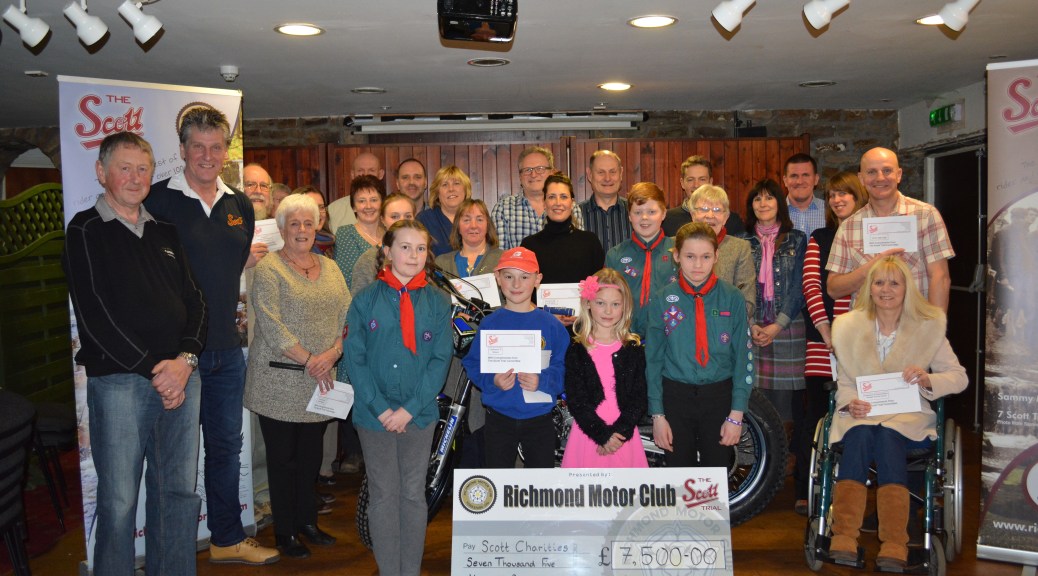
The Scott Trial 2015 winner Ian Austermuhle travelled from his home near Malton on Friday 26th February to the Buck Hotel in Reeth, North Yorkshire to present the cheques at the Scott Charity Presentation Evening .
Ian explained that it is every trial riders dream to win at the Scott which is undoubtedly one of the toughest trials in the world and definitely one of the riders favourites. Ian finally lifted the trophy on his 19th attempt.
Ian and his wife Beth were presented with a small gift by Callum and Chloe Fowler, members of the very popular and growing Youth Section of Richmond Motor Club who organise trials and training days for over 100 members aged from four years upwards.
On the evening John Fraser, the Scott Chairman introduced the recipients, several of whom said a few words about how the money helped their charities including an excellent speech given by Sam Watson representing ‘Just The Job’, when he explained how the charity has helped him and how much he enjoys going to work there.
This year a total of £7,500 was presented .
This amount is significantly less than usual because of costs involved for renewing the planning permission for another five years with the Yorkshire Dales National Park Authority to hold the event in the areas under their control. The Scott Trial has raised in excess of £150,000 since Richmond Motor Club took over the running of the trial in 1991.
The list of recipients are as follows (in no particular order):
Swaledale Scouts; Swaledale Mountain Rescue; Friends of Reeth and Gunnerside Primary Schools; Reeth and Gunnerside Schools fund; Ravensworth Primary School; Arkengarthdale Primary School; Yorkshire Air Ambulance; Great North Air Ambulance; Leyburn Primary School; Reeth Young Farmers; Swaledale Seedlings; St John’s Centre Wednesday Club; RABI; Friends of the 2 Dales Nursery; Hambleton & Richmond Multiple Sclerosis Society; Swaledale & Arkengathdale Luncheon Clubs Association; Richmond Cricket Club – Youth & General; Moorland Association; St Teresa’s Hospice; DELTA; Holmedale Pre-School; Wensleydale Rugby Club Development Fund; Gamekeepers Welfare Trust; ACU Benevolent Fund; Just The Job; The Robert Dent Fund; Richmond Rugby Club; Homestart; Marrick Parish Institute; The Mowbray Suite at the Friarage Hospital and the Alistair Bullen Aromatherapy Fund.
We have added more photos to our special ‘section’ on trials in the North East of England.

More photos from Jaxx Lawson and a new contributor, Ray Crinson who was a very good North east rider in the 1970s and 1980s. father of current rider, John Crinson.
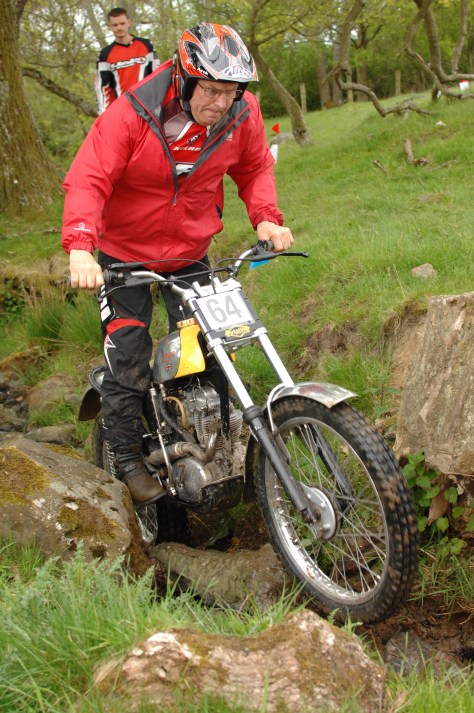
So have a look and see what we have been doing!
Coming soon to Trials Guru, an article taken from the Trials Guru’s original notes made in 1999 on the life and times of trials rider and former SACU President, Honda Motorcycle & Power Sales Manager for Scotland & NI – Bob Paterson.
The Highland Classic 2 Day Trial in Scotland has been overwhelmed with entries this year.

The trial is organised by the go-ahead Inverness & District Motor Cycle Club Ltd at the highland shooting estate, Alvie which is situated four miles south of Aviemore.
Originally an idea of club chairman, Malcolm H. Smith as a Pre’65 event back in 2003 for Scottish riders who were unsuccessful in obtaining an entry for the Pre’65 Scottish, it was increased by taking in twin-shock entries in 2005 and increased to a two-day event the same year.
In 2013 the introduction of a ‘guest of honour’ from the sport of trial saw Yrjo Vesterinen and the Bultaco team from the 1970s seriously increase the events profile and the number of riders fill the 130 maximum.

Last year the entry was closed only five days after opening, such was the event’s popularity. The guest was former Greeves rider Bill Wilkinson and in 2014 it was Dave Thorpe. The 2016 is the ‘Yamscot’ Edition with former Yamaha factory rider and five times SSDT winner Mick Andrews who will ride a specially prepared Yamaha TY twin-shock.
Entry Secretary Rick Lound has been swamped by entry forms this year. “I live way out in the countryside and the postie has had more envelopes in one day than he has all week!”
Yorkshire born Lound has taken over the task this year from Inverness man, Dave MacKay who steps down after 28 years service to the club.
Chairman, Malcolm Smith is a gun-dog trainer and estate shooting consultant who has close ties with the Alvie Estate and the Highland Field Sports Association.
Smith said: “We have been aware that our trial is becoming the event to take part in, but we have to limit the entry to ensure that the infrastructure can cope. We are quite a small club which punches above our weight. We have a small team of enthusiasts that are keen to keep the trial popular and to live up to it’s title as the friendliest classic trial in Scotland and probably now the United Kingdom”.
Malcolm continued: “We are all proud of the event and more importantly so is the Alvie Estate Laird, Jamie Williamson and his staff. The clerk of the course has no intention of increasing the events severity, we have a winning formula and have no plans to change that. We are keen to make only detail changes to enhance rider experience of competing on ground that is usually preserved for hunting and shooting activities”.
At the time of this report, the entries officially closed on Tuesday, 23rd February and was oversubscribed by over 50%. An entry list will be released by the club after competitors are all advised of their entry being accepted.
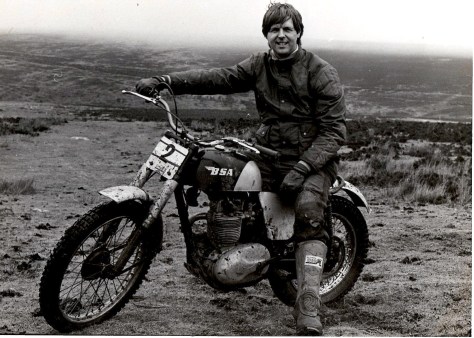
A new ‘section’ on Trials Guru – Bullock at Large
Well, not exactly!
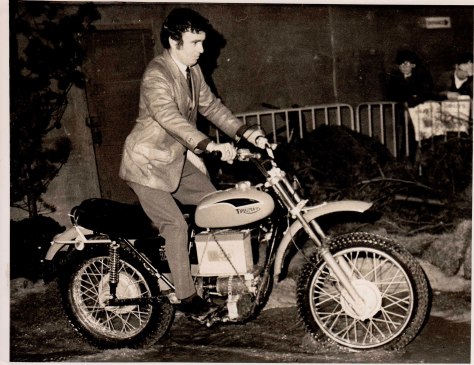
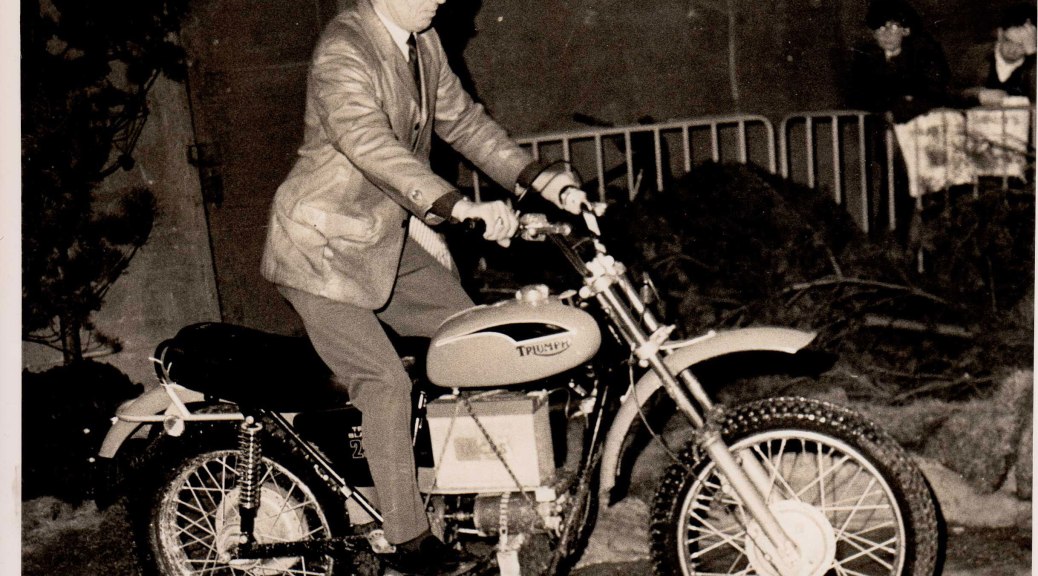
Here is a photo of well-known factory Yamaha, Honda and Bultaco road racer Tommy Robb back in 1971 on an electric trial bike at the Earls Court motorcycle show.
Tommy wonders if this was the first ever electric trials bike that perhaps inspired the current trend towards electric power?
If it isn’t, then it’s a great old photo to see how the future was shaped.
It appears to be based on a Triumph 250 Trophy chassis with an electric motor and a battery bungee tied into the frame. Compare it to the current electric bikes that are now on sale to see how technology has progressed in the last 45 years?

Mike Rapley has been beavering away sorting out some of his fantastic images of trials taken almost 40 years ago, this time it’s the 1978 British Experts Trial.

Trials Guru is proud to present more of Rapper’s photographs on Recalled by Rappers and Chairman’s View.
Still more mouth-watering photos to come from the UK’s top trials journalist.

The Inverness & District MCC have announced that their special guest of honour for the 2016 Highland Classic Two Day Trial on June 11 & 12 – ‘THE YAMSCOT EDITION’ will be former Yamaha factory trials rider, MICK ANDREWS. They will be paying homage not only to the ‘YamScot’ effort from the mid 1970s by Shirlaws Motorcycles, but also to the rider who won five Scottish Six Days Trials, two of them Yamaha mounted. Having moved from the Spanish Ossa factory, Andrews rode special factory OW series machines, which led to the development of the production TY series twin-shock bikes that were used by ‘YamScot’ riders in Scottish events. Shirlaws’ owner Leslie Shirlaw formed the YamScot team to promote Yamaha machines in Trials, Motocross and Road Racing. Mick Andrews will enter into the spirit of the trial by riding a suitably prepared Yamaha machine at Alvie. – Entry forms will be released and available on 20th February, 2016.
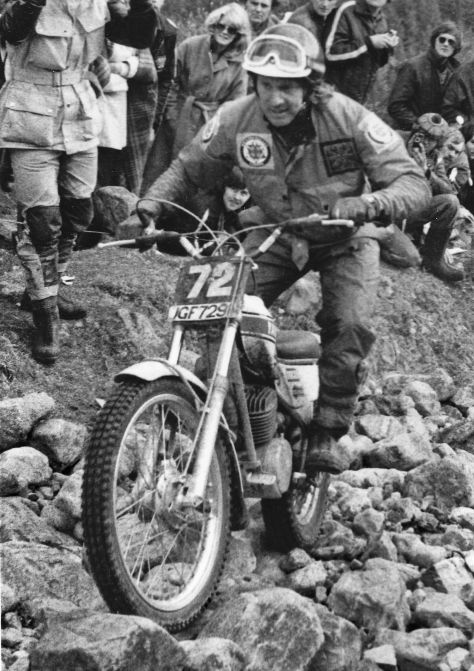
The Highland Classic was started in 2004 as a one day event for pre’65 machines at the highland shooting estate, Alvie. The second year entries were increased by the addition of twin-shock classes and finally in 2006 it was extended to a two-day event. The event has gained popularity, but entries became very sought after from the 2013 event, with the introduction of the special guest of honour feature, which is very popular with riders and the estate management who always have a representative present for the ‘address of the trial’ with some short introductions and speeches led by a welcome from the owner of Alvie & Dalraddy Estates himself, Laird Jamie Williamson. The event has been over-subscribed since 2013.
Previous Highland Classic guests of honour include Yrjo Vesterinen (2013); Dave Thorpe (2014) and Bill Wilkinson (2015).
Entry forms and regulations will be released by event secretary, Rick Lound on Saturday 20th February. Last year’s competitors will be sent forms by post, but they will also be available at Telford on the Classic Trial/Trial Magazine UK stand, The Putoline Oils stand and the Inverness & District club website (www.idmcc.co.uk).
Support for the event has been promised by both Classic Trial Magazine and Putoline Oils UK.






 TRIALS GURU - DEDICATED TO TRIAL