Dedicated to the hardest motorcycle trial riders can take part in, the Scott is regarded as an annual classic. One route for all, fastest rider sets standard time. All in the Swaledale, North Yorkshire.
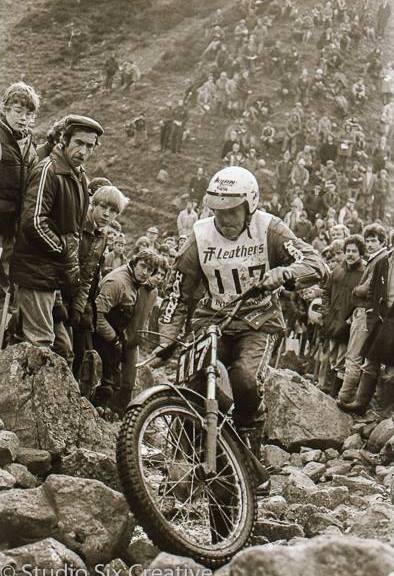
Rob Edwards on Blackwater in 1977. One of a number of photographs from Iain Lawrie that have never before been seen. Exclusive to Trials Guru. Copyright: Iain Lawrie, Kinlochleven.
Trials Guru friendly photographer, Iain Lawrie from Kinlochleven has just unearthed a number of photographs taken at the 1977 Scottish Six Days Trial. Many thanks to Iain for allowing Trials Guru to publish these.
Yamscot was the Competition and Racing section of Aberdeen’s Shirlaws dealership in the 1970’s.
The annual Highland Classic Two-Day Trial for 2016 will be held on 11/12 June and will pay homage to Yamscot, the competition part of Shirlaws Motorcycles, Aberdeen back in the 1970’s.
The brainchild of the late managing director, Leslie Shirlaw, it was created to promote Yamaha off-road and racing in Scotland. At the time Shirlaws were a Yamaha dealer, nowadays they are main Kawasaki dealers.
It is hoped that a glittering display of Yamaha trials machines will be at the event as well as some of the original Yamscot supported trials riders.
Yamscot were involved in trials, motocross and racing over a ten year period.
The event, promoted by Inverness & District Motorcycle Club Ltd will be held on the Alvie Estate, near Aviemore and the identity of the Guest of Honour will be announced nearer the event.
The trial itself was over-subscribed in 2015 and entry forms will be released for the 2016 event on 20th February.
2016 will be the 11th time the event has been run as a two day trial, the first year, 2004 was a one-day affair.
Previous Guests of Honour at the Highland Classic include Yrjo Vesterinen (2013), Dave Thorpe (2014) and Bill Wilkinson (2015).
The event is open to ACU,SACU & MCUI trials licence card holders and cater for both Pre’65 & twin-shock trials machines.
Stop Press: 2016 Guest of Honour – MICK ANDREWS
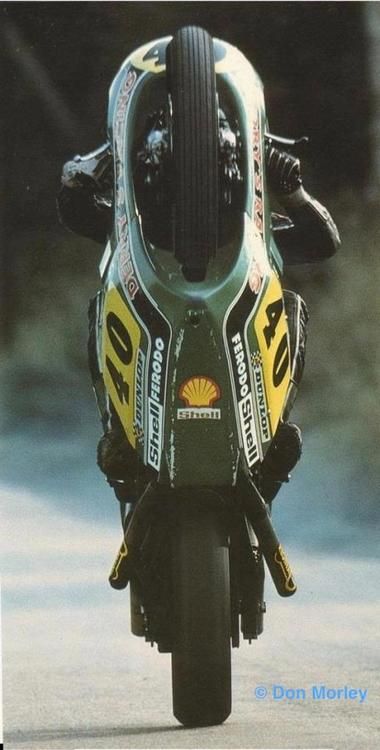
Roddy Taylor’s generously sponsored Yamaha TZ racing machine from 1987 (Yamscot) | Photo copyright: Ronnie Weir, Edinburgh.
Don Morley riding his ex-works 250cc Greeves Anglian in the 1995 Pre’65 Scottish Trial. Photo Copyright: Iain Lawrie, Kinlochleven, Scotland. When Don Morley was made aware of this very image, he was keen to obtain a copy and willing to pay for it. Iain Lawrie immediately provided Don with a copy with his compliments!
Words: Trials Guru
Photos: Don Morley; Iain Lawrie & John Knight
Trials Guru recognises the talents of a man from Redhill, Reigate in Surrey who has brought literally thousands of wonderful and exciting colour sporting images into magazines, periodicals and books the world over. His name is Don Morleyand what’s more he’s a trials rider! Well actually, Don is a frustrated road racer at heart as he didn’t have the funds available to race when he was a young man, so took up trials riding instead, being the less expensive motorcycle sport option!
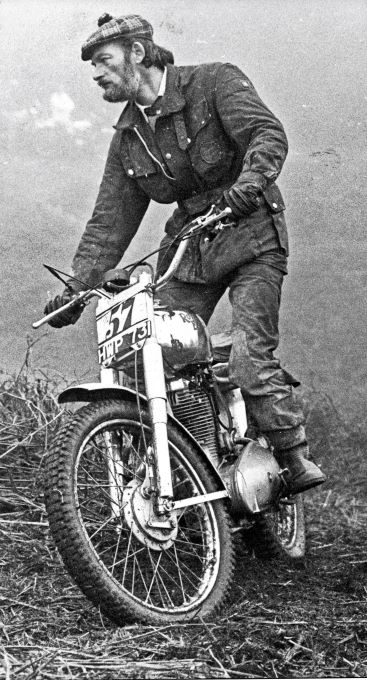
Don Morley aboard his 1949 ex-factory Royal Enfield (HWP731) – Morley is an acknowledged expert on the marque. (Photo supplied by Don Morley for this article from his personal collection)
Described as the ‘Godfather’ of sports photography by Fast Bikes Magazinein the article they ran on Don in their September 2010 edition, Morley is respected the world over by riders, athletes and team managers because of his uncanny ability to press the button just at the right moment.
Raised in Derby, Don started taking photographs for a living in the 1950’s when it was all glass negatives, progressing to processed roll film. He began his motorcycle photography as a staff photographer with Motor Cycle News in 1957.
Morley is a 100% professional sports photographer, joining forces with Tony Duffy’s “All-Sport International Photographic Agency/Don Morley” in the 1970’s, his images of sporting events and competitors are highly sought after around the globe.
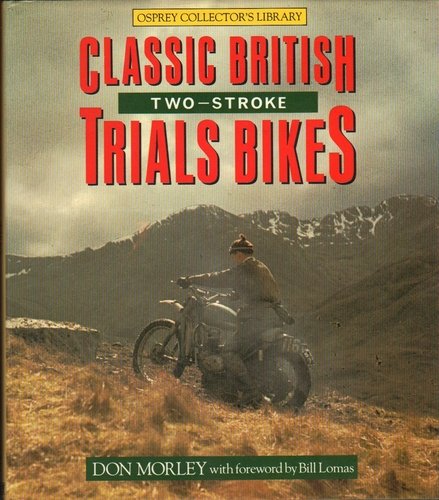
Puiblished by Osprey, Don Morley’s book on Classic British Two-Stroke Trials Bikes is a much sought after publication. Truly a collectors item now.
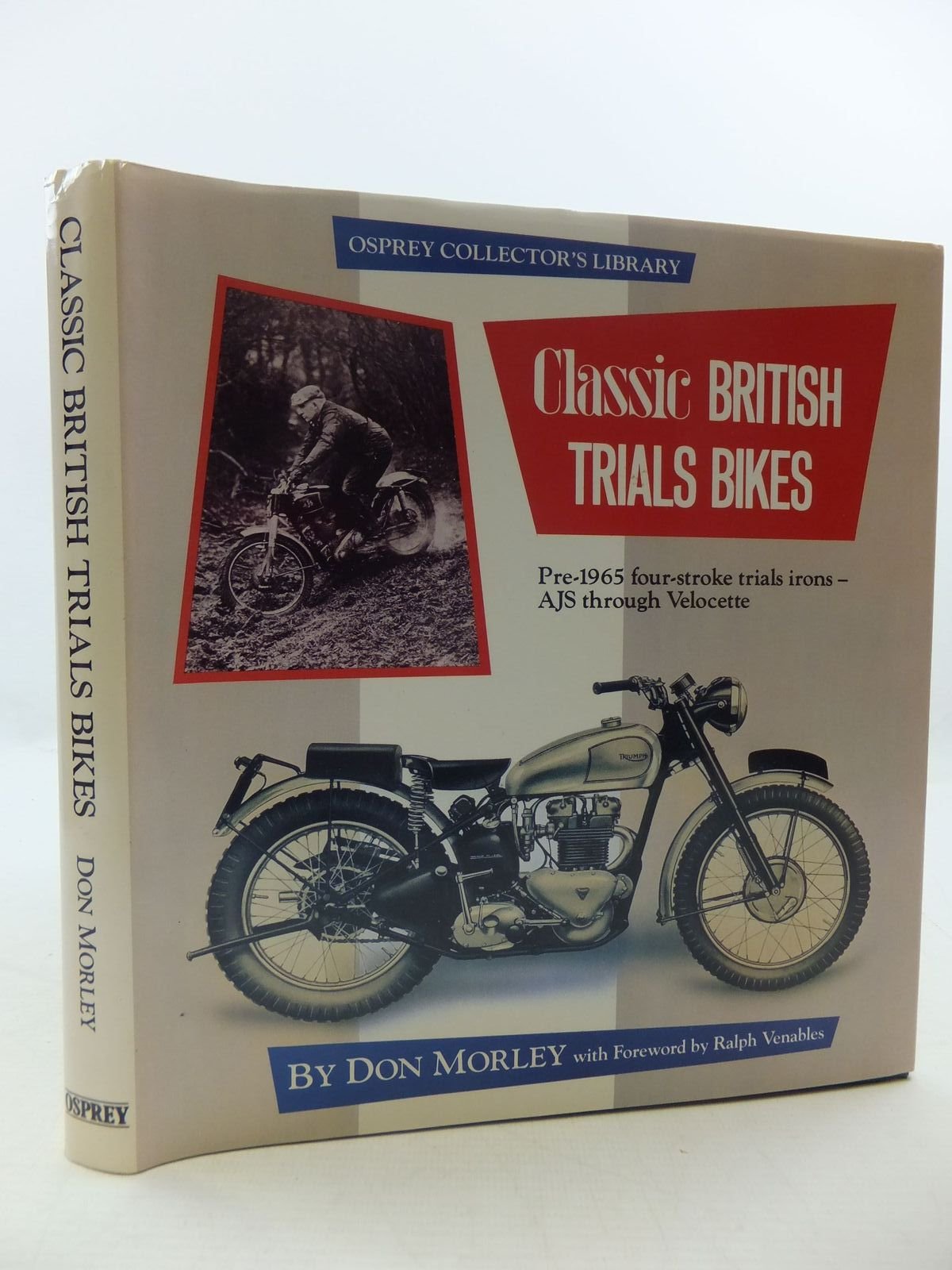
Don is also an accomplished author, writing several books which include: Classic British Trials Bikes& Classic British Two-Stroke Trials Bikes; Spanish Trials Bikesand Trials: – A Riders Guide, to name but four!
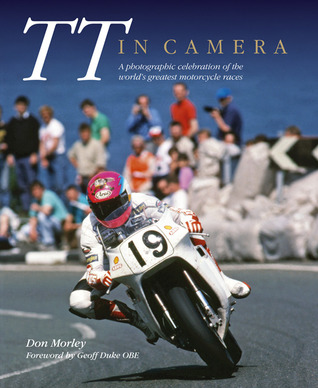
Published by Osprey in 1984, Don Morley’s Classic British Trials Bikes book was a top seller. Original copies fetch high prices to this day.“TT – In Camera”, One of the many titles written by Don Morley over the years, with foreword by Geoff Duke.
Morley has photographed many events, not just sporting events, witnessed the Munich Olympic Games terrorism atrocity to name but one major international incident and much, much more. He has had a varied and interesting life as a sports photographer.
Don has owned several ex-factory trials machines in his time as a rider, including the Johnny Brittain Royal Enfield 500 Bullet HNP331 and another ex-factory Enfield, LUY86. He appeared in the BBC TV series, ‘Perpetual Motion’ in an edition which covered the Royal Enfield and Enfield of India story in 1992. Morley is an acknowledged expert on the Royal Enfield marque. He built a few special trials machines including a BSA B40 and also wrote a series of articles on the development of four-stroke trials machines for the ‘Classic Motor Cycle’.
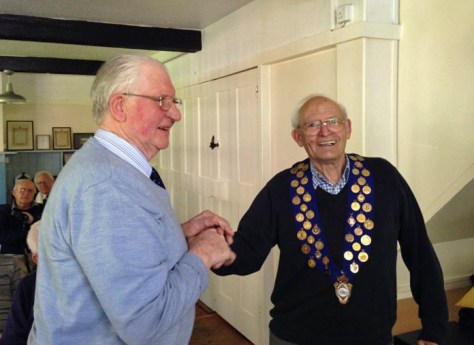
Don Morley (right) recieves his chain of office from Chairman, Ken Brady – Photo: John Knight (former British Trophy team member ISDT)
Don was one of the first to take up Pre’65 trials competition back in the early 1980’s on an ex-Brian ‘Tiger’ Payne AJS.
The one thing you notice about Don is his serious nature, he is a professional after all, he took photographs to make a living, but he does have a good sense of humour as well.
Trials Guru’s John Moffat met Don Morley many years ago at the Pre’65 Scottish at Kinlochleven, initially it was a frosty meeting as ‘The Guru’ intimated that Don had made a “slight mistake with a factory registration number” in one of his books! After a good frank chat, it was all ended very amicably, as this was merely an amateur enthusiast correcting a professional. Let’s face it EVERYONE can make a mistake. Happily, from that day on ‘Trials Guru’ and Don Morley have been good friends, their paths crossing occasionally and they are always happy to meet each other.
Don saw the funny side of the argument and said jokingly: “John, that’s OK, as long as you don’t want Osprey to reprint my book to make a correction!”
Morley once took a photo of ‘The Guru’ on his G3C Matchless with the great Gordon Jackson standing alongside, at Kinlochleven, the machine which was loaned to Jackson for the 2000 parade at the Scottish Six Days. The image has been a prized possession of ‘The Guru’ ever since.
Photo copyright: Don Morley (All Rights Reserved)
So, the next time you see a photo credit as “All-Sport/Don Morley” under an image of a racing bike at speed, you can say that this image was taken by a true enthusiast and … a trials rider!
Don Morley, Reigate, Surrey, England. – Trials Gurusalutes you, because you are an enthusiast as well as a photographic professional. – Thank you also for the kind permission to use one of your wonderful photographs on this website.
Beyond the call of duty! – Don Morley was lying on his side taking this shot of racer Dennis Ireland on his RG500 Suzuki. Unfortunately the throttles stuck wide open, the machine went out of control just a split second after Morley clicked the button. Don suffered a broken leg, Ireland more serious injuries, spending five months in hospital, having eleven operations on leg, ankle foot and tendons. A truly evocative image taken by a true professional. – Photo: strictly not for reproduction without permission of Don Morley – All Rights Reserved. Worldwide copyright.
The intellectual property formerly of ‘All-Sport’ photograph agency is now owned by Getty Images UK.
Please remember, all Don Morley’s photographs and those of his company ‘All-Sport’ are world-wide copyright and must not be used without prior express permission.
Trials Guru tells the story of a trials rider turned movie stunt performer.
Words: John Moffat
Photos: Iain Lawrie; Debbie Evans-Leavitt
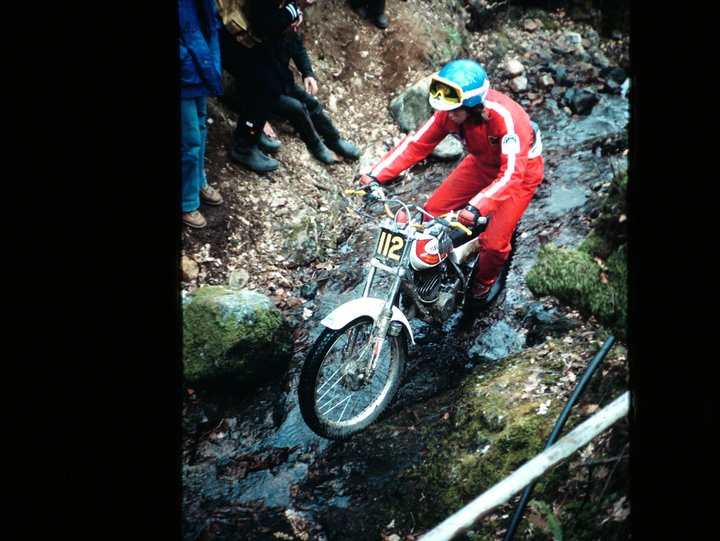
Debbie Evans number 112 (Yamaha 175) at the 1978 Scottish Six Days, this is the final machine inspection in down-town Fort William parc ferme. Number 109 is Mick Wilkinson (Ossa).
Over the years there have been numerous female riders compete in the annual Scottish Six Days Trial, which had traditionally been a male dominated sport. Times have now changed with female competitors very much the norm.
Before the Second World War, there was Louie McLean, Edyth Foley and Marjorie Cottle. Post-war, the 1950’s had Mollie Briggs, Lesley Blackburn, Olga Kevelos and Gwen Wickham; the 1960’s had Jill Savage and Renee Bennett. They had one thing in common, they were all British, but in the late seventies a female rider emerged who inspired even more women to compete in trials and the ‘Scottish’ than ever before, and she was the first female rider from overseas to compete in the SSDT, an American called Debbie Evans.
Trials Guru was fortunate to catch up with Debbie, now Evans-Leavitt having married her trials riding boyfriend Lane Leavitt, during a hectic schedule in Glasgow city centre, Scotland in September 2012 when filming for ‘The Fast & the Furious 6’ an action-packed movie which was released in May 2013.
Debbie refuses to slow down in an amazingly tight schedule which took her to England, twice, Scotland and Tenerife for filming plus a short break to go home to the United States to see her first grandchild born. I still couldn’t believe that I was talking with a stunt-performing grand-mother!
Born in 1958, Debbie, originally from Lakewood, now resident in Santa Clarita, California has been in the movie business for just over thirty-three years. She has stunt-doubled for some of the world’s best known superstars including Carrie-Ann Moss in ‘Matrix Reloaded’ – 2003; Linda Hamilton in ‘The Terminator: Judgement Day’ – 1991 and many more. Have a look at the credits of some of the world’s most famous action-packed films and you will see the name ‘Debbie Evans’ appear in more than just a few. Her speciality is car and motorcycle stunt performance and she has appeared in over two-hundred movies and TV programmes which included ‘CHiPS’ & ‘The Dukes of Hazzard’.
The Scottish connection…
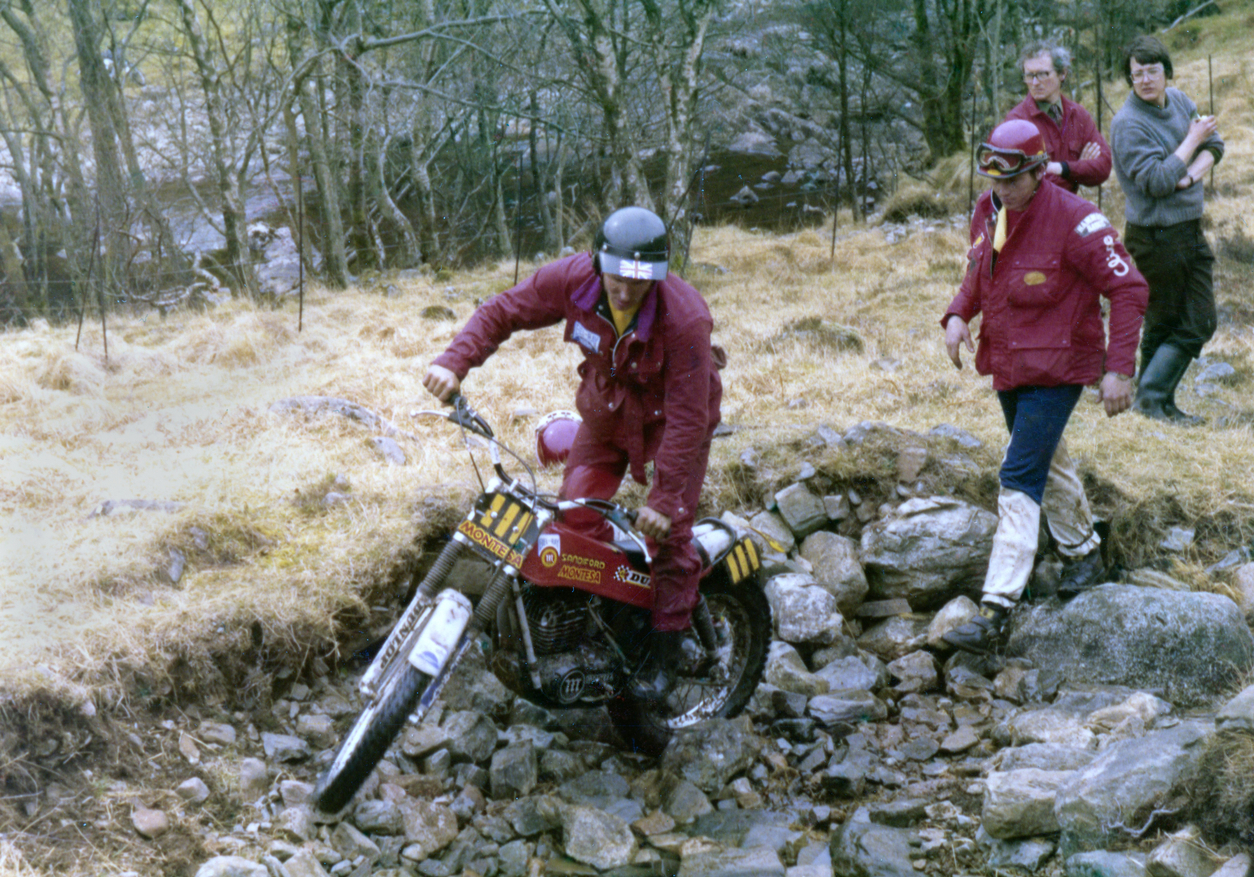
Debbie Evans on Blackwater sections in 1978 on her 175cc TY175 Yamaha. Debbie came 109th position on 473 marks. Photo copyright: Iain Lawrie, Kinlochleven, Scotland.
Having followed the history of the SSDT and watched Lane in action at the Six Days, I got to know Debbie and her three time AMA National Trials Champion husband back in 2007, when I put together an audio-visual presentation of the SSDT in the February of that year for the Fort William Mountain Film Festival.
Permission was sought to use material from Debbie’s website as part of the presentation, just for a bit of extra interest for the audience, which she willingly gave.
Debbie had entered the 1978 Scottish Six Days Trial on a TY175 Yamaha supplied by Gordon Farley Motorcycles, Aldershot, Hmpshire, England and her airline ticket was paid for by Yamaha USA. Lane had also competed in previous Scottish Six Days his first being 1973, as a supported rider for both the Spanish Bultaco and laterly Montesa factories.
Sunday lunch…
Having discovered that she would be in the UK during filming for the forthcoming ‘Fast 6’ movie, Debbie sent me a message via Lane through facebook which read: “Hi John, I’m sending my wife to Scotland in a few days. Maybe you guys can get together? She may have some cool stuff for you!”
On making contact upon her arrival in England, she suggested that we meet up with her one Sunday afternoon, when she was between filming schedules in Glasgow. Part of the car chase footage was shot late at night in city-centre Glasgow, including the famous George Square area.
After a pleasant lunch in Glasgow’s Princes Square, we all go back to Debbie’s hotel and ‘Skype call’ Lane in the USA, who takes us a virtual tour around the couple’s home. Lane picks out their Scottish Six Days trophies and Debbie’s stunt trophies and awards; culminating in a quick tour of their impressive garage.
Debbie was an accomplished trials rider when she began motion picture stunt performing at the age of twenty. I asked her how she entered into the movie business.
She explained: “I wondered why so many stunts involving women were carried out by male performers dressed to look like females? I thought… hey, I could do that… I researched it further and eventually obtained the necessary regulatory permissions and began training for my new chosen career with established professional stunt performers.”
The rest is history, Evans-Leavitt is a multiple award winner obtaining seven Red Bull Stunt ‘Taurus awards’ and was inducted into the American Motorcycle Association – Motorcyclist Hall of Fame in 2003.
Unique…
Debbie is probably the only competitor world-wide who can static balance a trials motorcycle upside down with her head on the seat, the bike is not supported in any way and the only extra piece of equipment is a rubber band on the front brake lever! Eric Kitchen was on hand in 1978 to photograph this very stunt, right in the middle of the traffic roundabout at the West End of Fort William, now an iconic SSDT photo.
Debbie performing her world famous ‘head-stand’ on the roundabout in down-town Fort William, Scotland, prior to the 1978 Scottish Six Days. Photo: Worldwide copyright, Eric Kitchen. All rights reserved.
In movies, she is best known for the 2001 award-winning scene where she doubled for actress Michelle Rodriguez in the Fast & the Furious. Debbie drove a tuned Honda Civic hatch-back under an artic semi-trailer at high speed, ending in a barrel-roll when emerging out the other side.
“…being a stunt-woman is that you get to ride fast motorcycles and drive real cool cars” – Debbie in a classic Jaguar with son Daniel – Photo: Lane Leavitt Archive – All rights reserved.
Debbie says: “I have to keep physically fit and in shape but the real neat part about being a stunt-woman is that you get to ride fast motorcycles and drive real cool cars!”
Dreaming…
Back to that Scottish Six Days ride at Fort William in May 1978, it was for Debbie the event of her lifetime. Debbie takes up the story:
“I had harboured a secret wish to ride in the ‘Scottish’ when I was quite young. I got into trials at the age of six with the help of my father Dave Evans, who was already an established trials and enduro rider in the USA and it was he who taught me all I know about bike control. I then read all about the Scottish Six Days in the American motorcycle press. I never really thought it was possible until an Englishman called Bill Emmison of BERM Specialities, a UK company which imported US off-road products. Bill on a visit to source parts asked me what I really wanted to do and on hearing my crazy wish said he could arrange the trip to Scotland and make it all happen. I was overjoyed at the thought of actually competing in the Six Days, for me it was truly a real dream come true. I hadn’t told anyone previously, because I believed it to be too wild to ever come true!
I packed my heavy bags and took a pair of handlebars, grips, foot-pegs and my Bell helmet and spent a few days sight-seeing in London on my own, before heading north to Fort William.
Bill supplied me with some riding suits, my riding number was one-hundred and twelve and so I rode all week in the company of Mick Wilkinson and Rob Shepherd, two of the best riders in Britain at the time and guys who knew their way around Scotland. The whole experience for a nineteen year old girl was really awesome; the Scottish was a great adventure!”
She continued: “Riding over the tracks and moors with Mick as my guide was great fun, Lane told me to ‘stick to this guy like glue’, which I did! However, I probably stuck to him too well and one day when hauling across a moor, Mick suddenly pulled up, I sat and waited for a little while, then he turned around and said, ‘Debbie! Can you sort of disappear for a minute, the call of nature beckons’ – or words to that effect?”
Wilkinson…
Mick Wilkinson remembers all too well the 1978 event with Debbie Evans in tow!
Mick recounts: “Soon after the trial started, I said to Rob (Shepherd), come on Rob let’s have a bit of fun, let’s leave this American lass on’t moor. We took off at a cracking rate as we knew where we were going and after a few miles we looked round. To our surprise, there she was, slap bang on our back mudguards. We didn’t try to pull that trick again!”
After their marriage Lane and Debbie had planned to ride once more in the 1980 Scottish together, but when they discovered that she was expecting their first child, Steve, this put paid to that idea and she reluctantly but sensibly withdrew her entry. The couple had another son, Daniel born in 1994.
On the left is Alan Wright, former Suzuki team rider and Telford Show organiser. On the right, Debbie Evans-Leavitt, the American trials rider turned movie stunt perfomer. Photographed here at the Scottish Six Days Trial on Pipeline in May 1978 by Iain Lawrie, Kinlochleven, Scotland. (All rights reserved.)
Inspiration…
But by then, Evans had already unwittingly captivated a whole new generation of women trials riders, one of which was Lisa Bayley (then Lisa Jones) from Sutton, Surrey who herself was inspired by reading about Debbie’s 1978 ride to compete herself in the 1981 Scottish at the tender age of eighteen on a 200cc SWM modified from a 125cc by her Father, Derek Jones.
Lisa Jones was so inspired by Debbie’s SSDT ride in 1978 that she trained hard and entered the 1981 event on a 200cc SWM prepared by her father Derek. – Photo: Derek Jones, Surrey, England.
Having read and been inspired by Evans, Lisa never actually met Debbie in person, although she did get to know former US National and World Champion, Bernie Schreiber during his time at Comerfords, Thames Ditton in 1979 and later, when on trips to the US riding Fantic.
Debbie on Town Hall Brae in down-town Fort William in 1978 – Photo: Iain C Clark, Fort William, Scotland (All rights reserved)
Fitness coach Lisa commented: “I was truly inspired by Debbie Evans’ 1978 ride at the Scottish which I did twice. For me it is the most brilliant event in the world. I have run in both the New York & London Marathons in 2005 and 2006; they were far easier by a long shot than the 600 miles and 180 Scottish sections of fantastic challenging and on some-days, impossible terrain. In my lifetime I have risen to the challenge of the hardest marathon and finished New York in three hours forty-eight minutes and London in three hours thirty-eight minutes, well within a veterans’ respectable timeframe, but still the SSDT was the hardest ever human achievement and the most enjoyable I have ever undertaken.”
Debbie in the 1978 Scottish Six Days. Photo copyright: Jimmy Young, Armadale, Scotland. (All rights reserved)
Bloodline…
Motorcycle observed trials is in Debbie’s blood, her father, Dave Evans is the guy who wheelies a Bultaco Sherpa for miles near the beginning of the Bruce Brown film ‘On Any Sunday’ the definitive bike-sport movie of all time. Her sister, Donna Evans is also a stunt performer, having worked with Debbie in a number of motion pictures.
Debbie in 1979. The top right image is Debbie doubling for Lynda Carter in the TV series, Wonder Woman – Photo copyright: Michael Vendrel, USA.
Debbie: “Being a trials rider really helped me throughout my stunt career, because you walk the section and memorise in your head many things, like when to go up or down a gear, where to brake, where to make the turn or change direction, which part is slippery and so on. The same thing applies when performing a motion picture stunt; you walk the set and plan everything, very carefully. It’s technical, just like trials. However, I knew that I would never make a living from just riding trials, at that time there were very few who were professional riders world-wide, whereas I could at movie stunt-performing. I grew up with trials riding ‘no-stop’; stop-allowed was alien to me. We do stunts no-stop too!”
Debbie in a scene from the ‘Dukes of Hazzard’ a CBS network TV series. She doubled for the postmistress and Hazzard Gazette reporter, Miz “Emma” Tisdale who delivered parcels by motorcycle.
Debbie stayed fairly loyal to the Yamaha brand during her riding years, having gained support from the company via their USA importers and promoted the brand wherever she rode.
After a eighteen years away from the sport, Debbie made a brief return to competitive trials in 1998, when she rode in the Women’s World Trials Championships. She was now forty years of age, but came a creditable eighth place overall, riding a 250cc Gas Gas.
Today…
Debbie tries out Lane’s Bultaco for size in his office. Photo: Lane Leavitt.
Lane, now a respected stunt technician in the US movie business still has a collection of interesting Bultaco trials machines and some modern road bikes to hand, as the area in which the Leavitts live is ‘canyon country’ and a Sunday afternoon ride out with the family is very much the order of the day.
Leavitt reckons Debbie would still be riding in trials competitively today had she not suffered a very serious accident when stunt doubling for the 2008 movie “Yes Man” starring Jim Carrey in which she was hit by a car when riding a bike during a sequence which went horribly wrong.
British actress Amanda Holden was trained by Debbie and Lane to do stunts for the UK TV series ‘Amanda Holden – Fantasy Lives’ in 2010 in which Debbie and Lane both appeared.
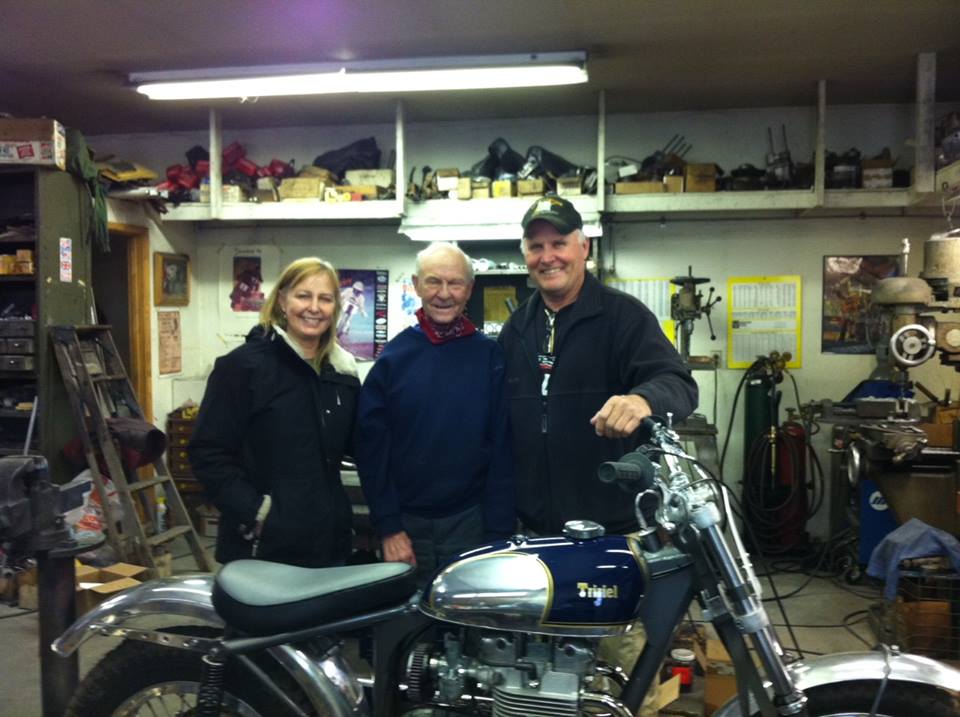
Debbie, Dick Mann and Lane at Dick Mann’s house discussing a Matchless build. Bike is one of Dick’s creations, a Triel (Triumph engined Ariel)
Return…
Debbie really enjoyed her film work in Glasgow; she even cultivated a Scots accent during her stay. Both she and Lane are planning a return trip to spectate at the SSDT in a few years time, once their youngest child, daughter Rebecca, graduates from high-school. It will be really nice to have the couple back at the SSDT where they have so many happy memories of competing many years ago.
Debbie Evans-Leavitt and Trials Guru’s John Moffat taken in Glasgow, during a break from filming ‘Fast 6’ in Glasgow, September 2012. Photo: Trials Guru copyright, all rights reserved.
Both Debbie and Lane felt honoured to be asked to write a few lines each for the one-hundred years celebration book on the SSDT that the Edinburgh Club produced in 2011. Only problem was they didn’t get a copy, as the limited edition book was quickly sold out! However, after a plea, Kinlochleven trials enthusiasts David & Lorna Dougan who had a pristine copy, came to the rescue and gifted their copy to Lane and Debbie. The photo of Debbie in the book was taken by Eric Kitchen on Grey Mare’s Ridge, only half a mile from the Dougan’s home.
Finally…
Oh yes and finally, the ‘cool stuff’ she gave me as a memento of our Glasgow meeting? A commemorative tee-shirt and poster from the ‘On Any Sunday Re-union’, all signed by some of the all-time greats of USA bike-sport – now that’s what I call neat!
Apart from ‘Fair Dealing’ for the purpose of private study, research, criticism or review as permitted under the Copyright, Design and Patents Act, 1988, no part of this article may be copied, reproduced, stored in any form of retrieval system, electronic or otherwise or transmitted in any form or by any means, electronic, electrical, mechanical, optical, chemical, photocopying, recording or otherwise without the prior written permission of the author as stated above. This article is not being published for any monetary reward or monetisation, be that online or in print.
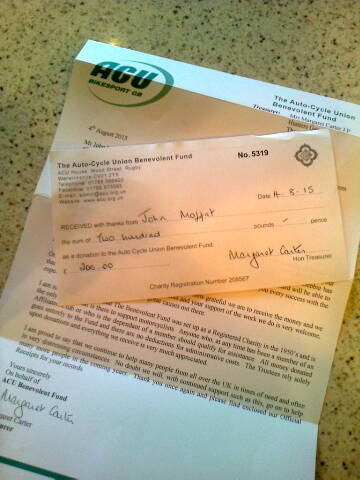
The ACU Benevolent Fund, the only registered UK charity that provides for motorcycle riders, has just benefited by the tune of 200 GBP from initial sales of John Moffat’s book, Motorcycle Competition: Scotland 1975-2005.
Released for sale on 30th March, 2015, it covers the four main motorcycle sports organised in Scotland during that time frame and features many of the Scottish champions who went on to British, European and even World championship status.
The book’s forward was written by eight times TT winner, Jim Moodie and has 134 pages and over 200 photographs, many never seen before from photographers such as Eric Kitchen, Jan Burgers, Graham Milne, Jimmy Young, Iain Lawrie and Ronnie Weir plus many more.
Copies are still available online through Trial Magazine UK website: Here
The ACU are delighted at receiving the sum of money, every penny of which goes to rider benefit.
Trials Guru is always looking for something new or old, unseen or forgotten….
‘Kimages’ photographs are copyright: Kimages/Kim Ferguson, Fort William.
We have just added two new ‘selections’ on the front page which link into photo collections of ‘Kimages – Trials Photos‘ and ‘Heather Mead – SSDT Photos‘.
Both are female photographers who have built up a sizeable archive of trials photographs over the last couple of years, particularly at the Scottish Six Days as these are Scottish based photographers.
Kim has lived in the Fort William area most of her life and has a love for motorcycle sport and trials in particular having grown up with the SSDT passing her door-step. Her brother rode in trials too, so there are family connections.
Heather became involved taking photos at the Parc Ferme in Fort William, a place that is usually inaccessible to spectators, so we can see SSDT competitors preparing for their daily battle with the terrain and elements.
SSDT 2013 An official goes over the route card with rider 20, Ian Thompson – Photo Copyright: Heather Mead Photography, Dingwall.
Heather Mead and Kimages (Kim Ferguson) have recently given Trials Guru permission to display their handy-work. Please remember photographs are copywritten and are the property of the photographer, so please be respectful of that. There is no implied permission to post these images anywhere else unless by express permission of the copy-holder. This also applies to our other photographers, Jimmy Young, Armadale; Jeremy Whittet; Neil Sturgeon; John Hulme; Iain Lawrie, Kinlochleven or any other images on this website.
Trials Guru have used some individual photos, which are the property of Mortons Media, Hornchurch this was done with their prior and express permission, for legal reasons, these are not for onward publication.
Sammy Miller developed the Sherpa N 200cc into the world beating 244cc Sherpa T in 1965, helped by his win at the Scottish Six Days Trial that year. (Photo: Rickman Brothers, New Milton, Hants.)
You may be forgiven if you haven’t realised that in May this year it will be fifty years since Samuel Hamilton Miller won the Scottish Six Days Open Reliability Trial on his 244cc Bultaco Sherpa registered as 669NHO.
Miller had left Ariels to ride for the Catalunian manufacturer based at San Adrien De Besos, part of Barcelona in late 1964 to develop the Bultaco Sherpa into a machine that was to change the face of motorcycle trials forever.
The defection to the lightweight Bultaco signalled the end of the big four-stroke single as the bike to win at trials.
There is a celebration of the marque in July this year at the Circuit De Barcelona.
Sammy went on to further develop the machine and many British born riders followed him to ride for the Spanish factory, riders such as Malcolm Rathmell and the first winner of the world championship, Martin Lampkin with Frenchman Charles Coutard and Finland’s Yrjo Vesterinen who was to win three world Championships for Bultaco.
The Bultaco Sherpa was a revelation as it weighed much less than its competitors with a 52 inch wheelbase it handled and steered much better than its rivals and pulled well from low revs. It turned novice riders into award winners.
Well restored examples of the four-speed Model 10 Sherpa still command high prices, if you can find one for sale as these are very much collector’s items.
Miller had written into his contract with Senor Bulto, that if he didn’t win more than 50% of all events he entered, then Bulto was not obliged to pay Miller’s salary! Of course, Sammy did win more than 50% of the events and was so confident of doing so.
Miller told Trials Guru: “If I didn’t win all those events on the Bultaco, it wasn’t worth my time competing in the first place”.
However, Sammy Miller wasn’t the first to compete in the famous Scottish Six Days Trial on a Barcelona-built Bultaco, it was a Lancastrian rider called Tommy Ollerton who rode a 200cc Bultaco Sherpa N in the 1962 event. Ollerton’s machine was registered in the UK as PDV700. Tommy Ollerton rode in company with Oriol Puig Bulto, nephew of Senor Bulto, having travelled all the way from the factory to Edinburgh in a Fiat 500 car with a two bike trailer attached, carrying two Sherpa N models, one for himself and the other for Ollerton, who was supported by Anellays of Blackburn, Lancashire.
Having said that, it was Miller who gave the factory it’s first Scottish Six Days win and that is a major part of both the event and motorcycle trial history.
In deepest Argyll, nestling among stunning scenery and mountains, lies the town of Kinlochleven. Many books have been written about the area, one of which is ‘Children of the Dead End – The Autobiography of a Navvy’ – By Patrick McGill – this book is exactly what the title says, it’s the story of an immigrant manual worker or ‘navvy’ as they were called. This book which is rated as one of the best 100 best Scottish books of all time, describes the times when the Aluminium smelter and factory was being constructed at the end of the 1800’s. Kinlochleven flourished as a direct result of the creation of the Aluminium factory which employed around 1,000 workers and produced high quality aluminium for the world. These employees came from far afield and settled in the town, one such settler was Ian Murray Pollock, who was originally from Falkirk, Stirlingshire. Pollock had been through the second world war, having served in the Argyll & Sutherland Highlanders regiment in Palestine. When he was effectively demobbed from the British Army, Pollock was fortunate to secure employment with the British Aluminium Company Ltd at their Kinlochleven smelter. The ‘BA’ as it was universally known, was a major employer both there and at their Fort William operation, which exists to this day.
Pollock started his career as a ‘fitter’ but quickly progressed through the ranks to become a shift foreman at the plant.
1950 – Jack Williamson from Newtongrange, Midlothian (347 AJS) on Mamore, watched by Ian Pollock (white paper in pocket) – Photo: W.S. Thomson, Fort William
Being an active young man who had forged many friendships in the locality, Pollock took an interest in the annual Scottish Six Days Trial which made use of the hills near to Kinlochleven during the ‘Sporting Holiday in the Highlands’. Pollock had amassed quite a knowledge of the local paths, bridleways and rough country high above the town. This was to eventually forge a strong bond between him and members of the Edinburgh & District Motor Club, who promoted the Scottish Six Days Trial.
Ian also became involved in local events, eventually becoming a central character in the Kinlochleven Motor Cycle Club, which he helped form.
Pollock in association with his good friend, Lithuanian refugee, Paul Kilbauskas discovered there was more land available to the SSDT than perhaps the organisers were aware of!
1959 Scottish Six Days Trial – Paul Kilbauskas with his 500 Royal Enfield – Photo: John Davies
The SSDT up until the late 1960’s, made extensive use of main and secondary roads, proper foot and bridle paths, sheep paths but very little open moorland. It wasn’t until Jimmy Mulvie became Clerk of Course that the SSDT made use of open moorland stretches.
It was Pollock and Kilbauskas that investigated the possibility of going out over the hills from Kinlochleven back over to the Fort William area other than by the original Mamore Road, which is the water bound surface that is still used by the SSDT and Pre’65 trials to this day. It stretches from Mamore Lodge across to Blarmafoldach, just outside Fort William and links into the Achintore Road.
Pollock and Kilbauskas were both energetic men, they liked the outdoors and they both jointly and severally, explored the many trails, paths and rocky burns and outcrops that littered the hills high above Kinlochleven. They also knew all the local keepers, shepherds and landowners, so permission was never a problem. Many of the hills surrounding the town had been purchased from estates at the end of the 19th century primarily for the water rights. This enabled the factory to operate and ensure plentiful supply of water via the Blackwater area, high above Kinlochleven. Pollock and Kilbauskas were trusted individuals and it helped the SSDT greatly by having reliable people such as Pollock and Kilbauskas on hand.
These explorations bore fruit aplenty, for the Pollock/Kilbauskas venture yielded many new sections in the form of ‘Loch Eild Path’; ‘Mamore’; ‘German Camp’; ‘Leitir Bo Fionn’; ‘Grey Mare’s Ridge’ and of course ‘Brump Brae’, later to be renamed ‘Pollock Hill’.
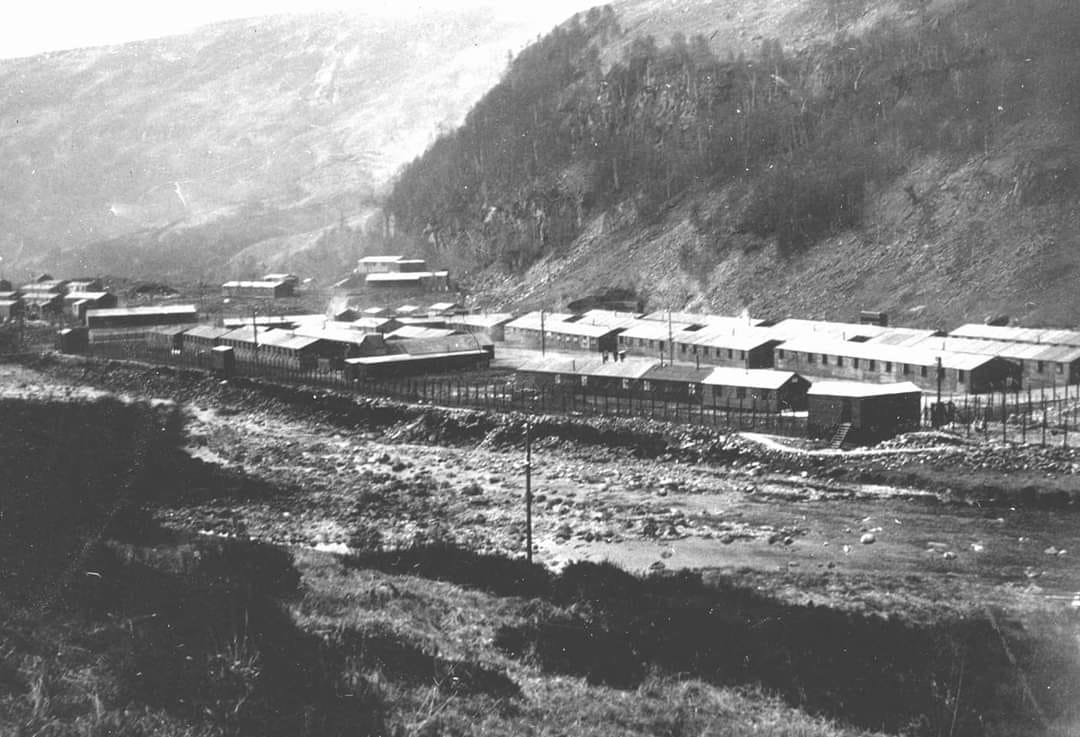
The ‘German Camp’, a first World War prisoner of war encampment on the banking of the River Leven high above Kinlochleven. Photo courtesy of Peter Anderson, Clackmannan
In the period 1955 through to 1959, Ian was listed in the official programmes of the SSDT as an observer, but Pollock was much more than that, he was the journeyman who discovered many of the iconic hills that would eventually unearth the most famous of them all, ‘Pipeline’ probably the most famous motorcycle trial section of all time! Alex Smith, from Bathgate, a former assistant Clerk of Course confirms that ‘Pipeline’ was first used as an observed section in the 1964 SSDT.
Jack Williamson (250cc Greeves) awaits the signal to start in the 1963 Spring Trial at Kinlochleven. Ian Pollock was a driving force in this event which was re-named in his honour after his death.
‘Pipeline’ is just a couple of miles out of the town and is the subject of many of the most stunning motorcycle trials photos to come from the cameras of Nick Nichols, Eric Kitchen and photographers of their age.
The Pipeline under construction, photo taken from an original glass negative, courtesy of Peter Anderson, Clackmannan
Pollock was an enthusiastic observer at the SSDT and when Johnny Brittain won the 1957 Scottish, his photo adorned the cover of the following year’s programme, the observer in the background watching intently being Ian Pollock. The original photo used on the 1958 SSDT programme front cover was a ‘Motor Cycling’ print which is now the property of Mortons Motorcycle Media, Hornchurch, but a personal copy still hangs in Pollock’s daughter Pamela’s home in Glencoe.
The 1958 SSDT Official Programme, with 1957 winner Johnny Brittain (Royal Enfield) being watched by Ian Pollock. The section is at the top of Loch Eild Path, one of the hills discovered by Pollock himself.
By 1962, Pollock was now listed as an Assistant Clerk of the Course and was held in high esteem by his peers and by the ‘Clerk’ himself, the late George Baird who described Ian as ‘our man on the spot’ in the official programme.
Paul Kilbauskas:
Paul Kilbauskas was also a ‘Tunnel Tiger’ who worked on the many hydro-electric schemes in the Scottish Highlands, he was an explosives handler during his time on these massive projects. He concentrated more on riding the Six Days on Matchless, Royal Enfield and BSA machinery, always a 500cc machine. He helped find a sizeable part of the route was in effect a ‘displaced person’ who had to flee his native Lithuania in 1947. His first port of call was Market Harborough in Leicestershire. Paul eventually settled in Kinlochleven, worked at the Aluminium factory for a period where he met and eventually married his sweetheart, Rose who also worked at the BA factory and was originally from the Orkney Islands. They had two daughters, Marina and Rachel. There is now a Paul Kilbauskas award in the SSDT in remembrance of the one-time course plotter and explorer for the event.
The late Paul Kilbauskas, a native of Lithuania who made the Scottish Highlands his home. A life member of Inverness & District Motorcycle Club.
‘Mambrec’ was yet another of the sections discovered by Ian Pollock, a section that has been used in the Pre’65 Scottish Trial many times. Pollock was fortunate to strike up a good friendship with Johnny Graham who also became Clerk of Course SSDT. Graham would leave a trials motorcycle at Ian’s home to give him something to explore with. One such machine was the ex-works 350cc Matchless registered ‘OLH722’ of Ted Usher and another was the ex-factory BSA of Brian Martin registered ‘BSA350’.
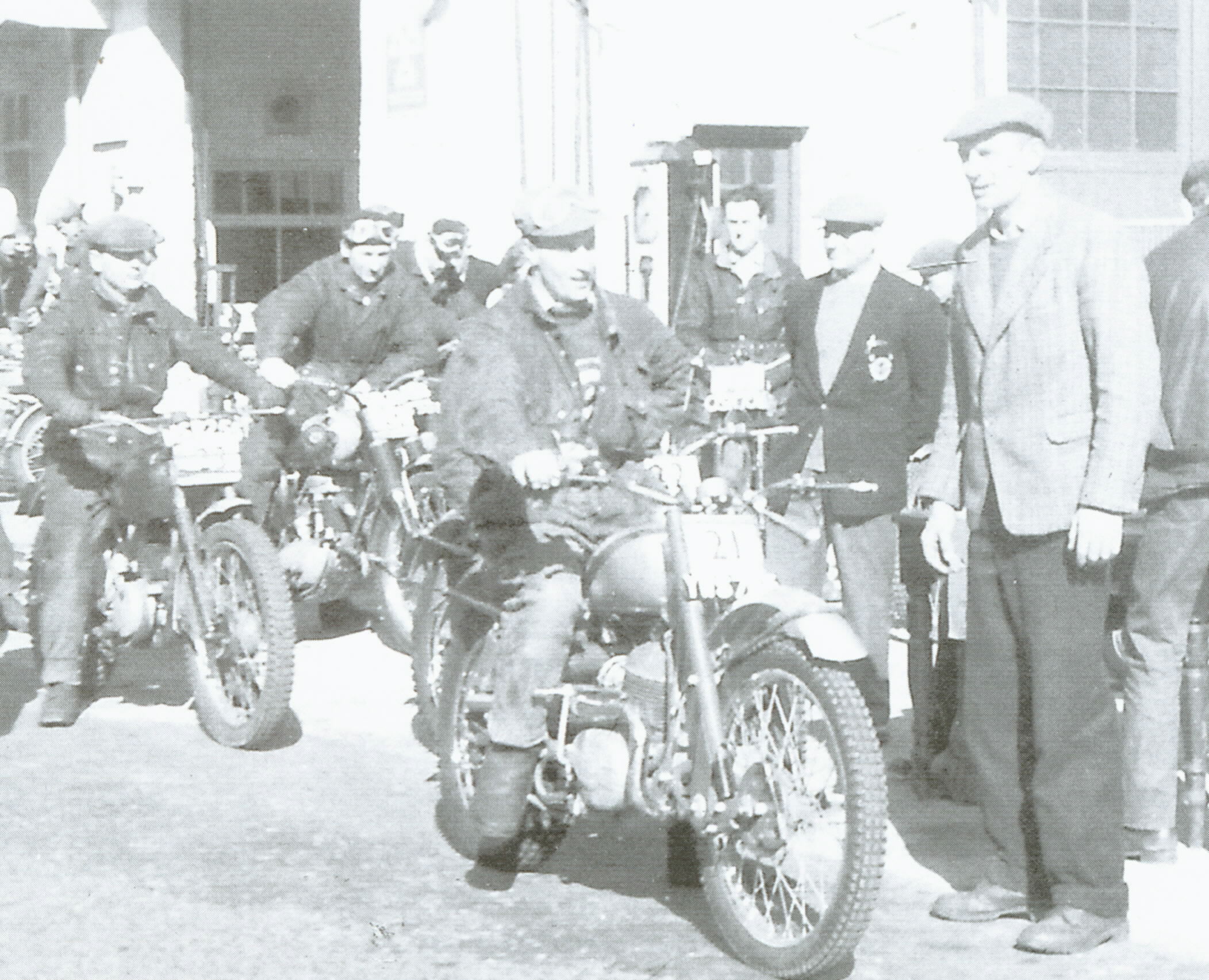
The Lochaber Spring Trial in 1959. Taken at Kinlochleven near the war memorial. From Left: Bobby Macleod (Francis Barnett); Ali McDonald (Ariel); Hugh McDonald (Royal Enfield); Ian Pollock (standing); Paul Kilbauskas (Royal Enfield); Tommy McNab (BSA – ex-works BSA 350) and Billy MacLeod (Ariel). The trial in modern times is known as The Ian Pollock Memorial Trial.
Pollock would regularly fire these ‘loan bikes’ up and take them up onto the Dam Road and into the hills to see what he could find.
In 1963 the SSDT committee honoured Ian by calling one of the sections ‘Pollock Way’, this was just off one of the many paths near the River Leven, that Ian and Paul Kilbauskas discovered on their explorations.
When the Lochaber and District Club was founded, they enlisted Ian’s help to organise their ‘Spring Trial’. This particular event was eventually re-named as The Ian Pollock Trial in his honour and is regarded as one of the best one-day trials in the Scottish trial calendar to this day.
Ian Pollock is survived by his only daughter, Pamela who married local man and trials rider, John MacGregor, they live in Glencoe and regularly watch the Pre’65 Scottish Two-Day Trial.
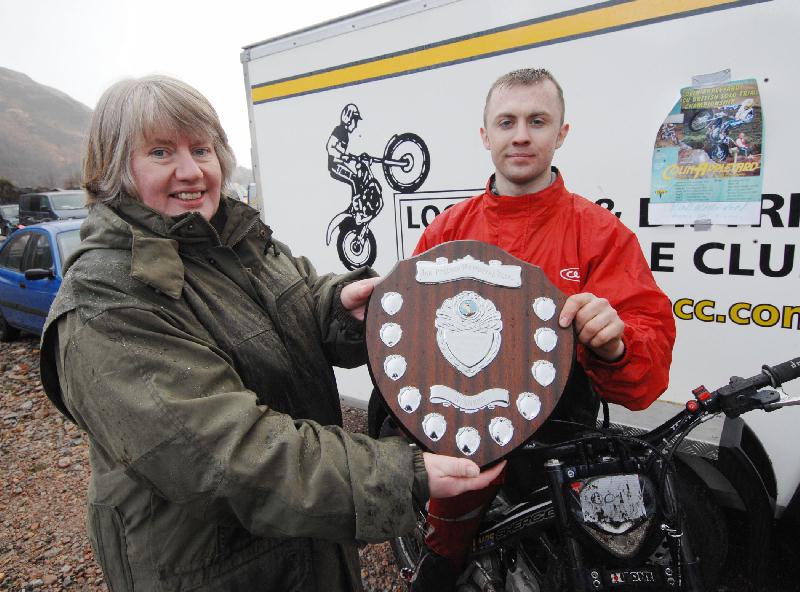
Pamela MacGregor (nee Pollock) presents the Ian Pollock Memorial trophy to local rider, ten times Scottish trials champion, Gary Macdonald in 2008. – Photo copyright and courtesy of: Iain Ferguson, The Write Image, Fort William.
John MacGregor was at one time himself an Assistant Clerk of Course SSDT and Pre’65 Scottish in its formative years.
So next time you climb up the ‘Dam Road’ to watch riders in either the SSDT or Pre’65 Scottish trials, spare a thought for the man who discovered many of these sections – Ian Murray Pollock.
More on Kinlochleven:
Kinlochleven in Scots Gaelic is Ceann Loch Liobhann, it was the first village in Scotland to have electric street lighting because of the electric power generated by the British Aluminium Company smelter. It used hydro or water power which was pioneered at Foyers in 1895 on the south side of Loch Ness, not far from Inverness. Kinlochleven was actually formed from two small villages, Kinlochmore (Large head of the loch) and Kinlochbeg (Small head of the loch). Kinlochmore on the north and Kinlochbeg on the south of the River Leven that runs into Loch Leven of which Kinlochleven sits at the head of.
The British Aluminium Company became part of Alcan, the Canadian based aluminium producer which laterly became Rio Tinto Alcan, part of the multi-national Rio Tinto company, which employs local personnel at their Fort William smelter operation. Rio Tinto (Alcan) is the world’s leading aluminium mining and producer. Rio Tinto Alcan can trace its roots back to Alcoa founded in 1928.
High quality, pure Aluminium was first produced at Kinlochleven at the ‘wee factory’ which was a temporary establishment high up in the hills on the Blackwater path. The ‘wee or temporary factory’ opened in 1907 with the main factory opening in Kinlochleven in 1909. The Blackwater dam or reservoir was formed purely to hold water reserves for the British Aluminium Company by flooding a sparsely populated valley high above the town, effectively trapping many of the River Leven’s tributaries and led down to the power house by six pipes, which are of course visible and beside the famous ‘Pipeline’ SSDT section group.
Trials Guru is indebted to Pamela and John MacGregor of Glencoe, Argyll for information supplied which made this article possible.
Text Copyright: Trials Guru / Moffat Racing, John Moffat – 2015
Photo Copyright: Iain Ferguson – ‘The Write Image’, Fort William – All Rights Reserved.
Photo of Paul Kilbauskas, by kind permission of Ms. Marina Kilbauskas.
Special thanks to: Alex Smith, former SSDT Assistant Clerk of Course and former Chairman, Pre’65 Scottish Trial.
Thanks to the Edinburgh & District Motor Club Ltd – For use of the cover of the 1958 SSDT official programme.
The Premier Trial Website – Recording the History of the Sport 'Established 2014'















 TRIALS GURU - DEDICATED TO TRIAL