Graham Taylor told Trials Guru: “I am the secretary of South Yorkshire and Derbyshire TRF. Could you please try to get as many of your readers to object to the TRO on Washgates you may not be aware of this? If it closes it will affect the Bemrose, Reliance and other trials. We have a feeling Hollinsclough will be the next target, see the attached link”.
So that’s two years passed since Trials Guru was created and what a 24 months it has been.
Taking stock we have brought you articles from the sport, special sections on competitors and machines and some great photographs from both amateur and professional photographers from around the globe.
It is encouraging to know that you, the reader enjoys Trials Guru, both here and on facebook/twitter, where we tend to set the links to new material when it becomes available.
We have also set a new logo on our facebook page which replaces the 1977 photo of Yrjo Vesterinen in the SSDT and updated our header photo.
Keep watching, it is all down to you! – More to come from the world of Trials.
The ‘Dan Stewart Memorial’ Loch Lomond Two Day Trial is one of Scotland’s premier trials held on the west sides of Loch Lomond, just north of Glasgow. First held in the early seventies it has grown into one of toughest trials in the Scottish calendar. Organised as always by the Loch Lomond Motorcycling Club.
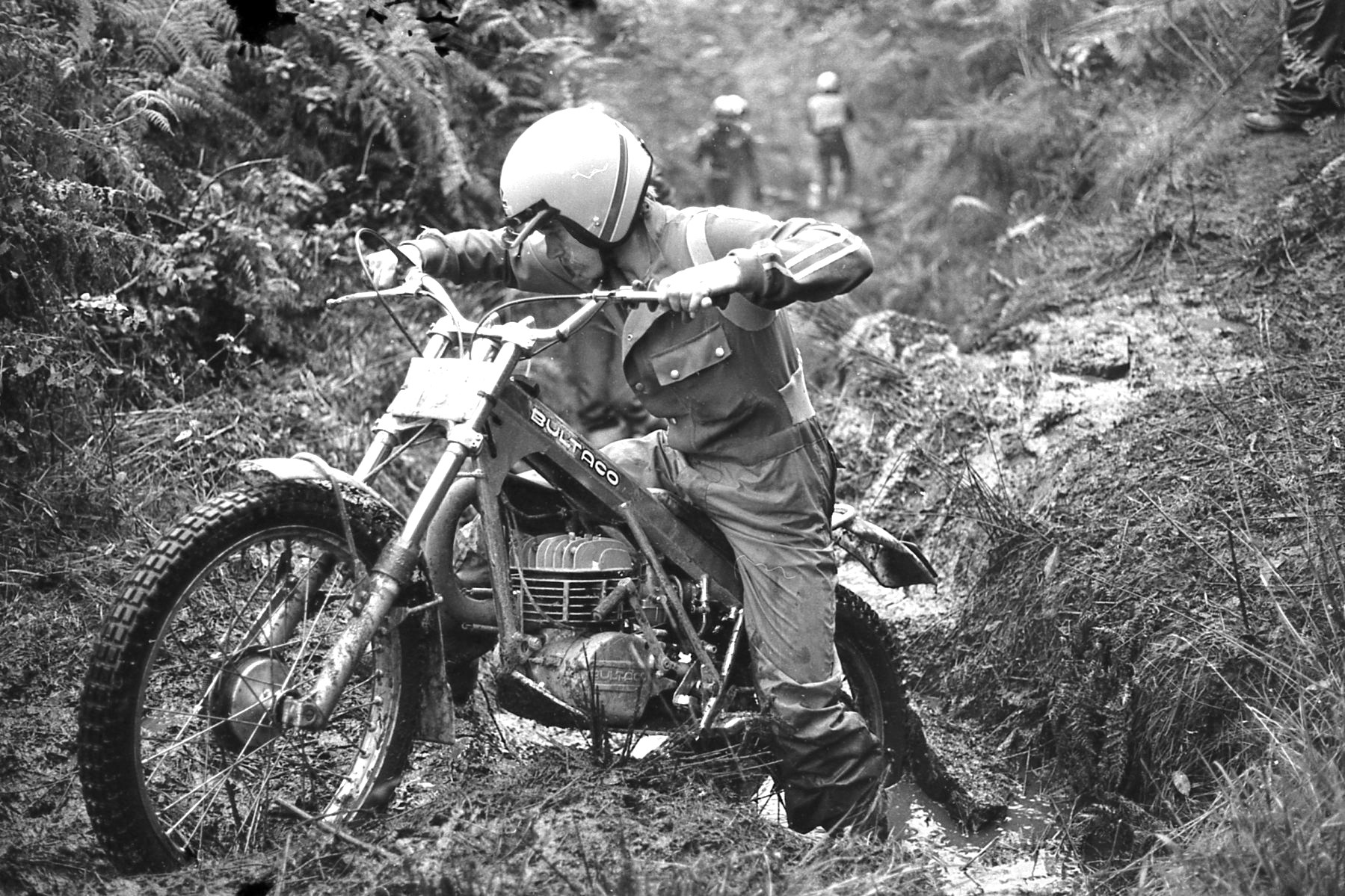
Dave Thorpe in the 1978 Loch Lomond Two Day on his Bultaco – Photo: Jimmy Young, Armadale
The Saturday route entails a lap of around 40 miles with 45 sections and Sunday is two laps of 11 miles with 25 sections. There are 2 fuel stops on Saturday. All sections are observed.
The route is all off road covering moorland and high mountains reaching the heights the surrounding horizons.
It is at heart a clubman trial but with sections suited to expert riders which can be tackled by good and eager B level riders.
Youth A riders are permitted to ride at the discretion of the Clerk of Course.
Entries will be taken up until the 20th of May. If you were unlucky not to get a entry to the SSDT then this trial is the next best thing for you.
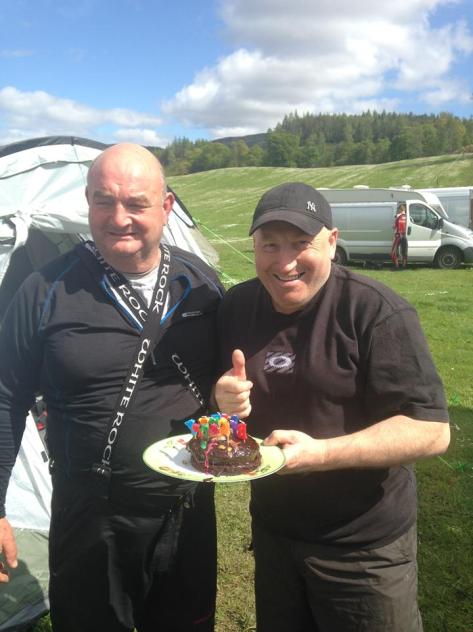
Friend, Dave Austin (left) with Mick Gallagher ‘Munch’ taken recently.
With respect, a short tribute to Michael Thomas ‘Munch’ Gallacher
1959 – 2016
The trials world was stunned by the news that Mick ‘Munch’ Gallagher had died suddenly on Wednesday, 16th March, aged 56. It is believed that he was playing a game of football and took unwell. Paramedics were called but were unable to revive him.
Known as ‘Mick’, ‘Micky’ or ‘Munch’ to his many friends and customers, he built up a business called M-Sport in Stevenage, Hertfordshire specialising in Montesa 4RT preparation and repairs.
Mick had been a Montesa dealer at the time of the model’s initial importation to the UK in 2005 and had carefully researched how these advanced and technical machines were built and rapidly amassed a great deal of knowledge on the brand.
Munch became the go-to man when riders encountered a problem with a 4RT. After the closure of the original Montesa UK importer in 2009 and for a period of time the non availability of machines, Mick became an independent dealer/repairer of the 4RT, but also had agencies with other brands, being a trials only retailer.
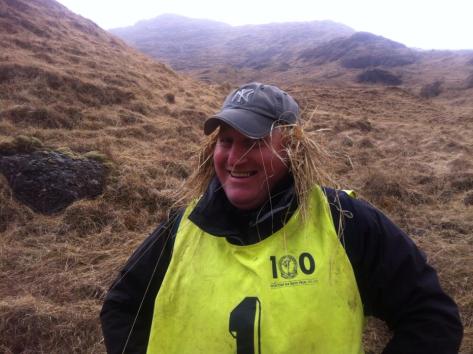
Gallagher was a regular official observer at the annual Scottish Six Days Trial and was known as a fair, but firm observer who understood the rules of the event and marked riders on what he saw, irrespective of their ability or stature. He wore his SSDT observer number-one bib with pride and was usually in the teams consisting of friends, Fred Savage, Mark Maynell and the Austin brothers, Dave and Clive.
Mick regularly was a ‘back-marker’ at the Pre’65 Scottish, ensuring that sections were closed on time and any stragglers accounted for.
Munch also had a long association with the famous Scott Trial in Swaledale, North Yorkshire, helping the event on numerous occasions as an official. He also enjoyed his outings with friend Fred Savage up to Mid Wales and Shropshire for trials events.
The funeral arrangements will be a celebration of Mick’s life with a humanist service at Harwood Park Crematorium at Stevenage, Hertfordshire on Tuesday 12th April at 2.45 pm, thereafter friends and family will gather at the Orange Tree, Baldock. Family flowers only with donations to the local air ambulance service.
Munch’s personal Montesa 4RT pictured at Fort William, we are posting this as the rider-less machine at rest, as our tribute to Mick Gallagher.
John Moffat: “Munch was a very good friend who I trusted 100% not only when it came to doing work on my bikes, but in everything he undertook. He will be a great loss to his customers of MSport. I got to know Mick in 2000 at the SSDT and he was a very keen supporter of trials sport in general. I know we call this website Trials Guru, but Munch was truly the ‘4RT Guru’. Mick was full of fun and always up for a good laugh when the opportunity arose. He and I had many phone conversations over the years. Munch was a decent, knowledgeable and warm human being who will be sorely missed by all who knew him”.
‘Munch’ in his having a laugh mode at the 2013 SSDT – Photo: James Maynell
Trials Guru sends its heartfelt condolences to Munch’s family, his widow Theresa, daughter Jemma and son Ross.
Trials Guru is all about trials worldwide, however here is a slight deviation from the normal!
John Moffat apart from being a trials rider and enthusiast has always enjoyed other forms of motorcycle sport from an early age and openly admits he has a 100% respect for those who race motorcycles, either for a living or sport.
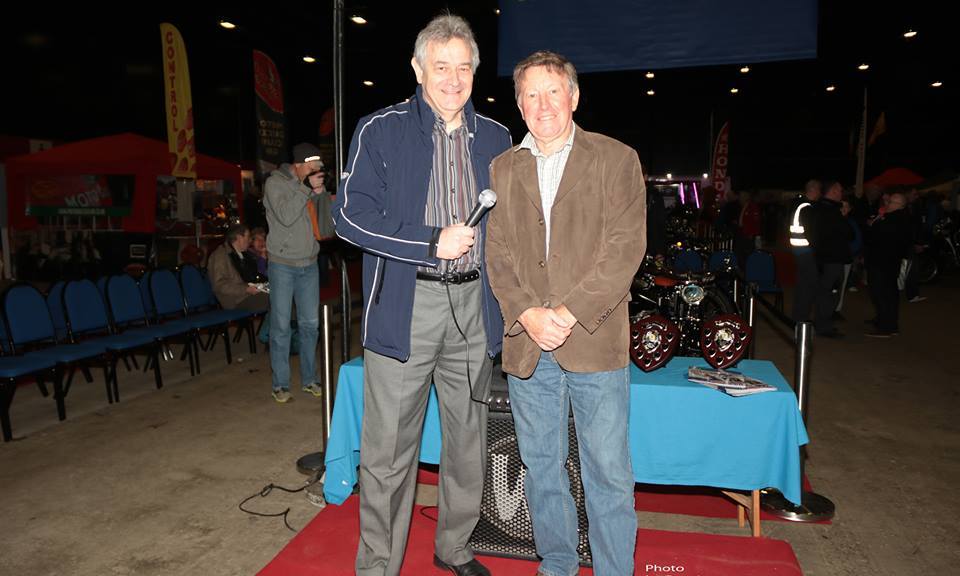
He has attended the MCN Scottish Motorcycle Show for many years as an announcer/interviewer and this year the guest of honour was seven times TT winner and trials enthusiast, Mick Grant.
Trials Guru’s John Moffat with Mick Grant, 7 times TT winner and trials rider at the Scottish Motorcycle Show, 2016 – Photo: Dan Jess
Son of a Yorkshire miner, Grant took up racing in 1967, strangely enough as he had a road bike and couldn’t afford a trials bike!
Moffat had the job of interviewing Mick on four occasions during a hectic weekend in the ‘Carole Nash Classic Pavilion’ at the Royal Highland Showground at Ingliston near Edinburgh on March 12th and 13th. It had nearly 500 classic motorcycles on show.
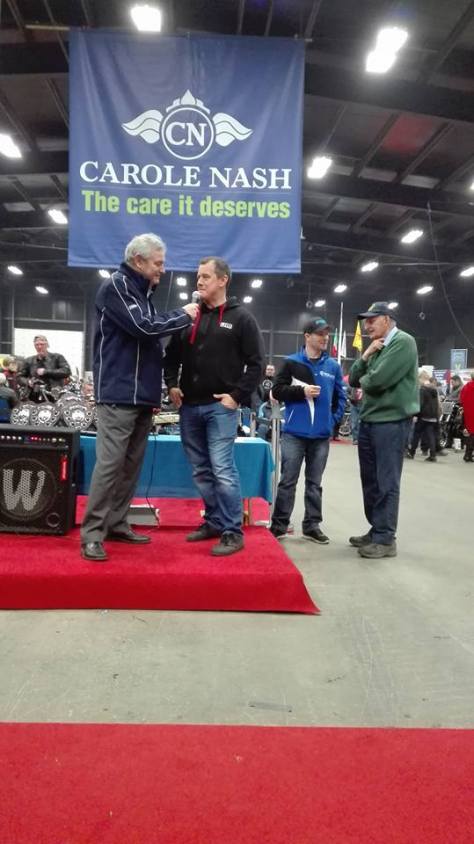
As a bonus, they were joined on the Sunday afternoon by 23 times TT winner, racing legend John McGuinness from Morecambe who aims to equal Joey Dunlop’s TT titles and Scots racer Stuart Easton who started in the sport as a youth motocross rider who went on to race for Paul Bird Racing and Hydrex Honda.
Trials Guru’s John Moffat interviewing racing legend, John McGuinness with Stuart Easton standing by on the right of the pair – Photo: Trials Guru/Jean Moffat
So you see, it’s not just trials we get involved with in Trials Guru, there is always something interesting going on!
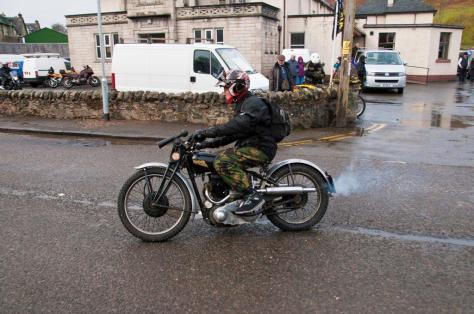
2015 Bob MacGregor Memorial Run with ‘Trials Guru’ representative John Moffat thoroughly enjoying the run on his late father’s 1951 AJS 16MC machine with the riding number carried in the 1953 SSDT and 2013 Pre’65 Scottish – Photo courtesy of Ron Allner, Killin.
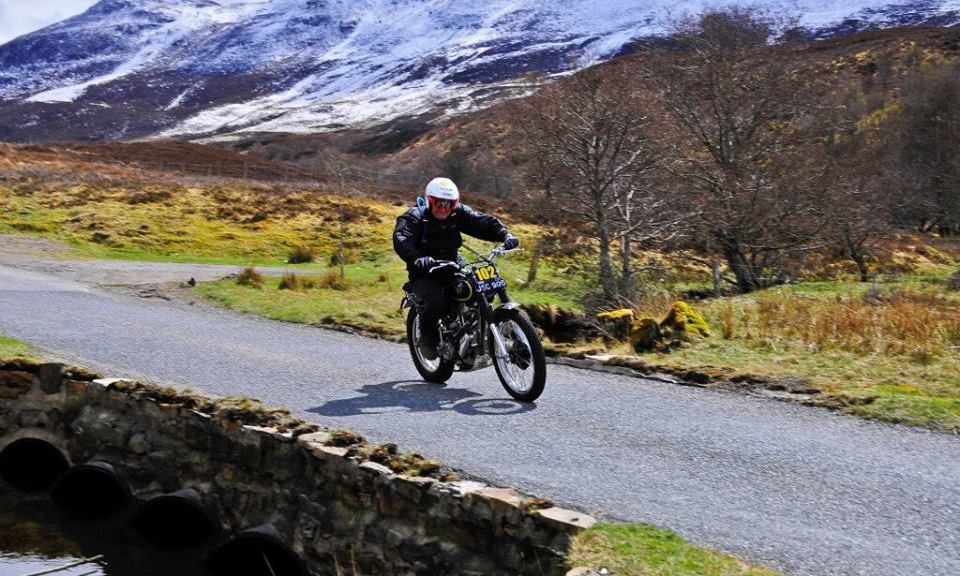
The annual Bob MacGregor Memorial road run for 2016 will take place on Tuesday 26th April, the week prior to the Pre’65 Scottish and the Scottish Six Days Trial.
The 2016 will have guest of honour, Bill Brown from Egremont, known affectionately as Mr. Wulfsport or even Mr. Maico given his connection with the German motocross marque and the world famous Wulfsport clothing brand which he created back in the 1970s.
Bill was a top motocross rider who raced predominately in the North West and Scotland, who ran Bill Brown Motorcycles.
The Greeves/NSU that Vic Allan will use in the 2016 Bob MacGregor Run on 26 April at Killin. – Photo: Vic Allan
The main organiser is of course Peter Remington, himself an accomplished trials and motocross rider who enjoys the road run which takes in approximately 130 miles of rural Perthshire public roads.
Peter Remington (Kendal) Saffire Bultaco 325 at the Lanarkshire Valente Trial in 1981. Photo: Jimmy Young, Armadale.
It is a circular route which goes from Killin to Aberfeldy and into the Loch Rannoch area. There is also a lunch break on route for the participants.
Peter ‘Rem’ Remington enjoys the fruits of his labour by taking part in the 2015 Bob MacGregor Memorial Run on his 644 CCM – Photo: Ron Allner, Killin.
The event starts and finishes at the McLaren Hall, Main Street, Killin FK21 8UH. Entry forms will be available from Peter by post: Peter Remington, Kenbrig, Levens, Kendal, Cumbria, LA8 8DT or by e-mail: premington2@gmail.com
The entry fee is £15 with £2 going to the local Bob MacGregor Motorcycle Club who provide local assistance.
Trials Guru representative, John Moffat took part last year on his father’s 1951 AJS 16MC and enjoyed it so much, he will be back in 2016 for another helping, this time on a 1964 AJS 16C short-stroke.
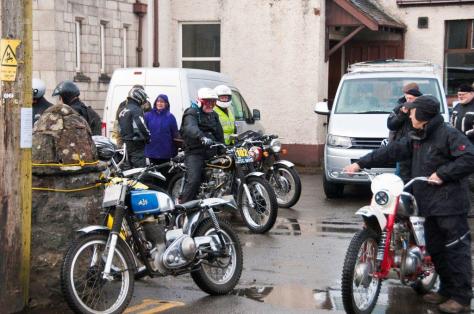
Riders preparing to leave the McLaren Hall in Killin for the 2015 event – Photo courtesy of Ron Allner of Killin
Mark Whitham leaves the start area on his Rudge in 2015, a machine similar to that which Bob MacGregor rode to SSDT victory in 1932 and 1935 – Photo courtesy of Ron Allner of Killin
It is noticeable how Trials Guru, the online medium for viewing photographs and articles of the sport of motorcycle trials world-wide, has really taken off.
Trials Guru is also now being referred to in sporting circles as ‘Guru’ or even ‘TG’ for short.
It started purely as an idea that ‘TG’ creator, John Moffat had back in 2003 which had been offered to a webmaster of a well-known trials website, but it was turned down because it “wouldn’t be of any interest”.
Alan Lampkin (325 Bultaco) seen here in 1978 is a keen follower of Trials Guru- Photo: Mike Rapley
Trials Guru was eventually launched quietly and without fuss in March 2014, that is two years ago now and it has grown steadily without advertising other than word of mouth.
Obviously its success is down to finding interesting material and the fact that it is totally without charge, be that subscription or payment to view. It is free and that is probably its appeal.
No fuss, no forums, no keyboard warriors to distract you from trials – just good honest information and photos from the contributing photographers and article writers.
We have been very fortunate that Trials Guru’s creator has many contacts in the sport, which has helped bring information to you the reader. Of course you, the reader, are equally important in the mixture, without you there would be no need for Trials Guru!
It is amazing how many former ‘works’ riders follow Trials Guru, many of them have appeared in photographs taken back in the day!
If you have an interesting tale to tell, then why not get in touch through the ‘contact’ page? We are always on the look-out for something out of the ordinary and new.
It goes without saying that we are all grateful for the contributions of our photographers who have given express permission for their material to be seen. Pleasebe respectful, as we are, of their copyright as the photographs belong to the photographer, not us!
We have a strict rule that every photograph is credited to the photographer, it is not masked over by using a collective ‘archive wrapper’, that is not the way we do things on Trials Guru and never will.
So please enjoy Trials Guru as a reader as much as we enjoy creating it for you.
Remember we are also on facebook and twitter.
Yours in sport,
John Moffat – Trials Guru website
Irish Trials on Trials Guru – Jonathan Bewley, 350 AJS, at the roadside sections in Glassamucky, Co Dublin, in the Leinster trial 18.11.1967 – Photo: Pat Ewen, Dublin
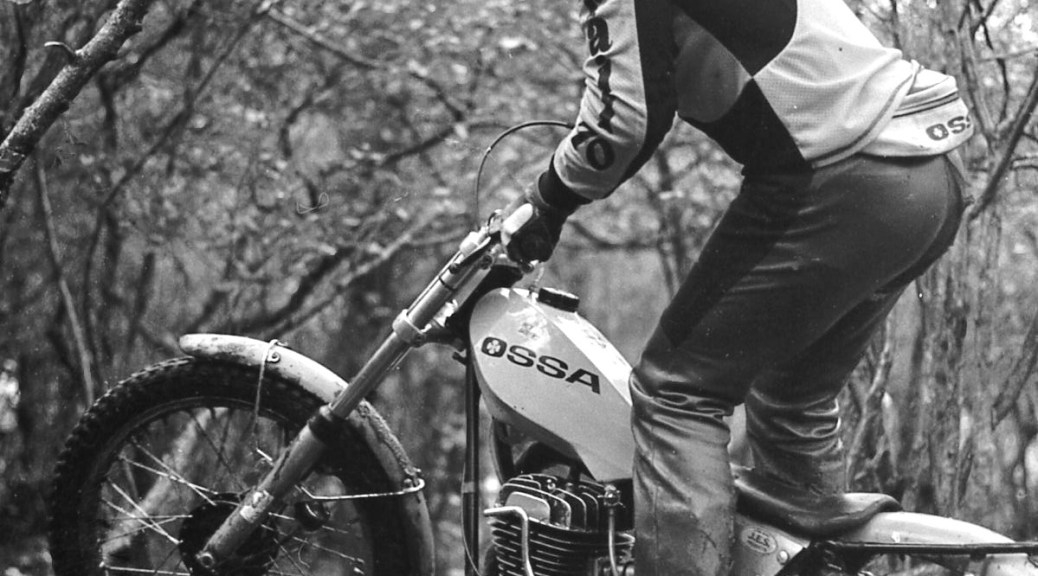
GR78005 – Close up of the unique monocoque Bultaco with the top tube acting as a fuel tank – Photo: Mike Rapley
Ahead of it’s time, we are carried back to 1978 when photo-journalist Mike Rapley snapped this unique monocoque framed 325cc Bultaco at the Welsh Trophy Trial.
The top frame tube carrying fuel it bears a strange resemblance to machines we use today.
WT78032 – The modified 325 Bultaco with special frame and top frame tube as fuel tank – Photo: Mike Rapley
Unfortunately, Mike Rapley could not recall who built it, who rode it or if it still exists, but we do know someone that would like to own it! Then, thanks to a Trials Guru reader, we discovered that the owner/creator was from Kiddermister, England, called Phill Smith.
GR78004 – Phill Smith on his very unusual Bultaco – Photo: Mike Rapley
Have a look at the detail shot and judge for yourself! It was a forward thinking concept using the tried and tested 325cc Bultaco motor, plus some Bultaco components, such as the front end and wheels.
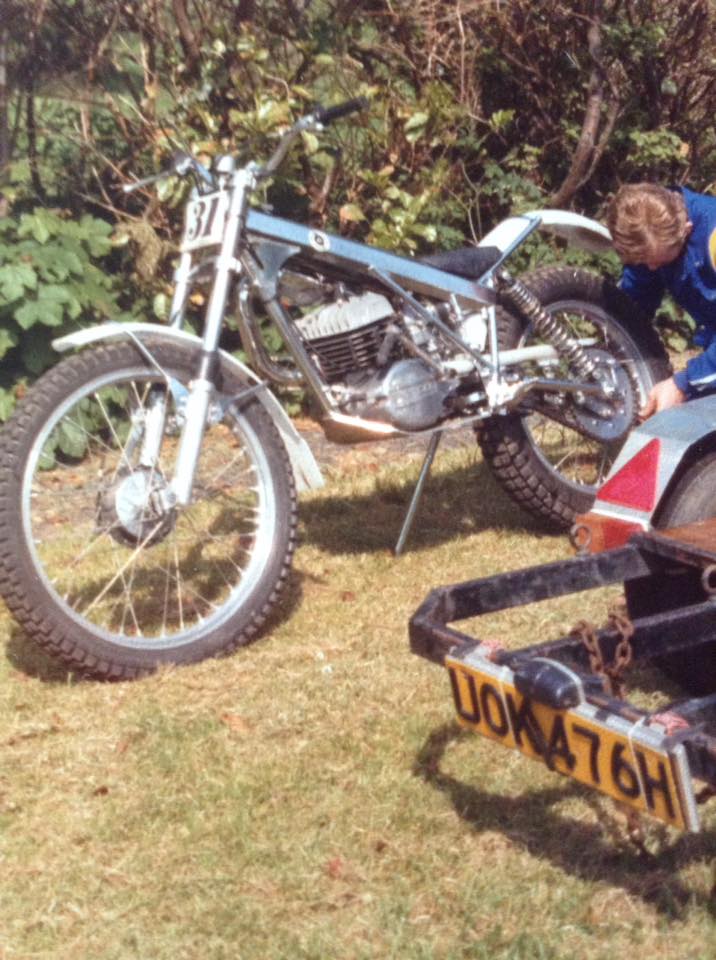
A colour photograph of the same machine, with owner, Phill Smith checking tyre prssures at a National Trial at Lynton, North Devon, but showing that the rear frame loop had been abbreviated and the exhaust front pipe modified. Photo courtesy: Stephen Hopkins.
All photos copyright: Mike Rapley & Stephen Hopkins
For more Welsh Trophy and other action from Mike Rapley, click HERE
To contact Trials Guru with information about this Bultaco special, make contact HERE
Mick Bradley wrote: 06/03/2016: “RE unusual Bultaco. Phill Smith from Kidderminster built and rode a very similiar Bulto to this around that time. Not sure if this is him but looks very much like it. Regards Mick”.
Apart from ‘Fair Dealing’ for the purpose of private study, research, criticism or review as permitted under the Copyright, Design and Patents Act, 1988, no part of this article may be copied, reproduced, stored in any form of retrieval system, electronic or otherwise or transmitted in any form or by any means, electronic, electrical, mechanical, optical, chemical, photocopying, recording or otherwise without the prior written permission of the author as stated above. This article is not being published for any monetary reward or monetisation, be that online or in print.













![image4[1]](https://trialsguru.net/wp-content/uploads/2016/01/image411.jpg?w=474)


 TRIALS GURU - DEDICATED TO TRIAL